EFFICIENT METHODS FOR RESOURCE ALLOCATION IN MULTI-ANTENNA ORTHOGONAL FREQUENCY-DIVISION MULTIPLE ACCESS (OFDMA) SYSTEMS
DIEGO ENRIQUE PEREA
D´EPARTEMENT DE G ´ENIE ´ELECTRIQUE ´
ECOLE POLYTECHNIQUE DE MONTR´EAL
TH`ESE PR ´ESENT´EE EN VUE DE L’OBTENTION DU DIPL ˆOME DE PHILOSOPHIÆ DOCTOR
(G´ENIE ´ELECTRIQUE) F´EVRIER 2013
c
´
ECOLE POLYTECHNIQUE DE MONTR´EAL
Cette th`ese intitul´ee :
EFFICIENT METHODS FOR RESOURCE ALLOCATION IN MULTI-ANTENNA ORTHOGONAL FREQUENCY-DIVISION MULTIPLE ACCESS (OFDMA) SYSTEMS
pr´esent´ee par : PEREA Diego Enrique
en vue de l’obtention du diplˆome de : Philosophiæ Doctor a ´et´e dˆument accept´ee par le jury d’examen constitu´e de : Mme SANS `O Brunilde, Ph.D., pr´esidente
M. FRIGON Jean-Fran¸cois, Ph.D., membre et directeur de recherche M. GIRARD Andr´e, Ph.D., membre et codirecteur de recherche M. NERGUIZIAN Chah´e, Ph.D., membre
La pluma es la lengua del alma ; cuales fueren los conceptos que en ella se engendraren, tales ser´an sus escritos.
The pen is the tongue of the soul ; as are the thoughts engendered there, so will be the things written.
Miguel de Cervantes Saavedra (1547-1616).
ACKNOWLEDGEMENTS
As I come to the end of my Ph.D. program, I would like to extend my gratitude to those people whose positive influence, both personal and academic, have helped me during these last five years in Montr´eal. I have had the good fortune of having two great research supervisors. Dr. Jean-Fran¸cois Frigon supported me during all the stages of my research, both with his knowledge of telecommunications and through his natural disposition to help. Dr. Andr´e Girard helped me start navigating the field of optimization in telecommunication networks, and to correctly formulate problems and find solutions. By sharing their knowledge and enthusiasm for research, they gave me the motivation and persistence needed to finish my studies ; their support and influence are reflected in this thesis. I also benefited from my association with some very talented graduate students and friends, Vida Vakilian, Ali Torabi and Xavier Kuhn. I would also like to thank the people who read and recommended text modifications to this thesis, my supervisors, fellow graduate students, and my very good friends, Carlos Cadena and Kimberly Nash.
But my educational journey and passion for research and school would not have started without the support of my parents, to whom this thesis is dedicated. They always encouraged me to play, create and study, and despite adverse circumstances shared my dreams. I also warmly remember several teachers from my elementary and secondary schools in Colombia, who inspired my love of learning, which I, in turn, now hope to pass on to my son, Diego Eduardo. Finally, from my engineering school years, my friends, Ivan Ladino and Rafael Adames, together with professors, Dr. Pedro Vizcaya and Dr. Edgar Ramos, likewise played an important role in my nascent career.
R´ESUM´E
Dans cette th`ese, nous proposons une solution au probl`eme d’allocation de ressources d’un syst`eme MISO (Multiple Input Multiple Output)-OFDMA (Orthogonal Frequency Division Multiplexing Access) supportant des usagers requ´erant un d´ebit de transmission minimal. Ce probl`eme peut ˆetre mod´elis´e comme une optimisation non-lin´eaire mixte avec variables enti`eres. Nous nous sommes int´eress´es dans cette th`ese `a diverses m´ethodes permettant la r´esolution d’un tel probl`eme.
La premi`ere approche ´etudi´ee utilise une m´ethode hors-ligne et permet d’obtenir une so-lution quasi-optimale qui peut ˆetre utilis´ee comme r´ef´erences pour ´evaluer la performance d’algorithmes heuristiques pouvant ˆetre r´ealis´es en temps r´eel. Pour ce faire, nous cherchons une allocation r´ealisable en se basant sur la solution optimale du probl`eme dual. Nous obte-nons la fonction duale et trouvons la solution `a l’aide d’un algorithme it´eratif `a sous-gradient. Cette solution permet d’otenir une borne sup´erieure `a la solution optimale. D’autre part, nous d´eveloppons une heuristique bas´ee sur la solution du probl`eme dual pour obtenir une solution r´ealisable du probl`eme primaire qui constitue une borne inf´erieure `a la solution optimale. Ces bornes nous permettent d’´etablir que l’´ecart de dualit´e est petit pour les configurations ´ etu-di´ees et elles peuvent servir de r´ef´erence pour l’´evaluation de performances des algorithmes heuristiques. La formulation duale nous fournit aussi une meilleure compr´ehension du sujet en ´etablissant un lien entre la r´ealisabilit´e de l’allocation de ressources et les d´ebits minimaux requis par les usagers.
Afin d’obtenir des m´ethodes de r´esolution plus pratiques pouvant ˆetre r´ealis´ees en temps r´eel, nous proposons deux heuristiques ayant une faible complexit´e et permettant d’atteindre des performances assez pr`es des performances optimales. Les performances ainsi obtenues sont l´eg`erement moins bonnes que celles d’autres algorithmes qu’on retrouve dans la litt´ era-ture, mais supportent une plus grande plage de valeurs de d´ebit minimal tout en r´eduisant la complexit´e de l’algorithme d’allocation de ressources de plusieurs ordres de grandeur. L’´ecart entre la solution trouv´ee par ces algorithmes heuristiques et la borne sup´erieure duale est relativement faible. Par exemple, l’´ecart est de 10.7% en moyenne pour toutes les configura-tions ´etudi´ees. L’augmentation dans la plage de d´ebits minimaux support´es compar´es avec les m´ethodes disponibles dans la litt´erature est de 14.6% en moyenne. Cette am´elioration est obtenue en consid´erant les variables duals de contrainte de d´ebits minimaux dans l’allo-cation de puissance aux usagers. L’algorithme heuristique propos´e s´electionne un ensemble d’usagers pour chaque sous-porteuse, mais contrairement aux autres m´ethodes propos´ees pr´ec´edemment, l’algorithme consid`ere l’ensemble des usagers avec des contraintes de d´ebits
minimaux dans la r´eassignation des sous-porteuses pour s’assurer que le niveau de service requis est rencontr´e. Suite `a la s´election des ensembles d’usagers, un probl`eme d’allocation de puissance convexe est r´esolu. Des algorithmes permettant de r´esoudre efficacement et en un temps moindre les probl`emes d’assignation des sous-porteuses aux usagers et d’allocation de puissance sont propos´ees dans cette th`ese.
Finalement, nous ´etudions aussi de quelle fa¸con ces algorithmes peuvent ˆetre utilis´es pour r´esoudre le probl`eme d’allocation de ressources dans une cellule utilisant la t´echnologie LTE (Long Term Evolution)-Advanced. Les m´ethodes ´etudi´ees dans cette th`ese font partie d’un nouvel ensemble d’algorithmes n´ecessaires pour supporter des applications temps r´eel `a haut d´ebit et `a l’efficacit´e spectrale requise dans les prochains r´eseaux d’acc`es sans-fil de quatri`eme g´en´eration.
ABSTRACT
In this dissertation, we solve the Resource Allocation (RA) problem of a Multiple Input Single Output (MISO)– Orthogonal Frequency Division Multiplexing Access (OFDMA) sys-tem supporting minimum rates. This problem can be modelled as a non-linear Mixed Integer Program (NLMIP). We are interested in various kinds of methods to solve this problem.
First, our focus is on an off-line method that gives near-optimal solutions that serve as benchmark for more practical methods. For this purpose, we propose a method based on the optimal solution of the dual problem. We obtain a dual function and solve the dual problem through subgradient iterations. Then, we find upper and lower bounds for the optimal solution and verify that the duality gap is small for the system configurations studied. Therefore, the dual optimal serves as a reference for any feasible solution produced by the heuristic methods. The dual formulation also gives a better insight into the problem, as it shows us the relation between the problem’s feasibility and the minimum rate requirements. To obtain more practical methods, we propose two heuristics that have very low com-putational complexity and give performances not far from the optimal. We compare their performance against other methods proposed in the literature and find that they give a somewhat lower performance, but support a wider range of minimum rates while reducing the computational complexity of the algorithm by several orders of magnitude. The gap be-tween the objective achieved by the heuristics and the upper bound given by the dual optimal is not large. For example, in our experiments this gap is 10.7% averaging over all performed numerical evaluations for all system configurations. The increase in the range of the sup-ported minimum rates when compared with the method resup-ported in the literature is 14.6% on average. This increase is achieved by considering the rate constraint dual variables in the user power allocation stage. The proposed heuristics select a set of users for each subcarrier, but contrary to other reported methods used to solve the throughput maximization problem, they consider the set of real-time (RT) users to ensure that their minimum rate requirements are met. Then, they solve a power allocation problem for fix subcarrier assignment, which is a convex problem that is simpler to solve. We use efficient algorithms for the subcarrier assignment and power allocation stages to solve the problem much quicker.
Finally, we adapt the algorithms to solve the RA problem in a single cell using LTE (Long Term Evolution)–Advanced technology. The methods examined in this dissertation are part of the new set of algorithms needed to support the high rate applications and spectral efficiency required in the wireless access of upcoming 4G networks.
TABLE OF CONTENTS
D´EDICACE . . . iii
ACKNOWLEDGEMENTS . . . iv
R´ESUM´E . . . v
ABSTRACT . . . vii
TABLE OF CONTENTS . . . viii
LIST OF TABLES . . . xi
LIST OF FIGURES . . . xii
LIST OF ACRONYMS . . . xiv
MATHEMATICAL CONVENTION . . . xvi
CHAPTER 1 INTRODUCTION . . . 1
1.1 Communications System to Optimize . . . 2
1.2 Thesis Objectives . . . 3
1.3 State of the Art . . . 4
1.3.1 Early Research Work on SISO-OFDMA Systems . . . 4
1.3.2 Work on MISO-OFDMA Systems . . . 5
1.3.3 Extension to Multi-cell MISO-OFDMA Systems . . . 7
1.4 Thesis Contribution . . . 8
1.5 Thesis Organization . . . 9
CHAPTER 2 PROBLEM FORMULATION AND SOLUTION METHODS . . . 10
2.1 Introduction . . . 10
2.2 System Description . . . 11
2.2.1 Signal Model . . . 11
2.3 General Beamforming Problem . . . 13
2.3.1 Problem Formulation . . . 13
2.3.2 Non Convexity of the General Beamforming Problem . . . 16
2.4 Zero Forcing Constrained Problem Formulation . . . 18
2.4.1 Structure of Subproblem for Fixed α and Direct Method . . . 20
2.4.2 Dual Lagrange Method . . . 22
2.4.3 Advantages of the ZF-constrained Over the General Beamforming Pro-blem Formulation . . . 24
2.5 Chapter Conclusion . . . 25
CHAPTER 3 DUAL-BASED BOUNDS . . . 27
3.1 Introduction . . . 27
3.2 Dual-Based Solution Method . . . 28
3.2.1 Subchannel Subproblem . . . 29
3.2.2 SDMA Subproblem . . . 30
3.2.3 Approximate Solution to the Beamforming Problem . . . 31
3.2.4 Solving the Dual Problem . . . 32
3.2.5 Analysis of the Dual Function . . . 33
3.2.6 Dual-Based Primal Feasible Method . . . 37
3.3 Performance Analysis . . . 39
3.3.1 Convergence of the Dual Algorithm . . . 39
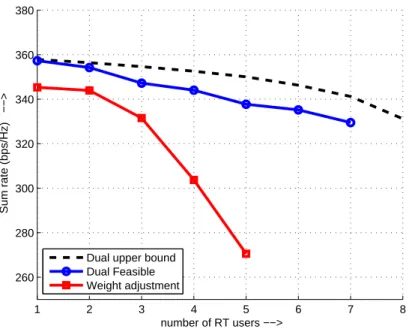
3.3.2 Weight Adjustment Heuristic . . . 39
3.3.3 Parameter Setup and Methodology . . . 41
3.3.4 Single User, Increasing Minimum Rate . . . 42
3.3.5 Single User, Increasing Attenuation . . . 44
3.3.6 Increasing Number of RT Users . . . 44
3.4 Chapter Conclusion . . . 46
CHAPTER 4 EFFICIENT HEURISTIC METHODS . . . 48
4.1 Introduction . . . 48
4.1.1 General Description of the Proposed Heuristic Method . . . 49
4.1.2 Chapter Description . . . 51
4.1.3 Chapter Contribution . . . 52
4.2 Power Allocation for Fixed Subcarrier Assignment . . . 52
4.2.1 Optimal Power Allocation . . . 54
4.2.2 Efficient Power Allocation . . . 55
4.2.3 Maximum Throughput Power Allocation . . . 56
4.2.4 Rate-constrained Power Allocation . . . 61
4.2.5 Heuristic vs. Optimal Results . . . 64
4.3.1 Maximum Throughput Subcarrier Assignment . . . 68
4.3.2 Papoutsis Rate Constrained Subcarrier Reassignment . . . 76
4.3.3 Proposed Subcarrier Reassignment Heuristic . . . 76
4.4 Reduced Complexity Algorithm . . . 78
4.5 Performance Comparison . . . 81
4.6 CPU Time . . . 84
4.7 Chapter Conclusion . . . 86
CHAPTER 5 APPLICATION TO LTE-ADVANCED SYSTEMS . . . 89
5.1 Introduction . . . 89
5.1.1 LTE General Architecture . . . 90
5.1.2 The eNB functions and the role of RA algorithms . . . 91
5.1.3 Chapter Objective . . . 93
5.2 Downlink Transmission Mechanisms in LTE-Advanced . . . 93
5.3 Parameters Correspondence with LTE-Advanced Systems . . . 95
5.3.1 LTE system problem parameters . . . 95
5.3.2 Scheduling Parameters . . . 97
5.3.3 Mapping Algorithms 9 and 10 Output to LTE Parameters . . . 98
5.3.4 RA Results Using LTE Parameters . . . 98
5.4 CSI Feedback in LTE-Advanced Systems . . . 99
5.4.1 Codebook-based Precoding . . . 100
5.4.2 Explicit CSI Feedback Assumption . . . 100
5.4.3 Non Codebook-based Precoding . . . 101
5.5 Chapter Conclusion . . . 102
CHAPTER 6 CONCLUSION . . . 104
6.1 Future Work . . . 105
6.1.1 CSI Feedback Aspect . . . 105
6.1.2 Multi-cell Interference Extension . . . 106
6.1.3 Muti-frame Problem Extension . . . 106
LIST OF TABLES
Table 2.1 Examples of utility functions . . . 14
Table 2.2 Examples of rate constraint functions . . . 14
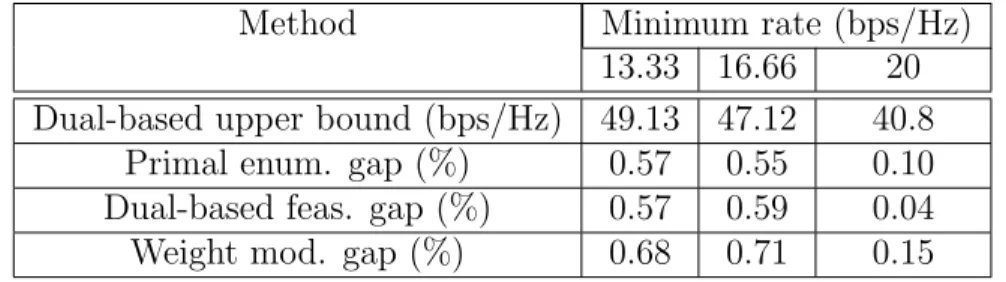
Table 3.1 Average performance gap against the dual optimal upper bound . . . . 42
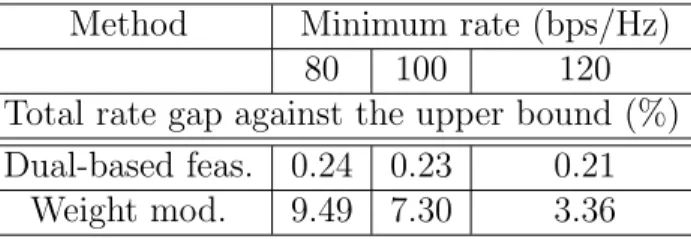
Table 3.2 Average total rate gap as a function minimum rate requirement . . . . 43
Table 3.3 Average total rate gap as a function of RT user large-scale channel attenuation . . . 44
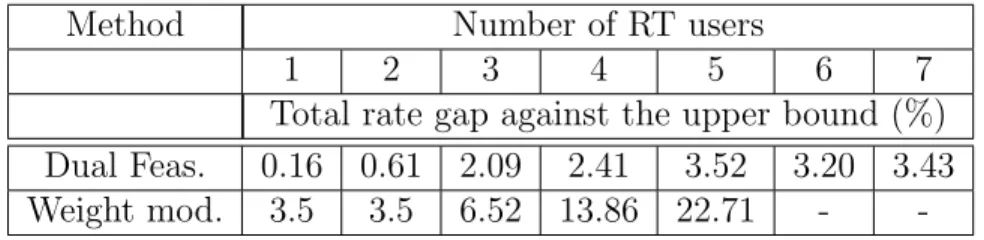
Table 3.4 Average total rate gap as a function of the number of RT users . . . . 45
Table 4.1 Parameters used for the golden section method . . . 60
Table 4.2 Parameters for Figures 4.5 and 4.7 . . . 64
Table 4.3 Maximum Throughput ZF User selection algorithms complexity . . . . 73
Table 4.4 Parameters for Figure 4.8 . . . 74
Table 4.5 Algorithms complexity . . . 79
Table 4.6 Average measurements for variable D . . . 83
Table 4.7 Average measurements for variable K . . . 84
Table 5.1 LTE-Advanced Transmission modes . . . 94
Table 5.2 LTE-Advanced bandwidth and number of resource blocks . . . 96
Table 5.3 LTE system problem parameters . . . 97
LIST OF FIGURES
Figure 2.1 System Diagram . . . 11
Figure 2.2 Example of local maxima found . . . 17
Figure 2.3 Beamforming vectors support of ZF constrained prob. for SDMA set with 2 users, K = 2, M = 2, N = 1, h1 = (2, 1), h2 = (1, 2) . . . 21
Figure 3.1 Contours of Dual Function, Single RT User. Parameters N = 8, K = 8, M = 3, ˇP = 20, ˇd1 = 50 bps/Hz . . . 35
Figure 3.2 Dual Functions for Different Rate Constraints, λ = 1.83 . . . 36
Figure 3.3 Dual Function vs. λ, µ = 0.24 . . . 37
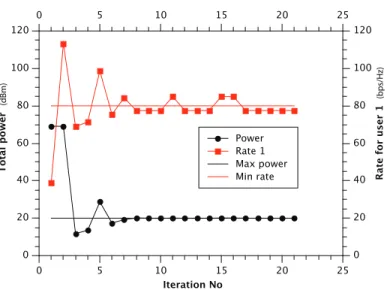
Figure 3.4 Dual function and multipliers for M = 3, K = 16, N = 16, ˇP = 20, D = 1 and ˇd1 =80 bps/Hz. . . 40
Figure 3.5 Power and rate constraints for M = 3, K = 16, N = 16, ˇP = 20 dBm, D = 1 and ˇd1 =80 bps/Hz. . . 40
Figure 3.6 Average total rate as a function of the minimum rate requirements . . 43
Figure 3.7 Average total rate as a function of RT user large-scale channel atte-nuation. . . 45
Figure 3.8 Average total rate as a function of the number of RT users. . . 46
Figure 4.1 Heuristic general algorithm . . . 50
Figure 4.2 Water-filling power sum curves . . . 57
Figure 4.3 Algorithm 4 and golden section method CPU comparison . . . 60
Figure 4.4 Algorithm 4 and golden section method CPU comparison . . . 60
Figure 4.5 Optimal and heuristic power allocation comparison . . . 65
Figure 4.6 Optimal and heuristic power allocation comparison for different values of ϵ . . . 66
Figure 4.7 Dual function of power allocation problem . . . 67
Figure 4.8 Maximum Throughput Optimal and heuristic methods comparison . . 74
Figure 4.9 Optimal and heuristic methods comparison . . . 82
Figure 4.10 Elapsed time of proposed algorithms vs. N for K=16 . . . 86
Figure 4.11 Elapsed time of proposed algorithms vs. N for K=32 . . . 87
Figure 4.12 Elapsed time of proposed algorithms vs. N for K=64 . . . 87
Figure 4.13 Elapsed time of proposed algorithms vs. for K=32, D=16 . . . 88
Figure 5.1 LTE General Architecture . . . 90
Figure 5.2 LTE Protocol stack . . . 91
Figure 5.4 Algorithms performance vs. the number of RT users . . . 99 Figure 5.5 Elapsed time vs. the number of RT users . . . 100
LIST OF ACRONYMS
AMPL A Modelling Language for Mathematical Programming BB Branch and Bound
BER Bit Error Rate BS Base Station
CBP Codebook Based Precoding CPU Central Processing Unit CQI Channel Quality Indicator CSI Channel State Information DMRS Demodulation Reference Signal
IEEE Institute of Electrical and Electronic Engineers IP Internet Protocol
LTE Long Term Evolution MAC Media Access Control MIP Mixed Integer Program
MIMO Multiple Input Multiple Output MISO Multiple Input Single Output MMSE Minimum Mean Squared Error
MU Multi-User
NLP Non Linear Program
NLMIP Non Linear Mixed Integer Program NP Non-deterministic Polynomial time nRT non Real Time
OFDMA Orthogonal Frequency Division Multiplexing Access PA Power Allocation
PDCP Packet Data Converge Protocol PHY Physical layer
PMI Precoding Matrix Indicator
QAM Quadrature Amplitude Modulation QoS Quality of Service
QPSK Quadrature Phase Shift Keying 4G Fourth Generation
RA Resource Allocation RB Resource Block
RE Resource Element RLC Radio Link Control RRC Radio Resource Control
RT Real Time
SDMA Spatial Division Multiple Access SISO Single Input Single Output SNR Signal to Noise Ratio SU Single-User
UMTS Universal Mobile Telecommunications System ZF Zero Forcing
MATHEMATICAL CONVENTION
A Matrix
AT Matrix transpose
AH Matrix Hermitian
A† Matrix pseudoinverse
I Identity matrix of compatible dimensions pi,j Element i, j of matrix P
qk Element k of vector q
[A]j,j Matrix diagonal element b, µ Vectors ∥b∥ Vector norm x, U, θ, Θ Scalars |x| Absolute value [x]+ = max{0, x} S Sets
S(x) Elements of set S are a function of x |S| Cardinality of set S
RK Real numbers set of K dimension
R+ Set of non-negative real numbers
C Complex numbers set
CHAPTER 1
INTRODUCTION
In today’s world we use telecommunication networks in most of our daily activities. For example, we receive or make phone calls, and send or receive instant messages or e-mails for our work, school and social affairs. The vision for fourth generation (4G) networks is that people and applications will communicate with each other through appropriate networks, fixed or mobile, with greater ease. However, with the ubiquitous use of smart phones, tablets, laptops and real-time (RT) applications, traffic demand on the wireless access network is increasing exponentially [1]. Therefore, there is a real need to create the infrastructure that supports traffic with higher rates and strict time deadlines.
Due to bandwidth scarcity, as the number of users per cell increases and user applica-tions require higher rates, it becomes critical to augment the system spectral efficiency, i.e., the achieved bit rate per unit of bandwidth. Resource allocation (RA) mechanisms that handle different types of traffic and adapts to the channel conditions would best use system resources. Both an increase in spectral efficiency and intelligent radio resource allocation are key enabling factors of the implementation of 4G wireless networks.
To increase spectral efficiency, we can use systems with multiple antennas. For example, consider a single user multiple input multiple output (MIMO) system with M antennas at the transmitter and M antennas at the receiver. In this configuration, the channel capacity increases approximately linearly when Rayleigh fading is considered [2]. Multi-user diver-sity, on the other hand, can take advantage of the channel fluctuations by selecting users with good channel conditions at every time interval. In this case the capacity growth as a function of the number of users is logarithmic. Frequency diversity can be attained by us-ing orthogonal frequency division multiplexus-ing access (OFDMA), where codus-ing is performed over independently faded subcarriers. Combining these techniques in a multi-user MIMO-OFDMA system would provide us with multi-user, spatial and frequency diversity, which give us a high spectral efficiency. These systems are proposed in current 4G standards, Long Term Evolution (LTE) and IEEE 802.16 [3, 4].
There is, however, a price to pay. Multi-antenna systems require more hardware and software resources to process the multiple spatial layers. In addition, by increasing the degrees of freedom in the system for transmission, the RA process becomes more complex because we have more possibilities from which to choose. As an example of the increase in computational complexity in the RA process, consider the method we use in chapter 2 to obtain a dual
optimal solution to the resource allocation problem for a system with M transmit antennas, N subchannels and K single antenna users. The computational complexity of the RA algorithm is O(N KMM3), which grows exponentially with the number of antennas, whereas in the single
antenna case there is only one possible signal path from the transmitter to each receiver so the computational complexity is linear with the number of subchannels and users, O(N K) [5]. This shows that increasing the number of spatial channels, users and subcarriers, increases the spectral efficiency, but it also greatly increases the computational complexity of the RA process. The problem we deal with in this dissertation is a common one in practical applications of optimization theory: how to devise RA algorithms that provide us with solutions not too far from the optimal and that are efficient to compute. In addition, how to obtain a near optimal solution to RA problems using off-line methods to benchmark the devised efficient methods. These two general questions, applied to the RA problem in a Multiple Input Single Output (MISO)-OFDMA system supporting minimum rates, are the subject of this dissertation.
The methods discussed in this dissertation try to answer these questions. More specifically, the set of algorithms proposed are part of the RA algorithms needed to support the high rate applications and spectral efficiency required in the wireless access of upcoming 4G networks.
1.1 Communications System to Optimize
We consider in this dissertation a MISO-OFDMA system in a single cell of a cellular network. This system provides frequency diversity by dividing the available spectrum into a number of subchannels and using OFDMA access techniques. Spatial diversity is achieved by placing multiple antennas at the BS spaced far enough so that the multiple paths from the antennas to each receiver are uncorrelated. We do not consider a general MIMO system where multiple antennas are placed at transmitter and receivers because multiple receive antennas are very complex to implement in small devices. Thus, we consider a scenario that is likely to be implemented in the short term.
We only take into account transmission in the downlink direction where spatial diversity is achieved by performing SDMA beamforming [28]. We restrict ourselves to linear beamforming where the vector of symbols to transmit is simply multiplied by a beamforming matrix. The main reason to select this beamforming technique is that it is supported by the current wireless access technologies IEEE 802.16 and LTE-Advanced. In the general beamforming problem described in in chapter 2, the user selection and the beamforming vectors are the variables to optimize. On the other hand, the objective to maximize is the weighted sum of the users rate. This is in contrast with more general utility functions found in the literature
[6]; we use this linear function because a closed-form of the dual function can be found in this case, which is the basis of the proposed method. The user weights can be adjusted from frame to frame, thus fairness among users can be implemented in the system. Strict QoS control is implemented by selecting a number of users at each frame for which hard minimum rate constraints are enforced. Therefore, real-time (RT) QoS is supported for the selected RT users.
For this system, we solve the following optimization problem: for a given time slot, find the user selection and beamforming vectors that maximize a linear utility function of the user rates, given a total transmit power constraint and minimum rate constraints for RT users. A total power constraint is chosen instead of more practical per-antenna power constraints to ease the analysis.
1.2 Thesis Objectives
In the research of methods to solve the RA problem for MISO-OFDMA systems sup-porting minimum rates, we are interested in solutions with several degrees of accuracy and computational complexity. Due to the combinatorial nature of the problem it is almost impos-sible to obtain optimal solutions for realistic problem sizes. Thus, we are initially interested in near-optimal solution methods that can be executed off-line and serve as references for more efficient on-line methods. It is important to evaluate the accuracy of these near-optimal solutions by finding limits on the difference between the optimal and near-optimal points. In addition, in optimization theory the problem formulation influences the complexity of the solution method and the set of techniques one has available. Therefore, the first two objec-tives of this dissertation are to find an adequate formulation to the problem and to devise and evaluate an off-line near-optimal solution method to solve it.
The subsequent objectives look at the design of RA algorithms that can be implemented in real-time systems. The third objective is the design of heuristic algorithms that are computationally efficient and that produce sub-optimal feasible points. In this case, it is also important to evaluate how far these points are from optimality. The fourth objective is to study the applicability of the proposed algorithms in current 4G wireless access technologies. We choose LTE-Advanced technology [3] to perform this study because of the expected prevalence in the industry in the upcoming years.
In summary, the objectives of this dissertation are to
1. Formulate an optimization problem for the allocation of physical layer resources in a MISO-OFDMA system considering RT and non Real-Time (nRT) traffic, where RT users have minimum rate requirements.
2. Devise an off-line solution method to solve the problem with near optimality and eval-uate the accuracy of the solutions.
3. Devise heuristic methods to solve the problem efficiently, and to evaluate their accuracy and computational complexity against the off-line method and other methods proposed in the literature.
4. Study the application of the proposed heuristic methods to the current LTE-Advanced technology used in 4G wireless access networks.
1.3 State of the Art
We first discuss in subsection 1.3.1 the most important papers for SISO-OFDMA systems. These papers contain the optimization principles later used in the more sophisticated MISO-OFDMA systems presented in subsection 1.3.2. In subsection 1.3.3, we review extensions to the MISO-OFDMA RA problem where multiple cells are considered.
1.3.1 Early Research Work on SISO-OFDMA Systems
In one of the first reported papers [7], the total transmitted power is minimized under user rate constraints. The problem is formulated as a Mixed Integer Program (MIP) where the user rates are modelled as a continuously increasing function of the power, and the subcarrier assignment variable is binary. The integer constraint is relaxed and an stationary point of the dual Lagrange function is obtained to perform subcarrier assignment and power allocation. This solution point is not necessarily primal feasible. Therefore, a simple heuristic is used to find a primal feasible point from the dual optimal. Kim et al. [8] formulated the same problem as a MIP, but solve it using a Linear Program (LP) relaxation. The linear program is less computationally expensive that the original but it is still unmanageable. Therefore, the authors devised a suboptimal heuristic where subcarrier allocation and power assignment are performed separately. Their solution is close to the optimal.
In [6], a general utility function of the rates is maximized under a total power constraint. The utility function is assumed continuous and concave. The purpose of this function is to balance the trade-off between spectral efficiency and fairness. First, the transmission power is assumed uniformly distributed over the entire available frequency band. The optimal subcarrier assignment is found for the constant power case. Later, for the fixed subcarrier assignment case the resulting optimal power is found to have the water-filling form. An optimal condition is derived by performing iteratively constant-power subcarrier assignment and water-filling power allocation. In [9], more efficient algorithms are proposed to solve the problem suboptimally.
Other way to model fairness is by enforcing a proportionality among the user rates. In [10], a set of proportional fairness constraints is imposed to assure that each user can achieve a portion of the total sum rate. Since the optimal solution to the constrained fairness problem is extremely computationally complex to obtain, a low-complexity suboptimal algorithm that separates subchannel allocation and power allocation is proposed. In the proposed algorithm, subchannel allocation is first performed by assuming an equal power distribution. An optimal power allocation algorithm then maximizes the sum rate while maintaining proportional fairness. The proposed algorithm reduces the complexity from exponential to linear in the number of subcarriers.
Several of these early papers use the dual Lagrange approach to solve the RA problem for SISO-OFDMA systems, but the optimality of the solutions is not justified mathematically. However, the intuition behind the dual Lagrange approach and the results obtained favor this method. Proof of optimality was more recently provided by later work such as [5] for the ergodic capacity case.
1.3.2 Work on MISO-OFDMA Systems
For the MISO-OFDMA system the RA problem we want to solve is a nonlinear, non-convex integer program, which makes it almost impossible to solve directly for any realistic number of subcarriers, users and antennas. For this reason, most research work focuses on developing heuristic algorithms. In this context, an important question is always how accurate are the results, i.e., how close to the optimum the objectives are. For an RA problem with rate constraints, it turns out that there are very few results of that kind, as we shall see.
Traffic in the system can be divided into two main groups: delay-sensitive RT services and delay-insensitive nRT services. Early work on OFDMA systems focuses on solving the RA problem for nRT services only, where the objective is to maximize the total throughput with only power constraints and possibly minimum Bit Error Rate (BER) constraints. In [11], the complete optimization problem is divided into two sub-problems: selection of users for each carrier and allocation of power to these users, which are both solved by a heuristic. A similar approach using Zero Forcing (ZF) beamforming is reported in [12]. The work of [11, 12] does not solve the complete optimization problem; instead, it separates it into uncoupled subproblems that provide suboptimal solutions.
There is a definite need to benchmark the performance of these heuristic algorithms. For the RA problem with nRT traffic only, several methods have been proposed to compute near-optimal solutions. For example, genetic algorithms are proposed in [13] while [14, 15, 16, 17] provide methods to compute a near-optimal solution based on dual decomposition. In addition to providing a benchmark, near-optimal algorithms can also lead to the design
of efficient RA methods as shown in [17], where heuristic algorithms derived from the dual decomposition method are proposed.
Several heuristic methods have been used to solve the RA problem for OFDMA-SDMA systems with both RT and nRT traffic. In [18], the objective is to maximize the sum of the user rates subject to per-user minimum rate constraints that model the priority assigned to each user at each frame. The optimization problem is solved approximately for each frame by minimizing a cost function representing the increase in power needed when increasing the number of users or the modulation order. The advantages of this approach are that it handles user scheduling and RA together and supports RT and nRT traffic. Its weaknesses are that no comparison is made against a near-optimal solution and the method used to determine user priorities at every frame is very complex.
In [19], both RT and nRT traffic are supported. Priorities are set according to the remaining deadline time for RT users and to the difference between the achieved rate and the desired rate required for nRT users. The user with the highest priority is paired with the subchannel with the highest vector norm and semi-orthogonal users are multiplexed on the same subchannel. Comparisons against the algorithm of [18] show that the packet drop rate for RT users is significantly reduced. The algorithm’s complexity is also reduced because of the semi-orthogonality criteria used to add users. However, as in [18], a performance comparison with a near-optimal solution is not provided.
In [20], the objective is to maximize a utility function without any hard minimum rate constraints for the RT users. The channel quality information is added to the utility function to favor users with good channel conditions and priorities are set by increasing user weights in the utility function. The advantage of this method is that the per-frame optimization problem has only a power constraint and no rate constraints, which makes it simpler to solve. The disadvantage with this reactive approach is that RT users with poor channel conditions are backlogged until their delay is close to the deadline, causing an increase in the average delay and jitter.
In [21], a heuristic algorithm is proposed for the sum rate maximization problem with proportional rates among the user data rates, i.e., the ratio among allocated user rates is predetermined. The criteria to form user groups includes semi-orthogonality as in [19], but also fairness through proportional rate constraints. This method is extended to include hard minimum rates in [22]. Again, there is no reported method to evaluate the accuracy of these heuristics, except by comparing them to each other.
Another approach is to maximize the sum rate subject to constraints on the average rate delivered to a user [23]. However, unlike the work presented in [24], where an optimal solu-tion is provided for the single antenna OFDMA RA problem with average rate constraints,
the algorithm presented in [23] is an approximation. Note also that with average rate con-straints, RT users tend to be served when they have good channel conditions which can create unwanted delay violations and jitter.
1.3.3 Extension to Multi-cell MISO-OFDMA Systems
The problem we formulate and solve in this dissertation considers only a single cell. We will not address the interference coming from other cells using the same channel bandwidth. Systems where the neighboring cells share the same channel bandwidth are important because spectrum re-use is necessary in dense areas. In addition, cell-edge users can greatly benefit from inter-cell interference reducing techniques. One avenue of future research is to extend the concepts and methods we develop in this dissertation to the multi-cell scenario; this scenario has been lately considered in [25], where a system with M′ cells is considered for a single transmit and receive antenna. The objective is to maximize the users weighted sum rate under a power constraint per BS. The variables to optimize are the users to subcarrier assignment and the users’ power allocation. The resulting problem is not convex and three methods are proposed to solve it. All three methods require that each user reports M′ channel gains per subcarrier to a central control unit that processes all the data and makes the subcarrier assignment and power allocation decisions. The numerical results reported provide similar sum rates for all three cases and outperform uncoordinated transmitting strategies. To limit the signaling overhead, a reduced-feedback implementation of these methods is investigated, where the scheduling decisions are made locally by the BS and only the power allocation problem is jointly solved. The sum rate achieved in this case is close to the full feedback case.
In [26], downlink coordinated transmission is considered in a multi-cell OFDM system, where the BSs have multiple antennas and the users have single antennas. This is a direct extension of the MISO-OFDM studied in this dissertation to the inter-cell interference coor-dinated case. Users are divided in two groups: users that receive data only from a serving BS and consider the interference coming from other BS as noise, and users that are served in a coordinated manner by multiple BSs. The objective is to maximize a monotonically increas-ing function of the users’ SNIR under linear power constraints. The optimization variables are the correlation matrices of the data symbol vectors along users and BSs, which model both the beamforming strategy and the user scheduling. Several properties of the optimal solution are derived to design heuristics that solve the problem efficiently. Two methods are proposed, one centralized algorithm and a distributed strategy. Numerical evaluations based on real channel measurements show that the solutions are close to the optimal and have
sig-nificant performance gains over single-cell processing schemes. The performance evaluation also shows that joint transmission is very sensitive to synchronization errors.
1.4 Thesis Contribution
None of the previous work listed in subsection 1.3.2 provides a near-optimal solution to the MISO-OFDMA RA problem with minimum rate requirements. This is important not only as a benchmark for any heuristic algorithms, but also to get a better insight into the problem and to help devise efficient real-time algorithms. We propose in this dissertation an off-line dual based method that provides a near-optimal solution to the problem.
In addition, we propose two efficient heuristic methods with much lower computational complexity than the methods proposed in the literature. The performance obtained with these heuristic method is within 10.7% of the optimal averaging over all performed numerical evaluations. They have lower computational complexity than the method proposed in [22]. The computational complexity reduction is several orders of magnitude depending on the algorithm used and the problem parameters. The proposed heuristic methods can also be adapted to be used in a LTE-Advanced system. To adapt these algorithms, however, we need to provide an explicit CSI feedback.
In summary, the main contributions of this dissertation are:
1. A dual formulation of the RA problem for a MISO-OFDMA system supporting mini-mum rate requirements, whose optimini-mum gives us an upper bound to all feasible solutions to the primal problem. The dual function also provides us with a better insight of the RA problem regarding the dependance of its feasibility respect to the minimum rate constraints. In addition, it guides us to the design of the heuristic algorithms.
2. An off-line method that provides a near-optimal solution to the problem. The feasible point obtained by this method and the upper bound are used to find limits on the duality gap.
3. A heuristic method to solve the problem with lower computational complexity than methods reported in the literature. This method also extends the support of the mini-mum rate requirements.
4. A second heuristic method to solve the problem with much lower computational com-plexity when the number of subcarriers is large. It uses per subchannel power con-straints instead of a total power constraint. As a drawback, this method supports lower minimum rates support than the heuristic method in item 3.
5. An efficient near-optimal power allocation heuristic method for the rate-constrained case. The method is used in this dissertation for an OFDM-SDMA system, but it can be used for power allocation problems in multicarrier SISO and MIMO systems. 6. A general procedure to adapt the proposed heuristic methods to the RA problem in
one cell using LTE-Advanced technology.
As results of our research efforts, contributions 1 and 2 resulted in paper [17] for the rate unconstrained problem and [27] for the rate constrained one. On the other hand, contributions 3 to 5 are part of a paper being prepared at the date of submission of this thesis.
1.5 Thesis Organization
This dissertation is divided into six chapters. This first chapter, the thesis introduction, provides a general overview of the problem and justifies the research topic.
In the second chapter, we mathematically formulate the problem we want to solve. We will see that this is a non-convex problem, which is in general difficult to solve. We list several approaches we can use to find a solution method, and we restrict ourselves to transmission in the downlink direction, i.e., from the Base Station (BS) to single antenna users, implementing Space Division Multiple Access (SDMA) and linear precoding.
In the third chapter, we choose the dual Lagrange method from the approaches listed in chapter 2, and propose an off-line method that provides an upper bound to the solution of the problem. Based on this dual solution, we propose a simple off-line heuristic algorithm to compute a feasible point. This point constitutes a lower bound to the optimal solution. Then, these bounds are used to limit the duality gap. We compare results using the upper bound, the proposed off-line method and a weight adjustment heuristic.
In the fourth chapter, we propose two heuristic methods to solve the problem more ef-ficiently. We compare their performance against the upper bound obtained in chapter 3 and against other methods proposed in the literature. The difference between the objective achieved by the heuristics and the upper bound is not large. In addition, the proposed heuris-tics have much lower computational complexity than the methods proposed in the literature. In chapter 5, we describe a general procedure to use the algorithms proposed in chapter 4 to solve the RA problem in a single cell using LTE-Advanced technology. The algorithm’s in-put and outin-put parameters are mapped to LTE-Advanced parameters, assuming that explicit Channel State Information (CSI) is available at the base station.
In the final chapter, we summarize the main findings and propose future work for research. These concluding remarks provide the thesis general conclusions. Detailed conclusions and discussions about the proposed algorithms and results are given at the end of each chapter.
CHAPTER 2
PROBLEM FORMULATION AND SOLUTION METHODS
2.1 Introduction
The main objective of this chapter is to formulate and analyze the problem we want to solve in the dissertation. We start by describing in section 2.2 the system under consideration and by defining a signal model to compute the user rates in terms of the physical layer parameters we want to optimize. We restrict the transmission strategy to linear precoding beamforming and consider the cases of beamforming with and without Zero Forcing (ZF) constraints. Linear precoding beamforming does not achieve the full channel capacity but it is widely used because of its simpler implementation [28].
In section 2.3, we formulate a general optimization problem without ZF constraints for an arbitrary utility function and arbitrary rate constraints and we study the benefits of this problem formulation. In this dissertation, we focus on linear utility functions and minimum rate constraints using ZF beamforming. However, we initially formulate a more general problem to illustrate that the problem in hand belongs to a wider category.
In section 2.4, we add ZF constraints to the problem formulation which results in a non-linear mixed integer program (NLMIP). We examine the structure of the resulting subproblem after fixing the binary variable and find that this can be approximated to a convex one. Thus, the ZF problem formulation presents us a structure that we can later use to design efficient heuristics.
Also in section 2.4, we present two approaches to solve the ZF-constrained problem. The first one — the direct method — is only practical for small problem sizes, but it is illustrative of the transformation of the original non-convex problem into smaller convex problems. The second approach is the dual Lagrange method, which we use in chapter 3 to solve the problem with near optimality. The dual Lagrange method has a much lower complexity, but its dual optimal differs from the primal optimal due to the problem’s non convexity. In section 2.4, we give a high level description of the dual method which is presented in detail in chapter 3. Along the chapter we provide an overview of other methods available to solve the problems and we illustrate the reasons behind the choice of the problem formulation and solution method we use. Finally, in section 2.5 we give the chapter conclusions.
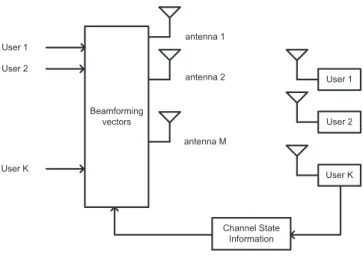
User 1 User 2 User K antenna 1 antenna 2 antenna M Channel State Information Beamforming vectors User 1 User 2 User K
Figure 2.1 System Diagram
2.2 System Description
We consider the resource allocation problem for the downlink transmission in a multi-carrier multi-user multiple input single output (MISO) system with a single base station (BS). There are K users, some of which have RT traffic with minimum rate requirements while the others have nRT traffic that can be served on a best-effort basis. The BS is equipped with M transmit antennas and each user has one receive antenna. Figure 2.1 shows the system diagram. The system’s available bandwidth Wo is divided into N subchannels
whose coherence bandwidth is assumed larger than Wo/N , thus each subchannel experiences flat fading and OFDMA is effectively used.
In this configuration, the BS can transmit data in the downlink direction to different users on each subcarrier by performing linear beamforming precoding. At each OFDM symbol, the BS can change the beamforming vector for each user on each subcarrier to maximize some performance function. We assume that we use a channel coding that reaches the channel capacity. The data rate are in units of bits per OFDM symbol, or equivalently bits per second per Hertz (bps/Hz).
2.2.1 Signal Model
First, we describe the model used to compute the bit rate received by each user. Define ˜
sk,n the symbol transmitted by the BS to user k on subcarrier n. We assume that the ˜sk,n
are independently identically distributed (i.i.d) random variables with ˜sk,n ∼ CN (0, 1).
wk,n an M -component column vector representing the beamforming vector for user k on
subcarrier n. Unless otherwise noted, we denote w the vector made up by the column stacking of the vectors wk,n.
xn an M -component column vector representing the signal sent by the array of M antennas
at the BS for each subcarrier n.
hk,n an M -component row vector representing the channel between the M antennas at the
BS and the receive antenna at user k for each subcarrier n.
zk,n the additive white gaussian noise at the receiver for user k on subcarrier n. The zk,n are
i.i.d. Gaussian random variables and, without loss of generality, we assume that they have unit variance, that is zk,n ∼ CN (0, 1).
yk,n the signal received by user k on subcarrier n.
r0
k,n the rate of user k on subcarrier n. We denote r∈ RK the column vector of all user rates
rk, where rk =
∑
nr 0 k,n.
The signal vector xn is built by a linear precoding scheme which is a linear transformation
of the information symbols ˜sk,n:
xn= K
∑
k=1
wk,n˜sk,n. (2.1)
The signal received by user k on subcarrier n is then given by yk,n = hk,nxn+ zk,n
= hk,nwk,ns˜k,n+
∑
k̸=j
hk,nwj,n˜sj,n+ zk,n. (2.2)
The second and third terms in the right side of (2.2) correspond to the interference and noise terms. Since the signals and noise are Gaussian, the interference plus noise term is also Gaussian and the data rate of user k for subcarrier n is given by the Shannon channel capacity for an additive white Gaussian noise channel [29]:
rk,n0 (w) = log2 ( 1 + |hk,nwk,n| 2 1 +∑k̸=j|hk,nwj,n|2 ) . (2.3)
In (2.3), beamforming vectors wk,n with high norms and aligned to the channel vector
hk,n, produce higher rates. In addition, if the other users’ beamforming vectors are
quasi-orthogonal to the channel vector hk,n, the inter-user interference in the denominator is low.
The beamforming vectors completely determine the user rates in (2.3). Therefore, they can be used as the problem optimization variables.
In the problem formulation section 2.3, we assume that we know the parameters listed below
Known problem parameters M Number of antennas at the BS. N Number of subcarriers available. K Number of users in the cell.
K Set of users in the cell: {1, . . . , K}. ˇ
dk Minimum rate requirement for user k. We denote by ˇd ∈ RK+ the vector made up of all
minimum rates ˇdk.
D A subset of K containing the users that have minimum rate requirements ˇdk > 0. We
define D = |D|. ˇ
P Total power available at the base station for transmitting over all channels.
ck Weight of the user rates in the objective function. These could be computed by the
scheduler to implement prioritization or fairness. We denote by c ∈ RK
+ the vector
made up of all weights ck.
hk,n the M -component row vector representing the channel between the M antennas at the
BS and the receive antenna at user k for each subcarrier n. We keep these definitions throughout the dissertation.
2.3 General Beamforming Problem 2.3.1 Problem Formulation
In general, the optimization problem consists of maximizing some utility function of the user rates. The user rates are determined by the beamforming vectors w through (2.3). The physical layer imposes constraints on these beamforming vectors. A common constraint is that the power sum of the beamforming vectors must be lower or equal than the total available power ˇP . Then, the problem power constraint is given by
N ∑ n=1 K ∑ k=1 ∥wk,n∥2− ˇP ≤ 0, (2.4)
i.e. the sum of the square norms of all beamforming vectors for all subcarriers must be lower or equal than the total power constraint ˇP .
The utility maximization problem consists of maximizing an utility function u of the rates under certain rate constraints g over the set of power feasible beamforming vectors.
max
Table 2.1 Examples of utility functions
Weighted sum rate cTr
Maximum fairness minkrk
Proportional fairness ∑kln(rk)
Sigmoidal ∑k(1 + exp(−a(rk− b)))−1
Table 2.2 Examples of rate constraint functions Minimum rates −r + ˇd ≤ 0
Maximum rates r− ˇe ≤ 0 Proportional rates rkγk = a, ∀k g(r(w))≤ 0 (2.6) K ∑ k=1 ∥wk,n∥2− ˇP ≤ 0, (2.7)
where r is the vector of stacked user rates rk =
∑
nrk,n and the utility function u : RK → R
is an increasing function of the user rates that represents the benefit we get out of the system. Examples of utility functions include weighted sum rate and sum of logarithm of the rates. Some are listed in table 2.1, where r is the vector of user rates {rk} and a , b , c indicate
function parameters
The rate constraint functions g : RK → RK are used as mechanisms to guarantee QoS
to the users. They include limiting the minimum and maximum user rates, maintaining pro-portionality among rates, etc. Some examples are listed in table 2.2, where ˇd, ˇe indicate box rate constraints, {γk} the pre-determined proportionality values and a > 0 is any constant.
For the particular case where the utility function is linear and minimum rate constraints are enforced,
u(r(w)) = cTr (2.8)
where c∈ RK+ is the vector of user weights {ck} and ˇd ≥ 0 is the vector with minimum rate
requirements { ˇdk} for the RT users. The resulting problem formulation is
max w∈CKN M N ∑ n=1 K ∑ k=1 ckr0k,n(wk,n) (2.10) N ∑ n=1 K ∑ k=1 ∥wk,n∥2− ˇP ≤ 0 (2.11) − N ∑ n=1 rk,n0 (wk,n) + ˇdk ≤ 0, k ∈ D. (2.12)
This is the general problem we aim to solve in this dissertation, we later modify it in section 2.4 to include ZF constraints that ease the computation of the beamforming vectors. Let’s study what we achieve with the solution to problem (2.10–2.12). The solution to this problem is the set of optimal beamforming vectors for all users at each subcarrier {w∗k,n}. In the case of interest when the number of users is higher than the number of antennas, i.e. K > M , the beamforming vectors of some users will be exactly zero at some subcarriers indicating that these subcarriers are not allocated to such users. Then, the first useful result is the per-subcarrier user selection.
Problem (2.10–2.12) maximizes a weighted sum rate by taking advantage of multi-user diversity and favoring the combination of users with good channel conditions at each sub-carrier. Concurrently, the solution guarantees that the selected RT users are assigned rates higher or equal than the minimum rate constraints. In an actual system, the RA process sits below a scheduler that determines which users and with how much rate they need to be served at each frame. In addition, the user weights ck can be varied from frame to frame by
the scheduler to implement fairness among users. Problem formulation (2.10–2.12) gives us a mechanism to optimally assign resources per time-slot to both RT and non-RT users in an SDMA-OFDMA system. This has practical applications in current LTE-Advanced systems as we will see in chapter 5.
In summary, the benefits of problem formulation (2.10–2.12) are that it – Exploits multi-user diversity
– Supports minimum rates for the selected RT users – Can implement fairness among users.
Solving (2.10–2.12) is overly complex because of the problem’s non-convexity as we explain in the following.
2.3.2 Non Convexity of the General Beamforming Problem
A non-linear program, where we maximize the objective function, is convex and therefore relatively easy to solve if the objective is a concave function of the optimization variables — the beamforming vectors in our case — and if the constraints are convex functions when written with inequalities of the form ≤ 0 [30]. In the problem formulation (2.10–2.12), constraint (2.11) is a convex function of the beamforming vectors. Define χ0 as the set of beamforming vectors that satisfy the power constraint
χ0 = { { wk,n ∈ CM } : N ∑ n=1 K ∑ k=1 ∥wk,n∥2 ≤ ˇP } (2.13)
χ0 is a convex set, it consists of a hypersphere of radius√P in theˇ CN KM space.
On the other hand, the objective function (2.10) is not concave, and the rate constraints (2.12) are not convex due to the form of the rate expression (2.3). Therefore, problem (2.10– 2.12) is a non-linear non-convex problem and generally hard to solve.
2.3.3 Solution Methods
In [31], Brehmer proposed solving problem (2.5–2.7) using the monotonic optimization method for the one-subcarrier case. This method has the advantage of supporting any type of utility function and rate constraints with the only requirement of being continuous and increasing, this allows to support utility functions like the sigmoidal in table 2.1. The same method can be used to solve problem (2.10–2.12) since it is a particular case. However, the computational demand of this method is extremely high which makes it impractical for realistic problem sizes. In addition, this method does not provides us with any insight into the problem’s structure and ideas on how to design efficient heuristics.
Other way to solve problem (2.10–2.12), that gives us more insight into the problem’s structure, is using a local non-linear programming (NLP) solver initialized at multiple starting points. Since the objective and constraints functions in problem (2.10–2.12) are smooth, we can use a derivative-based method. We explored this approach for a small problem size using the Minos solver with the AMPL modelling software [32]. Minos employs a projected Lagrangian algorithm [33] and assumes that the objective and constraint functions are twice differentiable. The solver finds one local optimal point, whose location depends on the given starting point. We used multiple starting points and compare all the local optima found, then we picked the largest objective. Figure 2.2 illustrates one example of the local maxima found for a single carrier system with three users and three antennas. In the figure, the local maxima are ordered from largest to smallest. The global solution is the first one in
! " # $ % # $ % %! %" %# %$ &'()*+,)-.,)+/0,123+445 6 (7 .2 82 9 +' 1 :2 (; .82 +445 + + &'()*+,)-.,) <23'+='3(2+>'*0;.'/
Figure 2.2 Example of local maxima found for a system with K = 3, M = 3, N = 1, ˇP = 10, ˇ
d = 0.
the figure. Notice that even for a small problem size, there are many local optima which makes this method computationally unfeasible for practical problem sizes. In addition, global optimality is not guaranteed without scanning all local maxima. However, this method shows us the beamforming vector characteristics of the largest local maxima found; we observe that in most cases some of the beamforming vectors are exactly zero, and that the beamforming vectors that are different than zero are close to the beamforming vectors obtained when ZF beamforming is applied.
After studying the outcome of multiple optimization experiments for different channel realizations we obtain the following observations for a system with M = K:
1. When some user channels are close to co-linearity, the global maxima occurs when one or more beamforming vectors are zero. Thus, the number of selected users per subcarrier is between 1 and M − 1 and the system does not exploit all degrees of freedom. 2. When user channels are not close to co-linearity, the global maxima corresponds to a
local optimal solution where none of the resulting beamforming vectors is zero. In this case the number of selected users per subcarrier is equal to M and the system exploits all degrees of freedom.
For the case K > M there is also a user selection process. The optimal solution is achieved by a combination of users that is always between 1 and M . On the other hand, the objectives achieved by solving (2.10–2.12) with and without ZF constraints are very close when the
SNR is high. For example, in figure 2.2 we indicate the ZF solution by a dashed line, the difference between both objectives is very small, i.e., 16.540 vs. 16.529.
It is well known that ZF beamforming is a sub-optimal solution to the sum rate maximiza-tion problem. But when the SNR is high or the selected channel vectors are semiorthogonal, the ZF beamforming solution is very close to the optimal [28]. Since in the user multi-carrier scenario with Rayleigh fading, the probability of finding a set of users with good channel conditions increases rapidly with the number of users, it is likely that we obtain a solution using ZF beamforming that is not too far from the optimal. We then will be satisfied with the zero force solution specially if it is much less expensive to compute. This motivates us to look for an alternative problem formulation and solution method using ZF constraints in section 2.4.
2.4 Zero Forcing Constrained Problem Formulation
Global optimization methods could serve our purpose of finding an optimal solution to problem (2.10–2.12) to compare against more efficient methods. However, they have two major drawbacks. First, they require a long time to compute even for an off-line method. Second, some methods do not give us any insight into the problem structure and how we can take advantage of it to design efficient heuristics. In chapter 3 we show that adding ZF con-straints to the users selected for each subcarrier, eases the computation of the beamforming vectors w and provides us with a structure that we can exploit to design efficient heuristics. Zero-forcing beamforming is a strategy that completely eliminates interference from other users. For each subcarrier n, we choose a set ϕ of g ≤ M users which are allowed to transmit. This is called an SDMA set. We then impose the condition that for each user k in this set, the beamforming vector of user k must be orthogonal to the channel vectors of all the other users in the set. This amounts to adding the orthogonality constraints
hk,nwj,n = 0 j ̸= k, j, k ∈ ϕ (2.14)
and the user k data rate for subcarrier n (2.3) then simplifies to r(1)k,n(wk,n) = log2
(
1 +|hk,nwk,n|2
)
. (2.15)
With ZF beamforming, the problem is now made up of two parts. We need to select a SDMA set ϕ(n) for each subcarrier n and, for each selected SDMA set, we must compute the beamforming vectors in such a way that the total rate received by all users is maximized. Because of this, we need to add another set of decision variables
αk,n a binary variable that is 1 if we allow user k to transmit on subcarrier n and zero
otherwise. We denote the collection of αk,n by the vector α.
Replacing the user rate expression (2.15) and adding the new optimization variable α and ZF constraints results in the following optimization problem
max w,α N ∑ n=1 K ∑ k=1 ckr (1) k,n(wk,n) (2.16) N ∑ n=1 K ∑ k=1 ∥wk,n∥2− ˇP ≤ 0 (2.17) − N ∑ n=1 rk,n(1)(wk,n) + ˇdk ≤ 0, ∀k ∈ D (2.18) K ∑ k=1 αk,n ≤ M, ∀n (2.19) |hk,nwj,n|2 ≤ B [(1 − αk,n) + (1− αj,n)] , ∀n, ∀k, ∀j, k ̸= j (2.20) ∥wk,n∥ ≤ Aαk,n (2.21) αk,n ∈ {0, 1} (2.22)
where A and B are some large positive constants. Constraints (2.17) and (2.18) are the same power and rate constraints as in the general beamforming case. Constraint (2.19) guarantees that we do not choose more than M users for each subcarrier, constraint (2.20) guarantees that if we have chosen two users k and j, they meet the ZF constraints while for other users the constraint is redundant, and constraint (2.21) guarantees that the beamforming vector is zero for users that are not chosen.
Problem (2.16–2.22) is a non-linear mixed integer program (NLMIP). The vector of binary variables α determines the set of users that are assigned to each subcarrier. On the other hand, the vector of continuous variables w need to comply with the ZF constraints (2.20– 2.21) which depend on the user selection binary variables α. The objective function (2.16) depends only on the set of variables w.
There are many off-the-shelf software packages available to solve NLMIPs, see [34] for a survey. They use different methods with different levels of accuracy and speed. However, the current NLMIP solvers do not automatically exploit the specific structure of our problem. For this reason, we devise in chapter 3 an off-line near optimal method that serves as a benchmark for more efficient methods to solve problem (2.16–2.22).
In subsection 2.4.1, we study the structure of the resulting subproblem after fixing the binary variables α in problem (2.16–2.22). We will see that the resulting subproblem can be
approximated to a small convex problem. A complete enumeration on the binary variables would require to solve I sub-problems, where I ∼ KM N. This is not practical for realistic
problem sizes, but it is illustrative of the problems’ structure.
In subsection 2.4.2 we outline a dual Lagrange method that reduces the number of sub-problems to I ∼ NKM, so we can use this method to obtain a solution in a reasonable
amount of time. The methods in subsections 2.4.1 and 2.4.2 give optimal and near optimal solutions to problem (2.16–2.22).
2.4.1 Structure of Subproblem for Fixed α and Direct Method
After fixing α in problem (2.16–2.22), the resulting subproblem over variable w is
max w N ∑ n=1 K ∑ k=1 ckr (1) k,n(wk,n) (2.23) N ∑ n=1 K ∑ k=1 ∥wk,n∥2− ˇP ≤ 0 (2.24) − N ∑ n=1 rk,n(1)(wk,n) + ˇdk ≤ 0, ∀k ∈ D (2.25) |hk,nwj,n|2 ≤ B [(1 − αk,n) + (1− αj,n)] , ∀n, ∀k, ∀j, k ̸= j (2.26) ∥wk,n∥ ≤ Aαk,n (2.27)
The objective (2.23) is not concave and the rate constraints (2.25) are not convex, thus the problem is not convex. However, subproblem (2.23–2.27) can be approximated to a convex problem. We perform this approximation in section 4.2 in detail. Here, we outline the basic principle through a small example.
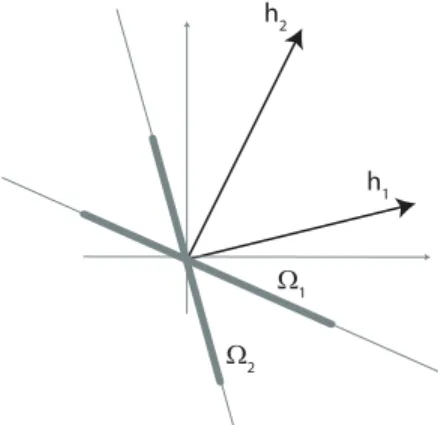
Let’s consider the case of one subcarrier, two users, two transmit antennas and the channel vectors listed in figure 2.3. The user channel vectors h1 and h2 are illustrated in the figure.
We drop the subindex n for this example because there is only one subcarrier. There are three possible values for α, i.e., three possible SDMA sets. Let’s focus on the SDMA set where both users are picked, this is equivalent to fix α1 = 1 and α2 = 1. The ZF constraints (2.26)
impose the beamforming vectors to be orthogonal to the other user channel vector. This is illustrated by the thick lines in figure 2.3. The vectors in set Ω1 are orthogonal to h2, and
the vectors in set Ω2 are orthogonal to h1, i.e.,
Ω1 ={w1 ∈ CM : h2w1 = 0},
h1
h2
Ω1
Ω2
Figure 2.3 Beamforming vectors support of ZF constrained prob. for SDMA set with 2 users, K = 2, M = 2, N = 1, h1 = (2, 1), h2 = (1, 2)
Each set is convex but the union of sets: Ω = Ω1∪ Ω2 is not convex. The sum of the norms
is limited by the power constrained ˇP . The resulting subproblem can be approximated to a convex problem by fixing the direction of the beamforming vectors using the ZF constraints and changing the optimization variable wk to a scalar variable qk ≥ 0. The new optimization
variable is related to the beamforming vectors by qk = |hkwk|2. Then, after replacing in
(2.15) the user rate becomes a concave function of the user power
r(1)k = log (1 + qk) (2.28)
and the power constraint becomes linear (c.f. problem (4.13–4.15))
K
∑
k=1
βkqk− ˇP ≤ 0, βk ≥ 0. (2.29)
where βk is given by (4.10) for any given subcarrier. With this approximation solving each
subproblem is easy since it is convex and the set of active users is small (≤ M). Moreover, the heuristic method we present in chapter 4 iteratively solves one subproblem for fixed α and then changes the subcarrier assignment until the minimum rate constraints are satisfied. Thus, both the direct and the heuristic methods solve the same convex sub-problem.
A direct method where we perform a complete enumeration of the binary variables would result in an extremely high number of sub-problems. For each subcarrier n, the number of possible values for variable αk,n equals the number of possible SDMA sets
I = M ∑ m=1 ( K m ) ∼ KM (2.30)