HAL Id: hal-02160607
https://hal.laas.fr/hal-02160607
Submitted on 19 Jun 2019
HAL is a multi-disciplinary open access
archive for the deposit and dissemination of
sci-entific research documents, whether they are
pub-lished or not. The documents may come from
teaching and research institutions in France or
abroad, or from public or private research centers.
L’archive ouverte pluridisciplinaire HAL, est
destinée au dépôt et à la diffusion de documents
scientifiques de niveau recherche, publiés ou non,
émanant des établissements d’enseignement et de
recherche français ou étrangers, des laboratoires
publics ou privés.
METHOD OF C2 H4 DETECTION IN HUMID
ATMOSPHERES USING A NANOPARTICULAR
SnO2 GAS SENSOR
M. Guerrero, Philippe Menini, L. Erades, A. Martinez
To cite this version:
M. Guerrero, Philippe Menini, L. Erades, A. Martinez. METHOD OF C2 H4 DETECTION IN
HUMID ATMOSPHERES USING A NANOPARTICULAR SnO2 GAS SENSOR. 16th International
Conference on Solid State transducers (Eurosensors XVI), Sep 2002, Prague, Czech Republic. pp.1019.
�hal-02160607�
METHOD OF C
2H
4DETECTION IN HUMID ATMOSPHERES
USING A NANOPARTICULAR SnO
2GAS SENSOR
M. Guerrero
a, P. Menini
a, L. Erades
b, A. Martinez
aa
Laboratoire d’Analyse et d’Architecture de Systèmes (LAAS-CNRS),
7 Avenue du Colonel Roche, 31077 Toulouse-France.
[email protected]
b
Laboratoire de Chimie de Coordination (LCC-CNRS)
205 Route de Narbonne, 31077 Toulouse-France
SUMMARY
Microhotplate architectures are widely studied in metal-oxide based sensors since their small size gives some advantages against traditional Taguchi type structures. The fast capability to vary sensors operating temperature allows to get information at different temperatures in short time periods and to extract transient information related to chemical adsorption and desorption processes. In this work, we present actual results in the development of a system, where a microhotplate architecture and synthesised nanoparticular SnO2 like sensing material are used to identify ethylene (C2H4) in controlled humid atmospheres. Temperature modulation and Factorial Discriminant Analysis are used in the identification process. Low concentrations of C2H4 (0;1;2;5 ppm) have been identified in controlled high relative humidity ambiances
.
Keywords: Tin oxide; gas sensor; temperature modulation; Factorial Discriminant Analysis.
Subject category: Chemical sensors and signal processing
INTRODUCTION
The use of metal-oxides gas sensors still being strongly limited because of their classical problems like signal drift and poor selectivity. However, different aspects of this kind of sensors still being studied to acquire a better knowledge of the sensing principles and to improve their actual performances. In addition to new materials and the use of additives to improve inner stability, sensitivity and selectivity, micromachined platforms came to reinforce the interest in metal-oxides, they present low power consumption with an interesting microelectronics fabrication compatibility.
In this work we present results obtained with a microhotplate architecture and nanosized sensing material developed by the Laboratory for Analysis and Architecture of Systems (LAAS-France) and the
Laboratory of Chemistry of Coordination (LCC-France) respectively. Our principal purpose is to develop a system for ethylene identification in humid atmospheres. Ethylene is an hormone who indicates plants maturity level and affects plants processes specially ripening stimulation; its supervision is really important for application in controlled fruits stocks and maturation chambers.
Sensor architecture and characteristic responses are presented. A method to reduce signal drifts and humidity influences is developed using transients responses to programmed temperature profiles. We show that transients responses to fast variations in operating temperature allows to extract enough useful information to be used in ethylene identification. Identification of low concentrations of ethylene in high and variable humidity ambiances has been possible using Factorial Discriminant Analysis and vector quantization.
ARCHITECTURE
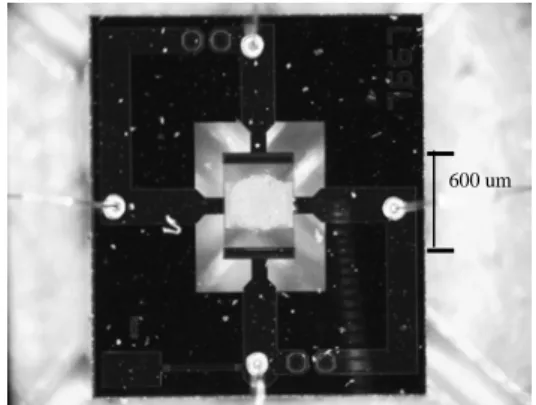
The sensor is formed by a microhotplate platform and a nanoparticular SnO2 sensing layer (Fig. 1). The microhotplate architecture was initially developed for Motorola and actually exploited by Microchemical Sensors S.A. A SiOxNy membrane of 1.5 µm supports a 600x430µm2 polysilicon heater. Dimensions have been optimised to achieve good thermo-mechanical reliability[1].
Fig. 1. Top view of the complete SnO2 gas sensor
The heater can reach operation temperatures of 450oC with a power consumption of 90mW; its geometry was improved via numerical analysis to obtain a zone of high temperature homogeneity where the sensing layer must be placed. At the maximal temperature of operation (450oC) the heater electrodes are below 300oC, avoiding metal degradations (Design process details can be found in [2]).
The metal-oxide used in this sensor is a crystalline SnO2 material synthesized by the decomposition and oxidation of a tin based organometallic precursor ([Sn(NMe2)2]2). The average grain size obtained is about 20 nm of diameter [3]. This material is deposed by a drop deposition technique over the two electrodes placed in the homogeneous temperature region of the heater (Fig 1 and 2).
Fig. 2. SEM image of the sensing layer
Deposited material oxidation is made using the inner heater of each sensor. Three days aging (continued operation at 450oC) is needed to reach good material stability. Grain size and porous morphology are kept after oxidation.
SENSOR RESPONSE
The sensors were tested and characterized exhaustively by mean of a labView controlled experimental setup. Gas mixtures, flux levels, humidity and temperature can be fixed. Measuring and data acquisition can be realised with up to 16 sensors working at the same conditions.
Typical behaviour is found to different temperature isotherms in dry air: semiconductor like behaviour at low temperatures and an important decrease of conductivity at higher temperatures caused by a depletion zone increased by oxygen adsorption and ionisation. Slope changes in temperature are consistent with reported works [4].
The sensor operating at the physically maximum temperature in the heater (≈450o
C) presents the highest sensitivity to ethylene (≈60% of resistance variation for 20 ppm of C2H4). Figures 3 and 4 show
experimental responses of a set of sensors for several C2H4 concentrations. In figure 3 we find the typical power law dependence of the resistance relative to gas concentrations
Rs
=
R
0.
[
C
2H
4]
β, where β can be viewed like a sensitivity factor. This factor is dependant on the environment conditions and operation temperature, Ex. β=0.43 at 450 oC in dry air. RS Vs [C2H4] HR=0% 10 100 1000 10 100 [C2H4] ppm R s ( K ohm ) Rs1 Rs2 Rs3 Rs4
Fig. 3. Sensing material resistance Vs ethylene concentrations
Figure 4 shows a time response for cycled gas injection [0,1,10,10]ppm, where the essential reversibility and reproducibility characteristics can be observed. HR=0%, Th=420o C 0 50 100 150 200 250 300 350 400 450 500 0 10 20 30 40 50 60 70 Temps (min) Rs (Kohm ) Rs1 Rs2 Rs3 Rs4 1 ppm 5 ppm 10 ppm 10 ppm Reversibility Reproducibility
Fig. 4. Reversibility and Reproducibility
Unfortunately, this sensor doesn’t escape to the principal problems of metal oxide sensors like signal drifts in the long term, cross sensitivity to others reducing gases and humidity dependencies. Low levels of relative humidity reduce abruptly the sensitivity (ex. Sensitivity to 20ppm of C2H4 decrease
from 60% in dry air to 5% at 15% of RH).
SIGNAL PROCESSING
Temperature modulation is a relative new technique used to extract more useful information in the sensor response [5]. This fact is principally due to speed of adsorption and desorption of volatile species in the sensing layer which varies with the temperature and with the specie; also different kind of reactions can be exploited, like electronics transient, chemisorption transient, and temperature and humidity dependence.
Some works (ex.[6],[7]), show interesting results in gas measure and classification using different temperature profiles. It’s reported that different gas signatures are obtained with programmed temperature sequences, then discrimination of gases and fixed mixtures with a single sensor are possible.
Performance improvement of our sensor by temperature modulation was easily tested. For example, with a simple cycled profile of temperature (10 seconds at 450oC followed by 10 seconds at 80oC) we obtain an important sensitivity increment from 5% to 35% in a 15% RH atmosphere, using like sensitivity the relation between the variations of the resistance at the highest temperature (eq. 1).
Fig 5. Cycled temperature response
)
0
(
)
(
,
ppm
R
xppm
R
S
b
a
R
∆
∆
=
−
=
∆
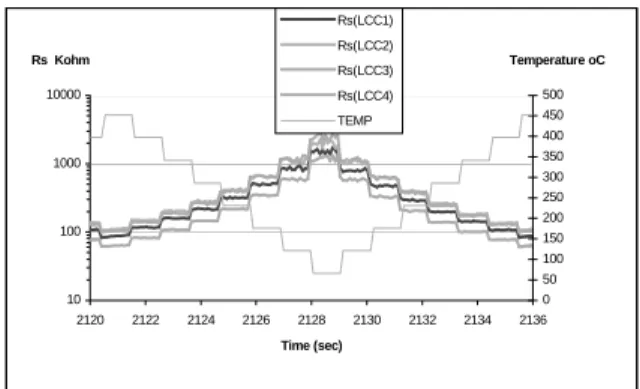
(1)Variations in gas concentrations can be masked by humidity changes, rending very difficult the gas quantization task. Since gas and humidity reactions in the sensing material are different processes, they affect sensor’s response in particular ways (different constants ratios, activation energies, sensitivity influence, among others). These reactions have a big dependency on temperature, then fast changes in sensor operation temperature produce environment dependent transients responses. In this way, enough information to separate the humidity influence from gas response may be obtained with more complex temperature profiles. We have tested and optimised empirical profiles to detect low C2H4 concentrations in wet conditions. With a triangular stepped profile varying between 65 o
C and 450 o
C, good results have been obtained to classify 0, 1 and 5 ppm of C2H4 in fixed and opposite conditions (0 and 90% RH), (Fig. 6-8).
Principal Component Analysis (PCA) and Factorial Discriminant Analysis (FDA) methods were employed to reduce data and to make human observable (2D or 3D) the improvements reached with each profile. Better results have been achieved with FDA because of its supervised nature (pre-established classes).
The triangular profile was improved to keep minimal but sufficient variations caused by chemisorption processes, a 14 one-second steps profile with 55oC temperature difference between them was proposed. An input vector of 14 variables is obtained with the mean value of each step.
Air Sec 10 100 1000 10000 2120 2122 2124 2126 2128 2130 2132 2134 2136 Time (sec) 0 50 100 150 200 250 300 350 400 450 500 Rs(LCC1) Rs(LCC2) Rs(LCC3) Rs(LCC4) TEMP Temperature oC Rs Kohm
Fig. 6. Triangular temperature profile and sensors response
Each entry must be normalized in order to partially avoid drifts and sensors dissimilarities. Maximal value of resistance was used for normalisation with good results. Fig.7 shows four sensors normalised response to the triangular profile. 0 and 90% responses are clearly identifiables. Small but enough differences in ethylene responses are kept to produce a good differentiation via FDA, where the three concentrations (0, 1 and 5 ppm) of C2H4 were specified as predefined classes.
RS Vs TEMP 0.01 0.1 1450 395 340 285 230 175 120 65 120 175 230 285 340 395 Rs(0ppm,RH 0%) Rs(1ppm, RH 0%) Rs(5ppm, RH 0%) Rs(0ppm, RH 89%) Rs(1ppm, RH 89%) Rs(5ppm, RH 89%)
Fig. 7. Normalised temperature response at 0 and 90% of RH
FDA results showed that 100% of total variance was concentred and likeliness distributed between the first two discriminant axes (Fig. 8). The three concentration levels specified can be clearly recognised. Linear Discriminant Analysis or Vectorial Quantization can be used to classify a pre-processed new entry. [C2H4]=10ppm 0 50 100 150 200 250 3516 3526 3536 3546 3556 3566 3576 Time (sec) R s ( K ohm ) Rs1 Rs2 Rs3 Rs4 b a
Fig 8. FDA for 0,1 and 5 ppm of
C
2H
4 in 0 and 90%of RH.
In a more real context, humidity level is variable. Last procedure was tested with some modifications in high humid and variable ambiances. Correlation analysis between original data and the new subspace obtained via the FDA showed us that low temperature steps gave minimal contribution to total variance. A similar profile with 12 one-second steps with temperatures between 120oC and 450 oC was used to validate the proposed method in humidity controlled ambiance with variable RH (80% ± 10%).
We have found that humidity variances mask the concentration variances for one sensor response, but by taking in to account the information of more than one sensors working at almost the same temperatures, we can obtain considerable improvements, as shown in figure 9, where the response of four sensors is used in the FDA analysis.
Fig. 9. FDA for 0,1,2 and 5 ppm C2H4 concentrations in 80 ± 10% of RH.
100% of variance is concentrated in three axes. First two axes give us a clear good identification with 74,7% of total variance. 60 of 120 entries have been used to find the translation matrix given by the FDA. 80% of total entries were well classified using vector
quantization, almost identical results have been found using Euclidean, Manhattan and L∞ metrics.
CONCLUSIONS AND PERSPECTIVES
A new generation of gas sensors based on nanoparticular SnO2 sensitive layer has been elaborated, tested and characterised. Good sensitivity to low concentrations of ethylene has been found, but it is significantly reduced in wet atmospheres. Desired identification of low concentrations of ethylene (0;1;2;5 ppm) in high and variable humid ambiances has been possible using modulated temperature and Factorial Discriminant Analysis.
A model of response in temperature, based on the electrochemical behaviour of the sensor including temperature and humidity effects is being optimised. A systematic optimisation approach of temperature profile is intended through this model.
ACKNOWLEDGMENTS
Authors would like to thank Mr. B. Chaudret group at the “Laboratoire de Chimie de Coordination” in Toulouse which have developed the sensing material, and to Mr. P. Fau of Microchemical Systems S.A. who have provided us the micromachined platforms.
REFERENCES
[1] S. Astie. Integration d’un capteur de gaz a oxyde semi-conducteur sur silicium. Raport de thèse LAAS N.98537 (1998)
[2] S. Astie et al. Design of a low power SnO2 gas sensor integrated on silicon oxynitride membrane. Sensors and Actuators B67 (2000) 84-88.
[3] Céline Nayral et al. Synthesis and use of a novel SnO2 nanomaterial for gas sensing. Applied Surface Science 164 (2000) 219-226.
[4] J.F.McAleer et al. Tin dioxide gas sensors. J. Chem. Soc. Faraday Trans.83 (1987) 1323-1346 [5] Andrew Lee, Brian Reedy. Temperature
modulation in semiconductor gas sensing. Sensors and Actuators B60 (1999) 35-42.
[6] E. Cavicchi et al. Fast temperature programmed sensing for micro-hotplate gas sensors. IEEE Electron Device Letters. Vol. 16 N.6 June 1995
[7] M. Jaegle et al. Micromachined thin film SnO2 gas sensors in temperature-pulsed operation mode. Sensors and Actuators B57 (1999) 130-134.