HAL Id: hal-01618007
https://hal.archives-ouvertes.fr/hal-01618007
Submitted on 10 Jul 2018HAL is a multi-disciplinary open access archive for the deposit and dissemination of sci-entific research documents, whether they are pub-lished or not. The documents may come from teaching and research institutions in France or abroad, or from public or private research centers.
L’archive ouverte pluridisciplinaire HAL, est destinée au dépôt et à la diffusion de documents scientifiques de niveau recherche, publiés ou non, émanant des établissements d’enseignement et de recherche français ou étrangers, des laboratoires publics ou privés.
Integrated production-distribution planning
optimization models: A review in collaborative networks
context
Beatriz Andrés, Raquel Sanchis, Jacques Lamothe, Leila Saari, Frederic
Hauser
To cite this version:
Beatriz Andrés, Raquel Sanchis, Jacques Lamothe, Leila Saari, Frederic Hauser. Integrated
production-distribution planning optimization models: A review in collaborative networks context. International Journal of Production Management and Engineering, Valencia Universitat Politècnica de València, 2017, 5 (1), p. 31-38. �10.4995/ijpme.2017.6807�. �hal-01618007�
Integrated production-distribution planning optimization models:
A review in collaborative networks context
Beatriz Andresai*,Raquel Sanchisaii, Jaques Lamotheb, Leila Saaric and Frederic Hauserd
aResearch Centre on Production Management and Engineering (CIGIP). Escuela Politécnica Superior de Alcoy,
Universitat Politècnica de València (UPV). Centre d’Innovació i Investigació. Calle Alarcón, 03801 Alcoy, Spain.
ai [email protected], aii [email protected] bUniversity of Toulouse – Mines Albi, Industrial Engineering Centre, Campus Jarlard, Route de Teillet. 81013 Albi, France.
b [email protected] cVTT Technological research centre of VTT Ltd., Kaitoväylä 1, FI-90570 OULU, Finland.
c [email protected] dLaboratoire Pierre Fabre Dermo Cosmetique. Les Cauquillous 81506 LAVAUR, France.
Abstract: Researchers in the area of collaborative networks are more and more aware of proposing collaborative approaches to address planning processes, due to the advantages associated when enterprises perform integrated planning models. Collaborative production-distribution planning, among the supply network actors, is considered a proper mechanism to support enterprises on dealing with uncertainties and dynamicity associated to the current markets. Enterprises, and especially SMEs, should be able to overcome the continuous changes of the market by increasing their agility. Carrying out collaborative planning allows enterprises to enhance their readiness and agility for facing the market turbulences. However, SMEs have limited access when incorporating optimization tools to deal with collaborative planning, reducing their ability to respond to the competition. The problem to solve is to provide SMEs affordable solutions to support collaborative planning. In this regard, new optimisation algorithms are required in order to improve the collaboration within the supply network partners. As part of the H2020 Cloud Collaborative Manufacturing Networks (C2NET) research project, this paper presents a study on integrated production and distribution plans. The main objective of the research is to identify gaps in current optimization models, proposed to address integrated planning, taking into account the requirements and needs of the industry. Thus, the needs of the companies belonging to the industrial pilots, defined in the C2NET project, are identified; analysing how these needs are covered by the optimization models proposed in the literature, to deal with the integrated production-distribution planning. Key words: Collaborative planning, Supply chain, Production planning, Distribution planning.
1. Introduction
The usual way to proceed in many manufacturing enterprises involves dealing with the optimisation of different types of plans separately (e.g. production, and distribution). Nevertheless, this approach has associated a set of drawbacks, because it does not consider the limitations of the partners downstream.
This limits potential improvement at the enterprises level and discards the total supply chain profit. Researchers are more aware of analysing and designing approaches based on the combination of different functions in the supply chain (SC) into integrated optimisation models; according to Park (2005) the collaborative planning is significantly relevant for companies that adopted it. The research area of integrating production and distribution
planning is increasing its impact, due to its decisive contribution in the establishment of collaborative relationships among the enterprises of the same supply chain.
In this paper, we consider the distribution planning problem and its evolution towards the collaborative production and distribution planning in supply chain. A literature review is carried out with the main aim of identifying solutions that deal with both plans, including the isolated perspective (in which each plan, production and distribution are separately calculated) and the collaborative perspective, which jointly computes production-distribution plans. Moreover, it is analysed how the integrated production-distribution planning approaches provided in the literature deal with the requirements of the real industry. The analysis of industrial planning needs was possible with the Pilot partners participating in the H2020 Cloud Collaborative Manufacturing Networks (C2NET) research project. The goal of C2NET Project is the creation of cloud-enabled tools for supporting the SMEs supply network optimization of manufacturing and logistic assets based on collaborative demand, production and delivery plans. C2NET Project will provide a scalable real-time architecture, platform and software to allow the supply network partners:
- to master complexity and data security of the supply network,
- to store and share product, process and logistic data,
- to optimize the manufacturing assets by the collaborative computation of production plans, - to optimize the logistics assets through efficient
delivery plans and
- to render the complete set of supply chain management information on the any digital mobile device (PC, tablets, smartphones) of decision makers enabling them to monitor, visualize, control, share and collaborate.
The objectives of the project are grouped in three categories: Technical, Functional and Exploitation. At the technical level C2NET objectives are focused on the (i) implementation of C2NET Data Collection Framework (C2NET DCF) for IoT-based continuous data collection from supply network resources; (ii) implementation of C2NET Optimizer (C2NET OPT) for the optimization of manufacturing and logistics assets of the supply network by the collaborative
computation of production, replenishment and delivery plans; (iii) implementation of C2NET Collaboration Tools (C2NET COT) for providing support to the collaborative processes of the supply network; and (iv) implementation of C2NET Cloud Platform (C2NET CPL) to integrate the data module, the optimizers and the collaborative tools in the cloud. At the functional level, the objectives lead to (i) provide new ways to securely store relevant information from supply network partners in public cloud, community cloud or private cloud, ensuring data security and provide the ability of data sharing and data analytics; (ii) provide new tools for supporting the supply network optimization of manufacturing and logistic assets; (iii) provide new tools to support decision-makers in collaborative processes with intuitive UIs that display in real-time the right data at the right time, built in advanced apps for mobile devices for selective management functionalities across the supply network; and (iv) provide a new cloud space for allowing the access to all the participants in the value chain to support their decisions and processes enhancement. Finally, the objectives related with the exploitation center its attention in (i) technological exploitation of new ICT tools developed by open its integration on existing and future software and its evolution as open source technologies; (ii) commercial exploitation of C2NET Platform and Tools providing the services to companies of any manufacturing sector and licensing the software to consultancy firms; and (iii) know-how exploitation of the new knowledge created during the research and innovation activities developed in the project providing consultancy and training to companies.
This paper focuses on the research of optimization of manufacturing and logistics assets of the supply network by the collaborative computation of production and delivery plans. Accordingly, this paper presents a study among production and distribution plans with the main aim of identifying gaps in the current optimisation models, taking into account the requirements and needs coming from the specifications defined in the C2NET industrrial pilots . Specifically, this paper reports the literature review regarding optimisation models for integrated production-distribution planning decisions. A summary of a review of optimization models for integrated production and delivery planning decisions is presented. In this regard, this paper will provide researchers and practitioners a starting point for generating optimization models in the context of integrated production-distribution planning.
Int. J. Prod. Manag. Eng. (2017) 5(1), 31-38 Creative Commons Attribution-NonCommercial-NoDerivatives 4.0 International
Andres, B., Sanchis, R., Lamothe, J., Saari, L. and Hauser F.
To this regard, the paper is organised as follows: In section 2 a brief description of C2NET project is provided, focusing on the Dermo-cosmetics sector. In Section 3 a review of the combined models for production and distribution planning is provided and the gaps between the literature and the industry are identified. Finally, Section 4 presents the conclusions.
2. Dermo-cosmetics pilot in C2NET
project
The current research work carries out a state of the art to collect and analyse some solutions in the context of distribution and production planning. This research is part of the C2NET H2020 project (2015-2017) that addresses the potential of Cloud technologies providing a collaboration infrastructure for the real-world data of different supply chain components such as manufacturing assets status, inventory levels or current demand at consumption points (Lauras et al., 2015).
C2NET H2020 project is motivated by the fact that currently, the European SMEs do not have access to advanced management systems and collaborative tools because of their limited resources (European Comission, 2005, 2012, 2013, 2014). Value chains formed by SMEs are distributed and dependent on information and complex materials flows that require new approaches to reduce the complexity of manufacturing management systems. In this context, ubiquitous tools are needed to support collaboration between different entities in the value chain and offer advanced algorithms to achieve global and local optimization of manufacturing processes and respond more quickly and efficiently unforeseen changes. The main objective of C2NET is building a new architecture in the cloud to provide SMEs, affordable tools (in terms of cost and ease of use) to help overcome the current economic crisis, improving competitiveness in the economy world. Therefore, C2NET objective is based on the creation of cloud tools to support optimization of manufacturing networks composed mainly of SMEs and their logistic assets through demand management, production and supply plans, considering the Collaborative Network perspective (Andres et al., 2016).
C2NET will provide specific tools for optimisation and collaboration in the cloud, allowing enterprises to be responsive and flexible against changes in
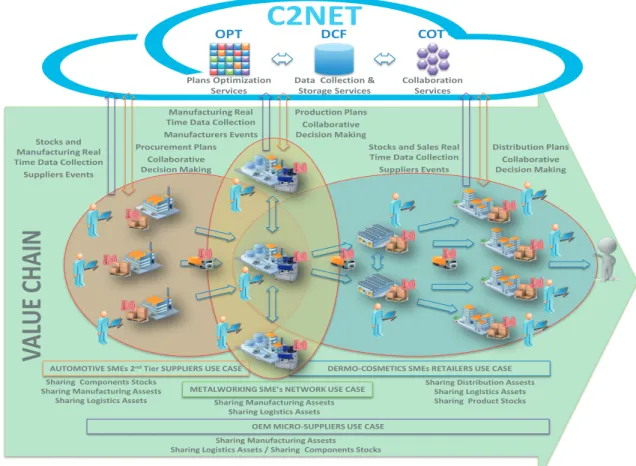
both the demand and unexpected events that take place during products production and distribution. Moreover, C2NET will provide a technological infrastructure that allows collecting real-world data from processes and products within the supply chain. Finally C2NET project provides collaboration tools with a set of services able to facilitate the decision-making processes, increasing the enterprises agility. Accordingly, the C2NET Project will generate a Cloud Architecture composed by the Cloud Plat-form (C2NET CPL), the Data Collection Framework (C2NET DCF), the Optimizer (C2NET OPT) and the Collaboration Tools (C2NET COT) (see Figure 1). The validation of C2NET outputs (collaborative platform) will be possible with the four industrial pilots participating in the project. Each pilot is devoted to improve different collaborative levels, due to their characteristics. Thus, pilots corresponding to the automotive sector and OEM manufacturing are devoted to enhance production collaborative processes. The dermo-cosmetics pilot is focused to enhance deliver collaborative processes. The metalworking pilot is devoted to enhance source collaborative processes. This paper focuses on the planning needs of Dermo-cosmetics Pilot regarding production and distribution. The supply chain under study in contains one production unit, its international warehouse, two subsidiaries’ distribution centres and 20 retailers (pharmacists’ drugstores). In a first stage, the supply chain under study concerns one production unit, his international warehouse, two subsidiaries’ distribution centres and 20 retailers (pharmacists’ drugstores). In a second phase, this pilot propose to test the scalability at a bigger size, the European supply chain composed of 15 distribution subsidiaries and 50000 selling points. Enterprises of Dermo-cosmetics pilot will use the C2NET platform (cloud infrastructure) and software to perform collaborative production and distribution network from first-tier suppliers of materials to final resellers all over the world. The use of C2NET optimiser will optimise the availability of products and limiting the inventory levels all along the supply chain. In this pilot the collaboration tools will be used to manage the production and delivery collaborative processes between the manufacturing plant, the subsidiaries, the transportation companies and the retailers. This will particularly take effect on the capability of these stakeholders to better manage the uncertainties such as sudden demand variation or transportation failures. The C2NET platform will improve the agility capabilities of the whole network.
3. Integrated optimization models
for production-distribution
planning
The consideration of a collaborative production and distribution planning problem is a determined decision to improve the net profit in a multi-plant, multi-retailer, multi-item, and multi-period logistic environment. Different optimisation models and heuristic solutions have been proposed in the literature the to deal with both integrated and decoupled plans of production and distribution. The main problems to face are the high inventory levels required to cover the demand, the long lead times that freeze a lot of assets, the bullwhip effect, the back orders, changes in short-term forecasts, etc. Next subsections will analyse the current solutions to of distribution plans and solutions that propose optimisation models, algorithms and simulation approaches to deal with the collaborative production and distribution planning.
3.1. Distribution Planning
Distribution planning deals with the Plan Delivery (D) identified in the SCOR views (Supply Chain Council, 2012), and focuses on the calculation of the amount of items to be delivered per periods in a planning horizon. The main input data are the customers’ orders, with amounts and locations to deliver the goods. The delivery will use limited resources (own, from the customer or from a third party). Distribution plans can be arranged considering four category levels:
- D/Demand Planning: Plan that enables sales teams to develop demand forecasts as input to the service planning processes, production, inventory planning and revenue planning;
- D/Distribution Planning: Plan that concerns the movement of a finished product or services to the customers. The customer is the final destination of a selling channel. This plan examines demographic characteristics and travel patterns evaluates alternative improvements for the distribution of finished products. Distribution
VA
LUE CH
AIN
OPT DCF Plans Optimization Services COTC2NET
Sharing Distribution Assests Sharing Logistics Assets Sharing Product Stocks Sharing Components Stocks
Sharing Manufacturing Assests Sharing Logistics Assets
Stocks and Manufacturing Real Time Data Collection Suppliers Events Procurement Plans Collaborative Decision Making Production Plans Collaborative Decision Making Distribution Plans Collaborative Decision Making Stocks and Sales Real
Time Data Collection Suppliers Events Manufacturing Real
Time Data Collection Manufacturers Events
AUTOMOTIVE SMEs 2ndTier SUPPLIERS USE CASE
METALWORKING SME’s NETWORK USE CASE
DERMO-COSMETICS SMEs RETAILERS USE CASE
Collaboration Services Data Collection &
Storage Services
Sharing Manufacturing Assests Sharing Logistics Assets
OEM MICRO-SUPPLIERS USE CASE Sharing Manufacturing Assests Sharing Logistics Assets / Sharing Components Stocks
Figure 1. C2NET Project results.
Int. J. Prod. Manag. Eng. (2017) 5(1), 31-38 Creative Commons Attribution-NonCommercial-NoDerivatives 4.0 International
Andres, B., Sanchis, R., Lamothe, J., Saari, L. and Hauser F.
planning includes steps like: (i) calculation of distances, times and distribution costs; (ii) optimisation of distribution routes; (iii) analysis of logistic flows; and (iv) design and analysis of a distribution network;
- D/Order Promising: Plan that matches customer orders against available manufacturing resources and then replies with promised quantities and due dates;
- D/Transport Planning: Plan that concerns the movement of raw materials or semielaborated products to manufacturing enterprises. Plan that deals with procurement transport activities for accomplishing production requirements.
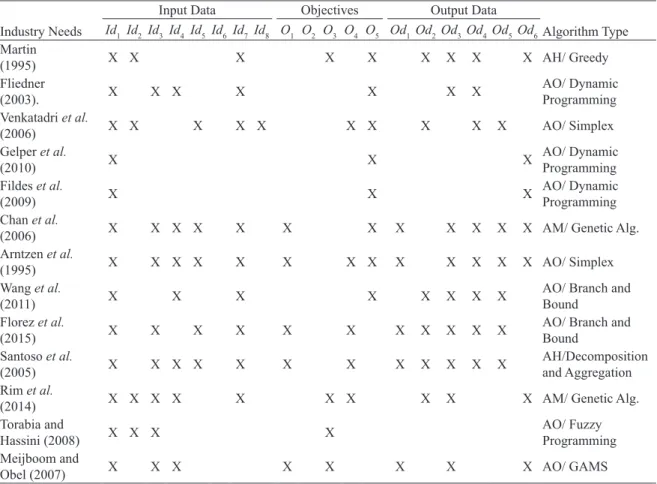
Table 1 below presents the mapping between Dermo-cosmetics industrial pilot optimisation needs and plans described in literature. The first column carries the reference of a plan in literature. For any optimisation case the input data, objectives and output data are crucial and need to match sufficiently. Input
data was classified into eight classes, objectives five and output data six. The last column identifies the algorithm type presented in the literature reference: AO is an optimisation algorithm, AH is a heuristic algorithm and AM is a matheuristic algorithm. Each X in the table presents a match between the algorithm in literature and industrial pilot optimisation needs. Correspondingly, each empty cell identifies a gap between literature and real case.
3.2. Collaborative Production and Distribution Planning
Make & Deliver (MD) plans deal with the transformation of a product into a finished good and provide finished goods and services to meet planned or actual demands. Dermo-cosmetics pilot allowed defining two collaborative processes regarding MD plans:
- M/Production Planning & D/Distribution Planning: Plan that deals with production and Table 1. Matching Pilot 2 industrial needs and deliver literature plans.
Industry Needs
Input Data Objectives Output Data
Algorithm Type Id1 Id2 Id3 Id4 Id5 Id6 Id7 Id8 O1 O2 O3 O4 O5 Od1Od2Od3Od4Od5Od6
Martin
(1995) X X X X X X X X X AH/ Greedy
Fliedner
(2003). X X X X X X X AO/ Dynamic Programming Venkatadri et al.
(2006) X X X X X X X X X X AO/ Simplex Gelper et al.
(2010) X X X AO/ Dynamic Programming
Fildes et al.
(2009) X X X AO/ Dynamic Programming
Chan et al.
(2006) X X X X X X X X X X X X AM/ Genetic Alg. Arntzen et al.
(1995) X X X X X X X X X X X X X AO/ Simplex Wang et al.
(2011) X X X X X X X X AO/ Branch and Bound Florez et al.
(2015) X X X X X X X X X X X AO/ Branch and Bound Santoso et al.
(2005) X X X X X X X X X X X X AH/Decomposition and Aggregation Rim et al.
(2014) X X X X X X X X X X AM/ Genetic Alg. Torabia and
Hassini (2008) X X X X AO/ Fuzzy Programming Meijboom and
Obel (2007) X X X X X X X X AO/ GAMS
Id1: Demand, Id2: Inventory, Id3: Capacity, Id4: Production Time, Id5: Transport/Distribution Cost, Id6: Backorders, Id7: Lead time of supply,
Id8: Supplier Prices.
O1: Transport cost min, O2: Sales max, O3: Inventory min, O4: Backorders min, O5: Service Level max.
distribution operations to customers, over the planning horizon. The plan identifies the production and distribution quantities of each item for each period at each site, subject to consider the capacity constraints and distribution lead-time. The total cost includes the costs of production, inventory, stockout, and distribution; - M/Production Planning & D/Transport
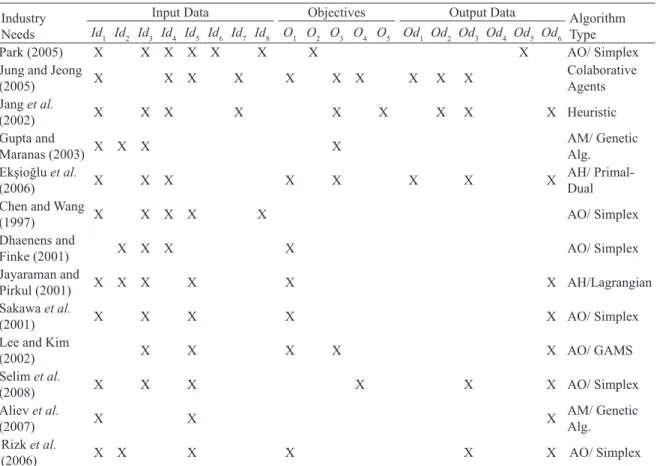
Planning: Plan that deals with two phases, (i) the manufacturing phase that focuses on the efficient allocation of the production capacity at the various production sites, and (ii) the transportation phase that focuses on procurement transport activities for accomplishing production requirements. Table 2 identifies the matches between the Dermo-cosmetics industrial pilot optimization needs and combined collaborative MD planning algorithms found in literature. This table follows the same structure as Table 1 in section Distribution planning.
4. Conclusions
The research work carried out in this paper identifies the concrete solutions proposed in the literature to support the collaborative process of production and distribution planning. The literature plans are compared with the real requirements collected from the industry. In this regard, the needs of one of the pilots of C2NET project, the Dermo-cosmetics pilot, are analysed. The comparison allowed identifying some gaps between the literature and the industrial needs regarding collaborative production and distribution planning. The algorithms found in the literature will need massive modifications before they can be applied in the optimisation cases because both the amount and nature of inputs, objectives and outputs have very low correlation with the industry needs. Some features of solutions found in literature will be adapted when implementing collaborative Table 2. Matching Pilot 2 industrial needs and integrated production-distribution literature plans.
Industry Needs
Input Data Objectives Output Data Algorithm Type Id1 Id2 Id3 Id4 Id5 Id6 Id7 Id8 O1 O2 O3 O4 O5 Od1 Od2 Od3 Od4 Od5 Od6
Park (2005) X X X X X X X X AO/ Simplex Jung and Jeong
(2005) X X X X X X X X X X Colaborative Agents Jang et al.
(2002) X X X X X X X X X Heuristic
Gupta and
Maranas (2003) X X X X AM/ Genetic Alg. Ekşioğlu et al.
(2006) X X X X X X X X AH/ Primal-Dual Chen and Wang
(1997) X X X X X AO/ Simplex
Dhaenens and
Finke (2001) X X X X AO/ Simplex
Jayaraman and
Pirkul (2001) X X X X X X AH/Lagrangian Sakawa et al.
(2001) X X X X X AO/ Simplex
Lee and Kim
(2002) X X X X X AO/ GAMS
Selim et al.
(2008) X X X X X X AO/ Simplex
Aliev et al.
(2007) X X X AM/ Genetic Alg.
Rizk et al.
(2006) X X X X X X AO/ Simplex
Id1: Demand, Id2: Inventory, Id3: Capacity, Id4: Production Time, Id5: Transport/Distribution Cost, Id6: Backorders, Id7: Lead time of supply, Id8: Supplier Prices.
O1: Transport cost min, O2: Sales max, O3: Inventory min, O4: Backorders min, O5: Service Level max.
Od1: Transport cost, Od2: Backorders, Od3: Inventory, Od4: Delivery time, Od5: Total cost, Od6: Product to transport.
Int. J. Prod. Manag. Eng. (2017) 5(1), 31-38 Creative Commons Attribution-NonCommercial-NoDerivatives 4.0 International
Andres, B., Sanchis, R., Lamothe, J., Saari, L. and Hauser F.
optimization algorithms for the requirements defined by the industry.
Acknowledgements
The research leading to these results is in the frame of
the “Cloud Collaborative Manufacturing Networks” (C2NET) project, which has received funding from the European Union’s Horizon 2020 research and innovation programme under grant agreement No 636909.
References
Aliev, R.A., Fazlollahi, B., Guirimov, B.G., Aliev, R.R. (2007). Fuzzy-genetic approach to aggregate production–distribution planning in supply chain management. Information Sciences, 177(20), 4241-4255. https://doi.org/10.1016/j.ins.2007.04.012
Andres, B., Sanchis, R., Poler, R. (2016). A cloud platform to support collaboration in supply networks. International Journal of Production Management and Engineering, 4(1), 5-3. https://doi.org/10.4995/ijpme.2016.4418
Arntzen, B.C., Brown, G.G., Harrison, T.P., Trafton, L.L. (1995). Global supply chain management at Digital Equipment Corporation. Interfaces, 25(1), 69-93. https://doi.org/10.1287/inte.25.1.69
Chan, F.T., Chung, S.H., Choy, K.L. (2006). Optimization of order fulfillment in distribution network problems. Journal of Intelligent Manufacturing, 17(3), 307-319. https://doi.org/10.1007/s10845-005-0003-z
Chen, M., Wang, W. (1997). A linear programming model for integrated steel production and distribution planning. International Journal of Operations & Production Management, 17(6), 592-610. https://doi.org/10.1108/01443579710167276
Dhaenens, C., Finke, G. (2001). An integrated model for an industrial production–distribution problem. IIE Transactions, 33(9), 705-715. https://doi.org/10.1080/07408170108936867
Ekşioğlu, S.D., Romeijn, H.E., Pardalos, P.M. (2006). Cross-facility management of production and transportation planning problem. Computers & Operations Research, 33(11), 3231-3251. https://doi.org/10.1016/j.cor.2005.02.038
European Commission. (2005). The New SME Definition: User Guide and Model Declaration. https://ec.europa.eu/digital-agenda/en/news/ new-sme-definition-user-guide-and-model-declaration, Retrieved December 2015.
European Commission. (2014). An Integrated Industrial Policy for the Globalisation Era. Putting Competitiveness and Sustainability at Centre Stage. http://eur-lex.europa.eu/legal-content/EN/TXT/?uri=URISERV%3Aet0005, Retrieved December 2015.
European Commission. Enterprise and Industry. (2012). European Competitiveness Report 2012. Reaping the benefits of globalization. http://wbc-inco.net/object/document/11137# Retrieved December 2015.
European Commission. Enterprise and Industry. (2013). Fact and figures about the EU's Small and Medium Enterprise (SME). http:// ec.europa.eu/enterprise/index_en.htm, Retrieved December 2015.
Fildes, R., Goodwin, P., Lawrence, M., Nikolopoulos, K. (2009). Effective forecasting and judgmental adjustments: an empirical evaluation and strategies for improvement in supply-chain planning. International Journal of Forecasting, 25(1), 3-23. https://doi.org/10.1016/j. ijforecast.2008.11.010
Fliedner, G. (2003). CPFR: an emerging supply chain tool. Industrial Management & data systems, 103(1), 14-21. https://doi. org/10.1108/02635570310456850
Florez, J.V., Lauras, M., Okongwu, U., Dupont, L. (2015). A decision support system for ro-bust humanitarian facility location. Engineering Applications of Artificial Intelligence. 46, 326-335. http://dx.doi.org/10.1016/j.engappai.2015.06.020
Gelper, S., Fried, R., Croux, C. (2010). Robust forecasting with exponential and Holt-Winters smoothing. Journal of forecasting, 29(3), 285-300. https://doi.org/10.1002/for.1125
Gupta, A., Maranas, C.D. (2003). Managing demand uncertainty in supply chain planning. Computers & Chemical Engineering, 27(8), 1219-1227. https://doi.org/10.1016/S0098-1354(03)00048-6
Jang, Y.J., Jang, S.Y., Chang, B.M., Park, J. (2002). A combined model of network design and production/distribution planning for a supply network. Computers & Industrial Engineering, 43(1), 263-281. https://doi.org/10.1016/S0360-8352(02)00074-8
Jayaraman, V., Pirkul, H. (2001). Planning and coordination of production and distribution facilities for multiple commodities. European journal of operational research, 133(2), 394-408. https://doi.org/10.1016/S0377-2217(00)00033-3
Jung, H., Jeong, B. (2005). Decentralised production-distribution planning system using col-laborative agents in supply chain network. The International Journal of Advanced Manufacturing Technology, 25(1-2), 167-173. https://doi.org/10.1007/s00170-003-1792-x Lauras, M., Lamothe, J., Benaben, F., Andres, B., Poler, R. (2015). Towards an Agile and Collaborative Platform for Managing Supply Chain
Uncertainties. In Enterprise Interoperability, 64-72. Springer Berlin Heidelberg. https://doi.org/10.1007/978-3-662-47157-9_6 Lee, Y.H., Kim, S.H. (2002). Production–distribution planning in supply chain considering capacity constraints. Computers & industrial
engineering, 43(1), 169-190. https://doi.org/10.1016/S0360-8352(02)00063-3
Martin, A.J. (1995). DRP: distribution resource planning: the gateway to true quick response and continuous replenishment. John Wiley & Sons.
Meijboom, B., Obel, B. (2007). Tactical coordination in a multi-location and multi-stage oper-ations structure: A model and a pharmaceutical company case. Omega, 35(3), 258-273. https://doi.org/10.1016/j.omega.2005.06.003
Park, Y.B. (2005). An integrated approach for production and distribution planning in supply chain management. International Journal of Production Research, 43(6), 1205-1224. https://doi.org/10.1080/00207540412331327718
Rim, S.C., Jiang, J., Lee, C.J. (2014). Strategic Inventory Positioning for MTO Manufactur-ing Using ASR Lead Time. In Logistics Operations, Supply Chain Management and Sustainability, 441-456. Springer International Publishing.
Rizk, N., Martel, A., D’Amours, S. (2006). Multi-item dynamic production-distribution planning in process industries with divergent finishing stages. Computers & Operations Research, 33(12), 3600-3623. https://doi.org/10.1016/j.cor.2005.02.047
Sakawa, M., Nishizaki, I., Uemura, Y. (2001). Fuzzy programming and profit and cost allocation for a production and transportation problem. European Journal of Operational Research, 131(1), 1-15. https://doi.org/10.1016/S0377-2217(00)00104-1
Santoso, T., Ahmed, S., Goetschalckx, M., Shapiro, A. (2005). A stochastic programming approach for supply chain network design under uncertainty. European Journal of Operational Research, 167(1), 96-115. https://doi.org/10.1016/j.ejor.2004.01.046
Selim, H., Araz, C., Ozkarahan, I. (2008). Collaborative production–distribution planning in supply chain: a fuzzy goal programming approach. Transportation Research Part E: Logistics and Transportation Review, 44(3), 396-419. https://doi.org/10.1016/j.tre.2006.11.001 Supply Chain Council. (2012). Supply Chain Operations Reference Model (SCOR), Supply Chain Operations Management Retrieved from:
http://www.apics.org/sites/apics-supply-chain-council/frameworks/scor
Torabi, S.A., Hassini, E. (2008). An interactive possibilistic programming approach for multiple objective supply chain master planning. Fuzzy Sets and Systems, 159(2), 193-214. https://doi.org/10.1016/j.fss.2007.08.010
Venkatadri, U., Srinivasan, A., Montreuil, B., Saraswat, A. (2006). Optimization-based decision support for order promising in supply chain networks. International Journal of Production Economics, 103(1), 117-130. https://doi.org/10.1016/j.ijpe.2005.05.019
Wang, F., Lai, X., Shi, N. (2011). A multi-objective optimization for green supply chain network design. Decision Support Systems, 51(2), 262-269. https://doi.org/10.1016/j.dss.2010.11.020
Int. J. Prod. Manag. Eng. (2017) 5(1), 31-38 Creative Commons Attribution-NonCommercial-NoDerivatives 4.0 International
Andres, B., Sanchis, R., Lamothe, J., Saari, L. and Hauser F.