OATAO is an open access repository that collects the work of Toulouse
researchers and makes it freely available over the web where possible
Any correspondence concerning this service should be sent
to the repository administrator:
[email protected]
This is an author’s version published in:
https://oatao.univ-toulouse.fr/cgi/users/home?screen=EPrint::View&eprintid=24586
To cite this version:
Arroita, Maite and Flores, Lorea and Larrañaga, Aitor
and Chauvet, Eric and Elosegi, Arturo Hydrological contingency : drying history
affects aquatic microbial decomposition. (2018) Aquatic Sciences - Research
Across Boundaries, 80 (3). 1-12. ISSN 1015-1621
Official URL:
https://link.springer.com/article/10.1007%2Fs00027-018-0582-3
OATAO
Op8n Arcllive To1Jlou&e Arcllive OuvsrteHydrological contingency: drying history affects aquatic microbial
decomposition
Maite Arroita1,2 · Lorea Flores3 · Aitor Larrañaga1 · Eric Chauvet4 · Arturo Elosegi1
Abstract
Climate change, land use intensification, and water abstraction magnify the frequency and severity of droughts but also result in totally unnatural hydrological patterns. Longer and more severe droughts slow down organic matter decomposition, whereas the effect of drying history, i.e. the specific sequence of different conditions to which organic matter is exposed, has seldom been addressed. Drying history could have important consequences for microbial communities colonizing and decomposing leaf litter in streams given the rapid fluctuations in microbial composition and processes. We studied whether the effects of drought-related impacts (stagnation, drying and both) on microbial activity and leaf litter decomposition are affected by the timing when peak stress (stagnation or drying) occurs, and whether the effect of the drying history is consistent among the three different stress types. In laboratory microcosms, we recreated areas with flowing water (aerated water), isolated pools with stagnant water (non-aerated water) and dry beds (dry microcosms). Combining these conditions and their sequence, we created nine treatments (ten with the control) differing in stress type (stagnation, drying, both) and timing of peak stress (early, middle, late), and measured fungal biomass, sporulation, microbial respiration, and microbial decomposition of alder leaf disks. The effects of drought-related stress conditions were not consistent among response vari-ables. However, disturbances were systematically more detrimental to decomposition in early stages, resulting in a lower fungal biomass and activity, and reduced microbial litter decomposition. These results suggest that the effects of stress on decomposition-associated variables depend not only on the intensity of the stress, but also on its timing, with early stress and its legacy effects having greatest impact on leaf litter decomposition.
Keywords Aquatic hyphomycetes · Microbial community · Organic matter · Decomposition · Drought · Timing
Introduction
Allochthonous organic matter is the main energy source sup-porting food webs in streams and rivers (Tank et al. 2010), with leaf litter decomposition being a major ecosystem-level process, especially in systems running through forested
catchments (Webster and Benfield 1986; Abelho 2001). Lit-ter decomposition results from several abiotic and biotic pro-cesses, which include leaching, mechanical abrasion, micro-bial degradation, and fragmentation by invertebrates (Graça 2001; Hieber and Gessner 2002). Within all these processes, the activity of microbial decomposers is among the most important mechanisms (Gessner and Chauvet 1994). In fact, the nutritional value and palatability of freshly fallen leaves of most tree species are usually too low for stream invertebrates, and thus, leaf litter is hardly consumed unless it is first conditioned by microbes (Petersen and Cummins 1974; Gessner et al. 1999; Allan and Castillo 2007). During the conditioning phase, the chemical composition of plant tissue is modified mainly through (1) conversion of plant tissue into microbial materials, (2) breaking of complex leaf molecules into simpler ones by means of microbial extracel-lular enzymes, (3) mechanical alteration of leaves mainly due to fungal hyphae growth; and (4) microbial nutrient
* Maite Arroita [email protected]
1 Faculty of Science and Technology, University of the Basque
Country, 644, 48080 Bilbao, Spain
2 Flathead Lake Biological Station, University of Montana,
Polson, MT 59860, USA
3 INRA, UMR 1224, Ecologie Comportementale et Biologie
des Populations de Poissons, Aquapôle, Quartier Ibarron, 64310 Saint-Pée-sur-Nivelle, France
4 EcoLab, Université de Toulouse, CNRS, INPT, UPS, 118
incorporation (Bärlocher and Kendrick 1975; Gessner et al. 1999). Within the microbial community involved in litter decomposition, bacteria and aquatic fungi are the dominant groups. These communities also exhibit very marked tempo-ral dynamics during the decomposition process (Bärlocher 2009). Quickly after deposition and germination of fungal spores on leaves, mycelial biomass increases exponentially until it stabilizes, then decreases (Gessner and Chauvet 1994; Suberkropp 2001; Artigas et al. 2011). Similarly, fungal sporulation rates may peak as early as 2 weeks after colonization and decrease afterwards (Bärlocher 2009), and the relative importance of different fungal taxa changes dur-ing the decomposition process (Gessner and Chauvet 1994; Duarte et al. 2010; Mora-Gómez et al. 2016).
The structure and activity of these microbial communi-ties and, in consequence, litter decomposition, are sensitive to many stressors, such as point-source pollution (Pascoal et al. 2003), eutrophication (Hladyz et al. 2011; Woodward et al. 2012), river regulation (Mendoza-Lera et al. 2012), changes in riparian vegetation (Lecerf et al. 2005), loss of biodiversity (Gessner et al. 2010), or drought (Romaní et al. 2012). In particular, droughts affect the physiology of trees, reducing the quantity and quality of leaves as well as altering the timing of litter inputs into streams (Farooq et al. 2009) and, thereby, reducing leaf litter decomposition (Hladyz et al. 2009). Additionally, flow reduction has been shown to slow down litter decomposition in the wetted channel (Abril et al. 2015; Arroita et al. 2015). Pool isolation and water stagnation rapidly alter water physico-chemical properties, even resulting in hypoxic conditions, which triggers changes in leaf-associated microbial communities and processes, and reduces macroinvertebrate density (Acuña et al. 2005; Can-hoto and Laranjeira 2007; Foulquier et al. 2014), thereby slowing down litter decomposition (Medeiros et al. 2009; Schlief and Mutz 2011; Mora-Gómez et al. 2015). Leaf litter stranded in emerged sediments also breaks down much more slowly than in the wetted channel (Langhans and Tockner 2006; Romaní et al. 2012). In fact, microbial diversity and activity, macroinvertebrate richness and density, and litter decomposition have been shown to depend on the duration (Langhans and Tockner 2006; Larned et al. 2007; Riedl et al. 2013) and severity (Bruder et al. 2011) of drying events, the cumulative duration of emersion being more important than drought frequency (Corti et al. 2011; Foulquier et al. 2015). Moreover, drying and hypoxia events produce legacy effects that reduce litter decomposition long after the flow has resumed (Datry et al. 2011; Dieter et al. 2011; Martínez et al. 2015).
Given the successional nature of microbial colonization during litter decomposition and the mentioned legacy effects, the impacts of pool isolation, drying and rewetting are likely to differ depending on when they occur (Bruder et al. 2011). In particular, it is likely that the resistance and resilience of
microbial decomposers to stressors differ depending on the maturity stage of the microbial community. Nevertheless, unlike the intensity and frequency of droughts, the effect of drying history has seldom been addressed.
This topic can be increasingly relevant in the context of global environmental change. Indeed, flow dynamics are likely to be seriously altered in the near future, affecting also stream communities and processes. The severity, frequency and occurrence of droughts are increasing in many regions due to ongoing climate change, and intensification of land and water uses are magnifying the relevance of these drying events worldwide (Milly et al. 2005; IPCC 2014). In particu-lar, human activities can affect not only the frequency and severity of drying events, but also result in totally unnatural hydrological patterns, such as those produced by hydropeak-ing, where large portions of stream channels are periodically immersed and emerged following a schedule that depends on human activity patterns (Jones 2014). All these changes can strongly alter the drying history of organic matter in stream and river ecosystems, which can in turn produce severe impacts on riverine communities and on ecosystem processes.
Here we simulated different drying histories by manipu-lating aeration and water level under laboratory conditions to test whether (1) the intensity of drought-related impacts on fungal activity and leaf litter decomposition is affected by the timing of the impact during the decomposition process, (2) the effect of the drying history is consistent among differ-ent drought-related stress conditions, and (3) these potdiffer-ential differences remain even after flow is resumed. We hypoth-esized dry conditions to have a more negative effect than the lack of aeration on the microbial community and microbial litter decomposition, as evidence has shown that microbial activity can be dramatically reduced by the drying of the organic materials, while microbes can be active under a wide range of pollution and oxygenation levels. Additionally, we expected the drying history to affect microbial activity irre-spective of the stress type, with early impacts being more detrimental than late ones because they would have more opportunities for legacy effects.
Materials and methods
Freshly fallen black alder [Alnus glutinosa (L.) Gaertner] leaves were collected in autumn, air-dried to constant mass and stored in the dark at room temperature (20 °C). Leaves were soaked and 2550 disks (12 mm in diameter) were punched out with a cork borer. Disks were arranged in groups of 10, identified, weighed, enclosed in 100 µm-mesh bags and incubated in the headwaters of the Agüera Stream (N. Iberian Peninsula; 43°12′36″N, 3°16′12″W) for one week (13–21 February 2013) to allow fungal colonization.
Previous studies reported the Agüera Stream headwaters to be oligotrophic and rich in aquatic hyphomycetes (Pérez et al. 2012). During field incubation, mean water tempera-ture was 8 °C, pH 7.4, conductivity 70.8 µS·cm−1 and water
was oxygen saturated (for more details about the Agüera Stream see Elosegi et al. 2002, 2006). After a week, bags were carried to the laboratory and all but 5 groups of 10 disks were extracted from bags and arranged in microcosms consisting of a 300-mL glass beaker filled with 60 cm3 of
coarse siliceous sand (2–4 mm) that was previously ashed (500 °C, overnight) and washed with deionized water. In total, there were 250 microcosms with ten disks in each.
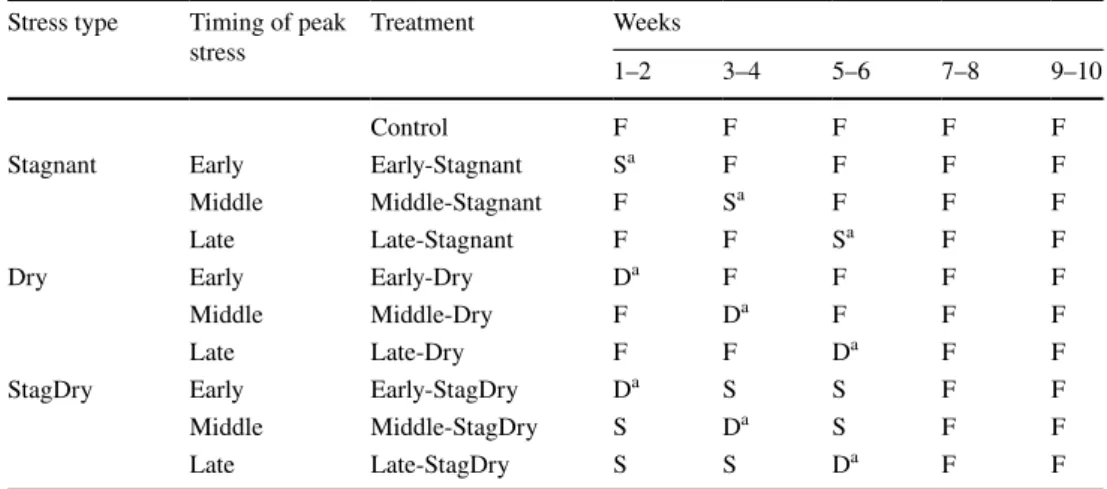
In these microcosms we recreated three different con-ditions that leaves could be subjected to in drying water-courses: areas with flowing water, stagnant water and dry beds. Flowing water was simulated by aerating the water in the microcosms by means of an air pump, stagnant water by maintaining the microcosms without aeration and dry bed by removing the superficial water from the micro-cosms. Combining these conditions and their sequence, we created ten treatments: one was constantly aerated for 6 weeks, and was considered the non-stress Control (Table 1). The other nine treatments were arranged in three groups of drought-related stress conditions and differed in the timing of peak stress. In the Stagnant stress condition, microcosms were subjected to 2 weeks of non-aeration during the 6-week period (three treatments, with non-aeration in the initial (early-Stagnant, the first 2 weeks), middle (middle-Stagnant, weeks 3 and 4) and late (late-Stagnant, weeks 5 and 6) stages, respectively). In the Dry stress condition, microcosms were subjected to 2 weeks of dry conditions during the 6-week period (three treat-ments, with dry conditions in the initial (early-Dry), mid-dle (midmid-dle-Dry) and late (late-Dry) stages, respectively). The StagDry stress condition combined both stagnation
and drying, and microcosms were subjected to 2 weeks of dry conditions and 4 weeks of non-aeration (three treat-ments, with dry conditions in the initial (early-StagDry), middle (middle-StagDry) and late (late-StagDry) stages, respectively). After these experimental weeks (6 weeks in total), the study was extended by four recovery weeks, during which all microcosms were kept with aerated water, which simulated flow resumption.
During the 10 weeks, microcosms were kept at 6 °C, with a 12:12 h light regime, common winter conditions in the region. In beakers with water, temperature and dis-solved oxygen concentration were measured twice a week and water was changed every week to avoid the accumula-tion of potentially toxic substances. Water for renewal was brought from the Agüera Stream every week and filtered through 100 µm pore size Nytal mesh (Sefar Nytal PA-13, Sefar Maissa, S.A.U., Cardedeu, Spain) to remove organic matter. It must be noted that this mesh size can exclude the largest conidia, but that the most abundant microbial inocula can go through. Adding new spores to microcosms probably homogenized fungal assemblages and made it difficult to detect the disappearance of sensitive taxa, but we aimed to recreate conditions in streams, where new spores arrive when flow is resumed. Every 2 weeks we sacrificed five replicate microcosms per treatment to meas-ure fungal biomass, sporulation rates of fungi, microbial respiration and microbial decomposition of alder disks (five microcosms per treatment per date × 10 treatments × 5 dates = 250 microcosms). On each sampling date, five of the disks in each microcosm (containing a total of ten disks) were used to determine respiration rate and ergos-terol content subsequently, and the other five to estimate sporulation rates. All disks were used to measure mass loss of alder leaf disks as proxy for microbial leaf litter decomposition.
Table 1 Experimental treatments as a function of type and timing of stress
All variables were measured after each 2-week period
F flowing water (aerated water), S stagnant water (non-aerated water), D drought (dry)
a Peak stress. Note that all treatments were subjected to aerated water during the last 4 weeks
Stress type Timing of peak
stress Treatment Weeks1–2 3–4 5–6 7–8 9–10 Control F F F F F Stagnant Early Early-Stagnant Sa F F F F
Middle Middle-Stagnant F Sa F F F
Late Late-Stagnant F F Sa F F
Dry Early Early-Dry Da F F F F
Middle Middle-Dry F Da F F F
Late Late-Dry F F Da F F
StagDry Early Early-StagDry Da S S F F
Middle Middle-StagDry S Da S F F
Fungal biomass
Fungal biomass was estimated as ergosterol content in disks, which is the main component of fungal cell membrane as well as one of the best descriptors of metabolically active fungal biomass (Gessner and Schmitt 1996; Charcosset and Chauvet 2001; Abelho 2009). From each microcosm, five disks out of ten were frozen at − 80 °C after being used to measure respiration (see below). Frozen samples were lyo-philized and weighed to obtain dry mass (DM). Lipids were extracted by incubating lyophilized samples with 0.14 M KOH in methanol at 80 °C for 30 min in a shaking bath. Ergosterol was separated and concentrated by solid-phase extraction (Waters Sep-Pack® Vac RC, 500 mg, tC18;
Gess-ner and Schmitt 1996) and quantified through high-pressure liquid chromatography (HPLC, Waters). HPLC system consisted of one pump, injector, column (Licrospher 100 RP-18, 25 cm, Merck), UV detector and a recording unit. Chromatograms were set as follows: 100% mobile phase (100% methanol), flow rate of 1.4 mL min−1, column
tem-perature at 33 °C, detection wavelength at 282 nm and injec-tion volume of 10 µL. Ergosterol was quantified based on the comparison with ergosterol standards (1–100 µg mL−1,
98% purity ergosterol, Fluka). Results were expressed as µg ergosterol g−1 DM.
Sporulation
To measure fungal sporulation (i.e. reproductive activity of spore-producing fungi, mainly aquatic hyphomycetes), the other five disks were incubated in 100-mL Erlenmeyer flasks with 25 mL filtered stream water (0.7 µm pore size glass fiber filters, Whatman GF/F, Whatman International Ltd., Maidstone, England) on an orbital shaker (60 rpm; Multitron II, INFORS HT, Bottmingen, Switzerland) for 48 h at 10 °C (Bärlocher 2005). Conidial suspensions were decanted to 50-mL centrifuge tubes and 2 mL of 37% formalin were added to fix conidia. Distilled water was added up to 35 mL. The suspensions were stirred to ensure a uniform distribu-tion, and an aliquot (between 1 and 20 mL) was filtered (5 µm pore size mixed cellulose filters, Millipore SMWP). Filters were stained with Cotton Blue in lactic acid (0.05%) and conidia identified and counted under a bright field Leica microscope (a minimum of 300 conidia counted or 0.09 cm2
of surface viewed). Disks were lyophilized and weighed, and sporulation rates were expressed as number of conidia released µg−1 DM day−1.
Respiration
Microbial respiration rates were measured using a closed six-channel dissolved oxygen measuring system (Strathkelvin 928 System, Strathkelvin Instruments,
Motherwell, U.K). Oxygen electrodes were calibrated with a solution of 2% sodium sulfite in 0.01 M sodium borate (0% O2), and 100% O2 saturated distilled water.
Five disks per microcosm were incubated together in chambers with 3 mL 100% O2 saturated filtered stream water (0.7 µm pore size glass fiber filters, Whatman GF/F, Whatman International Ltd., Maidstone, Eng-land) homogenized with a magnetic stirring bar (10 °C, 40 min). Chambers without disks were used as a control for oxygen depletion in the water. Oxygen consumption rates were calculated by subtracting the oxygen consump-tion in the control chamber over a 20-min interval from the consumption in the chamber with the sample. Results were expressed as mg O2 g−1 DM h−1.
Leaf litter mass remaining
Microbial leaf litter decomposition was expressed as the per-centage of leaf mass lost during the microcosm experiment. Five out of the 255 10-disk groups incubated in the stream for 1 week were carried to the laboratory, immediately lyo-philized and weighed to correct for leaf mass lost during the colonization period in the stream. Remaining mass in each microcosm was calculated by summing up DM of the ten disks after lyophilization and was expressed as percentage of initial mass.
Data treatment
The total amount of ergosterol (µg), the cumulative spore production (spores) and the cumulative oxygen consump-tion (mg O2) were calculated following Gessner and Chau-vet (1997): ergosterol concentration (µg g−1 DM) in each
beaker was multiplied by the remaining DM (g DM) in that beaker and we analyzed when the maximum amount of ergosterol occurred in each treatment; sporulation (conidia µg−1 DM day−1) and respiration (mg O
2 g−1
DM h−1) rates measured in each microcosm were also
multiplied by the remaining mass (g DM), and these rates (conidia day−1 and mg O
2 h−1) were scaled to the duration
of the experiment, assuming the mean rate per treatment and sampling date remained constant during the previous and posterior 7 days, to obtain, respectively, the total amount of spores produced (conidia) and the total amount of oxygen consumed (mg O2).
For data analysis, we computed log transformed Treat-ment/Control ratios (T/C) for all studied variables. The effect of stress type and timing of peak stress were analyzed using data measured at the end of the experimental phase (week 6) and during the recovery phase (weeks 8 and 10) indepen-dently, by means of a two-way ANOVA, with both stress type (Stagnant, Dry, StagDry) and timing (early, middle, late) as fixed factors. Interaction between both factors was
not significant in any of the analyses and, therefore, was removed from all two-way ANOVAs. Post-hoc Tukey HSD tests were performed when ANOVAs yielded significant dif-ferences. To search for general differences in conidial assem-blages, a non-metric multidimensional scaling (nMDS) was also performed based on the Bray-Curtis dissimilarity matrix, followed by a PERMANOVA (106 permutations) to
test the differences along time and among stress types, tim-ing and treatments. Linear regressions were used to test the relationship between mean ergosterol concentration during the experiment, the cumulative sporulation, the cumulative respiration, and the remaining mass of alder disks at the end of the experiment. All statistical analyses were conducted using R statistical software (version 3.0.2; R Core Team, 2014; Vienna, Austria).
Results
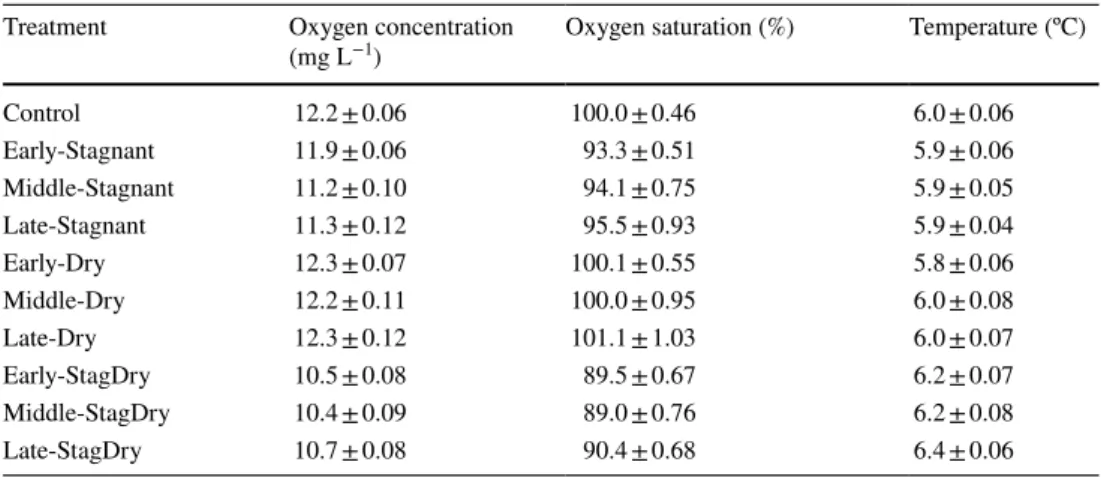
Lack of aeration caused small but statistically significant (F1,449 = 159.9, P < 0.0001) reduction in oxygen concentra-tion: the minimum concentration and saturation measured in non-aerated microcosms were, respectively, 10.3 mg L−1
and 85%, whereas they were 12.0 mg L−1 and 100% in
aer-ated ones. Overall, the mean concentration and saturation of dissolved oxygen during the whole experiment were, respectively, around 11.5 mg L−1 and 95% in all treatments
(Table 2). Similarly, temperature of water without aeration was higher (F1,426 = 50.95, P < 0.0001) and the mean tem-perature during the experiment was slightly higher in treat-ments within the StagDry stress type (6.3 °C) than in the rest of the treatments (5.9 °C).
Fungal biomass
Ergosterol concentration in the Control treatment ranged between 87 and 340 µg g−1 DM, whereas the lowest
(77 µg g−1 DM) and highest (531 µg g−1 DM) values of
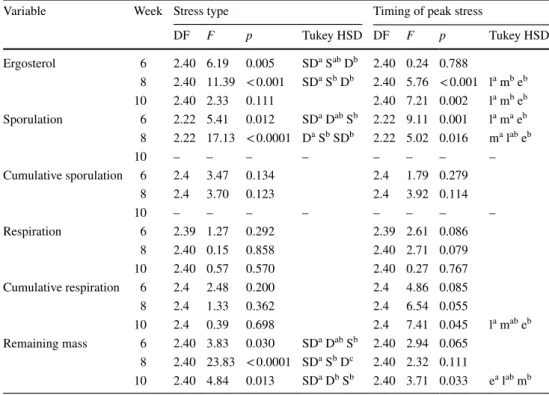
ergosterol concentration were measured in week 2 of early-Dry treatment and week 8 of late-StagDry treatment, respectively (Fig. 1). Ergosterol concentration measured at the end of the experimental phase (week 6) was highest in Control microcosms, but these differences were small. How-ever, there were significant differences among stress types (P = 0.005; Table 3), even though they did not follow the stress gradient: ergosterol content was lowest in disks that were only subjected to two weeks of dry conditions (Dry stress condition), highest in leaves subjected to a combina-tion of drying and non-aeracombina-tion (StagDry stress condicombina-tion) and intermediate in leaves subjected only to non-aeration (Stagnant stress condition). The timing of peak stress did not affect ergosterol concentration measured in week 6 (P = 0.788; Table 3).
Subjecting all treatments to aerated water during weeks 7 and 8 stimulated fungal growth in treatments combining dry periods with non-aeration (StagDry; Fig. 1). Therefore, ergosterol content measured in week 8 showed similar pat-terns to the ones observed in week 6, but greater differences among stress types (P < 0.001; Table 3), with ergosterol con-tent in treatments within StagDry stress condition being even higher than in the Control treatment. Flow resumption also revealed significant differences among timings, and treat-ments with peak stress in the late stage showed a higher ergosterol concentration than the ones with peak stress in earlier stages (P < 0.001; Table 3). At the end of the experi-ment, ergosterol concentration was higher than in Control microcosms in almost all treatments. Differences among timings remained at week 10 (P = 0.002), whereas the ones among stress types disappeared (P = 0.111; Table 3). The peak of the total amount of ergosterol was highest in the StagDry stress condition (20.4–23.9 µg; Table 4) and was measured after subjecting disks to aerated water (week 8), whereas in the Control treatment and in the Stagnant stress condition it only reached 15.6 µg and occurred at the
Table 2 Mean ± standard error concentration (mg L−1) and
saturation (%) of dissolved oxygen, and water temperature (ºC) measured during the experiment for each treatment
n = 54 for Control and Stagnant treatments and n = 30 for Dry and StagDry treatments Treatment Oxygen concentration
(mg L−1) Oxygen saturation (%) Temperature (ºC)
Control 12.2 ± 0.06 100.0 ± 0.46 6.0 ± 0.06 Early-Stagnant 11.9 ± 0.06 93.3 ± 0.51 5.9 ± 0.06 Middle-Stagnant 11.2 ± 0.10 94.1 ± 0.75 5.9 ± 0.05 Late-Stagnant 11.3 ± 0.12 95.5 ± 0.93 5.9 ± 0.04 Early-Dry 12.3 ± 0.07 100.1 ± 0.55 5.8 ± 0.06 Middle-Dry 12.2 ± 0.11 100.0 ± 0.95 6.0 ± 0.08 Late-Dry 12.3 ± 0.12 101.1 ± 1.03 6.0 ± 0.07 Early-StagDry 10.5 ± 0.08 89.5 ± 0.67 6.2 ± 0.07 Middle-StagDry 10.4 ± 0.09 89.0 ± 0.76 6.2 ± 0.08 Late-StagDry 10.7 ± 0.08 90.4 ± 0.68 6.4 ± 0.06
beginning of the experiment (week 2). The peak of the total amount of ergosterol, as well as the stage when it occurred, were more variable in the Dry stress condition (Table 4).
Sporulation
In total, 20 hyphomycete taxa were identified, but only 6 appeared in all treatments and sampling dates, accounting 9 3 0.3 0.1 16 Stagnant 0 Early 0 Middle
•
Late•
~;
--t-
1
-~ __
Q_
_
Dry---4---~--~-
ij
W
0f
StagDry-
--~-~-J-
4
f
~
-
t
-
-t
-
-+
---t
4 ~ ~ ~ -2 0.25 - ' - - - , - - - ~ ~ - - - ' - ' - - - , - - - ~ 2 ~ ~ ~-2
4
@@@2
4 @ @ @ 2 4@®@
for more than 95% of the conidia in every sample:
Alato-spora acuminata Ingold, AnguilloAlato-spora filiformis
Great-head, Anguillospora sp., Articulospora tetracladia Ingold,
Crucella subtilis Marvanová & Suberkropp and Flagel-lospora curvula Ingold. Although the conidial
assem-blage changed significantly over time (PERMANOVA:
pseudoF3,80 = 0.14, P < 0.0001), these changes were not consistent among stress types, as shown by statis-tically significant interactions between stress type and time (PERMANOVA: pseudoF9,104 = 0.13, P < 0.0001), and were mainly driven by the occurrence of rare taxa in isolated samples. Changes in assemblages during non-aeration or dry periods were minor, and no taxa prolifer-ated or disappeared in these conditions. Mean sporula-tion rates in the Control treatment decreased from 0.74 conidia µg−1 DM day−1 on the first sampling date to 0.10
conidia µg−1 DM day−1 on the last one. Sporulation also
showed a decreasing trend in the Stagnant stress condi-tion, decreasing to 0.05 conidia µg−1 DM day−1 in
early-Stagnant microcosms, whereas rates were more variable in Dry and StagDry stress conditions and showed mini-mum and maximini-mum values at different stages. Therefore, even if sporulation rates differed significantly among stress types, these differences were not consistent at dif-ferent sampling dates and did not support our hypotheses: sporulation in the StagDry stress condition was highest in week 6, while it was lowest in week 8 (Table 3; Fig. 1). The total production of spores was not affected by the stress type (P = 0.086), even though fungi in the Dry stress condition produced 50% more conidia than the ones in the Stagnant and StagDry stress conditions (Table 4). On the contrary, the timing of peak stress significantly influenced sporulation rates and, as hypothesized, treat-ments subjected to stress in the initial stage showed lower rates in week 6 (P = 0.001), differences being similar in week 8, after flow resumption (P = 0.016; Table 3).
Respiration
Mean respiration rates in the Control treatment decreased from 0.275 mg O2 g−1 DM h−1 on the first sampling date
to 0.183 mg O2 g−1 DM h−1 on the last date. Variability in
respiration rates was relatively high and we did not detect any consistent pattern relative to the stress type or timing of peak stress (Fig. 1), differences being statistically non-significant in all cases (P > 0.05; Table 3). Stress type did not affect the total amount of oxygen consumed either by the end of the experimental phase (week 6; P = 0.200) or by the end of the recovery phase (week 10; P = 0.698; Table 3), even though total oxygen consumption was highest in the Dry stress condition and lowest in the StagDry stress condition (Table 4). Nevertheless, microbial communities perturbed in the late and initial experimental stages consumed the highest and lowest amount of oxygen, respectively, these differences being statistically significant by the end of the experiment (week 10; P = 0.045; Table 3).
Leaf litter mass remaining
Alder leaf disks in the Control treatment lost, on average, 25% of their initial DM, decomposition mainly occurring during the first 6 weeks. Microbial decomposition of alder disks in treatments within Stagnant stress condition was sim-ilar to that in the Control treatment (Fig. 1), and significantly higher than in Dry and StagDry stress conditions (P = 0.030; Table 3). Although microbial decomposition of alder disks in late-Stagnant and middle-Stagnant treatments tended to be higher than in early-Stagnant, overall, differences did not achieve statistical significance (P = 0.065), probably because timing did not affect mass loss in the other stress types, espe-cially in the StagDry condition (Fig. 1). Flow resumption accelerated microbial litter decomposition in the Dry stress condition and by the end of the experiment leaf disks within Stagnant and Dry stress conditions lost, on average, around 25% of their initial DM, similar to Control microcosms. Sub-jecting treatments within StagDry stress condition to aerated water did not counterbalance the reduction of microbial lit-ter decomposition due to the first 6-week period, and disks only lost 10–15% of the initial DM (P = 0.013; Table 3). Flow resumption also revealed differences among timings, microbial decomposition of alder leaf disks being lowest in treatments disturbed in the initial stage and highest in the ones disturbed in the medium stage (P = 0.033).
The remaining mass of alder leaf disks at the end of the experiment was significantly related only to the cumulative respiration (R2 = 0.40, P = 0.048), where the higher the
oxy-gen consumption, the lower the remaining mass. Among all the other possible regressions, only the one between mean ergosterol concentration and cumulative respiration was sta-tistically significant (R2 = 0.56, P = 0.012).
Fig. 1 Treatment/Control (T/C) ratios of ergosterol concentra-tion (row 1), sporulaconcentra-tion rates (row 2), respiraconcentra-tion rates (row 3) and remaining mass of alder disks (row 4) measured every 2 weeks for treatments with Stagnant (column 1), Dry (column 2) and StagDry (column 3) stress conditions and with peak stress occurring in the early (white), middle (grey) and late (black) experimental stages. Note that the y-axis is log-transformed and the 1 line indicates a T/C ratio of 1 (T = C), values above 1 indicating T > C and values below 1 indicating T < C. Within each treatment, results obtained after being subjected to peak stress are shown with stars. Circles in the x-axis indicate the results used for statistical analysis and shown in Table 3. Note that all treatments were subjected to aerated water during weeks 7–10. Error bars show the standard error. Differences among stress types were not consistent, but early impacts tended to be more detri-mental than impacts at a later stage
Discussion
We hypothesized dry conditions would have a stronger effect than the lack of aeration on the microbial commu-nity and microbial leaf litter decomposition. However, differences among drought-related stress types in our experiment had no consistent effects on most measured response variables. Our experimental conditions had little effect on aquatic hyphomycete assemblages and seemed
neither to benefit nor to lead any taxa to extinction, with six taxa always accounting for more than 95% of the conidia. In addition, although microbial variables, both structural (biomass and structure of fungal assemblages) and functional (rates of fungal sporulation and microbial respiration), showed significant differences at the end of the experimental phase, these effects did not follow the expected stress gradient, neither did the different variables show a common ranking among stress types.
Table 3 Statistical results of response variables to stress type and timing
S stagnant, D dry, SD StagDry, e early, m middle, l late
Post hoc Tukey HSD tests were only performed when the two-way ANOVA yielded significant differences. Letters are ranked from highest (a) to lowest (b) values
Variable Week Stress type Timing of peak stress
DF F p Tukey HSD DF F p Tukey HSD Ergosterol 6 2.40 6.19 0.005 SDa Sab Db 2.40 0.24 0.788 8 2.40 11.39 < 0.001 SDa Sb Db 2.40 5.76 < 0.001 la mb eb 10 2.40 2.33 0.111 2.40 7.21 0.002 la mb eb Sporulation 6 2.22 5.41 0.012 SDa Dab Sb 2.22 9.11 0.001 la ma eb 8 2.22 17.13 < 0.0001 Da Sb SDb 2.22 5.02 0.016 ma lab eb 10 – – – – – – – – Cumulative sporulation 6 2.4 3.47 0.134 2.4 1.79 0.279 8 2.4 3.70 0.123 2.4 3.92 0.114 10 – – – – – – – – Respiration 6 2.39 1.27 0.292 2.39 2.61 0.086 8 2.40 0.15 0.858 2.40 2.71 0.079 10 2.40 0.57 0.570 2.40 0.27 0.767 Cumulative respiration 6 2.4 2.48 0.200 2.4 4.86 0.085 8 2.4 1.33 0.362 2.4 6.54 0.055 10 2.4 0.39 0.698 2.4 7.41 0.045 la mab eb Remaining mass 6 2.40 3.83 0.030 SDa Dab Sb 2.40 2.94 0.065 8 2.40 23.83 < 0.0001 SDa Sb Dc 2.40 2.32 0.111 10 2.40 4.84 0.013 SDa Db Sb 2.40 3.71 0.033 ea lab mb
Table 4 The peak of the total amount of ergosterol and when it occurred for each treatment. Mean oxygen consumption and spore production at the end of the experimental phase (week 6) and recovery phase (week 10, week 8 in the case of cumulative sporulation)
Min and max values per variable are in bold
Treatment Peak ergosterol Cum. sporulation (spores
× 106) Cum. respiration (mg O 2)
Week µg Week 6 Week 8 Week 6 Week 10 Control 6 15.55 0.89 1.00 11.85 18.88 Early-Stagnant 2 14.83 0.71 0.74 11.43 17.75 Middle-Stagnant 2 15.55 1.08 1.25 11.35 19.25 Late-Stagnant 2 15.55 0.89 1.01 11.93 19.05 Early-Dry 4 14.36 1.34 1.47 10.09 16.79 Middle-Dry 2 15.55 1.42 1.86 12.65 19.45 Late-Dry 8 18.19 0.95 1.20 12.83 21.34 Early-StagDry 8 20.41 0.53 0.67 9.46 17.47 Middle-StagDry 8 20.46 0.92 1.31 10.74 18.42 Late-StagDry 8 23.91 0.90 1.24 11.56 19.65
These results probably reflect that the stress range we recreated was small. Indeed, pool isolation and water stagna-tion are known to alter water physico-chemical properties, enhancing the accumulation of organic matter, concentrat-ing nutrients and potentially toxic leachates, increasconcentrat-ing water temperature and often resulting in hypoxic conditions (Lake 2003; Canhoto and Laranjeira 2007), which strongly affect microbial communities and processes (Foulquier et al. 2014). The conditions in our experimental treatments were less harsh, as a consequence of weekly water renewal, supply of new conidia and the fact that the experiment was per-formed in close systems at constant temperature, contrasting with the higher temperature commonly observed in isolated pools (Boulton 2003; Muñoz 2003). The effect of non-aera-tion in our microcosms was biologically irrelevant even on oxygen concentration, although it can be extremely strong in the field (Acuña et al. 2005) and severely impair aquatic fungi (Medeiros et al. 2009). Other effects of aeration might remain important in our experiment, namely turbulence, which increases the probability of a spore to colonize leaf litter, promotes nutrient renewal and decreases the concen-tration of potentially toxic exudates close to the microbial community (Schlief and Mutz 2007; Canhoto et al. 2013). Still, results obtained in non-aerated treatments, especially in treatments impacting middle (middle-Stagnant) and late (late-Stagnant) stages, were very similar to those in Con-trol microcosms. It is likely that the effects of non-aeration would be stronger if they had resulted in more severe anoxia, as has often been reported for drying streams (Acuña et al. 2005). The stress level simulated in our experiment might be compared to pools that are constantly disconnecting and reconnecting to the main oxygenated channel.
Drying has also been shown to alter the structure and activity of microbial assemblages, and slow down the decomposition of organic matter stranded in emerged sedi-ments (Romaní et al. 2012; Mora-Gómez et al. 2016). Nev-ertheless, most studies are focused on summer droughts characterized by high temperatures and very dry air condi-tions (Ylla et al. 2010; Vázquez et al. 2011), whereas tem-perature in our chamber was low and the atmosphere very humid. These conditions could lead to underestimation of the effects of natural summer droughts, but could also reflect better human-induced drying events in humid regions (e.g. caused by water abstraction) and, thus, could contribute to better understanding of the impacts of such drying events. As a result, alder leaf disks did not completely dry up and, because aquatic fungi are able to persist in moist substrata (Sanders and Webster 1978; Sridhar and Bärlocher 1993; Chauvet et al. 2015), fungal activity (i.e. sporulation and respiration) in our microcosms recovered quickly after rewetting, as has been described elsewhere (Langhans and Tockner 2006). One of the key factors that help fungi per-sist under these conditions is the thickness of their cell wall
(Schimel et al. 2007), which could explain why we measured the highest ergosterol concentration in treatments combining stagnation and dry conditions (StagDry). Our results agree with those from Bruder et al. (2011) that showed severe drying (oven-drying) has long-term consequences on fungal communities, whereas the effects of less severe desiccation, more similar to natural conditions in streams, were not sig-nificant. It is also likely that our experiment underestimated the effects of pool isolation and drying, as other factors such as abrasion and fragmentation by macroinvertebrates, which are important in organic matter decomposition (Graça 2001; Hieber and Gessner 2002), are strongly affected by flow reduction (Acuña et al. 2005; Arroita et al. 2015).
Concerning the relationship between variables, microbial mass loss of alder leaves was not related to mean ergosterol concentration in our study. Although many studies reported that fungi contributed to more than 98% to the microbial bio-mass measured as ergosterol concentration and emphasized the greater role of fungi than bacteria in litter decomposi-tion (Baldy et al. 1995; Gulis and Suberkropp 2003; Pascoal et al. 2005), Mille-Lindblom et al. (2004) highlighted that ergosterol should be used cautiously as a biomarker for liv-ing fungi because it can be stable even when associated with dead fungi. Some studies also found a strong relationship between sporulation and ergosterol concentration and lit-ter decomposition (Pascoal and Cássio 2004), whereas oth-ers reported sporulation not to be related to these variables (Lecerf and Chauvet 2008; Martínez et al. 2014), as in our case. Taxa from several fungal phyla as well as thousands of species of bacteria and archea are able to colonize leaf litter (Nikolcheva and Bärlocher 2004; Manerkar et al. 2008), all of which do not produce conidia. Moreover, species with high reproductive activity are not always the ones producing more biomass (Duarte et al. 2006) and fungal involvement in leaf decomposition is reflected by the active mycelia, not the conidia. In fact, the remaining mass of alder leaf disks at the end of the experiment was significantly related only to the cumulative respiration, as has been shown elsewhere (Gulis and Suberkropp 2003), because it integrates the activ-ity of the whole microbial communactiv-ity involved in leaf lit-ter decomposition. Therefore, cumulative respiration of the microbial community may be a better proxy of microbial leaf litter decomposition than ergosterol or sporulation, which provide important but partial information.
Overall, the measured variables differed in their sensitiv-ity to stress. Despite the small differences and the lack of consistent patterns in fungal biomass, sporulation or respi-ration, microbial decomposition of alder disks was signifi-cantly reduced in the StagDry stress condition, thus showing a pronounced effect of lack of aeration and dry conditions. In our study, microbial decomposition rate of alder disks was more sensitive than the microbial variables to differences among stress types, likely because it integrated all processes
occurring during the whole experiment, i.e. the last outcome reflects the integration of the entire sequence. In contrast, results obtained with the rest of the variables could be con-sidered instantaneous pictures of microbial assemblages at definite times, because biomass, sporulation and respiration measurements relied on punctual determinations related to the status of microbial assemblages at specific, discrete times and, thus, could be noisier. Although cumulative spore production and oxygen consumption also integrate the whole experiment, these estimates could be biased, as they were calculated from data obtained in six sampling dates, assuming constant rates during 2 weeks. Even though the significant relationship between total oxygen consumption and microbial alder decomposition suggests that cumulative microbial respiration could be an appropriate surrogate, sta-tistical power was lost as averages per sampling were used to estimate cumulative oxygen consumption.
As expected, the drying history affected microbial activ-ity irrespective of the stress type; early impacts tended to be more detrimental than impacts at a later stage, result-ing, in general, in a lower fungal biomass and activity, and reduced microbial litter decomposition. The consistency of our results shows that the legacy effects of stress affect the assemblages even after they return to more benign condi-tions. Therefore, the impacts of stress on leaf decomposi-tion-associated variables depend not only on the duration of stress, but also on that of post-stress periods and, thus, on the timing of the stress. In particular, the effects of drought on leaf litter decomposition can start as early as in the pre-conditioning phase (Dieter et al. 2011, 2013) and persist during the whole process (Datry et al. 2011; Martínez et al. 2015). These results could also apply to other ecological processes showing a clear succession of steps in which the last outcome integrates the processes occurring in the entire sequence. For instance, the biomass produced by an ecosys-tem would be more affected by disturbances occurring early than late in the year. Therefore, the timing of an impact can be as relevant as its intensity or frequency, emphasizing the hydrological contingency.
Acknowledgements This work was supported by the Spanish
Min-istry of Economy and Competitiveness and FEDER through the ABSTRACT project CGL2012-35848, and the Basque Government (IT302-10). Thanks to Sylvain Lamothe, Didier Lambrigot and Gorka Oyarzun for assisting in field and laboratory work. We also acknowl-edge financial support in terms of pre-doctoral and post-doctoral grants from the Basque Government (M. Arroita). We thank the comments by the editor and referees that enhanced the quality of the paper.
References
Abelho M (2001) From litterfall to breakdown in streams: a review. Sci World J 1:656–680
Abelho M (2009) ATP and ergosterol as indicators of fungal biomass during leaf decomposition in streams: a comparative study. Int Rev Hydrobiol 94:3–15
Abril M, Muñoz I, Casas-Ruiz JP, Gómez-Gener L, Barceló M, Oliva F, Menéndez M (2015) Effects of water flow regulation on eco-system functioning in a Mediterranean river network assessed by wood decomposition. Sci Total Environ 517:57–65
Acuña V, Muñoz I, Giorgi A, Omella M, Sabater F, Sabater S (2005) Drought and postdrought recovery cycles in an intermittent Mediterranean stream: structural and functional aspects. J N Am Benthol Soc 24:919 – 933
Allan JD, Castillo MM (2007) Stream ecology. Springer, The Netherlands
Arroita M, Aristi I, Díez J, Martínez M, Oyarzun G, Elosegi A (2015) Impact of water abstraction on storage and breakdown of coarse organic matter in mountain streams. Sci Total Environ 503/504:233–240
Artigas J, Gaudes A, Muñoz I, Romani AM, Sabater S (2011) Fungal and bacterial colonization of submerged leaf litter in a Mediter-ranean stream. Int Rev Hydrobiol 96:221–234
Baldy V, Gessner MO, Chauvet E (1995) Bacteria, fungi and the break-down of leaf litter in a large river. Oikos 74:93–102
Bärlocher F (2005) Sporulation by aquatic hyphomycetes. In: Graça MAS, Bärlocher F, Gessner MO (eds) Methods to study litter decomposition: a practical guide. Springer, The Netherlands, pp 185–188
Bärlocher F (2009) Reproduction and dispersal in aquatic hyphomy-cetes. Mycoscience 50:3–8
Bärlocher F, Kendrick B (1975) Leaf-conditioning by microorganisms. Oecologia 20:359–362
Boulton AJ (2003) Parallels and contrasts in the effects of drought on stream macroinvertebrate assemblages. Freshw Biol 48:1173–1185
Bruder A, Chauvet E, Gessner MO (2011) Litter diversity, fungal decomposers and litter decomposition under simulated stream intermittency. Funct Ecol 25:1269–1277
Canhoto C, Laranjeira C (2007) Leachates of Eucalyptus globulus in intermittent streams affect water parameters and invertebrates. Int Rev Hydrobiol 92:173–182
Canhoto C, Calapez R, Gonçalves AL, Moreira-Santos M (2013) Effects of Eucalyptus leachates and oxygen on leaf-litter process-ing by fungi and stream invertebrates. Freshw Sci 32:411–424 Charcosset JY, Chauvet E (2001) Effect of culture conditions on
ergos-terol as an indicator of biomass in the aquatic hyphomycetes. Appl Environ Microb 67:2051–2055
Chauvet E, Cornut J, Sridhar KR, Selosse MA, Bärlocher F (2015) Beyond the water column: aquatic hyphomycetes outside their preferred habitat. Fungal Ecol. https ://doi.org/10.1016/j.funec o.2015.05.014
Corti R, Datry T, Drummond L, Larned S (2011) Natural variation in immersion and emersion affects breakdown and invertebrate colo-nization of leaf litter in a temporary river. Aquat Sci 73:537–550 Datry T, Corti R, Claret C, Philippe M (2011) Flow intermittence con-trols leaf litter breakdown in a French temporary alluvial river: the “drying memory”. Aquat Sci 73:471–483
Dieter D, von Schiller D, García-Roger EM, Sánchez-Montoya MM, Gómez R, Mora-Gómez J, Sangiorgio F, Gelbrecht J, Tockner K (2011) Preconditioning effects of intermittent stream flow on leaf litter decomposition. Aquat Sci 73:599–609
Dieter D, Frindte K, Krüger A, Wurzbacher C (2013) Preconditioning of leaves by solar radiation and anoxia affects microbial colonisa-tion and rate of leaf mass loss in an intermittent stream. Freshw Biol 58:1918–1931
Duarte S, Pascoal C, Cássio F, Bärlocher F (2006) Aquatic hypho-mycete diversity and identity affect leaf litter decomposition in microcosms. Oecologia 147:658–666
Duarte S, Pascoal C, Alves A, Correia A, Cássio F (2010) Assessing the dynamic of microbial communities during leaf decomposition in a low-order stream by microscopic and molecular techniques. Microbiol Res 165:351–362
Elosegi A, Basaguren A, Pozo J (2002) Ecology of the Agüera: a review of fourteen years of research in a Basque stream. Munibe 53:15–38
Elosegi A, Basaguren A, Pozo J (2006) A functional approach to the ecology of Atlantic Basque streams. Limnetica 25:123–134 Farooq M, Wahid A, Kobayashi N, Fujita D, Basra SMA (2009) Plant
drought stress: effects, mechanisms and management. Agron Sus-tain Dev 29:185–212
Foulquier A, Dehedin A, Piscart C, Montuelle B, Marmonier P (2014) Habitat heterogeneity influences the response of microbial com-munities to severe low-flow periods in alluvial wetlands. Freshw Biol 59:463–476
Foulquier A, Artigas J, Pesce S, Datry T (2015) Drying responses of microbial litter decomposition and associated fungal and bacterial communities are not affected by emersion frequency. Freshw Sci.
https ://doi.org/10.1086/68206 0
Gessner MO, Chauvet E (1994) Importance of stream microfungi in controlling breakdown rates of leaf litter. Ecology 75:1807–1817 Gessner MO, Chauvet E (1997) Growth and production of aquatic
hyphomycetes in decomposing leaf litter. Limnol Oceanogr 42:496–505
Gessner MO, Schmitt L (1996) Use of solid-phase extraction to deter-mine ergosterol concentrations in plant tissue colonized by fungi. Appl Environ Microb 62:415–419
Gessner MO, Chauvet E, Dobson M (1999) A perspective on leaf litter breakdown in streams. Oikos 85:377–384
Gessner MO, Swan CM, Dang CK, McKie BG, Bardgett RD, Wall DH, Hättenschwiler S (2010) Diversity meets decomposition. Trends Ecol Evol 25:372–380
Graça MAS (2001) The role of invertebrates on leaf litter decomposi-tion in streams—a review. Int Rev Hydrobiol 86:383–393 Gulis V, Suberkropp K (2003) Interactions between stream fungi and
bacteria associated with decomposing leaf litter at different levels of nutrient availability. Aquat Microb Ecol 30:149–157
Hieber M, Gessner MO (2002) Contribution of stream detrivores, fungi, and bacteria to leaf breakdown based on biomass estimates. Ecology 83:1026–1038
Hladyz S, Gessner MO, Giller PS, Pozo J, Woodward G (2009) Resource quality and stoichiometric constraints on stream eco-system functioning. Freshw Biol 54:957–970
Hladyz S, Abjörnsson K, Cariss H et al (2011) Stream ecosystem func-tioning in an agricultural landscape, the importance of terrestrial-aquatic linkages. Adv Ecol Res 44:211–276
IPCC (2014) Summary for policymakers. In: Field CB, Barros VR, Dokken DJ, Mach KJ, Mastrandrea MD, Bilir TE, Chatterjee M, Ebi KL, Estrada YO, Genova RC, Girma B, Kissel ES, Levy AN, MacCracken S, Mastrandrea PR, White LL (eds) Climate change 2014: impacts, adaptation, and vulnerability. Part A: global and sectoral aspects. Contribution of working group II to the fifth assessment report of the intergovernmental panel on climate change. Cambridge University Press, Cambridge, pp 1–32 Jones NE (2014) The dual nature of hydropeaking rivers: is ecopeaking
possible? Riv Res Appl 30:521–526
Lake PS (2003) Ecological effects of perturbation by drought in flow-ing waters. Freshw Biol 48:1161–1172
Langhans SD, Tockner K (2006) The role of timing, duration, and frequency of inundation in controlling leaf litter decomposition in a river-floodplain ecosystem (Tagliamento, north-eastern Italy). Oecologia 147:501–509
Larned ST, Datry T, Robinson CT (2007) Invertebrate and microbial responses to inundation in an ephemeral river: effects of preceding dry periods. Aquat Sci 69:554–567
Lecerf A, Chauvet E (2008) Diversity and functions of leaf-decaying fungi in human-altered streams. Freshw Biol 53:1658–1672 Lecerf A, Dobson M, Dang CK, Chauvet E (2005) Riparian plant
species loss alters trophic dynamics in detritus-based stream ecosystems. Oecologia 146:432–442
Manerkar MA, Seena S, Bärlocher F (2008) Q-RT-PCR for assess-ing archaea, bacteria, and fungi durassess-ing leaf decomposition in a stream. Microbial Ecol 56:467–473
Martínez A, Larrañaga A, Pérez J, Descals E, Pozo J (2014) Tem-perature affects leaf litter decomposition in low-order forest streams: field and microcosm approaches. FEMS Microbiol Ecol 87:257–267
Martínez A, Pérez J, Molinero J, Sagarduy M, Pozo J (2015) Effects of flow scarcity on leaf-litter processing under oceanic cli-mate conditions in calcareous streams. Sci Total Environ 503/504:251–257
Medeiros AO, Pascoal C, Graça MAS (2009) Diversity and activ-ity of aquatic fungi under low oxygen conditions. Freshw Biol 54:142–149
Mendoza-Lera C, Larrañaga A, Pérez J, Descals E, Martínez A, Moya O, Arostegui I, Pozo J (2012) Headwater reservoirs weaken ter-restrial-aquatic linkage by slowing leaf-litter processing in down-stream regulated reaches. Riv Res Appl 28:13–22
Mille-Lindblom C, von Wachenfeldt E, Tranvik LJ (2004) Ergosterol as a measure of living fungal biomass: persistence in environmental samples after fungal death. J Microbiol Methods 59:253–262 Milly PCD, Dunne KA, Vecchia AV (2005) Global pattern of trends in
stream flow and water availability in a changing climate. Nature 438:347–350
Mora-Gómez J, Elosegi A, Mas-Martí E, Romaní AM (2015) Factors controlling seasonality in leaf-litter breakdown in a Mediterranean stream. Freshw Sci. https ://doi.org/10.1086/68312 0
Mora-Gómez J, Elosegi A, Duarte S, Cássio F, Pascoal C, Romaní AM (2016) Differences in the sensitivity of fungi and bacteria to season and invertebrates affect leaf litter decomposition in a Medi-terranean stream. FEMS Microbiol Ecol. https ://doi.org/10.1093/ femse c/fiw12 1
Muñoz I (2003) Macroinvertebrate community structure in an intermit-tent and a permanent Mediterranean streams (NE Spain). Lim-netica 22:107–115
Nikolcheva LG, Bärlocher F (2004) Taxon-specific fungal primers reveal unexpectedly hight diversity during leaf decomposition in a stream. Mycol Prog 3:41–50
Pascoal C, Cássio F (2004) Contribution of fungi and bacteria to leaf litter decomposition in a polluted river. Appl Environ Microb 70:5266–5273
Pascoal C, Pinho M, Cássio F, Gomes P (2003) Assessing structural and functional ecosystem condition using leaf breakdown: studies on a polluted river. Freshw Biol 48:2033–2044
Pascoal C, Cássio F, Marcotegui A, Sanz B, Gomes P (2005) Role of fungi, bacteria, and invertebrates in leaf litter breakdown in a polluted river. J N Am Benthol Soc 24:784–797
Pérez J, Descals E, Pozo J (2012) Aquatic hyphomycete communities associated with decomposing alder leaf litter in reference head-water streams of the Basque Country (northern Spain). Microbial Ecol 64:279–290
Petersen RC, Cummins KW (1974) Leaf processing in a woodland stream. Freshw Biol 4:343–368
Riedl HL, Marczak LB, McLenaghan NA, Hoover TM (2013) The role of stranding and inundation on leaf litter decomposition in headwater streams. Riparian Ecol Conserv 1:3–10
Romaní AM, Amalfitano S, Artigas J, Fazi S, Sabater S, Timoner X, Ylla I, Zoppini A (2012) Microbial biofilm structure and organic matter use in Mediterranean streams. Hydrobiologia 719:43–58 Sanders PF, Webster J (1978) Survival of aquatic hyphomycetes in
Schimel JP, Balser TC, Wallenstein M (2007) Microbial stress-response physiology and its implications for ecosystem function. Ecology 88:1386–1394
Schlief J, Mutz M (2007) Response of aquatic leaf associated micro-bial communities to elevated leachate DOC. Int Rev Hydrobiol 92:146–155
Schlief J, Mutz M (2011) Leaf decay processes during and after a supra-seasonal hydrological drought in a temperate lowland stream. Int Rev Hydrobiol 96:633–655
Sridhar KR, Bärlocher F (1993) Aquatic hyphomycetes on leaf-litter in and near a stream in Nova Scotia, Canada. Mycol Res 97:1530–1535
Suberkropp K (2001) Fungal growth, production, and sporulation during leaf decomposition in two streams. Appl Environ Microb 67:5063–5068
Tank JL, Rosi-Marshall EJ, Griffiths NA, Entrekin SA, Stephen ML (2010) A review of allochthonous organic matter dynamics and metabolism in streams. J N Am Benthol Soc 29:118–146 Vázquez E, Amalfitano S, Fazi S, Butturini A (2011) Dissolved organic
matter composition in a fragmented Mediterranean fluvial system under severe drought conditions. Biogeochemistry 102:59–72 Webster JR, Benfield EF (1986) Vascular plant breakdown in
freshwa-ter ecosystems. Annu Rev Ecol Syst 17:567–594
Woodward G, Gessner MO, Giller PS et al (2012) Continental-scale effects of nutrient pollution on stream ecosystem functioning across Europe. Science 36:1438–1440
Ylla I, Sanpera-Calbet I, Vázquez E, Romaní AM, Muñoz I, Butturini A, Sabater S (2010) Organic matter availability during pre- and post-drought periods in a Mediterranean stream. Hydrobiologia 657:217–232