O
pen
A
rchive
T
OULOUSE
A
rchive
O
uverte (
OATAO
)
OATAO is an open access repository that collects the work of Toulouse researchers and
makes it freely available over the web where possible.
This is an author-deposited version published in :
http://oatao.univ-toulouse.fr/
Eprints ID : 18390
To link to this article : DOI: 10.1111/fwb.12557
URL :
http://dx.doi.org/10.1111/fwb.12557
To cite this version : Doledec, Sylvain and Castella, Emmanuel and
Forcellini, Maxence and Olivier, Jean-Michel and Paillex, Amael
and Sagnes, Pierre The generality of changes in the trait
composition of fish and invertebrate communities after flow
restoration in a large river (French Rhône). (2015) Freshwater
Biology, vol. 60 (n° 6). pp.1147-1161. ISSN 0046-5070
Any correspondence concerning this service should be sent to the repository
administrator:
[email protected]
The generality of changes in the trait composition of fish
and invertebrate communities after flow restoration in a
large river (French Rh^
one)
S Y L V A I N D O L "ED E C * , E M M A N U E L C A S T E L L A†
, M A X E N C E F O R C E L L I N I‡
, J E A N - M I C H E L O L I V I E R * , A M A E L P A I L L E X† , § , ¶A N D P I E R R E S A G N E S *,* *
*CNRS, UMR 5023, LEHNA, Biodiversit!e des Ecosyst"emes Lotiques, Universit!e Lyon 1, Villeurbanne, France †
Institute F.A. Forel and Institute for Environmental Sciences, University of Geneva, Geneva, Switzerland
‡
IRSTEA, UR MALY, Villeurbanne, France
§
Aquatic Ecology Group, Department of Zoology, University of Cambridge, Cambridge, U.K.
¶
EAWAG, Swiss Federal Institute of Aquatic Science and Technology, Dubendorf, Switzerland€ **ONEMA, P^ole !ecohydraulique, Institut de M!ecanique des Fluides de Toulouse, Toulouse, France
S U M M A R Y
1. A multiple-trait-based approach can provide predictions and interpretations of the responses of freshwater communities to river restoration that apply in different taxonomic contexts. We compared the observed and predicted effects of restoration on sets of traits in fish and invertebrate communi-ties in four reaches of the Rh^one River. Restoration included minimum flow increases in three bypassed main channels and the reconnection of eight floodplain channels.
2. Predictions (described in detail in three other articles in this Special Issue) were based on habitat models that related the density of modelled taxa to their physical habitats. We used trait information extracted from the literature to translate predicted taxonomic changes into predicted changes in traits. Observed changes in traits calculated for modelled taxa and for all taxa in the community were both compared to predictions.
3. In 10 of 12 cases, observed changes in traits correlated with predicted ones. With few exceptions, the agreement was higher for fish and invertebrates in the main channels than for invertebrates in floodplain channels. Predictions translated to the trait category level improved those at the taxo-nomic level in 5/6 and 4/6 cases for modelled taxa and all taxa, respectively. However, the improve-ment was statistically significant according to a null model for 1/6 and 3/6 cases for modelled taxa and all taxa, respectively.
4. The validation of trait predictions suggested that traits related to locomotion and attachment, as well as general biology and physiology, were particularly suited to predicting and understanding the effects of physical restoration. For example, after restoration, clingers and passive filter feeders domi-nated invertebrate communities in the main channels, whereas invertebrate communities in the flood-plain underwent a selection of traits frequent in running water (clingers, flattened shape and gill respiration). Within fish communities, the periodic life-history strategy that characterises fish species in downstream reaches (long life span, large body, late sexual maturity) increased with restoration, whereas the opportunistic strategy decreased.
5. Our results suggest that a better understanding of how hydraulics shapes traits in riverine systems is critically needed for assessing the effects of restoration measures impacting flow. In addition, exist-ing trait databases (especially for fish) should be expanded to better reflect the energetic trade-offs that organisms must make in various flow contexts.
Keywords: benthic macroinvertebrates, fish, minimum flow increase, multiple-trait-based approach
Correspondence: Sylvain Dol"edec, UMR 5023 LEHNA, Universit"e Claude Bernard Lyon 1, 43 Boulevard du 11 novembre 1918, 69622 Ville-urbanne Cedex, France. E-mail: [email protected]
Introduction
Rivers are among the most heavily impacted ecosystems on earth as a result of multiple human-caused stressors (Dudgeon et al., 2006). In particular, stream regulation during the 19th and 20th centuries deeply transformed large rivers to allow navigation and power generation, resulting in habitat loss (Petts, M€oller & Roux, 1993; Aarts, Van Den Brink & Nienhuis, 2004) and reduced connectivity between the main channel and adjacent floodplain channels (Ward et al., 2001), and causing dra-matic changes in freshwater biodiversity (see Ward & Tockner, 2001; de Nooij et al., 2006; Poff et al., 2007). The wide recognition of the importance of flow regimes on aquatic communities (Hart & Finelli, 1999) has led to calls for a quantitative understanding of the responses of macroinvertebrate and fish community composition to flow alterations; this information is critically needed for the efficient management of water resources (de Nooij et al., 2006; Poff & Zimmerman, 2010).
Over the last two decades, restoring large rivers has become a challenging task in aiding in the recovery and managing the ecological integrity of damaged floodplain ecosystems (de Nooij et al., 2006; Lamouroux et al., 2015). This challenge has gained priority based on the need to achieve a ‘good ecological status’ in rivers by 2015, a goal instituted in Europe by the Water Framework Directive (European Commission, 2000). In a recent review, Palmer, Menninger & Bernhardt (2010) found that few stream res-toration projects, which were mainly focused on physical channel characteristics, achieved the expected significant enhancement of species richness. However, species are not necessarily equivalent, and species richness may not be the appropriate end point for assessing stream restora-tion; instead, considering species traits may provide a higher degree of generalisation about the responses of communities to changing hydrodynamic gradients (see Statzner & B^eche, 2010).
Two decades ago, a Special Issue of Freshwater Biol-ogy was dedicated to establishing a framework that related the species traits of a wide range of riverine organisms to the environmental variability in a large river (Statzner, Resh & Dol"edec, 1994). The study, embedded in a test of the habitat templet theory (South-wood, 1977; Townsend & Hildrew, 1994), demonstrated that any manipulation of the spatial heterogeneity of the physical habitat and its temporal variability (flow distur-bance) would predictably change the biological charac-teristics of aquatic communities. Therefore, considering traits or trait combinations that confer on a given species the ability to deal with spatial and temporal variations
in its habitat may improve our understanding of flow effects as a selective pressure on species (Verberk, Van Noordwijk & Hildrew, 2013).
Restoration operations, such as floodplain channel reconnection and flow increases, should favour species adapted to higher hydraulic constraints (Lamouroux, Dol"edec & Gayraud, 2004; Sagnes & Statzner, 2009; Statzner & B^eche, 2010; Gallardo et al., 2014). Translated to species traits of macroinvertebrates, the increase in near-bed velocity and shear stress should favour small body size to reduce drag. This would have indirect con-sequences on invertebrate species’ life histories includ-ing decreased longevity, increased reproduction frequency and/or a decrease in the frequency of preda-tors (generally large species; see Statzner & B^eche, 2010). Flow increases should modify locomotion ability and select species with firm attachment to the substrate (clingers) and also involve a change from spherical to streamlined shape to reduce drag. In addition, with higher flows, one should expect an increase in passive filter feeders. Finally, higher flows should limit aerial respiration, thereby benefiting aquatic respiration (tegu-ment and gill respiration; see Statzner & B^eche, 2010). For fish, flow increases should enhance water velocity and depth, favouring morphologies that minimise the swimming coefficient (low ratio of the minimum depth of the caudal peduncle to the maximum caudal fin depth, see Webb & Weihs, 1986), with a relatively high shape (5–6) coefficient (the ratio of total body length to maximum body depth; see Vogel, 1994) and a low (<0.3) drag coefficient (the resistance offered by a fish facing the flow, see Sagnes & Statzner, 2009). In addition, increasing hydraulic constraints should favour the pro-portion of periodic species (sensu Winemiller & Rose, 1992) with a long life, large body length, intermediate fecundity, large egg size, late maturation, high number of reproductive cycles and long travel distances per reproductive cycle (see Lamouroux et al., 1999; Blanck, Tedesco & Lamouroux, 2007).
Restoration operations on the French Rh^one River have involved four reaches. Their mean unregulated discharge ranged between 410 and 1030 m3 s!1, but the reaches were bypassed by hydropower plants decades ago. Since 1999, a total of 47.3 km were restored along 165 km of river (see Lamouroux et al., 2015; for details). Restoration increased minimum flows in the bypassed main channels and enhanced lateral connectivity between the main chan-nel and 24 floodplain chanchan-nels, among which six were directly reconnected with the main channel. Multiple sur-veys of fish and invertebrate taxa were conducted before and after restoration in the main channels of restored
reaches, and invertebrates were monitored in the flood-plain channels. In addition, habitat models predicting changes in density after restoration (that is, after- minus before-restoration average values) of several fish and invertebrate taxa were detailed in three articles of this Special Issue (fish of the main channel, Lamouroux & Oli-vier, 2015; invertebrates of the main channel, M"erigoux
et al., 2015; invertebrates of reconnected floodplain
chan-nels, Castella et al., 2015; hereafter called ‘taxonomic’ arti-cles). These predictions involved a subset of modelled taxa, which occurred in reaches before restoration and for which preference models (relating taxon density to physi-cal habitat) were available in the taxonomic articles. For modelled taxa, results obtained in the three articles sug-gested that changes in density after restoration were partly predictable.
In this article, we examine whether translating taxon-level predictions to the taxon-level of community traits can result in a more general interpretation of ecological responses to flow restoration across taxonomic groups (fish, invertebrates) and reaches (main and floodplain channels). We first provide a synthetic description of taxon-level predictions made in the three ‘taxonomic’ articles. Second, we translate predictions made for a sub-set of modelled taxa into predicted changes for commu-nity traits and compare them to observed changes (for modelled taxa and for the whole community). We then discuss which groups of traits are particularly relevant for understanding the observed taxonomic responses.
Methods
Study sites and taxonomic predictions
Three of the four reaches considered here are in the French Upper Rh^one between Switzerland and Lyon
(Chautagne, Belley and Br"egnier-Cordon, restored between 2004 and 2006), and the last reach (Pierre-B"enite, restored in 1999) is downstream of Lyon and the confluence of the Rh^one with its main tributary, the Sa^one River.
The two taxonomic articles concerning the main channels of bypassed reaches (datasets hereafter named CHAN INV and CHAN FISH for channel invertebrate and fish communities, respectively) involved three reaches with fish data (Chautagne, Belley, Pierre-B"enite; Lamouroux & Olivier, 2015) and two with invertebrate data (Chautagne and Pierre-B"enite; M"erigoux et al., 2015). These reaches were subjected to an increase in the daily minimum flow after restoration (10-fold at Pierre-B"enite, fivefold at Chautagne and slightly more than twofold at Belley). Minimum flows occur during most of the year in bypassed reaches and their restora-tion generated large changes in in-stream velocities and depths; for example, the average current velocity at Pierre-B"enite increased fivefold after restoration (from 8 to 36 cm s!1). The fish and invertebrate data collected in these reaches included repeated surveys made before and after restoration from 1995 to 2010 (see Table 1). Most surveys involved 100–200 electrofishing points (fish) or 8–40 samples (invertebrates) distributed at reg-ular spatial intervals over the reaches. In the two arti-cles concerning the main channels, predictions of changes in taxon density (log-transformed) were based on hydraulic habitat models. Such habitat models relate a hydraulic model at the reach scale with preference models of aquatic taxa for microhabitat hydraulics (point velocities and depths for fish and near-bed shear stresses for invertebrates). The habitat models used for predictions were mostly developed in rivers other than the Rh^one (see e.g. Lamouroux et al., 1999; M"erigoux
et al., 2009).
Table 1 Number of taxa (total considered and the number involved in the habitat models) and sam-pling periods (before and after restoration) for the
three data sets used in this article Channels/reach Taxonomicgroup Total number of taxa Number of modelled taxa Sampling period (number of surveys) Before After Main channels/ Chautagne (CHAU) Invertebrates 62 30 1997–2002 (7) 2006–10 (8) Fish 36 14 1996–2004 (17) 2004–10 (7) Belley (BELL) Fish 36 14 2003–04 (3) 2005–10 (6) Pierre-B"enite (PBE) Invertebrates 50 22 1995–99 (8) 2001–08 (8) Fish 36 14 1995–99 (7) 2001–10 (12) Floodplain channels/ Belley & Br"egnier-Cordon Invertebrates 145 54 2003–06 (2) 2007–10 (2)
The third taxonomic article (dataset hereafter named FLOODPL INV) involved invertebrate collections made in five floodplain channels that were fully reconnected to the main channel at the Belley and Br"egnier-Cordon reaches (Castella et al., 2015; Table 1). We used only floodplain data from the reconnected channels because discharge increases at those localities should favour spe-cies with traits adapted to higher flow rates, as in the main channels. Therefore, analysing these reconnected channels together with main channel data provided a consistent comparison of responses observed at the com-munity-trait level. A total of eight sites in the five recon-nected channels were sampled (with 6–8 quadrats) on four occasions, corresponding to two seasons before and two seasons 4 years after restoration. We did not use samples taken 2 years after restoration (see Castella
et al., 2015) to allow sufficient time for floodplain
chan-nel invertebrate communities to demonstrate changes, as well as for simplicity. In this third article, predictions of changes in density of invertebrate taxa after restoration were based on regressive habitat models relating taxa density to an index of lateral connectivity across flood-plain sites before restoration. This index of lateral con-nectivity was defined from environmental observations of water conductivity, vegetation cover, organic matter and substratum diversity and was related to the flood-ing frequency and magnitude at the sites (Riquier, Pi"egay & S$ulc Michalkova, 2015).
In all three taxonomic articles, predictions were made only for a subset of the sampled taxa (modelled taxa; see numbers in Table 1) for which enough information on hydraulic preferences was available and significant habitat models could be computed. In addition, for invertebrates, difficulties in separating species with potentially different hydraulic preferences in some taxo-nomic groups (e.g. gammarids) also constrained the selection of modelled taxa. Therefore, predicted changes in taxa density were calculated for modelled taxa only, whereas observed changes in taxa density could be com-puted for all sampled taxa considered in the taxonomic articles (hereafter named ‘the whole community’).
Trait data
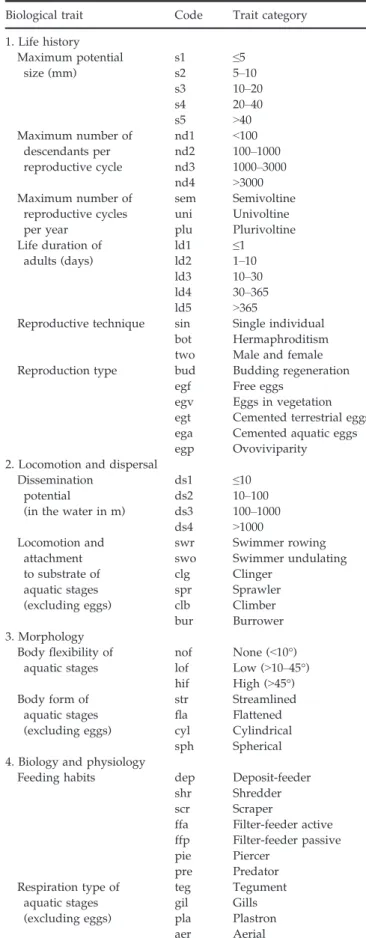
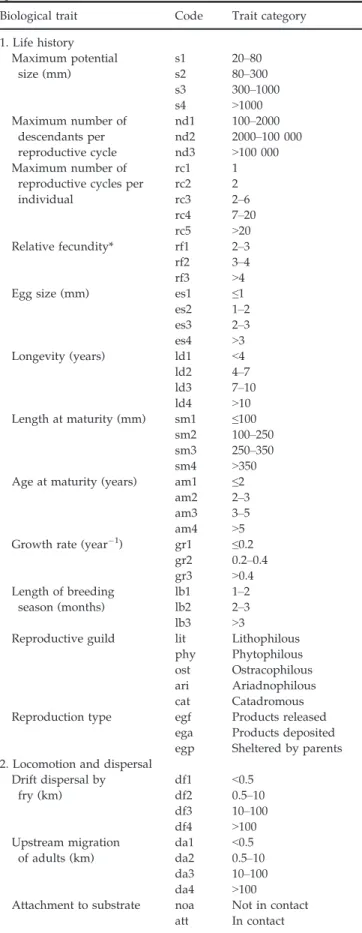
For each invertebrate taxon collected in the main chan-nel and in floodplain chanchan-nels, we documented 12 bio-logical traits that were coded using 54 trait categories (e.g. for the maximum number of reproductive cycles per year: semivoltine, univoltine, plurivoltine; Table 2). Similarly, for each fish species, we documented 21 bio-logical traits that were coded using 75 trait categories
Table 2 Traits and their categories that were available for the invertebrate taxa of the Rh^one River
Biological trait Code Trait category 1. Life history Maximum potential size (mm) s1 ≤5 s2 5–10 s3 10–20 s4 20–40 s5 >40 Maximum number of descendants per reproductive cycle nd1 <100 nd2 100–1000 nd3 1000–3000 nd4 >3000 Maximum number of reproductive cycles per year sem Semivoltine uni Univoltine plu Plurivoltine Life duration of adults (days) ld1 ≤1 ld2 1–10 ld3 10–30 ld4 30–365 ld5 >365
Reproductive technique sin Single individual bot Hermaphroditism two Male and female Reproduction type bud Budding regeneration
egf Free eggs egv Eggs in vegetation egt Cemented terrestrial eggs ega Cemented aquatic eggs egp Ovoviviparity 2. Locomotion and dispersal
Dissemination potential
(in the water in m)
ds1 ≤10 ds2 10–100 ds3 100–1000 ds4 >1000 Locomotion and attachment to substrate of aquatic stages (excluding eggs) swr Swimmer rowing swo Swimmer undulating clg Clinger spr Sprawler clb Climber bur Burrower 3. Morphology Body flexibility of aquatic stages nof None (<10°) lof Low (>10–45°) hif High (>45°) Body form of aquatic stages (excluding eggs) str Streamlined fla Flattened cyl Cylindrical sph Spherical 4. Biology and physiology
Feeding habits dep Deposit-feeder shr Shredder scr Scraper
ffa Filter-feeder active ffp Filter-feeder passive pie Piercer pre Predator Respiration type of aquatic stages (excluding eggs) teg Tegument gil Gills pla Plastron aer Aerial
(Table 3). For both fish and invertebrates, traits were grouped into four sets. The first set gathered those traits related to life history (e.g. size, number of descendants per reproductive cycle; see Table 2 for invertebrates and Table 3 for fish) with additional information for fish (e.g. relative fecundity, longevity, length at maturation; Table 3). The second set grouped those traits related to locomotion and dissemination in the water that confer resilience or resistance to disturbance (Tables 2 & 3). The third set included morphological features (e.g. body form, shape and swimming coefficients; Tables 2 & 3). The fourth set concerned more general biological and physiological features (e.g. feeding habits, respiration types; Tables 2 & 3). Trait information for invertebrates was obtained from data published by Statzner et al. (1994) for the Upper Rh^one River species and the BIO-FUN project (Gayraud et al., 2003) for species found in large European rivers and was supplemented by a litera-ture search (Falkner et al., 2001). For fish species, data were obtained from various sources in the literature (Persat, Olivier & Pont, 1994; Pont et al., 1995; Mann, 1996; Blanck et al., 2007; Sagnes & Statzner, 2009).
Because multiple sources of information were consid-ered in establishing trait databases (data were derived from a review of existing literature as well as from expert knowledge), a fuzzy coding approach (sensu Chevenet, Dol"edec & Chessel, 1994) helped to quantify the affinity of each taxon for each category within a trait. This established method of coding (Usseglio-Polatera
et al., 2000; Gayraud et al., 2003; B^eche, McElravy & Resh, 2006) involves, for each taxon, the assignment of an affinity score to each category of a given trait. An affinity score of 0 indicates no association of the taxon with a trait category, whereas a score of 3 indicates a high affinity for a given trait category. The approach acknowledges the variability in traits that often occurs among different life stages or populations of an organ-ism (Blanck & Lamouroux, 2007). Moreover, based on the taxonomic levels used by authors in this issue, espe-cially for the identification of invertebrates (Castella
et al., 2015; M"erigoux et al., 2015), fuzzy coding was the only way to account for within-species, within-genus or even within-family variation (especially for Diptera not identified beyond tribe level). As an example of the cod-ing, Caenis luctuosa was given an affinity of 3 for the ‘plurivoltine’ category and 1 for the ‘univoltine’ category for the trait of the maximum number of reproductive cycles per year. As another example, Helochares sp., whose larvae are predators and adults are scrapers (feeding on algae), was given an affinity of 3 for the feeding-habit category ‘predator’ and 3 for the category
Table 3 Traits and their categories that were available for the fish species of the Rh^one River
Biological trait Code Trait category 1. Life history Maximum potential size (mm) s1 20–80 s2 80–300 s3 300–1000 s4 >1000 Maximum number of descendants per reproductive cycle nd1 100–2000 nd2 2000–100 000 nd3 >100 000 Maximum number of
reproductive cycles per individual rc1 1 rc2 2 rc3 2–6 rc4 7–20 rc5 >20 Relative fecundity* rf1 2–3 rf2 3–4 rf3 >4
Egg size (mm) es1 ≤1
es2 1–2 es3 2–3 es4 >3 Longevity (years) ld1 <4 ld2 4–7 ld3 7–10 ld4 >10 Length at maturity (mm) sm1 ≤100 sm2 100–250 sm3 250–350 sm4 >350 Age at maturity (years) am1 ≤2
am2 2–3
am3 3–5
am4 >5 Growth rate (year!1) gr1 ≤0.2
gr2 0.2–0.4 gr3 >0.4 Length of breeding season (months) lb1 1–2 lb2 2–3 lb3 >3
Reproductive guild lit Lithophilous phy Phytophilous ost Ostracophilous ari Ariadnophilous cat Catadromous Reproduction type egf Products released
ega Products deposited egp Sheltered by parents 2. Locomotion and dispersal
Drift dispersal by fry (km) df1 <0.5 df2 0.5–10 df3 10–100 df4 >100 Upstream migration of adults (km) da1 <0.5 da2 0.5–10 da3 10–100 da4 >100
Attachment to substrate noa Not in contact att In contact
‘scraper’. Any category of a given trait for which infor-mation was not available was scored as 0. For inverte-brates, 10.5, 6.7 and 0.4% of the total taxa lacked information about their dissemination potential in water, the maximum number of descendants per reproductive cycle and the life duration of adults, respectively. For fish species, three traits (longevity, egg size and length of the breeding season) lacked information for one spe-cies (2.8% of the total taxa), two traits (minimum drag coefficient and growth rate) lacked information for 4–5 species (11.1–13.8% of the total taxa) and two traits (dis-tance travelled downstream or upstream by fry or adults) lacked information for 10 species (27.8% of the total taxa).
Translating taxonomic changes into changes in traits in the community
Predicted (habitat models) and observed (field surveys) changes in taxa density (log-transformed) after restora-tion were translated into predicted and observed changes in trait categories. To that end, we multiplied the predicted and the observed changes in log-density of taxa by their trait category profiles. For the main
channels, each bypassed reach was considered
separately. For the floodplain channels, sites were pooled (see Castella et al., 2015). As indicated above, in all of the taxonomic articles predictions could be made only for a subset of modelled taxa for which enough information was available (see Table 1). Consequently, predictions of changes in trait categories were computed using the modelled taxa only. In contrast, observed changes in traits could be computed for both the mod-elled taxa and the whole community (Table 1).
Statistical analyses of changes in traits
For comparisons of observed and predicted changes that were not made with similar units of density in the three articles (number of individuals per dm!3 for CHAN FISH, number of individuals per dm!2 for CHAN INV and number of individuals per m!2 for FLOOPL INV), we standardised the predicted values obtained from each taxonomic article (mean equal to 0 and variance equal to 1). We also standardised the observed changes, using the mean and standard deviation of the predicted values of a given taxonomic article. This technical stan-dardisation ensured the comparability between the pre-dicted and the observed changes in traits among the three datasets.
As in the three taxonomic articles, we used linear regression to quantify the strength of relationships between observed and the predicted changes in traits (instead of taxa changes). In addition, to assess whether the predicted changes in traits of the subset of modelled taxa could be used to predict overall changes in the trait composition of the whole community, we regressed observed changes in traits obtained for the total list of taxa with predicted changes in traits for modelled taxa. Comparisons were made for each dataset (CHAN INV, CHAN FISH and FLOOPL INV), for all traits and by sets of traits. We compared the adjusted R2 values between observations and predictions obtained at the trait and at the taxonomic levels. The 95% confidence intervals around the adjusted R2 values were computed using Walker’s alias resampling method (Ripley, 1987). In addition, we designed permutation tests to assess whether R2 values at the trait level significantly improved those obtained at the taxonomic level, that is, if the trait description reduced noise in taxonomic responses to flow restoration. Specifically, we compared adjusted R2 values obtained for traits (observed value) with similar values obtained after a random permutation (N = 999) of the trait category profiles of taxa (simulated values) as a null model. At each permutation, we multiplied the predicted and the observed log-density
Table 3 (Continued)
Biological trait Code Trait category opa Facultative 3. Morphology
Body form str Streamlined
fla Flattened cyl Cylindrical Shape coefficient† sh1 <4 sh2 4–5 sh3 5–6 sh4 >6 Swimming coefficient‡ sw1 <0.4 sw2 0.4–0.5 sw3 >0.5 Minimum drag coefficient cd1 <0.3 cd2 ≥0.3 4. Biology and physiology
Feeding habits in Invertivore om Omnivore hb Herbivore pr Piscivore pk Planktivore Respiration type gil Aquatic, ventilation
aer Aerial, no special organs *Quantified as the number of eggs per 100 g body mass.
†
Quantified as the ratio of the total body length to the maximum body depth.
‡
Quantified as the ratio of the minimum depth of the caudal peduncle to the maximum caudal fin depth.
changes of taxa by the permutated trait category pro-files, standardised the resulting predicted and observed changes in traits according to the above-mentioned pro-cedure and then computed the adjusted R2value.
Statistics and graphical outputs were performed with R freeware (R Development Core Team, 2013) including the ade4 library (Dray, Dufour & Chessel, 2007).
Results
Predicted versus observed changes in trait responses
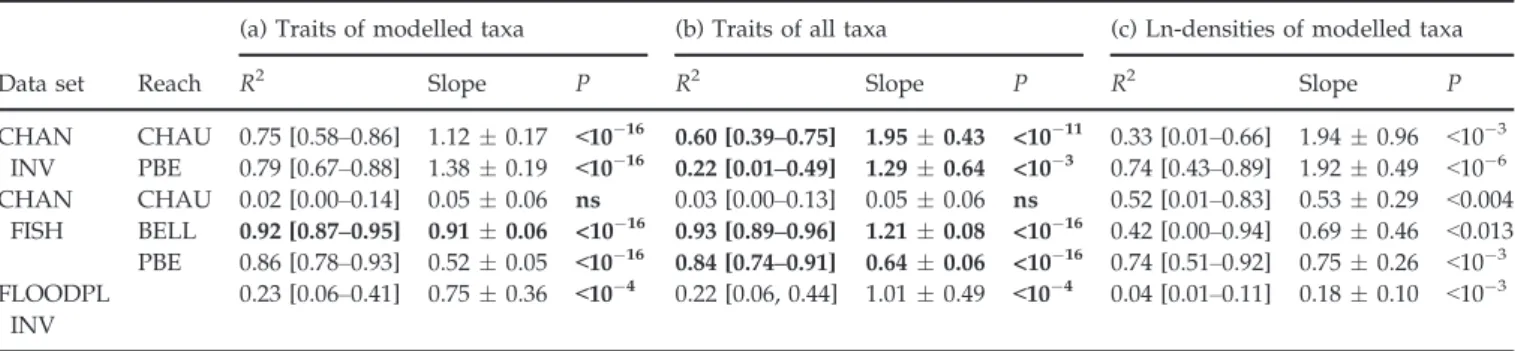
Weighting trait categories by the observed and predicted changes in log-density of modelled taxa, the models developed in the three taxonomic articles of the Special Issue predicted 2–92% of the observed changes in trait log-density after restoration (Table 4a). Highest agree-ments were obtained for fish (86–92% if omitting Chauta-gne; Table 4a; Fig. 1b). In contrast, traits of restored floodplain channel invertebrate communities had the low-est explained variance (23%; Table 4a; Fig. 1c), whereas traits of main channel invertebrates had fairly higher explained variance (75–79%; Table 4a; Fig. 1a). Using the whole community for computing observed trait-level changes provided similar results for main channel fish and floodplain channel invertebrates, whereas a decrease in explained variance occurred at the Pierre-B"enite reach for main channel invertebrates (Table 4b).
Trait versus taxonomic predictions
Predictive trait models were statistically significant in five of six cases for modelled taxa and for the whole
community (Table 4a,b; Fig. 1a–c), whereas they were significant in all cases for taxon models, for which R2 values ranged between 4 and 74% (Table 4c; Fig. 1d–f). With few exceptions (Pierre-B"enite in CHAN INV and Chautagne in CHAN FISH; Table 4a,c), the predictive power of trait models was higher than that of taxon models, for both modelled taxa and the whole commu-nity. However, the permutation procedure demonstrated that the observed R2 values obtained for traits signifi-cantly improved those obtained from taxa in only one case for modelled taxa and three cases for the whole community (bold cases in Table 4a,b). Trait R2 values were significantly lower in one case (Pierre-B"enite; Table 4b,c).
Predicting changes for sets of traits
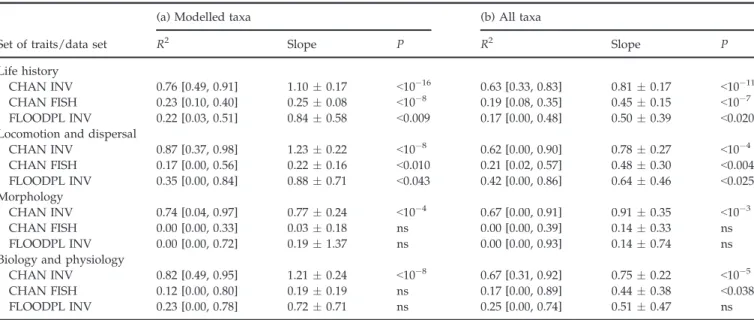
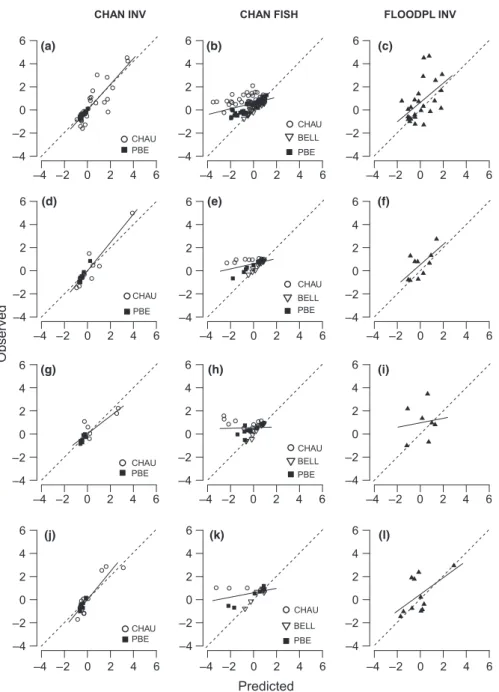
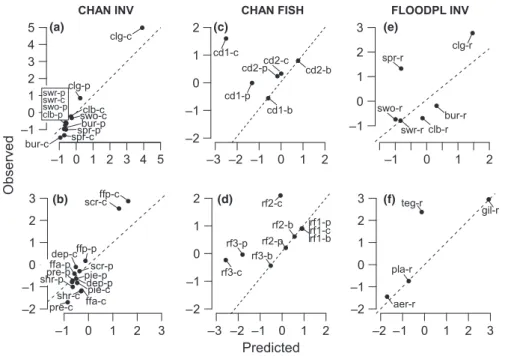
We further investigated how these patterns varied for the four sets of traits. Using invertebrates in the main channels, the performance of the models was significant for the four sets of traits, for both modelled taxa and for the whole community (CHAN INV in Table 5; Fig. 2). Trait categories that were mainly favoured by restora-tion included locomorestora-tion features such as clinging (Fig. 3a), biological and physiological features such as passive filter feeding and scraping (Fig. 3b) and gill res-piration, life-history features such as aquatic egg laying, small size (5–10 mm), and plurivoltine and univoltine cycles and morphological features such as high body flexibility and cylindrical form (see Figure S1).
When using fish species in the main channels, predicted and observed changes did not matched significantly for morphological, biological or
Table 4 Regression parameters (with 95% confidence intervals for slope (") and the R2estimates in brackets) between observed and
pre-dicted changes in the trait category-weighted log-densities for the three data sets considered (CHAN INV: invertebrates in the main chan-nels; CHAN FISH: fish in the main chanchan-nels; FLOODPL INV: invertebrates in the floodplain channels)
Data set Reach
(a) Traits of modelled taxa (b) Traits of all taxa (c) Ln-densities of modelled taxa
R2 Slope P R2 Slope P R2 Slope P
CHAN INV CHAU 0.75 [0.58–0.86] 1.12 " 0.17 <10!16 0.60 [0.39–0.75] 1.95 " 0.43 <10!11 0.33 [0.01–0.66] 1.94 " 0.96 <10!3 PBE 0.79 [0.67–0.88] 1.38 " 0.19 <10!16 0.22 [0.01–0.49] 1.29 " 0.64 <10!3 0.74 [0.43–0.89] 1.92 " 0.49 <10!6 CHAN FISH CHAU 0.02 [0.00–0.14] 0.05 " 0.06 ns 0.03 [0.00–0.13] 0.05 " 0.06 ns 0.52 [0.01–0.83] 0.53 " 0.29 <0.004 BELL 0.92 [0.87–0.95] 0.91 " 0.06 <10!16 0.93 [0.89–0.96] 1.21 " 0.08 <10!16 0.42 [0.00–0.94] 0.69 " 0.46 <0.013 PBE 0.86 [0.78–0.93] 0.52 " 0.05 <10!16 0.84 [0.74–0.91] 0.64 " 0.06 <10!16 0.74 [0.51–0.92] 0.75 " 0.26 <10!3 FLOODPL INV 0.23 [0.06–0.41] 0.75 " 0.36 <10!4 0.22 [0.06, 0.44] 1.01 " 0.49 <10!4 0.04 [0.01–0.11] 0.18 " 0.10 <10!3
Results are shown by reach for the main channels (CHAU: Chautagne; BELL: Belley; PBE: Pierre-B"enite). Observed changes in traits are cal-culated using alternatively (a) modelled taxa used for predictions and (b) all taxa in the community. Similar results obtained at the taxo-nomic level (regressions between observed and predicted changes in the log-densities of modelled taxa) are shown for comparison (c). Bold values in (a) and (b) indicate when R2at the trait and taxonomic levels significantly differ according to permutation tests (ns: not significant at P < 0.05).
physiological traits (CHAN FISH in Table 5; Fig. 2). When omitting the Chautagne reach data, predicted and observed changes in traits matched significantly
(modelled taxa, R2=0.53 [0.25–0.84]; 0.56 " 0.21;
P < 10!4; whole fish community, R2 =0.68 [0.49–0.80]; 1.16 " 0.32; P < 10!6). However, the direction of
(a) (b) (c)
(d) (e) (f)
Fig. 1 Observed (standardized; see Methods) versus predicted (standardized; see Methods) changes in (a–c) trait cate-gory-weighted log-densities (each dot is a trait category) and (d–f) taxa log-densi-ties (each dot is a taxon) in the restored reaches for invertebrate taxa in the main channels (CHAN INV), fish species in the main channels (CHAN FISH) and invertebrate taxa in the floodplain chan-nels (FLOODPL INV). All trait categories are pooled, and legends show symbols for reaches (CHAU: Chautagne; BELL: Belley; PBE: Pierre-B"enite). The regres-sion line (plain) and the line of perfect agreement (dashed) are shown. See Table 4 for statistics details by reach. Table 5 Regression parameters (with 95% confidence intervals for slope (") and the R2estimates in brackets) between observed and pre-dicted changes in the trait category-weighted log-densities
Set of traits/data set
(a) Modelled taxa (b) All taxa
R2 Slope P R2 Slope P
Life history
CHAN INV 0.76 [0.49, 0.91] 1.10 " 0.17 <10!16 0.63 [0.33, 0.83] 0.81 " 0.17 <10!11
CHAN FISH 0.23 [0.10, 0.40] 0.25 " 0.08 <10!8 0.19 [0.08, 0.35] 0.45 " 0.15 <10!7
FLOODPL INV 0.22 [0.03, 0.51] 0.84 " 0.58 <0.009 0.17 [0.00, 0.48] 0.50 " 0.39 <0.020 Locomotion and dispersal
CHAN INV 0.87 [0.37, 0.98] 1.23 " 0.22 <10!8 0.62 [0.00, 0.90] 0.78 " 0.27 <10!4 CHAN FISH 0.17 [0.00, 0.56] 0.22 " 0.16 <0.010 0.21 [0.02, 0.57] 0.48 " 0.30 <0.004 FLOODPL INV 0.35 [0.00, 0.84] 0.88 " 0.71 <0.043 0.42 [0.00, 0.86] 0.64 " 0.46 <0.025 Morphology CHAN INV 0.74 [0.04, 0.97] 0.77 " 0.24 <10!4 0.67 [0.00, 0.91] 0.91 " 0.35 <10!3 CHAN FISH 0.00 [0.00, 0.33] 0.03 " 0.18 ns 0.00 [0.00, 0.39] 0.14 " 0.33 ns FLOODPL INV 0.00 [0.00, 0.72] 0.19 " 1.37 ns 0.00 [0.00, 0.93] 0.14 " 0.74 ns Biology and physiology
CHAN INV 0.82 [0.49, 0.95] 1.21 " 0.24 <10!8 0.67 [0.31, 0.92] 0.75 " 0.22 <10!5
CHAN FISH 0.12 [0.00, 0.80] 0.19 " 0.19 ns 0.17 [0.00, 0.89] 0.44 " 0.38 <0.038 FLOODPL INV 0.23 [0.00, 0.78] 0.72 " 0.71 ns 0.25 [0.00, 0.74] 0.51 " 0.47 ns Trait categories were grouped by sets of traits for each dataset (CHAN INV: invertebrates in the main channels; CHAN FISH: fish in the main channels; and FLOODPL INV: invertebrates in the floodplain channels). Observed changes were calculated using alternatively (a) modelled taxa used for predictions and (b) all taxa in the community (ns: not significant at P < 0.05).
changes of the minimum drag coefficient was opposite from expectations, with low minimum drag decreasing after restoration (cd1 in Fig. 3c). Similarly, low swim-ming coefficient and high shape coefficient unexpect-edly dominated communities after restoration (sw1 and sh3 in Figure S2). In contrast, predicted changes in sev-eral locomotion and dispersal and life-history attributes significantly matched observed changes (CHAN FISH in Table 5; Fig. 2). Restoration generally favoured low relative fecundity (3–4; Fig. 3d), intermediate growth rates (0.2–0.4; Figure S2), late age at maturity (3– 5 years), intermediate length at maturity (100–250 mm), large size (300–1000 mm) and high mobility (>10 km for adults; Figure S2).
Invertebrates in the floodplain channels also showed discrepancies between predicted and observed changes for morphological and biological and physiological fea-tures (FLOODPL INV in Table 5; Fig. 2). In contrast, predicted changes in several life-history features signifi-cantly matched observed changes (FLOODPL INV in Table 5; Fig. 2). Trait categories that were mainly favoured by reconnection in floodplain channels included locomotion features such as clinging (Fig. 3e), biological and physiological features such as gill respira-tion (Fig. 3f), and life-history features such as aquatic egg laying, small numbers of descendants per reproduc-tive cycle, univoltine cycles and long life duration of adults (Figure S3).
(a) (b) (c)
(d) (e) (f)
(g) (h) (i)
(j) (k) (l)
Fig. 2 Observed (standardized; see Methods) versus predicted (standardized; see Methods) changes in life history (a– c), locomotion and dispersal (d–f), mor-phology (g–i) and biology and physiol-ogy (j–l) trait category-weighted log-densities in the restored reaches, as in Fig. 1 but detailed by sets of traits. The regression line (plain) and the line of perfect agreement (dashed) are shown. See Table 5 for regression statistics.
Discussion
Increasing minimum flow in by-passed and floodplain channels of a large river changes the distribution of hydraulic characteristics that directly influence fish (flow velocities and depths) and benthic invertebrates (near-bottom hydraulic forces). As a result, worldwide, hydro-logical constraints have been shown to favour inverte-brate species with more resistant and/or resilient traits (see Gallardo et al., 2014) and affect size, fecundity and swimming capabilities of fish species (see Lamouroux, Poff & Angermeier, 2002). Therefore, restoration based on increased minimum flow and enhanced lateral con-nectivity within the Rh^one floodplain was expected to shift the trait composition of communities accordingly.
We showed that the significant changes in species den-sity after flow restoration and connectivity enhancement translated into changes in the trait composition of aquatic communities. This suggests that the trait approach can assist comparisons of the consistency of ecological responses among multiple datasets. In addition, our approach enabled us to test whether models based on a subset of taxa could predict community-level changes in traits, whether trait observations reduced the biological ‘noise’ resulting from the complex responses of individ-ual taxa and whether changes in traits matched general expectations derived from the literature.
Predicted versus observed changes in trait responses
Using modelled taxa from the main channels, we observed significant agreement (75–92% of explained
variance) between predicted and observed changes in traits, with a noticeably higher explained variance for fish. Fish may respond more strongly to flow in the water column, whereas invertebrate responses may have a more complex response to the characteristics of near-bed hydraulics that vary at a finer spatial scale and are influenced, for example, by substrate roughness (Statz-ner, Gore & Resh, 1988). The similarity of results obtained for observed changes in traits based only on modelled taxa and those based on the whole community suggests that predictions for modelled taxa were appro-priate for predicting community-level changes. In one case (Pierre-B"enite invertebrate communities), however, the explained variance in the observed trait log-density changes dropped from 79 to 22%. However, the selected modelled taxa at Pierre-B"enite represented only 30% of the log-density of the whole community. In particular, orthoclad and tanytarsine Diptera, which contributed greatly to the among-year variability (M"erigoux et al., 2015), were not included in the habitat models, which may have caused this decrease in explained variance. In comparison, modelled taxa at Chautagne represented
c. 50% of the log-density of the whole invertebrate
com-munity. In this latter case, the prediction of observed changes in traits dropped only from 75 to 60% when considering all taxa. Finally, for fish in the main channel, the 14 species considered in the habitat models repre-sented 92–97% of the total density of individuals (La-mouroux & Olivier, 2015).
In contrast, using floodplain channel invertebrates, predicted changes in traits poorly matched observed ones. In this study, we selected reconnected sites in
(a) (c) (e)
(b) (d) (f)
Fig. 3 Observed (standardized; see Methods) versus predicted (standardized; see Methods) changes in selected trait category-weighted log-densities in the restored reaches for invertebrates in the main channels (CHAN INV) with (a) locomotion and attachment and (b) feed-ing habits; fish in the main channels (CHAN FISH) with (c) minimum drag coefficient and (d) relative fecundity; and invertebrates in the floodplain channels (FLOODPL INV) with (e) locomotion and attachment and (f) respiration types. Codes for categories include three letters (see Tables 2 and 3 for acronyms) and ‘c’ for Chautagne reach, ‘b’ for Belley reach, ‘p’ for Pierre-B"enite reach or ‘r’ for reconnected channel. The line (dashed) of perfect agreement is shown.
floodplain channels because these sites underwent increased flow comparable to the main channels, allow-ing better predictions of taxonomic changes. Several rea-sons may explain why changes in floodplain channels were more difficult to predict than changes in the main channel (see Castella et al., 2015). For example, initial communities of disconnected floodplain channels may depend on complex interactions between the main chan-nel and the floodplain (effects of backwater at the down-stream end, interaction with ground water). In addition, the connectivity models used to predict taxon and trait responses (see Castella et al., 2015) were not based on the response of organisms to near-bottom flow, which is prominent in connected channel. These connectivity models were inherently more difficult to validate due to the complex and sometimes lagged response of organ-isms to changing processes associated with flow increase (e.g. organic matter content, sediment heterogeneity).
Trait versus taxonomic predictions
Whereas taxon responses suffer from the low generality inherent to the natural variation of populations, traits describing resistance and resilience patterns shared by all organisms may reduce this intrinsic noise. Therefore, several authors have reported a higher stability of trait responses than taxonomic responses across environmen-tal gradients (Charvet et al., 2000; Archaimbault, Usse-glio-Polatera & Vanden Bossche, 2005; Bonada, Dol"edec & Statzner, 2007). Comparing trait-explained variance to a null model led to a significant improvement for only one of six cases and three of six cases for the modelled taxa and the whole community, respectively. Reasons for this result may include the current state of knowl-edge on species traits in the data sources used in this study, although we considered traits that were demon-strated to be related to hydraulics (Lamouroux et al., 2004; for invertebrates; Lamouroux et al., 2002; for fish). In addition, species may use various combinations of traits to face the same flow changes (alternative suite of traits; Resh et al., 1994; Verberk et al., 2013), and the species response may depend on the degree of correla-tion between one of its traits that responds to flow changes and other traits (phylogenetic link; Verberk
et al., 2013). In one case (fish communities at
Chauta-gne), predictions made from taxa outperformed those made from traits. A potential explanation for this pat-tern is that only a few species contributed to the observed changes after restoration at Chautagne (La-mouroux & Olivier, 2015). Because average current velocities were already high at Chautagne before
restora-tion (0.35 m s!1 before and 0.74 m s!1 after restoration; Lamouroux & Olivier, 2015), these species may share traits adapted to conditions of fast flow, which may have reduced some of the differences between the pre-dicted and observed changes in traits.
Expectations from the literature and predictions of changes in sets of traits
For main channel invertebrates, the match between pre-dicted and observed changes in traits was significant for all sets of traits studied (life history, locomotion and dis-persal, morphology, biology and physiology). This result suggests that in the main channel, invertebrate commu-nities shifted towards enhanced resistance to the increase in near-bottom flow forces (clinging ability), as expected from the literature (Horrigan & Baird, 2008; Statzner & B^eche, 2010). In contrast, body flexibility, which may confer some resistance in temporally variable habitats, shifted from low values to a combination of high values and no flexibility after restoration; this com-bination is associated with cylindrical forms that allow organisms to minimise drag force. The contrasts in body flexibility may reflect the different ways species can manage increases in minimum flow after restoration. The association between highly flexible bodies and cylin-drical forms represents a potential trait combination that provides species with an adaptive solution to manage new flow conditions. Finally, the balance of feeding groups changed from shredders towards passive filter feeders, suggesting a shift from CPOM- towards FPOM-based ecosystems, which generally occurs in larger river communities (Vannote et al., 1980). In addition, commu-nities were dominated by gill and tegument respiration, suggesting a recovery of insect species generally vulner-able to the interactive effects of warming and hypoxia associated with low flow (Verberk & Bilton, 2013).
In contrast to main channel invertebrates, floodplain channel invertebrates showed no relationship between predicted and observed changes in traits for sets of mor-phological, biological and physiological features. However, as with the main channel invertebrates, the pre-dicted decrease in floodplain channel invertebrates with aerial respiration and the predicted increase in inverte-brates with aquatic (gill) respiration were observed, sug-gesting cooler and better oxygenated waters in reconnected sites (see Verberk & Bilton, 2013). This shift occurred together with an enhancement of resistance to the increased near-bottom flow forces (clinging ability), a pattern also observed in the main channel invertebrate communities. In contrast to the main channel invertebrate
communities, floodplain channel invertebrates did not show strong patterns in feeding habits, which explains the lack of agreement between predicted and observed changes in biological and physiological features. Never-theless, a match between predicted and observed decreases in predators followed previous observations made by Paillex, Castella & Carron (2007) and Paillex
et al. (2009) that reconnection may shift towards fewer
predators because they are late settlers (Mackay, 1992) and towards invertebrates with better colonisation abili-ties. The later aspect was only partially confirmed because we observed fewer plurivoltine and more univoltine taxa after restoration than predicted.
For fish communities, contrary to expectations, observed and predicted effects of minimum discharge increases in the main channel on morphological traits (fish morphometrics and their drag resistance) did not match (Sagnes & Statzner, 2009). That is, the expected relationships between the global increase of water veloc-ities at the reach scale and the hydrodynamic capabili-ties of fish communicapabili-ties were not confirmed. This mismatch may also be due to the limits of the category definitions used for these traits. Indeed, among the 14 modelled species of fish, all but one have a low (<0.3) minimum drag coefficient and all but three have a low (<0.4) swimming coefficient. In addition, because cate-gory positions result from density-weighted responses, unequal densities associated with the different categories may complicate the interpretation of the relative posi-tions of categories. For morphological traits, real fish field measurements considering intraspecific variability would likely be more appropriate for assessing the effect of restoration on fish swimming abilities. Finally, it is also possible that fish shape is more closely related to hydraulic characteristics in reaches that are little affected by flow increase, such as the relative proportions of rif-fle-type and pool-type habitats (Lamouroux et al., 2002).
In contrast, the increase in hydraulic constraints in the different restored river reaches favoured the trait pro-portions that characterise periodic species (long lifespan, large body length, intermediate fecundity, large eggs and late maturation), in accordance with previous stud-ies (Lamouroux et al., 1999; Blanck et al., 2007). Mini-mum flow restoration in the Rh^one also involved the limitation of traits characterising opportunistic species (small body length, early maturation, small eggs and high fecundity). Consistently, Mims & Olden (2012) showed that an increase in the base flow index (the ratio of 7-day minimum flows and the mean annual flow, which increases with the minimum flow discharge) provided a higher predictability of hydraulic conditions
and good spawning conditions for fish, and subse-quently increased the presence of periodic species while limiting the presence of opportunistic species (Winemil-ler & Rose, 1992). In the Rh^one, minimum flow increases seem to have enhanced the predictability of habitat con-ditions and, as expected, reduced opportunist species, which prefer frequently disturbed environments (Winemiller & Rose, 1992; see also Mims et al., 2010).
Overall, our results confirm that at a relatively short time scale (c. 6–15 years), strategies of fish communities can change as expected in relation to new environmental conditions in large rivers. Traits associated with the sub-strate and with recolonisation abilities of invertebrates were modified by restoration as expected from the litera-ture. Consistent with the more pelagic behaviour of many fish species than benthic macroinvertebrates, traits characterising fish species of downstream river reaches (long lifespan, large body, late sexual maturity) were favoured (see Schlosser, 1990).
Outlook
Given the high amount of variability in species distribu-tions inherent to most natural communities (Palmer, Ambrose & Poff, 1997), focusing on biological traits may help develop generalisations useful for assessing restora-tion effects at the community level. Here, our observa-tions of similarities in some trait responses (locomotion, attachment and respiration) across reaches (main chan-nels), which were fairly consistent with expectations, support the use of traits to better understand and pre-dict the effects of flow change on aquatic communities. In addition, because taxa sharing given traits provide specific ecosystem services (nutrient cycling, organic matter decomposition and food resources), the trait com-position of communities can be meaningfully used as a proxy of ecosystem functions (see Verberk et al., 2010). Although a few fish traits have been considered to be potential subindicators of river restoration success in some studies (Woolsey et al., 2007), to our knowledge, traits of benthic invertebrates that are known to be involved in various important aquatic ecosystem pro-cesses (nutrient cycling, organic matter decomposition, sediment retention) have not. However, changes in traits were not always consistent with predictions and litera-ture expectations. Improved development of multiple-trait-based approaches for assessing river restoration success in large rivers would require as follows: (i) solv-ing taxonomic difficulties (e.g. those linked to difficult groups such as Chironomidae), (ii) filling gaps in biological trait information associated with these taxa
(especially focusing on energetically favourable traits) and (iii) increasing knowledge about the hydraulic pref-erences of taxa. In addition, although life-history strate-gies in response to flow changes are well established for fish communities (Winemiller & Rose, 1992; Mims & Olden, 2012), defining such strategies for invertebrate communities in response to flow disturbances, although remaining challenging and requiring a step-by-step approach (see Verberk et al., 2013), is critically needed for a predictive water management.
Acknowledgment
We thank Wilco Verberk and an anonymous referee for valuable comments on an earlier version of the manu-script. We acknowledge financial and scientific help from the Compagnie Nationale du Rh^one, the Agence de l’Eau M"editerrann"ee-Corse, the R"egion Rh^one-Alpes, the Rh^one Local Authorities and the EU FEDER Program. This article was edited for proper English lan-guage, grammar, punctuation, spelling and overall style by two highly qualified native English-speaking editors at American Journal Experts (certification verification key: B12D-C422-5B19-5E47-D50A).
References
Aarts B.G.W., Van Den Brink F.W.B. & Nienhuis P.H. (2004) Habitat loss as the main cause of the slow recovery of fish faunas of regulated large rivers in Europe: the transversal floodplain gradient. River Research and
Applica-tions, 20, 3–23.
Archaimbault V., Usseglio-Polatera P. & Vanden Bossche J.P. (2005) Functional differences among benthic macroin-vertebrate communities in reference streams of same order in a given biogeographic area. Hydrobiologia, 551, 171–182.
B^eche L., McElravy E. & Resh V. (2006) Long-term seasonal variation in the biological traits of benthic macroinverte-brates in two Mediterranean-climate streams in Califor-nia, U.S.A. Freshwater Biology, 51, 56–75.
Blanck A. & Lamouroux N. (2007) Large-scale intraspecific variation in life-history traits: European freshwater fish.
Journal of Biogeography, 34, 862–875.
Blanck A., Tedesco P.A. & Lamouroux N. (2007) Relation-ships between life-history strategies of European freshwa-ter fish species and their habitat preferences. Freshwafreshwa-ter
Biology, 52, 843–859.
Bonada N., Dol"edec S. & Statzner B. (2007) Taxonomic and biological trait differences of stream macroinvertebrate communities between Mediterranean and temperate regions: implications for future climatic scenarios. Global
Change Biology, 13, 1658–1671.
Castella E., Beguin O., Besacier-Monbertrand A.-L., Hug Peter D., Lamouroux N., Mayor Sim"eant H. et al. (2015) Realised and predicted changes in the invertebrate benthos after restoration of connectivity to the floodplain of a large river. Freshwater Biology, 60, 1131–1146.
Charvet S., Statzner B., Usseglio-Polatera P. & Dumont B. (2000) Traits of benthic macroinvertebrates in semi-natu-ral French streams: an initial application to biomonitoring in Europe. Freshwater Biology, 43, 277–296.
Chevenet F., Dol"edec S. & Chessel D. (1994) A fuzzy coding approach for analysis of long-term ecological data.
Fresh-water Biology, 31, 295–309.
Dray S., Dufour A.-B. & Chessel D. (2007) The ade4 pack-age – II: two-table and K-table methods. R News, 7, 47–52. Dudgeon D., Arthington A.H., Gessner M.O., Kawabata Z.I., Knowler D.J., Leveque C. et al. (2006) Freshwater biodiversity: importance, threats, status and conservation challenges. Biological Reviews, 81, 163–182.
European Commission (2000) Directive 2000/60/EC of the
European Parliament and of the Council – Establishing a Framework for Community Action in the Field of Water Pol-icy. European Commission, Brussels, Belgium.
Falkner G., Obrdlik P., Castella E. & Speight M.C.D. (2001)
Shelled Gastropoda of Western Europe. Verlag de
Friedrich-Held-Gesellschaft, M€unchen, 267 pp.
Gallardo B., Dol"edec S., Paillex A., Arscott D., Sheldon F., Zilli F. et al. (2014) Response of benthic macroinverte-brates to gradients in hydrological connectivity: a com-parison of temperate, subtropical, Mediterranean, and semiarid river floodplains. Freshwater Biology, 59, 630–648. Gayraud S., Statzner B., Bady P., Haybach A., Sch€oll F., Usseglio-Polatera P. et al. (2003) Invertebrate traits for the biomonitoring of large European rivers: an initial assess-ment of alternative metrics. Freshwater Biology, 48, 2045– 2064.
Hart D. & Finelli C.M. (1999) Physical-biological coupling in streams: the pervasive effects of flow on benthic organ-isms. Annual Review of Ecology and Systematics, 30, 363–395. Horrigan N. & Baird D.J. (2008) Traits patterns of aquatic
insects across gradients of flow-related factors: a multi-variate analysis of Canadian national data. Canadian
Jour-nal of Fisheries and Aquatic Sciences, 65, 670–680.
Lamouroux N., Dol"edec S. & Gayraud S. (2004) Biological traits of stream macroinvertebrate assemblages: effect of microhabitat, reach and basin filters. Journal of the North
American Benthological Society, 23, 449–466.
Lamouroux N., Gore J.A., Lepori F. & Statzner B. (2015) The ecological restoration of large rivers needs science-based, predictive tools meeting public expectations: an overview of the Rh^one project. Freshwater Biology, 60, 1069–1084.
Lamouroux N. & Olivier J.-M. (2015) Testing predictions of changes in fish abundance and community structure after flow restoration in four reaches of a large river (French Rh^one). Freshwater Biology, 60, 1118–1130.
Lamouroux N., Olivier J.-M., Persat H., Pouilly M., Souchon Y. & Statzner B. (1999) Predicting community characteris-tics from habitat conditions: fluvial fish and hydraulics.
Freshwater Biology, 42, 275–299.
Lamouroux N., Poff N.L. & Angermeier P.L. (2002) Inter-continental convergence of stream fish community traits along geomorphic and hydraulic gradient. Ecology, 83, 1792–1807.
Mackay R.J. (1992) Colonization by lotic macroinvertebrates: a review of processes and patterns. Canadian Journal of
Fisheries and Aquatic Sciences, 49, 617–628.
Mann R.H.K. (1996) Environmental requirements of Euro-pean non-salmonid fish in rivers. Hydrobiologia, 323, 223– 235.
M"erigoux S., Forcellini M., Dessaix J., Fruget J.-F., Lamou-roux N. & Statzner B. (2015) Testing predictions of changes in benthic invertebrate abundance and commu-nity structure after flow restoration in a large river (French Rh^one). Freshwater Biology, 60, 1104–1117.
M"erigoux S., Lamouroux N., Olivier J.-M. & Dol"edec S. (2009) Invertebrate hydraulic preferences and predicted impacts of changes in discharge in a large river.
Freshwa-ter Biology, 54, 1343–1356.
Mims M.C. & Olden J.D. (2012) Life history theory predicts fish assemblage response to hydrologic regimes. Ecology, 93, 35–45.
Mims M.C., Olden J.D., Shattuck Z.R. & Poff N.L. (2010) Life history trait diversity of native freshwater fishes in North America. Ecology of Freshwater Fish, 19, 390– 400.
de Nooij R.J.W., Verberk W.C.E.P., Lenders H.J.R., Leuven R.S.E.W. & Nienhuis P.H. (2006) The importance of hydrodynamics for protected and endangered biodiver-sity of lowland rivers. Hydrobiologia, 565, 153–162. Paillex A., Castella E. & Carron G. (2007) Aquatic
macroin-vertebrate response along a gradient of lateral connectiv-ity in river floodplain channels. Journal of the North
American Benthological Society, 26, 779–796.
Paillex A., Dol"edec S., Castella E. & M"erigoux S. (2009) Large river floodplain restoration: predicting species richness and trait responses to the restoration of hydro-logical connectivity. Journal of Applied Ecology, 46, 250– 258.
Palmer M.A., Ambrose R.F. & Poff N.L. (1997) Ecology the-ory and community restoration ecology. Restoration
Ecol-ogy, 5, 291–300.
Palmer M.A., Menninger H.L. & Bernhardt E. (2010) River restoration, habitat heterogeneity and biodiversity: a fail-ure of theory or practice? Freshwater Biology, 55(Suppl. 1), 205–222.
Persat H., Olivier J.-M. & Pont D. (1994) Theoretical habitat templet, species traits, and species richness: fish in the Upper Rh^one River and its floodplain. Freshwater Biology, 31, 439–454.
Petts G.E., M€oller H. & Roux A.-L. (Eds). (1993) Historical
Change of Alluvial Rivers: Western Europe. John Wiley &
Sons, New York, NY.
Poff N.L., Olden J.D., Merritt D.M. & Pepin D.M. (2007) Homogenization of regional river dynamics by dams and global biodiversity implications. Proceedings of the National
Academy of Sciences of the United States of America, 104,
5732–5737.
Poff N.L. & Zimmerman J.K.H. (2010) Ecological responses to altered flow regimes: a literature review to inform the science and management of environmental flows.
Fresh-water Biology, 55, 194–205.
Pont D., Allardi J., Belliard J., Boet P., Carrel G., Changeux T. et al. (1995) Strat"egies d"emographiques des poissons des rivi%eres franc!aises: premiers r"esultats. Bulletin Franc!ais de la P^eche et de la Pisciculture, 337, 113–120. R Development Core Team (2013) R: A Language and
Envi-ronment for Statistical Computing. R Foundation for
Statisti-cal Computing, Vienna.
Resh V.H., Hildrew A.G., Statzner B. & Townsend C.R. (1994) Theoretical habitat templet, species traits, and spe-cies richness: a synthesis of long-term ecological research on the Upper Rh^one River and its floodplain. Freshwater
Biology, 31, 539–554.
Ripley B.D. (1987) Stochastic Simulation. Wiley, New York NY, 237 pp.
Riquier J., Pi"egay H. & S$ulc Michalkova M. (2015) Hydro-morphological conditions in eighteen restored floodplain channels of a large river: linking patterns to processes.
Freshwater Biology, 60, 1085–1103.
Sagnes P. & Statzner B. (2009) Hydrodynamic abilities of riverine fish: a functional link between morphology and velocity use. Aquatic Living Resources, 22, 79–91.
Schlosser I.J. (1990) Environmental variation, life history attributes, and community structure in stream fishes: implications for environmental management and assess-ment. Environmental Management, 14, 621–628.
Southwood T.R.E. (1977) Habitat, the templet for ecological strategies? Journal of Animal Ecology, 46, 337–365.
Statzner B. & B^eche L.A. (2010) Can biological invertebrate traits resolve effects of multiple stressors on running water ecosystems? Freshwater Biology, 55(Suppl. 1), 80–119. Statzner B., Gore J.A. & Resh V.H. (1988) Hydraulic stream
ecology: observed patterns and potential applications.
Journal of the North American Benthological Society, 7, 307–
360.
Statzner B., Resh V.H. & Dol"edec S. (Eds). (1994) Ecology of the upper rh^one river: a test of habitat templet theories.
Freshwater Biology, 31, 253–556.
Townsend C.R. & Hildrew A. (1994) Species traits in rela-tion to a habitat templet for river systems. Freshwater
Biol-ogy, 31, 265–275.
Usseglio-Polatera P., Bournaud M., Richoux P. & Tachet H. (2000) Biomonitoring through biological traits of benthic
macroinvertebrates: how to use species trait database?
Hydrobiologia, 422/423, 153–162.
Vannote R.L., Minshall G.W., Cummins K.W., Sedell J.A. & Cushing C.E. (1980) The river continuum concept.
Canadian Journal of Fisheries and Aquatic Sciences, 37,
130–137.
Verberk W.C.E.P. & Bilton D.T. (2013) Respiratory control in aquatic insects dictates their vulnerability to global warming. Biology Letters, 9, 20130473.
Verberk W.C.E.P., Leuven R.S.E.W., van Duinen G.A. & Esselink H. (2010) Loss of environmental heterogeneity and aquatic macroinvertebrate diversity following large-scale restoration management. Basic and Applied Ecology, 11, 440–449.
Verberk W.C.E.P., Van Noordwijk K. & Hildrew A.G. (2013) Delivering on a promise: integrating species traits to transform descriptive community ecol-ogy into a predictive science. Freshwater Science, 32, 531–547.
Vogel S. (1994) Life in Moving Fluids. The Physical Biology of
Flow. Princeton University Press, Princeton, NJ, 467 pp.
Ward J.V. & Tockner K. (2001) Biodiversity: towards a uni-fying theme for river ecology. Freshwater Biology, 46, 807– 819.
Ward J.V., Tockner K., Uehlinger U. & Malard F. (2001) Understanding natural patterns and processes in river
corridors as the basis for effective river restoration.
Regu-lated Rivers, Research and Management, 17, 311–324.
Webb P.W. & Weihs D. (1986) Functional locomotor mor-phology of early life history stages of fishes. Transactions
of the American Fisheries Society, 115, 115–127.
Winemiller K.O. & Rose K.A. (1992) Patterns of life-history diversification in North-American fishes – implications for population regulation. Canadian Journal of Fisheries and
Aquatic Sciences, 49, 2196–2218.
Woolsey S., Capelli F., Gonser T., Hoehn E., Hostmann M., Junker B. et al. (2007) A strategy to assess river restora-tion success. Freshwater Biology, 52, 752–769.
Supporting Information
Additional Supporting Information may be found in the online version of this article:
Figure S1. Observed versus predicted changes in trait categories for invertebrates in the main channels.
Figure S2. Observed versus predicted changes in trait categories for fish in the main channels.
Figure S3. Observed versus predicted changes in trait categories for invertebrates in the floodplain channels.