ACCEPTED MANUSCRIPT
OPTIMIZATION OF PAHS OXIDATION FROM A CONCENTRATE OF SOIL ATTRITION
USING POTASSIUM PERMANGANATE
Malika Bendouz Ph.D. Student1, Lan Huong Tran Research Associate2, Lucie Coudert Research
Associate3, Guy Mercier Professor4 and Jean-François Blais Professor*,5
1
Institut national de la recherche scientifique (Centre Eau, Terre et Environnement), Université du Québec, 490 rue de la Couronne, Québec, QC, Canada, G1K 9A9, Phone: (418) 654--4677, Fax: (418) 654--2600, email: [email protected]
2
Institut national de la recherche scientifique (Centre Eau, Terre et Environnement), Université du Québec, 490 rue de la Couronne, Québec, QC, Canada, G1K 9A9, Phone: (418) 654--2550, Fax: (418) 654--2600, email: [email protected]
3
Institut national de la recherche scientifique (Centre Eau, Terre et Environnement), Université du Québec, 490 rue de la Couronne, Québec, QC, Canada, G1K 9A9, Phone: (418) 654--3793, Fax: (418) 654--2600, email: [email protected]
4
Institut national de la recherche scientifique (Centre Eau, Terre et Environnement), Université du Québec, 490 rue de la Couronne, Québec, QC, Canada, G1K 9A9, Phone: (418) 654--2633, Fax: (418) 654--2600, email: [email protected]
5
Institut national de la recherche scientifique (Centre Eau, Terre et Environnement), Université du Québec, 490 rue de la Couronne, Québec, QC, Canada, G1K 9A9, Phone: (418) 654--2575, Fax: (418) 654--2600, email: [email protected]
*Corresponding author: Tel: (418) 654-2575, Fax: (418) 654-2600, email: [email protected]
Abstract
The treatment of soils contaminated with organic compounds, such as polycyclic aromatic hydrocarbons (PAHs), by attrition produced large amounts of highly concentrated attrition sludge (PAH – attrition concentrate – PAC). This paper studied the performance of an oxidation process using potassium
permanganate (KMnO4) to degrade PAHs that were initially present in attrition concentrates. The
influence of operating conditions (temperature, concentration of KMnO4 and reaction time) was studied,
and these parameters were optimized using a response surface methodology (RSM). The results showed that the temperature and the reaction time had a significant and positive effect on the degradation of PAHs for the experimental domain studied (temperature between 20 and 60°C and reaction time between
1 and 7 hours). The interaction between the temperature and the concentration of KMnO4 significantly
influenced the degradation of the PAHs. The temperature and the concentration of KMnO4 were the main
parameters that influenced the degradation of both phenanthrene (Phe) and benzo [a] pyrene (BaP). For benzo [a] anthracene (BaA), the temperature was the most influential factor. According to our results, the
ACCEPTED MANUSCRIPT
optimal conditions were defined as [KMnO4] = 0.4 M for 5.5 h at 60°C. These optimal conditions led to
degradations of 42.9%, 40.8%, 41.0% and 46.0% of the total PAHs, Phe, BaA and BaP, respectively.
Keywords
Box-Behnken; Polycyclic aromatic hydrocarbons (PAHs); Permanganate oxidation; Attrition
sludge; Degradation
ACCEPTED MANUSCRIPT
1
Introduction
Polycyclic aromatic hydrocarbons (PAHs) are organic pollutants that are toxic, carcinogenic, mutagenic and resistant to some biological and/or chemical treatments (USEPA, 2008). PAHs are easily adsorbed onto the organic matter present in soils forming persistent micro-pollutants in the environment. A preliminary inventory of the PAHs present in the United Kingdom’s environment showed that the PAHs were mainly deposited on the soil, which led to the contamination of widespread sites across the world (Wild and Jones, 1995). Therefore, the remediation of PAH-contaminated soil is necessary to prevent the exposure of humans or fauna to these toxic contaminants.
Various remediation technologies have been developed to remove organic contaminants, such as PAHs, from soils involving one or a combination of physical, chemical, biological and thermal processes. Among the most promising processes, thermal technologies can effectively destroy PAHs but entail high costs due to the high temperatures required and the need for the treatment of the gaseous products (Gan et al., 2009). The use of an attrition process is a promising option to concentrate the PAHs present in contaminated soil into a smaller volume of fine particles (attrition sludge). Attrition is a physical process of separation based on the creation of frictions and collisions between the particles and the impeller, the attrition cell walls and the deflectors or between the particles themselves, allowing the removal of films around soil particles and/or the deagglomeration of the fine particles which are contaminated. During the attrition process, the concentration of contaminants present in the treated soil (coarse soil fraction) decreases, while a significant increase in the concentration of contaminants is observed in the fine
particles that are generated (attrition sludge) (Stražišar and Sešelj, 1999). The abrasion induced during the attrition by the rotation of the helix allows the detachment of the fine particles onto which the PAHs are adsorbed from the uncontaminated coarse particles. Then, the fine particles containing the PAHs were removed from the coarser ones by sieving (Petavy et al., 2009). Because most of organic contaminants are hydrophobic compounds, it is possible to separate them from the uncontaminated soil particles by attrition in the presence of surfactants. Cationic, anionic and nonionic surfactants or modified cyclodextrin,
biosurfactant and saponin can be used to enhance the removal of organic contaminants from the surface of the soil particles (Mulligan et al., 2001). Other methods are used to remove the contamination, like cyclodextrine extraction, solid phase extraction (Tenax), microbial incubations, etc. (Biache et al., 2015).
The removal of PAH compounds adsorbed onto the fine particles from contaminated soil using
attrition has been widely studied by several researchers (Mouton et al., 2010; Taillard, 2010;
Nielsen, 2011; Bisone et al., 2013). Nielsen (2011) showed that attrition effectively treated soil
contaminated by PAHs by removing 86% of the PAHs from the 2 – 5 mm soil fraction and 96%
from the 5 – 10 mm soil fraction. However, this attrition process generates a concentrate (sludge)
that contains huge amounts of PAHs (PAH – attrition concentrate – PAC). Therefore, these
ACCEPTED MANUSCRIPT
concentrates must be considered hazardous waste and must be adequately treated or disposed of
at specialized landfill sites or in incinerators. The costs related to the management of these
hazardous wastes would be high due to the toxicity of the concentrates.
The oxidation processes are promising technologies that could be used for the secondary treatment of highly contaminated residues emerging from the treatment of contaminated soils. Indeed, the oxidation processes convert hazardous contaminants, such as PAHs, into non-hazardous or less toxic compounds. Several researchers highlighted the performance of some oxidizing agents, such as ozone (O’Mahony et al., 2006), hydrogen peroxide or Fenton’s reagent (Flotron et al., 2005; Ferrarese et al., 2008) and
potassium permanganate (KMnO4) (Brown et al., 2003), to degrade the PAHs present in a solid matrix.
Despite his relatively lower oxidation potential (E0 = 1.7 V) compared to the others oxidants (eg. O3,
H2O2, OH•…), KMnO4 is an attractive oxidizing agent because of its effectiveness over a wide range of
pH values, its stability and its relative low cost (Kao et al., 2008). Permanganate ions can potentially oxidize aromatic hydrocarbons and carbon-carbon double bonds (Dash et al., 2009). The degradation of phenolic endocrine disrupting compounds (2, 4-dichlorophenol, nonylphenol and bisphenol A) that are present in aqueous solutions using potassium permanganate was evaluated by Abe et al. (2001). These
authors observed that the application of KMnO4 (64 mg/L) effectively decomposed each compound (1
mg/L) after 60 min.
Several authors studied the efficiency of this oxidizing agent to degrade PAHs. For example, Brown et al. (2003) reported significant decreases in the concentrations of benzo [a] pyrene (BaP), pyrene (Pyr),
phenanthrene (Phe) and anthracene (Ant) present in contaminated soil in the presence of KMnO4, with
removal yields reaching 72.1%, 64.2%, 56.2% and 53.8%, respectively. Another study conducted by Lemaire et al. (2013a) compared the performance of several oxidants to degrade the PAHs initially present in aged contaminated soil on a bench scale. Their results demonstrated the effectiveness of potassium permanganate, due to its long persistence, compared to the other oxidizing agents tested (hydrogen peroxide, sodium percarbonate and sodium persulfate). Moreover, these authors showed that the degradation of PAHs was positively correlated to the concentration of the oxidant used in the presence of potassium permanganate, which was not observed for the other oxidizing agents, especially those based on radical mechanisms for the degradation of organic compounds (Lemaire et al., 2013a).
However, the degradation of PAHs from environmental samples is a difficult task due to their
hydrophobic and refractory characteristics. They can be adsorbed onto the intrinsic components of the soils or diffused into the organic matter. Several studies have reported that the use of a pretreatment enhanced the oxidation efficiency of PAHs from a solid matrix (Lee and Hosomi, 2001; Lundstedt et al., 2006; Usman et al., 2012; Biache et al., 2015). Different methods can be used to desorb the PAHs and
therefore increase their availability. Biache et al. (2015) preheated the soil to 100°C for one week before
chemical oxidation to increase the availability of the PAHs. This pretreatment was proven to enhance the degradation of PAHs when using chemical oxidation. However, this pretreatment might be very
expensive due to the heating costs, limiting the potential application of this treatment at a larger scale.
ACCEPTED MANUSCRIPT
Another study conducted by Usman et al. (2012) revealed that a pretreatment using a solvent significantly increases the degradation of PAHs from contaminated soil during the oxidation process. These authors found that the most critical factors related to the oxidation efficiency of PAHs from a solid matrix are their unavailability (Usman et al., 2012).
Nowadays, the researches carried out on the PAHs oxidation are mainly achieved using batch experiments in duplicate or triplicate to find the optimal conditions (one parameter at a time) of the oxidation parameters, leading to a large number of experiments. Response surface methodology (RSM) is a statistical method that is useful to study the effects of several factors influencing the responses of interest while performing a limited number of experiments (Ranc et al., 2016). The RSM is a collection of mathematical and statistical methods that can be used to evaluate the influence of several variables in response to interest and to predict this response in the experimental domain (ED) studied (Zaviska et al., 2011). Among the different RSM designs, the Box-Behnken (BB) experimental design has been widely used to optimize various processes including biological and/or chemical remediation technologies (Körbahti et al., 2007; Dong et al., 2009; Sakkas et al., 2010; Yetilmezsoy et al., 2009; Li et al., 2010; Zaviska et al., 2011; Coudert et al., 2012; Mocellin et al., 2016).
The present study focused on the development and the optimization of an oxidation process in the
presence of KMnO4 to degrade the PAHs (total PAHs and/or each PAH molecule) present at high
concentrations in a sludge concentrate using an experimental design methodology. The BB experimental design methodology has been successively applied in order to point out the main and interaction effects of the factors on oxidant performance to degrade PAHs from a concentrate.
2
Materials and methods
2.1
Characterization of PAH-attrition concentrate
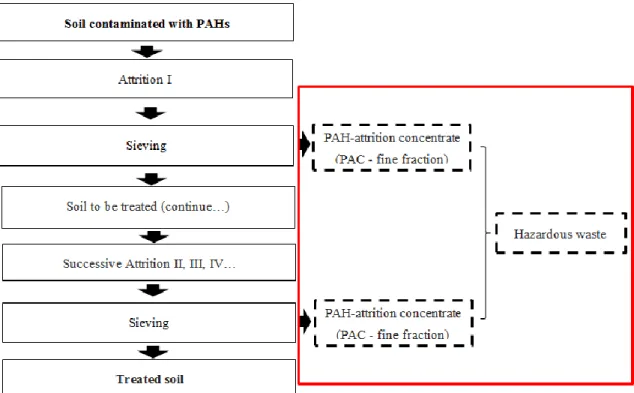
The PAH-attrition concentrate (PAC) was obtained at the end of an attrition process (Fig. 1) conducted in the presence of a surfactant on a contaminated soil collected from an industrial area. The history of the contamination and the location of the site cannot be provided. Before our experiments, the PAC was dried at 60°C for 24 h and then ground with a porcelain mortar and pestle to provide a homogenous medium, crucial for the application of a RSM. This pretreatment of the PAC will be not required for the application of the oxidation process at a larger scale.
2.2
Experimental set-up and KMnO
4oxidation assays
The experiments of KMnO4 oxidation were conducted in 250 mL opaque glass flasks that were
hermetically sealed. For the different experiments, the temperature was controlled using a water-bath and checked using a thermometer (Cole-Parmer, Model Thermo Scientific Ertco). The oxidation was
conducted without any adjustment of the pH of the solution. The PAC and the oxidation solution were
ACCEPTED MANUSCRIPT
stopped after the desired retention time by filtration through a G6-filter (porosity = 1.5 μm) and soil washing. The solid phase was then dried at 60°C before extracting the residual PAHs.
2.3
Preliminary assays
The preliminary experiments consisted of determining the reasonable solid/liquid ratio that should be
used to optimize the operating conditions of the KMnO4 oxidation process. During these experiments, the
same quantity of KMnO4 wasadded to the different amounts of PAC (5, 10, 20 and 30 g) to obtain
different solid/liquid ratios varying from 5 to 30% (w/v) with a final volume fixed at 100 mL. The
concentration of KMnO4 (required oxidant quantities) was determined based on the stoichiometric
amount of permanganate ion required to oxidize each PAH compound initially present in the PAC as reported in the Equation 1 (De Souza e Silva et al., 2009; Simonnot and Croze, 2012). In this equation,
the oxidation of PAHs led to the production of manganese dioxide (MnO2) and CO2 or organic
intermediates (PAH-OX).
-4 2 2 2
PAH + MnO MnO + CO or PAH-OX + MnO (1)
Based on the concentration of each PAH compound, the stoichiometric oxidant demand (SOD) was calculated using Equation 2:
oxidant ([ i i PAHi SOD = MM * PAH *S / MM] ) (2)
Where
SOD: Stoichiometric oxidant demand (mg/kg dry soil); MM oxidant: Molar mass of the oxidant (g/mol);
MMPAHi: Molar mass of each PAH (g/mol);
[PAHi]: Initial concentration of each PAH (mg/kg);
Si: Stoichiometric coefficient of PAHin the reaction between the oxidant and PAH.
2.4
Box-Behnken experimental design
In the present study, a BB experimental design was used to determine the optimal conditions for the
degradation of PAHs from PAC using KMnO4 oxidation. Three variables were investigated: (A)
temperature, (B) concentration of KMnO4 and (C) retention time. Due to the semi-volatile characteristics
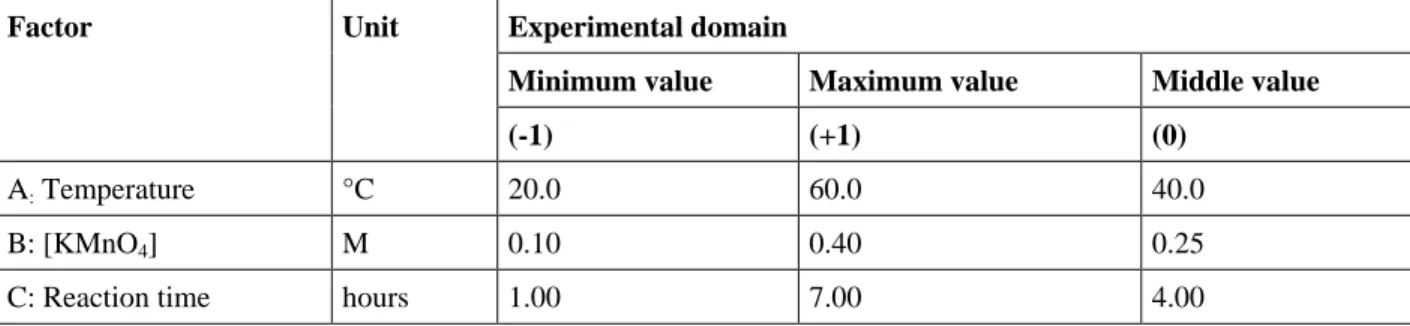
of the PAHs, the influence of the temperature was studied between 20 and 60°C, and the effect of the retention time was evaluated between 1 and 7 h. The low, middle and high levels of each variable, designated as -1, 0, +1, respectively, are presented in Table 1. In a system involving three independent variables, A, B and C, the mathematical relationship between the responses can be defined using a
ACCEPTED MANUSCRIPT
quadratic (second degree) polynomial equation (Equation 3). A multiple regression analysis was then used to determine the coefficients:
2 2 2
o 1 2 3 12 13 23 11 22 33
Y = b + b A + b B+ b C + b AB+ b AC + b BC + b A + b B + b C
(3)
where
Y:
Process response (dependent variable);
b
0:
Average value of the different experiments;
b
1, b
2and
b
3:
Linear coefficients;
b
12, b
13and b
23:
Interaction coefficients between the three factors;
b
11, b
22and b
33:
Quadratic coefficients.
For this series of assays, the experiments were performed with a solid/liquid ratio fixed at 30% (w/v).
Therefore, a mass of 30 g of dried PAC was mixed with 100 mL of a KMnO4 solution with a
concentration ranging from 0.1 to 0.4 M. In the present study, the experimental results were analyzed using Design–Expert 8.0 software.
2.5
Influence of a pretreatment using solvent extraction on PAHs
oxidized from PAC
To improve the performances of PAHs degradation, additional tests were performed, including the pretreatment of PAC using two different solvents to increase the availability of PAHs initially present in the PAC. As the solubility of PAHs, which are highly hydrophobic compounds, is higher in solvents than in aqueous solutions, hexane and methanol were used to enhance the desorption and the solubilization of the contaminants to improve the degradation of PAH compounds by rendering them more available to oxidant attack. The solvents, hexane and methanol (Fisher, Canada), were tested at different
concentrations fixed at 5% and 20% (v/v). Homogenous slurry (30%, w/v) was obtained by mixing the
PAC with the solvent at 250 rpm for 1 h at room temperature. Then, the KMnO4 oxidation of PAHs was
conducted using the optimal conditions defined and presented in Section 3.3.
2.6
Analytical methods
2.6.1 Operating parameters
Total carbon (C), hydrogen (H), nitrogen (N) and sulfur (S) were analyzed by a CHNS Leco Analyzer. The particle size distribution was measured using a Laser Particle Size Analyzer (Particle Laser Scattering
ACCEPTED MANUSCRIPT
LA-950V2, Japan). The physical and chemical characteristics of the sample were determined by the Agri-Direct laboratory (Quebec, Canada).
2.6.2 Extraction and analysis of PAHs
The residual concentration of PAHs present in the PAC was determined from GC-MS analysis after extraction performed on 5 g of dry soil in the presence of 25 mL of dichloromethane for 30 min in an
ultrasonic bath. Two recovery standards, pyrene-D10 and chrysene-D12, were added to the PAC sample to
confirm the adequacy of the solid/liquid extraction process. The extraction solution was purified using silica and stored in hermetically sealed vials at -4°C.
The residual concentrations of the PAHs were measured by GC-MS (Perkin Elmer, model Clarus 500) that was equipped with a DB-50 (30 m × 0.25 mm × 0.25 µm) column. External calibrations were
performed at the beginning of each series of measurements with standard solutions containing a mix of 27 PAHs.
3
RESULTS AND DISCUSSION
3.1
PAC characterization
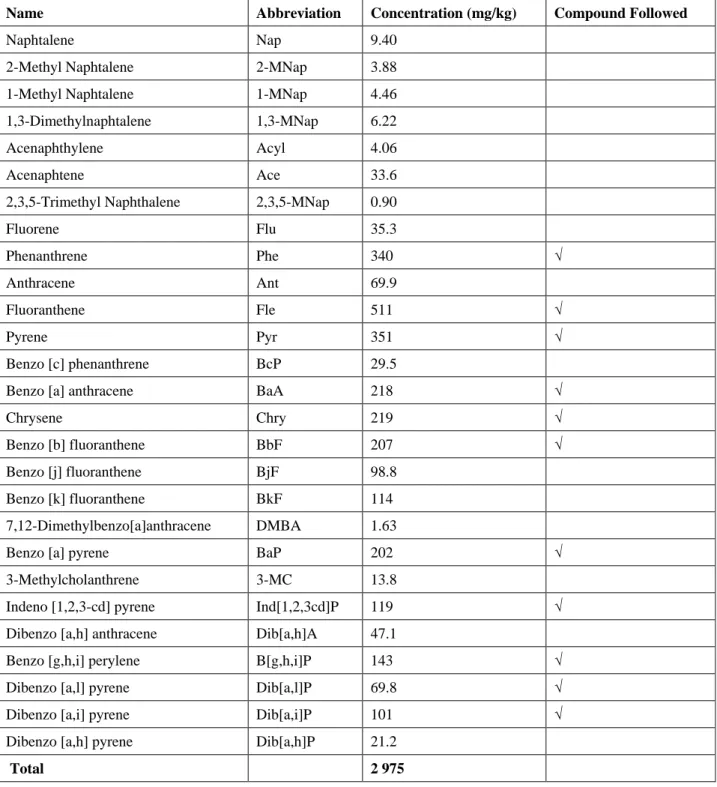
Table 2 summarized the main physico-chemical characteristics of the PAC, and Table 3 presented the initial concentrations of the 27 PAHs listed by the Minister of Sustainable Development, Environment and the Fight against Climate Change (MDDELCC). Conforming to these results, the PAC initially
contained 12.3% C, 0.22% N, 0.13% S and 2,975 mg.kg1of PAHs. The particle size distribution of the
PAC revealed that approximately 90% of the particles had a size below 250 µm. Among the PAHs present in the PAC, 11 molecules of PAHs were individually followed in the present study due to their high concentrations. As reported in the results presented in Table 3, PAH compounds with 3- to 5-rings,
such as Fle (511 mg.kg1), Pyr (351 mg.kg1), Phe (340 mg.kg1), Chry (219 mg.kg1), BaA (218
mg.kg1), BbF (207 mg.kg1) and BaP (202 mg.kg1), were present in higher concentrations than the
compounds having 6-rings, such as Ind[1,2,3cd]P (119 mg.kg1), B[g,h,i]P (143 mg.kg1), Dib[a,l]P (69.8
mg.kg1) and Dib[a,i]P (101 mg.kg1).
3.2
Preliminary experiments
Preliminary experiments were conducted to determine the reasonable solid/liquid ratio that should be used
to optimize the operating conditions of the KMnO4 oxidation process (5%, 10%, 20% and 30%). Table 4
presented the total degradation yields obtained and the amount of PAHs removed from the PAC depending on the solid/liquid ratio used. The results showed that the highest PAH degradation yields (49.2%) were recorded for the experiments conducted with 5% solids. However, when combining the
consumption of KMnO4 and the amount of PAHs removed from the PAC, the increase in the solid/liquid
ACCEPTED MANUSCRIPT
ratio led to an increase in the amount of the PAHs that degraded from the PAC. The highest degradation of PAHs (22.8 mg) was obtained for the experiment conducted with 30% solids. Therefore, the
solid/liquid ratio chosen for the following assays was 30%.
3.3
Evaluation
of
experimental
parameters
on
oxidant
performances
The degradation percentages of total PAHs (27 PAHs) and of 11 individual PAH compounds obtained during the different experiments were presented in Supplementary Table 1. According to our results, the degradation of PAHs varied from 21 – 47% for total PAH degradation (for 27 PAHs), 11 – 50% for Phe, 5 – 50% for Fle, 1 – 54% for Pyr, 14 – 51% for BaA, 15 – 65% for Chry, 15 – 43% for BbF, 7 – 47% for BaP, 21 – 65% for Ind[1,2,3cd]P, 4 – 54% for B[g,h,i]P, 3 – 78% for Dib[a,l]P and 11 – 63% for
Dib[a,i]P. The large variations observed in the PAH degradation yields indicated that the ED studied in the present study was well-defined. Despite the differences in the chemical structures of the different PAH compounds studied, the performances of degradation were similar for some compounds with different structures. Brown et al. (2003) observed that the oxidation of PAHs in the presence of
permanganate potassium is closely dependent of the chemical reactivity of the targeted compound. The reactivity order for a mixture of six PAH towards permanganate ion was defined as follows BaP > Pyr > Phe > Ant > Fle > Chry. In our study, similar results were obtained for some operating conditions (Supplementary Table 1 – Runs 3; 4; 7; 8 and 9) with average degradation performances following the same order: BaP (45%) > Pyr (32%) > Chry (23%) > Fle (22%). However, the literature mentioned that the oxidation of PAHs increased with an increase in the number of polycyclic rings. As reported by these authors, this might be because the energy required to overcome the aromatic character of a polycyclic ring was lower than for benzene (Brown et al., 2003; Forsey et al., 2010; Wang et al., 2015). Forsey et al. (2010) also reported that other factors such as steric interactions, oxidation conditions and the
connectivity of aromatic rings can affect the reaction rate of PAHs under certain conditions. On the other hand, De Souza e Silva et al. (2009) highlighted that the oxidation of Phe from contaminated soils in the
presence of KMnO4 was much easier than the oxidation of Pyr, even though the Pyr has a higher number
of polycyclic rings than Phe.
As reported by our results, it appeared that the highest degradation yields were obtained when the temperature was fixed at 60°C for the total PAHs, Phe, Fle, Chry, BaA, Ind[1,2,3cd]P and B[g,h,i]P and at 40°C for Pyr, Dib[a,l]P and Dib[a,i]P.
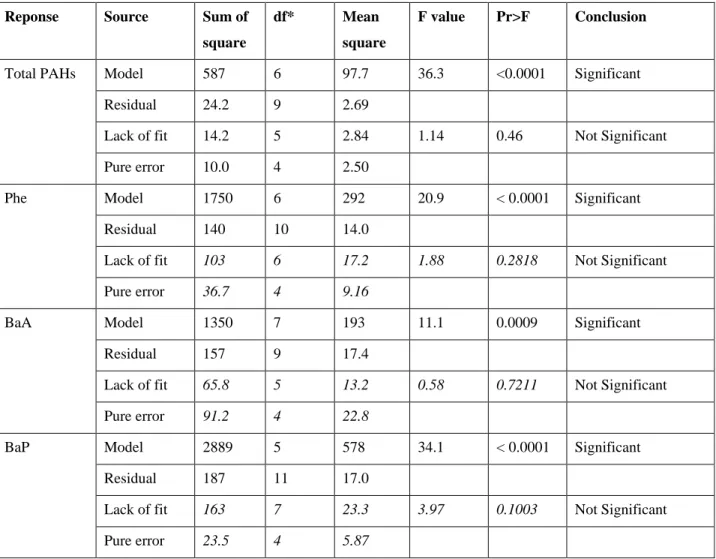
The results obtained were analyzed using the Expert Design software 8.0 to determine the relationship between the response and the different factors. The statistical significance of these models was evaluated using ANOVA. Table 5 presented the F values and Pr>F values obtained for the mathematical models established to predict the degradation of total PAHs, Phe, BaA and BaP because the models defined for the other PAH compounds were not significant. If the “Pr>F” value is lower than 0.05, the model and/or the factor is significant.
ACCEPTED MANUSCRIPT
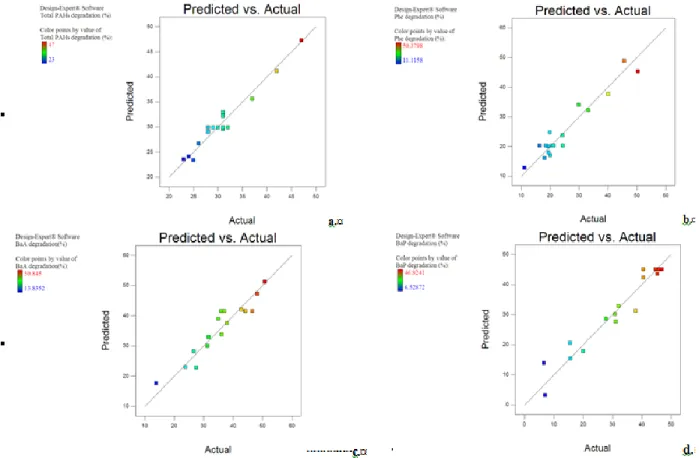
To assess the adequacy of the models, it is important to evaluate if there is a lack of fit to the models. A significant lack of fit to a mathematical model is explained by the fact that, for few experimental values, the differences observed between the experimental and predicted values are slightly higher than the variations measured between the five replicates conducted at the center of the ED (Coudert et al., 2012). Therefore, a non-significant lack of fit is preferable because this indicates that the mathematical models fit well with the experimental values. Conforming to our results, the lack of fit was not significant for the different models established. Fig. 2 presents the variations between the actual (experimental) values and the predicted values obtained for the degradation of total PAHs, Phe, BaA and BaP. The adequacy of the proposed models was confirmed by the satisfactory correlations that were observed between the
experimental and predicted values.
The correlation coefficients (R-Squared, Adj R-Squared and Pred R-Squared), as presented in Table 6, ranged from 0.81 to 0.96 for the model defined for the degradation of total PAHs and ranged from 0.70 to
0.94 for the models established for the degradation of Phe, BaA and BaP. These R2 values indicated that 4
to 30% of the experimental values could not be explained by the empirical models. As reported by Joglekar and May (1987), the R-squared values should be higher than 0.80 for a good fit between the mathematical models and the experimental values. The values of Adequation precision (Adeq precision), which evaluates the signal to noise ratio, were equal to 22.0, 15.0, 11.7 and 17.1 for the models defined to predict the degradation of total PAHs, Phe, BaA and BaP, respectively. A ratio greater than 4 is desirable (Kumar et al., 2008). The values obtained in the present study supported the suitability of the models established to predict the degradation of total PAHs, Phe, BaA and BaP.
The mathematical models, in terms of coded factors, obtained to predict the degradation of total PAHs, Phe, BaA and BaP were presented in Equations 4 to 7.
2 2Total PAHs % = 29.9 + 6.05A +1.30 B+ 2.75C +5.91AB+ 4.19 A –1.72C (4)
2Phe % = 20.33+10.28A +3.87 B+ 2.24C +5.16 AC +5.86 BC +10.89 A (5)
2 2 2BaA % = 41.61+ 4.15A + 2.70 B+ 2.62C + 6.44 AB+ 6.96 A -10.62 B - 8.03C (6)
2 2BaP % = 45.10 + 6.14 A +5.38B+ 7.36C-12.99 B -16.18C (7)
Where A represents the Temperature, B represents the concentration of KMnO4 and C represents the reaction time.
From Equations 4 to 7 and the results presented in Table 6, it can be seen that the temperature had a significant and positive influence on the different responses studied for the experimental domain studied. The positive influence of the temperature between 20 and 60°C indicated that an increase in the
temperature led to an increase in the degradation yields for the total PAHs, Phe, BaA and BaP. According
to our results, the concentration of KMnO4 had a significant and positive effect on the degradation of Phe
and BaP, whereas the influence of reaction time was only significant for the degradation of total PAHs
ACCEPTED MANUSCRIPT
and BaP. These results were in accordance with the observations made by Xu et al. (2005) and Aleboyeh, et al. (2009) on the decolorization of dye. Indeed, Xu et al. (2005) reported that the concentration of potassium permanganate and the temperature had significant effects on the decolorization efficiency. Most of dye solutions can be decolorized effectively within 30 min. However, Aleboyeh, et al. (2009) reported that the effect of temperature on the performances of dyes decolorization was not significant and that the color removal was enhanced by increasing the amount of potassium permanganate. The
difference between the results could be explained by the different chemical structures of the targeted organic compounds and the degradation of the double bonded dye molecules which does not require significant activation energy. Hence, the degradation rates of this group of dyes when using potassium permanganate were quite faster than those of other organic compounds.
The value of each coefficient present in the mathematical equation (defined in terms of the coded factor) indicated the importance of each factor on the response. Equations 4 to 7 showed that the degradation of total PAHs, Phe and BaA was mainly influenced by the temperature, whereas the degradation of BaP was mainly and positively impacted by the reaction time.
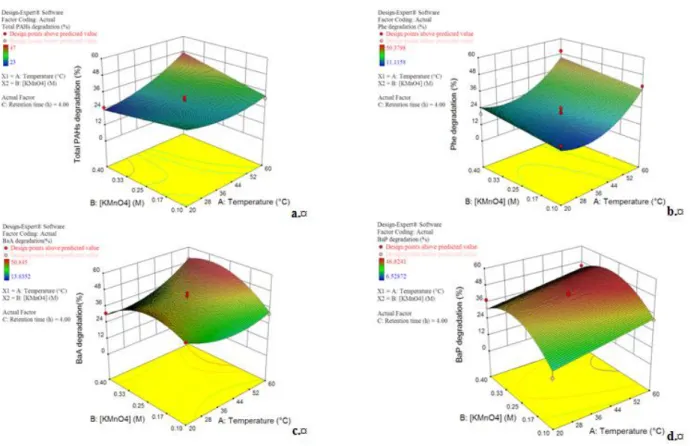
Figure 3 presented the three-dimensional response surface of the degradation Total PAHs (Fig. 3a.), Phe (Fig. 3b.), BaA (Fig. 3c.) and BaP (Fig. 3d.) depending on the temperature (factor A) and the
concentration of KMnO4 (factor B) to have a better understanding of the effects of experimental
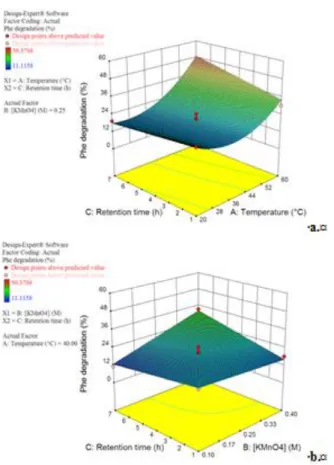
parameters on PAH degradation. Figure 4 illustrated the significant influence of the interaction AC
(temperature and retention time) and BC (concentration of KMnO4 and retention time) on the degradation
of Phe.
3.4
Optimization of the operating conditions for the oxidation of
PAHs
To identify the optimal conditions, only the response for which significant mathematical models were obtained can be considered. The optimal operating conditions were determinate based on maximizing the degradation of the total PAHs, Phe, BaA and BaP. Thus, the Expert Design 8.0 proposed numerous solutions (not shown) classified by the order of desirability. The optimal conditions selected were as
[KMnO4] = 0.4 M for 5.5 h at 60°C. Additional assays were conducted in triplicate with the optimized
conditions to validate the results. Supplementary Table 2 presented a comparison between the predicted values and the experimental results. According to our experiments, the degradation efficiencies of the total PAHs, Phe, BaA and BaP obtained under the optimal conditions were estimated to be 42.9%, 40.8%, 41.0% and 46.0%, respectively. It seemed that the oxidation process efficiency was slightly
over-estimated by the mathematical equations for the degradation of total PAHs, Phe and BaA under the optimal conditions. The variations between the experimental and predicted values obtained for the
degradation of total PAHs, Phe and BaA were approximately 9.3%, 10% and 20%, respectively. This may be due to the heterogeneity and complexity of the matrix (attrition sludge) or to the lower R-squared values, especially for the degradation of Phe and BaA. However, these error values were close to the
ACCEPTED MANUSCRIPT
the experimental and predicted values were similar (error = 5.5%). Generally, the variations between the predicted and experimental PAH degradation yields for the four significant models were close or similar to the CV values of the mathematical models, allowing us to validate the optimal conditions.
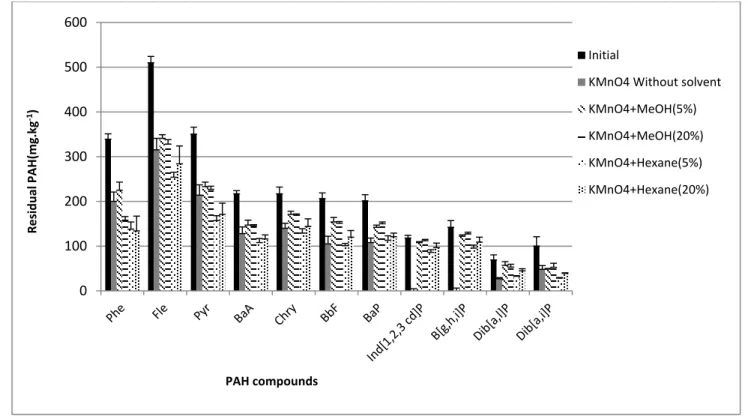
Figure 5 compared the concentration of the 11 PAH compounds present in high concentrations in the
PAC before and after KMnO4 oxidation under optimal conditions. The application of KMnO4 treatment
decreased the concentrations of Fle, Pyr, Chry and BbF from 511 to 316 ± 25 mg.kg1, from 351 to 215 ±
22 mg.kg1, from 218 to 141 ± 10 mg.kg1and from 207 to 106 ± 16 mg.kg1, respectively. This oxidation
process allowed for the degradation of 38, 39, 36 and 49% of Fle, Pyr, Chry and BbF, respectively. The residual concentrations of PAHs initially present in lower concentrations were as follows: 77.7 ± 4.6 mg
Ind[1,2,3cd]P. kg1, 85.1 ± 6.3 mg B[g,h,i]P. kg1, 27.9 ± 1.7 mg Dib[a,l]P.kg1 and 49.1 ± 7.32 mg
Dib[a,i]P.kg1. For these compounds, the oxidation process allowed for the degradation of 35, 41, 60 and
51% of Ind[1,2,3cd]P, B[g,h,i]P, Dib[a,l]P and Dib[a,i]P, respectively. According to these results, the degradation yields obtained for the different PAH compounds ranged from 35 to 60% under the optimal conditions. These low percentages of PAH degradation could be because the amount of oxidant added to the matrix corresponded to 4*SOD based on the concentrations of the 27 PAHs listed by MDDELCC.
This value did not include the presence of other organic compounds that could react with the KMnO4.
High contents of organic matter in the soil and therefore in the attrition sludge (12.3%) can consume significant amounts of oxidant during the oxidation process. Chen et al. (2009) found that a strong adsorption of PAHs and the competition with organic matter limited the degradation rate. However, the
amount of KMnO4 added was limited to 4*SOD to ensure the economic feasibility of the process.
Another explanation could be the low availability of the PAHs present in the PAC. Lemaire et al. (2013b) showed that the degradation of PAHs was limited due to their low availabilities. The highest PAH
degradation rate obtained from spiked soil was 55%, but it reached only 30% in aged soils. Therefore, the addition of a solvent to improve the availability of PAHs may be of interest.
3.5
Effects of solvents on PAH oxidation from PAC
Figure 5 presented the effects of different solvents on PAH oxidation. For the majority of the molecules (Phe, Fle, Pyr, BaA, Chry, BbF and Dib[a,i]P), the use of a solvent improved the degradation compared to
the use of KMnO4 alone. In the presence of hexane (5%), the degradation yields increased from 41 to
59% for Phe, from 38 to 50% for Fle, from 39 to 55% for Pyr, from 41 to 50% for BaA, from 36 to 40% for Chry and from 51 to 71% for Dib[a,i]P. In contrast, the degradation yields of BaP, Ind[1,2,3cd]P, B[g,h,i]P and Dib[a,l]P decreased from 46 to 44%, 35 to 32%, 41 to 32% and 60 to 52%, respectively, when using 5% hexane. According to these results, the addition of a solvent slightly increased the availability and therefore the degradation of some PAH compounds. The previous study of Wang et al. (2015) showed
ACCEPTED MANUSCRIPT
that the extraction technology by using hexane as solvent to enhance the removal of light PAHs was very effective. Conforming to their results, huge amounts of light PAHs have been extracted, especially for Phe with removal yields beyond 90%. However, a part of the methanol or hexane might be degraded by
KMnO4, increasing the amount of oxidant required. Therefore, the addition of a solvent to enhance the
availability of PAHs was not efficient enough to compensate for the increase in KMnO4 required and the
decrease in the performance observed for some PAH compounds.
4
Conclusion
The efficiency of PAH chemical oxidation from PAC in the presence of KMnO4 was studied using an
experimental design methodology. The treatment of data by the software produced non-significant models for most of the molecules (Fle, Pyr, Chry, BbF, Ind[1,2,3cd]P, B[g,h,i]P, Dib[a,l]P and Dib[a,i]P), and significant for only the degradation of total PAHs, Phe, BaA and BaP.
The BB design highlighted that temperature had a positive effect on the degradation of total PAHs, Phe,
BaA and BaP. The concentration of KMnO4 had a positive effect on the degradation of Phe and BaP,
whereas the reaction time impacted the oxidation of total PAHs and BaP. The temperature was the main parameter that influenced the degradation of the total PAHs, Phe and BaA, whereas the degradation of BaP was mainly influenced by the reaction time.
The optimal conditions were defined as [KMnO4] = 0.4 M for 5.5 h at 60°C. The optimal conditions
yielded degradations of 42.9%, 40.8%, 41.0% and 46.0% of the total PAHs, Phe, BaA and BaP, respectively. The oxidation performance of some PAH compounds could be improved by adding a solvent, but this improvement was not efficient enough to compensate for the increased amount of
KMnO4 required and the reduction in the performance observed for some PAH compounds. According to
our results, the optimal oxidation conditions allowed the diminution of the concentration of only two molecules of PAHs among the eleven PAHs compounds followed; indicating that the concentrate could not be considered as non-hazardous after oxidation treatment even if toxicity was reduced. The results of the bench scale studies demonstrated that chemical oxidation of PAHs initially present in highly
contaminated samples using permanganate can occur. Our results highlighted that this treatment significantly enhanced the degradation of PAHs and mainly the degradation of high-molecular weight PAHs (with five or six aromatic rings), which were proven to be more recalcitrant to biological
degradation. Besides its lower reactivity, the performances of KMnO4 to degrade PAHs from PAC were
better which can be due to its high persistence compared to hydroxyl radicals (very short life) and its lower sensitivity to pH. The application of chemical pre-oxidation can be a promising technique for the remediation of environmental matrices contaminated by recalcitrant PAHs to overcome the recalcitrance of PAHs to biodegradation. However, the performances of the process developed should be enhanced to
ACCEPTED MANUSCRIPT
oxidation process (Fenton) might be of interest to reach the limit concentration established by MDDELCC. Further experiments should be performed to identify the by-products obtained from permanganate oxidation of PAHs and to compare the toxicity of these degradation products to original PAHs.
N
OMENCLATUREANOVA Analysis of variance
BaA Benzo [a] anthracene
BaP Benzo [a] pyrene
BBD Box-Behnken
BbF Benzo [b] fluoranthene
B[ghi]P Benzo [g,h,i] perylene
Chry Chrysene
Dib[a,i]P Dibenzo [a,i] pyrene
Dib[a,l]P Dibenzo [a,l] pyrene
ED Experimental Domain
Fle Fluoranthene
Ind[1,2,3cd]p Indeno [1,2,3-cd] pyrene
PAC
PAHs-attrition concentrate
PAHs Polycyclic aromatic hydrocarbons
Phe Phenanthrene
Pyr Pyrene
RSM Response surface methodology
SOD Stoichiometric oxidant demand
Acknowledgments
Sincere thanks are extended to the Natural Sciences and Engineering Research Council of Canada (grant RDCPJ 418167-11) and Tecosol, Inc. for their financial contribution to this study.
ACCEPTED MANUSCRIPT
5
References
Abe, Y., Umemura, T. and Tsunoda, K. I. 2001. Decomposition of phenolic endocrine disrupting chemicals by potassium permanganate. Nippon Kagaku Kaishi, 2001(4), 239--242.
Aleboyeh, A., Olya, M. E. and Aleboyeh, H. 2009. Oxidative treatment of azo dyes in aqueous solution by potassium permanganate. J. Hazard. Mater., 162(2), 1530--1535
Biache, C., Lorgeoux, C., Andriatsihoarana, S., Colombano, S. and Faure, P. 2015. Effect of pre-heating on the chemical oxidation efficiency: implications for the PAH availability measurement in contaminated soils. J. Hazard. Mater., 286, 55--63.
Bisone, S., Mercier, G. and Blais, J. F. 2013. Decontamination of metals and polycyclic aromatic hydrocarbons from slag-polluted soil. Environ. Technol., 34(18), 2633--2648.
Brown, G. S., Barton, L. L. and Thomson, B. M. 2003. Permanganate oxidation of sorbed polycyclic aromatic hydrocarbons. Waste Management, 23(8), 737--740.
Chen, W., Hou, L., Luo, X. and Zhu, L. 2009. Effects of chemical oxidation on sorption and desorption of PAHs in typical Chinese soils. Environ. Pollut., 157(6), 1894--1903.
Coudert, L., Blais, J. F., Mercier, G., Cooper, P., Morris, P., Gastonguay, L., Janin, A. and Zaviska, F. 2012. Optimization of copper removal from ACQ-, CA-, and MCQ-treated wood using an experimental design methodology. J. Environ. Eng., 139(4), 576--587.
Dash, S., Patel, S. and Mishra, B. K. 2009. Oxidation by permanganate: synthetic and mechanistic aspects. Tetrahedron, 65(4), 707--739.
Dong, C. H., Xie, X. Q., Wang, X. L., Zhan, Y. and Yao, Y. J. 2009. Application of Box-Behnken design in optimisation for polysaccharides extraction from cultured mycelium of Cordyceps sinensis. Food Bioprod. Process., 87(2), 139--144.
De Souza e Silva, P. T., Da Silva, V. L., de Barros Neto, B. and Simonnot, M. O. 2009. Potassium permanganate oxidation of phenanthrene and pyrene in contaminated soils. J. Hazard. Mater., 168(2), 1269--1273.
Ferrarese, E., Andreottola, G. and Oprea, I. A. 2008. Remediation of PAH-contaminated sediments by chemical oxidation. J. Hazard. Mater., 152(1), 128--139.
Flotron, V., Delteil, C., Padellec, Y. and Camel, V. 2005. Removal of sorbed polycyclic aromatic hydrocarbons from soil, sludge and sediment samples using the Fenton’s reagent process. Chemosphere, 59(10), 1427--1437.
Forsey, S. P., Thomson, N. R. and Barker, J. F. 2010. Oxidation kinetics of polycyclic aromatic hydrocarbons by permanganate. Chemosphere, 79(6), 628--636.
ACCEPTED MANUSCRIPT
Gan, S., Lau, E. V. and Ng, H. K. 2009. Remediation of soils contaminated with polycyclic aromatic hydrocarbons (PAHs). J. Hazard. Mater., 172(2), 532--549.
Joglekar, A. M. and May, A. T. 1987. Product excellence through design of experiments. Cereal Foods World, 32(12), 857--861.
Kao, C. M., Huang, K. D., Wang, J. Y., Chen, T. Y. and Chien, H. Y. 2008. Application of potassium permanganate as an oxidant for in situ oxidation of trichloroethylene-contaminated
groundwater: a laboratory and kinetics study. J. Hazard. Mater., 153(3), 919--927.
Körbahti, B. K., Aktaş, N. and Tanyolaç, A. 2007. Optimization of electrochemical treatment of industrial paint wastewater with response surface methodology. J. Hazard. Mater., 148(1), 83--90.
Kumar, A., Prasad, B. and Mishra, I. M. 2008. Optimization of process parameters for acrylonitrile removal by a low-cost adsorbent using Box–Behnken design. J Hazard. Mater., 150(1), 174--182.
Lee, B. D. and Hosomi, M. 2001. A hybrid Fenton oxidation–microbial treatment for soil highly contaminated with benz (a) anthracene. Chemosphere, 43(8), 1127--1132.
Lemaire, J., Bues, M., Kabeche, T., Hanna, K. and Simonnot, M. O. 2013a. Oxidant selection to treat an aged PAH contaminated soil by in situ chemical oxidation. J. Environ. Chem. Eng., 1(4), 1261--1268.
Lemaire, J., Laurent, F., Leyval, C., Schwartz, C., Buès, M. and Simonnot, M. O. 2013b. PAH oxidation in aged and spiked soils investigated by column experiments. Chemosphere, 91(3), 406--414. Li, M., Feng, C., Zhang, Z., Chen, R., Xue, Q., Gao, C. and Sugiura, N. 2010. Optimization of process
parameters for electrochemical nitrate removal using Box–Behnken design. Electrochim. Acta, 56(1), 265--270.
Lundstedt, S., Persson, Y. and Öberg, L. 2006. Transformation of PAHs during ethanol-Fenton treatment of an aged gasworks’ soil. Chemosphere, 65(8), 1288--1294.
Mocellin, J., Mercier, G., Morel, J.L., Blais, J. F. and Simonnot, M.O. 2016. Factors influencing the Zn and Mn extraction from pyrometallurgical sludge in the steel manufacturing industry. J. Environ. Manag., 15, 48--54.
Mouton, J., Mercier, G. and Blais, J. F. 2010. Laboratory-scale flotation process for treatment of soils contaminated with both PAH and lead. J. Environ. Eng, 136(10), 1063--1074.
Mulligan, C. N., Yong, R. N. and Gibbs, B. F. 2001. Surfactant-enhanced remediation of contaminated soil: a review. Eng. Geo., 60(1), 371--380.
ACCEPTED MANUSCRIPT
Nielsen, G. 2011. Traitement physique de sols contaminés par des HAP et retraitement des concentrés de HAP pour valoriser les sols, M.Sc. Thesis, Université du Québec, Institut national de la
recherche scientifique, Quebec (Quebec), Canada, 144 p.
O’Mahony, M. M., Dobson, A. D., Barnes, J. D. and Singleton, I. 2006. The use of ozone in the
remediation of polycyclic aromatic hydrocarbon contaminated soil. Chemosphere, 63(2), 307--314.
Petavy, F., Ruban, V. and Conil, P. 2009. Treatment of stormwater sediments: Efficiency of an attrition scrubber–laboratory and pilot-scale studies. Chem. Eng. J., 145(3), 475--482.
Ranc, B., Faure, P., Croze, V. and Simonnot, M. O., 2016. Selection of oxidant doses for in situ chemical oxidation of soils contaminated by polycyclic aromatic hydrocarbons (PAHs): A review. J. Hazard. Mater., 312, 280--297.
Sakkas, V. A., Islam, M. A., Stalikas, C. and Albanis, T. A. 2010. Review – Photocalytic degradation using design of experiments: a review and exemple of the Congo red degradation. J. Hazard. Mater., 175, 33--44.
Simonnot, M. O. and Croze, V. 2012. Traitement des sols et nappes par oxydation chimique in situ. Techniques de l’ingénieur, report n° J3 983, Paris, France, 14 p.
Stražišar, J. and Sešelj, A. 1999. Attrition as a process of comminution and separation. Powder Technol., 105(1), 205--209.
Taillard, V. 2010. Démonstration à l'échelle pilote d'un procédé d'extraction simultanée des HAP et du plomb, M.Sc. report, Université du Québec, Institut national de la recherche scientifique, Quebec (Quebec), Canada, 306 p.
USEPA. 2008. Polycyclic Aromatic Hydrocarbons (PAHs), United States Environmental Protection Agency, 2008, Available at the following address:
https://archive.epa.gov/epawaste/hazard/wastemin/web/pdf/pahs.pdf (accessed on 03.05.2016). Usman, M., Faure, P., Ruby, C. and Hanna, K. 2012. Application of magnetite-activated persulfate
oxidation for the degradation of PAHs in contaminated soils. Chemosphere, 87(3), 234--240. Wang, W., Liu, G., Shen, J., Chang, H., Li, R., Du, J., Yang, Z. and Xu, Q. 2015. Reducing polycyclic
aromatic hydrocarbons content in coal tar pitch by potassium permanganate oxidation and solvent extraction. J. Environ Chem Eng., 3(3), 1513--1521.
Wild, S. R. and Jones, K. C. 1995. Polynuclear aromatic hydrocarbons in the United Kingdom environment: a preliminary source inventory and budget. Environ Pollut., 88(1), 91--108. Xu, X. R., Li, H. B., Wang, W. H. and Gu, J. D. 2005. Decolorization of dyes and textile wastewater by
ACCEPTED MANUSCRIPT
Yetilmezsoy, K., Demirel, S. and Vanderbei, R. J. 2009. Response surface modeling of Pb (II) removal from aqueous solution by Pistacia vera L.: Box–Behnken experimental design. J. Hazard. Mater., 171(1), 551--562.
Zaviska, F., Drogui, P., Blais, J. F., Mercier, G. and Lafrance, P. 2011. Experimental design methodology
applied to electrochemical oxidation of the herbicide atrazine using Ti/IrO2 and Ti/SnO2 circular
anode electrodes. J. Hazard. Mater., 185(2), 1499--1507.
ACCEPTED MANUSCRIPT
Table 1 Experimental domain studied for the optimization of PAHs
degradation from PAC using RSM
Factor Unit Experimental domain
Minimum value Maximum value Middle value
(-1) (+1) (0)
A: Temperature °C 20.0 60.0 40.0
B: [KMnO4] M 0.10 0.40 0.25
C: Reaction time hours 1.00 7.00 4.00
ACCEPTED MANUSCRIPT
Table 2 Physical and chemical characteristics of the PAC
Parameters Value pH 7.50 Organic matter (%) 5.20 Carbon (%) 12.3 Hydrogen (%) 0.60 Azote (%) 0.22 Sulfur (%) 0.13 Aluminium (Al) (ppm) 694
Cation Exchange Capacity (CEC) (meq/100g) 60.7
ACCEPTED MANUSCRIPT
Table 3 Concentrations of PAHs (mg/kg) in PAC
Name Abbreviation Concentration (mg/kg) Compound Followed
Naphtalene Nap 9.40
2-Methyl Naphtalene 2-MNap 3.88 1-Methyl Naphtalene 1-MNap 4.46 1,3-Dimethylnaphtalene 1,3-MNap 6.22
Acenaphthylene Acyl 4.06
Acenaphtene Ace 33.6
2,3,5-Trimethyl Naphthalene 2,3,5-MNap 0.90
Fluorene Flu 35.3 Phenanthrene Phe 340 √ Anthracene Ant 69.9 Fluoranthene Fle 511 √ Pyrene Pyr 351 √ Benzo [c] phenanthrene BcP 29.5
Benzo [a] anthracene BaA 218 √
Chrysene Chry 219 √
Benzo [b] fluoranthene BbF 207 √
Benzo [j] fluoranthene BjF 98.8 Benzo [k] fluoranthene BkF 114 7,12-Dimethylbenzo[a]anthracene DMBA 1.63
Benzo [a] pyrene BaP 202 √
3-Methylcholanthrene 3-MC 13.8
Indeno [1,2,3-cd] pyrene Ind[1,2,3cd]P 119 √ Dibenzo [a,h] anthracene Dib[a,h]A 47.1
Benzo [g,h,i] perylene B[g,h,i]P 143 √ Dibenzo [a,l] pyrene Dib[a,l]P 69.8 √ Dibenzo [a,i] pyrene Dib[a,i]P 101 √ Dibenzo [a,h] pyrene Dib[a,h]P 21.2
Total 2 975
ACCEPTED MANUSCRIPT
Table 4 Influence of the solid/liquid ratio on the degradation of total PAHs by KMnO4 oxidation
(T = 20oC, [KMnO4] = 0.2 M, t = 3 h)
Solid/liquid ratio (%, w/v) 5.0 10 20 30
Degradation yields (%) 49.2 ± 2.4 30.3 ± 1.0 39.2 ± 7.3 38.9 ± 7.9 Quantity of PAHs removed (mg) 4.83 ± 0.24 5.87 ± 0.22 15.4 ± 2.9 22.8 ± 4.7
ACCEPTED MANUSCRIPT
Table 5 Results from ANOVA for Response Surface Quadratic Model for the degradation of total PAHs, Phe, BaA and BaP from PAC
Reponse Source Sum of square
df* Mean
square
F value Pr>F Conclusion
Total PAHs Model 587 6 97.7 36.3 <0.0001 Significant
Residual 24.2 9 2.69
Lack of fit 14.2 5 2.84 1.14 0.46 Not Significant
Pure error 10.0 4 2.50
Phe Model 1750 6 292 20.9 < 0.0001 Significant
Residual 140 10 14.0
Lack of fit 103 6 17.2 1.88 0.2818 Not Significant
Pure error 36.7 4 9.16
BaA Model 1350 7 193 11.1 0.0009 Significant
Residual 157 9 17.4
Lack of fit 65.8 5 13.2 0.58 0.7211 Not Significant
Pure error 91.2 4 22.8
BaP Model 2889 5 578 34.1 < 0.0001 Significant
Residual 187 11 17.0
Lack of fit 163 7 23.3 3.97 0.1003 Not Significant
Pure error 23.5 4 5.87
Fle, Pyr, Chry, BbF, Ind(1.2.3 cd)P, B(g.h.i)P, Dib(a.l)P, Dib(a.i)P: Mathematical models Not Significant * df: degree of freedom
ACCEPTED MANUSCRIPT
Table 6 Significance of mathematical models and influencing factors
for the degradation of total PAHs, Phe, BaA and BaP from PAC
according to experimental design
Reponses Model – Conclusion Influencing factors R2 Values R-Squared Adj R-Squared Pred R-Squared Adeq Precision Total PAHs Significant A, C, AB, A2 0.96 0.93 0.81 22.0
Phe Significant A, B, AC, BC, A2 0.93 0.88 0.74 15.0 BaA Significant A, AB, A2, B2, C2 0.90 0.82 0.70 11.7 BaP Significant A, B, C, B2, C2 0.94 0.91 0.82 17.1
A: Temperature B: [KMnO4] C: reaction time
ACCEPTED MANUSCRIPT
Figure 1 Schema of successive attrition process (Nielsen, 2011)
ACCEPTED MANUSCRIPT
Figure 2 Comparaison of actual and predicted values defined for the degradation of total PAHs (a.), Phe (b.), BaA (c.) and BaP (d.) from PAC
ACCEPTED MANUSCRIPT
Figure 3 Effect of temperature and KMnO4 concentration onto the degradation of total
PAHs (a.), Phe (b.), BaA (c.) and BaP (d.) using a 3D response surface after 4 h of reaction
ACCEPTED MANUSCRIPT
Figure 4 Phe degradation as a function of temperature and retention time with concentration of KMnO4 fixed at 0.25 M (a.) and as a function of KMnO4 concentration and
retention for a temperature of 40°C (b.)
ACCEPTED MANUSCRIPT
Figure 5 Effect of solvent on the efficiency of PAHs oxidation
0 100 200 300 400 500 600 Initial
KMnO4 Without solvent KMnO4+MeOH(5%) KMnO4+MeOH(20%) KMnO4+Hexane(5%) KMnO4+Hexane(20%) PAH compounds R e sid u al PAH (mg.kg -1)