
Pépite | Pour une découverte et une intégration efficaces des choses dans une ville intelligente
104
0
0
Texte intégral
(2) Thèse de Riccardo Petrolo, Lille 1, 2016. © 2016 Tous droits réservés.. lilliad.univ-lille.fr.
(3) Thèse de Riccardo Petrolo, Lille 1, 2016. iii. To those who never give up.. © 2016 Tous droits réservés.. lilliad.univ-lille.fr.
(4) Thèse de Riccardo Petrolo, Lille 1, 2016. © 2016 Tous droits réservés.. lilliad.univ-lille.fr.
(5) Thèse de Riccardo Petrolo, Lille 1, 2016. v. “Science is but a perversion of itself unless it has as its ultimate goal the betterment of humanity.” Nikola Tesla. “All things appear and disappear because of the concurrence of causes and conditions. Nothing ever exists entirely alone; everything is in relation to everything else.” Siddhartha Gautama, Buddha. © 2016 Tous droits réservés.. lilliad.univ-lille.fr.
(6) Thèse de Riccardo Petrolo, Lille 1, 2016. © 2016 Tous droits réservés.. lilliad.univ-lille.fr.
(7) Thèse de Riccardo Petrolo, Lille 1, 2016. vii. Acknowledgements I still remember the first time I joined the FUN team at Inria on October 2012. It was the beginning of my internship and my feelings were confused and at the same time challenging -first experience alone abroad, no French communication skills, a little bit of English, etc.-. Now, after 4 years, I can say that it has been an amazing journey -from a professional and (especially) human perspective-, something that I will never forget. I would like to thank people I met during this "exploration" and that made it special. First of all, thanks to Dr. Nathalie Mitton for the opportunity she gave me to start this Thesis. Nathalie has always been available and present and I learned a lot from her. I wish you all the best and "bon courage" for your new adventure. "Merci Nathalie". If "time is the most precious resource that we all have" then, "grazie mille" to Dr. Valeria Loscrí. I really enjoyed working together with you, your advice, your availability for chats, etc. "Buona fortuna per tutto, grazie Vale". I would like to thank Prof. Antonella Molinaro. She was the first one to encourage me to embrace the research path. Thanks also for the passion that you transmit during your courses at the University "Mediterranea" of Reggio Calabria. "Grazie Antonella". Furthermore, I would like to thank the members of my thesis jury, professors Anna Förster, Yacine Ghamri-Doudane, Marcelo Dias de Amorim, and Françoise Sailhan for their opinion on this dissertation and helpful suggestions on how to further improve my work. Special thanks to the FUN family: Ibrahim, Salvatore, Raymond, Emilio, Roudy, Rim, Simon, Clément, Natale, César, Arash, Aziz, Farouk, Karen, Jad, Roberto, Tanel, Tahiry, Mouna, Viktor, Anne-Sophie, Julien, and Dimitrios. "Viva FUN!" Thanks to Anne Rejl, always available and friendly. Thanks to the all Inria Lille, it has been a pleasure and a privilege working for/with you. Thanks also to all the VITAL partners. Thanks to my co-authors: Claudia Campolo, Thierry Delot, Manfred Hauswirth, Aikaterini Roukounaki, Gregor Schiele, Martin Serrano, and John Soldatos. It has been interesting and nice working together with you. Thanks to amazing people I met in Brazil: Prof. Miguel E. Campista, Prof. Luis Henrique M. K. Costa, Prof. Otto C. M. B. Duarte, and the all GTA team at UFRJ. Thanks also to my flatmates: Bruno, Rodrigo, and Vinicius for making my experience in South America "maravilhosa". I will always bring with me this happy period in Rio de Janeiro. "Obrigado Rio". Thanks to my "famille lilloise": Benjamin, Milan, Fabio, Matteo, Ilaria P., Kate, Ilaria R., Giorgio, Valeria, Maria, Sandra, David, June, Anastasia,. © 2016 Tous droits réservés.. lilliad.univ-lille.fr.
(8) Thèse de Riccardo Petrolo, Lille 1, 2016. viii Chloe, Lorena, Diego, Enrico, Nicola, Alice, Mirko, Mathilde, Agnese, Coline, Virginie, etc. etc. "Grazie, Gracias, Merci, Thanks". Je tiens vivement à remercier Stephanie. On n’a pas souvent la chance de rencontrer quelqu’un comme toi. Merci pour tout. "Qui vient dans le Nord pleure deux fois : quand il arrive, et quand il repart" there is an incredible reality behind this quote. "Merci m’gaminnnn heinnnnn!". I would like also to thank my "old" -always available- friends from Calabria: Gabriele, Roberto, Luigi, Flavio, Dario, Antonino, Gilberto, Patrizia, Antonino, Michele, Luca, Salvatore, Luisa, Cosimo, Laura, Giuseppe, and the guys and girls from Radio Roccella. Ultimo ma estramemente importante, vorrei ringraziare di cuore la mia famiglia. In questi ultimi anni sono stato un distante, ma solo fisicamente, perchè vi ho sempre portato con me, ovunque. Grazie a mio papà (anche senza tante parole, ho imparato tantissimo da te); alla mia super mamma (la donna più forte che abbia mai conosciuto); alla mia bellissima sorellina (ti auguro tutto il meglio dalla vita) ed al piccolo Fede (non smettere mai di inseguire i tuoi sogni e le tue passioni), vi voglio tanto bene. Un ringraziamento speciale anche a Zia Mimma e Zio Mimmo, sempre disponibili e gentili. Grazie anche ai miei nonni ed al resto della famiglia. More than 60000 miles by flights, more than 20 states, 3 continents; thanks to all people I met; thanks for the time you gave me; thanks to you for reading these pages; thanks for the colors and the emotions.. © 2016 Tous droits réservés.. lilliad.univ-lille.fr.
(9) Thèse de Riccardo Petrolo, Lille 1, 2016. ix. Abstract Title: Semantic-based discovery and integration of heterogeneous things in a Smart City environment A Smart City can be seen as a complex system in which different actors –such as people, governance, environment, living, mobility, and economy– cooperate in order to improve, the urban area, making it efficient and sustainable. To achieve this goal, the Information and Communication Technologies (ICT), and especially the prominent Internet of Things (IoT), are called to play a key role for implementing innovative solutions, services, and applications. However, looking at the current status, the realization of the Smart City is still far from being realized; the real scenario is indeed characterized with a high level of fragmentation due to the plethora of technologies and devices present in a city. In order to bridge this gap, in this thesis, the evolution of the Internet of Things -by using Semantic interoperability and Cloud computing- towards the Cloud of Things (CoT) is demonstrated. The CoT enables the horizontal integration of various (vertical) IoT platforms and applications, making therefore, feasible the realization of the Smart City vision. To demonstrate this concept, the VITAL operating system is introduced. Within the CoT, and in general in the Smart City context, one of the most important challenges is the discovery of appropriate data-sources that satisfy user requirements. The discovery is an operation that can be performed directly in-network (i.e., the detection of neighbors) and/or out-network (i.e., a middleware that aims to discover resources that belong to different networks). In this thesis, both processes are discussed by introducing two different solutions: the VITAL Internet Connected Objects & Services Discovery, which offers out-network functionality and CACHACA, a ranking mechanism for Sensor Networks that deals with in-network tasks. Going deeply towards a horizontal unification of different data-sources and the need to have processing capabilities closer to the network, in the last part of the dissertation, the design of a gateway for the Cloud of Things is introduced. This gateway is capable to discover and manage different semantic-like things and, on the other hand, to act as end-point for the presentation of data to users, bridging the contributions of this thesis. Moreover, thanks to the use of virtualized software, the gateway enables a lightweight and dense deployment of services.. © 2016 Tous droits réservés.. lilliad.univ-lille.fr.
(10) Thèse de Riccardo Petrolo, Lille 1, 2016. © 2016 Tous droits réservés.. lilliad.univ-lille.fr.
(11) Thèse de Riccardo Petrolo, Lille 1, 2016. xi. Résumé Titre : Pour une découverte et une intégration efficaces des choses dans une Ville intelligente Une ville intelligente peut être considérée comme un système complexe dans lequel les différents acteurs - tels que les personnes, la gouvernance, l’environnement, la vie, la mobilité et l’économie - coopérent afin d’améliorer la zone urbaine, la rendant plus efficace et plus durable. Pour atteindre cet objectif, les technologies de l’information et de la communication (TIC) et, en particulier l’Internet des Objets (IoT), sont appelées à jouer un rôle clé pour la mise en œuvre des solutions innovantes, des services et des applications. Cependant, en regardant l’état actuel de la ville intelligente, la réalisation d’un tel concept est encore loin d’être atteinte; le scénario réel est en effet caractérisé par un niveau élevé de fragmentation en raison de la pléthore de technologies et de dispositifs présents dans une ville. Afin de combler cette lacune, dans cette thèse, l’évolution de l’Internet des objets basée sur l’interopérabilité sémantique et le Cloud computing vers le Cloud of Things (CoT) est démontrée. Le CoT permet l’intégration horizontale des différentes (verticale) plateformes et applications IoT, et rend donc possible la réalisation de la vision Smart City. Pour démontrer ce concept, le système d’exploitation VITAL est introduit. Dans le CoT, et en général dans le contexte Smart City, l’un des défis les plus importants est la découverte de données-sources appropriées aux besoins des utilisateurs. Cette découverte est une opération qui peut être exécutée directement in-network (par exemple, la détection des voisins) et / ou out-network (par exemple, un intergiciel qui vise à découvrir des ressources qui appartiennent à des réseaux différents). Dans cette thèse, les deux processus sont discutés en introduisant deux solutions différentes : le VITAL ICO & Services Discovery, qui offre des fonctionnalités out-network et CACHACA, un mécanisme de classement pour les réseaux de capteurs adapté aux faibles ressources matérielles des objets qui traite des tâches in-network. En ce qui concerne la découverte in-network, dans la dernière partie de la thèse, la conception d’une passerelle pour le Cloud of Things est introduite. Cette passerelle est capable de découvrir et de gérer différents objets sur une base sémantique et, d’autre part, d’agir comme point final pour la présentation des données aux utilisateurs, combinant ainsi tous les aspects de cette thèse. En outre, grâce à l’utilisation du logiciel virtualisé, la passerelle permet un déploiement léger et dense de services.. © 2016 Tous droits réservés.. lilliad.univ-lille.fr.
(12) Thèse de Riccardo Petrolo, Lille 1, 2016. © 2016 Tous droits réservés.. lilliad.univ-lille.fr.
(13) Thèse de Riccardo Petrolo, Lille 1, 2016. xiii. Contents Acknowledgements Abstract. ix. Résumé. xi. Contents. xiii. List of Figures. xv. List of Tables. xvii. List of Abbreviations 1. 2. 3. Introduction. xix 1. 1.1. Towards a Smarter City . . . . . . . . . . . . . . . . . . . . . .. 1. 1.2. Contributions of this thesis . . . . . . . . . . . . . . . . . . .. 5. 1.3. Structure of the thesis . . . . . . . . . . . . . . . . . . . . . . .. 7. State of the art. 9. 2.1. The Internet of Things . . . . . . . . . . . . . . . . . . . . . .. 9. 2.1.1. Technologies . . . . . . . . . . . . . . . . . . . . . . . .. 9. 2.1.2. Applications . . . . . . . . . . . . . . . . . . . . . . . .. 11. 2.2. Smart City pilots . . . . . . . . . . . . . . . . . . . . . . . . .. 12. 2.3. European Initiatives for Smart Cities . . . . . . . . . . . . . .. 15. 2.4. Conclusion . . . . . . . . . . . . . . . . . . . . . . . . . . . . .. 17. Towards the Cloud of Things. 19. 3.1. IoT middleware . . . . . . . . . . . . . . . . . . . . . . . . . .. 19. 3.2. Semantic Interoperability . . . . . . . . . . . . . . . . . . . .. 20. 3.2.1. Linked Data . . . . . . . . . . . . . . . . . . . . . . . .. 21. 3.2.2. RDF and JSON-LD . . . . . . . . . . . . . . . . . . . .. 22. 3.2.3. Ontologies . . . . . . . . . . . . . . . . . . . . . . . . .. 23. 3.3. The Cloud computing . . . . . . . . . . . . . . . . . . . . . .. 24. 3.4. The Cloud of Things: VITAL-OS . . . . . . . . . . . . . . . .. 26. 3.4.1. The VITAL-OS architecture . . . . . . . . . . . . . . .. 28. 3.4.2. VITAL-OS use cases . . . . . . . . . . . . . . . . . . .. 31. Conclusion . . . . . . . . . . . . . . . . . . . . . . . . . . . . .. 31. 3.5. © 2016 Tous droits réservés.. vii. lilliad.univ-lille.fr.
(14) Thèse de Riccardo Petrolo, Lille 1, 2016. xiv 4. Discovery of resources. 33. 4.1. Out-network discovery: VITAL ICOs & Services Discovery .. 33. 4.2. In-network discovery: CACHACA . . . . . . . . . . . . . . .. 36. 4.2.1. Assumptions and metrics . . . . . . . . . . . . . . . .. 38. 4.2.2. Fuzzy logic . . . . . . . . . . . . . . . . . . . . . . . .. 39. 4.2.3. Physical confidence computation . . . . . . . . . . . .. 39. 4.2.4. Service confidence computation . . . . . . . . . . . .. 40. 4.2.5. Performance Evaluation . . . . . . . . . . . . . . . . .. 43. 4.2.6. Simulation results . . . . . . . . . . . . . . . . . . . .. 45. 4.2.7. Experimentation results . . . . . . . . . . . . . . . . .. 47. Conclusion . . . . . . . . . . . . . . . . . . . . . . . . . . . . .. 48. 4.3 5. A gateway for the Cloud of Things. 51. 5.1. Towards distributed Cloud . . . . . . . . . . . . . . . . . . .. 51. 5.2. Lightweight virtualization technologies . . . . . . . . . . . .. 53. 5.3. Design of the gateway . . . . . . . . . . . . . . . . . . . . . .. 56. 5.3.1. Performance . . . . . . . . . . . . . . . . . . . . . . . .. 57. Design of the gateway for VITAL-OS . . . . . . . . . . . . . .. 59. 5.4.1. Performance . . . . . . . . . . . . . . . . . . . . . . . .. 61. 5.4.2. Using VITAL-OS . . . . . . . . . . . . . . . . . . . . .. 63. Conclusion . . . . . . . . . . . . . . . . . . . . . . . . . . . . .. 64. 5.4. 5.5 6. © 2016 Tous droits réservés.. Conclusions and Outlooks. 67. 6.1. Conclusions . . . . . . . . . . . . . . . . . . . . . . . . . . . .. 67. 6.2. Outlooks . . . . . . . . . . . . . . . . . . . . . . . . . . . . . .. 68. 6.3. Personal conclusions . . . . . . . . . . . . . . . . . . . . . . .. 69. Bibliography. 71. List of Publications. 83. lilliad.univ-lille.fr.
(15) Thèse de Riccardo Petrolo, Lille 1, 2016. xv. List of Figures 1.1. WWF - Living Planet Report. . . . . . . . . . . . . . . . . . .. 1. 1.2. Smart City domains. . . . . . . . . . . . . . . . . . . . . . . .. 4. 1.3. Libelium Smart World vision. . . . . . . . . . . . . . . . . . .. 6. 2.1. IoT application domains. . . . . . . . . . . . . . . . . . . . . .. 11. 3.1. RDF example. . . . . . . . . . . . . . . . . . . . . . . . . . . .. 22. 3.2. The SSN ontology - concepts and relations. . . . . . . . . . .. 24. 3.3. Cloud of Things. . . . . . . . . . . . . . . . . . . . . . . . . . .. 26. 3.4. VITAL-OS architecture. . . . . . . . . . . . . . . . . . . . . . .. 30. 4.1. VITAL ICOs & Services Discovery - example of interactions.. 35. 4.2. VITAL ICOs & Services Discovery - performance. . . . . . .. 36. 4.3. CACHACA - network elements. . . . . . . . . . . . . . . . .. 37. 4.4. CACHACA - diagrammatic representation of RSSI. . . . . .. 39. 4.5. CACHACA - diagrammatic representation of ∆t. . . . . . .. 40. 4.6. CACHACA - frame format. . . . . . . . . . . . . . . . . . . .. 41. 4.7. CACHACA - Stages. . . . . . . . . . . . . . . . . . . . . . . .. 43. 4.8. CACHACA - Number of Relays vs. Packetsavg sent. . . . . .. 45. 4.9. CACHACA - Number of Relays vs. Services and Neighbors Discovered. . . . . . . . . . . . . . . . . . . . . . . . . . . . .. 46. 4.10 CACHACA - Number of Relays vs. Physical and Service Confidence. . . . . . . . . . . . . . . . . . . . . . . . . . . . .. 46. 4.11 CACHACA - Number of Relays vs. Service and Neighbor Discovered (FIT IoT-lab). . . . . . . . . . . . . . . . . . . . . .. 47. 4.12 CACHACA - Number of Relays vs. Physical and Service. © 2016 Tous droits réservés.. Confidence (FIT IoT-lab). . . . . . . . . . . . . . . . . . . . . .. 48. 5.1. Distributed Cloud topology. . . . . . . . . . . . . . . . . . . .. 54. 5.2. Container-based virtualization architecture. . . . . . . . . . .. 55. 5.3. Gateway for the CoT - network topology. . . . . . . . . . . .. 56. 5.4. Gateway for the CoT - interactions. . . . . . . . . . . . . . . .. 57. 5.5. Raspberry Pi 2 - Model B. . . . . . . . . . . . . . . . . . . . .. 58. 5.6. Gateway for the CoT - interaction with the VITAL-OS. . . . .. 59. 5.7. Maxfor sensor node. . . . . . . . . . . . . . . . . . . . . . . .. 59. 5.8. Frame format in eCACHACA. . . . . . . . . . . . . . . . . . .. 60. 5.9. Gateway for VITAL-OS - architecture. . . . . . . . . . . . . .. 62. lilliad.univ-lille.fr.
(16) Thèse de Riccardo Petrolo, Lille 1, 2016. xvi 5.10 Gateway for VITAL-OS - Number of Nodes vs. Neighbors Discovered. . . . . . . . . . . . . . . . . . . . . . . . . . . . .. 62. 5.11 Gateway for VITAL-OS - Neighbors Discovered - temporal trend. . . . . . . . . . . . . . . . . . . . . . . . . . . . . . . . .. 63. 5.12 Gateway for VITAL-OS - Number of Nodes vs. Physical Con-. © 2016 Tous droits réservés.. fidence. . . . . . . . . . . . . . . . . . . . . . . . . . . . . . . .. 63. 5.13 The VITAL-OS development tool. . . . . . . . . . . . . . . . .. 64. lilliad.univ-lille.fr.
(17) Thèse de Riccardo Petrolo, Lille 1, 2016. xvii. List of Tables. © 2016 Tous droits réservés.. 1.1. Smart City - conceptual variants. . . . . . . . . . . . . . . . .. 3. 1.2. Some of the Smart City definitions. . . . . . . . . . . . . . . .. 5. 2.1. Some of the Smart City pilots. . . . . . . . . . . . . . . . . . .. 15. 2.2. European FP7 projects. . . . . . . . . . . . . . . . . . . . . . .. 16. 3.1. Cloud Computing - main service models. . . . . . . . . . . .. 25. 3.2. VITAL ontologies. . . . . . . . . . . . . . . . . . . . . . . . . .. 28. 4.1. VITAL ICOs & Services Discovery - ICOs request parameters.. 34. 4.2. VITAL ICOs & Services Discovery - experimentation parameters. . . . . . . . . . . . . . . . . . . . . . . . . . . . . . . . .. 36. 4.3. CACHACA - rule based fuzzy inference. . . . . . . . . . . .. 40. 4.4. CACHACA - service confidence computation for a Full node.. 41. 4.5. CACHACA - Neighbor Table. . . . . . . . . . . . . . . . . . .. 42. 4.6. CACHACA - service confidence computation for a Relay node. 42. 4.7. CACHACA - simulator parameters. . . . . . . . . . . . . . .. 44. 4.8. CACHACA - simulator scenarios. . . . . . . . . . . . . . . .. 44. 4.9. CACHACA - experimentation parameters. . . . . . . . . . .. 47. 5.1. Gateway for the CoT - benchmark results. . . . . . . . . . . .. 58. 5.2. Sensor node specifications. . . . . . . . . . . . . . . . . . . . .. 60. lilliad.univ-lille.fr.
(18) Thèse de Riccardo Petrolo, Lille 1, 2016. © 2016 Tous droits réservés.. lilliad.univ-lille.fr.
(19) Thèse de Riccardo Petrolo, Lille 1, 2016. xix. List of Abbreviations CACHACA. Confident-based Adaptable Connected objects discovery to HArmonize smart City Applications. © 2016 Tous droits réservés.. CEP. Complex Event Processing. CoAP. Constrained Application Protocol. CoT. Cloud of Things. DaaS. Data as a Service. DMS. Data Management Services. ETSI. European Telecommunications Standards Institute. FIT. Future Internet of Things. GPRS. General Packet Radio Service. GPS. Global Positioning System. IaaS. Infrastructure as a Service. ICO. Internet-Connected Object. ICT. Information and Communication Technologies. IEEE. Institute of Electrical and Electronics Engineers. IETF. Internet Engineering Task Force. IoE. Internet of Everything. IoT. Internet of Things. IT. Information Technology. ITU. International Telecommunication Union. JSON. JavaScript Object Notation. JSON-LD. JavaScript Object Notation Linked Data. HTTP. Hypertext Transfer Protocol. NaaS. Network as a Service. NFC. Near Field Communication. NT. Neighbor Table. OWL. Web Ontology Language. PaaS. Platform as a Service. PADA. Platforms Access and Data Acquisition. PoI. Point of Interest. PPI. Platform Provider Interface. RDF. Resource Description Framework. RFID. Radio Frequency Identification. RSSI. Received Signal Strength Indication. SaaS. Software as a Service. SeaS. Sensing as a Service. SD. ICO & Services Discovery lilliad.univ-lille.fr.
(20) Thèse de Riccardo Petrolo, Lille 1, 2016. xx SN. Sensor Network. SSN. Semantic Sensor Network. SPARQL. SPARQL Protocol and RDF Query Language. UMTS. Universal Mobile Telecommunications Service. URI. Uniform Resource Identifier. URL. Uniform Resource Locator. URN. Uniform Resource Name. VITAL. Virtualized programmable InTerfAces for innovative costeffective IoT depLoyments in smart cities. © 2016 Tous droits réservés.. VUAI. Virtualized Universal Access Interfaces. WiMAX. Worldwide Interoperability for Microwave Access. WSN. Wireless Sensor Network. W3C. World Wide Web Consortium. XaaS. Everything as a Service. XML. eXtensible Markup Language. lilliad.univ-lille.fr.
(21) Thèse de Riccardo Petrolo, Lille 1, 2016. 1. Chapter 1. Introduction 1.1. Towards a Smarter City. The town development, from the Greece’s "polis", the roman’s "urbis", the renaissances cities like "Florence", signs major milestones in our civilization history, up to the contemporary, global metropolis, where advanced services have replaced industrial plants [105]. During this evolution, the city has always been the core of aggregation and socialization, where trade, art, culture, and (lately) technology can help in designing and building solutions to many issues -i.e., environmental climate change and pollution, unemployment, fossil energy, etc.-. With the onset of the agricultural and industrial revolution (late 18th century), people started to move from rural to urban areas in order to access major opportunities for jobs, education, housing, and transportation. In England, for example, the percentage of the population living in urban areas jumped from 17 % in 1801 to 72 % in 1891 [112]. Following this trend, in 2010, 50 % of the world’s population was living in cities [50]; in the developed world the proportion of people living in cities is higher than 75 %. In China, even though the proportion of people living in cities is under 50 % (Figure 1.1 [115]), the total number of urban dwellers is the greatest (559 million).. F IGURE 1.1: Number of people together with percentage of population living in cities in each country in 2010.. © 2016 Tous droits réservés.. lilliad.univ-lille.fr.
(22) Thèse de Riccardo Petrolo, Lille 1, 2016. 2. Chapter 1. Introduction Fast Co. Design [27] forecasts that in 2050, 70 % of the world’s popu-. lation will be urban. It is, therefore, crucial for cities to become "smarter", in order to be ready to accommodate this huge amount of citizens and to face new arduous challenges (e.g., traffic congestion, air pollution, waste management, water monitoring, and so on). In this context, in the early 1990s, the phrase "Smart City" was coined to describe the evolution of the urban development towards technology, innovation and globalization [32], highlighting on the need of "smarter" urban ecosystems. Since then, the concept starts to gain popularity and to be used all over the world with different names and in different circumstances. Nam et al., in [68], grouped those initiatives in three different dimensions (Table 1.1): technology, people, and community. From a technology perspective: • a Digital City is defined as "a virtual environment that administers others -in either the private or public sector- where both marketing and social aspects must support public benefit" [3]. In [53], a Digital City is defined as "an arena in which people in regional communities can interact and share knowledge, experiences, and mutual interests". • the notion of Intelligent City refers to "a city that has all the infrastructure and info-structure of information technology, the latest technology in telecommunications, electronics, and mechanical technology" [60]. • a Ubiquitous City is "an extension of Digital City concept in terms of ubiquitous accessibility and infrastructure" [4]. • an Information City refers to "digital environments collecting information from local communities and delivering it to the public via web portals" [14]. Regarding the people perspective, variants are: the Creative City -a city that has human infrastructures as epicenter (i.e., crime-free environments, voluntary organizations, knowledge networks, creative occupations and workforce) [29]- and the Learning City, which is actively involved in building a skilled information economy workforce [91]. The Smart Community concept, in the community perspective, is a "community in which government, business, and residents understand the potential of information technology, and make a conscious decision to use that technology to transform life an work in their region in significant and positive ways" [51]. Aloi et al., in [2], classified the requirements for Smart City in two different types: 1. Service/application, considered from the point of view of the citizens.. © 2016 Tous droits réservés.. lilliad.univ-lille.fr.
(23) Thèse de Riccardo Petrolo, Lille 1, 2016. 1.1. Towards a Smarter City. 3. TABLE 1.1: Smart City - conceptual variants [68].. Dimension. Technology. Concept. Reference. Digital City Intelligent City Ubiquitous City. [3, 116, 53] [54, 60] [4] [14]. Information City People Community. Creative City Learning City. [29, 57] [91]. Smart Community. [51]. 2. Operational, seen from the city authorities and network administrators viewpoint. Concerning the service/application aspects,. the end-user devices. equipped with multiple radio technologies and several sensors and actuators deployed all over the cities, make possible the individuation of novel services and applications for the citizens. These services will have specific features, like: i) user-centric: based on the specific context and the preferences of the users, ii) ubiquitous: reachable everywhere and from any devices, and iii) highly-integrated: based on the integration of services and data from several and different applications or on the social cooperation of multiple users. Of course, beyond the citizens, also the stakeholders of a city, like educational institutions, health-care and public safety providers, governmental organizations, etc. will be in conditions to exploit the key features of these new services that make the city more sustainable. On the other hand, the Smart City concept considered from the point of view of the administrations and network providers is translated into a network infrastructure that is: i) highly-interconnected: by overcoming the heterogeneity of the devices it is possible to provide ubiquitous connectivity, ii) cost-efficient: the deployment and organization of the network should be as much automatic as possible and independent from the human intervention, iii) energy-efficient, able to realize an efficient resource utilization, in order to meet the main requirements of green applications, and iv) reliable: the ubiquity of the network should be guaranteed above all in the case of exceptional and adverse conditions. The real scenario we can observe nowadays is, anyway, characterized with a high level of fragmentation of technologies, lack of ubiquity in terms of both connectivity and coverage, due to the plethora of technologies and devices present in a city environment. This fragmentation is mainly due to the presence of many access networks usually managed by different operators -i.e. Universal Mobile Telecommunications System (UMTS), Worldwide Interoperability for Microwave Access (WiMAX), WiFi, etc.-.. © 2016 Tous droits réservés.. lilliad.univ-lille.fr.
(24) Thèse de Riccardo Petrolo, Lille 1, 2016. 4. Chapter 1. Introduction The aforementioned concepts emphasize on the human and social as-. pects. The "Smart City" concept cannot be seen, indeed, just as a technological solution; it involves and integrates different actors such as people, governance, economy, living, environment, and mobility (Figure 1.2).. smart governance. smart people. Smart City. smart mobility. smart environment. smart economy. smart living. F IGURE 1.2: Smart City domains.. Many definitions of Smart City have been introduced in literature highlighting on the need of integration among the different city’s infrastructures. Table 1.2 summarizes some of most in vogue [38, 40, 105, 39, 61] in which the role of intelligent devices, and in general Information and Communication Technologies (ICT), is crucial in order to harmonize the city environment and to implement innovative solutions, services, and applications [9]. To confirm this vision also big companies, like IBM, consider a Smart City as a complex infrastructure of "System of Systems" in which each individual system is an amalgamation of public and private sector organizations that span multiple industries [55]. For example, the Smart Mobility system -for moving people and goods from place to place- involves a number of industries -such as automotive, railways, travel, aerospace, logistics providers, energy and petroleum- and virtually every level of government, from city councils to national transport authorities. In the same direction, also Cisco, with the Internet of Everything (IoE) [64], aims at the creation of a network of networks where billions or even trillions of connections create unprecedented opportunities. In this context, the Internet of Things (IoT) [5] paradigm will play a primary role as an enabler of a broad range of applications, for both industries and general population. Figure 1.3 shows the Libelium Smart World full of sensors -which helps to improve humans lifestyle- and machines -which talk to other machines on their own- [58]. As a result, disparate applications © 2016 Tous droits réservés.. lilliad.univ-lille.fr.
(25) Thèse de Riccardo Petrolo, Lille 1, 2016. 1.2. Contributions of this thesis. 5. TABLE 1.2: Some of the Smart City definitions.. Authors. Definition. [38]. A city that monitors and integrates conditions of all of its critical infrastructures.. [40]. A city that connects the physical infrastructure, the IT infrastructure, the social infrastructure, and the business infrastructure to leverage the collective intelligence.. [105]. A city that combines ICT and WEB 2.0 technology with other organizational, design and planning efforts, to de-materialize and speedup bureaucratic processes and help to identify new, innovative solutions to city management complexity, in order to improve sustainability and livability.. [39]. A city that functions in a sustainable and intelligent way, by integrating all its infrastructures and services into a cohesive whole and using intelligent devices for monitoring and control, to ensure sustainability and efficiency.. [61]. A city seeking to address public issues via ICT-based solutions on the basis of a multi-stakeholder, municipally based partnership.. will be available in order to create smart roads, smart parking, noise urban maps, traffic congestion, smart lighting, and so forth.. 1.2. Contributions of this thesis. The role of the Internet of Things will be crucial in the development of future Smart Cities. At the same time, it is also evident that the IoT applications nowadays available are standalone, based on different standards and protocols, going against those needs of integration, cooperation, and interoperability required between the Smart City stakeholders. Those are the challenges that the FP7 VITAL1 project -which funded this work- aims to address. VITAL is an Internet of Things architecture that enables the development, deployment, and operation of semantically interoperable applications for Smart Cities. In this Thesis we address the following questions: 1. "Is the IoT enough to realize the Smart City vision?" As it is nowadays, the IoT is not adequate to enable the complete Smart City vision. There is indeed, a need to bridge the gap between the different IoT ecosystems. Therefore, the first contribution of this Thesis regards the evolution of the Internet of Things towards the Cloud of Things (CoT). This 1. © 2016 Tous droits réservés.. http://vital-iot.eu. lilliad.univ-lille.fr.
(26) Thèse de Riccardo Petrolo, Lille 1, 2016. 6. Chapter 1. Introduction. F IGURE 1.3: Libelium Smart World vision [58].. progress is possible thanks to Semantic technologies -well recognized as good enablers in the complex process of integration of heterogeneous data-sources- and Cloud computing -which assures scalability, availability, and so forth-. To validate the proposal, the VITAL operating system for Smart City is introduced as a solution that embraces the CoT philosophy. 2. "How to discover data-sources that better suit business criteria?" One of the most important challenges within the CoT context and the Smart City in general, is the discovery of appropriate data-sources that satisfy user requirements. It is indeed, important to have mechanisms capable to provide, in an efficient way, resources that better suit business criteria defined by users. To deal with this challenge, in this Dissertation we propose two complementary mechanisms, the VITAL ICOs & Services Discovery and CHACACA (Confident-based Adaptable Connected objects discovery to HArmonize smart City Applications). The first one is a module of the VITAL’s architecture that is responsible for discovering Internet-Connected Objects, Systems, and Services. The second one, is a mechanism that deals with in-network tasks. It offers means to discover and to evaluate the services provided by each network element by leveraging on the flexibility of fuzzy logic. CACHACA has been first evaluated through simulations and then stressed when facing a realistic environment through experimentation run on the FIT IoT-lab testbed. Achieved results demonstrate its effectiveness in the discovery of process. 3. "How to connect heterogeneous devices to the Internet and, at the same time, © 2016 Tous droits réservés.. lilliad.univ-lille.fr.
(27) Thèse de Riccardo Petrolo, Lille 1, 2016. 1.3. Structure of the thesis. 7. bring processing closer to the data-source?" With the increasing number of available technologies in the IoT landscape, it is important to have devices capable to present those things to consumer applications and users. In the last part of the Thesis, the design of a gateway for the Cloud of Things is proposed. The gateway can deal with different IoT scenarios and technologies and thanks to emerging virtualization techniques, it guarantees a lightweight and dense deployment of services. The gateway is designed to discover and manage different semantic-like things and, and to act as end-point for the presentation of data to users, bridging the contributions of this Thesis. By answering to the aforementioned questions, in this Thesis, we offer technological tools capable to deal with Smart City scenarios at different layers. We firstly introduce a whole system (VITAL) designed to act as operating system for urban environments. Then, we address the challenge of discovering appropriate data-sources -which satisfy user requirements- in a complex context, such as a Smart City, by introducing two complementary mechanisms that deal with out- and in-network tasks. Those contributions are bridged by introducing a gateway designed to unify different data-sources and, on the other hand, to act as end-point for the presentation of data to users.. 1.3. Structure of the thesis. The Thesis is organized as follows: • Chapter 2 presents the state of the art and the reason behind the massive attention received by the Smart City paradigm while highlighting the key role played by the Internet of Things in the context. • Chapter 3 is dedicated to the evolution -by using Semantic technologies and Cloud computing- of the Internet of Things towards the Cloud of Things. To validate this vision, the VITAL operating system for Smart City is introduced. • Chapter 4 focuses on the challenge of discovering appropriate datasources in a complex scenario like the one of Smart Cities. Two complementary mechanisms will be presented, the VITAL ICOs & Services Discovery that aims to address out-network problematic and CACHACA, a ranking mechanism for Sensor Networks that deals with in-network tasks. • Chapter 5 introduces the design of a gateway for the Cloud of Things. The gateway is able to manage semantic-like things and to act as endpoint for the dynamic presentation of real world data to consumer applications and users. In order to deal with different scenarios and © 2016 Tous droits réservés.. lilliad.univ-lille.fr.
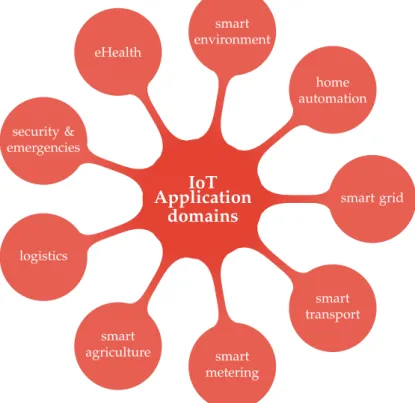
(28) Thèse de Riccardo Petrolo, Lille 1, 2016. 8. Chapter 1. Introduction technologies, the gateway is modeled to guarantee a lightweight and dense deployment of services, by leveraging on the emerging virtualization techniques, • Chapter 6 concludes the Thesis and draws the future guidelines in order to improve the solutions proposed.. © 2016 Tous droits réservés.. lilliad.univ-lille.fr.
(29) Thèse de Riccardo Petrolo, Lille 1, 2016. 9. Chapter 2. State of the art The continuous growth of the urban population has generated a drastic expansion of our cities. Nowadays, more than 50 % of the world’s population is urban, and they forecast that it will reach 70 % by 2050 [27]. It is therefore important to make cities ready to accommodate this huge amount of citizens and to improve the quality of life by facing new challenges such as traffic congestion, air pollution, waste management, etc. In this context, Information and Communication Technologies, and especially the Internet of Things, are called to play a crucial role. This Chapter highlights on the benefits and limitations of the IoT in the realization of the Smart City vision. Moreover, we shows the current status towards the realization of the Smart City by introducing some pilots and European initiatives.. 2.1. The Internet of Things. "The Internet of things has the potential to change the world, just as the Internet did. Maybe even more so." [5]. With this sentence, in 1999, Kevin Ashton introduced for the first time the term of "Internet of Things" (IoT). Some years later, in 2005, the International Telecommunication Union (ITU), formally defined the IoT as a technology capable to connect anyone, from anyplace and anytime to anythings [52]. Since then, the IoT starts to attract the attention of both academia and industry; its capability to create a world where all the objects around us are connected together and to the Internet with minimum human intervention, makes, indeed, possible the development of a huge number of applications in different domains.. 2.1.1. Technologies. Different technologies are available to connect objects already well spread in our everyday life environment like RFID in subway, 4G with our phone, Wi-Fi for Internet at home etc. Below, some of the most representative technologies are presented. Sensors represent an essential component of any intelligent control system. Thanks to technology advances, a multitude of different sensors is nowadays available, enabling applications that were unimaginable in the © 2016 Tous droits réservés.. lilliad.univ-lille.fr.
(30) Thèse de Riccardo Petrolo, Lille 1, 2016. 10. Chapter 2. State of the art. past. Sensor nodes are usually scattered in a sensor field; each of these scattered sensor nodes has the capability to collect data and route it back to a special node called "sink" by a multihop infrastructure-less architecture [1]. Currently, most of commercial Wireless Sensor Networks (WSN) are based on the IEEE 802.15.4 standard [49], which defines the physical and MAC layers for low-power, low bit-rate communications in wireless personal area networks (WPAN). However, IEEE 802.15.4 does not include specifications on the higher layers of the protocol stack, which are necessary for the integration of sensor nodes into the Internet [6]. The role of Sensor Network (SN) in the IoT is crucial and well examined in [76]. Smartphones represent another interesting sensing scenario. Indeed, the ever increasing number and the presence of a mixture of sensors such as GPS, gyroscopes, accelerometers and compasses, enabling a variety of crowd sourcing applications, which will eventually be augmented by the IoT. For instance, as users regularly update their location status on social networks like Twitter and Facebook; based on this location information, it is possible to aggregate this data, enabling tasks to be dispatched to people in specific locations [39]. Regarding to short range communications, two interesting technologies in the IoT context are Radio Frequency Identification (RFID) and Near Field Communication (NFC). RFID is a method of identifying unique items using radio waves. Typical RFID systems are made up of 2 major components: readers and tags. The reader sends and receives RF data to and from the tag via antennas. The tag is made up of a microchip that stores data, an antenna, and a carrier to which the chip and antenna are mounted [98]. RFID can be used to develop a large number of applications, to name a few: smart parking [71], traffic monitoring [74], library management [93], transportation tickets, etc. NFC is a contactless wireless communication technology based on RFID and Internet technologies [111]. It supports the communication within 20 centimeters, and it represents a prominent technology, enabling a range of applications in order to make people’s life more convenient and fast, i.e. the digital wallet introduced in [7] or building access control. Integrating resource-constrained devices into the Internet is difficult since ubiquitously deployed Internet protocols such as HTTP, TCP, or even IP are too complex and resource-demanding [89]. Many initiatives have been proposed in literature; here below some of the most relevant. The µIP [22] includes a low-power link built on IEEE 802.15.4 for small embedded devices. 6LoWPAN [56] defines mechanisms capable to fragment and to compress the header of IPv6 datagrams. Hui et al. in [48] consider multiple WSNs connected by IPv6-based border routers through IP links, including Ethernet, Wi-Fi, GPRS, and satellites. Constrained Application Protocol (CoAP) [19] is an application layer protocol designed for energy constrained devices. It deals with Constrained © 2016 Tous droits réservés.. lilliad.univ-lille.fr.
(31) Thèse de Riccardo Petrolo, Lille 1, 2016. 2.1. The Internet of Things. 11. RESTful environments, providing a lightweight alternative to HTTP. CoAP and 6LoWPAN allow sensor nodes to be integrated into the web, through the use of proxies for HTTP to CoAP conversion. As seen, a lot of effort has be done in order to design intelligent devices that can be adopted to improve our daily life. At the same time, the need to integrate those resource-constrained objects to the Internet -and the possibility to remotely manage them- is evident and important in order to implement more complete, accurate, and useful applications.. 2.1.2. Applications. Figure 2.1 shows some of the main IoT application domains, i.e., smart metering, home automation, smart agriculture, eHealth, retail, etc.. smart environment. eHealth. home automation security & emergencies. IoT Application domains. smartwater grid smart. logistics smart transport smart agriculture. smart metering. F IGURE 2.1: IoT application domains.. Smart Transport is one the hot application within the Smart City context. Due to the increasing number in cars number over recent years, there is an urgent need to improve the traffic management, by avoiding traffic jams and optimizing traffic flow. Smart Environment and in general environmental monitoring is absolutely important in order to ensure, and improve, the quality of life. By monitoring the quality of water and air, and other parameters such as ambient carbon dioxide level, temperature, humidity, etc. we can, indeed, keep the pollution to an acceptable level. In order to empower smart environments, it is necessary to collect data from different sensors. In this context, thanks to the diffusion of smartphones, it is possible to create collaborative. © 2016 Tous droits réservés.. lilliad.univ-lille.fr.
(32) Thèse de Riccardo Petrolo, Lille 1, 2016. 12. Chapter 2. State of the art. environment monitoring, like for example "SoundCity"1 , a mobile application for understanding the exposure to noise pollution. Smart Grid is another prominent application in the Smart City landscape, thanks to its objective to reduce carbon emission resulting from energy generation and consumption. Conventional electricity grid has been developed based on the assumption that electricity is generated at few stations generally outside urban areas and transported and distributed to large, medium and small sized consumers. The grid is nowadays, evolving to a power network combined with large central power plants. Electricity can be generated, consumed and stored anywhere in the grid. Renewable energy sources offer pollution free, climate friendly, sustainable and unlimited sources of energy. Their integration into the power grid is driven largely by environmental and economic regulation aimed at transforming into a clean and sustainable energy grid [92].. 2.2. Smart City pilots. Looking at the current status towards the realization of the Smart City paradigm, we can observe that it is still far from being realized, due to its highly autonomous and intelligent features. The available technologies are, indeed, not yet sufficiently mature to make Smart Cities truly autonomous. However, there are currently pilot projects worth mentioning. SmartSantander [96] is a pilot project which has recently received significant attention. This is a unique, in the world city-scale, experimental research facility to support typical applications and services for a Smart City. The testbed deployed has dual purpose; one allows real-world experimentation on IoT related technologies (protocols, applications, etc.), the second is supporting the provision of smart city services aimed at enhancing the quality of life in the city of Santander. Different devices have been installed: fixed sensor nodes attached to public lampposts or to building facade, which can observe a wide range of physical magnitudes (e.g., light intensity, noise, carbon monoxide, air temperature, relative humidity, solar radiation, atmospheric pressure, soil temperature, wind direction, etc.); mobile sensor nodes installed on top of public transport buses, taxis, and other municipal services vehicles; parking monitoring sensor nodes buried under the asphalt on outdoor parking places; traffic monitoring sensor nodes buried under the asphalt on the main entrances to the city; QR and NFC tags located at city Points of Interest (POI) (e.g., monuments, bus stops, local administration premises, shops, etc.) that represent a key asset for the augmented reality service. The development of Songdo [103] in South Korea, started from scratch in 2001 and is predicted to be complete by 2018. Smart systems are used in 1. © 2016 Tous droits réservés.. http://urbancivics.com/soundcity_app.html. lilliad.univ-lille.fr.
(33) Thèse de Riccardo Petrolo, Lille 1, 2016. 2.2. Smart City pilots. 13. every building to monitor the water and electricity, which also allow residents to connect remotely using their smartphones. Sensing technologies include RFID tags on vehicles, which send signals to sensors on the road to monitor traffic flow, surveillance systems as well as smart street lights, which can be adjusted to pedestrian traffic. Amsterdam has seen some recent developments en route to make it a Smart City. The main operator of this development is Amsterdam Smart City project2 , started in 2009 with the main goal of increasing green growth using technology. Different initiatives started in specific city locations, like for example an intelligent electricity network (Smart Grid) developed in the New West district, which promises to reduce the number and duration of power outages; to improve the opportunity to feed consumer-produced electricity back to the grid; to increase capability to support the integration of electric-powered vehicles, etc. Other important initiatives involve Barcelona3 . Sensors have been deployed in garbage bins, allowing remote monitoring of the content of bins and optimizing garbage collection service. Additionally, the City Council installed "smart water" system for tele-managing the irrigation of the city’s green spaces, an initiative that is as good for the environment as it is for the economical aspect, with its use of latest-generation technology for better resource management. Sensors on street-lights detect presence and adjust the light intensity accordingly as well. London and in particular Camden Town, is another active city in the field. Different sensors and data feeds are already available in Camden, like cameras used for monitoring traffic, public transport and safe shopping; GPS and location sensors used for deriving information about the positioning and the status of waste collection vehicles; meteorological data feeds used to provide relevant information to tourists; traffic data streams used to balance load on public and private transport; security data streams used for monitoring as per national policy directives; disaster prevention data streams used for monitoring as per disaster plans and simulations. The aims of Camden is to boost targets of its business strategy like reducing the cost of business operations, with a view to make it an attractive destination of commercial, retail and leisure activities; strengthen Camden’s links to neighboring areas/districts (such as Euston and Kings Cross), and so on. As one of the largest cities in the world, Istanbul has a population of 13.9 million on a surface area of 5313 square kilometers. This cosmopolitan and historic city needs to meet the challenge of maintaining transportation safety and accessibility since it continues to become an important international metropolis with increasing traffic numbers. To ensure effective and efficient use of the current main arterial road network, traffic management 2 3. © 2016 Tous droits réservés.. http://amsterdamsmartcity.com http://smartcity.bcn.cat/en. lilliad.univ-lille.fr.
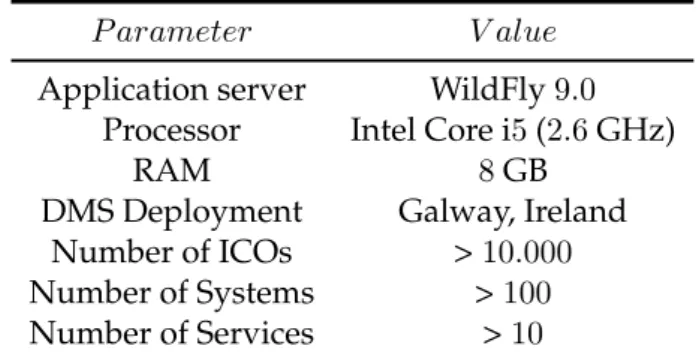
(34) Thèse de Riccardo Petrolo, Lille 1, 2016. 14. Chapter 2. State of the art. in Istanbul is a critical issue. To deal with those issues, the idea is to develop, install, maintain and operate Intelligent Transportation Systems and their infrastructure including traffic monitoring and supervision cameras, radar detectors, sensors, and so on. The project Smart City Písek4 seeks to introduce modern information technologies into the daily regime of the city. Písek can be considered as the first really intelligent city in the Czech Republic. The use of wireless technology IQRF5 increases comfort of the city’s population via dynamic control of intersections, smart management of public lighting and navigation system on public parking lots. Analysis of all the collected data brings optimization of urban traffic and public transport. Started in 2012, the Sense-City project6 will offer a suite of high-quality facilities for the design, prototyping and performance assessment of innovative, micro- and nano-technology based sensors devoted to urban instrumentation. Acknowledging the shortcomings of evaluating sensors performances in laboratory conditions only or in the ever-changing environment of our cities, Sense-City will provide a realistic urban test space in climatic conditions, far more complex than clean rooms and far less complex than actual cities. Sense-City revolves around the mini-city concept, a large, fully customizable climatic hall able to host full- and reduced-scale models of essential urban components. The design of the models will allow for the simulation in climatic conditions of numerous scenarios of sustainable cities. The scenarios to be implemented will correspond to different research topics related to urban sustainability: energy performances in buildings, quality of air, water and soils, quality of fluid distribution networks (gas, sewage, drink water), control of waste disposal areas, durability and safety of infrastructures. Table 2.1 summarizes the goals of the cities / projects discussed above. Looking at the aforementioned pilots, it is evident that there is a real need to intervene in the urban environment and make it more livable. The proposed approaches are different; from building a city from scratch -which, of course, is not always possible- to other initiatives that focus on solving a specific problem; therefore they adopt technologies that more suit the use case. In general, the surveyed solutions can be considered as standalone and vertical silos, designed to deal with a particular scenario. The lack of integration among different city actors is evident. It is worth highlighting that some of the above actions have testbed purposes, providing experimental research facility and letting researchers to design and deploy applications and services for Smart Cities. 4. http://tcpisek.cz/en/smart-city/ http://www.iqrfalliance.org 6 http://www.sense-city.univ-paris-est.fr 5. © 2016 Tous droits réservés.. lilliad.univ-lille.fr.
(35) Thèse de Riccardo Petrolo, Lille 1, 2016. 2.3. European Initiatives for Smart Cities. 15. City / Project. Purpose. Santander, Spain. testbed platform; smart parking systems; environmental monitoring; traffic monitoring. Songdo, Korea. smart buildings; tags on vehicles; sensors on the road; smart lighting. Amsterdam, the Netherlands. smart grid; smart energy management. Barcelona, Spain. smart garbage bins; smart-water systems; smart parking; smart lighting. Camden Town, England. traffic data; prevention. Istanbul, Turkey. smart traffic management. Písek, Czech Republic. smart intersections; parking. Sense-City. testbed around mini-city concept; urban sustainability (quality of air, water, etc.). meteorological data;. disaster. smart public lighting;. TABLE 2.1: Some of the Smart City pilots.. 2.3. European Initiatives for Smart Cities. The enormous interest acquired by the Smart City concept is also witnessed from the several initiatives that the European Commission has activated. The European Innovation Partnership on Smart Cities and Communities (EIP-SCC) focuses on the integration of industry, citizen and cities to try to improve the sustainability of the urban life through integrated solutions. The 7th Framework Programme for Research and Technological Development of the European Commission funded different projects under the call Smart City, in order to correctly identify and address Smart City issues and challenges. Without pretending to be exhaustive, we will present some of the most representative projects that have been proposed in the European FP7 calls. ClouT7 (2013-2016) uses the Cloud computing as an enabler to bridge the Internet of Things with the Internet of People via the Internet of Services, to establish an efficient communication and collaboration platform exploiting all possible information sources to make the cities smarter and to help them facing the emerging challenges such as efficient energy management, economic growth and development. ClouT provides infrastructures, services, tools and applications that will be reused by different city stakeholders such as municipalities, citizens, service developers and application integrator, in 7. © 2016 Tous droits réservés.. http://clout-project.eu. lilliad.univ-lille.fr.
(36) Thèse de Riccardo Petrolo, Lille 1, 2016. 16. Chapter 2. State of the art. order to create, deploy and manage user-centric applications taking benefit of the latest advances in the IoT and Cloud domains. SOCIOTAL8 (2013-2016) aims to design and provide key enablers for a reliable, secure and trusted IoT environment that will enable creation of a socially aware citizen-centric Internet of Things by encouraging people to contribute their IoT devices and information flows. It will provide the techno-social foundations to unlock billions of new IoT information streams taking a citizen-centric IoT approach towards creation of large-scale IoT solutions of interest to the society. By equipping communities with secure and trusted tools that increase user confidence in IoT environment, SOCIOTAL will enable their transition to smart neighborhood, communities and cities. CityPulse9 (2013-2016) provides innovative smart city applications by adopting an integrated approach to the Internet of Things and the Internet of People. The project will facilitate the creation and provision of reliable real-time smart city applications by bringing together the two disciplines of knowledge-based computing and reliability testing. SMARTIE10 (2013-2016) aims to create a distributed framework to share large volumes of heterogeneous information for the use in Smart City applications, enabling end-to-end security and trust in information delivery for decision-making purposes following data owner’s privacy requirements. Project ClouT. Technology Cloud. IoT. 3. 3. SOCIOTAL. 3. CityPulse. 3. SMARTIE. 3. TABLE 2.2: European FP7 projects.. It is important to highlight that all the above European initiatives consider the human and social aspect as crucial; furthermore the use of the Internet of Things is recognized as essential (Table 2.2), defining therefore a common strategy towards the Smart City vision. It is worth underlining that Cloud computing is acknowledged as an enabler of the integration between the IoT and other city stakeholders. 8. http://sociotal.eu http://www.ict-citypulse.eu 10 http://www.smartie-project.eu 9. © 2016 Tous droits réservés.. lilliad.univ-lille.fr.
(37) Thèse de Riccardo Petrolo, Lille 1, 2016. 2.4. Conclusion. 2.4. 17. Conclusion. In the last decades, the necessity to improve the quality of life and to make cities sustainable and efficient has lead to success the Smart City paradigm. Anyways, due to its popularity, the concept has been used with different names and in different circumstances, making therefore difficult a formal and universally accepted definition. Recently, a common vision is to describe a Smart City as a complex system that integrates different actors such as people, governance, economy, living, environment, and mobility. In order to achieve this model, a key role is played by ICT and especially by the prominent Internet of Things. Looking at the current status, we can observe that the realization of the Smart City paradigm is still far from being realized. The real scenario is indeed characterized with a high level of fragmentation of technologies and lack of ubiquity in terms of both connectivity and coverage, going therefore against those needs of integration, cooperation, and interoperability required between different Smart City stakeholders highlighted in Chapter 1. In order to bridge the gap between these different IoT ecosystems, in the next Chapter, the evolution of the Internet of Things -by using Semantic interoperability and Cloud computing- towards the Cloud of Things (CoT) is discussed. Compared to the other -standalone and vertical- solutions, the CoT aims to make better use of distributed resources -by enabling an horizontal integration-, to put them together and making therefore, real the Smart City vision.. © 2016 Tous droits réservés.. lilliad.univ-lille.fr.
(38) Thèse de Riccardo Petrolo, Lille 1, 2016. © 2016 Tous droits réservés.. lilliad.univ-lille.fr.
(39) Thèse de Riccardo Petrolo, Lille 1, 2016. 19. Chapter 3. Towards the Cloud of Things The Internet of Things (IoT) is signing an important revolution in all the aspects of our lives, e.g., work, health, transportation, etc. [107]. Looking at the bigger picture, we can perceive the Smart City concept as a clear example of integration and cooperation among those different IoT ecosystems. Nevertheless, the IoT deployments are, nowadays, based on different standards and protocols, making therefore, difficult and challenging the conception of the Smart City paradigm. To deal with this problematic, in this Chapter, the evolution of the Internet of Things towards the Cloud of Things (CoT) is presented. Aspects of both visions are analyzed while underlying the need of a technological progression in a Smart City context. Then, the VITAL operating system -which can monitor, visualize, and control all the operations of a city- is shown as a system that embraces the CoT philosophy.. 3.1. IoT middleware. Several platforms have been introduced in literature in order to manage IoT devices and deal with specific use-cases. In this field, middleware gained, recently, a lot of importance due to their major role in simplifying the development of new services and the integration of legacy technologies into new ones [6]. In the following, we will present some of the most representative IoT platforms without pretending to be exhaustive: • GSN1 is a platform developed in Java, aiming at providing flexible middleware to address the challenges of sensor data integration and distributed query processing. It lists all the available sensors in a combo-box which users need to select the ones they need. GSN’s purpose is to make the GSN applications hardware-independent and the changes and variations invisible to the application. The main limitation of GSN is due to lack of semantics to model the data and metadata. 1. © 2016 Tous droits réservés.. https://github.com/lsir/gsn. lilliad.univ-lille.fr.
(40) Thèse de Riccardo Petrolo, Lille 1, 2016. 20. Chapter 3. Towards the Cloud of Things • LSM2 (Linked Sensor Middleware) is a platform that brings together the live real world sensed-data and the Semantic Web. It provides many functionality such as, wrappers for real time data collection and publishing; a web interface for data annotation and visualization; and a SPARQL endpoint for querying unified Linked Stream Data and Liked Data. However it does not offer tools for manipulating data. • Fortino et al. in [30] propose a multi-layered agent-based architecture for the development of proactive, cooperating and context-aware smart objects. This architecture takes into account a wide variety of smart objects, from reactive to proactive, from small to very large, from stand-alone to social. • Sensor-Cloud [117] is an infrastructure that aims at managing physical sensors by connecting them to the Cloud. This infrastructure provides the service instances (virtual sensors) to the users in an automatic way at the same fashion as these virtual sensors are effectively part of the IT resources. The generation of the services instances implies that the sensor devices and service templates (used to create the virtual sensors) should be firstly prepared. • OpenIoT3 represents a joint effort of several contributors to IoT-based applications according to a Cloud computing delivery model. It concentrates on providing a Cloud-based middleware infrastructure in order to deliver on-demand access to IoT services, which could be formulated over multiple platforms. • Xively4 (formerly Cosm and Pachube) offers a public Cloud that simplifies and accelerates the creation, deployment and management of sensor in scalable way. Its main constraint is due to the limitation to manage and to retrieve data just from own devices. The aforementioned initiatives strengthen the use of semantic tech-. niques in order to enable the integration of different data-sources. At the same time, also the Cloud computing is recognized as a key player in this integration process. However, a lot of new enhancements are still needed to realize a platform that can offer the means to monitor, control, and visualize all the operations in a city environment.. 3.2. Semantic Interoperability. The aforementioned heterogeneous landscape -in terms of hardware capabilities / constraints, network protocols, and application requirements- is 2. https://code.google.com/archive/p/deri-lsm/ https://github.com/OpenIotOrg/openiot 4 https://xively.com 3. © 2016 Tous droits réservés.. lilliad.univ-lille.fr.
(41) Thèse de Riccardo Petrolo, Lille 1, 2016. 3.2. Semantic Interoperability. 21. in contrast with the Smart City requirements, i.e., integration and cooperation. In the last years, researchers focused on interoperability techniques that allow communication among the disparate devices available. In [41], authors highlight the need of an IP-based access as unifying network layer that can turn those objects into Internet-Connected Objects (ICOs). At the same time, authors point out on the need of a semantic representation in order to understand data which comes out and goes into the ICO interfaces. This "data exchange layer" may influence discovery and routing approaches and it will be crucial to enable scalability from an application’s point of view, as nobody will be able do deal with the number of ICOs, efficiently and scalable, without such a layer. The necessary technologies to build this layer are already being developed and deployed: Linked Data [11] and the Resource Description Format (RDF) [43] are accepted standards in the Web and provide a general model. Our approach is therefore, to use those solutions that are already widely accepted.. 3.2.1. Linked Data. The term Linked Data is usually applied to a set of techniques for publishing and interlinking structured data on the Web. As stated in [44], Linked Data is based on four principles: 1. Use URIs as names for things. Each thing has a globally unique name, usually an HTTP URI since this makes easy to enforce global uniqueness. 2. Use HTTP URIs. It makes easier to retrieve description of things using HTTP protocol. For humans the description can be provided as HTML page and for machines it can be provided as RDF triples. 3. Use standards to provide information. This usually means that standards like RDF are used to model and access data. 4. Use link to other URIs. This operation enables the possibility to discover more things. That means that there should be external links pointing to other data sources on the Web. By following these links, a larger and distributed data space can be explored automatically. To summarize, Linked Data enables the implementation of generic applications operating over a huge, interconnected and distributed data space by using Web standards and a common data model. The most common data model used in the context of Linked Data is the Resource Description Framework (RDF).. © 2016 Tous droits réservés.. lilliad.univ-lille.fr.
(42) Thèse de Riccardo Petrolo, Lille 1, 2016. 22. Chapter 3. Towards the Cloud of Things. 3.2.2. RDF and JSON-LD. RDF is a popular standard for describing things (known as resources or entities). It is a graph-based data model that represents information as labeled directed graphs. Each triple (s, p, o) consists of a subject s, a predicate p, and an object o. The predicate denotes the relationship between subject and object. The example in Figure 3.1 shows a representation in RDF; the information "The sea has the color blue" is modeled as a triple with "Sea" as the subject, "has color" as the predicate, and "blue" as the object. Both the subject and the predicate are identified by URI while the object can be a URI or a literal value (i.e., a string or a number). Sea. has color. Blue. F IGURE 3.1: RDF example.. RDF provides just a data model; to format data, a number of different technologies exist, i.e., RDF/XML, Turtle, N-Triples, and JSON-LD. Anyway, many developers have little or no experience with formats such as N-Triples and Turtle, therefore the use of JSON-LD is preferred. JSON-LD is, indeed, a JSON-based serialization for Linked Data. Its main features are: • Simplicity. No need for extra processors or software libraries. • Compatibility. JSON-LD documents are always valid JSON documents, so standard libraries from JSON can be used. • Expressiveness. Real-world data models can be expressed because the syntax serializes a directed graph. • Terseness. The syntax is readable for humans and developers need little effort to use it. • Zero Edits. JSON-LD can be devolved easily from JSON-based systems, in most of the cases. • Usable as RDF. JSON-LD can be mapped to/from RDF and can be used as RDF without having any knowledge of RDF. Listing 3.1 shows a description of a person (Bob Dylan) based on JSONLD data format. The context links object properties in a JSON document to concepts in an ontology. By having all data semantically annotated as in the example, an RDF processor can identify that the document contains information about a person (@type) and if the processor understands the FOAF vocabulary it can determine which properties specify the person’s name and homepage. © 2016 Tous droits réservés.. lilliad.univ-lille.fr.
(43) Thèse de Riccardo Petrolo, Lille 1, 2016. 3.2. Semantic Interoperability. 23. L ISTING 3.1: JSON-LD example. 1 { 2. "@context": { "name": "http://xmlns.com/foaf/0.1/name", "homepage": { "@id": "http://xmlns.com/foaf/0.1/workplaceHomepage", "@type": "@id" }, "Person": "http://xmlns.com/foaf/0.1/Person" }, "@id": "http://bobdylan.com", "@type": "Person", "name": "Bob Dylan", "homepage": "http://www.bobdylan.com". 3 4 5 6 7 8 9 10 11 12 13 14 }. 3.2.3. Ontologies. Linked Data can be used in cases in which data is originated from different sources. To integrate all data, therefore, it is important to have some rules in order to determine how the RDF graph has to be built and how triples may be connected or not. These rules are given by ontologies. An ontology specifies formally the conceptualization of a domain of interest. To define ontologies, the W3C published the Web Ontology Language5 (OWL) which builds on RDF. Many ontologies have already been developed, and among them, the Semantic Sensor Network (SSN) [18] answers the need for a domainindependent and end-to-end model for sensing applications. Within the SSN context, a sensor could be anything that observes; be it an electronic object, a virtual object or a human. Figure 3.2 shows the ten modules and key concepts and relations of the SSN ontology. The full ontology consists of 41 concepts and 39 object properties: that is, 117 concepts and 142 object properties in total, including those from DUL (DOLCE+DnS Ultralite)6 . To better understand the ontology in terms of sensors and observations, the four main perspectives of SSN ontology are explained below: • Sensor perspective. A sensor is described with a stimulus, a sensing method, observation, and capabilities. One sensor may have many measurement capabilities. Such capabilities are e.g., measurement precision, measurement range, accuracy, and measurement resolution. • Observation perspective. It describes an observation. An observation includes a context for interpreting incoming stimuli and puts the observation event into an interpreting context. 5 6. © 2016 Tous droits réservés.. http://www.w3.org/2001/sw/wiki/OWL https://www.w3.org/2005/Incubator/ssn/wiki/DUL_ssn. lilliad.univ-lille.fr.
(44) Thèse de Riccardo Petrolo, Lille 1, 2016. 24. Chapter 3. Towards the Cloud of Things • System perspective. A system can have sub-systems or sub-concepts like devices and sensing devices. • Feature and property perspective. It focuses on properties -sensors that sense some distinct property- or on observations -made about a distinct property-.. F IGURE 3.2: The SSN ontology - concepts and relations.. Semantic techniques are recognized as good enablers in the complex process of integration of heterogeneous data-sources. As seen, those technologies are already available and adopted in some of the most popular middleware solutions. However, once modeled and homogenized, there is still the need to physically store those data-sources and easily access them while ensuring scalability; in the next Section the Cloud computing is introduced as in order to face these challenges.. 3.3. The Cloud computing. In the last decades, Cloud computing attracted the attention from both academia and industry across the world, thanks to its capability to transform in service model the entirely current IT (Information Technology) industry. The main advantages introduced by Cloud computing are high performance, high availability, infinity scalability, tremendous fault-tolerance capability; at the same time, it minimizes the upfront investment [117]. According to Patidar et al. [73], the Cloud services can be divided into three main categories. As resumed in Table 3.1, they are: • Infrastructure as a Service (IaaS) offers computing resources such as processing or storage (e.g., Amazon Web Services (AWS), Cisco Metapod, Microsoft Azure). © 2016 Tous droits réservés.. lilliad.univ-lille.fr.
Figure


+5

![Table 5.1 shows the results of the benchmark analysis [87]. The sys- sys-bench 5 tool is used to test CPU and Disk I/O performance](https://thumb-eu.123doks.com/thumbv2/123doknet/3721190.111130/78.892.251.616.122.363/table-shows-results-benchmark-analysis-bench-disk-performance.webp)
Documents relatifs