O
pen
A
rchive
T
OULOUSE
A
rchive
O
uverte (
OATAO
)
OATAO is an open access repository that collects the work of Toulouse researchers and
makes it freely available over the web where possible.
This is an author-deposited version published in :
http://oatao.univ-toulouse.fr/
Eprints ID : 4332
To cite this version :
Privé , Florence and Combes, Sylvie and Cauquil, Laurent and
Farizon , Yves and Enjalbert, Francis and Troegeler-Meynadier,
Annabelle Temperature and duration of heating of sunflower oil
affect ruminal biohydrogenation of linoleic acid in vitro. (2010)
Journal of Dairy Science, vol. 93 (n° 2). pp. 711-722. ISSN
0022-0302
Any correspondance concerning this service should be sent to the repository
administrator: [email protected].
Temperature and duration of heating of sunflower oil affect
ruminal biohydrogenation of linoleic acid in vitro
F. Privé ,*†‡ S. Combes ,*†‡ L. Cauquil ,*†‡ Y. Farizon ,*†‡ F. Enjalbert ,*†‡ and A. Troegeler-Meynadier *†‡1 * ENVT, UMR1289 Tissus Animaux Nutrition Digestion Ecosystème et Métabolisme, F-31076 Toulouse Cedex 3, France
† INRA, UMR1289 Tissus Animaux Nutrition Digestion Ecosystème et Métabolisme, F-31326 Castanet-Tolosan, France ‡ Université de Toulouse, INPT ENSAT, UMR1289 Tissus Animaux Nutrition Digestion, F-31326 Castanet-Tolosan, France
ABSTRACT
Sunflower oil heated at 110 or 150°C for 1, 3, or 6 h was incubated with ruminal content in order to investi-gate the effects of temperature and duration of heating of oil on the ruminal biohydrogenation of linoleic acid in vitro. When increased, these 2 parameters acted together to decrease the disappearance of linoleic acid in the media by inhibiting the isomerization of linoleic acid, which led to a decrease in conjugated linoleic ac-ids and trans-C18:1 production. Nevertheless, trans-10 isomer production increased with heating temperature, suggesting an activation of ∆9-isomerization, whereas
trans-11 isomer production decreased, traducing an inhibition of ∆12-isomerization. The amount of perox-ides generated during heating was correlated with the proportions of biohydrogenation intermediates so that they might explain, at least in part, the observed ef-fects. The effects of heating temperature and duration on ruminal bacteria community was assessed using cap-illary electrophoresis single-strand conformation poly-morphism. Ruminal bacterial population significantly differed according to heating temperature, but was not affected by heating duration. Heating of fat affected ruminal biohydrogenation, at least in part because of oxidative products generated during heating, by alter-ing enzymatic reactions and bacterial population.
Key words: ruminal biohydrogenation , conjugated linoleic acid , heat processing , lipid peroxidation
INTRODUCTION
Conjugated linoleic acid (CLA) is a collective term for positional and geometrical isomers of linoleic acid (cis-9,cis-12-C18:2) with conjugated double bonds. Among them, cis-9,trans-11-CLA and trans-10,cis-12-CLA have been reported to prevent some diseases like cancer, obesity, and arteriosclerosis (Pariza et al.,
2001). In particular, cis-9,trans-11-CLA was shown to inhibit the cancer genesis in animal models. However,
trans-10,cis-12-CLA was also reported to have poten-tial adverse effects in humans in some cases, like insulin resistance in obese men with the metabolic syndrome (Riserus et al., 2002). Many foods contain CLA, with dairy products having the highest concentrations.
In dairy cows, milk CLA have 2 origins. The first origin is their formation during microbial ruminal bio-hydrogenation (BH) of cis-9,cis-12-C18:2, which be-gins with isomerization, mediated by several bacterial isomerases leading to several CLA isomers (Enjalbert and Troegeler-Meynadier, 2009), such as ∆12-isomerase and ∆9-isomerase that produce cis-9,trans-11-CLA and trans-10,cis-12-CLA, respectively (Griinari and Bauman, 1999). Thereafter, initial reduction produces different trans-octadecenoic acid (trans-C18:1) isomers:
trans-11-C18:1 (also called vaccenic acid) and trans-10-C18:1, respectively, for the above-mentioned CLA isomers. Finally, subsequent reduction produces stearic acid (C18:0). Because of its rapid reduction, very little CLA flows out of the rumen, implying that ruminal ori-gin is of minor importance for milk CLA. A more signif-icant origin of milk CLA is the mammary desaturation of trans-11-C18:1 into cis-9,trans-11-CLA (Griinari et al., 2000). Trans-11-C18:1 is an intermediate of ruminal BH of both cis-9,cis-12-C18:2 and α-linolenic acid (cis-9,cis-12,cis-15-C18:3). Thus, milk CLA content could be modulated by factors affecting cis-9,cis-12-C18:2 and cis-9,cis-12,cis15-C18:3 BH as well as factors af-fecting desaturation in the mammary gland.
One way to efficiently increase CLA milk concentra-tions is the addition of a fat supplement to the dairy cow diet, particularly fat rich in cis-9,cis-12-C18:2 and
cis-9,cis-12,cis-15-C18:3. In dairy cow diets, fat is usu-ally sourced from oilseeds, which are often heated (e.g., by roasting or extrusion). Among studies, these pro-cesses have been shown to have variable effects on BH that need to be specified and explained. Heated oilseeds often induced a decrease of 9,12-C18:2 and cis-9,cis-12,cis-15-C18:3 BH in vivo (Gonthier et al., 2005), in situ (Chouinard et al., 1997b; Troegeler-Meynadier J. Dairy Sci. 93 :711–722
doi: 10.3168/jds.2009-2534
© American Dairy Science Association®, 2010 .
711
Received July 1, 2009. Accepted November 9, 2009.
1
et al., 2006b) and in vitro (Reddy et al., 1994); how-ever, this partial protection of PUFA against BH was not always noticed (Chouinard et al., 1997a; Akraim et al., 2006; Neves et al., 2007). Moreover, in most of these studies, heat treatments resulted in an accumulation of BH intermediates, particularly cis-9,trans-11-CLA, or
trans-11-C18:1, or both.
Oilseeds heating effects on ruminal lipid digestion could be caused by a modification of the seed coat pro-tection, a reduction of the amount of PUFA subjected to BH, or the production of oxidation products (Reddy et al., 1994). These products could act on BH or on the biohydrogenating ruminal bacteria because anaerobes are known to be sensitive to peroxides (Brioukhanov and Netrusov, 2004). Oil heating can be an efficient model for the study of the effects of heat-induced lipid modifications on ruminal BH.
The purpose of this study was to investigate the ef-fects of 2 main modulators of the heating process, the duration of heating (1 vs. 3 vs. 6 h) and the temperature of heating (110 vs. 150°C), on cis-9,cis-12-C18:2 BH in ruminal cultures in vitro. The relationship between BH and the level of oil oxidation induced by heating (evalu-ated by peroxide value) was investig(evalu-ated, and the effects of heating on the structure of the bacterial community was studied using capillary electrophoresis single-strand conformation polymorphism (CE-SSCP).
MATERIALS AND METHODS
In Vitro Cultures
The oxidized oil was prepared by heating 20 mL of a commercial sunflower oil at 110 or 150°C for 1, 3, or 6 h in a crystallizing dish (9 cm in diameter). The heated oils were kept 1 h at ambient conditions to mimic cool-ing conditions after industrial heatcool-ing processes, and then were frozen at −80°C in 2-mL syringes until use. In parallel, nonheated oil was frozen in syringes to be used as a control for both the efficiency of the BH in our in vitro incubation system and for the global effect of heating.
Ruminal incubations were performed in a water bath rotary shaker (Aquatron, Infors AG, Bottmingen, Ger-many). Ruminal fluid was obtained from a fistulated, nonlactating Holstein cow receiving an alfalfa hay-based diet (5 kg of alfalfa hay, 2 kg of wheat straw, 2.5 kg of corn meal, and 0.3 kg of a minerals and vitamins supple-ment, as fed). The cow was allowed to adapt to this diet for 3 wk before the beginning of the experiment. Ru-men fluid was taken from the cow with a vacuum pump 30 min after feeding and strained through a metal sieve (1.6-mm mesh). Rumen fluid was transferred quickly to the laboratory in anaerobic conditions at 39°C.
Eighty milliliters of strained ruminal fluid were in-cubated in a 250-mL Erlenmeyer flask containing 200 mg of oil, 3 g of dehydrated alfalfa, and 80 mL of a bicarbonate buffer solution composed of 19.5 g/L of Na2HPO4·2H2O, 9.24 g/L of NaHCO3, 0.705 g/L of NaCl, 0.675 g/L of KCl, 0.108 g/L of CaCl2·2H2O, and 0.180 g/L of MgSO4·7H2O. The buffer solution was prewarmed to 39°C and saturated with CO2. The filled flasks were gassed with CO2 and placed in the water bath at 39°C. Flasks were then closed with a rubber cap crossed by a plastic tube leading into the water to vent fermentation gas without allowing the entrance of oxygen. Flasks were stirred at 130 rpm and kept safe from the light during the 6-h incubation.
Two replicates of the control and of each heat treat-ment were incubated during each of the 3 d of culture (i.e., a total of 6 replicates per treatment). Each day, 2 blanks (without fat and not incubated) were prepared to analyze the initial state of media. At the end of the incubation, fermentations were stopped by placing the flasks into ice water, pH was measured, and 2 × 200 µL were sampled for bacterial community analysis. The contents of the flasks were then immediately frozen. Samples were freeze-dried (Virtis Freezemobile 25, Vir-tis, Gardiner, NY), weighed, ground and homogenized in a ball mill (Dangoumau, Prolabo, Nogent-sur-Marne, France), and kept at −18°C for later analysis.
Fatty Acids and Peroxides Analysis
The degree of oxidation of oils was estimated by the peroxide value (PV; AFNOR, 2004), which was expressed as milliequivalents per kilogram (mEq/kg) of oil. The fatty acids of nonheated oils, heated oils, and incubated media were extracted and methylated in situ using the procedure of Park and Goins (1994), except that the solution of 14% of boron trifluoride in methanol was replaced by a solution of methanol-acetylchloride (10:1). Nonadecanoic acid (C19:0) was used as the internal standard at a dose of 0.8 mg. The fatty acid methyl esters were then quantified by gas chromatography (Agilent 6890N, equipped with a mod-el 7683 auto injector, Network GC System, Palo Alto, CA) using a fused silica capillary column (100 m × 0.25 mm i.d., 0.20-µm film thickness; CPSil88,Varian, Middelburg, the Netherlands).
For analysis, the flame ionization detector tempera-ture was maintained at 260°C and the injector at 255°C; the split ratio was 1:50. Hydrogen was the carrier gas, with a constant flow of 1 mL/min. The samples were injected in 1 µL of hexane. The initial temperature of the oven was 60°C, which was held for 2 min; it was then increased by 10°C/min to 150°C, held at 150°C for 12 min, increased by 2°C/min to 175°C, held at Journal of Dairy Science Vol. 93 No. 2, 2010
PRIVÉ ET AL.
175°C for 20 min, increased by 20°C/min to a final temperature of 225°C, and maintained at 225°C for 10 min. This temperature program allowed the separation of cis-15-C18:1 from C19:0, but did not allow the sepa-ration of cis-9,cis-12,cis-15-C18:3 from C20:1 and did not correctly separate trans-C18:1 isomers. Therefore, a second temperature program was used to separate these coeluted fatty acids. For this analysis, the flame-ionization detector temperature was maintained at 260°C and the injector at 255°C; the split ratio was 1:50. Hydrogen was the carrier gas, with a constant pressure of 160 kPa. The samples were injected in 0.5 µL of hexane. The initial temperature of oven was 60°C, which was held for 3 min; it was then increased by 8°C/ min to 190°C, held at 190°C for 13 min, increased by 5°C/min to 225°C, held at 225°C for 10 min, increased by 10°C/min to a final temperature of 230°C, and main-tained for 10 min. Peaks were identified and quantified by comparison with commercial standards (Sigma Co., St. Louis, MO), except trans-C18:1 other than trans-9- and trans-11C18:1, which were identified by order of elution. The fatty acid concentrations were expressed as milligrams per kilogram of DM.
Bacterial Community Analysis
Bacterial community analysis was performed as described by Michelland et al. (2009b). Briefly, total DNA was extracted and purified with QIAamp DNA Stool Mini kit (Qiagen Ltd., West Sussex, UK) directly from approximately 0.2 g of sample. The V3 region of the 16S rRNA genes of bacterial species, correspond-ing to a 205-bp fragment in Escherichia coli, were used as a diversity marker by performing PCR using the primers W49 5′-ACGGTCCAGACTCCTACGGG-3′ and 6FAM-labeled W34 5′-TTACCGCGGCGTGCTG-GCAC-3′ (Delbès et al., 1998; Zumstein et al., 2000). Then, PCR was carried out in 50-µL reaction mixtures containing 5 µL of 10× PCR buffer (PfuUltra II, Strat-agene, La Jolla, CA), 0.2 µM of each primer, 200 µM of each dNTP, 0.25 U of Pfu Ultra II Fusion HS DNA polymerase (Stratagene), 25 µg of BSA (Biolabs), and 1 µL of 200× diluted DNA extract. The temperature program consisted of 2 min at 95°C; 30 cycles of 30 s at 94°C, 30 s at 61°C, and 30 s at 72°C; and a final exten-sion of 3 min at 72°C. The PCR products were checked for appropriate size by 1% agarose gel electrophoresis.
Samples were then analyzed by the method of CE-SSCP, a capillary electrophoretic method based on the heterogeneity of single-stranded ribotype secondary structure providing different mobility through a gel. An internal standard using a different fluorochrome 6-carboxy-X-rhodamine (Applied Biosystems, Foster
City, CA) was analyzed simultaneously. The SSCP mix contained 1 µL of PCR product, 7.8 µL of deionized formamid (Genescan, Applied Biosystems), and 0.2 µL of the internal standard fluorochrome 6-carboxy-X-rhodamine. The mix was denatured at 95°C for 5 min and placed on ice before loading. Then, CE-SSCP was performed on an ABI Prism 3100 Genetic Analyzer us-ing a capillary 36 cm in length and a 7.2% nondenatur-ing polymer consistnondenatur-ing of 80% CAP polymer (Applied Biosystems), 10% glycerol, and 10% 10× Tris-borate EDTA buffer (Applied Biosystems). Electrophore-sis was performed at 25°C for 3,500 s at 15 KV and produced chromatograms containing both sample and internal standard signals. Bacterial communities were spread out in about 1,200 scans. The CE-SSCP data processing was computed with StatFingerprints soft-ware (Michelland et al., 2009a), and CE-SSCP profiles were aligned using pairwise alignment of their internal standard with the same reference internal standard. Simpson’s diversity index (D′) was calculated as follows (Rosenzweig, 1995):
D′ = −logΣai2,
where ai corresponds to the area of the ith peak. Calculations
The rates and efficiencies of the cis-9,cis-12-C18:2 isomerization (v1 and E1, respectively), CLA reduction (v2 and E2, respectively), and trans-C18:1 reduction (v3 and E3, respectively) were calculated as described previously by Troegeler-Meynadier et al. (2006a):
v1 = ([C18:2]b − [C18:2]e)/6 and E1 = ([C18:2]b − [C18:2]e)/[C18:2]b,
where 6 is the incubation time and [C18:2]b and [C18:2]e represent the concentration of C18:2 at the beginning and at the end of the 6-h incubation, respec-tively.
v2 = ([C18:2]b – [C18:2]e + [CLA]b – [CLA]e)/6 and E2 = ([C18:2]b – [C18:2]e + [CLA]b − [CLA]e)/([C18:2]b − [C18:2]e + [CLA]b), where [CLA]b and [CLA]e represent the concentration of total CLA isomers measured at the beginning and at the end of the 6-h incubation, respectively.
713
RUMINAL BIOHYDROGENATION OF HEATED OIL
v3 = ([C18:2]b − [C18:2]e + [CLA]b − [CLA]e + [trans-C18:1]b − [trans-C18:1]e)/6 and E3 = ([C18:2]b − [C18:2]e + [CLA]b − [CLA]e
+ [trans-C18:1]b − [trans-C18:1]e)/([C18:2]b − [C18:2n-6]e + [CLA]b − [CLA]e + [trans-C18:1]b), where [trans-C18:1]b and [trans-C18:1]e represent the concentration of total trans-C18:1 isomers measured at the beginning and at the end of the 6-h incubation period, respectively.
For each fatty acid, production or disappearance was calculated as amount in incubated flask − (amount in blank + amount from added oil).
Data Analysis
Fatty acids production or disappearance, rates and efficiencies of BH, and D′ of bacterial community were analyzed using the General Linear Model of SYSTAT (version 9, SPSS Inc., Chicago, IL) and were reported as mean values with standard errors of the mean.
Data were analyzed by ANOVA according to the model
variable = mean + effect day of incubation + effect oil treatment + ε,
with 3 levels for the day of incubation and 7 levels for oil treatment (control or 110 or 150°C for 1, 3, or 6 h), and ε representing the residual error. When significant differences were found, means of heated oils were com-pared with the control by a pairwise Dunnett’s compar-ison. The effects of temperature, duration of heating, and their interaction were analyzed on data obtained with heated oils; the effect of temperature was analyzed by 1-dimensional contrast, and the effects of duration of heating and temperature × duration interaction were analyzed by multidimensional contrasts.
Linear relationships were investigated between PV and fatty acids involved in cis-9,cis-12-C18:2 BH (cis-9,cis-12-C18:2, cis-9,trans-11-CLA, trans-10,cis-12-CLA, trans-11-C18:1, trans-10-C18:1, and C18:0) and between PV and kinetic parameters of BH (v1, E1, v2, E2, v3, and E3).
Linear relationships were then investigated between D′ and PV and between D′ and intermediates and kinetic parameters of cis-9,cis-12-C18:2 BH. For the latter regression, the intercept was not different from
zero so that a zero-intercept regression was computed. Significance was declared at P ≤ 0.05.
To compare the structure of the bacterial communi-ties, the pairwise Euclidean distances of the 33 CE-SS-CP profiles were used. To explore this distance matrix, nonmetric multidimensional scaling was performed using 10,000 random starts. Analysis of similarity (ANOSIM) was performed on the distance matrix us-ing 10,000 Monte Carlo permutations. Global ANOSIM was performed to test the fixed effects of oil treatment (all data) and of heating temperature and duration (ex-cluding C data). The ANOSIM R-value indicated the extent to which the groups differed and was between 0 (no separation) and 1 (well-separated groups).
RESULTS
Effects of Duration and Temperature of Heating on Oil
The PV of heated oils are presented in Table 1 with their respective amounts of oleic acid (9-C18:1), cis-9,cis-12-C18:2, and cis-9,cis-12,cis-15-C18:3. Peroxida-tion of oil increased with duraPeroxida-tion and temperature of heating. The oil heated at 150°C for 6 h (treatment
150–6) was characterized by a very high PV compared with the other heated oils. Initial amounts of unsatu-rated fatty acids weakly varied among treated oils.
Effects of Duration and Temperature of Oil Heating on Fatty Acids Disappearance and Production After the 6-h Incubation with Ruminal Fluid
Among short- and medium-chain fatty acids, the amounts of produced C7:0 and C8:0 increased with heating, and anteiso-C13:0 was not produced in the presence of heated oils (Table 2). Quantity and percent-age of cis-9-C18:1 and cis-9,cis-12,cis-15-C18:3 disap-pearance were not affected by heat treatments. The amounts and percentages by which cis-9,cis-12-C18:2 disappeared were decreased by both the longest dura-tion and 150°C heating, acting in synergy and leading to the lowest values for treatment 150–6. These conditions also decreased total CLA and trans-C18:1 production. The production of cis-11-C18:1 was increased by 150°C heating; the highest value was obtained for treatment 150–6.
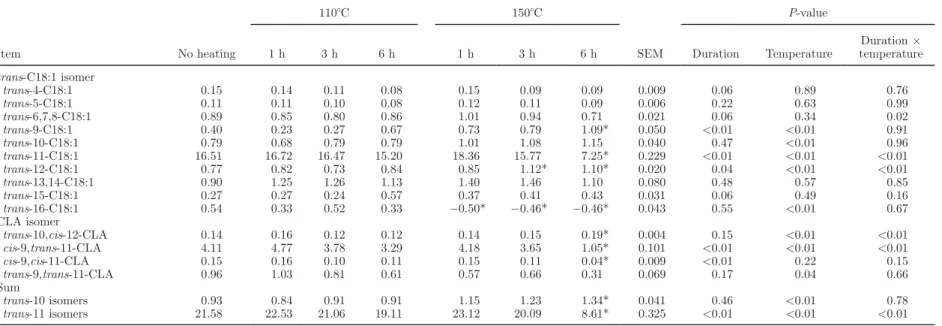
Among CLA isomers (Table 3), cis-9,trans-11-CLA production was significantly affected by heating: the 6-h duration and 150°C temperature acted in synergy to greatly decrease cis-9,trans-11-CLA production for treatment 150–6. The production of cis-9,cis-11-CLA
Journal of Dairy Science Vol. 93 No. 2, 2010
PRIVÉ ET AL.
was slightly affected by heating duration only, and the production of trans-9,trans-11-CLA was faintly de-creased by 150°C heating. Conversely, trans-10,cis-12-CLA production was significantly increased at 150°C heating, and a synergy between the 6-h duration and 150°C heating also existed, leading to the highest value for treatment 150–6.
Among trans-C18:1 isomers, an increase in the amount of trans-12-C18:1 produced was observed with 150°C temperature and the 3-h and 6-h durations of oil heating, leading to the maximum production for those treatments. Such an increase was also noticed for trans-9-C18:1, but no interaction was observed between the 2 factors. The production of trans-10-C18:1 was increased by 150°C heating but was not affected by duration. The production of trans-11-C18:1 was strongly decreased in a synergistic manner by 150°C temperature and the 6-h duration of heating of oil, leading to the lowest value for 150–6. The production of trans-16-C18:1 was affected only by 150°C heating; no production of trans-16-C18:1 was observed in the media containing the oils heated at 150°C.
An increase in heating temperature led to a significant increase in production of trans-10 isomers, whereas the amount of trans-11 isomers produced decreased signifi-cantly for the 6-h heating duration and 150°C heating. As a result, trans-10 production was the highest and
trans-11 production the lowest for 150–6 (Table 3).
Effects of Temperature and Duration of Oil Heating on Linoleic Acid Biohydrogenation Kinetic
Parameters After the 6-h Incubation with Ruminal Fluid
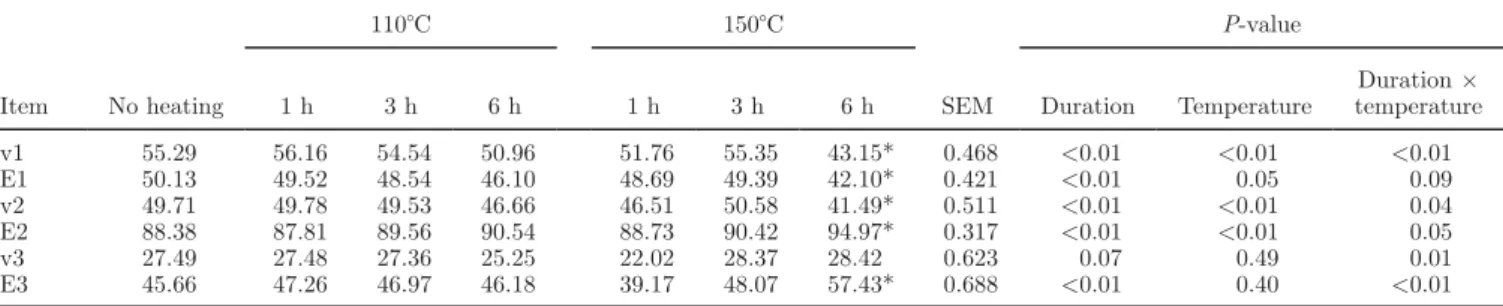
Increase in duration and temperature of heating significantly decreased v1 and E1 (isomerization), and heating temperature and duration acted in a synergic manner, leading to the lowest values for treatment 150–6 (Table 4). The rate of the first reduction, v2, decreased for the 6-h duration and 150°C heating, the
lowest value also being for treatment 150–6, and the rate of the second reduction, v3, was weakly affected by heating. The efficiencies of both reductions (E2 and E3) were significantly increased by the 6-h heating du-ration, but only E2 was affected by temperature.
Effects of Duration and Temperature of Oil Heating on Ruminal Bacterial Community After 6 h of In Vitro Incubation
Duration of heating did not influence bacterial com-munity structure (Table 5; P = 0.86; ANOSIM R-value = 0), but bacterial community structure was affected by heating temperature (P = 0.01; ANOSIM R-value = 0.21). Accordingly, the 2-dimensional nonmetric multidimensional scaling plot of the 33 CE-SSCP pro-files from the ruminal cultures showed that bacterial communities could be separated according to heating temperature (110 vs. 150°C) (Figure 1).
No effect of duration (P = 0.27) and temperature (P = 0.93) of heating was observed on bacterial com-munity D′. However, this D′ was strongly and linearly related to all BH intermediates and kinetic parameters of cis-9,cis-12-C18:2 BH (Table 5).
Relationships Between Intermediates and Kinetic Parameters of Linoleic Acid Biohydrogenation, Bacterial Community Diversity, and PV
Among the fatty acids involved in cis-9,cis-12-C18:2 BH, only C18:0 was not linked to PV (Table 6). The amount of cis-9,cis-12-C18:2 that disappeared from the media decreased when PV increased. The production of
trans-10 isomers increased slowly but significantly with the increase of PV values, whereas trans-11 isomers were negatively, significantly, and more strongly linked with PV.
Among kinetic parameters of cis-9,cis-12-C18:2 BH, v1 and E1 (isomerization) were negatively linked with PV, and the efficiencies of both reductions (E2 and
715
RUMINAL BIOHYDROGENATION OF HEATED OIL
Journal of Dairy Science Vol. 93 No. 2, 2010 Table 1. Peroxide values (PV; mEq/kg of oil) and unsaturated fatty acids content (g/100 g of oil) of sunflower
oils before and after heating at 110 or 150°C for 1, 3, or 6 h
Item No heating 110°C 150°C 1 h 3 h 6 h 1 h 3 h 6 h PV1 4.8e 11.1de 31.4cd 63.5b 27.7d 54.5bc 237.8a cis-9-C18:12 23.3 24.0 23.8 23.7 22.3 24.0 22.9 cis-9,cis-12-C18:22 47.7 49.4 48.8 48.1 45.7 48.8 44.1 cis-9,cis-12,cis-15-C18:32 0.2 0.2 0.2 0.2 0.2 0.2 0.2
a–eMeans within a row with different superscripts significantly differ (P < 0.05). 1SEM of PV = 2.1 (n = 21, 3 repetitions per treatment).
Journal of Dairy Science V
ol. 93 No. 2, 2010
PRIVÉ ET
AL.
716
Table 2. Effects of duration and temperature of heating of sunflower oil on production (positive values) or disappearance (negative values) of fatty acids (mg), and percentages of disappearance of oleic, linoleic, and linolenic acids after the 6-h incubation with ruminal fluid
Item No heating 110°C 150°C SEM P-value 1 h 3 h 6 h 1 h 3 h 6 h Duration Temperature Duration × temperature Fatty acid balance (mg)
C6:0 0.87 1.04 1.38 1.73* 1.53* 1.70* 1.53* 0.061 0.10 0.15 0.11 C7:0 0.06 0.08 0.11 0.15* 0.12 0.13* 0.14* 0.006 0.03 0.32 0.42 C8:0 0.02 0.01 0.02 0.04 0.02 0.03 0.10* 0.003 <0.01 <0.01 <0.01 C9:0 0.03 0.04 0.04 0.05 0.04 0.04 0.06 0.003 0.08 1.00 0.81 C10:0 0.03 0.01 0.01 0.02 0.02 0.02 0.02 0.002 0.80 0.46 0.96 C11:0 −0.33 −0.68* −0.66 −0.58 −0.65 −0.76* −0.78* 0.034 0.92 0.21 0.47 C12:0 −0.01 0.00 −0.09 −0.03 −0.10 −0.17 −0.13 0.033 0.62 0.22 0.99 C13:0 0.05 0.00 0.03 0.05 0.03 0.04 0.02 0.005 0.36 0.81 0.09 anteiso-C13:0 0.27 −0.01* 0.02* 0.00* −0.01* −0.07* −0.08* 0.011 0.58 0.02 0.29 iso-C13:0 0.03 −0.01 0.00 0.02 0.07 −0.01 0.02 0.006 0.03 0.02 <0.01 C14:0 0.57 −0.03 0.36 0.53 0.29 0.26 0.24 0.060 0.33 0.90 0.15 C15:0 0.65 0.36* 0.45 0.53 0.51 0.40* 0.37* 0.025 0.90 0.77 0.07 anteiso-C15:0 0.69 0.42* 0.55 0.61 0.64 0.57 0.52 0.021 0.85 0.24 0.02 iso-C15:0 0.32 0.16* 0.22 0.29 0.29 0.18* 0.20 0.013 0.48 0.89 <0.01 C16:0 −0.48 −2.85 −1.33 2.17 0.56 −0.31 −0.70 0.326 0.09 0.44 0.01 C16:1 −0.18 −0.17 −0.14 −0.12 −0.13 −0.38 −0.12 0.039 0.35 0.46 0.31 C17:0 0.33 0.23 0.26 0.37 0.30 0.13 0.22 0.024 0.25 0.18 0.14 anteiso-C17:0 0.15 0.12 0.12 0.16 0.16 0.13 0.13 0.007 0.48 0.54 0.11 iso-C17:0 0.12 0.08 0.08 0.11 0.10 0.07 0.07 0.005 0.51 0.66 0.09 cis-10-C17:1 0.03 0.03 0.04 0.04 0.05 0.05 0.03 0.003 0.79 0.58 0.09 C18:0 27.90 29.80 30.82 31.76 35.75 31.77 31.46 0.796 0.90 0.29 0.46 anteiso-C18:0 0.08 0.08 0.10 0.01 0.12 0.11 0.09 0.011 0.18 0.09 0.47 iso-C18:0 0.03 0.01 0.00 −0.01 −0.01 0.01 −0.03* 0.005 0.11 0.25 0.68 cis-9-C18:1 −15.17 −14.91 −15.17 −14.15 −13.16 −15.55 −14.20 0.253 0.05 0.23 0.0 cis-11-C18:1 0.84 0.87 0.84 0.70 0.93 1.08 1.35* 0.037 0.43 <0.01 0.01 cis-15-C18:1 0.03 0.02 0.02 0.00 0.04 0.03 0.03 0.004 0.40 0.02 0.31 Total trans-C18:1 21.33 21.41 21.28 20.55 23.51 21.32 12.55* 0.342 <0.01 <0.01 <0.01 cis-9,cis-12-C18:2 −53.08 −53.92 −52.36 −48.92 −49.69 −53.14 −41.43* 0.449 <0.01 <0.01 <0.01 Total CLA1 5.36 6.13 4.81 4.13 4.96 4.58 1.09* 0.154 <0.01 <0.01 0.02 cis-9,cis-12,cis-15-C18:3 −4.37 −4.59 −4.31 −3.59 −4.30 −3.83 −4.19 0.119 0.36 0.66 0.15 Disappearance (%) cis-9-C18:1 30.17 28.90 29.54 27.78 27.16 30.21 28.80 0.499 0.18 0.68 0.26 cis-9,cis-12-C18:2 50.13 49.52 48.54 46.10 48.69 49.39 42.10* 0.421 <0.01 0.05 0.09 cis-9,cis-12,cis-15-C18:3 45.52 47.50 45.00 38.23 43.56 40.89 44.28 1.122 0.39 0.77 0.16
1CLA = conjugated linoleic acid.
717
RUMINAL
BIOHYDROGENA
TION OF HEA
TED OIL
Journal of Dairy Science V
ol. 93 No. 2, 2010
Table 3. Effects of duration and temperature of heating of sunflower oil on produced amounts (mg) of trans-C18:1 and CLA1 isomers after the 6-h incubation with ruminal fluid
Item No heating 110°C 150°C SEM P-value 1 h 3 h 6 h 1 h 3 h 6 h Duration Temperature Duration × temperature trans-C18:1 isomer trans-4-C18:1 0.15 0.14 0.11 0.08 0.15 0.09 0.09 0.009 0.06 0.89 0.76 trans-5-C18:1 0.11 0.11 0.10 0.08 0.12 0.11 0.09 0.006 0.22 0.63 0.99 trans-6,7,8-C18:1 0.89 0.85 0.80 0.86 1.01 0.94 0.71 0.021 0.06 0.34 0.02 trans-9-C18:1 0.40 0.23 0.27 0.67 0.73 0.79 1.09* 0.050 <0.01 <0.01 0.91 trans-10-C18:1 0.79 0.68 0.79 0.79 1.01 1.08 1.15 0.040 0.47 <0.01 0.96 trans-11-C18:1 16.51 16.72 16.47 15.20 18.36 15.77 7.25* 0.229 <0.01 <0.01 <0.01 trans-12-C18:1 0.77 0.82 0.73 0.84 0.85 1.12* 1.10* 0.020 0.04 <0.01 <0.01 trans-13,14-C18:1 0.90 1.25 1.26 1.13 1.40 1.46 1.10 0.080 0.48 0.57 0.85 trans-15-C18:1 0.27 0.27 0.24 0.57 0.37 0.41 0.43 0.031 0.06 0.49 0.16 trans-16-C18:1 0.54 0.33 0.52 0.33 −0.50* −0.46* −0.46* 0.043 0.55 <0.01 0.67 CLA isomer trans-10,cis-12-CLA 0.14 0.16 0.12 0.12 0.14 0.15 0.19* 0.004 0.15 <0.01 <0.01 cis-9,trans-11-CLA 4.11 4.77 3.78 3.29 4.18 3.65 1.05* 0.101 <0.01 <0.01 <0.01 cis-9,cis-11-CLA 0.15 0.16 0.10 0.11 0.15 0.11 0.04* 0.009 <0.01 0.22 0.15 trans-9,trans-11-CLA 0.96 1.03 0.81 0.61 0.57 0.66 0.31 0.069 0.17 0.04 0.66 Sum trans-10 isomers 0.93 0.84 0.91 0.91 1.15 1.23 1.34* 0.041 0.46 <0.01 0.78 trans-11 isomers 21.58 22.53 21.06 19.11 23.12 20.09 8.61* 0.325 <0.01 <0.01 <0.01
1CLA = conjugated linoleic acid.
E3) were positively linked with PV. However, although significant, r2 values were less than 0.7. Diversity index was not linked to the peroxide content of the media.
DISCUSSION
Effect of Heating on PV of Oils
As expected, PV of oil increased with duration and temperature of heating, with the highest values for 150°C during the 6-h incubation. For treatment 150–6, the values obtained were very high compared with all other combinations of temperatures and durations of heating. The reaction of oxidation probably reached its propagation phase, characterized by an exponential increase of peroxides in the fat.
Heating of Oil Affected Linoleic Acid Biohydrogenation
Increasing duration and temperature of heating of sunflower oil, rich in cis-9,cis-12-C18:2, strongly affected
cis-9,cis-12-C18:2 BH. The disappearance of cis-9,cis-12-C18:2 was inhibited, leading to a decreased produc-tion of CLA and trans-C18:1, whereas disappearances of cis-9-C18:1 and cis-9,cis-12,cis-15-C18:3 remained unchanged. This inhibition of cis-9,cis-12-C18:2 disap-pearance could, at least partly, explain the protective effect of heat treatment of oilseeds against BH that was observed in some studies (Reddy et al., 1994; Choui-nard et al., 1997b; Troegeler-Meynadier et al., 2006b). In these studies, the conditions of extrusion and roast-ing were often not specified apart from the temperature of heating. In studies where extrusion did not lead to a protection of PUFA against BH, the temperature of extrusion was low, about 120°C (Akraim et al., 2006; Neves et al., 2007) as opposed to 140 to 160°C in studies where a protection was noticed. Duration of extrusion was probably not the same among studies because only 2 studies specified this: 30 s in the study of Neves et al.
(2007), who did not observe PUFA protection, and 43 s for Gonthier et al. (2005), who observed PUFA protec-tion. For roasting, duration of heating is longer than for extrusion, which could explain that a protection of PUFA against BH was frequently observed (Reddy et al., 1994; Chouinard et al., 1997a; Troegeler-Meynadier et al., 2006b). The capacity to withstand BH that was observed when using heated oilseeds compared with raw oilseeds could be explained, at least in part, by the effect of duration and temperature of heating on the modulation of isomerization and subsequent disappear-ance of PUFA.
Heating of Oil Affected CLA and Trans-C18:1 Production
Contrary to the studies where heating of oilseeds resulted in an accumulation of BH intermediates (Ch-ouinard et al., 1997a; Gonthier et al., 2005; Neves et
Journal of Dairy Science Vol. 93 No. 2, 2010
PRIVÉ ET AL.
718
Table 4. Effects of duration and temperature of heating of sunflower oil on rates (mg/L per hour) and efficiencies (%) of the 3 reactions of linoleic acid biohydrogenation1 in the 6-h incubation with ruminal fluid
Item No heating 110°C 150°C SEM P-value 1 h 3 h 6 h 1 h 3 h 6 h Duration Temperature Duration × temperature v1 55.29 56.16 54.54 50.96 51.76 55.35 43.15* 0.468 <0.01 <0.01 <0.01 E1 50.13 49.52 48.54 46.10 48.69 49.39 42.10* 0.421 <0.01 0.05 0.09 v2 49.71 49.78 49.53 46.66 46.51 50.58 41.49* 0.511 <0.01 <0.01 0.04 E2 88.38 87.81 89.56 90.54 88.73 90.42 94.97* 0.317 <0.01 <0.01 0.05 v3 27.49 27.48 27.36 25.25 22.02 28.37 28.42 0.623 0.07 0.49 0.01 E3 45.66 47.26 46.97 46.18 39.17 48.07 57.43* 0.688 <0.01 0.40 <0.01
1v1 and E1 refer to the isomerization of cis-9,cis-12-C18:2 to conjugated linoleic acid (CLA); v2 and E2 refer to the reduction of CLA to
trans-C18:1; v3 and E3 refer to the reduction of trans-C18:1 to C18:0.
*Treatment significantly (P < 0.05) differs from no heating (Dunnett’s test).
Table 5. Regression equations between bacterial population diversity index (D′) of incubated ruminal fluid and disappeared or produced amounts (mg) of fatty acids intermediates, rates (mg/L per hour), and efficiencies (%) of the 3 reactions of linoleic acid biohydrogenation,1
combining results obtained with heated and unheated oils (n = 42)
Regression equation r2 P-value
cis-9,cis-12-C18:2 = −7.79 D′ 0.97 <0.01 trans-10,cis-12-CLA = 0.02 D′ 0.96 <0.01 cis-9,trans-11-CLA = 0.52 D′ 0.90 <0.01 trans-10-C18:1 = 0.13 D′ 0.93 <0.01 trans-11-C18:1 = 2.31 D′ 0.94 <0.01 C18:0 = 4.88 D′ 0.97 <0.01 v1 = 8.12 D′ 0.97 <0.01 E1 = 7.35 D′ 0.97 <0.01 v2 = 7.42 D′ 0.97 <0.01 E2 = 13.89 D′ 0.98 <0.01 v3 = 4.23 D′ 0.98 <0.01 E3 = 7.39 D′ 0.98 <0.01
1v1 and E1 refer to the isomerization of cis-9,cis-12-C18:2 to
conju-gated linoleic acid (CLA); v2 and E2 refer to the reduction of CLA to trans-C18:1; v3 and E3 refer to the reduction of trans-C18:1 to C18:0.
al., 2007), in this study, the heating of oil for 6 h at 150°C induced a significant diminution of total CLA and trans-C18:1 production. In the study of Troegeler-Meynadier et al. (2006b), the increase of CLA and
trans-C18:1 production with extruded compared with raw soybeans was associated with a decrease in the ef-ficiencies of both reductions. Conversely, in the present study, heat treatment of oil increased the efficiencies of both reductions, which means that reduction was not inhibited. Therefore, the low production of CLA and
trans-C18:1 observed with heated oils could be caused only by the inhibition of isomerization. Indeed, the in-hibition of the isomerization led to a lack of substrate for the subsequent reaction, the reduction of CLA, and so to a decrease in the rate of this reaction.
However, the effect was not the same in the pro-duction of individual CLA as for trans-C18:1 isomers:
trans-10 isomers were increased and trans-11 isomers were decreased by 150°C heating. In fact, the diminu-tion of total CLA producdiminu-tion was caused mainly by the inhibition of the production of the main CLA isomer, cis-9,trans-11-CLA, and to a lesser degree to the inhibition of the production of cis-9,cis-11-CLA by long heating duration and of trans-9,trans-11-CLA by high heating temperature. Hence, there was an inhibi-tion of the ∆12-isomerization. In contrast, there was an increase in produced quantities of trans-10,cis-12-CLA with heating temperature and duration, suggesting an enhancement of the ∆9isomerase activity.
Similarly, the amount of trans-11-C18:1 produced was significantly reduced for the 6-h duration and 150°C temperature, which suggested an inhibition of
the ∆12-isomerization; the trans-10-C18:1 increase for 150°C heating could be linked to a more important ∆9-isomerization. The inhibitory effect of heating dura-tion and temperature on trans-11 isomers in ruminal cultures has been previously reported in a preliminary study in vitro (Troegeler-Meynadier et al., 2006c), and
cis-9,trans-11-CLA and trans-11-C18:1 percentages in milk were reported to decrease when dairy cows ingest-ed oxidizingest-ed soybean oil with PV = 240 mEq/kg of oil (Vazquez-Anon et al., 2008). Conversely, studies with heated oilseeds (Chouinard et al., 1997a; Troegeler-Meynadier et al., 2006b; Neves et al., 2007) reported an accumulation of cis-9,11-CLA isomers, trans-11-C18:1 isomers, or both. The nature, or the amount, or both, of oxidized products generated during heating may depend on the form of fat (oil vs. seed) and on the heating process (extrusion, roasting, and so on), which could explain the differences among these studies.
Effect of heating on trans-10 isomer production has not yet been reported. Nevertheless, the increase of
trans-10,cis-12-CLA in cultures with heated oil ob-served in this study could explain the decrease of milk fat content noticed in some in vivo studies with the use of extruded soybeans compared with raw soybeans (Guillaume et al., 1991; Neves et al., 2007) because this isomer causes a decrease in milk fat content (Baumgard et al., 2000).
719
RUMINAL BIOHYDROGENATION OF HEATED OIL
Journal of Dairy Science Vol. 93 No. 2, 2010 Figure 1. Two-dimensional nonmetric multidimensional scaling plot of the 33 capillary electrophoresis single-strand conformation polymorphism profiles from the ruminal cultures incubated for 6 h with oil heated at 110°C (}) or 150°C (~) regardless of the duration of heating. Analysis of similarity R-value = 0.21; P < 0.01.
Table 6. Regression equations between peroxide values (PV; mEq/ kg of oil) and disappeared or produced amounts (mg) of fatty acids intermediates, rates (v; mg/L per hour) and efficiencies (E; %) of the 3 reactions of linoleic acid biohydrogenation,1 and bacterial population diversity index (D′) of incubated ruminal fluid, combining results obtained with heated and unheated oils (n = 42)
Regression equation r2 P-value
cis-9,cis-12-C18:2 = 0.05 PV – 53.35 0.41 0.01 trans-10,cis-12-CLA = 0.0002 PV + 0.13 0.54 <0.01 cis-9,trans-11-CLA = −0.01 PV + 4.41 0.82 <0.01 trans-10-C18:1 = 0.002 PV + 0.80 0.40 <0.01 trans-11-C18:1 = −0.04 PV + 17.76 0.83 <0.01 C18:0 = 0.01 PV + 30.85 0.07 0.66 v1 = −0.05 PV+ 55.57 0.41 0.01 E1 = −0.03 PV + 49.65 0.32 0.04 v2 = −0.03 PV + 49.78 0.28 0.08 E2 = 0.03 PV + 88.31 0.69 <0.01 v3 = 0.00 PV + 26.09 0.10 0.52 E3 = 0.05 PV + 44.06 0.60 <0.01 D′ = 0.00 PV + 5.95 0.23 0.20
1v1 and E1 refer to the isomerization of cis-9,cis-12-C18:2 to
conju-gated linoleic acid (CLA); v2 and E2 refer to the reduction of CLA to trans-C18:1; v3 and E3 refer to the reduction of trans-C18:1 to C18:0.
Heated Oils Could Act Directly on Biohydrogenation Reactions and on Ruminal Bacteria
The action of heating duration and temperature of oil occurred principally on the isomerization process, but an additional action on lipolysis could not be ex-cluded. The heated oils could act either on the reaction or on isomerizating bacteria. The isomerizations of cis-9,cis-12-C18:2 to trans-10,cis-12-CLA and cis-9,trans-11-CLA do not follow the same pathways (Wallace et al., 2007) and are not performed by all bacteria; fibrolytic bacteria, belonging to the Butyrivibrio genus, produce only trans-11 isomers (Maia et al., 2007; Wal-lace et al., 2007), and some lactate-consuming bacteria predominantly produce trans-10 isomers (Verhulst et al., 1987; Kim et al., 2002; Wallace et al., 2007). As a consequence, the effects of heated oils on each pathway could be different: activation of ∆9-isomerization versus inhibition of ∆12-isomerization.
The ∆12-isomerization is a radical reaction, possibly initiated by hydrogen abstraction on C-11 catalyzed by a radical intermediate enzyme (Wallace et al., 2007). The cis-9,cis-12-C18:2 oxidation is also a radical reac-tion that also begins by an hydrogen abstracreac-tion on C-11 (Spiteller et al., 2001), so that some common in-termediates or some structural analogs generated dur-ing oxidation could interfere with the ∆12-isomerization. This explanation cannot apply to the activation of ∆9-isomerization, which is not a radical intermediate reaction but rather an ionic reaction with a carbocation as an intermediate (Liavonchanka et al., 2006; Wallace et al., 2007).
These 2 pathways of cis-9,cis-12-C18:2 BH are realized by different bacteria: trans-11 isomers are produced mostly by fibrolytic bacteria (mainly
Butyr-ivibrio fibrisolvens and to a lesser extent Butyrivibrio
proteoclasticus, formerly Clostridium proteoclasticum; Moon et al., 2008), whereas the trans-10 isomers are produced by lactate-consuming bacteria
(Propionibac-terium acnes, or Megasphaera elsdenii, or both; Kim et al., 2002; Maia et al., 2007; Wallace et al., 2007). Heated oils could contain products that inhibit the growth or activity of fibrolytic bacteria and favor those of P. acnes and M. elsdenii. This hypothesis is strength-ened by other modifications in the production of fatty acids. In our experiment, heating increased the produc-tion of trans10,trans12-CLA and trans12-C18:1, and
P. acnes is known to produce trans-10,trans-12-CLA (Wallace et al., 2007), which is partly reduced to trans-12-C18:1 (Shingfield et al., 2008). Similar results were obtained by Choi et al. (2005) studying the effect of oxygen on CLA production by mixed ruminal bacteria. They showed that in aerobic conditions, more trans-10,cis-12-CLA accumulated than cis-9,trans-11-CLA
and concluded that bacteria producing trans-10,cis-12-CLA were more aero tolerant than bacteria producing
cis-9,trans-11-CLA. This tolerance could be because of the production of antioxidant enzymes like superoxide dismutase and glutathione peroxidase by ruminal bac-teria, as shown on Streptococcus bovis and Selemonas
ruminantium (Lenartova et al. 1998). On the other hand, Hino et al. (1993) demonstrated that vitamin E and β-carotene increased growth of fibrolytic bacteria, possibly by decreasing the noxious effect of oxidative compounds. As a consequence, oxidative compounds would be more noxious for fibrolytic bacteria than for lactate consumers and therefore increase the participa-tion of bacteria producing trans-10,cis-12-CLA relative to that of bacteria producing cis-9,trans-11-CLA.
In the present work, we studied the whole bacte-rial community dynamics using CE-SSCP (Hori et al., 2006; Michelland et al., 2009b). Temperature of oil heating modulated the structure of the ruminal bac-terial population. Heating at 150°C could generate 1 or several oxidative products that could alter the mi-crobial population. This hypothesis was supported by
cis-9,cis-12-C18:2 BH and its intermediates being very closely linked to the bacterial community D′ (Table 5). Estimating D′ consists of summarizing a complex com-munity represented by a molecular fingerprint pattern in a single value by taking into account the number of species (number of peaks) and their relative abundance (area under each peak; Michelland et al., 2009b). The lowest value of D′ is obtained when the profile contains only 1 peak and the highest value of D′ obtained when the profile contains many overlapping peaks of equal abundance. Thus, the positive relationship between C18:2 BH process and D′ indicated (Table 5) that the lowering effect of heated oils on the diversity of the bac-terial community makes the BH process less efficient.
The heating of oils generates many different oxidative products that could act on the reaction of BH or directly on the bacteria. The parallel evolution between PV and
cis-9,cis-12-C18:2, CLA, and trans-C18:1 intermedi-ates of cis-9,cis-12-C18:2 BH, underlined by significant linear relationships and a major effect of the 150–6 oil treatment (highest PV), confirmed their possible effect on BH. Therefore, fatty acid peroxidation might ex-plain, at least in part, our results. In this first approach, PV was chosen to estimate the oxidative status of the oils; however, it cannot allow a precise estimation of the different products generated by oxidation. Because heating duration did not modify bacterial population while affecting BH, and heating temperature modified bacterial population, we hypothesized that at least 2 or more oxidative compounds were involved: first(s) accumulated for long-duration heating, acting directly on the ∆12isomerase, and other(s), identical or not, Journal of Dairy Science Vol. 93 No. 2, 2010
PRIVÉ ET AL.
produced at high temperature and able to act on the microorganisms. This is supported by the strong nega-tive linear relationship that existed between trans-11 isomers and PV because this isomerization may be af-fected by these 2 actions; bacteria producing trans-11 were probably more affected by peroxides and so pro-duced fewer trans-11 isomers, and ∆12isomerase was inhibited by these compounds (Table 6). Conversely,
trans-10 isomers were positively, and to a lesser, extent linked to the PV, showing that the appearance of these isomers would not be directly linked to the presence of peroxides but rather probably was a result of the higher resistance of the bacteria producing trans-10 to these compounds. The nature of these oxidative products was not determined here, and few data exist in the literature about the effect of the different oxidative products on BH. Contrary to our results, Lee et al. (2007) observed a stimulation of BH and therefore an increase of the production of CLA and trans-11-C18:1, and a decrease of trans-10,cis-12-CLA and trans-10-C18:1, when using pure trans-2-decenal, which is an end product of cis-9,cis-12-C18:2 oxidation (Spiteller et al., 2001). In the present study, oil was rapidly frozen at −80°C so that radical intermediates and hydroperoxides, which are formed at the beginning of oxidation, were probably the dominant oxidative products. Terminal oxidation products need more time to accumulate. They probably act differently on BH compared with peroxides. This underlines the importance of distinguishing oxidative products and their different capacity to modulate BH.
CONCLUSIONS
Increasing the duration and temperature of heating of sunflower oil had a synergistic action on cis-9,cis-12-C18:2 BH. An overall decrease in cis-9,cis-cis-9,cis-12-C18:2 disappearance occurred, leading to an overall decrease in CLA and trans-C18:1 production because of a de-creased production of cis-9,11-CLA and trans-11-C18:1. In contrast, there was an increase in the production of trans-10 isomers, mainly because of high heating temperature. Our results suggest that heating at high temperature would act via a modulation of the bacterial community, whereas increasing heating duration would not. Oxidative compounds produced during oil heating could explain, at least in part, these effects. They could act on BH reactions by generating substances directly affecting isomerases, or by stimu-lating or inhibiting specific bacterial communities, or both. Oxidative compound(s) accumulated during heating would act directly on the isomerization step, and oxidative compound(s), identical or not, generated only at high temperature would be able to affect bacte-rial population equilibrium. In this study, PV was used
as a proxy for cis-9,cis-12-C18:2 oxidation but did not reflect the production of other oxidative products (i.e., triglycerides oxipolymers, ketones, aldehydes). Further studies are therefore necessary to identify precisely which oxidative products affect BH.
ACKNOWLEDGMENTS
The authors thank B. Gabinaud, M. L. Chemit, and the staff at the experimental station (UMR 1289 Tan-dem, Castanet-Tolosan, France).
REFERENCES
AFNOR. 2004. Détermination de l’indice peroxyde. Corps gras d’origines animale et végétale. In Collection de Normes Françaises et de Méthodes Communautaires. Aliments des Animaux. Méthodes d’Analyse. AFNOR ISO 3960. Association Française de Normalisation, Paris, France.
Akraim, F., M. C. Nicot, P. Weil, and F. Enjalbert. 2006. Effects of preconditioning and extrusion of linseed on the ruminal biohydrogenation of fatty acids. 1. In vivo studies. Anim. Res. 55:83–91.
Baumgard, L. H., B. A. Corl, D. A. Dwyer, A. Saebo, and D. E. Bauman. 2000. Identification of the conjugated linoleic acid isomer that inhibits milk fat synthesis. Am. J. Physiol. Regul. Integr. Comp. Physiol. 278:R179–R184.
Brioukhanov, A. L., and A. I. Netrusov. 2004. Catalase and superoxide dismutase: Distribution, properties, and physiological role in cells of strict anaerobes. Biochemistry (Mosc.) 69:949–962.
Choi, N. J., J. Y. Imm, S. Oh, B. C. Ki, H. J. Hwang, and Y. J. Kim. 2005. Effect of pH and oxygen on conjugated linoleic acid (CLA) production by mixed rumen bacteria from cows fed high concentrate and high forage diets. Anim. Feed Sci. Technol. 123– 124:643–653.
Chouinard, P. Y., V. Girard, and G. J. Brisson. 1997a. Performance and profiles of milk fatty acids of cows fed full fat, heat-treated soybeans using various processing methods. J. Dairy Sci. 80:334– 342.
Chouinard, P. Y., J. Levesque, V. Girard, and G. J. Brisson. 1997b. Dietary soybeans extruded at different temperatures: Milk composition and in situ fatty acid reactions. J. Dairy Sci. 80:2913–2924.
Delbès, C., J. J. Godon, and R. Moletta. 1998. 16S rDNA sequence diversity of a culture-accessible part of an anaerobic digestor bacterial community. Anaerobe 4:267–275.
Enjalbert, F., and A. Troegeler-Meynadier. 2009. Biosynthesis of
trans fatty acids in ruminants. Pages 1–42 in Trans Fatty Acids in Human Nutrition. 2nd ed. F. Destaillats, J. L. Sébédio, F. Dionisi, and J. M. Chardigny, ed. The Oily Press, P. J. Barnes & Associates, Bridgwater, UK.
Gonthier, C., A. F. Mustafa, D. R. Ouellet, P. Y. Chouinard, R. Berthiaume, and H. V. Petit. 2005. Feeding micronized and extruded flaxseed to dairy cows: Effects on blood parameters and milk fatty acid composition. J. Dairy Sci. 88:748–756.
Griinari, J. M., and D. E. Bauman. 1999. Biosynthesis of conjugated linoleic acid and its incorporation into meat and milk in ruminants. Pages 180–200 in Advances in Conjugated Linoleic Acid Research. M. P. Yurawecz, M. M. Mossoba, J. K. G. Kramer, M. W. Pariza, and G. J. Nelson, ed. AOCS Press, Champaign, IL.
Griinari, J. M., B. A. Corl, S. H. Lacy, P. Y. Chouinard, K. V. Nurmela, and D. E. Bauman. 2000. Conjugated linoleic acid is synthesized endogenously in lactating dairy cows by delta(9)-desaturase. J. Nutr. 130:2285–2291.
Guillaume, B., D. E. Otterby, M. D. Stern, J. O. Linn, and D. O. Johnson. 1991. Raw or extruded soybeans and rumen-protected methionine and lysine in alfalfa-based diets for dairy cows. J. Dairy Sci. 74:1912–1922.
721
RUMINAL BIOHYDROGENATION OF HEATED OIL
Hino, T., N. Andoh, and H. Ohgi. 1993. Effects of β-carotene and α-tocopheol on rumen bacteria in the utilization of long-chain fatty acids and cellulose. J. Dairy Sci. 76:600–605.
Hori, T., S. Haruta, Y. Ueno, I. Masaharu, and Y. Igarashi. 2006. Direct comparison of single-strand conformation polymorphism (SSCP) and denaturing gradient gel electrophoresis (DDGE) to characterize a microbial community on the basis of 16S rRNA gene fragments. J. Microbiol. Methods 66:168–169.
Kim, Y. J., R. H. Liu, J. L. Rychlik, and J. B. Russell. 2002. The enrichment of a ruminal bacterium (Megasphaera elsdenii YJ-4) that produces the trans-10, cis-12 isomer of conjugated linoleic acid. J. Appl. Microbiol. 92:976–982.
Lee, M. R., S. A. Huws, N. D. Scollan, and R. J. Dewhurst. 2007. Effects of fatty acid oxidation products (green odor) on rumen bacterial populations and lipid metabolism in vitro. J. Dairy Sci. 90:3874–3882.
Lenartova, V., K. Holovska, and P. Javorsky. 1998. The influence of mercury on the antioxidant enzyme activity of rumen bacteria
Streptococcus bovis and Selenomonas ruminantium. FEMS Microbiol. Ecol. 27:319–325.
Liavonchanka, A., E. Hornung, I. Feussner, and M. G. Rudolph. 2006. Structure and mechanism of the Propionibacterium acnes polyunsaturated fatty acid isomerase. Proc. Natl. Acad. Sci. USA 103:2576–2581.
Maia, M. R. G., L. C. Chaudhary, L. Figueres, and R. J. Wallace. 2007. Metabolism of polyunsaturated fatty acids and their toxicity to the microflora of the rumen. Antonie Van Leeuwenhoek 91:303–314. Michelland, R., S. Déjean, S. Combes, L. Fortun-Lamothe, and L.
Cauquil. 2009a. StatFingerprints: A friendly graphical interface program for processing and analysis of microbial fingerprints profiles. Mol. Ecol. Resour. 9:1359–1363.
Michelland, R. J., V. Monteils, A. Zened, S. Combes, L. Cauquil, T. Gidenne, J. Hamelin, and L. Fortun-Lamothe. 2009b. Spatial and temporal variations of the bacterial community in the bovine digestive tract. J. Appl. Microbiol. 107:1642–1650.
Moon, C. D., D. M. Pacheco, W. J. Kelly, S. C. Leahy, D. Li, J. Kopecny, and G. T. Attwood. 2008. Reclassification of Clostridium
proteoclasticum as Butyrivibrio proteoclasticus comb. nov., a butyrate-producing ruminal bacterium. Int. J. Syst. Evol. Microbiol. 58:2041–2045.
Neves, C. A., G. T. Santos, M. Matsushita, E. M. Alves, R. L. Oliveira, A. F. Branco, D. C. Silva, A. C. Furlan, and H. V. Petit. 2007. Intake, whole tract digestibility, milk production and milk composition of Holstein cows fed extruded soybeans treated with or without lignosulfonate. Anim. Feed Sci. Technol. 134:32–44. Pariza, M. W., Y. Park, and M. E. Cook. 2001. The biologically active
isomers of conjugated linoleic acid. Prog. Lipid Res. 40:283–298. Park, P. W., and R. E. Goins. 1994. In situ preparation of fatty acid
methyl esters for analysis of fatty acid composition in foods. J. Food Sci. 59:1262–1266.
Reddy, P. V., J. L. Morrill, and T. G. Nagaraja. 1994. Release of free fatty acids from raw or processed soybeans and subsequent effects on fiber digestibilities. J. Dairy Sci. 77:3410–3416.
Riserus, U., P. Arner, K. Brismar, and B. Vessby. 2002. Treatment with dietary trans10cis12 conjugated linoleic acid causes isomer-specific insulin resistance in obese men with the metabolic syndrome. Diabetes Care 25:1516–1521.
Rosenzweig, M. L. 1995. Species Diversity in Space and Time. Cambridge University Press, Cambridge, UK.
Shingfield, K. J., S. Ahvenjärvi, V. Toivonen, A. Vanhatalo, P. Huhtanen, and J. M. Griinari. 2008. Effect of incremental levels of sunflower-seed oil in the diet on ruminal lipid metabolism in lactating cows. Br. J. Nutr. 99:971–983.
Spiteller, P., W. Kern, J. Reiner, and G. Spiteller. 2001. Aldehydic lipid peroxidation products derived from linoleic acid. Biochim. Biophys. Acta 1531:188–208.
Troegeler-Meynadier, A., L. Bret-Bennis, and F. Enjalbert. 2006a. Rates and efficiencies of reactions of ruminal biohydrogenation of linoleic acid according to pH and polyunsaturated fatty acids concentrations. Reprod. Nutr. Dev. 46:713–724.
Troegeler-Meynadier, A., M. C. Nicot, and F. Enjalbert. 2006b. Effects of heating process of soybeans on ruminal production of conjugated linoleic acids and trans-octadecenoic acids in situ. Rev. Med. Vet. (Toulouse) 157:509–514.
Troegeler-Meynadier, A., Y. Zhao, and F. Enjalbert. 2006c. Effects of duration and temperature of heating of sunflower oil on ruminal linoleic acid biohydrogenation in vitro. 4th Euro Fed Lipid Congress—Fats, Oils, and Lipids for a Healthier Future, Workshop: Rumen Biohydrogenation, Madrid, Spain.
Vazquez-Anon, M., J. Nocek, G. Bowman, T. Hampton, C. Atwell, P. Vazquez, and T. Jenkins. 2008. Effects of feeding a dietary antioxidant in diets with oxidized fat on lactation performance and antioxidant status of the cow. J. Dairy Sci. 91:3165–3172. Verhulst, A., G. Janssen, G. Parmentier, and H. Eyssen. 1987.
Isomerization of polyunsaturated fatty acids by propionibacteria. Syst. Appl. Microbiol. 9:12–15.
Wallace, R. J., N. McKain, K. J. Shingfield, and E. Devillard. 2007. Isomers of conjugated linoleic acids are synthesized via different mechanisms in ruminal digesta and bacteria. J. Lipid Res. 48:2247–2254.
Zumstein, E., R. Moletta, and J. J. Godon. 2000. Examination of two years of community dynamics in an anaerobic bioreactor using fluorescence polymerase chain reaction (PCR) single-strand conformation polymorphism analysis. Environ. Microbiol. 2:69– 78.
Journal of Dairy Science Vol. 93 No. 2, 2010
PRIVÉ ET AL.