S.S.D.N
HEC School of Management, Paris
Research paper on “Antitakeover Defense: Efficiency & Impact on Value Creation”
Mohit Chawla Grande Ecole, Majeure Finance Student ID: S46372
Title: Antitakeover Defense, Efficiency & Impact on Value Creation Author: Mohit Chawla
Guide: Prof. Mr. Patrick Legland Date: May 2015
Keywords: Hostile takeover, antitakeover defense, ATPs value creation, shareholder value, precautionary defense, reactive defense
Abstract
Takeovers are used as a mean for company(ies) to grow and gain entry to new markets. These can be of
two types, Friendly & Hostile Takeovers respectively. When undertaken with support from the
target management, termed as Hostile takeovers, whereas when an acquirer tries to takeover the
company against the will of management, shareholders and board of directors of target
company, is it termed as hostile takeover. Since all listed companies bear the (some) risk of
being a target for a takeover, thus firms adopt a set of defense propositions & strategies
regularly termed as Antitakeover Defence Provisions (ATPs), to protect them & direct their
course of action incase of a hostile takeover threat.These strategies could be either
precautionary such as poison pills, staggered board, fair price, and super-majority or
reactive such as white knight, greenmail, and recapitalization. Lacking such protective
measures could potentially prove to be a costly measure for the firm.
We use this research paper to serve as a medium to recapitulate a thorough literature review on
the various defense mechanisms implemented by firms, the ideology & rational for
implementing each of them, which d e f e n s e m e c h a n i s m is most efficient in limiting the
raider and whether the strategy is management entrenchment or shareholder entrenchment.
Further, we form a basis to In addition to theoretical analysis, we tend to model the behavior of
participants in a hostile battle, include a lot of statistic research results conducted by
scholars and explicitly take into consideration of actions of firms in the real world. By
comparing the defense strategy by referring to similar benchmark, we are able to reach the
conclusion of which antitakeover defense strategy is efficient.
Further, a consolidated literature review is conducted on one of the most discussed topics of
corporate finance as to whether antitakeover provisions (ATPs) measures are value creating or
destroying & with respect to the different stakeholders (shareholders, bondholders) each
considered in detail with empirical data analysis to further consolidate on the inferences.
Conclusions are hence drawn on the efficiency of takeover defenses & the effect of takeover
defenses on value creation or loss. A radical approach to valuing the effect of ATPs both ex-post
and ex-ante is proposed to form a comprehensive view on their efficiency & impact on value
creation, as compared to the past scholarly works that model their conclusions only on ex-post
analysis.
Acknowledgment
“First and Foremost, I would like to express my sincere gratitude to Prof. Mr. Patrick Legland (Global Head of Research, Societe Generale) for his guidance and regular availability for helping
out and tackling all obstacles and queries in coming up with this research report. Secondly, I would like to thank my Majeure Finance batch mates at HEC Paris for providing an ever so
important feedback and competitive spirit throughout the course of this work”
Table of contents
Section I: Introduction ...- 6
1.1 Background...- 6
1.2 Discussion of the Problem ...- 7
1.3 Purpose of this research...- 7
1.4 Methodology...- 8
1.4.1 Research Approach ...- 8
1.4.2 Research Theory & Data Selection ...- 8
1.5 Definitions ...-9
1.6 Limitation of this research ……...-11
Section II: Hostile takeover ... - 12
2.1 The rationales for hostile takeover...-12
2.2 Why the bidder is pursuing the target hostilely?... ...- 13
2.3 What are the reasons for target firm in not being interested by the acquisition offer? ...- 13
2.4 What are the ideal takeover targets ... -14
2.5 Valuing the Target Firm...-17
2.6 Hostile Takeovers: Bid Premium ...-20
2.7 Hostile Takeovers: The Process ... -20
2.7.1 Bear hug ...-20
2.7.2 Tender offer...-21
2.7.3 Proxy fight...-21
2.7.4 Process of hostile takeovers ... -22
2.7.5 Implication of hostile takeovers ... -22
Section III: Anti-Takeover Defence Provisions (ATPs) ...-24
3.1 Introduction ... -24
3.2 Pre bid Defenses... -25
3.2.1 Blowfish... -25
3.2.2 Poison pill...-26
3.2.2 a) Effectiveness of poison pills... -27
3.2.2 b) Vulnerability of poison pills defense...-27
3.2.3 Shark repellent...-28
3.2.4. Corporate charter amendments...-28
3.2.4.1 Staggered board...-28
3.2.4.1 a) Effectiveness of staggered board...-29
3.2.4.1 b) Effective Staggered Board...-29
3.2.5 Interaction of staggered board with poison pills...-30
3.2.6 Dual Class Stock: ...-30
3.2.7 CONCLUSION OF Preventive (pre-bid) Defence Strategies...-30
3.3 Post bid Defenses...-31
3.3.1 Attack the logic of the bid...-31
3.3.2 Corporate Restructuring and Reorganization/ Recapitalization...-31
3.3.2 White Knight & White Squire...-32
3.3.3 Crown jewel & Scorched Earth defense...-33
3.3.4 Share Repurchase...-34
3.3.5 Greenmail...-34
3.3.6 Management buyout...-35
3.3.7 Pac-man defense...-35
3.3.8 Positive public information...-35
3.4 CONCLUSION OF Reactive (post-bid) Defence Strategies...-36
Section IV: Efficiency of Hostile Takeovers...-37
4.1 Ideology Against Antitakeover defense Strategies Implementation...-37
4.2. Rational for adopting antitakeover provisions (ATPs) ...-38
4.3. Rationale behind reactive defense strategies...-40
Section V: Takeover Defences (ATPs): Impact on Value Creation w.r.t Stakeholders-42 5.1 Introduction...-42
5.2 Do Takeovers Create Value...-42
5.3 Takeover Defence (ATPs) Impact on Shareholder & Firm Value: Present research Analysis scope v/s Our Analysis (a Radical Shift) ...-42
5.4 Theoretical Ex-ante benefits of ATPs...-43
5.5 Empirical Evidence of Ex-ante benefits of ATPs w.r.t Shareholders……..-44
5.6 Ex-Ante v/s Ex-Post Valuation Problem...-45
5.7 Conclusion...-46
Section VI: Empirical Case Studies……….……..-48
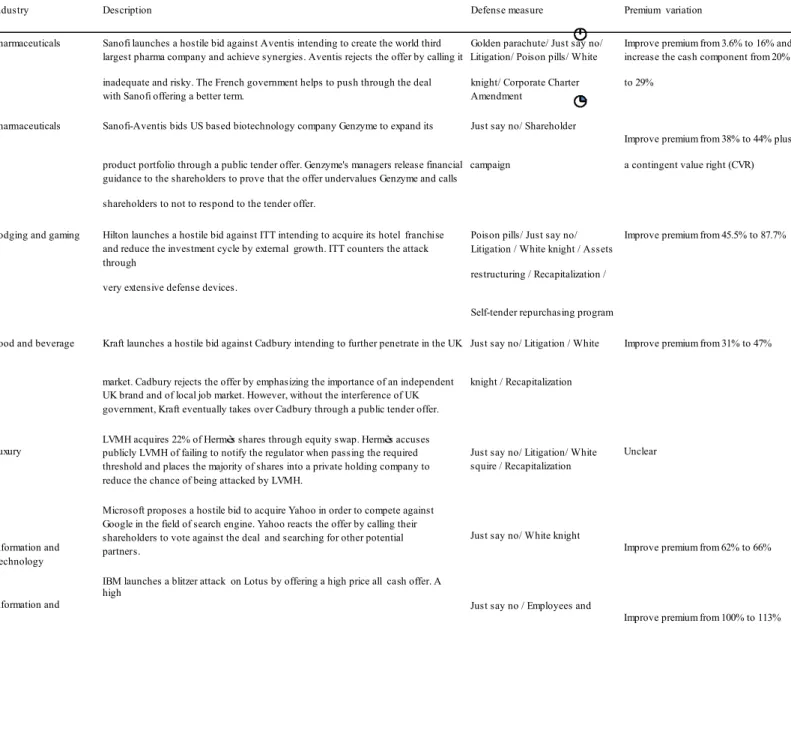
6.1. Sanofi –Aventis merger……….……..-48
6.1.1. Background and general description about the firms……….…...-48
6.1.2. Case Introduction……….…..-49
6.1.3. Hostile bid & ATPs: Validation of Literature Review w.r.t Empirical Case-50 6.1.4. Conclusion……….…-53
6.2 Hilton versus ITT……….-54
6.2.1. Background………...…-54
6.2.2.1 Hilton Hotel Corporation………...….-54
6.2.2.2 ITT Corporation………...…...-55
6.2.3. Hilton’s Hostile Offer………...……-55
6.2.4. ITT’s response………...…...-55
6.2.5. Hostile bids and antitakeover action………...…….-56
6.2.6. Conclusion………...……-58
Section VII: Recommendation and conclusion………-60
7.1 Further Reading & Recommendations………....-61
Appendix... - 62
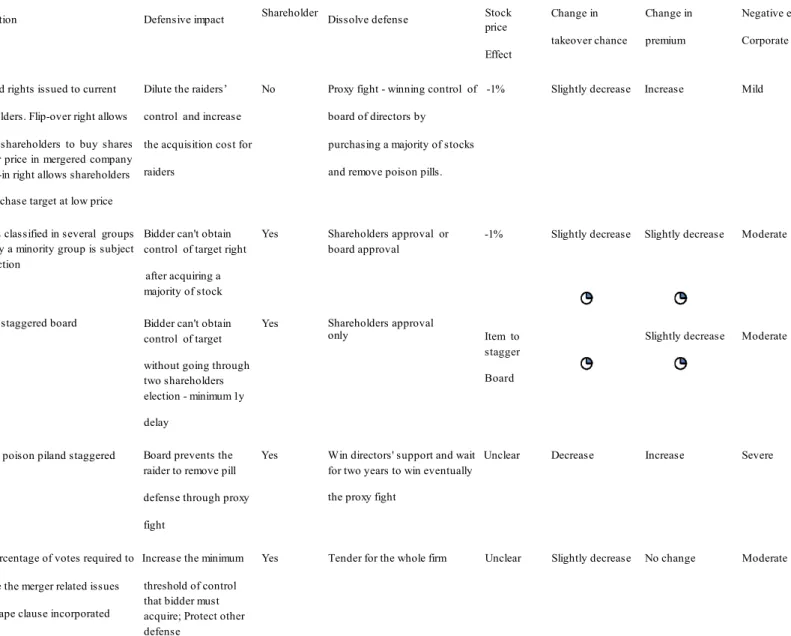
Figure 1: Summary of precautionary defense devices ... . . . - 63
Figure 2: Summary of reactive defense devices... . . . - 65
Section
I: INTRODUCTIONThis first chapter introduces the reader to the problem behind the research purpose. In the background a basic overview of the field of question is put forward, followed by the presentation of the problem & the purpose of research. A methodology has been laid and is consistently applied throughout. Further, In the last two sections useful definitions that will help the reader in its understanding and the limitations of the research are proposed.
1.1 Background
“M&A, deals, buyouts, LPOs, MPOs, private equity, venture capital, corporate development and a myriad of other terms are used to describe large transactions that fundamentally change the nature or course, and control, of a company” (Frankel, 2005).
Takeovers are used as a mean for corporations to grow and gain entry to new markets, and the global business environment has witnessed countless numbers of merger and acquisition activities during the past decades (Zollo, 2003). Hostile, unlike friendly takeovers is when an acquirer tries to take over a corporation against the will of management, share-holders and board of directors of the target company.
Historically, hostile takeovers originate from the USA and Great Britain but are an increasing method used all over Europe. During the 1980s hostile takeovers were considered a mechanism for enhancing the efficiency of the corporate systems respectively raising shareholder value. An unfriendly bid acted as an impediment for improvement for incumbent managers and aligning their interest with those of shareholders. Hostile bids had a propensity to provoke restructuring in target corporations, forcing on allocations of re-sources to more efficient uses elsewhere (Deakin & Slinger, 1997).
During the past few decades, corporate takeovers h a v e reached a new level of hostility due to many innovations in the corporate takeovers art. Due to an increased number of sharks, vulnerable (target) companies have started to look for antitakeover defenses. Throughout the years of development, the antitakeover defenses have become more and more sophisticated. Companies usually adopt these ATPs either beforehand as a precautionary measure to prevent takeover attempts or implement some of these ATPs as a reaction to the takeover activity observed in their respective cases. Based on these two possibilities, Antitakeover defense Provisions can be categorized as a) preventive and b) reactive measures.
The preventive measures are the ones with characteristics designed to reduce the possibility of hostile takeover offers whereas t h e reactive measures are the ones implemented in the scenario of takeover threat. i.e.: once the bid to takeover has been proposed.
1.2 Discussion of the Problem
In recent years, arguments have come up that propose that antitakeover defense deter prospective
bidders away and reduce the disciplinary effect (on management) from takeover threat. Also,
scholars & researchers have questioned the efficiency of these Antitakeover Provisions & also in
actually creating value for shareholders. Thereby arguing in favor of the fact that takeover defenses
are not value accretive for shareholders. Further, based on these implications, it has been observed
that more & more number of companies have started to reduce significantly the antitakeover
provisions from their corporate charters, and some have shifted focus to cost effective reactive
measures as compared to precautionary measures.
The present day corporate structure generally trends towards separate management & ownership,
with management possessing a non-major holding. This differentiation tends to create a dispute
around whether the ATPs are shareholder entrenchment or management entrenchment. To decide
which and when to implement the ATPs is a decision that requires certain prerequisite questions
to be thought over, discussed & answered in details. These include 1) whether the ATPs are easy
to implement. 2) What is the mechanism & how effective is it in preventive the attacker (raider),
possibilities of raider overcoming these & course of action in such a scenario. 3) What are the
associated costs for the company (potential target)?
1.3
Purpose of the Research
Our main purpose of this research work is to form an opinion on this argument as to whether the
antitakeover defenses adopted are actually an efficient proposition for firms globally as well as
specific to certain national environments, and to further discuss the impact of these antitakeover
defense provisions on stakeholders value.
Further, we seek to form an opinion as to whether the takeover defense measures & the ATPs
adopted by firms in general are value accretive or destroying for the various stakeholders
(stockholders, bondholders). Following a deductive approach, we not only draw inferences from
the past research carried out in this field by scholars but also draw empirical evidences from
multiple case analysis to form a defined opinion on this topical topic in corporate finance.
1.4 Methodology
Research works are often based on two specific pattern of approaches, these are inductive and
deductive approach, respectively. The inductive approach is fundamentally based on empirical evidence,
and you go from observations to findings and end up with theory building (Ghauri & Grønhaug,
2005). The inductive approach is often used in relation with qualitative research, and is seen as
flexible and allows for changes throughout the research process (Saunders, Lewis & Thornhill,
2003).
The deductive approach is based on logical reasoning, where the researcher builds his/her questioning or
hypothesis from existing knowledge, usually from secondary data. The questions or hypothesis is
then tested through empirical analysis if it can be confirmed or realized (Ghauri & Grønhaug,
2005). If the theory used deviates from what is necessary, modifications are entitled to be made. The
deductive approach gives the researcher both useful outcomes and the possibility to explain the
relationships between variables (Saunders, Lewis & Thornhill, 2003).
In this thesis, we have adopted a deductive approach, whereby the scholarly research work theories are used as
guidance when looking for rational & also for explaining. Based on the theoretical implications
from the literature review, empirical data is gathered & analyzed with the aim to verify the
propositions of the defense strategies, and conclude about their efficiency & further effect on
value creation (or loss). Since we have used secondary data to come up with explanations, and
not carried out any interviews or any other means to collect primary data, thus deductive
approach seems more feasible in this situation as compared to inductive approach, which is also
more suitable for qualitative data analysis. Further, since our approach is to form an empirical
basis with thorough numerical analysis & quantitative data to verify the propositions, thus
deductive approach is the logical choice.
The primary objective of the defense mechanism(s) implemented by a company is twofold.
1) To avoid a hostile bid or making it impossible for the hostile bidder to proceed with the bid
and close the deal. 2) To force the hostile bidder to increase the bid and pay more for the target
company.
To analyze the efficiency of each of the defense mechanisms, we develop & use statistical
models to answer the following questions a) which of these strategies is the most efficient?
b) The efficiency of Antitakeover provisions (ATPS) c) The impact of ATPs on value
creation, shareholder & bondholder value
1.4.2 Research Theory & Data Selection
The theoretical framework is an effective mechanism for summarizing accumulative facts.
Through connecting the results of the information to incoherent entity makes it more accessible
and therefore useable for researchers (Polit & Hungler, 1995).
Hostile takeovers & takeover defenses has been one of the most discussed topic in corporate
finance over the past few decades since the upbringing of takeover defenses in 1980s. Despite
this, there has been limited agreement on the efficiency of these takeover defenses & the value
implications they bring along with. To comment on this issue, we have conducted an intensive
research to gather data from reliable sources such as the HEC Paris Library Resources,
Thomson Reuters and its internet databases, Company Websites & Annual Reports (for the
specific case studies) to come up with comprehensive literature & academic articles as well as
industry & company specific data.
To better understand the whole picture, we start by investigating the behavior of hostile
bidders.
We develop a comprehensive analysis by firstly investigating the behavior & nature of hostile
bidders (attacker/ raider), their motive & line of reasoning for the takeover & for the hostility in
their takeover approach (hostile takeovers) as well as the most relevant approaches adopted by
them to pursue such interests. Finally, based on the implications from the academic literature
review, we explain the impact of ATPs on the value creation in the corporate finance
framework. Statistical & empirical evidence is provided to support our conclusions or to
contrast from the present literary research propositions. Multiple case studies have been
thoroughly discussed & evaluated in the end with the purpose of verifying the proposals made
& research base proposed by logical & intuitive reasoning, as well as application of numerical
& empirical analysis to real life corporate cases.
1.5 Definitions Merger Acquisition Friendly takeover Hostile takeover
A process when two companies join together into one entity. Both companies dissolve their assets and liabilities and fold them into a newly created entity, which refers to the creation of a new company (Weston, Mitchell, & Mulherin, 2004).
The process where one company takes over the controlling in-‐terest of another, through stock purchase or other means (Wes-‐ton et al, 2004).
An acquisition of one firm by another where both companies agrees to the terms of the takeover (Schoenberg & Thornton, 2006).
An attempted takeover of another company which goes against the will of the target’s management and board of directors. (Schoenberg & Thornton, 2006).
Target The company of aim in a takeover attempt (DePamphilis, 2005). Acquirer Bid Premium Defense tactics Pre-‐bid defense Post-‐bid defense
The company that is purchasing or trying to takeover another company (DePamphilis, 2005).
The additional amount an acquirer has to offer above the share price in order to succeed in a take-‐over offer (Schoenberg & Thornton, 2003).
Various methods designed prevent an acquirer from succeeding in their hostile takeover attempt of another company (DePam-‐philis, 2005).
Defense tactics used by companies as a preventing method in order to avoid a hostile takeover (Schoenberg & Thornton, 2006).
Defense tactics used by target companies after a hostile bid has been placed, in order to fight off the acquirer (Schoenberg & Thornton, 2006)
1.6 Limitations of the Research
The usage of different defense tactics varies from country to country mainly due to different legal systems and regulations and it is very hard to find a strategy that is universal and can be useful for all companies (Schoenberg, 2003). The difference of legislation highly impacts the defense strategies a firm could implement & thus has implications on the specific behavior of cross-border M&A transactions. Our proposals obviate the differences across countries and tend to model the best possible strategies. But this country specific factor & the deviated brought in by the legalities of different legal framework should be kept in mind for further implications.
Although we have chosen to elaborate significantly & discussed the various defense mechanisms adopted by firms, yet we have focused more on certain specific ATPs based on their topical nature & widespread usage in corporate world based on preferential choices. Further, in a chosen timeframe there exists a sufficient amount of hostile takeovers. Due to a constantly changing business environment, hostile takeovers performed in a specific period of time have some similar specific characteristics while over a relatively longer period & out of period sampling methodology helps us avoid the statistical bias specific to a particular period, industry &/ or a country.
Section II: FRAME OF REFERENCE ‘Hostile takeover’
The theoretical framework section introduces the reader to a more in-depth knowledge about takeovers in general and how they are performed and regulated. A further elaboration on hostile takeovers follows this, with the detailed outline of both pre-bid and post-bid defense tactics.
Before moving forward with our analysis with the desired outline proposed earlier, it is important to step back and investigate the general frame of reference that serves as a basis for this research work. Therefore to study antitakeover defenses, their efficiency & impact on value creation, it is important to learn & acquaint the reader with the essentials of the main reason behind the implementation of antitakeover defense measures, i.e.: Hostile Takeover attempts. It is further necessary to understand clearly the motives behind the bidder’s actions as well as the primary measures adopted in the takeover battle, so as to address the grievances & issues of target properly & thus to analyze the strategies (ATPs) that are the most efficient in addressing these issues.
Compared to friendly takeover which generally refers to a well organized negotiation process, hostile takeover occurs when a bidder attempts to bid for a controlling interest in a target, which has been explicitly opposed by target management or for which the management has no acknowledge of the bid (Damodaran, 1997). There is a common objective behind both the types of takeovers: to gain control of the target such that the combined entity delivers higher value as compare to the two entities value added on a stand alone basis.
Mathematically speaking,
If Va, Vb & Va+b represents the value of acquirer, target & the combined entity, then: Acquisition makes sense if, Va+b > Va + Vb
There is an opaque path b/w the friendly & hostile takeovers since in most of the cases observed, it has been noticed that the acquirer (bidder) tends to turn hostile in its measures if the bidding process does not work out in a friendly manner. i.e.: the acquirers turn to hostile measures after a friendly process fails to reap results.
2.1. The rationales for hostile takeover
Before we dive into how hostile takeover is launched and is processed, we would like to first address to the motivation of the bidder for pursuing the takeover in a hostile manner. M&A activities are primarily adopted by firms for growth of corporations, corporate control as well
as for synergies that they create (operational, cost, financial etc.). In some cases they may also cater to management motives of empire building (management’s ego) to control & operate a larger corporation. Adopting these M&A measures incorporates & brings along a certain level of risks, and uncertainties in implementation such as overpaying or overvaluing the target, error or inability in implementing the strategies for synergy synthesis among others. Therefore, keeping in view that these takeover activities are incorporated with the aim of value accretion, it is important to understand & acknowledge here that if a bidder is willing to pursue the target acquisition in a hostile manner, then he/she (bidder) is willing to bear the adder risks associated with this apart from the above mentioned risks. These risks include the risk of failure in attempt to takeover, the loss of money, time, and potential management resource utilization in value creating endeavors. Thus the bidder is willing to bear these opportunity costs apart from bearing the costs associated in the acquisition attempt. To understand & verify as to whether & why the bidder is willing to take these added risks by attempting to takeover in a hostile manner, we need to address a few questions that will provide us a better understanding of their rational & motives. These questions being as follows:
2.2. Why does the bidder want to pursue the target in a hostile manner?
Since the hostile takeover and friendly takeover share a similar motive of gaining corporate control of the combined entity (discussed in the previous section) thus it is intuitive to understand the scholarly finding backed by empirical observation, the claim that most takeover attempts are initially friendly in nature, whereas they converge to hostile measure when faced with retaliation or are rebuffed in this process by the target management, and or shareholders. Thus, when such attempts fail, bidders who are adamant in their approach to further pursue with the takeover attempt implement measures that are hostile and may potentially result in some unforeseen circumstances (public, private) for all the parties involved. Further, in certain cases it is efficient for a bidder to pursue in a hostile manner, since there is no constraint of retaining the current management (a common case in a friendly takeover) thus the acquirer is free to bring in the best human resources they deem appropriate for the efficient operations of the target, and the combined entity.
2.3. What are the reasons for target firm in not being interested by the acquisition offer? It is also important to look at the potential causes & reasons why the potential acquirer may have been rebuffed by the target company. Answer to this gives us a better understanding of the fact as to why the takeover process has taken a hostile turn. To answer this question, we resort to two of the very essential corporate finance theories on information asymmetry & agency costs.
Information Asymmetry Explanation: In general (not always) the management of the bidder company values the target company on a status-quo basis & on a market analysis (peer valuation method, comparable transactions method etc.). Although these methods are fairly appropriate, yet one needs to understand the fact 9with a pinch of salt) that since every company is unique in its own sense thus these methods might not give us an exact valuation of the target
company. We hereby clarify that this does not imply that these widely incorporated & used methodologies are inaccurate but merely stress the fact that these are good estimations and approximations. Thus, in our case, this means that the offer price (cash & or share price) of the offer by the bidder to the target management, shareholders might not actually represent the true valuation of the company business in the view of the target management & shareholders since they are the ones with better access to the sensitive & important information about the present & future operations of the firm. This information asymmetry might lead to the potential decline of the offer by the target shareholders, management, since it is in the fiduciary duties of the management, board of directors to act in the best interests of the shareholders, whereby accepting an inadequate offer violates that condition. It is also necessary here to understand that this cannot be the sole reason for such hostile measures adopted by the acquirer since if the management and/or shareholders are actually interested in giving up control/being taken over, then they could potentially negotiate with the bidder for a better & fair price that better reflects both the parties sentiments & incorporates fair valuation of the target. This brings us to the second explanation of the question s as to why the bidder is rebuffed by the target in an acquisition offer, “Agency costs explanation”.
Agency Costs Explanation: Modern corporate finance literature reasons that in certain cases management might not act in the best interests of the shareholders and the stakeholders in general. This could be due to the possible self interests (potential loss of position post takeover, higher compensations, management perks & personal benefits, power associated with their position). Thus in such a scenario, management might potentially not be interested in an offer which otherwise on a standalone basis could be equitable for the shareholders. This is the basis of the ‘agency costs’ theory of corporate finance and explains the second/other major reason for the rebuffing of bidder by acquirer.
2.4. What are the ideal takeover targets?
After getting an idea about why the bidder is willing to pursue the target in a hostile manner. We now shift our focus to the question as to which firm(s) are the ideal takeover targets. The answer to this question could have multiple viewpoints yet the primary views to take into consideration are:
a) perspective of the bidder
In terms of an ideal target, bidding firms are looking for targets for financial purposes & business advantages, for instance, firms that ideally integrate well with their business (competitors etc.), serve the purpose of vertical/horizontal integration (in terms of supply chain), provide synergies, or serve diversification needs. Apart from these reasons there are certain characteristic features of the target firm that a bidder (acquirer) may potentially be interested in.
b) target characteristics
Strategically synonymous characteristics (similar strategy, areas of operation etc.) of the target would definitely place a firm as an ideal target. Further, cash rich companies or firms with low debt on the balance sheets have been historically seen as ideal targets for acquisitions.
We hereby elaborate on the more relevant features of these ideal targets as:
1) Synergies obtained by combining the entities: Since the basic reason that forms the backbone of mergers & acquisition activities is value creation, thus the firms with a potential of creating synergies & in process value accretion for acquirer are seen as ideal takeover targets. These synergies can be both operational (vertical, horizontal integration in supply chain leading to cost reduction, higher growth rate, frequently termed as cost synergies) and financial synergies such as improved debt capacity, diversification, tax benefits etc.
2) Firms with a possible undervaluation in a financial markets are viewed as potential targets by acquirers to improve their market performance. This is also one of the criterions that bidder uses so as to decide upon an acquisition offer price since the difference of the rest would factor into the synergies upon acquisition.
3) Cash Rich and/or low Debt companies: It has been regularly observed that companies with large (or huge) amounts of cash are seen as a potential takeover target. Intuitively the reader can very easily see that the large cash on the balance sheet of the target could be used partially to finance the acquisition. Although management views differ on this topic, in a sense that they perceive this cash to provide them the financial flexibility to pursue value accretive endeavors and avail fruitful opportunities when they arise, yet it has been noted that this could also lead management to invest in low rate of return projects or earning low interest on cash, which in a sense violates the shareholder interests & brings down their return on equity. This cash could easily be returned back to shareholders in invest in their self decided prospects rather than using this in the above discussed manner.
Further, firms with low level of debt on their balance sheet, provide the flexibility to the acquirer to lever up & use the resources not only for financing the acquisition but also for improving efficiency (operational as well as financial). This is backed by the reasoning that debt has a disciplining impact on management since they are pushed towards paying off the debt service as well as interest payments.
4) Poorly Managed Firms: In a significant number of the hostile takeovers studied over the past three decades, evidence has been found in support of the fact that firms that are perceived to be poorly managed by markets & or by he acquirers are viewed as potential targets for acquisition since this opens up the room for improvement & efficiency in terms of management & operation that could drive superior performance & value creation for acquiring firm post acquisition. This is also termed as Value for Control in corporate finance terms.
5) Cash Rich and/or low Debt companies: It has been regularly observed that companies with large (or huge) amounts of cash are seen as a potential takeover target. Intuitively the reader can very easily see that the large cash on the balance sheet of the target could be used partially to finance the acquisition. Although management views differ on this topic, in a sense that they perceive this cash to provide them the financial flexibility to pursue value accretive endeavors and avail fruitful opportunities when they arise, yet it has been noted that this could also lead management to invest in low rate of return projects or
earning low interest on cash, which in a sense violates the shareholder interests & brings down their return on equity. This cash could easily be returned back to shareholders in invest in their self decided prospects rather than using this in the above discussed manner.
Further, firms with low level of debt on their balance sheet, provide the flexibility to the acquirer to lever up & use the resources not only for financing the acquisition but also for improving efficiency (operational as well as financial). This is backed by the reasoning that debt has a disciplining impact on management since they are pushed towards paying off the debt service as well as interest payments.
6) Synergies obtained by combining the entities: Since the basic reason that forms the backbone of mergers & acquisition activities is value creation, thus the firms with a potential of creating synergies & in process value accretion for acquirer are seen as ideal takeover targets. These synergies can be both operational (vertical, horizontal integration in supply chain leading to cost reduction, higher growth rate, frequently termed as cost synergies) and financial synergies such as improved debt capacity, diversification, tax benefits etc.
To summarize, in the table below, we characterize & match the target firm along with the acquisition ideology and motives of the acquirer.
Table 1: Target Firm Characteristics given Acquisition Motive If motive is Then the target firm…
Undervaluation trades at a price below the estimated value
Diversification Is in a business different from the acquiring firm’s business. Operating Synergy has the characteristics that create the operating synergy
Cost Savings: in same business to create economies of scale. Higher growth : with potential to open up new markets or expand existing ones.
Financial Synergy has the characteristics that create financial synergy Tax Savings: provides a tax benefit to acquirer
Debt Capacity: is unable to borrow money or pay high rates Cash slack: has great projects/ no funds
Control is a badly managed firm whose stock has under performed the market
2.5. Valuing the Target Firm
The valuation of the target firm is slightly different from the valuation of a standard firm given the fact that we have to factor in the valuation of control and synergy. Thus we implement the method of valuing the firm on a regular status quo basis, and add the value of control & synergies to get the target valuation. In general the value of control of a poorly managed firm is greater than the value of control for a properly & well managed firm.
Value of Control = Value of firm optimally managed - Value of firm with current management
Further, to value the synergies (operating, financial) we need to look into the value of the combined firm with synergy and the value of the combined firm without synergy, the difference provides us with an estimate of the valuation of synergies.
Table 1: Valuing an acquisition Summarized (D. Zeng, B. Lev, 1998)
Component Valuation Guidelines Should you pay?
Value the combined firm with synergy built in. This value may
include Which firm is indispensable for
a. a higher growth rate in revenues: growth synergy Synergy?
b. higher margins, because of economies of scale - If it is the target, you should be
Synergy
c. lower taxes, because of tax benefits: tax synergy willing to pay up to the value of
d. lower cost of debt: financing synergy Synergy.
e. higher debt ratio because of lower risk: debt capacity
- If it is the bidder, you should no
Subtract the value of the target firm (with control premium) + value of
the bidding firm (pre-acquisition). This is the value of the synergy.
Value the company as if optimally managed. This
stand-
will usually mean altering investment, financing and alone valuation, the sum of the
dividend policy: control premium and the status q
Investment Policy: Earn higher returns on projects and valuation is the maximum you
Control divest unproductive projects. should pay.
Premium Financing Policy: Move to a better financing
structure; e.g. optimal capital structure
Dividend Policy: Return cash for which the firm has no need. Practically,
1. Look at industry averages for optimal
2. Do a full-fledged corporate financial analysis
Status Quo Value the company as is, with existing inputs
If motive is undervaluation, the
status quo value is the maximum Valuation For investment, financing and dividend policy. should pay.
Previous Scholarly works of Aswath Damodaran reason that “hostile takeover targets are more likely to underperform the market and get undervalued by the market and enjoys less independence (higher agency cost)”. This is also backed by empirical evidence that has been evaluated in the figure below.
2.6 Hostile Takeovers: Bid Premium
In any hostile takeover process, a bid is to be made to the shareholders of the target company. This bid offer comes at a bid premium (a premium to the current market price of the stock of the target). This is usually incorporated so as to create & receive a positive response from the target shareholders and to offer them a value accretion in return for their stake of shareholding of be acquired by the acquirer. The size of this bid premium ideally depends on the acquirer’s willingness to pay for the target and is usually less than equal to the amount of synergies the acquirer aims and hopes to generate out of the business post-acquisition of the target so as to be financially feasible for the acquirer. This premium can range from 15-30% in some markets whereas it can be as high as 30-45% in some others.
Defense tactics serve a strategic purpose of not only preventing the hostile takeover but also in sense to make the bidder increase the bid premium. Usage of legal actions by the target company in preventing a hostile takeover can lead to provocative competing bids as well as an increase the bid premium (Jarell, 1985)
2.7 Hostile Takeovers: The Process
A study made in the UK between the years 1996 and 1999 concerning hostile takeovers and the bid premiums, shows a weak relationship between defense tactics and increases in the bid premium. Apart from using a White knight as a defense tactic, the target company’s ability to increase the price offered by the hostile bidder using different defense tactics or strategies, is rather restricted. The study points out that an increase in bid premium is more driven by competitive bidders or the overall market condition. (Schoenberg, 2003)
We utilize this sub-section to throw light on the next step of our analysis, the discussion of the hostile takeover’s process. This refers to the fact that we would be embarking upon the step by step analysis of the various tactics adopted by the acquirer & thereby the subsequent reactions observed from the target, so that the process of hostile takeovers is made familiar to the readers.
Over the 3 decades of Takeover defenses activities that have been observed & recorded by scholars, we can infer & further comment that the major initiatives that are taken by the bidder to start the hostile takeover process can be boiled down to three major tactics or methodologies. These are namely: Bear Hug, Tender Offer, and Proxy Fight. We discuss & throw light on each of these individually in the next few paragraphs.
2.7.1. Bear hug
The main motive of the acquirer/bidder through the adoption of the bear hug strategy is to clearly & publically convey its interest in taking over the target company. This is generally (potentially) followed up by a tender offer to the acquirer board. Although it sends a clear market signal about the intensions of the bidder in its endeavors to pursue the target, yet this strategy leaves some scope of maneuver for the target & could have a negative impact for the bidder. This is due to the fact that this public announcement of the bidder’s intention makes
the target aware of the exact circumstances at hand & provides it ample time to implement & adopt antitakeover defense strategies (reactive ATPs) so as to prevent the bidder in acquiring control, incase the target is not interested in such an offer.
Before initiating an offer of any kind, bidders might express explicitly their interest in acquiring the target and imply a potential tender offer. The bear hug strategy would place a strong pressure on the management via a public announcement of potential offer. By making the intention and price publicly known, target’s board of directors has less room for manipulation.
Generally, bear hug strategy is used in acquisitions where the bidders have realistic possibility to close the deal with board’s consent. Otherwise such a strategy would in fact work against the bidder by giving more time for target to implement anti-takeover defense, which is the opposite of the blitz attack usually adopted in hostile situation.
2.7.2. Tender offer
The bear hug strategy is followed up usually by a Tender offer, or a formal bidding process by the acquirer, whereby the acquirer directly offers to purchase the shares of the target shareholders at a price in synchronous to the market price prevalent of the target and thus approaches these target shareholders directly instead of approaching the target management or board. This tender offer can be a binding offer whereby shareholders can tender their shares, but incase a certain minimum threshold percentage is not reached (for instance, majority stake for the acquirer) then the offer can be withdrawn too.
Since the tender offers are targeted directly towards the target shareholders and thus bypasses the target management, even if they are in opposition. Thus, the target shareholders can themselves decide as to whether the premium at which the acquirer is willing to purchase their shares is a fair price. Further, in some cases the acquirer adopts a two-tiered tender offer strategy. A two tiered-tender offer, also popularly known as front-end loaded offer is a medium of acquisition whereby the acquirer offers to purchase the shares of the target in two blocks, the first one at a higher premium offered (hence the name front-end loaded) and the second block, if required to obtain majority control, with a comparatively lower premium. Thus in a tender offer, the shareholders of the target face not only the prisoner’s dilemma as to whether they should tender their shares or not, but also regarding the two-tiered tender offer.
2.7.3. Proxy fight
In cases whereby the management of the target rebuffs the acquirer in its endeavors of acquisition, the acquirer can resort to certain means such as a proxy fight. The basic idea behind a proxy fight is that since the board of directors are the one’s overviewing the
activities of the firm & the management, thus they are the one’s responsible for selecting the best feasible management to run the company. It thus becomes a mean for the acquirer to have their way with the board of the target wherein if the acquirer has significant influence with the board of directors of the target or if they can gain majority of votes on the board of target, then they can oust the current acquisition-repellant management thereby turning the hostile acquisition into a friendly one by bringing in a management that favors the acquisition or by voting a majority in favor of the acquisition in the board meetings. Staggered board is one of the measures adopted by firms to prevent such an incident from occurring. Using the proxy fight measures, the acquirer could potentially use the voting rights to cancel the anti-takeover defenses adopt by target to prevent such acquisition. “In a proxy fight, a bidder may attempt to use his voting rights and gain support from other shareholders to oust the incumbent board and/or management (Patrick A. Gaughan, Mergers, and Acquisitions & Corporate Restructures)”
2.7.4. Process of hostile takeover
Thus looking back at the takeover methodologies, we can summarize that, the takeover process could be initiated in manner as summarized below:
1) Friendly Takeover: Bidder makes an acquisition offer (price p) which the insiders accept or reject.
2) Hostile Takeover a) Bidder makes a public tender offer at price p, which the target shareholders could accept or reject.
3) Hostile Takeover b) Bidder makes a public acquisition offer (price p) which the insiders accept or reject. Further, incase the insiders reject it, comes down to whether the shareholders accept or reject in the subsequent step.
Thus in conclusion, we have say that ideally for a target to prevent a hostile takeover, there can be two broad categorization of action implemented: to keep a check on the insiders (such as the board of directors) as well as to take necessary actions that make the offering of tenders, by shareholders directly to the acquirer, unattractive for either or both of the parties i.e.: acquirer & shareholders of target. Further the target could themselves make a better offer to their shareholders so that it incentivizes the shareholders to reject the acquirer’s offer.
2.7.5. Implication of hostile takeovers
Hostile takeovers tend to have different implications for all the parties involved. We will justify this claim (affirmation) in the following paragraphs. In general, companies subject to takeover threats are those that are undervalued in the market, or the one’s being run by a poor management, which when replaced could lead to value creation & operational
efficiency. Many Scholarly works have been done to support this argument and have successfully verified these claims with empirical evidence.
As agency cost theory explains, interests’ b/w shareholders and management may not always be aligned. Shareholders view takeover threat as a disciplining factor to discipline management to run the firm efficiently, since in the contrary case could lead to management replacement by the acquirer. But the role of the management in terms of takeovers can be ambiguous. In one sense, they could fear losing their jobs & the incentives associated with them incase a takeover occurs, whereas on the other hand they are the agents that make the bidder reassess their offer (w.r.t premium, price) when they reject offers that are not in the best interests of the shareholders thus leading to a better offer from the bidder.
On the other side, generally a hostile takeover process is not only risky but also very time consuming for the bidder. As mentioned above, bidders tend to increase their offer prices incase of rejection of offer by target management. Empirically, It has been observed that the higher gains made by the target shareholders (in form of the premium received) come at the expense of a reduction in the return and value of the acquirer shareholders (Shivdasani, Journal of Financial Economics 1998). Further, a longer process leads to more resource consumption for the target in terms of legal, advisory costs as well as its impact on the market reaction (share price impact) of the bidder due to repetitive unsuccessful attempts. When looking at the social aspects of the takeover and takeover defense strategies, we can intuitively observe the double effect created hereof. Synergies serve as a value accretive factor in the post takeover scenario. Further, the target being taken over by acquirer for improved efficiency of operations & a leaner organization with better management would be a positive social consideration, since the acquirer, using the same asset base creates for a better management operations of the firm & thus creates an added value. On the Contrary, the defense mechanisms in place serve the purpose of preventing the acquirer/raider with short term vision of exploiting the resources of the target & creating better financial prospects for themselves rather than the focus on long-term successful operations of the firm.
SECTION III: Anti-Takeover Defense Provisions (ATPs)
3.1 Introduction
The Takeover defense mechanisms have peaked since 1980s with the development & implementation of two different type of defense strategies: reactive & precautionary. The preventive measures are those which reduce the likelihood of a potential takeover whereas the reactive measures are those which are brought into implementation if any action of takeover occurs on the target firm. Due to different restrictions pertaining to a specific legal system, some of the defense mechanisms may or may not be effective in a particular country. Thus incorporation of these takeover defenses also relies on the geographical scope of operations for a firm.
The preventive measures, also regularly recognized as pre-bid defense tactics are the measures taken by target firm before any takeover attempt is made on the firm, with the viewpoint of long term safeguarding interest of the firm. On the other hand, reactive measures or more popularly known as the post-bid defense mechanisms are those which are adopted in the event of a takeover attempt on the target firm by a bidder. The long term defense mechanisms are viewed as a way of making the target unattractive for takeover by a bidder, so that the firm’s management can channelize their resources & focus on effective running of firm’s operations & value creation whereas the short-term defense tactics are seen as an attempt to defeat the bidder in its attempt to takeover the firm or to provide resilience against such an attack.
When looking a major markets, a study conducted by Schoenberg & Thornton in 2006 reveals that
the target company in the US market is more likely to avoid a hostile takeover if the
company has implemented a pre-bid defense mechanism, but in the UK market a
company with a post-bid defense mechanism is more probable to overcome a hostile
takeover attempt.
W e d i v i d e t h i s s e c t i o n , i n t o t w o s u b - s e c t i o n s , e a c h c o v e r i n g p r e - b i d d e f e n s e m e c h a n i s m s a s w e l l a s p o s t - b i d d e f e n s e m e c h a n i s m s r e s p e c t i v e l y . B e f o r e l o o k i n g i n t o e a c h o f t h e s e t w o s u b - s e c t i o n s , w e h e r e b y c a t e g o r i z e t h e v a r i o u s d e f e n s e t a c t i c s i n e a c h o f t h e s e t w o c a t e g o r i e s . I t i s w o r t h n o t i n g t h a t a s h a r e r e p u r c h a s e p r o g r a m ( d e f e n s e t a c t i c ) c a n b e v i e w e d & i m p l e m e n t e d b o t h a s a p r e - b i d & p o s t - b i d d e f e n s e m e c h a n i s m . I n v i e w o f i t s r e l e v a n c e s k e w i n g m o r e t o w a r d s a p o s t - b i d d e f e n s e m e c h a n i s m , w e h a v e a d d e d i t t o l a t t e r c a t e g o r y .
Pre-bid Defenses Post-bid Defenses
Blowfish Attack the logic of the bid
Poison Pills Corporate Restructuring
Share Repurchase Crown Jewel Defense
Shark Repellants Greenmail
Management Buyout Pac-Man Positive Publics Info
Share Repurchase Scorched Earth White Knights, White Squire Table 2: Pre- and Post-bid Summary
3.2 Pre bid Defenses
As discussed previously, Prebid defense mechanisms are the ones adopted so as to make the target unattractive to the potential bidder. Further they serve as value maximizing for the shareholders. Since the shareholders are satisfied by maximizing the shareholder value thus the incentive for change in corporate control is reduced. Corporations can skillfully utilize their share structure, as a pre-bid defense tactic, to reduce the attractiveness of themselves.
For instance, by utilizing employee shareholding scheme, corporations can build a shareholding structure that supports the management. Further, companies very frequently use a debt financed share buyback program to lever up and thus reduce the attractiveness of the firm. Good long-term public relations also serves as a credible pre-bid defense mechanism in a sense that the communication of the full financial and social value of the company builds loyalty to the existing management and board. (Schoe nberg & Thornton, 2006)
3.2.1 Blowfish
One of the defense mechanisms adopted by firms which incorporates a strategy whereby the company focuses on buying new assets so as to grow its asset base & leading the firm towards growth focus thereby reducing the liquid asset base of the firm & potential excess cash at hand. This acquisition led growth strategy leads to an increase in firm value. The primary logic behind this defense mechanism is that the higher firm value can potentially intimidate the bidder from pursuing their course of acquisition, since the increased (higher) firm value would lead to a higher price & thus premium to be paid in the course of acquisition. Thus an acquirer with limited financial resources is thus limited in
carrying out the acquisition. Further, the reduced liquidity of the assets serves as a secondary aid in rebuffing the acquirer by limiting the attractiveness of the target company.
3.2.2 Poison pill
Poison pills has been historically seen as one of the most effective pre-bid defense tactic. The basic idea behind poison pills is that it entails creation of securities carrying specific rights which are triggered incase of a hostile takeover attempt. These special privileges entitled securities are levied upon the board and/or the management of a target company so as to enable them to fend of a bidder incase of a hostile takeover attempt.
But the corporate charter of these poison pills is defined in such a way that they can be withdrawn or taken back in scenarios where the acquisition process is a friendly one, and thus the target firm runs the risk of being turned down by a friendly bidder. This flexibility in taking back the poison pills makes the company attractive to a potential friendly takeover. We now spend this section to discuss some of the very frequently implemented poison pill strategies. A Call-Option Plan is a common poison pill strategy. As in the case of a plain vanilla call option, the owner of the call option is entitled to an option to purchase the share of the issuer on or before a predefined schedule, depending on whether it is an American or European call option. These call-option strategies can be of two types:
a) flip-in call option poison pill strategy b) flip-over call option poison pill strategy.
In case of a Flip-in call-option poison pill strategy, the board of directors as well as the management are envisaged with an option to purchase the shares of the target company, at a discounted prices, and are most frequently exercised incase of a hostile takeover attempt. As a result, the bidder’s holding in the target company is diluted as the target shareholders, management exercise their call option. Thus the control of target company is redistributed in favor of the target management & board.
In the other case, a flip-over call option poison pill is the scenario whereby the call options are placed on the acquiring company by the target firm. The basic idea is that the target board & management adopt a strategy where they defend the target by buying large blocks of shares in the bidder (acquirer) company through call options. These flip-over options are frequently exercised post the completion of hostile takeover so that the target company can own a large shareholding in the combined new established entity. Thus this strategy makes the target company less attractive in terms of a hostile takeover since the target management & board can access this strategy in case of a hostile takeover attempt.
Just as we have discussed that there are two different mechanisms to use a call-option plan as a hostile takeover defense strategy, similarly there are defense mechanisms based on put-options too. The put option plans give the option holder a right to sell shares of the hostile bidder. Thereby they provide the holder with an option to sell their shares to the target company so as to eliminate the hostile acquirer. This results in a situation whereby the hostile attacker has to pay a high premium price to do away with these put options or else it risks loosing control of the target. Although their mechanism is just the reverse of call-option plans, yet put option plan are less frequently used in comparison to call-option plans.
It is also noteworthy that a specific type of poison pill mechanism is used in post-bid or reactive measures too. The exploding poison pill, as the name suggests creates an explosive
effect as to when the acquirer makes a bid to acquire the target. This specific type of poison pill is a call option that comes with exclusive rights to huge dividend payments in the future. Since this could be potentially very costly for the target, thus they are implemented post hostile takeover bid and thus serve as an expense for the acquirer and not the target.
3.2.2.1 Effectiveness of poison pills
As discussed above, poison pills serve as an effective medium for fending off raiders. Yet to analyze its effectiveness, we need to analyze its effect in different prospects. Since it does not necessarily require shareholder approval, therefore it is easy to implement but comes at a striking observation from the shareholder’s perspective. Poison pill essentially serves a dual purpose, pushing up the bid price as well as fending off the incoming raider. Therefore, in deciding whether to incorporate poison pills, the firm management, shareholders need to take into account the following two essential queries. Firstly, the chances of being taken over post implementation of poison pills as well as their impact. Secondly, whether it is a value accretive or value destructive proposition.
To answer the first query, we have significant empirical evidence from the studies conducted by Georgeson as well as from Varaiya, 2000. Each of these studies individually infers through empirical observation that firms with poison pills implemented tend to receive higher offers in terms of premium on the share price at the time of acquisition. Further, implementation of poison pills does not essentially reduce the probability of takeover since it is in itself not a comprehensive strategy to fend off a
determined raider. We will discuss the shortcoming of poison pill in the next sub-sections. Further, to look into the fact whether poison pill is value destroying or accretive, there have been several studies conducted that refer to stock price movement. Most of these studies suggest that there has been a slight negatively correlation b/w poison pill implementation and stock price movement. Although one can take forward this view, yet, it is essential to note that stock price movement is a sensitive proposition that is factored and affected by multiple company as well as market factors, thus to study the impact of stock price effect and comment on shareholder value accretion or loss is at best a mediocre methodology. We leave this topic for further research implications.
3.2.2.2. Vulnerability of poison pills defense
Our analysis till now has helped us infer that poison pill is an effective mechanism for takeover defenses, its implementation potentially increases shareholder wealth more than the negative impact on value than it may cause. Despite the effectiveness of the poison pill strategy in being an effective ATP, there are certain issues that are related to this strategy that can be potentially harmful.
We now discuss these shortcomings. Firstly, in case of poison pill being triggered (or implemented) the acquirer can potentially question and challenge, in a court of law as well as with the regulatory authority, poison pill’s purpose based on the ground that these are adopted by management so as to get higher offers for the target rather than being in the best interest of shareholders (the primary purpose of Antitakeover defense provisions). Another major flaw with the poison pills is that it is essentially a comprehensive strategy that can prevent an acquirer from pursuing the takeover on a standalone basis, apart from the fact that its dilutive effect makes it difficult for the firm to even adopt other defense mechanisms such as white knights, white squires among others. Finally, the in-built provision that the
poison pills can be deactivated incase of an approval from the target board.
As an ending note to conclude about poison pills, we can say that although an effective mechanism, yet poison pills cannot stop a determined acquirer from pursuing the target. This does not question its effectiveness, since the dilutive effect associated with poison pill is immensely essential, to the extent that the acquirer may not pursue the target without deactivating the poison pill first.
3.2.3 Shark repellent
This Strategy is a pre-bid defense means by which the target company resorts to some measures that make it less attractive for a potential acquirer or bidder.
The most frequent strategies that are collectively termed as shark repellants include golden parachutes, dual class board as well as staggered board techniques we will discuss each one of them in detail in the coming paragraphs.
Golden Parachute: The golden parachute is a provision, or in a sense an additional
compensation provided to the management if the company is taken over by an acquirer and/or if the management is forcefully replaced by the acquirer or relieved of their duties. It provides a large provision to the management which may include cash or stock compensation or both. Thus it serves as a costly provision for the acquirer who has to bear these expenses. Golden parachute strategy may not be viewed as quite effective in the view of the acquirer, given the fact that they are paying a premium to acquire the target, thus they are willing to spend a little extra on the outgoing management team for the compensation package, as then they can bring in their own management team to best serve their interests.
3.2.4. Corporate charter amendments
As we discussed earlier, proxy fight serves as a tactic that is implemented to overcome the poison pill mechanism and serves an s a takeover tactic implemented by the acquirer. Such a strategy among others such as supermajority, dual class recapitalization, and staggered board serve as corporate charter amendments. These Corporate Charter amendments are essentially the strategies that require the approval of the target board and/or shareholders. Thus winning the majority votes on the target board and/or their confidence is essential for these.
3.2.4.1. Staggered board
This is one of the very effective pre-bid defense strategies incorporated in the corporate charter of firms to prevent a hostile takeover attempt or to retaliate it in the best plausible manner. The basic idea behind a staggered board mechanism is that it prevents the complete board to be replaced at the same time. For instance, some of the members are elected for a period whose term ends at a year that is different from the term completion of the other board members. Thus not all of the board members can be replaced or won over by an acquirer in an attempt to gain corporate control over the target. The acquirer thus has to wait or keep pursuing the target for two or more years consecutively so as to get a majority at the board.