HAL Id: pastel-00678039
https://pastel.archives-ouvertes.fr/pastel-00678039
Submitted on 12 Mar 2012HAL is a multi-disciplinary open access archive for the deposit and dissemination of sci-entific research documents, whether they are pub-lished or not. The documents may come from teaching and research institutions in France or abroad, or from public or private research centers.
L’archive ouverte pluridisciplinaire HAL, est destinée au dépôt et à la diffusion de documents scientifiques de niveau recherche, publiés ou non, émanant des établissements d’enseignement et de recherche français ou étrangers, des laboratoires publics ou privés.
Ontology driven framework for multimedia information
retrieval in P2P network
Maria Sokhn
To cite this version:
Maria Sokhn. Ontology driven framework for multimedia information retrieval in P2P network. Com-putational Engineering, Finance, and Science [cs.CE]. Télécom ParisTech, 2011. English. �pastel-00678039�
EDITE - ED 130
Doctorat ParisTech
T H È S E
pour obtenir le grade de docteur délivré par
TELECOM ParisTech
Spécialité « Informatique et Réseaux »
présentée et soutenue publiquement par
Maria SOKHN
26 Août 2011Plateforme de recherche basée sur l’ontologie pour des
données multimédia dans un réseau pair à pair
Directeur de thèse :Ahmed SERHROUCHNI Co-encadrement de la thèse :Omar ABOU KHALED
Jury
Mme Elena Mugellini,Pr., iTIC, Ecole díngénieurs et d’architecte de Fribourg Présidente M. Philippe CUDRE-MAUROUX,Pr., Diuf, Université de Fribourg Rapporteur Mme Rima KILANY,Maître de conférence, ESIB, Université Saint Joseph Rapporteur M. Jean-Marc OGIER,Pr., L3i de recherche, Université La Rochelle Examinateur M. Samer LAHOUD,Maître de conférence, IRISA, IUT St. Malot Examinateur M. Jacques BERSIER,Responsable Ra&D, Ecole d’ingénieurs et d’architecte de FribourgExaminateur
TELECOM ParisTech
Acknowledgements
First paper, first conference, first project, first course... A valuable experience which was made possible thanks to the wonderful people I met and to whom I would like to express my sincere acknowledgment. I wish to thank first and foremost, Professor Ahmed Serhrouchni, my thesis advisor, who offered me the opportunity to enroll in Telecom ParisTech for my PhD thesis. I thank him for the trust he had in me and his unconditional help. I would like to thank Jean-Yves Le Meur, section leader at the CERN, who has made possible my enrollment through the financial support granted by the CERN.
Words cannot express my endless and sincere thanks to Professor Abou Khaled, my co-advisor. I thank him for having consistently encouraging me over the four years. I thank him for believing in me and pushing me to the best of my abilities. I thank him for his support, guidance, encouragement and advice. I was fortunate to have, also as a co-advisor, Professor Elena Mugellini from whom I received precious help all long my work. I thank her for all her constant availability, her constructive remarks and her involvement and motivation in pushing forward the activities around the PhD thesis work. I wish to express my sincere thanks to the members of the jury. Specially Professor Rima Kilany and Professor Philippe Cudre-Mauroux for their precious time and valuable suggestions which helped improve my thesis report. Professor Jean-Marc Ogier for his commit-ment and availability, Professor Samer Lahoud for his encouragecommit-ment, sense of humor and important advice, and Jacques Bersier who kindly agreed to be a member of my PhD thesis jury.
I address my special thanks to Michel Rast, director of the Uni-versity of Applied Sciences of Western Switzerland, and Antoine Delley, director of the Information Technology and Communication Institute, who warmly welcomed me in their establishment where I spent four wonderful and memorable years of work and rich exchanges. I wish to extend my cordial appreciation to the engineers with whom I have closely worked with. Mainly Jean Revertera, David Godel, Dominic Wyler, Joel Dumoulin, Jonathan Stoppani and Samir Atittallah. I thank them for their time and valuable contribution.
iv
supporting me, particularly Didier Perroud and Stuart Miller. Didier, I am deeply grateful for your care, your attention, your friendship and all the "philosophical" discussions we had. Stuart, you may not know this but you helped me enormously and when I needed it the most, thank you. I owe my warmest thanks to Marck who made available his sup-port in a number of ways. Marck, I am infinitely thankful for your tireless encouragement, your calming presence, your incomparable support, your tenderness, your attention, your listening, your advice, your infinite patience. You always surprised me, calmed me down, made me laugh, took care of me. You knew how to deal with my caprices and black goat temperament. Merrrci!
My loving thanks go to my wonderful parents, Michel and Ninette without whom I would not have dare thinking of achieving any of my dreams. I am proud to be your daughter and blessed to have a wonderful brother and a delightful sister. Joe, Nayla, I love you ! ...I am writing this acknowledgment today, because, almost 5 years ago, at the Palmier hotel in Lausanne, I was encouraged by a wonderful person to jump into the adventure of a PhD thesis. For having, ...all the way, filled my heart with courage and confidence, I address you Jimmi, my deepest and most sincere gratitude.
Publications
EDITED BOOK & PROCEEDINGS:
[1] Advances in Intelligent Web Mastering - 3: Proceedings of the 7th Atlantic Web Intelligence Conference, AWIC 2011, Fribourg, Switzer-land, January, 2011. Elena Mugellini, Piotr S. Szczepaniak, Maria Chiara Pettenati, Maria Sokhn. Advances in Soft Computing series, Springer, 250 pages.
[2] Special issue for the journal of Ambient Intelligence and Humanized Computing, To be published on January 2012. Editor-in-Chief: Vincenzo Loia, Guest Editors: Elena Mugellini, Maria Sokhn, Piotr S. Szczepaniak. Journal no. 12652, Computational Intelligence and complexity, Springer, 70 pages.
JOURNAL:
[1] Maria Sokhn, Elena Mugellini, Omar Abou Khaled, Ahmed Serhrouchni. Conference knowledge modeling for conference-video-recordings querying & visualization. Journal of Multimedia Processing and Technologies Volume 1, Number 2, June 2010.
[2] [in submission ] Francesco Carrino, Maria Sokhn, Elena Mugellini, Omar Abou Khaled. Memoria-Mea: Personal Information Manage-ment. Journal of Ambient Intelligence and Humanized Computing. May, 2011.
INVITED PAPER:
[1] Maria Sokhn, Elena Mugellini, Omar Abou Khaled, Ahmed Serhrouchni. End-to-end adaptive framework for multimedia informa-tion retrieval, 9th Internainforma-tional Conference on Wired/Wireless Internet Communications (WWIC 2011), June, 2011, Vilanova i la Geltru, Catalonia, Spain.
PAPER:
[1] Samir Atitalah, Maria Sokhn, Elena Mugellini, Omar Abou Khaled. Semantic multimedia management in P2P Network, SEKE 2011, 23rd International Conference on Software Engineering and Knowledge Engineering, July, 2011, Miami Beach, USA.
[2] Joel Dumoulin, Maria Sokhn, Elena Mugellini, Omar Abou Khaled and Ahmed Serhrouchni, Vers une approche de visualisation multivues dans un systeme d’information repartie, NOTERE 2011, 11th Annual International Conference on New Technologies of Distributed Systems, May, 2011, Paris, France.
vi
Omar Abou Khaled. Speech to text in replay. The 7th Atlantic Web Intelligence Conference. Advances in Soft Computing series, Springer. January, 2011, Fribourg, Switzerland.
[4] Jean Revertera, Maria Sokhn, Elena Mugellini, Omar Abou Khaled. SMAC: Smart Multimedia Archiving conference. The 7th Atlantic Web Intelligence Conference. Advances in Soft Computing series, Springer. January, 2011, Fribourg, Switzerland.
[5] Francesco Carrino, Maria Sokhn, Elena Mugellini, Omar Abou Khaled. MEMORIA-MEA: Combining semantic technologies and interactive visualization techniques for personal information manage-ment. The 7th Atlantic Web Intelligence Conference. Advances in Soft Computing series, Springer. January, 2011, Fribourg, Switzerland. [6] Maria Sokhn, Elena Mugellini, Omar Abou Khaled. Querying over heterogeneous and distributed data sources. The 7th Atlantic Web Intelligence Conference. Advances in Soft Computing series, Springer. January, 2011, Fribourg, Switzerland.
[7] Maria Sokhn, Francesco Carrino, Elena Mugellini, Omar Abou Khaled. Conference knowledge modeling for conference-video-recordings, querying and visualization. ACM-MEDES, October, 2009, LYON, France.
[8] Maria Sokhn, Elena Mugellini, Omar Abou Khaled. Knowledge modeling for enhanced information retrieval and visualization. 6th Atlantic Web Intelligence Conference. Advances in Soft Computing series, Springer. September, 2009, Prague, Czech Republic.
[9] Maria Sokhn, Elena Mugellini, Omar Abou Khaled. Knowledge management framework for conference video-recording retrieval. The 21st International Conference on Software Engineering and Knowledge Engineering. July, 2009, Boston, USA.
POSTER:
[1] Joel Dumoulin, Maria Sokhn, Elena Mugellini, Omar Abou Khaled. Multimedia information browsing and visualization. IEEE VisWeek-InfoViz, October 2010, Salt Lake City, Utah, USA.
[2] Maria Sokhn, Elena Mugellini, Omar Abou Khaled, Ahmed Serhrouchni. Conference advanced level information management and retrieval. Spring School on Social Media Retrieval, February, 2010, Interlaken, Switzerland.
[3] Maria Sokhn, Elena Mugellini, Omar Abou Khaled. Knowledge based video-recordings visualization. The 8th International Semantic Web Conference, October, 2009, Washington DC, USA.
Administrative context
My Thesis was accomplished with the national school of telecommuni-cation, based in Paris, FRANCE (Telecom ParisTech), in collaboration with the intergovernmental organization, based in Geneva, SWITZER-LAND (CERN), and the university of applied sciences of western switzerland, based in Fribourg, SWITZERLAND (EIAFR).
SUBJECT TITLE: Ontology driven framework for multimedia information retrieval in P2P networks.
TOPICS: Multimedia Information retrieval, Knowledge modeling and management, Ontology, Semantic web, Model based retrieval and visualization, Retrieval in P2P network.
SPECIALTY: Computer engineering, Multimedia and Network. DOCTORAL SCHOOL:
Ecole doctorale d’informatique, telecommunication et elec-tronique de Paris. 46, rue Barrault 75014 Paris, FRANCE; http://www.telecom-paristech.fr/.
EXTERNAL LABORATORY:
University of Applied Sciences of Western Switzerland, Fribourg. 80, Bd de Perolles 1700 Fribourg, SWITZERLAND;http://www.eia-fr.ch. THESIS ADVISOR:
Professor Ahmed Serhrouchni 46, rue Barrault 75014 Paris France
phone: +33 1 45 81 79 94; [email protected]. THESIS CO-ADVISORS:
Professor Omar Abou Khaled
Bd de Perolles 80, 1700 Fribourg Switzerland
phone: +41 26 429 65 89; [email protected] http://omar.aboukhaled.home.hefr.ch.
Professor Elena Mugellini
Bd de Perolles 80, 1700 Fribourg Switzerland phone: +41 26 429 68 70; [email protected] http://elena.mugellini.home.hefr.ch.
Résumé
Au cours de la dernière décennie, nous avons assisté á une croissance exponentielle de documents numériques et de ressources multimédias, y compris une présence massive de ressources vidéo. Les vidéos sont devenu de plus en plus populaire grâce au contenue riche á l’audio riche qu’elles véhiculent (contenu audiovisuelle et textuelle). Les dernières avancées technologiques ont rendu disponibles aux utilisateurs cette grande quantité de ressources multimédias et cela dans une variété de domaines, y compris les domaines académiques et scientifiques. Toutefois, sans techniques adéquates se basant sur le contenu des multimédia, cette masse de donnée précieuse est difficilement accessible et demeure en vigueur inutilisable.
Cette thèse explore les approches sémantiques pour la gestion ainsi que la navigation et la visualisation des ressources multimédias générées par les conférences scientifiques. Un écart, que l’on appelle sémantique, existe entre la représentation des connaissances explicites requis par les utilisateurs qui cherchent des ressources multimédias et la connaissance implicite véhiculée le long du cycle de vie d’une conférence. Le but de ce travail est de fournir aux utilisateurs une plateforme qui améliore la recherche de l’information multimédia des conférences en diminuant cette distance sémantique. L’objectif de cette thèse est de fournir une nouvelle approche pour le contenu multimédia basé sur la recherche d’information dans le domaine des conférences scientifiques.
La contribution de cette thèse se présente en trois parties. La première contribution est la conception et la mise en place de HELO, un modèle de connaissance ontologique que les modèles les informations véhiculées au cours du cycle de vie d’une conférence scientifique tels que les enregistrements vidéo, les fichiers de présentation, ou aussi l’information administrative. La deuxième contribution est la conception d’une approche intégrée basée sur HELO pour la gestion de l’information, rendant ainsi possible l’exploration de l’information générée au cours du cycle de vie d’une conférence. La troisième con-tribution est la conception d’une navigation ainsi qu’une approche de visualisations basées sur HELO permettant aux utilisateurs d’effectuer facilement leurs requêtes. Afin de valider l’approche proposée, nous avons mis en place CALIMERA, une plateforme intégrée pour la
x
recherche d’information multimédia appliquée au domaine des con-férences scientifiques. CALIMERA offre un ensemble d’outils de gestion et de récupération. Elle est guidée par le modèle sémantique HELO et déployée sur un réseau pair á pair. La plateforme expérimentale proposée a été testé sur un ensemble de conférences qui ont eu lieu á l’EIAFR et au CERN.
Plateforme de recherche basée dur l'ontologie pour des données
multimedia dans un réseau pair à pair
Maria SOKHN
Résumé
Au cours de la dernière décennie, nous avons assisté à une croissance
exponentielle de documents numériques et de ressources multimédias, y
compris une présence massive de ressources vidéo. Les vidéos sont devenu
de plus en plus populaire grâce au contenue riche à l'audio riche qu'elles
véhiculent (contenu audiovisuelle et textuelle). Les dernières avancées
technologiques ont rendu disponibles aux utilisateurs cette grande quantité
de ressources multimédias et cela dans une variété de domaines, y compris
les domaines académiques et scientifiques. Toutefois, sans techniques
adéquates se basant sur le contenu des multimédia, cette masse de donnée
précieuse est difficilement accessible et demeure en vigueur inutilisable.
Cette thèse explore les approches sémantiques pour la gestion ainsi que la
navigation et la visualisation des ressources multimédias générées par les
conférences scientifiques. Un écart, que l'on appelle sémantique, existe entre
la représentation des connaissances explicites requis par les utilisateurs qui
cherchent des ressources multimédias et la connaissance implicite véhiculée
le long du cycle de vie d’une conférence. Le but de ce travail est de fournir
aux utilisateurs une plateforme qui améliore la recherche de l'information
multimédia des conférences en diminuant cette distance sémantique.
L'objectif de cette thèse est de fournir une nouvelle approche pour le
contenu multimédia basé sur la recherche d’information dans le domaine
des conférences scientifiques. La contribution de cette thèse se présente en
trois parties. La première contribution est la conception et la mise en place
de HELO, un modèle de connaissance ontologique que les modèles les
informations véhiculées au cours du cycle de vie d'une conférence
scientifique tels que les enregistrements vidéo, les fichiers de présentation, ou
aussi l'information administrative. La deuxième contribution est la conception
d'une approche intégrée basée sur HELO pour la gestion de l’information,
rendant ainsi possible l’exploration de l’information générée au cours du
cycle de vie d’une conférence. La troisième contribution est la conception
d'une navigation ainsi qu’une approche de visualisations basées sur HELO
permettant aux utilisateurs d’effectuer facilement leurs requêtes. Afin de
valider l'approche proposée, nous avons mis en place CALIMERA, une
plateforme intégrée pour la recherche d’information multimédia appliquée
au domaine des conférences scientifiques. CALIMERA offre un ensemble
d’outils de gestion et de récupération. Elle est guidée par le modèle
sémantique HELO et déployée sur un réseau pair à pair. La plateforme
expérimentale proposée a été testé sur un ensemble de conférences qui ont
eu lieu à l’EIAFR et au CERN.
La Figure 1 - Plan du contenu présente la structure de la thèse. Après une
introduction générale du contexte, l’état de l’art est présenté. Les partie trois
et quatre sont consacrés à la contribution de la thèse ainsi qu’au prototype.
La thèse est conclue par une synthèse et les perspectives futures.
Les progrès technologiques récents ont fait une grande quantité de
ressources multimédia disponibles aux utilisateurs dans une variété de
domaines. Toutefois, sans suffisamment des approches pour un accès effectif
à des contenus multimédias, cette mine de données est difficilement
accessible et, en effet inutilisable.
Dans cette thèse nous avons cherché à fournir une nouvelle approche pour
la recherche par contenu de données multimédia pour les événements
scientifiques et universitaires. Les informations diffusées par l'intermédiaire des
conférences est en croissance constante et un grand nombre de ces
événements sont enregistrés pour une utilisation ultérieure (lecture,
recherche, préparation de cours, et ainsi de suite). De nombreuses
caractéristiques propres aux manifestations scientifiques peuvent être
identifiées et manipulées dans le but d'améliorer la recherche par contenu
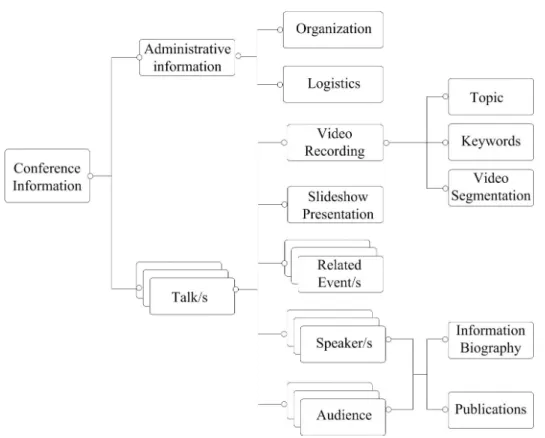
(cf. Figure 2 - Exemple d'information véhiculée dans un cycle de vie d'une
conférence).
L'analyse globale de l'état de l'art nous a conduits à conclure à un ensemble
d’observations et réflexions qui ont motivés les principaux axes de recherche
du travail proposé dans cette thèse (cf. Figure 3 - Récapitulatif sommaire de
l'état de l'art).
Dans cette thèse nous avons cherché à fournir une nouvelle approche
pour le contenu multimédia basé sur la récupération. Nous avons exploré des
approches sémantiques navigation de gestion de contenu basée sur la
visualisation et des ressources multimédias généré pour et lors des
conférences scientifiques. Nous avons cherché à fournir aux utilisateurs
une plateforme qui améliore la recherche d’information de conférence en
réduisant ce qui est communément nommé dans la littérature le «fossé
sémantique». L'écart qui existe entre la représentation des connaissances
explicites requis par les utilisateurs qui cherchent les ressources multimédia et
les connaissances implicites véhiculées au sein du cycle de vie d’une
conférence.
Trois questions principales ont été abordées et la principale contribution a été
portée vers ces questions :
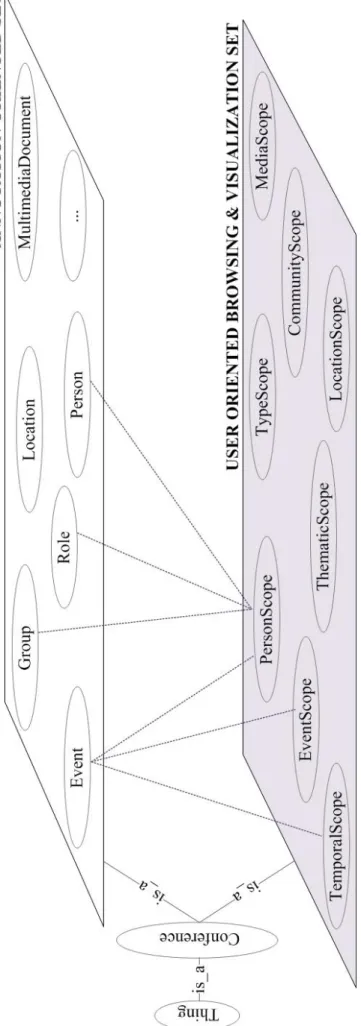
La première question est la modélisation des connaissances (cf. Figure 4 -
HELO, représentation d'une partie des concepts): Nous avons conçu un
modèle ontologique qui a été destiné à être utilisé comme un modèle
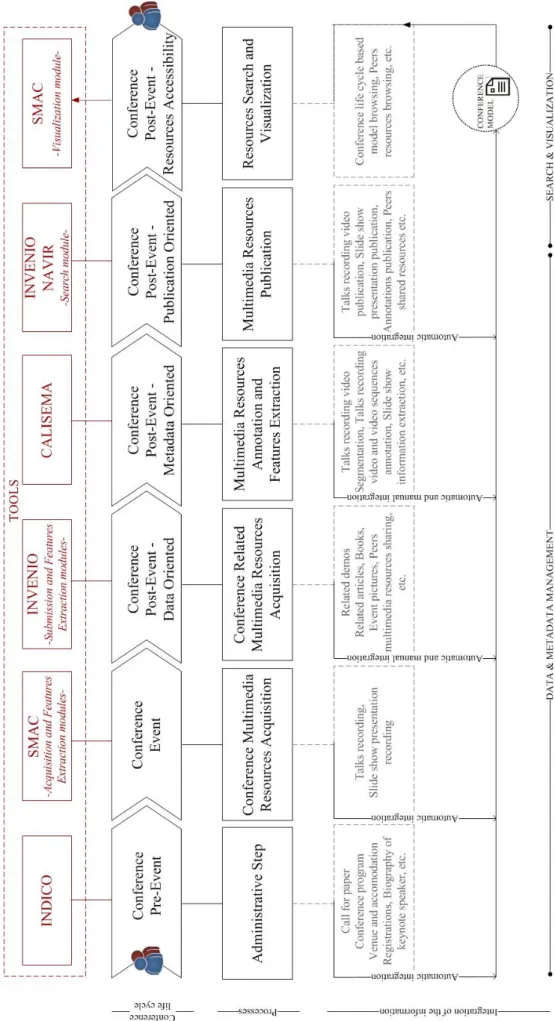
sous-jacent pour le processus de recherche d’information multimédia (cf. Figure 6 -
CALIMERA, représentation en couches, Figure 7 - CALIMERA, Cycle de vie
d'une conférence).
L'état de l'art a montré l'étude qu'une attention croissante est accordée à
l'approche basée sur l'ontologie, car il offre des solutions prometteuses pour
améliorer et permettre la recherche d’informations basée sur le contenu. Les
modèles existants couvrent une partie des structures et le contenu requis
descriptions basées dans le domaine des conférences scientifiques (cf. Figure
4 - HELO, représentation d'une partie des concepts). Nous avons conçu et
mise en œuvre HELO, une ontologie qui modélise les informations transmises
au cours du cycle de vie d'une conférence scientifique. Le modèle est
composé de concepts granulés qui sont représentatifs de l'annotation des
utilisateurs, et de huit différents concepts que nous appelons des Scope qui
sont représentatifs de la navigation des utilisateurs et du processus de
visualisation (cf. Figure 5 - HELO, représentation).
La deuxième question abordée est la gestion des connaissances: Dans cette
thèse nous avons cherché à améliorer la description du contenu multimédia
en se basant sur l’agrégation de l'information disponible générée par le cycle
de vie d'une conférence (cf. Figure 8 - CALIMERA, Cycle de vie d'une
conférence). Pour résoudre ce problème, nous avons conçu une approche
intégrée pour la recherche d'information par contenu en se basant sur la
modélisation du domaine de conférences scientifiques. L'approche
est basée l'ontologie de conférences. Nous avons cherché à rendre possible
l'utilisation de l’information existante transmises au cours un cycle de vie
d’une conférence. Cela a été possible en intégrant cette conférence
dans le modèle ontologique HELO (cf. Figure 8 - CALIMERA, Cycle de vie
d'une conférence).
La troisième question abordée est la navigation et la visualisation des
connaissances: Nous avons cherché à améliorer la récupération multimédia
en proposant un modèle approche fondée sur la navigation. Nous avons
proposé une approche de navigation et de visualisation
sur la base de HELO qui prend en compte le cycle de vie de récupération
d'informations.
Nous avons cherché à donner aux utilisateurs la possibilité d'explorer
l'information sur la conférence par rapport aux Scope définies sur la base de
leurs exigences. Afin d'unifier les nombreux efforts qui ont été menés au cours
de la thèse nous avons intégrés les approches proposées dans la plateforme
de recherche d'information. Nous avons conçu une plateforme intégrée
pour la recherche d’information multimédia basée sur le contenu (cf. Figure 6
-
CALIMERA, Architecture). Cette approche, fait usage
du cycle de vie grâce au modèle sémantique HELO sous-jacent à
l’architecture.
Nous avons cherché dans cette démarche de thèse à faire usage du
potentiel du P2P, principalement pour l'annotation de contenu et la
recherche.
Pour valider notre approche, nous avons mise en place CALIMERA (cf. Figure
6 - CALIMERA, Architecture, Figure 7 - CALIMERA, représentation en couches),
une plateforme de recherche d’information guidée par une ontologie qui
intègre un ensemble d'outils pour la récupération des ressources de
conférence multimédia (cf. Figure 8 - CALIMERA, Cycle de vie d'une
conférence).
Au niveau de l'annotation, le travail de thèse présente une amélioration
significative dans l'annotation d'enregistrement vidéo-conférence: (1) Nous
avons fait usage de l'information existante qui n'a pas été utilisé dans les
approches précédentes. (2) Nous avons conçu et mis en œuvre
un algorithme de segmentation de vidéo-conférence. L'algorithme proposé
repose sur la détection de changement. Cette décision était fondée sur le
fait que les utilisateurs peuvent avoir besoin de visualiser une séquence vidéo
spécifique d'une conférence. Cette séquence la plupart des cas correspond
à une diapositive spécifique ou un ensemble de diapositives. (3) Nous avons
proposé une annotation automatique par le biais un algorithme de
speech-to-text qui attribue automatiquement l'annotation basé sur le temps. (4) Nous
avons offert aux utilisateurs un outil perfectionné, conçu pour l'annotation
vidéo conférence. Cet outil d'annotation semi manuel est basé sur HELO un
modèle d'ontologie commune (cf. Figure 9 - CALISEMA, outil d'annotation
basée sur HELO).
Au niveau de navigation et de visualisation, le travail de thèse présente une
nouvelle approche de la recherche et la visualisation des conférences
basées sur une ontologie de la conférence. (1) Nous offrons aux utilisateurs la
possibilité de naviguer à travers les ressources multimédias basé sur le modèle
sémantique. Grâce à cette approche de navigation, fait référence dans
cette thèse travailler comme la recherche à facettes, a permis aux utilisateurs
d'explorer les informations disponibles et de visualiser le résultat de la
recherche en fonction de différents champs d'application tels que
PersonScope, CommunityScope, TemporalScope, et ainsi de suite. (2) Nous
avons également offert aux utilisateurs la possibilité de filtrer les résultats en
fonction de plus d'un champ d'application. Cette approche est essentielle et
intéressante en raison de filtrage des données des aspects qui, selon les cas,
peut en outre améliorer la visualisation du résultat de recherche (Figure 10 -
SMAC, outil de visualisation basée sur HELO).
Enfin, CALIMERA présente un cadre de bout en bout intégrée, qui peut être
utilisé comme une base utile pour les expériences, principalement pour une
plate-forme opérationnelle mais plus probablement comme une première
étape pour l'évaluation des utilisateurs. Les résultats actuels obtenus
dans ce travail de thèse appel pour diverses directions de recherche futures.
Dans la section suivante, nous proposons quelques-unes de ces améliorations
et possibilités d'extension.
Figure 2 - Exemple d'information véhiculée dans un cycle de vie d'une
conférence
Pour la suite, une des tâches imminente à faire est l'évaluation de la
plateforme proposée en particulier lorsque les recherches sont effectuées sur
le réseau P2P à grande échelle. Comme mentionné précédemment, le
succès d'un système de recherche multimédia est principalement déterminé
par sa capacité à soutenir les besoins des utilisateurs. À cette fin, nous avons
décidé de concevoir la plateforme en se basant sur un domaine, le domaine
spécifique. Cette spécification nous permet de se concentrer sur
besoins spécifiques des utilisateurs. L'évaluation des différentes
caractéristiques intégrées dans le cadre à savoir le modèle, les interfaces
utilisateur graphiques à la fois pour l'annotation et recherche sont d'un grand
intérêt pour améliorer l'approche proposée et par conséquent
la plateforme CALIMERA.
Cette évaluation devrait exploiter l'évaluation de la ontologique modèle
HELO, l'évaluation de l'interface sémantique d'annotation, l'évaluation de
l'interface de moteur de recherche sémantique, et l'évaluation de la rendu
multimédia et interfaces de navigation. Comme prochaines étapes, il serait
d'intérêt pour améliorer l'approche proposée. Cela pourrait se faire à
différents niveaux: (1) Dans le domaine des données et des métadonnées de
gestion, des améliorations peuvent être transportés sur le domaine de
l'extraction de contenu. En effet, de nombreux niveau de fonctionnalités,
telles que la reconnaissance du visage, qui peut être extraite
peut potentiellement être utilisé pour l'indexation et la récupération.
Techniques d'annotation sémantique comme reconnaissance de caractères
vidéo optique (OCR), suivi des objets peut être aussi intégrés dans la
plate-forme pour enrichir l'annotation disponibles. (2) Dans le domaine de la
recherche, l'approche requête virtuel doit être mis au point et à évaluer. Plus
interfaces utilisateurs devraient soutenir l'insertion de données, mise à jour et
la pertinence des commentaires. Les interfaces utilisateur proposées
devraient être complétées par la mise en œuvre celles qui n'ont pas encore
été développé. (3) Dans le domaine du réseau P2P, un rôle important et
aspect intéressant peut être amené à améliorer la performance de la
plate-forme. Comme la plateforme proposée est modulaire, nous pouvons répartir
les différents modules au cours de la connecté pairs faisant usage de leur
unité de traitement de commande (CPU). Cette distribution est intéressante
pour le module vocal-texte et l'outil d'enregistrement principalement lors de
des séances parallèles qui doivent être enregistrées.
D'autres aspects importants pourraient être prises en compte dans ce
domaine de travail et peut être considérée comme une extension de la
plateforme proposée. Il peut s'agir de l'extension de la HELO modèle, y
compris d'autres ontologies existantes et de faire l'utilisation de la grande
quantité d'informations que l'on peut trouver sur le web. Informations tels que
les bibliothèques numériques de la littérature scientifique et d'information que
nous pouvons extraire à partir de réseaux sociaux actuels et des réseaux P2P.
Abstract
During the last decade we have witnessed an exponential growth of digital documents and multimedia resources, including a vast amount of video resources. Videos are becoming one of the most popular media thanks to the rich audio, visual and textual content they may convey. The recent technological advances have made this large amount of multimedia resources available to users in a variety of areas, including the academic and scientific realms. However, without adequate tech-niques for effective content based multimedia retrieval, this large and valuable body of data is barely accessible and remains in effect unusable. This thesis explores semantic approaches to content based man-agement browsing and visualization of the multimedia resources generated for and during scientific conferences. Indeed, a so-called semantic gap exists between the explicit knowledge representation required by users who search the multimedia resources and the implicit knowledge conveyed within a conference life cycle. The aim of this work is to provide users with an integrated framework that enhances the conference multimedia information retrieval by bridging this semantic gap. The goal of this thesis is to provide a novel approach for content based multimedia retrieval in the domain of scientific conferences. The contribution of this thesis is of threefold. The first contri-bution is the design and implementation of HELO, an ontological knowledge model that models the information conveyed during the life cycle of a scientific conference such as video recordings, talk presen-tation files, speaker information and the administrative information. The second contribution is the design of an integrated approach for knowledge based management guided by HELO, making therefore use of the existing unused information conveyed during a conference life cycle. The third contribution is the design of a knowledge based browsing and visualization approach enabling users to easily make complex and structured queries. In order to validate the proposed approach, we put forward CALIMERA, an integrated framework for conference multimedia retrieval. CALIMERA offers a set of management and retrieval tools. It is driven by the semantic model HELO and deployed over a Peer to Peer network. The proposed experimental framework
xii
was tested over a set of conferences that took place at the EIAFR and the CERN.
Table of Contents
I CONTEXT 1
1 Global Introduction 3
1.1 Background and Motivation . . . 3 1.2 Thesis Objectives . . . 4 1.3 Summary of Achievements . . . 5 1.4 Report Road Map . . . 6
II STATE OF THE ART 9
2 Thesis Focus - Scientific and Academic Events 11
3 Content Based Multimedia Retrieval 15
3.1 Introduction . . . 15 3.2 Semantic Models . . . 16 3.2.1 Ontology Description. . . 18 3.2.2 Ontology Languages . . . 20 3.2.3 Conference Models . . . 21 3.3 Content Based Annotation. . . 24 3.3.1 Multimedia Annotation . . . 24 3.3.2 Video Annotation. . . 25 3.4 Content Based Browsing and Visualization . . . 28 3.4.1 Faceted Search . . . 29 3.4.2 Multimedia Visualization . . . 31 3.4.3 Conference Information Browsing and Visualization. . . 34 3.5 Content Based Querying . . . 37 3.5.1 Querying Heterogeneous Data . . . 38 3.5.2 Querying Systems . . . 39 3.6 Conclusion. . . 41 4 Multimedia Information Retrieval Platforms 43 4.1 Introduction . . . 43 4.2 Frameworks . . . 44 4.2.1 Matterhorn . . . 45 4.2.2 VIKEF . . . 46 4.2.3 RKBExplorer . . . 47 4.3 P2P Networks. . . 48 4.4 Conclusion. . . 53 5 Discussion 55
xiv Table of Contents
III CONTRIBUTION - Conference Multimedia Information
Retrieval 59
6 Knowledge Modeling 61
6.1 Introduction . . . 61 6.2 Conference Life Cycle . . . 61 6.3 HELO Model . . . 62 6.4 Conclusion. . . 67
7 Knowledge Management 69
7.1 Introduction . . . 69 7.2 Multimedia Knowledge Management . . . 69 7.2.1 Automatic Content Extraction . . . 69 7.2.1.1 Content Based Video Segmentation . . . 70 7.2.1.2 Speech Based Metadata Extraction . . . 74 7.2.2 Manual and Semi-manual Content Based Annotation . . . 79 7.3 Conclusion. . . 81
8 Knowledge Based Searching 83
8.1 Introduction . . . 83 8.2 Multimedia Knowledge Querying . . . 83 8.2.1 Virtual Query Engine . . . 83 8.2.2 Query Process . . . 85 8.2.2.1 Query Analysis . . . 86 8.2.2.2 Virtual Queries Building . . . 87 8.3 Multimedia Knowledge Browsing and Visualization . . . 89 8.3.1 Model Based Interface . . . 89 8.3.2 Faceted Browsing . . . 90 8.4 Conclusion. . . 92
9 Conference Multimedia Framework 97
9.1 Introduction . . . 97 9.2 CALIMERA Framework . . . 97 9.3 CALIMERA P2P Approach . . . 98 9.4 Conclusion. . . 100
IV PROTOTYPE - CALIMERA 101
10 CALIMERA Platform and Testbed 103
10.1 Introduction . . . 103 10.2 Platform Tools . . . 103 10.2.1 Management Tools . . . 103 10.2.1.1 INDICO. . . 105 10.2.1.2 SMAC - Acquisition and Features Extraction . . . . 105
10.2.1.3 INVENIO - Submission and Features Extraction . . 110 10.2.1.4 CALISEMA . . . 112 10.2.2 Search and Visualization Tools . . . 116 10.2.2.1 INVENIO - Search . . . 116 10.2.2.2 NAVIR . . . 117 10.2.2.3 SMAC - Visualization . . . 123 10.3 Platform Network. . . 126 10.4 Platform Testbed and Evaluation . . . 128 10.5 Conclusion. . . 131
V CONCLUSION AND PERSPECTIVES 133
11 Conclusion and Perspectives 135
VI Bibliography 139 Bibliography 141 VII Appendix 159 A Annex 161 B Glossary 165 C Curriculum Vitae 169
List of Figures
1.1 Example of the information conveyed within a conference life cycle . 5 2.1 CERN Document Server (CDS) - portal . . . 12 3.1 Content based multimedia retrieval process . . . 15 3.2 Virtual Information and Knowledge Environment Framework(VIKEF) - retrieval process . . . 16 3.3 Multi-layer abstraction of sport video. . . 17 3.4 International Semantic Web Conference ontology (ISWC) . . . 22 3.5 Part of the thesis proposed model based on the ISWC ontology . . . 23 3.6 Anvil - video annotation tool . . . 27 3.7 Annomation - video annotation tool . . . 28 3.8 Simile - example of faceted search . . . 30 3.9 Visual wiki applications - Thinkbase, Thinkpedia, ProcessMapper
and ThinkFree . . . 32 3.10 Classification of the visualization techniques according to the study
of Daniel K. . . 33 3.11 DBLPViz interface . . . 35 3.12 Arnetminer interface . . . 35 3.13 RKBexplorer interface . . . 36 3.14 Videolectures portal . . . 36 3.15 Wrapper-Mediator architecture . . . 39 3.16 XLive architecture overview . . . 40 3.17 SemanticLIFE framework overview . . . 40 3.18 SemanticLIFE virtual query workflow . . . 41 4.1 Combining P2P and semantic web for constructing digital libraries . 44 4.2 Matterhorn project . . . 45 4.3 VIKEF architecture . . . 46 4.4 RKBExplorer approach . . . 47 4.5 GSS architecture . . . 50 4.6 SAPIR approach . . . 50 4.7 JXTA software architecture . . . 52 5.1 Overview of the main works presented in the state of the art . . . 57 6.1 Conference life cycle steps description . . . 63 6.2 HELO - conference model overview . . . 65 6.3 HELO - part of the thesis proposed model . . . 67 7.1 Overview of the slide-changes based video segmentation approach . . 70
xx List of Figures
7.2 Slide-change based video segmentation process . . . 71 7.3 Slide-change based video segmentation - boundary shot detection . . 72 7.4 Comparison of a video frame against the images of the presentation
slides . . . 75 7.5 Video key-frames and their potentially slides candidates . . . 76 7.6 Speech recognition system - Sphinx4 process steps . . . 77 7.7 Speech recognition system - time-based metadata . . . 77 7.8 Conference life cycle information integration into HELO . . . 80 8.1 Virtual-Q - an overview of the approach . . . 84 8.2 Virtual Query Engine (VQE) architecture . . . 84 8.3 VQE process . . . 86 8.4 VQE - query process steps . . . 87 8.5 VQE - query process steps description . . . 88 8.6 Example of a complex request in natural language . . . 90 8.7 Example of a complex request SPARQL query language . . . 90 8.8 HELO based querying interface approach . . . 91 8.9 PersonScope interface approach . . . 92 8.10 CommunityScope interface approach . . . 93 8.11 TemporalScope interface approach. . . 93 8.12 Multi-Scope interface approach . . . 94 8.13 Results of the visualization interface approach . . . 94 9.1 CALIMERA - global view architecture . . . 99 9.2 CALIMERA - layered model overview . . . 100 10.1 CALIMERA - conference life cycle set of tools. . . 104 10.2 INDICO - conference management tool . . . 106 10.3 SMAC - acquisition interface . . . 107 10.4 SMAC - slide-show capturing . . . 107 10.5 INVENIO - modules overview . . . 111 10.6 Speech-to-text algorithm - example of generated MPEG7 file. . . 112 10.7 Speech-to-text algorithm - results of correct words in the transcript
after the optimization . . . 113 10.8 Speech-to-text algorithm - results of correct words from the original
video after the optimization . . . 113 10.9 CALISEMA - conference model based video annotation . . . 114 10.10CALISEMA - algorithm manager . . . 115 10.11CALISEMA - slide-change based video segmentation use . . . 115 10.12CALISEMA - automatically integrated information . . . 116 10.13CALISEMA - speaker information integration . . . 117 10.14INVENIO - traditional search tool . . . 118 10.15VQE - output example . . . 119 10.16VQE - Administration interface and Query frame . . . 120
List of Figures xxi
10.17Flare - layout samples . . . 121 10.18NAVIR - PersonScope implemented interface . . . 122 10.19NAVIR - ThematicScope implemented interface . . . 122 10.20NAVIR - EventScope implemented interface . . . 123 10.21SMAC - visualization module - talk video recording replay interface - I124 10.22SMAC - visualization module - talk video recording replay interface
- II . . . 125 10.23Platform Network. . . 126 10.24CALIMERA platform - main page . . . 127 10.25CALIMERA platform - example of a user request without connected
peers . . . 128 10.26CALIMERA platform - example of a user request with connected peers129 10.27CALIMERA testbed . . . 129 A.1 HELO - an extract - I . . . 161 A.2 HELO - an extract - II . . . 162 A.3 HELO - an extract - III . . . 162 A.4 HELO - an extract - IV . . . 163
WRITING CONVENTIONS
• Titles and important words and sentences are emphasized in BOLD • New concepts/words are written in ITALIC
• Cited sentences and words are "QUOTED"
• Query examples are "QUOTED AND IN ITALIC "
• Bibliographic references are cited [BETWEEN BRACKETS IN RED] • Acronyms and a list of particular terms are provided in the APPENDIX B
Part I
Chapter 1
Global Introduction
1.1
Background and Motivation
During the last decade we witnessed an exponential growth of digital documents and multimedia resources, including a vast amount of video resources. Videos are becoming one of the most popular media thanks to the semantic audio, visual and textual content they convey. The recent technological advances have made this large amount of multimedia resources available to users in a variety of areas, including the academic and scientific realms. However, without adequate techniques for effective access to multimedia content, this large and valuable body of data is barely accessible and in effect unusable. To date, most effort has been directed toward systems for image and audio retrieval as these media were in use much earlier than video. The multimedia retrieval systems that focus on video resources therefore require adapted and novel techniques and ap-proaches for providing relevant and efficient content based multimedia management. However, content based multimedia retrieval systems are difficult to build, mainly because of the large difference between the content that can be automati-cally extracted and the content that needs to be extracted in order to satisfy the needs of the users during the retrieval process. This is especially the case in the academic and the scientific domains, where the content that can be automatically extracted consists in content such as the shape, color, motion, and the like and the content that users who are searching the multimedia resources require, consists in content such as important topics, events, relation to other events and community. In the information retrieval field, this gap is called, the "semantic gap". The "semantic gap" has been defined and referenced in several research works [Liu 2007, Hellmann 2010, Ma 2010]. Smeulders et al. [Smeulders 2000] define it as "the lack of coincidence between the information that one can extract from the visual data and the interpretation that the same data has for a user in a given situation".
The main challenge facing multimedia retrieval systems today is bridging this "semantic gap". Several approaches have been proposed. One of these approaches is the domain specific approach which exploits the typical characteris-tics of a particular video genre to design the most effective tools for information management (extraction, annotation, etc.) and retrieval (querying and browsing). In this thesis we focus on the scientific conference domain. We define the word
4 Chapter 1. Global Introduction
‘conference’ in this thesis is as follows: A conference, is any type of meeting, hap-pening at a determinable time and place, with at least one speaker who intend to inform, explain, or talk about one or several topics. As technological developments have made recording technology more affordable and easier to use, the number of conference presentations that are recorded has been increasing. However, the information conveyed within the resulting multimedia resources is hardly accessible by large numbers of various interested users, including professors, students and researchers. In addition to the stated context, the characteristics of conferences make the use of the potential of the Peer to Peer (P2P) a promising solution for the enhancement of the multimedia information retrieval. Indeed, among several definitions found on the web, a conference is considered as a large gathering of individuals or members of one or several organizations, for discussing matters of common interest [COF a], an occurrence happening at a determinable time and place, with or without the participation of human agents [COF b], a formal meeting that typically takes place over a number of days and involves people with a shared interest [COF c]. In this context, the resources are obviously distributed, since it is a gathering of individuals and members. This recalls also to the necessity of sharing the distributed information within the community. The large scale of the scientific community and its computational resources can be exploited by using the P2P potential, hence improving the multimedia retrieval process [Ramzan 2010].
1.2
Thesis Objectives
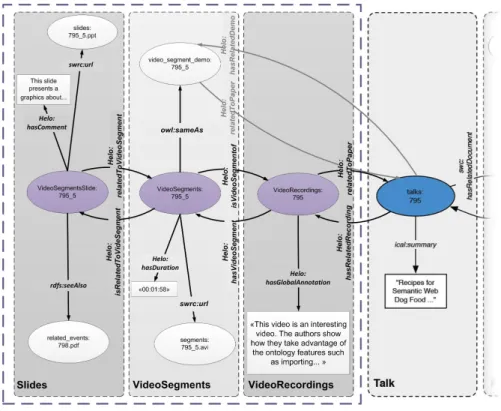
The goal of this thesis is to provide a novel and integrated1 approach for content based multimedia retrieval in the domain of scientific conferences. The aim of this thesis is to provide users with an integrated framework that enhances the confer-ence multimedia information retrieval by bridging the so-called "semantic gap". We aim to take advantage of the information conveyed during the life cycle of a conference. This information includes (Fig. 1.1): The administrative information (e.g. conference organization, logistics), the slideshow presentation of the talk (e.g. PowerPoint or PDF formats), the video recording of each talk with its content (e.g. video segmentation, keywords, topics), the related events, the speaker and the au-dience (each characterized by such information as name, organization the person belongs to and publications), the related demos, and more. The ability to extract this information constitutes a significant advance in the multimedia information retrieval, since it enriches its content based description. To that end, this thesis explores semantic approaches to content based management browsing and visual-ization of the multimedia resources generated for and during scientific conferences. It also explores the potential of P2P networks for supporting existing approaches to multimedia information retrieval. The main achievements of the thesis are presented
1In this work, the word ‘integrated’ is used to refer to an effective unit that combines
dif-ferent aspects/approaches that are relevant to address a single issue, which is, in this case, the enhancement of the content based multimedia retrieval
1.3. Summary of Achievements 5
in the following section.
Figure 1.1: Example of the information conveyed within a conference life cycle
1.3
Summary of Achievements
In this thesis we present the design and implementation of an integrated framework for content based multimedia retrieval that is driven by a knowledge2 model and deployed over a P2P network. We also offer a set of tools to validate the proposed approach. The main results of this thesis can be summarized as follows:
• Conference knowledge modeling: The design and implementation of an ontological model that formalizes the information conveyed during the life cycle of a scientific conference such as video recordings, talk slideshow presen-tation files, speaker information and administrative information. The designed model is named HELO which stands for High-level modEL Ontology. HELO is composed of granular concepts that are representative of users’ annotation
2
According to Oxford Dictionaries Online the term ‘knowledge’ is "Facts, information, and skills acquired through experience or education; the theoretical or practical understanding of a subject’. In this thesis, the term ‘knowledge’ is used to designate an understanding of a specific domain that goes beyond the simple information and integrates aspects such as competences, skills, expertise, etc.
6 Chapter 1. Global Introduction
process and of eight different scopes3 that are representative of users’ browsing and visualization processes [Sokhn 2010b,Sokhn 2009a,Sokhn 2009d]. • Hybrid knowledge management: The design of an integrated approach
for content based information retrieval in the domain of scientific events. The approach is based on the conference ontology HELO. It combines the auto-matic, manual and semi-manual techniques. Thanks to the unified model the proposed approach makes use of the existing unused information conveyed during a conference life cycle to enrich the multimedia content description [Sokhn 2011a,Atitallah 2011a,Atitallah 2011b,Revertera 2011,Sokhn 2010a,
Sokhn 2009b].
• Knowledge browsing and visualization: The design of a model based browsing and visualization approach based on the semantic conference model. This approach gives users the ability to explore conference information with respect to scopes defined based on their requirements. Because the multi-media content description is based on a model that structures characteristics and relationships through a set of scopes, this enables users to easily make complex and structured queries [Sokhn 2010b,Sokhn 2011b,Dumoulin 2011,
Dumoulin 2010,Sokhn 2009c].
• Conference multimedia framework: The implementation of the Confer-ence Advanced Level Information ManagemEnt & RetrievaAl (CALIMERA) an integrated framework for the management and retrieval of conference mul-timedia resources. To validate the proposed approach we developed a set of tools for both the management and retrieval of conference multimedia re-sources. These tools, which are integrated into CALIMERA, are designed on top of the HELO ontological model [Sokhn 2010b,Sokhn 2011a,Sokhn 2009b].
1.4
Report Road Map
In this section we present an overview of the thesis’s chapters organization. Part I - CONTEXT
• Chapter 1 - Global Introduction
In this introductory chapter we present the global context of this work, along with the thesis objectives and a summary of the main achievements.
Part II - STATE OF THE ART
• Chapter 2 - Thesis focus - Scientific and Academic Events
In this chapter we present the background and the motivation for the thesis.
3In this thesis, the term ‘scope’ designates a set of ontological concepts that refers to different
1.4. Report Road Map 7
• Chapter 3 - Content Based Multimedia Retrieval
In this chapter we present an overview of the state of the art in content based multimedia retrieval. We focus on three main issues: The multimedia in-formation modeling, the multimedia inin-formation management (content based acquisition, extraction, integration and annotation), and the multimedia in-formation searching (querying and browsing). In the first part we present the semantic models and the different techniques that are currently used to seman-tically model specific domains, particularly the conference domain. We focus on the existing model that is used for the domain of scientific conferences. In the second part we present an overview of existing projects and techniques for multimedia information management, with a focus on the content based annotation approach. In the third part we present an overview of previous work done in the area of content based searching (querying and browsing) and visualization.
• Chapter 4 - Multimedia Information Retrieval Platforms
In this chapter we present an overview of the major current multimedia infor-mation retrieval frameworks and platforms focusing on the frameworks devel-oped for scientific and academic contexts. We analyze the three frameworks that we consider to be most relevant ones according to this thesis topic. In this chapter we also introduce P2P networks, as we believe that these may en-hance the information retrieval process. Indeed, conferences being a gathering of individuals and members, this contributes to the existence of distributed information and the need of sharing and accessing resources and knowledge within a community. The large scale of the scientific community and its com-putational resources can be exploited by using the P2P potential.
• Chapter 5 - Discussion
In this chapter we discuss the approaches and techniques presented in the pre-vious chapters. We present the issues that have been identified and indicate the issues that we will address in this work. We discuss content based brows-ing and visualization approaches in detail and briefly discuss content based querying over heterogeneous data. The discussion in this chapter motivates the ontology driven framework approach for multimedia information retrieval in P2P networks.
Part III - CONTRIBUTION - Conference Multimedia Information Re-trieval
• Chapter 6 - Knowledge Modeling
In this chapter we present HELO, an ontology model for conferences. This model allows us to effectively manage and reuse knowledge conveyed in the content multimedia resources during the life cycle of a conference, specifically those resources used in scientific conferences. HELO is based on existing on-tologies, integrating the content descriptions that specifically relate to scientific conference.
8 Chapter 1. Global Introduction
• Chapter 7 - Knowledge Management
In this chapter we detail the proposed ontology driven knowledge management specifically features extraction and content annotation. In the first part we describe the proposed method for automatic metadata extraction and in the second part we describe the proposed semi-manual approach to ontology based annotation.
• Chapter 8 - Knowledge Based Searching
In this chapter we describe the ontology driven knowledge searching and vi-sualization. In the first part we introduce the proposed approach to heteroge-neous data querying (a minor focus was given to this specific issue), and in the second part we describe the information browsing and visualization approach which is based on the semantic model HELO.
• Chapter 9 - Conference Multimedia Framework
In this chapter we present the framework approach that we have designed for conference multimedia retrieval. The framework is driven by the HELO ontology. We describe the different modules constituting the framework. Part IV - PROTOTYPE - CALIMERA
• Chapter 10 - CALIMERA Platform and Testbed
In this chapter we present CALIMERA, which is the experimental research project that we set up as a proof of concept of the approach that we propose in this thesis. CALIMERA is implemented on a P2P network and integrates a set of tools for both information management and information retrieval. The design of these tools is based on by the semantic model HELO. In order to validate the thesis experimental project we set up a testbed of several videos provided by the CERN and performed CALIMERA over different conferences that took place at the EIAFR, the most important of which was the international Atlantic Web Intelligence Conference 2011 (AWIC2011).
Part V - CONCLUSION AND PERSPECTIVES • Chapter 11 - Conclusion and Perspectives:
In this final chapter, we state the conclusions and propose relevant directions for future research based on the work presented in this thesis.
Part II
Chapter 2
Thesis Focus - Scientific and
Academic Events
In this section we motivate the thesis focus on the realm of scientific and academic events1 by identifying the main aspects and characteristics of these events.
Scientific and academic events are gradually increasing [NBC ], and the quantity of high quality scientific information disseminated via conferences is growing steadily [Sidiropoulos 2005]. A large number of these events are being recorded for subsequent use (e.g. replay, research, course preparation). In the last decade, researchers have addressed the issue of enhancing the content based information retrieval. Various approaches and systems have been proposed for scientific and academic events. Most of these approaches, addressed a specific issue related to the content based multimedia retrieval. Due to the dynamic and temporal nature of video, the content based video retrieval issue was more particularly addressed. Every conference has a life cycle divided into different steps. Each of these steps conveys a set of information that can be used in the information retrieval process. The retrieval of a talk video recording may be considerably enhanced if the information generated through the conference life cycle is captured. What characterizes the video of scientific conferences is the domain characteristics relative to academic and more precisely scientific realm. Video recordings of scientific conferences have their own specificities such as the structure of the video, the scientific community relationships, the relative procedures, the related events and so on. In a scientific conference we may be interested to replay the different talks of a specific session, of a specific team, of a specific topic or year. We may be interested to watch back a specific sequence of the video relative to a specific slide of the presentation or relative to the demo part. Many characteristics specific to the scientific events can be identified and handled in order to enhance the content based multimedia retrieval. Adding to this, the conference talks are often recorded in poor lightening condition and have no attached presentations’ outline, which makes the video analysis and semantic features extraction a challenging task. Moreover, scientific conferences are characterized by the social/scientific community which actively participate in scientific events and can consequently provide interesting multimedia resources (photos, related demo, books, papers, and more) that can be
1The term ‘events’ denotes a scheduled activity. In this work, this term designates primarily
12 Chapter 2. Thesis Focus - Scientific and Academic Events
subsequently linked to the recorded talk.
The multimedia resources are stored and subsequently searched and accessed by different category of users:
• Occasional users which may have specific needs without having necessarily the adequate keywords or knowledge to formulate the query. For example a student searching for a specific video sequence which describes what an ontology is. It may be a talk of a famous speaker.
• Advised users, i.e. users that may need an advanced and scientific based research/browsing model. For example professors that may be preparing their presentations, may need different video sequences illustrating their ideas. It may also be some participants of the conference that would like to see back their presentation or search for the event related photos for instance.
• Expert users that need to analyze different talks, to learn more about a topics or even to organize a scientific event. For example advisors that need to evalu-ate their student’ presentation comparing to other presentations or professors that are preparing their courses may seek for specific details of a chosen topic, research community, or laboratory.
Figure 2.1: CERN Document Server (CDS) - portal
In addition to the described context, the thesis focus on scientific and academic events is motivated by the collaboration with the CERN. Indeed, at CERN, over
13
800,000 bibliographic records and 350,000 fulltext documents, organized in more than 500 collections, articles, books, journals, videos and more, are available, and the number of resources is continuously growing (Fig. 2.1). In this context, we identify a strong need for a content based multimedia retrieval in the scientific realm. Thanks to this collaboration we can make use of existing tools developed at the CERN for the conference management namely INDICO and INVENIO both of which are presented in the chapter 10. Moreover, having access to a full-scale data set is a motivating aspect for an efficient evaluation process for the thesis proposed approach.
Based on this context we propose in this thesis an approach that takes into account the characteristics of the scientific domains in order to provide users with a novel approach for multimedia information retrieval. The following part presents the state of the art related to the thesis focus and motivates the thesis approach for an ontology driven framework for multimedia information retrieval in a P2P network.
Chapter 3
Content Based Multimedia
Retrieval
3.1
Introduction
The recent technological advances have made digital multimedia resources more affordable and easily available for a wide variety of uses. However, accessing the content of these resources is not a trivial task, primarily because of their dynamic and temporal nature. The task of content based multimedia access has recently drawn increased attention in the multimedia information retrieval research commu-nity. As previously presented, in this work, we focus on multimedia resources that are generated by scientific conferences and academic events. Nevertheless, the rich information that is implicitly conveyed in these resources could be made accessible by concentrating efforts to create useful semantic annotations and to offer semantic based searching (querying and browsing) and visualization approaches. Several works have addressed the issues related to the Content Based Multimedia Retrieval (CBMR).
Figure 3.1: Content based multimedia retrieval process
The CBMR process may be represented as the combination of different en-tities: (1) The multimedia modeling which involves models design, (2) the multimedia management which involves the data acquisition and annotation aspects, and (3) the multimedia searching and visualization which involves the querying, browsing and visualization aspects (Fig. 3.1). The figure 3.2 provides an example of an overview of the CBMR provided by the authors of the Virtual Information and Knowledge Environment Framework (VIKEF) project [VIK]. In this figure we can identify the "information extraction" which is relative to the multimedia management entity, the "knowledge representation" and the "ontology
16 Chapter 3. Content Based Multimedia Retrieval
engineering" which are relative to the multimedia modeling entity and the "smart community services" which are relative to the information searching entity.
In this chapter, we present an overview of current work conducted on con-tent based multimedia retrieval, highlighting three main issues: The multimedia information modeling, the multimedia management (content based annotation) and the multimedia visualization. In the following section, we describe the approaches
Figure 3.2: Virtual Information and Knowledge Environment Framework (VIKEF) - retrieval process
that are currently used to model scientific and academic information related to an event. In the section 3, we focus on content based annotation approaches to multimedia information retrieval. In the sections 4 and 5, we present an overview of the major content based approach to multimedia searching and visualization approaches. Each section provides motivations for the proposed semantic based approach to multimedia information retrieval .
3.2
Semantic Models
A data model expresses the properties of the data that are to be stored and retrieved. One of the main aims of multimedia modeling is to hide the complexities of the data by using a formal language or semantic schema representation of the data. Multimedia data convey a large amount of information that needs to be organized and structured. A model of multimedia data that is to be used for information retrieval should correspond to users’ retrieval requirements. The multimedia models may represent low-level features, such as color, texture and
3.2. Semantic Models 17
shape, and high-level features also called semantic features descriptions, such as event descriptions, domain descriptions, topics and relationship. The figure 3.3 presents a layered abstraction of the description that may be associated to a sport video. We can identify in this figure the different level of information abstraction starting from low-level features (bottom of the figure), ending with high-level features referred as customized semantic (top of the figure) [Tjondronegoro 2005b].
Figure 3.3: Multi-layer abstraction of sport video
Modeling the multimedia semantic content may be more difficult than mod-eling the low-level features since semantic descriptions may be subjective, thus differ from one person to another. According to [Pridmore-Brown 2010], ontologies explicit specifications of the conceptualizations of domains, they provide a tech-nique in the area of "tacit knowledge" for structuring historically unstructured
18 Chapter 3. Content Based Multimedia Retrieval
and poorly represented data, accessible to both people and applications. To enable computers to access the knowledge conveyed within stored multimedia data, semantic models need to be developed. Additionally an understanding of the infor-mation structure shared by both humans and applications may produce new data. With a shared knowledge model, applications will be capable of extracting and aggregating information from different sources, and search engines will be capable of collecting information in a way that provides more useful results for users’ queries. Another advantage of developing semantic models is that domain knowledge can be reused. For instance, many different domains need a representation of the concept of time. This representation includes the notions of time intervals, points in time, relative measures of time, and so on. Once the concept of time is developed in one of the relevant domains, it can be used for other domains as well. Thus the task of building a large ontology (an ontology integrating other ontologies) may be made easier, in fact, several existing ontologies describing portions of a large domain may be integrated into a larger ontology for that domain. A semantic model allows explicit assumptions about a domain to be expressed, and this makes it possible to modify those assumptions easily as our knowledge about the domain changes [Zhang 2008]. The current state of knowledge repre-sentation, as this technology is often called, is comparable to that of hypertext before the advent of the Web: "It is clearly a good idea, and some very nice demonstrations exist, but it has not yet changed the world" [Berners-Lee 2001]. Controlled vocabularies, taxonomies and models for knowledge management have been developed since the mid 90s [Umar 2009]. Recently standards such as the Resource Description Framework (RDF) [RDF ] and the Web Ontology Language (OWL) [OWL] were proposed by the World Wide Web (W3C) [W3C]. Already, many websites, including Wikipedia [WIK ] and Linked Data [LIN], share their data through the standard model for data interchange on the web. This model is known as the Resource Description Framework (RDF) and can be queried by both users and automated agents [GAR ]. Ontologies are widely used to structure information for purposes ranging from analysis and artificial intelligence to simple categorization, searching, and information retrieval [Antoniou 2004]. As stated by [Kitamura 2003], an ontology, which is a system of fundamental concepts, makes explicit our conceptualization of the target domain and provides us with a solid foundation for building sharable knowledge bases that are more broadly usable than conventional knowledge bases. The following section presents the concept of an ontology.
3.2.1 Ontology Description
According to the W3C specifications, an ontology defines the terms used to describe and represent an area of knowledge. Ontologies are used by people, databases, and applications that need to share domain information. "Ontologies include