G
VHD and relapse are two major causes of death after HPC transplantation.1 The most efficientmethod for prevention of GVHD consists of T-cell depletion of the graft.2-5 However, this
usu-ally leads to greatly increased risks of leukemia relapse,3,6,7
due to the loss of the graft-versus-leukemia (GVL) effect that has been recognized as an important component of the anti-leukemic efficacy of allogeneic HPC transplantation, particularly for chronic myelogenous leukemia (CML). The demonstration of this GVL effect and of the primordial role of T-lymphocytes led investigators to transfuse donor lym-phocytes to CML patients relapsing after HPC transplanta-tion.8-14 Indeed, donor lymphocyte infusions (DLIs) have
in-creasingly been used to treat relapse after HPC transplantation not only for CML but also for acute myeloid leukemia (AML), acute lymphoblastic leukemia (ALL), myelodysplastic syndrome (MDS), multiple myeloma (MM), and non-Hodgkin’s lymphoma.15-22
DEMONSTRATION OF THE GVL EFFECT
AFTER HPC TRANSPLANTATION
A GVL effect was first posited in 1956 on the basis of mu-rine experiments: mice receiving syngeneic transplants af-ter the injection of leukemic cell lines and total body irra-diation almost uniformly relapsed, whereas mice receiving allogeneic transplants developed GVHD but had a lower incidence of relapse.23 The first landmark reports of GVLeffects in human allograft recipients were published by Weiden et al. in 197924 and 1981.25 Their observations were
con-firmed by a large retrospective study of 2254 patients receiv-ing HLA-identical siblreceiv-ing bone marrow (BM) transplants for various hematologic malignancies.7 A lower rate of relapse
was observed in recipients of non-T-cell-depleted BM transplants than in recipients of T-cell-depleted allografts or syngeneic BM transplants. In that study, the GVL effect was also evidenced by the lower rate of relapse in patients with GVHD (particularly chronic GVHD in AML and CML patients and acute GVHD in ALL patients), although the GVL reaction was not restricted to patients with GVHD.
The International Bone Marrow Transplant Registry also compared HLA-identical sibling transplants in 731 re-cipients of T-cell-depleted BM transplants and 2480 recipi-ents of non-T-cell-depleted BM transplants and determined the relative risk of relapse after adjusting for the incidence and severity of acute and chronic GVHD.3 The relative risks
of relapse with and without T-cell depletion for AML and ALL in first remission and CML in chronic phase were 1.66 (NS), 1.55 (NS), and 4.87 (p<0.0001), respectively. Finally, the GVL effect was also demonstrated by the evolution of minimal residual disease after transplant, which often ceases to be detectable only 6 to 12 months after BM trans-plant,26 and the occurrence of GVL activity with or without
GVHD after cessation of GVHD prophylaxis without DLI after posttransplant relapse.27-29
Mechanisms of GVL
Cells involved in the GVL effect. MHC-restricted CD4+ and CD8+ T cells and NK cells are probably all involved in the process of both GVL and GVHD.30-32 It is likely that cells
implicated in the GVL effect vary as a function of the
he-Adoptive immunotherapy with donor lymphocyte infusions
after allogeneic HPC transplantation
F. Baron and Y. Beguin
ABBREVIATIONS: ALL = acute lymphoblastic leukemia; AML = acute myeloid leukemia; BM = bone marrow; CML = chronic myelogenous leukemia; CR = complete remission; CTL(s) = cytoloxic T-lymphocyte(s); DLI(s) = donor lymphocyte infusion(s); GVL = graft-versus-leukemia; KIR(s) = killer cell in-hibitory receptor(s); MDS = myelodysplastic syndrome; MHA = minor histocompatibility antigens; MM = multiple myeloma. From the Division of Hematology, Department of Medicine, University of Liège, Liège, Belgium.
Address reprint requests to: Yves Beguin, MD, Department
of Hematology, University of Liège, CHU Sart Tilman, 4000 Liège, Belgium; e-mail: [email protected].
Supported in part by the National Fund for Scientific Re-search (FNRS, Belgium).
Received for publication June 8, 1999; revision received September 2, 1999, and accepted September 9, 1999.
matologic malignancies involved, depending upon their MHC expression33 and the nature of antigens presented.
However, the recognition by CD4+ cells of peptide antigens presented through MHC class II molecules on host cells is essential in initiating a response against leukemia.34 In
trans-plant recipients with CML, the most often identified are CD4+ T-cell lines or clones, which inhibit the growth of leu-kemic progenitors or lyse them, either through direct cy-totoxicity or cytokine-mediated anti-leukemic effects.35,36
More-over, the efficacy of CD8+ cell depletion in reducing the risk of GVHD without impairing the GVL effect, be it by deple-tion of the original graft37,38 or that of DLI after relapse,39,40
suggests a primary role for CD4+ cells in the GVL effect (par-ticularly in CML, but also in MM40) and a primary role for
CD8+ cells in GVHD.
Confirming these findings, Nagler et al.41 recently showed
that selective depletion of CD4+ cells does not prevent GVHD. However, these observations do not deny the role of CD8+ cells in the GVL effect. Even after CD8+ cell depletion, about 0.6 × 10⁶ CD3+CD8+ cells per kg are transfused,14 and
more-over, transfused CD4+ cells may recruit CD8+ cells in the host. In addition, CD8+ T-cell clones with cytotoxic activity against leukemic cells have been identified,42 and cytoloxic
T-lymphocyte(s) (CTLs) directed specifically against minor histocompatibility antigens (mHA)43 or EBV-related
anti-gens44 are CD8+. To provide help to CD8+ cells (that
recog-nize antigenic peptides complexed with MHC class I mol-ecules), CD4+ cells require co-stimulation with molecules of the B7 family.45,46 Many tumors, including most human
leukemias, lack expression of B7, which contributes to the absence of immune recognition in these diseases; in such diseases, B7 gene transfer could be an attractive approach.46
Despite the increased risk of relapse after T-cell-de-pleted HPC transplantation that leaves NK cells behind in the graft, NK cells may still play a role in the GVL effect in some situations. Inhibition of NK cell lysis is mediated by membrane receptors with different specificities for MHC class I alleles. In particular, killer cell inhibitory receptors (KIRs) recognize epitopes shared by HLA-C (Cw2, 4, 5, and 6 for KIR2DL2 vs. Cw1, 3, 7, and 8 for KIR2DL1) or HLA-Bw4 (KIR3DL1).47 Ruggeri et al.48 recently studied the role of KIR
epitope incompatibility in HLA-mismatched T-cell-depleted HPC transplantation and detected high frequencies of NK cell clones, which killed the recipient target cells in patients given cells from KIR epitope-incompatible donors. Moover, these patients had a lower incidence of myeloid re-lapse than patients given cells from KIR epitope-compatible donors, which suggests a GVL effect mediated by donor-derived NK cells. In mice, adoptive immunotherapy with MHC-mis-matched or donor-activated NK cells administered after BM transplant was shown to provide a strong GVL effect,49 and
depletion of NK cells from the graft enhanced the relapse rate of leukemic cell lines shown in vitro to be NK cell-sen-sitive.50 These results suggest that NK cells may play a role
in the GVL effect when leukemic cells are NK cell-sensitive (i.e., in myeloid malignancies) and when leukemic cells do not express MHC class I KIR ligands of the donor NK cells. Antigens involved in the GVL effect. Several studies have shown that response to DLI is associated with conver-sion from a mixed chimeric state before transfuconver-sion to com-plete donor hematopoiesis after DLI.11,13,16,40,51 Moreover,
DLI in patients who do not have residual donor hemato-poiesis induces severe marrow aplasia, which may be re-solved by the transfusion of donor stem cells.15,52 Finally, DLI
can displace residual host stem cells in case of the recur-rence of nonmalignant disease after allogeneic HPC trans-plantation.53 Taken together, these observations suggest that
the GVL reaction associated with DLI is likely directed against allospecific antigens rather than disease-specific targets.
The mHA may be a target of the GVL response,15,40,52,54
but other, unrecognized targets may also exist. The mHA are polymorphic antigens that are inherited independently from HLA antigens and that may be recognized by alloreactive T cells.54 One important characteristic of mHA is their
tissue-restricted distribution. Some, such as the H-Y antigen, are expressed on all MHC-bearing cells, whereas the expression of others (HA-1, HA-2, HA-5, HB-1, etc.) is restricted to the hematopoietic and lymphoid tissues.43 Mutis et al.54 recently
generated HA-1- and HA-2-specific CTLs from HA-1- and/ or HA-2-negative healthy blood donors by using HA-1- and HA-2-synthetic peptide-pulsed antigen dendritic cells. These CTLs displayed specific cytotoxic activity against target cells expressing HA-1 and/or HA-2 (including leukemic cells from ALL and AML patients) but not against nonhematopoietic cells. Warren et al.43 isolated other mHA, not only HLA-A2
or HLA-B7 but also HLA-A3, -A11, -B8, -B53, and -Cw7. Most of these mHA did not lyse dermal fibroblasts, which sug-gests that the transfer of these mHA-specific CTLs could have GVL activity without causing GVHD. However, some caution is necessary, as recent studies recognized a significant association of an HA-1 mismatch between donor and recipi-ent and the occurrence of GVHD.55,56 Moreover, data from
in vitro cytolytic assays against fibroblasts could underes-timate the expression of mHA in tissues in vivo and thus underestimate their potential for inducing GVHD.43
In treatment of malignancies in which translocations result in fusion proteins (CML and some ALL with t[9;22], AML M2 with t[8;21], AML M3 with t[15;17], and AML M4 with inv 16), these fusion proteins represent ideal targets for adoptive immunotherapy, because they are not present in normal cells. The rearrangement of the bcr and abl genes in the Philadelphia chromosome results in the expression of BCR-ABLb3a2 (the most frequently observed) or BCR-ABLb2a2
proteins. There are no convincing data that BCR-ABLb3a2 or
BCR-ABLb2a2 proteins are targets in DLI-mediated GVL
ef-fects. However, peptides from the joining region of b3a2 have been identified that bind to HLA-A3, -A11, -B8, or both HLA-A3 and –A11 molecules and that elicit CTLs in vitro.57-59
Several studies57,58 failed to show junctional peptide
presen-tation by HLA-A2, the most frequent MHC class I in humans, but Yotnda et al.60 recently identified a junctional nonapeptide
that binds to HLA-A2 molecules and elicits primary CTL responses in vitro. Moreover, CTLs that are specific for this junctional peptide were found at high frequency in 5 of 21 CML patients.60 In vitro generation of specific CTLs by
do-nor dendritic cells pulsed with b3a2 peptide was proposed as a way to increase the GVL effect without exaggerating GVHD. The ability of normal donor peripheral blood lym-phocytes stimulated with b3a2 peptide-loaded autologous dendritic cells to lyse b3a2-positive marrow cells derived from an HLA-identical sibling of a CML patient was recently reported.59 However, HLA restriction of the b3a2-specific
re-sponse may be responsible for the absence of cytotoxic ac-tivity induced by CTLs from some patients.59
In cases of B-cell lymphoma and MM, it has been pos-sible to immunize the donor to the antibody idiotype of the lymphoma61 or the MM,62-64 after which the immunity could
be transferred. However, the clinical benefits of such an approach remain to be determined.
Finally, in virus-induced malignancies, adoptive immuno-therapy against virus-derived antigens may be effective. Particu-larly after allogeneic HPC transplantation, CTLs directed against EBV-derived antigens were effective in preventing65 or treating 66-68 EBV-induced lymphomas. Adoptive immunotherapy against
other EBV-associated malignancies (Hodgkin’s disease or na-sopharyngeal carcinoma) in which less immunogenic EBV an-tigens occur is currently investigated.69
DLI IN PATIENTS WITH RELAPSED
MALIGNANCY AFTER ALLOGENEIC HPC
TRANSPLANTATION
Efficacy of DLI
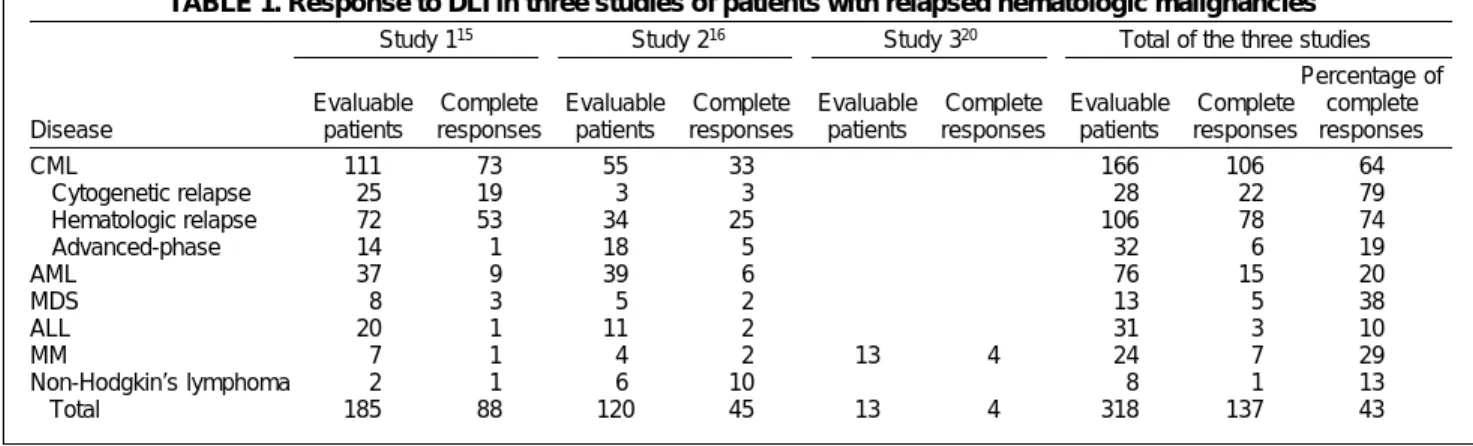
The apparent power of the GVL effect and its presumed mediation by donor lymphocytes led several groups to transfuse donor WBCs to patients with relapsed leukemia after HPC transplantation. Two large multicenter studies have reviewed the results from 27 transplant centers in
Europe15 and 25 in North America16 (Table 1). In these
stud-ies, DLI induced a complete remission (CR) in about 64 per-cent of the patients with CML and in 20 to 38 perper-cent of the patients with AML or MDS. In patients with CML, the re-sponse rate was highest when lymphocytes were transfused in early cytogeneic relapse (79%) and lowest when they were transfused during accelerated-phase CML (hemato-logic relapse)or blast crisis (19%). The median time to achieve a cytogenetic remission was 85 days (range, 28-241) for patients with CML (the time to achieve molecular remis-sion can be prolonged) and 34 days (range, 16-99) for pa-tients with AML.16 Remissions were durable in patients
treated for CML in the chronic-phase (probability of con-tinuous remission, 87% at 3 years), but almost 100 percent of patients treated for advanced-phase CML later re-lapsed,15 and less than 30 percent of them survived at the
time of the analysis.52 The median duration of remission in
AML patients with complete responses was 17.9 months,16
but the longest remissions lasted for 2 to 4 years.52
DLI can also induce CRs in patients with MM. In a ret-rospective study including 13 patients who underwent a total of 29 DLIs, 8 patients responded (4 patients achieved a partial remission and 4 achieved CR).20 In this study, acute
and chronic GVHD occurred in 66 and 56 percent of all patients and in 87 and 85 percent of the responders, respec-tively. However, unlike that in patients with early-stage CML, the response in patients with MM was not consis-tently durable. Moreover, the anti-tumor effect was essen-tially directed toward the BM, and development of plas-mocytomas could occur while the BM and serum paraprotein showed evidence of a response.20
In contrast to those in myeloid forms of leukemia, re-sponses were rare in ALL and in high-grade lymphoma (Table 1).15,16,52 It has been speculated that the better
re-sponse in chronic-phase CML may be explained by the fact that dendritic cells, the most potent antigen-presenting cells, are part of the leukemic clone in CML52 and are
ca-pable of inducing a strong T-cell response.70 In contrast, the
malignant cells in accelerated-phase CML or in acute leu-kemia may be more inappropriate antigen-presenting cells
TABLE 1. Response to DLI in three studies of patients with relapsed hematologic malignancies
Study 115 Study 216 Study 320 Total of the three studies
Percentage of Evaluable Complete Evaluable Complete Evaluable Complete Evaluable Complete complete Disease patients responses patients responses patients responses patients responses responses
CML 111 73 55 33 166 106 64 Cytogenetic relapse 0 25 19 03 03 028 022 79 Hematologic relapse 0 72 53 34 25 106 078 74 Advanced-phase 0 14 01 18 05 032 006 19 AML 37 09 39 06 076 015 20 MDS 00 8 03 05 02 013 05 38 ALL 20 01 11 02 031 003 10 MM 007 01 04 02 13 4 024 007 29 Non-Hodgkin’s lymphoma 002 01 06 10 008 001 13 Total 185 88 120 45 13 4 318 137 43
and may lead to the induction of anergy rather than to an anti-leukemic T-cell response.71 The reasons for the observed
differences in response rates among diseases should be fur-ther investigated. Finally, a recent report suggested that chemotherapy given after DLI did not nullify the ability of the lymphocytes to mediate GVHD as well as GVL effects.72
Complications of DLI
Complications of DLI include acute and chronic GVHD and transient marrow aplasia. Acute GVHD occurs in about 60 percent of the patients (grade 3 or 4 in about 20%) and is significantly correlated with CR.16 Chronic GVHD also
oc-curs in about 60 percent of the patients (extensive in 30%) and is also significantly correlated with response.16 However
CR may be observed in the absence of GVHD, which sug-gests that the GVL response may be independent of the clinical development of GVHD.16,40,52 The risk of GVHD (but
not the efficacy of DLI to induce CR) correlates with the dose of lymphocytes transfused. The MNC dose transfused varies between 0.1 to 11 × 108 per kg of body weight.15,16 It
is possible to reduce the risk of GVHD without impairing the GVL effect by starting with a low dose of T cells and in-creasing the dose in a stepwise fashion if there is no re-sponse.13 It is interesting that the involvement of GVHD in
the organs is different from that seen after HPC transplan-tation, and, in particular, the skin is less affected.52
Marrow aplasia, due to a direct cytotoxic effect of trans-fused lymphocytes on hematopoietic cells in the host, oc-curs in about 20 percent of the patients. It is significantly less frequent in patients with cytogenetic relapse (11%) than in those with hematologic relapse of CML (50%),15 because
residual hematopoiesis is still of donor origin in patients with cytogenetic relapse. Marrow aplasia resolved without treatment in about 50 percent of the patients and resolved with G–CSF in about 30 percent.16 However, in case of
se-vere pancytopenia, the transfusion of marrow or blood pro-genitor cells of the donor without further conditioning may correct myelosuppression,15 with the possible exception of
that in patients with chronic GVHD.
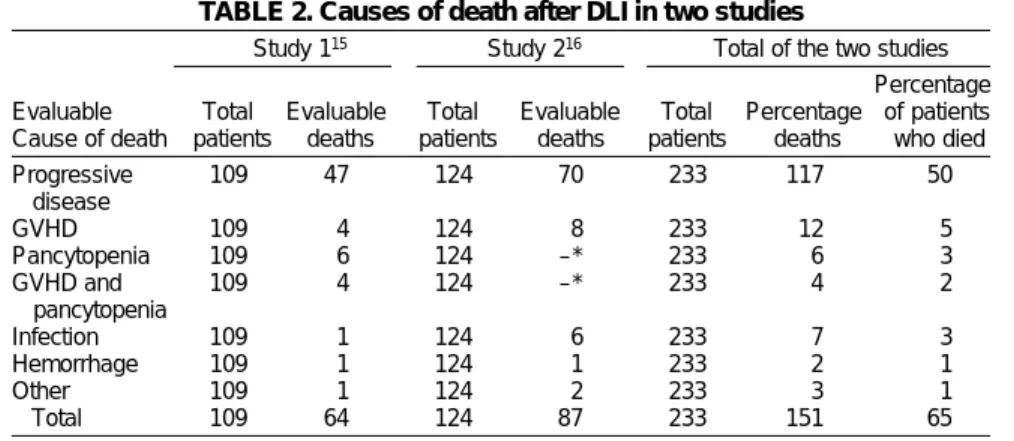
The primary cause of death after DLI is progressive disease, which is responsible for
about 77 percent of deaths (Table 2).15,16 Other causes include GVHD
(8%), infection (5%), pancytopenia (4%), and the combination of GVHD and pancytopenia (2.5%). Pretreatment factors
influencing response of recurrent CML to DLI
Multivariate analysis of these two multicenter series15,16 found that a
pre-DLI status of chronic-phase (as opposed to more advanced
disease) was favorable to a complete response to DLI. An-other favorable factor was an interval between HPC trans-plantation and DLI of less than 2 years.16 The role of T-cell
depletion of the graft and of post-BM transplantation chronic GVHD is controversial. Finally, the T-cell dose trans-fused did not influence response to DLI.15,16,52
MANIPULATIONS OF DLI
Immunotherapy with escalating doses of donor lymphocytes
Immunotherapy with escalating doses of donor lympho-cytes was evaluated in a prospective study of 22 patients with relapsed CML after allogeneic BM transplantation.13
Patients received escalating doses of donor lymphocytes (from 1 × 10⁵ to 5 × 10⁸/kg) at 4- to 33-week intervals.
Nine-teen of the 22 patients achieved CR, and T-cell doses as low as 1 × 10⁷ per kg were shown to achieve complete responses
(in patients with molecular, cytogenetic, and even acceler-ated-phase relapse) with a low risk of GVHD (only 1/8 CR patients vs. 8/11 responders receiving >5 × 10⁷/kg) (Table
3). In this study, and in accordance with previous stud-ies,15,52 there was no real evidence of a dose–response
rela-tionship in DLI. Low-dose therapy was primarily efficient in patients with molecular relapses.
Because there is a tendency for molecular positivity to come and go spontaneously, some caution should be ob-served in the interpretation of the role of DLI in correcting molecular relapses. Another recent study compared the efficacy and safety of a single transfusion of a relatively large dose of donor lymphocytes (bulk-dose regimen) and those of the transfusion of smaller doses repeated as necessary at 3-month intervals (escalating-dose regimen) in CML patients relapsing after allografting.73 In this study, the CR
rate at 2 years was higher (but not significantly so) and the risk of acute GVHD significantly lower in patients allocated to the escalating-dose regimen, even when the total num-ber of cells administered was similar. However, a strategy in which increasing numbers of lymphocytes are transfused must be viewed cautiously, as the median time to achieve TABLE 2. Causes of death after DLI in two studies
Study 115 Study 216 Total of the two studies
Percentage Evaluable Total Evaluable Total Evaluable Total Percentage of patients Cause of death patients deaths patients deaths patients deaths who died
Progressive 109 47 124 70 233 117 50 disease GVHD 109 04 124 08 233 012 05 Pancytopenia 109 06 124 –* 233 006 03 GVHD and 109 04 124 –* 233 004 02 pancytopenia Infection 109 01 124 06 233 007 03 Hemorrhage 109 01 124 01 233 002 01 Other 109 01 124 02 233 003 01 Total 109 64 124 87 233 151 65
cytogenetic CR was 85 days and the time to achieve molecu-lar CR was even greater.
Immunotherapy with DLIs depleted of CD8+ cells Unlike T-cell depletion of donor marrow, which increases the risk of relapse (particularly in patients with CML), se-lective CD8+ T-cell depletion of the graft significantly re-duced the risk of GVHD without losing the GVL effect.37,38
These observations led investigators to transfuse donor lym-phocytes depleted of CD8+ cells. One study included 10 patients with relapsed CML after allogeneic BM transplant (1 cytogenetic relapse, 4 in chronic phase, 2 in accelerated phase, and 3 in blast crisis).14 Patients received DLIs
de-pleted of CD8+ cells and containing 0.9 ± 0.3 × 10⁸ MNCs
per kg (0.6 ± 0.4 × 10⁶ CD3+CD8+ cells/kg). Six patients achieved
CR (1/1 with cytogenetic relapse, 4/4 with chronic-phase CML, and 1/2 with accelerated-phase CML), whereas only three patients developed GVHD, which responded well to systemic steroid therapy. Recently, another study of 40 pa-tients evaluated the response to 0.3 to 1.5 × 10⁸ CD4+ cells
per kg after depletion of CD8+ cells.40 Fifteen (87%) of 19
patients with early chronic-phase CML achieved a com-plete cytogenetic response, 5 of 6 with MM obtained a more than 50-percent decrease in their paraprotein level, and 1 with MDS also responded. GVHD occurred in 6 (22%) of 27 patients receiving 0.3 × 10⁸ CD4+ cells per kg and in 6 (55%)
of 11 patients who received >1.0 × 10⁸ CD4+ cells per kg.
Transfusion of donor lymphocytes transfected with a suicide gene
Another interesting approach consisted of in vitro insertion of a suicide gene, the HSV-tk gene (which selectively phos-phorylates gancyclovir, leading to its incorporation into DNA and causing cell death) into lymphocytes, allowing their elimination by gancyclovir if severe GVHD develops after DLI.74-76 A clinical study using this approach was
re-cently reported.75 Eight patients who relapsed or developed
EBV-induced malignancies after allogeneic BM transplant received genetically modified DLIs. An antitumor activity was observed in five patients, and two achieved a CR. GVHD developed in three patients, which could be efficiently con-trolled by the gancyclovir elimination of transfused cells. Moreover, transduced lymphocytes survived for up to 12 months. Unfortunately, the induction of a strong immune
response against genetically modified cells and partial re-sistance to gancyclovir-mediated elimination of transduced cells in chronic GVHD was observed. This justifies the de-velopment of new nonimmunogenic and non-cell cycle-dependent suicide genes.77
Transfusion of IL-2-activated donor lymphocytes Data from murine models and humans suggest that GVL effects may be increased by in vivo activation of lympho-cytes with rHuIL-2. These data led Slavin et al.17 to activate
donor lymphocytes in vitro and/or in vivo by using rHuIL-2 in patients with tumor cells that are resistant to standard DLIs. Complete responses were obtained in 10 of the 16 patients (4/6 ALL patients, 0/3 AML patients, 5/6 CML patients, and 1 MDS patient). All 4 of these patients with ALL and 4 of these 5 patients with CML were still alive and free of dis-ease 13 to 95 months (median, >2 years) after cell therapy. These results appear to be particularly interesting in pa-tients with ALL, who classically respond poorly to DLI. DLI to prevent relapse after allogeneic HPC transplantation
As DLIs are particularly effective when performed in early relapse,15,16 it might be more efficient to give donor
lympho-cytes before relapse, a time when minimal residual disease is still present. However, DLIs given early after BM trans-plant are associated with a very high risk of severe acute GVHD, which precludes any improvement in the control of leukemia.80 This dilemma between the risk of GVHD and
the benefit of a GVL effect may be resolved by delaying DLI until graft-versus-host tolerance has been established.15
This approach has been proposed after T-cell-depleted HPC transplantation.81-83 Naparstek et al.83 recently compared
three schedules of DLI (early, starting on Day 1; intermedi-ate, starting in Week 4; and lintermedi-ate, starting in Week 8) for pre-vention of relapse in 108 patients after T-cell-depleted BM transplant. In this study, patients receiving late DLI had sig-nificantly greater survival and decreased risk of GVHD than did those given DLI earlier. Barrett et al.82 recently
demon-strated a strong GVL effect with a low risk of acute GVHD after the return of 2 × 10⁶ T cells per kg on Day 30 and 5 ×
107 T cells per kg on Day 45 after T-cell-depleted BM
trans-plant, using cyclosporine prophylaxis. In this study, disease-free survival was comparable to that currently achieved in T-cell-replete transplants in similar pa-tients.82 However, the transfusion of 107
donor T cells per kg on Day 30 gave poorer results because of a high inci-dence of severe GVHD. Another recent report evaluated the feasibility of DLI 2 months after allogeneic BM transplant with selected CD34+ cells.84 Of 16
pa-tients included in this study, 6 under-went DLI. The first 3 received 5 × 10⁶
TABLE 3. Results of a study13 of immunotherapy with escalating doses of
donor lymphocytes
Number of patients achieving CR Response to DLI at four T-cell doses per kg Stage of CML Cases CRs 1 × 10⁷ 5 × 10⁷ 1 × 10⁸ 5 × 10⁸ Molecular relapse 02 02 2 2 0 0 Cytogenetic relapse 06 06 5 1 0 0 Chronic phase 10 09 0 3 2 4 Accelerated phase 04 02 1 0 1 0 Total 22 19 8 4 3 4
CD3+ cells per kg and all developed serious complications (grade 3 GVHD [n = 3] and severe aplasia [n = 1]). The other 3 received 1 × 10⁵ CD3+ cells per kg, and only 1 developed
GVHD. Taken together, these results suggest that DLI as a method of preventing relapse after allogeneic HPC trans-plantation is feasible, but its benefits remain to be demon-strated in large clinical trials.
Transfusion of tumor-specific CTLs
Several investigators have reported that DLI can cure EBV-induced lymphoproliferative disease after allogeneic BM transplant in more than 50 percent of patients.66,68 However,
several patients developed moderate to severe GVHD. To di-minish the risk of GVHD, researchers at one institution44,65,67,85,86
transfused specific anti-EBV donor T cells induced ex vivo with EBV-transformed B-lymphoblastoid cell lines. Donor-de-rived EBV-specific CTLs were transfused 45 days after allo-geneic BM transplant in 50 patients at high risk of develop-ing EBV lymphoma after T-cell-depleted transplantation from a matched unrelated donor or a mismatched related donor. None of the patients developed EBV-induced lym-phoproliferative disease, whereas there was a cumulative risk of 11 percent in patients who did not receive this treat-ment. Moreover, two patients who were treated for clinically evident EBV-induced lymphopro-liferative disease achieved a prolonged remission after CTL transfusion.44
Remarkably, no significant toxicity or GVHD was observed with this early posttransplant cell immunotherapy. The development of donor-derived CTLs against other antigens such mHA43,54 or the BCR-ABL fusion product42,59 is
cur-rently being investigated, and recently Falkenburg et al.71
reported the achievement of CR in a patient with acceler-ated-phase CML by treatment with leukemia-reactive CTLs. Cell immunotherapy after nonmyeloablative
preparative regimens
There is considerable evidence that the usual high-dose preparative regimen frequently does not eradicate malig-nancy. Moreover, its high-level toxicity restricts the use of allogeneic HPC transplantation to young patients without other medical illnesses. On the other hand, the high risk of relapse after T-cell-depleted HPC transplantation, the even greater risk after syngeneic HPC transplantation, and the effectiveness of DLI in inducing CR in case of relapse after allogeneic HPC transplantation indicate that the main therapeu-tic component of allogeneic HPC transplantation may some-times be due to the GVL effect rather than to the elimina-tion of tumor cells through high doses of cytoreductive agents. These observations led several centers to perform alloge-neic HPC transplantation after nonmyeloablative (but suffi-ciently immunosuppressive to allow engraftment), fludarabine-based preparative regimens to induce a GVL effect. In this approach, the posttransplant transient mixed chimerism may be successfully completed by DLI.87,88
More recently, Storb89 and McSweeney90 and their
cowork-ers tried allogeneic HPC transplantation after a nonmyeloab-lative but highly immunosuppressive (200 cGy total body irradiation and cyclosporine plus mycophenolate mofetil) preparative regimen to prevent host-versus-graft reactions as well as GVHD. This approach permitted the achievement of stable mixed chimerism in patients with either nonma-lignant or manonma-lignant hematologic disease. Secondary DLI in malignant disorders allowed the achievement of com-plete donor chimerism. The potential advantage of this technique would be a reduced risk of conditioning regi-men-related toxicity, infection, or hemorrhage.
Although the preliminary results of “mini-transplants” (transplant after a nonmyeloablative conditioning regimen) are encouraging, long-term results in regard to leukemia-free survival as well as the incidence of chronic GVHD re-main to be achieved in appropriate studies before this ap-proach can be considered effective and not merely anecdotal.
CONCLUSION
DLIs have been used increasingly to treat leukemic relapse after allogeneic HPC transplantation, inducing CR in about 65 percent of the patients with CML and 25 percent of those with AML or MDS. The risks of DLIs include transient mar-row aplasia and acute and/or chronic GVHD. DLIs are not associated with severe aplasia when given in early cytoge-netic relapse, because residual hematopoiesis is still of donor origin. It is possible to maintain a GVL effect with-out GVHD by decreasing the number of T cells transfused to 1 × 10⁷ per kg or by depleting donor lymphocytes of CD8+
cells. Preliminary observations have been generated for a number of newer approaches to DLI. In vitro transduction of donor WBCs with a suicide gene to eliminate donor phocytes in case of severe GVHD, transfusion of donor lym-phocytes for the prevention of relapse, development of CTLs specifically recognizing tumor antigens, activation of lymphocytes by cytokines, and DLI after allogeneic HPC transplantation with a nonmyeloablative preparative regi-men are promising new approaches that are currently be-ing investigated.
REFERENCES
01. Storb R. Bone marrow transplantation. Transplant Proc 1995;27:2649-52.
02. Champlin R. T-cell depletion to prevent graft-versus-host dis-ease after bone marrow transplantation. Hematol Oncol Clin North Am 1990;4:687-98.
03. Marmont AM, Horowitz MM, Gale RP, et al. T-cell depletion of HLA-identical transplants in leukemia. Blood 1991;78:2120-30. 04. Drobyski WR, Ash RC, Casper JT, et al. Effect of T-cell depletion
as graft-versus-host disease prophylaxis on engraftment, re-lapse, and disease-free survival in unrelated marrow
transplan-tation for chronic myelogenous leukemia. Blood 1994;83:1980-7.
05. Aversa F, Tabilio A, Velardi A, et al. Treatment of high-risk acute leukemia with T-cell-depleted stem cells from related donors with one fully mismatched HLA haplotype. N Engl J Med 1998;339:1186-93.
06. Goldman JM, Gale RP, Horowitz MM, et al. Bone marrow trans-plantation for chronic myelogenous leukemia in chronic phase. Increased risk for relapse associated with T-cell depletion. Ann Intern Med 1988;108:806-14.
07. Horowitz MM, Gale RP, Sondel PM, et al. Graft-versus-leukemia reactions after bone marrow transplantation. Blood
1990;75:555-62.
08. Kolb HJ, Mittermuller J, Clemm C, et al. Donor leukocyte trans-fusions for treatment of recurrent chronic myelogenous leuke-mia in marrow transplant patients. Blood 1990;76:2462-5. 09. Bar BM, Schattenberg A, Mensink EJ. Donor leukocyte infusions
for chronic myeloid leukemia relapsed after allogeneic bone marrow transplantation. J Clin Oncol 1993;11:513-9. 10. Drobyski WR, Keever CA, Roth MS, et al. Salvage
immuno-therapy using donor leukocyte infusions as treatment for re-lapsed chronic myelogenous leukemia after allogeneic bone marrow transplantation: efficacy and toxicity of a defined T-cell dose. Blood 1993;82:2310-8.
11. Porter DL, Roth MS, McGarigle C, et al. Induction of graft-ver-sus-host disease as immunotherapy for relapsed chronic my-eloid leukemia. N Engl J Med 1994;330:100-6.
12. Van Rhee F, Lin F, Cullis JO, et al. Relapse of chronic myeloid leukemia after allogeneic bone marrow transplant: the case for giving donor leukocyte transfusion before the onset of hemato-logic relapse. Blood 1994;83:3377-83.
13. Mackinnon S, Papadopoulos EB, Carabasi MH, et al. Adoptive immunotherapy evaluating escalating doses of donor leuko-cytes for relapse of chronic myeloid leukemia after bone marrow transplantation: separation of graft-versus-leukemia responses from graft-versus-host disease. Blood 1995;86:1261-8. 14. Girt S, Hester J, Huh Y, et al. CD8-depleted donor lymphocyte
infusion as treatment for relapsed chronic myelogenous leuke-mia after allogeneic bone marrow transplantation. Blood 1995;86:4337-43.
15. Kolb HJ, Schattenberg A, Goldman JM, et al. Graft-versus-leuke-mia effect of donor lymphocyte transfusions in marrow grafted patients. European Group for Blood and Marrow Transplanta-tion Working Party Chronic Leukemia. Blood 1995;86:2041-50. 16. Collins RH, Shpilberg O, Drobyski WR, et al. Donor leukocyte
infusions in 140 patients with relapsed malignancy after alloge-neic bone marrow transplantation. J Clin Oncol 1997;15:433-44. 17. Slavin S, Naparstek E, Nagler A, et al. Allogeneic cell therapy: the treatment of choice for all hematologic malignancies relapsing post BMT. Blood 1996;87:4011-3.
18. Szer J, Grigg AP, Phillips GL, Sheridan WP. Donor leucocyte infu-sions after chemotherapy for patients relapsing with acute leu-kaemia following allogeneic BMT. Bone Marrow Transplant 1993;11:109-12.
19. Bressoud A, Chapuis B, Roux E, et al. Donor lymphocyte infu-sion for a patient with relapsing myelodysplastic syndrome after allogeneic bone marrow transplantation. Blood 1996;88:1902-3. 20. Lokhorst HM, Schattenberg A, Cornelissen JJ, et al. Donor
leuko-cyte infusions are effective in relapsed multiple myeloma after allogeneic bone marrow transplantation. Blood 1997;90:4206-11.
21. Tricot G, Vesole DH, Jagannath S, et al. Graft-versus-myeloma effect: proof of principle. Blood 1996;87:1196-8.
22. Bernard M, Dauriac C, Drenou B, et al. Long-term follow-up of allogeneic bone marrow transplantation in patients with poor prognosis non-Hodgkin’s lymphoma. Bone Marrow Transplant 1999;23:329-33.
23. Barnes D, Loutit JF. Treatment of murine leukaemia with X-rays and homologous bone marrow. Br Med J 1956;2:626-7. 24. Weiden PL, Flournoy N, Thomas ED, et al. Antileukemic effect of
graft-versus-host disease in human recipients of allogeneic-marrow grafts. N Engl J Med 1979;300:1068-73.
25. Weiden PL, Sullivan KM, Flournoy N, et al. Antileukemic effect of chronic graft-versus-host disease: contribution to improved survival after allogeneic marrow transplantation. N Engl J Med 1981;304:1529-33.
26. Lee M, Khouri I, Champlin R, et al. Detection of minimal re-sidual disease by polymerase chain reaction of bcr/abl tran-scripts in chronic myelogenous leukaemia following allogeneic bone marrow transplantation. Br J Haematol 1992;82:708-14. 27. Beguin Y, Collignon J, Laurent C, Fillet G. Spontaneous com-plete remission and recovery of donor haemopoiesis without GVHD after relapse and apparent marrow graft rejection in poor-prognosis myelodysplastic syndrome. Br J Haematol 1996;94:507-9.
28. Suzuki R, Taji H, Iida S, et al. Complete cytogenetic response with host-derived hematopoiesis induced by cyclosporin: a dis-continuation in a patient with relapsed chronic myelogenous leukemia after bone marrow transplantation. Bone Marrow Transplant 1997;20:615-7.
29. Mehta J, Powles R, Kulkarni S, et al. Induction of graft-versus-host disease as immunotherapy of leukemia relapsing after allo-geneic transplantation: single-center experience of 32 adult pa-tients. Bone Marrow Transplant 1997;20:129-35.
30. Barrett AJ. Mechanisms of the graft-versus-leukemia reaction. Stem Cells 1997;15:248-58.
31. Antin JH, Ferrara JL. Cytokine dysregulation and acute graft-ver-sus-host disease. Blood 1992;80:2964-8.
32. Asai O, Longo DL, Tian ZG, et al. Suppression of graft-versus-host disease and amplification of graft-versus-tumor effect by activated natural killer cells after allogeneic bone marrow trans-plantation. J Clin Invest 1998;101:1835-42.
33. Weichold FF, Jiang YZ, Dunn DE, et al. Regulation of a graft-ver-sus-leukemia effect by major histocompatibility complex class II molecules on leukemia cells: HLA-DR1 expression renders K562 cell tumors resistant to adoptively transferred lymphocytes in severe combined immunodeficiency mice/nonobese diabetic mice. Blood 1997;90:4553-8.
34. Delain M, Tiberghien P, Racadot E, et al. Variability of the alloreactive T-cell response to human leukemic blasts. Leuke-mia 1994;8:642-7.
35. Faber LM, van der Hoeven J, Goulmy E, et al. Recognition of clonogenic leukemic cells, remission bone marrow and HLA-identical donor bone marrow by CD8+ or CD4+ minor histo-compatibility antigen-specific cytotoxic T lymphocytes. J Clin Invest 1995;96:877-83.
36. Jiang YZ, Mavroudis D, Dermime S, et al. Alloreactive CD4+ T lymphocytes can exert cytotoxicity to chronic myeloid leu-kaemia cells processing and presenting exogenous antigen. Br J Haematol 1996;93:606-12.
37. Nimer SD, Giorgi J, Gajewski JL, et al. Selective depletion of CD8+ cells for prevention of graft-versus-host disease after bone marrow transplantation. A randomized controlled trial. Trans-plantation 1994;57:82-7.
38. Champlin R, Jansen J, Ho W, Reichert T. Retention of graft-ver-sus-leukemia using selective depletion of CD8-positive T lym-phocytes for prevention of graft-versus-host disease following bone marrow transplantation for chronic myelogenous leuke-mia. Transplant Proc 1991;23:1695-6.
39. Giralt S, Hester J, Huh Y, et al. CD8-depleted donor lymphocyte infusion as treatment for relapsed chronic myelogenous leuke-mia after allogeneic bone marrow transplantation. Blood 1995;86:4337-43.
40. Alyea EP, Soiffer RJ, Canning C, et al. Toxicity and efficacy of de-fined doses of CD4(+) donor lymphocytes for treatment of re-lapse after allogeneic bone marrow transplant. Blood 1998;91:3671-80.
41. Nagler A, Condiotti R, Nabet C, et al. Selective CD4+ T-cell depletion does not prevent graft-versus-host disease. Trans-plantation 1998;66:138-41.
42. Nieda M, Nicol A, Kikuchi A, et al. Dendritic cells stimulate the expansion of bcr-abl specific CD8+ T cells with cytotoxic activity against leukemic cells from patients with chronic myeloid leuke-mia. Blood 1998;91:977-83.
43. Warren EH, Greenberg PD, Riddell SR. Cytotoxic T-lymphocyte-defined human minor histocompatibility antigens with a re-stricted tissue distribution. Blood 1998;91:2197-207.
44. Rooney CM, Smith CA, Ng CY, et al. Infusion of cytotoxic T cells for the prevention and treatment of Epstein-Barr virus-induced lymphoma in allogeneic transplant recipients. Blood 1998; 92:1549-55.
45. Guinan EC, Gribben JG, Boussiotis VA, et al. Pivotal role of the B7:CD28 pathway in transplantation tolerance and tumor im-munity. Blood 1994;84:3261-82.
46. Matulonis UA, Dosiou C, Lamont C, et al. Role of B7-1 in medi-ating an immune response to myeloid leukemia cells. Blood 1995;85:2507-15.
47. Yokoyama WM. Natural killer cell receptors. Curr Opin Immunol 1998;10:298-305.
48. Ruggeri L, Capanni M, Casucci M, et al. Role of natural killer cell alloreactivity in HLA-mismatched hematopoietic stem cell transplantation. Blood 1999;94:333-9.
49. Zeis M, Uharek L, Glass B, et al. Allogeneic MHC-mismatched activated natural killer cells administered after bone marrow transplantation provide a strong graft-versus-leukaemia effect in mice. Br J Haematol 1997;96:757-61.
50. Glass B, Uharek L, Zeis M, et al. Graft-versus-leukaemia activity can be predicted by natural cytotoxicity against leukaemia cells. Br J Haematol 1996;93:412-20.
51. Keil F, Haas OA, Fritsch G, et al. Donor leukocyte infusion for leukemic relapse after allogeneic marrow transplantation: lack of residual donor hematopoiesis predicts aplasia. Blood 1997;89:3113-7.
52. Kolb HJ, Holler E. Adoptive immunotherapy with donor lym-phocyte transfusions. Curr Opin Oncol 1997;9:139-45. 53. Aker M, Kapelushnik J, Pugatsch T, et al. Donor lymphocyte
in-fusions to displace residual host hematopoietic cells after alloge-neic bone marrow transplantation for beta-thalassemia major. J Pediatr Hematol Oncol 1998;20:145-8.
54. Mutis T, Verdijk R, Schrama E, et al. Feasibility of immuno-therapy of relapsed leukemia with ex vivo-generated cytotoxic T lymphocytes specific for hematopoietic system-restricted minor histocompatibility antigens. Blood 1999;93:2336-41.
55. Goulmy E, Schipper R, Pool J, et al. Mismatches of minor histo-compatibility antigens between HLA-identical donors and re-cipients and the development of graft-versus-host disease after bone marrow transplantation. N Engl J Med 1996;334:281-5. 56. Mutis T, Gillespie G, Schrama E, et al. Tetrameric HLA class
I-minor histocompatibility antigen peptide complexes demon-strate minor histocompatibility antigen-specific cytotoxic T lym-phocytes in patients with graft-versus-host disease. Nat Med 1999;5:839-42.
57. Ten Bosch GJ, Toornvliet AC, Friede T, et al. Recognition of pep-tides corresponding to the joining region of p210BCR-ABL pro-tein by human T cells. Leukemia 1995;9:1344-8.
58. Bocchia M, Korontsvit T, Xu Q, et al. Specific human cellular im-munity to bcr-abl oncogene-derived peptides. Blood
1996;87:3587-92.
59. Osman Y, Takahashi M, Zheng Z, et al. Generation of bcr-abl specific cytotoxic T-lymphocytes by using dendritic cells pulsed with bcr-abl (b3a2) peptide: its applicability for donor leukocyte transfusions in marrow grafted CML patients. Leukemia 1999;13:166-74.
60. Yotnda P, Firat H, Garcia-Pons F, et al. Cytotoxic T cell response against the chimeric p210 BCR-ABL protein in patients with chronic myelogenous leukemia. J Clin Invest 1998;101:2290-6. 61. Kwak LW, Campbell M, Czerwinski D, Levy R. Induction of
im-mune responses in patients with B-cell lymphoma against the surface-immunoglobulin idiotype expressed by their tumors. N Engl J Med 1993;327:1209-15.
62. Kwak LW, Taub DD, Duffey PL, et al. Transfer of myeloma idiotype-specific immunity from an actively immunised marrow donor. Lancet 1995;345:1016-20.
63. Massaia M, Borrione P, Battaglio S, et al. Idiotype vaccination in human myeloma: generation of tumor-specific immune re-sponses after high-dose chemotherapy. Blood 1999;94:673-83.
64. Reichardt VL, Okada CY, Liso A, et al. Idiotype vaccination using dendritic cells after autologous peripheral blood stem cell trans-plantation for multiple myeloma—a feasibility study. Blood 1999;93:2411-9.
65. Heslop HE, Ng CY, Li C, et al. Long-term restoration of immu-nity against Epstein-Barr virus infection by adoptive transfer of gene-modified virus-specific T lymphocytes. Nat Med 1996;2:551-5.
66. Papadopoulos EB, Ladanyi M, Emanuel D, Mackinnon S. Infu-sions of donor leukocytes to treat Epstein-Barr virus-associated lymphoproliferative disorders after allogeneic bone marrow transplantation. N Engl J Med 1994;330:1185-91.
67. Rooney CM, Smith CA, Ng CY, et al. Use of gene-modified virus-specific T lymphocytes to control Epstein-Barr-virus-related lymphoproliferation. Lancet 1995;345:9-13.
68. O’Reilly RJ, Small TN, Papadopoulos E, et al. Biology and adop-tive cell therapy of Epstein-Barr virus-associated
lymphoproliferative disorders in recipients of marrow allografts. Immunol Rev 1997;157:195-216.
69. Sing AP, Ambinder RF, Hong DJ, et al. Isolation of Epstein-Barr virus (EBV)-specific cytotoxic T lymphocytes that lyse Reed-Sternberg cells: implications for immune-mediated therapy of EBV+ Hodgkin’s disease. Blood 1997;89:1978-86.
70. Choudhury A, Gajewski JL, Liang JC, et al. Use of leukemic den-dritic cells for the generation of antileukemic denden-dritic cells for the generation of antileukemic cellular cytotoxicity against Philadelphia chromosome-positive chronic myelogenous leu-kemia. Blood 1997;89:1133-42.
71. Falkenburg JH, Wafelman AR, Joosten P, et al. Complete remis-sion of accelerated phase chronic myeloid leukemia by treat-ment with leukemia reactive cytotoxic T lymphocytes. Blood 1999;94:1201-8.
72. Fuchs EJ, Seber A, Altomonte V, et al. Chemotherapy does not nullify the ability of donor lymphocyte infusions to mediate graft-versus-host reactions. Bone Marrow Transplant 1998;22:303-5.
73. Dazzi F, Szydlo R, Craddock C, Goldman JM. Adoptive immuno-therapy for patients who relapse after allografting for chronic myeloid leukemia: a comparison of two regimens for donor lymphocyte infusion (abstract). Blood 1998;92:653a.
74. Tiberghien P, Cahn JY, Contassot E, et al. Gene transfer applied to the modulation of alloreactivity. Hematol Cell Ther 1996;38:221-4.
75. Bonini C, Ferrari G, Verzeletti S, et al. HSV-TK gene transfer into donor lymphocytes for control of allogeneic graft-versus-leuke-mia. Science 1997;276:1719-24.
76. Munshi NC, Govindarajan R, Drake R, et al. Thymidine kinase (TK) gene-transduced human lymphocytes can be highly puri-fied, remain fully functional, and are killed efficiently with ganciclovir. Blood 1997;89:1334-40.
77. Marktel S, Ciceri F, Bonini C, Bordignon C. A new suicide system based on gene transfer of Fas into donor lymphocytes for con-trolled GVL (abstract). Blood 1998;92:667a.
78. Benyunes MC, Higuchi C, York A, et al. Immunotherapy with interleukin 2 with or without lymphokine-activated killer cells after autologous bone marrow transplantation for malignant lymphoma: a feasibility trial. Bone Marrow Transplant 1995;16:283-8.
79. Slavin S, Ackerstein A, Vourka-Karussis U, et al. Control of re-lapse due to minimal residual disease (MRD) by cell-mediated cytokine-activated immunotherapy in conjunction with bone marrow transplantation. Baillieres Clin Haematol 1991;4:715-25. 80. Sullivan KM, Storb R, Buckner CD, Fefer A. Graft-versus-host
disease as adoptive immunotherapy in patients with advanced hematologic neoplasms. N Engl J Med 1989;320:828-34. 81. Naparstek E, Nagler A, Or R, et al. Allogeneic cell-mediated
im-munotherapy using donor lymphocytes for prevention of re-lapse in patients treated with allogeneic bone marrow trans-plantation for hematological malignancies. In: Cecka JM, Terasaki PI (eds). Clinical transplants, 1996. Los Angeles: UCLA Tissue Typing Laboratory, 1996:281-90.
82. Barrett AJ, Mavroudis D, Tisdale J, et al. T cell-depleted bone marrow transplantation and delayed T cell add-back to control acute GVHD and conserve a graft-versus-leukemia effect. Bone Marrow Transplant 1998;21:543-51.
83. Naparstek E, Nagler A, Or R, et al. Donor lymphocyte infusions (DLI) for prevention of leukemic relapse after T-cell depleted marrow transplants (abstract). Blood 1998;92:654a. 84. Stoppa AM, Aurran T, Chabannon M, Blaise D. Feasibility of
CD34+ selected allogeneic bone marrow transplantation (ABMT) followed after 2 months by prophylactic donor lympho-cytes infusion (DLI) in high risk hematologic malignancies (ab-stract). Blood 1998;92:454a.
85. Smith CA, Ng CY, Heslop HE, et al. Production of genetically modified Epstein-Barr virus-specific cytotoxic T cells for adop-tive transfer to patients at high risk of EBV-associated lymphoproliferative disease. J Hematother 1995;4:73-9. 86. Heslop HE, Brenner MK, Rooney CM. Donor T cells to treat
EBV-associated lymphoma. N Engl J Med 1994;331:679-80. 87. Slavin S, Nagler A, Naparstek E, et al. Nonmyeloablative stem
cell transplantation and cell therapy as an alternative to conven-tional bone marrow transplantation with lethal cytoreduction for the treatment of malignant and nonmalignant hematologic diseases. Blood 1998;91:756-63.
88. Khouri IF, Keating M, Korbling M, et al. Transplant-lite: induc-tion of graft-versus-malignancy using fludarabine-based nonablative chemotherapy and allogeneic blood progenitor-cell transplantation as treatment for lymphoid malignancies. J Clin Oncol 1998;16:2817-24.
89. Storb R, Yu C, Sandmaier BM, et al. Mixed hematopoietic chi-merism after marrow allografts. Transplantation in the ambula-tory care setting. Ann N Y Acad Sci 1999;872:375-6.
90. McSweeney PA, Wagner JL, Maloney DG, et al. Outpatient PBSC allografts using immunosuppression with low-dose TBI before, and cyclosporine (CSP) and mycophenolate mofetil (MMF) after transplant (abstract). Blood 1998;92:519a.