HAL Id: hal-01070701
https://hal.archives-ouvertes.fr/hal-01070701
Submitted on 7 Oct 2014
HAL is a multi-disciplinary open access
archive for the deposit and dissemination of
sci-entific research documents, whether they are
pub-lished or not. The documents may come from
teaching and research institutions in France or
abroad, or from public or private research centers.
L’archive ouverte pluridisciplinaire HAL, est
destinée au dépôt et à la diffusion de documents
scientifiques de niveau recherche, publiés ou non,
émanant des établissements d’enseignement et de
recherche français ou étrangers, des laboratoires
publics ou privés.
Implementation of an adaptive energy-efficient MAC
protocol in OMNeT++/MiXiM
Van-Thiep Nguyen, Matthieu Gautier, Olivier Berder
To cite this version:
Van-Thiep Nguyen, Matthieu Gautier, Olivier Berder. Implementation of an adaptive energy-efficient
MAC protocol in OMNeT++/MiXiM. 1st OMNeT++ Community Summit, Sep 2014, France. pp.1-4.
�hal-01070701�
Implementation of an adaptive energy-efficient MAC
protocol in OMNeT++/MiXiM
Van-Thiep Nguyen, Matthieu Gautier, Olivier Berder
University Rennes 1, IRISA, INRIA 6 Rue Kerampont, 22300 Lannion, France
{van-thiep.nguyen, matthieu.gautier, olivier.berder}@irisa.fr
Abstract—In recent years, many MAC protocols for wireless sensor networks have been proposed and most of them are evaluated using Matlab simulator and/or network simulators (OMNeT++, NS2, etc). However, most of them have a static behavior and few network simulations are available for adaptive protocols. Specially, in OMNeT++/MiXiM, there are few energy-efficient MAC protocols for WSNs (B-MAC & L-MAC) and no adaptive ones. To this end, the TAD-MAC (Traffic Aware Dynamic MAC) protocol has been simulated in OMNeT++ with the MiXiM framework and implementation details are given in this paper. The simulation results have been used to evaluate the performance of TAD-MAC through comparisons with B-MAC and L-MAC protocols.
I. INTRODUCTION
In Wireless Sensor Networks (WSNs), the MAC layer plays an important role in improving the lifetime of sensor nodes by efficiently managing the communication between these nodes. During the last recent years, many energy-efficient MAC protocols have been proposed to reduce the energy consumption of sensor nodes. One of the important techniques used is duty cycling that refers to change nodes between awake and sleeping states to save energy. B-MAC [1], WiseMAC [2] (sender initiated approach) and RI-MAC [3], PW-MAC [4] (receiver initiated approach) are based on this mechanism.
In asynchronous WSNs, collisions and idle listening are the main sources of energy consumption. In [5], MM Alam et al. proposed an adaptive energy-efficient MAC protocol: Traffic Aware Dynamic (TAD) MAC protocol to reduce the idle listening. In TAD-MAC, the sensor nodes try to dynamically adapt their wakeup-interval with the amount of received traffic (i.e. data packets). In receive node, the data transmission rate of a transmit node is estimated by using a Traffic Status Register (TSR) to update continuously its wakeup-interval. In [5], the results show that TAD-MAC outperforms other protocols but the simulation have been performed only with Matlab. In this paper, the implementation of TAD-MAC in OMNeT++ with the MiXiM framework is presented. The results show that TAD-MAC can be evaluated easier and more exactly than with Matlab by changing the network topology, adding more sensor nodes and variable traffic flows.
II. TAD-MACPROTOCOL DESIGN
The TAD-MAC protocol can be considered in the class of preamble sampling MAC protocol with the receiver initiated strategy. The basic principle of this protocol is described in Fig. 1. The figure is splitted into two phases (i.e., before convergence and after convergence) that outline the results of
Fig. 1: The principle of TAD-MAC.
a simple network with two nodes (Tx1 and Tx2) attempting to transmit data to a receive node.
During the evaluation phase, before reaching the conver-gence, the receive node try to adapt its wakeup-interval (Iwu)
to the data transmission rate of each transmit node. Each time the receive node wakes up, it sends the beacon packet to the node which has the nearest wake-up time. The transmit node waits for the beacon signal from the receive node before sending its data. The beacon transmitted contains the specific node identification (node ID). Other intending transmit nodes continue to wait for receiving their beacon.
After several wakeups, the receive node will adapt its Iwu
based on the statistics of traffic that it receives from each individual transmit node. The second phase, after convergence, indicates that the Iwu of receive node has been adapted to
traffic of each transmit node in a way that the idle listening is minimal.
The TSR is used for each node to collect the status information of the traffic at each node. On the wake-up of receive node, it sends a wake-up beacon to the chosen transmit node, if it receives a data response, the TSR corresponding with this transmit node is filled with a ’1’, contrarily, the TSR is filled with a ’0’. The register contents are shifted one bit right for inserting a new status value in the 1st index. The receive node has a traffic status register bank as shown in Fig. 2 to keep the traffic status of all the transmit nodes.
Fig. 2: TSR-bank: it contains N registers for N neighbor-nodes.
After sending the wake-up beacon and updating the TSR, the receive node calculates its next wake-up interval for the time instant (ti+1) by the following adaptive function:
Iwu(ti+1) = Iwu(ti) + [µ(ti) + e(ti)].tref (1)
where µ is the output of the weighting average algorithm, e is the correlation error and tref is defined with reference to the
system/simulator clock. The update factor µ(ti) is computed
based on two weighted values X1(ti) and X2(ti) shown in
Fig. 2 as
µ(ti) = α.X1(ti) + (1 − α).X2(ti) (2)
where α is a constant weighting factor and X1(ti), X2(ti) are
defined as X1(ti) = N0,1 L/2.N c0,1− N1,1 L/2.N c1,1 (3) X2(ti) = N0,2 L/2.N c0,2− N1,2 L/2.N c1,2 (4) where L is the length of the TSR, N0,1, N1,1, N c0,1, N c1,1
are the number of zeros, number of ones, number of pairs of zeros, number of pairs of ones in sub-sequence X1, whereas
N0,2, N1,2, N c0,2, N c1,2 are the number of zeros, number of
ones, number of pairs of zeros, number of pairs of ones in sub-sequence X2.
III. IMPLEMENTATION INOMNET++/MIXIM In this section, the implementation details of TAD-MAC protocol in a network simulator are explained. One of the net-work simulator which is supporting wireless sensor netnet-works is OMNeT++/MiXiM. OMNeT++ is an object-oriented modular event network simulator and it provides the infrastructure for writing simulations with the component architecture. All elements are called modules and the modules can be connected via gates (or ports) and communicate by exchanging messages. MiXiM is a modeling framework for wireless network (WSNs, body area network, ad-hoc network, vehicular network, etc). There are some wireless MAC protocols that are already implemented in the framework (B-MAC, L-MAC or Zigbee) but no adaptive protocols.
In OMNeT++/MiXiM, there is a definition of network node called WirelessNodeBattery which contains the specific elements for a sensor node such as the network interface WirelessNicBattery, the power supply SimpleBattery and the module BatteryStats which calculates the consumption of en-ergy for each element. The main implementation of TAD-MAC
Fig. 3: A network of HostTADMAC.
protocol is TADMACLayer, which is a module of the MAC layer that is integrated in a new network interface NicTADMAC (based on WirelessNicBattery). A new host HostTADMAC (based on WirelessNodeBattery), which contains this network interface is defined as shown in Fig. 3. Creating a network of HostTADMAC and changing the parameters of the network provides are two useful ways to evaluate the performance of TAD-MAC.
As the other modules in MiXiM, TADMACLayer contains the gates to connect with other modules/other layers. The messages are used not only as the packets to send between the layers of a sensor node or between two nodes but also as the events to change the state of a node. The state machines of transmit node and receive node shown in Fig. 4a and Fig. 4b describe all the self-messages and the network packets that are used in TADMACLayer to change the state of a HostTADMAC node. Each time a HostTADMAC node wakes up, based on the message that it receives, it will act as transmit node or receive node. A DATA packet, which is received from network upper layer, signifies that it has data to send so this node will play the role of transmit node. In the contrast, if the message received is the self-message wakeup, this node will work as receive node.
In TADMACLayer, the DATA packet, which is sent from network upper layer, is handled in the function handleUp-perMsg. In this function, after receiving a DATA packet, a signal is sent to the physicallayer below to switch on the radio antenna if it is in inactive mode or change to Rx state. On the other hand, the function handleLowerMsg is used to manipulate the data packet, which is sent from physical layer. This packet is also a data packet from the neighbor sensor node such as the WB packet, ACK packet for transmit node and the DATA packet for receive node. The TADMACLayer communicates with the physic layer below through another gate to exchange the control message. This type of message, which contains the state information of radio antenna such as the transmission of one packet is over or the radio an-tenna switching (to Rx or Tx state) is over, is handled in function handleLowerControl. Another important function of TADMACLayer is handleSelfMsg, which manages the state of MAC layer depending on the type of the received self-message.
(a) transmit node. (b) receive node.
Fig. 4: State machine of HostTADMAC.
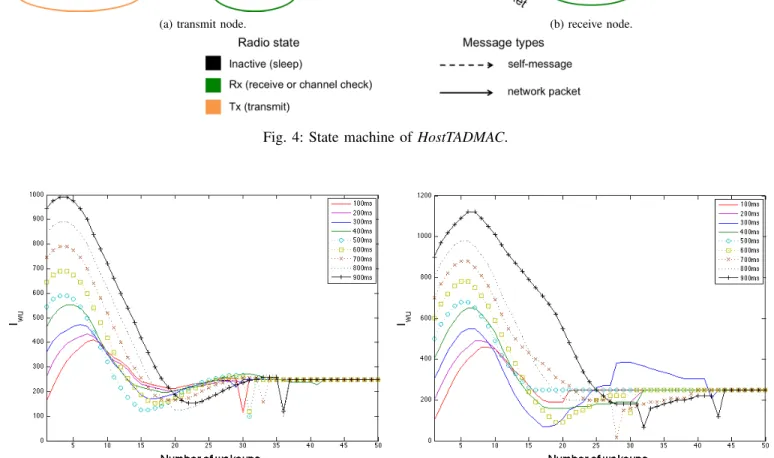
(a) results of Matlab simulation. (b) results of OMNeT++/MiXiM.
Fig. 5: Behavior of Iwu adaptation for number of different initial Iwu.
IV. PERFORMANCE EVALUATION
In this section, the performance of TAD-MAC protocol is evaluated by comparing with the simulation of Matlab and other MAC protocols which are implemented in OM-NeT++/MiXiM. Firstly, comparing with simulation of Matlab, the results shown in Fig. 5 describe that the implementation of TAD-MAC protocol in OMNeT++/MiXiM work mainly as in Matlab simulation. But in OMNeT++/MiXiM, some parame-ters of WSNs are calculated such as the time used to switch radio antenna to Rx or Tx or the time for sending a packet between 2 sensor nodes so the results of OMNeT++/MiXiM simulation are slightly different with the results of Matlab simulation. In Matlab simulation, the number of wakeups of
receive node, where the receive node reaches the steady state, is from 33 to 43 but with the same set of initial value of Iwu, in
OMNeT++/MiXiM simulation, the number of wakeups is from 16 to 44. Moreover, a complete network is created and man-aged within a single configuration file omnet.ini and a sensor node is inserted easily, the network topology is changed more flexibly without any modification of source code. It seems that in the Matlab simulation, there is no way to calculate the energy consumption of sensor nodes but in the contrast, there is a module in OMNeT++/MiXiM which calculate the energy consumption independently of TADMACLayer. By using this module, the consumed energy, the spent time of TAD-MAC is calculated in detail for each state of radio antenna like the
TABLE I: Energy consumption evaluated for different MAC protocols (in 1s).
States B-MAC L-MAC TAD-MAC
Time (ms) Sleep 9.6 490 918 Rx 180 497 81.03 Tx 800 1.9 0.53 Energy (mJ) Sleep 0.0006 0.032 0.06 Rx 9.78 26.89 4.38 Tx 45.31 0.083 0.03
Fig. 6: Total energy consumption comparison for different MAC protocols (in 1s).
transmit state, the receive state and the inactive state which are shown in Table I.
Secondly, to evaluate the performance of TAD-MAC, the simulation setup consists of 5 sensor nodes including a coor-dinating node based on a star topology with 2 types of the data traffic flow: static traffic and variable traffic. The sensor nodes are configured with 3 MAC protocols: B-MAC, L-MAC and TAD-MAC. The evaluation is executed by 100 simulations of 1000s, which are 50 simulations with the static traffic, 50 simulations with variable traffic. The average time spent to transmit, receive and sleep of each node are evaluated in Table I. As the results shown in Fig. 5b, after a number of wakeups, the receive node reaches the steady state. It means that after the convergence, the idle listening is minimized. So during the simulation, the sensor nodes are mostly in inactive state
to save energy (nearly 92% of time), contrarily, the sensor node, which uses B-MAC protocol, spends too much time in sending preamble (about 80% of time). In L-MAC, the spent time for sending is reduced but the idle listening is still a big problem. The problem of idle listening is resolved completely in TAD-MAC, a sensor node uses about 8% of time for Rx state, which includes also the spent time for clear channel assessment (CCA). The results in Fig. 6 show that the average for energy consumed by TAD-MAC is 5 times less than L-MAC and 10 times less than B-L-MAC.
V. CONCLUSION
In this paper, the implementation of TAD-MAC in OM-NeT++/MiXiM is presented. This is the first adaptive energy-efficient MAC protocol implemented in OMNeT++/MiXiM simulator. The results show that simulation in OMNeT++ has more benefit than Matlab simulation in evaluating the perfor-mance of MAC protocol. Via the simulation in OMNeT++, the TAD-MAC protocol is evaluated completely with many test cases of the network topology and variable traffic flows. In all experiments, TAD-MAC significantly outperformed the other MAC protocols. For example, the consumed energy by TAD-MAC is 5 times less than L-MAC and 10 times less than B-MAC in the simulation of 5 nodes with 4 concurrent transmit nodes.
REFERENCES
[1] Joseph Polastre, Jason Hill, and David Culler. Versatile low power media access for wireless sensor networks. In Proceedings of the 2Nd International Conference on Embedded Networked Sensor Systems, SenSys ’04, pages 95–107, New York, NY, USA, 2004. ACM. [2] A. El-Hoiydi and J.-D. Decotignie. Wisemac: An ultra low power mac
protocol for the downlink of infrastructure wireless sensor networks. In Proceedings of the Ninth International Symposium on Computers and Communications, ISCC ’04, pages 244–251, Washington, DC, USA, 2004. IEEE Computer Society.
[3] Yanjun Sun, Omer Gurewitz, and David B. Johnson. Ri-mac: A receiver-initiated asynchronous duty cycle mac protocol for dynamic traffic loads in wireless sensor networks. In Proceedings of the 6th ACM Conference on Embedded Network Sensor Systems, SenSys ’08, pages 1–14, New York, NY, USA, 2008. ACM.
[4] Lei Tang, Yanjun Sun, Omer Gurewitz, and David B. Johnson. Pw-mac: An energy-efficient predictive-wakeup mac protocol for wireless sensor networks. In In Proceedings of the 30th IEEE International Conference on Computer Communications (INFOCOM 2011, pages 1305–1313, 2011.
[5] Muhammad Mahtab Alam, Olivier Berder, Daniel Menard, and Olivier Sentieys. Tad-mac: Traffic-aware dynamic mac protocol for wireless body area sensor networks. IEEE J. Emerg. Sel. Topics Circuits Syst., 2(1):109–119, 2012.