
Relative influence of shredders and fungi on leaf litter decomposition along a river altitudinal gradient
Texte intégral
Figure

Documents relatifs
The influence of soil properties and litter quality on decomposition rate was studied in two semi-evergreen forests of Guadeloupe, a forest plantation and a secondary
When data from the complete time-series experiment was used, total and microbially driven alder leaf litter decomposition rates were slightly lower in the altered vs reference streams
In contrast, at site B both leaf species exhib- ited an increase of phosphorus content, and eucalyptus litter reached values close to initial concentrations of alder leaves..
habitat hypothesis, we expected (1) leaf-litter decomposition rates to be higher in streams than in soils due to favorable environmental conditions for this process (e.g., higher
Abstract – The amount and pattern of litterfall, its nutrient return, initial chemistry of leaf litter, and dynamics of N, P and K associated with leaf-litter decomposition were
In contrast, within the two shaded land-use types (SW and DW), where no change in decomposition rates was detected in relation to altitude, temperature was consistently warmer at
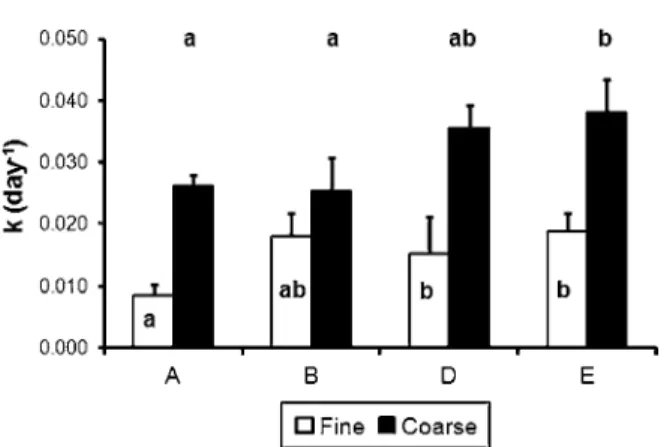
Consistent with the higher fungal biomass in the river channel compared to ponds and terrestrial habitats, decomposition rates in both coarse-mesh and fine-mesh litter bags were
presence of high ECM-colonized plants did not alter beech leaf litter decomposition rates. Likewise, Staaf (1988) showed that the exclusion of ECM-roots by trenching the soil in
