
Optimisation of wood-fired boilers using optical sensors
7
0
0
Texte intégral
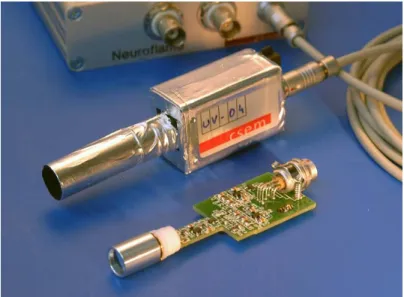
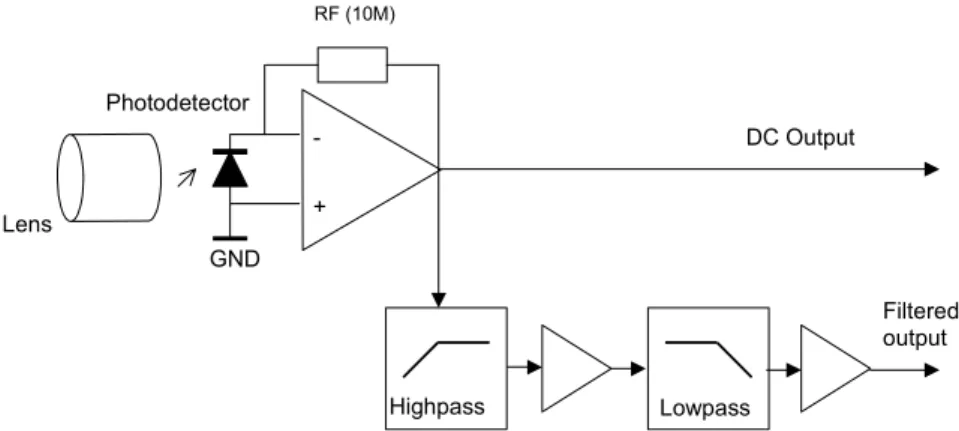
(2) To achieve this ambitious goal, one of the technical problems to overcome is the great variability of the biomass in terms of moisture, size distribution and composition, making it difficult to have a controlled combustion. This is especially the case for small installations (in the 300kW to a few MW range), which have only limited instrumentation. Combustion of wood on a grid is usually with a high excess air and relatively low temperature (around 800°C) compared to fossil fuels. The control of excess air along the various combustion zones, and as a function of residence time is very complex and rather poorly achieved due to the lack of reliable and low cost indicators of excess air levels. Oxygen sensors (e.g. lambda probes) are not suited to provide the needed information, i.e. the excess air in the various combustion zones and they lack reliabilty due to ash deposition. To this end, another approach is being tested in two different industrial size boilers. The method is based on the so-called “flame signature” principle already proven on gas and oil fired burners [3]. The method involves the use of two flame sensors, one with high sensitivity in the UV range another one in the visible/IR range. Test are being carried out to characterize this technique as a tool for excess air (and CO) control for gridfired wood boilers.. SENSOR PRINCIPLE The sensing method uses an innovative processing of the signals from the existing flame detector on the burner. The main idea is to use the fluctuating component of the global UV and/or IR radiation produced during combustion as an indicator for air/fuel mixing and in particular for excess air. The principle is described in Figure 1. The feasibility of this approach has already been demonstrated extensively on oil and gas fired burners of all types, ranging from 300 kW to 18 MW nominal load. In particular, it has been shown that the flame signature obtained with the wavelet transform in the frequency range 01500 Hz is correlated to the excess air in the combustion zone. The sensor can detect variations of excess air of +/-4% coressponding to +/- 0.5% vol. O2 in flue-gas). SENSOR OPERATION A photograph of the sensor and its electronics is shown in Figure 2. In the test version, the signal is amplified with a two stage-amplifier allowing to split the DC and AC parts as shown in Figure 3. Page 2/7.
(3) Flame signatures (variable with burner parameters). Amplitude. Flame sensors Signals (UV, IR). Frequency. Time. To control unit. performance. Correlation with performance Optimum. Control signal. Figure 1 – Flame signature principle on wood fired boiler. Figure 2 – Photograph of sensor and electronics. The DC part provides a normal flame detector whereas the AC of the signal is sampled and analysed in a separate box, using the wavelet Page 3/7.
(4) transform. Nine frequency bands are used for this transformation with a dyadic scale i.e. 1500 Hz and above, 750-1500 Hz, 375-750,...., 5.86-11.72 Hz. A dyadic filter bank (Daubechies wavelets) is used for the implementation of the algorithm on a commercial low-cost microprocessor RF (10M). Photodetector DC Output. +. Lens GND. Filtered output Highpass. Lowpass. Figure 3 – Block schematic of the amplifier stages. Learning/calibration mode At start-up, the system acquires 100 times 5s of signal at 3 kHz, and for each acquisition, the wavelet transformation algorithm is applied, producing nine coefficients corresponding to the energy of the associated frequency band. The measured matrix, formed of 100 vectors of nine coefficients, is used to calculate the system covariance matrix and the 9 mean values. The norm of the covariance matrix also characterises the measurement quality. The higher the norm is, the worst the quality is, giving therefore a very useful information, related to the signal/noise ratio.. Normal running mode As soon as the calibration is ended the signal is acquired at 3kHz and the wavelet transformation algorithm is applied in the same way as for the calibration, producing the nine coefficients. The coefficients are used to calculate a distance representing how far the combustion is from nominal conditions. The distance is the Mahalanobis distance, given by. D=. (X − µ) Covmat * ( X − µ )'. Page 4/7.
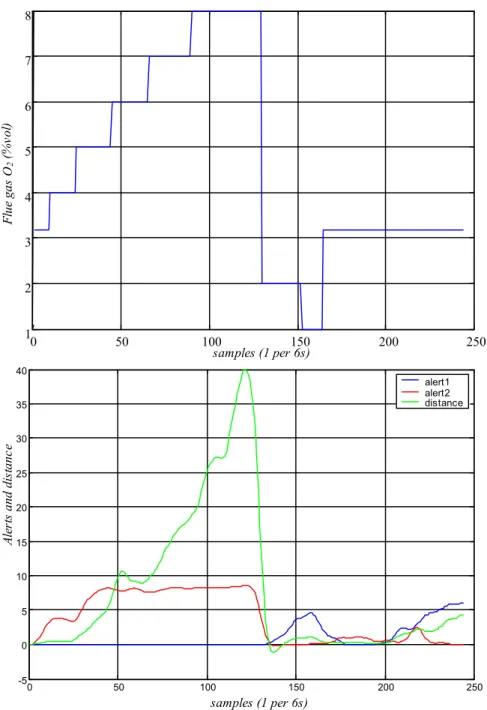
(5) where X is the vector composed of the 9 wavelet coefficients, µ is the vector of the 9 coefficients from the learning phase (mean value), Covmat is the covariance matrix. An example of result obtained with a forced draught gas burner is shown in Figure 4. The excess air was varied by steps and the oxygen concentration in the flue gas was measured at the same time as the distance. It can be seen that this distance is directly linked to the oxygen value. The sensor also provides alerts if (X-µ) is more or less than twice the standard deviation obtained during the learning phase. The sum of the alerts for the nine frequency bands is represented in Figure 3. A very interesting feature of the method is its inherent reliability and repeatability. It was found taht even after a prolonged stop of the burner or after several months of operation, the flame signature obtained is quite identical, with variations that are within the normal statistical deviation. This makes this sensor an ideal candidate for preventive maintenance of small to medium scale burners that are not continuously supervised by an operator.. USE OF THE SENSORS ON WOOD FIRED BOILERS The test campaign has just begun and is planned on several types of wood-fired boilers from various companies: - wood wastes - wood chips - tree bark The sensor was placed at the back, looking at the back-end of the movable grate. It was observed that the flame frequencies are significantly lower than with gas or oil burners. The method will also be adapted to enable the simultaneous recording and processing of two ranges of wavelengths from the flame: one which will contain the OH radical emissions (several paeks from 305 to 320 nm) and another which will contain the CH emissions (main peak at 432 nm). The objective is to get a combustion indicator for the overall degree of oxidation within the flame region including the unburnt hydrocarbons.. Page 5/7.
(6) 8 7. Flue gas O2 (%vol). 6 5 4. Samples. 3 2 1 0. 50. 100 150 samples (1 per 6s). 200. 40. alert1 alert2 distance. 35. Alerts and distance. 250. 30 25 20 15 10 5 0 -5. 0. 50. 100. 150. 200. 250. samples (1 per 6s) Figure 4 – Example of sensor response to step changes in excess air for a forced-draught diffusion burner, 180 kW (trained for 15% excess air).. Page 6/7.
(7) Economical aspects The cost of existing flue-gas oxygen monitoring systems for industrial boilers, based on Lambda sensors, is in the range of 1000 to 2000 Euros. The new sensor and its electronics, produced in medium series, will be on the order de 200 Euros. According to our industrial partners, this cost is very realistic for medium size boilers (around 1 MWth), especially when the sensor can provide a better way of setting the primary and secondary air flows, increased reliability of operation, and a higher overall thermal efficiency. ……………………………………………………………………………….. REFERENCES 1. 2. 3.. Commission of the european communities, commission staff working document - The share of renewable energy in the EU , Country Profiles, Overview of Renewable Energy Sources in the Enlarged European Union, SEC (2004) 547 Wood energy in Switzerland - www.magazine.ifrf.net/9903biomass1/neuchatel/ J.-B. Michel, R. Gentsch, E. Grenet, F. Heitger, E. Onillon, C. Verjus - Low cost sensors and methods for combustion control». Seventh International Conference on Technologies and Combustion for a Clean Environment, Lisbon, Juillet 2003.. Page 7/7.
(8)
Figure
Documents relatifs
Despite analyzing the global processing sequence (Fig. 12, right) by feeding the signal processing chain with a synthetic signal spanning from 0.05 times the sampling rate to 0.4
As I came to understand what happens in such circles, the relationship between the bodily ontology and the social ontology became more apparent, so that the juncture was not only
Our research showed that an estimated quarter of a million people in Glasgow (84 000 homes) and a very conservative estimate of 10 million people nation- wide, shared our
Kenya, Rwanda, St Helena Nigeria, Malawi, Ivory Coast, Madagascar Seychelles, Swaziland, Tanzania Cape Verde, Nigeria, Gambia, Kenya,
This approach is still based on the use of the Craig-Bampton decomposition of the admissible displacement field but the reduced matrix model of each substructure with fixed
the one developed in [2, 3, 1] uses R -filtrations to interpret the arithmetic volume function as the integral of certain level function on the geometric Okounkov body of the
Instead, Peterson’s theorem should (only) be interpreted in the following way: it formally shows that, given two other technical premises, the Archimedian condition and (as I argue
ASSOCIATION OF CANADA LANDS SURVEYORS - BOARD OF EXAMINERS WESTERN CANADIAN BOARD OF EXAMINERS FOR LAND SURVEYORS ATLANTIC PROVINCES BOARD OF EXAMINERS FOR LAND SURVEYORS ---..
