Auteurs:
Authors
: Patrice Farand et Jason Robert Tavares
Date: 2017
Type:
Article de revue / Journal articleRéférence:
Citation
:
Farand, P. & Tavares, J. R. (2017). A concept inventory for knowledge base evaluation and continuous curriculum improvement. Education for Chemical Engineers, 21, p. 33-39. doi:10.1016/j.ece.2017.07.001
Document en libre accès dans PolyPublie
Open Access document in PolyPublieURL de PolyPublie:
PolyPublie URL: http://publications.polymtl.ca/2788/
Version: Version finale avant publication / Accepted versionRévisé par les pairs / Refereed Conditions d’utilisation:
Terms of Use: CC BY-NC-ND
Document publié chez l’éditeur officiel
Document issued by the official publisher Titre de la revue:
Journal Title: Education for Chemical Engineers (vol. 21)
Maison d’édition:
Publisher: Elsevier
URL officiel:
Official URL: https://doi.org/10.1016/j.ece.2017.07.001
Mention légale:
Legal notice: "In all cases accepted manuscripts should link to the formal publication via its DOI"
Ce fichier a été téléchargé à partir de PolyPublie, le dépôt institutionnel de Polytechnique Montréal
A Concept Inventory for Knowledge Base Evaluation and Continuous Curriculum Improvement
1
Patrice Farand† and Jason R. Tavares†*
2
Department of Chemical Engineering, Polytechnique Montreal
3
P.O. Box 6079, station Centre-Ville, Montreal, Quebec (Canada), H3C 3A7
4
5
E-mail: [email protected]6
Telephone: 1-514-340-4711 ext. 23267
Fax: 1-514-340-41598
*Corresponding author, †The authors contributed equally to the study
9
10
Abstract. Students at Polytechnique Montreal have demonstrated the ability to tackle large-scale, complex
11
calculations through their integrative projects. However, high quality engineers must not only master calculations,
12
but the underlying fundamental concepts as well – this level of retention allows them to transfer their knowledge to
13
the new challenges they will face. To ensure this, accreditation criteria for engineering programs in Canada require
14
the evaluation of multiple attributes, the first of which is “a knowledge base for engineering”. While most
15
universities opt to evaluate this attribute through in-class grades, we choose to adapt a pedagogical tool (a concept
16
inventory) to formulate an evaluation of our students. Our students are examined using a subset of questions from
17
more than 800 chemical engineering questions, split into 10 subcategories. Data amassed over four years is
18
presented, showing the impact of various improvements to this tool, as well as its use for instructor feedback and
19
curriculum improvement. Key improvements include question revisions and targeted revisions of muddy concepts in
20
the affected courses.
21
22
Keywords: accreditation, attributes, computer tools, feedback, improvement, concept inventory
23
24
1. Introduction and context
25
1.1 Main Issue26
27
The 120-credit Chemical Engineering undergraduate curriculum at Polytechnique Montreal is a 4-year program
28
constructed as a learning program-based approach (Prégent & al., 2009). This program was designed to develop
29
several of students’ skills. To ensure that these skills had been gained, a variety of integrative projects have been put
30
in place within four of the program’s key courses, which close out each of the four years of schooling.
31
32
To develop these skills and put them into action, students must be able to effectively master and combine various
33
elements of their knowledge and know-how (Tardif, 2006). However, experience has shown us that, while in
34
integrative projects aligned with industry, students are able to resolve complex problems that involve a lot of
35
calculation, but have difficulty providing even simple explanations and descriptions of the concepts underlying those
36
calculations. In other words, students are able to resolve problems related to the higher cognitive levels within
37
Bloom’s taxonomy (e.g., analysis), but have difficulty with intellectual operations associated with the lower levels
38
(e.g., comprehension) (Anderson & Krathwohl, 2001). This gap in terms of comprehension of basic concepts can
39
lead to transfer-of-learning issues (Perrenoud, 1997).
40
41
These basic engineering concepts are reinforced with students throughout their studies. Nonetheless, it was difficult,
42
to the point of being impossible, to determine whether these essential concepts from their schooling were being
43
absorbed in a lasting manner (knowledge retention) (Tardif, 1999). Indeed, while integrative projects are present
44
throughout the curriculum, we have observed that team-based integrative projects lead to the formation of “experts”
45
within the teams. In other words, they split the work according to their preferences and strengths. However, this
46
means that certain students are not afforded the opportunity to reinforce concepts that may have been shaky. To
47
produce engineering graduates with solid foundational knowledge of their profession and who leverage that
48
knowledge to resolve complex, varied problems in real-life situations, it seemed necessary to offer a method of
49
individual evaluation that included the key concepts at the heart of chemical engineering. The results of this
50
evaluation will not only provide students with direct feedback, but will also give professors a means with which to
51
continue to improve their curricula.
52
53
1.2 The Canadian Engineering Accreditation Board (CEAB)
54
55
In addition to making use of our experience with the issue outlined above, we also must abide by a regulatory
56
framework put in place by the Canadian Engineering Accreditation Board (CEAB). The goal of this Engineers
57
Canada standing committee is to approve Canadian engineering programs grounded in a variety of educational
58
criteria (Engineers Canada, 2016).
59
60
One of these accreditation criteria is based on attributes required of graduates and asks that engineering faculties be
61
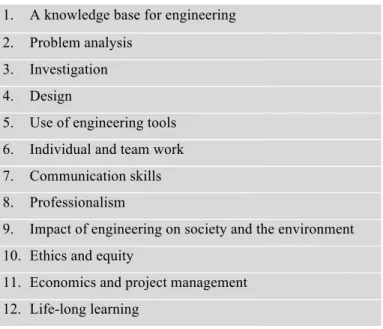
able to demonstrate that their graduates possess 12 attributes (Table 1).
62
63
64
Table 1: Graduates’ attributes (Engineers Canada, 2016)
65
1. A knowledge base for engineering 2. Problem analysis
3. Investigation 4. Design
5. Use of engineering tools 6. Individual and team work 7. Communication skills 8. Professionalism
9. Impact of engineering on society and the environment 10. Ethics and equity
11. Economics and project management 12. Life-long learning
66
Each faculty must put in place assessment mechanisms that allow for student learning to be documented. In addition,
67
results obtained from such assessment must allow for the improvement of the educational program (Engineers
68
Canada, 2016).
69
70
The first of the 12 attributes (A knowledge base for engineering) covers knowledge and know-how that every
71
engineering student should possess. More specifically, the CEAB defines the number-one attribute as “Demonstrated
72
competence in university level mathematics, natural sciences, engineering fundamentals, and specialized engineering
73
knowledge appropriate to the program’’ (Engineers Canada, 2016, p.15). To properly evaluate this attribute, it was
74
necessary to develop a tool that would provide us with clear data on students’ abilities.
75
76
1.3 Methods for knowledge-base evaluation
77
78
To gather data about students’ level of knowledge, several strategies are possible. The simplest method, advocated
79
by certain engineering faculties, consists of using the final grades in key courses to make inferences about
80
knowledge acquisition. In our opinion, this approach does not allow for the integration of all the main topics in
81
chemical engineering within a single, unified tool. In addition, the final grade received at the end of such courses
82
represents the results of several assessment mechanisms and not just those directly related to students’ knowledge.
83
Evaluation through a course can be a good measure of immediate knowledge uptake, but does not provide
84
information concerning knowledge retention over longer time scales.
86
Other institutions, such as England’s Imperial College, have taken an approach based on yearly examinations
87
(Imperial College London, 2017). This approach creates a situation where, every year, students are faced with a
88
summative evaluation recapping their knowledge, with various mechanisms in place in case of failure. From the
89
perspective of CEAB certification, such an approach is not necessary because the goals of said certification are more
90
related to the continuous improvement of the program, and not strictly to quantitatively evaluating students.
91
92
The approach advocated by this article is therefore to offer students a tool which covers all of chemical engineering’s
93
main topics, and which empowers them to evaluate their own mastery of those topics in a simple, lasting manner.
94
This tool is a concept inventory. Such tools have been developed previously by other universities (Ngothai & Davis,
95
2011 ; Csernia & al., 2008)., but not were available in French, nor did they cover the full extent of concepts in a
96
chemical engineering curriculum. Moreover, to the best of our knowledge, none of them have been used as
97
assessments for accreditation or feedback tools for curriculum improvement.
98
99
1.4 Objectives
100
101
The objectives of this project are to:
102
103
• Design a concept inventory that allows for the evaluation of students’ knowledge of chemical engineering’s
104
main topics
105
• Document our students’ abilities to learn key concepts in chemical engineering
106
• Improve our educational program by basing ourselves on rigorous analysis of the results
107
108
2. Method
109
2.1 Concept inventory creation
110
111
The first step in creating our concept inventory was to determine the main topics associated with chemical
112
engineering. To do so, we consulted a variety of references, which had already dealt with the essential topics in
113
chemical engineering (McCarthy and al., 2005; Bimbenet, 1998; Storck & Grevillot, 1993; Leesley, 1979; Badger &
114
McCabe, 1936), as well as five complete university programs (University of British Columbia, University of
115
Toronto, Université de Sherbrooke, University of Cambridge and Massachusetts Institute of Technology). This
116
review allowed us to focus on certain specific topics that were part of several of the programs: balances,
117
thermodynamics, transfers, reactor concepts, systems engineering, unit operations, and process design. We have
118
compared these topics with the current structure of our bachelor’s program and, based on their respective credit
119
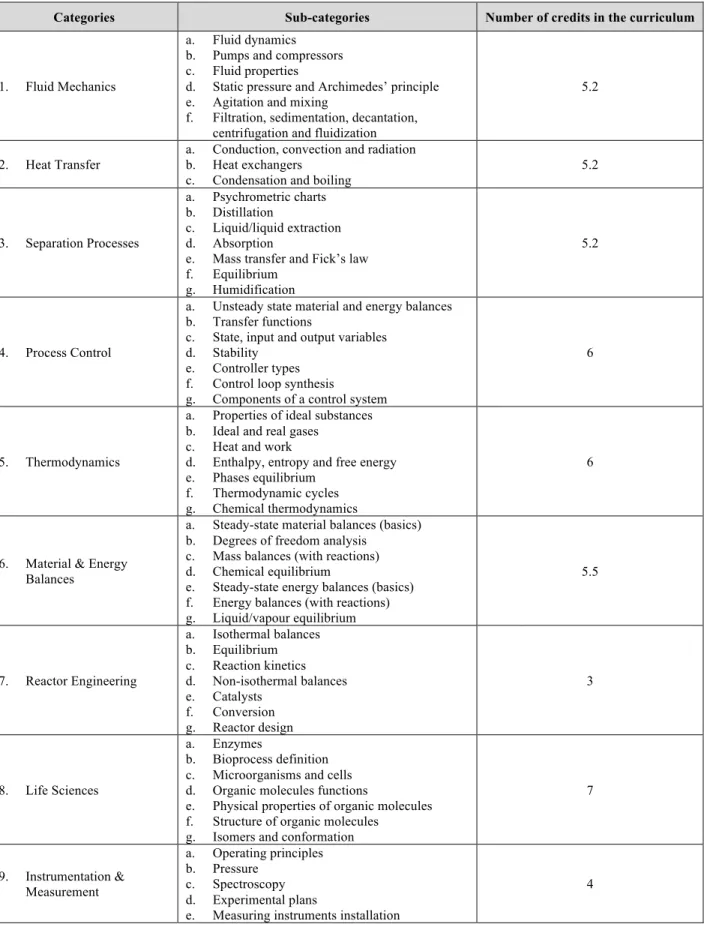
weighting in the curriculum, have isolated 10 main topics, along with their constituent sub-categories (Table 2).
120
121
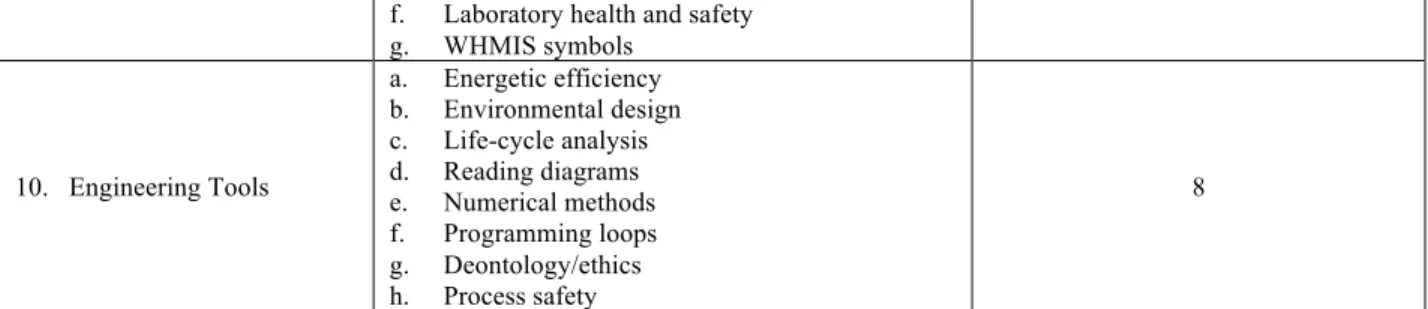
Table 2: Main topics in chemical engineering, along with the subcategories tested and the corresponding
122
credit weighting in the Polytechnique Montreal Chemical Engineering curriculum.
123
Categories Sub-categories Number of credits in the curriculum
1. Fluid Mechanics
a. Fluid dynamics b. Pumps and compressors c. Fluid properties
d. Static pressure and Archimedes’ principle e. Agitation and mixing
f. Filtration, sedimentation, decantation,
centrifugation and fluidization
5.2
2. Heat Transfer a. Conduction, convection and radiation b. Heat exchangers
c. Condensation and boiling
5.2 3. Separation Processes a. Psychrometric charts b. Distillation c. Liquid/liquid extraction d. Absorption
e. Mass transfer and Fick’s law
f. Equilibrium
g. Humidification
5.2
4. Process Control
a. Unsteady state material and energy balances b. Transfer functions
c. State, input and output variables d. Stability
e. Controller types
f. Control loop synthesis
g. Components of a control system
6
5. Thermodynamics
a. Properties of ideal substances b. Ideal and real gases
c. Heat and work
d. Enthalpy, entropy and free energy e. Phases equilibrium
f. Thermodynamic cycles
g. Chemical thermodynamics
6
6. Material & Energy Balances
a. Steady-state material balances (basics) b. Degrees of freedom analysis
c. Mass balances (with reactions) d. Chemical equilibrium
e. Steady-state energy balances (basics)
f. Energy balances (with reactions)
g. Liquid/vapour equilibrium 5.5 7. Reactor Engineering a. Isothermal balances b. Equilibrium c. Reaction kinetics d. Non-isothermal balances e. Catalysts f. Conversion g. Reactor design 3 8. Life Sciences a. Enzymes b. Bioprocess definition c. Microorganisms and cells d. Organic molecules functions
e. Physical properties of organic molecules
f. Structure of organic molecules
g. Isomers and conformation
7 9. Instrumentation & Measurement a. Operating principles b. Pressure c. Spectroscopy d. Experimental plans
e. Measuring instruments installation
f. Laboratory health and safety g. WHMIS symbols 10. Engineering Tools a. Energetic efficiency b. Environmental design c. Life-cycle analysis d. Reading diagrams e. Numerical methods f. Programming loops g. Deontology/ethics h. Process safety 8
124
125
2.2 Concept inventory structure
126
127
The concept inventory is therefore divided into 10 topics representing basic concepts at the heart of the chemical
128
engineering program. For each topic, roughly 80 questions were created and divided into subtopics. For example, the
129
Material & Energy Balances topic includes Steady-State Mass Balances, Steady-State Energy Balances and Degree
130
of Freedom Analysis subtopics. This indexation allows for the creation of a test that will have a similar structure for
131
each student.
132
133
Here is an example of a typical question, with its indexation (Table 3):
134
What is the mass of a solution composed of 30 g of water and 1 g of salt?
135
a. 30 grams136
b. 29 grams137
c. 31 grams138
d. Between 30 and 31 grams
139
140
141
Table 3: Question indexation example
142
Topic Material and Energy Balances X
Subtopic Steady-State Mass Balance X
Steady-State Energy Balance Degree of Freedom Analysis
143
It is important to mention that significant effort was devoted to creating clear questions and plausible distractors
144
(answers that were plausible, even if incorrect). For example, for the previous question, several students indicated
145
that the correct answer was “Between 30 and 31 grams”. This distractor seems realistic because during their previous
146
studies, students were exposed to the notion that volume is not additive, but were not particularly exposed to
147
conservation of mass. This is therefore a misconception that is important to detect (Krause & al, 2004).
148
149
A total of 95 subtopics and subtopic levels were isolated within the 10 topics. All questions are multiple-choice
150
(choice of answers, matching, rearrangements), allowing for the evaluation of the most essential core concepts within
151
chemical engineering. The goal of the concept inventory is therefore not to evaluate students’ abilities to perform
152
complex calculations, resolve long-form problems, or comprehend process intricacies. Within our program, these
153
types of know-how are evaluated using other tools, such as integrative projects.
154
155
In addition to indexation, a difficulty level between 1 and 3 was assigned to each question. Every question is
156
therefore codified in the following manner: YY-Z-NN where YY represents the number of the subtopic, Z represents
157
the question’s difficulty level, and N represents the question number.
158
159
Using that codification system, the questions that make up each test are chosen by the Moodle Quiz interface in a
160
random manner for every category, so that each student will have a different evaluation (consisting of 9 or 10
161
questions, based on the topic) that is still similar in terms of the difficulty level and concepts covered. This method
162
allows students to repeat their tests several times without receiving the same questions. Thus, students will undergo a
163
different, but equivalent, evaluation each time, to truly ensure their comprehension of the concepts (and not simply
164
their ability to memorize questions).
165
166
For each of the tests, it is possible to select the topics and subtopics to be evaluated, and therefore to create
167
personalized tests. Since the number of questions that were created greatly exceeds the number asked during an
168
evaluation, each test is unique.
169
170
When a student has completed their test, the software will provide the professor with a result, which can then be used
171
as feedback regarding each topic. In addition, a reading guide has been made available which allows students to
172
review the concepts and address their weaknesses. This approach makes it possible for each student to be aware of
173
their current status regarding their mastery of a variety of topics. They can then independently equip themselves with
174
a plan to address their weaknesses. This ability to take charge of one’s own education and take part in continuous
175
learning can be related to evaluation of the CEAB’s 12th attribute (Life-long learning), in that it provides them a first
176
opportunity to formulate a personalized study plan (useful later on in their career).
177
178
2.3 Implementation
179
180
To serve as an assessment tool to evaluate CEAB attribute 1 outcomes, the concept inventory test was implemented
181
in the fourth-year process design class (GCH4125 – Conception et synthèse des procédés). Given that this is a
182
mandatory course for all chemical engineering undergraduates, and that its principal objective is to integrate the
183
knowledge acquired over the first three years of the undergraduate curriculum, it was seen as the ideal target for the
184
knowledge test. From the very first lecture, students were informed of the test and its objectives as both a CEAB
185
attribute assessment tool, and as a feedback mechanism for the curriculum. The test would be associated to a 5%
186
mark in the course, attributed as a pass-or-fail grade (0% or 5%) – to obtain full marks, students would be required to
successfully answer at least 50% of the questions in each category. The test was conducted in a reserved computer
188
room, under exam conditions (no material permitted, strict invigilation), over a 110-minute period. Using the
189
MoodleQuiz system, each category had a 15-minute time limit imposed, to ensure that students would access a
190
maximum number of subtests. Students were provided with an instruction sheet for login, which also contained a
191
select few formulae and data for the “fluid mechanics” subtest (including friction factors, adimensional number
192
definitions, as well as the Bernouilli and Hagen-Poiseuille equations), as this subtest was constructed with the
193
expectation that students would have access to this written documentation.
194
195
While students were given the list of categories on which they would be quizzed, they were explicitly instructed not
196
to study beforehand, such as to provide baseline feedback to the department concerning which concepts were
well-197
assimilated. Since the objective of the assessment is not to penalize students, repeat tests took place every two weeks
198
until the end of the term – students would be permitted to redo the subtests where they had been unable to obtain a
199
50% grade (they received a 15-minute time allowance per failed subtest). To help them succeed in these do-overs, as
200
mentioned previously, they were provided with a list of recommended readings from their previous classes, targeted
201
per subtest and per subcategory. For example, if the student had failed the “reaction engineering” subtest, and knew
202
that they had trouble with catalysis, they were referred to Chapter 10 in Fogler’s Elements of Chemical Reactor
203
Engineering to brush up on the key concepts. This also has incidental impact on CEAB’s attribute #12 “life-long
204
learning”, by encouraging students to improve upon themselves in areas of difficulty. Some minor procedural
205
changes were applied over the first few years of the test, discussed in section 3.
206
207
Beyond its use as a summative assessment tool in the fourth year, the “Material and Energy Balances” subtest from
208
the concept inventory has also been implemented at other points in the undergraduate and graduate curriculum.
209
Namely, this subtest is used as a formative assessment tool in the first-year introduction to process analysis class
210
(GCH1140 – Analyse des procédés). It is also implemented as a qualifying test for several chemical engineering
211
graduate classes (where course requirements are not strictly enforced by the registrar’s office), particularly for
212
students enrolled in the “Diploma of Higher Specialized Studies” graduate certificate program (DESS – Diplôme
213
d’études supérieures spécialisées) who may not have engineering backgrounds.
214
215
216
3. Results and discussion
217
3.1 Continuous improvement
218
Following its first year in the field, the concept inventory underwent its first refit. Using the test data collected, each
219
individual question that had statistically amassed a success rate less than 50% over the first year was reassessed,
220
using the following questions:
221
I. Is the question poorly formulated, too long or unclear?
222
II. Is the question pertinent? Does it evaluate understanding or rely on memorization?
For example, one question in the “Fluid Mechanics” subtest was originally formulated as follows:
226
227
A compressible fluid exits a tank through a converging nozzle. Which of the following statements correctly
228
describes the flow regime in the nozzle?
229
a) The flow will be supersonic if the outlet pressure is smaller than the critical pressure of the system;
230
b) The outlet pressure has no impact on gas flow;
231
c) The flow cannot be supersonic in a converging nozzle;
232
d) The flow will be supersonic if the outlet pressure is greater than the critical pressure of the system.
233
234
This question had a success rate of 30% during the first year of assessment. While this original formulation does
235
focus on a fluid mechanics concept (flow through a nozzle), it was deemed necessary to reformulate it, based on
236
reasons (I) and (II): the answer relies on the student knowing off the top of their head the details of supersonic fluid
237
flow. While we expect students should be able to understand this, we do not require such concepts to be memorized.
238
The question was reformulated as follows:
239
240
Which of the following statements pertaining to flow through a nozzle is true?
241
a) For there to be flow, the pressure in the nozzle outlet must be higher than the pressure at the inlet;
242
b) Flow at the nozzle throat can be supersonic (Ma > 1);
243
c) For the flow in the diverging section of the nozzle to be supersonic (Ma > 1), flow at the nozzle throat
244
must be sonic (Ma = 1);
245
d) The shape of the nozzle can alter the mass rate of the fluid flowing from the inlet to the outlet.
246
247
This new formulation, while testing for the same concept, can be worked through by the student during the test if
248
they do not specifically recall details of supersonic flow. Moreover, a schematic of a nozzle identifying its various
249
sections now accompanies the question. The number of questions that were revised during this process following the
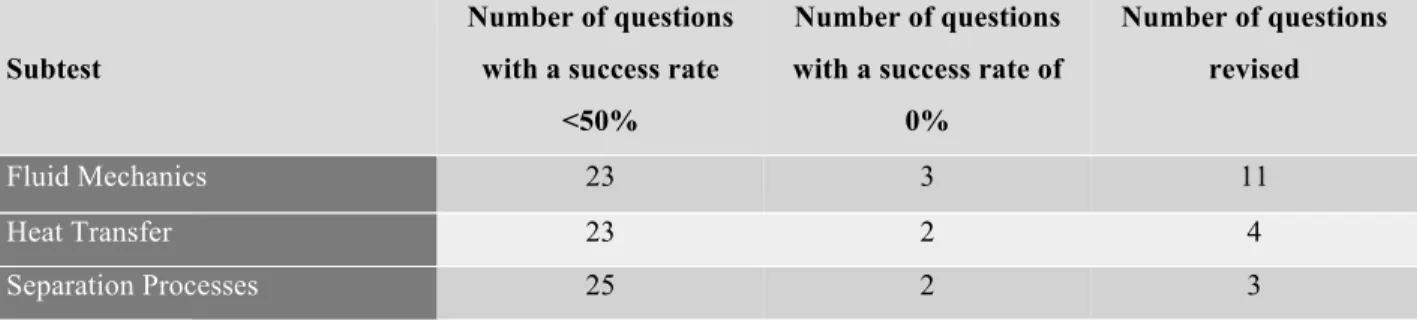
250
first year of testing are classified per subtest in Table 4. Out of 831 questions, 285 were examined and 48 were
251
revised. Further, it is interesting to note that, through the random processing of questions by the Moodle Quiz
252
interface, 8 questions were never assigned. Through the revision process, additional questions and variants were
253
added, bringing the total number of questions up to 990 from year 2 onwards.
254
255
Table 4: Questions revised per subtest after year 1
256
Subtest
Number of questions with a success rate
<50%
Number of questions with a success rate of
0% Number of questions revised Fluid Mechanics 23 3 11 Heat Transfer 23 2 4 Separation Processes 25 2 3
Process Control 20 1 2
Thermodynamics 39 4 2
Material & Energy Balances 42 2 18
Reactor Engineering 29 1 3
Life Sciences 23 3 5
Instrumentation & Measurement 21 2 0
Engineering Tools 40 6 0
TOTAL 285 26 48
257
Further changes to the implementation procedure were applied following this revision process. As of Year 2,
258
statistics for each test (including do-overs) were presented in class, allowing students to understand what themes are
259
problematic for their classmates and better situate themselves within the group. These statistics were always
260
presented to the undergraduate curriculum committee, but had been withheld from the students during Year 1. At the
261
students’ request, time management during the tests was altered from Year 2 onwards: rather than limit each test with
262
a 15-minute timers, students could manage their time as they saw fit. Noticing a drop off in student participation after
263
multiple failed tests, and because the material being tested was deemed a necessary baseline of concepts in chemical
264
engineering, it was decided to increase the students’ stake in the test starting on Year 3: successful completion of the
265
course (GCH4125) became contingent upon success in the concept inventory test (50% in all subtests, mandatory
do-266
overs every two weeks to facilitate student success).
267
268
3.2 Progression over four years and impact of feedback
269
The effect of the grading scheme change becomes apparent when considering the evolution of failed subtests (Figure
270
1). Despite comparable class sizes (Nyear 1 = 49, Nyear 4 = 47, separate cohorts), the students appear to take the exercise
271
significantly more seriously on Year 4: on their 2nd attempt (i.e. the first time they actively study for the test), the
272
number of students who pass goes from 9 to 21. Moreover, we see that students persist in taking the test until they
273
pass, reaching a 7th attempt for one student in Year 4, whereas the highest number of attempts in Year 1 was 5.
274
275
! " #! #" $! $" ! # $ % & " ' ( ) * #! !"#$%&'()')*+,%-'."$/%./. #+,-.,,/01, $23-.,,/01, %43-.,,/01, &,5-.,,/01, ",5-.,,/01, ! " #! #" $! $" ! # $ % & " ' ( ) * #! !"#$%&'()')*+,%-'."$/%./. #+,-.,,/01, $23-.,,/01, %43-.,,/01, &,5-.,,/01, ",5-.,,/01, ',5-.,,/01, (,5-.,,/01,
#('"
Figure 1: Number of failed subtests per attempt on Year 1 (left, N = 49) vs Year 4 (right, N = 47). The increases in
#(("
the total number of attempts and success on the 2ndattempt show that students take the activity more seriously in
#()
Year 4.
#(*"
#)+"
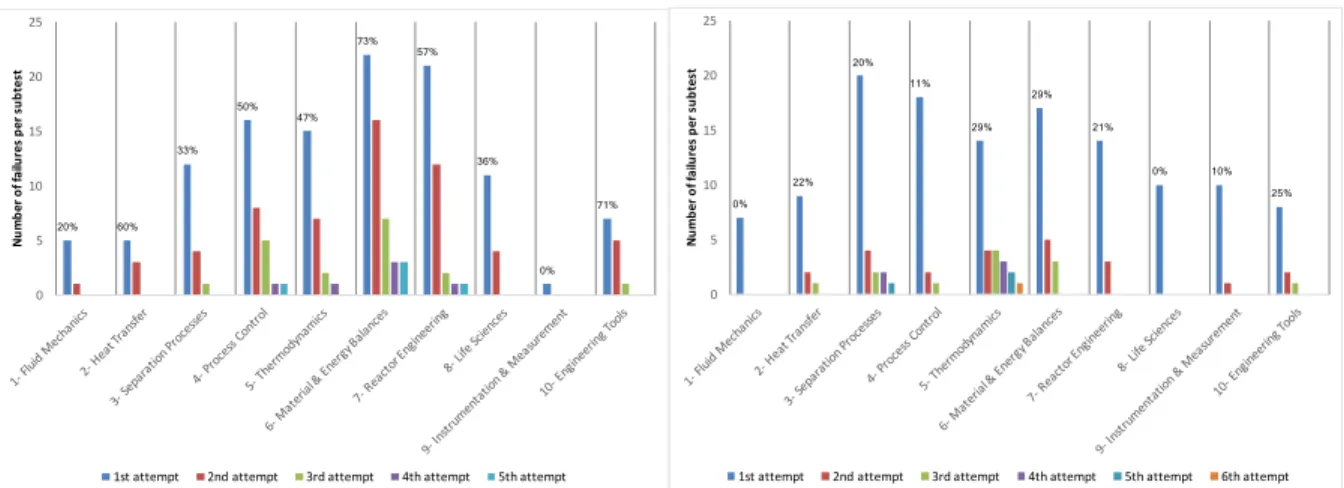
This improvement is also visualized through the distribution of failed subtests across categories (Figure 2). The
#)!"
percent values indicated in Figure 2 represent the ratio between the number of failures at the 2nd and 1st attempt – in
#)#"
Year 1, the average ratio is 45%, while in Year 4 this decreases to 17%, further illustrating the marked improvement
#)$"
on the second (and subsequent) attempt. The distribution per concept category also brings to light the impact of the
#)%
revision process initiated after Year 1 (these were observed as early as Year 2, data not reported), as well as feedback
#)&"
provided to some professors. For example, students succeeded in the “Material & Energy Balance” category to a far
#)'"
greater extent in Year 4: 14 failures on the 1st attempt, compared to 22 in Year 1. The contrast is even more drastic
#)("
for subsequent attempts. The reader will recall that the “Material & Energy Balances” category was the most revised
#))"
after Year 1 (Table 4).
#)*"
#*+"
“Reaction Engineering” also showed a great deal of improvement over the 4-year span, namely as a result of using
#*!"
the concept inventory assessment tool to provide feedback to the professors involved in teaching this subject. After
#*#
amassing 2 years of data concerning failures in this category, the undergraduate curriculum committee met with the
#*$"
professor in question (who had himself contributed many of the questions used in this category). During Year 3, the
#*%"
professor conducted a 2-hour workshop in his class, during which he presented a selection of five frequently-failed
#*&"
questions from the concept inventory. He reviewed each question carefully with the students and helped them to
#*'"
clarify muddy concepts, and adapt how he taught these concepts in subsequent years. Incidentally, this workshop
#*("
also had a positive outcome for his final exam. When these students reached GCH4125 (Year 4), they had only 14
#*)"
failures in the 1st attempt (compared to 21 in Year 1), 3 failures on the 2nd attempt and none afterwards. This
#**"
improvement is almost entirely attributed to the feedback given by the undergraduate curriculum committee, as the
$++
“Reaction Engineering” category was one of the least revised after Year 1 (Table 4).
$+!"
$+#"
!"#$ %"#$ &&#$ '"#$ ()#$ )&#$ ')#$ &%#$ "#$ )*#$ ! " #! #" $! $" !"# $% &'( )') *+ ,"& %-'.% &'-"$/ %-/
#%&'(&&)*+& $,-'(&&)*+& ./-'(&&)*+& 0&1'(&&)*+& "&1'(&&)*+&
!"# $$"# $!"# %%"# $&"# $&"# $%"# !"# %!"# $'"# ! " #! #" $! $" !"# $% &'( )') *+ ,"& %-'.% &'-"$/ %-/
#%&'(&&)*+& $,-'(&&)*+& ./-'(&&)*+& 0&1'(&&)*+& "&1'(&&)*+& 2&1'(&&)*+&
$+$"
Figure 2: Distribution of failures by subtest in Year 1 (left) and Year 4 (right). The percent values above the data
$+%"
represent the ratio between the number of failures at the second and first attempt, further illustrating the
$+&"
improvement in Year 4.$+'"
"
$+("
!"# $!"# %!"# &!"# '!"# (!"# )!"# *!"# +!"# ,!"# $!!"# )&"# ))"# )%"# (*"# ()"# (&"# ('"# )&"# )+"# )%"# )'"# *!"# )$"# )%"# (("# )$"# )%"# )("# )!"# )%"# -. /0 12 /#0 /3 45 6#7 /0 #34 86 /3 6 9/10#$ 9/10#' ! !"
$+)"
Figure 3: Comparison of average test results per subtest on the 1st attempt. All subtests show identical or improved
$+*"
results, with only Material & Energy Balances and Reactor Engineering showing statistically significant
$!+"
improvement (highlighted with a *)
$!!"
$!#"
The noted improvements in performance for “Material & Energy Balances” and “Reactor Engineering” are further
$!$"
apparent when comparing the average test results from the 1st attempt between Year 1 and Year 4 (Figure 3) – the
$!%"
average result increases by 8% in both cases. In fact, revisions, curriculum improvement through feedback and
$!&"
increased attention to the test by students (course requirement) have shown dividends in nearly all categories – the
$!'"
average result on the 1st attempt has either remained roughly identical or improved, though improvement is only
The only exception is “Instrumentation & Measurement”, a subtest that was plagued with technical difficulties
319
during the first test on Year 4 (images would not load properly).
320
321
4. Conclusions
322
A concept inventory assessment tool was designed and constructed to allow for the evaluation of students’
323
knowledge of a full range of chemical engineering topics, spread across 10 subcategories. This tool has allowed us to
324
document our students’ abilities to learn key concepts in chemical engineering, and data analysis from 4 years’ worth
325
of testing has been used for feedback to instructors in order to improve our educational program. This new tool is
326
now used as a summative assessment for the first of 12 graduate attributes defined by the Canadian Engineering
327
Accreditation Board (A knowledge base for engineering) – an accreditation process centered around continuous
328
curriculum improvement. Beyond the undergraduate curriculum, this tool is finding applications in introductory and
329
graduate classes. The next step will be to use the tool as a formative assessment (not strictly summative in fourth
330
year) over the first three years of the undergraduate curriculum, such as to form the basis of a longitudinal study that
331
would show our students’ progression.
332
333
334
Acknowledgments
335
The authors acknowledge the financial support of Polytechnique Montreal’s Pedagogical Support Office (Bureau
336
d’appui pédagogique - BAP) and Department of Chemical Engineering. The authors would also like to acknowledge
337
all professors, instructors and students who contributed to the concept inventory’s creation, revision and pilot testing,
338
specifically Sophie Hudon, Douaa Hassan, Philippe Leclerc, Christopher-Alex Dorval-Dion, Jean-Christophe
St-339
Charles, François Bertrand, Michel Perrier, Louise Deschênes, Louis Fradette, Fabio Cicoira, Jamal Chaouki,
340
Charles Dubois, Gregory De Crescenzo and Robert Legros. The work was conducted in conformity with
341
Polytechnique Montreal’s ethics requirements for use of student data in research.
342
343
References
344
• Anderson, L.W., Krathwohl, D.R., 2001. A Taxonomy for Learning, Teaching, and Assessing. A Revision of
345
Bloom’s Taxonomy of Educational Objectives. New-York, Longman.
346
• Badger, W.L., McCabe, W.L., 1936. Elements of Chemical Engineering (2nd edition). McGraw-Hill. New York.
347
• Bimbenet, J.J., 1998. Origine et évolution du génie chimique et du génie des procédés. Dans Techniques de
348
l’ingénieur : Bases conceptuelles du génie des procédés alimentaires. From http://www.techniques-ingenieur.fr/
349
• Csernia, J., Vigeant, M.A.S., Raymond, T.M., Prince, M.J., 2008. Development of a Chemical Engineering
350
Comprehensive Concept Inventory. AIChe Annual Meeting Conference.
351
• Engineers Canada, 2017. Ressources en matière d’agrément. Tiré de
352
https://engineerscanada.ca/fr/agrement/ressources-en-matiere-dagrement
• Imperial College London, 2017. MEng Chemical Engineering. From
354
https://www.imperial.ac.uk/study/ug/courses/chemical-engineering-department/chemical-engineering/#teaching-355
and-assessment356
• Krause, S. & al., 2004. Development, Testing, and Application of a Chemistry Concept Inventory. 34th
357
ASEE/IEEE Frontiers in Education Conference.
358
• Leesley, M.E., 1979. Freshman Chemical Engineering (1st edition). Gulf Publishing Company. Texas.
359
• Perrenoud, P., 1997. Vers des pratiques pédagogiques favorisant le transfert des acquis scolaires hors de l’école,
360
Pédagogie collégiale (Quebec), Vol. 10, n° 3, mars, pp. 5-16
361
• McCarthy, J.J., Parker, R.S., 2004. Pillars of Chemical Engineering: A Block-Scheduled Curriculum. Chemical
362
Engineering Education, Autumn 2004, p.292 à 295. From http://udfc.ufl.edu//AA000003831/00160
363
• Ngothai, Y., Davis, M.C., 2011. Implementation and analysis of a Chemical Engineering Fundamentals Concept
364
Inventory (CEFCI). Education for Chemical Engineers, Elsevier.
365
• Prégent, R., Bernard, H., Kozanitis, A., 2009. Enseigner à l’université dans une approche-programme. Presses
366
Internationales Polytechnique, Montreal.
367
• Storck, A., Grevillot, G., 1993. Génie des Procédés (1st edition). Lavoisier. Paris
368
• Tardif, J. (1999). Le transfert des apprentissages. Montreal : Éditions Logiques.
369
• Tardif, J., 2006. L’évaluation des compétences : Documenter le parcours de la formation. Chenelière Éducation,
370
Montreal.