UNIVERSITÉ DE MONTRÉAL
DEVELOPMENT OF A MICROWAVE HEATING-ASSISTED CATALYTIC REACTION PROCESS: APPLICATION FOR DRY REFORMING OF METHANE OPTIMIZATION
SEPEHR HAMZEHLOUIA
DÉPARTEMENT DE GÉNIE CHIMIQUE ÉCOLE POLYTECHNIQUE DE MONTRÉAL
THÈSE PRÉSENTÉE EN VUE DE L’OBTENTION DU DIPLÔME DE PHILOSOPHIAE DOCTOR
(GÉNIE CHIMIQUE) AOÛT 2017
UNIVERSITÉ DE MONTRÉAL
ÉCOLE POLYTECHNIQUE DE MONTRÉAL
Cette thèse intitulée:
DEVELOPMENT OF A MICROWAVE HEATING-ASSISTED CATALYTIC REACTION PROCESS: APPLICATION FOR DRY REFORMING OF METHANE OPTIMIZATION
présentée par : HAMZEHLOUIA Sepehr
en vue de l’obtention du diplôme de : Philosophiae Doctor a été dûment acceptée par le jury d’examen constitué de : M. PERRIER Michel, Ph. D., président
M. CHAOUKI Jamal, Ph. D., membre et directeur de recherche M. DOUCET Jocelyn, Ph. D., membre
DEDICATION
ACKNOWLEDGEMENTS
I would like to express my most sincere gratitude to my research supervisor, Prof. Jamal Chaouki, for his boundless mentorship, guidance, and support in both professional and personal levels as well as generous financial support for the duration of this research. The completion of this thesis would have not been possible without his enormous contributions.
I would like to reserve special thanks to my parents who supported me both financially and emotionally through all the pains and happiness, to make me be believe I have the potential to fulfill my dreams. Also, special tribute to my twin brother, who always challenged me to reach my hidden potentials and gave me hope to direct my endeavors to the way of a better future.
I would also like to thank my PhD thesis committee, Prof. Hugo de Lasa, Prof. Michel Perrier and Dr. Jocelyn Doucet for their careful review of my work and constructive input. Moreover, I would like to express my gratitude to Prof. Lahcen Saydy for representing the director of the graduate studies.
Furthermore, I would like to thank Natural Sciences and Engineering Research Council of Canada (NSERC), Total-NSERC chair, Polytechnique Montreal Department of Chemical Engineering and Centre d’Entrepreneuriat Poly-UdeM for providing their generous financial support.
Moreover, I would like to thank our industrial partners at Total, especially Dr. Shaffiq Jaffer for investing countless hours reviewing my work and providing invaluable input.
Additionally, I would like to extend my gratuities to all my colleagues in the Process Engineering Advanced Research Lab (PEARL), in particular Dr. Mohammad Latifi, Dr. Jaber Shabanian, Dr. Majid Rasouli, Dr. Sherif Farag and Mr. Philippe Leclerc for sharing their personal and professional experience with me as well as their valuable advices and assistance. I would also like to thank Mr. El Mahdi Lakhdissi for his much-appreciated assistance with translating the abstract of the thesis to French. Furthermore, I would like to acknowledge Dr. Ali Kashani for the revision of the scientific articles. I would like to further acknowledge Dr. Rahmat Sotudeh-Gharebagh, Dr. Navid Mostoufi and Dr. Reza Zarghami for their endless scientific support and constructive advices.
In addition, I would like to express my gratitude to Mr. Sylvain Simard-Fleury, Mr. Daniel Pilon and Mr. Robert Delisle for the technical support and the development of the experimental setups.
Moreover, I would like to thank Mr. Gino Robin, Ms. Martine Lamarche and Mr. Jean Huard for their endless support with the chemicals and gases purchasing.
Finally, I would like to thank Mr. Diego del Angel Salas, Ms. Selima Ben Khelifa, Ms. Ghita Bouanane El Edrisi, MS. Helena Miata-Bouna Ms. Abidah Bachoo, Mr. Sami Chaouki and Ms. Aya Kanso for their assistance with the experimental aspect of the study through various internship programs.
RÉSUMÉ
Les ressources conventionnelles de combustibles à base de pétrole sont en train de subir une période transitoire de déclin à cause des préoccupations environnementales liées à l’extraction, le traitement, l’application et aussi à l’épuisement irrépressible des réserves disponibles. Actuellement, le pétrole constitue le vecteur énergétique prédominant qui contrôle 33% du marché mondial d’énergie tandis que 1697.6 milliards barils estimés globalement comme réserves disponibles vont couvrir à peine la demande universelle en énergie pour les 50 prochaines années. Par conséquent, le secteur énergétique est rapidement inspiré de chercher une feuille de route alternative pour la perspective de la demande mondiale. Le gaz naturel, mélange de hydrocarbures légers dominé par le méthane comme constituant principal a été délibéré comme candidat robuste grâce à sa distribution mondiale, sa disponibilité et aussi ses diverses applications. Ainsi, grâce à la forte croissance de l’offre et à la conformité avec les politiques environnementales mondiales strictes, le gaz naturel a été fortement considéré comme l’énergie la plus croissante et le ressource de la production chimique. Toutefois, la distribution générale des ressources de gaz naturel sous forme d’hydrate dans les régions éloignées, les zones désertes et au fond des océans a suscité une controverse liée à l’accessibilité, le transport et les activités de manipulation.
La conversion du méthane en produits chimiques à valeur ajoutée a été fortement considérée pour remédier aux déficiences associées en conséquence au transport, à la manipulation et à la distribution des composants gazeux. Or, le procédé proéminent menant à la conversion du méthane au gaz de synthèse a été mis en évidence comme une approche substantielle pour préserver un cycle d’énergie carboneutre pour la perspective prospective d’énergie. Le gaz de synthèse, un mélange gazeux vraisemblablement dominé par l’hydrogène et le monoxyde de carbone est une matière première robuste pour une multitude de procédés de fabrication de produits chimiques et aussi énergivores. Subséquemment, plusieurs approches scientifiques ont été implémentée pour convertir le méthane en gaz de synthèse, substantiellement, les procédés du vaporeformage (SRM), l’oxydation partielle (POx) et le reformage à sec du CO2 (DRM). Simultanément, le procédé DRM a été renommé comme la méthode de conversion du méthane la plus avantageuse grâce aux avantages environnementaux, au ratio de composition du produit (H2/CO) et la flexibilité du procédé. Initialement étudié par Fischer et Tropsch, le reformage à sec du méthane est une réaction endothermique menant à un ratio H2/CO proche de l’unité et ainsi offrant une possibilité stimulante de convertir le gaz de synthèse en produits chimiques, en méthanol, et des hydrocarbures à longue
chaine particulièrement à travers le procédé de Fischer-Tropsch. De plus, le mécanisme du DRM permet de réaliser la conversion des deux composants clés des gaz à effet de serre à savoir CO2 et CH4 et permettant ainsi d’établir un avantage environnemental instantané. Toutefois, et à cause des multiples équilibres thermodynamiques, le procédé de reformage à sec DRM est fortement affecté par la production de sous-produits indésirables associée aux réactions secondaires en phase gazeuse à savoir la dégradation thermique du méthane, la réaction de la conversion à la vapeur d’eau et la dismutation du monoxyde de carbone. L’évolution de la réaction secondaire en phase gazeuse diminue drastiquement la sélectivité des composants du gaz de synthèse et mène ainsi à un produit de mauvaise qualité. Par conséquent, plusieurs études concentrées principalement sur le développement d’un système catalytique à haute performance ont été rapportées. Cependant, l’application industrielle du reformage à sec a été bloquée à cause de la non disponibilité d’un catalyseur efficace et économique et aux grands besoins en énergie. Bien que plusieurs études portant sur le design et l’optimisation du catalyseur pour résoudre le problème de sélectivité ont été rapportées dans la littérature, le manque d’études portant sur l’effet de la méthode de chauffage est évident.
Le développement des sources d’énergie renouvelables à savoir l’énergie solaire et éolienne a été reconnu comme une opportunité remarquable pour répondre aux exigences du marché énergétique et en même temps être conforme à la réglementation environnementale stricte pour protéger la planète contre une destruction irrémédiable. Or, les progrès récents concernant les techniques de production et de récolte, la dégradation et l’épuisement des réserves de combustibles fossiles, les procédés en série et la disponibilité spontanée des matières premières ont développé des critères pour diviser les ressources d’énergie renouvelable en ressources non rentables économiquement et à des ressources largement accessibles. Par conséquent, l’avènement des ressources d’énergie renouvelable rentable économiquement et écologiques prévoit une opportunité appréciée pour produire rapidement une électricité propre et accessible. Ainsi, l’opportunité d’obtenir une électricité renouvelable abordable offre une perspective exceptionnelle d’effectuer des réactions chimiques via des méthodes de traitement électromagnétiques à savoir, le chauffage par induction, le chauffage par ultrasons et le chauffage à micro-ondes.
Ainsi, pour remédier aux déficiences susmentionnées et relatives au procédé du reformage à sec DRM et plus généralement relatives aux conséquences liées aux réactions gaz-solide, la présente étude propose l’application du chauffage à micro-ondes pour l’optimisation des réactions
catalytiques gaz-solide. Les avantages majeurs de la méthode de chauffage à micro-ondes comprennent le chauffage sélectif, uniforme et volumétrique, une densité de puissance élevée, un contrôle de température instantané, une consommation d’énergie réduite, une sélectivité de réaction élevée, moins de limitations liées au transfert de chaleur, la flexibilité du procédé et la portabilité de l’équipement. Toutefois, la caractéristique clé de la méthode de chauffage à micro-ondes est associée au mécanisme exclusif de chauffage sélectif. Quand les matériaux sont exposés aux radiations micro-ondes, leur niveau d’énergie interne est augmenté en fonction des leurs propriétés diélectriques projetées et qui sont liées aux caractéristiques physiques et structurels. Cependant, le matériau principal le plus utilisé à savoir les composés gazeux échouent à projeter une interaction significative avec les micro-ondes à cause de l’insuffisance de leurs propriétés diélectriques. Par conséquent, et contrairement aux méthodes conventionnelles de chauffage, le mécanisme de chauffage à micro-ondes établit un gradient de température significatif entre la phase solide diélectrique et la phase gazeuse pour les réactions catalytiques gaz-solide. Ainsi, la température locale élevée sur les sites actifs du solide favorise la réaction catalytique tandis que la température faible du gaz permet de limiter la perspective des réactions secondaires en phase gazeuse. Par conséquent, le présent travail de recherche est classifié en trois sections principales :
1) La préparation de l’activateur du catalyseur/récepteur des micro-ondes : le récepteur des micro-ondes a été développé dans un réacteur à lit fluidisé pour le dépôt chimique en phase vapeur (FBCVD). Ainsi, le carbone a été déposé sur un substrat de sable de silice en utilisant le méthane dans un équipement de chauffage par induction. L’effet des conditions opératoires à savoir la température et le temps de réaction sur les propriétés de la couche de revêtement a été déterminé. Ainsi, la composition, l’épaisseur et la morphologie de la couche de revêtement en carbone a été examinée pour plusieurs conditions opératoires. Finalement, la performance des particules de sable de silice revêtues en carbone (C-SiO2) a été évaluée dans un lit fluidisé utilisant le chauffage à micro-ondes à l’échelle laboratoire. Il a été démontré que les particules C-SiO2 présentent une interaction exceptionnelle avec les micro-ondes grâce à leurs propriétés diélectriques significatives. Les particules C-SiO2 développées ont été recommandées pour leur application comme récepteur à micro-ondes et support/activateur de catalyseur pour les réactions catalytiques gaz-solide.
2) L’importance du mécanisme de chauffage : l’effet du mécanisme de chauffage à micro-ondes sur la réaction d’oxydation sélective gaz-solide a été étudié par la simulation de la
conversion du n-C4 en MAN sur le catalyseur VOP dans un réacteur à lit fluidisé à l’échelle industrielle. Il a été démontré qu’en fonction des propriétés diélectriques des composants, un gradient de température persiste entre le gaz et le solide. A cause de l’incapacité de mesurer directement le profil de température du gaz, les profils de température de la surface du solide et le profil de température du mélange ont été obtenu à l’aide des méthodes de radiométrie et thermométrie dans un réacteur à lit fluidisé chauffé à micro-ondes à l’échelle laboratoire. Ainsi, l’effet des conditions opératoires de la température et la vitesse superficielle du gaz sur les profils de température associés a été étudié. En outre, des corrélations ont été proposées pour estimer le profil de température de gaz à travers le lit en utilisant les données expérimentales et le bilan énergétique. Les profils de température du gaz, du solide et du mélange ont été utilisés après pour comparer le chauffage conventionnel et à micro-ondes pour la conversion de n-C4 et la sélectivité du MAN dans l’étude de simulation. Les résultats ont révélé que le chauffage à micro-ondes est supérieur en terme de la productivité de la réaction.
La réaction catalytique assistée par micro-ondes : le reformage à sec du méthane dans un réacteur à lit fluidisé chauffé à micro-ondes à l’échelle laboratoire a été effectué pour étudier l’effet du mécanisme de chauffage sur l’évolution des produits. Ainsi, l’effet de la température de fonctionnement sur la conversion des réactifs et la sélectivité des produits désirés, H2 et CO a été rigoureusement étudié. Il a été conclu que le chauffage à micro-ondes favorise les réactions catalytiques tout en limitant les réactions secondaires en phase gazeuse indésirables.
ABSTRACT
Conventional petroleum-based fuel resources are undergoing a transition decline period due to the environmental concerns associated with the extraction, processing and application, and the irrepressible depletion of the available reserves. Presently, oil has been the predominant energy vector, regulating 33% of the global energy market, while the 1697.6 thousand million barrels globally estimated available reserves will barely cover the universal energy demands for the next 50 years. Consequently, the energy sector is promptly inspired to pursuit alternative roadmap for the global demand outlook. Natural gas, a mixture of light hydrocarbons dominated by methane as the principal constituent, has been deliberated as a robust candidate due to the global distribution and availability, and the diverse applications. Accordingly, due to the strong supply growth and compliance with the strict global environmental policies, natural gas has been highly regarded as the fastest growing energy and chemical production resource. However, the general distribution of the natural gas resources in the hydrate format in remote regions, the deserted areas and the ocean beds, has aroused controversy associated with the accessibility, transportation and handling activities.
The conversion of methane to value-added chemicals has been highly regarded, to address the deficiencies associated with the transportation, handling and distribution of the gaseous components, correspondingly. Whereas, the prominent processes leading to the conversion of methane into syngas has been highlighted as a substantial approach to preserve a carbon-neutral energy cycle in the prospective energy outlook. Syngas, a gaseous mixture presumably dominated by hydrogen and carbon monoxide is a robust feedstock for multiple energy intensive and chemical production processes. Subsequently, numerous scientific approaches have been implemented to convert methane into syngas, substantially, steam reforming (SRM), partial oxidation (POx), and CO2 (dry) reforming processes (DRM). Meanwhile, the DRM process has been renowned as the most advantageous methane conversion method due to the environmental benefits, product composition ratio (H2/CO) and the process flexibility. Initially investigated by Fischer and Tropsch, the dry reforming of methane is an endothermic reaction concluding a H2/CO ratio close to unity, providing a stimulating possibility to convert syngas to chemicals, methanol, and long-chain hydrocarbons particularly, through the Fischer-Tropsch process. Moreover, the DRM mechanism accomplishes the conversion of the two key greenhouse gas components, CO2 and CH4, establishing an instantaneous environmental advantage. However, due to multiple thermodynamic
equilibria, the DRM process is heavily affected by the production of the undesired by-products associated with the secondary gas-phase reactions, namely, thermal degradation of methane, water gas shift reaction and carbon monoxide disproportionation. The evolution of the secondary gas-phase reactions drastically diminishes the selectivity of the syngas components and concludes a lower quality product, respectively. Hence, various studies, majorly concentrated on the development of a high performance catalytic system, have been reported. However, the industrial application of dry reforming has been stalled due to the scarcity of an effective and economical catalyst and high energy requirements. Although various investigations regarding the catalyst optimization and design has been reported in the literature, to address the selectivity issue, the lack of studies demonstrating the effect of the heating method is evident.
The development of the renewable energy resources, namely, solar and wind power, have been acknowledged as a remarkable opportunity to maintain the demanding energy market, while comply with strict environmental regulation to persevere the planet from further irretrievable destruction. Whereas, the recent advances in the production and harvesting methods, depletion and exhaustion of the fossil fuel reserves, mass production processes and spontaneously available feedstock has developed renewable energy criteria from economically unfeasible to highly affordable and accessible resources. Consequently, the advent of the economically feasible and environmental friendly renewable energy resources stipulates an esteemed opportunity to promptly produce clean and affordable electricity. Therefore, the expediency of the affordable renewable electricity provides an exceptional prospect to preform chemical reactions via electromagnetic processing methods, namely; induction heating, ultrasound heating and microwave heating, correspondingly.
Thus, to address the aforementioned deficiency with the DRM process, and the correlated consequence for the gas-solid reactions in general, the present study proposes the application of microwave heating for the gas-solid catalytic reactions optimization. Major advantages of the microwave heating method have been underlined as, uniform, selective, and volumetric heating, high power density, instantaneous temperature control, reduced energy consumption, high reaction selectivity, less heat transfer limitations, process flexibility and equipment portability. However, the key feature of the microwave heating method is associated with the exclusive selective heating mechanism. While materials are exposed to microwave radiation, their internal energy level is enhanced based on the projected dielectric properties, associated with the physical and structural
characteristics. However, most common material, namely, gaseous components, fail to project significant microwave interaction due to the lack of sufficient dielectric properties. Consequently, unlike the conventional heating methods, microwave heating mechanism establishes a significant temperature gradient between the dielectric solid phase and the gas phase in the gas-solid catalytic reactions. Hence, the higher local temperature on the solid active sites promotes the catalytic reactions while the lower gas temperature restricts the prospect of the secondary gas-phase reactions, correspondingly. Therefore, the present research study is classified into three major sections correspondingly:
1) Microwave Receptor/Catalyst Promoter Preparation: A microwave receptor has been developed by fluidized bed chemical vapor deposition (FBCVD) of carbon using methane over silica sand substrate material in an induction heating setup. The effect of the operating conditions, namely temperature and reaction time, on the properties of the coating layer was attained. The composition, thickness and morphology of the developed carbo-coating layer for multiple operating conditions were further investigated, accordingly. Ultimately, the performance of the developed carbon-coated silica sand particles (C-SiO2) in a lab-scale microwave heating-assisted fluidized bed reactor was thoroughly evaluated. It was demonstrated that the C-SiO2 particles exhibited exceptional microwave intractability according to significant dielectric properties of the material. The developed C-SiO2 particles were further recommended for application as microwave receptor and catalyst support/promoter in gas-solid catalytic reactions.
2) The Significance of Heating Mechanism: The effect of microwave heating mechanism on a gas-solid selective oxidation reaction was investigated by simulation of n-C4 conversion to MAN on the VOP catalyst in an industrial-scale fluidized bed reactor. It was exhibited that based on the dielectric properties of components a temperature gradient endures between the gas and the solid phases accordingly. Due to the inability for direct measurement of the gas temperature profile, the solid surface and bulk temperature profiles were demonstrated with the assistance of radiometry and thermometry methods in a lab-sale microwave heated fluidized bed reactor. Hence, the effect of operating conditions, temperature and superficial gas velocity, were investigated on the associated temperature profiles. Furthermore, correlations were proposed to estimate the gas temperature profile with the bed employing experimental data and an energy balance. The temperature profile
of solids, bulk and gas were further deployed to compare (conventional vs microwave heating) the conversion of n-C4 and selectivity of MAN in the simulation study. The results revealed microwave heating was superior in terms of the reaction productivity.
3) Microwave-Assisted Catalytic Reaction: The dry reforming of methane in a lab-scale microwave heating-assisted fluidized bed reactor was performed to study the effect of the heating mechanism on the evolution of the products. Whereas, the effect of the operating temperature on the conversion of the reactants and the selectivity of the desired products, H2 and CO was thoroughly investigated. It was concluded that microwave heating promoted catalytic reactions while restricting the secondary undesired gas-phase reactions.
TABLE OF CONTENTS
DEDICATION ... III ACKNOWLEDGEMENTS ... IV RÉSUMÉ ... VI ABSTRACT ... X TABLE OF CONTENTS ... XIV LIST OF TABLES ... XVIII LIST OF FIGURES ... XX LIST OF SYMBOLS AND ABBREVIATIONS ... XXIV
CHAPTER 1 INTRODUCTION ... 1
1.1 References ... 4
CHAPTER 2 LITERATURE REVIEW ... 8
2.1 Energy Resources ... 8
2.1.1 Natural Gas Prospect ... 11
2.2 Methane Conversion to Syngas ... 14
2.3 Dry Reforming ... 16
2.3.1 Reaction Mechanism and Carbon Deposition ... 19
2.3.2 Catalyst Selection ... 23
2.4 Microwave Heating ... 29
2.4.1 Dielectric Loss ... 30
2.4.2 Dielectric Properties ... 32
2.4.3 Dielectric Properties Dependency ... 38
2.4.4 Volumetric Heating ... 42
2.5.1 Wave Applicators ... 47
2.5.2 Leakage and Safety ... 50
2.5.3 Economics and Future Trends ... 51
2.6 References ... 52
CHAPTER 3 ORIGINALITY AND OBJECTIVES ... 60
3.1 Originality ... 60
3.2 Objectives ... 61
CHAPTER 4 COHERENCE OF THE ARTICLES... 62
CHAPTER 5 ARTICLE 1: DEVELOPMENT OF A NOVEL SILICA-BASED MICROWAVE RECEPTOR FOR HIGH TEMPERATURE PROCESSES ... 65
5.1 Abstract ... 65
5.2 Introduction ... 66
5.3 Methodology ... 69
5.3.1 Fluidized bed chemical vapor deposition (FBCVD) ... 69
5.3.2 Induction heating ... 70
5.3.3 Thermal decomposition (TDM) of methane ... 71
5.4 Experimental ... 72
5.4.1 Materials ... 72
5.4.2 Induction Heating FBCVD Setup ... 72
5.4.3 Carbon Layer and Surface Characterization ... 74
5.4.4 Microwave Heating Performance ... 75
5.5 Results and Discussion ... 78
5.5.1 Induction Heating FBCVD of Methane on Quartz Sand ... 78
5.5.2 Characterization of the Carbon Coated Sand Particles ... 81
5.6 Conclusion ... 100
5.7 Acknowledgments ... 102
5.8 Nomenclature ... 102
5.9 Literature Cited ... 103
CHAPTER 6 ARTICLE 2: EFFECT OF MICROWAVE HEATING ON THE PERFORMANCE OF CATALYTIC OXIDATION OF N-BUTANE IN A GAS-SOLID FLUIDIZED BED REACTOR ... 108
6.1 Abstract ... 108
6.2 Introduction ... 109
6.3 Methodology ... 110
6.3.1 Hydrodynamic model ... 111
6.3.2 Kinetic model ... 114
6.3.3 Temperature Distribution Model ... 117
6.4 Reactor Simulation Results and Discussion ... 131
6.5 Conclusion ... 137 6.6 Nomenclature ... 137 6.6.1 Acronyms ... 138 6.6.2 Symbols ... 138 6.6.3 Greek Letters ... 142 6.7 Acknowledgments ... 143 6.8 References ... 143
CHAPTER 7 ARTICLE 3: MICROWAVE HEATING-ASSISTED CATALYTIC DRY REFORMING OF METHANE ... 147
7.1 Abstract ... 147
7.3 Experiments ... 151
7.3.1 Materials ... 151
7.3.2 Dry Reforming of Methane (DRM) ... 151
7.4 Results and discussion ... 154
7.5 Conclusion ... 166 7.6 Acknowledgments ... 167 7.7 Nomenclature ... 167 7.7.1 Acronyms ... 167 7.7.2 Symbols ... 168 7.7.3 Greek Letters ... 168 7.8 References ... 169
CHAPTER 8 GENERAL DISCUSSION ... 174
CHAPTER 9 CONCLUSION AND RECOMMENDATIONS ... 178
BIBLIOGRAPHY ... 180
LIST OF TABLES
Table 2-1: The variation of CO2 in the atmosphere during the last 1000 years (Omae, 2006) ... 8 Table 2-2: Approximate Structural Data of Methane in Wet and Dry States (Speight, 1993). ... 12 Table 2-3: Summary of methane conversion processes to syngas (Hu & Ruckenstein, 2004; York et al., 2003) ... 19 Table 2-4: Complete reaction mechanism pathways for dry reforming of methane (Nikoo & Amin, 2011) ... 23 Table 2-5: Catalyst performance summary for multiple monometallic and bimetallic systems recreated from (Usman et al., 2015) ... 27 Table 2-6: Comparison of construction materials (Metaxas & Meredith, 1983) ... 50 Table 5-1: TGA and Combustion Infrared Carbon Detection (LECO) Results for the Original and Coated Particles at Various Coating Times and Temperatures ... 82 Table 5-2: Spectrum Analysis of EDX Data According to Figure 5-9 Acquisitions ... 89 Table 5-3: XPS Data Analysis for Original and Coated Particles at Various Coating Times and Temperatures ... 89 Table 6-1: General mass balance equations and mass transfer and hydrodynamic correlations . 113 Table 6-2: Kinetic parameters ... 116 Table 6-3: Dielectric properties of the employed material at ambient temperature and 2.45 GHz frequency ... 121 Table 6-4: The definition and expressions of energy balance terms ... 126 Table 6-5: Physical and hydrodynamic properties of the solid and gas phase material for the temperature distribution calculations. ... 128 Table 6-6: Operating conditions for the simulation ... 132 Table 6-7: Overall reaction rates ... 133 Table 7-1: The summary of the dielectric properties of the employed material at ambient temperature and 2.45 GHz frequency ... 155
Table 7-2: Complete reaction mechanism pathways for dry reforming of methane(Nikoo & Amin, 2011) ... 160
LIST OF FIGURES
Figure 2-1: The total greenhouse gas emission and CO2 emission in United states in 2014 breakdown reproduced from (EPA, 2015) ... 9 Figure 2-2: The representative data of worldwide (a) Oil consumption profile and (b) Verified oil reserves for various global regions from 1980 to 2015. (Image reproduced from data provided by (BP, 2016b)). ... 10 Figure 2-3: Global energy market share profile from 1965 to an estimated trend up to 2035 (Image reproduced from data provided by (BP, 2016a)). ... 13 Figure 2-4: Various conversion mechanisms and applications of natural gas. ... 14 Figure 2-5: A schematic review of syngas production and further conversion to value-added chemicals. ... 15 Figure 2-6: Thermodynamic equilibrium plots for DRM as a function of temperature at 1 atm and at inlet feed ratio of CO2/CH4 = 1 (a) Assuming no carbon formation occurs, (b) assuming carbon formation occurs (Pakhare & Spivey, 2014) ... 22 Figure 2-7: Electromagnetic Wave Classification (Metaxas & Meredith, 1983) ... 30 Figure 2-8: (a) Interfacial and (b) Reorientation Polarization (Metaxas & Meredith, 1983) ... 31 Figure 2-9: Current Density and Applied Electric Vectors Recreated From (Metaxas & Meredith, 1983) ... 33 Figure 2-10: The dielectric Constant as a Function of the Frequency in the Region of Dipolar and Distortion Absorption (Metaxas & Meredith, 1983) ... 36 Figure 2-11: The Effective Loss Factor as a Function of the Moisture Content Recreated From (Metaxas & Meredith, 1983) ... 39 Figure 2-12: Electric Properties vs. Moisture Content & Temperature in Douglas Fir (Wayne R. Tinga, 1970) ... 41 Figure 2-13: Rate of Rising Temperature During High-Frequency Drying (Perkin, 1979) ... 45 Figure 2-14: Schematic representation of the thermal balance on a dielectric element in the system (S. Farag et al., 2012) ... 47
Figure 2-15: Synthesis of a Guided Wave Between Conducting Planes by Two Coherence Plane
Waves (Metaxas & Meredith, 1983) ... 48
Figure 5-1: Induction heating-assisted fluidized bed CVD experimental setup ... 73
Figure 5-2: Microwave heating fluidized bed setup diagram ... 77
Figure 5-3: Gas velocity profile of nitrogen during the heating period ... 79
Figure 5-4: Temperature profile of the bed and the distributor plate during heating and reaction stages ... 80
Figure 5-5: Representative TGA results for coated particles produced under different FBCVD temperatures and reaction times: a) 120 mins and b) 240 mins under air ... 81
Figure 5-6: Representative TGA results at FBCVD temperatures: a) 900oC and b) 1000oC and different durations ... 84
Figure 5-7: Representative SEM observation of the particles: (a) pure sand, (b) coated sand at 800oC and 60 mins, (c) coated sand at 800oC and 120 mins, (d) coated sand at 900oC and 60 mins, (e) coated sand at 900oC and 240 mins and (f) coated sand at 1000oC and 240 mins FBCVD temperature and reaction time ... 85
Figure 5-8: Representative SEM images of the evolution of the coating layer thickness using FIB milling of a) 800oC, b) 900oC and c) 1000oC at 240-min FBCVD temperature and time ... 87
Figure 5-9: EDX results of (a) uncoated sand and coated particles at (b) 800oC and 240 mins, (c) 900oC and 240 mins and (d) 1000oC and 120 mins FBCVD temperature and reaction time 88 Figure 5-10: Microwave heating performance of coated particles produced at multiple FVCVD temperatures and (a) 60 mins, (b) 120 mins and (c) 240 mins reaction time at 0.2 Amps power cycle ... 91
Figure 5-11: Microwave heating performance of coated particles produced at (a) 800oC, (b) 900oC and (c) 1000oC FBCVD temperatures and multiple reaction durations at 0.2 Amps power cycle ... 92
Figure 5-12: Effect of microwave power on heating performance of coated particles produced at (a) 800oC, (b) 900oC and (c) 1000oC FBCVD temperatures and 240-min time at different microwave power cycles ... 93
Figure 5-13: Durability and attrition test results for coated particles obtained at (a) 800oC and 120 mins, (b) 900oC and 240 mins and (c) 1000oC and 60 mins FBCVD operational conditions at 0.2 Amps microwave power cycle ... 94 Figure 5-14: Microwave heating performance of (a) 1% (b) 5%, (c) 50% and (d) 90% graphite to sand mixtures at different microwave powers ... 96 Figure 5-15: Comparative microwave heating performance of different graphite and sand mixtures at 0.2-Amp microwave power ... 97 Figure 5-16: Comparative microwave heating performance of 50% and 90% graphite to sand mixtures and coated particles at 800, 900, 1000 oC and 240 mins FBCVD operational conditions ... 98 Figure 5-17: Effect of microwave output current and carbon composition on heating rate development of the coated receptors ... 99 Figure 6-1: Schematic diagram of the microwave heating-assisted fluidized bed apparatus ... 119 Figure 6-2: Effect of the operating temperature on the solids and bulk temperature in the C-SiO2
receptor bed at 𝑈𝑔= 6.7 cm/s ... 122 Figure 6-3: Effect of superficial gas velocity on the solids and bulk temperature distribution in the C-SiO2 receptor bed at solid surface temperature of 700oC ... 123 Figure 6-4: Effect of superficial gas velocity on the estimated gas temperature distribution in the C-SiO2 receptor bed at 700oC operating temperature ... 129 Figure 6-5: Temperature distribution of the solids, bulk and gas in the C-SiO2 receptor bed at 700oC operating temperature and 𝑢𝑔 = 10𝑐𝑚𝑠 ... 130 Figure 6-6: Comparative demonstration of the experimental values and the estimations for the bulk temperature by Eq. 6.12 and 6.13 at superficial gas velocities of 3.4, 6.7 and 10 cm/s ... 131 Figure 6-7: The effect of superficial gas velocity on the temperature distribution of solids, bulk, and gas for the microwave heating scenario ... 134 Figure 6-8: Prediction of performance of the fluidized bed reactor for all three scenarios at different superficial gas velocities. ... 135
Figure 6-9: The distribution of n-C4 conversion and MAN selectivity for conventional and microwave heating mechanisms in the range of superficial gas velocities 0.1 – 0.6 m/s .... 136 Figure 7-1: Schematic demonstration of the microwave heating apparatus ... 154 Figure 7-2: The distribution of the solid, bulk and gas temperatures according to the DRM operating conditions in a microwave-assisted fluidized bed reactor. ... 158 Figure 7-3: a) Conversion of the reactants (CH4 and CO2) and b) selectivity of the products (H2 and CO) at the operating temperature range of 650oC to 900oC. ... 162 Figure 7-4: a) Selectivity of H2 based on the conversion of CH4 and b) Selectivity of CO based on the conversion of CO2 at the operating temperature range of 800oC to 900oC ... 164 Figure 7-5: HiFUEL R110 catalyst deactivation as a function of time at 800oC to 900oC operating temperature range and CO2/CH4=1:1 ... 166
LIST OF SYMBOLS AND ABBREVIATIONS
B.E. Binding energy of the corresponding atomic orbitals CVD Chemical vapour deposition
DRM Dry reforming of methane
EDX Energy dispersive X-ray spectroscopy FBCVD Fluidized bed chemical vapour deposition FIB Focused ionized beam
GC Gas chromatographer MAN Maleic anhydride n-C4 Normal butane PEA Poly ethyl acrylate
RWGS Reverse water-gas shift reaction SEM Scan electron microscopy
S.F. Sensitivity factor of the corresponding atomic orbital TDM Thermal degradation of methane
TGA Thermogravimetric analysis VPO Vanadium phosphorus oxide WGS Water-gas shift reaction wt% Total weight percentage
CHAPTER 1
INTRODUCTION
The environmental concerns associated with the application of petroleum-based resources and the irrepressible depletion of available reserves has inspired the energy sector to pursuit alternative roadmap for the global demand outlook. In 2011, BP reported that there has been a +5.6% escalation in the global energy consumption, which is regarded as the strongest growth since 1973 with China leading the market share by 20.3% (BP, 2011). According to a report published by BP in 2016, oil has been the predominant vector, accounting for 33% of the global energy consumption. Furthermore, the total available oil reservoirs on the planet were estimated to be 1697.6 thousand million barrels. Thus, based on the current production rate and capacity, considering the reserves to production ratio (R/P), the accessible reservoirs will scarcely cover the global energy requirements for the next half decade (BP, 2016b).
Through the quest to seek an alternative to petroleum-based resources, natural gas has been signified as a robust candidate. Natural gas, a gaseous mixture of light hydrocarbons dominated by methane as the principal constituent, is globally distributed comparable to oil and coal reserves, although majorly confined in hydrate formatthroughout remote regions. Therefore, major studies on natural gas processes concentrate on methane as the predominant component, exclusively (A. P. York, T. Xiao, & M. L. Green, 2003). Natural gas has been denoted as the fastest growing energy resource, based on the strong supply growth, particularly due to US shale gas and liquefied natural gas (LNG) reserves and strict environmental policies. Consequently, natural gas has been considered as the dominant energy resource surpassing coal, due to the decline in production and rigorous environmental regulations, and merely approaching the petroleum level in the global energy outlook (BP, 2016a; IEA, 2016).
Due to the low accessibility of the available reserves and transportation deficiencies associated with the gaseous components, conversion of methane to value-added chemicals with improved transportation capacities have aroused prominent interest by the commercial sector. Conversion of methane into syngas has been highlighted as a substantial approach to preserve a carbon-neutral energy cycle in the advanced energy outlook. Synthetic gas, commonly known as syngas, is a complex conformation of gaseous products dominated by hydrogen and carbon monoxide (Wilhelm, Simbeck, Karp, & Dickenson, 2001). Major applications of syngas have been underlined as co-firing (Wu et al., 2004), energy production in gas turbines (Gadde et al., 2006), gas engines
(Martínez, Mahkamov, Andrade, & Silva Lora, 2012), Stirling engines (Miccio, 2013), fuel cell production (B. C. H. Steele & Heinzel, 2001) and production of value-added chemicals such as methanol, formaldehyde and long-chain hydrocarbons via gas to liquids (GtL) processes, namely Fischer-Tropch synthesis (Dry, 2002; Riedel et al., 1999). Originally, Sabatier and Senderens (Sabatier & Senderens, 1902) developed the reaction mechanism to produce syngas from methane in the presence of steam. Subsequently, numerous scientific approaches have been implemented to convert methane into syngas, substantially, steam reforming (SRM), partial oxidation (POx), and CO2 (dry) reforming processes (DRM). The critical factor in the prosperous conversion of methane to value added products is to postulate energy to disband the resilient CH3 – H bond, with a high dissociation energy of 439.3 kJ/mol (Lide, 2004).
Meanwhile, catalytic dry (CO2) reforming, conversion of hydrocarbons to synthetic gas in the presence of carbon dioxide, of methane has been extensively investigated in the available literature due to the environmental benefits and the process flexibility (M. C. J. Bradford & Vannice, 1999; Fidalgo, Domínguez, Pis, & Menéndez, 2008; Gallego, Mondragón, Barrault, Tatibouët, & Batiot-Dupeyrat, 2006; Guo, Lou, Zhao, Chai, & Zheng, 2004; Khajeh Talkhoncheh & Haghighi, 2015; M.-w. Li, Xu, Tian, Chen, & Fu, 2004; Pakhare & Spivey, 2014; Papp, Schuler, & Zhuang, 1996; Usman, Wan Daud, & Abbas, 2015; S. Wang, Lu, & Millar, 1996). Dry reforming of methane was initially investigated by Fischer and Tropsch at the presence of Ni and Co catalysts in 1928, while they reported severe deactivation of the catalyst due to the unexpected carbon deposition (Fisher & Tropsch, 1928). Comparable to steam reforming, dry reforming of methane is endothermic, thus enhances the energy requirements of the process. Furthermore, the equivalent (1:1) ratio of H2/CO in the product stream provides a stimulating prospect to convert syngas to chemicals, methanol, and long-chain hydrocarbons particularly, through the Fischer-Tropsch process (Hu & Ruckenstein, 2004). In addition, with the application of CO2 available in the natural gas reservoirs, dry reforming establishes a procedure to decrease the concentration of two major greenhouse gasses, CO2 and CH4, instantaneously through the process (Dyrssen, Turner, Paul, & Pradier, 1994). Unlike steam reforming and partial oxidation, which require cost-effective steam and oxygen production respectively prior to the process, dry reforming eliminates any excessive treatment and preparation of the reactants (Rostrup-Nielsen, Sehested, & Nørskov, 2002). However, the industrial application of dry reforming has been stalled due to the scarcity of an effective and economical catalyst and high energy requirements (Puskas, 1995). Although, the
pursuit of identifying a justifiable catalyst has been promptly under investigation (Ashcroft, Cheetham, & Green, 1991). It should be noted the major drawback of methane conversion to syngas in general, is associated with the complex and divers thermodynamic equilibria. Whereas, due to possibility of gas-phase reactions namely, thermal degradation (TDM), water-gas shift reaction (WGS) and carbon monoxide disproportionation, the reaction mechanism leads to the production of undesired products(Christian Enger, Lødeng, & Holmen, 2008; Hu & Ruckenstein, 2004; Pakhare & Spivey, 2014). Hence, the selectivity of the syngas components is drastically declined. Although various investigations regarding catalyst optimization and design has been reported in the literature to address the selectivity issue (Usman et al., 2015), the lack of studies demonstrating the effect of the heating method is evident.
Renewable energy resources have been acknowledged as noteworthy possibilities to maintain the ever-growing energy market, while comply with strict environmental regulation to persevere the planet from further irretrievable destruction (Turner, 1999). Application of renewable energy resources in transportation, electricity and power generation, and industrial processes have been highly regarded as the coherent alternative to economically unfeasible carbon dioxide sequestration endeavours (Pimentel & Patzek, 2008). Recent developments and breakthroughs in production and harvesting methods, depletion and exhaustion of the fossil fuel reserves, mass production processes and spontaneously available feedstock has developed renewable energy criteria from economically unfeasible to highly affordable and accessible resources (Timmons, Harris, & Roach, 2014). In 2015, U.S. Department of Energy reported a 4% growth in the global investments in renewable energy market for a total sum of $329 billion (Beiter & Tian, 2016). Consequently, the advent of the economically feasible and environmental friendly renewable energy resources stipulates an esteemed opportunity to promptly produce clean and affordable electricity (Carrasco et al., 2006). Moreover, a significant production, maintenance and distribution cost decline trend for solar and wind based electricity has been evidenced during the last 3 decades (Saidur, Islam, Rahim, & Solangi, 2010; Solangi, Islam, Saidur, Rahim, & Fayaz, 2011; Timilsina, Kurdgelashvili, & Narbel, 2012; Wiser et al.). Consequently, the convenience of affordable renewable electricity which projects substantially lower carbon footprint and CO2 emission during the production, distribution and application stages provides a unique potential to preform chemical reactions via electromagnetic processing methods, namely; induction heating, ultrasound heating and microwave heating, correspondingly.
Thus, to address the present deficiencies discussed earlier regarding the catalytic reactions, the present study proposes the application of microwave heating for the gas-solid catalytic reaction optimization. Hence, dry reforming of methane has been contemplated as a case study to optimize catalytic reactions to simultaneously increase the conversion of methane and the selectivity of syngas constituents, and minimize the production of undesired by-products via secondary gas-phase reactions. Microwave heating represents numerous advantages over conventional methods namely, uniform, selective, and volumetric heating, high power density, instantaneous temperature control, reduced energy consumption, high reaction selectivity, less heat transfer limitations, process flexibility and equipment portability (Dominguez, Menendez, et al., 2007; Doucet, Laviolette, Farag, & Chaouki, 2014; Sherif Farag & Chaouki, 2015; S. Farag, Sobhy, Akyel, Doucet, & Chaouki, 2012; Khaghanikavkani & Farid, 2013; Metaxas, 1988; Motasemi & Afzal, 2013; Sobhy & Chaouki, 2010).
A major advantage of microwave heating over conventional methods is the distinctive temperature distribution scheme generated inside the reactor. While in conventional heating methods, the heat is provided by an external source, the microwave heating mechanism is governed by the interaction of the electromagnetic wave with the dielectric material within the reaction zone. Consequently, the temperature throughout the dielectric material is significantly higher than the bulk temperature. Moreover, due to the neutral dielectric properties of gasses in general, there will be no interaction between the gas phase components and the microwave radiation. This exceptional mechanism provides a worthwhile opportunity for the gas-solid catalytic reactions. Whereas, the higher local temperature on the active sites promotes higher selectivity and yield of the catalytic reactions, while lower bulk temperature and negligible microwave interaction of the gaseous components restricts the prospect of the undesired gas phased reactions.
1.1 References
Ashcroft, A. T., Cheetham, A. K., & Green, M. (1991). Partial oxidation of methane to synthesis gas using carbon dioxide. Nature, 352(6332), 225-226.
Beiter, P., & Tian, T. (2016). 2015 Renewable Energy Data Book: National Renewable Energy Laboratory.
BP. (2011). BP Statistical Review of World Energy 2011. London, UK: BP. BP. (2016a). BP Energy Outlook 2016 Edition. London, UK: BP.
BP. (2016b). BP Statistical Review of World Energy 2016. London, UK: BP.
Bradford, M. C. J., & Vannice, M. A. (1999). CO2 Reforming of CH4. Catalysis Reviews, 41(1), 1-42. doi: 10.1081/cr-100101948
Carrasco, J. M., Franquelo, L. G., Bialasiewicz, J. T., Galvan, E., PortilloGuisado, R. C., Prats, M. A. M., . . . Moreno-Alfonso, N. (2006). Power-Electronic Systems for the Grid Integration of Renewable Energy Sources: A Survey. IEEE Transactions on Industrial Electronics,
53(4), 1002-1016. doi: 10.1109/tie.2006.878356
Christian Enger, B., Lødeng, R., & Holmen, A. (2008). A review of catalytic partial oxidation of methane to synthesis gas with emphasis on reaction mechanisms over transition metal catalysts. Applied Catalysis A: General, 346(1–2), 1-27. doi:
http://dx.doi.org/10.1016/j.apcata.2008.05.018
Dominguez, A., Menendez, J. A., Fernandez, Y., Pis, J. J., Nabais, J. M. V., Carrott, P. J. M., & Carrott, M. M. L. R. (2007). Conventional and microwave induced pyrolysis of coffee hulls for the production of a hydrogen rich fuel gas. Journal of Analytical and Applied Pyrolysis,
79(1-2), 128-135. doi: Doi 10.1016/J.Jaap.2006.08.003
Doucet, J., Laviolette, J.-P., Farag, S., & Chaouki, J. (2014). Distributed microwave pyrolysis of domestic waste. Waste and Biomass Valorization, 5(1), 1-10. doi: 10.1007/s12649-013-9216-0
Dry, M. E. (2002). The Fischer–Tropsch process: 1950–2000. Catalysis Today, 71(3–4), 227-241. doi: http://dx.doi.org/10.1016/S0920-5861(01)00453-9
Dyrssen, D., Turner, D., Paul, J., & Pradier, C. (1994). Carbon Dioxide Chemistry: Environmental Issues: Athenaeum Press, Cambridge.
Farag, S., & Chaouki, J. (2015). A modified microwave thermo-gravimetric-analyzer for kinetic purposes. Applied Thermal Engineering, 75, 65-72. doi:
http://dx.doi.org/10.1016/j.applthermaleng.2014.09.038
Farag, S., Sobhy, A., Akyel, C., Doucet, J., & Chaouki, J. (2012). Temperature profile prediction within selected materials heated by microwaves at 2.45GHz. Applied Thermal Engineering,
36, 360-369. doi: Doi 10.1016/J.Applthermaleng.2011.10.049
Fidalgo, B., Domínguez, A., Pis, J. J., & Menéndez, J. A. (2008). Microwave-assisted dry reforming of methane. International Journal of Hydrogen Energy, 33(16), 4337-4344. doi:
http://dx.doi.org/10.1016/j.ijhydene.2008.05.056
Fisher, F., & Tropsch, H. (1928). Conversion of methane into hydrogen and carbon monoxide.
Brennst.-Chem., 9.
Gadde, S., Wu, J., Gulati, A., McQuiggan, G., Koestlin, B., & Prade, B. (2006). Syngas capable
combustion systems development for advanced gas turbines. Paper presented at the ASME
Turbo Expo 2006: Power for Land, Sea, and Air.
Gallego, G. S., Mondragón, F., Barrault, J., Tatibouët, J.-M., & Batiot-Dupeyrat, C. (2006). CO2 reforming of CH4 over La–Ni based perovskite precursors. Applied Catalysis A: General,
311, 164-171. doi: http://dx.doi.org/10.1016/j.apcata.2006.06.024
Guo, J., Lou, H., Zhao, H., Chai, D., & Zheng, X. (2004). Dry reforming of methane over nickel catalysts supported on magnesium aluminate spinels. Applied Catalysis A: General, 273(1– 2), 75-82. doi: http://dx.doi.org/10.1016/j.apcata.2004.06.014
Hu, Y. H., & Ruckenstein, E. (2004). Catalytic Conversion of Methane to Synthesis Gas by Partial Oxidation and CO2 Reforming Advances in Catalysis (Vol. Volume 48, pp. 297-345): Academic Press.
IEA. (2016). Energy and Air Pollution. Paris, France: Inetrational Energy Agency.
Khaghanikavkani, E., & Farid, M. M. (2013). Mathematical Modelling of Microwave Pyrolysis.
International Journal of Chemical Reactor Engineering, 11. doi: 10.1515/ijcre-2012-0060
Khajeh Talkhoncheh, S., & Haghighi, M. (2015). Syngas production via dry reforming of methane over Ni-based nanocatalyst over various supports of clinoptilolite, ceria and alumina.
Journal of Natural Gas Science and Engineering, 23, 16-25. doi:
http://dx.doi.org/10.1016/j.jngse.2015.01.020
Li, M.-w., Xu, G.-h., Tian, Y.-l., Chen, L., & Fu, H.-f. (2004). Carbon Dioxide Reforming of Methane Using DC Corona Discharge Plasma Reaction. The Journal of Physical Chemistry
A, 108(10), 1687-1693. doi: 10.1021/jp037008q
Lide, D. R. (2004). CRC handbook of chemistry and physics (Vol. 85): CRC press.
Martínez, J. D., Mahkamov, K., Andrade, R. V., & Silva Lora, E. E. (2012). Syngas production in downdraft biomass gasifiers and its application using internal combustion engines.
Renewable Energy, 38(1), 1-9. doi: http://dx.doi.org/10.1016/j.renene.2011.07.035
Metaxas, A. C. (1988). Industrial Microwave Heating Power and Energy (pp. 1 online resource (376 p.)).
Miccio, F. (2013). On the integration between fluidized bed and Stirling engine for micro-generation. Applied Thermal Engineering, 52(1), 46-53. doi:
http://dx.doi.org/10.1016/j.applthermaleng.2012.11.004
Motasemi, F., & Afzal, M. T. (2013). A review on the microwave-assisted pyrolysis technique.
Renewable & Sustainable Energy Reviews, 28, 317-330. doi: 10.1016/j.rser.2013.08.008
Pakhare, D., & Spivey, J. (2014). A review of dry (CO2) reforming of methane over noble metal catalysts. Chemical Society Reviews, 43(22), 7813-7837. doi: 10.1039/c3cs60395d
Papp, H., Schuler, P., & Zhuang, Q. (1996). CO2 reforming and partial oxidation of methane.
Topics in Catalysis, 3(3), 299-311. doi: 10.1007/bf02113856
Pimentel, D., & Patzek, T. W. (2008). Biofuels, solar and wind as renewable energy systems.
Benefits and risks. New York: Springer.
Puskas, I. (1995). Natural gas to syncrude: Making the process pay off. CHEMTECH, 25(12). Riedel, T., Claeys, M., Schulz, H., Schaub, G., Nam, S.-S., Jun, K.-W., . . . Lee, K.-W. (1999).
Comparative study of Fischer–Tropsch synthesis with H2/CO and H2/CO2 syngas using Fe- and Co-based catalysts. Applied Catalysis A: General, 186(1–2), 201-213. doi:
http://dx.doi.org/10.1016/S0926-860X(99)00173-8
Rostrup-Nielsen, J. R., Sehested, J., & Nørskov, J. K. (2002). Hydrogen and synthesis gas by steam- and C02 reforming Advances in Catalysis (Vol. Volume 47, pp. 65-139): Academic Press.
Sabatier, P., & Senderens, J.-B. (1902). New synthesis of methane. CR Acad. Sci. Paris, 134, 514-516.
Saidur, R., Islam, M. R., Rahim, N. A., & Solangi, K. H. (2010). A review on global wind energy policy. Renewable and Sustainable Energy Reviews, 14(7), 1744-1762. doi:
http://dx.doi.org/10.1016/j.rser.2010.03.007
Sobhy, A., & Chaouki, J. (2010). Microwave-assisted Biorefinery. Cisap4: 4th International
Conference on Safety & Environment in Process Industry, 19, 25-29. doi: Doi
10.3303/Cet1019005
Solangi, K. H., Islam, M. R., Saidur, R., Rahim, N. A., & Fayaz, H. (2011). A review on global solar energy policy. Renewable and Sustainable Energy Reviews, 15(4), 2149-2163. doi:
http://dx.doi.org/10.1016/j.rser.2011.01.007
Steele, B. C. H., & Heinzel, A. (2001). Materials for fuel-cell technologies. Nature, 414(6861), 345-352.
Timilsina, G. R., Kurdgelashvili, L., & Narbel, P. A. (2012). Solar energy: Markets, economics and policies. Renewable and Sustainable Energy Reviews, 16(1), 449-465. doi:
Timmons, D., Harris, J. M., & Roach, B. (2014). The economics of renewable energy. Global
Development And Environment Institute, Tufts University, 52.
Turner, J. A. (1999). A Realizable Renewable Energy Future. Science, 285(5428), 687-689. doi: 10.1126/science.285.5428.687
Usman, M., Wan Daud, W. M. A., & Abbas, H. F. (2015). Dry reforming of methane: Influence of process parameters—A review. Renewable and Sustainable Energy Reviews, 45, 710-744. doi: http://dx.doi.org/10.1016/j.rser.2015.02.026
Wang, S., Lu, G. Q., & Millar, G. J. (1996). Carbon Dioxide Reforming of Methane To Produce Synthesis Gas over Metal-Supported Catalysts: State of the Art. Energy & Fuels, 10(4), 896-904. doi: 10.1021/ef950227t
Wilhelm, D. J., Simbeck, D. R., Karp, A. D., & Dickenson, R. L. (2001). Syngas production for gas-to-liquids applications: technologies, issues and outlook. Fuel Processing Technology,
71(1–3), 139-148. doi: http://dx.doi.org/10.1016/S0378-3820(01)00140-0
Wiser, R., Bolinger, M., Barbose, G., Darghouth, N., Hoen, B., Mills, A., . . . Widiss, R. 2015 Wind Technologies Market Report. Energy Efficiency and Renewable Energy.
Wu, K. T., Lee, H. T., Juch, C. I., Wan, H. P., Shim, H. S., Adams, B. R., & Chen, S. L. (2004). Study of syngas co-firing and reburning in a coal fired boiler. Fuel, 83(14–15), 1991-2000. doi: http://dx.doi.org/10.1016/j.fuel.2004.03.015
York, A. P., Xiao, T., & Green, M. L. (2003). Brief overview of the partial oxidation of methane to synthesis gas. Topics in Catalysis, 22(3-4), 345-358.
CHAPTER 2
LITERATURE REVIEW
This chapter delivers a comprehensive literature review emphasizing on the significance of natural gas in the future global energy market, available conversion methods to value-added chemicals, partial oxidation of methane particularly, the effect of the renewable energies and the principles of microwave heating as an innovative processing method for material treatment.
2.1 Energy Resources
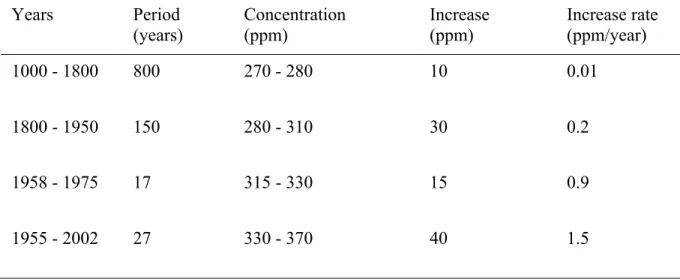
Carbon dioxide has been regarded as the premier source of greenhouse gas emission in the world. In 2014, United States Environmental Protection Agency (EPA) reported that 81% of the total greenhouse gas emission in US were associated with the carbon dioxide discharge and evolution represented in Figure 2-1 (EPA, 2015). Accordingly, the global level of carbon dioxide concentration has drastically increased by 90 ppm during the last 200 years, summarized in Table 2-1 (Omae, 2006).
Table 2-1: The variation of CO2 in the atmosphere during the last 1000 years (Omae, 2006)
The environmental concerns associated with the combustion and processing of petroleum-based resources, namely, sulfur dioxide, nitrogen oxides, carbon monoxide, carbon dioxide and particulate matter, have emerged the governments to mandate strict policies to control the emission crisis (IEA, 2016). Whereas, fossil fuels have severely contributed to the global warming discharging 70 - 75% of annual carbon dioxide via combustion reactions (Hoel & Kverndokk,
Years Period (years) Concentration (ppm) Increase (ppm) Increase rate (ppm/year) 1000 - 1800 800 270 - 280 10 0.01 1800 - 1950 150 280 - 310 30 0.2 1958 - 1975 17 315 - 330 15 0.9 1955 - 2002 27 330 - 370 40 1.5
1996). Furthermore, the irrepressible depletion of available dominant energy resource reserves, oil, and coal, has inspired the energy sector to pursuit alternative roadmap for the global demand outlook (Shafiee & Topal, 2009). In 2011, BP reported that there has been a +5.6% escalation in the global energy consumption, which is regarded as the strongest growth since 1973 with China leading the market share by 20.3% (BP, 2011).
Figure 2-1: The total greenhouse gas emission and CO2 emission in United states in 2014 breakdown reproduced from (EPA, 2015)
It has been estimated that the global energy demands would increase at an average rate of 1.1% per annum, from 500 quadrillion Btu in 2006 to 701.6 quadrillion Btu in 2030 (Shafiee & Topal, 2008). According to a report published by BP in 2016, oil has been the predominant vector, accounting for 33% of the global energy consumption. Furthermore, the total available oil reservoirs on the planet were estimated to be 1697.6 thousand million barrels. Thus, based on the current production rate and capacity, considering the reserves to production ratio (R/P), the accessible reservoirs will scarcely cover the global energy requirements for the next half decade (BP, 2016b). Figure 2-2 illustrates the petroleum consumption profile and proved reserves based on global regions for the last 30 years.
Meanwhile, the unprecedented decline of the conventional energy market on the one hand, and the environmental concerns associated with extraction, transportation and application of the established fissile fuel based energy on the other hand has urged the industrial sector to investigate for sustainable, innovative and alternative resources to satisfy the global energy market demands.
Carbon Dioxide 81% Nitrous Oxide 6% Fluorinated Gases 3% Methane 11% Electricity 37% Transportation 31% Industry 15% Residential & Commercial 10% Other (Non-Fossil Fuel Combustion) 6%
Consequently, renewable energy resources have been acknowledged as noteworthy possibilities to maintain the ever-growing energy market while comply with strict environmental regulation to persevere the planet from further irretrievable destruction (Turner, 1999). Application of renewable energy resources in transportation, electricity and power generation, and industrial processes have been highly regarded as the coherent alternative to economically unfeasible carbon dioxide sequestration endeavours (Pimentel & Patzek, 2008). Renewable energy in generally defined as a resource independent from viable and independent of restricted fossil reserves, namely, hydro-electricity, geothermal, hydrogen, biomass, solar and wind (Salameh, 2003).
Figure 2-2: The representative data of worldwide (a) Oil consumption profile and (b) Verified oil reserves for various global regions from 1980 to 2015. (Image reproduced from data provided by
(BP, 2016b)).
(a)
Moreover, solar energy has been regarded as the preliminary resource for all renewable energy segments contemplating that every supplementary format has been principally established and driven by the energy transmitted from the sun. Recent developments and breakthroughs in production and harvesting methods, depletion and exhaustion of the fossil fuel reserves, mass production processes and spontaneously available feedstock has developed renewable energy criteria from economically unfeasible to highly affordable and accessible resources (Timmons et al., 2014). In 2015, U.S. Department of Energy reported a 4% growth in the global investments in renewable energy market for a total sum of $329 billion (Beiter & Tian, 2016). Consequently, the advent of the economically feasible and environmental friendly renewable energy resources stipulates an esteemed opportunity to promptly produce clean and affordable electricity (Carrasco et al., 2006). Moreover, a significant production, maintenance and distribution cost decline trend for solar and wind based electricity has been evidenced during the last 3 decades (Saidur et al., 2010; Solangi et al., 2011; Timilsina et al., 2012; Wiser et al.). Consequently, the convenience of affordable renewable electricity which projects substantially lower carbon footprint and CO2 emission during the production, distribution and application stages provides a unique potential to preform chemical reactions via electromagnetic processing methods, namely; induction heating, ultrasound heating and microwave heating, correspondingly.
2.1.1 Natural Gas Prospect
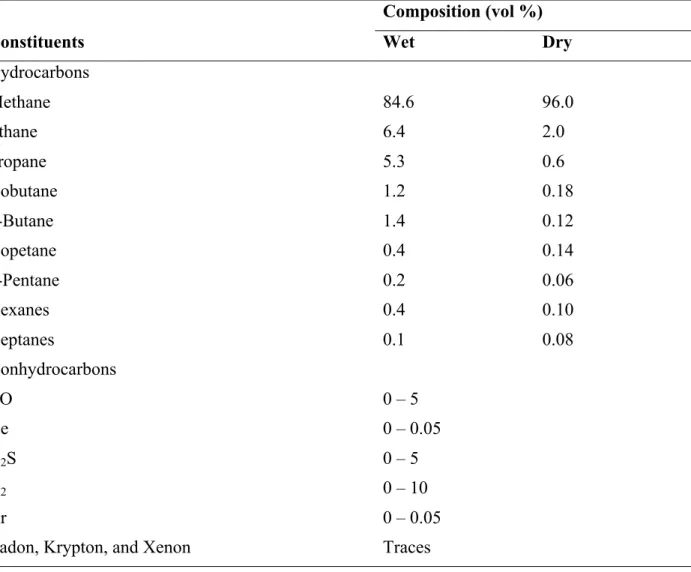
Contemplating the deficiencies of conventional resources, the energy sector has promptly maintained endeavors to identify complementary solutions, thus natural gas has been signified as a robust candidate. Natural gas is a combustible mixture of low-chain and light hydrocarbons structurally dominated by methane as the major component and minor proportions of ethane, propane, butane, pentane and acid gasses (S. Lee, 1996). Table 2-2 has summarized the conventional composition of natural gas according to the structural compounds. The major advantages of the application of natural gas over conventional dominant energy resources, oil and coal, are the clean burning, significantly lower carbon footprint, lower contribution to the worldwide emission and evolution of lower level of CO2, an influential factor in global warming (Christian Enger et al., 2008).
Due to the dominant proportions of methane in the structure of natural gas, major studies emphasize on the methane processes and reaction mechanisms (A. P. E. York, T. Xiao, & M. L. H. Green,
2003). Natural gas has been highlighted as the fastest growing energy resource, while oil and coal are suffering from a declining transition period, specifically due to the escalation in US shale gas and liquefied natural gas (LNG) production rate, strict environmental policies reinstated by the governments and the significant elevation of demands from emerging economies with China, India and the Middle East leading the market shares (BP, 2016a). Early predictions have concluded natural gas to surpass coal as the second dominant energy vector, majorly based on the decline in the production and rigorous environmental regulations, and further reach the petroleum dominance level in the short-term energy outlook (Birol & Argiri, 1999; BP, 2016a; IEA, 2016). Figure 2-3 provides a representative profile of primary energy resources from 1980 to an estimated trend up to 2035.
Table 2-2: Approximate Structural Data of Methane in Wet and Dry States (Speight, 1993). Composition (vol %)
Constituents Wet Dry
Hydrocarbons Methane 84.6 96.0 Ethane 6.4 2.0 Propane 5.3 0.6 Isobutane 1.2 0.18 n-Butane 1.4 0.12 Isopetane 0.4 0.14 n-Pentane 0.2 0.06 Hexanes 0.4 0.10 Heptanes 0.1 0.08 Nonhydrocarbons CO 0 – 5 He 0 – 0.05 H2S 0 – 5 N2 0 – 10 Ar 0 – 0.05
The distribution of natural gas has been identified similar to oil and coal reserves. However, natural gas is majorly confined in hydrate form allocated in remote regions and deep ocean environments. Clathrates of gas and water, commonly known as gas hydrates, are solid and non-stoichiometric compounds generate by contact between small guest molecules, namely, methane and carbon monoxide at minimal sizes (< 0.9 nm) with water at ambient temperature and moderate pressures higher than 0.6 Mpa (Sloan, 2003).
Presently, methane has been an indispensable component of various industrial applications including, energy supply for power plants and electricity generation, automotive fuels, syngas production, and production of various value added chemicals including hydrogen cyanide, chloromethane and carbon disulfide (R. Edwards, Mahieu, Griesemann, Larivé, & Rickeard, 2004; Eriksson et al., 2006; Folkins, Miller, & Hennig, 1950; Hickman & Schmidt, 1993; Koberstein, 1973; Murray, Tsai, & Barnett, 1999; Podkolzin, Stangland, Jones, Peringer, & Lercher, 2007). Figure 2-4 illustrates various applications and conversion processes of methane to energy and value-added chemicals.
Figure 2-3: Global energy market share profile from 1965 to an estimated trend up to 2035 (Image reproduced from data provided by (BP, 2016a)).
2.2 Methane Conversion to Syngas
Deliberating the critical accessibility issues associated with the discovered reserves and the general complexity accompanying the transportation of gaseous components, conversion of methane resources to value-added chemicals have been promptly perused (C. A. Jones, Leonard, & Sofranko, 1987). Conversion of methane aims to address the transportation deficiencies while economically justifies the processing for the energy sector (Rostrup-Nielsen, 1994). Meanwhile, conversion of methane into syngas has aroused prominent interest to preserve a carbon-neutral energy cycle on the future industrial outlook. Synthetic gas, commonly referred as syngas, is a complex gas mixture majorly dominated by hydrogen, carbon monoxide and carbon dioxide and traces of sulfur compounds as impurities (Hu & Ruckenstein, 2004; Wilhelm et al., 2001).
Figure 2-4: Various conversion mechanisms and applications of natural gas.
Natural Gas Syngas Direct Conversion LNG Electricity Reinjection Flaring Diesel (FT) MEOH DME Gasoline (MTG) MeOH CnHm
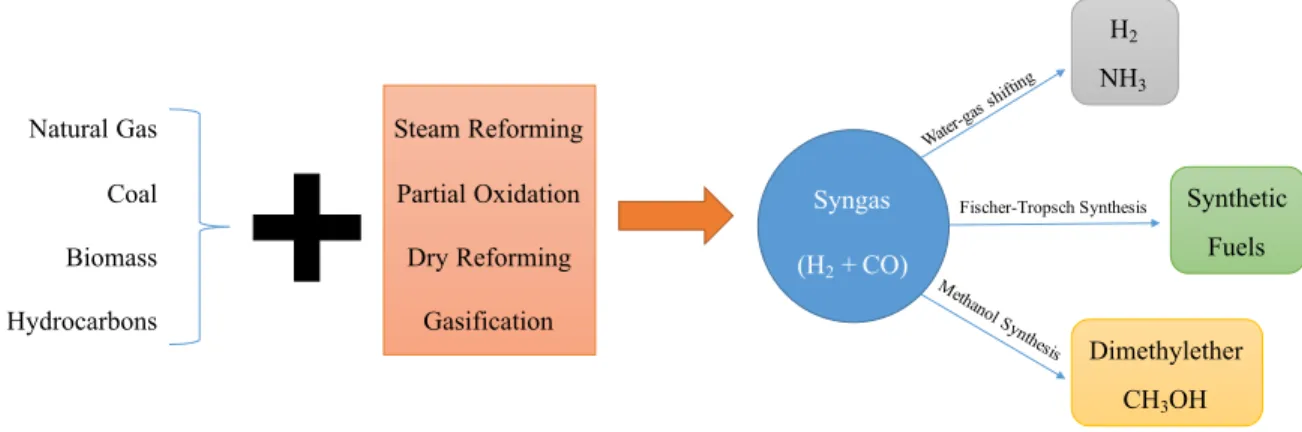
The production of syngas from various resources including natural gas, coal, biomass or various hydrocarbon feedstock has been investigated in the literature using multiple oxidizing components namely, steam and oxygen, denoting the versatility of the feedstock and the flexibility of the processes (Aasberg-Petersen et al., 2001; Rostrup-Nielsen, 2000). Major applications of syngas have been underlined as co-firing (Wu et al., 2004), energy production in gas turbines (Gadde et al., 2006), gas engines (Martínez et al., 2012), Stirling engines (Miccio, 2013), fuel cell production (B. C. H. Steele & Heinzel, 2001) and production of value-added chemicals such as methanol, formaldehyde and long-chain hydrocarbons via gas to liquids (GtL) processes, namely Fischer-Tropch (FT) synthesis (Dry, 2002; Riedel et al., 1999). The direct conversion of CH4 to methanol (MeOH) with a relatively high selectivity of 80% presents a very low conversion of 7% which leads to scale-up issues such as high recycling rate and complex separation processes (Yarlagadda, Morton, Hunter, & Gesser, 1990). In contrary, the commercial production of methanol from syngas provides 50% conversion and the selectivity can reach as high as 99% (Aasberg-Petersen et al., 2001). Figure 2-5 provides a graphical review of various syngas production routes and applications.
Figure 2-5: A schematic review of syngas production and further conversion to value-added chemicals.
Originally, Sabatier and Senderens developed the mechanism of conversion of methane into syngas in the presence of steam in 1902 (Sabatier & Senderens, 1902). Since then multiple state-of-the-art processes have been developed to convert methane into syngas based on the final application of the products (Christian Enger et al., 2008; Hu & Ruckenstein, 2004). However, the most prominent processes have been acknowledged as steam reforming (SRM), dry (CO2) reforming (DRM) and catalytic partial oxidation (POx). The critical factor in the prosperous conversion of methane to value added products is to provide energy to disband the resilient CH3 – H bond, with a high
Natural Gas Coal Biomass Hydrocarbons Steam Reforming Partial Oxidation Dry Reforming Gasification Syngas (H2+ CO) Fischer-Tropsch Synthesis H2 NH3 Synthetic Fuels Dimethylether CH3OH