Journal of Applied Biosciences 120: 11993-11998
ISSN 1997-5902
Heavy metal pollution of aquatic systems in oil
producing communities of delta state, Nigeria
*Ubiogoro, O.E and Adeyemo, O.K
Fish and Wildlife Unit, Department of Veterinary Public Health and Preventive Medicine, University of Ibadan, Ibadan, Nigeria
Correspondence: UBIOGORO, O.E, Fish and Wildlife Unit, Department of Veterinary Public Health and Preventive Medicine University of Ibadan, Ibadan, Nigeria , Tel: +234-803-330-7054. E-mail: [email protected]
Original submitted in on 27th September 2017. Published online at www.m.elewa.org on 30th December 2017
https://dx.doi.org/10.4314/jab.v120i1.1
ABSTRACT
Objective: This study was designed to determine the heavy metal pollution status of some rivers and creeks within oil producing communities in Delta state of Nigeria.
Methodology and Results: Water and fish samples were collected from six Rivers in Delta state viz: Egbokodo River in Warri, River Ethiope in Sapele, Urie River in Igbide Isoko, Asaba-Ase creek, Aragba River in Abraka, and Uzere Creek. Water fresh, and ready to eat fish samples were analyzed for heavy metals (lead, cadmium, manganese, copper, iron and nickel) levels. Most heavy metals were marginally below the residual level recommended by the World health organisation (WHO) and Federal Environmental Protection Agency (FEPA). Iron cadmium and Nickel were detected in all samples irrespective of the site of collection. Nickel exceeded the WHO standard limit (0.6) in fresh fish samples from Aragba (0.89) and Asaba-Ase (0.7), while fresh fish sample from Ethiope river had marginally higher Manganese concentrations (0.57) than recommended by WHO (0.5) Conclusion and application of results: Fish from each of these rivers were marginally safe in their concentration of the studied metals. Caution and constant monitoring to prevent increased concentration and to the aquatic fauna and resultant toxicity to human consumers through the trophic web is important. Further investigation and routine monitoring will enable optimal recommendations and policies for surface water and fauna monitoring of the Niger Delta region in Nigeria.
Keywords: Heavy metals; Pollution; fish; Delta state; Nigeria. INTRODUCTION
Heavy metals are natural components of the earth crust that cannot be degraded or destroyed. Some heavy metals are required in living organisms but in trace amounts for normal metabolic activities example of such are copper, iron, zinc, manganese and cobalt. These are referred to as trace elements, while some others are toxic even at low concentrations (Tyrell et al., 2003; NZFSA, 2008). However, excessive amounts of the essential trace
metals are also detrimental to health (Pierce et al., 1998). Pollution of the aquatic ecosystem by heavy metals is an environmental problem, as heavy metals constitute some of the most dangerous toxicants that can bioaccumulate (Nsikak et al., 2007). Heavy metal have been reported by several researchers as major water pollutants, though naturally occurring, their high level as pollutants in water is traceable to anthropogenic activities
particularly industrialization. Areas containing mineralized rocks (River beds containing solid minerals) will usually have elevated metal levels as, the trace metal content of River water is normally controlled by the abundance of metals in the rocks of the River’s catchment area and by their mobility (Olajire et al., 2000). These heavy metals at high level constitute toxic pollutants in our water bodies, and hence threaten aquatic organisms since exposure even at low levels cause bioaccumulation. (Adeyemo, 2007). The Niger Delta is unique in Nigeria because it is the home of Nigeria’s oil industry. The Niger delta region of Nigeria is known for the crude oil natural resources. Human activities and those of oil exploration raise a number of issues such as depletion of biodiversity, coastal and river bank erosion, flooding, oil spillage, gas flaring, noise pollution, sewage and waste water pollution, land degradation and soil fertility loss and deforestation, which pose great challenges to economic development of the Niger Delta (Adati, 2012).This does not only disrupt the functions of the aquatic ecosystem but also pose a threat to public health. Records exist of pollution of Warri River by refinery, steel and other industrial effluents. Rivers, creeks, etc. around the fertilizer plant at Onne in Rivers State and many aquatic systems of the coastal oil producing zones have been reported to be polluted by spilled petroleum (Egborge, 1998). Pollution in the
Niger Delta region is therefore largely due to industrialization and the petrochemical industrial. Heavy metals such as Ni, V, Pb, Fe, Mn, Zn, Hg, Cu and Cd have been associated with oil refinery activities including oil spillage (Biney et al., 1994; Osuji et al., 2004; Akpoveta and Osakwe, 201). The accumulation of toxic metals to hazardous levels in aquatic biota has become a problem of increasing concern (Manahann, 1994; Idodo–Umeh, 2002). Metals can be absorbed by organisms from the surrounding water or ingested with their food. Once absorbed, metals tend to accumulate in certain tissues and organs rather than distributing uniformly through the body. Most of them are excreted very slowly and thus they may accumulate in the body. connected to severe health conditions like cancer brain damage, nervous system dysfunction, osteoporosis, kidney, liver damage, diabetes, respiratory and reproductive disorders and more (Kazantzis, 2004; Sanders et al., 2009). They may also impair growth, development and reproduction, cause malformations of the body, damage to organs or disruption in the immune system. Developing foetuses and growing young are particularly sensitive to low levels of many metals the adverse biological effects are varied, complex and potentially fatal (Pierce et al., 1998). This study was aimed at assessing the heavy metal pollution status of oil producing communities of Delta State.
MATERIALS AND METHODS
Study Area Description: Delta state is one of the oil producing states of Nigeria situated in the region known as the Niger Delta, South-South Geo-political zone with a population of about 4,098,291 (Federal Republic of Nigeria, Official gazette, No. 24, vol. 94, 2007.) The State is located approximately between Longitude 5°00 and 6°.45' East and Latitude 5°00 and 6°.30' North. Specific sites of sample collection are Egbokodo side of the river in Warri although Warri is a busy town, the Egbokodo area is more of a fishing community. Uzere creek in Uzere township that is within the coordinates 5° 12N and 6° 10Ea relatively quiet and sparkly populated community. Urie river (from the Oteri-Igbide axis, Isoko south Local government area) is also a sparsely populated community, with Asaba-Ase creek off River Niger in Ndokwa East Local Government Area, Aragba
river 5° 45' 0" North, 6° 10' 0" East, and River Ethiope in Sapele, Sapele lies within Coordinates: 5°54′N 5°40′E. Sample collection: This study was carried out on six Rivers and creeks within Delta state. Upstream and downstream surface water samples were collected from each water body. Water samples were collected at a 30cm depth in pre-cleaned 500 ml plastic bottles and accurately labelled. Live fish samples were purchased from the local fishermen at each water site visited, the samples were immediately cleaned of particulate debris and packed in labelled clean plastic bags and immediately preserved in coolers containing ice packs. Samples (water and fish) were kept on ice during transportation to the laboratory for analysis. Some of the purchased samples, which were to be processed into ready-to-eat samples, were washed with water and smoke-dried before being analyzed in the laboratory
Laboratory Analysis Technique: The standard method for examination of water (APHA, 1998) was adopted in the determination of the physical and chemical qualities of the water samples. The physiochemical qualities assessed include: pH, conductivity, salinity, turbidity, suspended solids, total nitrogen (TN), the sum of nitrate and nitrogen, (NO3-N), iron, phosphate and sulphate. Preparation of water and fish samples for heavy metal determination: Analysis was also done according to standard methods for heavy metal determination (APHA, 1989) using Atomic Absorption Spectrophotometer (Varian SpectrAA 400plus). Frozen fish samples were allowed to thaw gradually at room temperature, skinned and filleted. The musculature was weighed to a constant wet weight of about 5g of each sample and digested in a beaker using 25mls of concentrated nitric acid and hydrogen peroxide at a ratio of 2:1; this was allowed to digest over a hot plate at a temperature not more than
160oC until only about 3-5mls of the content was left. The
beaker and its content were allowed to cool and were transferred through Whatman filter into a 50ml volumetric flask and made up to the 50ml mark with distilled water. Reagent blanks were also prepared accordingly to test the purity of the reagents. Metal concentrations for all extractions were determined by Varian SpectrAA 400plus Atomic Absorption Spectrometer, using the respective lamps and wavelengths. Values of heavy metals were read in mg/L and then converted and recorded in mg/kg for fish samples.
The BCF was derived as follows: BCF = Level of Heavy metal in fish Level of Heavy metal in water
Statistical Analysis: Data collected were computed into means with standard deviation. Means were compared statistically using student’s “t-test” and ANOVA.
RESULTS
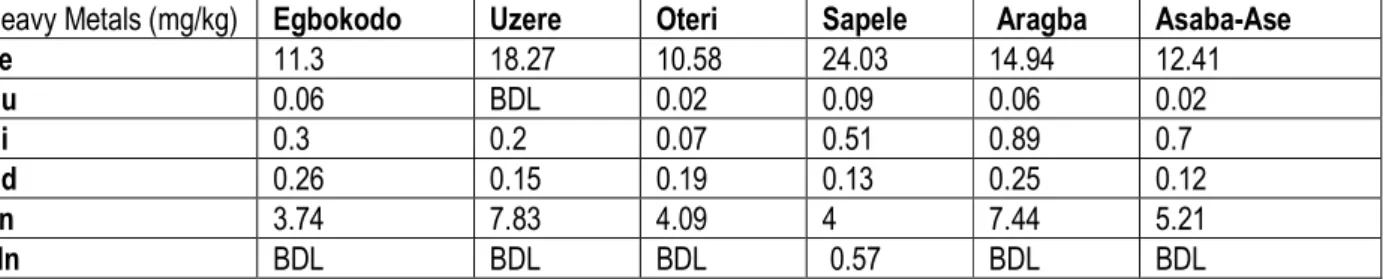
The results of the quantitative analysis of 7 heavy/trace metals (iron, Copper, Nickel, Cadmium, Zinc and Manganese.) in the sampled water, fresh fish and dry ready to eat fish is presented in Tables 1, 2 and 3
respectively. Generally, Nickel appeared to be more abundant in all the sampled rivers followed by cadmium; lead was not totally absent but not obviously detectable
Table 1: Speciation of Heavy Metals in Rivers and Creeks in Delta State.
Heavy Metals (mg/l) Egbokodo Uzere Oteri Sapele Aragba Asaba-Ase
Fe 0.19±0.02 3.21±0.80 0.27±0.17 0.19±0.09 0.14±0.09 0.18±0.03 Cu BDL BDL BDL BDL BDL BDL Ni 0.05±0.03 0.02±0.02 0.01±0.00 0.01±0.00 0.00±0.00 0.02±0.01 Cd 0.02±0.01 0.02±0.00 0.02±0.00 0.01±0.01 0.02±0.00 0.02±0.00 Zn 0.01±0.01 BDL 0.01±0.00 0.04±0.03 BDL BDL Mn BDL BDL BDL BDL BDL BDL
Results are presented as mean ± standard deviation (SD). Table 2: Speciation of Heavy Metals in Fresh Fish Samples
Heavy Metals (mg/kg) Egbokodo Uzere Oteri Sapele Aragba Asaba-Ase
Fe 11.3 18.27 10.58 24.03 14.94 12.41 Cu 0.06 BDL 0.02 0.09 0.06 0.02 Ni 0.3 0.2 0.07 0.51 0.89 0.7 Cd 0.26 0.15 0.19 0.13 0.25 0.12 Zn 3.74 7.83 4.09 4 7.44 5.21 Mn BDL BDL BDL 0.57 BDL BDL
Table 4 shows the bio concentration of the heavy metals in the studied rivers. While the metal levels in the fresh fish samples and dry-ready to eat samples from the
various rivers are presented in tables 2 and 3 respectively.
Table 3: Speciation of Heavy Metal in Dry Ready-to-Eat Fish Samples
Heavy Metals (mg/kg) Egbokodo Uzere Oteri Sapele Aragba Asaba-Ase
Fe 23.58 25 29.79 12.08 17.21 14.94 Cu BDL 0.02 0.14 0.27 0.03 0.13 Ni 0.75 0.98 0.51 0.5 0.08 0.01 Cd 0.14 0.21 0.2 0.2 0.16 0.18 Zn BDL 14.19 32 27.04 9.65 14.63 Mn BDL BDL 0.33 0.45 0.68 0.12
Table 4: Bio concentration Factor of Different Heavy Metals.
Heavy Metals (mg/kg) Egbokodo Uzere Oteri Sapele Aragba Asaba-Ase
Fe 58.6 5.7 38.8 125.2 106.0 70.9 Cu BDL BDL BDL BDL BDL BDL Ni 6. 7 8.3 5 46.4 222.5 43.8 Cd 10.8 9.4 10 11.8 13.2 7.1 Pb BDL BDL BDL BDL BDL BDL Zn 287.7 BDL 584.3 100 BDL BDL Mn BDL BDL BDL BDL BDL BDL
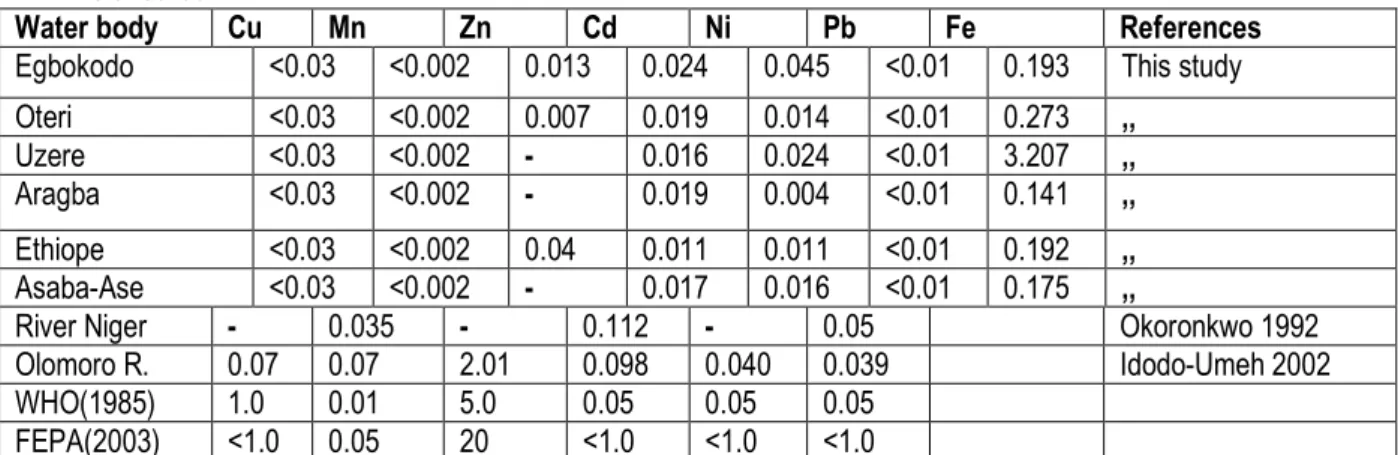
Table 5: Comparison of mean heavy metal levels of the various study rivers with those of other nearby rivers, WHO, and FEPA standards
Water body Cu Mn Zn Cd Ni Pb Fe References
Egbokodo <0.03 <0.002 0.013 0.024 0.045 <0.01 0.193 This study Oteri <0.03 <0.002 0.007 0.019 0.014 <0.01 0.273 ,,
Uzere <0.03 <0.002 - 0.016 0.024 <0.01 3.207 ,, Aragba <0.03 <0.002 - 0.019 0.004 <0.01 0.141 ,, Ethiope <0.03 <0.002 0.04 0.011 0.011 <0.01 0.192 ,, Asaba-Ase <0.03 <0.002 - 0.017 0.016 <0.01 0.175 ,,
River Niger - 0.035 - 0.112 - 0.05 Okoronkwo 1992
Olomoro R. 0.07 0.07 2.01 0.098 0.040 0.039 Idodo-Umeh 2002
WHO(1985) 1.0 0.01 5.0 0.05 0.05 0.05
FEPA(2003) <1.0 0.05 20 <1.0 <1.0 <1.0
Table 6: Comparison of metal values obtained in fish samples with international standards
Rivers Cu Mn Zn Cd Ni Fe Egbokodo 0.06 - 3.74 0.26 0.3 11.3 Uzere - - 7.83 0.15 0.2 18.27 Oteri 0.02 - 4.09 0.19 0.07 10.58 Ethiope 0.09 0.57 4.00 0.13 0.51 24.03 Aragba 0.06 - 7.44 0.25 0.89 14.94 Asaba-Ase 0.02 - 5.21 0.12 0.7 12.41 WHO 3.0 0.5 10-75 2.0 0.6 FEPA 1-3 0.5 75 2.0 0.5
DISCUSSION AND CONCLUSION
Nwadinigwe et al. (1999) described Nigeria’s crude oil as known to contain heavy metals in varying proportion. Delta state, the largest oil producing state in Nigeria is
exposed to a large proportion of the environmental degradation and health hazards that normally accompany exploration and exploitation of crude oil. The subsurface
flow system of the Niger delta is as complex as the braided nature of the streams and rivers therein (Ekundayo, 2006) coupled with the problems of environmental pollution, degradation, river siltation, coastal erosion, as well as extermination of wildlife, fauna and flora that are of the fate of oil bearing communities in Niger-delta region. Largely adverse effects on humans have motivated concern about heavy-metal contamination of fish, given that consumption of fish is the primary route of heavy metal exposure (Nsikak et al., 2007; Adeyemo et al., 2011). The results of heavy metals obtained, below detectable levels (BDL) of Pb and Mn in mg/ml was found in all the sampled waters. This can probably be attributed to the scanty population and low level of commercial activities in the communities sampled and possibly the season. Cu had BDL - 0.27 ranges, River Ethiope in Sapele had the highest value of 0.27. Egbokodo, Uzere and Asaba-Ase river had 0.045, 0.024, 0.16 values of nickel respectively. None of these metals exceeded the WHO and FEPA standards for water of 1985 and 2003 respectively. Heavy metal (Cd, Cr, Pb, Mn) values obtained from Egbokodo river water samples were lower than those obtained in the study of Nduka et al. (2009), though both studies indicate the presence of most of these metals, the proximity of the point of sample collection to the industrial sites and probable time/season of the year could have effect on the results obtained. Values of Cu, Ni, and Zn in this studies are within safe level compared to the WHO and FEPA standards, this
also corresponds with report of several researchers on water bodies within Delta state, specifically Warri rivers (Aremu et al., 2002; Emoyan et al., 2006; Kaizer et al., 2010). The metal level in the fish sample showed the Manganese and Nickel level in Fresh Fish sample from River Ethiope slightly exceeding the WHO and FEPA acceptable limits of 0.5 and 0.6 respectively, this shows some level of biomagnifications in the fish. Nickel level in the fish from Aragba and Asaba- Ase were also higher than the WHO and FEPA limits. Nickel presented a slightly higher level of 0.75 and 0.98 in the dry- ready to eat fish from Egbokodo and Oteri Rivers respectively. Heavy metals are potentially harmful to most organisms at some level of exposure and absorption (Chan, 1995). Considering the biomagnifications ability of heavy metals, constant exposure in small doses will certainly lead to a magnified health risk effect in consumers. For example, long-term exposure to cadmium in man has been associated with renal dysfunction (Zahir et al., 1999), reproductive toxicity and poor semen quality (Akinloye et al., 2006). Most metals have received attention as both environmental and potential toxicological hazards, and are enlisted by the WHO as chemicals of public health concern (WHO, 2015). The level of heavy metal pollution of water bodies in this region is relatively unstable depending on the ongoing industrial activities in the area par time It is therefore recommended that the aquatic systems in this region be subjected to periodic. monitoring for metal toxicants to ensure public health safety. ACKNOWLEDGEMENT
The author appreciates Dr. John Paul Unyinmadu, of the Nigerian Institute of Oceanography and Marine Research
(NIOMR) for his assistance. The management and staff of Environmental Protection services laboratory Lagos. REFERENCES
Adati Ayuba Kadafa 2012. Oil Exploration and Spillage in the Niger Delta of Nigeria. Civil and Environmental Research www.iiste.org ISSN 2222-1719 (Paper) ISSN 2222-2863 (Online) Vol 2, No.3, 2012 38
Adeyemo, O.K. 2007. Haematological Profile of Clarias gariepinus Exposed to Lead. Turkish Journal of Fisheries and Aquatic Sciences 7: 163-169. http://www.trjfas.org / pdf/issue 7 2/163_169.pdf. Adeyemo, O.K., and Akomolafe, O.T. 2011. Copper Level
in Fish, Selected Fresh and Marine Aquatic Ecosystems in Nigeria. Afr. J. Biomed. Res. 14: 105 - 111.
Akhilesh, J., Savita, D., Suman, M. 2009. Some trace elements investigation in groundwater ofof Bhopal and Sehore District in Madhya Predesh,
India. Journal of Appl. Sci. Environ. Manage, 13(4):47-50.
Akpoveta, O.V., Osakwe, S.A. 2014. Determination of Heavy Metal Contents in Refined Petroleum Products OSR Journal of Applied Chemistry (IOSR-JAC) e-ISSN: 2278-5736.Volume 7, Issue 6 ver. I., pp 01-02. www.iosrjournals.org APHA (American Public Health Association). 1989.
Standard Methods for Examination of Water and Waste Water. Clesceri LS, Greenberg AA, Trussel RR 17th Edition, p. 314.
Aremu, D.A., Olawuyi, J.F., Meshitsuka, S., Sridhar, M.K., and Oluwande, P.A., 2002. Heavy metal analysis of groundwater from Warri, Nigeria. Intern. J. Environ. Health Res., 12: 261-267.
Biney, C.H, Amuzu T.A., Calamari, D., Kaba, N., Mbome. I.L., Naeve., P.B. Ochumba., Osinbanjo, O., Radegonde, V., and Saad, M.A.H. 1994. Review of Heavy Metals in the African Aquatic Environment. Ecotoxicol.Env. Saf., 28(2):134-59.
Chan, H.M., Kim C, Khoday, K., Receveur, O., Kuhnlein, H.V., 1995. Assessment of dietary exposure to trace metals in Baffin Inuit food. Environ Health Perspect., 103: 740-6.
Egborge, A.B.M 1998. First Urhobo Economic summit on Oil, Gas and Sustainable Development; Some Solutions to Water Problems in the Niger Delta. November 27-28, 1998.
Ekundayo, E.O 2006. Geoenvironmental properties of the ground water protective soil layers in Brass, Nigeria. Int J Environ Waste Manag.2006; 1(1): 75-84.
Emoyan, O.O., Ogban, F.E., Akarah, E., 2006. Evaluation of heavy metals loading of river Ijana in Ekpan-Warri, Nigeria. J. Applied Sci. Environ. Manage., 10: 121-127
FRN (Federal Republic of Nigeria). 2007.Nigeria: State by State. Official gazette, No. 24, vol. 94. FEPA (Federal Environmental Protection Agency). 2003.
Guidelines and Standards for Environmental Pollution Control in Nigeria. p.238.
Idodo-Umeh, G. 2002. Pollution assessments of Olomoro Water bodies using Physical, Chemical and Biological indices: PhD. Thesis, University of Benin, Benin City, Nigeria, p. 485.
Kaizer, A.N., Osakwe 2010. Physicochemical characteristics and heavy metals levels in water samples from five river systems in Delta State, Nigeria. J. Applied Sci. Environ. Manage, 14: 83-87.
Kazantzis G, 2004. Cadmium, osteoporosis and calcium metabolism. Biometals, 17:493-498.
Mahboob S., Al-Balawi H.F.A, Al-Misned F., Al-Quraishy S., Ahmad Z. 2014. Tissue Metal Distribution and Risk Assessment for Important Fish Species from Saudi Arabia. Bulletin of Environmental Contamination and Toxicology, 92: 61-66.
Manahann, S.E. 1994. Environmental Chemistry, 6th Edition, Lewis Publishers Ann. Arbor, London, Tokyo, p. 812.
Nduka, J.K, Orisakwe,O.E. 2009. Effect of Effluents from Warri Refinery Petrochemical Company WRPC on Water and Soil Qualities of “Contiguous
Host” and “Impacted on Communities” of Delta State, Nigeria; The Open Environmental Pollution & Toxicology Journal, 1: 11-17 NZFSA (New Zealand Food Safety Authority). 2008.
68-86 Jervois Quay P.O. Box 2835, Wellington, NEW ZEALAND.
Nwadinigwe C.A., Nworgu O.N., 1999. Metal contaminants in some Nigerian Wellheads crudes. Comparative analysis. J Chem Soc Nigeria, 24: pp118-121.
Nsikak, U.B., Joseph, P.E., Akan, B.W., David, E.B. 2007. Mercury accumulation in fishes from tropical aquatic ecosystems in the Niger Delta, Nigeria. Current Science. 92(6): pp 781–785. Okoronkwo, I.P 1992. Heavy metals content in Water and
Fish of River Niger at Yelwa – Yauri: M.Sc. Thesis: University of Benin, Benin City, Nigeria. 88pp.
Osuji, L., Onojake, N. 2004. Trace Heavy Metals Associated with Crude Oil: A Case Study of Ebocha‐8 Oil‐Spill‐Polluted Site in Niger Delta, Nigeria Chemistry & Biodiversity 1(11):1708-15 · November 2004 DOI: 10.1002/cbdv.200490129 Olajire, A.A., Imeokparia, F.E., 2000. A study of the water
quality of the Osun River: Metal monitoring and geochemistry. Bull Chem Soc. Ethiopian 2000; 14(1): 1-8.
Sanders T., Liu Y., Buchner V., Tchounwou P.B. 2009. Neurotoxic effects and biomarkers of lead exposure: A review. Reviews on Environmental Health 24:15-45
Tyrell, L., Mchugh, B., Lynn, D.G., Womey, M.T., Oyce, E.J., Ostell, J.C., McGovern, E. 2003. Trace metal Concentrations in Various Fish species landed at selected Irish ports, Marine Environment and Health series, No. 20. Pierce R.C., Whittle D.M., Bramwell J.B. 1998. Chemical
Contaminants in Canadian Aquatic Ecosystems; Fisheries and Oceans Canada. Canadian Government Publishing, Ottawa, ON (editors) Bay of Fundy Marine Ecosystem 2004. WHO (World Health Organization). 1985. Guidelines for
Drinking Water Quality. Vol.1. Recommndation Geneva, p. 130.
WHO (World Health Organization) 2015. WHO Chemical Safety- Activity Report. Ten Chemicals of Major Public Health Concern". World Health Organisation.