UNIVERSITÉ DE MONTRÉAL
INTEGRATED FLUIDIZED BED-MEMBRANE PROCESS FOR ADVANCED
IRON AND MANGANESE CONTROL IN DRINKING WATER
SEYEDEH LALEH DASHTBAN KENARI
DÉPARTEMENT DES GÉNIES CIVIL, GÉOLOGIQUE ET DES MINES POLYTECHNIQUE MONTRÉAL
THÈSE PRÉSENTÉE EN VUE DE L’OBTENTION DU DIPLÔME DE PHILOSOPHIAE DOCTOR
(GÉNIE CIVIL) AVRIL 2017
UNIVERSITÉ DE MONTRÉAL
POLYTECHNIQUE MONTRÉAL
Cette thèse intitulée :
INTEGRATED FLUIDIZED BED-MEMBRANE PROCESS FOR ADVANCED IRON AND MANGANESE CONTROL IN DRINKING WATER
présentée par : DASHTBAN KENARI Seyedeh Laleh en vue de l’obtention du diplôme de : Philosophiae Doctor a été dûment acceptée par le jury d’examen constitué de :
M. COMEAU Yves, Ph. D., président
M. BARBEAU Benoit, Ph. D., membre et directeur de recherche M. PERRIER Michel, Ph. D., membre
DEDICATION
ACKNOWLEDGEMENTS
This is the opportune moment to acknowledge all who in one way or another contributed to the completion of this thesis. First and foremost, I wish to express my deep and sincere gratitude to my supervisor Prof. Benoit Barbeau for his solid support, caring and patience, as well as providing me with an excellent atmosphere for conducting my research. His vast knowledge and logical way of thinking helped me throughout this process.
I acknowledge the members of my committee, Prof. John Tobiason, Prof. Michel Perrier and Prof. Yves Comeau, for taking interest in my work, examining my thesis and providing insightful comments.
I also gratefully acknowledge the financial support of RES’EAU-WATERNET, a NSERC (Natural Sciences and Engineering Research Council of Canada) collaborative strategic network, which made this research work possible.
Special thanks go to my friend, Émile Sylvestre, for translating the abstract of this thesis into French. I am very grateful to all my colleagues in our research group and my fellow labmates and officemates for their cooperative manner and friendly support.
My deepest appreciation goes to the technicians and research associates in the Department of Civil, Geological and Mining Engineering, particularly Mireille Blais, Yves Fontaine, Julie Philibert, Jacinthe Mailly, Marcellin Fotsing and Valentin Pfeiffer for their excellent assistance. In addition, I thank the secretaries of the Department of Civil, Geological and Mining Engineering for helping us and providing us with an ideal atmosphere in which to advance our projects.
I genuinely express my profound gratefulness to my beloved husband, Jaber Shabanian, as I owe my success to his love, patience, heartfelt sympathy, and support.
And last but not least, from the bottom of my heart, I would like to express my endless gratitude to my mother, father, lovely brothers and sister, and in-laws for the absolute support they have provided me throughout my entire life, and without whose love, spiritual encouragement and altruism I would not have finished this thesis. Words are powerless to express what I feel in my heart for them.
RÉSUMÉ
Le fer et le manganèse se retrouvent généralement dans les sources d'eau naturelles, particulièrement en eaux souterraines, qui contiennent fréquemment des niveaux élevés de ces minéraux sous forme dissoute. Les concentrations de fer et de manganèse peuvent causer des problèmes esthétiques à l’eau potable et entrainer des coûts supplémentaires pour le nettoyage ou le renouvellement des conduites obstruées. Les usines de traitement de l'eau ont donc intérêt à éliminer ces minéraux de l'eau potable. De plus, plusieurs préoccupations en santé publique sont liées à la consommation du manganèse à l’eau potable. Par conséquent, Santé Canada (2016) a récemment proposé des lignes directrices pour protéger les enfants de ses effets neurotoxiques. La stratégie traditionnelle d'élimination du fer et du manganèse, par oxydation et la filtration en profondeur, a certaines limites, comme le faible taux d'oxydation du manganèse dissous (Mn(II)) et la formation d'oxyde de manganèse colloïdal, ce dernier étant difficile à retenir par la filtration en profondeur. L'application de membranes d'ultrafiltration (UF)/microfiltration (MF) a récemment été proposée en alternative pour leur capacité à éliminer efficacement les matières particulaires/colloïdales, les organismes pathogènes et les virus (seulement l’UF) par un procédé compact. Ce choix, permet à l’utilisateur de répondre à des normes règlementaires de plus en plus strictes à l’eau traitée. Cependant, le colmatage des membranes limite l'application de ce procédé. Par conséquent, le développement d'un procédé de prétraitement, pouvant diminuer le colmatage de la membrane, est nécessaire. L'élimination du Mn(II) par adsorption sur des milieux recouverts d'oxyde de manganèse suivie d'une oxydation catalytique du manganèse adsorbé, est un procédé efficace et économique. Toutefois, comme la capacité des sites d’adsorption disponibles est principalement régi par le pH, la concentration en chlore et le niveau de recouvrement d'oxyde de manganèse, elle a un impact important sur la performance du procédé. De plus, le taux de charge hydraulique (TCH), la concentration de Mn(II), la température et la dureté peuvent influencer la performance du procédé. Cependant, peu d'informations sont présentement disponibles sur l'impact de ces paramètres. De plus, les milieux recouverts d'oxyde de manganèse ont uniquement été étudiés en lits fixes, ce qui amène certaines limitations, comme un mauvais contact fluide-solide, une accumulation rapide de pertes de charge et un rétro-lavage fréquent conduisant à des TCH faibles. Ainsi, le développement d'un procédé pouvant éliminé efficacement des niveaux élevés de fer et de manganèse et opéré à des TCH élevés est souhaitable.
L'objectif principal de ce projet de recherche est de développer un procédé hybride à lit fluidisé de pyrolucite (LFP)-membrane pour améliorer le contrôle du fer et du manganèse dans l'eau potable (la limite cible de 0,02 mg Mn/L et 0,02 mg Fe/L dans l'eau traitée). Les objectifs spécifiques du projet sont: (1) déterminer les caractéristiques (distribution de la taille des particules (DTP), potentiel ζ et dimension fractale) des colloïdes/particules de l'hydroxyde ferrique et du dioxyde de manganèse qui sont générés en conditions d'oxydation typiques prévalent dans l'eau sous différentes conditions physico-chimiques (pH, force ionique et dureté), (2) évaluer la performance du procédé par membrane UF pré-oxydée par rapport à l'élimination du fer et du manganèse et le niveau de colmatage sous différentes conditions chimiques de l'eau, (3) déterminer les mécanismes de colmatage et la réversibilité du colmatage pour les membranes UF tubulaires en céramique et à fibres creuses en polymères, (4) étudier l’application d'un contacteur LFP pour réduire la concentration de Mn(II) dans les eaux souterraines sous les 0,02 mg/L en opérant à des conditions de TCH élevées et sous autres conditions, (5) opérer une usine pilote pour comparer les performances d'un contacteur fixe par rapport à un contacteur à lit fluidisé pour le contrôle du fer et du manganèse dans une nappe phréatique naturelle en condition d’opération à long terme afin de d’évaluer la faisabilité de ce processus pour les petites collectivités et les communautés rurales, et (6) comparer la performance d'un procédé hybride membranaire LFP-MF/UF par rapport à un procédé classique avec MF/UF membrane incluant une pré-oxydation (en ce qui concerne l'élimination du fer et du manganèse ainsi que l'atténuation du colmatage) sous différentes conditions chimiques.
En première partie de ce projet, la performance des membranes UF en céramique et en polymère avec une pré-oxydation en ligne pour le contrôle du fer/manganèse a été évaluée. En raison de l'impact possible des caractéristiques du fer et du manganèse oxydés sur la performance membranaire, cette recherche vise d'abord à déterminer le diamètre (DTP), le potentiel ζ et la dimension fractale de ces agrégats, en fonction du pH, de la force ionique et de la dureté en utilisant la diffraction laser (DL), la diffusion dynamique de la lumière (DDL) et le fractionnement par filtration membranaire en série. Pour le dioxyde de manganèse, le potentiel ζ a proportionnellement diminué par rapport au pH mais la force ionique et, surtout, la dureté l’ont augmenté, entrainant la formation de plus gros agrégats. En revanche, le potentiel ζ et le DTP des agrégats d'hydroxyde ferrique n'ont pas été significativement altérés par la chimie de l'eau. À l'étape suivante, le colmatage des membranes UF en céramique et en polymère a été évalué en utilisant les
modèles de loi de blocage et de résistance en série. Les résultats montrent que les paramètres chimiques de l'eau testée n'ont pas eu d'impact significatif sur l'efficacité d'élimination du fer/manganèse (> 99,5% pour toutes les conditions), mais ils ont permis d'expliquer le niveau du colmatage causé par les agrégats de dioxyde de manganèse. Contrairement au manganèse, le gâteau formé par les agrégats d'hydroxyde ferrique a exercé une résistance très faible et comparable sur les deux membranes pour toutes les conditions testées en accord avec les caractéristiques d'agrégats similaires. En général, bien que qu’un comportement de colmatage similaire eût été observé pour les membranes de céramique et de polymère, la réversibilité du colmatage a différé.
Pour la deuxième partie de ce projet, un contacteur LFP a été utilisé comme processus autonome pour traiter les eaux souterraines contenant des niveaux élevés de Mn(II). Une étude à échelle pilote a été menée en conditions dynamiques en utilisant de l'eau souterraine synthétique pour déterminer l'impact des conditions d’opération (TCH et température) et de la composition de l'eau souterraine (concentration Mn(II), dureté calcique et pH) sur l'élimination de Mn(II). Les résultats montrent un enlèvement quasi-total du manganèse (≈ 100%) en moins de 1 min dans toutes les conditions testées. L'adsorption de Mn(II) sur la pyrolucite s'est avérée être le seul mécanisme responsable de l'élimination du manganèse. Un taux d'adsorption plus élevé a été obtenu avec des TCH élevés. L'augmentation du résiduel de chlore libre à l'effluent de 1,0 à 2,0-2,6 mg Cl2/L a augmenté le
temps d'opération nécessaire avant une nouvelle régénération de 6 jours à plus de 12 jours. La turbidité à l'eau traitée est restée inférieure à 0,2 NTU pendant toute la période d'essai.
Pour la partie suivante, des lits fixes et fluidisés de pyrolucite à échelle pilote ont été testés en parallèle pour comparer les performances à long terme de ces procédés pour éliminer le fer et/ou le manganèse d'une eau souterraine naturelle dans laquelle du Fe(II)/Mn(II) a parfois été ajouté. La configuration de la plaque de distribution située au fond du LFP a fortement influencé le relargage du manganèse particulaire de la pyrolucite et la turbidité à l'eau traitée. Après avoir installé une plaque de distribution optimale, un enlèvement efficace du manganèse (< 0,02 mg/L en sortie) a été obtenu par le contacteur LFP à un TCH très élevé (45 m/h). Le même résultat a également été obtenu pour le lit fixe à TCH de 20 m/h. En présence d'une concentration élevée de fer, le contacteur LFP n'a pas réussi à contrôler correctement la concentration de fer et de manganèse en dessous de la limite cible de 0,02 mg/L alors que le contacteur à lit fixe a permis à lui seul un enlèvement presque complet mais à défaut de lavages fréquents du lit filtrant (3 d). Une étude plus approfondie de l'application d'un processus rentable en aval du LFP serait nécessaire.
Enfin, un procédé hybride LFP-MF/UF intégré a été proposé pour améliorer le contrôle du fer et du manganèse. Une étude à échelle laboratoire a été faite pour évaluer la performance de ce procédé et la comparer avec le procédé classique de pré-oxydation-MF/UF sous différentes conditions. Les modèles de loi de blocage et de résistance en série ont été utilisés pour mieux comprendre les mécanismes de colmatage de la membrane et sa réversibilité. Le flux membranaire et les concentrations en calcium et en acides humiques dans les eaux d'alimentation ont eu un impact notable sur le comportement de filtration des membranes en céramique et en polymère. La présence d'acides humiques a influencé la compressibilité du gâteau formé par le fer oxydé et le manganèse. L'ion calcium favorise l'agrégation du dioxyde de manganèse et des acides humiques, ce qui a entrainé un colmatage considérable. L'application d'un LFP comme procédé de prétraitement a atténué le colmatage des membranes en éliminant plus de 75% du fer et 95% du manganèse dans l'eau. Dans l'ensemble, ce travail apporte des informations supplémentaires sur le colmatage du fer oxydé et du manganèse pour le traitement de l'eau et propose un nouveau procédé permettant un meilleur contrôle du fer et du manganèse.
ABSTRACT
Iron and manganese are commonly found in natural water supplies, particularly groundwater, which frequently contains high levels of these minerals in dissolved form. The occurrence of iron and manganese in drinking water mainly gives rise to aesthetic issues as well as additional cost for cleaning or renewing clogged pipes; thus, it is of interest for water treatment utilities to remove these minerals from drinking water. In addition, health concern is also associated with manganese intake from water ingestion. Consequently, Health Canada (2016) has recently proposed a health-based guidance to protect children from neurotoxic effects. The traditional removal strategy for iron and manganese, i.e., oxidation and depth filtration, is subject to some limitations, such as slow oxidation rate of dissolved manganese (Mn(II)) and formation of colloidal manganese oxide that is difficult to retain by depth filtration. Alternatively, application of ultrafiltration (UF)/microfiltration (MF) membrane has been proposed more recently because they can properly remove particulate/colloidal materials, pathogens and viruses (only UF) in a compact process. Thus, the treated water can meet the increasingly stringent regulations. However, membrane fouling has limited the application of this process. Therefore, developing a pretreatment process, which can alleviate membrane fouling is of great interest. The Mn(II) removal through sorption onto manganese oxide coated media followed by catalytic oxidation of adsorbed manganese, is an effective and economical method. Nonetheless, maintenance of available sorption sites, which is mainly governed by pH, chlorine concentration and manganese oxide coating level, strongly affects the process performance. In addition, hydraulic loading rate (HLR), Mn(II) concentration, temperature and hardness may further influence the process performance. However, there is currently little information available on the impact of these parameters. Moreover, manganese oxide coated media has been solely studied in fixed beds which have some limitations, such as poor fluid-solid contact, rapid head loss buildup and frequent backwash, leading to low HLRs. Thus, developing a process which can efficiently remove elevated levels of iron and manganese and be operated under high HLRs is of great interest.
The main objective of this research project is to develop an integrated pyrolucite fluidized bed (PFB)-membrane hybrid process for improved iron and manganese control in drinking water (target limit of 0.02 mg Mn/L and 0.02 mg Fe/L in treated water). On a more detailed level, the following specific objectives are defined: (1) determine the characteristics (i.e., particle size distribution
(PSD), ζ-potential and fractal dimension) of ferric hydroxide and manganese dioxide colloids/particles, which are generated during typical oxidation conditions prevailing in water of various physicochemical characteristics (i.e., pH, ionic strength and hardness), (2) evaluate the performance of pre-oxidation-UF membrane process with respect to iron and manganese removal, and the extent of fouling under various water chemistry conditions, (3) determine the fouling mechanisms and reversibility of the fouling in tubular ceramic and hollow fiber polymeric UF membranes, (4) investigate the potential application of a PFB contactor to remove elevated concentrations of Mn(II) from groundwater down to below 0.02 mg/L while operating under high HLRs and different conditions, (5) conduct a field pilot plant comparing the performances of a fixed vs. fluidized bed contactors for iron and manganese control on a natural groundwater during a long-term operation in order to demonstrate the feasibility of this process for small rural communities, (6) compare the performance of a PFB-MF/UF membrane hybrid process with the conventional pre-oxidation-MF/UF membrane process (with respect to iron and manganese removal as well as fouling mitigation) under variable water chemistry conditions.
In the first part of this project, the performance of a ceramic and a polymeric UF membrane with in-line pre-oxidation for iron/manganese control was evaluated. Due to the possible impact of oxidized iron/manganese characteristics on membrane performance, this research, first, focused on determining the PSD, ζ-potential and fractal dimension of these aggregates, as a function of pH, ionic strength and hardness using laser diffraction (LD), dynamic light scattering (DLS) and fractionation through serial membrane filtration techniques. For manganese dioxide, the ζ -potential was found to decrease as the pH decreased and the ionic strength and, especially, hardness increased, resulting in the formation of larger aggregates. In contrast, the ζ-potential and PSD of ferric hydroxide aggregates was not significantly altered by water chemistry. In the next step, fouling of a ceramic and a polymeric UF membranes was evaluated using the blocking law and resistance-in-series models. Results suggest that the water chemistry tested did not produce significant impacts on the iron/manganese removal efficiencies (> 99.5% under all conditions) while it did contribute to explain the extent of fouling caused by manganese dioxide aggregates. Unlike manganese, the cake formed by ferric hydroxide aggregates exerted very low and comparable resistance on both membranes under all conditions tested, in agreement with the similar aggregate characteristics. In general, although a similar fouling behavior was found for the ceramic and polymeric membranes, the reversibility of the fouling differed from one another.
In the second part of this project, a PFB contactor was introduced as a stand-alone process to treat groundwater containing high levels of Mn(II). A lab pilot-scale study was conducted under dynamic conditions using synthetic groundwater to elucidate the impact of operational conditions (HLR and temperature) and groundwater composition (Mn(II) concentration, calcium hardness and pH) on Mn(II) removal. Results indicated almost complete manganese removal (≈ 100%) in less than 1 min under all conditions tested. Adsorption of Mn(II) onto pyrolucite was proven to be the only mechanism responsible for manganese removal. Higher adsorption rate was achieved under elevated HLRs. Increasing the effluent free chlorine residual from 1.0 to 2.0-2.6 mg Cl2/L extended
the operation time before further regeneration from 6 days to more than 12 days. Turbidity of the treated water remained below 0.2 NTU during the entire test period.
In the next part, pilot-scale pyrolucite fixed and fluidized bed contactors were tested in parallel to compare the long-term performance of these processes for iron and/or manganese removal from a natural groundwater which was occasionally supplemented with Fe(II)/Mn(II). The configuration of the distributor plate located at the bottom of the PFB strongly influenced the release of particulate manganese from pyrolucite and the turbidity of the treated water. After installing an optimal distributor plate, effective manganese removal (< 0.02 mg/L) was achieved through the PFB contactor at very high HLR (45 m/h). The same result was also found for the fixed bed at HLR of 20 m/h. Under elevated iron concentration, the PFB contactor failed to properly control the iron and manganese concentration below the target limit of 0.02 mg/L while the fixed bed contactor alone provided almost complete removal but required frequent backwash of the filter bed (3 d). Further study should address the application of a cost-effective process downstream of the PFB. Finally, an integrated PFB-MF/UF hybrid process was proposed for improved iron and manganese control. A lab-scale study was undertaken to assess the performance of this process and compare it with the conventional pre-oxidation-MF/UF process under different conditions. Blocking law and resistance-in-series models were used to elucidate the membrane fouling mechanisms and its reversibility. Membrane flux and calcium and humic acids concentrations in the feed waters had both a notable impact on the filtration behavior of the ceramic and polymeric membranes. The presence of humic acids influenced the compressibility of the cake formed by oxidized iron and manganese. Calcium ion promoted aggregation of manganese dioxide and humic acids, thus, considerably impacted fouling. Application of a PFB as a pretreatment process mitigated membrane fouling by removing more than 75% and 95% of iron and manganese from water,
respectively. Overall, this work provides further insight on the fouling of oxidized iron and manganese in water treatment and proposes a new process, which can fulfil appropriate iron and manganese control.
TABLE OF CONTENTS
DEDICATION ... III ACKNOWLEDGEMENTS ... IV RÉSUMÉ ... V ABSTRACT ... IX TABLE OF CONTENTS ... XIII LIST OF TABLES ... XX LIST OF FIGURES ...XXII LIST OF ABBREVIATIONS ... XXVIII
CHAPTER 1 INTRODUCTION ... 1
1.1 Background ... 1
1.2 Structure of dissertation ... 4
CHAPTER 2 LITERATURE REVIEW ... 6
2.1 Iron and manganese in natural water systems ... 6
2.2 Water quality concerns and regulations ... 8
2.3 Traditional methods for iron and manganese control in drinking water ... 9
2.3.1 Direct oxidation and particle removal ... 9
2.3.1.1 Oxidation of iron and manganese ... 9
2.3.1.2 Removal of oxidized particles by conventional treatment ... 16
2.3.2 Manganese removal by sorption and oxidation within filters ... 17
2.3.2.1 Filter media for NGE process ... 20
2.3.2.2 Effect of surface manganese oxide coating level on manganese removal ... 23
2.3.2.3 Effect of pH on manganese removal ... 24
2.3.2.5 Effect of NOM on manganese removal ... 27
2.3.2.6 Effect of HLR, feed Mn concentration and temperature on manganese removal .. ... 28
2.3.2.7 Effect of operation mode (fixed bed vs. fluidized bed state) on manganese removal ... 29
2.4 Membrane filtration ... 31
2.4.1 Membrane rejection mechanisms ... 32
2.4.2 Parameters impact initial membrane permeability ... 34
2.4.3 Membrane fouling ... 35
2.4.3.1 Models for membrane fouling mechanisms ... 37
2.4.3.2 Fouling of inorganic colloids/particles ... 39
2.4.4 Iron and manganese removal by LPMs ... 42
CHAPTER 3 RESEARCH OBJECTIVES, HYPOTHESES, AND METHODOLOGY ... 45
3.1 Critical review of previous research ... 45
3.2 Objectives and hypotheses ... 47
3.3 Methodology ... 49
3.3.1 Characteristics of ferric hydroxide and manganese dioxide colloids/particles and the performance of ceramic and polymeric UF membrane ... 50
3.3.1.1 Characteristics of synthetic feedwater (SFW) ... 50
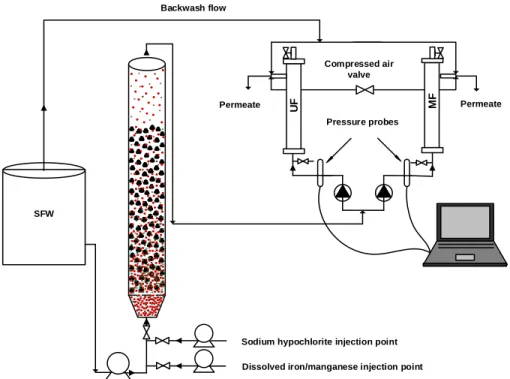
3.3.1.2 Experimental set-up and procedure ... 50
3.3.1.3 Particle characterization ... 52
3.3.2 Performance of lab pilot-scale PFB contactor for manganese removal ... 52
3.3.2.1 Characteristics of synthetic groundwater (SGW) ... 52
3.3.3 Performance of pilot-scale pyrolucite fixed and fluidized bed contactors for iron and
manganese removal ... 54
3.3.3.1 Characteristics of groundwater ... 54
3.3.3.2 Experimental set-up and procedure ... 55
3.3.4 Performance of the PFB-MF/UF hybrid process compared to that of conventional pre-oxidation-MF/UF process ... 57
3.3.4.1 Characteristics of SFW ... 57
3.3.4.2 Experimental set-up and procedure ... 57
3.3.4.3 Characterization of membrane fouling ... 59
CHAPTER 4 ARTICLE 1 : SIZE AND ZETA POTENTIAL OF OXIDIZED IRON AND MANGANESE IN WATER TREATMENT: INFLUENCE OF PH, IONIC STRENGTH AND HARDNESS ... 61
4.1 Introduction ... 62
4.2 Materials and methods ... 64
4.2.1 Materials ... 64
4.2.2 Synthetic water preparation ... 64
4.2.3 Experimental procedure ... 65
4.2.4 Particle size measurement techniques ... 66
4.2.4.1 Light scattering ... 66
4.2.4.2 Fractionation through serial membrane filtration ... 67
4.2.5 Zeta potential analysis ... 67
4.3 Results and discussion ... 68
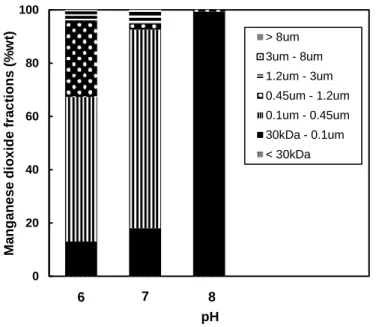
4.3.1 Effect of pH on particle size of oxidized manganese in water ... 68
4.3.2 Effect of ionic strength on particle size of oxidized manganese in water ... 72
4.3.4 Effect of pH, ionic strength and hardness on particle size of oxidized iron in water . 77
4.4 Conclusions ... 80
CHAPTER 5 ARTICLE 2 : UNDERSTANDING ULTRAFILTRATION FOULING OF CERAMIC AND POLYMERIC MEMBRANES CAUSED BY OXIDIZED IRON AND MANGANESE IN WATER TREATMENT ... 82
5.1 Introduction ... 83
5.2 Materials and methods ... 85
5.2.1 UF membranes ... 85
5.2.2 Preparation of synthetic feedwater (SFW) ... 86
5.2.3 Experimental procedure ... 88
5.2.4 Membrane cleaning procedures ... 89
5.2.5 Particle characterization ... 90
5.2.6 Iron and manganese analysis ... 92
5.2.7 Membrane fouling characterization ... 92
5.2.7.1 Constant flux blocking law model for compressible cake layer ... 92
5.2.7.2 Resistance-in-series model for quantifying membrane fouling ... 94
5.3 Results and discussion ... 94
5.3.1 Iron and manganese removal performance in oxidation and UF hybrid process ... 94
5.3.2 Characterization of manganese dioxide fouling in UF membranes ... 95
5.3.2.1 Effect of pH ... 95
5.3.2.2 Effect of ionic strength ... 98
5.3.2.3 Effect of hardness ... 100
5.3.3 Characterization of ferric hydroxide fouling in UF membranes ... 101
5.3.4 Resistance-in-series model analysis ... 104
CHAPTER 6 ARTICLE 3 : PYROLUCITE FLUIDIZED BED REACTOR (PFBR): A ROBUST AND COMPACT PROCESS FOR REMOVING MANGANESE FROM
GROUNDWATER ... 109
6.1 Introduction ... 110
6.2 Material and Methods ... 112
6.2.1 Synthetic Groundwater (SGW) Preparation ... 113
6.2.2 Lab-Pilot Experimental Set-up and Pyrolucite Characteristics ... 113
6.2.3 Operation of the Experimental set-up ... 113
6.2.4 Experimental Matrix ... 114
6.2.5 PFBR Stability Experiments ... 114
6.2.6 Analytical Methods ... 115
6.3 Results and Discussion ... 116
6.3.1 Short-term (4h) PFBR performance ... 116
6.3.2 Long-Term Stability of the PFBR ... 123
6.4 Conclusions ... 124
CHAPTER 7 ARTICLE 4 : COMPARISON OF PYROLUCITE FIXED AND FLUIDIZED BEDS FOR IRON AND MANGANESE CONTROL IN GROUNDWATER: A PILOT-SCALE STUDY ... 126
7.1 Introduction ... 127
7.2 Materials and methods ... 130
7.2.1 Materials: chemicals, source water and pyrolucite filter media ... 130
7.2.2 Pilot plant configuration ... 131
7.2.3 Pilot plant operation ... 133
7.2.4 Analytical methods ... 134
7.3.1 Effect of distributor in fluidized bed contactor ... 135
7.3.2 Iron and manganese removal performance in pilot plant ... 139
7.3.2.1 Experiments with un-spiked natural groundwater ... 139
7.3.2.2 Experiments with manganese-spiked natural groundwater ... 142
7.3.2.3 Experiments with iron-spiked natural groundwater ... 143
7.3.3 Evolutions of head losses in the fixed and fluidized bed contactors ... 147
7.4 Conclusions ... 149
CHAPTER 8 ARTICLE 5 : INTEGRATED PYROLUCITE FLUIDIZED BED-MEMBRANE HYBRIDE PROCESS FOR IMPROVED IRON AND MANGANESE CONTROL IN DRINKING WATER ... 151
8.1 Introduction ... 152
8.2 Materials and methods ... 155
8.2.1 Pyrolucite filter media and MF/UF membranes ... 155
8.2.2 Preparation of synthetic feedwater (SFW) ... 156
8.2.3 Experimental procedure ... 157
8.2.4 Analytical methods ... 160
8.2.5 Characterization of membrane fouling ... 160
8.2.5.1 Constant flux blocking law model ... 160
8.3 Results and discussion ... 162
8.3.1 Iron and manganese removal performance ... 162
8.3.2 Comparison of membrane fouling for the pre-oxidation-MF/UF process vs. the PFB-MF/UF hybrid process ... 165
8.3.2.1 Soft water condition (hardness = 2 mg CaCO3/L) ... 165
8.3.2.2 Moderately hard water condition (hardness = 100 mg CaCO3/L) ... 170
8.3.3 Resistance-in-series model analysis ... 174
8.4 Conclusions ... 176
CHAPTER 9 GENERAL DISCUSSION ... 178
9.1 Characteristics of oxidized iron and manganese in water treatment ... 178
9.2 Fouling of UF membranes caused by oxidized iron and manganese ... 180
9.3 Application of PFB for manganese removal ... 183
9.4 Pilot-scale study on fixed vs. fluidized pyrolucite beds for iron and manganese control .. ... 185
9.5 Performance of a PFB-MF/UF hybrid process for improved iron and manganese control ... 189
CHAPTER 10 CONCLUSION AND RECOMMENDATIONS ... 193
BIBLIOGRAPHY ... 198
LIST OF TABLES
Table 1.1. Theoretical reaction stoichiometry for oxidation of Fe(II) and Mn(II) (Sommerfeld,
1999). ... 16
Table 1.2. Schematic diagrams of fouling mechanisms proposed by Hermia (1982). ... 38
Table 2.1. Characteristics of SFW. ... 50
Table 2.2. Specifications of ceramic and polymeric UF membranes. ... 51
Table 2.3. Characteristics of SGW. ... 53
Table 2.4. Characteristics of commercial pyrolucite (LayneOx™ brand). ... 53
Table 2.5. Characteristics of the groundwater tested in this study. ... 54
Table 2.6. Characteristics of commercial pyrolucite (MangOxTM brand). ... 55
Table 2.7. Characteristics of the SFW tested in this study. ... 57
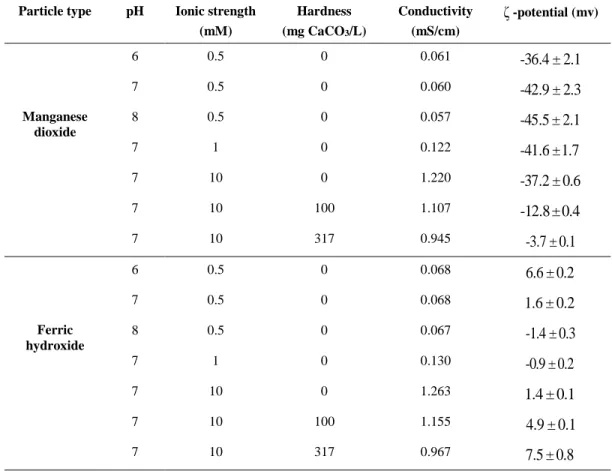
Table 3.1. Comparison of apparent ζ-potential of ferric hydroxide and manganese dioxide particles under various water characteristics. ... 69
Table 4.1. Specifications of ceramic and polymeric membranes utilized in this study. ... 86
Table 4.2. Characteristics of ferric hydroxide and manganese dioxide particles at various water chemistry conditions. ... 87
Table 4.3. Summary of the blocking law model parameters and average specific cake resistances for the ceramic and polymeric membranes. ... 98
Table 5.1. Summary of pyrolucite media characteristics. ... 113
Table 5.2. The average mass transfer coefficient at different HLR. ... 122
Table 6.1. Characteristics of the groundwater tested in this study. ... 130
Table 6.2. Characteristics of commercial pyrolucite. ... 131
Table 7.1. Characteristics of commercial pyrolucite. ... 155
Table 7.3. Compressibility coefficients (n' ) for the deposited cake layer in pre-oxidation-microfiltration (MF)/ultrafiltration (UF) process. ... 167
LIST OF FIGURES
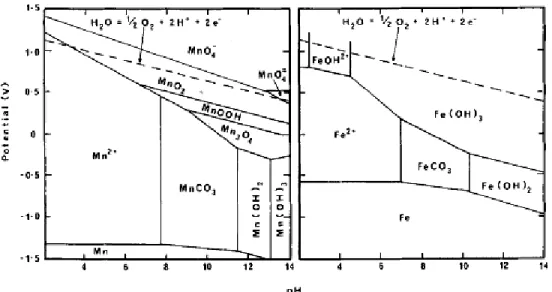
Figure 1.1. Eh-pH stability diagram for iron and manganese at 25oC and divalent species concentration (activity) of 10-5 M (Morgan and Stumm, 1965). ... 7 Figure 1.2. Pyrolucite ore. ... 22 Figure 1.3. Effect of surface oxide coating level on Mn(II) uptake capacity of media. pH = 6-6.2,
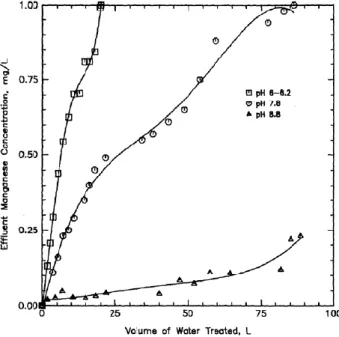
Mn(II)0 = 1.0 mg/L and in the absence of free chlorine (Knocke et al., 1990b). ... 24 Figure 1.4. Influence of pH on the sorption of Mn(II) onto MnO2(s) (Morgan and Stumm, 1964).
... 24 Figure 1.5. Effect of pH on Mn(II) uptake capacity of media: manganese oxide coating = 3 mg
Mn/g media , Mn(II)0 = 1.0 mg/L and in the absence of free chlorine (Knocke et al., 1990b). ... 25 Figure 1.6. Effect of pre-filter chlorination on Mn (II) uptake capacity of media: manganese oxide
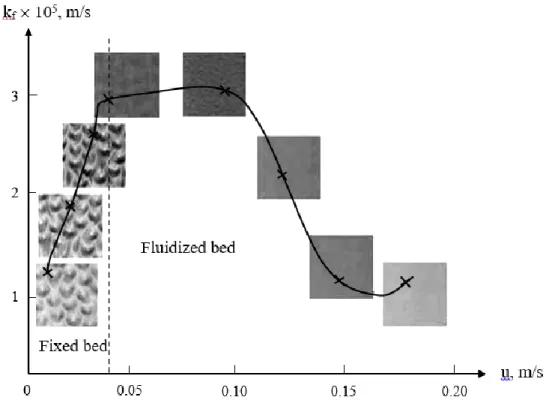
coating level = 18 mg Mn/g media, Mn(II)0 = 1.0 mg/L and at pH = 6-6.2 (Knocke et al., 1990b). ... 27 Figure 1.7. Effect of superficial fluid velocity on mass transfer coefficient in both fixed and
fluidized bed contactors (Bošković-Vragolović et al., 2009). ... 31 Figure 1.8. Membrane rejection mechanisms: (a) Straining (b) Cake filtration (c) Adsorption
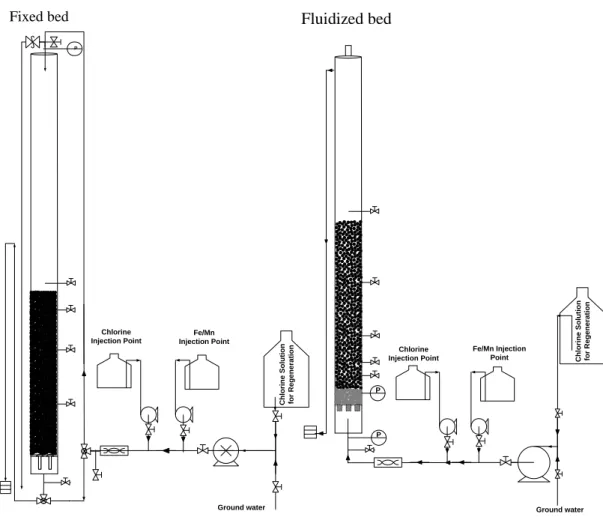
(Montgomery Watson Harza (MWH), 2005). ... 33 Figure 2.1. Schematic diagram of the bench-scale UF setup with peroxidation step. ... 51 Figure 2.2. Schematic diagram of the long-term experimental plan. ... 54 Figure 2.3. Schematic of pilot plant experimental set-ups. Left: Fixed bed. Right: Fluidized bed. ... 56 Figure 2.4. Schematic of the pilot-scale PFB- MF/UF hybrid process. ... 58 Figure 3.1. Size fractions of manganese after oxidation at different pH values using membrane
filters. ... 68 Figure 3.2. Comparison of PSD for manganese dioxide at different pH values measured by DLS
Figure 3.3. Size fractions of manganese after oxidation at different ionic strength using membrane filters. ... 72 Figure 3.4. Comparison of PSD for manganese dioxide at different ionic strength measured by DLS
and LD, A) at 0.5 mM, B) at 1 mM, C) at 10 mM. ... 74 Figure 3.5. Size fractions of manganese after oxidation at different hardness of water using
membrane filters. ... 75 Figure 3.6. Comparison of PSD for manganese dioxide at different hardness (mg CaCO3/L) of
water measured by LD. ... 76 Figure 3.7. Size fractions of iron in water after oxidation with sodium hypochlorite at different pH,
ionic strength and hardness. ... 77 Figure 3.8. Comparison of PSD for ferric hydroxide at different water characteristics measured by
LD, A) Effect of pH, B) Effect of ionic strength (mM), C) Effect of hardness (mg CaCO3/L).
... 79 Figure 4.1. Schematic diagram of the bench-scale UF setup with peroxidation step. ... 88 Figure 4.2. Typical results of static light scattering for fractal dimension calculation. ... 92 Figure 4.3. Effect of pH on constant flux/dead-end UF of manganese dioxide suspensions using (a)
a ceramic membrane and (b) a polymeric membrane. Ionic strength = 0.5 mM, T = 23oC. Instantaneous normalized pressures from experimental data are shown as discrete points. Solid lines represent the model fits using the constant flux blocking law model for compressible cake (Eq. (4.8)). ... 97 Figure 4.4. Effect of ionic strength (pH = 7.0) on constant flux/dead-end UF of manganese dioxide
suspensions using (a) a ceramic membrane and (b) a polymeric membrane. Instantaneous normalized pressures from experimental data are shown as discrete points. T = 23oC. Solid lines represent the model fits using the constant flux blocking law model for compressible cake (Eq. (4.8)). ... 99 Figure 4.5. Effect of calcium hardness (IS = 10 mM) on constant flux/dead-end UF of manganese
dioxide suspensions using (a) a ceramic membrane and (b) a polymeric membrane. T = 23oC.
Figure 4.6. Constant flux/dead-end UF of ferric hydroxide suspensions under different pH, ionic strength and harness conditions using a ceramic membrane (a1 & a2) and a polymeric membrane (b1 & b2). Instantaneous normalized pressures from experimental data are shown as wisker-boxes points. Figures a1 and b1 use an identical Y-axis scale than the equivalent Mn figures (Figure 4.3, Figure 4.4, and Figure 4.5) while Figures a2 and b2 present a blow-up
Y-axis scale. ... 103 Figure 4.7. Resistance-in-series model analysis for the constant flux/dead-end UF of manganese
dioxide suspension under different (a) pH, (b) ionic strength, and (c) hardness conditions by the ceramic and polymeric membranes. T = 23oC. ... 105
Figure 4.8. Resistance-in-series model analysis for the constant flux/dead-end UF of ferric hydroxide suspension under different (a) pH, (b) ionic strength, and (c) hardness conditions by the ceramic and polymeric membranes. T = 23oC. ... 106
Figure 5.1. Schematic diagram of the long-term experimental plan. ... 115 Figure 5.2. Mn removal performance over the height of PFBR as a function of time. Influent SGW:
Mn0 = a) 0.5, b) 1.0, c) 2.3-2.4, d) 3-3.2 mg/L, T= 9±1oC, pH = 7.0±0.1, chlorine = 1-1.3 mg/L, alkalinity and hardness = 200 mg CaCO3/L. ... 117
Figure 5.3. Mn removal performance over the height of PFBR as a function of time. Influent SGW: Mn0 = a) 0.5, b) 1.0-1.1, c) 2.3-2.4, d) 3.2-3.3 mg/L, T= 23±1oC, pH = 7.0±0.1, chlorine = 1.2-1.4 mg/L, alkalinity and hardness = 200 mg CaCO3/L. ... 118
Figure 5.4. Effect of pH on Mn removal performance over height of PFBR. Influent SGW: Mn0 = 1.0-1.1 mg/L, T= 9±1oC, chlorine = 1.2-1.4 mg/L, hardness = 200 mg CaCO3/L, alkalinity =
50 mg CaCO3/L. ... 120
Figure 5.5. Effect of HLR on a) Mn removal performance and b) specific Mn adsorption rate over height of PFBR. Influent SGW: Mn0 = 2.2-2.4 mg/L, T= 9±1oC, pH = 7.0±0.1, chlorine = 1.2-1.4 mg/L, hardness and alkalinity = 200 mg CaCO3/L. ... 121
Figure 5.6. Stability of the PFBR for Mn control at effluent free chlorine concentrations of a) 1.0 mg/L b) 2.0-2.6 mg/L. Mn0 = 0.8-1.3 mg/L, T= 10±2oC, pH = 7.0±0.1, HLR ≈ 40 m/h (10%
Figure 6.1. Schematic of pilot plant experimental set-ups. Left: Fixed bed. Right: Fluidized bed. ... 132 Figure 6.2. Schematic drawing of various distributors for fluidized bed contactor. ... 133 Figure 6.3. Bed pressure drop profile in the pyrolucite fluidized bed contactor during decreasing
superficial fluid velocity (Distributor C). T= 8oC. ... 136 Figure 6.4. Effect of distributor configuration on the performance of pyrolucite fluidized bed
contactor for dissolved manganese (Mn) removal. Initial Mn (Mn0) = 0.09-0.15 mg/L, T = 8-12oC and pH = 7.0-7.2. ... 137 Figure 6.5. Effect of distributor configuration on the release of particulate manganese (Mn) along
the height of pyrolucite fluidized bed contactor. Initial Mn (Mn0) = 0.09-0.15 mg/L, T = 8-12oC and pH = 7.0-7.2. ... 138 Figure 6.6. Evolutions of normalized manganese (Mn) concentrations as a function of empty bed
contact time. Pyrolucite fluidized bed at (a) hydraulic loading rate (HLR) of 32 m/h (10% bed expansion), (b) 45 m/h (20% bed expansion), and (c) fixed bed at HLR of 20 m/h. Groundwater conditions: Initial Mn (Mn0) = 0.09±0.01 mg/L, Initial iron = 0.01±0.00 mg/L
and T= 8oC... 141
Figure 6.7. Evolutions of normalized manganese (Mn) concentrations as a function of empty bed contact time. (a) Pyrolucite fluidized bed at hydraulic loading rate (HLR) of 45 m/h (20% bed expansion) and (b) fixed bed at HLR of 20 m/h (b). Groundwater conditions: Initial Mn (Mn0)
= 0.35±0.03 mg/L, Initial iron = 0.01±0.00 mg/L and T= 8oC. ... 143 Figure 6.8. Evolutions of normalized manganese (Mn) concentrations as a function of empty bed
contact time. (a) Pyrolucite fluidized bed at hydraulic loading rate (HLR) of 45 m/h (20% bed expansion) and (b) fixed bed at HLR of 20 m/h. Groundwater conditions: Initial Mn (Mn0) =
01 . 0 ± 11 .
0 mg/L, Initial iron = 0.18±0.02mg/L and T= 9oC. ... 145 Figure 6.9. Evolutions of normalized iron (Fe) concentrations as a function of empty bed contact
time. (a) Pyrolucite fluidized bed at hydraulic loading rate (HLR) of 45 m/h (20% bed expansion) and (b) fixed bed at HLR of 20 m/h. Groundwater conditions: Initial Fe (Fe0) =
02 . 0 ± 18 . 0 mg/L and T= 9oC. ... 146
Figure 6.10. Evolution of (a) head loss and (b) turbidity in fixed and fluidized bed contactors under different experimental conditions. T= 9oC. ... 148 Figure 7.1. Schematic of the pilot-scale pyrolucite fluidized bed (PFB)-microfiltration
(MF)/ultrafiltration (UF) hybrid process. SFW: Synthetic feed water. ... 158 Figure 7.2. Iron (Fe) and manganese (Mn) concentrations for increasing empty bed contact times
inside the pyrolucite fluidized bed (PFB). Assays conducted under various water quality conditions: a) hardness ≈ 0 mg CaCO3/L, b) hardness = 100 mg CaCO3/L and c) hardness =
100 mg CaCO3/L + Humic acids. Alkalinity = 50 mg CaCO3/L, T = 20oC, pH = 7.0 and
hydraulic loading rate (HLR) = 41 m/h. ... 163 Figure 7.3. Iron (Fe) and manganese (Mn) concentrations in the permeate of the two process
configurations tested under various water quality conditions at different experimental time: a) pre-oxidation + microfiltration (MF), b) pre-oxidation + ultrafiltration (UF), c) pyrolucite fluidized bed (PFB) + MF and d) PFB + UF. T = 20oC, pH = 7.0 and flux = 300 LMH. ... 164 Figure 7.4. Comparison of membrane fouling for the pre-oxidation-microfiltration
(MF)/ultrafiltration (UF) process and the pyrolucite fluidized bed (PFB)-MF/UF hybrid process under soft water condition (hardness ≈ 0 mg CaCO3/L): (a) instantaneous
transmembrane pressure (TMP) from experimental data and the model fits using the constant flux blocking model for compressible cake (solid lines) (Eq. (1)) and (b) foulant resistance. T = 20oC and pH = 7.0. ... 166 Figure 7.5. Particle size distribution of oxidized iron (Fe) and manganese (Mn) aggregates in the
membrane feed water using the serial filtration technique. a) Hardness ≈ 0 mg CaCO3/L, b)
Hardness = 100 mg CaCO3/L, and c) Hardness = 100 mg CaCO3/L + humic acid ≈ 2 mg/L, T
= 20oC and pH = 7.0. ... 169 Figure 7.6. Comparison of membrane fouling in pre-oxidation-microfiltration (MF)/ultrafiltration
(UF) process and pyrolucite fluidized bed (PFB)-MF/UF hybrid process under moderately hard water condition (hardness = 100 mg CaCO3/L): (a) instantaneous transmembrane
pressure (TMP) from experimental data and the model fits using the constant flux blocking model for compressible cake (solid lines) (Eq. (1)) and (b) fouling resistance. T = 20oC and
Figure 7.7. Comparison of membrane fouling in pre-oxidation-microfiltration (MF)/ultrafiltration (UF) process and pyrolucite fluidized bed (PFB)-MF/UF hybrid process under moderately hard water condition (hardness = 100 mg CaCO3/L) and ≈ 2 mg/L humic acid: (a)
instantaneous transmembrane pressure (TMP) from experimental data and the model fits using the constant flux blocking model for compressible cake (solid lines) (Eq. (1)) and (b) fouling resistance. T = 20oC and pH = 7.0. ... 172 Figure 7.8. Resistance-in-series analysis for the constant flux/dead-end microfiltration
(MF)/ultrafiltration (UF) of ferric hydroxide and manganese dioxide suspensions under (a) hardness ≈ 0 mg CaCO3/L, (b) hardness = 100 mg CaCO3/L, and (c) hardness = 100 mg
LIST OF ABBREVIATIONS
APHA American Public Health Association Ca2+ Calcium Ion
ClO2 Chlorine Dioxide
CR Continuous Regeneration DBPs Disinfection by Products DLS Dynamic Light Scattering DM Demineralized
DOC Dissolved Organic Carbon EDL Electrostatic Double Layer FBR Fluidized Bed Reactor
Fe Iron
Fe(II) Ferrous Iron Fe(III) Ferric Iron Fe(OH)3 Ferric Hydroxide
GAC Granular Activated Carbon HLR Hydraulic Loading Rate HOCl Hypochlorous Acid H2O2 Hydrogen Peroxide
IOCS Iron Oxide Coated Sand IR Intermittent Regeneration KMnO4 Potassium Permanganate
LD Laser Diffraction
MDDELCC Ministère du Développement Durable de l’Environnement et de la Lutte contre les Changements Climatiques
MF Microfiltration
Mn Manganese
Mn(II) Reduced Manganese MnO2 Manganese Dioxide
MnO4- Permanganate
MW Molecular Weight
MWCO Molecular Weight Cut Off MWH Montgomery Watson Harza NF Nanofitration
NGE Natural Greensand Effect NOM Natural Organic Matter
NSERC Natural Sciences and Engineering Research Council of Canada
O3 Ozone
OCl- Hypochlorite PAA Poly-Acrylic Acid PES Polyethersulfone
PFB Pyrolucite Fluidized Bed
PFBR Pyrolucite Fluidized Bed Reactor PSD Particle Size Distribution
PVC Polyvinyl Chloride PVDF Polyvinylidene Fluoride PVP Polyvinylpyrrolidone
SFW Synthetic Feedwater SGW Synthetic Groundwater SiC Silicon Carbide
SMCL Secondary Maximum Contaminant Level THM Trihalomethane
TiO2 Titanium dioxide
TMP Transmembrane Pressure TOC Total Organic Carbon UF Ultrafiltration
USEPA United States Environmental Protection Agency WHO World Health Organization
ZrO2 Zirconium dioxide
CHAPTER 1
INTRODUCTION
1.1 Background
Iron and manganese naturally co-occur in surface and ground water supplies as a result of weathering and leaching of metal-bearing minerals, rocks and soils rich in organic matter, thermal stratification in lakes and contamination by industrial effluents. Among different water sources, groundwater frequently contains significant levels of dissolved iron (Fe(II)) and manganese (Mn(II)) due to more reduced redox conditions. Nearly 44% of population in United States and 30% of population in Canada, mostly living in small rural communities, relies on groundwater as a source of drinking water. The presence of iron and manganese in drinking water is principally regarded as creating aesthetic and operational issues, including colored water formation, increased turbidity, metallic taste and odor, staining of laundry and plumbing fixture, and pipeline clogging, which may result in customer complaints (World Health Organization (WHO), 2008). In this regard, the United States Environmental Protection Agency (USEPA) (2004) and the Canadian Drinking Water Quality Guidelines (Health Canada, 2014) have established an aesthetic objective limit of 0.3 and 0.05 mg/L for total iron and manganese concentrations in drinking water, respectively. However, iron and manganese concentrations as low as 0.05 (World Health Organization, 2003) and 0.02 mg/L (Sly et al., 1990), respectively, may still give rise to adverse aesthetic impacts. As a result, Health Canada (2016) has lately proposed an aesthetic objective limit of 0.02 mg/L for total manganese in drinking water. Furthermore, manganese control in drinking water is receiving more attention owing to its potential neurotoxicity (Wasserman et al., 2006; Tuschl et al., 2013). Epidemiological studies reported that exposure to manganese in drinking water is associated with neurological impacts in children, such as intellectual impairment and poor neurobehavioral function (Bouchard et al., 2011; Oulhote et al., 2014), even at fairly low manganese concentrations in treated water. Consequently, Health Canada (2016) has recently proposed a health-based maximum acceptable concentration of 0.1 mg/L for manganese in drinking water. Thus, effective iron and manganese removal (target limit of 0.02 mg Mn/L and 0.02 mg Fe/L) is becoming an important objective of drinking water treatment.
One of the common treatment strategies for Fe(II) and Mn(II) control in drinking water, especially in North America, includes oxidation of dissolved species to particulate forms, ferric hydroxide
and manganese dioxide, followed by separation of oxidized particles from water. Unlike Fe(II), which is rapidly oxidized by a weak oxidant, direct oxidation of Mn(II) requires the application of a strong oxidant, such as potassium permanganate (KMnO4) or ozone (O3) (Knocke et al., 1990b),
which always brings the risk of permanganate (MnO4-) escaping into treated water and therefore
producing pink water (Gregory and Carlson, 2003). In addition, traditional processes for particulate/colloidal matter removal from water include coagulation, flocculation, sedimentation and granular media filtration, which have drawbacks of operating in successive steps requiring significant contact time and, consequently, large process footprint. Moreover, oxidized manganese may not be effectively removed by such treatment technologies (Carlson et al., 1997) because of its propensity to form colloidal manganese dioxide (Morgan and Stumm, 1964). Alternatively, compact membrane processes, such as microfiltration (MF) and ultrafiltration (UF), are increasingly retrofitted in water treatment plants for filtration of dilute suspensions based on size exclusion (Crittenden et al., 2012). However, management of membrane fouling is an important limitation of this technology, which requires a systematic study to identify the contribution of different parameters. Although organic matter dominantly controls membrane fouling in surface water systems, management of fouling caused by iron/manganese is of importance for many MF/UF/NF/RO groundwater systems. This is particularly important for manganese removal since colloidal manganese oxides are prone to severely foul membranes (Choo et al., 2005). Thus, developing a pretreatment process, which can properly alleviate the fouling of the membrane, would be a good option.
Several factors influence the fouling of a MF/UF membrane; namely, membrane type (e.g., tubular vs. hollow fiber), material (e.g., ceramic vs. polymeric) and pore size (e.g., MF vs. UF), operating conditions (e.g., flux), process configuration (e.g., dead end vs. cross flow), cleaning strategies and feed water characteristics (Crittenden et al., 2012; Lee and Kim, 2014). Application of ceramic membrane has been receiving growing attention owing to its inherent advantages over the conventional polymeric membrane, such as superior chemical, thermal and mechanical stability, which allow water practitioners to exert more aggressive physical and chemical cleaning, prolonging the membrane life expectancy. Despite the high potential application of ceramic membrane for iron/manganese control, the fundamental fouling behavior caused by ferric hydroxide and manganese dioxide aggregates has not yet been documented. Previous studies on some inorganic minerals, rather than oxidized iron and manganese, have revealed the influence of
pH, ionic strength and salt valency on the characteristics of inorganic aggregates (Faibish et al., 1998; Ramachandra Rao et al., 1999; Zhao et al., 2005; Duan et al., 2014), and, subsequently, on the performance of the membrane due to their impact on particle-particle and particle-membrane interactions (Lee et al., 2003; Santiwong et al., 2008). Furthermore, permeability of MF/UF membranes may be also altered by these parameters, although salt rejection is negligible (Huisman and Dutre, 1997; Faibish et al., 1998; Zhao et al., 2005; Manttari et al., 2006). Thus, understanding the characteristics and behavior of oxidized iron and manganese aggregates is of interest for application of UF/MF membranes.
Considering the propensity of MnOx(s) to adsorb dissolved metal ions (Morgan and Stumm, 1964),
a process, termed Natural Greensand Effect (NGE), was historically developed for Mn(II) control. Based on NGE process, Mn(II) removal is achieved through sorption of Mn(II) onto MnOx(s)
surface, e.g. MnOx(s) coated sand, followed by auto-catalytic oxidation of adsorbed Mn(II) in the
presence of an oxidant. NGE process allows two modes of operation depending on the presence of free chlorine: intermittent regeneration (IR) and continuous regeneration (CR) (Knocke et al., 1990a). In IR operation mode, the MnOx(s) surface adsorbs Mn(II) until available sorption sites are
occupied and breakthrough arisen. KMnO4 or free chlorine solution is then used to restore the
adsorption capacity of the filter media (i.e., regeneration of the filter media). In CR mode, a free chlorine solution is continuously spiked into the feed water just prior entering the column, thus the adsorption sites are continuously regenerated and become available. Nevertheless, maintenance of available adsorption sites, which is governed by the MnOx(s) coating level, chlorine concentration
and pH, strongly affect the performance of NGE process (Knocke et al., 1990a). In addition, the process performance may be further influenced by the hydraulic loading rate (HLR), Mn(II) concentration, temperature and hardness.
Adsorption of Mn(II) onto MnOx(s)-coated sand is normally performed in packed bed contactors
operated at relatively low HLRs (6-12 m/h) to remove low feed water Mn(II) concentrations (< 0.5 mg/L) (Hargette and Knocke, 2001; Yang et al., 2008; Piispanen and Sallanko, 2010). Under higher HLRs, rapid head loss buildup gives rise to frequent backwash, high energy expenses and large amount of backwash water production, which are important limitations of a packed bed configuration. Knocke et al. (2010) have shown that application of post-filtration adsorptive contactors filled with large size (2.0-2.4 mm) pyrolucite (a natural manganese dioxide ore) media could overcome these constraints. HLRs as high as 32-50 m/h (16-20 gpm/ft2) were successfully
tested under low manganese concentrations (< 0.1 mg/L). The backwash frequency was approximately every other month.
Alternatively, a fluidized bed adsorptive contactor could offer a number of promising benefits in comparison with the fixed bed contactors because the adsorption sites can be effectively used in fluidized state due to the better fluid-solid contact, which offers a higher adsorption rate. In addition, it allows application of small size pyrolucite media (effective diameter of 0.4 mm) with high specific surface area at high HLRs that is favorable for adsorption kinetic while it simultaneously eliminates the head loss increase.
In order to come up with a novel process, which can properly overcome the problems encountered in the abovementioned methods, a pyrolucite fluidized bed (PFB) contactor was proposed as a pretreatment for membrane filtration. Due to the specific configuration of the fluidized bed, the number of available active sites for sorption is more than for the fixed-bed and it allows operating at relatively high HLRs. An increased HLR reduces the process footprint and therefore capital costs. This hybrid process could be a promising alternative for the treatment of groundwater containing high levels of iron and manganese, especially for groundwaters requiring primary disinfection which could be achieved with UF membranes.
1.2 Structure of dissertation
This thesis is subdivided in eight chapters. Following an in-depth review on common methods for iron and manganese control in drinking water (Chapter 1), the research objectives and methodology are presented (Chapter 2). Chapters 3 through 7 present results of this research in the form of 4 published articles and 1 submitted manuscript. The first article intends to determine the characteristics of oxidized iron and manganese aggregates in water treatment under different water chemistry conditions (Chapter 3, published in Journal of Environmental Engineering). The second article aims at understanding UF fouling of ceramic and polymeric membranes caused by oxidized iron and manganese under different water quality (Chapter 4, published in Journal of Membrane
Science). The next chapter proposes a PFB as a robust and compact process for manganese removal
from groundwater (Chapter 5, published in Water Research). Chapter 6 compares the long-term performance of pilot-scale pyrolucite fixed and fluidized bed contactors for iron and manganese control in natural groundwater (submitted to the Journal of Environmental Chemical Engineering).
Chapter 7 proposes an integrated PFB-MF/UF hybrid process for improved iron and manganese control in drinking water (published in Water Research). Finally, a general discussion is provided in Chapter 8 followed by conclusions and recommendations.
CHAPTER 2
LITERATURE REVIEW
This chapter presents a summary of previous research studies conducted in areas relevant to the removal of soluble iron and manganese from water. It includes sections on the geochemistry of iron and manganese in natural water systems, water quality concerns and regulations, traditional methods for iron and manganese control in drinking water, and the use of membrane filtration for the removal of these species.
2.1 Iron and manganese in natural water systems
Iron and manganese are both abundant and naturally-occurring elements in the earth’s crust that frequently co-occur in natural water sources. Manganese is commonly found at concentrations below 0.3 mg/L, while iron generally presents at concentrations five to twenty times higher than manganese (Buamah et al., 2008). They usually occur in groundwater and anoxic hypolimnion layer of reservoirs at high concentrations due to dissolution of these minerals from rocks and soils under low redox potential and pH values. Likewise, groundwater containing high levels of iron (7-15 mg Fe/L) and manganese (2 mg Mn/L) has been reported in the province of Quebec (Ellis et al., 2000). Another research by Barbeau et al. (2011) revealed that the concentration of manganese in drinking water supplied by groundwater in southern Quebec can reach up to 2.7 mg/L. In addition, the leakage of industrial wastewater might also be responsible for heavy metal contamination of water sources (United States Environmental Protection Agency (USEPA), 2004). Furthermore, agricultural applications of manganese-containing fungicides have also been identified as a possible source of groundwater manganese contamination (van Wendel de Joode et al., 2016). Manganese can exist in numerous oxidation states between 0 and +7 (Trudinger, 1979). Among these oxidation states, Mn(II), Mn(III), Mn(IV) and Mn(VII) are commonly encountered in water treatment practices. In natural water sources with pH values between 5-8, manganese predominantly exists in dissolved form, Mn(II) or Mn+2. Mn(III), MnOOH, and Mn(IV), MnO2,
are insoluble forms of manganese. Mn(VII), the highest oxidized form of manganese, is a strong oxidant, exists in the form of MnO4- anion. Morgan and Stumm (1964) revealed that insoluble
manganese in water can also occur as mixed oxides, termed MnOx (where 1 < 𝑥 < 2).
Iron compounds presents in natural waters in two oxidation states, Fe(II) and Fe(III). Dissolved state of iron, Fe(II), is generally unstable in surface waters and precipitated as insoluble Fe(III)
hydroxide, Fe(OH)3 (World Health Organization (WHO), 2003). However, anaerobic groundwater
sources may contain high levels of Fe(II).
The equilibrium between the various iron and manganese species are commonly determined by pH and redox potential as depicted in Figure 2.1 (Eh-pH stability diagram). Obviously, this figure illustrates that at any Eh, or redox potential, value, the pH level for the stability of soluble Mn(II) is considerably higher than Fe(II). Consequently, it can be concluded that manganese cannot be oxidized and removed from water as easily as iron. The diagram also shows that under reducing condition with pH above 8.0, solid MnCO3 is the primary form of manganese. Generally, solubility
of Fe(II) and Mn(II) is controlled by the concentration of carbonate (alkalinity) in water which may result in the precipitation of FeCO3 and MnCO3, respectively (Buamah et al., 2008). However, in
the presence of O2 and high pH levels, Mn(III) and Mn(IV) are favored. In addition, presence of
iron and manganese oxidizing and reducing microorganisms can also govern the oxidation state of these minerals in natural water sources (Trudinger, 1979). Furthermore, formation of stable complexes between either Fe(II) or Mn(II) and various dissolved organic compounds can greatly increase the solubility of these metals, especially iron (Trudinger, 1979).
Figure 2.1. Eh-pH stability diagram for iron and manganese at 25oC and divalent species concentration
2.2 Water quality concerns and regulations
Iron and manganese are objectionable constituents of water mainly for aesthetic and/or operational issues. Soluble iron and manganese in water distribution systems may be oxidized by oxygen or free chlorine, which is applied as a secondary disinfectant, resulting in the deposition of blackish-brown manganese dioxide and/or reddish-blackish-brown iron hydroxide. This can cause discoloration of water, staining of laundry and plumbing fixtures, an unpleasant metallic taste to water, and, in severe case, the reduction in hydraulic capacity of pipes or an increase in required energy for pumping water through the pipes; hence, it represents additional costs to municipality. Furthermore, in the case of insufficient secondary disinfectant residual, the presence of these metals in distribution system may promote the growth of iron and manganese utilizing bacteria, resulting in clogging of the pipelines or creating additional aesthetic problems (Sly et al., 1990; World Health Organization (WHO), 2008). A recent study further revealed that bio-chemical oxidation and sorption of iron and manganese significantly influence the accumulation of these species in water distribution network (Prasad and Danso-Amoako, 2014). In this regard, the United States Environmental Protection Agency (USEPA), (2004) has established secondary maximum contaminant levels of 0.3 mg/L and 0.05 mg/L for total iron and manganese in drinking water, respectively. However, consumer complaints regarding aesthetic issues have been reported at concentrations of iron and manganese as low as 0.05 (World Health Organization (WHO), 2003) and 0.02 mg/L (Sly et al., 1990), respectively. Consequently, Health Canada (2016) has recently proposed an aesthetic objective limit of 0.02 mg/L for total manganese in drinking water. Therefore, it is recommended to keep the level of these minerals in drinking water as low as possible.
Over the last decade, numerous studies have reported adverse health impacts from manganese intake from drinking water. The reader is referred to the recent Health Canada (2016) literature review for a complete description of studies related to manganese neurotoxicity. For example, although manganese is an essential nutrient for human health, it has been indicated that exposure to elevated levels of manganese in drinking water may cause neurological disorders, especially, in children (Wasserman et al., 2006; Dion et al., 2016; Oulhote et al., 2014; Bouchard et al., 2011). Consequently, to prevent potential health effect, health-based guidelines of 0.5, 0.4, 0.3 and 0.1 mg/L manganese in drinking water have been recommended by California Department of Public
Health (CDPH) (2010), World Health Organization (WHO) (2008), United States Environmental Protection Agency (USEPA) (2004) and Health Canada (2016), respectively. The Health Canada guideline is currently under review and the final recommendation is expected in 2017. The Minnesota Department of Health followed the same approach as Health Canada and established a manganese level of 0.1 mg/L for infants less than 1 year old, and 0.3 mg/L for children > 1 year old and adults (MDH, 2012).
No health guideline value has been proposed for iron at concentrations normally found in drinking water (World Health Organization (WHO), 2008).
2.3 Traditional methods for iron and manganese control in drinking
water
There are several available methods for iron and manganese removal from water depending on the speciation of these elements and water quality. The most common methods are as follows:
Oxidation of Fe(II) and Mn(II) to particulate forms, ferric iron (Fe(III)) and manganic manganese (Mn(IV)), using a strong oxidant, followed by removal of the precipitates through depth granular media filtration;
Sorption of Mn(II) onto manganese oxide coated media followed by autocatalytic oxidation of adsorbed manganese using oxygen or chlorine; however, in this process, Fe(II) may be readily oxidized in water and, thus, removed through granular media filtration.
These techniques are discussed in detail in the following sections.
2.3.1 Direct oxidation and particle removal
2.3.1.1 Oxidation of iron and manganese
In general, removal of manganese from water is more difficult than iron because of its slower oxidation rate (Knocke et al., 1991) and its tendency to form colloidal particles when it is rapidly oxidized in water (Morgan and Stumm, 1964).
Oxygen (from air), chlorine and KMnO4 are the most common oxidants applied in water treatment
practices. In addition to these, O3, chlorine dioxide (ClO2) and hydrogen peroxide (H2O2) are also
Oxidation of Fe(II) and Mn(II) in water most often forms iron hydroxide (Fe(OH)3) and manganese
dioxide (MnO2), respectively. Knocke et al. (1990a) revealed that oxidation from the bulk solution
is the only mechanism responsible for Fe(II) removal in low-dissolved organic carbon (DOC) waters. However, oxidation of Mn(II) involves three steps: solution-phase oxidation, adsorption of Mn(II) onto MnO2(s) particles and subsequent oxidation of adsorbed ions on the oxide surface,
which are depicted on the following equations:
Mn(II) + Ox → MnO2(s) (Oxidation) (1.1)
Mn(II) + MnO2(s) → Mn(II).MnO2(s) (Adsorption) (1.2)
Mn(II).MnO2(s) + Ox → 2MnO2(s) (Oxidation) (1.3)
The following discussion reviews details of iron and manganese oxidation by different oxidants that are commonly used in water treatment plants:
Aeration. In many cases, aeration is the first pretreatment that has been used prior to filtration. It
helps to oxidize iron in varying rates depending on the pH of water, temperature and the presence of organic matter (Sommerfeld, 1999; Azizi et al., 2013). Although aeration can theoretically be employed to oxidize Mn(II) to MnO2(s), the oxidation reaction is too slow under the pH of most
natural waters, and thus a long detention time is required (Griffin, 1960; Wong, 1984). Likewise, Phatai et al. (2010) showed that the maximum Mn(II) removal efficiency using aeration alone was 40% even at pH 9.0. Under an elevated pH of 11.0 only 70% of Mn(II) could be oxidized by aeration (Kaya et al., 2005). Therefore, previous results indicate that aeration alone cannot satisfactorily oxidize Mn(II) even under high pH values (Azizi et al., 2013; Phatai et al., 2010). Another disadvantage related to this process is the high capital cost incurred due to the large-size retention tank that would be required.
Chlorination. Chlorine is a stronger oxidizing agent than oxygen which has been used for many
years as a water treatment chemical because it is economical, readily available, easy to feed and can be used both for the oxidation of inorganic contaminants and as a disinfectant. There are two options for dosing chlorine, as a gas forced into water under pressure or as a solution of calcium hypochlorite or sodium hypochlorite pumped into water (Sommerfeld, 1999). The end-product is however the same: a mixture of hypochlorous acid (HOCl) and hypochlorite ion (OCl-) which
The stoichiometric amounts of chlorine required for oxidizing 1mg/L of Fe(II) and Mn(II) are 0.64 and 1.3 mg/L, respectively. However, in reality, the required chlorine has been found to be much higher than the stoichiometric amount owing to the additional chlorine demand caused by organic matter, ammonia and other reduced compounds in water such as hydrogen sulfide (Sommerfeld, 1999). Knocke et al. (1990a) found that Fe(II) and Mn(II) oxidation by chlorine was impacted by several factors including water pH, temperature, chlorine dosage and retention time. They revealed that the reaction rate between Fe(II) and chlorine was rapid even under low pH and temperature. Typically, at pH 5.0, complete oxidation of Fe(II) was observed within 10-15 seconds. Even though a considerable reduction in Fe(II) oxidation rate was noticed by decreasing temperature, effective Fe(II) oxidation was observed within 15 seconds (at pH 6.0) or 90 seconds (at pH 5.0) at 2°C (Knocke et al., 1990a).
The oxidation rate of Mn(II) by chlorine is highly dependent on pH. It has been indicated that even under a chlorine dosage 4 times greater than the stoichiometric value, a minimum of three hours contact time was necessary at pH 7.0 to oxidize 30% of Mn(II) in water (Knocke et al., 1990a). However, when the pH was increased to 9.0, Mn(II) was effectively controlled within 1 hour to below 0.05 mg/L. Also, it has been shown that the reduction of temperature from 25°C to 14°C declined the reaction rate significantly while increasing the reaction time by three or four times could not compensate this reduction (Knocke et al., 1990a). Consequently, direct oxidation of Mn(II) via chlorination is often unpractical because of the too slow oxidation rate even under high chlorine dosage (Griffin, 1960; Knocke et al., 1990a; Allard et al., 2013). In addition, the resultant oxidized Mn(II) may form negatively charged colloidal particles that can be difficult to remove by granular media filtration (Griffin, 1960; Wong, 1984). Nevertheless, chlorine is one of the most popular oxidant used for Mn removal applications in North America where it is combined with catalytic filters (e.g. greensand) to achieve removal trough adsorption-oxidation (cf. Eqs. 1.2 and 1.3). This treatment strategy will be further discussed in section 1.3.2
Chlorine dioxide treatment. ClO2 is a powerful oxidant and disinfectant. It is being used for
improving the removal of compounds that cause taste and odor, for the oxidation of iron and manganese and the inactivation of chlorine-resistant pathogens such as Giardia. Unlike chlorine, it does not produce organic disinfection by products (DBPs) (Gopal et al., 2007), although it generates chlorite and chlorate which are also regulated DBPs.