UNIVERSITÉ DE MONTRÉAL
CHARACTERIZATION OF FLOW-INDUCED STRUCTURES IN CARBON
NANOTUBE SUSPENSIONS
FATEMEH KHALKHAL
DÉPARTEMENT DE GÉNIE CHIMIQUE ÉCOLE POLYTECHNIQUE DE MONTRÉAL
THÈSE PRÉSENTÉE EN VUE DE L’OBTENTION DU DIPLÔME DE PHILOSOPHIAE DOCTOR
(GÉNIE CHIMIQUE) SEPTEMBRE 2011
UNIVERSITÉ DE MONTRÉAL
ÉCOLE POLYTECHNIQUE DE MONTRÉAL
Cette thèse intitulée:
CHARACTERIZATION OF FLOW-INDUCED STRUCTURES IN CARBON NANOTUBE SUSPENSIONS
présentée par : KHALKHAL Fatemeh
en vue de l’obtention du diplôme de : Philosophiae Doctor a été dûment accepté par le jury d’examen constitué de: M. AJJI Abdellah, Ph. D., président
M. CARREAU Pierre J., Ph. D., membre et directeur de recherche M. FRADETTE Louis, Ph. D., membre
DEDICATION
ACKNOWLEDGEMENT
I enjoyed working with CREPEC group in the last few years. In particular, I appreciate my supervisor, Dr. Carreau, for criticizing my work leading to the improvement of the quality of my published articles. My special thanks to Melina Hamdine for well maintaining the rheology lab and making the equipments accessible to us. I would like to appreciate very kind assistance of Marie Matet and Melina Hamdine for helping me to translate some parts of this thesis to French.
I acknowledge helpful discussions with Dr. Michel Moan and Dr. Frederic Bossard during their short visits to Montreal. I am thankful to Dr. Suong Hoa and Dr. Daniel Theriault for providing access to the facilities at Concordia composite laboratory and three roll mill at the composite laboratory in the mechanical engineering department of Ecole Polytechnique, respectively.
At the end, I like to appreciate my husband, Farhad, and my family for their encouragements and support.
RÉSUMÉ
Les nanotubes de carbone sont des nanoparticules fibreuses présentes dans de nombreuses applications. Grâce à leur importante surface spécifique apparente, leur densité de courant électrique élevée, leur stabilité thermique et leurs excellentes propriétés mécaniques, les nanotubes de carbone sont utilisés pour améliorer les propriétés physiques des matrices polymériques.
Les propriétés macroscopiques des suspensions proviennent de leurs propriétés à l’échelle du micron et du submicron. La structure des suspensions peut être facilement influencée par de nombreux paramètres tels que les forces de cisaillement externes, la concentration de la suspension, la température, les caractéristiques des particules, etc. L’étude de la structure de la suspension représente un défi majeur et devient un sujet d’intérêt grandissant pour de nombreux chercheurs.
Dans cette étude, la structure d’une suspension modèle de nanotubes de carbone dispersée dans une résine époxy est étudiée en utilisant un ensemble de méthodes rhéologiques, les théories fractales et de mise à l’échelle ainsi qu’un modèle structural thixotropique. L’effet de l’histoire d’écoulement sur les propriétés viscoélastiques linéaires des suspensions et l’évolution de la structure lors de l’arrêt du cisaillement ont été investigués pour une large gamme de vitesse de pré-cisaillement, de concentrations et de températures. Les résultats de ces analyses sont les suivants.
L’effet de l’histoire d’écoulement s’est avéré plus prononcé pour les suspensions diluées ou semi-diluées. Les faibles vitesses de pré-cisaillement entraînent un plus grand nombre d’enchevêtrements entre les particules. Cela résulte de la réduction du seuil de percolation rhéologique. Pour les suspensions diluées ou semi-diluées, après l’arrêt du cisaillement, les
différentes structures métastables formées ont pu être distinguées par leurs différents modules de conservation qui sont inversement reliés à la vitesse de pré-cisaillement. Pour les suspensions concentrées, les structures métastables formées ont donné des modules de conservation équivalents quelque soit le pré-cisaillement appliqué. Il a été montré que la vitesse de formation de ces structures métastables augmentait avec l’augmentation de la concentration. De plus, pour les concentrations faibles et intermédiaires, la vitesse de formation des structures métastables décroît lorsque l’on augmente la vitesse de pré-cisaillement appliqué, alors que pour les concentrations élevées, le pré-pré-cisaillement n’a pas d’influence sur la formation des structures.
Il a été trouvé que le module élastique des structures métastables formées est relié aux vitesses du pré-cisaillement appliquées selon une loi de puissance; les paramètres de celle-ci dépendent fortement de la concentration. Cette corrélation est applicable aux résultats à cisaillements constants pour les suspensions formant une courbe maîtresse sur une large échelle de concentrations, au-dessus et en-dessous du point de gélification. Cela illustre également l’importance du module de conservation des structures métastables comme un paramètre représentant l’évolution de la structure. À la lumière des théories fractales et de mise à l’échelle, il apparaît dans cette recherche que les suspensions de nanotubes étudiées sont classées comme des suspensions à floculation lente pour lesquelles l’élasticité des structures provient à la fois des liaisons inter- et intra-flocs. De plus, le potentiel d’interaction des suspensions est une combinaison des composants centraux et non-centraux. La faible sensibilité de la dimension fractale des suspensions à l’histoire d’écoulement est en accord avec le module de conservation constant des structures métastables, qui est faiblement influencé par la vitesse de pré-cisaillement proche et au-dessus du point de gélification.
Etant donné que les forces de cisaillement perturbent l’état de dispersion et d’enchevêtrement des particules, cela peut causer la formation de structures sous écoulement ou la distorsion des structures dépendant de la concentration et de la vitesse du pré-cisaillement appliquée. En comparant le module de conservation des suspensions sans pré-cisaillement et celui des structures métastables après cisaillement à différentes vitesses, une vitesse de pré-cisaillement critique a été déterminée pour les concentrations faibles et intermédiaires au-dessus desquelles des enchevêtrements de nanotubes se sont rompus; cela réduit leur élasticité et provoque la formation incomplète de la structure au repos. L’évolution de la structure est en accord – qualitativement – avec les prédictions d’un modèle structural thixotropique.
A la différence de nombreuses suspensions de fibres et de nano-composites, le mouvement Brownien est un mécanisme influençant la formation de la structure de la suspension de nanotubes de carbone modèle en l’absence d’écoulement. Cette conclusion a pu être formulée grâce à une analyse quantitative de la vitesse de formation de la structure selon différentes températures conjointement à la réponse de la suspension en démarrage dans des directions opposées.
ABSTRACT
Carbon nanotubes (CNTs) are fibre-like nano-particles with many different applications. Due to their high specific surface area, high electric current density, thermal stability and excellent mechanical properties, they are used to reinforce physical properties of polymer matrices. The macroscopic properties of suspensions are inherited from their properties at micron and sub-micron scales. The suspensions structure can be easily influenced by many parameters such as the extent of external shear forces, the suspension concentration, temperature, the particles specifications, etc. This makes the study of the suspension structure a very challenging task and has been the subject of interest to many researchers.
In this thesis, the structure of a model carbon nanotube suspension dispersed in an epoxy is studied by employing a set of rheological methods, scaling and fractal theories and a structural thixotropic model. The effect of flow history on linear viscoelastic properties of suspensions and the evolution of structure upon cessation of shear flow has been studied over a wide range of pre-shearing rates, concentration and temperature. The results of these analyses are as follows.
The effect of flow history is more pronounced on the suspensions structure in dilute and semi-dilute concentration regimes. By pre-shearing at low rates, more inter-particle entanglements were induced, which resulted in reduction of rheological percolation thresholds. After cessation of shear flow, for dilute and semi-dilute suspensions, the formed metastable structures were distinguishable by different storage moduli, which were inversely related to the rate of pre-shearing. However, for the concentrated suspensions, the formed metastable structures had an approximately equal storage modulus regardless of the rate of the applied pre-shearing. It was shown that the rate of formation of these metastable structures was
enhanced by increasing concentration. Furthermore, the rate of structure build-up decreased by increasing the applied pre-shear rate in low and intermediate concentrations, while it remained almost intact with respect to the pre-shearing rate at high concentrations.
It was found that the elastic modulus of the formed metastable structures scaled with the applied pre-shear rate in a power-law form, the parameters of which strongly depended on the concentration. As a result, scaling the steady shear results of the suspensions using this correlation formed a master curve over a wide range of concentrations below and above the gel point; this illustrated the importance of the storage modulus of metastable structures as a parameter, which represented the parameters involved in the evolution of structure. The conducted research in the light of scaling and fractal theories revealed the fact that the model CNT suspensions under investigation was classified as slowly flocculating suspensions in which the elasticity of structures originated from both the inter- and intra-floc links. Moreover, the interaction potential of the suspensions was a combination of central and non-central components. The less sensitivity of the fractal dimension of the suspensions to the flow history was in agreement with the invariant storage modulus of the metastable structures, which was barely influenced by the rate of pre-shearing near and above the gel point.
Since application of shear forces disturbed the state of dispersion and particle entanglements, it may cause formation of some flow-induced structures or distortion of structures depending on the concentration regime and the rate of the applied pre-shearing. By comparing the storage modulus of the suspensions without pre-shearing and the one for the metastable structures after pre-shearing at various rates, a critical pre-shear rate was found at low and intermediate concentrations above which some nanotube entanglements broke down; this reduced their elasticity and resulted in the incomplete structure build-up at rest during transient flow
reversal measurements. The structural evolution that has been explained so far was shown to be in qualitative agreement with the predictions of a structural thixotropic model.
Unlike many fiber suspensions and nano-composites, the Brownian motion was an influential mechanism in structure build-up of the carbon nanotube model suspensions in the absence of flow. This was concluded by a quantitative analysis of the rate of the structural build-up under the variation of temperature in conjunction with the extent of structure reconstruction at rest in a set of transient stress growth measurements in opposite directions.
CONDENSÉ EN FRANÇAIS
Une recherche approfondie a été dédiée à l’étude de l’état de floculation, de défloculation et de l’orientation des nanotubes de carbone en suspension selon différentes conditions d’écoulement comme dans [Lin-Gibson et al. (2004); Hobbie and Fry (2006)]. Ces études ont été en grande partie effectuées par la technique de dispersion de la lumière applicable aux suspensions diluées et semi-diluées. Toutefois, il est important de noter que la structure n’évolue plus lorsque le cisaillement est stoppé. Plus récemment, Mobuchon et al. (2009) et Negi et Osuji (2010) ont montré que l’histoire de l’écoulement influence fortement l’évolution de la structure des suspensions non-aqueuses d’argile aussi bien que celle des suspensions aqueuses de laponite. Néanmoins, ces études étaient limitées à une seule concentration ou à une gamme de concentration limitée alors que les propriétés rhéologiques peuvent changer radicalement d’une concentration à une autre. De plus, les mécanismes qui entrent en jeu dans l’évolution de la structure doivent être étudiés pour comprendre leur influence sur l’état de dispersion des suspensions.
Dans cette thèse, la structure d’une suspension de nanotubes de carbone modèle dispersée dans de l’époxy est caractérisée par un ensemble de tests rhéologiques, des théories fractales et de mise à l’échelle et un modèle structural thixotropique. Le but est de déterminer plus particulièrement les mécanismes impliqués dans la formation de la structure et de déterminer aussi de quelle manière la variation des paramètres, dont la concentration, la température et le taux de pré-cisaillement, vont influencer l’état de dispersion des suspensions.
Les nanotubes de carbone multifeuillets avec un facteur de forme de 45 en moyenne sont dispersés dans de l’époxy Epon 828 de densité 1.16 g/mL et de viscosité 12.33 Pa.s (à 25 °C),
en utilisant un laminoir à trois rouleaux. Des suspensions de différentes concentrations ont été préparées.
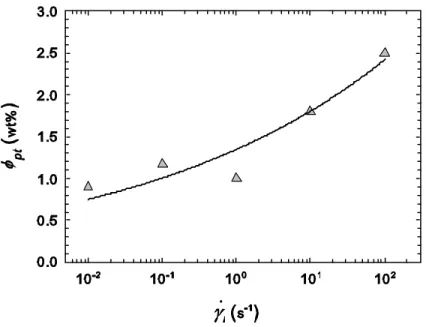
Au début, il a été montré, qualitativement, que l’histoire de l’écoulement influence fortement les propriétés viscoélastiques linéaires des suspensions. L’application de faibles forces de cisaillement implique des enchevêtrements entre les particules plus nombreux, tandis que le fort taux de pré-cisaillement provoque une destruction de la structure et le désenchevêtrement de nanotubes. Cette conclusion provient du fait que le début de la création d’un réseau de nanotubes de carbone interconnectés se déplace vers les faibles concentrations lorsque le taux de pré-cisaillement décroît. Le seuil de percolation rhéologique a été déterminé à environ 2.5 % en poids après un taux de cisaillement de 100 s-1, tandis que l’application d’un pré-cisaillement à 0.01 s-1 aboutit à un seuil de percolation de 1 % en poids.
La mesure du module de conservation des suspensions à une basse fréquence constante et à une contrainte dans la région linéaire a montré que l’évolution de la structure continue après l’arrêt du cisaillement. Les modules mesurés évoluent de manière exponentielle dans le temps pour chaque concentration. Différentes structures métastables se forment après un certain temps à la suite de l’arrêt du cisaillement. Les structures métastables créées se distinguent par les différents modules de conservation pour les systèmes dilués et semi-dilués, ceux-ci sont inversement reliés aux taux de pré-cisaillement. Cependant, pour les suspensions plus concentrées, les structures métastables formées ont approximativement le même module de conservation après le pré-cisaillement à différents taux. Ces observations révèlent que la structure des suspensions est plus sensible à l’histoire de l’écoulement pour des concentrations faibles et intermédiaires. En effet, pour de telles concentrations, les interactions entre les particules ne sont pas assez fortes; alors la structure fragile des suspensions est plus
susceptible d’être affectée par les forces de cisaillement externe. Toutefois, pour les fortes concentrations, les particules interagissent selon des forces hydrodynamiques et des forces de friction suffisamment fortes; alors la structure enchevêtrée formée est plus résistante au champ de cisaillement externe et le pré-cisaillement a une faible influence sur leur structure et sur leurs propriétés macroscopiques.
Des analyses supplémentaires sur l’effet de l’histoire de l’écoulement sur les structures métastables formées montrent que le module élastique de ces structures est lié au taux de pré-cisaillement selon une loi puissance telle que G κγi−ε
∞′ = & , ses paramètres étant fortement dépendants de la concentration. En appliquant ce modèle aux résultats à cisaillement constant des suspensions, une courbe maîtresse est sur une large échelle de concentrations, au-dessus et en-dessous du point de gélification; cela illustre l’importance du module de conservation des structures métastables comme un élément caractéristique, lequel représente un paramètre important de l’évolution de la structure.
En comparant les modules de conservation des suspensions avant le pré-cisaillement (excepté pour l’échantillon chargé dans l’instrument),G′ , avec ceux obtenus pour les structures ref métastables,G∞′, il a été montré qu’il existe un taux de cisaillement critique pour les concentrations intermédiaires et faibles en-dessus duquel les enchevêtrements des nanotubes sont rompus impliquant une élasticité plus faible de la suspension. Le taux de cisaillement critique a été quantifié en traçant ces deux modules en fonction du taux de pré-cisaillement appliqué; le taux de pré-cisaillement correspondant au point d’intersection est appelé taux de cisaillement critique,γ&c, et est compris entre 1.7 s-1 à 0.5 % en masse et 10 s-1 à 3 % en masse avec une erreur expérimentale de 15%± . Pour les concentrations plus élevées, aucun taux de
cisaillement critique n’est observé dû à la présence d’enchevêtrements forts de nanotubes. En effectuant un pré-cisaillement à un taux de cisaillement plus faible que le taux critique (
i c
γ γ
& < & ), il y a formation d’un plus grand nombre d’enchevêtrements entre les nanotubes; cela amène une plus grande élasticité des structures métastables formées (G∞′ >Gref′ ). À l’inverse, l’application d’un taux de cisaillement plus élevé (γ γ
&i ≥ &c) entraîne une rupture partielle de la structure et en conséquence l’élasticité des structures métastables diminue (G∞′ ≤Gref′ ).L’étendue de la formation et de la rupture de la structure au voisinage des taux de cisaillement critiques a été quantifiée par un ensemble d’expériences en écoulement transitoire inverse. Il apparaît que la formation de la structure est complète lorsque le taux de cisaillement appliqué est inférieur au taux critique. Cela a été caractérisé en approchant la valeur du pic de la contrainte inverse à une valeur similaire du pic de la contrainte dans le sens des aiguilles d’une montre après un temps de repos suffisant. Dès l’application de taux de cisaillement plus élevés, la structure se développe partiellement dû au désenchevêtrement de certains nanotubes. Pour les plus hautes concentrations, les pics de contrainte dans des directions opposées se chevauchent après un temps de repos suffisant quelque soit le taux de cisaillement appliqué. La vitesse de formation des structures et la formation des structures métastables après l’arrêt du pré-cisaillement ont été caractérisées en déterminant le temps caractéristique du système en fonction de la concentration, du taux de pré-cisaillement et de la température. Le temps caractéristique décroît avec la concentration révélant une reconstruction de la structure plus rapide. Cependant, cette variation en ce qui concerne le taux de pré-cisaillement est fortement dépendante de la concentration. Pour les suspensions diluées, il augmente significativement
avec le taux de pré-cisaillement, révélant une reconstruction de la structure plus lente tandis qu’il reste presque identique pour les suspensions plus concentrées.
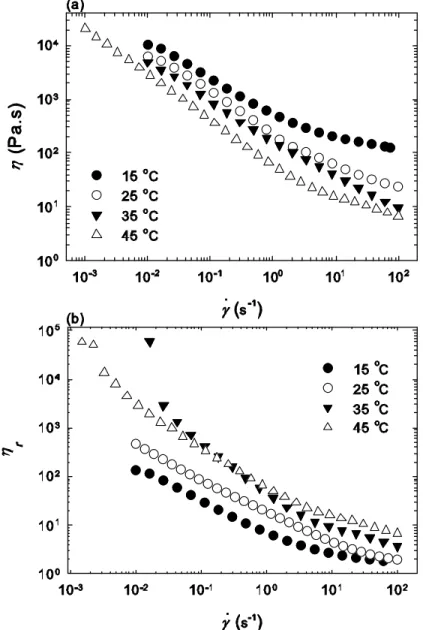
L’autre paramètre influençant la vitesse de formation des structures est la température. Toutefois, l’étude de l’effet de la température est plus compliquée puisque les interactions entre particules et les propriétés rhéologiques de la matrice polymérique sont toutes les deux sensibles aux variations de température. Donc, pour l’interprétation des résultats, il est essentiel de distinguer ces deux phénomènes. En normalisant la viscosité en cisaillement ainsi que les modules de conservation et de perte des suspensions aux valeurs correspondantes au polymère pur pour chaque température, l’effet des interactions entre particules est mis en évidence. Les valeurs normalisées augmentent avec la température, ce qui reflète l’augmentation des interactions entre particules. En observant la même tendance pour le module de conservation normalisé des suspensions métastables avec le module complexe de l’époxy pur pour chaque température, on aboutit à la même conclusion.
La variation de la température affecte le temps caractéristique de la formation des structures métastables. On observe que la vitesse de formation des structures métastables croît avec la température indépendamment de la concentration ou du taux de pré-cisaillement. Cela correspond à l’observation de la vitesse de formation des structures plus élevée lorsque la concentration augmente pour une température constante. A partir de ces deux observations, on peut conclure que les interactions entre particules ont un rôle crucial dans la formation des structures métastables. D’un autre coté, le temps de diffusion diminue avec la température; cela démontre le rôle important que jouent les forces Browniennes dans la formation des structures de suspensions de nanotubes de carbone en l’absence d’écoulement. Cela correspond au fait que le temps caractéristique des suspensions métastables diluées, pour de
forts taux de pré-cisaillement, diminue avec la température dans une gamme plus grande comparé aux faibles taux de pré-cisaillement. Cela veut dire qu’en l’absence de fortes interactions entre particules (déformation des structures possible pour les plus hauts taux de pré-cisaillement), la vitesse de reconstruction des structures augmente avec la température puisque fortement influencée par les forces Browniennes. En conclusion, dans une large gamme de concentrations, de taux de pré-cisaillement et de températures, le mouvement Brownien et les interactions entre particules sont deux mécanismes importants dans le développement des structures métastables.
L’importance des forces Browniennes et des interactions entre particules dans le développement des structures a été étudiée à travers un ensemble d’expériences en écoulement transitoire inverse au voisinage des taux de cisaillement critiques. Il a été observé que la formation des structures avait lieu en grande partie durant les 300 premières secondes de repos après l’arrêt de l’écoulement transitoire dans la direction dans le sens des aiguilles d’une montre; ce temps est comparable au temps de diffusion, 1/Dr égal à 314 s pour les systèmes
dilués et même plus court ( ~ / 2
r r
D′ D φ ) pour les suspensions semi-diluées. Cependant, la formation complète d’une structure prend plus de temps (~ 1 h) révélant le fait que les forces Browniennes ne peuvent pas être le seul mécanisme rentrant en jeu au repos. D’un autre coté, comme discuté plus tôt, l’insuffisance d’interactions entre particules dû à l’application de forts taux de pré-cisaillement (
γ γ
& &≥ c) et à la déformation de la structure, aboutit, lors des mesures en écoulement transitoire inverse, à une structure partielle. Donc, les forces Browniennes conjointement avec les interactions entre particules sont nécessaires à la reconstruction de la structure d’une suspension de nanotubes pré-cisaillée en l’absence d’écoulement.En utilisant le modèle structural thixotropique d’Yziquel et al. (1999), le comportement transitoire des suspensions de nanotubes est comparé aux prédictions obtenues du modèle. Le modèle prédit qualitativement les résultats de l’expérience ainsi que le développement d’une structure partielle pour des taux de cisaillement supérieurs aux taux de cisaillement critique. Cependant, le pic inverse et le temps de repos requis pour une formation complète de la structure sont surestimés.
Une plus ample interprétation du comportement de la structure des suspensions grâce à la théorie de mise à l’échelle apporte des informations précieuses sur la nature du réseau de nanotubes. Il a été démontré que les suspensions de nanotubes forment un réseau auto-assemblé au voisinage et au-dessus du point de gélification qui est supposément formé de paquets serrés de flocons fractals. La nature fractale du réseau a été mise en évidence en observant le comportement du plateau du module de conservation à basses fréquences des suspensions et la contrainte pour la limite maximale de linéarité,
γ
c, avec la concentration suivant la loi de puissance. En utilisant les exposants de la corrélation de la loi de puissance adaptée, la dimension fractale des suspensions est estimée à environ 2.15 pour les suspensions à floculations lentes. Cela explique pourquoi le temps d’utilisation des suspensions est limité à quelques mois. Au vu de la théorie de mise à l’échelle, les liaisons inter- et intra-flocons sont à l’origine de l’élasticité des réseaux.À partir de ce point de vue, les variations complexes des propriétés rhéologiques des structures métastables sous écoulement ont été étudiées. Il a été montré que les exposants des paramètres G∞′ et
γ
c de la loi de puissance, en ce qui concerne la concentration, augmentent significativement avec le taux de pré-cisaillement appliqué. Cependant, les dimensions fractales résultantes ont légèrement changé de 2.13 à 2.31 après un pré-cisaillementrespectivement de 0.1 s-1 et de 100 s-1. En fait, la faible différence entre les dimensions fractales des structures métastables est comprise dans l’erreur expérimentale, alors la superstructure du réseau des suspensions montre seulement une faible variation avec l’histoire de l’écoulement; cela est relié à la structure compacte initiale des suspensions avant le pré-cisaillement (df ~ 2.15). La faible sensibilité de la dimension fractale des suspensions à
l’histoire de l’écoulement est en accord avec le module de conservation constant des structures métastables, qui est très peu influencé par le taux de pré-cisaillement au voisinage et au-dessus du point de gélification. De plus, l’exposant m de la loi de puissance relié à la variation du rayon de giration (ξ) des agrégats avec le taux de cisaillement appliqué (
ξ γ
~ −m& ) a été trouvé dans la gamme de 0.36-0.38 et dans la limite des valeurs théoriques pour les agrégats rigides et mous. Cela illustre bien que les agrégats sont partiellement mous et partiellement rigides et que leur potentiel d’interaction est une combinaison des composants centraux et non-centraux.
Lors de la dernière étape, l’effet de la température sur le comportement de mise à l’échelle des suspensions a été caractérisé. Les modules de conservation réduits des suspensions augmentent avec la température alors que
γ
c diminue révélant la formation d’une structure plus fragile. Cela est en contradiction avec les travaux d’Abbasi et al. (2009) qui ont montré queγ
c augmentait avec la température, qu’il y avait formation d’un réseau plus fort et que les nanotubes de carbone étaient mieux dispersés dans le nano-composite. Dans ce sens, la diminution deγ
c avec la température pourrait être l’indication qu’il y a plus agrégats lorsque la température augmente. Pourtant, aucune séparation de phase n’a lieu puisque la superposition temps-température est valide sur l’étendue des températures étudiées. Les exposants du module de conservation de la loi de puissance etγ
c, et alors les dimensionsfractales estimées, présentent des erreurs importantes et la difficulté est donc de savoir si la superstructure des suspensions est influencée par la température; cela peut être dû à la plage limitée de température de seulement 30 °C.
TABLE OF CONTENTS
DEDICATION ... iii
ACKNOWLEDGEMENT ... iv
RÉSUMÉ ... v
ABSTRACT ... viii
CONDENSÉ EN FRANÇAIS ... xi
TABLE OF CONTENTS ... xx
LIST OF TABLES ... xxiii
LIST OF FIGURES ... xxiv
LIST OF SYMBOLS AND ABBREVIATIONS ... xxviii
LIST OF APPENDICES ... xxxiv
CHAPITRE 1 INTRODUCTION AND OBJECTIVES ... 1
1.1 Introduction ... 1
1.2 Objectives ... 3
CHAPITRE 2 LITERATURE REVIEW ... 7
2.1 Carbon nanotubes ... 7
2.2 Dispersion of CNTs ... 9
2.3 Rheology of CNT suspensions ... 12
2.4 Scaling theory ... 18
2.5 Thixotropic models ... 23
CHAPITRE 4 EFFECT OF FLOW HISTORY ON LINEAR VISCOELASTIC PROPERTIES AND THE EVOLUTION OF THE STRUCTURE OF MULTIWALLED CARBON NANOTUBE
SUSPENSIONS IN AN EPOXY ... 31
4.1 Introduction ... 32
4.2 Materials and their characterization ... 38
4.3 Results and discussion ... 46
4.3.1 Effect of flow history on LVE results ... 47
4.3.2 Effect of flow history on the evolution of the microstructure ... 51
4.3.3 Effect of temperature... 58
4.4 Summary ... 64
4.5 Acknowledgements ... 66
4.6 References ... 66
CHAPITRE 5 SCALING BEHAVIOUR OF THE ELASTIC PROPERTIES OF NON-DILUTE MWCNT-EPOXY SUSPENSIONS ... 74
5.1 Introduction ... 76
5.2 Theoretical background ... 78
5.2.1 Scaling theory ... 78
5.2.2 Fractal theory ... 81
5.3 Materials and their characterization ... 82
5.4 Results and discussion ... 83
5.4.1 Scaling behaviour of steady-shear results ... 85
5.4.2 Scaling behaviour of linear viscoelastic properties ... 87
5.4.3 The effect of flow history ... 90
5.5 Conclusion ... 106
5.6 Acknowledgements ... 107
5.7 References ... 107
CHAPITRE 6 CRITICAL SHEAR RATES AND STRUCTURE BUILD-UP AT REST IN
MWCNT SUSPENSIONS ... 110
6.1 Introduction ... 112
6.2 Materials and rheological measurements ... 115
6.3 Structural model ... 116
6.4 Critical shear rates ... 118
6.5 Transient results ... 122
6.6 Model simulation and prediction ... 128
6.7 Result comparison with model predictions ... 130
6.8 Discussion ... 140
6.9 Summary ... 144
6.10 Acknowledgements ... 145
6.11 References ... 145 CHAPITRE 7 GENERAL DISCUSSION AND CONCLUSION ... 148 RECOMMENDATIONS ... 155 BIBLIOGRAPHY ... 158
LIST OF TABLES
Table 2-1: Physical properties of some fibres in comparison with CNTs. ... 9
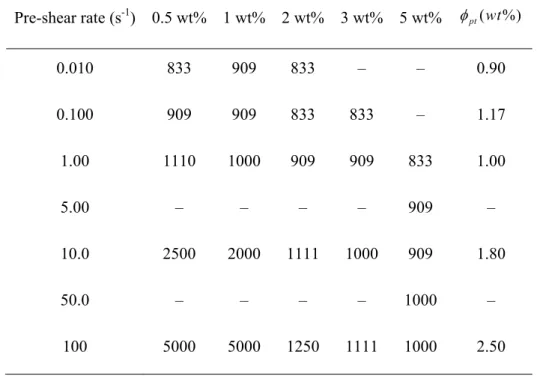
Table 4-1: Variations of τ(s) and φpt with pre-shear rate for different concentrations. ... 53 Table 5-1: Exponents from the scaling behaviour of the LVE properties and fractal dimension
as a function of pre-shear rate. ... 98
Table 5-2: Variations of γc(%) with temperature at various concentrations ... 100 Table 5-3: Variations of the scaling exponents with temperature ... 105
Table 6-1: Power-law exponents from the best fit of Eq. (6-6) with experimental data and
(Pa)
ref
G′ for various concentrations at 1 rad/s in LVE region. ... 120
Table 6-2: Model parameters used to predict the steady shear viscosity and stress growth results. ... 132
LIST OF FIGURES
Figure 2-1: A schematic of SWCNT (left), DWCNT (middle) and MWCNT (right). ... 8
Figure 2-2: A transmission electron micrograph of MWCNTs dispersed in acetone by sonication at 240 W for few minutes. The scale bar shows 50nm. ... 10
Figure 2-3: Schematic of a three-roll-mill. ... 12
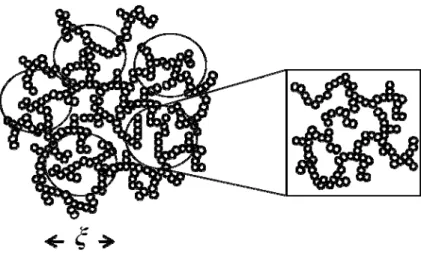
Figure 2-4: Schematic structure of a colloidal gel. The circles show the fractal flocs with the radius of ξ. The regions between flocs are considered as links. On the right, a schematic of the backbone structure of a floc is shown, which is a self-similar system with a different fractal dimension of x. ... 18
Figure 4-1: (a) TEM micrographs of MWCNTs. (b) Higher magnification of some overlapped MWCNTs. ... 37
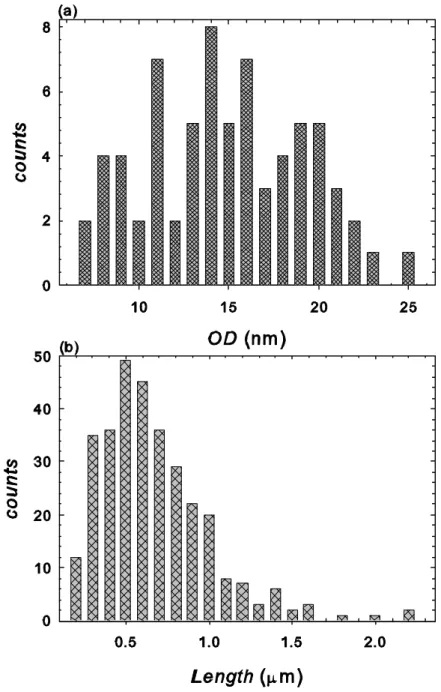
Figure 4-2: (a) Outer diameter (OD) and (b) length (L) distribution of MWCNTs obtained by image analysis on TEM results using ClemexTM Vision software. ... 39
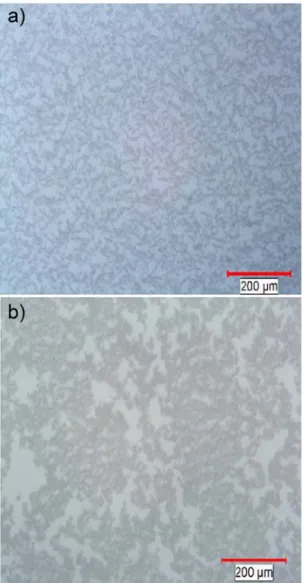
Figure 4-3: Optical micrographs of CNT-epoxy suspensions (a) 0.5 wt% and (b) 1 wt% concentration. The scale bars are 200 µm in both cases. ... 43
Figure 4-4: Reduced viscosity of suspensions at 0.5 s-1 versus volume fraction of MWCNTs. ... 44
Figure 4-5: Effect of pre-shearing on the storage modulus (a) and loss modulus (b) of a 1 wt% MWCNT-epoxy suspension as functions of frequency at a strain of 0.01 after pre-shearing under different rates followed by 5000 s rest. ... 48
Figure 4-6: Rheological percolation threshold as a function of the pre-shear rate, 5000 s after pre-shearing at room temperature. ... 50
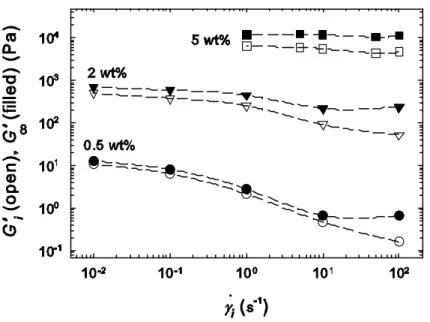
Figure 4-7: Development of the elastic modulus at 1 rad/s for MWCNT-epoxy suspensions versus time after cessation of shear flow for different pre-shearing rates: (a) 2 wt% concentration at strain amplitude of 0.0072 and (b) 5 wt% concentration at strain amplitude of 0.0025. ... 52
Figure 4-8: G′i and G∞′ as functions of the pre-shear rate for the 0.5, 2 and 5 wt% suspensions at room temperature. ... 56
Figure 4-9: Effect of temperature on the steady shear viscosity (a) and the reduced shear viscosity (b) of the 3 wt% MWCNT-epoxy suspension. ... 60
Figure 4-10: Reduced storage modulus as a function of the pre-shear rate for (a) 1 wt% and (b) 3 wt% suspensions at different temperatures. G∞′ is the storage modulus of the suspensions and *
s
G is the complex modulus of the neat epoxy... 62
Figure 4-11: Variations of the characteristic time (
τ
) for (a) 1 wt% suspension as a function of temperature and (b) for 1 wt% and 3 wt% suspensions as a function of the pre-shearing rate. ... 64Figure 5-1: (a) Steady-shear measurement of MWCNT suspensions at different concentrations. The lines show the best fits of the data using the Herschel-Bulkley model where the apparent yield stress appears. (b) Scaling behaviour of the apparent yield stress obtained using the Herschel-Bulkley model with volume concentration of MWCNTs. The line shows the best power-law fit. ... 84
Figure 5-2: Scaling behaviour of steady shear data with low angular frequency (1 rad/s) storage modulus of the suspensions. ... 86
Figure 5-3: Scaling behaviour of (a) the elastic modulus and (b) the critical strain before pre-shearing as a function of volume concentration of MWCNTs. ... 88
Figure 5-4: Strain sweep of reduced elastic modulus carried out at 0.1 rad/s and 10 rad/s after pre-shear rates of 1 s-1 and 100 s-1 for a 3 wt% MWCNT suspension in epoxy (G′0 is the storage modulus of the linear zone). ... 91
Figure 5-5: Increases of the elastic modulus for 3 wt% MWCNT-epoxy suspensions with time after cessation of shear flow for different pre-shear rates. The SAOS measurements were carried out at 1 rad/s and at a strain amplitude of 0.0072. ... 92
Figure 5-6: Dependence of the storage modulus on pre-shear rate for the pre-sheared MWCNT suspensions followed by 5000 s rest (G∞′). SAOS measurements were carried out at 1
Figure 5-7: Scaling behaviour of steady-shear data with the low angular frequency storage modulus of the pre-sheared suspensions
( )
G∞′ obtained from interpolation using Eq. (5-15). ... 95Figure 5-8: Scaling behaviour of (a) the elastic modulus and (b) the critical strain after pre-shearing at different rates followed by 5000 s rest as a function of volume concentration of MWCNTs. ... 97
Figure 5-9: The effect of temperature on the frequency sweep results of a 2 wt% MWCNT-epoxy suspension (a) reduced storage modulus (b) reduced loss modulus. G is the norm *s of the complex modulus of the neat epoxy. ... 103
Figure 5-10: (a) Time-temperature superposition for reduced storage modulus of MWCNT suspensions in epoxy; G is the norm of the complex modulus of the neat epoxy (b) *s
variation of the shift factor aT with absolute temperature at various concentrations. ... 104
Figure 6-1: Storage modulus of the pre-sheared (G∞′ , symbols) suspensions at various concentrations (measured in LVE region and angular frequency of 1 rad/s) plotted as a function of the pre-shear rate. For the non-pre-sheared samplesG′ , are reported as the ref dashed lines. The arrows show an estimation of the critical shear rate. ... 122
Figure 6-2: Transient stress data for a 2 wt% MWCNT suspension in an epoxy at shear rates of (a) 1 s-1 and (b) 10 s-1. The result for neat epoxy is shown for the reference. ... 125
Figure 6-3: Transient stress data for a 5 wt% MWCNT suspension in an epoxy at shear rates of (a) 1 s-1 and (b) 10 s-1. The results for the neat epoxy are shown for reference. ... 126
Figure 6-4: Transient normal stress difference for a 5 wt% MWCNT suspension in an epoxy under an applied shear rate of 10 s-1... 127
Figure 6-5: Sensitivity analysis on the fitting parameters for stress growth results. (a) Variable k1 and constant k2. (b) Variable k1 and constant k2/k1. (c) Variable G0 and G∞= 0. The
arrow in (b) shows the direction of increasing k1. ... 129
Figure 6-6: Steady-shear viscosity results for the 0 wt%, 2 wt% and 5 wt% suspensions. The lines show the model predictions. ... 131
Figure 6-7: Shear stress growth data for the 2 wt% suspension under an applied shear rate of (a)1 s-1 and (b)10 s-1. The lines show the model predictions. ... 135
Figure 6-8: Shear stress growth data for the 5 wt% suspension under an applied shear rate of (a) 1 s-1 and (b) 10 s-1. The lines show the model predictions. ... 136
Figure 6-9: First normal stress difference as a function of strain in a stress growth experiment at 10 s-1 for the 5 wt% suspension. The lines show the model predictions. ... 137
Figure 6-10: Evolution of the structural parameter (ξ) during (a,c) CCW flow and (b,d) rest for the 5 wt% (a,b) and the 2 wt% (c,d) suspensions... 138
Figure 6-11: Extent of structure build-up at rest for the 2 wt%, 3 wt% and 5 wt% suspensions of MWCNTs in epoxy for applied shear rates of (a) 1 s-1 and (b) 10 s-1. The symbols are experimental data and the lines show the model predictions. The vertical dashed line marks the rest time at 300 s. ... 143
LIST OF SYMBOLS AND ABBREVIATIONS
Latin symbols
a particle diameter, consistency index AH Hamaker constant
aT shift factor b flow behaviour index c2 constant
d fibre diameter, mean value of outer diameter, Euclidean dimension De Deborah number
df fractal dimension
Dr rotational diffusion coefficient Ea activation energy
Ec the work required to break up the elastic structure EY Young modulus
f(ξ) empirical function in structural model ( , )
G γ t relaxation modulus
G′ storage modulus, macroscopic elastic constant of a system with size L
0
G′ low angular frequency storage modulus ( )
G t′ storage modulus ( )
G′ ξ structured modulus in structural model i
G′ initial storage modulus right after pre-shearing
ref
G′ storage modulus of suspensions before pre-sharing
G∞′ equilibrium storage modulus
min
(G∞′) minimum value of equilibrium storage modulus
max
(G∞′) maximum value of equilibrium storage modulus
exp
(G∞′) equilibrium storage modulus from experiment
model
(G∞′) equilibrium storage modulus from model G′′ loss modulus
*
s
G complex modulus of neat polymer
h Planck constant
ID inner diameter
k1, k2 kinetic constants of structural model kB Boltzmann constant
Kchain elastic constant of a linear chain
K0 bending constant between two neighbouring springs Keff effective elastic constant of a floc
Kl inter-floc elastic constant KL storage modulus of suspension
Kξ elastic constant of a floc, intra-floc elastic constant
L fibre length
N number of experimental data, number of springs in a floc
m power-law exponent
mrigid power-law exponent for rigid aggregates msoft power-law exponent for soft aggregates n power-law exponent
n1 relative refractive index of a particle N1 first normal stress difference
N2 second normal stress difference
n3 relative refractive index of neat polymer OD outer diameter
Pe Peclet number
r distance between particles
R gas constant
R2 a measure of the extent to which the total variation of the dependent variable is explained by the regression
Seff effective stiffness t time
T temperature
T0 reference temperature tdiffusion characteristic diffusion time x fractal dimension of backbone
Greek symbols
α fitting parameter, coefficient of proportionality β power-law coefficient
γ strain, power-law exponent
γ1 the power-law exponent relating the storage modulus to the concentration
γc maximum limit for linearity γ& shear rate
i
γ& rate of pre-shearing
c
γ& critical shear rate
ε power-law exponent ε1 permittivity of particles ε3 permittivity of neat polymer η shear viscosity
( )
η γ& shear viscosity η0 characteristic viscosity
ηs viscosity of suspending medium η* complex viscosity
ηr reduced shear viscosity of suspension η∞ high shear viscosity
η(ξ) structured viscosity [η] intrinsic viscosities κ constant
λ0 characteristic time related to particle interactions νe absorption frequency
ν
∇ velocity gradient
T
(∇ν) transpose of velocity gradient
ξ effective floc size, radius of gyration of fractal flocs, structural parameter ξCCW steady-state value of the structural parameter at the end of CCW
ξ0 characteristic length scale
ρ mass density
σ+ transient shear stress in a stress growth experiment σ+
max(CCW) transient shear stress in a counter-clockwise stress growth experiment σ+
max(CW) transient shear stress in a clockwise stress growth experiment σN normalized standard deviation
τ characteristic time, shear stress τy apparent yield stress
φ particle concentration
int
φ internal concentration
pt
φ concentration at percolation threshold
ν
φ volume concentration
ν
φ′ transition concentration from dilute to semi-dilute regime
ν
φ′′ transition concentration from semi-dilute to concentrated regime Φ interaction potential ω angular frequency
Abbreviations
CCW counter clockwise CNF carbon nano-fibre CNT carbon nanotubeCTAB cetyl trimethyl ammonium bromide
CW clockwise
DWCNT double wall carbon nanotube iPP isotactic polypropylene
LVE linear viscoelastic
MWCNT multiwall carbon nanotube ODA octadecylamine
PB polybutene
PBSA poly[butylene succinate-co-adipate] PBT polybutylene terephthalate
PDI poly-dispersity index PEO polyethylene oxide PIB poly-iso-butylene
PMMA poly-methyl-methacrylate
PP polypropylene
PS polystyrene
SANS small angle neutron scattering SAOS small amplitude oscillatory shear SDBS sodium dodecyl benzene sulfonate SDS sodium dodecyl sulfate
SWCNT singlewall carbon nanotube 3RM three-roll mill
LIST OF APPENDICES
CHAPITRE 1
INTRODUCTION AND OBJECTIVES
1.1 Introduction
Carbon nanotubes show many potential applications and have been widely used to improve the physical properties of polymers such as their electrical conductivity [Zhang et al. (2006); Kota et al. (2007)], mechanical properties [Allaoui et al. (2002); Gojny et al. (2004)], thermal properties [Lau et al. (2005); Nanda et al. (2008)] and inflammability [Schartel et al. (2005); Cipiriano et al. (2007)]. The stability and dispersion quality of nanotube suspensions are crucial for different applications. The state of dispersion of the suspensions depends on the internal and external forces. Repulsive inter-particle interactions help to keep the particles dispersed while attractive interactions can result in aggregation.
Depending on the preparation conditions, particles disperse differently in the suspending medium and form numerous structures. A qualitative definition of structure is the interrelation or arrangement of particles in the dispersing medium. Application of shear forces at various amplitudes during processing can strongly influence the structure, the quality of dispersion of particles in the suspension and their macroscopic properties. A great deal of research has been devoted to analyze the effect of various processing parameters on the dispersion quality and macroscopic properties of colloidal suspensions.
If the particles associate by attractive forces or due to flow conditions, they aggregate. There are two types of aggregation: flocculation and coagulation [Larson (1999)]. Flocculation is a reversible aggregation and is usually the result of a physical change in the system. It can be reversed by the application of mechanical processes such as shaking or stirring. The
breakdown of aggregates (flocculates) and re-dispersion of particles in the suspension is called dis-aggregation or de-flocculation. Coagulation is a fast irreversible aggregation.
Application of external fields such as shear field may cause aggregation or dis-aggregation. If the particles are stiff enough and interact by large friction forces, shear forces induce aggregation even in the absence of attractive inter-particle interactions [Switzer III and Klingenberg (2003)]. The stiffness of particles not only depends on their physical properties such as the Young modulus and particle dimensions, but also on the viscosity of the suspending medium and the flow conditions; thus, same particles may act as flexible or rigid ones depending on the rate of the applied shear or the properties of the matrix. By applying high shear forces, the aggregates can break down and the particles re-disperse in the suspensions more homogenously.
The state of flocculation/de-flocculation of suspensions under the influence of flow strongly depends on the rate of the applied shear and the concentration. Depending on their concentration, the suspensions may belong to dilute, semi-dilute or concentrated regime. In dilute systems, the particles are theoretically isolated and free to rotate without being disturbed by the presence of other particles. Thus, the inter-particle interactions are very weak and the fragile structure of suspensions can be easily influenced by shear forces. In semi-dilute regime, the particles interact through excluded volume interactions and form a relatively stronger structure; though, their structure can be influenced by high shear forces. The particles overlap in concentrated regime and interact by mechanical contacts and hydrodynamic interactions; hence, external shear forces can barely influence their structure. In the particular case of nanotube suspensions, Brownian motion competes with short range attractive van der Waals forces between nanotubes in the absence of external forces to keep
them suspended. During flow, long range hydrodynamic forces compete with Brownian motion; the dominating force determines the final microstructure of the suspension.
The fact that the suspensions structure can be easily influenced by many parameters such as external shear forces, suspension concentration, particles stiffness, etc., makes the study of structure very challenging.
Light scattering techniques can provide morphological information about suspensions structure at certain length scales. However, in most cases, a combination of scattering techniques should be accessible to have a thorough understanding about the microstructure over a wide range of length scales from few nanometres to tens of microns [Pignon et al. (1997)]. Moreover, these techniques are limited to very dilute systems.A more applicable tool for characterizing the microstructure is through the study of the rheological behaviour of the suspensions which can detect structural changes at submicron scales over a wide range of concentrations.
1.2 Objectives
An extensive research has been devoted to investigate the state of flocculation, de-flocculation and orientation of CNT suspensions subjected to different flow conditions such as those in [Lin-Gibson et al. (2004); Hobbie and Fry (2006)]. These studies have been mainly performed by light scattering techniques applicable to dilute and semi-dilute concentrations. However, it should be noted that the evolution of structure does not stall upon cessation of shear flow. Recently, Mobuchon et al. (2009) and Negi and Osuji (2010) have shown that flow history strongly influenced the evolution of structure of the non-aqueous layered silicate suspensions as well as the aqueous laponite suspensions respectively. Nevertheless, these studies have
been restricted to a single or a limited range of concentrations while the rheological properties can dramatically change from one concentration regime to another. Furthermore, the mechanisms involved in the structure evolution need to be investigated as how they influence the state of dispersion of suspensions.
In this thesis, the structure of a model carbon nanotube suspension dispersed in an epoxy is characterized by employing a set of rheological methods, scaling and fractal theories and a structural thixotropic model. In particular, it is aimed to determine the mechanisms involved in the formation of the structure and the extent by which the variation of the parameters namely concentration, temperature and pre-shear rate affect the state of dispersion of the suspensions.
Multiwall carbon nanotubes with relatively short lengths and the average aspect ratio of about 45 are dispersed in an epoxy Epon 828 using a three-roll mill mixer and suspensions with a wide range of concentrations are prepared. Initially the size and size distribution of nanotubes are determined by transmission electron microscopy (TEM) and image analysis. These results are used to elaborate the limits of our system including the concentration regimes of the suspensions, the effective stiffness of nanotubes and the rotary diffusion coefficient. A variety of rheological measurements including non-destructive small amplitude oscillatory shear (SAOS) measurements as well as the steady shear and transient flow measurements have been performed to pursue the objectives of this thesis. The results of the rheological measurements have been interpreted in the light of the scaling theories [Shih et al. (1990); Wu and Morbidelli (2001)], fractal theories [Potanin (1991); Potanin (1993)] and a structural kinetic
model [Yziquel et al. (1999)]. The main contributions of this research are highlighted as the following:
1) The suspensions microstructure and its evolution were analyzed under the simultaneous influence of pre-shearing, concentration and temperature in a quantitative manner.
2) It has been shown that pre-shearing at low rates induced more entanglements between carbon nanotubes and resulted in the formation of a percolated network at lower concentrations. By increasing the rate of pre-shearing, more nanotubes disentangled and the onset for the formation of an interconnected network shifted to higher concentrations.
3) A critical shear rate was obtained that exhibits a limit for the applied pre-shear rate at low and intermediate concentrations to avoid the breakdown of nanotube entanglements.
4) The kinetics of structure build-up under the influence of flow history, concentration and temperature was analyzed.
5) The nature of nanotubes network structure and the origin of its elasticity were determined using the scaling theories.
6) The influence of flow history and temperature on the microstructure and the degree of compactness of suspensions structure was quantitatively characterized using fractal dimension analysis.
7) The mechanisms of structure evolution during flow and in quiescent was studied by comparing the stress growth transient results with a structural kinetic model and the
importance of Brownian forces as a possible mechanism in structural evolution was shown.
CHAPITRE 2
LITERATURE REVIEW
In this chapter, a brief review on the properties of CNTs and their potential applications are presented. Then, different suspension preparation techniques as well as other dispersion techniques useful for nanotubes are reviewed. A more in-depth critical review on the rheology of these suspensions as well as the influential parameters on the rheological properties of nanotube suspensions (composites) is presented. Given the extent by which we use the scaling theory and a thixotropic model to interpret the measured rheological properties, they have been reviewed in the last sub-sections of this chapter.
2.1 Carbon nanotubes
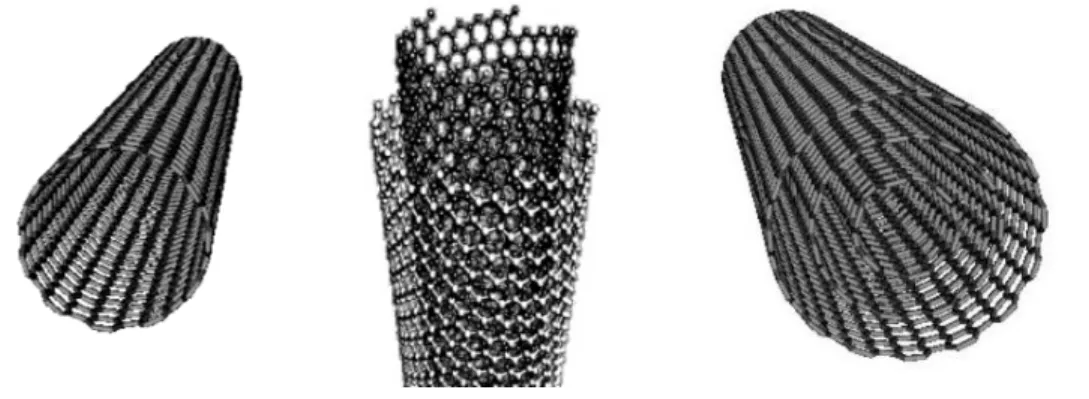
Carbon nanotubes (CNTs) are fibre-like particles made up of graphite sheets with a small diameter in the range of few nanometres and lengths of few microns to few millimetres. They are formed of carbon atoms with sp2 bonds which are stronger than sp3 bonds found between carbon atoms in diamond which makes them very strong and stiff fibres. They may have different structures depending on their length, thickness, number of layers and chirality. The most commonly used types of CNTs are single wall carbon nanotubes (SWCNTs), double wall carbon nanotubes (DWCNTs) and multi-wall carbon nanotubes (MWCNTs). Figure 2-1 represents a schematic of the three types of nanotubes.
Although the structure of carbon nanotubes is similar to graphite, they show different electrical properties depending to their chirality. In theory, metallic nanotubes can carry an electric current density of more than 1,000 times greater than metals such as copper [Hong and Myung (2007)]. The thermal stability of carbon nanotubes is estimated to be up to 2800 °C in vacuum and about 750 °C in air [Thostenson et al. (2005)].
Figure 2-1: A schematic of SWCNT (left1), DWCNT (middle2) and MWCNT (right3).
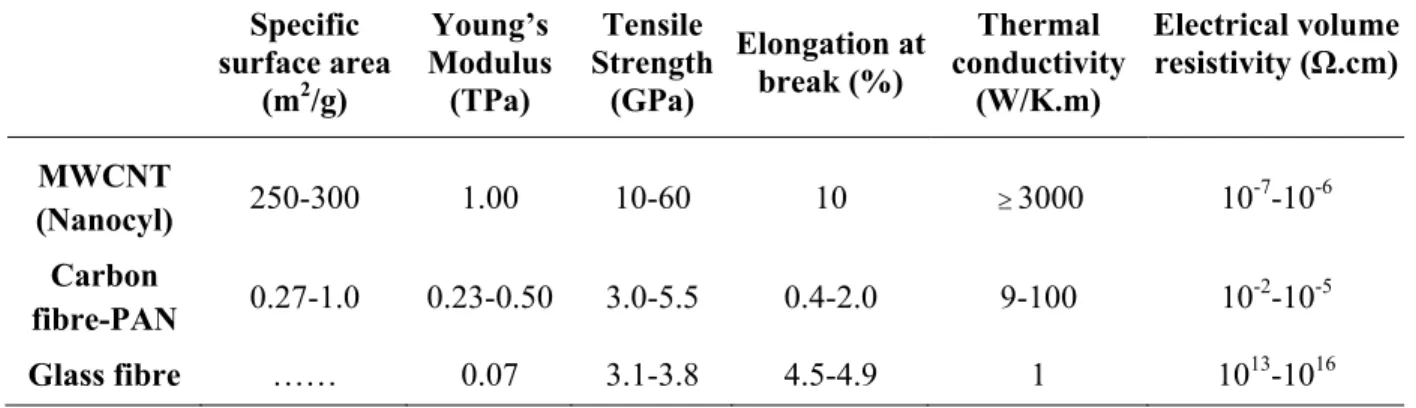
Some properties of CNTs are summarized and compared with glass fibre as a non-conductive fibre and PAN-based carbon fibre [Wypych (2000)] as a conductive fibre in Table 2-1. The properties of carbon nanotubes are obtained from MSDS of a thin MWCNT (NC7000 Series) produced by NANOCYL ™. From this table, it can be observed that carbon nanotubes have a high specific surface area; this makes them good candidates as fillers since the addition of small quantities of nanotubes can provide a large surface area available to the suspending medium. They are also very strong fibres with tensile strength of more than 10 GPa and stiff with the Young’s modulus of about 1 TPa. They break at much larger (~10 %) elongation compared to carbon fibre (~2%) or glass fibre (~ 4.5%). Considering copper as a metal with very low electrical resistivity (~10-6 Ω-cm), carbon nanotubes are relatively conductive fillers whereas glass fibre (~1013-1016 Ω-cm) is almost an isolator similar to most polymers such as epoxy resins (~1012-1014 Ω-cm). 1 http://www.physorg.com/news11668.html 2 http://www.nec.co.jp/press/ja/pr-room/cnt-img/cnt-01.jpg 3 http://itech.dickinson.edu/chemistry/?cat=74
Table 2-1: Physical properties of some fibres in comparison with CNTs. Specific surface area (m2/g) Young’s Modulus (TPa) Tensile Strength (GPa) Elongation at break (%) Thermal conductivity (W/K.m) Electrical volume resistivity (Ω.cm) MWCNT (Nanocyl) 250-300 1.00 10-60 10 ≥3000 10 -7-10-6 Carbon fibre-PAN 0.27-1.0 0.23-0.50 3.0-5.5 0.4-2.0 9-100 10 -2-10-5 Glass fibre …… 0.07 3.1-3.8 4.5-4.9 1 1013-1016
The unique properties of carbon nanotubes make them good candidates for polymer reinforcements and fabrication of multi-functional nano-composites. Addition of small quantity of CNTs to polymers can significantly change their physical properties such as electrical conductivity, electromagnetic shielding effectiveness and thermal conductivity.
2.2 Dispersion of CNTs
Since, CNTs have a smooth surface and attract each other by weak van der Waals forces, they tend to entangle; this makes their dispersion into polymer matrices very challenging. A schematic of 0.1 wt% pristine MWCNTs dispersed in acetone is presented in Figure 2-2. As it can be observed, it is not possible to identify the single nanotubes in this micrograph.
Dispersion exhibits how uniformly CNTs are distributed in the suspensions and strongly depends on the processing conditions. Huang et al. (2006) reported a critical mixing time is required at a certain mixing shear stress and concentration to well disperse nanotubes in a suspension. Insufficient mixing time results in jamming of clusters and instabilities in the form of sedimentation.
Figure 2-2: A transmission electron micrograph of MWCNTs dispersed in acetone by sonication at 240 W for few minutes. The scale bar shows 50nm.
In addition, they emphasized that the shear stress energy delivered to the nanotubes clusters during processing must exceed the van der Waals forces between the nanotubes in order to break the clusters and well disperse the nanotubes in the suspensions. If large aggregates are present in the structure of final nano-composites, they act as stress accumulators and diminish the mechanical properties. On the other hand, the presence of an interconnected network is necessary to make electrically conductive nano-composites. Thus, an efficient technique needs to be used to disperse nanotubes homogenously in the matrix while preserving the network structure for electrical conductivity.
In some cases, the addition of a surfactant, such as sodium dodecyl sulfate (SDS), sodium dodecyl benzene sulfonate (SDBS) or cetyl trimethyl ammonium bromide (CTAB) can improve the quality of dispersion and stability of CNT suspensions, by reducing the surface tension of the dispersing medium and improving the separation of nanotubes. In this thesis, SDS was used to well disperse CNTs in water in order to perform image analysis on their TEM micrographs and characterize their dimensions. The surfactant should be soluble in the
dispersing medium. This introduces a new challenge since it is difficult to find a surfactant for many polymer matrices. Moreover, the addition of surfactant can affect the rheological properties and diminish the electrical conductivity of the final nano-composites if it helps to improve the dispersion of the nanotubes and opens up their entanglements thoroughly.
Depending on the viscosity of the dispersing medium, different techniques can be used to disperse nanotubes. For high viscosity polymer matrices, twin-screw extrusion [Bose et al. (2007)], melt mixing in an internal mixer [Abbasi et al. (2009)] or micro-compounder [Abdel-Goad and Potschke (2005)] can be used. Usually a master-batch of high concentrated composite is diluted with the neat polymer at high temperatures. For relatively low viscosity matrices, mechanical stirring or sonication [Kim et al. (2006)] are used. Addition of a solvent can sometimes improve the dispersion quality since the solvent helps to reduce the viscosity of medium and facilitates the diffusion of particles [Lau et al. (2005)]. However, after mixing, the solvent needs to be removed which makes it a time-consuming and a non-environmentally friendly technique. In addition, some traces of solvent may remain in the suspension since by increasing the concentration of particles it is more difficult to evaporate the solvent. This can definitely influence the rheological properties of the suspensions. In a direct mixing technique, no solvent is involved but the quality of dispersion may not be perfect even when a combination of mechanical stirring and sonication techniques are used.
Another technique has been recently used which makes the dispersion of particles in polymer matrices more efficient. In this method, the particles are manually mixed with the dispersing medium with a spatula and then the mixture is poured between the rolls of a three roll mill where each two rolls rotate in opposite directions. The rotation speed and the gap size between the rolls can be adjusted by the user. By decreasing the gap size between the mills and circulating the sample in the mixer for a number of times, a relatively homogenous suspension
can be obtained. However, it should be noted that this technique is restricted to room temperature and is not suitable for volatile suspensions. A schematic of a three-roll-mill mixer is shown in Figure 2-3.
Figure 2-3: Schematic of a three-roll-mill.
A comparative study was performed to evaluate the dispersion quality of a 1 wt% MWCNT in an epoxy prepared by sonication with and without solvent and mixing in a three-roll-mill. The results are shown in Appendix A.
2.3 Rheology of CNT suspensions
CNTs are fibre-like nano-sized particles that are highly entangled in the absence of any surfactant or functional groups. Hence, there should be some similarities between their rheological behaviour and rheology of short fibre suspensions on one hand and nano-composites on the other hand. A great deal of research has been devoted to study the rheological properties of CNT suspensions. Different parameters have been shown to influence the rheology of CNT suspensions among which are concentration, surface treatment,
orientation, aspect ratio and flexibility of nanotubes as well as the dispersion quality of CNT suspensions.
Functionalization or surface treatment of carbon nanotubes can be performed by various techniques such as acid treatment, amine treatment or heat treatment [Lee et al. (2007)]. In the former technique, the nanotubes are passed through solutions of super acids for a number of times, then rinsed with deionised water and dried in vacuum at high temperature. As a result, the impurities such as amorphous carbons, graphite particles and metal catalysts are removed from the surface of nanotubes. In addition, some functional groups such as hydroxyl group (O-H) and carboxyl group (C=O) are introduced during the functionalization process. If the acid treated nanotubes are heated with octadecylamine (ODA) for few days and then washed in ethanol for a couple of times, (N-H) groups appear on the surface of nanotubes. Heat treatment can be performed by heating the pristine nanotubes at high temperature in air where hydroxyl groups appear on the surface of nanotubes.
Introduction of functional groups to the surface of nanotubes results in better dispersion of nanotubes in the suspensions (or polymer melts) and strong interactions between the polymer molecules and the nanotubes surface. Consequently, higher rheological properties, e.g. storage modulus and complex viscosity can be obtained [Song (2006); Lee et al. (2007)]. Furthermore, a strong attachment of nanotubes to polymer molecules via the functional groups allows more efficient stress transfer between CNT and the matrix which consequently improves the mechanical properties of the resulting composites [Kim et al. (2008)]. However, functionalization can cause morphological damages to the surface of nanotubes and reduce their length and their aspect ratio which consequently reduces their effectiveness as reinforcing agents. If this is the case, the rheological properties of surface treated CNT
suspensions are influenced by a compromise of the two effects as a result of functionalization [Fan and Advani (2007)].
Similar to fibre suspensions, the orientation state of nanotubes can influence their rheological properties. Du et al. (2004) showed that the SWNTs aligned by melt fibre spinning in poly-methyl-methacrylate (PMMA), have lower storage modulus than the isotropically dispersed nanotubes in the nano-composites. For initially aligned nanotubes in the flow direction, Abbasi et al. (2010) has recently shown that the complex viscosity significantly decreased and the rheological and electrical percolation thresholds increased remarkably.
The aspect ratio of nanotubes affects their hydrodynamic volume and so their rheological properties [Cipiriano et al. (2007); Xu et al. (2008); Wu et al. (2010)]. By increasing the nanotubes aspect ratio, their rheological properties such as storage modulus increase upon addition of small quantities of nanotubes to the polymer matrices. Xu et al. (2008) reported positive normal stress differences at high shear rates in low aspect ratio CNT-isotactic polypropylene (iPP) composites and negative normal stress differences in high aspect ratio CNT composites. The former was in-line with the observation of die swell during the extrusion process and latter with die shrinkage. Moreover, a percolated nanotube network forms at much lower concentrations as the aspect ratio increases [Cipiriano et al. (2007)]. Recently, Keshtkar et al. (2009) has shown that the onset of transition from dilute to semi-dilute and semi-semi-dilute to concentrated regimes shifts to lower concentrations for different micron-size fibres when their aspect ratios increased. A similar behaviour is expected to be observed in CNT suspensions.
CNTs may act as rigid or flexible fibres depending on CNTs aspect ratio, the applied shear rate and the properties of the suspending medium. The flexibility of nanotubes can be verified
by the effective stiffness S from the following correlation proposed by [Switzer and eff
Klingenberg (2003)] for fibres: 4 4 64 eff Y s E d S L π η γ = & (2-1)
where, EY is the fibre Young modulus, d and L are the fibre diameter and length, ηs is the
viscosity of the suspending medium and
γ
&
is shear rate. According to Switzer and Klingenberg (2003), S describes the relative importance of the fibre stiffness and the effhydrodynamic torque in determining the bending of a fibre in shear flow. When Seff → the 0 fibres behave like flexible strings whereas for very large valuesSeff → ∞ , the fibres become
rigid and maintain their equilibrium shape during flow. The fibre flexibility can considerably affect the viscous and elastic properties of the suspensions. Keshtkar et al. (2009) has recently shown that by increasing the fibre flexibility, it is more difficult to align the fibres in the flow direction by calculating the required energy per unit volume for orienting the fibres. In this work, the CNTs that are dispersed in a low viscosity Newtonian fluid behave more like stiff fibres in the range of shear rates studied.
The dispersion quality of suspensions has a significant influence on their rheology. Conflicting results about the effect of the quality of nanotubes dispersion quality on the rheological properties of polymer melts and suspensions have been reported. Du et al. (2004) reported higher storage modulus with a low frequency plateau modulus in SWCNTs dispersed in poly-methyl- methacrylate (PMMA) with better dispersion and a liquid-like behaviour for poorly dispersed nanotube suspensions at similar concentrations. On the other hand, Song and Youn (2005) observed that the MWCNTs-epoxy nano-composites with poorly dispersed nanotubes exhibited higher storage modulus, loss modulus, and complex viscosity than the