OATAO is an open access repository that collects the work of Toulouse
researchers and makes it freely available over the web where possible
Any correspondence concerning this service should be sent
to the repository administrator:
[email protected]
This is an author’s version published in:
http://oatao.univ-toulouse.fr/25522
To cite this version:
Jeannin, Thomas and Yung, Loïc and Evon, Philippe
and Labonne,
Laurent
and Ouagne, Pierre
and Lecourt, Michael and Cazaux, David and
Chalot, Michel and Placet, Vincent Native stinging nettle (Urtica dioica L.)
growing spontaneously under short rotation coppice for phytomanagement of
trace element contaminated soils: Fibre yield, processability and quality.
(2020) Industrial Crops and Products, 145. 1119997. ISSN 0926-6690
Native stinging nettle ( Urtica dioica
L.)
growing spontaneously under short
rotation coppice for phytomanagement of trace element contaminated soils:
Fibre yield, processability and quality
Thomas Jeannin
3,
Loïc Yung
b, Philippe Evon
C, Laurent Labonne
C, Pierre Ouagne
d,
Michael Lecourt
e, David Cazamr, Michel Chalot
b, Vincent Place
t'
•'"
• PEMTO-ST lnsdlutt, UPC/CNRS!ENSMM/UTBM, Uni1<ersiti Bo,rgogne Promhe.-Comti, Besançon, Promeb LaborotOin Chrono-Environnement, UMR CNRS/UPC, Universiti Bowwgne Pranche-Comli, Montbéliard, Prome
• LaboratOire de Chimie Ai,oo-lndustrlelle (LCA), INP-ENSIACET, Toulouse, France • LaborotOire Génie de Production (U::P), Universiti de Toulouse-ENIT, Tarbes, Prome • rnTechPibres Divis/Jm, PCBA, Grenoble, Pronœ
11novyn, Tamm; Prome
ARTICLE INFO ABSTRACT
Keywords: Nettie fibre Phytcmanagement Contanùnated soils Fibre yield Tensile properties
This work assesses the potential of stinging nettle (Urd.ca dioica L.) growing on trace element contaminated soils to produœ fibres for rnaterial applications. The nettles studied in this work grew spontaneously and dominated the vegetation cover in poplar short rotation coppices planted for the phytornanagement of lands contaminated by trace elements. Two sites were studied, contaminated by Hg for the first one and a mix of As, Cd, Pb and Zn for the second one. Results show that, for the considered soils, the contaminant contents in nettle bast fibres were at low levels, comparable to those collected at unpolluted control areas. lt rnakes it possible to consider this biornass for material use. The measured rnatter yield was lower than those obtained with traditional fibre crops cultivated in Europe on agricultural lands. However, the tensile properties of the bast fibres mechanically ex tracted without field retting or prior alkaline treatment were equal to or better than those of industrial hemp and flax, rnaking spontaneous nettles an interesting supplement to traditional European fibre crops for rnaterial applications.
1. Introduction
Environmental contamination is a threat to global sustainable de velopment. The United Nations (UN ) Sustainable Development Goals (SDGs ) have a strong focus on reducing and managing environmental pollution. Among the various soi! phytoremediation options, phytost abilisation is a sustainable and profitable use of marginalized lands
(Pilon Smits, 2005) that can remediate soi! layers in contact with the roots and at the same time provide tree biomass (Robinson et al., 2006 ), which can be used to reach the targets for the use of renewable energy sources (Ciadamidaro et al., 2017; Mench et al., 2010). lt creates value from contaminated land while minimising environmental risl<s and even rendering ecosystemic services by promoting biodiversity, im proving the carbon storage and limiting soi! erosion. Interestingly, it has been observed simultaneous growth of poplars under short rotation coppice (SRC) cropping systems and spontaneous dioecious nettle in
• Corresponding author.
phytomanaged land sites, thus constituting a multilevel canopy. Bio mass from nettle could be used to extend the productivity of the mar ginal land from SRC alone, whilst still maintaining a functioning phy tomanagement system of land rehabilitation. This nettle biomass could constitute a relevant fibre source and thus contribute to answer the increasing demand in plant fibres for material application, by miti gating at the same time the land use conflict between the needs of food and non food production. Indeed, recent literature underlines that the use of marginal land is a sustainable method to expand purpose grown biomass and essential for meeting the emerging massive requirement for biomass in the future (Mohanty et al., 2018).
Urtica dioica L, often called common nettle or stinging nettle, is a
herbaceous perennial flowering plant in the family UTticaceae, living up to 10 15 years and growing up to 2m in height (Gravis, 1885). Each stem is formed of a succession of nodes and intemodes containing bast fibres in the bark. At each node, two opposite leaves and four cauline
E-mail address: vinœ[email protected] (V. Placet).
stipules are inserted. As for all thefibre crops, the fibre features depend on the living conditions, the plant maturity, the position in the stem (Gravis, 1885). The morphological features of nettle bastfibres were accurately characterised in historical and encyclopaedic works (Gravis, 1885;Vétillart, 1876) and more recently in the scientific literature (Di Virgilio, 2013). Thefibres, in limited amount, are distributed in small
numbers in the parenchyma in an irregular manner. Most of thefibres
are oval in shape, with a diameter generally comprised between 20 and
40 μm. They have a relatively thin wall and thus a very large inner
cavity. Thefibre wall is mainly composed of cellulose, hemicellulose
and lignin, in amount generally comprised in the following ranges 53 86, 4 12.5 and 2 10 % respectively, depending on the plant age,
maturity, growing and processing conditions (Bacci et al., 2010; Di
Virgilio, 2013;Di Virgilio et al., 2015). When nettle is cultivated, dry stalk yields could be comprised between 3 and 12 t ha−1(Bacci et al., 2009; Dreyer et al., 1996; Vogl and Hartl, 2003). As the two other Europeanfibre crops (flax and hemp), nettle (Urtica dioica L) has a long
history as a textile fibre and its potential as reinforcement fibres in
composite applications was also investigated more recently (Bacci
et al., 2010;Di Virgilio et al., 2015;Dreyer et al., 2002;Franck, 2005; Harwood and Edom, 2012;Vogl and Hartl, 2003). Indeed, its bastfibres have remarkable tensile strength andfineness, along with a low density. Average tensile strength and rigidity up to 1600 MPa and 90 GPa have been reported in literature (Bodros and Baley, 2008;Davies and Bruce, 1998;Lanzilao et al., 2016). The stalks and shives can also be used to
manufacturefibreboards (Akgül, 2013). As underlined by Di Virgilio
et al. (Di Virgilio et al., 2015), despite a high market potential, the products made from nettle are currently more a result of curiosity ra ther large scale industrial production, mostly due to lack in crop and post harvest management.
The present study is part of a wider research project, which main
objective is the multi purpose valorisation of wood and plant fibres
produced on marginal lands, and focused more precisely on the phy tomanagement of trace element (TE) contaminated lands. It aims at investigating the potentialities of nettlefibres growing spontaneously under SRC grown poplar at two phytomanagement sites, for material application. Hg is the main contaminant at thefirst site due to the chlor alkali process (Durand et al., 2017), whereas As, Cd, Pb and Zn are the main contaminants at the second site due to contamination of deposit sediments from the canal Escaut. (Ciadamidaro et al., 2017). This work addresses several issues such as the potential accumulation of TE in the
bastfibres. The potential influence of contamination on the plant and
fibre yields and on the physical properties of the bast fibres are also studied by comparing the data obtained on the contaminated sites to data from literature collected on non contaminated soils. Regarding TE accumulation in plants, previous studies (revealed that nettle is a poor TE accumulating specie when grown on contaminated soils, as
compared to woody accumulating or hyperaccumulating species (Phanthavongsa et al., 2017). Indeed, in our previous work, Zn and Cu contents in nettle leaves collected at a sediment landfill were within physiological ranges (< 100 mg/kg DWt for Zn and < 10 mg/kg DWt for Cu), and Cd content was < 10 mg/kg DWt) (Phanthavongsa et al., 2017); (Codling and Rutto, 2014; Tack and Verloo, 1996). However, there is no clear conclusion regarding the content in stems and bast fibres. For other fibre crops, such hemp, it was previously demonstrated
that bast fibres and shives were not affected by TE contamination
(Linger et al., 2002). Thefibre features (fineness, strength) were also not altered by the contamination making this type of crop a relevant candidate for phytostabilisation option.
2. Materials and methods 2.1. Site description
The experimental sites are located in Tavaux (France, Bourgogne
Franche Comté region, lat. 47° 5’ 5.98’’ N. 5° 19’ 44.0322” E) and
Fresnes sur Escaut (France, Hauts de France region, lat. 50° 25' 4’’ N, 3° 35'‘’ E) (Fig. 1). Briefly, the Tavaux site (S1) (Fig. 2and Fig. S1) in vestigated in the present study was exploited from the 1950s to 2003 as a storage area for sediments originated from effluents produced during the electrolytic processes associated with a Hg cell chlor alkali activity. The Fresnes sur Escaut (S2) (Fig. 2and Fig. S2) site was a deposit site of sediments from the canal Escaut. Due to transport of metal ores in the past, sediments were contaminated by TE such as Cd, Zn, As and Pb. Soils at both sites differed in their composition. The full description of the Tavaux and Fresnes sur Escaut sites and soils are provided in (Durand et al., 2017) and (Ciadamidaro et al., 2017), respectively. The main meteorological parameters during the growth period at the two
sites are summarized in Table 1. At both sites, nettle grew sponta
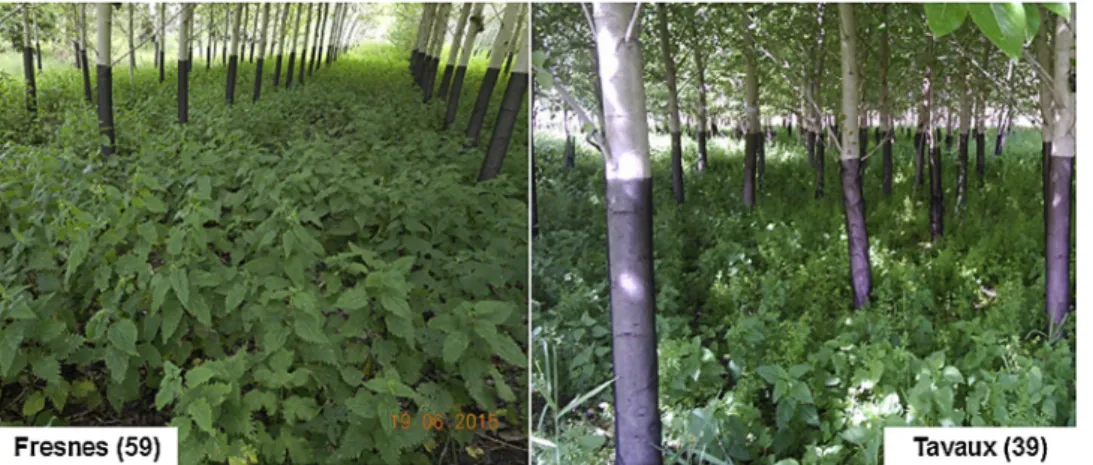
neously under the woody cover (Fig. 1).
Two other uncontaminated site (control) were used as reference to compare contamination values. The control site in France is a natural area located at Courcelle les Montbéliard, 140 km east of the site S1, not directly influenced by the point source. (Yung et al., 2019b) gives a description of this site. The other control site is located in Belgium at Ghent region at 120 km north east of the site S2. A description of this
Fig. 1. Photograph of stinging nettle growing spontaneously and in suppa prevalent manner under short rotation coppice for phytomanagement of trace elements contaminated soils.
Table 1
Main meteorological conditions during the growth period at the two sites.
S1-Y1 S1-Y2 S2-Y1 S2-Y2
Annual average temperature (°C) 11.9 13.1 10.8 11.3
Total annual sunshine (h) 2068 2122 1290 1699
site is given in (Tack and Verloo, 1996). 2.2. Experimental design
Within the BIOFILTREE project (Ciadamidaro et al., 2017), four
type offield plots were set up in March (S2) and April (S1) 2011. The
four type of plots consisted in i) poplar (Skado clone) monocultures, ii) poplar (I214 clone) monocultures, iii) Skado alder associations, iv) I214 alder associations, with or without inoculation. Only the poplar monocultures have been considered in the present study. On the two sites, non rooted poplar cuttings (1.5 m length) of the clones Skado (P. trichocarpa x P. maximowiczii section Tacahamaca) and I214 (P. deltoides x P. nigra section Aigeiros) were used, with afinal tree density of 2.200 plants. ha−1, each plot therefore having a surface of 28 × 18 m for S1 and 36 × 12 m for S2. Both clones were selected for their growth yield and low leaf TE accumulation capacities, from the previous clonalfield trial PHYTOPOP (Pottier et al., 2015).Fig. 2represents the implanta tion of the two described sites. Full description of the sites is provided in (Phanthavongsa et al., 2017).
2.3. Nettle harvesting
During thefirst year (Y1), half of each plot area (approximately
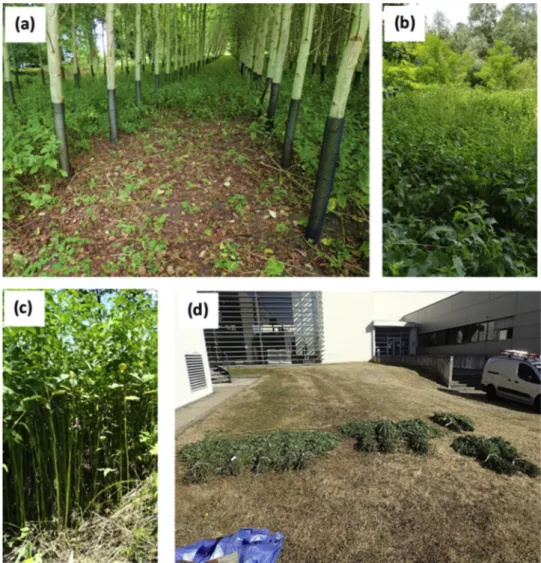
250 m2) was harvested for three selected plots (T.I1, T.I2 and T.I3) on S1 (Figs. 2, 3a, b and c) on the 28th of September 2017. The second year (Y2), an area of 50 m² was harvested in the plot TS of S1 on the 8thof June 2018, and an area of 156 m² in the plots FS, P4, P5 and P30 on S2 on the 18thof July 2018. The harvesting strategy was mainly driven by observations of the nettle development as well as the competing spe cies. At each harvest, stems were cut at soil level using scythes and shears. The aerial parts of the cut plants were then immediately picked
up by hand and baled, without priorfield retting. The stems were kept
aligned in the bundles (Fig. 3d). The bundles were picked up the same day and stored in indoor spaces for a minimal period of 3 months. 2.4. Fresh and dry matter yields
The nettle bales were weighed in thefield just after harvesting to
determine the mass of fresh plant materials (Mfresh), and then weighed
again after air drying (at least 4 months of conditioning in indoor
spaces) to determine the mass of dried plant materials (Mdry). The
leaves were then manually picked off. The remaining stems were fur ther weighed to determine the mass of dried stems (Mstem). The yields were then estimated by calculating the ratio between the masses and the plot areas. The yields in fresh matter, dry matter and dry stems are notedηfresh,ηdry,ηstem, respectively.
2.5. Stem length and diameter
Stems were analysed in terms of dimensions by selecting randomly 30 stems in each harvested batch. Stem diameters were measured for each stem in three positions along the stem height (top, middle and base parts of the stem) using a calliper with a precision to 0.01 mm. For each position, two measurements were done according to the two main directions of the transversal cross section area. The average diameter for this position was then calculated from these two measurements. The mean diameters measured in these respective positions are noted Dtop, Dmid, Dlow. The length (L) was measured using a graduated steel rule with a precision of 0.1 cm.
2.6. Stalks processing andfibre extraction
The stems of the Y2 S1 batch were mechanical processed using a
Laroche (France) Cadette 1000“all fibre” extraction device. This ma
chine is a three drum opener with a 1000 mm wide feed belt (Fig. 4a). At the entrance of each of the three modules, the feeding of thefibrous material was provided by a pair of rolls, one smooth and the other
grooved (made of rubber) (Fig. 4b). Then, each module was equipped
with a cylinder with nails, i.e. the extracting roller (orfibre extraction roller) (Fig. 4c). Its distance from the metal trough located at the module inlet is adjustable (distance A inFig. 4b), as well as its rota tional speed (from 750 to 1800 rpm). Under the extracting roller, a trap door allowed the evacuation of shives by gravity. The trap door opening is also adjustable and, for this study, it was set at its maximum to favour the shives removal. At the end of the module, there was also a perfo rated cylinder at which ventilation was applied. The latter had three distinct functions: (i) the de dusting of the material, (ii) the formation of thefibre lap, and (iii) its transfer to the next module or the outlet.
Fig. 2. Experimental designs at the two phy-tomanaged field sites, Tavaux (S1) and Fresnes-sur-Escaut (S2). The sampled plots are in dark grey (I214 plots) and light grey (Skado), on which nettles were collected. Full description of the sites is provided in (Phanthavongsa et al., 2017). Nettles were also collected in the edge of the poplar plots.
Each de dusting fan was equipped with a motor having a 2865 rpm maximum rotation speed.
During the experiments, the operating parameters used were in spired by two previous studies dealing with the mechanical extraction of technicalfibres from oleaginous flax (Ouagne et al., 2017) and hemp (Grégoire et al., 2019) straws, respectively. From modules 1 3, distance
A were 1.9 mm, 1.4 mm and 1.1 mm, respectively. The inletflow rates
of nettle stems were approximately 125 kg/h, corresponding to a 2.5 m/ min feed belt speed. The transmission speed of the lap from module 1 to module 2 was 2.2 m/min, and it was 2.1 m/min from module 2 to module 3. Finally, a 1.7 m/min speed was used for the output belt. In each of the three modules, a 750 rpm rotation speed was chosen for the extracting roller. Looking at the de dusting fans, the rotation speed of the motor was 1500 rpm for module 1, and 2000 rpm for the next two modules.
Since the nettle straws were notfield retted, three different con
ditionings before processing were tested to evaluate their influence on the nettlefibre yield and quality. Prior to these treatments, the straws were stored during 3 months.
Condition 1 (C1): as received. The nettle straw was processed as received after the 3 months of storage. Its average moisture content was approximately 10.4 %.
Condition 2 (C2): moistened. The nettle straw was sprayed with water to re moisturise the matter (during 15 h). Its average moisture content was thus approximately 22.0 %.
Condition 3 (C3): soda treatment. The nettle straw was immersed for 2 h and at 60 °C in a soda solution (2 %) and then thoroughly rinsed with water until reaching a pH value comprised between 7 and 8. The nettle straw was then oven dried inside a ventilated oven at 50 °C and during 16 h. The moisture content before mechanical processing was 16.5 %.
After the mechanical processing step, the fractions of the resulting matters were determined. These matters were divided into three cate gories: afibre lap containing the extracted bast fibres, shives and dust. The content of impurities inside thefibre lap (i.e. remaining shives and dust) was also evaluated. Indeed, the lap collected at the outlet of the “all fibre” extraction device consisted not only in bast fibres but also in some remaining shives and dust, both trapped inside the lap. From each of the three generated laps, a 50 g sample was collected to determine
the content of impurities inside the lap, and thus the real bastfibre
content. A mechanical sieving was performed on the lap sample for 5 min in order to drop shives and dust. Then, the residual shives that remained trapped were collected manually.
Moisture content of the fibrous materials at the inlet of the “all
fibre” extraction device and out of the process was determined ac cording to standard ISO 665:2000.
2.7. Fibre diameter
In order to characterize the morphology of the bast fibres and
Fig. 3. Photograph the plots and the crops. (a) Plot No. Y1-S1-T.I3 after harvest, (b, c) Nettles in the plot No. Y1-S2-TS, at the wood-edge, and (d) Crop of Y2-S2-(FS, P4, P5, P30).
determine their diameters, fresh transverse cross sections were cut from the stems using razor blades at different locations and different devel opment and maturity stages. Cytochemical staining of lignin was
achieved on sections using the Wiesner reagent (phloroglucinol−HCl)
that colored lignin into purple red and assist in the definition of the fibre wall outlines. The observations were made on a microscope
Keyence VHX 5000 series with a magnification of 20.
2.8. Singlefibre tensile properties
Singlefibre tensile tests were performed on nettle fibres isolated by hand from the batch Y2 TS and Y2 FS, and from the mechanically
processed batch Y2 TS. Thefibres were first glued on a paper frame and
then examined using an optical microscope to determine their external
width. The average width of eachfibre was computed by obtaining ten
measurements equally spaced along its length. A Bose Electroforce 3230 machine was used to perform the monotonic tensile tests up to
failure. The paper frame supporting eachfibre was clamped onto the
testing machine and then cut prior to the beginning of each test. The clamping length was 10 mm. Fibres were tested at a constant crosshead
displacement rate of 0.01 mm s−1. The applied force was measured
with a load sensor of 22 N with a resolution of approximately 10 mN, and the displacement was measured using an LVDT with a resolution of
approximately 0.5μm. The sample elongation and the load were re
corded continuously. The strain was calculated as the elongation di vided by the initialfibre length, taking into account the compliance of the loading frame.
The effective cross section was determined using the mean external
width, assuming that thefibre was perfectly cylindrical and the lumen
area neglected. The stress was calculated using the applied force and the evaluated initial cross section mean value of thefibre. The variation of the cross section during the tensile loading was neglected. The tensile strength (σR) and the strain at failure (εR) were determined, and the apparent tangent modulus of rigidity (E) was computed on a strain range comprised between 0.2 % and the strain at failure. During the fibre preparation, and using only optical microscopy, it is sometimes
difficult to discriminate single fibres against small bundle of fibres. As a result, some small bundles of nettlefibres were also tested. This can be easily detected on the shape of the resulting stress strain curve. In a strain controlled situation, the force drops abruptly when an individual fibre breaks. Thus, a criterion was introduced to identify during the
data processingfibre bundles. This one is based on the detection of
sudden stress drop (set at 5 MPa) between two successive measure points.
2.9. Determination of TE content
Before analyses, dried nettle stems and leaves from S1 and S2 and non contaminated soil (control) were separated, air dried and ground into a homogenous powder in a Mixer Mill, for 4 min at 30 Hz and 7 min at 30 Hz for leaves and stems, respectively. We also isolated nettlefibres for Hg analysis. Cd, Cu, Hg, Pb and Zn concentrations were measured in the soil and different parts of nettles. Soil samples were ice dried and sieved (0.2 mm particle size). The total element concentrations (Al, Cd, Fe, Mn, Pb, S, Zn) in the soil from S1, S2 and control were measured following the acid digestion of 500 mg of sample (DigiPREP system, SCP Sciences, Courtaboeuf, France) using a mix of 2 mL of 67 % nitric
acid, 6 mL of 34 % hydrochloric acid and 2 mL of 48 % hydrofluoric
acid (Ciadamidaro et al., 2017). CaCl2extractable fractions of TE were determined in soil samples after shaking 2.5 g of dried soil in 25 ml of a 0.01 M solution of CaCl2during 3 h (140 g/min−1) (Houba et al., 1996). The soil mixtures werefiltered on filtration units at 0.45 μm (Millipore). Eluates were acidified to a pH < 2 for preservation. TE in plant and soil samples were analysed using inductively coupled plasma atomic emission spectrometry (ICP AES, Thermo Fischer Scientific, Inc., Pitts burgh, USA). Hg was measured using the atomic absorption spectro photometry AMA 254 cold vapor atomic absorption (CV AAS) Hg analyser (Altec Co., Czech Republic), using standard conditions (45 s drying, 150 sheating, 45 s cooling) and the certified reference material (CRM), i.e. Oriental Basma Tobacco leaves (INCT OBTL 5). All the re sults are expressed asμg/kg of the dry weight (DW).
Fig. 4. Laroche (France) Cadette 1000 “all fibre” extraction device used in this study (from Laroche company website). (a) Material path along the opener (in yellow on the drawing), from the feed belt (left) to the exit belt (right). (b) Detailed view (from left to right) of the pair of rolls needed for feeding (smooth roll down and grooved roll up), and the fibre extraction roller (cylinder equipped with nails), all three located at the module inlet. (c) Photograph of the nails of the ex-tracting roller in module 1.
= − ⎛ ⎝ − ⎞ ⎠ LogN μ λ f x x λ πe ( , ): ( ) 1 1 2 ln x μ λ 1 2 ( ) 2 (1)
3. Results and discussion
3.1. Trace element content of soils and harvested biomasses
The Fresnes sur Escaut soil was highly contaminated by Cd, Pb and
Zn, and Cu to a lesser extent, which confirms our previous studies
(Ciadamidaro et al., 2017;Phanthavongsa et al., 2017). However the nature of the soil rendered these TE poorly available, with CaCl2ex tractable fraction represented 0.2, 0.4, 0.02 and 0.04 % of the total fraction for Cd, Cu, Pb and Zn, respectively (Table 2). Cu, Zn and Pb contents in nettle collected at the Fresnes sur Escaut site ranged within physiological levels (Kabata Pendias, 2011;Kalra et al., 1998), and did not significantly differed between tissues (Table 2). Cd contents in the various nettle tissues were within the ranges found in plants grown in agricultural soils, and always much lower than Cd concentrations measured in poplar or salix leaves (from 2 to 14 mg/kg DW) collected at the same site (Phanthavongsa et al., 2017). Additionally, the TE con centrations in nettle found in our study were within the ranges of concentrations measured in nettles collected at uncontaminated sites in Belgium near the location of the site S2. (Tack and Verloo, 1996). These TE concentrations were also well below the critical levels set up for plant tissues (Kabata Pendias, 2011), at which growth depression may be observed, i.e. 10 20 and 100−500 mg/kg DW for Cd and Zn, re spectively.
The Tavaux soil was contaminated by Hg, with concentrations around 6 mg/kg DW, as previously found (Durand et al., 2017;Maillard et al., 2016). At the Tavaux site, translocation of Hg to nettle tissues remained low, as Hg contents in leaves did not exceed 0.01 mg/kg DW (Table 2). These concentrations were comparable to those measured at our French control site (mean 0.006 mg/kg DW,Table 2). Hg content of
nettlefibres was below the limit of quantification. The Hg concentra
tions in nettle leaves were far below the threshold set to 0.2 mg/kg for
concentrations tolerable in agronomic crops and within the ranges measured in food plants (0.006 0.139 mg/kg DW) in various countries (Kabata Pendias, 2011). The Hg content of food plants grown in chlor
alkali areas were in the range 0.032 0.59 mg/kg DW (Kabata Pendias,
2011). These authors also set the toxic Hg content in crop leaves within the range 1−3 mg/kg DW.
Overall, our dataset confirmed the limited translocation of TE in nettle biomass, as compared to woody species grown on the same plots, which indicate thatfibres from nettle grown at these sites may be used without restriction in industrial processes.
3.2. Fresh biomass and straw yields
Nettle bales were weighed just after harvesting to determine the yields of fresh matter (Table 3). During thefirst year, only the experi mental site of Tavaux (S1) was harvested at the end of summer. Rela tively low yields were measured on each plot and were comprised be
tween 0.293 and 0.817 t.ha−1for fresh matter, and between 0.028 and
0.091 t ha−1for dry stems. This disparity between each plot and par ticularly for I3 was due to the presence of plant species (Galium aparine L., Sambucus ebulus L., Calystegia sepium L.) which are able to compete
with nettle (Strutek and M, 1998), and also to differences in the
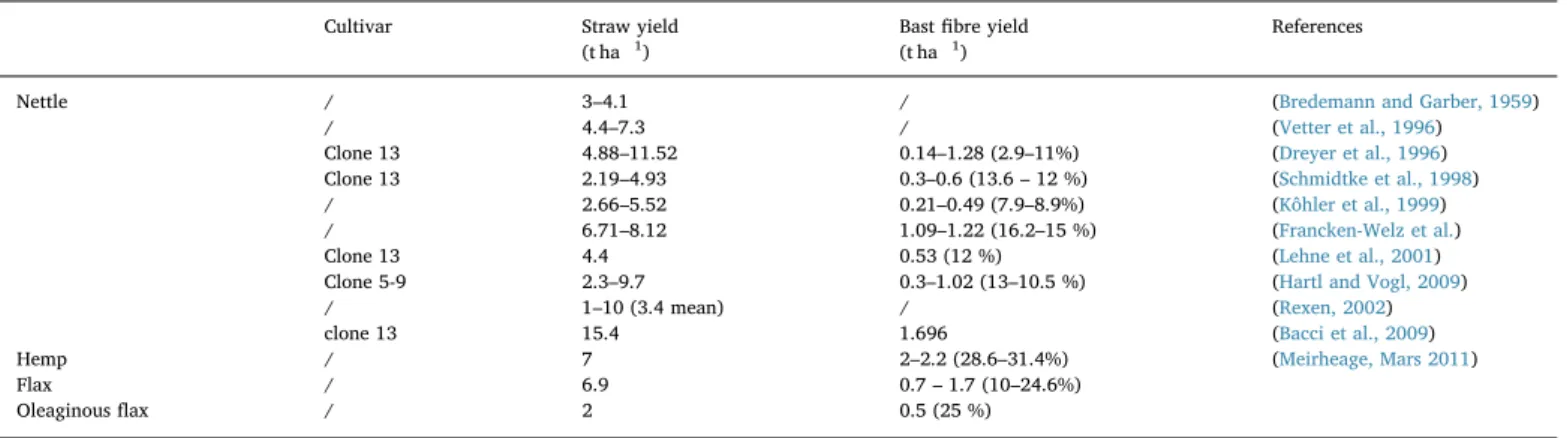
quantity of incident light (Yung et al., 2019a). These yields values were lower than those mentioned in the literature (Table 4, (Bacci et al., 2009;Bredemann and Garber, 1959;Dreyer et al., 1996;Francken Welz et al.;Kôhler et al., 1999;Lehne et al., 2001;Meirheage, Mars 2011; Rexen, 2002;Schmidtke et al., 1998;Vetter et al., 1996) which were in
the range 1 11.5 t ha−1 for dry stem in the context of traditional
agronomic practices. The second year, at the beginning of the summer, two plots (TS and FS) located at the edge of the poplar coppices were harvested in Tavaux (S1) and Fresnes sur Escaut (S2) respectively. Yields in fresh matter were 4 10 times higher than those measured under the poplar coppices (Table 3). A new weighing was made, after 4 months of air drying. The dry biomass yield reached a value of ap proximately 2 t ha−1. The dry stem yields were also measured after leaf removal. The obtained values varied between 0.55 and 1.38 t ha−1, as a
Table 2
Trace element concentrations (mg/kg DW) in soil and nettle samples from the two sediment landfills. For comparison, the TE background concentrations, from natural sites in Belgium were obtained fromTack and Verloo (1996)for Cd, Cu, Pb and Zn, and from our control site located in the East of France for Hg.
Trace element (mg/kg DW) Cd Cu Pb Zn Hg
Industrial sediment landfills Fresnes sur Escaut Tavaux
Soil (pH = 6.6) total 15 ± 19 79 ± 33 541 ± 1397 1506 ± 856 6 ± 1
CaCl2ext. 0.03 ± 0.01 0.33 ± 0.06 0.13 ± 0.57 0.71 ± 0.003 NA
Nettle stems 1.0 ± 0.7 3.3 ± 0.6 1.9 ± 0.4 24.0 ± 6.3 0.01 ± 0.004
Nettle fibres 1.1 ± 0.4 2.9 ± 1.0 1.3 ± 0.5 47.5 ± 5.0 NA
Nettle leaves 0.9 ± 0.8 9.4 ± 0.53 2.0 ± 0.2 31.9 ± 1.8 0.03 ± 0.01
Control sites Belgium France
Soil aqua regia ext. 0.5 ± 0.4 12 ± 5 28 ± 17 54 ± 13 0.6 ± 0.1
Nettle leaves & stems 0.4 ± 0.2 14 ± 5 34 ± 19 113 ± 82 0.006 ± 0.003
Table 3
Nettle stem and bastfibre yields (t. ha−1) determined at the two contaminated
sites.
Fresh biomass yield Dry biomass yield Dry stem yield
Y1-S1-T-I1 0.73 0.15 0.059 Y1-S1-T-I2 0.817 0.154 0.091 Y1-S1-T-I3 0.293 0.059 0.028 Y2-S1-TS 3.5 – 0.55 Y2-S2-P30 2.95 0.91 0.60 Y2-S2-P4 2.38 0.77 0.34 Y2-S2-P5 2.2 1.01 0.67 Y2-S2-FS 3.76 1.98 1.38 2.10. Statistical analysis
The dimensional and mechanical data presented in this paper are the mean values, standard deviations and the parameters of a log normal distribution law identified by inverse method.
The best distribution function for each property was identified using the EasyFit software by minimising the criterion of distances from the distribution diagram. The distribution functions were selected among the classical ones. The log normal distribution (LogN(μ,λ)) (Eq. (1)) was found to be more realistic and is preferred to the other distributions. This distribution is a two parameter family of continuous probability distributions. μ and λ are the expectation and standard deviation of x and ln(x), respectively.
function of the harvesting site.
These yields were comparable to the lower values reported in the literature in the context of traditional agronomic practices. Indeed, literature (Bacci et al., 2009;Dreyer et al., 1996;Francken Welz et al.; Hartl and Vogl, 2009) reported dry matter yields comprised between 2.3 to 15.4 t ha−1depending on the fertilization conditions. The yields obtained in our site conditions were nevertheless extremely interesting since, in this agro forestry system, nettle grows naturally and sponta neously, without chemical inputs. The savings associated to the lack of planting / sowing, crop maintenance and inputs may motivate har vesting lower yielding plots.
The fraction of leaves consisted in approximately 35 60% of the dry biomass, depending of the year and localisation of harvest. reported leaf fractions around 7 %, which emphasizes the differences that can be obtained between the spontaneous nettle and cultivars.
Fig. 5represents the statistical distributions of the stem features for each harvested plots. The features measured for the Tavaux (Fig. 5a)
and Fresnes sur Escaut (Fig. 5b) sites show that the length or the dia meters of the stems were higher for nettle growing at the edge of the poplar coppice (Y2 S1 TS and Y2 S2 FS) than under the coppice. The mean length was approximately 1.14 m at the edge of the coppice and 0.87 m under poplars. These values of native nettle length were 33 50% lower than those measured by (Bacci et al., 2009) (1.7 m) for a cultivar using traditional practices.
We further estimated the diameter of the nettlefibres for the plots Y2 S1 TS and Y2 S2 F, with average values of 37 ± 11 and
34 ± 12μm, respectively. These values are in agreement with the
mean diameters measured by others authors (Di Virgilio, 2013) for
nettle cultivars (20−47 μm). On the other hand, the thickness of the fibre wall was very different between the two batches. The batch Y2 S2 FS presented an average wall thickness of 6.5 ± 2, as compared to a
thickness of 12.5 ± 3μm for the Y2 S1 TS batch.Fig. 6shows trans
verse cross sections of nettle stems harvested in the second year that are representative of each site, S1 (Fig. 6a) and S2 (Fig. 6b), respectively. It
Cultivar Straw yield
(t ha 1)
Bastfibre yield (t ha 1)
References
Nettle / 3–4.1 / (Bredemann and Garber, 1959)
/ 4.4–7.3 / (Vetter et al., 1996)
Clone 13 4.88–11.52 0.14–1.28 (2.9–11%) (Dreyer et al., 1996)
Clone 13 2.19–4.93 0.3–0.6 (13.6 – 12 %) (Schmidtke et al., 1998)
/ 2.66–5.52 0.21–0.49 (7.9–8.9%) (Kôhler et al., 1999)
/ 6.71–8.12 1.09–1.22 (16.2–15 %) (Francken-Welz et al.)
Clone 13 4.4 0.53 (12 %) (Lehne et al., 2001)
Clone 5-9 2.3–9.7 0.3–1.02 (13–10.5 %) (Hartl and Vogl, 2009)
/ 1–10 (3.4 mean) / (Rexen, 2002)
clone 13 15.4 1.696 (Bacci et al., 2009)
Hemp / 7 2–2.2 (28.6–31.4%) (Meirheage, Mars 2011)
Flax / 6.9 0.7– 1.7 (10–24.6%)
Oleaginousflax / 2 0.5 (25 %)
Fig. 5. Statistical distribution of the nettle stem features (length and diameter) as a function of the location in the plant and of the harvesting site: S1 (a) and S2 (b). Table 4
can be observed that the nettle bastfibres presented a quite large lumen area for the two batches, when compared to other European crops such
as hemp andflax. For the spontaneous nettle, the harvesting time was
not selected as a function of a specific maturity stage. However, it is
well known for other cropfibres that the harvest time strongly influ
ences the fibre yield and the fibre filling level (Goudenhooft et al.,
2018;Musio et al., 2018). So, the influence of the harvest time of the nettlefibre features needs to be investigated in further studies. 3.3. Continuousfibre extraction using the “all fibre” extraction device
From the standard settings described in Section2.5, the“all fibre” extraction device was able to extract the textilefibres contained in the nettle stalks, leading to the separate production of afibre enriched mat (i.e. thefibre lap), shives and dust (Fig. 7). Shives were conveyed se parately via the waste evacuation belt, and dust was removed thanks to the de dusting fans. The three extracting conditions (C1, C2 and C3)
showed significant differences in the quality of the nettle fibres ob
tained in the outgoing mat. Visually, the C1 condition, corresponding to the use of the as received nettle stalks, resulted in the cleanest and the finest fibres obtained, with extracted bast fibres up to 10 cm in length. The material balance of the three trials conducted is mentioned in Table 5. Firstly, it systematically showed a slight decrease in the moisture content of nettlefibres from the inlet to the outlet, which was very likely explained by the use of the de dusting fans. Moreover, these
fans allowed a suitable elimination of dust generated during thefibre
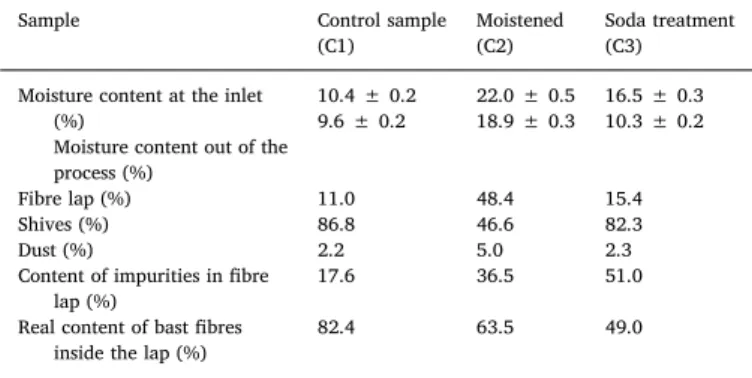
extraction (2.2 5.0 % of the mass of nettle stalks processed), in priority at the level of module 1 and, to a lesser extent, at the level of the two following modules. Depending on the extracting condition, thefibre lap collected at the outlet of the Cadette machine represented between 11 and 48 % of the incoming mass. The C2 samples (i.e. straw re moistened before extraction) had the greatest proportion offibre lap.
However, this mass proportion must be corrected by the content of impurities inside thefibre lap (Table 5). The latter was estimated inside the three laps produced, impurities corresponding to (i) shives trapped
inside the mat, (ii) dust not properly removed by aspiration, and also
(iii) the fewfibres not yet separated from shives. The content of im
purities was minimal (18 %) for the C1 condition (control sample), whereas it doubled for the C2 condition (re moistened stalk) and reached a particularly high value for the C3 one (stalk pre treated with soda before mechanical extraction).
In conclusion, the as received nettle straw (i.e. control sample, C1) undoubtedly appeared as the most promising raw material, combining
(i) the lower impurity (shives) content inside thefibre lap (18 % in
weight) and (ii) the finest extracted fibre bundles, some of them
reaching about 10 cm in length. For this sample, the bastfibres con
tained in the outgoing mat represented 9.1 % of the initial mass of nettle stalks introduced. Before any further textile step (carding), it would still be necessary to clean this mat to remove impurities (shives,
dust) trapped between the extracted fibres. For future experiments,
such operations could be performed using an additional sieving step for thefibre mat. This nettle fibre yield obtained for the Y2 S1 TS batch is
in accordance with the literature, which reports nettle fibre yields
Fig. 6. Micrograph of the transverse cross-section of nettle stems. Nettle stems were harvested in second year on S1 (a), and S2 (b) site, respectively.
Fig. 7. Pictures of the nettle matters after mechanical processing. Table 5
Material balance for the three trials conducted, including nettle bastfibre content and impurities level in nettlefibre lap, after mechanical processing.
Sample Control sample
(C1)
Moistened (C2)
Soda treatment (C3) Moisture content at the inlet
(%)
Moisture content out of the process (%) 10.4 ± 0.2 9.6 ± 0.2 22.0 ± 0.5 18.9 ± 0.3 16.5 ± 0.3 10.3 ± 0.2 Fibre lap (%) 11.0 48.4 15.4 Shives (%) 86.8 46.6 82.3 Dust (%) 2.2 5.0 2.3
Content of impurities infibre lap (%)
17.6 36.5 51.0
Real content of bastfibres inside the lap (%)
between 3 and 16 % (Table 4). 3.4. Mechanical properties offibres
Fig. 8 shows the stress/strain curves obtained from single fibre tensile tests, for three different batches that comprised from 32 to 50 fibres. OnFig. 8a, results concern nettlefibres from the Fresnes sur Escaut site, manually extracted.Fig. 8b and c presente the results ob
tained for the nettle fibres obtained on the Tavaux site after manual
extraction and after mechanical extraction, respectively. The mean value of the stress at failure for each batch is represented by a dotted line. A large scattering in the response was observed, which is typical of plantfibres (Bourmaud et al., 2018). A significant non linearity could be observed for most of the tested nettlefibres, which contrasts with the
results of Bodros and Baley (Bodros and Baley, 2008) who reported a
linear response for nettlefibres manually extracted from retted stems. Table 6synthetises the mean tensile properties for each batch. 3.4.1. Influence of the harvesting site
The average properties, presented inTable 6(tensile strength, strain at failure and apparent rigidity), of the nettlefibres extracted manually are equal to 711 MPa, 1.37 %, 53 GPa and 812 MPa, 2.14 %, 36 GPa for Y2 S2 FS and Y2 S1 TS respectively. These values are lower than those reported in the literature for native nettle cultivars (Bodros and Baley, 2008; Lanzilao et al., 2016). These differences can be due to several factors such as the harvesting time or related to thefibre preparation. If the strength was quite similar for the two tested batches, a significant difference could be observed for the strain at failure and the apparent
rigidity. Y2 S1 TS nettlefibres had a mean strain at failure 1.5 time
greater than the Y2 S2 FS nettlefibres and an apparent rigidity 1.5 time lower.
This difference in apparent rigidity can be attributed to the differ
ence in the averagefibre wall. It was above mentioned that the wall
thickness of the Y2 S2 FS nettlefibres was twice higher than for Y2 S1
TS. The cross section area (CSA) of the fibres was calculated con
sidering thefibre cylindrical and by neglecting the lumen area. This
clearly led to a significant over estimation of the CSA and then an under estimation of the apparent rigidity and strength. This under es timation was more important when the lumen area was large. To ensure a more reliable comparison, additional tests taking into account the real CSA of the nettlefibres are necessary.
3.4.2. Influence of the fibre extraction method
The impact of the extraction mode (mechanical or manual) was also evaluated on the Y2 S1 TS batch. An analysis of variance (ANOVA) was realised on the different values. While the impact on the stress at failure was not statistically representative (p Value = 0.258), a strong influ ence was observed on the apparent rigidity and on the strain at failure. Interestingly, we can observe a significant difference also in the dia
meters of the tested nettlefibres, with means of 35 and 28 μm, mea
sured for the tested nettlefibres obtained after manual extraction and after mechanical extraction, respectively. This difference could be at
tributed to the betterfibre separation achieved with the mechanical
extraction. The fibre individualisation is a particularly difficult step
when made by hand, which is confirmed during the post treatment of
the tensile tests. Using the introduced criterion, it is observed that the
bundles of nettlefibres represented approximately 6 % of the tested
fibres after mechanical extraction against 30 % for the manual extrac tion. For bundle offibres, a lower rigidity and strength were generally measured (Placet et al., 2017). This was due to the weakness of layer between the individualfibres. So, based on this reasoning, it could be expected to measure a higher stress at failure for the mechanically processed batch. This potential positive effect induced by the im provement of thefibre individualization can also be counterbalanced by the fact that mechanical extraction also generally induces damages and thus a lowering of the properties at failure (Ouagne et al., 2017).
Finally, the properties obtained for nettle after mechanical proces sing are promising when compared to the best results obtained for the
Fig. 8. Tensile stress-strain curves of nettlefibres from the batches Y2-S2-FS manually extracted (a), Y2-S1-TS with manual extraction (b) and Y2-S1-TS with mechanical extraction (c).
Table 6
Tensile properties of nettle bastfibres.
Mechanical properties of nettlefibres Y2-S2-FS Y2-S1-TS Y2-S1-TS (Bodros and Baley, 2008) (Lanzilao et al., 2016)
Fibre extraction Manual Mechanical Manual Manual Manual
Diameter (μm) 27.8 ± 6.8 28.2 ± 6 35.4 ± 9 19.9 ± 4 24.0 ± 15.9
Stress at failure (MPa) 1314 ± 552 711 ± 427 812 ± 451 1594 ± 640 2196 ± 801
Elastic modulus (GPa) 54 ± 17 53 ± 24 36 ± 19 87 ± 28 79 ± 29
4. Conclusions
This work focused on the sustainability of spontaneously stinging nettle grown on trace element contaminated soil. Our results demon strate that the use of trace element contaminated soils is a relevant option to expand the material purpose grown biomass and at the same time mitigate the land use conflict between the needs of food and the
increasing demand for plant based fibre raw materials.Trace element
contents in nettle fibres are far below the tolerable threshold for
agronomic crops. Tensile properties obtained after an extraction made with an“all fibre” industrial extraction device and without field retting or prior alkaline pre treatment are comparable to the properties of the best industrialflax fibres.
Our set of results is promising in view of a material use. Indeed, the savings associated to the lack of planting/sowing, crop maintenance and inputs may motivate harvesting lower yielding plots. The question of the mechanization of the harvesting, collecting and transportation and thus of the economic balance are however still opened, as well as the generalization of the results to other phytomanagement sites and configurations.
CRediT authorship contribution statement
Thomas Jeannin: Investigation, Formal analysis, Visualization,
Writing original draft. Loïc Yung: Investigation, Visualization.
Philippe Evon: Investigation, Resources. Laurent Labonne:
Investigation. Pierre Ouagne: Resources. Michael Lecourt: Project
administration, Funding acquisition.David Cazaux: Resources. Michel
Chalot: Conceptualization, Funding acquisition, Supervision, Writing
review & editing. Vincent Placet: Conceptualization, Methodology,
Supervision, Writing review & editing. Declaration of Competing Interest
The authors declare that they have no known competingfinancial
interests or personal relationships that could have appeared to influ ence the work reported in this paper.
Acknowledgements
The authors gratefully acknowledge the funding provided by ADEME, France, under grant n° 1772C0018, PHYTOFIBER project and
the Fondation de France and ADEME for theirfinancial support to LY
under a PhD grant, VNF (Voies Navigables de France) and Valérie Bert (INERIS) for providing us with access to the experimental site at Fresnes sur Escaut. This work has also been supported by the EIPHI Graduate school (contract "ANR 17 EURE 0002")
References
Akgül, M., 2013. Suitability of stinging nettle (Urtica dioica L.) stalks for medium density fiberboards production. Compos. Part B: Eng. 45, 925–929.
Bacci, L., Baronti, S., Predieri, S., di Virgilio, N., 2009. Fiber yield and quality offiber nettle (Urtica dioica L.) cultivated in Italy. Ind. Crop Prod. 29, 480–484. Bacci, L., Di Lonardo, S., Albanese, L., Mastromei, G., Perito, B., 2010. Effect of different
extraction methods onfiber quality of nettle (Urtica dioica L.). Text. Res. J. 81,
827–837.
Bensadoun, F., Verpoest, I., Baets, J., Müssig, J., Graupner, N., Davies, P., Gomina, M., Kervoelen, A., Baley, C., 2017. Impregnatedfibre bundle test for natural fibres used in composites. J. Reinfor. Plast. Compos. 36, 942–957.
Bodros, E., Baley, C., 2008. Study of the tensile properties of stinging nettlefibres (Urtica dioica). Mater. Lett. 62, 2143–2145.
Bourmaud, A., Beaugrand, J., Shah, D.U., Placet, V., Baley, C., 2018. Towards the design of high-performance plantfibre composites. Prog. Mater. Sci. 97, 347–408. Bredemann, G., Garber, K., 1959. Die grosse Brennessel Urtica dioica L.: Forschungen
über ihren Anbau zur Fasergewinnung. Akademie Verlag, Berlin.
Ciadamidaro, L., Girardclos, O., Bert, V., Zappelini, C., Yung, L., Foulon, J., Papin, A., Roy, S., Blaudez, D., Chalot, M., 2017. Poplar biomass production at phytomanage-ment sites is significantly enhanced by mycorrhizal inoculation. Environ. Exp. Bot. 139, 48–56.
Codling, E.E., Rutto, K.L., 2014. Stinging nettle (URTICA DIOICA L.) growth and mineral uptake from lead-arsenate contaminated orchard soils. J. Plant Nutr. 37, 393–405. Davies, G., Bruce, D., 1998. Effect of environmental relative humidity and damage on the
tensile properties offlax and nettle fibers. Text. Res. J. 68, 623–662.
Di Virgilio, N., 2013. Stinging Nettle: a Neglected Species With a High Potential As Multi-purpose Crop. Summer school of FIBRA, Catania, Italy.
Di Virgilio, N., Papazoglou, E.G., Jankauskiene, Z., Di Lonardo, S., Praczyk, M., Wielgusz, K., 2015. The potential of stinging nettle (Urtica dioica L.) as a crop with multiple uses. Ind. Crop Prod. 68, 42–49.
Dreyer, J., Dreyling, G., Feldmann, F., 1996. Cultivation of Stinging Nettle Urtica dioica L. with High Fibre Content as an Raw Material for the Production of Fibre and Cellulose: Qualitative and Quantitative Differentiation of Ancient Clones.
Dreyer, J., Müssig, J., Koschke, N., Ibenthal, W.D., Harig, H., 2002. Comparison of en-zymatically separated hemp and nettlefibre to chemically separated and steam ex-ploded hempfibre. J. Ind. Hemp. 7, 43–59.
Durand, A., Maillard, F., Foulon, J., Gweon, H.S., Valot, B., Chalot, M., 2017. Environmental metabarcoding reveals contrasting belowground and aboveground fungal communities from poplar at a Hg phytomanagement site. Microb. Ecol. 74, 795–809.
Franck, R.R., 2005. Bast and Other Plant Fibres, Boca Raton, USA.
Francken-Welz, H., Scherr-Triebel, M., Léon, J., 2019. Ertragsund QualitaÈtsbildung von Lein, Hanf und Fasernessel in AbhaÈngigkeit von Bestandesdiche und N-DuÈngung. Mitteilungen der Gesellschaft fuÈr Pflanzenbauwissenschaften 12, 177–178. Goudenhooft, C., Siniscalco, D., Arnould, O., Bourmaud, A., Sire, O., Gorshkova, T., Baley,
C., 2018. Investigation of the mechanical properties offlax cell walls during plant development: the relation between performance and cell wall structure. Fibers 6, 6. Gravis, A., 1885. Recherches anatomiques sur les organes végétatifs de l’Urtica Dioica
L.Recherches anatomiques sur les organes végétatifs de l’Urtica Dioica L. Grégoire, M., Barthod-Malat, B., Labonne, L., Evon, P., de Luycker, E., Ouagne, P., 2019.
Investigation of the potential of hempfibre straws harvested using a combine ma-chine for the production of technical load-bearing textiles. Ind. Crop. Prod.https:// doi.org/10.1016/j.indcrop.2019.111988.
Hartl, A., Vogl, C.R., 2009. Dry matter andfiber yields, and the fiber characteristics of five nettle clones (Urtica dioica L.) organically grown in Austria for potential textile use. Am. J. Alternative Agric. 17, 195–200.
Harwood, J., Edom, G., 2012. Nettlefibre: its prospects, uses and problems in historical perspective. Text. Hist. 43, 107–119.
Houba, V.J.G., Lexmond, T.M., Novozamsky, I., van der Lee, J.J., 1996. State of the art and future developments in soil analysis for bioavailability assessment. Sci. Total Environ. 178, 21–28.
Kabata-Pendias, A., 2011. Trace Elements in Soils and Plants.
Kalra, Y.P., Soil, Plant Analysis, C, 1998. Handbook of Reference Methods for Plant Analysis. CRC Press, Boca Raton.
Kôhler, K., Schmidtke, K., Rauber, R., 1999. Eignung verschiedener pflanzenarten zur untersaat in fasernesseln (Urtica dioica L.). Beiträge zur 5, 496–500.
Lanzilao, G., Goswami, P., Blackburn, R.S., 2016. Study of the morphological char-acteristics and physical properties of Himalayan giant nettle (Girardinia diversifolia L.)fibre in comparison with European nettle (Urtica dioica L.) fibre. Mater. Lett. 181, 200–203.
Lehne, P., Schmidtke, K., Rauber, R., 2001. Ertrag von Fasernesseln im ökologischen Landbau bei unterschiedlicher Nährstoffversorgung. Mitt. Ges. Pflanzenbauwiss 13, 158–159.
Linger, P., Müssig, J., Fischer, H., Kobert, J., 2002. Industrial hemp (Cannabis sativa L.) growing on heavy metal contaminated soil:fibre quality and phytoremediation po-tential. Ind. Crop Prod. 16, 33–42.
Maillard, F., Girardclos, O., Assad, M., Zappelini, C., Pérez Mena, J.M., Yung, L., Guyeux, C., Chrétien, S., Bigham, G., Cosio, C., Chalot, M., 2016. Dendrochemical assessment of mercury releases from a pond and dredged-sediment landfill impacted by a chlor-alkali plant. Environ. Res. 148, 122–126.
Meirheage, C., Mars, 2011. In: FRD (Ed.), Evaluation de la disponibilité et de l’accessibilité de fibres végétales à usages matériaux en France. Etude réalisée pour le compte de l’ADEME par FRD, pp. 84.
Mench, M., Lepp, N., Bert, V., Schwitzguébel, J.-P., Gawronski, S., Schröder, P., Vangronsveld, J., 2010. Successes and Limitations of Phytotechnologies at Field Scale: Outcomes, Assessment and Outlook from COST Action 859.
Mohanty, A.K., Vivekanandhan, S., Pin, J.-M., Misra, M., 2018. Composites from re-newable and sustainable resources: challenges and innovations. Science 362, 536. Musio, S., Müssig, J., Amaducci, S., 2018. Optimizing hemp Fiber production for high
performance composite applications. Front. Plant Sci. 9 1702–1702.
Ouagne, P., Barthod-Malat, B., Evon, P., Labonne, L., Placet, V., 2017. Fibre extraction from oleaginousflax for technical textile applications: influence of pre-processing parameters onfibre extraction yield, size distribution and mechanical properties.
other European fibre crops, such as flax (see Table 6). (Bensadoun et al., 2017) reported 57 GPa and 791 MPa for the tensile rigidity and strength of industrial flax fibres, respectively, when determined using single fibre tensile test. It is also important to emphasize that for this spon taneous nettle fibres, the harvest time was not optimized and, thus, an improvement of the tensile properties can be expected by adjusting the harvest time to the fibre maturity. In this work, we only considered the apparent properties, which are clearly under estimated when con sidering the large lumen area of the tested fibres. By taking into account the real CSA, the effective properties of the fibres could be determined.
physicochemical and mechanical properties of industrial hemp bastfibres. J. Mater. Sci. 52, 5759–5777.
Pottier, M., García de la Torre, V.S., Victor, C., David, L.C., Chalot, M., Thomine, S., 2015. Genotypic variations in the dynamics of metal concentrations in poplar leaves: afield study with a perspective on phytoremediation. Environ. Pollut. 199, 73–82. Rexen, F., 2002. The Stinging Nettle: Its Reintroduction for Fibre Production. Interactive
European Network for Industrial Crops and their Applications.
Robinson, B., Schulin, R., Nowack, B., Roulier, S., Menon, M., Clothier, B., Green, S., Mills, T., 2006. Phytoremediation for the management of metalflux in contaminated sites. Forest Snow Landscape Res. 80, 221–234.
Schmidtke, K., Rauber, R., Koehler, K., 1998. Ertragsbildung von Fasernesseln (Urtica
dioica L.). Mitt. Ges. Pflanzenbauwiss 11, 107–108.
Strutek, M., M, T, 1998. Review of biology and ecology of Urtica dioica. Preslia. Praha 70, 1–19.
Tack, F.M., Verloo, M.G., 1996. Metal contents in stinging nettle (Urtica dioica L.) as affected by soil characteristics. Sci. Total Environ. 192, 31–39.
Vétillart, M., 1876. Etudes sur lesfibres végétales textiles employées dans l’industrie. Vetter, A., Wieser, P., Wurl, G., 1996. Untersuchungen zum anbau der Groben Brennessel
(Urtica dioica L.) und deren eignung als verstärkungsfaser für kunststoffe. Vogl, C.R., Hartl, A., 2003. Production and processing of organically grownfiber nettle
(Urtica dioica L.) and its potential use in the natural textile industry: a review. Am. J. Altern. Agric. 18, 119–128.
Yung, L., Peter, A., Chiapusio, G., Chalot, M., C, B, 2019a. Stinging Nettle (Urtica Dioica L.) As a Driver of Insect Diversity at a Phytomanaged Chlor-Alkali Site. In Preparation..
Yung, L., Bertheau, C., Cazaux, D., Regier, N., Slaveykova, V.I., Chalot, M., 2019b. Insect life traits are key factors in mercury accumulation and transfer within the terrestrial food web. Environ. Sci. Technol. 53, 11122–11132.
Procedia Eng. 200, 213–220.
Phanthavongsa, P., Chalot, M., Papin, A., Lacercat-Didier, L., Roy, S., Blaudez, D., Bert, V., 2017. Effect of mycorrhizal inoculation on metal accumulation by poplar leaves at phytomanaged sites. Environ. Exp. Bot. 143, 72–81.
Pilon-Smits, E., 2005. Phytoremediation. Annu. Rev. Plant Biol. 56, 15–39.
Placet, V., Day, A., Beaugrand, J., 2017. The influence of unintended field retting on the