OATAO is an open access repository that collects the work of Toulouse
researchers and makes it freely available over the web where possible
Any correspondence concerning this service should be sent
to the repository administrator:
[email protected]
This is an author’s version published in:
http://oatao.univ-toulouse.fr/25290
To cite this version:
Moureu, Sophie
and Violleau, Frédéric
and Ali Haimoud-Lekhal, Djamila
and Décriaud-Calmon, Anne
Influence of Storage Temperature on the
Composition and the Antibacterial Activity of Ozonized Sunflower Oil. (2016)
Ozone: Science & Engineering, 38 (2). 143-149. ISSN 0191-9512
Official URL:
https://doi.org/10.1080/01919512.2015.1128319
Influence of Storage Temperature on the Composition and the Antibacterial
Activity of Ozonized Sunflower Oil
Sophie Moureua, Frédéric Violleaua,b, Djamila Ali Haimoud-Lekhal,cand Anne Calmona,b
aLaboratoire de Chimie Agro-Industrielle, Université de Toulouse, INP-Ecole d’Ingénieurs de Purpan, 31076, Toulouse Cedex 03, France; bINRA, UMR 1010 CAI, 31030 Toulouse, France;cEquipe Systèmes de Productions Agricoles Université de Toulouse, INP-Ecole d’Ingénieurs de Purpan, 31076, Toulouse Cedex 03, France
ABSTRACT
The use of ozonized vegetable oils as drugs or cosmetics requires having data on their stability over the time. In this study, ozonized sunflower oil was stored under different temperatures for up to 1 year. Peroxide index, acidity value, gas chromatography profile, infrared profile and antibacterial activity (againstStreptococcus uberis) of this ozonized oil were followed. The results highlight the fact that the better way to preserve the initial composition of ozonized oil is to keep it at low temperature. However, the antibacterial activity is not diminished by the changes occurring to the composition.
KEYWORDS
Ozone; Antibacterial Activity; Ozonized Oil; Stability; Storage Temperature
Introduction
Ozonized vegetable oils are well known for their use in dermatology and for their antibacterial activity (Falcón Lincheta et al. 1998; Montevecchi et al. 2013; Travagli et al. 2010). These products have shown some interesting effects on burns (Campanati et al.2013) and wound healing (Kim et al. 2009; Valacchi et al. 2011,
2013), and for the treatment of mycoses (Menéndez et al.2002). Their activity could be due to the activation of different metabolic pathways as well as a decrease in the fungal and bactericidal pressure due to their antibacterial activity (Geweely 2006; Sechi et al. 2001; Skalska et al.
2009). Kim et al. (2009) have demonstrated that the application of ozonized olive oil on wounds increased the expression of growth factors (e.g., PDGF, TCF-β and VEGF) and promoted the collagen synthesis and fibro-blast proliferation. Kataoka et al. (2009) have shown that ozonized olive oil also stimulated the development of inflammatory responses (e.g., vasodilatation, swelling).
The properties of ozonized vegetable oils can also be used in the veterinary field (Camps-Ramírez et al.
2006). They have shown some interesting antibacterial effects on the main pathogens responsible for mastitis (udder infection), which is one of the major concerns in dairy farming (Moureu et al.2015).
The commercialization of any new health product requires having data on its stability. The ICH guideline Q1A(R2) defines the stability data package that is
sufficient for the registration of a new drug substance or drug product in the United States, Japan and Europe. According to this document it is necessary to provide data from at least a long-term study (minimum 12 months) and on an accelerated study (6 months). The temperatures selected for these studies depend on the intended storage condition (room temperature, fridge or freezer), but the accelerated study always takes place at higher temperature than the intended storage conditions. For cosmetics, it is also necessary to prove the stability of the substance under storage conditions as well as in formulations. It is important to be sure that the product is not going to decompose and form toxic compounds during its use.
Several products containing or made of ozonized vegetable oils have been commercialized (e.g., Oleozon®, Stilderm Ozonidi Crema®, OleoForte®, Oxaktiv®), but little data is available in the literature on their stability. Cirlini et al. (2012) demonstrated that ozonized sunflower oil (Neozone 4000) and cosmetic enriched in ozonized sunflower oil are stable for at least 6 months if refrigerated or kept at room temperature. However, the authors focused their study on the determination of the peroxide value to control stability during storage through a dedicated method. To our knowledge there is no public data available on storage effects on the evolution of composition and antibacterial activity of ozonized oil.
CONTACTFrédéric Violleau [email protected] Université de Toulouse, INP-Ecole d’Ingénieurs de Purpan, Laboratoire de Chimie http://dx.doi.org/10.1080/01919512.2015.1128319
The aim of this work was to study the influence of different storage temperatures on the composition and antibacterial activity of ozonized sunflower oil. Based on the results of a previous work (Moureu et al.2015), high oleic sunflower oil ozonized with water for 4 h was chosen for this study. After different storage durations (1, 3, 6, 9 and 12 months) at different storage temperatures (−20 °C, +4 °C, RT, +37 °C), gas chromatography profile, infrared spectra, peroxide index and acidity value of ozonized oil were determined. The antibacterial activity was also evaluated, through the determination of the minimal inhibitory concentration, against Streptococcus uberis to determine the changes in ozonized oil quality due to the storage conditions.
Material and methods
Samples and reagents
Refined high oleic sunflower oil (89% of oleic acid) was obtained from a local oil producer (France). Solvents (e.g., acetic acid, isooctane) were purchased from Carl Roth (France) and used without further purifications (ACS grade). Toluene, potassium iodide, sodium thiosulfate and Tween-80 were from Fisher Scientific (France). Potassium hydroxide, trimethylsulfonium hydroxide (TMSH), tert-butyl methyl ether (TBME) and gas chromatography standards (hexanal, nonanal, methyl hexanoate, methyl nonanoate, methyl undecanoate, dimethyl azelate, methyl palmitate, methyl stearate, methyl oleate and methyl linoleate) were from Sigma-Aldrich (France). Mueller Hinton broth was purchased from Carl Roth (France).
Bacterial strain
One strain, Streptococcus uberis (CIP number 105450) obtained from the Institut Pasteur (Paris, France) was tested.
Preparation of ozonized sunflower oil samples
Ozone was generated by a Triogen device (OZAT-CFS1 Ozonia, Suisse) supplied with pure oxygen. An emulsion made of 50 g of oil and 5 g of ultra-pure water was placed in a reactor. Ozone (gas flow rate: 30 L/h, [O3] ≈ 65 mg/L) was bubbled through this emulsion for 4 h. Water (27 °C) was recirculated inside the double wall of the reactor during all the ozonation process. Three batches were prepared for each storage temperature and analyzed immediately after production. Each batch was then divided into four
polystyrene flasks (volume of the flask = 40 mL), which were stored in the dark at the determined temperature.
Storage of the samples
Four different temperatures were selected:−20 °C (free-zer), +4 °C (fridge), laboratory room temperature (RT) and +37 °C (incubator). Oils were tested after 1, 3, 6, 9 and 12 months of storage to determine the effect of the storage temperature over time. Analyses were performed by taking samples from one flask corresponding to each batch. After being used twice, flasks were discarded to avoid a bias due to successive freeze-thaw cycles.
Characterization of oils Peroxide index
Peroxide index (IP) is a quantification of all the peroxidic compounds formed during oil oxidation. IP was determined by an iodometric titration adapted from the ISO standard 3960 (AFNOR 2010a). The titration was based on the reaction of iodide with the peroxidic species to form diiode, which was titrated with sodium thiosulfate. IP was expressed in milliequivalents of active oxygen per kilogram of oil.
Acidity value
Acidity value (AV) indicates the quantity of free fatty acids present in oil. It was determined by an acido-basic titration adapted from the ISO standard 660 (AFNOR
2009). AV corresponds to the amount (milligrams) of potassium hydroxide that were necessary for the reaction with the free fatty acids of 1 gram of oil.
Peroxide index and acidity value were determined four times for each batch using a titration device 916 Ti-Touch (Metrohm, France).
Gas chromatography
Samples were analyzed using gas chromatography after transesterification with TMSH (AFNOR 2010b). Solutions of ozonized oil at 50 mg/mL were prepared by adding the required volume of a 10 mg/mL solution of methyl-undecanoate in TBME to the sample of ozonized oil. Fifty microliters of this solution were mixed in a vial equipped with an insert to 50 µL of TMSH. One microliter of this mixture was injected.
Analyses were carried out using a Clarus 680 Gas Chromatographic system (Perkin Elmer) in a ZB-FFAB capillary column (30 m × 0.25 mm × 0.25 µm film thickness, Phenomenex) and a flame ionization detector. The run was conducted under an optimized
temperature program as follows: initial column temperature 70 °C maintained for 5 min, programmed to increase at a rate of 5 °C/min up to 160 °C and then at 2 °C/min up to final temperature of 220 °C and held for 12 min. Injector and detector temperatures were set at 250 °C and 230 °C, respectively. Hydrogen was used as the carrier gas at a flow rate of 3.2 mL/min with a split flow of 50 mL/min.
Each sample was injected twice. External standards were used to identify components by comparing their relative retention time. Methyl undecanoate was used as internal standard to quantify nonanoic and azelaic acids. Results are expressed as concentrations in mg/mL.
Infrared spectroscopy
FT-IR analyses were done to investigate the changes in the functional groups in ozonized oil during storage. An aliquot of the sample was deposited on a ST-IR polyethylene card (Thermo Scientific, France). IR spectra were acquired using an Avatar 370 FT-IR spectrometer (Thermo Nicolet, France) in absorbance. The dataset was collected between 400 and 4000 cm−1 by co-addition of 32 scans at a resolution of 2 cm−1. The background spectrum of ST-IR polyethylene card was recorded and showed peaks between 2800–3000 cm−1, between 1460–1490 cm−1 and between 720–740 cm−1.
Minimal Inhibitory Concentrations (MICs) determination
MICs were determined by using the microdilution method (CLSI 2012). In that purpose, diluted ozonized sunflower oil solutions, with concentration ranging from 80 to 1.25 mg/mL (twofold dilutions), were prepared in Mueller Hinton broth. To allow the dispersion of the oil in the medium, 2% of Tween-80 was added to the broth. Fifty microliters of the solution with the highest concen-tration were placed in three wells of the top row of a 96-wells microplate. This operation was repeated for all the dilutions (one row/concentration). In the last row 50 µL of Mueller Hinton broth alone were added to the wells (positive control). Then, the wells of two columns were inoculated with 50 µL of standardized bacterial suspen-sion (1 × 10⁶UFC/mL). The wells of the last column were inoculated with 50 µL of broth alone (negative control). The final concentrations were between 40 and 0.625 mg/ mL for ozonized sunflower oil and of 5 × 10⁵UFC/mL for bacterial suspension. Colony counts were performed to ensure that the final inoculum concentration approximate this value.
Microplates were covered with a lid and sealed with parafilm before incubation at 37 °C for 24 ± 4 h. MICs were defined as the lowest concentration of ozonized
oil visibly inhibiting bacterial growth (detected by eye). This experiment was carried out two times (indepen-dent weighing) for each batch.
Controls were realized with Mueller Hinton broth plus Tween-80 and non-ozonized sunflower oil (with the same concentration range) in order to show that they had no effect on bacterial growth.
Statistical analysis
Results for the IP and the AV were expressed as the mean of the values determined for the three batches of each storage temperature with standard deviation (SD). The gas chromatography results were expressed as the mean of the concentration values of the three batches (two values per batch) with standard deviation (SD). For one condition (one temperature, one duration), three infrared spectra were recorded for each of the three batches. IR spectra presented are the average of these nine spectra. Values given for the MICs are the ones that were the more often observed over the 12 values determined for each storage condition (4 values for each of the three batches).
Results and discussion
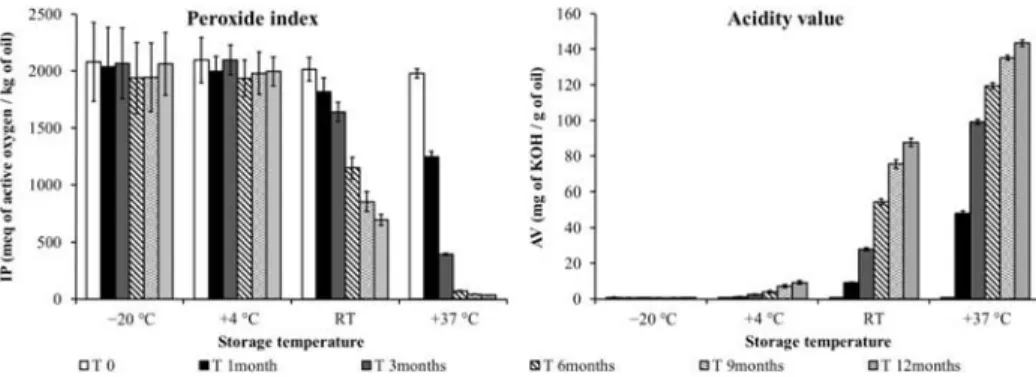
The reaction of ozone with the unsaturated fatty acids of vegetable oils leads to the formation of oxygenated com-pounds such as ozonides, aldehydes and carboxylic acids following the mechanism described by Criegee (1975). Thereby, ozonized oils show high IP values, even more when ozonized with water (Moureu et al.2015). For this study, the initial peroxide index was around 2000 meq of active oxygen per kilogram of oil and the initial AV was around 0.7 mg of KOH per gram of oil.
The results showed that the evolution of the IP and AV (Figure 1) were significantly affected by the storage temperature. The IP values decreased faster at high sto-rage temperature (+37 °C) than at room temperature. Conversely, the AV increased but at a slower rate at RT than at +37 °C. The IP of the samples kept at low storage temperature (+4 °C) remained stable over a year but the AV slightly increased during this time. The properties of the samples stored in the freezer (−20 °C) did not change over the time. These results are in agreement with those of Cirlini et al. (2012), who have demonstrated that the decrease of the IP occurred at a faster rate for samples of ozonized sunflower oil and enriched cosmetics kept at +40 °C. Miura et al. (2001) also observed a better stability for ozonized olive oil stored in a fridge than at room temperature.
No significant differences were observed on the IR spectra of ozonized oil stored at low temperature
(Figure 2a, b). On the other hand, changes are to be noticed for the batches kept at +37 °C and at RT (Figure 2c, d) with the disappearance of the shoulder around 3500 cm−1corresponding to the degradation of hydroperoxides (Guillén and Cabo 2002). In the same time an increase in width of the band at 1750 cm−1due to the appearance of new carbonylic species was observed (e.g., carboxylic acids) (Soriano, Migo, and Matsumura
2003). A decrease in intensity of the band at 1100 cm−1, which can be attributed to the C–O stretching of the ozonide (Wu et al. 1992), was noticed under the same storage conditions.
These data suggest that the ozonides and hydroperoxides disappear while carboxylic acids are
formed which is in accordance with previous works (Cataldo 2014,2015a). It is well known that carboxylic acids are by-products of the ozonolysis reaction (Omonov, Kharraz, and Curtis 2011). They can be formed by oxidation of the aldehydes which are produced during the cleavage of the double bond of olefins (Killops 1986) or during the thermal degradation of ozonides (Cataldo 2013, 2015b; Ewing et al. 1989; Perkins, Roden, and Pryde1975). As there are still some unsaturations in the ozonized oil, aldehydes can also be formed during the thermal oxidation of unsaturated fatty acids (Roman et al.
2013). The present study was done with high oleic sunflower oil, meaning that the main fatty acid is Figure 1.Evolution of the IP and the AV depending on storage temperature and duration.
oleic acid (89%). According to the mechanism described by Criegee, the reaction of ozone with oleic acid in a protic media (e.g., water) mainly leads to the formation of aldehydes and peroxidic and oligomeric species but ozonides are also produced (Ledea et al.
2003; Reynolds et al. 2006; Vesna et al. 2009). The aldehydes formed from oleic acid are the nonanal and the 9-oxononanoic acid which can be oxidized in nonanoic and azelaic acids respectively.
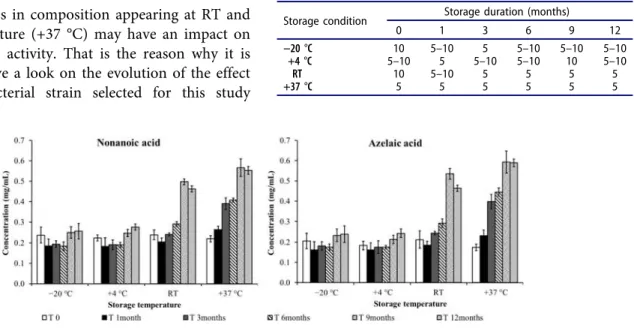
Gas chromatography analysis enabled verifying the increase in those carboxylic acids (Figure 3). By comparing the results of the analysis of the different temperatures some conclusions can be drawn. There were no significant changes in the concentration in nonanoic and azelaic acids observed over time for the samples stored at low temperatures (−20 °C and +4 °C). In comparison, there was a significant increase after 3 months for the samples kept at high temperature (+37 °C) and after 6 months at RT. However the concentration of nonanoic and azelaic acids was distorted. Indeed, the determined concentrations of nonanoic and azelaic acid represented the quantity of these compounds in the media added by the part produced by thermal degradation of ozonides during the injection in gas chromatography. Moreover, it was noticed that the TMSH used for the esterification of fatty acids induced a degradation of the aldehydes. When injecting nonanal alone with TMSH several peaks were observed on the chromatograms (data not shown). Part of the compound remained unchanged but part was transformed to the corresponding acid and to some unidentified compounds. It is likely that the same happened to 9-oxononanoic acid.
These changes in composition appearing at RT and at high temperature (+37 °C) may have an impact on the antibacterial activity. That is the reason why it is necessary to have a look on the evolution of the effect against the bacterial strain selected for this study
(Streptococcus uberis) over time. The minimal inhibitory concentration values determined are presented inTable 1.
The antibacterial activity remained unexpectedly stable for all storage temperatures. Diaz et al. (2001) have demonstrated the antibacterial activity of ozonides from ozonized methyl oleate. The conclusion of their study was that the ozonides were one of the active principles of the Oleozon® (ozonized sunflower oil). Some other compounds are also involved in the antibacterial effect (e.g., peroxides, short chain carboxylic acids). Indeed, azelaic acid is used for the treatment of acne due to its bactericidal and anti-inflammatory activities (Cherrington et al. 1991; Leeming, Holland, and Bojar 1986; Sieber and Hegel
2014) and nonanoic acid has been identified as an antifungal compound (Jang et al. 2012). In this study the data suggest that at RT and at high temperature (+37 °C) the ozonides and unsaturated fatty acids present in the medium decompose to form nonanoic and azelaic acids (through the oxidation of aldehydes). This mechanism could explain the stability of the antibacterial activity of ozonized oil. Indeed, the increase in the concentration of nonanoic and azelaic acids may compensate the degradation of the ozonides. This hypothesis could be verified by testing individually the antibacterial potential of the different ozonides, nonanoic and azelaic acids requiring the separation and the purification of these compounds.
Figure 3.Evolution of the concentration in nonanoic and azelaic acids depending on the different storage temperatures.
Table 1.Evolution of the MIC (mg/mL) value depending on the storage temperature and duration.
Storage condition Storage duration (months)
0 1 3 6 9 12
−20 °C 10 5–10 5 5–10 5–10 5–10
+4 °C 5–10 5 5–10 5–10 10 5–10
RT 10 5–10 5 5 5 5
Conclusion
The aim of this study was to investigate the effect of different storage temperatures applied on ozonized sunflower oil and to determine the best conditions to store these products. The samples kept at room temperature and at high temperature (+37 °C), showed a rapid alteration of the initial composition (decrease in IP and increase in AV). Conversely, the samples stored at low temperatures (−20 °C and +4 °C) remained stable over 1 year. The best condition to preserve the initial composition of ozonized sunflower oil is to keep it at low temperature in a fridge or a freezer. However, even if the composition is modified, ozonized oil is still active against Streptococcus uberis. A possible explanation is that compounds responsible for the antibacterial activity of ozonized sunflower oil are ozonides, nonanoic and azelaic acids. The increase in concentration of the acids compensates for the disappearance of ozonides. To verify this hypothesis it will be necessary to assess the effect of each compound individually after separation and purification.
Funding
The authors are grateful to the Midi-Pyrénées Region for funding by Grant No. 12050572.
References
AFNOR. 2009. NF EN ISO 660: Corps Gras D’origines Animale et Végétale - Détermination de L’indice D’acide et de L’acidité. France: AFNOR Group.
AFNOR. 2010a. NF EN ISO 3960: Corps Gras D’origines Animale et Végétale - Détermination de L’indice de Peroxyde—Détermination Avec Point D’arrêt Iodométrique. France: AFNOR Group.
AFNOR. 2010b. NF EN ISO 12966–3: Corps Gras D’origines Animale et Végétale—Chromatographie En Phases Gazeuse Des Esters Méthyliques D’acides Gras - Partie 3: Préparation Des Esters Méthyliques À L’aide D’hydroxyde de Triméthylsulfonium (TMSH). France: AFNOR Group. Campanati, A., S. De Blasio, A. Giuliano, G. Ganzetti, K.
Giuliodori, T. Pecora, V. Consales, I. Minnetti, and A. Offidani. 2013. “Topical Ozonated Oil versus Hyaluronic Gel for the Treatment of Partial- to Full-Thickness Second-Degree Burns: A Prospective, Comparative, Single-Blind, Non-Randomised, Controlled Clinical Trial.” Burns : Journal of the International Society for Burn Injuries 39 (6) (September):1178–83. doi:10.1016/j. burns.2013.03.002.
Camps-Ramírez, A., B. María, E.-C. Fernández, R. Denis, and A. Labrada. 2006.“El Oleozón, Una Nueva Perspectiva de Tratamiento En La Medicina Veterinaria.” Revista Electronica De Veterinaria REDVET VII:10.
Cataldo, F. 2013.“Chemical and Thermochemical Aspects of the Ozonolysis of Ethyl Oleate: Decomposition Enthalpy of
Ethyl Oleate Ozonide.” Chemistry and Physics of Lipids 175– 176 (January):41–9. doi:10.1016/j.chemphyslip.2013.07.005.
Cataldo, F. 2014. “Thermochemistry of Ozonides
Decomposition.” European Chemical Bulletin 3 (3):227–33. Cataldo, F. 2015a.“Ethyl Oleate and Ethyl Elaidate Ozonides: Thermal Decomposition and Photolysis.” Ozone: Science & Engineering 37(5):431–440.
Cataldo, F. 2015b. “Thermal Stability, Decomposition
Enthalpy, and Raman Spectroscopy of 1-Alkene
Secondary Ozonides.” Tetrahedron Letters 56 (8) (February):994–8. doi:10.1016/j.tetlet.2015.01.056.
Cherrington, C. A., M. Hinton, G. C. Mead, and I. Chopra. 1991. “Organic Acids: Chemistry, Antibacterial Activity and Practical Applications.” In Advances in Microbial Physiology, vol. 32, 87–108, Elsevier.
Cirlini, M., A. Caligiani, G. Palla, A. De Ascentiis, and P. Tortini. 2012.“Stability Studies of Ozonized Sunflower Oil and Enriched Cosmetics with a Dedicated Peroxide Value Determination.” Ozone: Science & Engineering 34 (4) (July):293–9. doi:10.1080/01919512.2012.692992.
CLSI. 2012. “Methods for Dilution Antimicrobial Susceptibility Tests for Bacteria That Grow Aerobically ; Approved Standard—Ninth Edition. ” In CLSI Document M7-A9, vol. 32. Wayne, PA: Clinical and Laboratory Standards Institute.
Criegee, R. 1975. “Mechanism of Ozonolysis.” Angewandte Chemie International Edition in English 14 (11) (November):745–51. doi:10.1002/anie.197507451.
Diaz, M., I. Lezcano, J. Molerio, and H. Frank. 2001. “Spectroscopic Characterization Of Ozonides With Biological Activity.” Ozone : Science & Engineering 23:35–40. doi:10.1080/01919510108961986.
Ewing, J. C., J. P. Cosgrove, D. H. Giamalva, D. F. Church, and W. A. Pryor. 1989.“Autoxidation of Methyl Linoleate Initiated by the Ozonide of Allylbenzene.” Lipids 24 (7) (July):609–15. doi:10.1007/BF02535077.
Falcón Lincheta, L., S. M. Cepero, R. D. Simón, E. G. Otaño, S. M. Duque, and M. A. Garcìa. 1998.“Aceite Ozonizado En Dermatología. Experiencia de 9 Años.” Revista CENIC Ciencias Biologicas 29 (3):192–5.
Geweely, N. S. I. 2006. “Antifungal Activity of Ozonized Olive Oil (Oleozone).” International Journal of Agriculture & Biology 08 (5):670–5.
Guillén, M. D., and N. Cabo. 2002. “Fourier Transform Infrared Spectra Data versus Peroxide and Anisidine Values to Determine Oxidative Stability of Edible Oils.” Food Chemistry 77 (4) (June):503–10. doi:10.1016/ S0308-8146(01)00371-5.
Jang, Y.-W., J.-Y. Jung, I.-K. Lee, S.-Y. Kang, and B.-S. Yun. 2012. “Nonanoic Acid, an Antifungal Compound from
Hibiscus Syriacus Ggoma.” Mycobiology 40 (2)
(June):145–6. doi:10.5941/MYCO.2012.40.2.145.
Kataoka, H., M. Semma, H. Sakazaki, K. Nakamuro, T. Yamamoto, S. Hirota, K. Tazuya-Murayama, and A. Ichikawa. 2009.“Proinflammatory Event of Ozonized Olive Oil in Mice.” Ozone: Science & Engineering 31:238–46. doi:10.1080/01919510902839022. .
Killops, S. D. 1986.“Action of Ozone on Methyl Octadec-9-Enoate in Polar Solvents.” Water Research 20 (2) (February):167–71. doi:10.1016/0043-1354(86)90006-0. Kim, H. S., S. U. Noh, Y. W. Han, K. M. Kim, H. Kang, H. O.
Application of Ozone on Acute Cutaneous Wound Healing.” Journal of Korean Medical Science 24 (3) (June):368–74. doi:10.3346/jkms.2009.24.3.368.
Ledea, O., M. Díaz, J. Molerio, D. Jardines, A. Rosado, and T. Correa. 2003.“1H-NMR Spectroscopy Study of Oleic Acid and Methyl Oleate Ozonation in Different Reaction Conditions.” Revista CENIC Ciencias Quimicas 34 (1):3–8. Leeming, J. P., K. T. Holland, and R. A. Bojar. 1986.“The in Vitro Antimicrobial Effect of Azelaic Acid.” British Journal of Dermatology 115 (5) (November):551–6. doi:10.1111/ bjd.1986.115.issue-5.
Menéndez, S., L. Falcόn, D. R. Simόn, and N. Landa. 2002. “Efficacy of Ozonized Sunflower Oil in the Treatment of Tinea Pedis.” Mycoses 45:329–32. doi: 10.1046/j.1439-0507.2002.00780.x.
Miura, T., S. Suzuki, S. Sakurai, A. Matsumoto, and N. Shinriki. 2001. “Structure Elucidation of Ozonated Olive Oil.” Proceedings of the 15th Ozone World Congress: Medical Therapy Conference, 3–7. London.
Montevecchi, M., A. Dorigo, M. Cricca, and L. Checchi. 2013. “Comparison of the Antibacterial Activity of an Ozonated Oil with Chlorhexidine Digluconate and Povidone-Iodine. A Disk Diffusion Test.” New Microbiologica 36 (July):289–302.
Moureu, S., F. Violleau, D. Ali Haimoud-Lekhal, and A. Calmon. 2015.“Ozonation of Sunflower Oils: Impact of Experimental Conditions on the Composition and the Antibacterial Activity of Ozonized Oils.” Chemistry and Physics of Lipids 186:79–85. doi:10.1016/j.chemphyslip.2015.01.004.
Omonov, T. S., E. Kharraz, and J. M. Curtis. 2011.“Ozonolysis of Canola Oil: A Study of Product Yields and Ozonolysis Kinetics in Different Solvent Systems.” Journal of the American Oil Chemists’ Society 88 (5):689–705. doi:10.1007/ s11746-010-1717-4.
Perkins, R. B., J. J. Roden, and E. H. Pryde. 1975.“Nylon-9 from Unsaturated Fatty Derivatives: Preparation and Characterization.” Journal of the American Oil Chemists Society 52 (11) (November):473–7. doi:10.1007/BF02637493. Reynolds, J. C., D. J. Last, M. McGillen, A. Nijs, A. B. Horn, C. Percival, L. J. Carpenter, and A. C. Lewis. 2006.“Structural Analysis of Oligomeric Molecules Formed from the Reaction Products of Oleic Acid Ozonolysis.” Environmental Science & Technology 40 (21):6674–81. doi:10.1021/es060942p. Roman, O., B. Heyd, B. Broyart, R. Castillo, and M.-N.
Maillard. 2013. “Oxidative Reactivity of Unsaturated
Fatty Acids from Sunflower, High Oleic Sunflower and Rapeseed Oils Subjected to Heat Treatment, under Controlled Conditions.” LWT - Food Science and Technology 52 (1) (June):49–59. doi:10.1016/j. lwt.2012.12.011.
Sechi, L. A., I. Lezcano, N. Nunez, M. Espim, I. Duprè, A. Pinna, P. Molicotti, G. Fadda, and S. Zanetti. 2001. “Antibacterial Activity of Ozonized Sunflower Oil (Oleozon).” Journal of Applied Microbiology 90 (2) (February):279–84. doi:10.1046/j.1365-2672.2001.01235.x. Sieber, M. A., and J. K. E. Hegel. 2014. “Azelaic Acid:
Properties and Mode of Action.” Skin Pharmacology and Physiology 27 (Suppl 1):9–17. doi:10.1159/000354888. Skalska, K., S. Ledakowicz, J. Perkowski, and B. Sencio. 2009.
“Germicidal Properties of Ozonated Sunflower Oil.” Ozone: Science & Engineering 31 (3):232–7. doi:10.1080/ 01919510902838669.
Soriano, N. U., V. P. Migo, and M. Matsumura. 2003. “Functional Group Analysis during Ozonation of Sunflower Oil Methyl Esters by FT-IR and NMR.” Chemistry and Physics of Lipids 126 (2) (December):133– 40. doi:10.1016/j.chemphyslip.2003.07.001.
Travagli, V., I. Zanardi, G. Valacchi, and V. Bocci. 2010. “Ozone and Ozonated Oils in Skin Diseases: A Review.” Mediators of Inflammation 2010 (January). doi:10.1155/ 2010/610418.
Valacchi, G., I. Zanardi, Y. Lim, G. Belmonte, C. Miracco, C. Sticozzi, V. Bocci, and V. Travagli. 2013.“Ozonated Oils as Functional Dermatological Matrices: Effects on the Wound Healing Process Using SKH1 Mice.” International Journal of Pharmaceutics 458:65–73. doi:10.1016/j. ijpharm.2013.09.039.
Valacchi, G., Y. Lim, G. Belmonte, C. Miracco, I. Zanardi, V. Bocci, and V. Travagli. 2011. “Ozonated Sesame Oil Enhances Cutaneous Wound Healing in SKH1 Mice.” Wound Repair and Regeneration 19:107–15. doi:10.1111/ wrr.2011.19.issue-1.
Vesna, O., M. Sax, M. Kalberer, A. Gaschen, and M. Ammann. 2009.“Product Study of Oleic Acid Ozonolysis as Function of Humidity.” Atmospheric Environment 43 (24) (August):3662–9. doi:10.1016/j.atmosenv.2009.04.047. Wu, M., D. F. Church, T. J. Mahier, S. A. Barker, and W. A. Pryor. 1992. “Separation and Spectral Data of the Six Isomeric Ozonides from Methyl Oleate.” Lipids 27 (2):129–35. doi:10.1007/BF02535812.