J. L. Rodr´ıguez-S´anchez,1, 2 J.-C. David,3 J. Hirtz,3, 4 J. Cugnon,5 S. Leray,3 and D. Mancusi6 1
Universidad de Santiago de Compostela, E-15782 Santiago de Compostela, Spain 2GSI-Helmholtzzentrum f¨ur Schwerionenforschung GmbH, D-64291 Darmstadt, Germany
3
IRFU, CEA, Universit´e Paris-Saclay, F-91191 Gif-sur-Yvette, France 4
Center for space and habitability, Universit¨at Bern, CH-30 12 Bern, Switzerland 5AGO department, University of Li`ege, all´ee du 6 aoˆut 19, bˆatiment B5, B-4000 Li`ege, Belgium
6
SERMA, CEA, Universit´e Paris-Saclay, F-91191 Gif-sur-Yvette, France
( Dated: June 8, 2018)
The new version of the Li`ege intranuclear cascade model INCL, recently extended to the pro-duction of strange particles and hypernuclei, is used to investigate the Λ-nucleus potential in a broad range of nuclear masses from Si to Pb. The combination of INCL calculation results with experimental cross sections of Λ hypernuclei, obtained from (π+,K+) reaction studies, allows us to
constrain the Λ-nucleus potential depth with an accurancy of about 0.9 MeV. Our results show that the potential depth increases with the mass number (A) from 28 MeV, in the region of medium-mass hypernuclei, up to a maximum of 39.6 MeV in the region of heavy hypernuclei around Z = 82. This deviation could be related with the nucleon-isospin dependence of the three-body Λ-nucleon-nucleon force in asymmetry matter whose contribution is more relevant in hyper-neutron matter due to a strong contribution from Λnn interactions.
PACS numbers: 21.80.+a
Experimental study of hypernuclei is one of the few possibilities to obtain information about nucleon-hyperon (NY), nucleon-nucleon-hyperon (YY), and nucleon- hyperon-nucleon-nucleon (YNN) forces, which have a high im-pact in astrophysical applications [1–4]. Since some years NY potentials fitted to the existing experimental data on elastic NY scattering are available for the theoreti-cal description of hypermatter and hypernuclei [5]. Un-fortunately, since the experimental data is rather scarce in comparison with the nucleon-nucleon case, the corre-sponding potentials are not very constrained [6–8]. In the case of YY and YNN forces the situation is even more complicated because there are no available data.
Experimental data from emulsion studies provided the first measurements of binding energies for light hyper-nuclei [9]. These experimental findings were followed by many theoretical studies whose aim was to determine the potential well depth of Λ particles in nuclear matter. On the one hand, in the first phenomenological studies based on a Woods-Saxon potential well, it was found that a po-tential depth of about 30 MeV could provide a reasonable description of the data [10]. Subsequent phenomenolog-ical investigations showed that a multi-parameter fit of binding energies changing the nuclear radius and the Λ-nucleus potential gives a better agreement, obtaining a potential well with a depth of about 28 MeV [11,12]. On the other hand, from more sophisticated models based on Brueckner-Hartree-Fock [7], skyrme-Hartree-Fock [13], or soft-core one-boson-exchange [6] approaches the poten-tial depth could fluctuate between 21 and 35 MeV. How-ever, these studies were only carried out for light and medium-mass hypernuclei because of the scarce measure-ments of heavy hypernuclei.
In last decades, the strangeness-exchanging reactions (π+,K+) and (K−,π−) were also utilized for
spectro-scopic study of hypernuclei using the excitation spectra to extract information about the Λ shell structure, ob-taining the binding energies of Λ single-particle states with a resolution below 2 MeV [14–18]. In the case of (π+,K+) reactions, the cross sections were also
deter-mined with an accurancy below 7%.
In this work, we propose to study the Λ-nucleus po-tential depth by combining experimental data of hy-pernuclei produced in strangeness-exchanging (π+,K+)
reactions with theoretical calculations performed with sophisticated dynamical reaction models based on the intranuclear-cascade (INC) approach [19–23]. In these models, the reaction is described by means of a two-step process usually applied in spallation, fragmentation, and charge-exchange reactions [24–26]: the collision it-self, where part of the nucleons contained in the target nucleus are removed or modified and some excitation en-ergy and angular momenta are gained by the remnant; and subsequent de-excitation processes by evaporation of particles or, if applicable, by fission. Here, INC mod-els are considered as a Monte Carlo method to solve nu-merically the dynamic transport equations describing the hadron-nucleus collision. The nature of INC models is es-sentially classical, being assumed that nucleons are per-fectly localised in phase space and that they are bound by a potential. In this approach, the nuclear collision is treated as successive relativistic binary hadron-hadron collisions separated in time, where the positions and mo-menta of hadrons are followed as time evolves. It is also assumed that hadrons move along straight trajectories until they undergo a collision with another hadron or until they reach the surface, where they could eventually escape. Cross sections are determined from a set of colli-sion events taken at different impact parameters and for which nucleon positions and momenta are initially
sam-pled for each participant nucleus.
For our purpose, we use the Li`ege intranuclear-cascade model (INCL) [27] that has been recently extended to-wards high energies (∼15 GeV) including multipion pro-duction [28], strange particles like kaons and hyperons [29], and the production of η and ω mesons [30]. This new version of INCL permits us to predict the formation of hyperremnants and their characterization in atomic, mass, and strange numbers together with their excitation energies and angular momenta. These improvements in INCL also require de-excitation models considering the emission of hyperons, in particular, the evaporation of Λ particles. Currently, there are a few number of de-excitation models that treat the evaporation of hyper-ons and the formation of hypernuclei. In this work we use the evaporation model ABLA07 developed at GSI by Schmidt and collaborators [31], recently extended to hy-pernuclei by us including the evaporation of Λ particles on basis of Weisskopf’s approach according to Ref. [32].
In the new version of INCL elementary cross sections related with the production and interaction of strange particles (such as K, ¯K, Σ, and Λ) were implemented
using sophisticated parametrizations of available experi-mental data as well as their characteristics: angular dis-tributions, momenta, and charge repartition of the parti-cles in the associated final states [29]. These new ingredi-ents made INCL become in a powerful tool to study the production of strange particles in nuclear matter and to go further in the understanding of hypernuclei formation. Target density profiles are prepared at the first step of the simulation assuming independent Woods-Saxon density distributions for protons and neutrons according to the method described in Ref. [33]. For the Woods-Saxon density distribution the radius (R0) and the
dif-fuseness parameter (a) are taken from Hartree-Fock-Bogoliubov calculations since they provide a good de-scription of single-nucleon knockout reactions [34]. The initial nucleon momenta are uniformly distributed in hard Fermi spheres of radii (2Z/A)1/3pF for protons and (2N/A)1/3pF for neutrons (see Ref. [35] for details). Moreover, the nucleons are sampled in phase space tak-ing into account the correlations between kinetic energy and radius of the potential well [33]. The relation is such
TABLE I. Nuclear radii (in fm) for neutrons, protons, and Λs used in INCL to define the Woods-Saxon potential well of the nuclei investigated in this work, as well as the separation energies (in MeV) used in the de-excitation process.
Nucleus Rn Rp RΛ Sn Sp SΛ 28 SiΛ 3.25 3.29 3.57 16.00 10.30 16.0 89 YΛ 5.01 4.84 5.13 9.55 6.51 22.1 139 LaΛ 5.85 5.83 5.93 7.04 5.87 23.8 208Pb Λ 6.76 6.64 6.76 5.88 7.74 26.5 0 20 40 60 80 100 ] ° [ θ 50 100 150 200 250 300 350 400 450 [MeV] + Kinetic energy of K (Rem) Λ Si 28 ) + , K + π Si ( 28
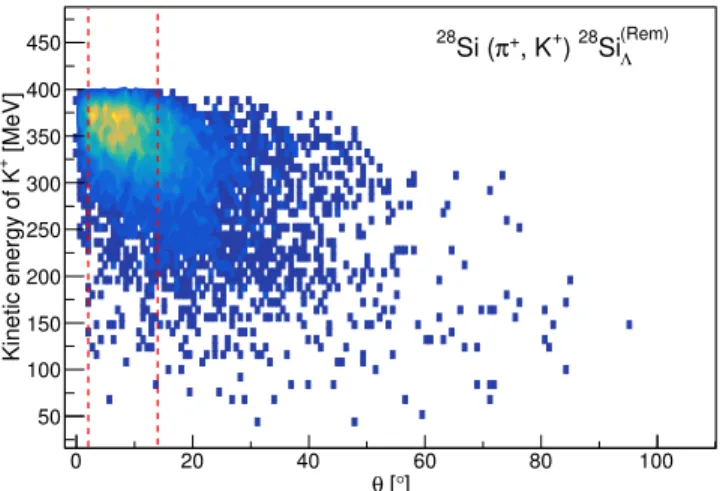
FIG. 1. (Color online) Scatter plot of the INCL predictions for the kinetic energy of K+ particles emitted in the
produc-tion of hyperremnants28SiΛ as a function of the angle θ for
the reaction π+ (1.06 GeV/c) + 28Si. The vertical lines lo-cated at 2◦and 14◦are to indicate the region selected for the comparison with experimental data.
that the space density distribution is given by the Saxon distribution. For Λ particles we also use a Woods-Saxon potential well, taking the diffuseness parameter (aΛ) as for neutrons and a nuclear radius RΛ0 = (1.128 +
0.439A −2/3)A1/3 since this parametrization provides a
reasonable description of the distance between hypernu-clei binding energies [11]. In TableIare summarized the nuclear radii utilized to define the Woods-Saxon poten-tial well of neutrons, protons, and Λ particles. Finally, the Λ-nucleus potential well is set to a constant value of 28 MeV by default, although it will be modified latter to constrain its depth within the strangeness-exchanging (π+,K+) reactions.
For the dynamical description of the collision between projectile and target nuclei, each event is fired at a given impact parameter b, ranging from 0 to a distance bmax given by the maximum radius of the target nucleus. If two hadrons approach each other at a distance lower than a minimum distance, they interact. The minimum dis-tance is calculated from energy-dependent parametriza-tions of the hadron-hadron interaction cross secparametriza-tions for all possible collisions according to Ref. [36]. During the cascade process, the particles are divided into partici-pants and spectators. Participartici-pants are defined as par-ticles that have collided with at least one other partici-pant, while spectators are the other particles. Collisions between spectators are forbidden in order to eliminate the spontaneous boiling of the Fermi sea, which leads to particles that could escape from the target, even if the particle is left alone. This condition is used because the spontaneous boiling is a direct violation of the Pauli-exclusion principle. For nucleons, a strict Pauli blocking is also applied to the first collision to account for surface effects and for effects of the depletion of the Fermi sea [37]. For the subsequent collisions, we apply the Pauli
0 5 10 15 20 25 30 35 40 45 Λ Pb 208 ) + ,K + π Pb ( 208 0 5 10 15 20 25 30 35 40 45 Λ La 139 ) + ,K + π La ( 139 0 5 10 15 20 25 30 35 40 45 Λ Y 89 ) + ,K + π Y ( 89 0 5 10 15
b/sr]
µ
Cross section [
20 25 30 35 40 45 Λ Si 28 ) + ,K + π Si ( 28-nucleus potential [MeV]
Λ
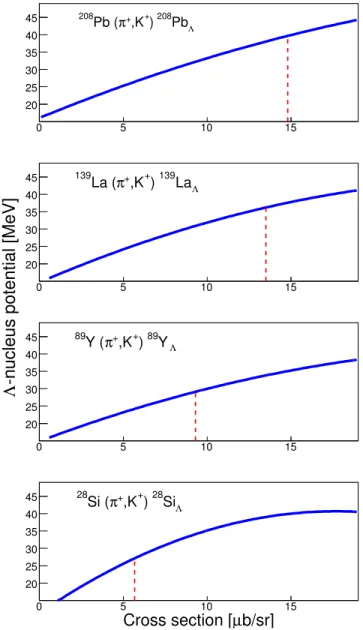
FIG. 2. (Color online) Correlation between the Λ-nucleus potential and the cross section of hypernuclei produced in the reactions indicated in each pannel for a pion momentum of 1.06 GeV/c. The vertical lines indicate the experimental cross sections, obtained from Ref. [16], that were used to determine the potential well depth.
principle according to the usual procedure by means of statistical blocking factors, which do not have any effect in the case of single-Λ hypernuclei. In addition, a consis-tent dynamical Pauli blocking is applied to all particles at the end of the cascade process to reject unphysical re-sults, see Ref. [33] for more details. The excitation energy of the remnants is calculated from energy and momen-tum conservation laws applied over all existing particles in the initial configuration and at the end of the cascade process [33].
In Fig. 1 we display the kinetic energy of the positive kaons emerged from the reaction π+(1.06 GeV/c) +28Si
producing hyperremnants of 28SiΛ, this means that in
this picture we do not take into account the de-excitation stage in which the excited hyperremnant could evaporate any particle. Here, the vertical lines indicate the angu-lar selection that we will apply for the comparison with experimental data since the kaon emission angle is not affected by the de-excitation process.
For modeling the de-excitation stage, we use the ABLA07 code [31] that describes the de-excitation of a nucleus emitting γ-rays, neutrons, light-charged parti-cles, and intermediate-mass fragments according to Weis-skopf’s formalism [38]. For a more realistic description of this process, the separation energies are taken from the atomic mass evaluation of 2016 [39] and the emis-sion barriers for charged particles are determined with the Bass potential [40]. This model has been extended by us to account for the emission of Λ particles and the production of cold hypernuclei following Refs. [32, 41]. The Λ separation energies are parametrized according to the fit of experimental binding energies described in Ref. [42]. In addition, neutron and proton separation energies are modified in case of hypernuclei to take into account the hyperenergy released from the presence of the Λ par-ticle [41]. The values of all the separation energies used in this work are also listed in Table I. For this specific work, we do not need to introduce more ingredients in the de-excitation process since we are only interested in the survival probability of the isobaric hyperremnant that is determined basically by the number of excited hyperrem-nants with an excitation energy that does not surpass the minimum particle separation energy, defined as Smin = min{Sn, Sp, SΛ}. This probability can be written as
PE∗≤Smin= 1 N N ∑ j=0 Θ(Smin− Ej∗),
where Θ is the Heaviside function and N the total
num-50 100 150 200
Mass number (A) 25
30 35 40 45
-nucleus potential [MeV]
Λ
This work Others
FIG. 3. (Color online) Λ-nucleus potential obtained from our model calculations (open squares) compared with the values reported in other works (solid circles). Dashed area is just to show the expected region for the Λ potential depth.
ber of isobaric hyperremnants produced by strangeness-exchanging reactions.
In Fig. 2 we show the results obtained from our cal-culations for the strangeness-exchanging reactions indi-cated in each pannel. In these pictures we illustrate how the cross section evolves with the Λ-nucleus poten-tial depth. One can see that the cross sections increase with the Λ potential, which is basically explained by the increase of the phase space compatible with the kinetic energy gained by the Λ particle. After defining these correlations for each hypernucleus, we can use the exper-imental cross sections, indicated in the figure with ver-tical dashed lines, to constrain the Λ-nucleus potential depth.
Our findings for the Λ-nucleus potential depth (open squares) are displayed in Fig. 3 together with the re-sults obtained in other works. For hypernuclei with mass numbers below 89 we obtain a potential depth of around 28 MeV that is in agreement with the values reported in other works based on phenomenological approaches [11] and on Skyrme-Hartree-Fock calculations [13]. However, for higher masses we find a potential depth of 36.2 MeV for 139LaΛ and 39.6 MeV for 208PbΛ, which were not
observed in previous investigations because of the scarce experimental measurements in the region of heavy hyper-nuclei. We also performed INCL calculations assuming a smaller phenomenological radius of RΛ0 = 1.165A1/3
suggested by Gal and collaborators [43], which leads to a lower Λ potential depth for Pb of about 37 MeV, but this value is still far from being adequate according to other theoretical predictions and thus it cannot explain the observed deviation. Recently, some works have also pointed out this possible deviation [8] whose understand-ing is still not clear.
0 0.05 0.1 0.15 0.2 (N-Z)/A 25 30 35 40 45
-nucleus potential [MeV]
Λ
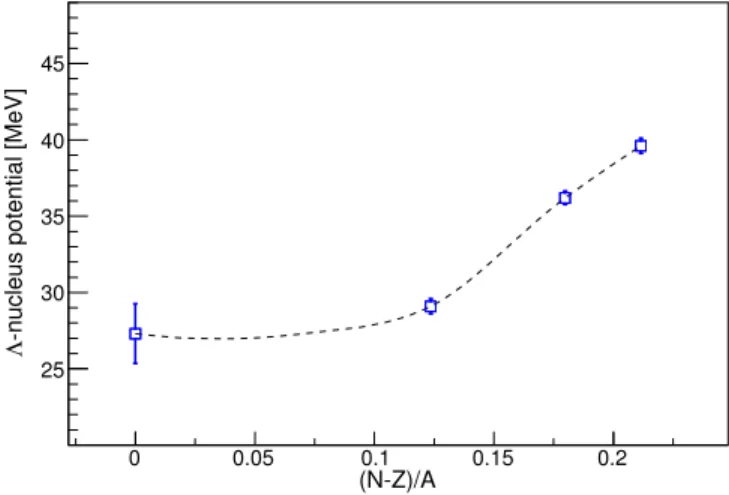
FIG. 4. (Color online) Λ-nucleus potential obtained from our approach as a function of the asymmetry (N− Z)/A. The dashed line is just a guide to the eye.
To go further, in Fig. 4 we also display the Λ-nucleus potential depth as a function of the asymmetry of the tar-get nucleus, defined as (N− Z)/A, where N is the num-ber of neutrons, Z is the numnum-ber of protons, and A is the mass number. This asymmetry parameter was proposed recently to study the nucleon-isospin dependence of the three-body ΛN N force in neutron-rich hypermatter that could be important for the prediction of neutron star properties [44]. In the picture, we can observe a strong increase of the Λ potential depth with this parameter when we move towards neutron-rich nuclei, which have a large neutron abundance at the surface that enhances the Λnn interaction. Note that in our INCL calculations we do not take into account three-body collisions, but it is clearly evident that their effects are included in the experimental separation energies and cross sections that we use as an input in our approach. Therefore, the devi-ation that we find in Fig. 3 could be a first evidence of such dependence that should be investigated in detail.
In conclusion, a new version of the Li`ege intranuclear cascade model INCL has been used for the first time to investigate the production of hypernuclei in strangeness-exchanging collisions. INCL calculations, together with experimental Λ-separation energies, are utilized to es-tablish direct correlations between the cross sections of hypernuclei produced via peripheral strangeness-exchanging reactions (π+,K+) and Λ-nucleus potential depth. Experimental cross sections are then used to de-termine the potential depth with an average accurancy of 0.9 MeV. These constraints provide a potential depth of about 28 MeV for medium-mass hypernuclei that is con-sistent with the results obtained in other works, whereas for heavy hypernuclei around Pb, we obtain a potential depth of 39.6 MeV. This deviation was also pointed out previously, but without any clear conclusion. To go a step further, we also investigate how the Λ-nucleus potential depth evolves with the asymmetry of the nucleus. This kind of study was suggested recently to investigate the fundamental problem of the nucleon-isospin dependence of the three-body ΛN N interaction [44], which could be important in the study of neutron star matter due to a strong contribution from the Λnn interaction. Surpris-ingly, we find a strong increase of the Λ-nucleus poten-tial depth when we move towards neutron-rich nuclei, concluding that this fact could be a first proof of such strong interaction. We also think that more measure-ments in the region of heavy hypernuclei and theoretical analysis should be performed in order to confirm and un-derstand this interesting behavior.
We wish to thank Dr. Alain Boudard for enlighten-ing discussions and Dr. Georg Schnabel for his technical support. This work has been partially supported by the Department of Education, Culture and University Or-ganization of the Regional Government of Galicia under the program of postdoctoral fellowships and by the EU ENSAR2 FP7 project (grant agreement 654002).
[1] D. Lonardoni, A. Lovato, S. Gandolfi, and F. Pederiva, Phys. Rev. Lett. 114, 092301 (2015).
[2] A. I. Qauli, M. Iqbal, A. Sulaksono, and H.S. Ramadhan, Phys. Rev. D 93, 104056 (2016).
[3] R. Wirth and R. Roth, Phys. Rev. Lett. 117, 182501 (2016).
[4] M. Fortin, S. S. Avancini, C. Providˆencia, and I. Vida˜na, Phys. Rev. C 95, 065803 (2017).
[5] K. Tominaga, T. Ueda, M. Yamaguchi, N. Kijima, D. Okamoto, K. Miyagawa, T. Yamada, Nucl. Phys. A 642, 483 (1998).
[6] Th. A. Rijken, V. G. J. Stoks, and Y. Yamamoto, Phys. Rev. C 59, 21 (1999).
[7] H.-J. Schulze, M. Baldo, U. Lombardo, J. Cugnon, and A. Lejeune, Phys. Rev. C 57, 704 (1998).
[8] H.-J. Schulze and T. Rijken, Phys. Rev. C 88, 024322 (2013).
[9] D. H. Davis and J. Pniewski, Contemp. Phys. 27, 91 (1986).
[10] C. B. Dover, l. Ludeking, and G. E. Walker, Phys. Rev. C 22, 2073 (1980).
[11] D. J. Millener, C. B. Dover, and A. Gal, Phys. Rev. C 38, 2700 (1988).
[12] A. Bouyssy and J. H¨ufner, Phys. Lett. 64B, 276 (1976). [13] J. Cugnon, A. Lejeune, and H.-J. Schulze, Phys. Rev. C
62, 064308 (2000).
[14] R. Bertini et al., Phys. Lett. 83B, 306 (1979). [15] R. Bertini et al., Nucl. Phys. A 360, 315 (1981). [16] T. Hasegawa et al., Phys. Rev. C 53, 1210 (1996). [17] P. H. Pile et al., Phys. Rev. Lett. 66, 2585 (1991). [18] P. K. Saha et al., Phys. Rev. Lett. 94, 052502 (2005). [19] H. W. Bertini, Phys. Rev. 131, 1801 (1963); Phys. Rev.
188, 1711 (1969).
[20] K. Chen, Z. Fraenkel, G. Friedlander, J. R. Grover, J. M. Miller, and Y. Shimamoto, Phys. Rev. 166, 949 (1968). [21] Y. Yariv and Z. Fraenkel, Phys. Rev. C 20, 2227 (1979). [22] V. S. Barashenkov, B. F. Kostenko, and A. M.
Zadorogny, Nucl. Phys. A 338, 413 (1980). [23] J. Cugnon, Phys. Rev. C 23, 2094 (1981). [24] R. Serber, Phys. Rev. 72, 1114 (1947).
[25] A. Boudard, J. Cugnon, J.-C. David, S. Leray, and D. Mancusi, Phys. Rev. C 87, 014606 (2013).
[26] Th. Aoust and J. Cugnon, Phys. Rev. C 74, 064607 (2006).
[27] D. Mancusi, A. Boudard, J. Cugnon, J.-C. David, P.
Kai-taniemi, and S. Leray, Phys. Rev. C 90, 054602 (2014). [28] S. Pedoux, J. Cugnon, A. Boudard, J.-C. David, and S.
Leray, Adv. Space Res. 44, 926 (2009).
[29] J. Hirtz, J.-C. David, A. Boudard, J. Cugnon, S. Leray, D. Mancusi, submitted to Eur. Phys. J. Plus.
[30] J.-C. David, A. Boudard, J. Cugnon, J. Hirtz, S. Leray, D. Mancusi, J. L. Rodr´ıguez-S´anchez, accepted in Eur. Phys. J. Plus.
[31] A. Keli´c, M. V. Ricciardi, and K.-H. Schmidt, Pro-ceedings of Joint ICTP-IAEA Advanced Workshop on Model Codes for Spallation Reactions, ICTP Trieste, Italy, 4-8 February 2008, edited by D. Filges, S. Leray, Y. Yariv, A. Mengoni, A. Stanculescu, and G. Mank (IAEA INDC(NDS)-530, Vienna, 2008), pp. 181-221.
[32] A. S. Botvina, N. Buyukcizmeci, A. Ergun, R. Ogul, M. Bleicher, and J. Pochodzalla, Phys. Rev. C 94, 054615 (2016).
[33] A. Boudard, J. Cugnon, S. Leray, and C. Volant, Phys. Rev. C 66, 044615 (2002).
[34] J. L. Rodr´ıguez-S´anchez, J.-C. David, D. Mancusi, A. Boudard, J. Cugnon, and S. Leray, Phys. Rev. C 96, 054602 (2017).
[35] D. Mancusi, A. Boudard, J. Carbonell, J. Cugnon, J.-C. David, and S. Leray, Phys. Rev. C 91, 034602 (2015). [36] J. Cugnon, D. L’Hˆote, and J. Vandermeulen, Nucl. Instr.
Methods Phys. Res., Sect. B 111, 215 (1996).
[37] J. Cugnon and P. Henrotte, Eur. Phys. J. A 16, 393 (2003).
[38] V. F. Weisskopf and D. H. Ewing, Phys. Rev. 57, 472 (1940).
[39] W. J. Huang, G. Audi, M. Wang, F. G. Kondev, S. Naimi, and X. Xu, Chin. Phys. C 41, 030002 (2017).
[40] R. Bass, Proceedings of the Symposium on Deep-Inelastic and Fusion Reactions with Heavy Ions, Springer Verlag, Berlin, 1980.
[41] N. Buyukcizmeci, A. S. Botvina, J. Pochodzalla, and M. Bleicher, Phys. Rev. C 88, 014611 (2013).
[42] C. Samanta, P. Roy Chowdhury, and D. N. Basu, J. Phys. G.: Nucl. Part. Phys. 32, 363 (2006).
[43] A. Gal, E. V. Hungerford, and D. J. Millener, Rev. Mod. Phys. 88, 035004 (2016).
[44] D. Lonardoni and F. Pederiva, https://arxiv.org/abs/1711.07521.