Les Cahiers de la Chaire Economie du Climat
Reducing deforestation and forest degradation:
leakage or synergy?
Arild Angelsen
1and Philippe Delacote
2Agricultural expansion is the main deforestation driver, while forest degradation is due to non-sustainable poaching and harvesting of forest products. Policies to reduce emissions from deforestation and forest degradation (REDD) thus focus on agricultural expansion and illegal harvesting. The feedbacks between these two policy instruments are rarely discussed. Does reduced deforestation indirectly decrease or enhance forest degradation? How does better control on illegal harvesting influence deforestation? Using a simple household model, we assess the impact of a Payment for Environmental Services (PES) on both deforestation and illegal harvesting, and the impact of increasing the control on illegal harvesting on deforestation. We show that when land and labor are substitutes, both policies have positive feedbacks and win-win potential. Conversely, when production factors are complements, they have negative feedbacks and need to be taken into account by the public policies. Further, we demonstrate that the production factors can become substitutes if distance costs are high, making a win-win situation more likely.
Keywords: deforestation, REDD, payment for environmental services, agricultural expansion,
illegal harvesting, poaching, leakage, synergies
n° 2013-11
Working Paper Series
1. School of Economics and Business, Norwegian University of Life Sciences, Norway
2. INRA, UMR 356 Économie Forestière, F-54000 Nancy, France
Agroparistech, Engref, Laboratoire d’économie forestière, F-54000 Nancy, France Climate Economics Chair, Paris, France
This paper has been presented at the EAERE annual conference (Rome, 2011), and to a research seminar at Copenhagen University. We acknowledge useful
comments from participants. We also thank Jo Albers and Pablo Andres-Domenech for their feedback. The research leading to these results has received funding from the European Union’s Seventh Framework Programme (FP7/2007-2013) under grant agreement no 243950.
Reducing deforestation and forest degradation: leakage or synergy?
Arild Angelsen ∗ Philippe Delacote †‡§¶
October 4, 2013
Abstract
Agricultural expansion is the main deforestation driver, while forest degradation is due to non-sustainable poaching and harvesting of forest products. Policies to reduce emissions from deforestation and forest degradation (REDD) thus focus on agricultural expansion and illegal harvesting. The feedbacks between these two policy instruments are rarely discussed. Does reduced deforestation indirectly decrease or enhance forest degradation? How does better con-trol on illegal harvesting influence deforestation? Using a simple household model, we assess the impact of a Payment for Environmental Services (PES) on both deforestation and illegal harvesting, and the impact of increasing the control on illegal harvesting on deforestation. We show that when land and labor are substitutes, both policies have positive feedbacks and win-win potential. Conversely, when production factors are complements, they have negative feedbacks and need to be taken into account by the public policies. Further, we demonstrate that the pro-duction factors can become substitutes if distance costs are high, making a win-win situation more likely.
Keywords: deforestation, REDD, payment for environmental services, agricultural expansion, illegal harvesting, poaching, leakage, synergies
∗
School of Economics and Business, Norwegian University of Life Sciences, Norway
†
INRA, UMR 356 Économie Forestière, F-54000 Nancy, France
‡
Agroparistech, Engref, Laboratoire d’économie forestière, F-54000 Nancy, France
§
Climate Economics Chair, Paris, France
¶
This paper has been presented at the EAERE annual conference (Rome, 2011), and to a research seminar at Copenhagen University. We acknowledge useful comments from participants. We also thank Jo Albers and Pablo Andres-Domenech for their feedback. The research leading to these results has received funding from the European Union’s Seventh Framework Programme (FP7/2007-2013) under grant agreement no 243950.
1
Introduction
Agricultural expansion is responsible of the highest share of deforestation in the developing world (IPCC (2007), Rudel (2007); Angelsen (2009)). Effective policies aiming to reduce deforestation must therefore target agricultural expansion. However, when the agents of deforestation are poor agricultural households, they frequently mix their activities between agriculture and (sometimes illegal) forest products harvesting and poaching, which can lead to forest degradation (Godoy et al. (1997), Pattanayak and Sills (2001), Delacote (2007), Delacote (2009)). In situations of imperfect markets, as frequently found in remote, forested areas, different activities are interlinked in household decision making. In this context, what happens if the policy to reduce deforestation focuses on agricultural expansion only, while the deforestation agents are also illegal loggers and poachers?1 Similarly, how does better control of illegal harvesting influence deforestation? In other
words, do policies aiming at reducing deforestation and illegal harvesting present policy makers with a menu of synergies or trade-offs (leakage)?
Leakage or "emission displacement" (in official climate language) refers to a situation where reduction in emissions in one area or activity leads to higher emissions of greenhouse gases (GHG) in another. There are several channels of leakage (Wunder (2008)), including activity shifting of agricultural households. Addressing leakage is a major challenge in designing and implementing effective climate mitigation policies.
In this paper, our aim is to better understand the pattern of shifting activities that may create leakage between activities of rural households of developing regions. This paper develops a simple agricultural household model. Households allocate labor both to agriculture and illegal harvesting, and choose the area to deforest for agricultural purposes. Policies to reduce agricultural expansion may take the form of payment for environmental services (PES), cf. Wunder (2005). We consider a PES scheme in which agricultural households are paid to reduce their agricultural expansion compared to a business as usual (BAU) scenario. While such a scheme should at least in theory -reduce deforestation, its impact on illegal harvesting is not straightforward. Similarly, controlling illegal harvesting can be a policy instrument to contain forest degradation, and we ask how this will impact on deforestation.
1From now on, we will employ the term illegal harvesting, when talking of illegal logging and poaching of (both
timber and non-timber) forest products. Note, however, that agricultural expansion may also be illegal, when forest clearing is made without the clearer having property rights or legal restrictions apply on forest conversion
Our results show that the relation between production factors is the main factor influencing those feedback effects. When labor and agricultural land are substitutes, the PES scheme yields a win-win outcome: it directly decreases deforestation and indirectly decreases labor allocated to illegal harvesting and thereby forest degradation. Similarly, better control over illegal harvesting leads to less labor being allocated to this activity, and deforestation also decreases. In this case, both policy instruments have positive feedbacks. In contrast, when both factors are complements, the PES scheme generates a shift in labor allocation from agriculture to illegal harvesting. In this case, both policy instruments imply a trade-off between avoided deforestation and forest degradation. Our simulations from Brazilian data show that a situation with factor complementarity is more likely than a situation with factor substitutability.
Section 2 presents the household model in the BAU case. Section 3 presents the policy in-struments to reduce deforestation and forest degradation. Section 4 outlines direct and indirect outcomes of the forest policy in terms of avoided deforestation and illegal harvesting. Section 5 further elaborates on the role of distance costs on factor complementarity, and presents a simple numerical application of the model. Section 6 concludes.
2
A household model of agricultural expansion and illegal
har-vesting
In many regions of the developing world, poor rural communities expanding their land for livelihood are major agents of deforestation. The households pursue a mix of economic activities, including agriculture and forest products harvesting. By forest products, we mean here both wood (e.g. fuelwood and timber) and non-wood (e.g. fruits, edible plants and game meat) forest products. One reason for high diversification is missing or incomplete markets, where lack of access to labor is frequently considered as a limiting factor in agricultural production (Amacher, 2009; Angelsen, 1999). To simplify the model, we assume households have no access to off-farm labor markets (following, among others, Amacher et al. (2009), Baland and Francois (2005), Delacote (2009)). This is modeled as a constraint on labor allocation l, and households devote an amount of labor l to agriculture and an amount l − l to illegal harvesting. Households then make two decisions: (i) how much forest to convert to agricultural land L, and (ii) how to allocate family labor between agriculture and illegal harvesting.
If we, alternatively, assumed labor could be sold freely at a given wage rate in an off-farm labor market, the decisions are inseparable and interaction between the two forest activities would disappear . 2
2.1 Business-as-usual situation
In the BAU case, no policy is implemented to control illegal harvesting nor to reduce agricul-tural expansion. Assuming risk neutrality3, households choose their land and labor allocation to
maximize net expected return from their activities: max
L,l Y(l, L) = A(l, L) + H(l, L) − cL (1)
A(l, L) is the net return from agriculture, L the size of new agricultural land (deforestation).
We assume standard features of the agricultural production function: labor allocated to agriculture has positive and decreasing marginal productivity, representing congestion effects and tiredness; the most productive forest land is converted first to agriculture, resulting in positive and decreasing marginal productivity: Al = ∂A∂l >0 and All = ∂
2A
∂l2 < 0; AL = ∂A∂L >0 and ALL = ∂
2A
∂L2 <0. c is
the unit cost of land conversion (net any income from timber sale).
Illegal harvesting provides net return of H(l, L). Marginal labor productivity is positive and decreasing, i.e. negative in labor allocated to agriculture (l): Hl = ∂H∂l < 0 and Hll = ∂
2H
∂l2 < 0.
Agricultural expansion affects illegal harvesting negatively, as it reduces the remaining forest stock:
HL= ∂H∂L <0 and HLL = ∂
2H
∂L2 <0.
Note that the cross-derivatives AlLof the agricultural production function and HlLof the illegal
harvesting function are not explicitly signed (thus YlL is not signed either). As we will show, the
sign will influence the win-win potential of the REDD policies.
2
A more complete model would include leisure and the tradeoff between productive activities and leisure in the utility function (the Chayanovian approach). That would not have changed the key feature of the model, namely the interdependency between labor for agricultural production and harvesting of forest products when access to labor is constrained.
3
Assuming risk aversion would bring potentially important modifications here. First, forest products harvesting is frequently mentioned as a risk-management tool against agricultural risk (Delacote (2007, 2009)). Second, if we assume, like we do in this paper, that forest product harvesting is illegal, risk-averse agents would consider here the risk of being caught and fined in their decisions. We can therefore assume here that risk neutrality tends to over-estimate illegal harvesting in the following model.
F.o.c. give:
Al = Hl (2)
AL+ HL = c (3)
which implicitly defines the optimal Business-As-Usual (BAU) labor allocation lBAU, and
agri-cultural expansion LBAU. Note that (5) defines two types of costs of agricultural expansion: the
clearing costs c and the costs in terms of reduced forest stock and availability of forest products (HL). 4
2.2 How distance costs may influence factor complementarity
As noticed earlier, we do not make assumptions on factor complementarity or substitutability in the net income function (YlLmay be positive or negative). In this section, we consider how this
relation between production factors may be related to distance costs. The literature on distance costs and forest products extraction (essentially non-timber forest products) is quite well-developed. Our approach follows Robinson et al. (2002) and Robinson et al. (2011): we distinguish between time spent on forest product harvesting (extraction intensity) and time spent on traveling (as determined by distance), which creates a trade-off between the two time uses. Our contribution is that we consider that the time spent on traveling depends on the level of agricultural expansion or deforestation. Consider the case where agricultural expansion follows a circular von Thunen pattern, where agricultural land forms a circle around the village with forests beyond that agricultural frontier (Angelsen (1999)). Agricultural expansion then implies that the household members will have to walk further to reach new agricultural fields and to harvesting products in the forest. We capture this in the model by including travel time as unproductive labor, i.e. it does not directly contribute to higher production of either agricultural or forest products. A surprising result is that such distance costs may create a substitution effect between land and labor.
We model labor allocated to illegal harvesting as follows: f = l − l − kL, where kL is time spent on traveling (walking). k is a parameter determined by terrain and local infrastructure. As
L increases, the share of unproductive labor dedicated to traveling increases as new agricultural
land and available forests are located further away from the homestead. We can rewrite H(l, L) =
I(l − l − kL). This specification implies a slight modification of model presented in equation 1, in
4
We implicitly assume here that the BAU scenario is of common knowledge. We thus avoid the issue about the definition and estimation of the BAU scenario, which is a major issue in the REDD debate (Busch et al. (2009), MeridianInstitute (2011)).
the sense that L enters the illegal logging return function trough labor allocation. We note that for sufficiently high distance costs, i.e. k > l−l
L , illegal harvesting becomes totally unproductive and
the household allocates all its effort to agriculture. For the remaining part of the paper, we will thus use function H(l, L) for the general case, and function I(l − l − kL) for the transport costs case. Analogies between functions H(l, L) and I(l − l − kL) are given in appendix 1, in order to facilitate switching between the two cases.
We can therefore specify expected net return in the following way: max
L,l Y(l, L) = A(l, L) + I(l − l − kL) − cL (4)
If the cross derivative of the net return function is negative (positive), then land and labor are substitutes (complements). A fair assumption to make is complementarity in agricultural production, i.e. AlL>0 (as in the case of a Cobb-Douglas function with two inputs, for instance).
In contrast, due to distance costs, land and agricultural labor generate substitution in the net return function through illegal harvesting : IlL<0. Thus the question is how strong this complementarity
is in agriculture, compared to the substitution in illegal harvesting implied by distance costs. Indeed, if distance costs are sufficiently large, land and labor may become substitutes in the net return function. It follows that land and labor are complement (substitute) if AlL+ kIf f >0. It
follows that the value of k, as well as the cross-derivatives will determine whether the factors are complements or substitutes, cf. Proposition 1. Land and labor are complementary if distance cost (k) is sufficiently low:
YlL = AlL+ (kIf f) > 0 (5)
k < AlL
−If f
An illustration on the influence of distance costs on factor complementarity is given in figure 1.
Proposition 1 : For low distance costs (k < AlL
−If f), production factors are complement in the
net return function. As distance costs increase (k > AlL
−If f), production factors become substitutes
up to the point at which illegal harvesting is abandoned (k > l−lL ).
In order to give an illustration of our simple model, we run some simulations using more specified functions. 5 For calibrating our agricultural production function, we rely on the work done by
Marchand (2012), who estimated this function for the Brazilian Legal Amazon. In his paper, the
5
author calibrates an aggregate agricultural production function as a translog function using not only land and labor, but also cattle and purchased inputs. As we in this paper only consider land and labor, we plug the average amount of cattle and purchased inputs into the calibrated function. We obtain the following form (values of the coefficients are given in appendix 1):
A(l, L) = K.(l)β1.(l2)β2.(l.cattle)β3.(l.inputs)β4.(L)β5.(L2)β6.(L.cattle)β7.(L.inputs)β8.(L.l)β9.
(6) Concerning the illegal harvesting return function, we adopt a simpler functional form:
I(l) = z.(l − l − kL)σ (7)
As noticed by several studies (Wunder, 2001; Angelsen and Wunder, 2003; Delacote, 2009), extraction of forest products generally provides low returns to labor. In our calibration, we thus make sure to set the marginal labor productivity lower in illegal harvesting than in agriculture.
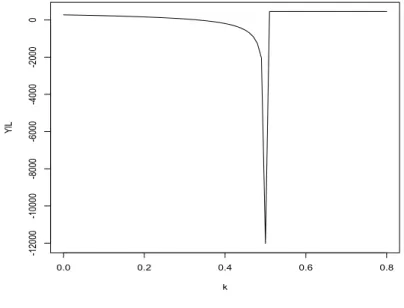
Some first simulations (figure 1) show that the cross-derivative of the net return function in-creases with and is very sensitive to distance costs. More specifically, figure 2 shows that corner solutions as suggested above, i.e. labor becoming unproductive in illegal harvesting due to distance costs, may arise very fast as distance costs increase. This result suggests that the two more likely situations are the ones in which factors are complement in the net return function, and the ones in which factor substitutability leads to corner solutions in which households focus on agriculture and abandon illegal harvesting.
3
REDD: addressing deforestation and forest degradation
Policies to reduce emissions from deforestation and forest degradation (REDD) normally deal with the two Ds separately as they are driven by different activities. We thus consider two policy instruments.
3.1 A PES scheme to avoid deforestation
To reduce deforestation, the government offers a Payment for Environmental Services (PES) to the households, so that they are compensated for reducing their agricultural expansion. We assume that the PES contract only focuses on agricultural expansion and does not consider illegal harvesting. Indeed, PES schemes are only likely to function or be implemented where property rights are in place and respected, and to focus on legal activities and not on the informal sector.
Figure 1: Production factors tend to be complement (substitute) when distance costs
are low (high)
0.0 0.2 0.4 0.6 0.8 -1 00 0 100 200 300 400 k Yl L Parameters: appendix 2
Figure 2: Corner solutions arise when distance costs are sufficiently high
0.0 0.2 0.4 0.6 0.8 -1 20 00 -1 00 00 -8 00 0 -6 00 0 -4 00 0 -2 00 0 0 k Yl L Parameters: appendix 2
We consider the following PES scheme. The regulator (government) has full information about the BAU level of deforestation LBAU. Estimating the accurate level of BAU level of deforestation is
a crucial matter per se, but that discussion is not the purpose of this paper (Angelsen (2008)). The household announces how much land it will convert LP ES. The payment to compensate avoided
deforestation is then simply proportional to the difference between the two variables: r(LBAU −
LP ES). r is the amount paid to the household per unit of land which is not deforested.6 We assume
perfect monitoring: the policy maker can check with certainty the actual deforestation rate, and agents do not cheat on the PES contract. An interesting extension would be to consider imperfect information about the BAU baseline, or in the monitoring of actual deforestation. Clearly, getting information on the BAU deforestation for individual households is a non-trivial task.
We do not discuss explicitly the price setting in the PES scheme, r, which is considered as given and constant. In reality, r could be calibrated based on different considerations. First, households may be retributed according to their opportunity costs. In this case, the policy maker, in order to minimize the cost of the policy, just ensures that households are just marginally better off with the policy than without it. Second, a fixed price may be offered to households, so that they reduce deforestation. In this case, households self select themselves: they accept the PES if and only if it makes them better off. Finally, the PES can be set in order to compensate for the value of the environmental service, e.g the carbon sequestered in non-deforested forests. Leplay et al. (2011) compare those different PES models for price setting, while Delacote et al. (2013) shows how the objective of the PES project manager influence the price setting.
3.2 Addressing illegal harvesting: improved control quality
We make the implicit assumption here that labor allocated to illegal harvesting tends to increase forest degradation, which may result in carbon emissions. This may be the case when fuelwood is over harvested. To reduce illegal harvesting, the government implements control on it. For example, households may be randomly inspected, and have to pay a fine if they are convicted of illegal harvesting. It follows that the household keeps the return from illegal harvesting only if it is not controlled and convicted. α is the exogenous conviction probability times the fine, which is proportional to the amount of illegal harvesting. The parameter then describes the control quality
6
Note here that the PES may become a tax if LP ES> LBAU, which is somehow contrary to the voluntary nature of PES schemes. However, this case should not happen in our model, since agents are necessarily better off decreasing their deforestation rates. At the extreme, they could choose LP ES= LBAU, and would get the same return as under
and can be seen as an indicator of institutional efficiency: a larger α corresponds to more effective institutions, while,for example, corrupted civil agents may be related to a low α. The policy maker may thus choose to invest resources in order to increase control efficiency α. Expected return from illegal harvesting is thus: (1 − α)H(l, L).
3.3 The household factor allocation with the REDD policy
The household’s maximization problem with the two REDD policies in place becomes: max
L,l Y(l, L) = A(l, L) + (1 − α)H(l, L) − cL + r(L
BAU − L) (8)
lP ES and LP ES are implicitly defined by the f.o.c:
Al = (1 − α)Il, (9)
AL+ (1 − α)HL = c + r (10)
Labor allocation is made so that marginal productivity of labor in agriculture equals expected marginal productivity of labor in illegal harvesting, factoring in the risk of being caught and fined. Land allocation is made to equalize the marginal productivity of agricultural land and marginal cost of land clearing plus the PES.
4
Direct and indirect impacts of the REDD policy
The policy maker has two policy choice variables: it can play on the value of the PES, by adjusting r; or it can increase the quality of control on illegal harvesting, by adjusting α. The first variable plays on the household’s land-use choice (equation 10), while the second variable plays on labor allocated to illegal harvesting (equation 9). However, both policy choice variables (r, α) have an indirect impact on the other household’s choice variable (lP ES, LP ES, respectively).
4.1 Direct impacts of the policy on deforestation and illegal harvesting
Comparing equation (3) and (10), we easily see that deforestation is smaller when the PES scheme is implemented than in the BAU case. We can infer more precisely the influence of the level of the payment r on deforestation by using the implicit function theorem:
∂LP ES
∂r =
1
ALL+ (1 − α)HLL
<0 (11)
The direct effect of the PES is straightforward: increasing the amount offered to household increases the opportunity cost of deforesting for the agents. The decrease in deforestation is larger
when the net return function is more concave in L, i.e if the marginal productivity of land decreases rapidly. This should be the case in places where land is of heterogenous quality. In contrast, deforestation would be less sensitive to the PES when land is of homogenous quality.
Second, it is also readily seen that increasing the quality of control on illegal harvesting will decrease labor allocated to the illegal activity:
∂lP ES
∂α =
Hl
All+ (1 − α)Hll
>0 (12)
Here again, the effect is clear-cut: if controlling illegal harvesting becomes more efficient, ex-pected return for the illegal activity decreases, which again decreases the incentive to allocate labor to that activity. Labor allocation to agriculture lP ESthus increases. We summarize these results as:
Proposition 2 : Increasing the payment for avoided deforestation will decrease deforestation,
while increasing the control quality decreases labor allocated to illegal harvesting and thereby forest degradation.
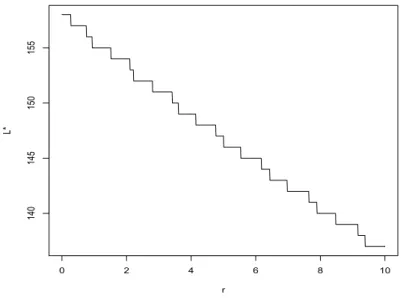
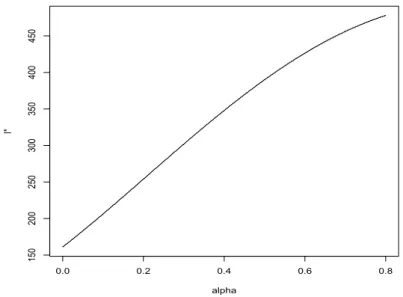
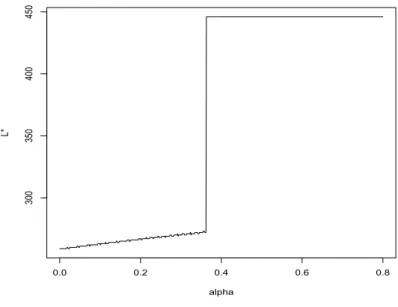
Our simulations focusing on distance costs give an illustration of proposition 2. Figures 3 and 4 show the direct influence of the PES on deforestation in the case in which factors are complement and substitute, respectively. Similarly, figures 5 and 6 illustrate the direct impact of improving control quality on illegal harvesting. Figure 6 also suggests that increasing the control quality rapidly brings corner solutions in the substitution case. Indeed, it is easy to see that α has a multiplicative effect on distance costs, and thus make corner solutions happen faster.
4.2 Indirect impacts of the policy on deforestation and illegal harvesting Both policy instruments have also an indirect effect, which needs to be factored in. PES has an influence on the land use choice, which has an influence on labor allocation. Similarly, the control efficiency has an influence on labor allocation, which has an influence on land use.
Considering the impact of the PES scheme on illegal harvesting is equivalent to considering the impact of the PES scheme on labor allocation. By reducing agricultural expansion, the PES scheme may lead either to intensified agricultural production, or to free some labor which is allocated to illegal harvesting, or a combination of the two. In the first case, more labor is required in agriculture, and less labor is available to illegal harvesting. In the second case, the PES scheme leads to a shift in labor allocation, from agriculture to illegal harvesting.
Figure 3: Increasing the PES decreases deforestation when production factors are com-plement 0 2 4 6 8 10 140 145 150 155 r L* Parameters: appendix 2
Figure 4: Increasing the PES decreases deforestation when production factors are
substitute 0 2 4 6 8 10 240 245 250 255 r L* Parameters: appendix 2
Figure 5: Increasing the control quality decreases illegal harvesting when production
factors are complement
0.0 0.2 0.4 0.6 0.8 150 200 250 300 350 400 450 alpha l* Parameters: appendix 2
Figure 6: Increasing the control quality decreases illegal harvesting when production
factors are substitute
0.0 0.2 0.4 0.6 0.8 440 460 480 500 alpha l* Parameters: appendix 2
The indirect impact of the PES on labor allocation can be expressed as follows: ∂lP ES ∂r = ∂lP ES ∂LP ES ∂LP ES ∂r = − AlL+ (1 − α)HlL All+ (1 − α)Hll 1 ALL+ (1 − α)HLL (13)
The second question is how a change in the quality of control on illegal harvesting will affect the level deforestation under the PES scheme. Using the implicit function theorem, we see that:
∂LP ES ∂α = ∂LP ES ∂lP ES ∂lP ES ∂α = − ALl+ (1 − α)HLl ALL+ (1 − α)HLL Hl All+ (1 − α)Hll (14) We see from equation (13) and (14) that the indirect effect of the PES depends on the cross derivative of the net returns of agriculture and illegal harvesting.
Proposition 3 :
• Increasing the Payment for Environmental Services indirectly increases (reduces) illegal harvesting if land and labor are complement (substitutes) in the net return function:
AlL+ (1 − α)HlL>0 (AlL+ (1 − α)HlL<0).
• Improving the control quality on illegal harvesting indirectly increases (decreases) de-forestation if land and labor are complements (substitutes) in the net return function:
AlL+ (1 − α)HlL>0 (AlL+ (1 − α)HlL<0).
• Increasing the PES tends to decrease illegal harvesting in cases in which the fields are far away from the main markets, or when slope and elevation are high . In contrast, if distance costs are low, the PES scheme then tends to increase illegal harvesting.
Proof: ∂L∂αP ES ≤0 and ∂lP ES∂r ≥0 ⇐⇒ AlL+ (1 − α)HlL≤0
A PES scheme will reduce the expansion of agricultural land. If land and labor are substitutes in the net return function, this reduction leads to agricultural labor being more productive. Thus, the households intensify agriculture (and thus reduce illegal harvesting) as a feedback of this reduced agricultural expansion. In contrast, if both factors are complement, the reduction in agricultural expansion reduces the marginal productivity of agricultural labor. The household thus decreases its use, leading to an increase of illegal harvesting.
Then strengthening the REDD policy (increasing the PES and the quality of illegal harvesting control) has win-win potential, i.e has positive feedbacks, when land and labor are substitutes in
Figure 7: Increasing the PES increases illegal harvesting when production factors are complement 0 2 4 6 8 10 154 155 156 157 158 159 160 161 r l* Parameters: appendix 2
agricultural production. In contrast, the feedback is negative of land and labor are complement in agricultural production.7
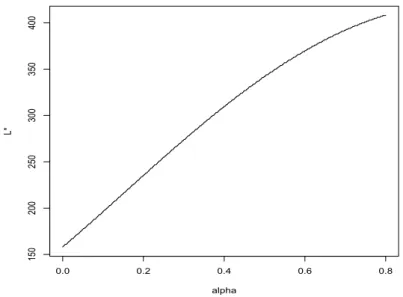
Figures 7 and 8 show his indirect effects of the PES and the control quality when factors are complements. In this case, one instrument focusing on one particular objective produces leakage toward the other one.
The results are a bit different when dealing with the case of substitutability. As mentioned before, corner solutions rapidly happen when production factors are substitutes. Indeed, distance costs rapidly imply that labor is fully unproductive in illegal harvesting. In this case, figure 9 shows that increasing the PES has at best a small effect on reducing illegal harvesting. Figure 10 shows that increasing α rapidly brings corner solution in which illegal harvesting is fully abandoned by the households. This imply an important increase in deforestation.
7
Forest products may have pretty inelastic demands in reality, as many of them are used for subsistence purpose. This inelastic demand may be related to an important concavity of the net return on illegal logging, which can tend to reduce the extend (but not the nature) of result of equations (10) and (11).
Figure 8: Increasing the control quality increases deforestation when production factors are complement 0.0 0.2 0.4 0.6 0.8 150 200 250 300 350 400 alpha L* Parameters: appendix 2
Figure 9: Increasing the PES decreases illegal harvesting when production factors are
substitute 0 2 4 6 8 10 424.0 424.2 424.4 424.6 424.8 425.0 r l* Parameters: appendix 2
Figure 10: Improving the control quality rapidly generates corner solutions when
fac-tors are substitutes
0.0 0.2 0.4 0.6 0.8 300 350 400 450 alpha L* Parameters: appendix 2
5
Conclusion
This paper has analyzed possible spillover effects between the D’s in REDD policies: How do PES schemes aiming to reduce agricultural expansion (deforestation) influence illegal harvesting of forest products (degradation)? How does better control of illegal harvesting impact deforestation? Our simple model demonstrates that the result depends on the nature of the relationship between land and labor. If land and agricultural labor are substitutes in the net return function, imple-menting PES presents policy makers with a win-win scenario: it directly slows down deforestation and indirectly decreases labor allocated to illegal harvesting. Similarly, improving the control qual-ity directly reduces labor allocated to illegal harvesting and indirectly decreases deforestation. If land and labor are complements, which may be a more reasonable empirical assumption, increasing the payment for avoided deforestation indirectly increases illegal harvesting, while increasing the quality of control indirectly increases deforestation.
Our results bring clear prediction when dealing with distance costs. Such costs may yield a win-win scenario even if we have technical complementarity between the factors in agricultural production. It then follows that win-win outcomes (both reduced deforestation and forest degra-dation) are more likely in regions with higher distance costs. Moreover, our simulations suggests
that sufficiently high level of distance costs generates corner solutions in which labor allocated to illegal harvesting is no longer productive. In this case, leakage between deforestation and illegal harvesting may no longer be a problem.
This result has several policy implications. First, our results bring a very practical conclusion that a real policy mix of resource preservation is necessary in places where production factors are complement. PES scheme should be combined with strengthening of the control quality, to reduce efficiently the feedback effects of the REDD policy. In particular, deforestation hotspots are likely to be in areas with high return to agricultural expansion, for example, caused by by low distance costs, and these are exactly the areas where we are likely to face a win-lose outcome if only one policy is pursued.
Second, the PES scheme could be more effective if focused on places where distance costs are high (described by our parameter k) in order to get win-win outcomes. Empirically, high distance costs may be associated with low opportunity costs of deforestation (e.g. through high remoteness and lack of access to markets). In those cases of low opportunity costs, the implementation of the PES scheme presents a win-win scenario.
Third, our simulations suggest it is less likely to have synergies when increasing the control quality on illegal harvesting, due to probable corner situations in which leakage between illegal harvesting and deforestation is important. This does not suggest that increased control should not be undertaken, but serves as a warning that win-win outcomes cannot readily be assumed.
Finally, our results hold when the households have constrained access to labor, which makes decisions on labor allocation to different activities inseparable. Increasing access to labor markets and development of attractive off-farm opportunities indeed disconnects the two activities and make the two decisions separable. Better labor market access can help to reduce those leakage situations. This result reinforces the intuition that providing better outside income generating options is a major challenge for REDD policies.
Appendix 1: general case and transport cost case
General Case Transport cost case Sign
H(l, L) I(l − l − kL) Hl −If <0 HL −kIf <0 Hll If f <0 HLL k2If f <0 HlL kIf f <0
Appendix 2: Value of the parameters of the simulation
Variable K 10499.25 β1 0.709 β2 0.087 β3 -0.1 β4 -0.098 β5 0.18 β6 -0.019 β7 -0.021 β8 -0.013 β9 0.047 cattle 2750 inputs 62436 Substitutability Complementarity k 0.1 0.01 c 100 100 l 500 500 z 10604.25 17848.73 σ 0.4 0.5
Substitutability Complementarity
Policy PES Control quality PES Control quality
Parameters r ∈[0, 10] r= 0 r ∈[0, 10] r= 0
α = 0 α ∈[0, 0.8] α= 0 α ∈[0, 0.8]
Deforestation ∈ [259, 240] ∈[259, 446] ∈ [158, 137] ∈[158, 408] Labor in illegal logging ∈[76, 75] ∈[76, 0] ∈ [339, 346] ∈[339, 22]
References
Amacher, G., Koskela, E., and Ollikainen, M. (2009). Deforestation and land use under insecure property rights. Environment and Development Economics, 14(03):281–303. 2
Angelsen, A. (1999). Agricultural expansion and deforestation: modelling the impact of population, market forces and property rights. Journal of Development Economics, 58(1):185–218. 2.2 Angelsen, A. (2008). How do we set the reference levels for REDD payments? In Angelsen,
A., editor, Moving ahead with REDD: Issues, options and implications. Centre for International Forestry Research (CIFOR). 3.1
Angelsen, A. (2009). Realising REDD: National Strategies and Policy Options. Center for Interna-tional Forestry Research (CIFOR). 1
Angelsen, A. and Wunder, S. (2003). Exploring the forest-poverty link. Technical report. CIFOR Occasional Paper n40. 2.2
Baland, J. and Francois, P. (2005). Commons as insurance and the welfare impact of privatization.
Journal of Public Economics, 89(2-3):211–231. 2
Busch, J., Strassburg, B., Cattaneo, A., Lubowski, R., Bruner, A., Rice, R., Creed, A., Ashton, R., and Boltz, F. (2009). Comparing climate and cost impacts of reference levels for reducing emissions from deforestation. Environmental Research Letters, 4(4):044006. 4
Delacote, P. (2007). Agricultural expansion, forest products as safety nets and deforestation.
En-vironment and Development Economics, 12(02):235–249. 1, 3
Delacote, P. (2009). Commons as insurance: safety nets or poverty traps? Environment and
Delacote, P., Palmer, C., Baakegaard, R., and Thorsen, B. (2013). Unveiling information on opportunity costs in redd: who obtains the surplus when policy objectives differ? Resource and
Energy Economics, forthcoming. 3.1
Godoy, R.and O’Neill, K., Groff, S., Kostishack, P., Cubas, A., Demmer, J., McSweeney, K., Overman, J., Wilkie, D., Brokaw, N., and Martinez, M. (1997). Household determinants of deforestation by amerindians in honduras. World Development, 25(6):977–987. 1
IPCC (2007). Fourth Assessment Report: Climate Change 2007: The AR4 Synthesis Report. Geneva: IPCC. 1
Leplay, S., Busch, J., Delacote, P., and Thoyer, S. (2011). Implementation of national and in-ternational redd mechanism under alternative payments for environemtal services: theory and illustration from sumatra. Working papers, LAMETA, Universtiy of Montpellier. 3.1
Marchand, S. (2012). The relationship between technical efficiency in agriculture and deforestation in the brazilian amazon. Ecological Economics, 77(0):166 – 175. 2.2
MeridianInstitute (2011). Guidelines for REDD+ Reference Levels: Principles and
Recommenda-tions. Government of Norway. 4
Pattanayak, S. and Sills, E. (2001). Do tropical forests provide natural insurance? the microe-conommics of non-timber forest product collection in the brazilian amazon. Land Economics, 77(4):595–612. 1
R Development Core Team (2012). R: A Language and Environment for Statistical Computing. R Foundation for Statistical Computing, Vienna, Austria. ISBN 3-900051-07-0. 5
Robinson, E. J. Z., Albers, H. J., and Williams, J. C. (2011). Sizing reserves within a landscape: The roles of villagers? reactions and the ecological-socioeconomic setting. Land Economics, 87(2):233–249. 2.2
Robinson, E. J. Z., Williams, J. C., and Albers, H. J. (2002). The influence of markets and policy on spatial patterns of non-timber forest product extraction. Land Economics, 78(2):260–271. 2.2 Rudel, T. (2007). Changing agents of deforestation: From state-initiated to enterprise driven
processes, 1970-2000. Land Use Policy, 24. 1
Wunder, S. (2001). Poverty alleviation and tropical forests: What scope for synergies? World
Wunder, S. (2005). Payments for environmental services: some nuts and bolts. Center for Interna-tional Forestry Research, Bogor. 1
Wunder, S. (2008). Moving ahead with REDD: Issues, options and implications, chapter How do we deal with leakage?, page 65. CIFOR. 1
Les Cahiers de la Chaire Economie du Climat
n° 2013-11
Working Paper Series
Contact us :
Chaire Economie du Climat - Palais Brongniart (4e étage) 28 Place de la Bourse, 75 002 Paris
Tel : +33 (0)1 73 01 93 31
Email : [email protected] Working Papers Publication Director: Pierre-André Jouvet
Les opinions exposées ici n’engagent que les auteurs. Ceux-ci assument la responsabilité de toute erreur ou omission
n° 2013-04 Modeling of Emission Allowance Markets: A Literature Review
By Vincent Bertrand
n° 2013-05 EU ETS Phase 3 benchmarks: Implications and potential flaws
By Stephen Lecourt
n° 2013-06 Switching to biomass co-firing in European coal power plants: Estimating
the biomass and CO2 breakeven prices
By Vincent Bertrand
n° 2013-07 Governance of CO2 markets: Lessons from the EU ETS
By Christian de Perthuis and Raphael Trotignon
n° 2013-08 A stochastic generalized Nash-Cournot model for the northwestern
European natural gas markets: The S-GaMMES model By Ibrahim Abada and Pierre-André Jouvet
n° 2013-09 Carbon and energy prices under uncertainty: A theoretical analysis of fuel
switching with non-equally efficient power plants By Vincent Bertrand
n° 2013-10 Greenhouse gas mitigation in Chinese agriculture: distinguishing technical
and economic potentials
By Wen Wang, Frank Koslowski, Dominic Moran, Dali Rani Nayak, Eli Saetnan, Erda Lin, Liping Guo, Guodong Han and Xiaotang Jug
n° 2013-11 Reducing deforestation and forest degradation: leakage or synergy?