Does Inter-Market Competition Lead to Less Regulation?
Sarah Draus1 January 2010
Abstract
This paper presents a model to analyze the consequences of competition in order-flow between a profit maximizing stock exchange and an alternative trading platform on the decisions concerning trading fees and listing requirements. Listing requirements, set by the exchange, provide public information on listed firms and contribute to a better liquidity on all trading venues. It is sometimes asserted that competition induces the exchange to lower its level of listing standards compared to a situation in which it is a monopolist, because the trading platform can free-ride on this regulatory activity and compete more aggressively on trading fees. The present analysis shows that this is not always true and depends on the existence and size of gains related to multi market trading. These gains relax competition on trading fees. The higher these gains are, the more the exchange can increase its revenue from listing and trading when it raises its listing standards. For large enough gains from multi-market trading, the exchange is not induced to lower the level of listing standards when a competing trading platform appears. As a second result, this analysis also reveals a cross - subsidization effect between the listing and the trading activity when listing is not competitive. This model yields implications about the fee structures on stock markets, the regulation of listings and the social optimality of competition for volume.
Keywords: competition in order flow, fragmentation, listing requirements, stock exchanges JEL classification: G10, G18, G12
1
Université Paris-Dauphine, DRM Finance; Place du Maréchal de Lattre de Tassigny, 75775 Paris Cedex 16, France; [email protected]
This paper is a part of my PhD research under the supervision of Prof. Jacques Hamon. I would like to thank him for his invaluable help and support throughout the preparation of this doctoral thesis. Furthermore, I am particularly grateful to Gilles Chemla, Thierry Foucault, Denis Gromb, Terrence Hendershott and Ernst Maug for very helpful feedback and suggestions, and to Jungsuk Han, Carmen Stefanescu and Anis Samet for helpful discussions. Discussions with seminar participants at Dauphine Recherches en Management-Finance (June 2009), the EFMA Annual Meeting (June 2009), the NFA Conference (September 2009), the FMA Annual Meeting (October 2009) and at the Research Seminar Financial Markets at the University of Mannheim (December 2009) have also contributed to the development of this paper.
1. Introduction
This paper explores how multi-market trading affects the optimal decision of a profit maximizing exchange on listing requirements in connection with trading fees and listing fees. Over the last two decades exchanges have increasingly been transformed into demutualised and listed firms the decisions of which are based on the principle of profit maximization. Many of them have retained or acquired discretion on listing requirements. Furthermore, alternative trading systems have emerged since the 1970’s in the US but very recently in Europe, and compete for volume with “traditional” stock markets without listing firms themselves.2 The changes in the competitive environment and the objective of profit maximization are sometimes seen as factors inducing stock markets to reduce their level of regulation and to deteriorate thereby the quality of markets.
In this paper, a model is established to analyze whether competition for order flow between a “traditional” stock exchange and an alternative trading platform leads to a lower level of listing requirements compared to a situation in which the stock exchange is a monopoly. The specific questions addressed are the following: Where do the gains and losses related to listing requirements come from? Why does a profit maximizing stock exchange regulate listing at all? How are the listing and trading activities linked? How is the equilibrium level of listing requirements related to the strength of competition for order-flow? Finally, which welfare effects are related to the existence of an alternative trading platform?
If an exchange regulates listings, competing trading platforms can free ride on this regulatory activity while offering more advantageous trading conditions. The exchange, which does not internalize the profit of trading platforms and faces competition on trading fees, might be induced to reduce the level of listing requirements when a trading platform appears. The results of the present analysis show that this is not necessarily the case. Competition for order-flow reduces the trading costs borne by investors due either to smaller trading fees or to a smaller price impact. This, in turn, induces the listing firm to issue more shares on the exchange. Not only does competition alter the distribution of volume, it also increases the total volume and contributes to raising the listing fee the exchange can charge. These effects might increase the marginal gain the exchange obtains from raising listing standards and might lead to a higher equilibrium level of listing requirements than the one that obtains in a monopoly situation. Such an equilibrium occurs when investors have strong
2
These alternative trading systems are for instance electronic order books such as Chi-X or Island which offer to organise trading in the shares of large firms listed on stock exchanges.
incentives to split their orders across the two trading venues, in which case competition for order-flow is weak. This finding is in contrast to what the free-rider logic suggests.
The model developed in this paper is based on the following assumptions: The owner of a firm with a value unknown to market participants lists the firm on a stock exchange to sell a fraction of his shares to outside investors. At a later period, these investors might trade and can do so on a stock exchange or on an alternative trading platform. On both venues, they trade with a risk averse market maker, which creates a price impact corresponding to the risk premium of the market makers. Risk aversion ensures the absorption capacity of both markets is limited, which is crucial in the model. At the IPO stage, the investors discount the IPO price they are willing to pay by their expected trading costs. The listed firm must commit to listing requirements that oblige the firm to disclose noisy information about its productivity after it undertook the IPO, and to thereby reduce information asymmetry on the secondary market. Complying with listing requirements is costly for the firm. Both trading venues charge a fee per traded share and determine this fee simultaneously to maximize their respective profits. In addition, the exchange charges a listing fee which is proportional to the surplus net of costs that the owner of the firm earns by undertaking the listing. The exchange determines the level of listing requirements to maximize its profit.
Consider first an exchange which is a monopoly, both in listing and in trading. Higher listing requirements reduce the trading costs that investors expect to incur. This translates into a higher IPO price inducing the owner of the firm to sell more shares, to the extent that the gain from smaller trading costs is not offset by the additional compliance costs. In this case, his surplus also increases. As a consequence, the exchange benefits from a higher level of listing requirements both through a larger income from trading and through a larger income from listing. The optimal level of listing requirements is reached when the marginal increase in compliance costs offsets these marginal gains.
In the case in which a trading platform competes for volume with the exchange, both the pressure this competition induces on the trading fees, and the smaller price impact investors can obtain due to multi-market trading, increase the IPO price. This leads to a higher number of issued shares and thus a higher volume on the secondary market as well as a higher surplus for the initial owner of the firm. In this situation, an increase in the level of listing requirements has two effects: it reduces the size of the price impact faced by investors on both trading venues intensifying thereby competition on trading fees, and it reduces overall trading costs leading to a higher number of issued shares and thus to an increase in the total volume and in the revenue from listing. When the competition effect on trading fees dominates, the
trading revenue of the exchange decreases the higher the level of listing requirements is and its marginal gain from increasing listing standards is smaller than in the monopoly case. The level of listing requirements is smaller in equilibrium. If, in contrast, competition on trading fees is weak, the marginal revenue that the exchange obtains from raising the listing standards is larger than in the monopoly situation even though the exchange loses a fraction of the volume. This is due to the possibility to set a higher trading fee and occurs when the price impact faced by investors is large (i.e. when the incentive to trade on both venues is strong). As a consequence the exchange is induced to increase the level of listing requirements compared to the monopoly situation.
The main contribution of this paper is to show that the effect of competition for trading volume on the regulatory activity of a self-regulating exchange regarding listings depends on whether competition is mainly driven by trading fees or by gains related to the fragmentation of order-flow. In the academic literature there is a controversial debate about the reasons for order-flow fragmentation and its consequences on market quality.3 The present analysis shows that uncovering the reasons for fragmentation of order flow is essential for the assessment of the consequence of competition in volume on the regulatory activity of a “traditional” stock exchange. The existing literature also mainly focuses on the consequences of multi-market trading on the behavior of traders and considers stock exchanges as given institutions. The present paper pushes the analysis further by considering the impact of multi-market trading on the decisions of stock multi-markets.
Listing requirements affect the utility of investors and the profit of additional trading venues. If they are determined by the exchange, they are sub-optimal from a social point of view since the exchange bears a part of the regulatory costs but internalizes neither the changes in the utility of investors nor the gains of the trading platform. The problem of non internalized benefits related to listing requirements can be solved partially by merging the exchange with the trading platform: While the extent to which regulation is sub-optimal becomes smaller due to the merger, the merged entity increases the trading fee due to the lack of competition. Also, the decision about the level of listing requirements depends again on the factors driving order-flow fragmentation.
As a second result, this paper reveals the existence of a cross-subsidization effect between the listing and the trading activities. Smaller trading fees increase the surplus of the owner of the firm and lead thereby to an increase in the listing fee. The equilibrium trading
3
See Pagano (1989b), Gajewski and Gresse (2007), Foucault and Menkveld (2008), O’Hara and Ye (2009), Chowdry and Nanda (1991), Madhavan (1995), Foucault and Gehrig (2008)
fee is lower than whithout income from listing. In the case of competition for volume, this effect triggers price competition between the trading venues. Consequently, the association of listing and trading in one profit maximising entity leads to smaller average trading costs as compared to a case in which listing and trading are separated.
One way which has been proposed to mitigate the supposed problem of under-regulation related to competition in volume consists of separating listing from trading completely so that exchanges only provide liquidity but have no discretion on listings (Macey and O’Hara 2005). Many other reasons might also justify a separation of these functions.4
The economic objectives of the listing and trading functions can be achieved through different organisational settings, including settings, in which they are carried out by different independent organisations. However, the present analysis shows that bundling the listing and trading functions on one single exchange or separating them into several independent organisations has substantial impacts on the price structure of the services provided in relation to these functions.
These findings are of particular interest when considering the recent evolution in the stock market industry. The demutualisation process of stock exchanges has brought about changes in the competency of some stock exchanges regarding listing conditions. While some exchanges have lost discretion on listings, others have kept or even acquired the right to regulate listings autonomously.5 The variety of existing organisational models shows that there is no consensus among policy makers regarding self regulatory competencies of exchanges. These developments have triggered a debate in the professional and the legal academic literature about whether stock exchanges should continue to regulate listings. 6 The reasons mentioned in favor or against regulation of listings by stock exchanges are based on arguments developed in the literature on self-regulatory organizations.7 They are related, among other things, to the incompatibility of listing regulation with the objective of profit
4
Other reasons are related to the existence of conflicts of interests, anti-competitive behaviour, the lack of incentives to enforce listing requirements as well as the rise of other institutions which compete with exchanges in different services and might be more efficient than exchanges. See Fleckner (2006), Lee (2002), Macey and O’Hara (2002, 2005), Macey et al. (2005).
5
Firms wishing to trade on the London Stock Exchange and the Hong Kong Stock Exchange need first to be listed by the respective independent authority, the Financial Services Authority and the Securities and Futures Commission. Euronext has remained self-regulating while Deutsche Börse has acquired the right to determine listing rules in 2002. The NYSE has separated the entire regulatory activity from other operations. This activity is now carried out by a separate entity.
6 Fleckner (2006), Macey and O’Hara (2005), Macey and O’Hara (2002),, Lee (2002), Steil (2002), Centre for
financial market integrity (2007), OICV – IOSCO Consultation Report (2006) 7 See for instance DeMarzo et al. (2005)
maximization or to the necessity to sustain the confidence of investors specifically in a competitive environment.
While the debate about regulatory competencies of stock markets is strong in the legal literature, only a small number of studies in economics and finance analyze the economic rationales behind choices of self-regulating and profit-maximizing exchanges. Chemmanur and Fulghieri (2006) analyze how profit maximizing exchanges set optimal listing requirements and suggest that exchanges are induced to set a high level of listing requirements because this allows them to build and to sustain a good reputation. In Chemmanur and Fulghieri’s model listing requirements refer to the efficiency with which the exchange selects the firms it lists. In the present paper, in contrast, listing requirements constitute a commitment of the firm to reveal information. Also, the authors only consider competition in listings and trading does not occur, while the present study analyses both listing and trading.
Competition in trading in relation with disclosure requirements is addressed in Huddart et al. (1999). In their model, managers who list their firms also possess private information which they want to exploit by trading their shares. Liquidity concentrates on the exchange with the highest disclosure standards due to smaller adverse selection costs. Managers prefer to list their firms on this exchange although they cannot exploit their private information. This induces exchanges competing for listings and for trading volume to set high levels of listing requirements and to “race to the top”. The present paper displays major differences compared to Huddart et al. (1999). While in Huddart et al. liquidity concentrates on one exchange, the present paper allows for endogenous fragmentation of volume. Also, exchanges in Huddart et al. maximize only volume. In the present paper, the exchange obtains revenue from both, listing and trading, and the alternative trading platform has revenue only from trading. Therefore, the model presented in this paper is more realistic in that it considers the decisions of trading venues also on listing and trading fees and not only on volume.
This paper also relates to literature dealing with the price structure on stock markets. The linkage between listing and trading fees is studied in Foucault and Parlour (2004). The authors show that where firms differ in productivity, highly productive firms prefer to list on an exchange with a high listing fee and a small trading fee while firms with a low productivity have the reverse preference. This is because highly productive firms issue a higher number of shares. They need to attract investors with a shorter expected horizon, and are therefore more sensitive to the level of trading costs. In Foucault and Parlour (2004), two competing exchanges differentiate in trading and in listing fees and the equilibrium structure of these
fees depends on the profile of the firms which the exchanges attract as clientele: An exchange listing firms with a high productivity will set a high listing fee and a small trading fee in equilibrium. While competition for volume affects the price structure, the authors consider in particular the listing decisions of firms and assume that the shares are traded on the exchange on which the firms are listed. In addition, the authors do not analyze listing requirements.
The article proceeds as follows. Section 2 sets out the model. Section 3 analyses the trading round and the IPO stage. Section 4 analyses of the decisions of a monopoly exchange on the trading fee and the level of listing requirements as a benchmark case. Section 5 carries out the analysis of competition for volume. Section 6 extends the analysis by considering the social desirability of competition in volume, the social optimality of listing requirements when they are privately determined by a stock market and the influence of differently informed investor bases on the main result. Section 7 presents the implications of the analysis developed in the previous sections and formulates conclusions. Proofs are given in the appendix.
2. Model
The game is organized in six stages. Time is not discounted. There is a firm initially entirely owned by a private financier (a venture capitalist for example) who is called “the owner” in what follows. The owner sells a fraction of his shares to two large outside investors by listing the firm on a stock exchange. At a later period, these investors can be hit by a liquidity shock or observe private information about the firm. They can trade their shares on the stock exchange or on an alternative trading platform. Trading is intermediated by competitive market makers. All agents are risk neutral except the owner and the market makers who are risk averse.
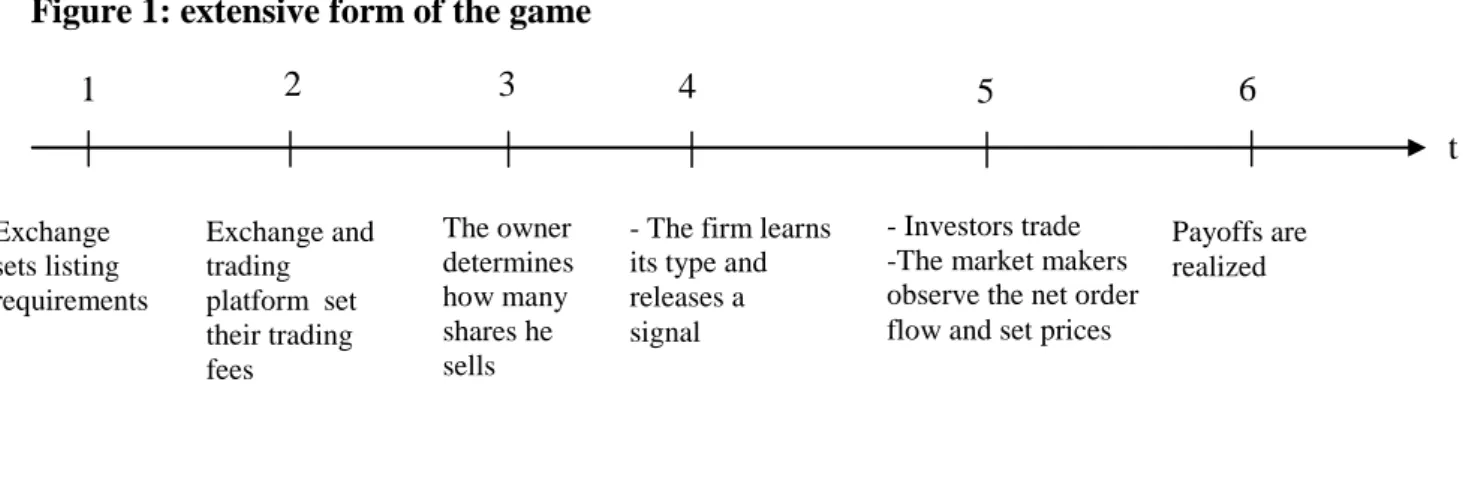
The timing of the model is illustrated in figure 1. In the two first stages, the exchange determines its listing and trading conditions. First, it sets a level of listing requirements. This decision is considered as a long term decision since it implies the setting up of particular listing procedures as well as of specialized departments to enforce these requirements.8 Second, the exchange sets the trading fee. This decision is considered as short term decisions since fees can be changed quickly.9 At the third stage, the owner of the firm determines how
8
Listing requirements can also contribute to the reputation of the exchange (Chemmanur and Fulghieri (2006))and are therefore taken in a long term perspective.
9 Foucault and Parlour (2004) analyze the decisions of exchanges on listing fees and trading technologies sequentially. Competition in listing fees represents short run competition and occurs in the second stage of their model while competition in trading technologies represents long run competition and occurs at the first stage.
many shares to sell to the outside investors. At this stage, the future cash flows of the firm are unknown to all agents. At the fourth stage, the firm learns the value of future cash flows. To comply with listing requirements the firm releases a noisy signal about its value. At the fifth date, one of both investors might be hit by a liquidity shock and might sell his entire holding. The other investor might observe perfectly the value of the future cash flows of the firm and might trade to exploit this information. Finally payoffs are realized. The equilibrium concept is sub-game perfection. The model is solved by backward induction.
Figure 1: extensive form of the game
2.1. The firm
We consider a firm with assets in place. Initially, the firm is completely owned by a private financier or an entrepreneur who has invested an amount K in the firm at an earlier stage not analyzed explicitly in this model. We assume that the owner holds Kshares which he has bought for 1 monetary unit each.10 This normalization allows reasoning in number of shares, which reduces considerably the complexity of the analysis. The firm realizes a project which yields a payoff of V 1x per monetary unit invested by the owner, and thus per share, where x is a random variable taking two equally likely values: x andh x with l
0
l
h x
x . Shares are divisible so that fractions of a share can be traded.
The owner of the firm is characterized by a mean variance utility, U . At t3he lists the firm on the exchange and sells a fraction,
0,1 , of his shares to outside investors at the share price, PIPO.11 He determines the fraction of shares to be sold to maximize his utility:
10
A similar normalization is used in Foucault and Parlour (2004), where investors can buy shares for 1 monetary unit.
11 Here, the possibility to diversify risk is the reason why the owner lists his firm and sells shares. However, the entire analysis would also hold in a setting in which the firm sells shares to realize a new project and determines the number of shares sold to maximize its proceeds from the IPO.
1 5 t 2 3 4 Exchange sets listing requirements Exchange and trading platform set their trading fees The owner determines how many shares he sells
- The firm learns its type and releases a signal
- Investors trade -The market makers observe the net order flow and set prices
6
Payoffs are realized
2 2 2 ) 1 ( 2 ) 1 ( V IPO KEV K KP Max , (1)where measures his risk aversion, E
V is the expected payoff per share and2 2 ) ( 25 . 0 h l V x x
is the variance of the value. The utility of the owner if he does not sell shares is:
2 2 2 K V V KE U (2)The surplus he obtains when he lists the firm and sells a fraction of his shares, is:
U U
U
() () (3)
At the time of listing, x is unknown to all agents. Therefore, the listing decision alone
does not convey information about the quality of the firm to the market.12 The firm learns the value of the project after the shares are floated but before trading takes place. However, it cannot credibly convey this information to market participants. It remains its private information. This hypothesis is necessary, because the model relies on the existence of information asymmetry.
2.2. The stock market industry
We assume that there is a stock market listing the firm and organizing trading in the shares. It is a monopolist in listing. There is also a trading platform which does not operate listings but offers only to trade the shares of the firm listed on the exchange. In what follows, the stock market operating listings is called “the exchange” whereas the market operating only trading in the listed shares is called “the trading platform”. All variables related to the exchange have a subscripte , and those related to the trading platform have a subscriptpl.
The exchange sets listing requirements, which are a set of rules to which the listed firm must adhere. These rules contain accounting and reporting standards but also corporate governance mechanisms which, if in place, reveal information about the value of the firm. Listing requirements lead to a noisy public signal, s, about the value of the firm, which is
12
In a different set up in which the firm knows its type before it takes the decision to list, Stoughton et al. (2001) show the existence of separating equilibria in which only good firms list and reveal perfectly their type. The results in this paper rely on the existence of information asymmetry and would also hold if listing were informative as long as the type of the firm is not revealed perfectly. Similarly, a noisy signal at the IPO about the type of the firm would not change the results.
observed by all market participants. The observed signal corresponds to the true value with probability
0.5,1
; it corresponds to the wrong value otherwise. The precision of the signal, , represents the strictness of listing requirements: the more stringent they are, the higher is the probability to observe the true value of the firm. The signal is expected to take either value, x or h x , with a probability of ½. The listed firm bears compliance costs when it lreleases the required information: C() with C'0 and C ''0.
Both trading venues charge a trading fee per share traded on the secondary market, f e
and f .pl 13 The exchange also charges a listing fee, F, paid by the owner of the firm when he lists the firm. We assume that the listing fee is the outcome of some exogenous bargaining between the owner of the firm and the exchange. It is a fraction,
0,1 , of the owner’s surplus net of compliance costs.14 Since the owner holds (1)of the shares, he anticipates that his final total payoff is reduced by the same fraction of compliance costs. The listing fee is:
() (1 ) ()
U C
F (4)
This assumption is important for what follows, it is hinged upon the assumption that listing is not competitive. Some observations might justify this. First, competition for listings on an international level seems to be limited to a small number of firms. Also, these firms prefer to cross-list rather than to do an IPO directly on a foreign exchange.15 Second, on a regional or national level, exchanges competing for listings are rare when we look outside the US.16 From a practical point of view, some exchanges discriminate through prices with a listing fee schedule depending for instance on the market value or on the number of shares of firms. Other exchanges impose fixed listing fees, independent of the size of firms. 17 The results of
13 The structure of trading fees differs among stock exchanges. Many charge fees that are proportional to the value traded. However, some also charge fees per order or per share. The assumption made here, that trading fees are proportional to the number of traded shares and not to the transaction value keeps the analysis tractable. 14 If the firm had no bargaining power, the exchange would charge the entire surplus of the owner.
15Some Israeli high-tech firms listed directly in the US instead of on their home market (Blass & Yafeh (2001)). This however, constitutes an exception. See Karolyi (2006) for an overview of the literature on cross-listings. 16
As an example, there are only two German firms cross-listed on the European regulated markets operated by the group NYSE Euronext and two French firms cross-listed on the regulated market of Deutsche Börse.
17 The NYSE, for instance, charges a listing fee which is proportional to the number of issued shares (see the Listed Company Manual, www.nyse.com). Deutsche Börse imposes a fixed annual fee which is independent of the size of listed firms or of the number of shares issued (see http://deutsche-boerse.com).
this model hold with different fee structures, as long as the revenue that the exchange obtains from listing depends on the listing or share issue decisions of the firm.
The level of listing requirements, , and the trading fees are determined by the exchange and by the trading platform to maximize their respective expected profit. As stock markets are increasingly transformed into demutualised and listed entities, the objective of profit maximization seems relevant.
2.3. Investors
Two large investors participate in the IPO of the firm. Each of them buys half of the offered shares. At t5, one of both investors suffers a liquidity shock (henceforth the “liquidity trader”). With probability ½ this investor must sell his entire holding at this stage. Otherwise he does not trade.18 At the same time, the other investor observes the true value of the firm with probability 1 and trades to exploit this information (henceforth the “informed trader”). At the IPO (in t3), the investors do not know their type. They expect to become a liquidity trader with probability .
Both investors can trade on the exchange and on the trading platform. On both trading venues, they trade with a competitive market maker characterized by a mean-variance utility. Market makers do not pay trading fees. This assumption is consistent with the current policy of many trading venues to impose reduced trading fees, or not to impose trading fees on liquidity suppliers.19 The market makers determine the bid price they are willing to pay for a given number of shares according to the public signal and to the total order-flow they observe. They equalize the transaction price to the utility they obtain from trading in the shares of the firm. The bid price for a total order-flowQ, PB(Q), and given signal, s, is determined as follows:
Vs Q
QVar
Vs Q
E Q PB , 2 , ) ( , (5)where measures the risk aversion of the market maker, E
Vs,Q
and Var
Vs,Q
are the expected value of a share and the variance of the value respectively, both conditional on the18 This assumption that the liquidity trader does not trade with probability ½ is made for simplicity. The model also holds if the liquidity trader sold a different number of shares.
19
If market makers paid trading fees, they would pass it through to the transaction price and these fees would eventually be borne by investors. The results of the analysis would not change qualitatively in such a case.
public signal and on the observed total order-flow. If the market makers buy shares, the bid price at which investors can sell these shares decreases with the number of traded shares, unless the market makers can infer the true value of the firm from the order-flow or the signal. The risk aversion of market makers represents the limited absorption capacity on both trading venues (on the secondary market of the exchange and on the trading platform) which is crucial for the model.20
The possible price impact might induce investors to split their orders across the two trading venues. Investors execute a fraction of their order on the trading platform. They determine to maximise the proceeds they obtain from trading. The public signal released by the firm is observed on both trading venues. As a consequence, the price obtained by investors on the trading venues differs only in the price impact if the submitted orders are of a different size. The trading venues only differ in trading fees. Orders are submitted to minimize the costs stemming from the expected price impact and from the trading fees. For a quantity Q sold by investors, the objective function is:
( (1 ) ) 2 ) 1 ( 2 2 f f QVarV s Min pl e (6)where represents the probability that the market maker does not infer the true value of the firm given signal s, and Var
Vs (1)(xhxl)2is the variance of the value given the public signal.3. Trading and IPO
Trading price. This sub-section examines how the price is set in t5. The precision of the public signal released by the firm prior to the trading round indicates not only the possible value of the asset, but also the probability with which the informed trader has the same information as the one observed by the other market participants. If the market maker has observed a good signal (x ), he knows that the signal is correct with probabilityh . Thus, with probability the informed trader also knows that the firm has a high value. If the market
20 Assuming risk averse market makers is a simple way of modelling the fact that large orders cannot be traded without a price impact. However, the results presented in this paper should also hold in a setting in which the price impact is generated through another mechanism. Thus, it is not the risk aversion of market makers per se, but its consequence on prices which is important here.
maker has observed a bad signal (x ), he knows that it is correct with probabilityl . Thus, with probability the informed trader also knows that the firm has a low value.
The informed trader always imitates the liquidity trader and sells his entire holding, K
5 .
0 , if he trades. He also splits his order across the two trading venues in the same way as the liquidity trader to remain hidden. If the informed trader submits orders of different quantities to the market makers, he is recognized and cannot benefit from his private information. The market makers on both trading venues face a signal extraction problem. Consider the market maker on the exchange (the logic is identical for the market maker on the trading platform). A total net order flow of (1)0.5K is obtained if the informed investor knows that the firm has a high value. In this case, the order-flow stems from the liquidity trader. The same net order-flow is obtained when the liquidity trader does not trade and the strategic trader knows that the firm has a low value. Since the market maker cannot infer the quality of the firm from the order flow in these situations, he bears a risk from holding the shares. He sets the price equal to the expected value per share minus his risk premium per share conditional on the public signal:
V s KVar s V E PB (1 )0.5 * 2 ) ( (7)If the firm has a low value and the liquidity trader trades, the market maker observes a net order flow of (1)*K and infers from this observation that the firm is bad. If the firm has a high value and the liquidity trader does not trade, there is no trading volume.
The price, at which the liquidity trader expects to sell his shares in the case of a liquidity shock, is below the expected value of the asset, since the market maker bears a risk premium when information remains asymmetric, and he takes into account the possibility of informed trading. The expectation of the bid price on the exchange over the signal and the probability of informed trading is the expected value of the shares reduced by a spread composed of a information component, S, and the risk premium of the market maker,
e Q RP :
PB E V S RP Qe E 2 1 ) ( (8)where S(1)(xhxl), RP Var
Vs 2
and Qe (1)0.5K. See appendix A1 for the derivation of equation 8. The expected bid price on the trading platform is similar and differs only in the price impact related to the risk aversion of the market maker which is determined
by Qpl K * 5 . 0
. The expected value of the asset is discounted by the adverse selection costs, S, borne by the liquidity investor which accounts for the presence of the informed trader on the market. A more volatile asset leads to a less accurate price on average. A more precise signal reduces the information gap between the market maker and the informed trader, which reduces the adverse selection cost. The signal precision also determines the uncertainty about the value of the asset and thus the risk premium of the market maker. More precise information reduces the conditional variance of the payoff and thereby the risk premium and the price impact. It follows that a higher level of listing requirements improves the liquidity by reducing the adverse selection costs and the price impact borne by the liquidity trader.
When 1, uncertainty about the firm is completely removed and investors expect to sell their shares at the true value. The spread is zero. If 0.5, the public signal is completely uninformative. The spread is at its highest value.
Fragmentation. When 0and 1, investors expect to bear a price impact due to the limited absorption capacity of the trading venues. This might induce them to split their orders across the two trading venues. If the order-flow is fragmented, each market maker buys a smaller amount of shares and the total price impact faced by investors is smaller compared to the situation in which the entire flow is directed to only one trading venue.21 When investors split their order between the exchange and the trading platform, they trade-off the gain in the price impact against a possibly higher cost due to different trading fees. For given trading fees and a given total quantity of shares sold by investors, Q, the optimal fraction of volume executed on the trading platform is:
Q RP f fe pl 2 2 1 * (9)
21 The possibility to reduce the price impact by splitting orders across several market makers (or markets) grounds also the models in Bernhardt and Hughson (1997) and Chowdry and Nanda (1991). However, utility gains from the possibility to trade on several venues can also stem from the possibility to avoid queuing in an order book and to increase the execution probability of a limit order (Foucault and Menkveld (2008)). Theoretical and empirical research displays mixed results concerning the existence of such gains. However, recent empirical work (O-Hara and Ye (2009), Foucault and Menkveld (2008)) find evidence consistent with the existence of liquidity gains associated to fragmentation.
If the trading fees are identical on both trading venues, investors execute half of their order on each trading venue. If trading fees differ, investors execute the larger part of their order on the cheaper trading venue. The higher the risk aversion of the market makers, , the larger the gain investors obtain from splitting their orders. Therefore, a higher makes investors less sensitive to the difference in trading fees and to changes in trading fees. If there is no price impact, 0, there is no reason for investors to split their order. They trade on the trading venue with the lowest trading fee. Similarly, a high precision of public information reduces the price impact on both the exchange and the platform, and reduces the incentive of investors to split their order-flow. When information is perfectly revealed ( 1), they also trade only on the cheapest venue.
The risk aversion parameter determines the strength of competition between the two trading venues. The smaller is, the tougher is competition in trading fees since the distribution of the volume across both trading venues is more sensitive to differences in trading fees. Investors gain less from splitting their orders. In contrast, a large stands for weak competition in trading fees because the incentive of investors to split their order is strong. This parameter can be compared to the transportation cost in the Hotelling (1929) model in that it determines the degree of price competition between the two trading venues.
IPO. At the IPO stage, both investors anticipate that they might be either a liquidity trader or an informed trader in the future. Both investors face the price impact related to the risk aversion of market makers. They also anticipate that the liquidity trader trades at a loss against the other investor who is the informed trader. At this stage we make the assumption that becoming the informed trader or the liquidity trader is equally likely: 0.5. The impact of informed trading on the main result will be developed at the end of the analysis. Regardless of whether investors trade, they anticipate to bear a fraction of the compliance costs and take this cost into account in the price they are willing to pay for the shares
In the case investors become the liquidity trader, they expect to keep their holding until the end of the game with probability ½. Their expected wealth per share is:
K C f K RP S V E ( ) 4 1 2 1 (10)where
( (1 ) ) 2 2 * 2 * VarV sRP is the weighted marginal risk premium of market makers and f *fpl (1*)fe is the weighted trading fee. In the case investors become the informed trader, they expect to trade with probability 21 . Their expected wealth per share is:
K C f K RP S V E ( ) 4 1 2 1 (11)The owner of the firm sells the shares at the highest price he can obtain from the investors, i.e. the price which makes them indifferent between buying and not buying. Therefore, the IPO price corresponds to the expected per share wealth of investors before they know their type:
K C f K RP V E PIPO ( ) 2 1 4 1 * (12)The IPO price increases when investors bear smaller trading costs. Since the probability to be a liquidity trader is ½, the expected adverse selection cost is offset by the expected information gain and does not affect the IPO price. If the probability to become the liquidity trader was large, 0.5, the adverse selection cost would reduce the IPO price and vice versa if 0.5. The results derived in the analysis which follows hold for any probability . The impact of different value for this probability is explained in an extension.
The possibility to sell shares on the exchange allows the owner of the exchange to receive a payment which is certain and therefore to reduce his risk. However, the cost of selling shares consists in selling them below their expected value due to the trading costs borne by investors. Also, investors pass the compliance costs through to the owner. Thus, it is the owner of the firm who bears the full burden of the compliance with listing requirements.
Replacing the expression of the IPO price (equation 12) in the objective of the owner (equation 1), yields the optimal fraction of shares the owner is willing to sell on the exchange:
) 125 . 0 2 ( ) ( 25 . 0 2 2 2 * RP K f f K V pl e V (13) where V2 0.25(xhxl)2
The fraction, *, is always smaller than 1. The owner never sells his entire holding. We assume that K is large enough for *to be greater than zero. The owner sells more shares the smaller the trading costs of investors are since higher trading costs reduce the IPO price and therefore the proceeds from the sale. In particular an increase in the level of listing requirements reduces the price impact since the uncertainty about the final payoff becomes smaller, and leads to a higher *.
The fraction of shares sold by the owner depends on the unweighted average of the trading fees and on the price impact. It is independent of the actual distribution of the volume across the two trading venues determined by*. Thus, the number of issued shares is determined as if investors traded half of their shares on each market. This is because the gain obtained by investors due to the possibility to strategically allocate their order-flow across the two trading venues (compared to a situation in which they trade half of their order on each venue) leads to a utility increase for the owner which is independent of the quantity of traded shares, (fpl fe) 4RP
2
.
The surplus of the owner is obtained by combining equation 13 with the IPO price and his utility:
) ( 4 4 25 . 0 ) ( 25 . 0 2 ) ( * 2 2 2 2 * C RP f f RP f f K U e pl V pl e V (14)The surplus of the owner increases the smaller the trading costs of investors are because he sells more shares at a higher price. It increases also with a higher gain from the optimal volume allocation across the trading venues, represented by the second term in equation 14, because this gain increases furthermore the IPO price. Both elements of the owner’s surplus increase with the level of listing requirements.
The initial owner lists his firm if and only if his surplus exceeds the compliance costs: ) ( ) 1 ( ) (* * C U
. Otherwise, the utility gain he obtains from diversification is not large enough to compensate the compliance costs related to the listing.22
22 The fact that costs related with the compliance of listing standards, in particular those concerning information disclosure and corporate governance, might exceed the benefits of a listing on a highly regulated exchange for some firms is debated in the literature on cross listings and in particular on the competitiveness of the NYSE. Anecdotal evidence also indicates the deterring role these costs can have for firms seeking to list.
Although producing public information at a later period about the value of the firm increases the surplus that the owner of the firm obtains at the IPO, he cannot credibly commit to produce this information when he keeps the control over the firm. Information is produced in stage 4, after the IPO, date at which the initial owner of the firm does not intervene on the market. At that stage, he does not benefit from revealing information but bears the cost. Thus, as long as he keeps the control over the firm (*0.5) he will not release an informative signal ex post. This is in particular the case, when the risk aversion of the owner is small enough. The present analysis does not deal with voluntary information disclosure which is left for future research. It is assumed throughout the analysis that the firm does not disclose information voluntarily.23
4. Listing and trading: the monopoly case
The analysis of the decisions on the trading fee and on the level of listing requirements is first carried out by considering a situation in which the exchange is a monopolist both in listing and in trading. In this case, 0 by assumption. This allows a better understanding of the determinants of the optimal level of listing requirements as well as of the determinants of the trading fee. The next section includes the competing trading platform in the analysis.
The volume expected to occur in t5is:
K * * 5 . 0 (15)
where **is the fraction of shares sold by the owner in the case the exchange is a monopoly in trading.24 The exchange knows that one among the two investors will become the liquidity trader and the other the speculative trader. Therefore, the probability with which investors expect to become the liquidity trader in t 3, does not affect the volume that occurs once the type of investors has been realized. The liquidity trader trades with probability ½ and the speculative trader trades if he has observed that the firm has a low value which occurs with probability ½. Both investors sell their entire holding if they trade, **K
5 .
0 .
23
The firm might not release information at stage 4 for other reasons: There might be an interest conflict between informed and uninformed shareholders (if these have the control) or a moral hazard problem between the shareholders and the manager of the firm.
24 ) 25 . 0 2 ( 5 . 0 2 2 , 2 * * RP K f K V m e V
The exchange determines its trading fee, fe,m, to maximize its expected profit, e,m. The profit is composed of the listing fee, F, and the total volume multiplied by the trading fee. The objective function of the exchange is:
U C
f K Max em fem * * , * * * * 5 . 0 ) ( ) 1 ( ) ( , (16)The exchange determines the trading fee so as to maximize its income from trading and listing. The surplus of the owner contains the part of the compliance costs borne by investors. This cost has no influence on the trading fee determined by the exchange. At a given level of compliance costs, it corresponds to a fixed cost for the firm and thus for the exchange.
The trading fee has opposite effects on the exchange’s profit: On the one hand it increases the income per traded share. However on the other hand, not only does it reduce the number of shares sold by the owner of the firm and therefore the trading volume, it also reduces the surplus and thereby the revenue from listings. The exchange determines the trading fee taking into account its negative effect on the volume as well as on the listing fee.
Proposition 1
The optimal trading fee is:
2 1 2 2 * ,m V e K f (17)
The equilibrium trading fee depends on the size of the volume and on its impact on the listing fee. The more the initial owner gains from selling shares (the higher his risk aversion is or the more risky the asset is), the higher is the volume on the exchange. This leads to a higher equilibrium trading fee. The equilibrium fee does not depend on the level of listing requirements. This is not only because informed trading does not affect the IPO price and thus the size of the IPO issue. This comes also from the fact that the marginal gain in the revenue from trading as well as the marginal loss due to a smaller amount of issued shares when the trading fee increases are both scaled by the price impact. A higher level of listing requirements reduces the price impact and contributes thereby to an increase in the marginal gain and in the marginal loss from a higher trading fee. For an equal quantity of shares, the exchange obtains a higher benefit per share, but the reduction in the number of issued shares is also larger. Both effects cancel out.
The exchange takes into account the negative effect of the trading fee on its listing fee, it therefore sets a trading fee that is smaller than the fee maximizing the revenue from volume.
In equation 19, the expression 2
2KV represents the optimal trading fee if there is no revenue from listing. This expression is reduced by the term 2KV2 (2)which represents the negative effect of a higher trading fee on the profit of the exchange through the reduced listing fee.
Because of this interdependence between listing and trading fees, investors pay a lower trading fee and are better off (for a given level of listing requirements) if the exchange exercises both functions, listing and trading, than if the exchange only organizes trading. As a consequence, the volume on the exchange and the surplus of the owner are larger when both functions are exercised by the same institution, the exchange, than when these functions are disconnected and fulfilled by two independent institutions.
In the present case, the optimal trading fee is always positive. This is due to the assumption that the probability with which one investor observes private information is 1 and that the probability of becoming a liquidity trader is ½. If these assumptions are relaxed, the equilibrium trading fee could also be negative for some parameter regions. Extending the model in such a way allows for situations in which the exchange pays for order-flow because it has income from listing.
The owner of the firm undertakes the IPO if and only if its utility gain net of all costs is greater than zero:
( ) (1 ) 0 ) 2 ( 4 2 2 2 2 2 C RP K (18)The exchange sets the equilibrium level of listing requirements such as to equalize its marginal gains that stem from a higher number of issued shares and a higher utility gain of the owner of the firm, to the marginal losses stemming from the increased compliance costs that reduce the revenue from listing. However, there is an upper bound to the level of listing requirements given by the participation constraint of the firm (equation 18). The exchange never sets the level of listing standards above the level rendering the participation constraint of the owner binding.
5. Competition for volume.
The existence of the alternative trading platform allows investors to benefit from a smaller total price impact because they can trade on both venues (or equivalently with two
market makers) rather than on a single one. This reduces the trading costs and thus the cost borne by the owner of the firm when he lists his firm and sells shares. The number of issued shares and consequently the overall trading volume are higher in the case in which the alternative platform exists. This also leads to a higher surplus earned by the owner and thus to a higher income from listing for the exchange.
The smaller price impact faced by investors also increases the sensitivity of the volume and of the owner’s surplus to changes in trading fees. Since the owner of the firm issues more shares due to the smaller price impact, the effect of higher trading fees per traded share affects his utility to a larger extend. When trading fees increase, he will reduce the number of shares he issues to a larger extend than in the monopoly case.
When the exchange and the trading platform determine their trading fees, they take into account how changes in trading fees affect their income per shares as well as their market share on trading volume. As in the benchmark case, trading fees affect the volume and the surplus of the owner. However, trade-offs are finer than previously because the two trading venues depend on each other: a change in the trading fee on one trading venue alters the volume and the revenue of the other trading venue. If, for instance, the trading platform lowers its trading fee, the overall number of shares in the economy becomes larger. The platform benefits not only from a higher fraction of the volume, but this fraction concerns an overall larger number of shares. In this case, the exchange has a smaller fraction of the volume but the general increase in the number of shares limits the loss of revenue incurred by the exchange in its trading activity. Furthermore, the exchange benefits from a higher listing fee since the surplus of the initial owner of the firm is larger.
While in the monopoly case, the trading fee was only determined by its impact on the total volume, trading fees in the case of competition depend also on the degree of competition for trading volume between the trading venues. Strong competition for trading volume corresponds to a situation in which the market shares of the trading venues are highly sensitive to changes in trading fees (see equation 9).
The expected overall volume is determined as in section 2 (equation 15). The exchange and the platform set the trading fee simultaneously to maximize their expected profits:
U C
fe K e * * * * ) 1 ( ) ( ) 1 ( ) ( (19) K fpl p * * 1 (20)While the adjustment of trading fees affects only the distribution and size of the volume from the platform’s point of view, it also affects the listing fee of the exchange. The equilibrium trading fee set by the exchange differs from the fee set by the platform because the exchange takes into account the negative effect of the average trading fee on its income from listing.
Proposition 2
(i) If 0, the exchange always sets a smaller trading fee than the trading platform in equilibrium: fe* fpl*.
(ii) If 0, fe* fpl* 0 and investors are indifferent between trading on the exchange and trading on the trading platform.
(iii) For 0, the average trading fee is smaller than the trading fee in the monopoly case. For 0, the average trading fee is higher.
The determination of the threshold 0 is explained in the appendix.
In the case, in which fragmentation does not lead to gains for investors, e.g. when0, they trade on the trading venue with the lowest trading fee. There is no other reason for investors to split their order. This leads to price competition à la Bertrand and eventually to zero trading fees on both trading venues.
If 0, the exchange and the platform capture a fraction of the order flow since investors prefer to split their orders between the two trading venues rather than to execute their order on only one trading venue. This relaxes price competition and leads to positive trading fees. The income which the exchange earns from listing, increases the smaller the average trading fee is, since this leads to a higher surplus of the owner. Thus, the exchange has an incentive to trigger price competition by setting a smaller trading fee than the trading platform. Here again, the existence of a income from listing makes investors and thus the owner better off (everything else equal) since it leads to overall lower trading fees than when this income did not exist.
When the gain from fragmentation is small, investors are sensitive to differences in trading fees. In this case, both trading venues are induced to set a small trading fee. The exchange as well as the platform increase their trading fees when the gain related to fragmentation becomes large (when becomes large). In this case, a large difference in trading fees has a minor impact on the distribution of the trading volume. The average trading fee faced by investors can even exceed the equilibrium trading fee set by a monopolist. This is because the trading platform is induced to increase its own trading fee above the monopoly
level when the trading volume is not sensitive to the difference of trading fees. It increases thereby its revenue from trading without losing much trading volume.
Lemma 1
For a given level of listing requirements:
(i) The overall volume is larger than in the monopoly case
(ii) The utility gain that the owner obtains from the IPO is larger than in the monopoly case
(iii) The exchange obtains a higher profit if and only if 1. Otherwise, its profit is smaller.
The possibility of multi-market trading increases the utility gain of the owner and the number of shares he sells in equilibrium because he obtains two gains from this possibility: either the average trading fee is larger but the owner benefits from the increased absorption capacity of the markets which is reflected in the smaller total price impact, or the markets are anyway able to absorb large volumes but the induced competition leads to smaller trading fees. In any case, the total trading costs of investors are lower than in the monopoly situation. While the total volume is larger with fragmentation, the part of the volume captured by the exchange is smaller than in the monopoly case. Despite the loss of volume, the exchange can obtain a higher profit in the presence of an alternative platform when competition on trading fees is weak enough to compensate the loss in revenue due to a smaller trading volume. The higher income from listing is not sufficient for the exchange to obtain a larger profit; it must be complemented by a high enough revenue from trading.
This discussion shows that there might be conflicting interests regarding competition for trading volume between the firm and the exchange. While the owner of the firm always benefits from competition (at a given level of listing requirements), the exchange only benefits from it when the pressure on trading fees is low enough.
Not only does competition for volume change the level of listing fees, the surplus from the IPO and the profit of the exchange, it also affects the sensitivity of these variables to changes in the level of listing requirements.
Lemma 2
(i) Equilibrium trading fees diminish with the level of listing requirements.
(ii) The larger the gain from fragmentation is (the larger is), the less equilibrium trading fees are sensitive to changes in the level of listing requirements.
In contrast to the monopoly case, the trading fee set by the exchange is sensitive to changes in the level of listing requirements. A more informative signal has two opposite effects. First, it reduces the price impact on both trading venues and thereby the gain that investors obtain from fragmentation. This lowers their incentive to split their orders across the two trading venues and enhances the pressure on trading fees, which leads to smaller trading fees in equilibrium. Second, a higher level of listing requirements increases the gain per share the exchange obtains from increasing its trading fee but enhances also the marginal loss due to a smaller trading volume. Not only do the lower trading costs induce the owner of the firm to issue more shares, they also render the market share of the exchange more sensitive to the difference in the trading fee.
If the gain of investors coming from multi-market trading is small (if is small), the competition effect dominates the volume effect and leads to a sharp decrease in equilibrium trading fees when the level of listing requirements increases. If, in contrast, the gain from fragmentation is large (if is large), the volume effect gains in importance and nearly offsets the competition effect, which is then weaker. The equilibrium trading fees become nearly insensitive to changes in the precision of public information.
Lemma 3
The total trading volume and the income from listing increase more with the level of listing requirements when an alternative trading platform exists, compared to a situation in which the exchange is a monopolist in trading.
The total trading volume becomes more sensitive to changes in the level of listing requirements because it reacts more to changes in trading costs as compared to the monopoly case. This amplifies in particular the positive effect of a reduction in the trading fee on the trading volume when public information becomes more precise. Since the sensitivity of the volume to changes in the level of listing requirements increases, the surplus of the initial owner of the firm also increases more in equilibrium. A higher level of listing requirements contributes therefore also to an increase in the revenue from listing.
The exchange benefits from the increase in the total volume because its market share also increases when public information becomes more precise. Although both trading fees diminish with , the trading volume becomes more sensitive to the difference in trading fees which yields a higher market share to the exchange.
Lemma 4
For 2, the revenue from volume of the exchange diminishes with the level of listing requirements. For 2, it increases.
The revenue the exchange obtains from trading is affected in opposite ways when increases. First, the market share of the exchange becomes larger and this increase is the highest when competition on trading fees is low, i.e. when is small. Second the trading fee decreases and this in particular when is small either. The effect on the revenue from trading stemming from the evolution of the trading fee dominates the one related to changes in the market share. When competition is strong, the revenue from trading diminishes with the level of listing requirements due to the decreasing trading fee. When competition is weak, the revenue from trading increases with the level of listing requirements, due to the larger market share and to the negligible change in the trading fee. This contrasts to the monopoly case, in which the revenue from trading always increases with the level of listing requirements since the exchange captures the entire growth in the trading volume.
Even though the exchange might be able to increase its revenue from trading by setting a higher signal precision, this increase is always smaller than when the exchange is a monopolist. Thus, even with weak competition and despite the positive effects that competition has on the overall trading volume and on the exchange’s market share, the exchange is not able to improve its revenue from trading to the same extend than when it is a monopolist. Weak competition only limits the loss the exchange suffers compared to the monopoly situation.
Proposition 3
Assuming that the participation constraint of the owner of the firm is not binding:
(i) If 3, the exchange sets a higher level of listing requirements than in the monopoly case.
(ii) If 3, the exchange sets a smaller level of listing requirements than in the monopoly case.
The determination of the threshold 3 is explained in the appendix.
If the gain from fragmentation is large, an increase in the signal precision limits competition on trading fees. If the exchange raises its level of listing requirements, it benefits not only from a higher increase of the revenue from listing compared to the monopoly case. The increase in the revenue from trading is smaller than in the monopoly case, but this difference is limited by the possibility for the exchange to raise its market share. The large