ÉCOLE DE TECHNOLOGIE SUPÉRIEURE UNIVERSITÉ DU QUÉBEC
THESIS PRESENTED TO
ÉCOLE DE TECHNOLOGIE SUPÉRIEURE
IN PARTIAL FULFILLMENT OF THE REQUIREMENTS FOR THE DEGREE OF DOCTOR OF PHILOSOPHY
Ph.D.
BY
Suliman Khaled ALBASHEIR
ENHANCED RESOURCE UTILIZATION IN THE EVOLVED PACKET CORE NETWORK FOR 4G/LTE MOBILE BROADBAND SERVICES
MONTREAL, JUNE 02, 2016
This Creative Commons license allows readers to download this work and share it with others as long as the author is credited. The content of this work cannot be modified in any way or used commercially.
THIS THESIS HAS BEEN EVALUATED BY THE FOLLOWING BOARD OF EXAMINERS:
M. Michel Kadoch, thesis director
Department of Electrical Engineering at École de Technologie Supérieure
M. Christopher Fuhrman, committee president
Department of Software Engineering and IT at École de technologie supérieure
Mme. Anjali Agarwal, external examiner
Department of Electrical and Computer Engineering at Concordia University
M. Abdelouahed Gherbi, Member of the jury
Department of Software Engineering and IT at École de technologie supérieure
THIS THESIS WAS PRESENTED AND DEFENDED
IN THE PRESENCE OF A BOARD OF EXAMINERS AND THE PUBLIC ON "APRIL 13, 2016"
ACKNOWLEDGEMENTS
First and foremost, I would like to express my great thanks to the Almighty God, Who gave me the strength and patience to complete this work.
I would like to extend my sincerest gratitude for my supervisor Dr. Michel Kadoch, who has been a constant source of thoughtful guidance in pursuing this work. Because of his input, advice, and challenge, I have become professional researcher.
I would also like to thank my thesis committee members: Dr. Abdelouahed Gherbi and Dr. Christopher Fuhrman at Department of Software Engineering and IT, École de Technologie Supérieure and Dr. Anjali Agarwal at Department of Electrical and Computer Engineering, Concordia University for their valuable feedback on the thesis.
My sincere thanks and deepest appreciation go out to my parents, Fatima and Khaled for their endless love, support, encouragement, and prayers.
Also, I would also like to express my sincere thanks to my sisters, brothers, aunt Shama’a and in-laws for their support, love and encouragement. I would like also to thank all my friends and relatives around the world.
Last but not least, I would like to thank my beloved wife Ola and my lovely daughter Bailasan who never stopped believing in me, they will always be dear to my heart.
AMÉLIORER UTILISATION DES RESSOURCES DANS LE PAQUET EVOLVED RÉSEAU CENTRAL POUR 4G/LTE MOBILE SERVICES À LARGE BANDE
Suliman Khaled ALBASHEIR RÉSUMÉ
Au cours des dernières années, la communication numérique et de télécommunication ont joué un rôle important dans la vie des gens grâce à l’introduction de plusieurs services innovants (par exemple de vidéoconférence, des services bancaires en ligne, e-santé, etc.) qui sont en permanence l’amélioration de la personne interaction avec le reste du monde. Avec les an-nées à venir, l’industrie des télécommunications va gagner plus d’importance et plus de ser-vices de télécommunications liés sera introduit considérant que les droits, les machines, les voitures, les banques, les hôpitaux, et d’autres choses seront tous connectés. Le monde en-tier devient étroitement lié à la recherche au service de l’humain dans les moindres détails dans cette vie. Par conséquent, les systèmes de télécommunications/réseaux seront plus com-pliqués, nécessiter plus de ressources et d’impliquer des exigences plus difficiles. La technolo-gie 4G ÉLT (évolution à long terme) a été introduite et la technolotechnolo-gie 5G est prévue d’assurer que l’infrastructure/technologie nécessaire est présente pour répondre à toutes les exigences des services mobiles. Pour assurer une haute performance, le débit et l’évolutivité, une al-location efficace des ressources et l’optimisation du réseau sont très cruciales dans tous les systèmes 4G/ÉLT & 5G communication qui permettraient d’éviter de gaspiller les ressources et d’assurer la disponibilité et les systèmes de service/réseaux efficacité. Compte tenu des améliorations apportées dans le/accès radio ÉLT 4G et les améliorations prévues pour la tech-nologie 5G, le cœur de réseau mobile EPC (Evolved Packet Core network) devrait évoluer en conséquence pour faire face aux grandes améliorations au niveau du réseau d’accès radio. Par conséquent, les systèmes EPC devraient fournir un débit plus élevé et moins de latence pour assurer la performance de bout en bout et la qualité des services mobiles nouvellement introduits. Le temps réel et des services ÉLT conversation nécessitent garantie de ressources pour être strictement allouées pour toute la durée de l’appel de service. La conception interne réseau ÉLT Evolved Packet Core (EPC) est insuffisante en ce qui concerne les techniques de réservation des ressources utilisées pour effectuer les services dédiés garantis. En fait, EPC n’a pas les capacités nécessaires pour utiliser correctement la bande passante inutilisée du porteur garanti lorsque la bande passante réservée n’est pas entièrement utilisée par le service mo-bile. La largeur de bande garantie utilisée est considérée comme un gaspillage de ressources et par conséquent l’efficacité du réseau ÉLT ensemble/EPC se touchés. Dans ce travail, nous allons proposer une technique adaptative qui améliore la réservation de ressources pour les ser-vices ÉLT mobiles garantis. Dans notre travail de recherche, nous fournissons des techniques pour: analyser le mobile garanti l’utilisation du trafic en cours, fournir des modèles de séries chronologiques qui représentent mathématiquement les données menées, prévoir la garantie de la consommation de services mobiles des ressources, identifier les ressources inutilisées/-gaspillées et utilisent ces ressources par d’autres services. Nos expériences ont été menées sur plusieurs jeux de données capturées sur l’environnement ÉLT émulé. Les résultats
expérimen-VIII
taux montrent que notre approche est possible et bénéfique, car elle accroît l’allocation des ressources pour les services mobiles ÉLT et augmente le débit global des réseaux ÉLT/EPC.
ENHANCED RESOURCE UTILIZATION IN THE EVOLVED PACKET CORE NETWORK FOR 4G/LTE MOBILE BROADBAND SERVICES
Suliman Khaled ALBASHEIR ABSTRACT
Over the past years, digital communication and telecommunication have played a significant role in people’s life through introducing several innovative services (e.g. video conferencing, online banking, e-Health, etc) that are continuously enhancing the people interaction with the rest of the world. With years to come, the telecommunication industry will gain more impor-tance and more telecom related services will be introduced considering that human, machines, cars, banks, hospitals, and other things will be all connected. The whole world is getting closely connected seeking to serve the human in every detail in this life. Consequently, telecom sys-tems/networks will be more complicated, require more resources and involve more challenging requirements.
The 4G LTE technology (Long Term Evolution) has been introduced and the 5G technology is being planned to ensure that the needed infrastructure/technology is present to meet any requirements of the mobile services. To ensure high performance, throughput and scalability, efficient resource allocation and network optimization are very crucial in all 4G/LTE & 5G communication systems that would help to avoid wasting the resources and ensure service availability and systems/networks efficiency. Considering the improvements introduced in the 4G/LTE radio access and the enhancements planned for the 5G technology, the mobile core network "EPC" (Evolved Packet Core network) should evolve accordingly to cope with the big improvements at the radio access network. Hence, the EPC systems should provide higher throughput and less latency to ensure the end-to-end performance and quality of the newly introduced mobile services.
The real-time and conversational LTE services require guaranteed resources to be strictly allo-cated for the whole lifetime of the service call. The LTE Evolved Packet Core network (EPC) internal design is inadequate with regards to the resources reservation techniques used to carry out the guaranteed dedicated services. In fact, EPC does not have the capabilities to utilize properly the unused bandwidth of the guaranteed bearer when the reserved bandwidth is not fully used by the mobile service. The unused guaranteed bandwidth is considered as wasted resources and consequently the whole LTE/EPC network efficiency gets affected. In this work, we will propose an adaptive technique which enhances the resource reservation for the LTE Mobile guaranteed services. In our research work, we provide techniques to; analyze the ongo-ing mobile guaranteed traffic usage, provide time-series models that mathematically represent the conducted data, forecast the mobile service guaranteed resource consumption, identify the wasted/unused resources and utilize these resources by other services. Our experiments were conducted on several datasets captured on emulated LTE environment. The experimental
re-X
sults show that our approach is feasible and beneficial as it enhances the resource allocation for the LTE mobile services and increases the overall throughput of the LTE/EPC networks.
CONTENTS
Page
CHAPTER 1 INTRODUCTION . . . 1
1.1 Overview: LTE/EPC Networks . . . 2
1.2 Problem Statement . . . 3
1.3 Objectives . . . 4
1.4 Methodology Overview . . . 6
1.5 Thesis Contribution . . . 7
1.6 Thesis Outline . . . 8
CHAPTER 2 LITERATURE REVIEW AND BACKGROUND . . . 11
2.1 Introduction . . . 11
2.2 Background . . . 11
2.2.1 LTE Network Architecture . . . 11
2.2.2 EPS Bearer and QoS Concepts . . . 14
2.2.3 Complexity of the EPC Network . . . 19
2.3 Literature Review . . . 20
2.3.1 QoS and Resource Allocation in EPS system . . . 21
2.3.2 Time-Series and Forecast Models . . . 23
CHAPTER 3 PROPOSED APPROACH: ENHANCED RESOURCE UTILIZATION FOR LTE MOBILE SERVICES . . . 29
3.1 Introduction . . . 29
3.2 Approach Overview . . . 29
3.3 Solution Modeling . . . 32
3.4 Solution Methodology . . . 34
3.4.1 Time-Series and Stationary Data . . . 34
3.4.2 Overall Structure . . . 37
CHAPTER 4 EVOLVED APPROACH FOR LTE VIDEO SERVICE RESOURCE RESERVATION . . . 41
4.1 Introduction . . . 41
4.2 Dataset Analysis . . . 41
4.2.1 Dataset: LTE Guaranteed Service . . . 41
4.2.2 Data Characteristics Analysis . . . 42
4.2.3 Transformation . . . 44
4.2.4 Differencing . . . 44
4.3 Time-Series Modeling and Data Forecast . . . 47
4.3.1 Time-Series Models . . . 47
4.3.2 Time-Series Modeling Experiments . . . 48
4.3.3 Time-Series Model Testing . . . 53
XII
4.4 Resource Reservation Enhancement . . . 55
CHAPTER 5 ENHANCED RESOURCE RESERVATION FOR GUARANTEED MULTI VIDEO LTE SESSIONS . . . 63
5.1 Introduction . . . 63
5.2 Dataset Formulation and Analysis . . . 63
5.3 Modeling of Time-Series . . . 66
5.4 Data Prediction and Forecast . . . 70
5.5 Enhanced Resource Reservation . . . 71
CHAPTER 6 RESOURCE UTILIZATION ENHANCEMENT FOR GUARANTEED MULTI-MEDIA LTE SESSIONS . . . 75
6.1 Introduction . . . 75
6.2 Multi-Media Dataset Formulation . . . 75
6.3 Dataset Analysis & Preparation . . . 78
6.4 Time-Series Modeling . . . 81
6.5 Data Forecast . . . 85
6.6 Resource Utilization Enhancement & Simulation . . . 87
6.6.1 Resource Utilization . . . 87
6.6.2 Simulation: Enhanced Resource Utilization . . . 89
CHAPTER 7 CONCLUSION AND FUTURE WORK . . . 95
7.1 Conclusion . . . 95
7.2 Future Work . . . 97
APPENDIX I LIST OF PUBLICATIONS . . . 99
LIST OF TABLES
Page
Table 2.1 QCI Information Adapted from 3GPP 23.203 (2015, p. 46) . . . 17
Table 3.1 New Concept of the LTE Guaranteed Bearers . . . 31
Table 4.1 Preliminarily Estimation for Experiment 4.1 . . . 50
Table 4.2 Preliminarily Estimation for Experiment 4.2 . . . 51
Table 4.3 Preliminarily Estimation for Experiment 4.3 . . . 52
Table 5.1 Dataset Formulation: voice & video conversational calls . . . 64
Table 5.2 Preliminarily Estimation using Innovations algorithm for: ARMA(p,q) p ∈ [1 − 5], q ∈ [1 − 8], d = 5 ... 68
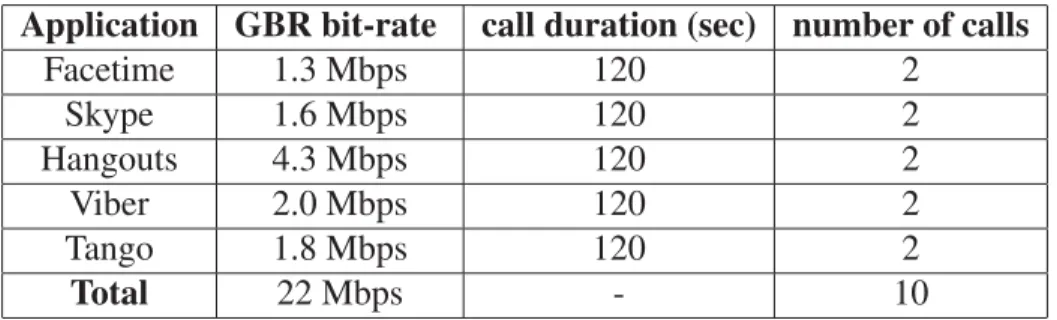
Table 6.1 Dataset: voice & video conversational calls . . . 76
Table 6.2 Dataset: Conversational video (Live Streaming) calls . . . 76
Table 6.3 Dataset: non-Conversational video (buffered streaming) calls . . . 77
Table 6.4 Dataset: Real-time Gaming calls . . . 77
Table 6.5 Total Dataset Formulation . . . 77
Table 6.6 Experiment: Preliminarily Estimation using Innovations algorithm for: ARIMA(p,d,q) p ∈ [1 − 6], q ∈ [1 − 8], d = 1... 82
LIST OF FIGURES
Page
Figure 2.1 LTE Network Design Adapted from 3GPP 36.300 (2015, p. 23) . . . 13
Figure 2.2 EPS Bearer Architecture Taken from 3GPP 36.300 (2015, p. 122) . . . 15
Figure 2.3 EPC Bearers Resource Reservation . . . 18
Figure 3.1 Time-Series Modeling Structure . . . 37
Figure 4.1 LC-100 Conversational Video Dataset . . . 42
Figure 4.2 Sample ACF of the Conversational Video Dataset . . . 45
Figure 4.3 LC-100 Dataset after Transformation & Differencing . . . 46
Figure 4.4 ACF Function of the Differenced Data at d= 1... 46
Figure 4.5 PACF Function of the Differenced Data at d= 1 ... 47
Figure 4.6 ACF of the fitted model residual . . . 54
Figure 4.7 PACF of the fitted model residual . . . 54
Figure 4.8 Forecast results with h= 5 ... 56
Figure 4.9 Forecast results with h= 10 ... 56
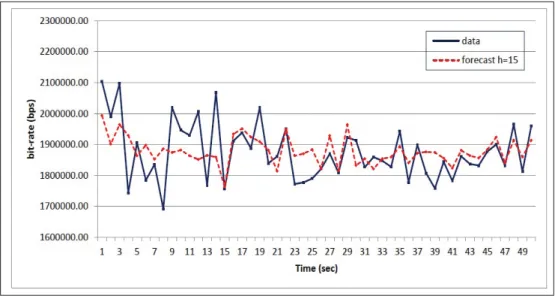
Figure 4.10 Forecast results with h= 15 ... 57
Figure 4.11 Potential Unused GBR Bit-rate Forecast . . . 57
Figure 4.12 RMSE Error Behavior for h= 5 ... 58
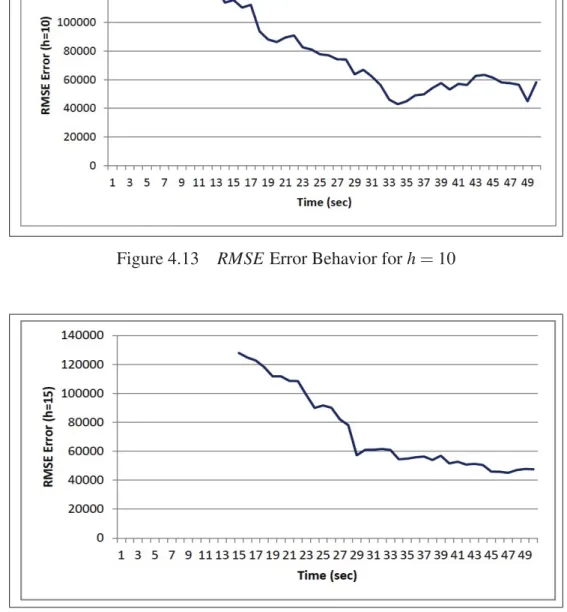
Figure 4.13 RMSE Error Behavior for h= 10 ... 59
Figure 4.14 RMSE Error Behavior for h= 15 ... 59
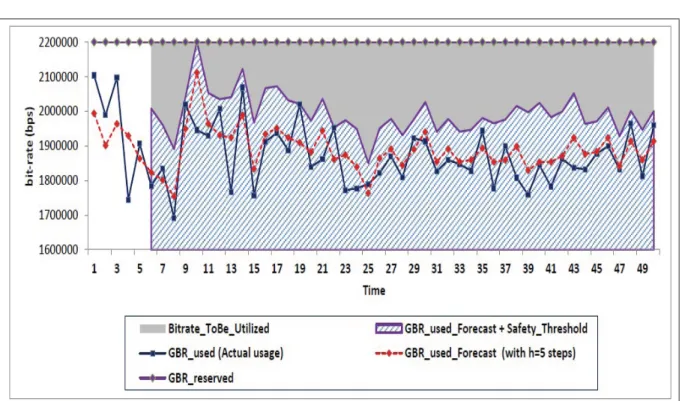
Figure 4.15 Guaranteed Unused Bit-rate that can be Utilized. . . 60
Figure 4.16 Overall view of bandwidth allocation . . . 60
Figure 5.1 Dataset: Total GBR_used. . . 64
XVI
Figure 5.3 ACF after Transformation and Differencing. . . 66
Figure 5.4 PACF after Transformation and Differencing . . . 66
Figure 5.5 ACF of the fitted model residual . . . 69
Figure 5.6 PACF of the fitted model residual . . . 69
Figure 5.7 Forecast results with h= 5 ... 71
Figure 5.8 Forecast results with h= 10 ... 71
Figure 5.9 Forecast results with h= 15 ... 72
Figure 5.10 RMSE Error Behavior for h= 5 ... 73
Figure 5.11 Guaranteed Unused Bit-rate that can be Utilized. . . 73
Figure 5.12 Overall view of bandwidth allocation . . . 74
Figure 6.1 Dataset: Total GBR_used. . . 78
Figure 6.2 ACF of the Multi-Media Dataset . . . 79
Figure 6.3 Dataset after Transformation & Differencing . . . 79
Figure 6.4 ACF after Transformation and Differencing. . . 80
Figure 6.5 PACF after Transformation and Differencing . . . 80
Figure 6.6 ACF of the fitted model residual . . . 84
Figure 6.7 PACF of the fitted model residual . . . 84
Figure 6.8 Forecast results with h= 5 ... 86
Figure 6.9 Forecast results with h= 10 ... 86
Figure 6.10 Forecast results with h= 15 ... 87
Figure 6.11 RMSE Error Behavior for h= 5 ... 88
Figure 6.12 Guaranteed Unused Bit-rate that can be Utilized. . . 88
Figure 6.13 Overall view of bandwidth allocation . . . 89
XVII
Figure 6.15 Resource Utilization for non-GBR bearers (set 2) . . . 92 Figure 6.16 Resource Utilization for non-GBR bearers (set 3) . . . 92 Figure 6.17 Resource Utilization for non-GBR bearers (set 4) . . . 93
LIST OF ABREVIATIONS
3GPP 3rd Generation Partnership Project 3GPP2 3rd Generation Partnership Project 2
AICC Akaike Information Criterion with Correction AMBR Aggregated Maximum Bit Rate
AR Autoregressive Model
MA Moving Average Model
ARMA Autoregressive Moving-Average Model
ARIMA Autoregressive Integrated Moving-Average Model
AF Application Function
CS Circuit Switched
CSCF Call Session Control Function
DL Downlink
UL Uplink
E-UTRAN Evolved-UTRAN
EMM EPS Mobility Management
eNodeB evolved NodeB
EPC Evolved Packet Core
EPS Evolved Packet System
XX
GGSN Gateway GPRS Support Node
GPRS General Packet Radio Service
GSM Global System for Mobile communications
GTP GPRS Tunnelling Protocol
HLR Home Location Register
HSDPA High Speed Downlink Packet Access HSPA High Speed Packet Access
HSS Home Subscriber Server
HSUPA High Speed Uplink Packet Access IETF Internet Engineering Task Force
IEEE Institute of Electrical and Electronics Engineers
IMS IP Multimedia Subsystem
IMSI International Mobile Subscriber Identity ITU International Telecommunication Union
LTE Long Term Evolution
MBMS Multimedia Broadcast and Multicast Service
MME Mobility Management Entity
NGN Next Generation Network
OFDM Orthogonal Frequency Division Multiplexing OFDMA Orthogonal Frequency Division Multiple Access
XXI
PGW PDN Gateway
PCEF Policy and Charging Enforcement Function PCRF Policy and Charging Rules Function
PDP Context Packet Data Protocol Context
PDN Packet Data Network
PLMN Public Land Mobile Network
PS Packet Switched domain
PSTN Public Switched Telephone Network
RNC Radio Network Control
SGW Serving Gateway
SAE System Architecture Evolution
SDF Service Data Flow
SGSN Serving GPRS Support Node
SIP Session Initiation Protocol
SM Session Management
TCP Transmission Control Protocol
UDP User Datagram Protocol
UE User Equipment
UMTS Universal Mobile Telecommunications System UTRAN Universal Terrestrial Radio Access Network
XXII
WCDMA Wide band Code Division Multiple Access
GBR Guaranteed Bit Rate
Non-GBR non-Guaranteed Bit Rate
AGBR Adaptive GBR
PGBR Pure GBR
BW Bandwidth
Gn SGSN to GGSN Interface
MBR Maximum Bit Rate
CHAPTER 1
INTRODUCTION
The Long Term Evolution (LTE) telecommunication technology has been introduced to pro-vide more capabilities and functionalities to support innovative mobile services. The LTE represents a revolution in telecom technology to provide faster communication and higher data transmission with improved coverage and spectrum efficiency as well as optimized radio access network.
The LTE technology introduces new architectural changes which indicate that the EPC core network is more centralized with more responsibilities to be considered while the radio ac-cess network is more distributed. Furthermore, the LTE architecture simplifies the radio acac-cess network side by considering only one system which is the "eNodeB" and introduces compli-cated functionalities and intelligence towards the EPC network. Therefore, the EPC systems are supposed to provide new/evolved responsibilities in LTE technology compared to the 3G & 2G technologies (3GPP TS 36.300 (2015)). Hence, the EPC network has more challenges to be resolved and more intelligence to be provided to meet the expectations of the evolved technology (LTE) and the Next Generations Network services.
The real-time and conversational LTE services require guaranteed resources to be strictly allo-cated for the whole lifetime of the service call. The LTE mobile core network (EPC) resource allocation approach is inadequate with regards to the guaranteed resources used by those ser-vices. More precisely, the EPC mobile gateway system is not capable of properly utilizing the unused bandwidth of the guaranteed resources when the mobile service is not fully using the reserved bandwidth. In this thesis, we will focus on optimizing the guaranteed resource utilization for the LTE mobile services and present an adaptive approach which enhances the resource reservation for the LTE mobile guaranteed services. Our approach provides tech-niques to: analyze the ongoing mobile guaranteed traffic usage, provide time-series models that mathematically represent the conducted data, forecast the mobile service guaranteed resource consumption, identify the wasted/unused resources, and utilize these resources by other
ser-2
vices. Our approach introduces a novel type/method of resource allocation in 3GPP standards. Our experiments will be conducted on datasets captured on an emulated LTE environment. The goal of our experiments is to show that our approach is feasible and beneficial in enhancing the resource allocation for the LTE mobile services and increasing the overall throughput of the LTE/EPC networks.
1.1 Overview: LTE/EPC Networks
The telecommunication evolution 4G/LTE technology came in to provide higher data rate and lower delay with improved coverage and spectrum efficiency. The LTE systems provide capa-ble signaling as well as optimized radio transmission in the radio access network.
Through comparing the telecom wireless technologies such as 2G, 3G and WiMAX with the 4G/LTE radio access system, the LTE system provides evolution to the telecommunication as it offers higher data rate, bigger capacity, lower delay, and more improvement on coverage and spectrum efficiency (Shin et al. (2008b) and Verizon (2010)). The radio access network part of the LTE system has only one node which is the Evolved Node B (eNodeB) while the 3G technology in the Universal Mobile Telecommunications System (UMTS) has two nodes: NodeB and Radio Network Controller (RNC). 2G technology also has two nodes: Radio Base Station (RBS) and Base Station Controller (BSC). This architectural change helps to offer less transmission delay in the radio access network and moves more intelligence towards the core network. Also, 3GPP has proposed key system features such as the default PDN session for the User Equipment (UE), and also proposed new architecture of the policy control and charging to have more control on the mobile broadband services.
The evolved packet system (EPS) defines a single core network -all IP based- for multiple heterogeneous accesses that provide triple play services in the next generation networks. In the 2G and 3G technologies, there were two separate core networks: the circuit-switched core network which, delivers the telephony services over circuit switching methodology, and the packet-switched core network, which delivers the wireless mobile broadband data services over
3
the packet switching methodology using all-IP network. In the LTE technology, the evolved packet core network (EPC) is considered as a single mobile core network to run all services required by the wireless user equipments (3GPP TS 36.300 (2015)).
The Packet Data Network (PDN) session is established in the LTE/EPC network for UE con-nectivity to the internet or to any other network. As part of the PDN session, the UE can have a default bearer and dedicated bearer(s). The default bearer is used for session connectivity and best-efforts traffic. It is established once the UE attaches to the network and an IP address will be assigned to it. It is the responsibility of EPC gateway system to assign the IP address and maintain the UE PDN session(s) and their bearers. On the other hand, the dedicated bearers can be activated to run specific services that require special QoS requirements. Based on the guar-antee criteria of the resource reservation, the dedicated bearer can be classified as guarguar-anteed or non-guaranteed bearer (Ekstrom (2009)).
The dedicated guaranteed bearer (GBR) will be used to run special services that require band-width to be reserved for the whole lifetime of the service/call. Usually, the GBR bearer is established once the UE demands a service that is provisioned to trigger the guaranteed bearer creation. Conversational voice & video and real-time gaming are examples of the services that would use GBR bearer. On the other hand, the dedicated non-guaranteed bearer (non-GBR) can be used to run services that require special priorities, but it does not require bandwidth to be reserved for the whole lifetime of the service. The non-GBR can remain established for long time, as it does not require bandwidth to be strictly reserved.
1.2 Problem Statement
As part of our work, we will concentrate on the challenges that the EPC network encounters and highlight the related weaknesses which could reduce the systems capabilities and effi-ciency in the EPC network. By studying the current EPC network design, we can observe that many limitations and weaknesses can be identified. As indicated in the 3GPP standards (3gpp 36.300), the LTE/EPC dedicated guaranteed bearers require guaranteed resources/bandwidth
4
to be strictly allocated for the whole lifetime of the running service call. No other services can share the guaranteed resources, even if they are not fully used.
The EPC network internal design is inadequate with regards to the resource reservation tech-niques used to carry out the guaranteed dedicated services. So when an LTE mobile is running any service that requires guaranteed bandwidth reservation and this bandwidth is not fully used, the unused guaranteed bandwidth is considered as wasted resources in the EPC gateway and consequently the whole EPC network gets affected. Additionally, the EPC gateway does not have the capabilities to utilize properly the unused guaranteed bandwidth when it is not fully used by the mobile service.
Considering that guaranteed bandwidth is not fully utilized, the operational EPC network throughput and capacity is less than the actual capabilities. According to the 3GPP standards in (3GPP TS 36.300 (2015)), the EPC network indicates that resource allocation for bearers is only based on guaranteed and non-guaranteed rules. The EPC network only provides strict and static implementation of the bearer resource allocation and does not introduce any capabil-ities to have dynamic or adaptive way for resource allocation. Furthermore, the EPC systems, according to 3GPP standards, do not have any intelligence to provide traffic forecasting to pre-dict the future situation of the running traffic in order to perform more enhanced bandwidth utilization and resource allocation. All of these issues may lead to scalability problem at the EPC gateway system, which would require extra cost for operator’s network expansion.
1.3 Objectives
In this thesis, we will focus on enhancing resource utilization for LTE mobile services. Our main objective is to design and model an adaptive technique which improves the resource reservation for the LTE mobile guaranteed services and minimizes the wasted resources of the guaranteed bandwidth allocation in the LTE/EPC network. To achieve our objective, we introduce a novel technique that provides smart, efficient and adaptive approach for the LTE bearers resource allocation. The new concept of adaptive guaranteed bearer will provide an
5
intermediate class between the strict guaranteed and the very open non-guaranteed resource allocation types.
This concept of adaptiveness would provide flexible implementation which allows us to apply some forecasting methods to estimate the wasted bandwidth in the guaranteed resources and utilize them accordingly to reduce the waste and increase the system throughput. Furthermore, the approach indicates that several mobile sessions of the adaptive guaranteed services can be conducted together in order to forecast the overall usage of all those sessions, estimate a pool of unused resources and utilize some of those resources for other non-guaranteed running services. Whenever the adaptive guaranteed service(s) request back the contributed resources, they will get it back from a standby resources pool which will be designated for this purpose. As part of our work, we need to study the traffic profile and characteristics of the LTE guaran-teed services according to the 3GPP standards. This would be required for dataset formulation, analysis and examination. Datasets will be the input for our proposed approach. Furthermore, we aim to provide an algorithm for mathematically representing the LTE mobile guaranteed traffic dataset through conducting time-series models. This includes using and investigating the time-series models; AR(p), MA(q), ARMA(p,q) and ARIMA(p,d,q). The modeling will be validated for the applied time-series to find suitable time-series models that can give better results.
In addition, our research provides the data forecasting method based on the designed time-series model where the predictor function will be used to estimate the potential unused band-width of the guaranteed bearers in the EPC network. The forecast error will be calculated to ensure higher efficiency. The idea is to release part of the forecasted guaranteed unused bit-rate to be utilized by other running services. This represents the benefit of our proposed approach in increasing the LTE/EPC gateway capacity and throughput.
Finally, a safety model will be proposed to ensure avoiding any disturbance for the contributing guaranteed bearers. A safety technique will be established based on the forecast error provided
6
by the time-series forecast model. The safety model ensures the resource availability when the guaranteed bearers require their resources back.
1.4 Methodology Overview
In this research, our approach proposes a new concept of having adaptiveness in the guaranteed bearers implementation to provide flexibility which allows us to apply some forecast methods in order to estimate the wasted bandwidth in the guaranteed resources and utilize them accord-ingly to reduce the waste and increase the system throughput.
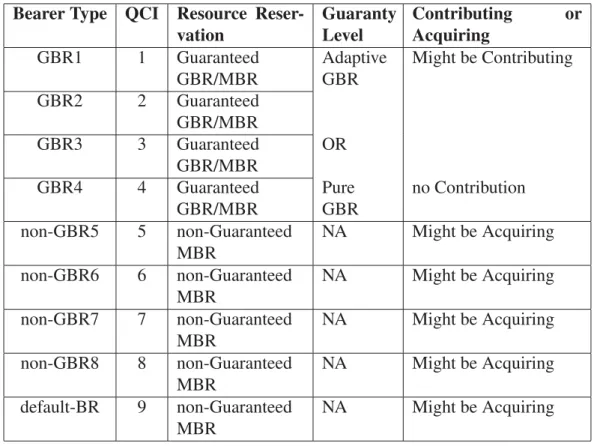
To achieve this, our approach indicates that the guaranteed bearers can be further classified -based on the criteria of adaptiveness- into two types: (i) adaptive-guaranteed bearers that allow adaptive resource allocation and contribute the unused guaranteed resources. All contributed resources will be added up in a pool. These bearers can be considered as contributing-bearers, and (ii) pure-guaranteed bearers that cannot accept any adaptive resource allocation even if they are not fully used. The later represents the current behavior of the guaranteed bearer as defined by the 3GPP standards. Our approach would manage unused resources into two pools. One can be considered as guaranteed standby resources to be used any time by the guaranteed bearers once the resources are requested back, and the other pool of the unused resources can be utilized by the non-guaranteed bearers. Our approach considers these bearers to be acquiring-bearers based on their willingness to utilize more resources to reach the MBR limit.
Considering the concept of having adaptive resource reservation in guaranteed mobile services, we should have robust techniques that can forecast and predict the usage of the guaranteed resources for short-term period for the ongoing bearers in the EPC gateway system, by fore-casting the usage of the resources, the unused bandwidth will be measured and estimated. Time-series will be used in this research work to model the data of the bit-rate usage of the mobile LTE guaranteed services. Time-series analysis includes methods for analyzing series of data in order to get meaningful characteristics of that data. One of the most important data
7
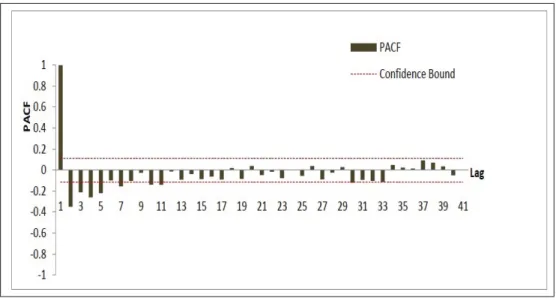
characteristics is the Stationarity. The ACF & PACF functions will be used to examine the data stationarity. Based on the characteristics of the dataset examined, several time-series models will be investigated to provide an appropriate model to represent the dataset. For stationary dataset, the models Autoregressive AR(p), Moving Average MA(q) and Autoregressive Mov-ing Average ARMA(p,q) can be used. For non-stationary dataset, the Autoregressive Integrated Moving Average ARIMA(p,d,q) model can be considered as it uses the "integrated" property to transform the given dataset to stationary series through applying the Differencing technique (Robert H. Shumway (2010)). Along with the Differencing technique, Box-Cox Transforma-tion will be helpful in converting the data to become staTransforma-tionary. The resulted time-series model will be utilized in the prediction function that will provide the forecasted unused resources in the LTE/EPC network.
To evaluate the forecast results, the Mean Squared Error (MSE) will used to show the accuracy of both. The chosen time-series model and the prediction parameters selection. The forecasting error behavior, which is driven from the MSE, will be used in calculating the standby resources pool that will be reserved for the guaranteed bearers to be used any time once the resources are requested back.
1.5 Thesis Contribution
In this thesis, we propose and design an adaptive technique which enhances the resource reser-vation for the LTE mobile guaranteed services. In the proposed approach, we introduce a novel algorithm for resource allocation in 3GPP standards. The algorithm aims to include
adaptive-ness in the guaranteed bearer resource allocation. The algorithm also consolidates the
guaran-teed traffic usage in one pool to estimate the expected waste of the resources and utilize them properly. Our technique ensures and guarantees the resource availability through designing the "Safety Model" which complements our algorithm. We also propose a framework which analyzes the mobile data traffic and determines the mathematical characteristics. As part of the framework, we utilize some methods that can help in converting the mobile data series into stationary data.
8
In this thesis, we also propose another algorithm which mathematically represents the mobile data series into time-series model. Different models and techniques were used to design the time-series, validate the model and perform comparison in order to get better data representa-tions. The proposed algorithm also helps to forecast the consolidated mobile data guaranteed resource consumption. The forecast process will help to identify the unused resources in the LTE/EPC system.
Our technique would help to maximize the use of resources by other mobile services. This would increase LTE/EPC system throughput and capacity. It would also help to avoid network expansion at telecom operators that could be caused by scalability problem. We believe that our technique will help network operators especially because our technique concentrates on improving usage of telecom network resources in particular for LTE mobile networks.
1.6 Thesis Outline
The rest of the thesis is organized as follows: in Chapter 2, we present some background about LTE/EPC network architecture, LTE bearer resource reservation, QoS mechanisms and some challenges of the LTE/EPC network. We also provide a detailed description about the related work which has been done in the QoS and Resource Allocation in LTE/EPC network. In addition, we provide a review of the related research work which has been done in the time-series modeling and forecast fields. In Chapter 3, we provide a full description of our proposed approach, explain the mathematical modeling of our approach and provide details of the methodologies and algorithms that would be used to achieve our objectives.
In Chapter 4, we apply our approach to a single guaranteed service that carries video conver-sational call where we analyze the dataset, prepare it for modeling, find the time-series model that fits the data, validate the the model, perform the data forecast and estimate the wasted re-sources. In Chapter 5, we study a bigger dataset which contains several guaranteed bearers that carry video conversational calls. We apply our approach on this dataset in order to validate the feasibility. In the time-series modeling, several experiments were conducted to find the model
9
that better fits the data. Data forecasting was performed and our approach was able to provide and estimate the resources gain that can be used by other services.
In Chapter 6, a real-life dataset was analyzed and studied. The dataset consists of several guaranteed bearers that carry different kinds of guaranteed services which would reflect a real-life scenario. Our approach was applied to find the time-series model. The data forecast was performed to provide the unused resources. Data simulation experiments were executed to show the benefit that our approach would provide. Finally, in Chapter 7, we summarize and conclude the thesis and we present some future directions.
CHAPTER 2
LITERATURE REVIEW AND BACKGROUND
2.1 Introduction
In this Chapter, we present some background about LTE/EPC network architecture, LTE bearer resource reservation, QoS mechanisms and some challenges of the LTE/EPC network. We also provide detailed description about the related work which has been done in the QoS and Resource Allocation in LTE/EPC network. In addition, we provide a review about the related research work which has been done in the time-series modeling and forecast fields.
2.2 Background
2.2.1 LTE Network Architecture
Overview
The telecommunication evolution LTE (Long Term Evolution) technology came about to pro-vide higher data rate and lower delay with improved coverage and spectrum efficiency. The LTE system provides capable signaling as well as optimized radio transmission and radio ac-cess network.
Through comparing the telecom wireless technologies such as 2G, 3G and WiMAX with the LTE radio access system, the LTE system provides evolution to the telecommunication as it offers higher data rate, bigger capacity, lower delay and more improvement on coverage and spectrum efficiency (Shin et al. (2008b) and Verizon (2010)). The radio access network part of the LTE system has only one node which is the Evolved Node B (eNodeB) while the 3G tech-nology in UMTS has two nodes, NodeB and Radio Network Controller (RNC). 2G techtech-nology also has two nodes, Radio Base Station (RBS) and Base Station Controller (BSC). This archi-tectural change helps to offer less transmission delay in the radio access network and moves
12
more intelligence towards the core network. Also, 3GPP has proposed key system features such as the default PDN session for the User Equipment (UE), and also proposed the new ar-chitecture of the policy control and charging to have more control on the mobile broadband services.
LTE and Evolved Packet Core Network Overview
The radio access network in the LTE system is composed of only one kind of node, Evolved NodeB (eNodeB). Access stratum (AS) protocols such as Medium Access Control (MAC), Radio Link Control (RLC) and Radio Resource Control (RRC) are located in the eNodeB. LTE provides higher capacity by using the Orthogonal Frequency Division Multiplexing (OFDM) as the radio access technology. LTE uses OFDM for the data carried in the downlink direction (from the radio base station to the UE) (Ericsson (2013) and Ericsson (2008)).
The evolved packet system (EPS) defines a single core network, all IP based, for multiple heterogeneous accesses that provide triple play services in the next generation networks. In the 2G and 3G technologies, there were two separate core networks: the circuit-switched core network which delivers the telephony services over circuit switching methodology, and packet-switched core network which delivers the wireless mobile broadband data services over the packet switching methodology using all-IP network. In the LTE technology, the evolved packet core network (EPC) is considered as a single mobile core network to run all services required by the wireless user equipments (3GPP TS 36.300 (2015)).
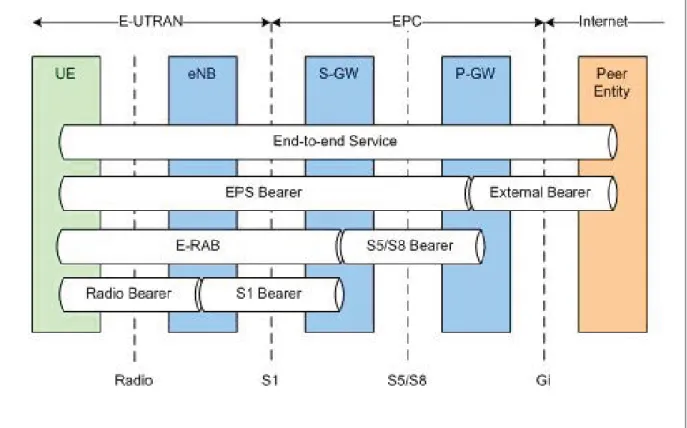
Figure 2.1 adapted from (3GPP TS 36.300 (2015)) demonstrates the LTE/EPC architecture and highlights how the User Equipment (UE) accesses the internet and other networks through running the data traffic via the eNodeB, SGW & PGW systems. The Evolved Packet Core network (EPC) consists of the following elements:
• Mobility Management Entity (MME); • Serving Gateway (SGW);
13
Figure 2.1 LTE Network Design Adapted from 3GPP 36.300 (2015, p. 23)
• Packet Data Network Gateway (PGW); • Policy and Charging Rule Function (PCRF).
The MME is responsible for the control plane function. MME controls the mobility manage-ment with the eNodeB in the LTE radio access network. MME also controls the session man-agement with the SGW and PGW to activate and maintain the Packet Data Network sessions (PDN). The user plane is handled by the SGW node. It transports the user plane to/from the Evolved NodeB (eNodeB) in the LTE radio access network. PDN-GW or PGW provides the gateway functionality to connect the telecom world to the data communication world, e.g. IMS or packet data network (PDN). The PGW gateway is the key node for maintaining and con-trolling the PDN session management with the help of the SGW towards the MME; the PGW gateway allocates the IP address to the UE to be able to access the IMS, internet and corporate services. The PGW gateway has some capabilities and intelligence to perform packet inspec-tion and service classificainspec-tion on the UE user plane going through the gateway. The traffic classification capabilities allow the PGW to perform credit control charging functionalities
to-14
ward the Online Charging System (OCS) and to perform the charging differently based on run-ning services. PGW also plays another rule as Policy Control Enforcement Function (PCEF), towards the Policy and Charging Rule Function (PCRF), to perform policy and QoS control enforcement on the running user plane. The Policy and Charging Rule Function (PCRF) con-trols QoS policy and charging for users and services and communicates that towards the PCEF (PGW) to enforce and apply the rules (3GPP TS 23.882 (2008)).
Policy and Charging Control (PCC)
Policy and charging control (PCC) provides some capabilities for service-aware QoS, policy and charging control. PCC is used in the evolved packet core network (EPC), which is defined as part of the 3GPP Release 8 specifications, and has evolved significantly to support policy and charging control for multiple-access technologies, roaming and mobility (3GPP TS 29.212 (2014) and 3GPP TS 29.213 (2014)). PCC was designed to be independent from the radio access technology. For this reason PCC can be easily adapted to be used in EPS system. In PCC 3GPP Release 8, more features and capabilities have been added; all of these new capabilities make PCC more suitable to meet EPS system requirements. These requirements include: support for mobile IP-based protocols in the EPS, roaming and mobility between heterogeneous radio access networks (Balbas et al. (2009)).
2.2.2 EPS Bearer and QoS Concepts
The Evolved Packet System Bearer
An EPS bearer uniquely identifies packet flows that run between the UE and the gateway. These flows receive a common QoS treatment and policy enforcement. A packet flow is defined and filtered by five-tuple parameters: the source and destination IP address, source and destination port number and protocol ID.
All packet flows which construct the bearer, mapped to the same service, receive the same packet-forwarding treatment (e.g., policy control and authorization, scheduling policy, queue
15
Figure 2.2 EPS Bearer Architecture Taken from 3GPP 36.300 (2015, p. 122)
management policy, traffic-shaping policy, link-layer configuration, etc.). The bearer enables traffic separation and provides different treatment for the traffic flows, belonging to the corre-sponding bearer, based on the QoS requirements required (Ekstrom (2009)).
Figure 2.2, taken from 3GPP TS 36.300 (2015), shows the EPS bearer architecture and identi-fies the EPS bearer which runs between the UE and the PGW gateway, the EPS bearer consist of the radio bearer (between the UE and the eNB), S1 bearer (between the eNB and the SGW) and the S5/S8 bearer (between the SGW and the PGW).
EPS QoS Concepts & Parameters
In EPS system, a UE can have a default bearer which is used for basic connectivity. The default bearer is set up when the UE attaches to the network where one default bearer exists for each UE IP address, and it is kept for that UE as long as it is connected to the network.
16
Because the default bearer can remain established for long periods, the 3GPP specifications mandate that the default bearer is a non-guaranteed-bit-rate bearer (non-GBR). A UE also can have dedicated bearers which can be used for different services that require different QoS requirements. The dedicated bearer can be either a non-guaranteed or a guaranteed bearer (3GPP TS 36.300 (2015)).
A GBR bearer typically is established "on demand", because it reserves bandwidth resources by having special QoS attributes. On the other hand, a non-GBR bearer can remain established for long periods of time because it does not reserve any bandwidth resources. The QoS concept in the evolved packet system is based on classes/services.
According to the the 3GPP standards, each dedicated bearer will have QoS class identifier (QCI) which indicates the QoS information that the bearer would require while running the service/call through the UE in the LTE/EPC network. The QCI is given by the network based on the class/type of the bearer. The QCI specifies QoS requirements that the bearer’s payload (user-plane) will receive.
The allocation and retention priority (ARP) specifies the control-plane treatment that the bear-ers receive. Recently, a new optional Information Element (IE) called evolved ARP is added to the GRPS Tunneling Protocol (GTP) messages that are received and sent over the Gn interface in applicable procedures between the Transport Node (SGSN) and the core network gateway (GGSN) (3GPP TS 23.401 (2015)). Previously, the ARP values were 1 to 3, where the evolved ARP values are 1 to 15 which gives more possibilities to treat the traffic differently. This func-tionality ensures that high-priority subscribers get prioritized access when congestion occurs and improves the service level granularity.
Resource Reservation for Guaranteed Dedicated Bearer
The guaranteed dedicated bearer is established based on prior signaling. When the user tries to access/start a specific service (e.g., a SIP data call), the application server (e.g., P-CSCF) detects the ongoing signaling, needed to establish data call, and instructs the PCRF to establish
17
an EPS dedicated bearer for that data call. The PCRF server initiates that by sending a special diameter message to the PCEF server (PGW) to request the PCEF (PGW) to establish the EPS dedicated bearer. The PCEF (PGW) establishes the dedicated bearer with guaranteed resources. The diameter message which triggers the dedicated bearer establishment contains the IMSI, TFT and the QCI information elements. The PCEF (PGW) uses the diameter message elements to establish the dedicated bearer towards the transport and radio networks.
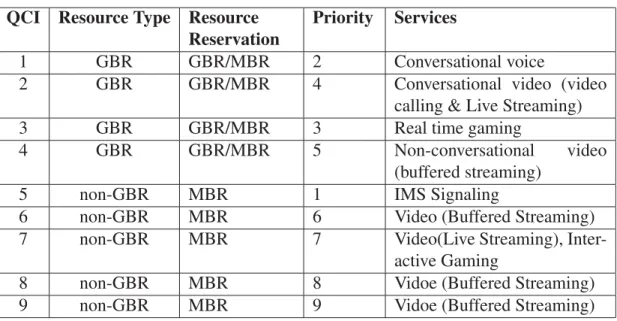
Table 2.1 QCI Information Adapted from 3GPP 23.203 (2015, p. 46) QCI Resource Type Resource
Reservation
Priority Services
1 GBR GBR/MBR 2 Conversational voice
2 GBR GBR/MBR 4 Conversational video (video
calling & Live Streaming)
3 GBR GBR/MBR 3 Real time gaming
4 GBR GBR/MBR 5 Non-conversational video
(buffered streaming)
5 non-GBR MBR 1 IMS Signaling
6 non-GBR MBR 6 Video (Buffered Streaming)
7 non-GBR MBR 7 Video(Live Streaming),
Inter-active Gaming
8 non-GBR MBR 8 Vidoe (Buffered Streaming)
9 non-GBR MBR 9 Vidoe (Buffered Streaming)
According to the 3GPP standards (3GPP TS 23.203 (2015)), some services require dedi-cated bearer with guaranteed resources to ensure a better quality of service. Table 2.1 shows some examples of the services that require dedicated and guaranteed bearers. These services are conversational voice, conversational video (Live Streaming), real-time gaming and non-conversational video (buffered streaming). The handling of EPC bearers resource reservation in LTE/EPC network is illustrated by Figure 2.3 (3GPP TS 23.203 (2015)) where the PDN connection and its bearers connect the UE applications to the services via the radio and core networks.
18
QoS Mechanisms
The QoS control in EPS can be controlled through different mechanisms; these mechanisms are divided into control-plane signaling and user-plane functionalities. The Policy Control Rule Function system (PCRF) in the network determines how each packet flow for each subscriber must be handled in terms of the QoS parameters. These QoS parameters will be associated with corresponding packet flows which run through the bearer. The policy control engine (PCRF) communicates the policy and charging control (PCC) rules with the EPC gateway (PGW) which is responsible to establish a new bearer or modify an existing bearer with respect to the authorization rules and QoS parameters received from the PCRF. This is considered as applying the QoS mechanisms at the user-plane level (3GPP TS 23.401 (2015)).
Figure 2.3 EPC Bearers Resource Reservation
Using the deep packet inspection techniques at the EPC gateway helps to identify the packet flows for the bearers. Specifying these bearers helps the EPC gateway to apply the policy control rules and the QoS mechanisms on the corresponding data bearers. Using bandwidth policing, EPC gateway can identify certain packet flows and throttle the bit-rate experienced
19
by that particular packet flow without modifying the bearer-level QoS parameters. This is called "traffic policing" in 3GPP standards.
For bearer-level functions on non-GBR bearers, the PGW performs bandwidth policing based on the MBR value(s) for both uplink and downlink traffic; whereas the LTE RAN performs bandwidth policing based on the terminal related MBR value for both uplink and downlink traffic in the air interface (Ekstrom (2009) and 3GPP TS 23.203 (2015)). Table 2.1 shows the mapping of the standardized QCI values to the standardized guaranteed and non-guaranteed services with their priorities . To allow traffic separation in the transport network, the EPC gateway and the LTE RAN implement a QCI to DSCP mapping function. The purpose of this function is to make a translation from bearer-level QoS (QCI) to transport level QoS (DSCP).
2.2.3 Complexity of the EPC Network
The LTE architecture simplifies the radio access side by considering only one node (eNodeB) and pushes more complex functionalities and design towards the core network (EPC). The EPC network is supposed to provide more responsibilities in LTE compared to the 3G & 2G technologies. With the new architectural design in LTE, EPC network consist of four nodes which are: MME, SGW, PGW & PCRF. This will add more complexity to the coordination between these nodes and make the EPC network responsible for more work to accomplish. Apparently, there are several important factors to be aware of, these factors are: (LTE radio capacity increase, 50B devices expected by 2020, more advanced services introduced and new responsibilities for the EPC network) (Ericsson (2008)). With all of those factors, the EPC network has more challenges to be resolved and more intelligence should be provided to meet the expectations of the evolved technology (LTE) and the Next Generations Network services. Some of these challenges can be summarized as follows:
• Coordination between the radio access (eNodeB) and the EPC network nodes for
central-ized and distributed network architecture;
20
• End-to-end QoS control and coordination with the underlying transport; • Traffic classification and deep packet inspection;
• Policy and Charging Control coordination; • Scalability and network optimization.
The PDN gateway in EPC (PGW) plays an important role in handling these challenges. PGW is in charge of activating the PDN session and run the IP traffic of the UE’s. PGW is responsible of the control and user planes; it is also responsible of performing the deep packet inspection through analyzing the running user plane.
In addition, PGW plays an important role of the end-to-end QoS control as it enforces the QoS for the downlink traffic in the EPC network. Furthermore, PGW interacts with the PCRF server to get the policy control rules and apply them on the running user-plane based on packet inspection results; PGW also communicates with the OCS for the online charging support. It is obvious that PGW carries out several functionalities and responsible of handling many challenges in the EPC network. With all of those mentioned, PGW would have more complex operations, scalability problems and be more sensitive from the changes in the carried traffic profile.
One EPC network could cover a metropolitan area which could have several radio access net-works that are all connected to the same EPC network. This centralized design would indicate that any weakness or deficiency in the EPC network would consequently degrade the through-put for all the radio access networks and mobile users connected in that area.
2.3 Literature Review
Many research work activities have been done in the areas of the 4G/LTE technology and the Evolved Packet System (EPS) especially about the topics of Bearer QoS control, policy and charging control, EPS bearer design, EPS signaling in LTE network. Also, many researchers
21
have paid attention to the time-series methods and how can be used for forecast and prediction. In this section we will review/discuss some techniques and research work done for those topics.
2.3.1 QoS and Resource Allocation in EPS system
In (3GPP TS 23.401 (2015), Ekstrom (2009), 3GPP TS 23.882 (2008), 3GPP TS 29.213 (2014) and 3GPP TS 36.300 (2015)) researchers describe the QoS concept of the EPC network and explain the "bearer" terminology which was introduced in LTE technology. A UE also can have dedicated bearers which can be used for different services that require different QoS re-quirements. The dedicated bearer can either be guaranteed or non-guaranteed bearer. Through checking the technical or research work on LTE technology, there was nothing proposed or discussed about having semi or adaptive guaranteed resource reservation.
Many research activities in (Molazem Tabrizi et al. (2011), Youjun et al. (2006), Wang et al. (2006) and Chandra and Helenprabha (2014)) have been done for bandwidth allocation opti-mization for the LTE/LTE-A radio channel but nothing has been done for optimizing bandwidth allocation in the EPC core network. According to (Mitra and Agrawal (2016) and Rodriguez (2015)), it is indicated that 5G technology will continue focusing on intelligent resource alloca-tion scheme for cognitive radio links which somehow would positively affect the core network but no focus is proposed on optimizing the resource allocation setup at the core network espe-cially that the typical dedicated guaranteed bearer resource allocation is still present.
The authors in (Molazem Tabrizi et al. (2011)) conducted some topics on bandwidth utilization on the radio channel between the base station and the mobile system. The algorithm transmits multiple variable-bit-rate (VBR) video streams from a base station to mobile in wireless net-works. The algorithm transmits video streams in bursts to save the energy of mobile devices. The algorithm is adaptive to the changes in the bit-rates of video streams and allow the base station to transmit more video data on time to mobile receivers. This approach could only handle the buffered streaming video; conversational video and live streaming might not benefit from this algorithm. This algorithm does not have enough capability to provide bandwidth
uti-22
lization for all different types of traffic running on the base station. Some protocols e.g. SPDY (Speedy) & QUIC (Quick UDP Internet Connections) have been introduced to focus on the data bandwidth and to make the internet faster through compressing the bandwidth as in SPDY (Belshe and Peon (2012)) or by estimating the bandwidth in each direction to avoid congestion as in QUIC (Roskind (2013)), both protocols are running at the client/server level.
In (Ekstrom (2009)), the author describes the QoS concept of the EPS system and explains the new terminology (bearer) introduced in LTE technology. This paper explains the difference between the guaranteed and non-guaranteed bearers by showing their characteristics. Each data session will have several pipes of data (bearers) where each one will have different treatment and QoS attributes which are defined according to the running service in the bearer. This paper gives an end to end use case where the EPS system inspects the signaling of a call and triggers the initiation of a dedicated bearer to run the requested call to ensure the quality of the running service. Author in (Balbas et al. (2009)) explains the architecture of the Policy and Charging Control (PCC) and its elements. The paper shows the role provided by the PCC about policy and charging control and how it contributes to the EPS system by adding valuable functionalities which add more intelligence to the EPS system.
The work in (Luo et al. (2010)) proposes a new method for EPS QoS control using the IPv6 Flow Label field to represent QoS information about the corresponding flow. The authors highlight a problem that, in the EPC network, each node needs to have an inspection rule to identify the bearer to apply the QoS policies corresponding of the running bearer. All of these tasks require more processing and storage resources at the EPC network nodes. To reduce the waste of resources, the authors provide a technique to pass the information between the nodes using a customized IPv6 flow label and apply the QoS attributes without inspecting the traffic based on the TFT fields. The flow is expected to be uniquely identified with its source and destination IP addresses as well as flow label.
The research work in (Shin et al. (2008a)) proposes a model for the LTE radio interface sig-naling for session and bearer control, this model utilizes the LTE features agreed in 3GPP such
23
as: network-controlled service, QoS aggregation and default IP access service. The authors of this paper claim that the provided architectural changes help to offer less transmission delay in the radio access network. The authors in (Li and Shen (2011)) present high level system architecture for monitoring and troubleshooting harmonization of CoS/QoS based on DSCP (Diffserv Code Point) mappings that optimize end-to-end network performances over multiple LTE network elements. The research work in (Anas et al. (2008)) presents combined admission control and scheduling for QoS differentiation in LTE uplink direction.
In (Alcatel-Lucent (2009)), the authors explained the challenges that are facing the EPS system. Some of these challenges are the end-to-end QoS control and deep packet inspection overhead in the LTE network. Research work in (Armitage (2003) and Bell (2003)) discuss the QoS in the IP networks which can be also applied to the LTE from some aspects with respect to the end to end QoS control.
2.3.2 Time-Series and Forecast Models
The main role of conducting the time-series methods is to forecast the future and extrapolate the events in near or far future. Time-series are utilized in several fields or applications to get some future knowledge based on the current and past values of the forecasted series; e.g traf-fic flow, weather, economy, internet traftraf-fic usage and power load. Identifying the time-series depends on the conducted field/application, time period and characteristics of the forecasted time-series. The time-series model considered as statistical method of dynamic relation be-tween the past/current observations and the forecasted variables (?).
The constant-level forecasting model includes very simple methods such as: the last-value forecasting method which uses the last observed value as the next forecast. The Averaging Forecasting Method determines the forecast based on the average of all the previously ob-served values, Moving-Average Forecasting Method does not include all the previous values; instead it provides the average of the most recent values observed (Rivett (1968)). Exponential smoothing depends on the last observation and the preceding forecast based on some weighted
24
constant which is called smoothing constant. It implies a recursive relation between all the ob-servations with decreasing weights for the earliest obob-servations. There are also other alternative models for the exponential smoothing technique which are slightly different from the general one with more attention to the most recent forecasting error (Rivett (1968) and Hyndman et al. (2008)).
The author in (He et al. (2001)) uses the Exponential Smoothing model with some attention to the periodicity of the patterns. The proposed model was designed and implemented to per-form network traffic forecast. This paper indicates that the network traffic is characterized with strong periodicity through applying some analysis of the network transmission rate. The proposed forecasting model dynamically selects the smoothing parameters to get near opti-mal results for the forecast. The proposed model demonstrates the effectiveness of the results through applying some error calculation and evaluation. The Stochastic time-series is consid-ered to be one of the most popular approaches that has been applied for forecasting in several applications. Based on the research work conducted in (Basu et al. (1996), You and Chandra (1999), Yin and Lin (2005) and Svoboda et al. (2008)), the following mentioned time-series models are the most popular and mainly considered for traffic forecast in most of the wire-less networks, telecommunications and internet applications. Some of these models are: the (i) Autoregressive (AR) model, (ii) the Moving-Average (MA) model, (iii) the Autoregres-sive Moving-Average (ARMA) model and (iv) the AutoregresAutoregres-sive Integrated Moving-Avenge (ARIMA) model. The Seasonality is a time-series component that indicates periodic behavior in the time-series models (Moghram and Rahman (1989)).
In the Autoregressive model, the current value of the time-series is represented in terms of the time-series previous values and some random noise. The Moving-Average model indicates that the current value of the time-series is represented using the current and previous values of a white noise series. This noise series is constructed from the forecast errors when the observa-tions become available. The Autoregressive Moving-Average (ARMA) model considers both previous model AR and MA. The current value of the time-series is represented Based on the time-series previous values and the white noise current and previous values. The time series
25
explained previously; AR, MA and ARMA models are utilized for the stationary model. It indicates that the mean and variance for those time-series do not change with time. If the data in the series is not stationary, an initial step is applied to remove the non-stationary property of the data, this is known as "integrated". The Autoregressive Integrated Moving-Average model is considered as a generalization model for the ARMA model. The generalized ARIMA(p,d,q) indicates whether the autoregressive, integrated, or moving-average are conducted in the model (Moghram and Rahman (1989) and De Gooijer and Hyndman (2006)).
Many research works (Davis et al. (2000), Liu and Mao (2005) and Dai and Li (2009)) have utilized the time-series to perform forecast on the variable video traffic flow. The research work in (Davis et al. (2000)) analyzes the VBR video traffic into the queuing system to represent the time series to forecast the buffer size of the VBR video in away to better allocate the resources and to ensure the QoS requirements. This model uses the Markov chain to model the system in correspondence with video frames sent during the session, the work involves nonlinear autoregressive time series models. The author in (Dai and Li (2009)) uses the ARMA model to provide forecast for the dynamic variable bit-rate MPEG video traffic. This model concentrates on short-term period prediction.
The work in (Kalle et al. (2012)) applies the time-series and specifically the ARIMA model to forecast the usage of real-time applications for video streaming over the RTP protocol. The forecast results are utilized to better control and reduce the power consumption in the battery for the mobile station browsing the video media. The forecast model is proposed to be run in the eNodeB system which represents the radio station in the LTE technology. It is not an easy consideration to have dynamic power control over the air interface especially that other application could be running on the mobile and using same channel. Other consideration should be applied for any other traffic.
The Autoregressive Moving Average (ARMA) and the Autoregressive (AR) models are pro-posed by the authors in (Nomura et al. (1989) and Xu and Qureshi (1999)) to determine the
26
statistical characteristics of the video traffic discussed. These methods are utilized for offline video applications without conducting any application for online video traffic.
The research work in (Basu et al. (1996), Sivakumar et al. (2011), You and Chandra (1999) and Yin and Lin (2005)) have applied the time-series models to provide forecast on the traffic usage of the IP networks. The author in (Basu et al. (1996)) investigates parametric time-series mod-els that can be used to forecast aggregated data traffic in the internet. The author investigated some datasets collected from different universities networks to provide traffic forecast. The research work considers the traffic as stationary process. Considering this and based on non-random periodicity shown by the author. The Auto-Regressive Moving-Average (ARMA) has been used as a time-series for many datasets. The author indicates that in some datasets where more TCP applications are present (FTP-control, WWW, TELNET, SMPT). The ARIMA pro-cess should be used considering the stationarity property. The research work indicates that the forecasting model has potential application in dynamic resource allocation.
The research work in (Sivakumar et al. (2011)) conducts the Hidden Markov model and the Neural Network model to predict and forecast number of wireless devices connected to the Access Point in the wireless network that varies with time. The Author highlights that the fore-casted number of devices could give some indications about the ongoing traffic which would help in early allocation of the network resources; that would help to avoid congestion. Based on some simulation results, the author concluded that the Neural Network will give better fore-cast for the varying number of wireless devices. It is important to mention that wireless devices can differ from the capability perspectives; also user applications can be different with respect to traffic volume required. Based on that, number of devices will not always give correct indi-cation about the ongoing traffic in the wireless network.
The work in (Akinaga et al. (2005)) proposes a method of forecasting the radio traffic to give some prediction about the overall usage of the radio channels in the mobile communication system. The forecast results would help the radio access systems to have better admission control to avoid any congestion in the resources. The author discusses the mobile traffic
char-27
acteristics based on individual behavior, regular pattern, or temporary incidents. This research work proposes a new forecasting method based on the discussed mobile traffic characteristics. The research work in (Svoboda et al. (2008)) proposes a method of forecasting traffic load in the 3G Packet Core Network (PCN). The authors considered some simple and sophisticated time-series modeling approaches; e.g. exponential regression and the ARMA approaches. The research work provides long-term forecast of the mobile traffic running in the PCN network to have better planning of the packet core network resources to handle any forecasted boast in the mobile traffic during the year. The dataset of the forecast approach was a mobile traffic trace collected from real 3G mobile network. The authors studied the trace to have more under-standing of the dataset characteristics. To represent the forecasting error, two representations were used: the (i) Mean Absolute Error (MAE) which is the mean of the absolute differences between the real observations and the forecasted data, and the (ii) Mean Squared Error (MSE) which is the mean of the absolute squared differences between the real observations and the forecasted data. The MSE error representation gives more weight to larger differences than smaller ones. The authors obtained that the simple and sophisticated approaches give similar results of forecasts for less than 100 days. For longer forecasts, the ARMA approach will deliver better performance results.
To summarize, through checking technical and research work done on LTE technology, there was nothing proposed or discussed about having semi or adaptive guaranteed resource reserva-tion. Furthermore, research activities lack of providing adaptive resource reservation for LTE mobile services at the network or system level. It is important to mention also that lots of research work have been conducted for bandwidth allocation optimization for the LTE/LTE-A radio channel but very minimal work has been done to optimize bandwidth allocation in the EPC core network.
CHAPTER 3
PROPOSED APPROACH: ENHANCED RESOURCE UTILIZATION FOR LTE MOBILE SERVICES
3.1 Introduction
The ultimate goal of our research is to advance the state of the art in the LTE and mobile broad-band technologies. Particularly, our research will serve to provide more capable and adaptive resource reservation techniques for the LTE mobile services to reduce wasted resources and increase the overall throughput of the EPS system. The approach helps to improve the resource reservation for LTE mobile services through forecasting the actual bandwidth consumption of the guaranteed service using time-series modeling, identifying the wasted/unused guaranteed bandwidth and helping to utilize the unused bandwidth by other non-guaranteed bearers. The approach would help to increase the overall throughput of the LTE/EPC network. In this chap-ter, we provide a full description of our proposed approach, explain the mathematical modeling of our approach and provide in detail the methodologies and algorithms that are used to achieve our objectives.
3.2 Approach Overview
By conducting a literature review, we noticed that EPS system design lacks optimization tech-niques for the resources reservation of the EPS bearers. By conducting the 4G technology design details of the bandwidth reservation for the guaranteed and non-guaranteed bearers, we concluded that by utilizing the unused bandwidth of some guaranteed bearers, that hold re-served bandwidth through the guaranteed QoS parameter, we can perform some optimization and utilize the unused bandwidth for other bearers (i.e., these bearers are willing to consume more resources). This shall increase the capability of the telecom network and improve the service availability.