Enabling large scale cloud services by software defined wide
area network
by
Haifa SASSI
THESIS PRESENTED TO ÉCOLE DE TECHNOLOGIE SUPÉRIEURE
IN PARTIAL FULFILLMENT FOR A MASTER’DEGREE
WITH THESIS IN ELECTRICAL ENGINEERING
M.A.Sc
MONTREAL, JULY 11, 2017
ÉCOLE DE TECHNOLOGIE SUPÉRIEURE
UNIVERSITÉ DU QUÉBEC
© Copyright reserved
It is forbidden to reproduce, save or share the content of this document either in whole or in parts. The reader who wishes to print or save this document on any media must first get the permission of the author.
BOARD OF EXAMINERS (THESIS M.SC.A. OR THESIS PH.D.)
THIS THESIS HAS BEEN EVALUATED BY THE FOLLOWING BOARD OF EXAMINERS
Mr Mohamed Cheriet, Thesis Supervisor
Department of Automated Production Engineering, École de technologie supérieure
Mr Kim Khoa Nguyen, Thesis Co-supervisor
Department of Electrical Engineering, École de technologie supérieure
Mr Georges Kaddoum, President of the Board of Examiners
Department of Electrical Engineering, École de technologie supérieure
Mr Michel Kadoch, Member of the jury
Department of Electrical Engineering, École de technologie supérieure
THIS THESIS WAS PRESENTED AND DEFENDED
IN THE PRESENCE OF A BOARD OF EXAMINERS AND PUBLIC 5 JULY 2017
ACKNOWLEDGMENT
I would like to give a special thanks to my supervisor Mr Mohamed Cheriet, professor in the department of Automated Production Engineering and director of Synchromedia laboratory, for his guidance, his availability and his scientific and moral support during this master.
Also, I would like to thank my co-supervisor, Mr Kim Khoa Nguyen, professor in the department of Electrical Engineering for his valuable suggestions and corrections and his patience which gave me the effective support for my project.
I would like to thank Mrs Saida Khazri and all Synchromedia Laboratory members for their support, their help and for the great research environment.
Finally, I would like to dedicate this master to my parents and my fiancé: my dear and loving mother; the source of my inspiration and my success, my dear father; the man who taught me that the respect is the best kind of knowledge and my dear fiancé; the most supportive person in my life.
APPROVISIONNEMENT À GRANDE ECHELLE DES SERVICES BASÉS SUR LE NUAGE INFORMATIQUE À TRAVERS SDN DANS LES RÉSEAUX ÉTENDUS
Haifa SASSI
RÉSUMÉ
Interconnecter les centres des données (DC) d’une manière efficace et utiliser la totalité des ressources disponibles dans le réseau étendu (WAN) présentent les challenges les plus difficiles pour les fournisseurs de services (SP). Dans ce mémoire, nous présentons une nouvelle approche pour optimiser l’ingénierie de trafic dans le réseau WAN qui interconnecte les centres des données (Inter-DC WAN) en utilisant le nouveau concept de réseaux programmables (SDN). Nous formulons un modèle mathématique pour l’optimisation de l’allocation de la bande passante aux différents flux appartenant aux différentes classes de services (CoS) en se basant sur la priorité des services et l’état actuel du réseau. L’objectif de notre formulation mathématique est de maximiser l’utilisation des ressources dans le réseau et de minimiser la consommation d’énergie. En outre, le modèle proposé prend en considération la communication entre les domaines avec différentes spécifications et respecte les spécifications techniques sous-jacentes telles que MPLS.
Afin de construire notre modèle, nous considérons quatre formulations mathématiques pour la consommation d’énergie des nœuds et liens existants dans la topologie : le modèle au repos, le modèle entièrement proportionnel, le modèle agnostique et le modèle en escalier et nous adoptons le modèle MPLS pour le réseau WAN qui interconnecte les centres des données. Nous proposons un algorithme déterministe qui se base sur les solveurs de programmation linéaire pour résoudre notre problème d’optimisation et nous comparons la performance de notre algorithme avec celle de deux modèles existants : SWAN, le modèle proposé par Microsoft, qui s’intéresse à la maximisation de l’utilisation des ressources et un autre modèle qui vise à minimiser la consommation d’énergie pendant la procédure d’allocation de la bande passante aux différentes flux. Les expérimentations effectuées dans l’environnement de simulation montrent que la solution proposée est capable d’une part d’exploiter la capacité physique existante dans le réseau afin de répondre à la demande de l’utilisateur en termes de bande passante et d’autre part de minimiser l’énergie consommée pour router le trafic. Comme le problème d’optimisation proposé est NP-difficile, nous proposons également une heuristique de type glouton pour améliorer le temps d’exécution de la solution proposée.
Mots clés: Inter-DC WAN, réseau programmables (SDN), ingénierie de trafic centralisée, consommation d’énergie, maximisation de l’utilisation des ressources, MPLS.
ENABLING LARGE SCALE CLOUD SERVICES BY SOFTWARE DEFINED WIDE AREA NETWORK
Haifa SASSI ABSTRACT
Interconnecting data centers (DCs) efficiently and using the fully available capacity of existing resources in Wide Area Network (WAN) seems to be one of the most challenging issues for service providers (SPs). In this master memory, we investigate a new approach to optimize traffic engineering in WAN which interconnects DCs (Inter-DC WAN) using Software Defined Networking (SDN). We propose a model to optimize bandwidth allocation to flows belonging at different Classes of Services (CoS) according to their priority and the current network state. The proposed model aims to maximize the throughput in the network and to minimize the overall energy consumption. The proposed model takes into account inter-domain communication and respects underlying technology specifications such as Multi-Protocol Label Switching (MPLS).
To build our model, we consider four mathematical expressions for energy consumption of the topology nodes and links namely: the idle, the fully proportional, the agnostic and the step increasing models, and we adopt the MPLS model for Inter-DC WAN. We propose a deterministic algorithm to solve the optimization problem using Linear Programming (LP) solvers and we compare its performances with two existing models: Microsoft solutions’ SWAN which focuses on throughput maximization, and a base line model which aims to minimize energy consumption while allocating bandwidth to different flows. Experiments in the simulation environment show that the proposed solution can optimally exploit available physical capacity in the network to afford users demand in terms of bandwidth and uses the minimum energy to carry traffic. The proposed optimization model is NP-hard, so we propose a greedy heuristic to improve the runtime of the proposed solution.
Keywords: Inter-DC WAN, Software Defined Networking (SDN), centralized traffic engineering, energy consumption, throughput maximization, MPLS.
TABLE OF CONTENTS Page CHAPTER 1 INTRODUCTION ...1 1.1 Context ...1 1.2 Problem statement ...3 1.3 Research questions ...6 1.4 Objectives ...8 1.5 Hypothesis...10 1.6 Research originality ...10 1.7 Plan ...10
CHAPTER 2 BACKGROUND AND MOTIVATIONS ...13
2.1 Introduction ...13
2.2 Traditional solutions for Inter-DC WAN ...13
2.2.1 Layer 3 Virtual Private Network: L3 VPN ... 13
2.2.2 Multi-Protocol Label Switching Traffic Engineering: MPLS-TE ... 16
2.2.3 VPN over MPLS ... 18
2.2.4 VPLS ... 20
2.3 Software Defined Networking ...21
2.3.1 Overview ... 21
2.3.2 SDN protocol: OpenFlow ... 24
2.3.3 Contributions of SDN ... 25
2.4 Comparative study between traditional solutions for Inter-DC ... 26
2.5 Conclusion ...26
CHAPTER 3 RELATED WORKS ...27
3.1 Introduction ...27 3.2 Virtual WAN ...27 3.2.1 DSPP ...27 3.2.2 ViNEYard ...32 3.3 SD-WAN...36 3.3.1 Google’s solution B4 ... 38
3.3.2 Microsoft’s solution: SWAN ... 42
3.3.3 SDN-based multi-class QoS-guaranteed inter-data center traffic management ... 46
3.3.4 Delay-Optimized video traffic routing ... 49
3.4 Comparative study between existing solutions for DCs interconnection ...52
3.5 Conclusion ...54
CHAPTER 4 METHODOLOGY ...55
4.1 Introduction ...55
4.2 Throughput maximization modeling...55
4.3.1 The fully proportional model for energy consumption ... 58
4.3.2 The idle model for energy consumption ... 59
4.3.3 The agnostic model for energy consumption ... 59
4.3.4 Discrete step increasing model for energy consumption ... 60
4.4 MPLS network modeling ...62 4.5 Optimization model ...64 4.5.1 Objective function ... 64 4.5.2 Constraints ... 66 4.6 Deterministic solution ...68 4.7 Greedy heuristic ...71 4.8 Conclusion ...73
CHAPTER 5 RESULTS AND VALIDATION ...75
5.1 Introduction ...75
5.2 Validation protocol ...75
5.3 Implementation and test ...77
5.3.1 Test with SWAN topology... 77
5.3.2 Test with NSF topology ... 82
5.3.3 Impact of the energy consumption model in the optimization model ... 84
5.3.4 Large scale cloud services ... 85
5.3.5 Implementation of the greedy heuristic ... 85
5.4 Conclusion ...89
CONCLUSION ...91
LIST OF TABLES
Page
Table 2.1 Existing solutions and Inter-DC WAN challenges ... 26
Table 3.1 Comparative study between related works ... 53
Table 4.1 Symbols in the load balancing model ... 57
Table 4.2 Symbols in the idle energy consumption model ... 59
Table 4.3 Symbols in MPLS specifications modeling ... 64
LIST OF FIGURES
Page
Figure 1.1 Local path selection using MPLS TE (a) vs global optimal path (b) ... 4
Figure 1.2 Graphical presentation of the problem statement ... 5
Figure 1.3 Deploying the proposed solution in SDN application layer ... 6
Figure 1.4 Graphical presentation of the plan of the memory ... 12
Figure 2.1 Example of VPN using overlay model ... 14
Figure 2.2 Example of VPN peer-to-peer model ... 14
Figure 2.3 VPN over MPLS example ... 19
Figure 2.4 Traditional network architecture (a) versus SDN architecture (b) ... 23
Figure 2.5 SDN framework ... 23
Figure 3.1 Dynamic Service placement architecture ... 29
Figure 3.2 Modeling the substrate network (a), Example of VN request with node and link constraints (b) ... 33
Figure 3.3 An augmented graph based on VN request ... 34
Figure 3.4 Google’s approach (a) vs Microsoft’s approach (b) to build an SD-WAN network ... 37
Figure 3.5 B4 architecture ... 39
Figure 3.6 Traffic engineering architecture ... 40
Figure 3.7 SWAN architecture ... 43
Figure 3.8 Inputs and outputs of SWAN bandwidth allocation model ... 44
Figure 3.9 SWAN bandwidth allocation algorithm ... 45
Figure 4.1 Building dynamically the virtual network on top of the physical network based on the required demand ... 56
Figure 4.2 Graphical presentation of energy consumption models: idle, fully proportional and agnostic model ... 60
Figure 4.3 Discrete step increasing model for energy consumption of a node in the
network ... 61
Figure 4.4 MPLS network modeling ... 62
Figure 4.5 Iteration number M based on the number of nodes ... 69
Figure 5.1 Validation protocol ... 76
Figure 5.2 SWAN test topology ... 78
Figure 5.3 Total energy consumption during 10 iterations (SWAN vs our solution vs a base line solution) ... 79
Figure 5.4 Total energy consumption during 20 iterations (SWAN vs our solution vs a base line solution) ... 79
Figure 5.5 Comparing the variation of MLBF during 10 iterations (SWAN vs our solution vs a base line solution) ... 80
Figure 5.6 Comparing the variation of MLBF during 20 iterations (SWAN vs our solution vs a base line solution) ... 81
Figure 5.7 Total energy consumption (SWAN vs our solution vs base line model) during 10 iterations ... 82
Figure 5.8 MLBF (SWAN vs our solution vs a base line model) during 10 iterations ... 82
Figure 5.9 NSF topology ... 83
Figure 5.10 Total energy consumption with NSF topology (SAWN vs our solution vs a base line solution) during 10 iterations. ... 83
Figure 5.11 Idle vs Step increasing vs agnostic model in the optimization problem during 10 iterations ... 84
Figure 5.12 Correlation between the growth of the demand and the total energy consumption (SWAN vs our solution vs a base line solution) ... 85
Figure 5.13 Total energy consumption during 10 iterations (SWAN vs deterministic algorithm vs the heuristic) ... 86
Figure 5.14 Total energy consumption during 20 iterations (SWAN vs the deterministic algorithm vs the heuristic) ... 87
Figure 5.15 Total energy consumption during 30 iterations (SWAN vs the deterministic algorithm vs the heuristic) ... 87
XVII
Figure 5.16 Runtime of the deterministic algorithm vs the heuristic during 20 iterations 88 Figure 5.17 The variation of the runtime based on the number of nodes in the topology
LIST OF ABBREVIATIONS ACL Access Control List table
ARIMA Auto-Regressive Integrated Moving Average
ATM Asynchronous Transfer Mode
BFS Breadth-first search BGP Border Gateway Protocol BW Bandwidth
B4 Google’s solution for Inter-DC WAN CMU Carnegie Mellon University
CoS Class of Services CPU Central Processing Unit
CSPF Constrained Shortest Path First
DC Data Center
DFS Depth- First Search DiffServ Differentiated Services
DOV Delay-Optimized Video traffic routing DSPP Dynamic Service Placement Problem DSCP Differentiated Service Code Point
D-ViNE Deterministic Virtual Network Embedding ECMP Equal Cost Multipath Routing
FG Flow Group
GR Guaranteed Rate
G-WAN Google Wide Area Network IETF Internet Engineering Task Force IGP Interior Gateway Protocol InterServ Integrated Services
InP Infrastructure Provider IP Internet Protocol IPsec Internet Protocol Security
LAN Local Area Network
LP Linear Programming
LPM Longest Prefix Match table L3 VPN Layer 3 Virtual Private Network MCF Multi-Commodity Flows
MCTEQ Multi-Class QoS Guarantee in Inter-Data Center Communications MCTE Variant of MCTEQ without delay constraint
MIP Mixed Integer Programming MLBF Mean Load Balancing Factor
MMF Maximum-Minimum Fairness approach MPC Model Predictive Control
MPLS TE Multi-Protocol Label Switching Traffic Engineering NA Nash Equilibrium
NCA Network Control Applications NCS Network Control Servers NSF National Science Foundation NUM Network Utility Maximization OFA OpenFlow Agent
OFC OpenFlow Controller OTN Optical Transport Network OS Operating System
QoS Quality of Service
RAP Routing Application Proxy RIB Routing Information Base
R-ViNE Random Virtual Network Embedding SDN Software Defined Networking
SD-WAN Software Defined Wide Area Networking SP Service Provider
SLA Service Level Agreement
XXI
SWP Social Welfare Problem TCP Transmission Control Protocol TED Traffic Engineering Database TE op Traffic Engineering Operation TE Traffic Engineering
TG Tunnel Group
UCB University of California, Berkeley VC Virtual Circuit
ViNEYard Virtual Network Embedding Algorithms With Coordinated Node and Link Mapping
VN Virtual Network
VPLS Virtual Private LAN Service VPN Virtual Private Network WAN Wide Area Network
WDM Wavelength Division Multiplexing
WiNE Generalized Virtual Network Embedding algorithm W-MPC Extended Model Predictive Control
CHAPTER 1 INTRODUCTION 1.1 Context
The Wide Area Network (WAN) that interconnects data centers (DCs) is a critical infrastructure, it is very sensitive to congestion and failures, and its resources are often under-utilized. In fact, WAN links are typically used to 30%-40% average utilization (Jain et al., 2013). Moreover, bandwidth demand continues to increase rapidly and WAN traffic is growing at an even faster rate; as a consequence, it is required to improve DCs interconnection to overtake existing problems related to network utilization and QoS guarantee.
Nowadays, researchers are focusing on two main objectives: first, enhance the efficiency and the flexibility of WAN that interconnects DCs, second, minimize the total cost of this network. In fact, the infrastructure of Inter-DC WAN is an expensive resource with amortized annual cost of 100s of millions of dollars when it provides 100s of Gbps to Tbps of capacity over long distances (Hong et al., 2013) .For these reasons, interconnecting DCs is considered as a large investment for Service Providers (SPs) and this investment must allow Inter-DC WAN to meet the following requirements:
¾ Respecting Service Level Agreements (SLAs) contracted between customers and SPs; ¾ Increasing the average of use of available resources (links and nodes) in order to allow
WAN to carry more traffic with the same capacity;
¾ Reducing the total cost for the customer (resource costs) and for the SP (reconfiguration costs, maintenance costs and operation costs).
To this end, major challenges must be addressed. In this master thesis, we will focus on three main challenges which are: bandwidth, cost and operations.
Bandwidth: due to the rapid growth and the diversity of applications in WAN such as video conference, IPTV, video streaming, etc., the aggregate size of inputs and outputs is huge. Therefore, Inter-DC WAN must provide reliability and high capacity connections to ensure efficiency and scalability (Jain et al., 2013).
Cost: for a SP, it’s primordial to minimize the total cost which includes the allocation costs, reconfiguration costs, maintenance costs, operation costs, etc. That’s why; the industry is always looking for new techniques to enhance high-speed networking and to interconnect DCs at the lowest possible cost. An important portion of costs also include energy consumption which is increasing exponentially (Zhang et al., 2010). In order to provide a green and energy aware solutions, it is essential to focus on the minimization of these factors when designing Inter-DC WAN.
Operations: establishing a connection between two DCs should be fast. Managing this connection should not require manual operational tasks because they are expensive, complex, slow, and so they can produce many errors. Therefore, it’s very important to minimize the manual operations by automating frequent tasks in order to design a Zero Touch Network: ZTN (Sassi et Subedi, 2017).
Prior solutions dealing with challenges related to bandwidth utilization, cost minimization, and the automation while ensuring efficiency, reliability and scalability in Inter-DC WAN can be classified into three main categories:
Traditional technologies: they are used in legacy WAN that interconnects DCs such as: Virtual Private Networks (VPNs) (eTutorials.org, 2017) , Multi-Protocol Label Switching Traffic Engineering (MPLS-TE) (Parra, Rubio et Castellanos, 2012), VPN over MPLS (Cittadini, Battista et Patrignani, 2013; Dumka et al., 2015; Sun et Wu, 2012) and Virtual Private LAN Service (VPLS) (Battista, Rimondini et Sadolfo, 2012; Lu et Xu, 2010) . These techniques lack of flexibility and efficiency, and they are highly complex in terms of configuration and maintenance.
Virtual WAN: it interconnects DCs using the concept of network virtualization (Chowdhury, Rahman et Boutaba, 2012; Yunos et al., 2013). This approach is proposed to enhance
3
flexibility in Inter-DC WAN and to maximize resources utilization compared with traditional solutions. However, virtual WAN does not optimize resource allocation based on the current and the global state of the network.
Software Defined Wide Area Network (SD-WAN): is based on two main concepts which are network virtualization and Software Defined Networking (SDN) applied to WAN (Hong et al., 2013; Jain et al., 2013; Liu, Niu et Li, 2016; Wang et al., 2014) . The main contribution of this approach is the centralized and global view of the current state of the network provided by SDN which can be used to optimize resource allocation in order to ensure efficiency, flexibility and scalability in Inter-DC WAN. Many companies, like Google and Microsoft, are adopting SD-WAN because of its ability to minimize the total cost of Inter-DC WAN design while improving its utilization (Hong et al., 2013; Jain et al., 2013). However, adopting this technique to interconnect DCs is a new approach, that’s why, existing solutions based on SD-WAN still has limits which should be taken into account in future work.
1.2 Problem statement
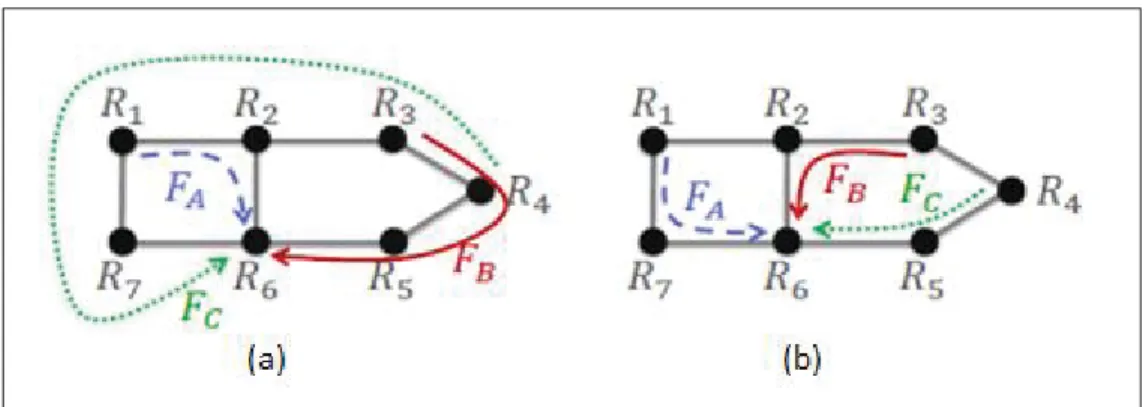
Adopting SDN technology in Inter-DC WAN is a new trend in networking field. SD-WAN provides a globally central view of the current state of the network which can be used to make optimal decisions for resource allocation, unlike legacy WAN which is based on local decisions made by each network node. In fact, using traditional approaches, Inter-DC WAN can be stuck in suboptimal state related to resource allocation as shown in Figure 1.1 which can affect the required performance of Inter-DC WAN.
Figure 1.1 Local path selection using MPLS TE (a) vs global optimal path (b) Taken from Hong et al. (2013)
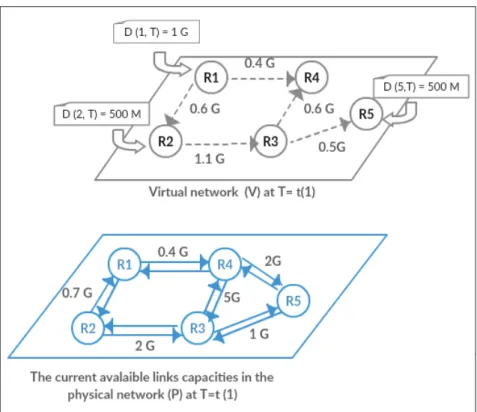
This thesis lies within this context, and is dedicated to the optimization of traffic engineering in WAN in order to minimize the total cost (e.g., energy consumption) using the SD-WAN approach. Our problem is to overlay optimally a virtual network on the top of a physical Inter-DC WAN as shown in Figure 1.2 while minimizing the total cost and satisfying application requirements in terms of bandwidth demand and QoS. Existing solutions such as B4 (Jain et al., 2013) presented by Google, and SWAN (Hong et al., 2013) of Microsoft, both focus on optimizing resource allocation in WAN while respecting priorities of different flows CoS in order to maximize resource utilization and throughput in the network. These solutions do not take into account network specifications and inter-domain communication. On the other hand, these solutions are not energy aware: they do not consider energy parameters in their problem formulation.
5
Figure 1.2 Graphical presentation of the problem statement
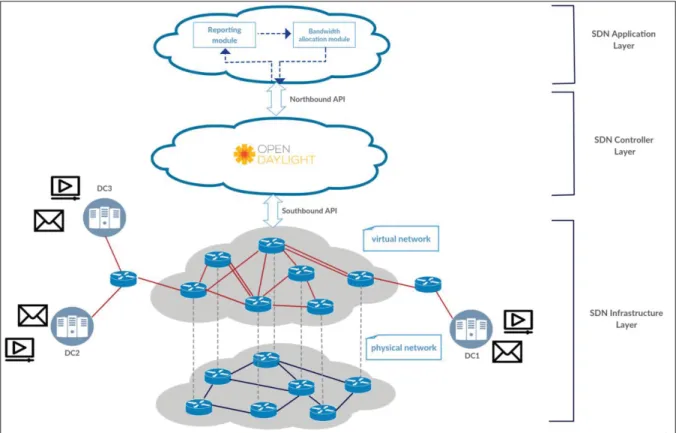
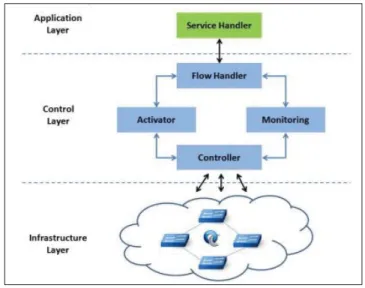
Our main goal is to maximize network utilization and to minimize the total energy consumption while taking into account network specifications and inter-domain communication. Evolved from the SWAN (Hong et al., 2013), we will use the global view of the current state of the network provided by SDN controllers to optimize the virtual network on top of the physical WAN. Figure 1.3 presents the architecture of SDN network which contains three main layers: infrastructure, control and application layer. Our solution will be deployed as a SDN application in order to be generic and to ensure the portability and the adaptability with different WAN infrastructure belonging to different SPs.
Figure 1.3 Deploying the proposed solution in SDN application layer
To achieve our goals, a number of research questions need to be addressed throughout this thesis. Therefore, a research objective will be defined, which will then be divided into specific objectives. Our research methodology will be proposed targeting these objectives.
1.3 Research questions
In order to build a virtual network on top of a physical Inter-DC WAN, so that the utilization of available physical resources will be maximized and the total cost in terms of energy consumption will be minimized, it is primordial to deal with the following research questions:
RQ1: How is a virtual network mapped into the physical network while respecting existing physical capacities of different components (links and nodes) in real time?
7
The first challenge in this thesis is the mapping problem: mapping virtual network into the physical network while taking into account existing physical capacities and maximizing throughput in the network. To optimally embed virtual links onto the physical network, we should have a global view of the current state of the network which is provided by SD-WAN approach. Traditional and virtual solutions for Inter-DC WAN use the local state of the network provided by routers which can lead to a suboptimal mapping and a waste of resources. In order to provide efficient traffic engineering, we propose in this thesis to investigate how to use the centralized and the global view of the state of the network provided by SD-WAN to optimize the mapping between virtual and physical network in order to maximize throughput in Inter-DC WAN in real time.
RQ2: How can the network be energy efficient when bandwidth is allocated to applications belonging to different CoS?
Existing works such as B4 (Jain et al., 2013) and SWAN (Hong et al., 2013) do not take into account energy parameters in their proposed models. This work aims to provide an optimal and green traffic engineering in Inter-DC WAN. To meet this goal, the minimization of the total energy consumption must be taken into account in the proposed optimization model. So, it is primordial to model energy consumption of different components (links and nodes) based on the current load in the network. In this thesis we consider the energy efficiency problem from the high level which contains logical nodes and links, when applying our proposed model to a specific network (e.g: DWDM) other components should be taken into account to compute the total energy consumption.
RQ3: How to add new constraints related to network specifications and inter-domain communication to the optimization model?
Taking into account constraints related to the nature of WAN is very important to improve outputs of the optimization model proposed in this thesis. In fact, considering network
specifications, in our case MPLS, and the communication inter domains with different policies such as: maximum/minimum capacity that could be allocated to single flow, etc. will simulate the real behavior of Inter-DC WAN and make our approach very realistic: it can be deployed easily in a real environment unlike existing works which consider just two main layers: the virtual layer and the physical layer.
1.4 Objectives
The main objective of our work is to optimally define the virtual network on the top of the existing physical network in order to satisfy applications requirements (Bandwidth and QoS) and to minimize the total cost related to energy consumption and resource utilization. This objective can be divided into five specific objectives based on previous research questions. SO1: Model the energy consumption of links and nodes and add these parameters to the proposed optimization model in order to minimize energy consumption when allocating bandwidth to applications.
To answer our third research question related to the minimization of the total energy consumption of the proposed solution it is primordial to model energy consumption of links and nodes in the network based on the allocated bandwidth in each of these components. So, we must start by studying existing energy consumption models, then, proposing our mathematical formulation. Then, we must add these parameters to the proposed optimization model in order to be able to generate an energy aware solution.
SO2: Add constraints related to network specifications (MPLS) and inter-domain communication to the proposed optimization model.
Existing solutions do not consider network specifications or communication inter-domain; in fact, physical WAN can be a combination of different MPLS domains with different specifications. So it is very important to consider the diversity of domains and their different specifications in the proposed optimization model. Through this specific objective, we will
9
focus on adding constraints related to network specifications (MPLS in our case) and communication inter-domain to the proposed problem formulation.
SO3: Build an optimization model and implement a solution to optimize resources allocation and to maximize throughput in the network while minimizing the total cost in terms of energy consumption and respecting underlying specifications and inter-domain communication.
To respond to our research questions related to throughput maximization through the network virtualization, mapping and energy efficiency, we build an optimization model for throughput maximization which allocates bandwidth to flows based on their CoS while respecting existing physical capacity in the physical network (link and node capacities), minimizing energy consumption and respecting network specifications. As a first step, this model will be inspired from Microsoft solutions’ SWAN (Hong et al., 2013). The proposed model uses linear programming (LP) for bandwidth allocation: it uses the throughput maximization approach to allocate bandwidth to flows belonging to different CoS with different priorities. It uses MMF approach to allocate bandwidth to flows having the same CoS. This model generates a virtual topology which should be defined on top of the physical topology to meet bandwidth demand in each node in the network and to guarantee the required QoS. Then, we propose a deterministic algorithm to solve the proposed optimization model using LP solvers.
SO4: Propose a greedy heuristic to improve the runtime of the deterministic algorithm when physical topology is dense.
Finally, in order to improve the performance of the proposed algorithm, which uses LP to solve the proposed optimization model, we propose a greedy heuristic which is able to produce a solution meeting our requirements in terms of the minimization of energy consumption and the maximization of throughput in the network within a shorter runtime.
1.5 Hypothesis
By optimizing the design of the virtual WAN that should be over-layered on the top of the physical WAN, we would satisfy applications demand in terms of resource requirements and QoS while minimizing energy consumption, maximizing resource utilization and optimizing resource allocation.
1.6 Research originality
Our main contributions in this work are: (i) energy consumption modeling for different components (links and nodes) in the network (ii) an optimization model which takes into account different energy profiles of network elements (nodes and links) and cover different layers (iii) a deterministic algorithm proposed to solve the optimization problem using LP solvers and (iv) a greedy heuristic proposed to improve the runtime of the proposed solution.
1.7 Plan
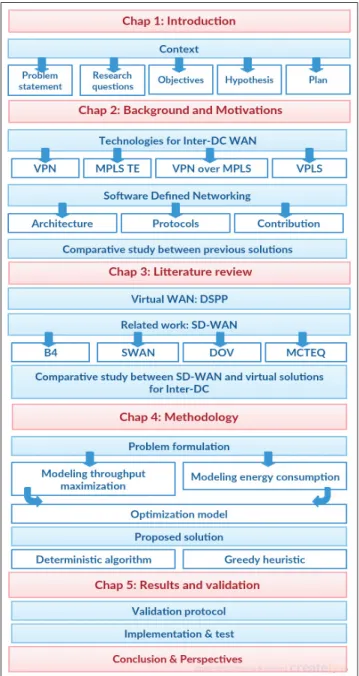
This thesis will be divided into four main chapters:
¾ In the second chapter, we will present our background and our motivation to deal with the problem statement presented in chapter 1 by introducing traditional solutions used in Inter-DC WAN and SDN technology:
o The first section in this chapter will expose traditional technologies used in legacy WAN to interconnect DCs, their advantages and their limitations;
o In the second section of this chapter, we will present Software Defined Networking (SDN) technology: its architecture, its protocols and its contributions;
o Finally, we will summarize benefits and drawbacks of different solutions presented in this chapter for Inter-DC WAN.
11
o The first section will present contributions and limitations of two solutions proposed to interconnect DCs and to optimize resource allocation using network virtualization; o Then, we will expose four solutions proposed for Inter-DC WAN using the concept of
SDN applied to WAN (SD-WAN) and we will discuss their contributions and their limitations;
o The final section will be reserved to present benefits and drawbacks of different solutions presented in this chapter for Inter-DC WAN in order to highlight our main contributions through this thesis.
¾ The fourth chapter will present our methodology to achieve our objectives listed previously in section 1.4.
o In the first section of this chapter, we will present an optimization model which aims to maximize throughput in the network based on bandwidth demand in different nodes;
o In the second section, we will present four models for the energy consumption of different components in the network (links and nodes): the idle, the fully proportional, the agnostic and the step-increasing models;
o Then, we will introduce MPLS network modeling which are constraints that should be added to the proposed optimization model in order to generate a solution which takes into account underlying specifications;
o Then, we will present the final energy aware optimization model with different constraints related to network specifications and inter-domain communication;
o The final section of this chapter will be reserved to introduce the deterministic algorithm proposed to solve the optimization problem using LP solvers and the greedy heuristic proposed to improve the runtime of the deterministic algorithm when the physical topology is dense.
¾ The last chapter, which deals with the results and validation, will present:
o First, the validation protocol proposed to validate our work and our proposed solution;
o Then, the implementation steps of the deterministic algorithm and a comparative study between the performance of the proposed algorithm and two existing solutions which are: Microsoft’s solution SWAN and a base line solution;
o Finally, the implementation of the greedy heuristic and a comparative study between its performance and the performance of the deterministic algorithm and Microsoft’s solution: SWAN.
CHAPTER 2
BACKGROUND AND MOTIVATIONS 2.1 Introduction
In this chapter, we present existing approaches used nowadays to interconnect DCs. We start by traditional technologies such as VPN, MPLS TE, VPN over MPLS and VPLS used in legacy WAN, and we will highlight their features and limitations. Then, we introduce the new technology “Software Defined Networking: SDN”: its architecture, its protocols and its different contributions. Finally, we introduce few motivations which encourage research to use SDN concept in WAN.
2.2 Traditional solutions for Inter-DC WAN
2.2.1 Layer 3 Virtual Private Network: L3 VPN
2.2.1.1 Overview
Layer 3 Virtual Private Networks (L3 VPNs) are used by SPs in order to provide VPN services to their customers by transmitting sensitive information across the public Internet using their IP backbone. A L3 VPN (Jerkins, 2015) is a set of sites that share common routing information and whose connectivity is controlled by a set of policies and rules. Before introducing MPLS architecture, private networks were deployed by using two basic techniques which are: the overlay model and the peer-to-peer model.
¾ The overlay model (Detti, Caricato et Bianchi, 2010) uses the virtual circuits of a Frame Relay or ATM service, which means that sites can be interconnected through IP layer above a Layer 2 connectivity service. It is a traditional approach to interconnect distant DCs based on setting up secure end-to-end connections which emulates virtual circuits
over public networks. In this model, the service is negotiated and rendered only in the two end points of the created tunnel;
Figure 2.1 Example of VPN using overlay model Taken from eTutorials.org. (2017)
¾
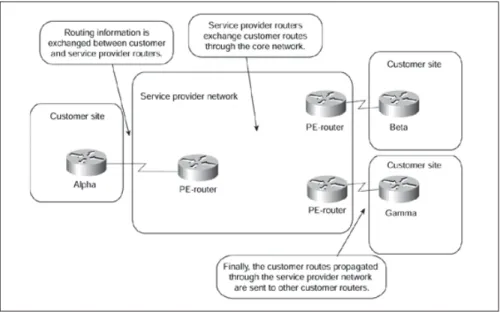
In the peer-to-peer model, some limitations of the overlay model were taken into consideration by replacing the use of multiple virtual circuits with a direct exchange of routing information in aggregated tunnels as shown in Figure 2.2.Figure 2.2 Example of VPN peer-to-peer model Taken from eTutorials.org. (2017)
15
2.2.1.2 Advantages
The L3 VPN overlay model has the following advantages:
¾ Possibility to use duplicated addresses;
¾ Isolation offered by this model between the control plan and security plan.
The L3 VPN peer to peer model also has many advantages compared to the overlay model. The most important ones are:
¾ Routing and installation procedures are very simple and easy, due to the elimination of multiple virtual circuits concepts used in the overlay model;
¾ Elimination of the problem related to the size of circuits; ¾ High scalability compared to the overlay model.
2.2.1.3 Limitations
The main disadvantages of the overlay model are:
¾ Difficulty and complexity in the optimization of the virtual circuits’ size between sites; ¾ Meshed circuits are required to interconnect the different equipment in the network. In
fact, this model has a serious scaling problem when the number of egress routers is large due to the need to establish a tunnel between every two sites in WAN;
¾ Provisioning is a problem with this model because the time required to configure VPN tunnels increases with the size of the network. That’s why, fully meshed networks are very hard to configure and to manage;
¾ A simple link failure can result in dozens of VCs going down, forcing the IP routing protocols into a major re-convergence.
On the other hand, main drawbacks of the peer-to-peer model are the following: ¾ Requirements for an IGP protocol to allow the SP to manage all the VPN tunnels;
¾ This model does not allow using duplicated addresses between customers unlike the overlay model.
2.2.2 Multi-Protocol Label Switching Traffic Engineering: MPLS-TE
2.2.2.1 Overview
Multi-protocol Label switching (MPLS) is an IETF standard which merges layer 2 and layer 3 protocol by using labels switching in the core network, thus reduces the workout of looking the routing table overhead (Malis, 2012; Winter, 2011). Nowadays, many WANs are operated using the MPLS-TE. To effectively use network capacity, MPLS-TE spreads traffic across a number of tunnels between ingress-egress router pairs. Ingress routers split traffic, typically equally across the tunnels to the same egress using the Equal Cost Multipath Routing (ECMP) (Hong et al., 2013) which is a load balancing algorithm used in the session level to choose a path between equal cost paths. To estimate the traffic demand for each tunnel and to find network paths for it, MPLS TE uses the Constrained Shortest Path First (CSPF) algorithm, which identifies the shortest path that can be used to carry the traffic in the network with the respect of some constraints related to service priorities and link capacity (Jain et al., 2013).
MPLS offers a single QoS paradigm; but more importantly, it makes it simple for services to request QoS and have that request mapped through to traffic engineering (Awduche, 1999). MPLS TE is based on the differentiation between services using service priorities and the Differentiated Service Code Point (DSCP) which is a field in the IP header which can be used to classify services.
17
MPLS TE forwards packets based on labels placed in the header, this method can reduce the complexity of the routing procedure: the source router is responsible for the complex task which is adding the label to the traffic, and routers in the core network simply read the label and forward the packet based on the rules created for that label.
2.2.2.2 Advantages
MPLS TE unifies advantages of two technologies used before to ensure the scalability and the QoS which are the Integrated Services (InterServ) (Yildirim et Girici, 2014) and the Differentiated Services (DiffServ) (Wang et Guo, 2012). So the most important advantages of MPLS TE are the following (Malis, 2012):
¾ MPLS TE provides an efficient way to forward traffic across the network and to avoid overutilization and underutilization of links and nodes in the WAN;
¾ MPLS TE takes into account the configured and the available bandwidth of different links in the topology;
¾ MPLS TE computes the shortest path for services with the highest priority; ¾ MPLS TE supports the rerouting of traffic around a failed link;
¾ MPLS TE optimizes the routing procedure by introducing the concept of labels switching;
¾ MPLS increases network scalability, simplifies network service integration, offers integrated recovery, and simplifies network management (Awduche, 1999).
2.2.2.3 Limitations
MPLS TE is widely used for DCs interconnection, there is some advanced MPLS TE implementation used today by many online SPs such as Google and Microsoft. However, even enhanced versions of MPLS TE have major limitations that can affect the performance of this technology (Strelkovskaya, Solovskaya et Paskalenko, 2015):
¾ With MPLS TE, services send their traffic without having a global idea about the current state of the network;
¾ The allocation model used by MPLS TE is inefficient because it is based on local decisions. In fact; no router in a MPLS-TE network has a global view of the current state of the network; as a result, the network can be stuck in a local optimal solution which is globally suboptimal;
¾ With MPLS TE there is no possibility to coordinate changes in the network. For example, it is impossible to move some flows, in a real time, in order to free links to be used by other flows. MPLS TE does not support such flexibility in WAN.
2.2.3 VPN over MPLS
2.2.3.1 Overview
MPLS VPN is a VPN built on top of an MPLS network (Cittadini, Battista et Patrignani, 2013). It is usually used by SPs to ensure connectivity between companies or DCs. The terms "MPLS IP VPN," "MPLS VPN,” "MPLS-based VPN" and “VPN over MPLS” can be used synonymously.
VPN over MPLS is built according to a peer to peer VPN model and uses a connection less architecture to create a highly scalable solution and to ensure the required QoS (Dumka et al., 2015). In this technology, VPN and MPLS work together to create a private virtual network which is extremely efficient at labeling and delivering traffic compared with using only VPN or MPLS TE separately. VPN over MPLS has the ability to ensure the required QoS demanded by enterprises, comparable to other technologies previously presented in this section.
19
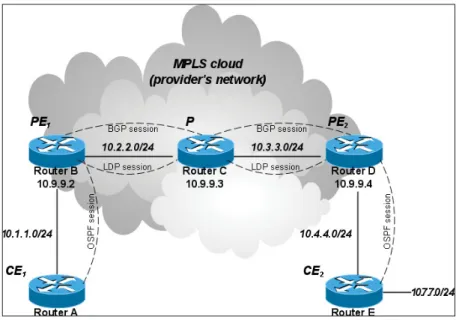
Figure 2.3 VPN over MPLS example Taken from MikroTik (2010) 2.2.3.1 Advantages
Obviously, VPN over MPLS combines advantages of VPN and MPLS TE. In addition, this technology has other improvements such as (Yunos et al., 2013):
¾ VPN over MPLS performs in connection less state which means that no prior action is required to establish the communication between two hosts. This criterion makes the procedure of communication establishment very efficient and flexible;
¾ VPN over MPLS is structured according to the peer-to-peer model to ensure high scalability in the network. In fact, according to this model, a customer site is required to communicate only with one provider to eliminate drawbacks of point to point approach or virtual circuits;
¾ Another advantage of VPN over MPLS is that no intelligence is required in VPN devices because all of the VPN functions are executed in the core network. That’s why there is no need to tunneling protocols like IPsec. So, using VPN over MPLS allows the customer to use less expensive devices or to continue to use same devices;
¾ And finally, provisioning is easier with VPN over MPLS because this procedure needs to be done only on backbone network devices.
2.2.3.2 Limitations
There are some known limitations of this technology; the most important ones are the following:
¾ VPN over MPLS does not provide a guaranteed QoS in terms of Service Level Agreement (SLAs) because QoS cannot be provided by MPLS. On the other hand, trying to guarantee the required QoS and adding traffic engineering require keeping state in the network which can generate a scalability problem;
¾ MPLS VPNs are only private at the routing level: no authentication, confidentiality, or integrity is provided by the architecture (Cittadini, Battista et Patrignani, 2013). In fact, SPs is able to inspect all traffic carried in WAN and the isolation in this case depends on the provider;
¾ In VPN over MPLS, the provider and the customer share the maintenance of the network which makes this mission very complicated in case of failures or connectivity problems.
2.2.4 VPLS
2.2.4.1 Overview
VPLS is an emerging layer 2 MPLS based services standard that provides multi-point-to-multi-point connectivity to enterprise users. It connects all of its enterprise sites that are located in a single metro area or spanned over multiple metro areas using the scalable-shared IP/MPLS infrastructure to provide a transparent LAN connectivity. Enterprises can create one or more VPLS domain in their carrier's network (Biradar, Alawieh et Mouftah, 2006; Lu et Xu, 2010). Virtual Private LAN Services (VPLS) supports distributed Ethernet LANs, it uses MPLS as the backbone network to route packets. A 100 Mbps interface to VPLS can support an SLA at speeds of 1 Mbps to 100 Mbps of traffic.
21
2.2.4.2 Advantages
¾ VPLS has been proven to be an effective and inexpensive way to provide a multi-point Layer 2 Ethernet network business services, as well as network edge infrastructure to residential voice, video and data (Triple Play) services (Hachimi et Bennani, 2007); ¾ Using VPLS, multiple Ethernet domains are considered as a single Ethernet LAN which
allows sharing the same broadcast domain between different domains; ¾ Using VPLS to interconnect DCs minimize latency in the network; ¾ In addition of IP, VPLS supports legacy protocols.
2.2.4.3 Limitations
VPLS has the following limitations:
¾
VPLS has a good performance when the number of sites is limited, in fact, VPLS has a scalability problem;¾
The process of provisioning a new VPLS circuit is complicated because the service provider has to check device configurations one by one. Therefore, it is difficult to provide the service on demand (Hu, Yang et Liu, 2016);¾
Finally, VPLS is a complex technology because to manage a VPLS network, you need to manage a large number of MAC addresses since there is no hierarchy like IP addresses. 2.3 Software Defined Networking2.3.1 Overview
The traditional WAN technologies used to interconnect DCs have some issues when the traffic increases; it is characterized by a poor efficiency and poor sharing which can degrade the performance of the current network devices. Besides, these devices can’t provide enough flexibility to deal with different packet types and to dynamically execute some path changes
to avoid the underutilization or the sub-utilization of Inter-DC’s resources (Hong et al., 2013). As a consequence, WAN needs to be able to adapt some dynamic changes in resource allocation based on the current state of the network in order to increase the average of utilization of links and nodes in inter-DC WAN , to reduce the delay and to ameliorate WAN performance when the traffic is important.
A potential solution proposed to this problem is to extract the data handling rules from the hardware and implement it as software modules. This method enables to have more centralized control over the network traffic which allows improving the performance of the network in terms of efficiency and resource optimization. Such an idea is presented in an innovative technology, called Software-Defined Networking (SDN), its concept was originally proposed by Nicira Networks based on their earlier development at UCB, Stanford, CMU, Princeton (Hu, Hao et Bao, 2014).
Software-defined networking (SDN) is a new approach to design, build, and manage networks, this approach is based on the separation between the control plane and the data plane to better optimize each part. SDN centralizes control of the network by implementing it as software in a separate entity called the controller (Kreutz et al., 2015). This controller is responsible for inserting rules in routers and switches in data plane based on decisions taken by the control plane in order to simplify data delivery in the infrastructure layer. This method helps to make changes globally and to improve the efficiency of the network and to simplify its management (Nunes et al., 2014).
23
Figure 2.4 Traditional network architecture (a) versus SDN architecture (b)
Taken from Rawat et Reddy. (2017)
Figure 2.5 shows SDN framework which contains three main layers: data plane, control plane and application plane.
Figure 2.5 SDN framework Taken from Gouveia et al. (2014)
Data plane: comprises network elements such as switches and routers which expose their availability to the centralized controller via southbound interfaces.
Control plane: contains the centralized controller which is responsible for routing, traffic engineering and mobility.
Application plane: contains SDN applications, which communicate their network requirements to the controller via northbound interfaces.
2.3.2 SDN protocol: OpenFlow
There are many standard protocols used by SDN to ensure the communication between the control plane and the data plane, the most popular one is the “OpenFlow” which allows SDN implementation in both hardware and software devices (Lara, Kolasani et Ramamurthy, 2014). OpenFlow is flow-oriented protocol; it is used for communication between the infrastructure layer and the control layer. In fact, the controller communicates with switches and manages them through OpenFlow. An OpenFlow switch can contain multiple flow tables, a group table and an OpenFlow channel; therefore, OpenFlow switches in the data plane are connected to each other via the OpenFlow ports. To understand the different functionalities of OpenFlow, it is primordial to explain first the following key words:
Flow tables: contains a set of flow entries, the flow table is used to match or to specify an action to incoming packets and to direct them to its destination based on its header. A flow table entry is identified by its match fields and priority: the match fields and priority taken together identify a unique flow entry in the flow table (TS-007, 2012).
Group tables: contains a set of group entries, a flow table may direct a flow to a group Table, which may execute a variety of actions that affect one or more flows.
OpenFlow channel: is the interface used for communication between an OpenFlow switch and an SDN controller. First, the controller uses this interface to configure and to manage switches. Second, it uses it to receive events from switches.
OpenFlow ports: there are physical network interfaces used to pass packets between OpenFlow processing and the rest of the network.
25
2.3.3 Contributions of SDN
SDN concept is a strong candidate to replace existing architectures because it has many advantages that can overtake limitations of traditional technologies used in WAN to interconnect DCs. So in this section, we will expose the most important advantages of SDN which encourage SPs to think about using to this new approach:
Intelligence and speed: SDN is able to optimize the distribution of the workload in the network thanks to the centralized control and the global knowledge of the current state of different links and nodes in the topology. This optimization can lead to a high-speed transmission in the network and enhance the efficiency of resource allocation.
Easy network management: There is a remote and global control over the network and there is also the possibility to change the network characteristics based on the workload patterns. This is the main advantage of the centralized architecture proposed by SDN. Additionally, the centralized architecture proposed by SDN is a motivation for researchers in traffic characterization and prediction field. In fact, they can develop advanced algorithms to predict failures or link overutilization and based on this prediction module, the controller can update in a real time some rules in different switches in the data plane.
Multi-tenancy: SDN ensures that all tenants have good cross site performance isolation, unlike existing architectures which do not support control network ability between different intra-tenants and inter-tenants.
These advantages listed above present a really good motivation for researchers who are looking for a solution to control and manage their networks in an optimal and efficient way, to minimize the total cost of resource allocation and to achieve the required level of scale. So, using the new concept of SDN in inter-DC WAN will remedy to some limitations of traditional or even virtual technologies used nowadays to interconnect DCs.
2.4 Comparative study between traditional solutions for Inter-DC
In the beginning of this report we mentioned three challenges (bandwidth, cost and operations) that should be taken into account while over layering virtual network on top of the physical Inter-DC WAN. We will present, in the following table, how each solution presented in this chapter deals with these three challenges.
Table 2.1 Existing solutions and Inter-DC WAN challenges
Solution Bandwidth allocation Cost Operations
Layer 3 VPN Dedicated
Distributed (routers) Static
Bandwidth utilization Manual
MPLS TE Shared Distributed (routers) Static Bandwidth utilization Shortest path Manual VPN over
MPLS Shared Distributed (routers) Static
Bandwidth utilization
Shortest path Manual
VPLS Shared
Distributed (routers) Static
Bandwidth utilization
Shortest path Manual
SDN Shared
Centralized Dynamic
Bandwidth
Energy consumption Delay, load balancing, etc.
Dynamic
2.5 Conclusion
In this chapter, we introduced first traditional technologies used in legacy WAN to interconnect DCs such as: VPN, MPLS TE, VPLS and VPN over MPLS. We studied their advantages and we highlighted their limitations related to resource utilization in order to highlight our contribution. Then, we presented the new concept SDN: its architecture, its protocols and finally its advantages in order to expose our motivation to use SDN approach to optimize traffic engineering in Inter-DC WAN. Finally, we compared the proposed technology for Inter-DC WAN based on three criteria presented previously in the introduction chapter: bandwidth, cost and operations.
CHAPTER 3 RELATED WORKS 3.1 Introduction
In this chapter, we introduce some advanced solutions proposed to optimize the interconnection between DCs which are known as “virtual WAN solutions.” We present how network virtualization can optimize resource allocation and maximize throughput in Inter-DC WAN. Then, we expose four related works which have same objectives related to resource maximization and the minimization of the total cost using SD-WAN approach. And finally, we introduce a comparative study which highlights advantages and limitations of each existing solution used to interconnect DCs presented in chapter 3 in order to emphasize our contribution through this thesis.
3.2 Virtual WAN
3.2.1 DSPP
3.2.1.1 Overview
As we know, large-scale online SPs have made their choice to geographically distributed their cloud infrastructure to host and deliver services in order to be able to ensure performance requirements specified in SLA while satisfying QoS expected by users. The most difficult challenge faced by SPs is to locate different applications while minimizing the hosting cost and ensuring key performance requirements. Existing solutions for the service placement has usually ignored: cost fluctuations, reconfiguration costs, availability of resources and impact of the geographical location. In fact, existing solutions are mostly static or time invariant. The problem of service placement is very similar to the problem of application deployment in WAN proposed in this thesis, both problems focus on optimizing
resource allocation in Inter-DC WAN with the minimum cost while satisfying application requirements and respecting existing physical capacities.
.
The suggested solution in this work is to propose as a first step a control framework based on Model Predictive Control (MPC) approach to provide an online adaptive control mechanism which focuses on reducing service provider costs, resource allocation and reconfiguration costs (Zhang et al., 2012). And as a second step, this solution will be extended to a game-theory model to consider the competition among multiple SPs while taking into account the capacity constraint of each data center (Zhang et al., 2012). This work uses game theory as a tool to optimize resource allocation in case of having multiple SPs competing for distributed resources.
This work proposes three cases: first, it takes into consideration resources required by a single SP and it analyzes how a single SP can respond to its demand in terms of resource allocation and minimize the total cost. Second, they simulate the competition between multiple SPs using game theory. And finally, they take into consideration the contribution of an infrastructure provider to ensure the welfare between different SPs. The main objective is to minimize the total cost dynamically over time with the respect of two main constraints which are SP’s demand and resource price fluctuations. Qi Zhang et al focus on helping SPs to dynamically control the number of active servers placed in each data center and to minimize the total resource cost while satisfying SLA and QoS requirements.
3.2.1.2 Proposed solution for single SP Architecture
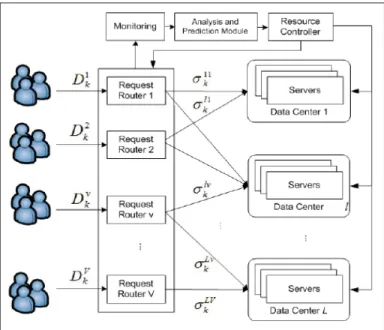
To understand the problem of dynamic resource allocation, it is primordial to present the architecture used for distributed service placement, this architecture contains:
29
Request routers: redirect requests from customers to appropriate servers. The monitoring module: collects statistics related to the network state.
Analysis and prediction module: is responsible to model the dynamicity of the demand and price fluctuations. On the other hand, it computes and forecasts their future values.
Resource controller: solves DSPP and makes online control decisions at run time. Moreover, it informs the request routers about the number of servers allocated in each data center for each SP.
Figure 3.1 Dynamic Service placement architecture Taken from Zhang et al. (2012)
MPC and W-MPC algorithm
The main objective of SP is to minimize its total cost which contains resource allocation costs and reconfiguration costs. In fact, SP must minimize the total cost under two main constraints: demand constraints and SLA constraints. So, DSPP is a linear quadratic problem that can be solved using the standard methods like: comparison method, elimination method and substitution method. MPC algorithm is used to solve DSSP dynamically based on
resource availability and resource costs fluctuations in different DCs. This algorithm can be summarized in three main steps:
1. At time k, the resource controller predicts the future demand for multiple periods using the Auto-Regressive Integrated Moving Average (ARIMA) (Ariyo, Adewumi et Ayo, 2014) model which predicts a value in a time series using a linear combination of past values in past time series;
2. The controller solves the optimization problem for the prediction horizon starting with the initial state;
3. The solution of the optimization problem will contain a set of values; the controller will only execute the first one in the sequence and other values in the sequence will be used to predict the resource allocation while minimizing the reconfiguration cost.
To conclude, MPC helps to find ( , , ) which is the number of servers that should be added between the two states and + 1 in order to serve the demand in the location . But there is a serious problem in this stage: MPC is not enough to guarantee the required SLA in case of underestimated future demand. So to avoid this issue, they propose to increase the frequency at which MPC algorithm runs in order to reduce the duration in which servers are under-provisioned.
After proposing a solution for a single SP, Qi Zhang et al propose to extend it with multiple SPs which can share resources in the existing infrastructure. It is obvious that the goal of each SP is to minimize its operational costs while respecting previous constraints which are SLA performance requirements and demand. In this case, there is an additional constraint that should be added to the previous optimization model which is the current data center capacity and the current resource availability. For each , the problem is used to minimize its total cost while respecting an additional constraint related to total capacities of different DCs. In this case, competition between SPs is simulated using “Game theory”: player dynamic non-cooperative game, in fact each makes its decision independently. So the objective here is to find the NE (Nash Equilibrium) which is the stable outcome of the current competition.
31
To solve this problem, Qi Zhang et al propose to work with W-MPC Nash Equilibrium because it responses to their requirements, they proved that to find the NE that minimizes the cost function, they must find the NE that minimizes the Social Welfare Problem (SWP) function. It means that they try to find NE where costs incurred by all service providers are minimized. But, if SPs decide the placement of their own resources based on the price, some of them will hog all cheap resources and hence the others will get only expensive resources. That’s why, Qi Zhang et al extend their work to introduce the contribution of infrastructure providers (InP) to increase the total revenue and to minimize costs for all SPs while ensuring fairness.
So InP’s objective is to minimize its utility function which contains a convex penalty that captures the penalty of demand rejection. Utility function of InP can be determined by the revenue from selling resources to different SPs and service quality expressed by the number of rejected resources request. To solve the problem presented previously, InP uses the following algorithm which can be summarized in five main steps:
1. At time k, InP announces the future resource prices for a window 1 ≤ t ≤ W, and each ∈ N submits its demand;
2. At each step, each solves the problem its ;
3. At each step, InP solves an optimization problem that minimize its total cost with the respect of price fluctuations;
4. Finally, the algorithm updates the value of the Lagrangian parameter in each iteration; 5. This process repeats until the solution converges to a local optimal solution.
3.2.1.3 Advantages and limitations
This work uses Game Theory to optimize hosting costs dynamically over time based on both demand and price fluctuations. Game Theory in this case is used to control the network’s state when the centralized control defined in SDN concept is absent. In case of uncoordinated SPs which can act in a selfish way, the resulting NE can be significantly suboptimal. So, Qi
Zhang et al propose to take into consideration the contribution of InP in order to maximize the social welfare.Obviously, this framework has achieved its main goal which is the ability to adjust resource allocation based on the dynamicity of resource prices. But the proposed algorithm is very complicated and can generate a huge overhead in the network, especially when the number of players (SPs) that are competing for resources is important, in this case the convergence of the proposed algorithm can take time. In addition, algorithms proposed in case of single SPs or multiple SPs do not take into consideration the difference between price models used in different DCs while solving the placement problem, which can have an important impact on the stable outcome of this competition. Finally, this work does not take into account the minimization of the total energy consumption while allocating resources to different SPs, it just consider the load balancing as a main objective.
3.2.2 ViNEYard
3.2.2.1 Overview
Mosharaf et al propose a new heuristic to deal with the problem of virtual network (VN) embedding which is known as an NP-hard problem. The proposed solution “ViNEYard: Virtual Network Embedding Algorithms With Coordinated Node and Link Mapping” (Chowdhury, Rahman et Boutaba, 2012) allows multiple SPs to use and share the same resources efficiently.
The VN embedding problem focus on the mapping of virtual network (virtual links and virtual nodes) in the existing physical infrastructure while respecting constraints related to physical resources availability and existing capacities. Moreover, this work deals with the VN embedding problem with online requests for the build of VNs, however, the VN embedding problem is known to be NP-hard even in the offline case (Chowdhury, Rahman et Boutaba, 2012). Existing works, usually, separate the mapping of virtual nodes and virtual links but even when all nodes are already mapped into the physical infrastructure, the mapping of virtual links still an NP-hard problem. On the other hand, making the decision of
33
nodes mapping without taking into account constraints related to link mapping can generate a poor solution which can affect the required performance. As a consequence, this work proposes a solution which takes into consideration the correlation between nodes and links mapping in order to produce an optimal solution for VN embedding with online and offline VN requests.
The main objective of this work is to propose an efficient alternative to solve the VN embedding problem while ensuring an optimal share of existing resources between different SPs and maximizing the acceptance ration of VN requests in order to increase the revenue of the InP.
3.2.2.2 Network modeling
In order to model the VN embedding problem, Mosharaf et al consider the network as weighted undirected graph with a set of substrate nodes and a substrate of links. Each node is characterized by its capacity in terms of the CPU and its location in the topology. On the other hand, each link has its capacity in terms of bandwidth. So the substrate network is modeled as shown in Figure 3.2 (a).
Figure 3.2 Modeling the substrate network (a), Example of VN request with node and link
constraints (b)
On the other hand, VN request is also modeled as a weighted undirected graph (Figure 3.2 (b)). Each VN request has its own requirements which are the following: preferred location, how far a virtual node can be embedded from its preferred location and required capacity in terms of BW and CPU (Chowdhury, Rahman et Boutaba, 2012). If there is a request for VN, the first step is to check if this request can be accepted based on its requirements in terms of BW and CPU and the existing capacities in the substrate network. In case of accepting the request, it is primordial, to select an assignment for this new VN that should be embedded. The procedure of assignment can be divided into two main components: node assignment and link assignment. The main objective of this work is to map multiple VN request while respecting virtual nodes and links requirements, increasing revenue for InP, decreasing costs for SPs and ensuring load balancing in the substrate network.
3.2.2.3 Problem formulation
The main contribution of this work is the correlation between nodes mapping and links mapping. In order to emphasize this correlation, Mosharaf et al propose to extend the substrate network to an augmented substrate graph while respecting location requirements of virtual nodes (Figure 3.3).
Figure 3.3 An augmented graph based on VN request Taken from Chowdhury, Rahman et Boutaba (2012)