HAL Id: hal-01174299
https://hal.inria.fr/hal-01174299
Submitted on 8 Jul 2015
HAL is a multi-disciplinary open access
archive for the deposit and dissemination of
sci-entific research documents, whether they are
pub-lished or not. The documents may come from
teaching and research institutions in France or
abroad, or from public or private research centers.
L’archive ouverte pluridisciplinaire HAL, est
destinée au dépôt et à la diffusion de documents
scientifiques de niveau recherche, publiés ou non,
émanant des établissements d’enseignement et de
recherche français ou étrangers, des laboratoires
publics ou privés.
Understanding and Improving Reformulation-Based
Query Answering Performance in RDF
Damian Bursztyn, François Goasdoué, Ioana Manolescu
To cite this version:
Damian Bursztyn,
François Goasdoué,
Ioana Manolescu.
Understanding and Improving
Reformulation-Based Query Answering Performance in RDF. BDA’15, Sep 2015, Île de Porquerolles,
France. �hal-01174299�
Understanding and Improving Reformulation-Based Query
Answering Performance in RDF
Damian Bursztyn
INRIA & U. Paris-Sud, France
[email protected]
François Goasdoué
U. Rennes 1 & INRIA, France
[email protected]
Ioana Manolescu
INRIA & U. Paris-Sud, France
[email protected]
ABSTRACT
Answering queries over Semantic Web data, i.e., RDF graphs, must account for both explicit and implicit data, entailed by the explicit data and the semantic constraints holding on them. Two main query answering techniques have been devised, namely Saturation-based (Sat) which precomputes and adds to the graph all implicit information, and Reform-ulation-based (Ref) which reformulates the query based on the graph constraints, so that evaluating the reformulated query directly against the explicit data (i.e., without consid-ering the constraints) produces the query answer.
While Sat is well known, Ref has received less attention so far. In particular, reformulated queries often perform poorly if the query is complex. Our demonstration [6] show-cases a large set of Ref techniques, including but not limited to one we proposed recently [5]. The audience will be able to 1. test them against different datasets, constraints and queries, as well as different well-established systems, 2. ana-lyze and understand the performance challenges they raise, and 3. alter the scenarios to visualize the impact on perfor-mance. In particular, we show how a cost-based Ref ap-proach allows avoiding reformulation performance pitfalls.
1.
INTRODUCTION
The efficient management of complex, semantic-rich Web data is a hot topic within the Databases, Semantic Web, and Knowledge Representation communities. In particular, the former has produced many techniques for storing, indexing, querying and updating such data, e.g., [4, 13, 14, 17], while the latter have mostly focused on expressive semantic lan-guages to describe the meaning of the data, e.g., [2, 3, 7]. Currently, technical interest seems to be split between the experts in “query evaluation”, which consider large databases and complex queries, but tend to ignore the data semantics, and the experts in “reasoning”, whose main focus is on the knowledge description formalisms. As an unfortunate con-sequence, reasoning is rarely considered in database systems and prototypes handling Semantic Web data. This makes
(c) 2015, Copyright is with the authors. Published in the Proceedings of the BDA 2015 Conference (September 29-October 2, 2015, Ile de Porquerolles, France). Distribution of this paper is permitted under the terms of the Cre-ative Commons license CC-by-nc-nd 4.0.
(c) 2015, Droits restant aux auteurs. Publié dans les actes de la conférence BDA 2015 (29 Septembre-02 Octobre 2015, Ile de Porquerolles, France). Redistribution de cet article autorisée selon les termes de la licence Creative Commons CC-by-nc-nd 4.0.
BDA29 septembre 2015, Ã ˝Ole de Porquerolles, France.
them ill-adapted to real-life applications, which are rich in constraints describing the properties of the data [16]; such constraints must be taken into account in order to compute correct results, and do so efficiently.
One possible reason for disregarding semantics is that for popular data models (such as the W3C’s Resource Descrip-tion Framework, or RDF in short) and associated constraint languages (such as RDF Schema, or RDFS), constraints can be compiled in the database, by materializing in the data all possible consequences of the constraints. For instance, if a constraint states that any Manager is an Employee, given a database D, one can build another database D0 by adding to D an Employee instance for each Manager from D. This can be seen as making explicit in D0, the instances of Em-ployee which were implicit in D; the process is called materi-alization or saturation. To answer a query over the original database D under the above constraint, one can just evalu-ate the query over D0, ignoring the constraint (since its ef-fects are fully reflected in D0). We use Sat to designate the saturation-based query answering technique outlined above. Sat is rather simple and well-understood. However, the saturation needs to be maintained after changes in the data and/or constraints, which may incur a performance penalty. Further, Semantic Web data is often found not in a single repository, but in a set of independent ones, typically called RDF endpoints; a set of well-known endpoints are listed in the Linked Open Data Cloud1. Data in each such indepen-dent source may or may not be saturated; further, implicit facts may be due to the presence of one fact in one endpoint, and a constraint in another. Computing the complete (dis-tributed) set of consequences in this setting is unfeasible, especially considering that such sources often return only restricted answers (e.g., the first 50) to a query, to avoid overloading their servers.
The alternative technique is based on query reformulation. It leaves the database unchanged, but changes the given query Q into a query Q0 which, evaluated over the original database D, returns the answer of Q against D0, reflect-ing both the implicit and the explicit data. In the simple example above, if Q asks for all the Employees, it is refor-mulated into Q0 returning the union of all Employees and all Managers. We term this technique reformulation-based query answering, and denote it Ref. While it has obvious advantages (it does not require credentials or space to store implicit data, nor the effort to maintain saturation), de-pending on the language in which the reformulated query is
1http://linkeddatacatalog.dws.informatik.
expressed, which we term a reformulation strategy, reformu-lation may lead to very large queries, whose evaluation is inefficient or even infeasible, making Ref non practical in general.
Our demonstration aims at showcasing to the audience the performance challenges raised by reformulation-based query answering. We will prepare a set of scenarios (data, constraints, and queries) and allow the audience to experi-ment with a variety of Ref strategies, and evaluating them through performant relational database management sys-tems (RDMBSs, in short): DB2, Postgres and MySQL. To enlarge the comparison, we also include native RDF systems using their own fixed (incomplete) Ref strategy, Virtuoso and AllegroGraph, as well as a query answering technique based on translating scenarios to Datalog programs and re-sorting to the LogicBlox engine for evaluation. In partic-ular, we show that (i) a fixed reformulation strategy may lead to very bad performance or simply fail - on moderate-size databases and simple constraints - on all the systems, because reformulated queries may be syntactically huge and (ii) a cost-based query reformulation approach allows avoid-ing such performance pitfalls and makes Ref feasible - and efficient - in the same setting(s).
2.
RELATED WORK
A thorough discussion of RDF Ref and Sat can be found in [5, 10]; we recall the most relevant works here. Most RDF data management systems use Sat, either providing a saturation service, like 3store, OWLIM, Sesame, etc., or by simply assuming that RDF graphs have been saturated prior to loading. RDF platforms built on top of RDBMSs [4], or RDBMS-style engines, e.g., [13, 14, 17] fall in this category. Ref has also been the topic of many works [8, 15, 18, 19], including ours [9]. Existing techniques apply to the Description Logics (DLs) [3] fragment of RDF, the conjunc-tive subset of SPARQL and extensions thereof [2, 7, 15, 19], including the “database fragment” of RDF we intro-duced in [9], the most expressive RDF fragment for which Ref techniques are known. Only a few RDF data manage-ment systems, such as AllegroGraph, Stardog or Virtuoso, use reformulation, in some cases incomplete (ignoring some RDFS constraints) [10].
A query is typically reformulated into an equivalent large union of conjunctive queries (UCQ) w.r.t. the RDF Schema constraints [7, 8, 9, 15, 19], or in a language currently not well supported by available engines, e.g., nested SPARQL [2]. The technique of [18], when translated to the RDF setting, reformulates a conjunctive query into a join of unions of atomic queries, called a semi-conjunctive query (SCQ).
In our recent work [5], we devised a novel strategy for improving Ref performance and robustness. Instead of re-formulating into a fixed UCQ or SCQ, we have identified a space of alternative reformulations, corresponding to an en-larged reformulation language consisting of joins of unions of conjunctive queries (denoted JUCQs in the sequel). UCQ and SCQ reformulations are each just a point in this space. The evaluation performance of distinct JUCQs from this space may differ by several orders of magnitude; we devised a cost model and used it in a greedy search algorithm to find out the JUCQ whose evaluation is likely to be most efficient.
Sat and Ref are combined in [19]; the resulting reformu-lated query may still be large, thus hard to evaluate.
Assertion Triple Relational notation Class s rdf:type o o(s)
Property s p o p(s, o)
Constraint Triple OWA interpretation Subclass s rdfs:subClassOf o s ⊆ o
Subproperty s rdfs:subPropertyOf o s ⊆ o Domain typing s rdfs:domain o Πdomain(s) ⊆ o
Range typing s rdfs:range o Πrange(s) ⊆ o
Figure 1: RDF (top) & RDFS (bottom) statements.
3.
PRELIMINARIES
3.1
RDF Graphs
An RDF graph (or graph, in short) is a set of triples of the form s p o. A triple states that its subject s has the property p, and the value of that property is the object o.
We consider only well-formed triples, as per the W3C’s RDF specification, using uniform resource identifiers (URIs), typed or un-typed literals (constants), and blank nodes (un-known URIs or literals) corresponding to a form of incom-plete information.
Notations. We use s, p, and o in triples as placeholders. Literals are shown as strings between quotes, e.g., “string”. Finally, the set of values – URIs (U ), blank nodes (B), and literals (L) – of an RDF graph G is denoted Val(G).
Figure 1 (top) shows how to use triples to describe re-sources, that is, to express class (unary relation) and prop-erty (binary relation) assertions. The RDF standard pro-vides a set of built-in classes and properties, as part of the rdf: and rdfs: pre-defined namespaces. We use these names-paces exactly for these classes and properties, e.g., rdf:type specifies the class(es) to which a resource belongs.
For example, the RDF graph G shown below describes a book, identified by doi1: its author (a blank node :b1related
to the author name), title and date of publication.
G =
{doi1rdf:type Book, doi1writtenBy :b1,
doi1hasTitle “El Aleph”,
:b1 hasName “J. L. Borges”,
doi1publishedIn “1949”}
RDF Schema allows enhancing the descriptions in RDF graphs by means of RDFS triples, declaring semantic con-straints between the classes and the properties used in those graphs. Figure 1 (bottom) shows the allowed constraints and how to express them; domain and range denote respectively the first and second attribute of every property. The RDFS constraints (Figure 1) are interpreted under the open-world assumption (OWA) [1].
RDF entailment. Implicit triples may be part of the RDF graph even though they are not explicitly present in it. W3C names RDF entailment the mechanism through which, based on the explicit triples and some entailment rules, implicit RDF triples are derived. We denote by `i
RDF immediate
en-tailment, i.e., the process of deriving new triples through a single application of an entailment rule. More generally, a triple s p o is entailed by a graph G, denoted G `RDF s p o,
if and only if there is a sequence of applications of imme-diate entailment rules that leads from G to s p o (where at each step of the entailment sequence, the triples previously entailed are also taken into account). For instance, assume that the RDF graph G above is extended with the following constraints.
doi1 Book Publication “El Aleph” :b1 “J. L. Borges” “1949” Person writtenBy hasAuthor publishedIn rdfs:subClassOf rdfs:domain rdfs:range rdfs:subPropertyOf hasTitle writtenBy hasName rdf:type rdf:type hasAuthor rdf:type rdfs:domain
Figure 2: Sample RDF graph.
• books are publications:
Book rdfs:subClassOf Publication
• writing something means being an author: writtenBy rdfs:subPropertyOf hasAuthor
• writtenBy is a relation between books and people: writtenBy rdfs:domain Book and
writtenBy rdfs:range Person
The resulting graph is depicted in Figure 2. Its implicit triples are those represented by dashed-line edges.
Saturation. The immediate entailment rules allow defin-ing the finite saturation (a.k.a. closure) of an RDF graph G, which is the RDF graph G∞ defined as the fixed-point obtained by repeatedly applying `iRDF rules on G.
The saturation of an RDF graph is unique (up to blank node renaming), and does not contain implicit triples (they have all been made explicit by saturation). An obvious con-nection holds between the triples entailed by a graph G and its saturation: G `RDFs p o if and only if s p o ∈ G∞.
RDF entailment is part of the RDF standard; the answers to a query posed on G must take into account all triples in G∞, since the semantics of an RDF graph is its saturation.
3.2
Conjunctive Queries
We consider the widely used SPARQL dialect consisting of (unions of) basic graph pattern (BGP) queries, a.k.a. con-junctive queries (CQs), widely considered in research but also in real-world applications [16]. A BGP is a set of triple pat-terns, or triples/atoms in short. Each triple has a subject, property and object, some of which can be variables. Notations. We use the CQ notation q(¯x):- t1, . . . , tα, where
{t1, . . . , tα} is a BGP; the query head variables ¯x are called
distinguished variables, and are a subset of the variables in t1, . . . , tα; for boolean queries ¯x is empty. The head of q is
q(¯x), its body is t1, . . . , tα; x, y, z, etc. denote variables.
Query answering. The evaluation of a CQ q against G has access only to G’s explicit triples, thus may lead to an incomplete answer. The (complete) answer of q against G is obtained by the evaluation of q against G∞. For instance, the query below asks for the names of authors of books somehow connected to the literal 1949:
q(x3):- x1 hasAuthor x2, x2 hasName x3, x1x4 “1949”
Its answer against the graph in Figure 2 is q(G∞) = {h“J. L. Borges”i}. Note that evaluating q only against G leads to the empty answer, which is obviously incomplete.
3.3
Reformulation-based query answering
The database (DB) fragment of RDF [9] is the most ex-pressive RDF fragment for which both saturation- and reformulation-based query answering techniques have been defined. Its name comes from the fact that query answering
Triple #answers #reformulations #answers after reformulation (t1) 18, 999, 082 188 33, 328, 108
(t2) 0 4 3, 223
(t3) 396 3 683
Table 1: Characteristics of the sample query q1.
against any graph from this fragment can be easily imple-mented on top of any RDBMS.
The DB fragment is defined by: (i) Restricting RDF en-tailment to the RDF Schema constraints only (Figure 1), a.k.a. RDFS entailment. While simple, these allow express-ing many practical application domain (ontological) con-straints. (ii) Not restricting RDF graphs in any way. In other words, any triple allowed by the RDF specification is also allowed in the DB fragment.
The associated query reformulation algorithm devised in [9] exhaustively applies a set of 13 reformulation rules based on RDFS constraints. Starting from a CQ query q to answer against db, the algorithm produces a UCQ reformulation qref using the constraints in a backward-chaining fashion, which retrieves the complete answer to q out of the (non-saturated) db: q(db∞) = qref(db).
4.
OPTIMIZED REFORMULATION
We illustrate performance challenges raised by the evalu-ation of state-of-the-art reformulated queries, and how our cost-based approach [5] allows tackling them.
Example 1. Let q1 be the query:
q1(x, y) :- x rdf:type y, (t1)
x ub:degreeF rom “http : //www.U niv532.edu”, (t2)
x ub:memberOf “http : //www.Dept1.U niv7.edu” (t3)
Table 1 gives some intuition on the difficulty of answer-ing q1 over an 108 triples LUBM [12] benchmark dataset,
evaluated through PostgreSQL 9.3.2 on a 8-core Intel Xeon (E5506) 2.13 GHz machine with 16GB RAM, using Man-driva Linux release 2010.0 (Official).
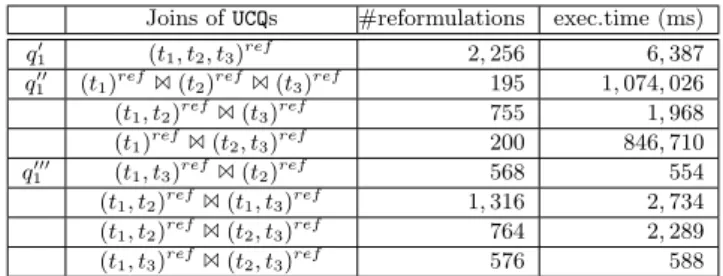
The state-of-the-art Ref technique reformulating a CQ into an UCQ computes the answer to q1 by evaluating a
reformu-lated query q10, which is a union of 2, 256 conjunctive queries,
each of which consists of three triples (one for the reformu-lation of each triple in the original q1). This query q01
ap-pears in Table 2, where all the triples t1, t2, t3 are
reformu-lated together by a CQ to UCQ reformulation algorithm de-noted (.)ref. Observe that in q01, many sub-expressions are
repeated; for instance, the join over the single triples result-ing from the reformulation of triples (t2) and (t3) will appear
for each of the 188 reformulations of triple (t1). Evaluating
q10 on the 100 million triples LUBM dataset takes more than
6 seconds.
Alternatively, one could consider the equivalent query q001 =
(t1)ref ./ (t2)ref ./ (t3)ref, which joins the CQ to UCQ
reformu-lation of each query’s triple. In other terms, q100first
refor-mulates each triple (into, respectively, a union of 188, 4, and 3 queries), and then joins these unions. This query corresponds to the simple semi-conjunctive queries (SCQ) al-ternative proposed in [18]. While this avoids the repeated work, its performance is much worse: it takes about 1074 seconds to evaluate.
Let us now consider the following equivalent query q1000=
(t1, t3)ref ./ (t2)ref where t1, t2, t3 are the triples of the
Joins of UCQs #reformulations exec.time (ms) q10 (t1, t2, t3)ref 2, 256 6, 387
q001 (t1)ref1 (t2)ref1 (t3)ref 195 1, 074, 026
(t1, t2)ref1 (t3)ref 755 1, 968 (t1)ref1 (t2, t3)ref 200 846, 710 q1000 (t1, t3)ref1 (t2)ref 568 554 (t1, t2)ref1 (t1, t3)ref 1, 316 2, 734 (t1, t2)ref1 (t2, t3)ref 764 2, 289 (t1, t3)ref1 (t2, t3)ref 576 588
Table 2: Sample reformulations of q1.
Triple #answers #reformulations #answers after reformulation (t1) 18, 999, 082 188 33, 328, 108 (t2) 18, 999, 082 188 33, 328, 108 (t3) 476 1 476 (t4) 509 1 509 (t5) 7, 299, 701 3 7, 803, 096 (t6) 7, 299, 701 3 7, 803, 096
Table 3: Characteristics of the sample query q2.
takes 554 ms, more than 10 times faster than the initial reformulation. The performance improvement of q0001 over q
00 1
is due to the intelligent grouping of the triples t1 and t3
to-gether. Such grouping of triples reduce the cardinality of the respective reformulated queries. Thus, (t1, t3)ref has 2, 045
answers and 564 reformulations. Table 2 shows the number of reformulations and execution time for all the eight possi-ble JUCQs.
Example 2. Let q2 be the query:
q2(x, u, y, v, z)
:-x rdf:type u, (t1)
y rdf:type v, (t2)
x ub:mastersDegreeF rom “http : //www.U niv532.edu”, (t3)
y ub:doctoralDegreeF rom “http : //www.U niv532.edu”, (t4)
x ub:memberOf z (t5)
y ub:memberOf z (t6)
Statistics on the query triples, when evaluated over a 100 million triples LUBM dataset, appear in Table 3.
The CQ to UCQ reformulation of q2 leads to a query q20
corresponding to a union of 318, 096 CQs, which could not be evaluated in our experimental setting: this huge query could not even be parsed [5].
Now consider the query q200= (t1)ref ./ (t2)ref ./ (t3)ref ./
(t4)ref ./ (t5)ref ./ (t6)ref, where t1, . . . , t6 are the triples
of q2; this corresponds to the SCQ reformulation proposed in
[18]. q002 is equivalent to q 0
2, and in our same
experimen-tal setting, it is evaluated in 229 seconds. This is due to the large results of the (syntactically small) subqueries (t1)ref, . . . , (t6)ref (especially the first two with 33, 328, 108
results each), which required some time to join.
Finally, consider the query q0002 = (t1, t3)ref ./ (t3, t5)ref ./
(t2, t4)ref ./ (t4, t6)ref, also equivalent to q20. Evaluating q2000
takes 524 ms, more than 430 times faster than q200.The
performance advantage of q0002 is due to intelligently
group-ing triples, so that the subquery correspondgroup-ing to each triple group can be efficiently evaluated and returns results of man-ageable size. In particular, the largest-result query triples (t1) and (t2) had been grouped with (t3) and (t4) respectively,
resulting in smaller intermediate results of 2, 296 and 2, 475 rows respectively, and improving the perfomance. Grouping triples (t3) and (t4) with the (t5) and (t6) respectively, yields
analogous performance improvements.
As the above examples shows, enlarging the query reformu-lation language from the state-of-the-art UCQs [7, 8, 9, 11, 15, 19] or of SCQs [18], to that of joins of UCQs (or JUCQs, in short), has a great performance improvement potential. Query covering is a technique we introduced [5] for ex-ploring a space of JUCQ reformulations of a given query. The idea is to cover a query q with (possibly overlapping) sub-queries; for instance, {{t1, t3}, {t3, t5}, {t2, t4}, {t4, t6}} is a
cover of our query q2, corresponding exactly to the query
q2000in Table 3, which has the shortest evaluation time.
As shown in [5], each cover naturally leads to a query an-swering strategy: reformulating each cover subquery using any CQ-to-UCQ algorithm, and joining the results of these re-formulated queries, yields the answer to the original query. Greedy cost-based cover selection (GCov). To select the cover leading to the most eficient evaluation, we rely on a cost estimation function c which, for a JUCQ q, returns the cost of evaluating it through an RDBMS storing the database. Function c may reflect any (combination of) query evaluation costs, such as I/O, CPU etc.; in [5] we computed c based on database textbook formulas.
Our greedy cost-based cover search algorithm, named GCov, starts with a cover where each atom is alone in a fragment, and adds an atom to a fragment (leading to a new cover) if the cost model suggests the new cover may lead to a more efficient query answering strategy. This (i) makes Ref fea-sible in cases when the reformulated queries built by previ-ous reformulation algorithms simply fail, and (ii) strongly improves Ref performance in the other cases, as our exper-iments have shown [5] on three different RDBMSs.
5.
DEMONSTRATION OUTLINE
Our demo [6] analyzes reformulation-based query answer-ing, with a particular focus on performance and complete-ness.
A first dimension of the problem is the query reformu-lation strategy. Since UCQ and SCQ reformureformu-lations are JUCQ ones obtained from particular query covers, our demo rep-resents them by the corresponding covers, which are well suited to a graphical visualization.
A second dimension is the data management platform. (i) We use well-established RDBMSs, namely Post-greSQL 9.3.2, DB2 Express-C 10.5 and MySQL Server 5.6.20, on top of which queries can be answered using any cover: a fixed one (i.e., a UCQ or SCQ), a user-chosen one with the help of our GUI (a JUCQ), or a best one w.r.t. cost (a best performing JUCQ). (ii) We demonstrate the same al-ternatives on top of the state-of-the-art RDF-3X research prototype [17]. (iii) Our demo integrates the popular RDF platforms Virtuoso and AllegroGraph using their own (incomplete) Ref strategy. These systems and reformu-lation strategies are representative of the state of the art for Ref. In addition, we showcase a simple encoding of the RDF data, constraints and queries into Datalog programs to be evaluated by the LogicBlox engine. This can be viewed as another answering technique Dat, an alternative to Ref and Sat.
The third important aspect is (sub)query evaluation costs, which depends on the characteristics of data and constraints. We will rely on real and synthetic RDF data sets, such as French statistical (INSEE) and geographical (IGN) data, DBLP, and LUBM.
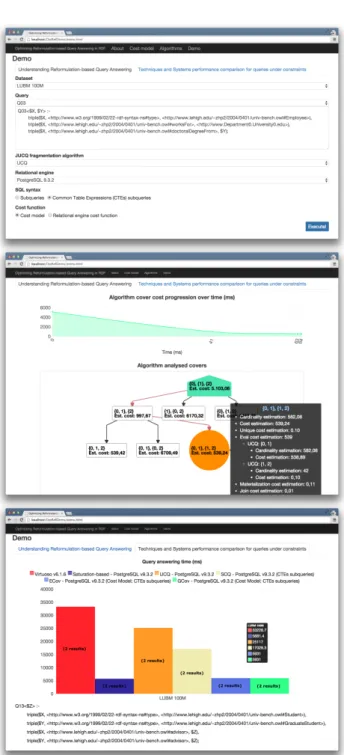
Figure 3: Demonstration screen shots.
The demo attendee experience is as follows. 1. Pick an RDF graph (data and constraints), and visualize its statis-tics (value distributions for subject, property and object, for attribute pairs etc.). 2. Select a query (upper part of Figure 3) and answer it through a chosen system and query cover, or through all the available systems, to compare their performance and completeness (bottom of Figure 3). 3. Ob-serve the evaluation runtime and inspect: the chosen query plan; cardinalities and costs of (sub)queries; and (if the cover was selected by GCov) the space of explored alternatives, and their estimated costs (center of Figure 3). 4. Choose (from a pre-defined set) or propose modifications to the available RDF data and constraints, and re-run steps 1.-3. to see the impact on Ref performance (constraints and query modifi-cations, in particular, may have a dramatic impact).
6.
REFERENCES
[1] S. Abiteboul, R. Hull, and V. Vianu. Foundations of Databases. Addison-Wesley, 1995.
[2] M. Arenas, C. Gutierrez, and J. P´erez. Foundations of RDF databases. In Reasoning Web, 2009.
[3] F. Baader, D. Calvanese, D. L. McGuinness, D. Nardi, and P. F. Patel-Schneider, editors. The DL Handbook: Theory, Implem., and Applications. Cambridge Univ. Press, 2003.
[4] M. A. Bornea, J. Dolby, A. Kementsietsidis, K. Srinivas, P. Dantressangle, O. Udrea, and
B. Bhattacharjee. Building an efficient RDF store over a relational database. In SIGMOD, 2013.
[5] D. Bursztyn, F. Goasdou´e, and I. Manolescu. Optimizing reformulation-based query answering in RDF. In EDBT, 2015.
[6] D. Bursztyn, F. Goasdou´e, and I. Manolescu. Reformulation-based query answering in RDF: alternatives and performance”. In VLDB, 2015. [7] D. Calvanese, G. D. Giacomo, D. Lembo,
M. Lenzerini, and R. Rosati. Tractable reasoning and efficient query answering in description logics: The DL-Lite family. JAR, 39(3), 2007.
[8] G. D. Giacomo, D. Lembo, M. Lenzerini, A. Poggi, R. Rosati, M. Ruzzi, and D. Savo. MASTRO: A reasoner for effective ontology-based data access. In ORE, 2012.
[9] F. Goasdou´e, I. Manolescu, and A. Roati¸s. Efficient query answering against dynamic RDF databases. In EDBT, 2013.
[10] F. Goasdou´e, I. Manolescu, and A. Roati¸s. RDF data mgmt.: Reasoning on Web data (tutorial). In ICDE, 2015.
[11] G. Gottlob, G. Orsi, and A. Pieris. Query rewriting and optimization for ontological databases. ACM TODS, 39(3):25, 2014.
[12] Y. Guo, Z. Pan, and J. Heflin. LUBM: A benchmark for OWL knowledge base systems. J. Web Sem., 3(2-3), 2005.
[13] S. Gurajada, S. Seufert, I. Miliaraki, and
M. Theobald. TriAD: a distributed shared-nothing RDF engine based on asynchronous message passing. In SIGMOD, 2014.
[14] M. Hammoud, D. A. Rabbou, R. Nouri, S.-M.-R. Behehti, and S. Sakr. DREAM: Distributed RDF engine with adaptive query planner and minimal communication. In PVLDB, 2015.
[15] Z. Kaoudi, I. Miliaraki, and M. Koubarakis. RDFS reasoning and query answering on DHTs. In ISWC, 2008.
[16] D. Lanti, M. Rezk, G. Xiao, and D. Calvanese. The NPD benchmark: Reality check for OBDA systems. In EDBT, 2015.
[17] T. Neumann and G. Weikum. The RDF-3X engine for scalable management of RDF data. VLDBJ, 19(1), 2010.
[18] M. Thomazo. Compact rewriting for existential rules. IJCAI, 2013.
[19] J. Urbani, F. van Harmelen, S. Schlobach, and H. Bal. QueryPIE: Backward reasoning for OWL Horst over very large knowledge bases. In ISWC, 2011.