HAL Id: hal-01630353
https://hal.archives-ouvertes.fr/hal-01630353
Submitted on 13 Nov 2018
HAL is a multi-disciplinary open access
archive for the deposit and dissemination of
sci-entific research documents, whether they are
pub-lished or not. The documents may come from
teaching and research institutions in France or
abroad, or from public or private research centers.
L’archive ouverte pluridisciplinaire HAL, est
destinée au dépôt et à la diffusion de documents
scientifiques de niveau recherche, publiés ou non,
émanant des établissements d’enseignement et de
recherche français ou étrangers, des laboratoires
publics ou privés.
Offer Elaboration: New Confidence Indexes to take into
account Uncertainty
Abdourahim Sylla, Élise Vareilles, Thierry Coudert, Michel Aldanondo,
Laurent Geneste
To cite this version:
Abdourahim Sylla, Élise Vareilles, Thierry Coudert, Michel Aldanondo, Laurent Geneste. Offer
Elab-oration: New Confidence Indexes to take into account Uncertainty. 20th IFAC World Congress, Jul
2017, Toulouse, France. p.7290 - 7295, �10.1016/j.ifacol.2017.08.1457�. �hal-01630353�
10.1016/j.ifacol.2017.08.1457 2405-8963
Offer Elaboration: New Confidence Indexes to take into account Uncertainty
A. Sylla*,** E. Vareilles* T. Coudert**
M. Aldanondo* L. Geneste**
*Univ. de Toulouse / Mines Albi / CGI - France
(e-mail: [email protected], [email protected], [email protected]) ** Univ. de Toulouse / ENI Tarbes / LGP - France
(e-mail: [email protected], [email protected])
Abstract: In order to respond to a call for tenders, bidders must define and evaluate potential solutions,
based upon the specifications of customer’s requirements and their capabilities (skills, existing solutions, resources … etc.). The definition and the evaluation of potential solutions are not trivial activities. The lack of relevant information makes the evaluation imprecise and uncertain. Therefore bidders choose the most suitable solution based upon the standard indicators (cost, performance and lead time) and their subjective feeling. Unfortunately, this may leads to the choice of unfeasible solution regarding customer’s expectations (cost, performance and delivery time). Therefore, the aim of this paper is twofold: (i) first, to clarify the notion of imprecision and uncertainty in the evaluation of potential solutions; and (ii) second, to propose two Confidence Indexes (CI) in order to take into account uncertainty in offer elaboration. The first one (CIS) characterizes the confidence in the technical system
solution and the second one (CIP) the confidence in the implementation process of the technical system.
The proposed CIS and CIPwill enable bidders to choose the most relevant solution not only based upon
the standard indicators but also considering the confidence in the potential solutions.
Keywords: Bidding Process, Offer Elaboration, Systems Engineering, Uncertainty, Confidence Index
(CI), Technology Readiness Level (TRL), Activity Risk Level (ARL), Human Factors.
1. INTRODUCTION
The call for tenders or bidding process is a process in which, a customer puts into competition several potential suppliers in order to choose the best one for the acquisition of a product/system or service (Vanwelkenhuysen 1998). In order to respond to a call for tenders, bidders (potential suppliers) must define and evaluate potential solutions, based upon the specifications of customer’s requirements and their capabilities (skills, existing solutions, resources … etc.) (Krömker, Thoben, and Wickner 1997). In this paper, we only focus on call for tenders referring to the acquisition of a product/system and not that of a service. Therefore, all the proposals presented in this paper are relevant for any product/system development but not necessarily for services. The bidding process, including the definition and the evaluation of potential solutions, corresponds to the first phase of the product/system development (Chalal and Ghomari 2008). The bidding process is often characterized by stringent and tight deadline for the submission of offers (Kroemker et al. 1997) and (Botero Lopez et al. 2012). Therefore, it is difficult to bidders to establish a detailed design (description) of all potential solutions. In some cases, it may be opportune for bidders to avoid detailed description of all potential solutions in order to reduce efforts and resources involved, especially in the cases in which the offers are not accepted (Sylla et al. 2017). Given all these previous
elements, it is clear that the definition and the evaluation of potential solutions are not trivial. The difficulty can vary depending on the context of the definition of potential solutions. In the Make-To-Oder (MTO) or Assembly-To-Order (ATO) contexts, relevant solutions already exist. No design or engineering activities are necessary. At the opposite, for the Engineering-To-Order (ETO) context, some design and engineering activities are necessary in order to define novel solutions that are relevant to the customer’s expectations. In both MTO/ATO and ETO situations, the evaluation of offers in terms of cost, performance and delivery time, may be imprecise and uncertain. The imprecision and the uncertainty are more important for novel solutions as the knowledge about the solutions for both the technical system and its implementation process are less available and less accurate (Brown and Chandrasekaran 1985) and (Sylla et al. 2017). The presence of imprecision and uncertainty makes the choice of the most relevant solution to be sent as an offer to the customer very difficult. Then, the choice of the relevant solution is based upon the standards indicators (cost, performance and lead time) and the subjective feeling of bidders. This may leads to the choice of unfeasible offer with regards to customer expectations (cost, performance and delivery time) (Leśniak 2016).
Therefore, the aim of this paper is twofold: (i) first, to clarify the notion of imprecision and uncertainty in offer evaluation; and (ii) second, to propose two Confidence Indexes (CI) in order to take into account the uncertainty in offer elaboration.
Proceedings of the 20th World Congress
The International Federation of Automatic Control Toulouse, France, July 9-14, 2017
Copyright © 2017 IFAC 7561
Offer Elaboration: New Confidence Indexes to take into account Uncertainty
A. Sylla*,** E. Vareilles* T. Coudert**
M. Aldanondo* L. Geneste**
*Univ. de Toulouse / Mines Albi / CGI - France
(e-mail: [email protected], [email protected], [email protected]) ** Univ. de Toulouse / ENI Tarbes / LGP - France
(e-mail: [email protected], [email protected])
Abstract: In order to respond to a call for tenders, bidders must define and evaluate potential solutions,
based upon the specifications of customer’s requirements and their capabilities (skills, existing solutions, resources … etc.). The definition and the evaluation of potential solutions are not trivial activities. The lack of relevant information makes the evaluation imprecise and uncertain. Therefore bidders choose the most suitable solution based upon the standard indicators (cost, performance and lead time) and their subjective feeling. Unfortunately, this may leads to the choice of unfeasible solution regarding customer’s expectations (cost, performance and delivery time). Therefore, the aim of this paper is twofold: (i) first, to clarify the notion of imprecision and uncertainty in the evaluation of potential solutions; and (ii) second, to propose two Confidence Indexes (CI) in order to take into account uncertainty in offer elaboration. The first one (CIS) characterizes the confidence in the technical system
solution and the second one (CIP) the confidence in the implementation process of the technical system.
The proposed CIS and CIP will enable bidders to choose the most relevant solution not only based upon
the standard indicators but also considering the confidence in the potential solutions.
Keywords: Bidding Process, Offer Elaboration, Systems Engineering, Uncertainty, Confidence Index
(CI), Technology Readiness Level (TRL), Activity Risk Level (ARL), Human Factors.
1. INTRODUCTION
The call for tenders or bidding process is a process in which, a customer puts into competition several potential suppliers in order to choose the best one for the acquisition of a product/system or service (Vanwelkenhuysen 1998). In order to respond to a call for tenders, bidders (potential suppliers) must define and evaluate potential solutions, based upon the specifications of customer’s requirements and their capabilities (skills, existing solutions, resources … etc.) (Krömker, Thoben, and Wickner 1997). In this paper, we only focus on call for tenders referring to the acquisition of a product/system and not that of a service. Therefore, all the proposals presented in this paper are relevant for any product/system development but not necessarily for services. The bidding process, including the definition and the evaluation of potential solutions, corresponds to the first phase of the product/system development (Chalal and Ghomari 2008). The bidding process is often characterized by stringent and tight deadline for the submission of offers (Kroemker et al. 1997) and (Botero Lopez et al. 2012). Therefore, it is difficult to bidders to establish a detailed design (description) of all potential solutions. In some cases, it may be opportune for bidders to avoid detailed description of all potential solutions in order to reduce efforts and resources involved, especially in the cases in which the offers are not accepted (Sylla et al. 2017). Given all these previous
elements, it is clear that the definition and the evaluation of potential solutions are not trivial. The difficulty can vary depending on the context of the definition of potential solutions. In the Make-To-Oder (MTO) or Assembly-To-Order (ATO) contexts, relevant solutions already exist. No design or engineering activities are necessary. At the opposite, for the Engineering-To-Order (ETO) context, some design and engineering activities are necessary in order to define novel solutions that are relevant to the customer’s expectations. In both MTO/ATO and ETO situations, the evaluation of offers in terms of cost, performance and delivery time, may be imprecise and uncertain. The imprecision and the uncertainty are more important for novel solutions as the knowledge about the solutions for both the technical system and its implementation process are less available and less accurate (Brown and Chandrasekaran 1985) and (Sylla et al. 2017). The presence of imprecision and uncertainty makes the choice of the most relevant solution to be sent as an offer to the customer very difficult. Then, the choice of the relevant solution is based upon the standards indicators (cost, performance and lead time) and the subjective feeling of bidders. This may leads to the choice of unfeasible offer with regards to customer expectations (cost, performance and delivery time) (Leśniak 2016). Therefore, the aim of this paper is twofold: (i) first, to clarify the notion of imprecision and uncertainty in offer evaluation; and (ii) second, to propose two Confidence Indexes (CI) in order to take into account the uncertainty in offer elaboration.
Proceedings of the 20th World Congress
The International Federation of Automatic Control Toulouse, France, July 9-14, 2017
Copyright © 2017 IFAC 7561
Offer Elaboration: New Confidence Indexes to take into account Uncertainty
A. Sylla*,** E. Vareilles* T. Coudert**
M. Aldanondo* L. Geneste**
*Univ. de Toulouse / Mines Albi / CGI - France
(e-mail: [email protected], [email protected], [email protected]) ** Univ. de Toulouse / ENI Tarbes / LGP - France (e-mail: [email protected], [email protected])
Abstract: In order to respond to a call for tenders, bidders must define and evaluate potential solutions,
based upon the specifications of customer’s requirements and their capabilities (skills, existing solutions, resources … etc.). The definition and the evaluation of potential solutions are not trivial activities. The lack of relevant information makes the evaluation imprecise and uncertain. Therefore bidders choose the most suitable solution based upon the standard indicators (cost, performance and lead time) and their subjective feeling. Unfortunately, this may leads to the choice of unfeasible solution regarding customer’s expectations (cost, performance and delivery time). Therefore, the aim of this paper is twofold: (i) first, to clarify the notion of imprecision and uncertainty in the evaluation of potential solutions; and (ii) second, to propose two Confidence Indexes (CI) in order to take into account uncertainty in offer elaboration. The first one (CIS) characterizes the confidence in the technical system
solution and the second one (CIP) the confidence in the implementation process of the technical system.
The proposed CIS and CIPwill enable bidders to choose the most relevant solution not only based upon
the standard indicators but also considering the confidence in the potential solutions.
Keywords: Bidding Process, Offer Elaboration, Systems Engineering, Uncertainty, Confidence Index
(CI), Technology Readiness Level (TRL), Activity Risk Level (ARL), Human Factors.
1. INTRODUCTION
The call for tenders or bidding process is a process in which, a customer puts into competition several potential suppliers in order to choose the best one for the acquisition of a product/system or service (Vanwelkenhuysen 1998). In order to respond to a call for tenders, bidders (potential suppliers) must define and evaluate potential solutions, based upon the specifications of customer’s requirements and their capabilities (skills, existing solutions, resources … etc.) (Krömker, Thoben, and Wickner 1997). In this paper, we only focus on call for tenders referring to the acquisition of a product/system and not that of a service. Therefore, all the proposals presented in this paper are relevant for any product/system development but not necessarily for services. The bidding process, including the definition and the evaluation of potential solutions, corresponds to the first phase of the product/system development (Chalal and Ghomari 2008). The bidding process is often characterized by stringent and tight deadline for the submission of offers (Kroemker et al. 1997) and (Botero Lopez et al. 2012). Therefore, it is difficult to bidders to establish a detailed design (description) of all potential solutions. In some cases, it may be opportune for bidders to avoid detailed description of all potential solutions in order to reduce efforts and resources involved, especially in the cases in which the offers are not accepted (Sylla et al. 2017). Given all these previous
elements, it is clear that the definition and the evaluation of potential solutions are not trivial. The difficulty can vary depending on the context of the definition of potential solutions. In the Make-To-Oder (MTO) or Assembly-To-Order (ATO) contexts, relevant solutions already exist. No design or engineering activities are necessary. At the opposite, for the Engineering-To-Order (ETO) context, some design and engineering activities are necessary in order to define novel solutions that are relevant to the customer’s expectations. In both MTO/ATO and ETO situations, the evaluation of offers in terms of cost, performance and delivery time, may be imprecise and uncertain. The imprecision and the uncertainty are more important for novel solutions as the knowledge about the solutions for both the technical system and its implementation process are less available and less accurate (Brown and Chandrasekaran 1985) and (Sylla et al. 2017). The presence of imprecision and uncertainty makes the choice of the most relevant solution to be sent as an offer to the customer very difficult. Then, the choice of the relevant solution is based upon the standards indicators (cost, performance and lead time) and the subjective feeling of bidders. This may leads to the choice of unfeasible offer with regards to customer expectations (cost, performance and delivery time) (Leśniak 2016). Therefore, the aim of this paper is twofold: (i) first, to clarify the notion of imprecision and uncertainty in offer evaluation; and (ii) second, to propose two Confidence Indexes (CI) in order to take into account the uncertainty in offer elaboration.
Proceedings of the 20th World Congress
The International Federation of Automatic Control Toulouse, France, July 9-14, 2017
Copyright © 2017 IFAC 7561
Offer Elaboration: New Confidence Indexes to take into account Uncertainty
A. Sylla*,** E. Vareilles* T. Coudert**
M. Aldanondo* L. Geneste**
*Univ. de Toulouse / Mines Albi / CGI - France
(e-mail: [email protected], [email protected], [email protected]) ** Univ. de Toulouse / ENI Tarbes / LGP - France
(e-mail: [email protected], [email protected])
Abstract: In order to respond to a call for tenders, bidders must define and evaluate potential solutions,
based upon the specifications of customer’s requirements and their capabilities (skills, existing solutions, resources … etc.). The definition and the evaluation of potential solutions are not trivial activities. The lack of relevant information makes the evaluation imprecise and uncertain. Therefore bidders choose the most suitable solution based upon the standard indicators (cost, performance and lead time) and their subjective feeling. Unfortunately, this may leads to the choice of unfeasible solution regarding customer’s expectations (cost, performance and delivery time). Therefore, the aim of this paper is twofold: (i) first, to clarify the notion of imprecision and uncertainty in the evaluation of potential solutions; and (ii) second, to propose two Confidence Indexes (CI) in order to take into account uncertainty in offer elaboration. The first one (CIS) characterizes the confidence in the technical system
solution and the second one (CIP) the confidence in the implementation process of the technical system.
The proposed CIS and CIPwill enable bidders to choose the most relevant solution not only based upon
the standard indicators but also considering the confidence in the potential solutions.
Keywords: Bidding Process, Offer Elaboration, Systems Engineering, Uncertainty, Confidence Index
(CI), Technology Readiness Level (TRL), Activity Risk Level (ARL), Human Factors.
1. INTRODUCTION
The call for tenders or bidding process is a process in which, a customer puts into competition several potential suppliers in order to choose the best one for the acquisition of a product/system or service (Vanwelkenhuysen 1998). In order to respond to a call for tenders, bidders (potential suppliers) must define and evaluate potential solutions, based upon the specifications of customer’s requirements and their capabilities (skills, existing solutions, resources … etc.) (Krömker, Thoben, and Wickner 1997). In this paper, we only focus on call for tenders referring to the acquisition of a product/system and not that of a service. Therefore, all the proposals presented in this paper are relevant for any product/system development but not necessarily for services. The bidding process, including the definition and the evaluation of potential solutions, corresponds to the first phase of the product/system development (Chalal and Ghomari 2008). The bidding process is often characterized by stringent and tight deadline for the submission of offers (Kroemker et al. 1997) and (Botero Lopez et al. 2012). Therefore, it is difficult to bidders to establish a detailed design (description) of all potential solutions. In some cases, it may be opportune for bidders to avoid detailed description of all potential solutions in order to reduce efforts and resources involved, especially in the cases in which the offers are not accepted (Sylla et al. 2017). Given all these previous
elements, it is clear that the definition and the evaluation of potential solutions are not trivial. The difficulty can vary depending on the context of the definition of potential solutions. In the Make-To-Oder (MTO) or Assembly-To-Order (ATO) contexts, relevant solutions already exist. No design or engineering activities are necessary. At the opposite, for the Engineering-To-Order (ETO) context, some design and engineering activities are necessary in order to define novel solutions that are relevant to the customer’s expectations. In both MTO/ATO and ETO situations, the evaluation of offers in terms of cost, performance and delivery time, may be imprecise and uncertain. The imprecision and the uncertainty are more important for novel solutions as the knowledge about the solutions for both the technical system and its implementation process are less available and less accurate (Brown and Chandrasekaran 1985) and (Sylla et al. 2017). The presence of imprecision and uncertainty makes the choice of the most relevant solution to be sent as an offer to the customer very difficult. Then, the choice of the relevant solution is based upon the standards indicators (cost, performance and lead time) and the subjective feeling of bidders. This may leads to the choice of unfeasible offer with regards to customer expectations (cost, performance and delivery time) (Leśniak 2016). Therefore, the aim of this paper is twofold: (i) first, to clarify the notion of imprecision and uncertainty in offer evaluation; and (ii) second, to propose two Confidence Indexes (CI) in order to take into account the uncertainty in offer elaboration.
Proceedings of the 20th World Congress
The International Federation of Automatic Control Toulouse, France, July 9-14, 2017
Offer Elaboration: New Confidence Indexes to take into account Uncertainty
A. Sylla*,** E. Vareilles* T. Coudert**
M. Aldanondo* L. Geneste**
*Univ. de Toulouse / Mines Albi / CGI - France
(e-mail: [email protected], [email protected], [email protected]) ** Univ. de Toulouse / ENI Tarbes / LGP - France
(e-mail: [email protected], [email protected])
Abstract: In order to respond to a call for tenders, bidders must define and evaluate potential solutions,
based upon the specifications of customer’s requirements and their capabilities (skills, existing solutions, resources … etc.). The definition and the evaluation of potential solutions are not trivial activities. The lack of relevant information makes the evaluation imprecise and uncertain. Therefore bidders choose the most suitable solution based upon the standard indicators (cost, performance and lead time) and their subjective feeling. Unfortunately, this may leads to the choice of unfeasible solution regarding customer’s expectations (cost, performance and delivery time). Therefore, the aim of this paper is twofold: (i) first, to clarify the notion of imprecision and uncertainty in the evaluation of potential solutions; and (ii) second, to propose two Confidence Indexes (CI) in order to take into account uncertainty in offer elaboration. The first one (CIS) characterizes the confidence in the technical system
solution and the second one (CIP) the confidence in the implementation process of the technical system.
The proposed CIS and CIP will enable bidders to choose the most relevant solution not only based upon
the standard indicators but also considering the confidence in the potential solutions.
Keywords: Bidding Process, Offer Elaboration, Systems Engineering, Uncertainty, Confidence Index
(CI), Technology Readiness Level (TRL), Activity Risk Level (ARL), Human Factors.
1. INTRODUCTION
The call for tenders or bidding process is a process in which, a customer puts into competition several potential suppliers in order to choose the best one for the acquisition of a product/system or service (Vanwelkenhuysen 1998). In order to respond to a call for tenders, bidders (potential suppliers) must define and evaluate potential solutions, based upon the specifications of customer’s requirements and their capabilities (skills, existing solutions, resources … etc.) (Krömker, Thoben, and Wickner 1997). In this paper, we only focus on call for tenders referring to the acquisition of a product/system and not that of a service. Therefore, all the proposals presented in this paper are relevant for any product/system development but not necessarily for services. The bidding process, including the definition and the evaluation of potential solutions, corresponds to the first phase of the product/system development (Chalal and Ghomari 2008). The bidding process is often characterized by stringent and tight deadline for the submission of offers (Kroemker et al. 1997) and (Botero Lopez et al. 2012). Therefore, it is difficult to bidders to establish a detailed design (description) of all potential solutions. In some cases, it may be opportune for bidders to avoid detailed description of all potential solutions in order to reduce efforts and resources involved, especially in the cases in which the offers are not accepted (Sylla et al. 2017). Given all these previous
elements, it is clear that the definition and the evaluation of potential solutions are not trivial. The difficulty can vary depending on the context of the definition of potential solutions. In the Make-To-Oder (MTO) or Assembly-To-Order (ATO) contexts, relevant solutions already exist. No design or engineering activities are necessary. At the opposite, for the Engineering-To-Order (ETO) context, some design and engineering activities are necessary in order to define novel solutions that are relevant to the customer’s expectations. In both MTO/ATO and ETO situations, the evaluation of offers in terms of cost, performance and delivery time, may be imprecise and uncertain. The imprecision and the uncertainty are more important for novel solutions as the knowledge about the solutions for both the technical system and its implementation process are less available and less accurate (Brown and Chandrasekaran 1985) and (Sylla et al. 2017). The presence of imprecision and uncertainty makes the choice of the most relevant solution to be sent as an offer to the customer very difficult. Then, the choice of the relevant solution is based upon the standards indicators (cost, performance and lead time) and the subjective feeling of bidders. This may leads to the choice of unfeasible offer with regards to customer expectations (cost, performance and delivery time) (Leśniak 2016). Therefore, the aim of this paper is twofold: (i) first, to clarify the notion of imprecision and uncertainty in offer evaluation; and (ii) second, to propose two Confidence Indexes (CI) in order to take into account the uncertainty in offer elaboration.
Proceedings of the 20th World Congress
The International Federation of Automatic Control Toulouse, France, July 9-14, 2017
Copyright © 2017 IFAC 7561
Offer Elaboration: New Confidence Indexes to take into account Uncertainty
A. Sylla*,** E. Vareilles* T. Coudert**
M. Aldanondo* L. Geneste**
*Univ. de Toulouse / Mines Albi / CGI - France
(e-mail: [email protected], [email protected], [email protected]) ** Univ. de Toulouse / ENI Tarbes / LGP - France
(e-mail: [email protected], [email protected])
Abstract: In order to respond to a call for tenders, bidders must define and evaluate potential solutions,
based upon the specifications of customer’s requirements and their capabilities (skills, existing solutions, resources … etc.). The definition and the evaluation of potential solutions are not trivial activities. The lack of relevant information makes the evaluation imprecise and uncertain. Therefore bidders choose the most suitable solution based upon the standard indicators (cost, performance and lead time) and their subjective feeling. Unfortunately, this may leads to the choice of unfeasible solution regarding customer’s expectations (cost, performance and delivery time). Therefore, the aim of this paper is twofold: (i) first, to clarify the notion of imprecision and uncertainty in the evaluation of potential solutions; and (ii) second, to propose two Confidence Indexes (CI) in order to take into account uncertainty in offer elaboration. The first one (CIS) characterizes the confidence in the technical system
solution and the second one (CIP) the confidence in the implementation process of the technical system.
The proposed CIS and CIP will enable bidders to choose the most relevant solution not only based upon
the standard indicators but also considering the confidence in the potential solutions.
Keywords: Bidding Process, Offer Elaboration, Systems Engineering, Uncertainty, Confidence Index
(CI), Technology Readiness Level (TRL), Activity Risk Level (ARL), Human Factors.
1. INTRODUCTION
The call for tenders or bidding process is a process in which, a customer puts into competition several potential suppliers in order to choose the best one for the acquisition of a product/system or service (Vanwelkenhuysen 1998). In order to respond to a call for tenders, bidders (potential suppliers) must define and evaluate potential solutions, based upon the specifications of customer’s requirements and their capabilities (skills, existing solutions, resources … etc.) (Krömker, Thoben, and Wickner 1997). In this paper, we only focus on call for tenders referring to the acquisition of a product/system and not that of a service. Therefore, all the proposals presented in this paper are relevant for any product/system development but not necessarily for services. The bidding process, including the definition and the evaluation of potential solutions, corresponds to the first phase of the product/system development (Chalal and Ghomari 2008). The bidding process is often characterized by stringent and tight deadline for the submission of offers (Kroemker et al. 1997) and (Botero Lopez et al. 2012). Therefore, it is difficult to bidders to establish a detailed design (description) of all potential solutions. In some cases, it may be opportune for bidders to avoid detailed description of all potential solutions in order to reduce efforts and resources involved, especially in the cases in which the offers are not accepted (Sylla et al. 2017). Given all these previous
elements, it is clear that the definition and the evaluation of potential solutions are not trivial. The difficulty can vary depending on the context of the definition of potential solutions. In the Make-To-Oder (MTO) or Assembly-To-Order (ATO) contexts, relevant solutions already exist. No design or engineering activities are necessary. At the opposite, for the Engineering-To-Order (ETO) context, some design and engineering activities are necessary in order to define novel solutions that are relevant to the customer’s expectations. In both MTO/ATO and ETO situations, the evaluation of offers in terms of cost, performance and delivery time, may be imprecise and uncertain. The imprecision and the uncertainty are more important for novel solutions as the knowledge about the solutions for both the technical system and its implementation process are less available and less accurate (Brown and Chandrasekaran 1985) and (Sylla et al. 2017). The presence of imprecision and uncertainty makes the choice of the most relevant solution to be sent as an offer to the customer very difficult. Then, the choice of the relevant solution is based upon the standards indicators (cost, performance and lead time) and the subjective feeling of bidders. This may leads to the choice of unfeasible offer with regards to customer expectations (cost, performance and delivery time) (Leśniak 2016). Therefore, the aim of this paper is twofold: (i) first, to clarify the notion of imprecision and uncertainty in offer evaluation; and (ii) second, to propose two Confidence Indexes (CI) in order to take into account the uncertainty in offer elaboration.
Proceedings of the 20th World Congress
The International Federation of Automatic Control Toulouse, France, July 9-14, 2017
Copyright © 2017 IFAC 7561
Offer Elaboration: New Confidence Indexes to take into account Uncertainty
A. Sylla*,** E. Vareilles* T. Coudert**
M. Aldanondo* L. Geneste**
*Univ. de Toulouse / Mines Albi / CGI - France
(e-mail: [email protected], [email protected], [email protected]) ** Univ. de Toulouse / ENI Tarbes / LGP - France
(e-mail: [email protected], [email protected])
Abstract: In order to respond to a call for tenders, bidders must define and evaluate potential solutions,
based upon the specifications of customer’s requirements and their capabilities (skills, existing solutions, resources … etc.). The definition and the evaluation of potential solutions are not trivial activities. The lack of relevant information makes the evaluation imprecise and uncertain. Therefore bidders choose the most suitable solution based upon the standard indicators (cost, performance and lead time) and their subjective feeling. Unfortunately, this may leads to the choice of unfeasible solution regarding customer’s expectations (cost, performance and delivery time). Therefore, the aim of this paper is twofold: (i) first, to clarify the notion of imprecision and uncertainty in the evaluation of potential solutions; and (ii) second, to propose two Confidence Indexes (CI) in order to take into account uncertainty in offer elaboration. The first one (CIS) characterizes the confidence in the technical system
solution and the second one (CIP) the confidence in the implementation process of the technical system.
The proposed CIS and CIP will enable bidders to choose the most relevant solution not only based upon
the standard indicators but also considering the confidence in the potential solutions.
Keywords: Bidding Process, Offer Elaboration, Systems Engineering, Uncertainty, Confidence Index
(CI), Technology Readiness Level (TRL), Activity Risk Level (ARL), Human Factors.
1. INTRODUCTION
The call for tenders or bidding process is a process in which, a customer puts into competition several potential suppliers in order to choose the best one for the acquisition of a product/system or service (Vanwelkenhuysen 1998). In order to respond to a call for tenders, bidders (potential suppliers) must define and evaluate potential solutions, based upon the specifications of customer’s requirements and their capabilities (skills, existing solutions, resources … etc.) (Krömker, Thoben, and Wickner 1997). In this paper, we only focus on call for tenders referring to the acquisition of a product/system and not that of a service. Therefore, all the proposals presented in this paper are relevant for any product/system development but not necessarily for services. The bidding process, including the definition and the evaluation of potential solutions, corresponds to the first phase of the product/system development (Chalal and Ghomari 2008). The bidding process is often characterized by stringent and tight deadline for the submission of offers (Kroemker et al. 1997) and (Botero Lopez et al. 2012). Therefore, it is difficult to bidders to establish a detailed design (description) of all potential solutions. In some cases, it may be opportune for bidders to avoid detailed description of all potential solutions in order to reduce efforts and resources involved, especially in the cases in which the offers are not accepted (Sylla et al. 2017). Given all these previous
elements, it is clear that the definition and the evaluation of potential solutions are not trivial. The difficulty can vary depending on the context of the definition of potential solutions. In the Make-To-Oder (MTO) or Assembly-To-Order (ATO) contexts, relevant solutions already exist. No design or engineering activities are necessary. At the opposite, for the Engineering-To-Order (ETO) context, some design and engineering activities are necessary in order to define novel solutions that are relevant to the customer’s expectations. In both MTO/ATO and ETO situations, the evaluation of offers in terms of cost, performance and delivery time, may be imprecise and uncertain. The imprecision and the uncertainty are more important for novel solutions as the knowledge about the solutions for both the technical system and its implementation process are less available and less accurate (Brown and Chandrasekaran 1985) and (Sylla et al. 2017). The presence of imprecision and uncertainty makes the choice of the most relevant solution to be sent as an offer to the customer very difficult. Then, the choice of the relevant solution is based upon the standards indicators (cost, performance and lead time) and the subjective feeling of bidders. This may leads to the choice of unfeasible offer with regards to customer expectations (cost, performance and delivery time) (Leśniak 2016). Therefore, the aim of this paper is twofold: (i) first, to clarify the notion of imprecision and uncertainty in offer evaluation; and (ii) second, to propose two Confidence Indexes (CI) in order to take into account the uncertainty in offer elaboration.
Proceedings of the 20th World Congress
The International Federation of Automatic Control Toulouse, France, July 9-14, 2017
Copyright © 2017 IFAC 7561
Offer Elaboration: New Confidence Indexes to take into account Uncertainty
A. Sylla*,** E. Vareilles* T. Coudert**
M. Aldanondo* L. Geneste**
*Univ. de Toulouse / Mines Albi / CGI - France
(e-mail: [email protected], [email protected], [email protected]) ** Univ. de Toulouse / ENI Tarbes / LGP - France
(e-mail: [email protected], [email protected])
Abstract: In order to respond to a call for tenders, bidders must define and evaluate potential solutions,
based upon the specifications of customer’s requirements and their capabilities (skills, existing solutions, resources … etc.). The definition and the evaluation of potential solutions are not trivial activities. The lack of relevant information makes the evaluation imprecise and uncertain. Therefore bidders choose the most suitable solution based upon the standard indicators (cost, performance and lead time) and their subjective feeling. Unfortunately, this may leads to the choice of unfeasible solution regarding customer’s expectations (cost, performance and delivery time). Therefore, the aim of this paper is twofold: (i) first, to clarify the notion of imprecision and uncertainty in the evaluation of potential solutions; and (ii) second, to propose two Confidence Indexes (CI) in order to take into account uncertainty in offer elaboration. The first one (CIS) characterizes the confidence in the technical system
solution and the second one (CIP) the confidence in the implementation process of the technical system.
The proposed CIS and CIP will enable bidders to choose the most relevant solution not only based upon
the standard indicators but also considering the confidence in the potential solutions.
Keywords: Bidding Process, Offer Elaboration, Systems Engineering, Uncertainty, Confidence Index
(CI), Technology Readiness Level (TRL), Activity Risk Level (ARL), Human Factors.
1. INTRODUCTION
The call for tenders or bidding process is a process in which, a customer puts into competition several potential suppliers in order to choose the best one for the acquisition of a product/system or service (Vanwelkenhuysen 1998). In order to respond to a call for tenders, bidders (potential suppliers) must define and evaluate potential solutions, based upon the specifications of customer’s requirements and their capabilities (skills, existing solutions, resources … etc.) (Krömker, Thoben, and Wickner 1997). In this paper, we only focus on call for tenders referring to the acquisition of a product/system and not that of a service. Therefore, all the proposals presented in this paper are relevant for any product/system development but not necessarily for services. The bidding process, including the definition and the evaluation of potential solutions, corresponds to the first phase of the product/system development (Chalal and Ghomari 2008). The bidding process is often characterized by stringent and tight deadline for the submission of offers (Kroemker et al. 1997) and (Botero Lopez et al. 2012). Therefore, it is difficult to bidders to establish a detailed design (description) of all potential solutions. In some cases, it may be opportune for bidders to avoid detailed description of all potential solutions in order to reduce efforts and resources involved, especially in the cases in which the offers are not accepted (Sylla et al. 2017). Given all these previous
elements, it is clear that the definition and the evaluation of potential solutions are not trivial. The difficulty can vary depending on the context of the definition of potential solutions. In the Make-To-Oder (MTO) or Assembly-To-Order (ATO) contexts, relevant solutions already exist. No design or engineering activities are necessary. At the opposite, for the Engineering-To-Order (ETO) context, some design and engineering activities are necessary in order to define novel solutions that are relevant to the customer’s expectations. In both MTO/ATO and ETO situations, the evaluation of offers in terms of cost, performance and delivery time, may be imprecise and uncertain. The imprecision and the uncertainty are more important for novel solutions as the knowledge about the solutions for both the technical system and its implementation process are less available and less accurate (Brown and Chandrasekaran 1985) and (Sylla et al. 2017). The presence of imprecision and uncertainty makes the choice of the most relevant solution to be sent as an offer to the customer very difficult. Then, the choice of the relevant solution is based upon the standards indicators (cost, performance and lead time) and the subjective feeling of bidders. This may leads to the choice of unfeasible offer with regards to customer expectations (cost, performance and delivery time) (Leśniak 2016). Therefore, the aim of this paper is twofold: (i) first, to clarify the notion of imprecision and uncertainty in offer evaluation; and (ii) second, to propose two Confidence Indexes (CI) in order to take into account the uncertainty in offer elaboration.
Proceedings of the 20th World Congress
The International Federation of Automatic Control Toulouse, France, July 9-14, 2017
Copyright © 2017 IFAC 7561
This will enable bidders to compare the potential solutions in terms of confidence and to choose the most relevant one to be sent as an offer to the customer not only based upon the standard indicators but also considering the confidence. The rest of the paper is structured in four sections. The second section is dedicated to the notions of imprecision and uncertainty in offer evaluation. In the third section the proposed confidence are presented and discussed. The fourth section presents an illustrative application of the proposed method for the assessment of the confidence indexes. And the last section presents some conclusions and future works.
2. IMPRECISION and UNCERTAINTY in OFFER EVALUATION
Each phase of the development of a product/system is characterized by the presence of both imprecision and uncertainty (Wood and Antonsson 1990). Several efforts have been dedicated to the clarification, modelling and treatment of imprecision and uncertainty in many fields. According to the field and the application, different concepts, definitions and classification have been proposed in the scientific literature (Thunnissen 2003), (Dantan et al. 2013) and (Klir and Folger 1988). In this paper, in the same sense as in (Dubois and Prade 2012), imprecision is related to the content of information, to the values of design attributes or performance indicators (e.g. cost and duration). Uncertainty concerns the confidence in the values of a design attribute or performance indicators. Let’s consider the following evaluation of the cost of an engine: the engine possibly costs 10 ± 3. If we consider this information as a quadruplet of (object, attribute, value, confidence) as suggested in (Dubois and Prade 2012), we can easily identify respectively (engine, cost, 10 , possibly). e imprecision is ± 3 composing the value of the cost and the uncertainty (confidence) is possibly . These two notions of imprecision and uncertainty encompass several concepts and have various definitions. The figure 1 below depicts some concepts related to imprecision and uncertainty. The concepts presented in this figure 1 are not exhaustive. Thunnissen (2003) provides more concepts related to imprecision and uncertainty.
Confidence: is a kind of measure of the feasibility of a solution (Vareilles et al. 2014).
Risk: is defined as a measure of the uncertainty of achieving an objective (Haskins, Forsberg, and Krueger 2006).
Reliability: is related to the truth of an information (Dubois and Prade 2012).
Ambiguity: is associated to situations in which the choice between several alternatives is left unspecified (Klir and Folger 1988).
Vagueness: is associated with the difficulty of making precise distinctions in the world (Klir and Folger 1988).
Nonspeficity: can be seen as an ambiguity (Thunnissen 2003).
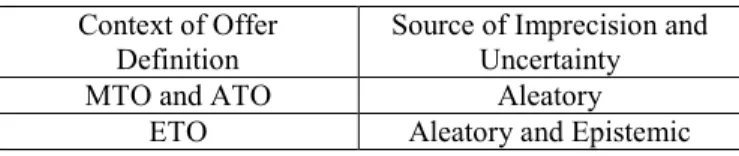
The presence of imprecision and uncertainty in the evaluation of potential solutions makes the evaluation imperfect, and then often leads to the choice of unfeasible solutions with regards to customer’s expectations (cost, performance and delivery time). The source of uncertainty and imprecision can be epistemic or aleatory (Dantan et al. 2013). The epistemic uncertainty and imprecision are due to any lack of knowledge whereas the aleatory uncertainty and imprecision are due to the inherent variability of the characteristics of the considered artifact (Thunnissen 2003). According to the offer definition context (MTO/ATO or ETO), the imprecision and uncertainty can be more or less important (Sylla et al. 2017). The table 1 below depicts a classification of imprecision and uncertainty based upon the offer definition context and the source of the imprecision and the uncertainty. In the context of MTO/ATO, relevant solutions (systems) have already been designed, implemented and successfully deployed. All the relevant knowledges for the design and the implementation of these solutions are completely available and accurate (Brown and Chandrasekaran 1985). Therefore, we assume that, there are no imprecision or uncertainty due to any lack of knowledge (epistemic uncertainty or epistemic imprecision). In the context of ETO, all relevant knowledge for the design and the implementation of the solutions (systems) are not available. This lack of knowledge is the source of the epistemic imprecision and uncertainty in ETO situations.
Table 1. Imprecision and Uncertainty in Offer Evaluation
Context of Offer
Definition Source of Imprecision and Uncertainty MTO and ATO Aleatory
ETO Aleatory and Epistemic
The inherent variability of some characteristics of the solutions (e.g. variability of component’s cost and variability due to the properties of a specific material) may lead to an imprecise and uncertain evaluation of these solutions. Therefore, the aleatory imprecision and uncertainty are always present in offer definition and evaluation for both MTO/ATO and ETO situations.
The epistemic imprecision and uncertainty are more important in first phase of product/system development and then in offer elaboration. This kind of imprecision and uncertainty can be reduced by more analysis and efforts (Perry, Amine, and Pailhès 2015). In this paper we focus on the epistemic uncertainty. We propose two Confidence Indexes (CI) in order to take into account the epistemic uncertainty in the choice of relevant solutions to be sent as an
Figure 1: Concepts related to Uncertainty and Imprecision
Proceedings of the 20th IFAC World Congress Toulouse, France, July 9-14, 2017
offer to the customer. The CI represents the confidence in the values of standards indicators (cost, performance and lead time). In other words, it represents the confidence that, the technical solution will be developed with regards to these values. The values may be imprecise or precise. The next section is dedicated to the definition of the CI.
3. CONFIDENCE INDEXES for OFFER ELABORATION In this section, we present four indicators and a method for the evaluation of the Confidence Indexes (CI) of potential solutions. The proposed indicators are composed of two kinds of indicators and both kinds of indicators characterize the system and the process. The first kind of indicators is factual, based upon the experiences and the observations. It provides a kind of objective judgment about the system and the process. The second one is less factual, and based exclusively upon the subjective feeling of the person in charge of the offer elaboration. Some aggregation mechanisms are proposed in order to compute the CI at the system and process level. The table 2 summarizes the proposed indicators.
Table 2. Proposed Indicators
3.1 Objective Indicators
Objective indicators provide reliable information on the solutions of both technical system and its implementation process. At the system side, it is related to the notion of readiness level of subsystems, integrations and systems (Mankins 1995) and (Sauser et al. 2008). At the process side, it is based on the risk level of process activities and processes (Sylla et al. 2017). As in (Sylla et al. 2017), we propose to add to each elements of the system and the process, the proposed objective indicators (see Table 2).
For the system, the Confidence Index (CIS) evaluation starts
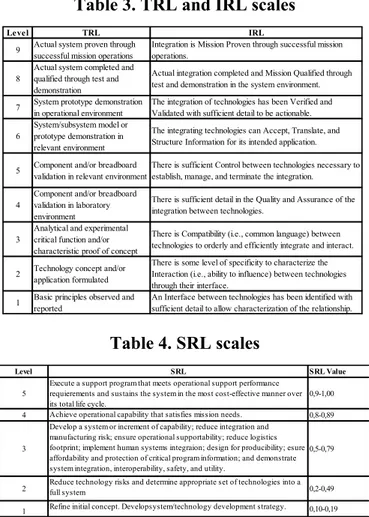
with the characterization of the Technology Readiness Level (TRL) of each subsystem and the characterization of the Integration Readiness Level (IRL) of each relevant integration involved in a system. The TRL is a systematic and factual measurement that indicates how much a sub-system technology is ready to be deployed for a given function and environment (Mankins 1995). It has been adopted by US Department of Defense (DoD) and the US Department of Energy (DoE) for the evaluation of the maturity of a technology (Tan, Sauser, and Ramirez-Marquez 2011). It is widely used in industry in order to take into account the uncertainty related to the development of a technology. TRL is measured on a nine-level scale (1 being the less maturation stage and 9 the highest maturation stage)
(see table 3). In the same sense as the TRL, the IRL is a systematic measurement that provides a factual evaluation of the maturity of integration between two technologies. IRL is also measured on a nine-level scale (1 being the less maturation stage and 9 the highest maturation stage) (see table 3) (Sauser et al. 2008). In order to compute the readiness of a whole system, (Sauser et al. 2008) have proposed a System Readiness Level scale (SRL). The SRL value is computed as a function of TRLs of subsystems and relevant IRLs of integrations. The calculation method proposed by (Sauser et al. 2008) is based on the matrix algebra and this method is used in this paper for the computation of SRL value of a system. SRL is then measured on a five-level scale (see table 4) (Sauser et al. 2008). In the proposed method, each subsystem is characterized with a TRL and each integration between two subsystems with an IRL. Then each system is characterized with a SRL.
Table 3. TRL and IRL scales
Level TRL IRL
9 Actual system proven through successful mission operations Integration is Mission Proven through successful mission operations. 8
Actual system completed and qualified through test and demonstration
Actual integration completed and Mission Qualified through test and demonstration in the system environment. 7 System prototype demonstration
in operational environment
The integration of technologies has been Verified and Validated with sufficient detail to be actionable. 6
System/subsystem model or prototype demonstration in relevant environment
The integrating technologies can Accept, Translate, and Structure Information for its intended application. 5 Component and/or breadboard
validation in relevant environment
There is sufficient Control between technologies necessary to establish, manage, and terminate the integration. 4
Component and/or breadboard validation in laboratory environment
There is sufficient detail in the Quality and Assurance of the integration between technologies.
3
Analytical and experimental critical function and/or characteristic proof of concept
There is Compatibility (i.e., common language) between technologies to orderly and efficiently integrate and interact. 2 Technology concept and/or application formulated
There is some level of specificity to characterize the Interaction (i.e., ability to influence) between technologies through their interface.
1 Basic principles observed and reported
An Interface between technologies has been identified with sufficient detail to allow characterization of the relationship.
Table 4. SRL scales
Level SRL SRL Value
5
Execute a support program that meets operational support performance requierements and sustains the system in the most cost-effective manner over its total life cycle.
0,9-1,00 4 Achieve operational capability that satisfies mission needs. 0,8-0,89
3
Develop a system or increment of capability; reduce integration and manufacturing risk; ensure operational supportability; reduce logistics footprint; implement human systems integraion; design for producibility; esure affordability and protection of critical program information; and demonstrate system integration, interoperability, safety, and utility.
0,5-0,79
2 Reduce technology risks and determine appropriate set of technologies into a full system 0,2-0,49 1 Refine initial concept. Developsystem/technology development strategy. 0,10-0,19
For the process, the Confidence Index (CIP) starts with the
characterization of the Activity Risk Level (ARL) of each process activity. As already said in (Sylla et al. 2017), every business is exposed to risks all the time and such risks can directly affect day-to-day operations, decrease revenue or increase expenses. The impacts of these risks may lead to cost growth and schedule slippage in the implementation process. Therefore, we propose the ARL in order to take into account the uncertainty associated to an activity of the implementation process. This ARL is inspired by the risk
Proceedings of the 20th IFAC World Congress Toulouse, France, July 9-14, 2017
offer to the customer. The CI represents the confidence in the values of standards indicators (cost, performance and lead time). In other words, it represents the confidence that, the technical solution will be developed with regards to these values. The values may be imprecise or precise. The next section is dedicated to the definition of the CI.
3. CONFIDENCE INDEXES for OFFER ELABORATION In this section, we present four indicators and a method for the evaluation of the Confidence Indexes (CI) of potential solutions. The proposed indicators are composed of two kinds of indicators and both kinds of indicators characterize the system and the process. The first kind of indicators is factual, based upon the experiences and the observations. It provides a kind of objective judgment about the system and the process. The second one is less factual, and based exclusively upon the subjective feeling of the person in charge of the offer elaboration. Some aggregation mechanisms are proposed in order to compute the CI at the system and process level. The table 2 summarizes the proposed indicators.
Table 2. Proposed Indicators
3.1 Objective Indicators
Objective indicators provide reliable information on the solutions of both technical system and its implementation process. At the system side, it is related to the notion of readiness level of subsystems, integrations and systems (Mankins 1995) and (Sauser et al. 2008). At the process side, it is based on the risk level of process activities and processes (Sylla et al. 2017). As in (Sylla et al. 2017), we propose to add to each elements of the system and the process, the proposed objective indicators (see Table 2).
For the system, the Confidence Index (CIS) evaluation starts
with the characterization of the Technology Readiness Level (TRL) of each subsystem and the characterization of the Integration Readiness Level (IRL) of each relevant integration involved in a system. The TRL is a systematic and factual measurement that indicates how much a sub-system technology is ready to be deployed for a given function and environment (Mankins 1995). It has been adopted by US Department of Defense (DoD) and the US Department of Energy (DoE) for the evaluation of the maturity of a technology (Tan, Sauser, and Ramirez-Marquez 2011). It is widely used in industry in order to take into account the uncertainty related to the development of a technology. TRL is measured on a nine-level scale (1 being the less maturation stage and 9 the highest maturation stage)
(see table 3). In the same sense as the TRL, the IRL is a systematic measurement that provides a factual evaluation of the maturity of integration between two technologies. IRL is also measured on a nine-level scale (1 being the less maturation stage and 9 the highest maturation stage) (see table 3) (Sauser et al. 2008). In order to compute the readiness of a whole system, (Sauser et al. 2008) have proposed a System Readiness Level scale (SRL). The SRL value is computed as a function of TRLs of subsystems and relevant IRLs of integrations. The calculation method proposed by (Sauser et al. 2008) is based on the matrix algebra and this method is used in this paper for the computation of SRL value of a system. SRL is then measured on a five-level scale (see table 4) (Sauser et al. 2008). In the proposed method, each subsystem is characterized with a TRL and each integration between two subsystems with an IRL. Then each system is characterized with a SRL.
Table 3. TRL and IRL scales
Level TRL IRL
9 Actual system proven through successful mission operations Integration is Mission Proven through successful mission operations. 8
Actual system completed and qualified through test and demonstration
Actual integration completed and Mission Qualified through test and demonstration in the system environment. 7 System prototype demonstration
in operational environment
The integration of technologies has been Verified and Validated with sufficient detail to be actionable. 6
System/subsystem model or prototype demonstration in relevant environment
The integrating technologies can Accept, Translate, and Structure Information for its intended application. 5 Component and/or breadboard
validation in relevant environment
There is sufficient Control between technologies necessary to establish, manage, and terminate the integration. 4
Component and/or breadboard validation in laboratory environment
There is sufficient detail in the Quality and Assurance of the integration between technologies.
3
Analytical and experimental critical function and/or characteristic proof of concept
There is Compatibility (i.e., common language) between technologies to orderly and efficiently integrate and interact. 2 Technology concept and/orapplication formulated
There is some level of specificity to characterize the Interaction (i.e., ability to influence) between technologies through their interface.
1 Basic principles observed and reported
An Interface between technologies has been identified with sufficient detail to allow characterization of the relationship.
Table 4. SRL scales
Level SRL SRL Value
5
Execute a support program that meets operational support performance requierements and sustains the system in the most cost-effective manner over its total life cycle.
0,9-1,00 4 Achieve operational capability that satisfies mission needs. 0,8-0,89
3
Develop a system or increment of capability; reduce integration and manufacturing risk; ensure operational supportability; reduce logistics footprint; implement human systems integraion; design for producibility; esure affordability and protection of critical program information; and demonstrate system integration, interoperability, safety, and utility.
0,5-0,79
2 Reduce technology risks and determine appropriate set of technologies into afull system 0,2-0,49 1 Refine initial concept. Developsystem/technology development strategy. 0,10-0,19
For the process, the Confidence Index (CIP) starts with the
characterization of the Activity Risk Level (ARL) of each process activity. As already said in (Sylla et al. 2017), every business is exposed to risks all the time and such risks can directly affect day-to-day operations, decrease revenue or increase expenses. The impacts of these risks may lead to cost growth and schedule slippage in the implementation process. Therefore, we propose the ARL in order to take into account the uncertainty associated to an activity of the implementation process. This ARL is inspired by the risk
Proceedings of the 20th IFAC World Congress Toulouse, France, July 9-14, 2017
7563
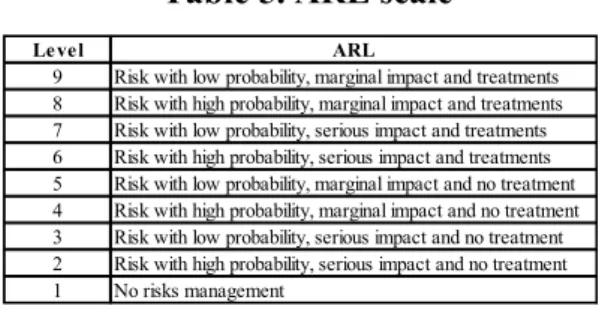
management process area of CMMI (Software Engineering Institute 2006) and the TRL scale. It is based on three elements: (main risk probability (high or low), the main risk impact (serious or marginal) and the main risk treatment (it exists or not action plans to manage the risk) (Sylla et al. 2017). ARL is measured on a nine-level scale (1 being the most risked and 9 less risked) as shown by the table 5. The phenomenon of integration between sub-systems introduced for the system readiness calculation seems not relevant to the delivery process. Therefore, the Process Risk Level of the whole implementation process is computed as a function of the ARLs of all activities involved in this process. Several functions could be used in order to compute PRL (minimum function, maximum function …etc.). In this paper we use a weighted average to compute the PRL of the process in order to take into account the relative importance of each activity. The ARL of activities are first normalized. As the SRL, the PRL is measured on a five-level scale. In the proposed method, each activity of the implementation process and each process are respectively characterized by an ARL and a PRL.
Table 5. ARL scale
Level ARL
9 Risk with low probability, marginal impact and treatments 8 Risk with high probability, marginal impact and treatments 7 Risk with low probability, serious impact and treatments 6 Risk with high probability, serious impact and treatments 5 Risk with low probability, marginal impact and no treatment 4 Risk with high probability, marginal impact and no treatment 3 Risk with low probability, serious impact and no treatment 2 Risk with high probability, serious impact and no treatment 1 No risks management
3.2 Subjective Indicators
The objective indicators provide relevant information about the readiness of the potential solutions of a system and the risk level of the associated processes. However this information is not sufficient to measure that the system finally designed and implemented will match all customer’s expectations (cost, performance and delivery time). Moreover, as already said by Mankins, not all sub-systems need a maximum readiness level as a prerequisite for an application (Mankins 2009). The same reasoning can be applied to the process. Not all activities need a maximum ARL to be performed.
Therefore, we propose a second version of Supplier Feeling Level (SFL) in order to capture the thought of the person in charge of the offer elaboration. Based on his experience and his risk aversion, the person (expert) provides a subjective judgment about the offer. In the contrary to the first version of SFL which is measured on a three level-scale (Sylla et al. 2017), this second version of SFL is measured on a five-level scale as shown by the table 6. This is to simplify the computation of the overall Confidence Indexes (CIS for
system and CIP for process) introduced in the next
subsection. This SFL scale is used for both the elements of system and those of process (table 2). The aggregation mechanisms proposed for the objective indicators are used to compute the SFL at the system (SFLS) and process (SFLP)
level.
Table 6. SFL scale
Level SFL 5 Very good 4 Good 3 Neutral 2 Bad 1 Very bad3.3 Overall Confidence Indexes (CIS and CIP)
The CIS and CIP are computed only at the system and process
level (see table 2). The CIS is a function of SRL and SFLS of
the system whereas the CIP is a function of PRL and SFLP of
the process. The same function is used to compute them. Several methods could be used to compute the CIS and CIP
(minimum function, maximum function, average … etc.). In this paper, as a first idea, we proposed to compute CIS and
CIP using the formulas below. The CIS and CIP are then
measured on a nine-level scale.
4. ILLUSTRATIVE APPLICATION
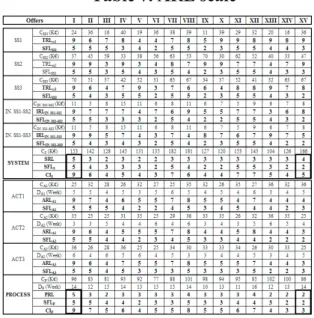
The aim of this section is to show the applicability and the effectiveness of the proposed method for the evaluation of the confidence indexes of potential solutions. In this illustrative application, we consider the development of a system. For each potential solution, we consider two items that have to be evaluated, a technical system and the associated implementation process. The technical system is composed of three subsystems (SS1, SS2 and SS3) and two relevant
integrations (IT. SS1-SS2 and IT. SS1-SS3) (left part of figure
2). Each subsystem is characterized with a cost (CSS), a TRL
and a SFL (SFLSS) and each integration is also characterized
with a cost (CIN), an IRL and a SFL (SFLIN). Then, thanks to
the proposed aggregation mechanisms for the system, the SRL, SFLS and CIS of the system are determined. The cost
(CS) of the whole technical system is computed as a sum of
the costs of the subsystems and their integrations.
The implementation process is composed of a sequence of three activities (ACT1, ACT2 and ACT3) as presented in the
right part of figure 2. Similarly to the technical system, each activity of the process is characterized with a Cost (CA),
duration (DA), an ARL and a SFLA. The cost of the process
(CP) is determined as the sum of the costs of all activities, and
the duration of the process (DP) as the sum of the duration of
all the activities. Then, thanks to the proposed aggregation mechanisms for the process, the PRL, SFLP and CIP of the
process are determined.
Figure 2: System and Process
Proceedings of the 20th IFAC World Congress Toulouse, France, July 9-14, 2017