HAL Id: hal-00766257
https://hal.inria.fr/hal-00766257
Submitted on 18 Dec 2012
HAL is a multi-disciplinary open access
archive for the deposit and dissemination of
sci-entific research documents, whether they are
pub-lished or not. The documents may come from
teaching and research institutions in France or
abroad, or from public or private research centers.
L’archive ouverte pluridisciplinaire HAL, est
destinée au dépôt et à la diffusion de documents
scientifiques de niveau recherche, publiés ou non,
émanant des établissements d’enseignement et de
recherche français ou étrangers, des laboratoires
publics ou privés.
A Framework for Enhancing Video Viewing Experience
with Haptic Effects of Motion
Fabien Danieau, Julien Fleureau, Audrey Cabec, Paul Kerbiriou, Philippe
Guillotel, Nicolas Mollet, Marc Christie, Anatole Lécuyer
To cite this version:
Fabien Danieau, Julien Fleureau, Audrey Cabec, Paul Kerbiriou, Philippe Guillotel, et al.. A
Framework for Enhancing Video Viewing Experience with Haptic Effects of Motion. Haptic Symposium
-2012, Mar -2012, Vancouver, Canada. �hal-00766257�
A Framework for Enhancing Video Viewing Experience
with Haptic Effects of Motion
Fabien Danieau∗ Technicolor / INRIA Julien Fleureau Technicolor Audrey Cabec Technicolor Paul Kerbiriou Technicolor Philippe Guillotel Technicolor Nicolas Mollet Technicolor Marc Christie IRISA Anatole L´ecuyer INRIA Abstract
This work aims at enhancing a classical video viewing expe-rience by introducing realistic haptic feelings in a consumer environment. More precisely, a complete framework to both produce and render the motion embedded in an audiovisual content is proposed to enhance a natural movie viewing ses-sion. We especially consider the case of a first-person point of view audiovisual content and we propose a general work-flow to address this problem. This latter includes a novel approach to both capture the motion and video of the scene of interest, together with a haptic rendering system for gen-erating a sensation of motion. A complete methodology to evaluate the relevance of our framework is finally proposed and demonstrates the interest of our approach.
Index Terms:
H.5.1 [Information Interfaces and Presentation]: Multime-dia Information Systems—Video; H.5.2 [Information Inter-faces and Presentation]: Multimedia Information Systems— Haptic I/O;
1 Introduction
New technology developments allow the creation of more and more immersive multimedia systems. 3D images and sound spatialization are now present in the end-user living space. But these systems are still limited to the stimulation of two senses, sight and hearing, while researches in virtual real-ity have shown that haptic perception seems to be strongly connected to the feeling of immersion [12].
In line with these works, we focus here on the way to enhance a natural video viewing experience with “realistic” haptic effects in a consumer environment. More precisely, our motivation is to develop a framework to make the user feel the motion embedded in the multimedia (Audio/Video) content he is watching. In this work, we target an automatic way to both produce and render the motion effects embedded in an audiovisual content. We especially consider the case of a first-person point of view A/V content, for which we expect the viewer to feel what the main actor is currently feeling in terms of motion. In this context, a comprehensive framework is presented and includes:
1. An approach to both capture motion and video of the scene of interest,
2. The method necessary to send and transform the orig-inal motion information to the back-end haptic device, 3. A haptic rendering scheme for generating a motion
ef-fect on a force-feedback device,
∗e-mail: [email protected]
4. A methodology to evaluate the interest and the rele-vance of such a framework.
The remainder of this paper is as follows. Section2 de-scribes existing works proposing to produce or render mo-tion effects. Secmo-tion 3 presents the framework including a description of the main components of the proposed work-flow. Section 4 details the methodology adopted to assess the proposed system as well as the obtained results. Finally section5provides conclusions and perspectives.
2 Related Work
2.1 Haptic effects for audiovisual contents
The production and the rendering of haptic effects for audio-visual contents are two typical issues identified in the pioneer theoretical work of O’Modhrain and Oakley [9].
The first issue deals with the content creation, i.e. how the haptic effects can be produced in order to be added to the audiovisual stream. In our context haptic effects are “mo-tion effects”. According to O’Modhrain and Oakley there are two ways to create such effects: the off-line creation and the real-time generation. In the first case haptic effects are synthesized and the editor of the content manually adds ef-fects to the media. In the second case the efef-fects are directly captured from physical sensors using specific device.
The second issue refers to the visualization of the content, more precisely to the rendering of the haptic cues. The haptic feedback should be rendered by a technology able to produce a wide range of haptic sensations. Moreover several constraints might appear if the content has to be displayed in a user’s living space, potentially shared.
Only a few contributions exploring the interest of haptic feedback for audiovisual contents have been reported in the literature. Most of them rely on the use of vibrotactile de-vices (Rahman et al. [11], Kim et al. [8]) or force-feedback devices (Gaw et al [5], Cha et al. [2]). But the haptic ef-fects proposed by these contributions are relatively simple : artificial vibrations patterns or abstract force-feedback. To our best knowledge, no haptic effects of motion have been introduced.
2.2 Simulation of motion
In the context of motion rendering, motion simulators are well-known devices designed to make the user feel motion. They are intensively used as driving or flight simulators for learning purposes or in amusement parks. Most of them are based on the Stewart’s platform [4]. It is a 6-DOF platform moving thanks to 6 hydraulic cylinders. Motion platforms are very immersive but they remain expensive for end-user customers and are not designed to be integrated in a user’s living space. In a less invasive way, the sensation of motion can be also induced by a force-feedback device. Ouarti et al. [10] apply a force on the user hand and the system is ex-pected to generate an illusion of motion with force-feedback.
While the interface is pulling the hand, the user feels mov-ing forward. In our work we consider usmov-ing a force-feedback device to render the effect of motion instead of a motion simulator. Such a technique takes advantage of its low cost and of its convenient size to be compatible with consumer applications.
In the context of motion capture, motion effects can be produced thanks to external sensors such as i) Inertial Mea-surement Units (see [1] or [15] for examples in the context of radio-controlled cars and actor modeling respectively) or ii) the camera used to record the scene combined with mo-tion extracmo-tion techniques (see Hu et al. [6] for a survey). Extraction algorithms can be helped by adding markers into the filmed scene (Sigal et al. [14] relied on this technique to perform motion capture) or by using a camera enhanced with infra-red capabilities (Microsoft Kinect device for instance). Thus several motion capture techniques exist but they are not designed to enhance a video viewing session. They tar-get other applications such as human behavior modeling or human computer interaction.
3 Outline of the system
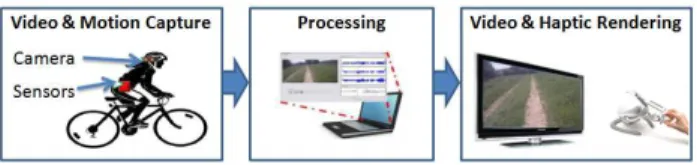
The system we propose is a comprehensive framework de-signed from the production of motion effects to their ren-dering on dedicated devices. Three main steps compose this framework as depicted in Figure1.
Figure 1: Workflow Overview. Data are simultaneously captured by a camera and a motion sensor. Then motion data are converted into a signal suitable for the dedicated haptic renderer. Finally both video and motion are rendered simultaneously.
3.1 Motion capture with physical sensors
The first step consists in i) capturing the motion effects for the renderer and ii) recording the audiovisual content that should be displayed simultaneously with the renderer. In the context of our work, a combined system making use of, on one hand, an Inertial Measurement Units (IMU) and, on the other hand, of a High Definition (HD) camera dedicated to sportive activities has to be designed.
The IMU we chose is the Ultimate IMU board which com-bines an ADXL345 accelerometer, an ITG-3200 gyroscope and a HMC-5843 electronic compass (cf. Figure2-Left,B). The first component records the 3-axis accelerations of the board, the second one quantifies the rotation of the board around its 3 axes and the last component allows a geocen-tric orientation by giving an estimation of the local magnetic field. An additional micro-SD memory card may be embed-ded on the board and allows the recording of the three raw signals. A dedicated middleware has been developed and uploaded to the Ultimate IMU to set the recording process to 30Hz.
Complementary, a Camsports HDS-720p (see Figure 2 -Left,A) was selected to record the scene corresponding to the current point of view of the actor. The camera is a HD bullet camera. It uses a 120 degrees wide-angled lens and integrates a built-in 4GB memory chipset. The spatial resolution of this device is 1280 x 720p at a frequency of 30fps. It is
water-proof and is able to handle harsh environments. It finally integrates a mono-channel microphone.
Figure 2: Overview of the device capturing both video and motion. Left: The integrated prototype is composed by a (A) Camsports HDS-720p and a (B) Ultimate IMU board with its battery. Right: The prototype is fixed on an actor’s chest and records his motion on 3 axes.
A complete integrated prototype combining the IMU, its battery and the camera has been developed. As the system is designed to be fixed on an actor (first-person point of view recording), it is enough robust to resist to different conditions of recording (cf. Figure2-Right).
To synchronise the IMU and the camera, which are ob-viously independent, and do not offer possibilities of exter-nal synchronisation, a mechanical trick is used (very similar to the A/V synchronisation techniques traditionally used in movie making). Before each record, three little pats are given on the prototype which cause a fast and big peak in both the acceleration signals of the IMU and the audio stream of the camera. Basic signal processing techniques are then used to make those peaks match in both signals (variance-based threshold).
3.2 Processing of the captured motion signals
Once the different motion information have been recorded, they have to be processed to be compatible with the input of the haptic device that is used. As stated previously, Ouarti et al. [10] relied on a force-feedback device to make the user feel a sensation of self-motion. A force in the user hand was applied while the subject was watching a visual stimu-lus. The force (orientation and direction) is highly correlated to the motion embedded in the visual content and creates an illusion of self-motion even though the application point (hand) is different from the stimulating point where the ac-celerations have been recorded (chest).
In our context, we propose to replace the single accelera-tion of the approach of Ouarti et al. [10] by using the three raw accelerations a[k] = {ax[k], ay[k], az[k]}T recorded
dur-ing the capture step at each sample k to modulate the 3-axis effort applied to the subject’s hand. The methodology de-scribed here is generic and may be applied to other kinds of rendering devices. Though this approach is quite direct and requires very few processing, several points require specific attention (see Figure3).
Figure 3: Processing Overview. The gravity is removed from the accelerations motion signals captured. Optionally extra processing can be performed such as low-pass filtering.
3.2.1 Gravity removal
The main processing to apply is linked to the gravitational component g included in the raw acceleration. This latter is quite important regarding the other external sources of ac-celeration and can mask some useful information needed to render a motion feeling. Our empirical observations showed that removing this specific contribution enhance the user experience. A two-step methodology is therefore applied to remove this component from the original signal. In a first step, the board orientation is estimated using the approach described by Sabatini [13]. This latter especially combines the use of i) a quaternion-based representation of the board attitude and ii) a dedicated extended Kalman filter to es-timate the board orientation by fusioning the information coming from the three sensors (gyroscope, accelerometer, magnetometer). This operation allows to estimate the di-rection of the gravity (vertical) ng[k] in the accelerometer
frame (frame A) at each time sample k. The raw accelera-tion vector is therefore updated by removing the quantity, kgkng[k], from each sample a[k].
The processing output signal p[k] = {px[k], py[k], pz[k]}T
may be formalized, at each time sample k, by:
p[k] = a[k] − kgkng[k] (1)
3.2.2 Filtering and Additional effects
A filtering step is necessary to reduce the noise of the orig-inal signal. For practical reasons, the filtering is actually performed on the IMU. More precisely, the 3 sensors data were natively sampled at 200Hz but due to limitations with the writing speed on the embedded micro-SD, samples were averaged and down-sampled at 30Hz. This averaging step contributes to a low-pass filtering of the raw signal.
Extra operations enhancing the signal for a better render-ing for the end-user may be optionally addressed. They may be simple operations to remove artifacts or artificial modu-lation (reduction or amplification) of some parts of interest in the signal a to underline specific haptic events.
3.3 Haptic rendering of the motion effect
An open-loop rendering system was introduced to dis-play the force-feedback. This way the signal p was sim-ply rendered as a force vector F, defined as F[k] = {Fx[k], Fy[k], Fz[k]}T. However a few transformations of the
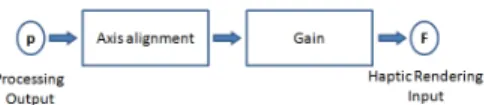
signal p should be performed in order to render a force suit-able for the haptic device (Figure4).
Figure 4: Pre-Rendering Overview. The signal from the processing step is aligned to the axes of the haptic device and then amplified.
The processed signal p is sent to a haptic rendering al-gorithm controlling a haptic device which is, in our frame-work, a Novint Falcon device. This latter is a 3-DOF force-feedback device, able to apply a force along three axes. 3.3.1 Axis alignment
To be rendered on the haptic device, an axis permutation of the signal p has to be performed to align the axes of the accelerometer (frame A) with the axis of the device (frame
D). The associated permutation matrix is termed MA D.
In our context, the matrix simply switches the y and z-axis of A in D. A complementary step reverses the z-z-axis as the force-feedback device is placed in front of the user and it is supposed to pull the user’s hand when the recorded acceleration is positive on the z-axis.
3.3.2 Gain
Then a scaling of the raw data is necessary to adapt the amplitude of the signal p to the renderer input range. The scaling factors sx, syand szfor each axis are assumed to be
constant (independent of the time sample) and empirically set according to experimental feedbacks. The associated di-agonal scaling matrix is termed diag(sx, sy, sz) and in the
context of our work sx= sy= sz.
The force rendered by the haptic device may be finally formalized by:
F[k] = diag(sx, sy, sz)MAD(p[k]) (2)
3.4 Multimedia player with haptic effects
Once the force F is computed, it has to be rendered by a haptic device. A force F is computed for each IMU sample and oversampled (point sampling, i.e. piecewise constant interpolation) to meet the requirements of the 1kHz haptic rendering loop frequency.
The rendering algorithm was integrated in a home-made multimedia player allowing the haptic rendering on a force-feedback device and the A/V rendering in a synchronized way. The HAPI 1 was used to control the Novint Falcon.
This high-level C++ library allows to simply create force vectors which are then rendered on a force-feedback device. The framework presented here allows to produce and ren-der realistic haptic effects of motion. The renren-dering stage relies on a force-feedback device to generate a sensation of motion. Accelerations of the camera are rendered on this de-vice. But the framework is not limited to one kind of haptic device. The positions of the IMU, and so of the prototype, are computed in the processing step in order to remove the gravity. These data could be used to render motion effect on a classical motion simulator which will reproduce the po-sition of the camera.
4 User Evaluation
A dedicated experimental protocol has been developed to assess the impact of the haptic feedback on the user’s Qual-ity of Experience (QoE). QoE relates to the subjective user experience with a service or an application [7]. The protocol designed to evaluate the QoE is presented hereafter as well as the associated results.
4.1 Experimental Setup
4.1.1 Capturing test sequences
Our motion capture prototype was used to create several samples of audiovisual contents enriched with haptic data. We identified 4 scenarios to represent different kinds of mo-tion feelings (Figure 5). The prototype was placed on an actor’s chest and we obtained the following videos sequences as well as the corresponding haptic data:
- Bike. The objective of this scenario is to capture low-amplitude movements. The actor is performing out-door cycling and a succession of vertical movements with small amplitude are captured. (duration 61s).
- Horse. In this case the actor is riding a galloping horse and feels recurrent top-down movements. High-amplitude vertical movements are captured. (duration 60s).
- Car turning. In this scenario, the actor is inside a car engaged in a roundabout. The centrifugal force makes him feel pushed on a side. The captured motion is felt as strong and long. (duration 45s).
- Car Braking. This last scenario aims to capture a strong punctual movement. The actor is in a car strongly braking and he feels a strong force pushing him forward during few seconds. (duration 75s). Duration of each sequence is around one minute.
Figure 5: Tests Scenarios. Top Left Outdoor cycling. Top Right -Horse riding. Bottom Left - Car engaged in a roundabout. Bottom Right - Car strongly braking.
4.1.2 Haptic setup
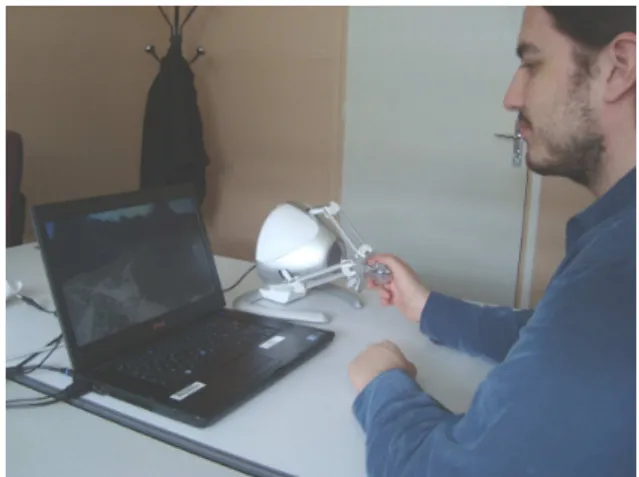
The playback system was composed of a 15” laptop and a Novint Falcon device (Figure 6). The user is comfortably seated in front of the computer where one of the captured video sequence is displayed and experiences haptic feedback by holding the Novint Falcon device in his dominant hand. Our home-made Haptic/Audio/Video Player was used to play the video in fullscreen mode.
Figure 6: A participant experiences an audiovisual content enriched with haptic feedback.
4.2 Experimental Protocol
4.2.1 Variables
In order to evaluate the user’s QoE for each sequence we defined three types of haptic feedback to be rendered with the video:
- Realistic Feedback. The captured haptic feedback, consistent with the sequences.
- No Feedback. Only the audiovisual content is dis-played. The goal of this condition is to measure the QoE of a classical A/V content. This will be used as a reference to evaluate the interest of a haptic feedback for a video.
- Random Feedback. A random haptic feedback made of a low-pass filtered white noise (cutoff frequency
Fc= 0.5Hz) of the same length and amplitude of the
consistent haptic feedback. This feedback is not con-sistent with the video and will be used to evaluate the interest of providing a realistic haptic feedback. Combining the whole set of possibilities we get 12
condi-tions(4 videos sequences x 3 haptic feedbacks) which were tested in each experiment in order to evaluate the QoE, our independent variable. These conditions will be presented in a random order to the participants.
4.2.2 Measures
A questionnaire was designed to evaluate the QoE of a video enriched with haptic feedback. It was built around the
Pres-ence[18] and Usability [16] concepts.
Presence aims at measuring how much the user feels be-ing physically situated in a virtual environment. Witmer and Singer [18] identified four factors to determine the pres-ence: Control, Sensory, Realism and Distraction. “Control” determines how much the user can control and modify ob-jects within the virtual environment. “Sensory” character-izes how each sensory modality is solicited during the in-teraction. “Realism” describes how much the environment is realistic and consistent with user’s representation of the real world. “Distraction” identifies how much the user is disturbed by the apparatus used to create the virtual world. From this definition we focused on two factors: Realism and
Sensory. As the user is passive with our system, Control factor was not relevant here. Moreover we did not mea-sure Distraction in our QoE questionnaire but this aspect was interesting and was evaluated in a second questionnaire (post-test questionnaire).
Usability is defined by the norm ISO 9241-11 and aims at measuring how easy a system is to use. Three factors composed this concept: Efficiency, Effectiveness and Satis-faction. This latter measures how well the user enjoyed the system. “Effectiveness” means how well a user can perform a task while “Efficiency” indicates how much efforts are re-quired. These two factors were not totally suitable for our system in the sense that it was not designed to perform a task. We preferred to use the term of Comfort to measure how well was the system to provide feedback. Satisfaction was however fully relevant in our situation.
Hence, the QoE of our system was evaluated by 4 items : Realism, Sensory, Comfort and Satisfaction (cf. Table 1). We defined only one question by item supposed to be rated on a five-point Likert-scale. The QoE is computed by the sum of these 4 items. This way the QoE questionnaire is easy to fill in and can be submitted for each condition.
A second questionnaire was designed in order to collect more information about user’s feelings. It was composed by
Factor Question
Realism How much did your experiences in the virtual environment seem consistent with your real-world experiences?
Sensory How much did the haptic feedback improve the interaction?
Comfort How much was the system comfortable? Satisfaction How much was the system pleasant to use?
Table 1: QoE Qestionnaire. Each question is rated on a 5-point Likert-scale from 1 (Not at all) to 5 (Totally)
several open-ended questions supposed to be submitted at the end of the experiment. The participant was asked to label each haptic feedback, to indicate which one seemed the more realistic and why. To answer these questions he had the possibility to replay every sequences classified into 3 groups : Feedback 1, Feedback 2 and Feedback 3. He was also asked to tell how the system was tiring and comfortable to use, and finally to imagine several applications.
4.2.3 Procedure
15 participants have taken part to the experiment. They were aged from 21 to 59 (M=27.8 SD=9.7), 9 were Male, 1 participant was left-handed, 8 never used a Novint Falcon device. The whole experiment lasted from 30 to 40 minutes. The procedure for each user was organized as follows:
1. Fill in a consent form. 2. Fill in an information sheet.
3. Demonstration of the falcon and its capacities (forces it can provide). This step aims of reducing the “surprise effect” for novice users.
4. Presentation of the 12 conditions in a random order. For each one:
4a. Experience the multimedia content (video se-quence + haptic feedback),
4b. Answer to the QoE questionnaire.
5. Answer the post-test questionnaire. Possibility to retry every sequences.
4.3 Results
The data collected were 4 notes (Realism, Sensory, Com-fort and Satisfaction; from 1 to 5) for each condition per participant. The sum of these notes gives the QoE per con-ditions per participants (Figure7). The QoE per feedback per participant was also computed. This metrics is termed
QoEAll. The normality of the distributions was tested with
the Shapiro-Wilk test and was rejected most of the time. Hence non-parametric tests were used to analyze the results presented in this section.
We first found that the QoE for each sequence follows the same pattern. The QoEAll of the “Random Feedback”
condition (M = 10.2 SD = 1.6) is higher than the QoE for the “No Feedback” condition (M = 7.5 SD = 2.1), and the QoE of the “Realistic Feedback” (M = 15.3 SD = 2.6) is higher than the random one. Figure7depicts this pattern. This result is significant according to the Friedman Anova (χ2= 24.71, df = 2, p < 0.05).
Figure8shows the mean score for each item of the QoEAll
for the three feedback conditions. The more realistic the feedback is the higher are the Realism, Sensory and Sat-isfaction items: Realism MN one = 1.3 MRandom = 1.9
MRealistic = 3.8, Sensory MN one = 1.1 MRandom = 2.4
MRealistic= 3.9 and Satisfaction MN one = 2.1 MRandom=
Figure 7: QoE of each sequence and haptic feedback. For each se-quences, participants found that a realistic haptic feedback improves the experience. Interestingly a random feedback was more appreci-ated that no feedback.
2.8 MRealistic= 4.1. These results are also significant
(Fried-man Anova: χ2 = 24.0.3, df = 2, p
Realism < 0.05;
χ2 = 26.68, df = 2, p
Sensory < 0.05; χ2 = 23.05, df = 2,
pSatisf action < 0.05). However Comfort appears to be
relatively stable all along the experiment (MN one = 2.9
MRandom = 3.2 MRealistic = 3.6). But this result is less
significant (Friedman Anova, χ2= 8.79, df = 2, p = 0.012).
Figure 8: QoE of each haptic feedback and details of the components. The Comfort component of the QoE remains the same whatever the feedback perceived. However the three others increase with no feedback, random feedback and realistic feedback respectively.
We also observed that the QoEAll for the realistic haptic
feedback remains the same for those who never used a Novint Falcon (M = 15.5 SD = 2.9) and for those who did (M = 15.25 SD = 2.5). The expertise of the participant do not affect the result significantly (Wilcoxon Mann-Whitney test,
p <0.05).
4.4 Discussion
The main result of this study is that QoE increases with haptic feedback and more particularly with haptic feedback consistent with audiovisual content. Moreover participants’ expertise with the Novint Falcon do not affect the QoE. This observation let us think that our main result is not due to a “surprise effect”. However the low score obtained by se-quences with no feedback can be in part due to our experi-mental protocol. Whatever the condition, participants were asked to hold the Novint Falcon device in their dominant hand. Thus they might have been frustrated when they felt no haptic feedback. Obviously if there is a haptic device people are expecting haptic feedback.
perception of the audiovisual content, especially if the mean-ing of the video is ambiguous. For instance one cannot see a bike in the bike sequence although a head of a horse is visible in the horse sequence as well as a part of a car in the two car sequences. During the experiment a participant thought that the bike sequence represented a buggy riding video because he felt that the haptic feedback (realistic feed-back condition) was closed to his own buggy driving expe-rience. Thus it appears that users build a mental represen-tation of the multimedia content consistent with their own experience, and it is interesting to see how haptic feedback can influence this representation when audiovisual content is ambiguous.
Another interesting behavior was observed while partic-ipant experienced video enriched with random feedback. Most of them tried to find a meaning for this haptic feed-back, consistent with their own personal experience. This observation may explain higher QoE for random feedback than for no feedback. The phenomenon was particularly highlighted in the Car Turning and Car Braking conditions. Several participants supposed that the haptic feedback was mapped to the gear shift of the car. This can also explain why QoE for Random Feedback in these two conditions is better than in Bike and Horse conditions.
Finally participants reported in the post-test question-naire to feel comfortable all along the experiment although the position of the arm and the hand-grip were reported as quite uncomfortable. This setup is obviously not suitable for watching a 2-hours movie. Of course, the limitations mainly due to the haptic rendering system and to the screen size, should be improved to reduce the user’s fatigue in a out-of-the-lab context.
5 Conclusion and Perspectives
In this paper we presented a comprehensive framework to add realistic haptic effects of motion to a video. A novel approach to capture both audiovisual content and motion of the camera was first detailed. Then an original way to ren-der this multimedia content was described. Our playback system relies on a force-feedback device to make the user feel the captured motion. Finally we presented a method to evaluate users’ Quality of Experience with our system. Re-sults show that the user experience increases with a realistic haptic feedback.
The work presented here focuses on the production and on the rendering of haptic effects. A third issue important to consider would be the distribution of the audiovisual content enriched with haptic effects. Cha et al. [3] introduced the notion of haptic broadcasting which correspond to the tech-niques to transmit haptic effects synchronized to the other components of the media. In a similar way, Walt [17] de-scribed a data format to formalize haptic effects and to syn-chronize them to an audiovisual content. These techniques would be an interesting extension for this framework, es-pecially in a consumer context where users used to watch videos through streaming platforms.
The first user study yielded promising results. Therefore, it would be first interesting to conduct a large-scale study in order to characterize more precisely the user’s feelings and attitude with the system as well as the design of a more ecological setup. Moreover research efforts are necessary to determine when the user perceives a haptic feedback as con-sistent or not with an audiovisual content. This will help to finely design haptic effects necessary to trigger an im-mersion feeling. Second, sequences representing a diversity movements have also to be captured. More fundamentally,
it is important to understand how users feel a sensation of motion through a force-feedback device. Finally it would also be interesting to evaluate the perception of effects with third-person point of view records.
To conclude, the framework we proposed in this paper al-lows to create more immersive audiovisual content by involv-ing our sense of touch. This brinvolv-ings a new way to experience multimedia content and can enhance many viewing contexts such as movies, extreme sports videos or video games.
References
[1] A. Brady, B. MacDonald, I. Oakley, S. Hughes, and S. O’Modhrain. Relay: a futuristic interface for remote driv-ing. In Eurohaptics, 2002.
[2] J. Cha, M. Eid, and A. E. Saddik. Touchable 3D video sys-tem. ACM Transactions on Multimedia Computing,
Com-munications, and Applications, 5(4):1–25, Oct. 2009.
[3] J. Cha, Y.-S. Ho, Y. Kim, J. Ryu, and I. Oakley. A Frame-work for Haptic Broadcasting. IEEE Multimedia, 16(3):16– 27, July 2009.
[4] B. Dasgupta. The Stewart platform manipulator: a review.
Mechanism and Machine Theory, 35(1):15–40, Jan. 2000.
[5] D. Gaw, D. Morris, and K. Salisbury. Haptically Annotated Movies: Reaching Out and Touching the Silver Screen. In
Haptic Interfaces for Virtual Environment and Teleoperator Systems, pages 287–288. IEEE, 2006.
[6] W. Hu, T. Tan, L. Wang, and S. Maybank. A Survey on Vi-sual Surveillance of Object Motion and Behaviors. IEEE
Transactions on Systems, Man and Cybernetics, Part C (Applications and Reviews), 34(3):334–352, Aug. 2004.
[7] K. Kilkki. Quality of experience in communications ecosys-tem. Journal of universal computer science, 14(5):615–624, 2008.
[8] Y. Kim, J. Cha, J. Ryu, and I. Oakley. A Tactile Glove De-sign and Authoring System for Immersive Multimedia. IEEE
Multimedia, pages 2–12, 2010.
[9] S. O’Modhrain and I. Oakley. Touch TV: Adding feeling to broadcast media. In European Conference on Interactive
Television: from Viewers to Actors, 2003.
[10] N. Ouarti, A. L´ecuyer, and A. Berthoz. Method for sim-ulating specific movements by haptic feedback, and device implementing the method, September 2009. French Patent
N◦09 56406.
[11] M. A. Rahman, A. Alkhaldi, and J. Cha. Adding haptic feature to YouTube. In ACM International Conference on
Multimedia, pages 1643–1646, 2010.
[12] M. Reiner. The Role of Haptics in Immersive Telecommu-nication Environments. IEEE Transactions on Circuits and
Systems for Video Technology, 14(3):392–401, Mar. 2004.
[13] A. M. Sabatini. Quaternion-Based Extended Kalman Fil-ter for DeFil-termining Orientation by Inertial and Magnetic Sensing. IEEE Transactions on Biomedical Engineering,
53(7):1346–1356, 2006.
[14] L. Sigal and M. J. Black. Humaneva: Synchronized video and motion capture dataset for evaluation of articulated human motion. Technical Report CS-06-08, Brown Univertsity TR, 2006.
[15] R. Slyper and J. K. Hodgins. Action capture with accelerom-eters. In Eurographics/ ACM SIGGRAPH Symposium on
Computer Animation, 2008.
[16] T. Tullis and W. Albert. Measuring the user experience:
col-lecting, analyzing, and presenting usability metrics. Morgan
Kaufmann, 2008.
[17] M. Waltl. Enriching Multimedia with Sensory Effects:
An-notation and Simulation Tools for the Representation of Sensory Effects. VDM Verlag Saarbr¨ucken, Germany, 2010. [18] B. G. Witmer and M. J. Singer. Measuring presence in vir-tual environments : A presence questionnaire. Presence,