Institut du développement durable
et des relations internationales
27, rue Saint-Guillaume
75337 Paris cedex 07 France
The State of
Environmental
Migration
2010
N°07/11 DECEMBER 2011 | CLIMATEEdited by
François Gemenne
Pauline Brücker
Joshua Glasser
Brazil
Pakistan
Russia
Haiti
Chile
France
Nepal
Darfur
www
.iddri.org
D – IDDRI
As a foundation of public utility, IDDRI encour-ages reproduction and communication of its copy-righted materials to the public, with proper credit (bibliographical reference and/or corresponding URL), for personal, corporate or public policy research, or educational purposes. However, IDDRI’s copyrighted materials are not for commer-cial use or dissemination (print or electronic). Unless expressly stated otherwise, the findings, interpretations, and conclusions expressed in the materials are those of the various authors and are not necessarily those of IDDRI’s board.
D – IOM
The opinions expressed in the report are those of the authors and do not necessarily reflect the views of the International Organization for Migration (IOM). The designations employed and the pres-entation of material throughout the report do not imply the expression of any opinion whatsoever on the part of IOM concerning the legal status of any country, territory, city or area, or of its authorities, or concerning its frontiers or boundaries.
IOM is committed to the principle that humane and orderly migration benefits migrants and society. As an intergovernmental organization, IOM acts with its partners in the international community to: assist in meeting the operational challenges of migration; advance understanding of migration issues; encourage social and economic develop-ment through migration; and uphold the human dignity and well-being of migrants.
Publisher:
International Organization for Migration route des Morillons - Geneva SwitzerlandTel: +.. Fax: +..
E-mail: [email protected]
Internet: http://www.iom.int
All rights reserved. No part of this publication may be reproduced, stored in a retrieval system, or transmitted in any form or by any means, elec-tronic, mechanical, photocopying, recording, or otherwise without the prior written permission of the publisher.
of Environmental
Migration
2010
Edited by
François Gemenne
Pauline Brücker
Joshua Glasser
I
t is not so often that a university professor gets the chance to write the foreword of a volume put together by Masters’ students. But I have to say that this project is excep-tional in many regards.First of all, this volume does an exceptional job in documenting recent events of environmental migration and displacement. Today, there is hardly a week that goes by without the media announcing significant population displacements due to envi-ronmental changes. Yet, beyond the press head-lines, little is known about the complex relationship between environmental changes and migration. Through an analysis of a variety of case-studies, this volume highlights the wide diversity of move-ments that hide beyond the label of “environmen-tal migration”. It sheds a new, more complex light on many of the crises that marred the year . It is the first of an annual series, responding to the need to provide a foundation of empirical evidence for the cases that attract high media attention, but also for those that go unnoticed because they are often considered as “not spectacular enough”.
But what is most remarkable about this volume is that it is the work of students. When Sciences Po created a course on “Environment and Migration”, as part of the Master on Environment, Sustainable Development and Risks, it was the very first uni-versity course dedicated to this issue. This volume is first and foremost a testimony of the exceptional potential of the youth to address this issue: they represent the generation that will need to provide leadership on what appears to be one of the defin-ing issues of our time.
Finally, I am very happy that IDDRI has joined ef-forts with IOM in order to put this volume togeth-er. IDDRI has actively engaged in research on this topic since , and it is one of the areas where IDDRI and IOM closely cooperate together, and this cooperation should further grow in the years to come. This volume reaffirms the importance of policy-relevant research – one of IDDRI’s core ob-jectives, and it is with great pride that I support the publication of this special volume. |
FOREWORD BY LAURENCE TUBIANA
Director,
Institute for Sustainable Development
and International Relations (IDDRI)
FOREWORD BY MD. SHAHIDUL HAQUE
E
nvironmental degradation promptedby increased extreme weather patterns such as floods, severe hurricanes, deser-tification, and melting glaciers have be-come much more frequent. In , ex-treme weather events displaced million people compared to . million people displaced within their own country by conflict and violence. Cli-mate-related disasters are the main sudden onset trigger responsible for displacement in and causing the displacement of million people in and million people in (IDMC ).
The impact of these major environmental inci-dents demands a broader policy discourse to de-vise stronger mitigation and/or adaptation capaci-ties. The incorporation of all stakeholders of all ages is central in learning lessons and developing new alternatives. The International Organisation for Migration is therefore pleased to support the innovative student-led project entitled The State of
Environmental Migration initiated by the Institute for Sustainable Development and International re-lations (IDDRI).
The IOM and IDDRI have a long history of co-operation on the topics of environmental degra-dation and migration, collaborating on knowl-edge creation and devising field projects to better manage the migratory effects of environmental change. The link between IDDRI’s experience in governance, climate and agriculture, and IOM’s expertise as a leader on migration issues is key for staying abreast of environmentally-induced migration trends. Incorporating student research papers within the wider policy discourse on envi-ronmental and climate change is a novel practice which gives our youth a strong voice in the debate.
Migration is a way for people to adjust to a changing environment. The consequence of envi-ronmental degradation on migration presents hu-manity with unprecedented challenges. The num-ber of storms, droughts and floods has increased threefold over the last years with devastating effects on vulnerable communities. Since the early s, the IOM has been particularly committed to tackling the emerging issues of environmental
degradation and migration. The IOM has carried out programs to address the challenges in more than countries in the Pacific, Latin America, Asia and Africa, and is or has been present in many of the areas that are described in case studies in this publication, such as Pakistan, Haiti, Nepal or Darfur. In line with IOM’s comprehensive ap-proach to human mobility, interventions cover the continuum from emergency preparedness and response to disaster risk reduction and climate change adaptation, contributing to the sustainable development of countries and communities.
As this collection of student research papers and case studies on emerging and ongoing dis-asters demonstrates, despite the global nature of environmental change, the manifestations of the phenomenon will be characteristically local. Fail-ing to incorporate migration within the policy discourse could seriously undermine potential al-ternative livelihood strategies. The papers discuss
the necessity for states and their partners as well
as local populations to develop strategies, policies and programmes along a continuum ranging from emergency preparedness and response to disaster risk reduction and climate change adaptation.
One of the greatest inequities in the shift of glob-al temperature and the increase in naturglob-al disas-ters is that future generations will most likely wit-ness the greatest disruption to their livelihoods. Incorporating the voices of tomorrow within the current policy discourse is an important step in de-veloping strong future leadership needed to tackle these difficult challenges. |
“It is the youth of the world who can set the agenda for the future and pursue it with dili-gence. We must do all we can to empower young people to take action, because the future be-longs to them” (Rajenda Pachauri, chairman of the intergovernmental Panel on Climate Change at COP /CMP).
Director,
Department for International Cooperation and Partnerships
International Organization for Migration (IOM)
EDITORS AND CONTRIBUTORS
8
INTRODUCTION
13
PART 1 – EMERGING CATASTROPHES
15
. Floods in Pakistan (Shoghi Emerson) . Wildfires in Russia (Daria Mokhnacheva) . The Earthquake in Haiti (Nikola Gütermann and Eve Schneider) . The Earthquake in Chile (Mylène André) . The Xynthia Storm in France (Jean Le Goff)
PART 2 – ON-GOING CRISES
65
. Displacement risks from glacial melting in Nepal (Radu Nikolaus Botez) . Migration and relief action in drought-affected Darfur (Charles-Édouard de Ramaix) . Patterns of environmental migration in Brazil: three case studies
(Nathalia Capellini, Carolina M. Castro and Eva Gutjahr)
.. Case : Drought and migration in Northeastern Brazil
.. Case : Environmental migration in the Brazilian Amazon: What is the role of policy? .. Case : Environmental and Human Disaster in the Hilly Regions
of the State of Rio de Janeiro (January )
J G
Joshua Glasser is a Master’s student at the Har-vard School of Public Health. Prior to graduate
school, he worked as a grassroots organizer and public interest lob-byist for a non-profit
organization,
Com-mon Cause, in his home state of North Carolina. He was also awarded a Fulbright Scholarship (-) for studies in Vietnamese language and culture in Hanoi, Vietnam. During his Ful-bright year, he conducted a qualitative research study with migrant workers living with HIV/AIDS and their families. He completed undergraduate studies in political science and public policy analy-sis at the University of North Carolina at Chapel Hill in .
After graduate school, Joshua plans to work on research related to climate change adaptation policy. He is particularly interested in linkages between global climate policy and finance frame-works, and local, community-based adaptation efforts.
F G
François Gemenne teaches the course on “Environ-ment and Migration” at Sciences Po’s Paris School
of International Affairs (PSIA). When he’s not teaching, he conducts research on this and other related topics at IDDRI, where he is a research fellow. He has conducted field studies in New Orleans, Tuvalu, China, Central Asia and Mauritius. He has been in-volved in different international research projects, and has consulted for the Asian Development Bank, the International Organization for Migra-tion and the Cartier FoundaMigra-tion for Contemporary Art. He has published three books and numerous articles on environmental migration, adaptation and vulnerability. He is also the editor of the ‘Sus-tainable Development’ series at the Presses de
Sci-ences Po, a leading French academic publisher. A political scientist by training, he was first educated at the University of Liège (Belgium) and holds a joint PhD from Sciences Po and the University of Liège, as well as a Master of Research in Political from the London School of Economics and a Mas-ter of Sciences in Environmental Studies from the University of Louvain.
P B
Pauline Brücker is a research fellow at the Institute for Sustainable Development and International Relations (IDDRI). Her current research focuses on environment, migra-tion and human rights issues.
Graduated of a Master of International Affairs from the Paris School of International Affairs (PSIA) at Sciences Po Paris, she is specialized in public international law (IHRL, IRL, IHL) and migrations in the Middle East, West Asia and the Horn of Africa.
She has been focusing her research on the pro-tection of internal displaced persons, asylum seek-ers and migrants in the occupied Palestinian terri-tories, Egypt, Iraq and Afghanistan. She especially worked for the defense of their economic, social and cultural rights as well as their inclusion in transitional justice processes.
M A
Mylène André is a French student and a recent Master’s graduate in International Public
Manage-ment at the Paris School of International Af-fairs (PSIA, Sciences Po Paris). She holds a Bach-elor Degree from the Latin-American campus of Poitiers (Sciences Po) and has academic and professional experience in Chile, where she completed an academic ex-change and internships in the private sector.
Her interests include the environment, climate change and energy and their present and future impacts on our lifestyles. Additionally, she is inter-ested in human rights awareness and especially in the Southern Cone of South America. She hopes to enhance her experience in these fields through different departments (communications, research and publication or public policies), in France or abroad.
R B
Born in Romania and raised in Germany, Radu Nikolaus Botez is a graduate student in
Interna-tional Security, special-ized in Migration Studies and Asian Studies, at the Paris School of Inter-national Affairs (PSIA, Sciences Po Paris). His interest lies mainly in security challenges in South Asia, where he is currently interning with a think tank in New Delhi. Besides regularly writing security briefings for openDemocracy.net, Radu Botez is also part of Asylos, a network of volunteers researching for lawyers representing asylum-seekers in Europe. In the future, he would like to complete his education with a PhD and later work in a think tank.
N C
Natalia Capellini is an anthropologist from Sao Paulo, Brazil, where she studied at the University of Sao Paulo. She is cur-rently in the second year of the International Af-fairs Master’s degree on Environment and Sus-tainable Development at the Paris School of Inter-national Affairs (PSIA, Sciences Po Paris). She studied agricultural uses of water in France and the Mediterranean Region.
She additionally worked on gender issues with Brazilian and international social movements, in isolated communities in Brazil. She wants to pur-sue her studies making links between gender and environment, especially in rural areas.
C M C
Brazilian student holding Bachelor’ degrees in In-ternational Relations and in Biology/Ecology, Car-olina Milhorance de Castro is currently enrolled in the Environment, Sustainable Development and Risks Master’s degree at the Paris School of Inter-national Affairs (PSIA-Sciences Po Paris).
She has had diverse professional experienc-es in rexperienc-esearch institu-tions, NGOs and inter-national organizations, including the Oswaldo Cruz Foundation, the
Brazilian Biodiversity
Fund, and the OECD. She also has field experience in the Amazon re-gion. Her main interests are international coop-eration, environmental politics and the promotion of sustainable development. She is currently work-ing on the role of transnational networks and on South-South cooperation mechanisms.
S E
Shoghi Emerson is a Belgian student, holding a Bachelor’s degree in Economics and Politics (SOAS, London) and a Master’s degree in
Sustainable
Develop-ment (PSIA, Sciences Po Paris). He is currently a graduate student in the MSc International Politi-cal Economy at the London School of Economics.
He worked in the European Parliament as a par-liamentary assistant on climate change issues, and would now like to pursue a career in crisis man-agement and humanitarian work.
E G
Eva Gutjahr is a Brazilian student, holding a MSc degree in Social Anthro-pology from the Uni-versity of São Paulo in Brazil and a Professional Master’s degree in Inter-national Affairs from the Paris School of Interna-tional Affairs (PSIA, Sci-ences Po Paris). She also holds specializations in the fields of Environmen-tal Management (Senac-SP) and Intangible Cul-tural Heritage instruments and policies (Unesco and Brazilian Ministry of Culture).
She has worked as a consultant for over six years in projects related to the safeguard of the intan-gible cultural heritage of the Wajãpi indigenous community of Amapá, Brazil, and has also provid-ed services in the fields of environment, provid-education and cultural promotion for several organizations working with indigenous peoples in Brazil. She has received a “best academic production” prize in and her thesis was awarded a publica-tion by the University of São Paulo in . She is interested in relations between environmental change, social vulnerability and cultural aspects of development.
N G
Nikola Gütermann is a German student. She stud-ied in International Affairs and Governance from
the University of St. Gal-len in Switzerland and at the Universidad del Pacífico in Lima, Peru. She is now completing her double Master’s de-gree at the University of St. Gallen and at the Paris School of Interna-tional Affairs (PSIA, Sciences Po Paris).
She is particularly interested by international organizations and issues such as international security, migrations, and trade, and overall, inter-national challenges from a political and economic standpoint.
J L G
French Student, Jean Le Goff has completed a Master’s degree in international relations, with a specialization in envi-ronmental issues, at the Paris School of Inter-national Affairs (PSIA, Sciences Po Paris). He is now following a re-search Master in psycho-sociology, in which he is conducting a research project about sustainable lifestyles and the process of change. His broad interest in environmental and social issues mostly relate to one question: how to build a post-oil and post-carbon society?
D M
Daria Mokhnacheva was awarded a BA (Hons) Degree in Japanese Studies and Social and
Po-litical Sciences from the University of Cambridge (UK). She is completing a Master’s degree in En-vironment and Sustain-able Development at the Paris School of Interna-tional Affairs (PSIA, Sci-ences Po Paris). She is currently on a study exchange at the University of Columbia, New York, focusing on environmental migration, development, and humanitarian relief in the context of natural disasters.
She gained experience in the areas of first aid and conservation, volunteering in the Natural Park of Aconcagua in Argentina. She worked at UNDP Russia as Programme Associate in the Energy and Environment Unit.
C E R
Charles-Edouard de Ramaix is a French-American student. He has been attending Sciences Po Paris since , but has also attended the Univer-sity of Edinburgh. After completing a Bachelor’s degree in Euro-Asian studies, he is completing a Master’s degree in En-vironment, Sustainable Development and Risks at the Paris School of International Affairs (PSIA, Sciences Po Paris).
He is currently interning for an American NGO, Audubon, involved in the conservation and protec-tion of natural ecosystems.
Concerned about global warming issues, he would like to pursue his studies with a PhD ana-lyzing the possible implementation in today’s world of ancient irrigation systems. Profession-ally, he would like to stay in the environmental field and hopes to combine it with his passion for archeology.
E S
Eve Schneider is currently pursuing her Master’s degree on Environment, Sustainable Development and Risks at the Paris School of International Affairs (PSIA, Scienc-es Po Paris). After a year spent in Mongolia work-ing on the protection of surface waters from the adverse effects of both climate change and the rapid development of mining industries, she would now like to specialize in humanitarian and development actions that take the environment into account. To this end, she is currently working on a research project that looks into how climate change adaptation and disaster risk reduction can be better integrated and mainstreamed into hu-manitarian and development projects.
INTRODUCTION
François Gemenne, Pauline Brücker and Joshua Glasser
W
e came upon the idea for thisvolume as we read student term papers for a course at Sciences Po in Paris. The course, “Envi-ronment and Migration”, which is thought to be the first of its kind in the world, examines the complex relationship between envi-ronmental change and migration flows. Created by Sciences Po in , the course serves as part of the Master’s Degree Program offered by the Paris School of International Affairs (PSIA).
For their final assignment, students were asked to select and analyse a case of environmental mi-gration, be it a sudden and violent natural disas-ter or a slow-onset environmental degradation. As we read, we were struck by the quality of the papers, many of which could be mistaken for the work of scholars. Second, though the areas of fo-cus spanned the globe, most of the cases occurred (or saw turning points) in . Thus, we set out to assemble the best student papers into this com-pendium, “The State of Environmental Migration .”
The student-authors responded enthusiasti-cally to the idea, and agreed to continue working through the summer months, to transform the term papers into full-fledged book chapters. We edited and proofread them, and by summer’s end, this volume was born.
The student-authors for this volume come from a wide variety of backgrounds and countries. Some chose to address events that took place in their home countries, and made use of local-language reports to provide a unique vantage on these events. Others examined on-going, but overlooked, crises, providing new insights and frameworks through which to understand these intractable problems. All told, while hardly a uni-versal account of environmental migration events in , our volume does capture a diverse array of illustrative cases, from decades-long quagmires to enormous catastrophes, and from incremental migration to massive displacement.
Above all, our objective in assembling this vol-ume has been to provide empirical evidence on the linkages between environmental change and migration. While media reports often capture the basic facts on the ground, our student-authors have dug further and unearthed answers to more fundamental questions. Who moved, and under what circumstances? What sort of assistance did they receive, and from whom? Was return migra-tion possible, and if not, where are those displaced now living?
Such assessments were needed for a variety of reasons. First, they provide a new lens through which we might view the most dramatic world events of . Most of the papers constitute the first detailed analyses of the migration flows that were induced by these events, paving the way for future scholarly works.
Second, by using a comparative perspective, we see that no two events of are the same, though they often carry the same uniform label of “en-vironmental migration”. As a concept, environ-mental migration has attracted enormous policy and media attention in recent years, by actors as diverse as the European Commission, the Asian Development Bank, and the government of the United Kingdom. Yet too little has been done to study and explore the phenomenon comprehen-sively, leading to oversimplified and deterministic narratives in the mass media. A key endeavour of this volume is to situate the different cases in their historical and socio-economic contexts.
Our volume reveals considerable diversity among ‘environmental migrants’. Some were forced to flee for their lives, while others made ra-tional decisions as part of their livelihoods strate-gies for meeting basic household needs. Some will return to their hometowns, while others will need to relocate to new communities. Some crossed in-ternational borders and were exposed by the lack of an international human rights regime to protect them, while most stayed within national bounda-ries. Some needed massive international assistance
(whether or not it was received is another ques-tion), while others were able to cope more or less independently. Thus, a key takeaway from this vol-ume should be that policy instrvol-uments to address environmental migration should be as diverse and varied as the migrants themselves: a one-size-fits-all approach cannot hope to succeed.
On the other hand, while one theme of the book is diversity, another is universality. Regardless of the context, a few themes emerge that thread the cases together. For example, in nearly every event, affected persons (migrant and non-migrant alike) were forced to deal with incomplete (and sometimes inaccurate) information in making key decisions. Second, though some countries did bet-ter than others, the intense social needs of post-disasters (and the equally intense politics) created tension and discord in many cases. There is simply no such thing as a “perfect response”. Third, while returning to their houses is not always possible, many environmental migrants do wish to re-estab-lish homes and communities as quickly as possi-ble. Policymakers should consider these common themes as they consider the value of early-warning systems, the need for disaster management plan-ning, and the importance of dignity and commu-nity in responding to environmental migration.
Each chapter in the book has a similar structure. Because each case has a specific context, the au-thor begins by contextualizing the environmental change to be analyzed. For example, what were the underlying vulnerabilities of the population? What mechanisms were in place to prevent the dis-aster and/or help people cope with environmental changes? Each chapter then describes the change in the environment and the migration flows that ensued. Policy responses from governmental and non-governmental actors are assessed, and their effectiveness evaluated. Finally, each chapter clos-es by bringing the case forward to prclos-esent-day and hinting at future developments, including pros-pects for return migration.
We have organized our volume into two sections. The first section includes the cases of emerging catastrophes from . Because of their sudden nature, migration typically takes the form of sud-den, unplanned-for displacement. Though these events often elicit widespread media attention, the focus is often on the immediate aftermath, and thus the complexities and long-term ramifications of sudden displacement are not well-understood. In this section, we will examine the record-break-ing floods that wracked Pakistan startrecord-break-ing in July,
displacing more than million people by year’s end. We will study the wildfires of Russia (July and August), which singlehanded caused a spike in world food prices. The devastating Haiti Earth-quake of January and the more seismically-severe (but less deadly) quake in Chile (March) are each addressed. The section will close with an exam-ple from France: February’s Xynthia storm, which demonstrates that environmental migration can be an important issue in developed countries as much as in the developing world.
In our second section, we turn to on-going cri-ses, disasters, and problem spots. Though they rarely make headlines, these intractable events continue to affect the lives of millions who live nearby. We will examine the hazards posed by glacial melting in Nepal, where thousands of families live downhill from major glacial lakes. Darfur, where a continuing drought has caused intense suffering for millions, will also be ad-dressed. The volume concludes with a study link-ing three seemlink-ingly-separate cases in Brazil. This chapter highlights the fact that ecological pres-sure (often associated with ‘slow-onset’ disasters) can in fact be related to sudden crises, as was the case in the tragic Rio landslides that struck in the early days of .
This volume will mark the first in an annual series, which will aim to provide the reader with regularly-updated qualitative assessments on the changing nature and dynamics of environmental migration. We look forward to developing this se-ries in the future, and are happy that the Interna-tional Organization for Migration (IOM) has asso-ciated itself with this publication.
Finally, we wish to thank those who made this publication possible. The student-authors, of course, went “beyond the call of duty” in spending many weeks of their summers revising their papers and transforming them into the following chap-ters. We hope that this publication does justice to their efforts. Pierre Barthélemy, who is in charge of IDDRI’s publications, has spent countless hours proofreading the chapters and ensuring that every last detail is fit to print. Benoît Martimort-Asso, Development and Communication Director at ID-DRI, has encouraged and supported this publica-tion immensely, while Dina Ionesco, Policy Officer at IOM, ensured a smooth liaison between IDDRI and her organization. Laurence Tubiana and Sha-hidul Haque have been supportive of our endeav-our from the outset, and each has kindly agreed to
PART 1
EMERGING
CATASTROPHES
Fleeing the floods in Pakistan, . © UNHCR.
E
merging disasters are suddenevents that catalyse enormous media attention and generally inspire massive response on the part of governmental and non-governmental actors. They often induce large-scale displacement, particularly in the immediate aftermath. Though displaced persons often de-sire to return home as quickly as possible, recent cases demonstrate that return is not always pos-sible and that acute events can lead to long-term (or even permanent) displacement. In , more than million people were displaced by disaster, more than the global number of refugees and in-ternally-displaced persons (IDPs) combined. Most displacement occurred in Asia, where populations are massive, environmental hazards are common, and social vulnerability is prevalent. Moreover, in an era of climate change, such events are likely to become more frequent--and severe.
In this section of the volume, we highlight sev-eral cases of emerging disasters (and related
displacement) from around the world. We open with two of the most catastrophic events from : the floods in Pakistan, and the Haiti earth-quake. However, middle-income countries are not exempt from such events, as the cases of the Russian forest fires and Chilean earthquake show. However, the significantly lower death toll and more robust response to these events highlight the virtues of addressing vulnerability, risk reduction, and disaster response from a policy perspective, before disasters strike. Lastly, the final case, of the Xynthia storm in France, underscores the fact that even the world’s wealthiest countries can struggle with risk reduction, land use, and resettlement policy, though they also have substantial more re-sources with which to respond to the problem.
Taken together, these cases span the globe, geo-graphically and economically. While each case is unique, the challenges posed by emerging disas-ters are ubiquitous. And while there is no “ideal re-sponse”, policy and planning do matter. We cannot prevent natural hazards, but we can take impor-tant steps to reduce their human toll. |
INTRODUCTION
In late July , Pakistan experienced unusually heavy monsoon rains that resulted in the largest and most destructive floods in its history (IRIN, ). The downpour, which went on uninter-rupted for more than eight weeks, swelled the Indus River up to times its normal volume, inundating an area of , square kilometers (equivalent to the size of Italy), leaving one-fifth of the country under water. The heavy precipita-tion gathered into waves of floodwater flowing down the Indus River basin, spurring UN Secre-tary General Ban Ki-moon to describe the crisis as a “slow-motion tsunami” (The Guardian, ).
The floods spread chaos and destruction along its path, submerging entire villages, sweeping roads and bridges away, devastating agricultural land and livestock, and damaging many health and education facilities. The floods killed ap-proximately , people, destroyed one million homes, and seriously affected more than mil-lion people, making it the largest disaster ever recorded in terms of affected population, area covered, and number of households damaged (Solberg, ). A wider area and more people were affected by the floods in Pakistan than by the Indian Ocean tsunami, the Kash-mir earthquake, and the Haiti earthquake combined (NDMA, ). The cost of the damage was equally colossal, with more than $ billion (US) worth of losses, effectively reducing Paki-stan’s GDP by .% (Asian Development Bank/ World Bank, ).
This case study addresses population displace-ments caused by rapid onset disasters, by exam-ining the particular case of the floods in Pakistan. The consequences of the floods are first analyzed as a quadruple crisis: health, shelter, and food crises in the midst of a complex emergency (Part I) –highlighting how its multi-dimensional
aspect deepened population vulnerabilities and raises questions about their legal rights. The ar-ticle then explores the emergency response to the floods by considering funding, coordination, and ground operations (Part II). It ends by assessing the effectiveness of the response and evaluates the prospects of future flood impacts in Pakistan (Part III). The discussion will reveal that while the emergency relief phase of the response suc-cessfully avoided a major humanitarian crisis, the early recovery and reconstruction objectives are being neglected, leaving affected populations more vulnerable than ever in facing the next in-evitable flood. It is therefore imperative that les-sons be learned from the floods and concrete measures be taken to strengthen preparedness and resilience to floods in Pakistan.
1. THE CONSEQUENCES
OF THE FLOODS
Many regions of Pakistan were affected by the floods, which submerged of the coun-try’s districts. The floodwaters ran from the northern Pakistani provinces of Khyber Pakh-tunkhwa (KPK) and the Federally Administered Tribal Areas (FATA), through the central regions of Punjab and Balochistan, and finally reached the Southern Sindh area, before finding their way into the Indian Ocean (see map ).
Regions were affected differently, nonetheless, according to their level of exposure to the flood and their topography. Mountainous areas like KPK were more affected by flash floods and mudslides, while others were more exposed to lasting ripar-ian floods. Furthermore, while the water receded in Balochistan and KPK within days, it took sev-eral weeks in Punjab, and months in some areas of Sindh, for the water to clear, due to their flat topography.
1. FLOODS IN PAKISTAN
.. Floods as a quadruple crisis
Floods are fast-onset disasters caused by prolonged heavy precipitation, which can affect populations both directly and indirectly (IPCC, a). They provoke direct physical damage by causing deaths and injuries, damaging crops and destroying houses and infrastructure. They also affect people indirectly by disrupting agricultural production, contaminating water supplies, spreading diseases, and putting pressure on public resources and services. Floods are multi-dimensional crises, therefore, whose factors of impact (direct and indi-rect) often interact to produce cumulative effects. Thus, the consequences of the floods in Pakistan can be understood as a quadruple crisis: health, shelter, and food crises in the midst of a complex emergency.... The health crisis
Floods are first and foremost a health crisis. They cause death through drowning and fatal injuries, contaminate clean water supplies, and foster vector-borne diseases. According to Paki-stani government statistics, the floods affected
,, people, and resulted in , deaths and , injuries (Solberg, ). These data indi-cate that morbidity and mortality rates remained relatively low, despite the immense scale of the disaster. According to the final IASC report, the timely and effective delivery of emergency human-itarian aid can largely be credited for this success (ISAC, :).
By contaminating water supplies, floods pro-voke dehydration and diarrhoeal diseases such as cholera, typhoid, and rotavirus. They often com-bine with dehydration and undernourishment, morevover, to create a vicious cycle of susceptibil-ity to infections that particularly affects children. Floods also favour the spread of infectious diseases like malaria, as the pools of stagnant water consti-tute prolific breeding grounds for disease-carrying insects and rodents (Ahern, ).
In Pakistan, outbreaks of acute respiratory in-fections (ARI), typhoid, malaria, hepatitis A, conjunctivitis, skin infection and gastroenteritis were particularly feared in the aftermath of the floods (Solberg, ). World Health Organiza-tion (WHO) data shows that out of the . million consultations it conducted, % were for acute
Map 1. Pakistan Flood Extent and Losses
diarrhoea, % were for ARI, % were for skin dis-ease, and % were for suspected malaria (WHO, a).
Floods can also have substantial mental health impacts, although no studies were found for this case, such as post-traumatic stress syndrome, depression, anxiety, and even suicide (Ahern, :). In addition, the floods had indirect health impacts in Pakistan by damaging or de-stroying of the , hospitals and clinics pres-ent in the affected districts, further aggravating the vulnerability of local communities to health risks (NDMA, ).
... The shelter crisis
Although the health crisis was contained, millions of people lost their home in the flood. A total of ,, houses were destroyed, which will amount to a total cost of some $.bn (ADB/WB, ). About million people were left homeless as a result and were forced to seek refuge along roadsides, in public buildings, within host commu-nities, or in displacement camps (UN, ). In total, about . million people were forced to flee their area to live in some , relief camps (UNHCR, a).
According to a WHO survey conducted in the most severely-affected districts, close to % of households were forced to move for at least weeks after the floods, with over half having living in an Internally Displaced People (IDP) camp at some point. Most displaced populations also remained in their area of origin – with only % moving away. Finally, once they relocated to an IDP camp, the majority of IDPs stayed put, as shown in Table ; the paths taken by those who moved repeatedly were not captured in the survey (WHO, ).
Table 1. Movements of flood-affected IDP (after
relocation to IDP camp)
Stayed in one place 64%
Moved once 34%
Moved more than 5 times 2.5% Source: WHO, 2011.
UNHCR data also shows that IDPs mostly gath-ered in small groups after the floods, with the average camp size being IDPs and the larg-est camp holding , people (UNHCR, ). With regards to camp management, the Pakistani authorities headed half the camps, a quarter lacked any central management, and the rest was organized by local NGOs, the Army, or individu-als. The location of camps also varied, as shown in Table .
Table 2. Camp Locations
Sites % of camps
Schools 39%
Other public buildings 10%
Tents 28%
Spontaneous roadside settlements 11%
Other 12%
Source: UNHCR, 2010.
Then again, it is very difficult to draw a detailed picture of population movements, in part due to the sheer size of the disaster and because data was not systematically collected. Nevertheless, the In-ternational Organization for Migration (IOM) is now rolling out a “displacement-tracking matrix”, which will enable detailed data about population displacements to be gathered systematically and centralized in a common database (IOM, b).
... The food crisis
Thirdly, the floods brought about an acute food crisis by destroying many crops shortly before harvesting season. This caused prices to increase at the very moment that the purchasing power of the affected population fell sharply. On the one hand, the floods reduced the availability of food by destroying agri-cultural production. About % of food reserves were lost, . million hectares of standing crops (worth $ billion) were destroyed (including a third of the rice planted in ), and hundreds of thou-sands of livestock and poultry were killed (WFP, ). According to the World Bank, the damage inflicted on the agricultural and fisheries sectors amounts to about $ billion, roughly half the total cost of the damage (ADB/WB, ).
On the other hand, the food shortage was com-pounded by a reduced accessibility to food. By submerging land, sweeping away stores of feed and seed, and destroying irrigation systems, the floods hindered agricultural production and de-prived rural communities of their unique sources of livelihoods. As % of the affected populations depended on agriculture for their income, mil-lions became dependent on food aid – especially those families forced to flee to IDP camps (IASC, :).
As a result, the floods gravely stressed food secu-rity and increased under-nutrition, a condition that also exacerbates vulnerability to diseases (Black et al, ). UNICEF reported that six months after the floods, % of children aged - months in Sindh were still suffering from acute malnutrition, well above the WHO’s % emergency threshold level (UNICEF, a).
The floods wiped out years of development and aggravated the inequality that is endemic in
Pakistan: two percent of households control more than % of the land in the country (World Bank, ). The cataclysmic results of the floods further marginalized poor and vulnerable populations, leaving most farmers without productive land and severely curtailing access to vital services that would normally serve as a safety net in difficult times.
... A complex emergency
Finally, a “complex emergency” occurred in areas of military conflict that were also affected by the floods. The precarious security situation in North-west Pakistan aggravated the risk of negative outcomes from the natural disaster. The region is embroiled in the “War on Terror” pitting national and international security forces against Taliban insurgents, and over . million people have been internally displaced by the fighting (HRCP, ).
Conflict-induced IDPs were “among the most vulnerable groups in flood-affected areas” (IDMC, ). Many had only just recently resumed farm-ing activities when the floods destroyed their crops. Furthermore, the most severely affected ar-eas were precisely those where people displaced by conflict and human rights abuses had sought pro-tection. Finally, the precarious security slowed the delivery of emergency relief. Tellingly, the highest mortality rates occurred in areas controlled by Is-lamist militants: for example, KPK province expe-rienced mortality rates times above the national average (WHO, b).
It is clear that floods are multidimensional cri-ses with wide-ranging consequences for affected populations. But how do underlying vulnerabili-ties interact with the crisis itself to trigger migra-tion? The context of social vulnerability that paved the way for mass displacement in the wake of the floods will be now examined, in line with the legal rights that protected them.
.. Vulnerabilities and rights
The relationship between floods and migration is non-linear, but contingent on the vulnerability of the affected group or individual. Vulnerability refers to “the totality of relationships in a given social situation producing the formation of a condition that, in combination with environmental forces, produces a disaster” (Oliver-Smith, ). That is to say that disasters are socially produced, in so far as environmental hazards only become disasters when the social, economic, and political resources “to anticipate, cope with, resist, and recover from the impact of a natural hazard” are exhausted (Blaikie, Cannon, and Wisner, :). Population displacements, therefore, depend onthe level of exposure to the flood, as well as on the ability to resist or adapt to its effects.
Vulnerability to environmental disasters, fur-thermore, is determined by four categories of factors: (i) individual factors, such as the level of health or socio-economic standing of a person; (ii) community-level factors, such as the presence of water and sanitation infrastructure in a local-ity and egalitarian access to drinkable water; (iii) access to information, which is facilitated by early warning systems and democratic institutions; and (iv) geographical factors, such as the proneness of low-lying river basin areas to floods (Adger, ).
The floods impacted Pakistani communities so markedly not solely because of their wide ex-tent, but also because of the high vulnerability of the exposed population. The floods took place in flood-prone areas, and where communities had little access to information and similarly meager resources with which to cope or adapt. The people most severely-affected were predominantly small farmers and unskilled laborers that are reliant on agriculture for subsistence and live close to, or below, the poverty line. In addition, children were most affected by infectious diseases due to their inherent physiological vulnerability. Lastly, political instability and insecurity also contrib-uted to this climatic event becoming a “complex emergency”.
Responses to floods may vary, including flight and evacuations of people from harm’s way, tem-porary displacements, resettlements to new homes, or migration to new (and usually distant) areas (Oliver-Smith, ). Moreover, such responses are often linked with one another. In Pakistan, for example, people initially fled or were evacu-ated by the Army, many were then placed in camps; and upon leaving camps, some resettled to new homes, while those who could not return to their area of origin simply migrated elsewhere (though detailed figures on such patterns are not available).
The vast majority of Pakistani displaced also did not cross an international border, which is a pre-requisite to be granted the “refugee” status. The populations displaced by the floods in Pakistan, therefore, are not refugees but
environmentally-induced internally displaced peoples (IDPs).
Although not a legal category as such, IDPs are more and more recognized in international law.
. IDPs are those “forced or obliged to flee or to leave their homes or places of habitual residence, in particular as a result of or in order to avoid the effects of armed conflict, situations of generalized violence, violations of human rights or natural or human-made disasters, and who have not crossed an internationally recognized State border.” ( UN Guiding Principles on Internal Displacement)
Certain legal documents do indeed provide pro-tection to them, such as the United Nations (U.N.) Guiding Principles on Internal Displace-ment, which sets clear rules to protect their
hu-man rights. But they remain instruments of soft
law devoid of clear enforceability. While such principles have gained general acceptance and authority, and were broadly respected during the Pakistani floods, it is important to note that the Pakistani Government labeled flood victims “flood affectees” – restricting the IDP category to those affected by military conflict in the Northwest (IASC, ).
2. RESPONSE TO A HISTORIC
CATASTROPHE
Underlying social vulnerabilities and the legal context shape much of how the flooding disaster unfolded. But how did the emergency response play out on the ground?
The floods in Pakistan occurred with such speed and on such a scale that few governments could have faced it alone. With over half the coun-try’s districts affected, the sheer geographical scale and the number of affected people by the flood made the humanitarian response one of the big-gest and most complex ever conducted by the hu-manitarian community (IASC, ).
.. Timetable of the response
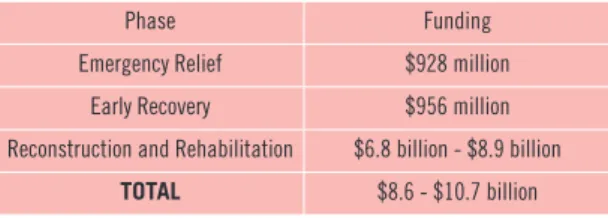
The timetable of the response to the floods was organised in three phases: () a “rescue & relief” phase focused on immediate emergency opera-tions, to prevent epidemics and provide emergency food and shelter, which started with the floods and ended in January ; () an “early recovery” phase to help affected populations rebuild their houses, restore their livelihoods, and restore basic health and education services, which also started with the floods and is expected to end at the end of ; and () a “reconstruction & rehabilita-tion” phase to rebuild all the remaining damage, which started in January and is expected to be completed within three to five years (OCHA, ). According to the Damage and Need Assess-ment conducted by the World Bank and the Asian Development Bank, the costs of the floods are as follows:. Also provide similar guidelines for action: the IASC Operational Guidelines on Human Right and Natural Disasters, the Humanitarian Charter, and Minimum Standards in Humanitarian Response.
Table 3. Total Cost of the floods (in $US)
Phase Funding
Emergency Relief $928 million Early Recovery $956 million Reconstruction and Rehabilitation $6.8 billion - $8.9 billion
TOTAL $8.6 - $10.7 billion Source: ADB/WB, 2010.
.. Funding
The Pakistani authorities quickly solicited the help of the international community as the colossal scale of the floods became apparent. A first appeal was launched in early August for $ million to respond to the immediate relief needs of the flood-affected populations. In November, the UN Office for the Coordination of Humanitarian Affairs (UNOCHA) launched the “Pakistan Floods Emergency Relief and Early Recovery Response Plan” (PFRERRP), which called for $. billion to finance the first two phases of the response. To date, only $. billion (.%) of funds requested have been raised, and only % of the early recovery components having been financed (OCHA Financial Tracking Service, ).
These funds have been the main source of finance for the international relief efforts. They have been directly distributed to UN Agencies, international organisations and INGOs/NGOs to fund projects on the ground, but have not been routed through Pakistani government channels (NDMA, ). In addition to international funds, help came in the form of rescue operations, medical supplies, food, clothing, non-food items (NFIs) and shelter kits from various countries, donor agencies, NGOs, the private sector and individuals.
In spite of these donations, the brunt of the cost of the floods is being born by the Pakistani govern-ment, especially as it now enters into the “recon-struction & rehabilitation” phase of the response. The immense cost of the disaster has placed an extreme burden on public finances in Pakistan (ADB/WB, ).
.. Coordination
In Pakistan, natural disasters are managed by the National Disaster Management Authority (NDMA), which is mandated to oversee and coordinate all disaster response activities. At the national level, it coordinated the evacuation and rescue operations of the Army and established a logistic flow system to dispatch relief goods to affected areas. Relief goods were first centralised at the Pakistani Air Force “main operating base” in
Chaklala, then dispatched to provincial “forward operating bases”, and transported to “district nodal points”. From district nodal points, relief assistance was transported to affected areas by helicopter, boats, trucks or mules (NDMA, ). By and large, these early first-response operations are credited with having prevented massive loss of life (IASC, :).
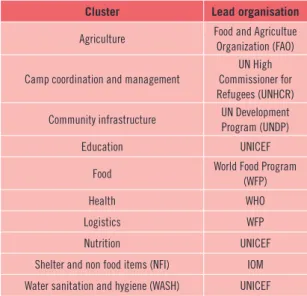
Within a few weeks, the vast array of actors who came to operate on the ground were organised into clusters, as requested by the humanitar-ian reform. Local and international non-govern-mental organizations, international organizations, UN agencies and foreign aid agencies all worked to support the Pakistani authorities. The UN and its partner NGOs formed clusters, each with a specific mandate and lead organisation at its head (see Table ).
Table 4. Clusters and lead organisations
Cluster Lead organisation
Agriculture Food and Agricultue Organization (FAO) Camp coordination and management
UN High Commissioner for Refugees (UNHCR) Community infrastructure UN Development Program (UNDP)
Education UNICEF
Food World Food Program (WFP)
Health WHO
Logistics WFP
Nutrition UNICEF
Shelter and non food items (NFI) IOM Water sanitation and hygiene (WASH) UNICEF Source: OCHA, 2010.
.. Humanitarian response
The humanitarian response has sought to meet three overarching objectives: implementing the “survival strategy” to prevent excess mortality and morbidity, restoring livelihoods, and re-estab-lishing community services (OCHA, ).
The Health Cluster carried out million medical consultations through the Disease Early Warning Systems (DEWS). With the help of its partners, the WHO also set up , mobile health clinics in di-saster zones, which have treated . million people (WHO, b). Medical teams have been primar-ily treating skin diseases, acute diarrhoea, respira-tory infections and suspected malaria. They have also been running immunization programs as well as providing health education and maternal care
(WHO, b). Six months after the floods, three-quarters of households reported a flood-related health issue, but almost all reported sufficient ac-cess to basic healthcare (WHO, :-).
The Food Cluster was able to nearly triple its food emergency distributions from three million to eight million beneficiaries by October , thereby preventing millions from temporary hun-ger (IASC, :). The Nutrition Cluster, for its part, has focused on screening and treating chil-dren for malnutrition (UNICEF, ). From Oc-tober onwards, it substantially expanded its nutri-tion programs: especially in Southern Pakistan, UNICEF established a total of Feeding Centres for the management of severely malnourished children, as well as Supplementary Feeding Programmes (UNICEF, a.). So far, . million young children have been screened, and , out of , severely malnourished, , out of , moderately malnourished and , out of , pregnant and lactating women have been treated in feeding centres (OCHA, b:). UNICEF also provided . million children with Vi-tamin A supplements (UNICEF, a).
The Water Sanitation, and Hygiene (WASH) Cluster has worked to reduce the vulnerability of affected populations to water-related diseases, by improving access to safe drinking water and sanita-tion, and raising hygiene awareness. UNICEF and its reporting organisations have provided clean water to . million people daily (mainly by install-ing and repairinstall-ing hand pumps) and sanitation fa-cilities to . million people. By January , it had also provided hygiene kits to nearly . mil-lion people and distributed thousands of buckets and jerry cans (USAID, ). On the whole, the absence of major outbreaks of water or sanitation-related diseases highlights the success and benefit of the WASH aid (IASC, ).
The Shelter and NFI Cluster, headed by IOM, pro-vided emergency shelter to families made home-less by the flood, and has since been helping them rebuild their homes. During the floods, the clus-ter distributed one million tents and tarpaulins, mostly in the provinces of Punjab, Sindh and KPK – still, only accounting for % of the emergency shelter needs. In addition, it provided substantial non-food items (NFIs) that included , bed-ding sets, , kitchen sets and , tool kits (IOM, b). As part of its “winterization strate-gy”, moreover, it distributed more than . million blankets to help households get through the cold winter (IOM, a).
Since March , the Cluster has focused on “Early Recovery” efforts to rebuild houses and sup-port sustainable returns. Households with com-pletely destroyed houses (% or more damaged)
have been helped to move out of their emergency shelter and into solid “one-room” or “transitional” shelters. Transitional shelters are wooden light-weight structures that can be relocated, and are aimed to those who cannot yet return to their area. One-room shelters are simple traditional struc-tures made from mud or brick, which can progres-sively be upgraded with more rooms to form a home once finances are available. The cluster has used work-for-food programs and cash hand-outs (WATAN cards) in order to support the recovery of the local economy. It has refrained from conduct-ing key-in-hand projects, while providconduct-ing techni-cal assistance and ensuring the fluid supply of lo-cally sourced materials (NDMA, ).
Furthermore, other clusters have worked to re-store livelihoods where crops and livestock have been destroyed and land inundated. The
Agricul-ture Cluster has distributed seeds (wheat and veg-etable) as well as fertilizers for the winter plant-ing season to over , households. Some , households have also received livestock feed to prevent further losses of animals. As a re-sult, the latest estimates show that agricultural production in flood-affected areas will reach % of pre-flood levels (NDMA, :-). Finally, the response sought to restore basic commu-nity services. The Education Cluster, for example, repaired about , flood-damaged schools, trained , teachers in disaster risk reduction, and established Temporary Learning Centers that benefited nearly , children. UNICEF also established about , Child Friendly Spaces (CFS), which today provide educational and rec-reational activities as well as psychosocial support to , children. In addition, it plans to install Transitional School Structures (TSS) in flood affected areas in to ensure access to quality education for children whose schools were dam-aged or destroyed by the floods (UNICEF, b).
3. THE CURRENT SITUATION
AND FUTURE PROSPECTS
.. Assessing the response
The emergency relief phase of the response was successful, as a major food crisis or epidemic outbreaks were avoided, despite being undertaken in difficult circumstances. Aid was sent to areas that were either under water, in mountainous regions cut off by damaged bridges, or in areas where the Taliban insurgency was under way. Conversely, it has been reported that aid distribution was subor-dinated to political interference in some instances,
and that organisations with ties to radical Islamic organisations such as Lashkar-e-Taiba engaged in relief and rescue operations, raised funds, and set up camps (Times of India, ).
In addition, most IDPs have now left relief camps. In the aftermath of the floods, . million people were displaced and forced to live in some , relief camps. Six months after the floods , people still lived in more than camps and spontaneous settlements (UNHCR, a). To-day, % of displaced populations have left relief camps. Some areas remain under water, however, such as in Sindh and Balochistan, where approxi-mately , acres of land are still inundated with half a metre of floodwater. In these prov-inces, relief camps continue to host a total of , flood affected IDPs, while all other provinc-es are now showing % ratprovinc-es of return (NDMA, ).
But due to the scale of the destruction, many returnees have not been able to live in their own homes. As of January , more than half the IDPs had returned to their original homes, but a third were still living in tents, while the remaining % were living with host families or in rented ac-commodation in their area of origin, according to a survey conducted by UNHCR in Sindh (UNHCR, b).
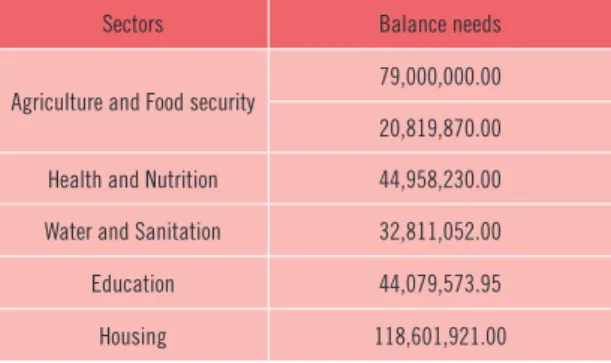
Early recovery and reconstruction objectives, on the other hand, have only partially been met thus far. A year after the floods, affected popula-tions report ongoing needs across all sectors, with the most pressing issues being permanent shelter (.%), economic support (.% for loans to restart farms or businesses and .% for employ-ment), and food (.%) (WHO, ). The main impediments are by-and-large financial and or-ganisational insufficiencies, as only % of the re-quested funds for early recovery have been raised from donors to date, and most clusters have inad-equate strategic plans (IASC, :). As detailed below, the funding gap particularly affects the housing and agricultural sectors, as well as health and education (OCHA, a).
Table 5. Funding gap for early recovery (in $US)
Sectors Balance needs Agriculture and Food security 79,000,000.00 20,819,870.00 Health and Nutrition 44,958,230.00 Water and Sanitation 32,811,052.00 Education 44,079,573.95 Housing 118,601,921.00
Governance 10,536,000.00 Non-Farm Livelihood 12,030,000.00 Community physical
Infrastructure 25,000,000.00 Disaster risk reduction 10,665,000.00 Environment (4,316,500.00) Gender 4,909,582.00 Protection 14,000,600.00
TOTAL 413,095,328.95 Source: OCHA, 2011a.
Limited financial resources have meant that few houses have been rebuilt. Only , one-room and transitional shelters have now been construct-ed, out of the . million homes damaged or de-stroyed by the floods. Likewise, the current com-mitment to help build , solid shelters by the end of the year would only meet % of the total needs (UN, ). This shows that there remains a clear and dire need for increased funding if the shelter crisis is to be resolved. In addition, many
houses are being rebuilt in dangerous riverbank areas, while many people without land rights have been returning home to find themselves without a place to plant or rebuild a house (OCHA, b).
Moreover, basic social services remain disrupted in flood-affected areas (UNICEF, b). Concerns subside about the potential outbreak of epidemics, while many people still lack food assistance, safe drinking water, and permanent shelter, particular-ly in Sindh. Local communities are also facing the challenge of re-establishing their source of liveli-hood and rebuilding destroyed infrastructure. In addition, Pakistan hosts . million IDPs, as well as . million refugees from Afghanistan (IOM, c:). These populations are particularly vul-nerable to environmental disasters and underscore the continuing risks created by complex emergen-cies in Pakistan.
.. Climate change
and preparedness
Early recovery activities must transition as seam-lessly as possible to support long-term reconstruc-tion and avoid leaving affected populareconstruc-tions in an even more vulnerable position to face the next disaster. Indeed, future prospects do not bode well for floods in Pakistan. It already is a disaster hotspot and one the most flood-prone countries in the world. Unfortunately, climate change will only
. Nevertheless, the crisis has been resolved in certain regions, like in Gilgit-Baltistan where % of the casel-oads have been covered.
worsen the trend, forcing ever-larger numbers of people off their land. It will intensify monsoons, with up to % more rain falling in South Asia by . Melting glaciers will increase the risk of flooding during the wet season and drought in the dry-season, particularly in South Asia (IPCC, b). Global warming will also cause extreme weather events to increase in intensity and frequency, with category tropical storms expected to triple over the next century (Knutson and Tuleya, ).
Climate change is also set to cause more epi-demics and malnutrition (IFPRI, ), as crop yields will fall by % in South Asia over the next years (IPCC, a:), and diarrhoeal and in-fectious diseases will affect more people due to higher temperatures and humidity levels (WHO, :-). This in turn will erode the systems sustaining health and may lead to conflicts over depleted resources.
Pakistan is therefore caught in a ratchet, as en-vironmental factors steadily gain in strength while affected populations become ever more vulnerable. The floods have stretched the coping mecha-nisms of flood-affectees to their limit as many have reportedly sold whatever assets they owned to sur-vive last year’s disaster (IASC, :). It is there-fore urgent to help the most vulnerable groups build up their resilience. Until now, the interna-tional response has largely focused on emergency relief, but a strong commitment to early recovery and reconstruction is absolutely necessary.
Pakistan must also improve preparedness. It must first build up national capacities and develop specific contingency plans for areas at risk. Since the floods, the NDMA has established a Strategic Planning Unit (SPU). The government has also set a goal to meet the Hyogo Framework for Ac-tion (HFA) on disaster risk reducAc-tion by , and has established early warning systems for this purpose; flooding mitigation programmes are also being developed in collaboration with the UN (NDMA, ).
Pakistan must also strengthen its cooperation with external actors and improve cluster coordina-tion. Indeed, reconstruction has been organised along cluster lines rather than having an integrat-ed perspective at national and regional levels. An overarching strategy for reconstruction and reha-bilitation as well as a comprehensive assessment of outstanding needs are both still lacking today in Pakistan. A major reason for this is that the NDMA and OCHA requirements for medium and long-term strategies have been inconsistent and changed over time (IASC, :). Also, while in-formation was widely collected, it was often dupli-cated and not used for strategic purposes.