Preparing for the Unknown
: The Livelihood Strategies
of the Displaced Karen from Burma in Times of
Decreasing Humanitairian Aid in Thailand
Mémoire
Jean-Daniel Vachon
Maîtrise en anthropologie - avec mémoire
Maître ès arts (M.A.)
RÉSUMÉ
Prenant comme ancrage le contexte actuel de diminution de l'aide humanitaire amenée aux réfugiés installés du côté thaï de la frontière thaïe-birmane, cette recherche vise à documenter la (ré)organisation des stratégies de subsistance des réfugiés karen vivant dans cette région en réaction à la diminution de l'aide humanitaire qu'ils reçoivent. Le cadre théorique sous-jacent cette recherche est l'approche des livelihood adaptée au contexte spécifique des réfugiés, auquel est ajouté l'espoir comme élément analytique permettant de considérer dans l'analyse l'imagination, les projets et les visions du futur des réfugiés. Les résultats montrent que les stratégies de subsistance des réfugiés karen sont profondément diversifiées et profondément influencées par l'état spécifique de vulnérabilité dans lequel ils se retrouvent lorsque cherchant refuge en Thaïlande. Les réfugiés, autant dans et hors des camps de réfugiés officiels, misent fortement sur la mobilité, l'éducation et les opportunités de travail pour acquérir ou améliorer leurs compétences et savoirs professionnels, leur permettant d'espérer un meilleur futur. Au final, cette recherche met en évidence l'agencéité, la résilience, et la soif d'autosuffisance des réfugiés, plaidant pour qu'ils soient considérés comme des acteurs actifs et des décideurs lorsqu'il est question de problématiques les concernant.
ABSTRACT
Taking as anchor the current context of decreasing humanitarian aid brought to refugees settled on the Thai side of the Thai-Burma border, this research aims to document the (re)organization of the livelihood strategies of the Karen refugees living in this region in reaction to the decreasing humanitarian aid they receive. The theoretical framework underlying this research is the livelihood approach adapted to the specific context of refugees, to which is added hope as an analytical element, allowing for the consideration of refugees' imagination, projects and visions of the future into the analysis. Results show that Karen refugees' livelihoods are deeply diversified and deeply influenced by the specific state of vulnerability they find themselves in when seeking refuge in Thailand. Refugees, both inside and outside of the official refugee camps, heavily bet on mobility, education and work opportunities to acquire or improve their professional skills and knowledge, allowing them to hope of a better future. In the end, this research highlights Karen refugees' agency, resilience and thirst for self-sufficiency, and advocates for them to be considered as active actors and decision makers when it comes to issues affecting them.
TABLE OF CONTENTS
RÉSUMÉ III ABSTRACT IV TABLE OF CONTENTS V LIST OF FIGURES VII ACRONYMS VIII ACKNOWLEDGMENTS XI INTRODUCTION 1 THE RESEARCH 5 1. THEORY AND METHODOLOGY 9 1.1 RESEARCH'S THEORETICAL ANGLE 9 1.1.1 BEING REFUGEE 9 1.1.2 LIVELIHOODS IN CONFLICT 18 1.1.3 HOPE IN LIMINAL SPACES 24 1.2 METHODOLOGY 32 1.2.1 THE FIELDWORK 32 1.2.2 PARTICIPANT OBSERVATION 35 1.2.3 INTERVIEWS 39 1.2.4 ANALYSIS AND OTHER SOURCES OF DATA 42 2. BURMA AND THE KAREN 45 2.1 THE VERY RELATIVE UNITY OF THE KAREN PEOPLE 452.2 POLITICAL TURMOIL IN BURMA: THE KAREN REVOLUTION 50
2.3 FLEEING THE BURMESE MILITARY 56 2.4 1984: THE FIRST SIZEABLE WAVE OF KAREN REFUGEES 62 3. THAILAND 69 3.1 A SHORT HISTORY OF MODERN REFUGEES IN THAILAND 69 3.2 KAREN REFUGEES NOW 72 3.3 CONSEQUENTIAL POSSIBILITIES 82 4. LIFE IN THE CAMPS 87 4.1 THE PHYSICAL ENVIRONMENT 87 4.2 WORKING TO EARN, LEARN AND HELP 91 4.3 EDUCATION AS A PRIORITY 99
5. BEYOND THE CAMP BOUNDARIES 109 5.1 NUMEROUS AND DISPARATE REASONS TO GO OUT 109 5.2 MAKING A LIVING OUTSIDE THE CAMPS 114 5.3 STAYING CONNECTED 119 5.4 A RISKY ENDEAVOUR 122 6. DEMOCRACY, PEACE TALKS AND REFUGEES' FUTURE 128 6.1 RECENT DEVELOPMENTS 128 6.2 DECREASING HUMANITARIAN AID 134 6.3 PREPARING FOR AN UNKNOWN FUTURE 143 CONCLUSION 155 BIBLIOGRAPHY 172 ANNEX 1 TABLE OF INTERVIEWED PEOPLE 191 ANNEX 2 CHARTS OF CAMP POPULATION AND FUNDING 194 ANNEX 3 GLOBAL RESETTLEMENT PROGRAM OVERVIEW 195
LIST OF FIGURES
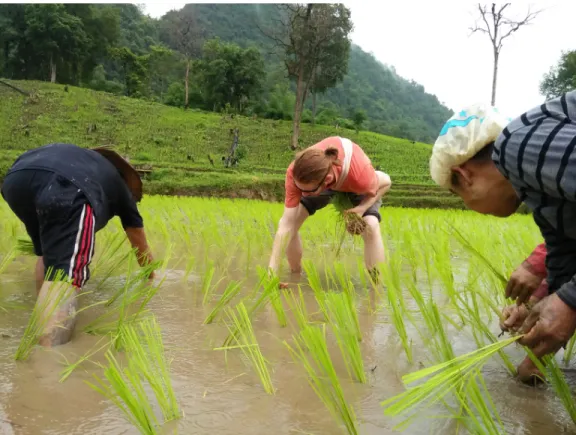
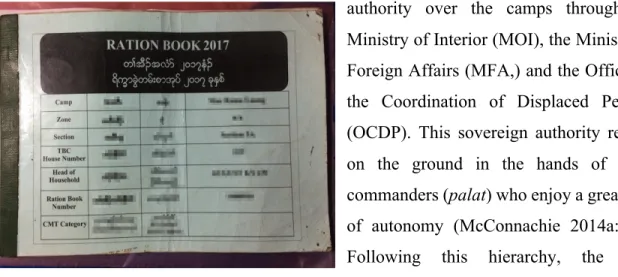
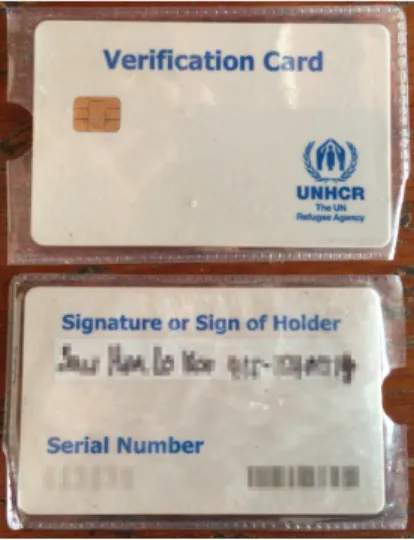
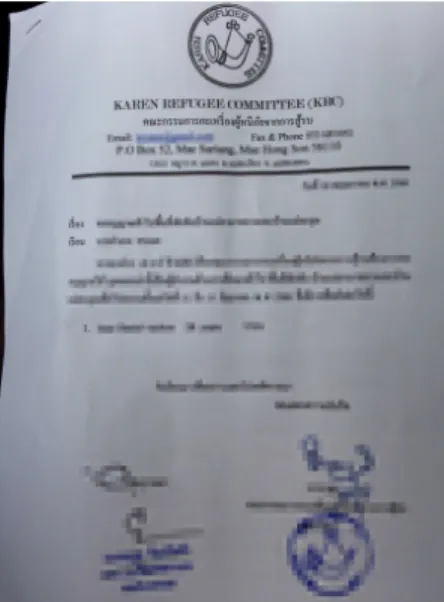
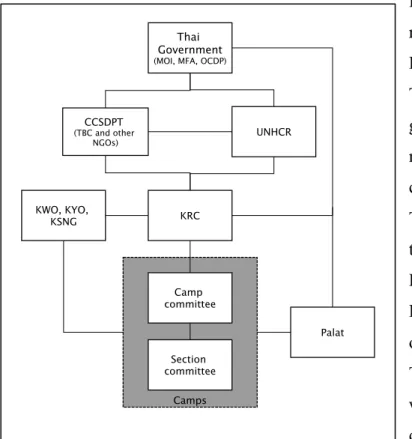
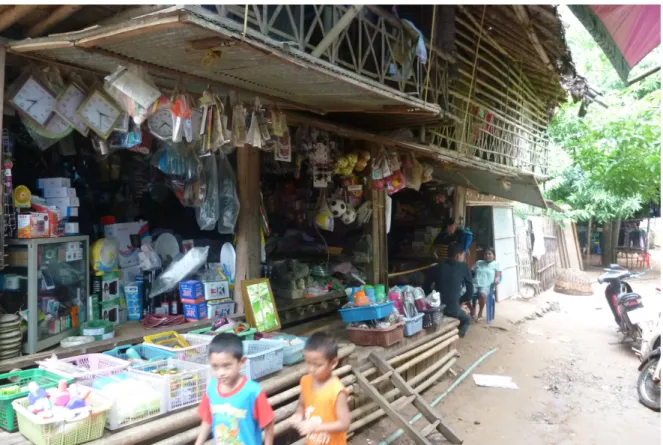
Figure 1. Participant observation session outside the camps. 36 Figure 2. Map of an approximate geographic distribution of Karen people. 46 Figure 3. Comparative map between the demanded territory and the modern Karen State. 54 Figure 4. Map of refugee camps in Thailand. 75 Figure 5. TBC's ration book. 77 Figure 6. UNHCR's verification card. 78 Figure 7. A camp pass. 79 Figure 8. Camp management flowchart. 84 Figure 9. Houses and foothpath inside a camp. 89 Figure 10. A store in a camp. 95 Figure 11. A classroom in a camp. 100 Figure 12. A church in a camp. 106 Figure 13. Working in the fields outside the camps. 116 Figure 14. A check point along the road near the border. 123 Figure 15. A Thai ID card beginning by 0. 124 Figure 16. A seven days Border Pass. 125 Figure 17. Table of monthly food ration quantities over time for a standard adult. 137ACRONYMS
ACTED Agency for Technical Cooperation and Development ACU Australian Catholic University
ADRA Adventist Development and Relief Agency ARC American Refugee Committee
ASEAN Association of Southeast Asian Nations BBC Burmese Border Consortium
BGF Border Guard Force
BIA Burma Independence Army
BKNA Buddhist Karen National Association BSPP Burma Socialist Program Party CAP Camp Agricultural Program CBO Community Based Organization CCA Consortium of Christian Agencies
CCSDPT Committee for Coordination of Services to Displaced Persons in Thailand CEG Committee for Ethnic Groups
COERR Catholic Office for Emergency Relief and Refugees CPA Comprehensive Plan of Action
DARE DARE Network
DKBA Democratic Karen Buddhist Army DSEZ Dawei Special Economic Zone EVI Extremely Vulnerable Individual HHR Household Registration
HI Handicap International IDP Internally Displaced Person IRC International Rescue Committee JRS Jesuit Refugee Service
KED Karen Education Department KIO Kachin Independence Organization KNA Karen National Association
KNDO Karen National Defense Organization KNLA Karen National Liberation Army KNU Karen National Union
KRC Karen Refugee Committee
KRCEE Karen Refugee Committee Education Entity KSNG Karen Student Network Group
KWO Karen Women Organization KYO Karen Youth Organization MFA Ministry of Foreign Affairs MI Malteser International MOI Ministry of Interior MSF Médecins sans frontières
NCA Nationwide Ceasefire Agreement NDF National Democratic Front NLD National League for Democracy NUP National Unity Party
OCDP Office for the Coordination of Displaced Persons OCEE Office of Camp Education Entity
PAB Provincial Admission Board PMO Population Monthly Overview RTP Right to Play
SCI Save the Children
SLORC State Law and Order Restoration Committee SPDC State Peace and Development Council SVA Shanti Volunteer Association
TBBC Thailand Burma Border Consortium TBC The Border Consortium
UNHCR United Nations High Commissioner for Refugees USDP Union Solidarity and Development Party
VT Vocational Training
For it is only through some sort of politics of hope that any society or group can envisage a journey to desirable change in the state of things.
ACKNOWLEDGMENTS
I must first thank my director, Jean Michaud, for believing in my ideas and giving me the opportunity to explore my long-standing interest and curiosity about Karen refugees. Through his supple and insightful guidance, I always felt supported, challenged, stimulated and empowered. I also thank Achariya Choowonglert and the Naresuan University of Thailand for welcoming me to their establishment and helping me with fieldwork logistics. Achariya personally spent a few days in the field with me, making sure I was comfortable and well set up for my research purpose. Her generous support made my fieldwork experience much easier, if not simply possible.
This research project has been financially supported by the Social Sciences and Humanities Research Council of Canada, by the Fonds de recherche du Québec, by the Fonds Georges-Henri-Lévesque and by the International Office of Laval University. Without their support, I would not have been able to achieve such a fruitful fieldwork nor a thesis of this quality. I also have to thank my family and friends for their constant support all along this long and sometimes arduous journey. Their simple presence in my life has made going through moments of doubts and discouragement much easier. Special thanks to Anne-Marie Dubois, who took time to custom design the maps, and to Madeleine Hykes, Peter Garber and Patrick Slack for their meticulous proofreading and incisive suggestions.
The most profound thanks go to all people who I met on the Thai-Burma border and who participated in one way or another in my research project (Karen from Thailand, Burmese, interpreters, NGO workers, and others), but mostly to Karen refugees. I would like to mention every single one of you, but for safety reasons, I cannot. You know, however, who you are. I want to thank you for your honest and selfless participation in my research project and also for now being part of my life. You have welcomed me into your home and life, and shared with me your culture and life stories. You have inspired me with your jovialness and resilience. I do not have much to offer in exchange for what you have given me but the following pages to share your reality, and give one more humble voice to your requests. All lack and mistakes are mine, and I apologize in advance for them.
INTRODUCTION
Tae Mee will never forget this fateful day when the Burmese military brutally entered his village, forcing him, his family and co-villagers to flee for their life. He remembers the soldiers burning houses, burning fields, and killing people. He has the vivid memory of at least seven villagers being shot before his eyes. With his family and a few neighbours, he fled to the jungle and began a fugitive life overshadowed by diseases, hunger and an ever-glooming fear of being found by the Tatmadaw. They wandered for a month in the jungle, crossing rivers and climbing mountains. Tae Mee's four-year-old daughter got sick and died. Maybe from malaria. Nobody really knows. They ended up in an IDP camp overwhelmed by the influx of people fleeing persecution. Morally unable to not assist these people in need, camp authorities, in coordination with the KNU, organized transportation for newcomers toward refugee camps in Thailand. There, Tae Mee and his wife were able to rebuild a new life in peace. They now have a house sponsored by NGOs, they receive food rations every month and their children can safely go to a good school. Tae Mee is employed by a refugee organization and his wife works as a kindergarten teacher. This enables them to make a little money, allowing them to buy meat, vegetables and other necessities to complement the humanitarian support they receive. Life in the camp is far from perfect, but he doesn't want to go back to Burma yet. He feels there is still no peace in his homeland and fears he and his family would not be safe there.
***
Her father was a soldier for the KNU. Because of this, he and his family became a target of the Burmese military. Unable to guarantee their safety, he sent his 18-year-old daughter, Wah Kler, and her two siblings to find protection in a refugee camp in Thailand where he and his wife joined them later. There, they were safe, and their children could continue their education. But life in the refugee camps is far from easy. For some inexplicable reasons, Wah Kler's family didn't have access to any sort of humanitarian aid the first three years in the camp. They lived in a cramped bamboo house with three other people who were generous enough to welcome them in their humble house and share the food they received from humanitarian aid. It goes without saying that food wasn't enough for this household of eight
living on portions for three. While studying, Wah Kler, the oldest child, had to join her father and mother in scraping a living together with small jobs here and there. Their main source of income during this time was gathering bamboo shoots in the forest and selling it back in the camp, a forbidden practice for refugees. Through a friend of her father, Wah Kler found a job as a Karen language teacher in a school outside the camp. For a few years she taught there, coming back to the camp only during holidays. It was outside the camp that she met her husband: a Karen man from Thailand. They now have two daughters, four and six, and Wah Kler is still teaching Karen language in the village where she now lives. Her parents are still in the camp, but, fortunately, they now receive the support of the humanitarian organizations. She visits them sometimes and helps them as best she can, bringing them money, food and gifts. But her situation outside the camp is irregular. She has no Thai identification, but she lives in a small village where as long as she remains in the vicinity, the local authorities turn a blind eye to her presence. She hopes one day to be able to live freely in Thailand and that her children receive a good education, so that they can live a better life than hers.
***
In her younger days, Takaw Paw moved a lot in between camps, at first to live with her aunt, later to attend Bible school at a different camp where spots were available, and finally to move in with her husband who she met in exile. Being quite educated, she got a job as a high school teacher after finishing her studies. Yet, after teaching for several years, Takaw Paw got bored and started thinking about a livelihood that would bring her more challenges and freedom. She joined a vocational training in cooking organized by the Karen Refugee Committee Education Department. With her savings and a grant from an NGO, she opened her very own little shop selling snacks and meals. She doesn't make a fortune out of her little business, but it is enough to enable her to save some money and to support her children while they are still young and attending school. She is also able to learn a lot about entrepreneurship and budget keeping. But Takaw Paw sees that the humanitarian support to the camps is decreasing due to recent political changes in Burma. Her monthly food rations have diminished and so has the financial support she receives from NGOs that she relies on to buy the merchandise she sells. She worries about the future but doesn't see any way she can make
up for the lack of support. She did however apply to the resettlement program of the UNHCR, but has not received any news on her application in years. Now, the only things she wishes for is good business for her little shop and a good education for her children so that they can compare themselves to kids in developed countries.
***
Son of peasants, Hsi Htoo fled to the camps in Thailand so he could safely continue his education. He graduated from high school in the camps and then took an admission examination to the Australian Catholic University, which offers a degree in liberal studies to migrants in Thailand. Luckily enough, he was one of the twenty students chosen out of over a thousand applicants. He moved out of the camps to settle himself in the ACU dormitory near Mae Sot. His tuition fees, his lodging and food were all taken care of by the ACU grant he automatically received with his admission. Hsi Htoo was thrilled to receive such a great education, something he would not have dreamed of being possible in Burma. Yet living as a refugee outside the camps presents certain risks as Thailand sees these individuals as illegal migrants. So Hsi Htoo never travels very far from the ACU compound and never without his student ID card, a thin precaution against being arrested and deported. Highly stimulated by knowledge, he applied for another grant to pursue his studies in a regular university in Thailand. Again, his determination and excellent academic profile led him to qualify for the scholarship he asked for. Upon receiving the great news, he embarked in a long and tedious procedure to make his presence in Thailand regular and legal. Hsi Htoo dreams of becoming a politician to work on the peace process in Burma and to help the country to reconcile with its wide ethnic diversity. He thinks that his studies in the social sciences will help him achieve this goal.
*** *** ***
Tae Mee, Wah Kler, Takaw Paw and Hsi Htoo are among hundreds of thousands of Burmese people displaced by the long-standing conflict opposing the Burmese military to various other ethnic groups in Burma and seeking refuge in Thailand. Since 1962, the junta has been ruling the country with a firm and violent hand with the aim of imposing its Burmese Way to Socialism on the entirety of the Burmese territory. Many ethnic minorities living in the remote mountainous margins of the country have been resisting authoritarian attempts by the
military to control them. With their sociopolitical project of an autonomous state of their own, the Karen have been at the core of this resistance, leading to numerous military actions perpetrated against them by the Tatmadaw. For a long time, the strong military and social organization of the Karen allowed them to respond successfully to these attacks and protect the civilian population of the Karen State. This changed in 1984 when strikes of unprecedented magnitude marked the beginning of the Karen's loss of control over their territory and led several thousands of people to seek refuge in neighbouring Thailand. Since then, the flow of Burmese refugees, Karen and others, crossing into Thailand has never really stopped. Even today, harsh living conditions and occasional skirmishes between the Burmese army and ethnic armed groups still push some people to seek refuge in Thailand.
While Thailand has been at the receiving end of refugee migrations before, it is still not a signatory party to the 1951 Refugee Convention relating to the status of refugees nor its 1967 Protocol. However, Thailand's actions toward Burmese refugees, albeit ad hoc and often criticized, have been quite in line with the non-refoulement principle, the essence of these international documents. Recognizing the humanitarian needs of Burmese refugees, Thailand has decided to temporarily welcome them on its territory, on the sin qua non condition that they stay in "temporary shelters", camps, managed by a consortium of NGOs and overviewed at a distance by the Thai Government itself. All of this creates a particular legal context affecting both the lives of refugees and the work of the humanitarian organizations trying to help them.
Today there are nine "temporary shelters", refugee camps, along the Thai-Burma border, seven of which are inhabited primarily by Karen people. Currently, the total population of these nine camps is about 100 000 people. However, there are also approximately half a million Burmese people living outside of the camps and along the border that could be considered as refugees on account of their life story.
The relative distance with which the government is involved in the daily life of the camps has created a liminal space where refugees have developed a unique community life that includes schools, self-governing structures, cultural preservation initiatives and numerous and diverse livelihood strategies. Despite what can be seen as a unique refugee camp setting,
beyond the official limits established by the Thai Government, thus creating a complex network between refugees in the camps, those outside of them and local Karen and Thai communities, allowing refugees to live a semi-normal life in which they can develop their human potential and hope for a better future.
But all of this is now at a crossroad. The 2003 Road Map to Disciplined Democracy put in place by the Burmese military led to significant positive political and economic changes in Burma, and eventually to free elections in November 2015 that brought the National League for Democracy to power, a civilian political party led by the Nobel peace prize-winner, Aung San Suu Kyi. Also resulting from the 2003 Road Map to Disciplined Democracy are ceasefire negotiations leading in 2015 to a Nationwide Ceasefire Agreement between the Burmese military and most of the major rebel groups, including the Karen National Union. Strong of this national agreement, the NLD government embarked, in 2016, in a round of peace conferences to negotiate with ethnic minority groups their inclusion in the Union of Myanmar.
While democracy and peace are seemingly well on their way in Burma, donors supporting the humanitarian work with the Burmese refugees in Thailand are progressively shifting their attention toward other, more pregnant, crisis elsewhere in the world and toward development work in Burma. Consequently, humanitarian organizations working with Burmese refugees in Thailand have been seeing a gradual decrease in their funding since 2008. This translates to very concrete changes for refugees who are seeing their food and material rations reduced, their stipends cut down and their chances to be resettled in a third safe country almost completely voided. With the Thai Government, the UNHCR, and other NGOs increasingly putting forward the voluntary repatriation as the sole and imminent long-term solution for Burmese refugees in Thailand, people feel that they are being pushed to go back to Burma. A dreading prospect for them, as they are yet ready to consider Burma as safe enough to return to.
T
HE RESEARCHIt is then in this specific context that this research aims at documenting the livelihood strategies of the Karen refugees living on the Thai side of the Thai-Burma border. In adopting
a typical anthropological approach, I ultimately seek to give an account of the refugees' perspective on their life and their potential futures, advocating for them to be considered as active actors and decision makers when it comes to issues affecting them. As a general guidance, this research takes the following question: How do Karen refugees living on the Thai side of the Thai-Burma border (re)organize their livelihood strategies in a context of decreasing humanitarian aid? In order to answer this seemingly simple, though in reality quite complicated and implicating, question, I have broken it down into four inter-related objectives.
Before jumping right into these objectives, I present in Chapter 1 the theoretical angle of the research. The term "refugee" being problematic and vaguely defined, I first theoretically explore what it means being a refugee and what are the consequences of such a status on an individual's life. Second, I present the livelihood approach, which is at the heart of my research question, and, adapt it to the specific context of refugees, therefore adopting the livelihood in conflict framework. Third, I extend this general livelihood framework to include hope as an analytical element. This enables me to consider refugees' imaginations, projects and visions of the future in my analysis. I feel that these considerations allow me to render a more human portrait of refugees' livelihood strategies and their life situation in general, thus showing more efficiently their agency and resilience. In the second half of Chapter 1, I outline the methodology I have used at all steps of the research process, presenting in a concrete way the fieldwork context, the way I conducted participant observation and interviews, and how I finally analyzed the data obtained through these methods.
Chapter 2 contextualizes the Karen refugee problematic with a nuanced ethnographic portrait of the Karen as a heterogenous ethnic group with its mysteries and incoherencies and a long-standing political project that reaches some, but definitely not all, Karen individuals. Thereafter, I link the history of the Karen as a people to Burma's history, in order to explain the reasons behind the refugees' flight. In doing so, I humbly try, with the help of readings and accounts gathered during my fieldwork, to give a sense of what it was like to live under the dictatorship of the Burmese military.
one: to clarify the Thai socio-legal context that influences the lives and livelihood strategies of the refugees. I begin with an overview of Thailand's position and actions towards modern refugee movements in Southeast Asia, namely the Indochinese refugee crisis. This overview allows me, in a second part of this chapter, to make parallels between the then position of Thailand toward refugees and its present position toward Burmese refugees on its territory, shedding light on the contemporary Thai government's ambiguous stand on the matter. The third and final section of Chapter 3 focuses on the impacts, both positive and negative, of Thai laws and the sociopolitical organization on Karen refugees' lives.
My second research objective, which is the heart of my research question, is covered in Chapters 4 and 5. This research objective aims to give an ethnographic description of the subsistence strategies of the Karen refugees living on the Thai side of the Thai-Burma border, in the camps (Chapter 4) and outside them (Chapter 5). The four sections of Chapter 4 are dedicated to a descriptive rendering of life inside the camps, addressing the physical environment, the economy and occupation opportunities, with a specific section dedicated on education opportunities, and the cultural and social life. In Chapter 5, I address the same elements but for those refugees living in various situations outside the camps. Here, I include discussions on the reasons these people chose or ended up to not live inside the "temporary shelters" as the Thai Government commands it, how they stay connected with family, friends, and business partners inside the camps, in Burma and elsewhere in Thailand, and the risks they face by living in such an irregular/illegal way as well as how they mitigate those risks. I bring, in Chapter 6, my analysis in the current context by giving an account of the main economic, political, and humanitarian changes occurring on the Thai-Burma border that are affecting the lives of the refugees on the Thai side, the third objectives. I begin by looking at the recent political, economic, and social changes that have occurred and are still occurring in Burma. Turning to the Thai side of the border, I also give an overview of the political changes that recently occurred in Thailand. I then link the Burmese and Thai changes with the refugee situation on the border, focusing mainly on the consequences of the decreasing humanitarian aid brought to Karen refugees caused by a shift in humanitarian funding towards other more pregnant crisis and projects elsewhere in the world.
My fourth and final research objective is to evaluate the impacts of these changes on the lives of the refugees and to look at how they, the refugees, (re)organize their livelihood strategies in response to these shifts. I begin my analysis in the third section of Chapter 6, where I present the various ways refugees, inside and outside the camps, react to the changes presented in the first two sections of the same chapter. This analysis continues into the conclusion where I underline the continuity and rupture between the usual livelihood strategies of refugees and the changes they have to make in order to adapt to this ever-changing context. In the end, I present a new, or simply different, way of looking at the refugee problematic in Thailand, and at refugees at large, weaving links between what I observed during my research process, the theories, questions, and grey zones raised throughout this thesis.
I hope that, despite the cruel realities rendered throughout these chapters, the reader will also see the inspiring resilience of refugees and that he or she will feel galvanized to imagine and work toward realizing a different world. I rally to the epistemological posture of the anthropology of the good (Robbins 2013), a positive anthropology (Ortner 2016), which aims at exploring how people from different cultures organize themselves, collectively and individually, to achieve what they think is good and how life presents itself when driven by such a project. I take this position in reaction to what has been called dark anthropology (Ortner 2016), an anthropology that focuses on the human experience of marginality, misery and brutality. The idea here is not to ignore the sufferings of people but quite the contrary, to understand these sufferings and push the reflection further toward hope and the ethic of possibility (Appadurai 2013), a sort of optimism of the intellect (Harvey 2000: 17). I follow Appadurai and Harvey (whose position rely on Gramsci's philosophy) in their idea that anthropology, and academics at large, can assist people in creating « ways of thinking, feeling, and acting that increase the horizons of hope, that expand the field of the imagination, that produce greater equity […], and that widen the field of informed, creative, and critical citizenship » (Appadurai 2013: 295), rather than creating a pessimist, cynical and disillusioned world, sterile to the elaboration of solutions and alternatives, calling only for renunciation and fatalism. I feel there is something inspiring and reassuring in seeing that refugees are strongly resilient and that they themselves do not lose hope, showing that at least
1. THEORY AND METHODOLOGY
1.1
R
ESEARCH'
S THEORETICAL ANGLE1.1.1 Being refugee
What makes someone a refugee? What does it mean to be a refugee? Are the displaced Karen from Burma now living on the Thai side of the Thai-Burma border refugees? The most common definition of a refugee is given in the 1951 Geneva Convention relating to the status of refugees, written in the post-World War II context to deal with European refugees (Malkki 1995: 501). In this document, a refugee is someone who
owing to well-founded fear of being persecuted from reasons of race, religion, nationality, membership of a particular social group or political opinion, is outside the country of his nationality and is unable or, owing to such fear, is unwilling to avail himself of the protection of that country; or who, not having a nationality and being outside the country of his former habitual residence as a result of such events, is unable or, owing to such fear is unwilling to return to it. (1951 Convention Relating to the Status of Refugees: Chapter 1, Article I A(2))
In 1967, a Protocol associated with this Convention removed the geographic and temporal restriction of the 1951 refugee definition1, making these documents the contemporary
universal instruments of refugee law (Field 2010: 528; Malkki 1995: 501). Legally then, refugees are victims of persecution, who have fled from their home and in doing so have crossed an international border. Their migration has to be motivated by a need for protection, which makes refugees different from economic migrants, who voluntarily migrate in search of better economic conditions (Yarris et al. 2015: 113). They are considered as asylum seekers when they have made a claim to the refugee status in a foreign country and are awaiting an official recognition by authorities (Castles 2000: 271; UNHCR 2017). Refugees are not necessarily stateless people, although some of them may be. Internally displaced persons (IDPs) and economic migrants are not, according to this definition, recognized as refugees and consequently cannot claim the rights attached to this legal status, which minimally equals the treatment accorded to aliens generally (1951 Convention: Chapter 1,
1 The 1951 Convention was initially designed to only encompass European refugees in Europe who were
displaced by the Second world war, so before 1 January 1951, not as a universal instrument applicable to other refuge situations in the world. (Field 2010: 528; Malkki 1995: 501)
Article 7-1), and which obviously also implies a non-refoulement right, the fundamental principle of these documents, which states that « no one shall expel or return ("refouler") a refugee against his or her will, in any manner whatsoever, to a territory where he or she fears threats to life or freedom. » (1951 Convention: Introduction) But this legal definition of a refugee implies several subjective elements often difficult to prove with concrete evidences (The Editor in chief et al. 1989). This led to drifts in the interpretation of the definition and to its application.
The legal approach taken by the contemporary universal instruments of refugee law to an otherwise not new phenomenon is characteristic of the territorial organization of the world in nation-states, where rights are granted on the basis of a state affiliation; a citizenship status, rather than on the recognition of a shared humanity (Bertossi 2008; Brighenti 2010; Malkki 2002: 353; Polzer 2009: 95). Underlying this territorial paradigm (Field 2010) is the idea that people, cultures and places correlate (Turner 2004: 229). This sedentarist assumption about people's attachment to places leads to perceive displacement as a personal pathology rather than a consequence of a socio-political, even economic, problem or dysfunction (Malkki 1992). Following this perception is the idea that, having lost their territorial anchorage, refugees might have lost their moral bearings and might be susceptible to criminal activities. On a larger scale, they are seen as a matter out of place (Horst and Grabska 2015: 7; Turner 2004: 227), and by their simple presence, criminal or not, as a potential threat to the national sovereignty that could disrupt the social, political, economic, and environmental equilibrium of the nation-state (Castles 2000: 271). Such perceptions of refugees as abnormal beings, undesirables, has led to the idea that refugees are a problem and that laws and mechanisms are therefore needed to manage this refugee problem in order to protect the national order of things, i.e. the state-citizenship system (Malkki 1992: 33; Turner 2004: 227-228). Thus, the experience of being a refugee involves much more than what is invoked in the strictly legal definition given by the 1951 Convention.
First countries of asylum2 have many different laws and kinds of mechanisms designed to
manage the refugee problem, ranging from encampment to local integration and
settlement. Despite this variation, they all share, to various degrees, the aim of keeping refugees outside the national order of things (Sharples 2016: 38). If in some cases, simple legal mechanisms are considered sufficient by some states to ensure the distinction, hence a separate regime of law, between refugees and citizens, it is no surprise, considering their aim, that most states prefer adding to this legal distinction a spatial element, making refugee camp the most frequent mechanism used to manage refugees today (Malkki 1992: 34). This state of affairs brought Michel Agier (2008b: 131) to cynically qualify the encampment as the fourth durable solution of the United Nations High Commissioner for Refugees (UNHCR)3.
Today, refugee camps are the most widespread tool to manage refugees and hence have a direct influence not just on how refugees are perceived and treated, but also on what it means to be a refugee.
Camps are quite an effective way to keep refugees outside of the national order of things, outside of civil society, therefore neutralizing their status of being a threat. Because of this social and legal segregation exacerbated by spatial restrictions, refugee camps have widely been analyzed through the lens of the state of exception concept (Agamben 1998; 2005; Oesch 2017; Ramadan and Fregonese 2017; Tuastad 2017). This approach highlights the suspension of individual rights and the exclusion of people, in this case the refugees, from political systems and how this enables the sovereign, usually the executive branch of the state, to rule in an absolutist fashion. Michel Agier (2002; 2008a; 2008b) picked up and expanded the state of exception concept, suggesting the idea of out-places (hors-lieux in French), which he applies specifically to refugee camps. Out-places are not simply locations where the sovereign has total power, they are extraterritorial places considered outside the national order of things, despite their material presence on national territory. This extraterritorial attribute makes possible the suspension of the national laws inside refugee camps the applying of a state of exception, but also, it is possible for the state to discharge itself from managing these spaces inhabited by "undesirables" and shift responsibility on
the first country of asylum) through UNHCR's programs that involve a rigorous screening process (UNHCR 2016: 1-2). Since the perception of refugees, and the laws and mechanisms used to deal with them in first countries of asylum differ significantly from those found in third countries, and Thailand, in the case of Karen refugees, is factually a first country of asylum, only these perceptions, laws and mechanisms are to be discussed here.
3 The UNHCR has officially three durable solutions to help refugees rebuild their life in dignity and peace: local
humanitarian organizations. Humanitarian organizations do their best to manage the situation, and in doing so often exceed their resources and capacities. Concentration in confining places, the camps, allows a more measured use of human, material, and financial resources; and by this very fact a management of refugees significantly more efficient (Pandolfi 2003: 380). Furthermore, the out-place attribute of the camps makes this management all that much easier, given that the suspension of national laws allows the creation of a space of exception where humanitarian organizations are autonomous and free to act without the need for approbation from other institutions. This is not to suggest, however, that the camps are completely devoid of rules and laws, quite the contrary, but that these rules and laws are dictated by the camp managers, thereby forming an ad hoc humanitarian government (Agier 2008b: 298-299). This humanitarian government, which locally composes the sovereign power in the camps, is composed of various humanitarian organizations and NGOs, local and international, various UN agencies and donors. The conceptualization of refugee camps as tools to manage the undesirables rather than as pure humanitarian actions reveals a functional solidarity at play between humanitarian organizations and the states' police order to protect the national order of things (Agier 2008b: 15; Pandolfi and Corbet 2011: 467).
It is the concurrent conceptualization of the refugee camps as a management mechanism existence of logistical, human and, mostly economic constraints, that makes it easier for the humanitarian organizations to depoliticize refugees and ignore their personal histories (Malkki 1996: 378). Such an explicit reduction of human life to its mere biological dimension has been called "bare life" by Giorgio Agamben (1998). A bare life is without importance, without real value, lacking both political voice and weight in political decisions. To have only a bare life can be understood as being socially dead or inexistent, yet biologically alive. In refusing to recognize the full identities of the refugees, the humanitarian organizations focus only on the refugees' bare life (Agier 2008b: 32; Pandolfi and Corbet 2011: 467). This focus is materialized through the attention paid exclusively to primary needs in the camps (food rations, water, emergency health services, waste disposal, etc.), at the expense of social and cultural life, fundamental nonetheless. Further, reduction to a bare life induces a perception that refugee's rights are restricted to the biological life (Malkki 1996: 383). Hence,
without a name nor identity, simply beneficiary of humanitarian aid, whose rights are in consequence limited (Bauman 2004: 76; Malkki 1992: 34).
This situation in the out-places that are the camps, where refugees are reduced to bare life, is vastly accepted by humanitarian organizations and states, even though they themselves admit that the life conditions in these places are harsh and far from perfect. Such a general acceptance results from the urgency in which the camps have been erected (Pandolfi 2003: 375). The reasoning underpinning this acceptance is that the camps are a temporary solution to an emergency situation that will inevitably resolve itself and eventually allow refugees to go back to their home. Hence, even if history shows a contradictory story, where refuge regularly becomes a protracted life situation, the humanitarian government still approaches the problem with a logic of temporariness. Furthermore, states insist that refugee camps remain in the provisional spectrum, still considering them as a threat to their national sovereignty. This again reinforces the temporary approach of urgency underlying the whole humanitarian structure. Refugees are themselves the first ones to see their situation as temporary, wishing more than anything to promptly go back home (Agier 2002: 56). But history has shown that it is most often not what happens. Urgency drags on and transforms itself in a protracted situation where refugees live in the vulnerability of the bare life (Agier 2008b: 199; Pandolfi et Corbet 2011: 467).
With this protracted situation in mind, the idea of non-places (non-lieux in French) (Augé 1992) has been used to understand the consequences of such a life in the camps. The main characteristic of these non-places is their anonymity, meaning that they don't have an identity with which someone could develop a meaningful attachment. Empty of social and symbolic meanings, these places leave no room for human creative activities, for the development of human potential. The unique identity of these spaces is limited to their only function: sites of waiting, places of transit. Nothing is really accomplished in non-places. Life doesn't develop. It waits. It stays passive. Not only is identity suspended – nobody is an athlete, an artist or a teacher in a refugee camp, all are refugees, the only identity that matters – but time is also suspended (Ball and Moselle 2015: 6; Norum et al. 2016: 65-66; Ticktin 2014: 278). Past and future are of little importance. Past doesn't change anything to the waiting state and the absence of human potential development doesn’t incite to think about the future, to plan it or
try to influence it. All that matters is the present. Camps are then perceived as places of liminality, an in-between, by both the humanitarian organizations and the refugees themselves, who await a safe return to their home (Agier 2002). To identify oneself to the camps and develop a life within this in-between is to identify as a refugee, not as a Karen, a Burmese, a student, a musician, an engineer, etc. But since, again, the urgency drags on and transforms itself in a protracted situation, the non-place also drags on with it, the waiting appears to be never ending, transforming the present in a perpetual present (Augé 1992: 131). This protracted situation, the double exclusion from the home state and the national order of the host state (Agier 2008b: 267) and the focus on the bare life reduce once more refugees to the identity of passive victims (Malkki 1996: 378; Sharples 2016: 46).
These mechanisms of control and management of the refugees and the subjectivity directly imbedded in the universal instruments of refugee law induce a popular distinction between the real refugees, those who can legitimately benefit the humanitarian aid, and the false refugees, those who claim the status on the basis of sufferings considered as illegitimate (Sharples 2016: 46; Yarris et al. 2015). There is then a tendency to identify the real refugees on the basis of extralegal criteria, usually fed by a specific imaginary of victimhood and helplessness that also implies a performative dimension (Malkki 1996: 384). The suffering body is usually an important element to this victimhood image as it is seen as an objective proof of their suffering. This is linked to the fact that the narratives offered by the refugees themselves are seen as falsifiable or minimally subject to the hazards of memory and refugee's subjectivity, therefore further depersonalizing the refugee experience (Malkki 1996: 384; Ticktin 2014: 276). To be recognized as a refugee and to consequently benefit from humanitarian aid, refugees discipline themselves to look and act as "real refugees", adapting their narrative to fit what is expected by the humanitarian government and putting forward their helplessness and distress rather than their resourcefulness and agency (Biehl 2015: 69). Beyond this strategic self-discipline, some refugees internalize this identity associated with victimhood and helplessness, as is shown by Atay, a man living in a refugee camp:
First, when we look at the refugee life, it is really uncomfortable and hopeless if we tell the truth. Compared with Thai citizens, we have less or no access to
opportunities and chances, like working and finding jobs to be able to support our family and ourselves. Living as a refugee brings us less hope and no opportunity.4
And also by Paw Dae Nya, a woman living outside the camps:
Since my childhood, I had to flee all the time owing to the fighting and conflict between the Karen Army and the Burmese military. My mother was killed. I faced many problems. I did not have any chance to enjoy my life at all. I am tired of fleeing from the Burmese military. I just want a place little safer to stay now. Therefore, I consider myself a refugee.
Some, on the other hand, don't identify themselves as refugees, even if in the face of it, they seem to fit the description. Eh Htee Kaw, a Karen man who fled violence in Burma found refuge in a Thai village, far from any camp. He says:
We are quite different from refugees. We face difficulties in our lives, but I have much more freedom than refugees. We can move around here. I thought to go in a refugee camp, but because my friend invited me here, I decided not to go there and come here instead.
This is not to suggest that victimhood, helplessness, segregation, and liminality are not part of the experience, but to strictly define refugee-ness in those terms misses the broad diversity that composes it and that can be observed on the field (Sharples 2016: 38). Such an essentialized definition of refugee-ness that tends to make it as a particular form of the human condition, naturally delimited, leads to such drifts as to identify real refugees (Agier 2008b: 108; Malkki 2002: 356-357), that is, in the end, based on subjective criteria that are in turn based on a specific conception of the world in nation states (Castles 2000: 270; Malkki 2002: 356). If the refugee experience obviously implies a great deal of distress and constraints, we cannot presume a generalizable homogenous refugee identity that leads us to understand its, also generalizable homogenous, reality (Horst 2006: 19; Malkki 1995: 510). Rather, it is much more accurate and analytically useful to understand refugees as a simple legal and social category, a construct, that exists only through a specific set of institutional
4 Quotes from interviews translated by an interpreter have been reworked to correct language errors and make
sure the intentions of the respondent are well understood. I think that since the initial words have already been changed by the interpreters, that there is no point in keeping the translator language errors. However, some interviews have been directly done in English when the respondent were fluent enough. In these few cases, I have kept intact the words of the interviewee, with their errors and confusedness. These interviews are marked with an " * " in Annex 1.
organizations (Agier 2008b: 17; Horst and Grabska 2015: 3; Malkki 2002b: 356). However, in turn the institutional organizations that often materialize in a humanitarian government have a direct influence on the refugee experience; an influence that has, of course, various concrete consequences for refugees (Horst 2006: 14; Tague 2017: 125). This is not to say that a refugee is necessarily living under the direct care of the humanitarian government, rather that the legal definition of a refugee used by these institutions can also be applied to refugees living outside the humanitarian care (Tague 2017: 125). This is the case of prima facie refugees, where people, because of their general life situation, are recognized as refugees without having been systematically individually recognized as such (Agier 2008b 50; Rutinwa 2002: 1; Sharples 2016: 46).
To get away from the paralyzing idea that the refugee experience is only characterized by victimhood and helplessness and other attributes that render refugees passive, it may be also useful and realistic to acknowledge that this legal and social category, thus this experience, is indeed characterized by forms of liminality, uncertainty, and vulnerability that are more or less important dependent on each individual. As previously said, this liminality can be spatial, an in-between between their home country and the first country of asylum, or temporal, between the fled past and the unknown future (Norum et al. 2016: 65-66). This liminality leads to uncertainty, radical for some (Horst and Grabska 2015), such as not knowing when they will go back home or when they will be allowed to legally resettle elsewhere (Oka 2011: 232) or unclear on when they will receive adequate legal recognition (Ball and Moselle 2015: 6; Biehl 2015: 58). The ultimate consequence of these characteristics is a specific state of vulnerability where refugees have to abandon their livelihood when fleeing violence, where they lack access to the same resources as local communities where they find themselves, where they don't benefit from stable and guaranteed rights and ultimately remain dependent on the generosity and goodwill of their host country (Jacobsen 2002).
To explicitly answer the opening questions of this section, it is legal and social contexts and categories that make someone a refugee, and that means various kinds of liminality states, uncertainty and vulnerability. Refugee-ness is neither a homogenous nor natural category of people and consequently the empirical consequences of the states of liminality, uncertainty, and vulnerability must be considered through a vast array of possibilities; possibilities that
are not completely determining of the refugee experience nor necessarily always negative for refugees.
With this in mind, even if Thailand does not officially recognize the presence of Karen refugees on its territory, or any refugees for that matter, it does not mean there are no refugees in Thailand. But, since the Burmese Government and, most importantly for the Karen, the Thai Government are not signatory parties of any international document regarding the status of refugees, using the term "refugee" in this specific geopolitical context might be controversial in some ways. On the other hand, there is clear evidence that several Burmese people have crossed and continue to cross into Thailand because they have suffered various kinds of persecution in their country of origin and that they are unable to avail themselves of the protection of the Burmese Government, leading to their fleeing and subsequent life marked by liminality, uncertainty, and vulnerability. Important here is the concept of de facto refugees, similar to the idea of prima facie refugees, denotes people recognized by non-state actors as refugees on the basis of apparent and objectives circumstances in the country of origin that could legitimately lead some people to flee (HRW 2012: 5).
While recognizing that this terminology might not please everyone, but because it is not the objective of this thesis to play on semantic differences, I consider Karen people from Burma now temporarily living on the Thai side of the Thai-Burma border as de facto refugees, as they, in fact, fled persecution as stipulated in the UNHCR refugee definition leading to a life situation marked by liminality, uncertainty, and vulnerability. They could also be called "asylum seekers" but, refugees in Thailand are not awaiting a decision related to the determination of their status, they have already been officially classified either as displaced people or as illegal migrants according to whether they are living or not in the designated "temporary shelters". Furthermore, I feel that using the term "asylum seeker" does not fully recognize the persecution refugees have suffered nor the state of vulnerability they find themselves in. A deplorable situation that is sadly implied in Thailand's treatment of refugees. Thus, I will simply be using the term "refugee" throughout this thesis. This rather subjective and simplistic choice, I confess, allows me, however, to first emphasize the political nature of the reasons these Karen people have been displaced, something that the Thai Government is voluntarily or not ignoring by refusing to recognize them as refugees. Second, to also
emphasize the shared experience and life situation that all these displaced Karen find themselves in, which has a considerable influence on their livelihood strategies.
The idea that will be put forward in the next section and throughout this thesis is to recognize the life situation of Karen refugees in Thailand, their agency and their capacity to deal actively in ways that stand as contradictory to the passive popular image of refugees, with their life situation in order to better it and develop their human potential. Without denying their refugee status, refugees find that this passive identification does not represent accurately their reality, and find the term rather disempowering (Sharples 2016: 47-48). Instead, they prefer to identify themselves through their actions and their struggle for political recognition and a decent livelihood.
1.1.2 Livelihoods in conflict
In order to recognize Karen refugees' agency and their capacity to deal actively with their life situation and develop their human potential, the general theoretical framework I have adopted in this research is the one suggested by the livelihood studies. Broadly, this approach aims to understand how people organize themselves in order to gain a living (de Hann and Zoomers 2005: 27; Scoones 1998: 13; 2009: 172; Turner 2017: 1). Originating from the field of development studies, it takes a holistic stance to emphasize the multiplicity of strategies put forward by people, voluntarily drifting away from the classical reductionist analysis design to quantitatively measure poverty (Chambers and Conway 1991: 3; Turner 2017: 1). In doing so, it further allows one to show that livelihoods are fluid, and that they are adaptable to the changing and diverse natural, social, cultural, political, and economic environments in which people live (Bouahom et al. 2004: 615; Turner and Michaud 2008: 164). Hence, a livelihood has to be defined as more than just a way to generate income (Small 2007: 29). Chambers and Conway (1991: 6) suggested this definition in their fundamental article:
a livelihood comprises the capabilities, assets and activities required for a means of living: a livelihood is sustainable which can cope with and recover from stress and shocks, maintain or enhance its capabilities and assets, and provide sustainable livelihood opportunities for the next generation; and which contributes net benefits to other livelihoods at the local and global levels and in the short and long term.
The livelihood analysis then primarily focuses on the economic activities of people and the assets determining these activities (Turner and Michaud 2008: 164; Turner 2017: 1). It understands that most people, especially poor people, do not earn their living from a single source. Rather, their livelihood is better understood as a complex portfolio of assets and activities strategically mobilized according to their feasibility, cost, and returns (Moser 1998: 5). This portfolio is most often analyzed at the household level, where family members share earnings and responsibilities according to the assets, opportunities, and limits of each member (Chambers and Conway 1991: 6; de Hann and Zoomers 2005: 28). This combination of livelihood strategies, sometimes applied at the same time, sometimes in sequence (Scoones 1998: 9), allows a household to maximize its earnings and reduce risks through diversification, therefore making it more resilient (Bouahom et al. 2004: 616; Turner and Michaud 2008: 164; Turner 2017: 5). Livelihood strategies must be analyzed to understand individual and household reasoning, the conditions that allowed these strategies to happen, their sustainability and their results (Small 2007: 35).
As the livelihood's definition given by Chambers and Conway suggests, the identification of assets is primordial in analyzing the livelihood strategies. These assets determine, in part, people's capabilities and the activities they engage in (Chambers and Conway 1991: 7; de Hann and Zoomers 2005: 32; Korf 2004: 277; Scoones 1998: 7; Turner 2017: 3). Assets can be understood in terms of capital: natural capital composed of natural environment and resources; physical capital, encompassing any good, infrastructure, tool, and machinery; financial capital including cash, credit, savings and material assets; human capital such as skills, knowledge, abilities, health and physical capabilities; and social capital composed of networks, social relations, affiliations, associations and prestige. In focusing more on the assets of people, a livelihood approach takes an optimistic stance in that it emphasizes what poor people have and what their strengths and capacities are, rather than focusing on their poverty, i.e. what they lack or what they need (Horst 2006: 9; Scoones 2009: 183; Turner 2017: 3). Furthermore, these assets are not merely a way for people to only meet their material needs, assets also enable people to give meaning to their actions and their world. They provide people with the capability to be and to act (de Hann and Zoomers 2005: 32; Small 2007: 35; Turner 2017: 3). Hence, assets are not only vehicles for instrumental actions (answering material needs), but also vehicles for hermeneutical actions (giving meaning to
life) and emancipatory actions (challenging structures) (Jakimow 2012: 1276; Scoones 2009: 178).
To achieve its objective, the livelihood approach has to focus on the micro-level, to orient its research concerns toward the local realities in order to be well grounded in the daily life of people (Scoones 2009: 172). A livelihood approach is actor-oriented, meaning that it considers individuals as acting according to internal and external factors, thus having agency while still being influenced by structures (Turner and Michaud 2008: 166; Turner et al. 2015: 10). In integrating agency, the livelihood approach rejects the notion that people are passive victims of their life situation and instead recognizes their position as dynamic agents capable of acting according to their own will and adapting to situations of shock or stress (de Hann and Zoomers 2005: 28; Korf 2004: 277; Mackenzie 2012: 2). However, recognizing the agency of people does not mean seeing them as possessing absolute free will in total opposition to being totally determined by social structures (Ahearn 2001: 114; Bartky 2002; Frank 2006: 287). Rather, it means recognizing that an individual's intentional actions never take place outside the influence of larger socioeconomic, cultural and political dynamics (Ahearn 1999: 13; Turner et Michaud 2008: 166). Ahearn (2001: 112) proposes a provisional definition of agency as referring « to the socioculturally mediated capacity to act. » This definition points towards the influence of structures on people's mind, desires, intentions, beliefs, knowledge and actions (Ahearn 2001: 114; Jakimow 2012: 1277; Ortner 2006: 138). If these structures never manage to totally define people's lives, their freedom of action is nevertheless « loosely structured » (Ortner 1989: 198 in Ahearn 2001: 120) by them. Indeed, people internalize cultural norms and standards and act accordingly (Frank 2006: 288). It is by creatively applying schemas learned through internalization of structure that people can control and transform social interactions according to their own intentions (Sewell 1992). Intentionality is thus central to the concept of agency which should imply a certain dose of intentionality, enough to distinguish every day mechanical actions but not too much as to eclipse the fact that most results of human actions are involuntary (Ortner 2006: 136). If most human actions are oriented toward a goal, this orientation is in no way always conscious and doesn't define in itself agency. We should be careful not to equate agency to resistance since there are many other forms of agency other than oppositional, such as complicit agency,
agency of power, agency of intention and agency of project, because motivations behind actions are always multiple, complex and sometimes contradictory (Ahearn 2001; 1999). Thus, to understand the reasons underpinning livelihood strategies, the analysis should not only focus on assets, but also consider the larger structures and their influences (Jakimow 2012: 1275; Scoones 1998: 12; 2009: 178; Turner and Michaud 2008: 164; Turner et al. 2015: 7). These elements, which often exceed the household and even local level, have a crucial impact on the livelihood strategies of people in determining their level of vulnerability by imposing restrictions on their livelihood but also offering opportunities. Personal experiences and intentions should also be considered as they are used by agents to make sense of the present (Frank 2006), and consequently form agency and influence social interactions, hence livelihood strategies (Ahearn 1999: 14).
As mentioned previously, the livelihood framework comes from the field of development studies, and was originally thought out to be used in the context of poor rural populations in order to ultimately help them develop their livelihood and raise their standard of living. Using this approach in the context of refugees, however, requires some adaptations in order to emphasize the particular state of liminality, uncertainty, and vulnerability in which refugees find themselves because these intersecting states have substantial consequences on their livelihood strategies (Jacobsen 2002: 98).
The first dimension is the recognition of the necessary migration that occurred in order for refugees to become refugees in the first place. The experience of displacement and increased vulnerability, let alone the experience of violent conflict, can generate traumas affecting the capacities of people (Horst 2006: 13; Jacobsen 2002: 99). In the case of livelihoods, displacement entails a loss of properties such as one's house, field, or other material assets; a breaking of social bonds due to deaths or different migration path; and the antagonizing of local populations and authorities, who often see refugees as a threat. On the other hand, this displacement can also be understood as a strategy among many others, resulting in a rational and informed choice, allowing refugees to maximize and diversify their household's livelihood portfolio, rather than as a fatality of which refugees are passive victims (Castles 200: 272; Kaiser 2010: 55-57).
The second dimension to be recognized when studying refugees' livelihood strategies is the distinct regime of law they are subjected to. Regardless of the international conventions and protocols providing refugees with a specific set of rights, the management of refugees varies greatly from one country to another. The legal context in which refugees find themselves when crossing international boundaries has direct consequences on their vulnerability and their livelihood strategies (Horst 2006: 14; Jacobsen 2002: 100). Refugees usually lack legal documents and protection rights, making them vulnerable to abuse from authorities and exploitation from local employers and landlords. But again, while the state of legal liminality, uncertainty, and vulnerability can most certainly be a constraint, a limit, and a source of anxiety, it can also be an asset providing a source of protection, opportunities, even a tool for political demands (Biehl 2015; Jansen 2008; Malkki 1996: 381; 2002: 358-359; Polzer 2009: 99). The process of negotiating and mediating between diverse legal categories and the advantages and constraints associated to these categories become part of their livelihood strategies. For example, the fact that many Karen are still fleeing Burma today in search of better economic conditions and are strategically claiming refugee status blurs the distinction between political and economic migrants, making refugee-ness a form of resistance to or avoidance of the Burmese state (Norum et al. 2016: 63).
None of this is to ignore the fact that this particular legal status severely constraints refugees' freedom of movement, their rights to work and access to social services. When dealing with a large population of refugees, first countries of asylum frequently resort to refugee camps as a means to manage refugees and control the situation, seen as exceptional. Camps are usually located in remote areas, away from towns and markets, where land is unproductive and in proximity to insecure borders (Horst 2006: 15). Yet, these liminal spaces can still be stimulating places for social transformation and innovation (Ball and Moselle 2015: 12; Horst and Grabska 2015: 6). The non-place characteristic of the camps and the bare life can then be challenged (Oesch 2017: 112), since rather than a suspension of time and identity, there is evidence of political reorganization, transformation of individual and collective identities, rivalries, entrepreneurship, socialization (Ticktin 2014: 278).
Thus, despite limits imposed on them, refugees remain resourceful, able to imagine, and even take advantage of, alternative livelihood strategies adapted to their situation (Korf 2004:
288). Refugees benefit from resources that local people often don't have, such as a transnational social network created through their displacement experience and the resettlement in third country of family members and friends (Horst 2006: 18; Jacobsen 2002: 100). They also benefit from the humanitarian aid that offers them food, housing, health services, education and, to some extent, protection (Horst 2002: 250; 2006: 7; Jacobsen 2002: 100; Korf 2004: 291). The various strategies that can emerge from their situation implies a rearrangement of household members' responsibilities and a greater diversification of livelihood activities (Jacobsen 2002: 96; Korf 2004: 287). Depending on each household member's capabilities and level of vulnerability, some will stay in the camps to benefit from protection and humanitarian aid while others will go out to find various income generating avenues to be shared with the rest of the household in the camps, such as the humanitarian aid (Horst 2002; 2006: 7). Most of the time, activities taking place outside of the camps are not legal, not because the activity in itself is illegal, although it might sometimes be the case, but because the refugees themselves are usually not allowed to go out of the camps or to work, therefore shifting their economic activities in the informal sector (Oka 2011; 2014). Refugees then become quite savvy in the art of circumvention, narrating, identifying and networking (Kaiser 2010: 51). However, the risks involved while engaging in such activities are often trumped by the gains that can come out of it, making the livelihood strategy portfolio of the refugees often composed of legal and illegal activities taking place in multiple locations (Jacobsen 2002: 100).
The specific livelihood context of refuge, with its own limits, possibilities, and strategies, further implies distinct objectives. In the first moments of the flight, refugees’ objectives are to find physical security and food (Jacobsen 2002: 99). Then comes the lessening of their economic vulnerability and the search for family members and friends lost during the flight. Once these basic needs are relatively well met, new objectives are shaped through both the prospect of an uncertain future and knowledge gained from contact with the humanitarian organizations. Refugees then take advantage of the resources offered through humanitarian aid to develop new skills, learn more about their rights and simply broaden their scope of experiences. The education of youths, and sometimes adults, is seen as a priority to guarantee a better future (Dryden-Peterson 2006; Horst 2006: 13).