an author's http://oatao.univ-toulouse.fr/22800
https://doi.org/10.1016/j.ifacol.2015.06.290
Bekkaoui, Mokhtaria and Karray, Mohamed Hedi and Sari, Zaki Knowledge formalization for experts’ selection into a collaborative maintenance platform. (2015) In: INCOM2015, 13 May 2015 - 11 May 2015 (Ottawa, Canada).
Knowledge formalization for experts’ selection into a collaborative maintenance
platform
M. Bekkaoui*, M-H .Karray**, Z. Sari*
*Manufacturing Engineering Laboratory of Tlemcen (MELT), Abou Bekr Belkaid University of Tlemcen, Algeria ([email protected]).
** Laboratory of Production Engineering (LGP),ENIT,University of Toulouse, 47 Avenue d’Azereix, BP 1629,65016 Tarbes Cedex, France ([email protected])
Abstract: Over the past twenty years, the maintenance function has undergone considerable change to respond to advanced technologies of information and communication (NTIC) with successive concepts, e-maintenance and s-e-maintenance. The important role of the human factor in the problems related to conduct industrial processes is indisputable and is justified by a greater diversity of research. Indeed, the consideration of the human characteristics is essential to enhance the factory performance. Particularly, reuse of human knowledge is an element which plays an essential role in the continuous improvement of maintenance activities. In this context, we are interested to the problem of selection of experts in maintenance process. We propose, in this paper, a new approach to formalize knowledge as first step to solve the experts' selection problem under the previous experience. In that purpose, this paper takes domain ontology as a framework, the experience feedback models used to select experts, in the purpose to collaborate the interactions between them as a team that is capable of making decision in a fault diagnosis/repair situation based not only on skills but also according to the previous experience and CMDO ontology as the knowledge domain.
Keywords: Knowledge Management, Ontology, S-Maintenance, Experience Feedback, Assignment
problem, Conceptual Graphs.
1. INTRODUCTION
The 20th century was defined as a century of the industrial society, the end of the 20th century as a century of the information society, and the early 21st century has become a century of the knowledge society, where knowledge is a significant resource of manufacturing and an essential factor of individual well-being. The production that determines the competitiveness of companies and shaped the current state of maintenance management in which availability of equipment, monitoring and control systems are essential. The maintenance has changed much during the last decade, from autonomic system to integrated system. The term maintenance according to the AFNOR (2001) standard is, ‘maintenance includes all technical, administrative or managements that are intended to maintain or restore equipment in a state or data condition dependability to perform a required function’. Towards, s-maintenance concept, it defined as the carrying out of maintenance based on the domain expert knowledge where systems in the network manage this knowledge (formalization, acquisition, discovery, elicitation, reasoning, maintenance use and reuse) and share the semantics to emerge new generation of maintenance services (Karray, 2011). This diversity of maintenance system, behaves towards diversity of maintenance activities.
In this activities, complex decision-making concerning a complex equipment, require intellectual and intangible
resources. Take, for example, diagnostic activities requires, the actors to take the appropriate decisions for identify the failure and allows to repair the faulty equipment. Problem solving of faulty equipment require searching and sharing knowledge among a group of actors in a particular context, where, its impact creates knowledge conditions for maintenance management. The problem is compounded by the fact that most of the knowledge resides in people’s heads and often exists in the form of tacit knowledge. As a result, the company continues to struggle in finding the best possible solutions to leverage on the valuable intellectual asset in order to ensure long term growth and success (Rezgui, 2001). In research, the collaborative environment is shown as a solution, where pertinent knowledge and intelligence become available and usable at the right place and time, in order to facilitate reaching the best maintenance decisions (Muller, 2008). The application of knowledge management technology in maintenance management can offer easy access to collaboration tools and community work.
We hope through this work to manage the various experts who are not all on the same site, and not necessarily available all the time to perform an activity in collaborative situation. But, before managing collaboration between experts to solve a complex problem of equipment failure, we must solve the problem of selecting an appropriate expert, from the collaboration participants, in each field of maintenance. In other words, before asking the question, how to repair the failure? We must ask the question who should be involved (i.e.
as expert) to repair this failure? This question brings us closer over the problematic of actors' selection. Knowledge management will, therefore, permit to respond to such uncertainties and contain elements of experience feedback. The paper is structured as follows. Section 2 exposes the state of the art concerning Knowledge Management and Collaboration situations. The literature review presented in Section 3 about the problem of selection of actors in industrial maintenance process, we used to position of our problem and propose therefore the approach used for its resolution. Section 4 describes the Experience Feedback approach applied to selection of experts’ process in fault diagnosis/repair situation. While Section 5 explains Knowledge formalization. The definition of ontology and its importance in this work concerning interoperability and problem solving are described as well as the justification of the conceptual graphs paradigm as processing support for ontology. Finally, section 6 concludes and discusses future challenges.
2. OVERVIEW: KNOWLEDGE MANAGEMENT AND COLLABORATION
2.1 Knowledge
Knowledge is defined as the ability to sustain the coordinated deployment of assets and capabilities in a way that helps the firm achieve its goals (Soliman, 2000). To the organization, knowledge is defined as what people know about customers, products, processes, mistakes and success (Ishak et al.2010). Knowledge Management (KM), is the creation and subsequent management of an environment which encourages knowledge to be created, shared, learnt, enhanced and organized for the benefit of the organization and its customers(Kebede, 2010); In general terms, knowledge can be divided into two primary categories, explicit and tacit knowledge. Explicit knowledge can be explained as the type of knowledge that can be articulated, codified, stored and reused easily. On the other hand, tacit knowledge is highly personal, which makes it difficult to articulated or shared with others. It is contextual and is obtained through experience, observation and reflection (Davenport & Prusak, 2000; Quintas, 2005).
Experience is defined in Webster's dictionary as "knowledge or practical wisdom gained from what one has observed, encountered, or undergone” (Anon., 2001). Bergmann (2002) defines experience as “valuable, stored, specific knowledge that was acquired by an agent in a previous problem-solving situation” and is useful for future re-use by the agent. Both definitions imply that experience can only be gained by humans. Such experience may be stored tacitly (i.e., in human brains) or explicitly (i.e., documented). Another important criterion is that experience is always gained in a context, that is, it is context-dependent. Since experience is defined as specific knowledge, it is necessary to consider management of this specific knowledge as part of knowledge management. Therefore, techniques allowing to reuse knowledge have recently been object of an increasing attention. Particularly, sharing of knowledge resulting from Experience Feedback (EF) are elements which play an essential role in the continuous improvement of industrial. The goal of affective EF system to provide the right knowledge at the right actor at the right time and at the right level for this
actor can make the right decision. Especially, to avoid reproducing past mistakes and to benefit from all the knowledge and the know-how used and produced within them. Therefore, EF process is consistent with the usual processing stages of experience management (Potes Ruiz, 2014): discover, capture and collect, store (Capitalisation), evaluate, adapt, transform experience into knowledge (Processing), reuse and maintain (Exploitation). One major EF advantage resides in the contextualization of knowledge which makes it useful for practical needs. Actually, the EF approach insist in the formalisation the data structuring in order to be able to computerize the EF process and better extract knowledge. These formalisms are mainly:
- Frames based systems: where concept represent sets of objects with common properties (Potez Ruiz, 2014).
- Semantic networks, providing a graphical representation of human knowledge, expressed by semantic relations between concepts.
- Graphe-based: (in which Conceptual Graphs "CG" are a key representative) represent knowledge as labelled direct graphs, where nodes denote conceptual entities and arc the relationship between them. Has advantages over frame-based models in expressing certain forms of modelling and in providing a visual reasoning that facilitates an intuitive understanding. Furthermore, CG can be easily translated into the terminology of some other approaches in knowledge engineering, such as resource description framework schema (RDFS).
2.2 Collaboration
Repairing and maintaining equipment involve increasing the collaboration of several experts to solve complex problems. The complexity and diversity of equipment today are that the users must increasing, seek expert who are not all on equipment site and are not necessarily available all the time. So, that there are several expert, the decision process must consider the influence relationships (positive or negative) that may exist between the actors of the decision.
The collaboration allows improvements in maintenance on various activities (Potez Ruiz, 2014). (Failure analysis, fault diagnosis/location and repair/reconstruction). The failure analysis is the use of different technologies to monitoring and diagnostic enable stakeholders maintenance to improve understanding of the causes of the failures, faults of the system and better monitoring to move from fault detection to monitor the degradation (Kamsu-Foguem, 2013). In our study, we considered the collaboration in a fault diagnosis/repair situation, where the full implementation of web-based mechanisms provides expert to diagnose fault online with their most significant experience, and proposes solutions to operators if an abnormal condition occurs on the equipment to inspect. The different actors in same group tries to diagnostic and solve the problem in case base. The crucial point in this work is how to select the most suitable Experts in this team for solve the problem. We talk about the problem of assignment or selection of actors. In what follows, we present in more details about actors' selection problem.
3. PROBLEM OF SELECTION IN INDUSTRIAL MAINTENANCE PROCESS
In different fields, selection of actors is based on different criteria such as skills, preferences, degree of specialization in a field, age etc. In the domain of industrial maintenance, skills, knowledge and qualifications are the working tools of each operator. Consequently, their assignments depends on their skills. Team that is capable of making decision and execute changes has been cited as a primary implementation success factor. A variety of works has focused primarily on selection of actor taking into account the skills. Some consider the difference between actors as a factor that directly influences operational performance. Agnes Letouzey conducted a survey of nineteen companies to get their opinion on the issue of assignment of operators (Letouzey, 2001). Points that emerge from her work is, that the management of operators based on their competence is important for industrials. Bennour and Crestani propose to quantify the impact of individual dimensions (Knowledge, Skills) and collective (inter-trade and intra-trad) of actors in the estimation of the modulation rate of the nominal performance of various trades involved in carrying out the activities of process (Bennour,2007). In other studies the authors showed that the actual duration of task can vary linearly at the skills rate (Marmier, 2007). (Hlaoittinun, 2009) and (Gonsalves, 2010) propose to correct the time to complete task, based on degree of similarity to estimate the proximity of the required levels of skills and achievements. More recently, Mkaouar (2012) find the best adequacy between the assignment of 'n' actors to 'm' tasks with a minimum total cost. (Bekkaoui and al., 2014) propose to use the cosine similarity measure to seek for the best matching between the skills acquired and required in experts' selection process.
So, most works done in this objective are based on skills as a primary factors in actors' selection problem. We propose in the next section, the formulation and approach to solve the problem of selection of experts under not only skills but also on previous experience (i.e. experts who have already participated to solve the same problem, or a similar problem).
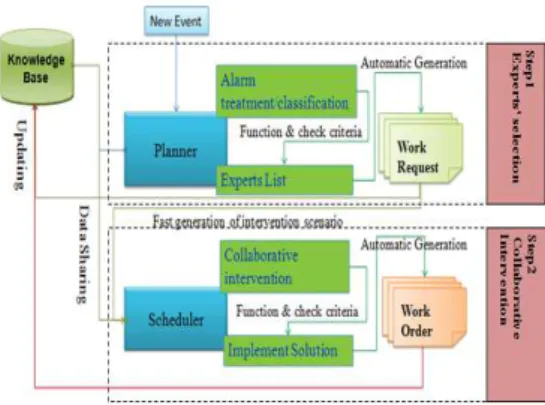
4. PROPOSED APPROCH FOR SELECTION EXPERTS The implementation of an Experience Feedback (EF) process relies on the development of knowledge management framework. In practice, knowledge management framework can be materialized in various manners. In this work, we consider that framework of EF should rely on the conceptualization of domain vocabulary. The aim is to explicitly represent experiential knowledge, for allowing its access and reuse by actors. For doing this, the ontology with SWRL as a language of interrogation is used for solving the problem of selection of experts. Moreover, CG formalism is used as model interpretation in graph theory of an experience. Our process of selection shown in fig 1 is based on EF process, it is devised on 3 steps: the first is capitalization phase in this step we propose to capture and store the experience (including Alarm analysis and Work Request 'WR' generate). We aim to achieve the CG formalism with uses domain ontology for the representation of experiences. Step two, the analysis of the problem has to be realized, aided by the previous capitalized
experience. The most important point is to capitalize this analysis within a model of experience. Finally, the exploitation task or generalization, we aim to perform Case-Based Reasoning (CBR) as a technique of problem solving (generate a new WR) that is based on the adaptation of the solution from previous alarms to solve new similar case.
Fig. 1. General scheme of maintenance process.
The first step is a preparatory phase for the resolution of the problem which serves to generate WR. The Work Request is a specific type of document automatically generated when a trigger event (Alarm) is detected and which contains the details as needed tangible and intangible resource (such as experts). The edition of a work request document launches the work request process. The experts' selection is based on the result of selections that is already done in a similar alarm.
According to WR, we move to the second step which is the diagnostic/repair process. In this step, the list of selected experts are collaborate to solve the problem. The resulting analysis with solution to their problem are forms of knowledge (WO) that can be capitalized to be used as a previous experience. The result of step 2 is capitalized to be used as a previous experience in experts' selection (i.e. if the problem is resolved, we will stored this selection to be useful for the same problem or a similar case).
In that follows, we present the capitalization phase of the EF process. The step two and three are not described in the article.
5. KNOWLEDGE FORMALIZATION
Since maintenance is a matter of communication between operators, maintenance actors and experts of various fields, a specific attention has been drawn on ontology, ensuring that information/knowledge exchanged by different actors is meaning full, and that all the stakeholders interpret it in the same way (Potez Ruiz, 2014).
The conceptual graphs are a knowledge representation language, introduced by permits at the same time to define a vocabulary (i.e ontology) and use this vocabulary to conceptualize facts.
5.1 Ontology
An ontology defines a common vocabulary for researchers who need to share information in a domain, it includes machine-interpretable definitions of basic concepts in the domain and relations among them.
It is possible to find in the literature several definitions of ontology. The most quoted is proposed by Gruber [Gruber, 93]: 'an ontology is a formal, explicit specification of a shared conceptualization'. The conceptualization can be considered as a given by a set of features constraining the structure of a piece of reality, which an agent uses in order to isolate and organize relevant objects and relevant relations (Kamsu-Foguem, 2008). An ontology is a rigorous representation of concepts and their allowed interactions, with the purpose of providing an explicit framework in which to elaborate the experience feedback modelling.
Karray (2012a,b) develop a general product maintenance ontology (IMAMO), which covers the whole of maintenance domain, having the goal to ensure semantic interoperability among different systems in the maintenance platform. In our context, we build a new ontology CMDO (Collaborative Maintenance Diagnosis Ontology) as extension of the ontology IMAMO, it is used in this work for modelling experience feedback process. The main advantage of this ontology is to propose jointly a support for EF and a support for the domain. It consist of six part (i.e. packages).
The equipment expertise management system is
characterized on the one hand, by the equipment components and sub components in a tree form (Component).
State model system: during its operation, equipment may be in one of the following states: Normal state, Degraded state, Failure state, Programmed stop state. We include in programmed stop any stopping of the carried equipment by the authorized personnel. Among scheduled stops, we are interested only to maintenance.
The monitoring management system consists of sensors (sensor) installed on the equipment and various measurements (Measure) coming from these sensors. A model of data acquisition (Data acquisition model) manages the acquisition and the exploitation of these measures. This model can trigger the procedure of intervention request according to a threshold measures and is therefore connected with the intervention management model.
The intervention management system focuses on the maintenance intervention. Intervention lets to remedy the equipment failure and is described by an intervention report and characterized by maintenance type.
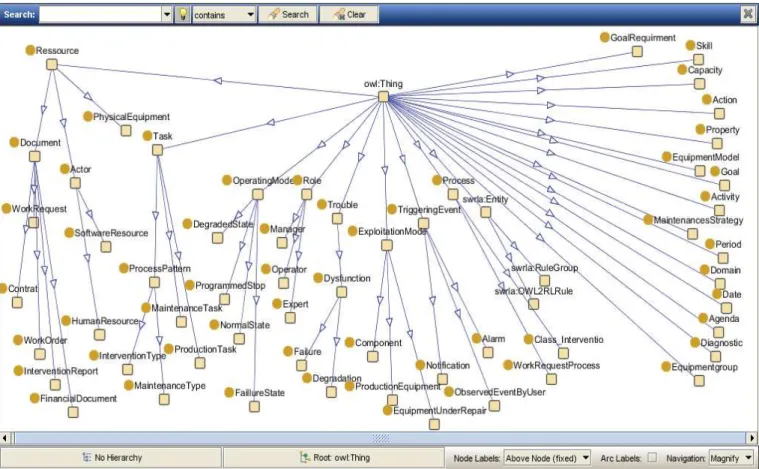
Fig. 2. CMDO Graphic Mode in plugin Jambalaya.
The resources management system describes the resources used in the maintenance system, namely human, material, document and their subclasses: operators (Operator), expert (Expert) and manager (Manager) are subclasses of human resource. Tools (Tool), consumables (consumable) and spare
parts (Spare part) are subclasses of material resource. The document resource and their subclasses are presented in a separated package. Include Document management system: presents documentation resources which are indispensable in maintenance as: the equipment plan which contains the design
and the model of the equipment and its components, technical documentation where is defined all technical information of an equipment and its use guide, contract which presents maintenance contract,
Dysfunctional equipment management system each equipment can suffer from breakdowns and failures described in the Failure class and analyzed in the failure Analysis (Failure equipment model). A failure is identified by symptoms (symptoms) caused by origins (Origin) and remedied with a remedial action (Action). It also has characteristics (Characteristics) such as criticality, appearance frequency, non detection and the gravity which are evaluated in the FMECA (Failure Mode, Effects and Criticality Analysis).
We used Protégé 3.5 as tool for building CMDO ontology. In the context of the Semantic Web "plugin" for RDF languages, SWRLTab and OWL have been developed for Protégé. These "plugin" allow to use as an editor Protégé ontology for these different languages, create instances and save them in the respective formats. An ontology is structured in protected classes, attributes, facets and axioms. In Fig.2. a graphical representation of CMDO, using the plugin Jambalaya, it is structured in nodes and arcs. The Protégé knowledge base includes ontology and individual instances of classes, with specific attribute values.
5.2 Concept Graphs
In practice, the taxonomy consider as an element contributing to the formation of the skeleton of ontology, without axioms constraining the possible interpretations for the defined terms. Conceptual Graph is a connected, directed, bipartite graph consisting of concept nodes (denoted as boxes), which are connected to conceptual relation nodes (denoted as circles). In the alternative linear notation, concept nodes are written within []-brackets while conceptual relation nodes are denoted within
()-brackets. The concepts set and the relations set are disjoint. A concept is composed of a type and a marker [<type>: <marker>]. The type of concept represents the occurrence of object class. They are grouped in a hierarchical structure called a concepts lattice showing their inherit relationships. The marker specify the meaning of a concept by specifying an occurrence of the type of concept. A conceptual relation binds two or more concepts according to the following diagram: [C1] (relation’s name) [C2] (meaning that ‘‘C1 is related to C2 by this specific relation’’) [].
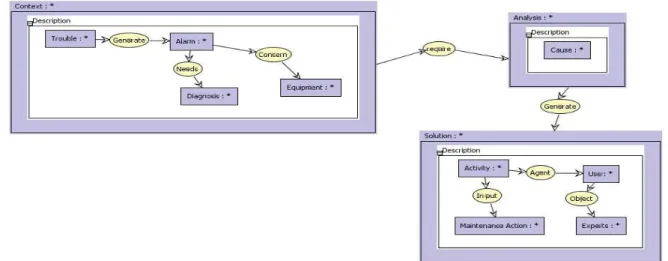
For knowledge representation in our study. In firstly, we used CMDO ontology to define a support, which provides the domain vocabulary. Is defined as a couple (TC, TR), representing respectively the hierarchy of concept types and the hierarchy of relation types. And secondly, the CG is considered to be the representation graphing of the experience feedback formalization. Considering the general Experience Feedback process of figure 3, a framework describing an experience in a generic manner is required. It is necessary to precise the context in which the Alarm has occurred. Clearly, in a continuous improvement context, it is not sufficient and the Alarm has to be analysed according to its context (search of causes, search the original of this alarm, evaluation of effects on the system) and a selection process has to be proposed.
From the support (S) described, an example of predefined CG is proposed on the figure 3. The concept nodes are defined by a label and an individual marker, which identify the considered instance (the ‘‘*’’ denotes a generic marker or undefined instance).
6. CONCLUSIONS
In this work, Knowledge formalization for experts’ selection taking into account an experience feedback process model was presented. This was done by taking conceptual graph implementation of the domain ontology as a framework for experience feedback processes formalization. The main contributions of this paper is: A methodology (Context-Analysis-Solution, framework and its reification using conceptual graphs) suitable for effective description graphic of experience feedback. Thus experiences acquired from past contexts and inducing solution can be used to improve maintenance activities within a selection expert’s process. This methodology is based on the idea that interoperability can be facilitated if different actors have guidelines for knowledge capitalization and exploitation using a common ontology. Future investigations firstly aimed at developed step two and three of EF process which are at first the analysis of the problem and the capitalization of this analysis within a model of experience. We aim to perform Case-Based Reasoning (CBR) as a technique of problem solving (generate a new WR) that is based on the adaptation of the solution from past alarms to solve new similar case.
REFERENCES
AFNOR, (2001). Terminologies de la maintenance, Norme européenne NF EN 13306.
Anon. (2001). Random House Webster’s unabridged dictionary. New York: Random House
Bekkaoui M., and al.( 2014). The collaboration of experts in a platform S-Maintenance. 2éme édition de la conference IEEE Internationale Gestion Opérationnelle de la Logistique, GOL'14 ENSIAS, Rabat, Maroc 5–7 Juin 2014.
Bennour, M., Crestani, D., (2007) Using competencies in performance estimation : From the activity to the process. Computers in Industry, 58 (2), pp. 151-163.
Bergmann R. Experience Management: Foundations, Development Methodology, and Internet-Based Applications , volume 2432 of LNAI (Lecture Notes in Artificial Intelligence), Springer, 2002.
Davenport, T. H., & Prusak, L. (2000). Working knowledge: Harvard Business Press.
Gruber TR.(1993) A translation approach to portable ontology specifications. Knowledge Acquisition, n°2(5), p. 199-220, 1993.
Gonsalves, T., Itoh, K., (2010) Multi-Objective Optimization for Software Development Projects, proceeding of International MultiConference of Engineers and Computers Scientists, 1, Hong Kong.
Hlaoittinun, O., (2009) Contribution à la construction d’équipes de conception couplant la structuration du projet et le pilotage des compétences, Thèse de doctorat, Université Franche-Comté, France.
Ishak, N. B., Eze, U. C. & Ling, L. S. 2010. Integrating Knowledge Management and Human Resource Management for Sustainable Performance. Journal of Organizational Knowledge Management,1–13. http://dx.doi.org/10.5171/2010.322246
Kamsu-Foguem, B., Noyes, D., (2013). Graph-based reasoning in collaborative knowledge management for industrial maintenance, Computers in Industry 64 (2013) 998–1013.
Kamsu-Foguem, B., T. Coudert, C. Béler, L. Geneste, Knowledge formalization in experience feedback processes: an ontology-based approach, Comp. Indust. 59(7) (2008) 694–710.
Karray, M.H., Chebel-Morello, B., Zerhouni, N., (2009).
TOWARDS A MAINTENANCE SEMANTIC
ARCHITECTURE. Published in "World Congress of Engineering Asset Management, WCEAM'09., Athènes: Greece (2009).
Karray, M.H., Chebel-Morello, B., Lang, C. & Zerhouni, N., (2011). A Component Based System for S-maintenance. Published in 9th IEEE International Conference on Industrial Informatics, INDIN'11, Caparica, Lisbon: Portugal.
Karray, M.H., (2012a) Contribution à la spécification et à l’élaboration d’une plateforme de maintenance orientée connaissances.Thèse de doctorat, Université de Franche-Comté, France
Karray, M.H., (2012b) A Formal Ontology for Semantics in Maintenance Platforms Applied Ontology 7 (3), 269-310 Kebede, G. (2010). Knowledge Management: An Information Science Perspective, International Journal of Information Management, 30, 416-424
Letouzey Agnès (2001). Ordonnancement interactif basé sur des indicateurs : Application à la gestion de commandes incertaines et à l'affectation des opérateurs, PhD thesis, Institut National Polytechnique de Toulouse.
Marmier, F., (2007) Contribution à l’ordonnancement des activités de maintenance sous contrainte de compétence: une approche dynamique, proactive et multicritère, Thèse de doctorat, Université de Franche-Comté, France. Mkaouar Hachicha, R., Dafaoui, E-M., Hadji, S., El Mhamedi,
A., (2012) Approche de résolution du problème d’affectation sous contraintes de compétences et préférences.
Muller, A., Crespo Marquez, A., Iung, B. (2008). On the Concept of E-maintenance: Review and Current Research, Reliability Engineering and System Safety, 93 (8), p. 1165-1187.
Potes Ruiz, P., Kamsu Foguem, B., Grabot, B., (2014). Generating knowledge in maintenance from Experience Feedback.Knowledge-Based Systems, vol. 68 . pp. 4-20. ISSN 0950-7051.
Rezgui, Y. (2001). Review of Information and Knowledge Management Practices state of the art in the Construction Industry. The Knowledge Engineering Review, 16(03), 241-254.
Soliman, F. (2000). Application of Knowledge Management for Hazard Analysis in the Australian dairy industry. Journal of Knowledge Management, 4,287–294. http://dx.doi.org/10.1108/13673270010379830.