To cite this document:
Lo Jacono, David and Bergeon, Alain and Knobloch, E. (2010) Spatially localized
binary fluid convection in a porous medium. In: SIAM--Emerging Topics in
Dynamical Systems and Partial Differential Equations, 31 May - 04 June 2010,
Barcelona, Spain.
O
pen
A
rchive
T
oulouse
A
rchive
O
uverte (
OATAO
)
OATAO is an open access repository that collects the work of Toulouse researchers and
makes it freely available over the web where possible.
This is an author-deposited version published in:
http://oatao.univ-toulouse.fr/
Eprints ID: 4601
Any correspondence concerning this service should be sent to the repository
administrator:
[email protected]
Spatially localized binary fluid convection in a porous medium
D. Lo Jacono
1,2,3, A. Bergeon
1,2and E. Knobloch
41Universit´e de Toulouse; INPT, UPS; IMFT (Institut de M´ecanique des Fluides de Toulouse); All´ee Camille
Soula, F-31400 Toulouse, France
2CNRS; IMFT; F-31400 Toulouse, France
3Fluids Laboratory for Aeronautical and Industrial Research (FLAIR), Department of Mechanical and Aerospace
Engineering, Monash University, Melbourne, Victoria 3800, Australia
4Department of Physics, University of California, Berkeley CA 94720, USA
The origin and properties of time-independent spatially localized binary fluid convection in a layer of porous material heated from below are studied. Different types of single and multipulse states are computed using numer-ical continuation and the results related to the presence of homoclinic snaking of single and multipulse states.
Stationary spatially localized states are of great interest in the theory of pattern formation. Recently such states have been found in several different types of convection, including binary fluid convection(1,2), convection
in an imposed magnetic field(6,7,11) and natural doubly diffusive convection(12,13,4,5,3). Similar states, localized in
the cross-stream direction, have been identified in plane Couette flow as well(15). Despite their physical difference these systems have two properties in common: they are reversible in space, and exhibit bistability (i.e., there is a parameter regime in which a trivial spatially homogeneous state coexists with a spatially periodic steady state).
In the standard picture of systems of this type on the real line spatially localized states first appear via a bifurcation from the trivial state and do so simultaneously with the primary branch of spatially periodic states. Typically there are two branches of spatially localized states that are produced, both symmetric under reflection with either global maxima or global minima. These states are distinct, and are not related by symmetry. The branches of localized states bifurcate in the same direction as the periodic states, i.e., subcritically, and are initially unstable. With decreasing parameter the localized states grow in amplitude but shrink in extent; when the extent of the localized state approaches one wavelength and the amplitude reaches that of the competing periodic state the branch enters the so-called snaking or pinning region, and begins to ‘snake’ back and forth. As this happens the localized state gradually adds rolls, symmetrically on either side, thereby increasing its length. As a result the localized states high up the snaking branches resemble the finite amplitude spatially periodic state over longer and longer lengths. Typically each snaking branch repeatedly gains and loses stability via saddle-node bifurcations, producing an infinite multiplicity of coexisting stable states within the pinning region. Secondary bifurcations to pairs of (unstable) branches of asymmetric drifting states are found in the vicinity of each saddle-node; these branches resemble ‘rungs’ that connect the two snaking branches and are responsible for the ‘snakes-and-ladders’ structure of the localized states(8,10,9). This structure is typical of bistable systems with no additional symmetry,
such as natural doubly diffusive convection(5), although similar behavior is also found in systems with an additional
midplane reflection symmetry such as binary fluid convection(2), plane Couette flow(15)and binary fluid convection
in a porous medium (this study).
In this study we explore similar behavior in binary fluid convection in a porous medium, focusing not only on the single pulse states whose behavior is described above, but also on multipulse states in which two or more localized structures are present simultaneously. We find that these states snake too and that the possible behavior is substantially richer than that of the single pulse states. Apart from the importance of porous medium convection in various applications(14), the simplification of the equation of motion allows one to compute many more steady states
and do so in larger domains than in other problems of this type. This is, of course, essential for any investigation of multipulse states. We do not consider time-dependent states.
References
[1] O. Batiste and E. Knobloch. Simulations of localized states of stationary convection in 3He-4He mixtures.
Phys. Rev. Lett., 95:244501, 2005.
[2] O. Batiste, E. Knobloch, A. Alonso, and I. Mercader. Spatially localized binary fluid convection. J. Fluid Mech., 560:149, 2006.
[3] A. Bergeon, J. Burke, E. Knobloch, and I. Mercader. Eckhaus instability and homoclinic snaking. Phys. Rev. E, 78:046201, 2008.
0 50 100 150 200 250 300 350 400 52 54 56 58 60 62 64 66 68 70
E
Ra
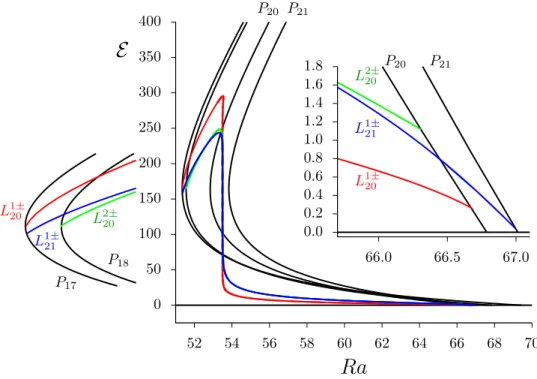
0.0 0.2 0.4 0.6 0.8 1.0 1.2 1.4 1.6 1.8 66.0 66.5 67.0 P18 P17 L120± L2± 20 L121± P20 P21 L220± L1±21 L120± P20 P21Figure 1: Bifurcation diagram showing some of the secondary branches of localized states connecting the various periodic states. The insets show enlargements of the small amplitude behavior near onset and the termination of the secondary branches near the saddle-nodes on P17 and P18. The snaking region near Ra = 53.5 is not resolved
on the scale of this plot. Parameters: τ = 0.5, S =−0.1.
[4] A. Bergeon and E. Knobloch. Periodic and localized states in natural doubly diffusive convection. Physica D, 237:1139, 2008.
[5] A. Bergeon and E. Knobloch. Spatially localized states in natural doubly diffusive convection. Phys. Fluids, 20:034102, 2008.
[6] S. Blanchflower. Magnetohydrodynamic convectons. Phys. Lett. A, 261:74, 1999.
[7] S. Blanchflower and N. Weiss. Three-dimensional magnetohydrodynamic convectons. Phys. Lett. A, 294:297, 2002.
[8] J. Burke and E. Knobloch. Localized states in the generalized Swift–Hohenberg equation. Phys. Rev. E, 73:056211, 2006.
[9] J. Burke and E. Knobloch. Homoclinic snaking: structure and stability. Chaos, 17:037102, 2007.
[10] J. Burke and E. Knobloch. Snakes and ladders: Localized states in the Swift–Hohenberg equation. Phys. Lett. A, 360:681, 2007.
[11] J. H. P. Dawes. Localized convection cells in the presence of a vertical magnetic field. J. Fluid Mech., 570:385, 2007.
[12] K. Ghorayeb. Etude des ´ecoulements de convection thermosolutale en cavit´e rectangulaire. Th`ese de Doctorat de l’Universit´e Paul Sabatier, Toulouse 3, France, 1997.
[13] K. Ghorayeb and A. Mojtabi. Double diffusive convection in a vertical rectangular cavity. Phys. Fluids, 9:2339, 1997.
[14] D. A. Nield and A. Bejan. Convection in Porous Media. New York: Springer, 1992.
[15] T. M. Schneider, J. F. Gibson, and J. Burke. Snakes and ladders: localized solutions of plane Couette flow. arXiv:0912.2739v1, 2009, preprint.