Digiworld Economic Journal, No. 108, 4th Q. 2017, p. 1. www.idate.org
More generous for small favour?
Exploring the Role of Monetary and
Pro-Social Incentives of Daily Ride Sharing
Using a Field Experiment in Rural
Île-de-France
Dianzhuo ZHU (
*)
Université Paris Dauphine, PSL Research University, France
Abstract: This paper conducts a field experiment with a spontaneous short-distance ride-sharing company to understand the interaction of monetary and pro-social motivations of drivers. Drivers pick up passengers (hired by the author) without knowing the amount that they will be paid, and can decide privately and freely after the trip whether to receive payment, to donate it to charity or to do nothing. Both monetary and pro-social motivations are found to be relevant. However, pro-social incentive works better for short-distance (5 km) trips, while monetary incentive seems to be more efficient for long-distance (20 km) trips. Drivers tend to be more generous to give up their compensation when the favour they offer is small. The author discusses the importance of taking pro-social motivations into design of daily ride-sharing, especially when the sector focuses on monetary incentive of the date.
Key words: Ride sharing, monetary, pro-social, field experiment
ecent years have witnessed the rise of sharing economy (BOTSMAN & ROGERS, 2011) both in industry and in academia. Although this term still lacks a universal definition, a large part in the sharing economy movement is based on two-sided platforms (ROTH & SOTOMAYOR, 1992) to match "sharers" with "sharees", so that "sharers" offer temporary access of their personal good to "sharees", either for free or not. The most famous companies – Airbnb and Uber – are both of this kind. Since platforms don't own any shared goods themselves, but need to favour the sharing of private, often very personal goods with strangers, who have not
* Ph.D. student in group M&O, laboratory DRM. [email protected]
done it before, understanding their motivations becomes an urge for platforms and policy makers.
Several studies have been made using various platforms. Methods like surveys and interviews helped to seek out existing motivations. SHAHEEN, STOCKER & MUNDLER (2017)'s survey on Blablacar's drivers and passengers found that for passengers and drivers, both practical, extrinsic motivations (save money and time) and ideological, more intrinsic motivations (pleasant to socialize with others, willing to help people and to save the environment) gain a high level of agreement, although money saving outperforms all other motivations. GERBER & HUI (2013) showed that creators of crowdfunding projects often have more "extrinsic" purposes like raising funds and expanding awareness, while project supporters are in general more "intrinsic", who mostly want to support a good cause and to be part of the community. Natural field experiments (in real settings, without the participants knowing that they are in an experiment, see the definition of HARRISON & LIST (2004)) have entered the domain of the sharing economy research recently and helped measuring the quantitative effect of incentives. An example would be CHEN et al. (2015)'s paper on team competition and the crowdfunding amount.
However, not enough attention has been paid to the relationship and interaction of monetary and non-monetary incentives, despite its relevance in the sharing economy. The word "sharing economy" combines two seemingly contradictory terms: "share", which often represents the altruistic, non-profit side of humanity, and "economy", which leads immediately to the picture of a world that chases efficiency, analyses monetary costs and benefits, and lets heartless market rules decide everything. Although sharing one's home with strangers via platforms is new, sharing it with friends and family members or even friends' friends is amongst the oldest practices of human society, and continues to exist today–we would not ask our friends to go through Airbnb if they ask for a short stay! In fact, there have always been tough debates towards whether a platform should be considered as "true" sharing economy, and among some idealists, a simple improvement of resource usage efficiency without the sense of community should not be included in the sharing economy1.
1 For an example of criticism, see DREHER & PICK (2015)’s article on Ouishare magazine. http://magazine.ouishare.net/2015/05/sustaining-hierarchy-uber-isnt-sharing/
Ideological debates set aside, today's version of the sharing economy does witness the combination of the "sharing" side and the "economy" side. Market efficiency helps scale up sharing around the world. Platforms position themselves in a way that is either more sharing-oriented, or more economy-oriented. Coexisting with, and even earlier than Airbnb, Couchsurfing allows people to stay at local hosts' places for free, under the idea of solidarity and general reciprocity (LAUTERBACH et al., 2009). Together with various ride-sharing services, hitchhiking continues to work. All these require us to explore more possibilities on the organising forms of the sharing economy, on when and why people share for free or for a price. Is there only one motivation that dominates the decision making, and if not, how do different contradictory motivations interact?
Why focus on short-distance daily ride sharing in rural
areas?
Ride sharing2 is one of the important pillars in the sharing economy. Ordinary drivers are mostly seen using platforms for long distance, city-to-city trips (Blablacar). Uber, the most successful private platform for satisfying short-distance commute demands, relies on professional drivers who wander around the city. The only difference compared to taxi drivers is that they are with their own cars. The price is also too high for daily commutes. Ordinary drivers are still reluctant to enter the short-distance, daily ride sharing market. The blame is not entirely on them – who likes the burden of opening a mobile app, entering their trip3, waiting for a passenger to validate, negotiating the picking-up location and making a detour4 for only 2-3 euros? Nevertheless, these unprofessional drivers could play a crucial role in offering more efficient trip solutions, solving congestion problems and releasing the burden of investing in road infrastructures. Policy makers are putting great attention on
2 Here, we distinguish ride sharing (driver and passenger are both in driver’s car and go to the same destination) from car sharing (a person rents a car from a car rental company or from an individual, without the latter driving with this person).
3 Some start-ups are trying to skip this step by using machine learning to predict drivers’ trips. 4 The early version of organised car sharing—carpooling in the 1960’s US—saved these steps because picking up points are at the entrance of highway, see CHAN & SHAHEEN (2012) for a historical review. This form is still performing well now in San Francisco (SHAHEEN, CHAN & GAYNOR, 2016).
unblocking this market5. The benefit will be even larger for rural areas, since the public transportation system there cannot satisfy all needs. People without cars still find themselves in difficulty to go anywhere.
Which field and what behavioral theories may apply?
The key to onboarding ordinary drivers relies either on decreasing cost per trip, or on motivating them through non-monetary channels, which is to say, to balance the term "sharing" and "economy".
We collaborate with a ride sharing company, which operates in rural villages of Île-de-France (Great Paris Area). It's a spontaneous ride-sharing system (more description in the experiment design part) which minimizes drivers' effort of picking up passengers, and allows drivers to decide whether to earn money or not. Pilot analysis on declarative questionnaire archive data shows that the majority of drivers mention solidarity as their first motive. Historical data before the experiment (January 2017) also shows that the overall ticket cash out rate is low.
However, behavioral theories suggest more complex reasoning. ANDREONI (1990)'s paper argues that people may behave pro-socially (in this case, refuse the payment) because they want to feel like a good person (warm-glow giving). Another famous theory called crowding-out shows that monetary incentives may backfire intrinsic motivations (FREY & JEGEN, 2001). In this case, drivers don't want money since it will ruin the pure pleasure of helping others. Despite the fact that drivers may hold esteem-related or altruistic motivations, a simple cost-benefit analysis may also explain low cash out rate: most of the existing trips are for very short distances. Drivers may have simply forgotten the ticket or find it too costly to cash several cents out, especially when the cashing out action is not automatic. DECI, RYAN & KOESTNER (1999), BOWLES & POLANÍA-REYES (2012) and CAMERON
et al. (2001)'s meta-analysis also prove that the crowding-out effect is
framing-dependent. If extrinsic rewards are on performance level but not on result, if
5 See report on Assises de la mobilité, the planning of new law on transportation. The transportation ministry has postponed several ongoing infrastructural projects in favour of "new mobility strategy", especially "light modes" like electronic bicycle, ride sharing and autonomous buses. Source in French.
http://www.lefigaro.fr/flash-eco/2017/09/19/97002-20170919FILWWW00011-lancement-des-assises-de-la-mobilite.php
actors endorse the social beneficial side of the incentive, if actors give positive feedback to recipients, or if the extrinsic incentives are chosen by the recipients themselves, a crowding-out effect may not happen.
Hypothesis
So, are drivers really not interested in monetary payoffs? If they are not, for which reasons? If they are, for how much money? How will drivers' choices be affected by framing? We made some preliminary hypotheses and tried to answer some of the questions by an exploratory field experiment.
Hypothesis 1: Some drivers do choose not to cash out for pro-social reasons, like warm-glow or to avoid intrinsic motivation crowding-out.
Hypothesis 2: However, this effect will be partially compensated when monetary incentive is sufficiently large.
The tricky part is to disentangle cash out behaviour from a pure cost-benefit point of view, and cash out behaviour when pro-social reasons are taken into account. If only operational costs are considered, as long as the price surpasses the drivers' cost of cashing out money, drivers will cash out. Since each driver's perceived cost is unknown and not unified, the higher the price level, the more likely that the driver will cash out. Under the pro-social reasoning schema, the positive relationship of price level and cash out rate still holds. How can we be sure that some drivers do refuse to cash out because of pro-social reasons, no matter who they are and what these reasons are?
Charitable giving offers an option. In the classic version of laboratory experiments like the dictator game, "dictators" are given an endowment and can freely decide to divide this endowment (usually money) between themselves and a passive recipient. The omnipresent positive amount of transfer (HENRICH et al., 2004) is often considered as a proof of pro-sociality. ECKEL & GROSSMAN (1996) used charity as recipient and again found a positive amount of transfer, even higher than when the recipient is an anonymous person. In the setting of the ride sharing model, if under the same price, more drivers are willing to treat the ticket when donation option is offered, we can say that these drivers are purely motivated by pro-social reasons. Although we cannot say that those who neither donate, nor cash out are not pro-social, it would be enough to prove pro-sociality.
Experiment design
How does the service work?
The company's ride sharing system doesn't require downloading a mobile application. Instead, they build ride sharing stations in villages. Passengers go to the station, buy a ride sharing ticket to a destination using the machine at the station, take the printed ticket and wait there. At the moment when the ride sharing request is passed, the destination will be shown on a screen several hundred meters in front of the station. All drivers passing by can see the request and those who are going to the same destination and are willing to help can slow down and pick the passenger up. At the end of the trip, the passenger can give the ticket to the driver. The amount that the driver can get is printed on the ticket, drivers need to go to the service's website to cash it out. They may either be happy to earn some extra money, or just to help without compensation.
Who?
We hired people to act as passengers to make requests at a station and to wait for drivers to pick them up. Before the experiment, hired passengers are given a briefing and a practical guide which detailed what they should and should not do. To summarize, they have to choose the destination that we ask them to choose (more information below). They are also required to chat with drivers in a natural way during the trip to learn basic information about drivers (for example, driver's gender, approximate age, knowledge of the service, history of participation, etc.). They report this information in a questionnaire after each trip. At the end of the trip, they need to give the ticket to the driver and explain clearly that drivers can cash out the amount on the ticket if they go to the website or donate it to a charity (when donation option if offered). They also need to mention the amount, so that every driver is clear about what they can get, in case that some of them forgot to look at the ticket even though they would have been interested in the amount had they known. They also need to make clear that in no case will the money be given back to them. However, hired passenger can never try to influence drivers' choices by highlighting that one choice is "better" than the other. Their role is to give necessary information neutrally and let the drivers decide. This point was made clear during the briefing stage.
Drivers are whoever pass by and decide to pick the passenger up, as in the real settings. Passengers will at no time tell drivers that they are in an experiment, in order to observe the most natural behaviour of drivers during and after the trip. Since we cannot control the identity of the driver before each trip, passengers could encounter any type of driver when they wait. If we equalize the overall time period of test for each control and treatment group, we could say that drivers who eventually stopped for each group are of the same profile distribution, since randomization is given by nature. MICHELITCH (2015)'s work also uses the randomness of taxi drivers passing by to conduct bargaining experiments. Prices are not shown on the screen, so that there is no risk of driver self-selection bias under a different price level by the time they see the request6.
When and where?
The main departure place of the experiment is village A, which has a ride sharing station by a main road with heavy traffic. Another advantage of the station is that the screen is located at an upward slope, which is 200 meters in front of the station. Passengers are not visible the moment when drivers climb upward and see the screen. Once they have climbed up, then need to slow down immediately in order to turn a bit to the right and stop at the parking lot next to the passenger. This ensures that drivers barely have time to carefully check passengers' appearance and discriminate, so that the self-selection issue of participation is well controlled7.
From this village, short (about 5 km) and long (15-20 km) distance8 trips are tested. The destination for short-distance trips is a nearby village B, also close to the main road. The destination for long distance trips is either a shopping centre in village C next to an exit of the main road, or village D, 2 minutes ahead of village C if you drive along the main road. All four villages
6 Of course, drivers who have participated would know that they are getting paid, some even know for how much. This question was included in the knowledge of the service part in the questionnaire. Data shows that most drivers do not know the amount that they are getting paid, even though some know that it’s not for free. In any case, all drivers will be given the same information after the trip to debias.
7 Weather also helped in reducing biases. The experiment was conducted in winter, when all passengers were wearing heavy clothes, scarfs and sometimes hats, making it difficult to judge their appearance from far away.
8 In the experiment setting, we use "short" and "long" to distinguish the relative distance. Under the frame of ride sharing in general, they are both short distances—inside or between villages and for frequent commute needs.
are in the same agglomeration, and since they can all be reached by the main road and that villages C and D are larger, a typical resident of village A goes to all the other villages for shopping, administrative tasks, leisure or work. A typical resident from other villages who passes by the main road in village A also goes to the direction of village D and will pass by the other villages. We ensure that under each distance, drivers are of the same pool with comparable sociodemographic profiles9.
How?
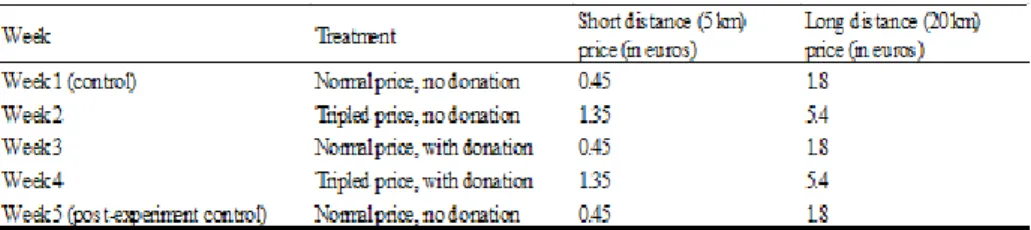
The experiment lasted for 5 weeks, from the 9th of January to the 12th of February in 2017. In each week, different treatments were applied, as shown in table 1 below.
Table 1 - Experiment design—treatment and control groups
We are not able to totally randomize each treatment and control because of technical complexity10. We thus decided to test each treatment for a week. Since prices are not shown on the screen, drivers will not see the treatment unless they participate. For new participants, price levels for past weeks have no effect on their judgement of the price they receive. Drivers who already participated during the test behave differently. We discuss these drivers in the next section.
9 For the convenience of hired passengers and the efficiency of time and budget, some return trips are made from village B and C, where there are also ride sharing stations. However, they count only for minority of all tests done and the driver pool remains the same. It’s easier for drivers to see the passenger before deciding to stop in these stations though. The data analysis part will show more evidence.
10 The donation option can only be activated and disactivated at the station and has to enter maintenance password for manipulation. We cannot give it to hired passengers, neither is it practical for them to manipulate at each trip.
The first week is for control, in which we standardize the basic price level, holding the per-kilometre price the same for short-distance trips (0.45 euros for 5 km) and long-distance trips (1.8 euros for 20 km). No donation option is mentioned on the ticket given to drivers. In the second week, we set the high price level for each distance with tripled price, which is the maximum legal level that we can offer under a ride sharing regime. The third and fourth week we repeat the price levels of the first and second weeks but with a donation option on the ticket. Passengers will also mention this information before getting out of the car. In the last week, we repeat the control level in order to see if the simple exposure of intensive requests changes drivers' cash out behaviour. Examples of tickets with and without donation option is available in Annex I.
Data analysis
Descriptive data
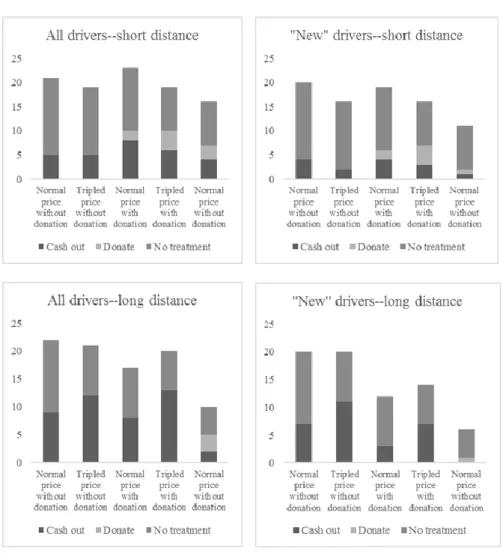
At the end of the fifth week, we have collected 197 effective trips, with around 20 observations each week for each distance. Effective means that those trips are succeeded, tickets are given, key messages are explained to drivers and drivers are not suspicious about the experiment. Figure 1 shows trip number in each week and how drivers treat tickets. In this figure, "new drivers" contains those who have never participated during the experiment period before the current trip, and "all drivers" includes those who have already participated before. Since we would not know who the driver will be
ex-ante, the same driver may end up picking passengers up several times.
These drivers may behave differently since they have already known some information and that they may face different price levels in different weeks11. We report statistics both with and without experienced drivers in the following sections. We discuss these data in the next section.
11 However, none of them was suspicious about being in an experiment. Some of them reasoned the change of price as a strategy made by the company to reward drivers in non-peak hours, others thought that passengers decided to pay a higher price.
Figure 1 - Drivers' ticket treatment behaviour in each week.
Around 95% of short-distance trips (96 out of 102) depart from village A. For long-distance trips, 38% of the trips (36 out of 95) start from village B or C. Passengers are from different origins and have participated in different treatments, as shown in table 2.
Table 2 - Passenger profile and trip distribution
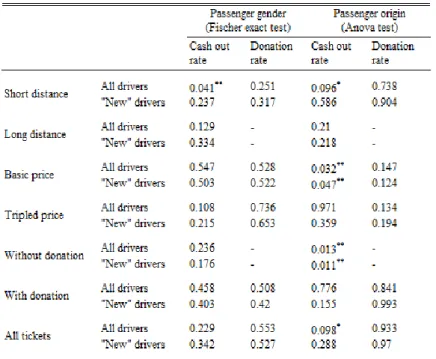
Table 3 - Drivers' behaviour difference under different passenger profiles
*** p<0.01 ** 0.01<p<0.05 * 0.05<p<0.1 More stars, higher significance level; no star, not significant. Same for all tables
Biasness checks
Highlights (table 3-6): The purpose of this part is to check if some of the
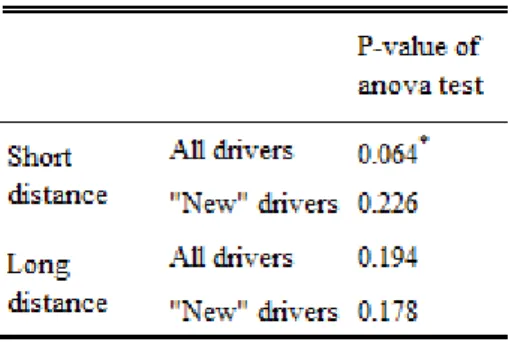
key variables that are not included in experimental tests influence ticket treatment behaviour significantly differently in different control and treatment groups, which creates bias. No significance was found on how passenger gender, passenger age or driver gender may influence driver behaviour. Elder drivers cash out less often, but different aged drivers are distributed similarly under each price level. Executing different treatments in consequential weeks instead of randomizing all treatments together does not bias drivers' cash out behaviour either.
Tests show that passengers' sociodemographic profiles have no significant effect on drivers' ticket treatment behaviour. Table 3 shows that at least for new drivers, for each treatment, drivers who pick up different passenger genders behave similarly in cash out rate and donation rate, the same for drivers who pick up different passenger origins (None of the statistical tests is significant).
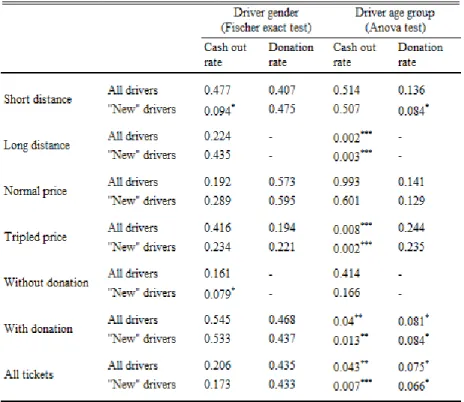
Drivers' profiles are more difficult to obtain because drivers are not obliged to register in order to participate. We use passengers' observational data for gender and age group as basic information and correct estimation error using registration data of drivers who cashed out or donated money. Passengers estimate drivers' ages in 4 groups: 18-30, 30-45, 45-60 and above 60 years old. Table 4 shows that in general, driver gender does not influence their ticket treatment behaviour significantly. The only exception is for week 2, where female drivers cash out significantly more often than male drivers, especially for new drivers. However, we can still say that driver gender does not bias the results systematically.
Table 4 - Drivers' behaviour difference under different driver profiles
*** p<0.01 ** 0.01<p<0.05 * 0.05<p<0.1
Age plays a more important role in defining driver behaviour. The right block of table 4 demonstrates that under tripled price (week 2 and 4), especially for long distances, drivers under 30 years old cash out significantly more often than other age groups12. When the donation option is offered, elder drivers are more likely to donate. This makes sense intuitively—young drivers are more sensitive to payment, and are more willing to use the Internet. Elder drivers, however, may refuse to cash out because of small amount or reluctance to technology, but are more pro-social in general since they are more willing to donate money to charity.
12 The table itself only shows that different age groups cash out under significantly different frequency. If we look at each age group, we can see that drivers under 30 years old cash out more often. Raw cash out rate is not presented here due to limited place, but available upon request. The same for donation rate data.
This raises the question of whether drivers of different age groups distribute equally. From table 5, we can see that middle-aged and old drivers (more than 45 years old) are less representative in long-distance trips if we take all drivers into consideration, which may explain the higher cash out rate for long distance trips. However, when we only consider new drivers, age groups are distributed equally both for short-distance and long-distance trips. To summarize, driver gender and age do not bias our results for new drivers.
Table 5 - Driver age group distribution difference
*** p<0.01 ** 0.01<p<0.05 * 0.05<p<0.1
The concern of exposure effect is released as well. The last part of table 6 shows that drivers participated in the post-experiment control week do not behave significantly differently comparing to those participated in the first week. Each driver's ticket treatment decision is more of a personal thing, independent of the number of requests having been made, although drivers will be more likely to stop if they see requests more often.
Hypothesis check
Hypothesis 1: Partially verified. Yes, pro-social reasons for not cashing out money have been witnessed among drivers, but in our exploratory study, it can only be proven among short-distance drivers.
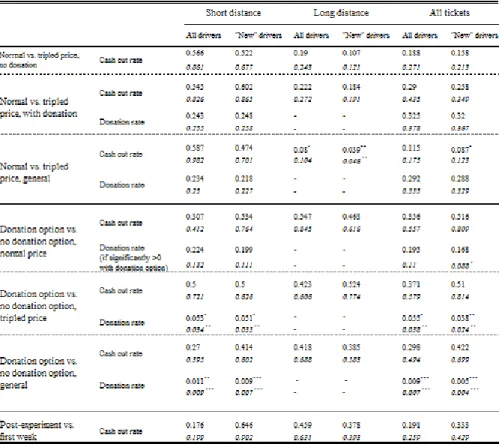
Table 6 compares if drivers of short-distance trips behave differently when different treatments are given (the same for long distance). Each grouped horizontal block shows comparison of two treatments, for example, normal or tripled price. Under each block, several ticket treatment behaviours are compared, either for cash out rate or for donation rate (if available). As mentioned above, we measure both for new drivers' behaviour differences
and for all drivers. Both Fisher exact test results (first line) and Chi-2 test results (second line)13 are reported for comparison.
Table 6 - Ticket treatment behaviour under different price levels and donation options
*** p<0.01 ** 0.01<p<0.05 * 0.05<p<0.1
From the table, we can see that for short-distance drivers, tripling price
from 0.45 euros to 1.35 euros has no significant effect in changing ticket treatment behaviour (the first three horizontal blocks have no starred items).
Drivers will cash out at about the same rate under tripled price as under the basic price level. This effect holds both when donation option is not available and when donation option is available, for new drivers as well as for all drivers.
13 Both are common methods in comparing if two groups behave similarly in choosing yes-or-no questions.
Similarly, drivers will not donate more often when price is tripled compared to basic price level.
However, offering a donation option to short-distance drivers has
significant effects on donation rate (starred items for new drivers in the next
three horizontal blocks). In general, when short-distance drivers can decide whether to donate or to keep the money themselves, significantly more drivers will donate. At the same time, neither significantly more, nor fewer drivers will cash the money out, which means that the donation option has attracted some drivers who don't want to cash out to eventually make an effort to go the website and donate14. The pro-sociality of some drivers is proved. It is also worth noticing that the significance applies both for new drivers and for all drivers.
For long-distance drivers, the results switched. Offering donation option
has not attracted a single driver to donate, except for one driver in the post-experiment control15 (see Figure 1). Meanwhile, the cash out rate remains the same as well. It seems that drivers have thought through when making decisions. Those who decided to cash out will not change their mind facing the possibility to donate, and those who didn't cash out will not donate either. They may be happy just to help a passenger, but they may also have forgotten the ticket or are not willing to give personal information to the company. More studies are required in order to disentangle pro-social motives of long-distance drivers.
Hypothesis 2: Partially verified. Monetary incentives may crowd in cash out behaviour of drivers who initially hold pro-social motives or find the cost of cashing out higher than the benefit, but this effect has only been proven on long-distance drivers.
We have seen from above that raising the price has no crowding effect on cash out behaviour for short-distance trips. However, when the price of
long-distance trips is tripled, significantly more drivers will cash out tickets. Out of
the added drivers, there may be some who hold pro-social motivations when the price is not tripled, which, again, cannot be disentangled from other motivations. In any case, we can prove that monetary incentive does have a crowd-in effect for long-distance drivers.
14 The donation option may also cause a change of mind of some drivers who want to cash the money out in the first place, but the effect is not significant here, since the cash out rate does not change.
15 There was no donation option printed on the ticket during the post-experiment control week, but some bugs led some drivers to the website with donation option.
Learning effect: We also observe that for drivers who participated several times during the text, most of them end up cashing out money. According to
the report of hired passengers, some drivers only reminded themselves of the ticket until their next trip, some found that the long-term payoff may be interesting after several repetitions. Also, experienced drivers, compared to drivers who are unfamiliar with the service, are more likely to stop the next time they see passengers, even if they never cash out money16.
Discussion and further research
The exploratory study shows that under the same per-kilometre price level, short-distance drivers react more actively to pro-social incentives, while long-distance drivers react more actively to monetary incentives. This effect holds even when we compare the tripled price of short-distance trips and the basic price of long-distance trips—drivers are willing to donate for 1.35 euros but not for 1.80 euros, while the cash out rates of these two do not differentiate significantly17. It is normal if drivers are willing to cash out more often when the price is higher, but for those who don't want to get paid, why won't they donate even when the price is high enough?
One hypothesis based on data analysis is that drivers justify their cash out behaviours differently. Under short-distance trips, drivers are more likely to think that they are offering help, and are thus less sensitive to price change but more sensitive to donation. Under long-distance trips, drivers spend more time with passengers and may start thinking that the time and fuel that "cost" them for taking a passenger on a trip that they would have driven anyway. They are still willing to help, but since the passenger gains more from them compared to a short trip, it is like they are offering a service, and it becomes more reasonable for passengers to share the cost. Even if they are not willing to cash the money out for various reasons, they are not willing to let a charity have "their money" either. Further research based on a more precise design is needed to test this explanation as well as to consolidate the relationship between distance and generosity.
16 Although we are not 100% sure about drivers who never cash out, we are at least certain of one benevolent driver who has participated twice (confirmed by passengers) but has never cashed out nor donated.
17 We don’t report tests comparing short-distance and long-distance ticket cash out and donate behaviour under each treatment in this paper due to space limit, but data is available upon request.
The design of the exploratory study has its limits as well, which may bias the validity of findings. Drivers are given the same per kilometre payment, not the same absolute payment. To verify the hypothesis of generosity difference under different trip distances, the further step could be to give drivers the same absolute payment level for both short and long distances, say 1.5 euros or 3 euros, and see if the results still hold. The fact that drivers choose to donate under 1.35 euros but not under 1.80 euros may lie on the difference of 0.45 euros. Even though we don't find a difference in cash out rate (thus, 1.80 euros don't attract drivers naturally more than 1.35 euros), the insignificance may simply be caused by small sample size. Indeed, the relatively small sample size for various treatments that we want to explore in the first stage may make some "would be" effects insignificant and increase the risk of biasness, although we still found interesting patterns.
Conclusion and policy implications
Ride sharing for short-distance, daily commutes has gained importance in urbanization planning. Take the example of where the field is located, the French government expressed the wish to support and develop this solution as part of the public transportation system in the undergoing Assises de la
mobilité, at the end of which a new law of transportation will be settled.
Despite its potential in solving various problems in transportation. Short-distance ride sharing faces difficulties in motivating people to use it. Current focus has been made mainly on monetary incentives (subsidizing passengers and drivers by offering passengers free trips and giving drivers extra bonuses). This paper argues that pro-social motivations should not be neglected and if they are used properly, they may help unblocking cases where monetary incentives are dysfunctional or are too costly in the long run. An example would be extremely short-distance trips. Of course, monetary incentives are also present and should not be forgotten either, especially when trips are getting longer. A combination of monetary and pro-social incentives may be the proper way to promote daily ride sharing, but further investigations need to be made to better understand behaviour under this emerging phenomenon.
"Macro" factors will also help for short-distance ride sharing. Adopting a new commuting habit is about cost and benefit but also about culture. Service providers should understand the operational and psychological costs for
drivers and passengers, the particularities of daily ride sharing costs compared to long-distance ride sharing, which works well in lots of countries. Innovations anchored in service design that can reduce these special costs can help before playing with incentives. Policy makers, on their side, can also help reducing costs of adopting daily ride sharing by integrating ride sharing costs into public transportation subscription or by building reserved roads for ride-shared cars. Most importantly, by doing so, they are building the culture of ride sharing that will eventually create synergy with individual motivations.
References
ANDREONI, J. (1990): "Impure Altruism and Donations To Public Goods : a Theory of Warm-Glow Giving", The Economic Journal, 100(401), 464–477.
BOTSMAN, R. & ROGERS, R. (2011): What's Mine Is Yours: The Rise of Collaborative Consumption, Collins, London.
BOWLES, S. & POLANÍA-REYES, S. (2012): "Economic Incentives and Social Preferences : Substitutes or Complements ?", Journal of Economic Literature, 50(2), 368–425.
CAMERON, J., BANKO, K. M. & DAVID PIERCE, W. (2001): "Pervasive Negative Effects of Rewards on Intrinsic Motivation: The Myth Continues", The Behavior Analyst, 24(1), 1–44.
CHAN, N. D. & SHAHEEN, S. A. (2012): "Ridesharing in North America: Past, Present, and Future", Transport Reviews, 32(1), 93–112.
CHEN, R., CHEN, Y., LIU, Y. & MEI, Q. (2015): "Does Team Competition Increase Pro-social Lending? Evidence from Online Microfinance", Games and Economic Behavior.
DECI, E. L., RYAN, R. M. & KOESTNER, R. (1999): "A Meta-Analytic Review of Experiments Examining the Effects of Extrinsic Rewards on Intrinsic Motivation", Psychological Bulletin, 125(6), 627–668.
DREHER, J., PICK, F. (2015): "Sustaining Hierarchy-Uber Isn't Sharing", Ouishare Magazine.
http://magazine.ouishare.net/2015/05/sustaining-hierarchy-uber-isnt-sharing/
ECKEL, C. C. & GROSSMAN, P. J. (1996): "Altruism in Anonymous Dictator Games", Games and Economic Behavior, 16(2), 181–191.
FREY, B. S. & JEGEN, R. (2001): "Motivation Crowding Theory", Journal of Economic Surveys, 15(5), 589–611.
GERBER, E. M. & HUI, J. (2013): Crowdfunding: Motivations and Deterrents for Participation, ACM Transactions on Computer-Human Interaction, 20(6).
HARRISON, G. & LIST, J. (2004): "Field Experiments", Journal of Economic Literature, 42(4), 1009–1055.
HENRICH, J., BOYD, R., BOWLES, S., CAMERER, C., FEHR, E. & GINTIS, H. (2004): Foundations of Human Sociality: Economic Experiments and Ethnographic Evidence from Fifteen Small-Scale Societies, Oxford: Oxford University Press. LAUTERBACH, D., TRUONG, H., SHAH, T. & ADAMIC, L. (2009): "Surfing A Web of Trust: Reputation and Reciprocity on CouchSurfing.com", in 12th IEEE International Conference on Computational Science and Engineering, CSE 2009 (Vol. 4, pp. 346– 353).
MICHELITCH, K. (2015): "Does Electoral Competition Exacerbate Interethnic or Interpartisan Economic Discrimination? Evidence from a Field Experiment in Market Price Bargaining", American Political Science Review, 109(1), 43–61.
ROTH, A. E., & SOTOMAYOR, M. (1992): Two-Sided Matching, in Handbook of Game Theory with Economic Applications (Vol. 1, pp. 485–541).
SHAHEEN, S. A., CHAN, N. D. & GAYNOR, T. (2016): Casual Carpooling in the San Francisco Bay Area: Understanding User Characteristics,Behaviors,and Motivations, Transport Policy, 51, 165–173.
SHAHEEN, S., STOCKER, A., & MUNDLER, M. (2017): Online and App-Based Carpooling in France: Analyzing Users and Practices—A Study of Blablacar, in Disrupting Mobility (pp. 181–196). Springer International Publishing.
Annex I - Tickets with and without donation
Above are two tickets of short distance trips used during the experiment. The name of the destination is anonymized by "destination". The first ticket is without donation option and the second is with donation option. The only difference is that the second ticket has one more phrase between "0.45€" and the code of the ticket, indicating that the driver can "cash out or donate the money (mentioned above)". The tickets also contain information on the number of passengers of the trip, the emission time and practical information for passengers and drivers. Tickets of long distance trips are the same in terms of design, except that the date and time, the destination and the price change accordingly.