Brand gender and cross-gender extensions VEG N. et NYECK S. Cahier n°364 Mai 2007 Nathalie Veg Doctoral student
Programme Doctoral Essec et DRM-UMR CNRS 7088 Université Paris-Dauphine 75775 Paris Cedex 16
Simon Nyeck Professor
Essec Business School, Paris Avenue Bernard Hirsch B.P. 50105
95021 Cergy-Pontoise Cedex [email protected]
BR A N D G E N D E R A N D C R O S S-G E N D E R E X T E N S I O N S
Summary: In order to develop brands and increase growth, most luxury brands rely on
extensions on different product categories. On top of that, the current trend is the
cross-gender extensions (eg. Masculine watchmakers targeting female audience). The objective of
this paper is to discuss the concept of brand gender and its potential influence in crossover extensions. More specifically, we intend to describe how female brands extend on the men market and vice versa. Using semiotic analysis, a qualitative research is performed on a sample of eight brands. The semiotic techniques allow to understand the deep meanings of their products, communication, web sites and narratives. The exploratory findings highlight the importance of brand consistency in terms of values while addressing both male and female segments. These findings, specific to luxury brands, provide support to the brand extension literature.
Key words: Brand gender, cross-gender extensions, masculinity, femininity, consistency,
luxury
Résumé: Afin de se développer et de générer des profits, la plupart des marques de luxe
utilisent les stratégies d’extension de marque, c'est-à-dire qu’elles essaient de s’introduire dans de nouvelles catégories de produits. En complément, une nouvelle tendance émerge : il s’agit des extensions de segments de marché (par exemple un horlogers masculin visant les femmes). L'objectif de cet article est de discuter du concept du genre de la marque et de son influence potentielle sur les extensions de segments de marché (homme – femme). Plus spécifiquement, nous souhaitons décrire comment les marques féminines s’étendent sur le marché d'hommes et vice-versa. Une recherche qualitative, de type sémiotique structurale, est effectuée sur un échantillon de huit marques de luxe. Les techniques sémiotiques permettent de comprendre les significations profondes du discours des marques au travers de leur communication. Les résultats exploratoires soulignent l'importance de la cohérence entre le genre de la marque et le genre utilisé pour parler au segment de marché opposé. Ce constat fort qui ressort des analyses est en conformité avec la littérature sur les extensions de marque et l’importance de la congruence.
Mots clés: Genre de la marque, extensions de segments de marché, masculinité, féminité,
BR A N D G E N D E R A N D C R O S S-G E N D E R E X T E N S I O N S
1. Introduction
The concept of brand extension has been widely studied, the main objective being to explain key success factors of brand extension. The congruence between brand and extension (Boush and al, 1987; Romeo, 1991), the conceptual fit (Park and al, 1991; Aaker and Keller, 1990; Roux and Boush, 1997) and the typicality (Boush and Loken, 1991; Ladwein, 1994) are some of the factors explaining a successful extension, the brand name and awareness reducing the costs of new products launch and the risk of failure.
But a new trend in brand development is the cross-gender extensions and few, if none research has been published on the topic. The trend appears to be of interest for managers who need to sustain their double digit growth, mainly in the luxury sector (Nyeck and Veg, 2006). Eg. Chanel is offering watches for men, Aubade is a lingerie brand and has developed recently male products; Montblanc is a masculine brand and has extended into female market, with jewel collections. This gender extension is complex, especially when the brand gender (masculine or feminine) is well established.
Thus, the purpose of this paper is to understand how the brand gender affects the cross-gender extensions. Particularly, how masculine brands enter on woman market and conversely for feminine brands? Which processes they use? How do they transfer their codes in order to maintain the brand desirability?
The exploratory research is conducted on a corpus of eight brands whose have made cross-gender extensions. A semiotic analysis allows to compare the values and narratives used by brand to tap women and men targets. The patterns of cross gender extensions are discussed in the light of brand extension literature.
2. Conceptual Background 2.1. Brand identity and gender
Every reflection on brand strategy begins with the following question: what is brand ? A brand is a sum of associations, but the distinction between brand image an brand identity should be made clear (Kapferer, 1991, 2004). The brand identity focuses on the stable values that the company wants to convey to consumers, while image is the brand as perceived by consumers. The brand identity in the long run is what conveys the brand essence and guarantees a continuous relationship with consumers and employees.
Cultural anthropology underlines the fact that identity is used to point out the principle of permanence which allows the individual to remain « the same », to persist in his being during his whole life, (…) despite the alterations of his living modes or the roles he plays (Greimas and Courtés 1986; Courtés 1991). The brand identity is a consistent, recognizable and unique brand imaginary transmitted by creation, style, products, packaging, communication, distribution, merchandising. The permanence underneath disruptions, changes and innovation leads to brand invariance. Invariants define the brand, and their meanings are shared with consumers in a given culture. Besides, through time, the invariants allow the brand to stay true to his essence, whilst adapting to trends. The two dimensions of brand identity are the
physical attributes) on one hand, and the ethic invariants on the other hand. The later deals with intangibles signified, the brand’s vision of the world (its personality, its philosophy) (Floch, 1995; Roux and Floch, 1996).
Gender is one of the aesthetic and ethic invariants organizing and defining the brand identity, and leading to strong associations with the brand (Remaury, 2004; Park and al, 1991 ; Aaker, 1996 ; Kapferer, 2004 ). Femininity and masculinity are therefore relevant in studying cross-gender extensions. In the next section, we will briefly discuss the factors that define a brand as a feminine or a masculine one, through its aesthetic and ethic invariants.
The brand gender
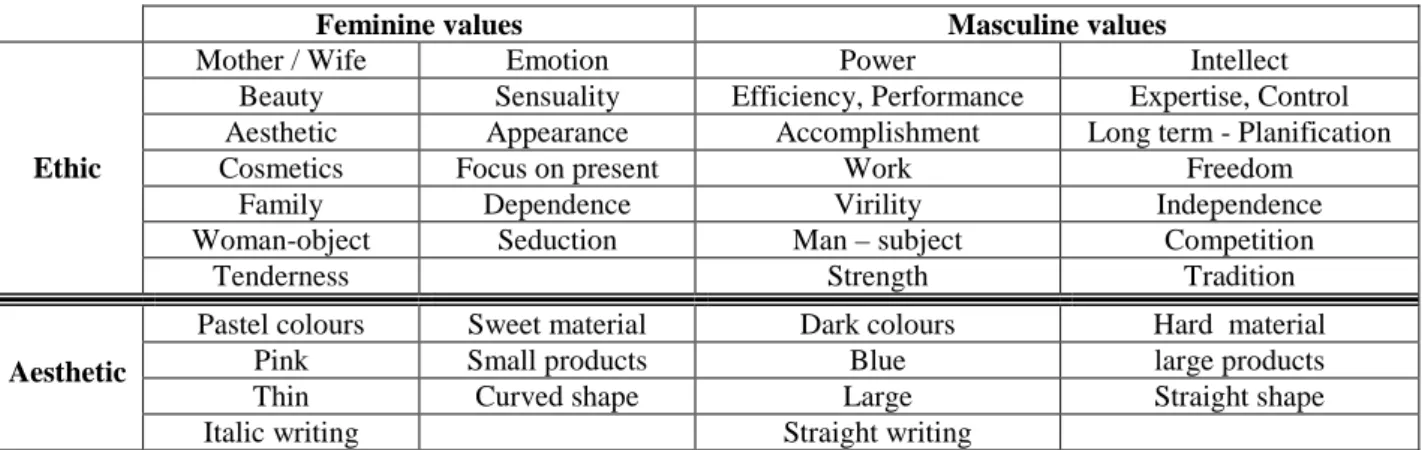
The « feminine vs. masculine » opposition is a semantic axis describing culture (Floch, 1990). This axis relevant to analyse brands as they are cultural products, carrying meanings shared in any given society. Then, a brand will have a gender if its aesthetic and ethic invariants contain feminine or masculine values (Alreck, 1994). Many authors have defined gender ethic and aesthetic values (Badinter, 1992 ; Maffesoli, 1990, 1993 ; Alreck, 1994 ; Bourdieu, 1998 ; Palan et al, 1999 ; Tissier-Desbordes et Kimmel, 2002 ; Vigarello, 2004), which are described in the following table 1.
Table 1 : Cultural Stereotypes of femininity and masculinity
Badinter (1992), Maffesoli (1990; 1993), Bourdieu (1998), Vigarello (2004)
Feminine values Masculine values
Mother / Wife Emotion Power Intellect
Beauty Sensuality Efficiency, Performance Expertise, Control Aesthetic Appearance Accomplishment Long term - Planification
Cosmetics Focus on present Work Freedom
Family Dependence Virility Independence
Woman-object Seduction Man – subject Competition
Ethic
Tenderness Strength Tradition
Pastel colours Sweet material Dark colours Hard material
Pink Small products Blue large products
Thin Curved shape Large Straight shape
Aesthetic
Italic writing Straight writing
To build a strong gender association, brands use symbols, signs and codes referring to these feminine and masculine values in their narratives, advertisings, products and retailing. Also, using gender as invariants leads the brand to define the relationship between men and women (Remaury, 2004). Each of them can be “subject” if he/she is active in the relation or “object” if he/she is more submissive. Different patterns can be defined according to the man-woman relationship (appendix 2).
Assuming the gender is part of brand aesthetic and ethic invariants, one key issue in cross-gender extensions (extensions from female market to male market or from male market to female market) is to translate this brand identity to the other segment (male or female) while staying true to his essence. Previous research on brand extension underlines the factors leading to a successful extension.
2.3. Success factors of brand extension
The congruence between brand and extension seems to be a key variable for successful extension evaluation. The physical similarity (Boush and al, 1987; Romeo, 1991; Lee, 1994),
the conceptual fit (Park and al, 1991; Aaker and Keller, 1990; Roux and Boush, 1997) and the typicality (Boush and Loken, 1991; Ladwein, 1994) are some of the measures of proximity between brand and extension (Sujan and Tybout, 1988).
The physical similarity compares only the material features of products; but the brand is not only a product. The conceptual fit included others associations and analyses the logical perceived link between the different products of brands. In the same way, the typicality compares the number of same features (concrete or abstract) and the number of the different features (concrete or abstract).
As the brand is also linked to more abstract associations, it is important to evaluate the proximity between brand and extension in terms of concept and value consistency. These values (concrete and abstract) have to be consistent to have a successful extension. Finally, the more typical the extension (including physical attributes and symbolic values), the more favourable are consumers evaluations. Successful extensions need to show congruence with the brand values.
The gender (feminine or masculine) is included in brand values. The literature seems to focus on the importance of consistency between brand and extension. But no research on extension topic has analyzed congruence within the framework of the cross-gender extensions, that is to say for female brand that wants to introduce in male market and conversely.
Thus, we propose that if the extension gender is consistent with the brand gender, then the likelihood for having a successful cross-gender extension will be great.
3. Research proposition and Methodology
The research objective is to understand the cross-gender extension process of brands with an established gender identity. More specifically, we want to address the following propositions:
P1- Are the brand gender and extension in a new gender segment consistent/congruent? P2- How do the brands translate theirs values in the new segment ? how do they transfer their aesthetic (physical )characteristics of femininity or masculinity and/or their ethic (intangibles) values of these stereotypes? Which relationship can be defined between male and female?
Representative figure
Data and qualitative procedure
Eight (8) brands are used as cases studies: Aubade, Audemars Piguet, Cartier, Chanel, Hugo Boss, Lancôme, Montblanc, and Rolex (Appendix 1). The brands have an established gender and have already moved into cross-gender extensions. Cross-gender extensions are an important trend in the luxury and few research deals with this sector (Roux and Boush, 1997). Finally, the brands illustrate several product categories: fashion and underwear (Chanel, Aubade, and Hugo Boss), jewellery and watch making (Audemars Piguet, Cartier, and Rolex), writing (Montblanc) and cosmetics (Lancôme).
Brand gender Aesthetic Ethic Extension gender Aesthetic Ethic Congruent? Congruent ?
Corpuses of the 8 brands communications (new segment and original gender) are created with Ads, products, window stores and web sites. First, we define the brand essence, using gender values stereotypes (see table 1), then, the research analyses the gender extension and compares the female and male narratives to seek for consistency.
To identify the meanings of brand narratives, a structural semiotic analysis is performed (Courtès, 1991, Floch, 1990) with three main purposes: (1) exhibit gender aesthetic and ethic of several brands and their extension, (2) define the relationships between man and woman et (3) analyse the congruence of codes and values.
4. Preliminary Findings
First, the results define the brand gender as feminine or masculine through the narratives. Next, the research describes the different cross-gender strategies used by the 8 brands, ie, how do brands portray their aesthetic and ethic invariants in both male and female segments.
4.1. Feminine brands and masculine brands
Based on the use of aesthetic and ethic invariants in the brand communication and narrative, the semiotic analysis of the corpus leads us to classify four brands as feminine (Aubade, Cartier, Chanel and Lancôme) and four other as masculine (Audemars Piguet, Hugo Boss, Montblanc and Rolex).
Feminine brands and their narrative
The seduction discourse: In this discourse, the Aubade woman offers a fantasy, a pleasure. She uses rules to provoke and stimulate men: Lesson n°62: wake up his 6th senses; Lesson n°74: Stimulate his creativity. She offers her body highlighting her sensuality.
The aesthetic and emotion discourse: The discourse of beauty is linked to the impressiveness. Cartier communication focuses on products with little narrative. Sumptuous sets of jewels,
Exceptional pieces, The gems glitter, Precious jewel.
The beauty discourse: Lancôme claims that the brand has an uncontested beauty expertise, and want all the ladies to Believe in beauty.
The Queen archetype discourse: The aesthetic invariants of Chanel are very feminine and are conveyed by products: fashion, jewels, and cosmetics. However, its ethic invariants underline freedom for modern women’s body. The meaning of masculine working clothes is reversed into and becomes luxury and feminine. The Chanel woman is audacious, perfectionist,
unique, passionate and visionary. This new meaning refers to a strong Queen in Western
society imagery, shared culture and mythology. (Floch 1995, Remaury 2004)
Masculine brands and their narrative
The tradition/heritage and expertise discourse: Montblanc is synonymous of the Art of
writing. It is the pen expert: Writing founds its masters. Audemars Piguet is The Maître Horloger since 1875. The technical know-how is transmitted since centuries.
The achievement and work discourse: This discourse focuses on successful men in business world. The Montblanc products are essential for this accomplishment (pens, cufflinks, and watches). The brand has developed the Culture Arts Patronage Award, rewarding the CEO commitment into Arts. Hugo boss also uses elements of men stereotype aesthetics, underlining his masculinity: suits, straight lines, dark colours.
The power/performance discourse: The Rolex invariants are linked to the power. The crown is the logo of the brand, which carries meaning of power. Rolex portrays performance in several activities (sport, business world…): If you win the F1 price, you would carry a Rolex. Since 1961, the brand emphasises on this value in theirs advertisings: The people who can change
the world wear Rolex.
4.2. Brand gender and cross-gender extensions
In this part, we seek to look at consistency between the brand and the female or male market extension. Is it consistent with the original brand gender, and how do brands define the relationships between males and females ?
Narrative of Feminine brands in the male market extensions
Aubade: The seduction narrative is used for both men and women, with appearence and the body being the focus. The Aubade man is portrayed in a universe of sensuality and emotions.
Lesson n°1: Steal the limelight; Lesson n°2: resist in vain. Women and men are both objects
in their relationship.
Cartier: The beauty narrative is predominant in both segments. Like ladies, the Cartier man is interested by aesthetic and design features.
Chanel: The feminine aesthetic invariant of Chanel products is transferred to man. The men and women watches share the same design. However, the analysis shows that the Chanel man is represented with feminine codes. He is soft and tender. The Allure fragrance for men emphasises on sensuality. While the Chanel lady is strong, the Chanel man is far from traditional virility. Besides, both of them don’t seem to be connected.
Lancôme: Lancôme man invariants exhibit performance. The brand doesn’t use beauty narrative but emphasises on problem solving: Soin hydratant resource, anti-tiraillement. The packaging is different with a more masculine blue colour. The rose (brand logo) is avoided. Lancôme man is an expert.
Narrative of Masculine brands in the female market extensions
Rolex: Ethic and aesthetic invariants are the same for male and female, portraying a masculine universe of success and performance: The man’s watch women prefer. The Rolex woman is an achiever : The femininity without weakness; That twinkle in her eye, that’s her
burning desire for perfection. Both the Rolex man and woman are subject, with powerful will.
Hugo Boss: The same aesthetic and ethic invariants apply to ladies. The Hugo Boss woman is in a masculine universe of work and performance. The working girl is wearing suits like man. Both are subject of the relationship.
Montblanc: Monblanc narrative emphasises expertise, work and accomplishment for both markets.
Audemars Piguet: Both communications for men and women portray different values. The universe of Audemars Piguet for ladies (Femmes du Monde) conveys a feminine ethic. Few products share aesthetic invariants (Lady Royal Oak line) of male watches with the same design, while the bulk of ladies collection is linked to feminine values. A detailed analysis of Audemars Piguet extension in ladies market is provided (Appendix 3).
The table 2 below describes a summary of the brand gender and extension in male/female market.
Brand gender Extension gender Relationship Brands
Aesthetic Ethic Aesthetic Ethic H F
Aubade Feminine Feminine Feminine Feminine Object Object
Cartier Feminine Feminine Feminine Masculine Subject Object
Chanel Feminine Masculine Feminine Feminine No relationship
Lancôme Feminine Feminine Masculine Masculine Subject Object
Audemars
Piguet Masculine Masculine
FdM : Feminine LRO : Masculine
FdM : Feminine
LRO : Feminine Subject Object
Hugo Boss Masculine Masculine Masculine Masculine Subject Subject
Montblanc Masculine Masculine Masculine Masculine Subject Subject
Rolex Masculine Masculine Masculine Masculine Subject Subject
5. Findings discussion and managerial implications
This study shows different brand extension strategies into male/female market with respect to the gender ethic and aesthetic invariants. While the literature focuses on extension congruence/fit/consistency with the core brand identity to explain a key success factor, we found that some extensions are consistent with the brand gender (aesthetic and/or ethic) while others don’t share the same codes and values. This raises the issue of the extension desirability. Then, several issues have to be addressed in order to maintain and translate the brand identity (with respect to gender) in a new segment.
More precisely, (4) four cross-gender strategies are found in the study. The Figure 1 below organizes the findings through both aesthetics and ethic invariants dimensions. Each dimension opposes the brands portraying the same invariants for Female & Male segments to the brands transferring different invariants to Female/Male segment.
The first group defines brands that share gender aesthetic and ethic invariants with their extension (Aubade, Hugo Boss, Montblanc and Rolex). This cluster provides support to research findings on brand extension (Boush and al, 1987; Romeo, 1991; Lee, 1994; Park and al, 1991; Aaker and Keller, 1990; Roux and Boush, 1997). Out of the 4 brands using the total
congruence strategy with respect to gender identity, only Rolex seems to enjoy success as a
leader on luxury female watch market.
The second group adopts new aesthetic and ethic gender invariants while entering a new market, as Lancôme or Audemars Piguet (Femmes du Monde Collection). This refusal of
congruence in terms of gender identity leads to inconsistency between male and female
segments. Secondary data show that this strategy is not successful, business wise. Same F-M Ethics Different F-M Ethics Différents Same F-M Aesthetics AUDEMARS PIGUET (Femmes du Monde) CARTIER CHANEL AUBADE MONTBLANC ROLEX
Different F-M Aesthetic AUDEMARS PIGUET (Lady
Royal Oak Line) LANCOME
However, a third strategy is found in the sample. The congruence of aesthetic invariants between brand gender and the extension is only based on the physical similarity (Boush and al, 1987; Romeo, 1991; Lee, 1994). Audemars Piguet for example only transferred its aesthetic invariants to the extension (with the specific Lady Royal Oak line). It is worth noting that this specific line accounts for 2/3 of female watches turnover.
The fourth strategy, dealing with the transfer of only gender ethic invariants in the new segment didn’t find support in our study. In this model, the conceptual fit (Park and al, 1991; Aaker and Keller, 1990; Roux and Boush, 1997) is the key element.
In conclusion, it seems that even if brands respect their aesthetic and ethic gender, like the literature recommendation, the brand extensions are not always successful. A brand has to stay consistent with its values, but this necessity doesn’t imply that the brand can enter in the other market (male or female). Some product categories are not desirable for the male or female when the brand is associated with a string gender. For example, Aubade is a feminine brand. When it enters in men markets, the brand has used the same feminine values, but the underwear for men, associated to feminine values seems to be not desirable for them, even if the men universe changes. This link between gender, consistency and brand category can explain the relative failure of brands which stay consistent.
Managerial implications
Three steps are necessary for managers to know if theirs brands can enter in a new market (male or female):
1- Analysing the brand gender (its aesthetic and its ethic); 2- Having in mind to maintain its values,
3- Analysing the category of the potential cross-gender extension:
- if it is desirable to consumer with the respect of its values, the brand have interest to enter in this market;
- if it is not desirable to consumer with the respect of its values, it is preferable that the brand doesn’t move.
Research limitations
By using a qualitative and semiotic approach, our sample was kept small (8 brands), which is relevant in semiotic studies. Further research is needed to validate our findings. The semiotic analysis of brand narrative has to be triangulated with experts and consumer studies. Interviews of managers and consumer can help providing a better understanding of success/failure of cross-gender extensions and their desirability by consumers. Finally, as social values are changing in the post-modern era, some brands perceived to “androgynous” like Calvin Klein should be taken into account.
These preliminary findings seem to indicate the need for consistency in the case of gender identity while entering a new market, and provide support to previous research indicating the need of congruence for brand extension. This paper has revealed that consistency is also a key factor for successful cross-gender extension.
References
Aaker, David A (1991), Managing, brand equity, The Free Press. Aaker, David A (1996), Building strong brands, Free Press Business.
Aaker, David A and Alexander L Biel (1993), Brand equity & advertising : advertising’s role in building strong brands, Editions Lawrence Erlbaum associates.
Aaker, David A. and Kevin Lane Keller (1990), « Consumer evaluations of brand extensions», Journal of marketing, 54 (Janvier), 27-41.
Ahluwalia, Rohini and Zeynep Gurhan-Canli (2000), « The effects of extensions on the family brand name : an accessibility-diagnosticity », Journal of consumer research, 27, 371-381.
Alexandre Bourhis, Nathalie (1995), La gestion des extensions de marque, Thèse IAE de Caen.
Alreck, Pamela (1994), « Commentary: A new formula for gendering products and brands », Journal of product and brand management, vol 3, 1, 6-18.
Badinter, E. (1986) L’un est l’autre, des relations entre hommes et femmes, Odile Jacob. Badinter E., (1992), XY, de l'identité masculine, Paris, éd. Odile Jacob.
Bourdieu P. (1998) - La domination masculine. Seuil
Boush, David and al (1987), « Affect generalization to similar and dissimilar brand extensions », Psychology and marketing, vol 4 (3), 225-237.
Boush, David and Barbara Loken (1991), « A process-tracing of brand extension evaluation », Journal of marketing research, vol 28 (Février), 16-28.
Broniarczyk, Susan M and Joseph W. Alba (1994), « The importance of the brand in brand extension », Journal of marketing research, 31 (Mai), 214-228.
Courtes, J. (1991) Analyse sémiotique du discours, de l’énoncé à l’énonciation, Hachette. Dano F., Roux E. and Nyeck S. (2003) Les hommes, leur apparence et les cosmétiques : approche socio-sémiotique, Décisions Marketing, 29, Janvier-mars, 7-19.
Dimitriadis, Serge (1994), Le management de la marque, Les éditions d’Organisation.
Dubois, Bernard and Gilles Laurent (1996), « The functions of luxury : a situational approach to excursionism », Advances in consumer research, 23, 470-477.
Floch, J-M. (1990) Sémiotique, Marketing et Communication, Sous les signes, les stratégies, PUF.
Floch, Jean-Marie (1995), Identités visuelles (formes sémiotiques), Presse Universitaire de France (PUF).
Greimas, A. J. and Courtés (1986) Sémiotique, dictionnaire raisonné de la théorie du
langage, Hachette, Tome 2.
Héritier, F. (1996) Masculin/ féminin, la pensée de la différence, Odile Jacob.
Kapferer, Jean-Noël (1991), Les marques, capital de l’entreprise, Les éditions d’organisation. Kapferer, Jean-Noël (1999), « Les marques face au défi du temps », Les Echos, L’art du marketing.
Kapferer, Jean-Noël (2004), The new strategic brand management, Kogan Page.
Kapferer, Jean-Noël and Jean-Claude Thoenig (1989), La marque, moteur de la compétitivité et de la croissance de l’économie, Edition d’Organisation.
Keller, Kevin Lane (1999), « Managing brand for the long run: brand reinforcement and revitalization strategies », California management review, 41 (3) (Spring), 102-124.
Klink, Richard R. and Daniel C Smith (2001), « Threats to external validity of brand extension research », Journal of marketing research, 38 (3), 326-336.
Ladwein, Richard (1994), « Le jugement de typicalité dans l’évaluation de l’extension de marque », Recherches et applications en marketing, vol 9 (2), 1-18.
Lee, Moonkyu (1994), « Informational and motivational influences on consumer evaluations of line and brand extensions », Journal of business and psychology, vol 8 (4), 475-496.
Lewi, Georges (2003), Les marques mythologiques du quotidien : comprendre le succès des grandes marques, Editions Pearson.
Loken, Barbara and Deborah Roedder John (1993), « Diluting brand beliefs: when do brand extensions have a negative impact? », Journal of marketing, 57 (July), 71-84.
Maffesoli, M. (1990) Au creux des apparences, pour une éthique de l’esthétique, Plon.
Michel, Géraldine (2000), La stratégie d’extension de marque : facteur d’évolution de la marque, Edition Vuibert.
Nyeck, Simon and Nathalie Veg (2006), « Genre de la marque et conquête de nouveaux marchés », Les Echos, 15 juin 2006.
Palan, Kay, Charles Areni and Pamela Keicker (1999), « Re-examining masculinity, feminity and gender identity scales », Marketing Letter, vol 10, 4, 363-377.
Park, C. Whan, Sandra Milberg and Robert Lawson (1991), « Evaluation of brand extensions : the role of product feature similarity and brand concept consistency », Journal of consumer research, 18 (Septembre), 185-193.
Reddy, Srinivas, Susan L Holak and Subodh Bhat (1994), « To extend or not to extend: success determinants of line extensions », Journal of marketing research, vol 31 (Mai), 243-262.
Remaury, B. (2000) Le beau sexe faible, les images du corps féminin entre cosmétique et
santé, Grasset.
Remaury Bruno (2004), Marques et Récits : la marque face à l’imaginaire culturel contemporain, Institut français de la mode, Regard.
Romeo, Jean B (1991), « The effect of negative information on the evaluations of brand extension and the family brand », Advances in consumer research, 18, 399-406.
Semprini, Andea (1992), La marketing de la marque: approche sémiotique, Editions Liaisons. Smith, C Daniel and C Whan Park (1992), « The effects of brand extensions on market share and advertising efficiency », Journal of marketin research, vol 29 (August), 296-313.
Sujan, Mita and Alice M Tybout (1988), « Applications and extensions of categorization research in consumer behavior », Advances in consumer research, vol 15, 50-54.
Tissier-Desbordes, Elisabeth and Allan Kimmel (2002), « Sexe, genre et marketing : Définition des concepts et analyse de la littérature », Décision Marketing, 26 (Avril-Juin), 55-69.
Vigarello G (2004) Histoire de la beauté. Le corps et l’art d’embellir de la Renaissance à nos jours, Seuil, Paris
Appendixes Appendix 1 : Brand corpus
Brands Creation date Activities Cross-gender extensions
Aubade 1958 Women lingerie Men lingerie
Audemars Piguet 1875 Men watch-making Women watch-making and jewel
Cartier 1847 Women watch-making and
jewel
Men watch-making and jewel Chanel 1910 Women fashion, jewel,
watch-making, fragrance, cosmetics
Men watch-making and fragrance Hugo Boss 1923 Men fashion, accessories,
shoes, fragrances, watches
Women fashion, accessories, shoes, fragrances, watches
Lancôme 1935 Women cosmetics and
fragrances
Men cosmetics and fragrances Montblanc 1909 Men writing, watch-making,
accessories
Women writing, watch-making, jewels
Rolex 1905 Men watch-making Women watch-making
Appendix 2 : Man and Woman Relationships
Man and woman relationships
Woman – subject Woman – object Woman without man Man - subject
Man - object Man without woman
Appendix 3 : Audemars Piguet analysis
Audemars Piguet gender
Aesthetic Ethic
Watches
Octagonal form of Royal oak Screws on watches Mechanisms complications Linear writing of logo and brand name
⇓ Masculinity
watch making how-know Sponsoring (Alinghi America Cup)
Maserati Racing cars ⇓
Audemars Piguet Extension in Ladies market
Aesthetic Ethic
Lady Roal Oak : Octagonal form of Royal oak
Screws on watches ⇓
Masculinity
Femmes du monde collection : Supple form Beauty Different colours ⇓ Fémininity Women representations Seduction Beauty ⇓ Fémininity
Appendix 4 : Samples of feminine brand advertisings and extension on male market
AUBADE
Woman Man
LANCOME
Woman Man
Appendix 5 : Samples of masculine brand advertising and extension in female market
ROLEX