People Behaviors in Crisis Situations:
Three Modeling Propositions
Maude Arru
Paris-Dauphine University
PSL Research University
CNRS, LAMSADE
75016 Paris, France
[email protected]
Elsa Negre
Paris-Dauphine University
PSL Research University
CNRS, LAMSADE
75016 Paris, France
[email protected]
ABSTRACTWarnings can help to prevent damages and harm if they are issued timely and provide information that help responders and population to adequately prepare for the disaster to come. Today, there are many indicator and sensor systems that are designed to reduce disaster risks. These systems have proved to be effective. Unfortunately, as all systems including human beings, a part of unpredictable remains. Indeed, each person behaves differently when a problem arises.
In this paper, we focus on people behaviors in crisis situations: from the definition of factors that impact human behavior to the integration of these behaviors, with three different modeling propositions, into a warning system in order to have more and more efficient crisis management systems.
Keywords
Behaviors, modeling, crisis management, data analysis
INTRODUCTION
Context
The inclusion of cognition and realistic human behavior to reproduce or predict some events or actions is a common concern for intelligent systems developers. Understanding human behavior in a manner that it could be integrated in intelligent systems is still a challenge that needs the interconnection of heterogeneous elements such as physiology, personality, social or environmental items.
Today, thanks to the Information and Communication Technologies (ICT), it is faster and faster and more efficient to manage real time data, make maps from geolocalised data or make assessments based on scenarios that integrate data from different sources. These improvements permit to crisis management systems, developed to face disasters that can be humanitarian, economic, ecologic or social for example to become more and more complex. These crisis management systems help to predict as precisely and as soon as possible the crisis consequences and it evolution on a given territory. Despite knowledge and technologies developed in order to minimize or avoid disastrous consequences that can produce crises, they remain, by definition, determined by aleatory phenomena which all components are not always considered in these crisis management systems: vulnerability of territories, coordination measures between services, or the probable behaviors of populations in danger for example, are sometimes neglected.
Objectives of the study
Before and after a crisis, people act according to their own knowledge and interpretation schemes (Mileti and Sorensen1990), these schemes do not always permit people to react in an appropriate way to risk situations and can lead to dangerous reactions. To respond to these problems, crisis management systems include, most of time, warning systems that permit to (i) know risk and define indicators to be monitored to anticipate crisis, (ii) monitor
these indicators in order to be able to (iii) trigger warnings and broadcast them as fast as possible to people in risk situations, and finally (iv) bring up and raise awareness among populations exposed to risks. ICT are a key element in these warning systems, they permit to orient people behaviors when a crisis is announced by giving them information before the crisis, and orienting them in the perceived signals interpretation during the crisis. The potential influence of communication is sometimes under-exploited, warnings are for example often simplified and reduced to "Red Alerts" instead of giving concrete advice and recommendations to populations (Comes et al.2015). The consideration of laws and phenomena that influence human behaviors in crisis situations seems for us an important area of research and reflection on the improvement of warning broadcast, crisis communication, and on the development of politics of education and of targeted awareness. In this article, we endehavour to understand how and according to what factors people react and adapt their behaviors in crisis situations. To do so, we propose to start with a first analysis of the factors that determine people behaviors in crisis situations in order to face environment changes and to react to information and warnings that they receive (Arru and Negre2017). Then, we propose three modeling solutions to represent these factors that can be computed in order to validate research hypotheses from data issued of simulations or pasts crisis situations.
Thus in a first time, to lead this study, we expose our definition of the behavior concept with a state of the art, we precise in this part the stakes of behavior in crisis situations and the most commonly observed human reactions. Afterwards we present the list of factors that we identified to have an influence on behaviors, with a list of indicators associated to each of them. In a third time we propose our three choices of modeling to integrate these factors and their indicators in a computational representation. We discuss in this third section the advantages and inconveniences of each representation and of their capacities to both represent the reality and to validate efficiently researches hypotheses. Finally we present research perspectives that we would like to pursue in future work to apply our modelings on concrete cases.
WHAT IS BEHAVIOR ?
General definition
The behavior concept needs to be precised and well defined, it can be approached very differently in the scientific sphere. Some speak of "nomadic" concept that can take several meanings according to the disciplines (Toniolo
2009). In philosophy, for example, definitions rest on conscience and experiences notions (Merleau-Ponty1942), although in cognitive sciences it can be aborded as a logical suite of actions (Skinner2005). The most important number of works on the subject is provided by human sciences, notably in ethiology and in psychology domains (Alcock1989; Cooper et al.2007). We take over in this paper the definition of Sillamy (1983) for whom behavior corresponds to the "reactions of a person, considered in a milieu and in a given time unit to an excitation or a set of stimulation".
We propose here an approach based on cognitive and environmental factors that can be modeled in a computable way. Several models already exist in the computer science literature, in MAS (Multi-Agent Systems). We can cite the one for example of Müller and Pischel (2011) with the inteRRaP architecture, or the one of Ferguson (1992) with his TouringMaching architecture that represents a particular functioning of human behavior in precised situations. This kind of representations takes into account only in a weak extent individual interactions (Goldstone and Janssen2005), and in crisis situations they are generally targeted on a few actions that have been already defined (Zoumpoulaki et al.2010; Adam et al.2010).
Human behavior is also integrated in artificial intelligence researches whose idea is to transport in a virtual reality knowledge elements and the treatment of theses elements that make possible for virtual agents to make strategic choices. We find this kind of researches in domains such as automatic production of explanations or in mathematical problems resolution (Balacheff1994), but it is still difficult on this day to integrate cognitive dimensions of behaviors to these computer science representations.
Behaviors in crisis situations
Individual behaviors in crisis situations do not correspond to everyday life behaviors. It is difficult to represent these behaviors from the information that have been obtained after a crisis as this information is always static, punctual and contextual, and it make it difficult to integrate the whole diversity of human reactions that can appear in crisis situations. We can however work to establish tendencies, or rules that permit to determine factors that orient particular behaviors. The behaviors frequently observed in crisis situation are the followed (Dauphiné and Provitolo2013): evacuation, escape; panic escape; stupor; sideration; immobility; confinement; sheltering; struggle again disaster effects; assistance; urgency assistance; "antisocial" behavior; curiosity; return on the habitation or
work place. We distinguish three types of behaviors : (i) reflex or instinctive behaviors that permit a fast action by struggle, astonishment or evasion, (ii) panic behaviors, or crowd phenomena that can emerge from imitation or contagion mechanisms and (iii) controlled behaviors that are reasoned (Provitolo et al.2015).
It is important to take into account a maximum of elements to study crisis behaviors, two events that seems similar can bring about very different reactions. Between the tsunami that occurred in Fukushima the 11 March of 2011 and the other that occurred five years after, the 22 of November 2016, authorities and inhabitants reactions have significantly evolved. In 2016, The Prime Minister ordained to the government to give to people a precise and reliable information on the evacuation ways and means and the appeals to evacuate have been more much numerous, reactions have been generally strongly influenced by the experience lived five years earlier.
Emotions such as fear or surprise can also have a strong influence on crowd movements as in the Nice attacks the 14 of July of 2016, which was a National Day in France. After the attacks, some people began to run without knowing where to go, several rumors have been spread in streets... These panic movements are very relied to danger perception and to the perception of the means that people have to escape; they also can worsen crisis consequences.
Behavioral factors role
A crisis approach from the analysis of behaviors is relatively complex and needs a good understanding of the mechanisms underlying collective movements. Behavior mechanisms in crisis situations are still not much studied (Helbing et al.2000; Provitolo et al.2015) or poorly represented (Quarantelli2008), notably in computer sciences. They are often limited to the observation and analysis of reactions produced during a specific event (Ripley2009; Ruin2010), from data collected or from a precise behavior analysis such as pillaging or panic (Quarantelli2008; Hagenauer et al.2011; Crocq2013). We take an interest here to individuals behaviors without including the complexity of interactions between individuals in a first time, and considering the collective as a separate entity with its own mechanisms. A distant objective of this study is to be able to propose thereafter an approach of the collective movements in crisis situations.
BEHAVIOR IMPACT FACTORS
Before to be able to propose a computer science model and to analyze the influence of the different behavioral factors on the global reactions of populations in crisis situations, we have to describe individuals behaviors by decomposing as much as possible their factors. Bases components are indicators, measurable elements that can be aggregated with different methods to describe a multitude of observations on a same parameter.
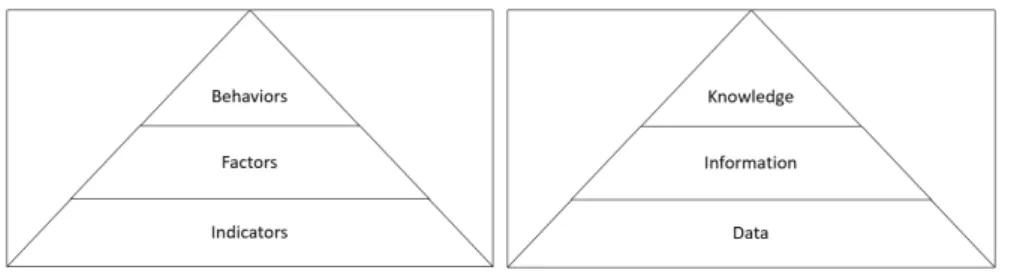
Figure 1. From indicators to behaviors: overview
Figure 1 represents the indicators, or data, that are the components of the behavioral factors, and the base of a structure that leads to behaviors, knowledge, understanding. An application example of this kind of structure has been proposed to rank Smart Cities (Giffinger and Pichler-Milanović2007), it permits to describe the smart level of cities from different factors. Indicators for example of sanitary condition in this representation are life expectancy, number of hospital beds, the number of doctors per inhabitant and the satisfaction level on the health system quality.
Proposition of twenty factors
We choose here to take the behavior formalization of Kurt Lewin (1936), who conceptualize the behavior B in function of the person P and it environment E: B = f (P,E). The twenty behavioral factors that we identified have been selected to have an influence on human behaviors in crisis situations from researches in literature. We assemble them in two categories according to the objects they refer to, individual and environmental, and to the type of information sources that allows to characterize them. They are presented here with the list of indicators associated to each of them.
Factors linked to the individual
1. Civil status : age (F1a), sex (F1b), nationality (F1c), residence place (F1d), level of schooling (F1e), occupation (F1f).
2. Personality : desires (F2a), moral principles (F2b), sociability (F2c), beliefs, religious or not (F2d), capacity to take decisions (F2e), mimetic reactivity (F2f).
3. Motivation to escape/defend (F3) : motivations are strongly influenced by the experience, risk assessment, the current action and the physiological signals identified after.
4. Responsibility (F4) : in the situation when a fire alert is given in a school for example, a teacher can have a reaction absolutely different depending on whether he is alone in his office or he is in a classroom, teaching to a student group. He can have no reaction if he is alone, but he will be much well disposed to evacuate with its students in good conditions if he is responsible of them and has to be an example.
5. Emotions : joy (F5a), sadness (F5b), anger (F5c), disgust (F5d), fear (F5e), surprise (F5f), contempt (F5g). 6. Experience : crisis faced in the past (F6a), objective escape/defend ability (F6b), subjective escape/defend
ability (F6c).
7. Explicit knowledge : general knowledge shared by the population (F7a), training followed (F7b), access to documents (F7c), access to knowledge sharing tools (F7d) (Arru, Negre, et al.2016).
8. Risk assessment : objective assessment (F8a), subjective assessment (F8b).
9. Perception of the alert system (F9) : we define perception as the process of collecting, organizing, and interpreting stimuli that can be information or knowledge coming from different sources (Arru, Mayag, et al.
2016).
10. Current action : interaction (F10a), concentration (F10b) and movement (F10c) needed.
11. Physiological signals : hearth rate (F11a), tightness (F11b), transpiration level (F11c), muscular tension (F11d).
Factors linked to the environment
12. Geographic zone characteristics (Comes et al.2015) : zone extent (F12a), population density (F12b), poverty level (F12c), economic status (F12d), urban level (F12e), population pyramid (F12f), cultural characteristics : individual versus group orientation (F12g), trust in government (F12h).
13. Interaction and mobility capacity : frequented area (F13a), smartphone (F13b), access to transportation (F13c).
14. Perceptible signals of the crisis : indicators of perceptible signals depend directly of the concerned crisis type, this is why we defined three generic indicators, visual signals (F14a), sound signals (F14b), olfactory signals (F14c).
15. Period characteristics : day/night (F15a), number of hours from the crisis peak (F15b).
16. Temporal phase of the crisis : before (F16a), at the beginning (F16b), at the peak (F16c), on the decreasing phase (F16d), after (F16e) the crisis.
17. Alerts / Transmitted information : quantity (F17a) and quality (F17b) of information transmitted, number of diffusion channel (F17c) (DGSCGC2013).
18. Entourage characteristics : density of population (F18a), presence of authority representatives (F18b), security level of the area (F18c), presence of close relations (F18d) (Dupuy2003).
19. Behaviors of the closer people : contagion level of the three dominant behaviors (F19a), (F19b), (F19c). The contagion level of an agent vary according to the number of neighbourhoods who have a similar activity (Granovetter1978) (Solomon et al.2000).
20. Entourage global behavior (F20) : global behavior followed in an extended perimeter (Dupuy2003). Figure 2 sums up data, indicators F1a, F1b... that indirectly characterize behaviors.
Figure 2. From indicators to behaviors: detailed vision
MODELING
One of the reasons that lead us to propose a model integrating our factors is to give the possibility to researchers to take into account human reactions in crisis situations. With a model of behavior we can test hypotheses on the participation of the different factors to crisis behaviors for a given population. We can also distinguish the importance of the different factors implied for different types of crisis. The results obtained from such analyses could help prevention and preparation in crisis managing programs and help to bring models that provide real time predictions with the integration of new indicators to the monitoring step. Unfortunately these steps need validated models with large data sources that we will not be available in medium term. A combination of different models seems necessary for us to both have a representation of the definitions and interaction complexity, and to be able to aggregate data to offer a synthetic vision of validated hypotheses. A lot of approaches already propose combinations of several models (Ding et al.2006; Swat et al.2016; Lin and Lee1991).
To describe our three propositions of models we take the illustrative example of a fire occurrence in a University. We focus on a population of 20 professors, four of them are in a classroom and the other are working in their offices. Four factors are considered : (i) civil status, (ii) responsibility, (iii) perception of the alert system and (iv) perceptible signals of the crisis and one behavior. Then, we retain the following indicators and the evacuation behavior :
• age (F1a), with three levels : from 0 to 30, from 30 to 50, from 50 to more ; • occupation (F1f), with two levels : student, professor ;
• responsibility (F4), with two levels : yes, no ;
• perception of the alert system (F9), with five levels : 1, 2, 3, 4, 5 (1 referring to a strong unsafety and 5 highlighting a strong safety perception) ;
• visual signals (F14a), with two levels : yes, no ; • sound signals (F14b), with two levels : yes, no ; • olfactory signals (F14c), with two levels : yes, no ; • evacuation, with two levels : yes, no.
1 - Entity–relationship model with a statistical approach
The entity-relationship model can be directly extracted from the indicators presented in the Figure 2, with the addition of relations between the different variables. According to the perspective of analysis preliminary chosen, we can select indicators and relations to test. The MCA (Multiple Correspondence Analysis) method is particularity
adapted in this approach, allowing to test hypothesis from link analysis between any number of variables. It is particularly adapted to survey analysis.
Data for this models are represented as a file with twenty lines, corresponding to the number of individuals, and 8 columns, corresponding to the number of indicators. The first line of the file will be for example 0 1 1 3 0 0 1 1, referring to a professor between 0 to 30 years old, with no responsibility, a score of 4/5 for his perception of the alert system and who perceive visual and sound crisis signals but no olfactory signals, and who do not evacuate. Levels of each qualitative variable are coded as numerical values. The first result from our data file is the variable representation table that we can observe on Figure 3, constructed with the FactoMineR package integrated in R free software environment1. We can observe on this Figure that the variable "age" is linked to both first and second
dimensions, "visual signals" is much linked to the second dimension and "evacuation" and "responsibility" to the first dimension. We cannot say much more from this Figure and need a representation of categories to interpret these relationships. We use the MCA factor map on Figure 3 to view that the second dimension opposes "no sound signals" and "no evacuation" between "responsibility" and "evacuation".
Figure 3. Variable representation map & MCA factor map
We can enter in detail of the factors contributions with the analyze of coordinates, contribution, cos2 (quality of representation in [0;1]) and the v.test value, generally comprised between 2 and -2. For a given variable category, if
the absolute value of the v.test is superior to 2, this means that the coordinate is significantly different from 0, see Figure 4.
Figure 4. Contribution of the variable categories on the dimensions 1 and 2
In practice, we can use this method to explain one variable from the others, but we can’t define preliminary relations between indicators. Indeed known relations between indicators represent information that have to be taken into account.
2 - Ontology and decision rules
Ontologies have already been proposed to represent behavioral strategies (Silverman2001; Silverman et al.2006). We can integrate our behavioral factors on ontologies implementations, with a working memory module that could take advantage of decision rules to discover information from data obtained. In Figure 5 we can see the ontology of the illustrative example model, constructed with Protege2.
Figure 5. Ontology example applied to the illustrative example
In computer science, an ontology is an « explicit formal specifications of the terms in the domain and relations among them » (Gruber1993). Coming from Knowledge engineering, it makes possible to represent semantic relations and composition or inheritance. Its objective is to be consensual, normative, coherent, shareable and reusable. It provides a formal semantic of the information allowing its use by a computer. Here, our ontology describes relationships such as "influences", "involves"... which allow to identify the precise nature of the links between the concepts (behavioral factors).
3 - Predictive models and correlation analysis
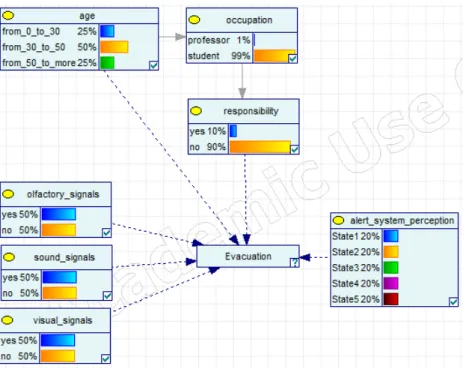
With a complete information on past situations or statistical studies we could construct Bayesian Networks for example, or Markov Decision Process models to make predictions from the existing data in crisis management systems. Today we do not have this possibility, we propose in Figure 6 a Bayesian network constructed from hypothetical probability tables.
Figure 6. Bayesian network representation of the illustrative example
We suppose that the age of a person have an influence on his occupation and that his occupation influence his responsibility level. The age will also weigh directly on the decision to evacuate, but the occupation in this example only have an indirect influence on this decision to evacuate via the responsibility node.
A Bayesian network is, in computer science and statistics, a probabilistic graphic model representing random variables in the form of an acyclic oriented graph. Bayesian networks are both (i) models of knowledge representation, (ii) conditional probability calculators, and (iii) a basis for decision support. Here, we can describe the causal relationships between variables by this graph (Figure 6). The causal relationships between the variables are not deterministic but probabilistic. Thus, the observation of a cause does not systematically entail the effect(s) that depend on it, but modifies the probability of observing them. The interest of Bayesian networks is to take into account simultaneously of a priori knowledge (in the graph) and of the experience contained in the data.
Discussion
Our modelings choices have to be refined to enrich a representation at least partly probabilistic, or resting on fuzzy methods that are the two bases to reason and take decisions on uncertain situations (Gaines1978). Indeed, "behavior is not reducible to a state or a set of points that would define the trajectory of a mapped out driving. It contains uncertainety." (Toniolo2009).
The proposition of three models to represent people behaviors in crisis situations remains the theoretical part of our research project. Obviously, they will be put to the test with probably a reassessment of the models, and a need for more detailed representations to be able to interpret the results.
It should be noted that, at first glance, a combination of these three models, combining knowledge, expertise, experience and probability / statistical engineering, could be envisaged, making it possible to benefit from each one, thus obtaining the most complete and as realistic as possible behavior modeling.
CONCLUSION AND PERSPECTIVES
In this article, we proposed the first step to integrate a global vision of people behaviors in crisis situations in crisis management systems. We identify twenty behavioral factors that we split up in indicators in order to make computable elements to integrate to our propositions of models.
In a first time, we plan to collect data in simulations to work on a part of the indicators of our model. We choose to work first with the entity–relationship model with a statistical approach to test hypothesis based on responsibility and physiological signals co-factors. The analyze will be based on responses from a survey with multiple choice questions proposed to participants on their civil status, experience, the context and their actions during the simulation,
and their personality. In a second time, we would like to test the ontology and decision rules model with the integration of relations. And in the longer term, we hope to tend towards the modeling of collective behavior in a crisis situation.
REFERENCES
Adam, C., Canal, R., Gaudou, B., Vinh, H. T., Taillandier, P., et al. (2010). “Simulation of the emotion dynamics in a group of agents in an evacuation situation”. In: International Conference on Principles and Practice of
Multi-Agent Systems. Springer, pp. 604–619.
Alcock, J. (1989). Animal behavior. Sinauer Associates Sunderland.
Andreewsky, E. (n.d.). “De l’individuel au collectif: quelques modèles systémiques”. In: Gouvernance indivi. Arru, M., Mayag, B., and Negre, E. (2016). “Early-Warning System Perception: a Study on Fire Safety”. In: 13th
International Conference on Information Systems for Crisis Response and Management.
Arru, M. and Negre, E. (2017). “Vers une modélisation des comportements en cas de crise”. In: Submitted to
INFORSID 2017.
Arru, M., Negre, E., Rosenthal-Sabroux, C., and Grundstein, M. (2016). “Towards a responsible early-warning system: Knowledge implications in decision support design”. In: Research Challenges in Information Science
(RCIS), 2016 IEEE Tenth International Conference on. IEEE, pp. 1–12.
Balacheff, N. (1994). “Didactique et intelligence artificielle”. In: Recherches en didactique des mathématiques 14, pp. 9–42.
Bartneck, C. (2002). “Integrating the occ model of emotions in embodied characters”. In: Workshop on Virtual
Conversational Characters. Citeseer, pp. 39–48.
Bratman, M. (1987). “Intention, plans, and practical reason”. In:
Buffet, O., Dutech, A., and Charpillet, F. (2006). “Etude de différentes combinaisons de comportements adaptatives.” In: Revue des Sciences et Technologies de l’Information-Série RIA: Revue d’Intelligence Artificielle 20.2-3, pp. 311–344.
Charreaux, G. (2005). “Pour une gouvernance d’entreprise «comportementale» Une réflexion exploratoire...” In:
Revue française de gestion4, pp. 215–238.
Comes, T., Negre, E., and Mayag, B. (2015). “Beyond Early: Decision Support for Improved Typhoon Warning Systems”. In:
Cooper, J. O. H., Heward, T. E., William, L., Cooper, J. O., Heron, T. E., and Heward, W. L. (2007). Applied
behavior analysis. Sirsi) i9780131421134.
Crocq, L. (2013). Paniques Collectives (Les). Odile Jacob.
Dauphiné, A. and Provitolo, D. (2013). Risques et catastrophes: observer, spatialiser, comprendre, gérer. Armand Colin.
Demont, E. (2011). La psychologie: histoire, concepts, méthodes, expériences. Sciences humaines.
Deroïan, F. (2004). “Comportements collectifs dans les réseaux d’influence sociale”. In: Annales d’Economie et de
Statistique, pp. 209–224.
DGSCGC (2013). Guide ORSEC - Alerte et information des populations. Direction générale de la sécurité civile et de la gestion des crises.
Ding, Z., Peng, Y., and Pan, R. (2006). A Bayesian approach to uncertainty modelling in OWL ontology. Tech. rep. DTIC Document.
Dupuy, J.-P. (2003). La panique. Empêcheurs de penser en rond.
Ferguson, I. A. (1992). “TouringMachines: An architecture for dynamic, rational, mobile agents”. PhD thesis. University of Cambridge UK.
Gaines, B. R. (1978). “Fuzzy and probability uncertainty logics”. In: Information and Control 38.2, pp. 154–169. Giffinger, R. and Pichler-Milanović, N. (2007). Smart cities: Ranking of European medium-sized cities. Centre of
Regional Science, Vienna University of Technology.
Goldstone, R. L. and Janssen, M. A. (2005). “Computational models of collective behavior”. In: Trends in cognitive
Granovetter, M. (1978). “Threshold models of collective behavior”. In: American journal of sociology, pp. 1420– 1443.
Gruber, T. R. (1993). “A Translation Approach to Portable Ontology Specifications”. In: Knowl. Acquis. 5.2, pp. 199–220.
Hagenauer, J., Helbich, M., and Leitner, M. (2011). “Visualization of crime trajectories with self-organizing maps: a case study on evaluating the impact of hurricanes on spatio-temporal crime hotspots”. In: Proceedings of the
25th conference of the International Cartographic Association, Paris.
Hamon, T., Fraisse, A., Paroubek, P., Zweigenbaum, P., and Grouin, C. (2015). “Analyse des émotions, sentiments et opinions exprimés dans les tweets: présentation et résultats de l’édition 2015 du défi fouille de texte (DEFT)”. In: Helbing, D., Farkas, I., and Vicsek, T. (2000). “Simulating dynamical features of escape panic”. In: Nature 407.6803,
pp. 487–490.
Jondeau, E. (2001). “Le comportement mimétique sur les marchés de capitaux”. In: Bulletin de la Banque de France 95.
Kinateder, M. T., Kuligowski, E. D., Reneke, P. A., and Peacock, R. D. (2015). “Risk perception in fire evacuation behavior revisited: definitions, related concepts, and empirical evidence”. In: Fire Science Reviews 4.1, p. 1. Kurt, L. (1936). “Principles of topological psychology”. In: New York-London.
Lin, C.-T. and Lee, C. S. G. (1991). “Neural-network-based fuzzy logic control and decision system”. In: IEEE
Transactions on computers40.12, pp. 1320–1336.
Merleau-Ponty, M. (1942). La structure du comportement. Presses Universitaires.
Mileti, D. S. and Sorensen, J. H. (1990). Communication of emergency public warnings: A social science perspective
and state-of-the-art assessment. Tech. rep. Oak Ridge National Lab., TN (USA).
Müller, J. P. and Pischel, M. (2011). “The agent architecture inteRRaP: Concept and application”. In:
Obernesser, C. (2003). “Cartes cognitives pour la modélisation comportementale”. In: Mémoire DEA, Université de
Bordeaux2.
Ochs, M., Sadek, D., and Pelachaud, C. (2005). “La représentation des émotions d’un agent rationnel”. In: Workshop
Francophone sur les Agents Conversationnels Animés, pp. 43–52.
Pak, A. and Paroubek, P. (2010). “Twitter as a Corpus for Sentiment Analysis and Opinion Mining.” In: LREc. Vol. 10, pp. 1320–1326.
Phan, N., Dou, D., Wang, H., Kil, D., and Piniewski, B. (2016). “Ontology-based deep learning for human behavior prediction with explanations in health social networks”. In: Information Sciences.
Provitolo, D., Dubos-Paillard, E., Verdière, N., Lanza, V., Charrier, R., Bertelle, C., and Aziz-Alaoui, M. (2015). “Human behaviors in the face of disasters: from observing to conceptual and mathematical modeling”. In:
Cybergeo : Revue européenne de géographie / European journal of geography.
Quarantelli, E. L. (2008). “Conventional beliefs and counterintuitive realities”. In: Social research, pp. 873–904. Ripley, A. (2009). The unthinkable: Who survives when disaster strikes-and why. Harmony Books.
Ruin, I. (2010). “Conduite à contre-courant et crues rapides, le conflit du quotidien et de l’exceptionnel”. In: Annales
de géographie. 4. Armand Colin, pp. 419–432.
Sarshar, P., Radianti, J., and Gonzalez, J. J. (2013). “Modeling panic in ship fire evacuation using dynamic Bayesian network”. In: Innovative Computing Technology (INTECH), 2013 Third International Conference on. IEEE, pp. 301–307.
Sillamy, N. (1983). Dictionnaire usuel de psychologie. Bordas.
Silverman, B. G. (2001). “More realistic human behavior models for agents in virtual worlds: emotion, stress, and value ontologies”. In:
Silverman, B. G., Johns, M., Cornwell, J., and O’Brien, K. (2006). “Human behavior models for agents in simulators and games: part I: enabling science with PMFserv”. In: Presence: Teleoperators and Virtual Environments 15.2, pp. 139–162.
Skinner, B. F. (2005). “Science et comportement humain”. In: Juillet 2005.
Solomon, S., Weisbuch, G., Arcangelis, L. de, Jan, N., and Stauffer, D. (2000). “Social percolation models”. In:
Swat, M. J., Grenon, P., and Wimalaratne, S. (2016). “ProbOnto–Ontology and Knowledge Base of Probability Distributions”. In: Bioinformatics, btw170.
Toniolo, A.-M. (2009). “Le comportement: entre perception et action, un concept à réhabiliter”. In: L’Année
psychologique109.01, pp. 155–193.
Van Dyke Parunak, H., Bisson, R., Brueckner, S., Matthews, R., and Sauter, J. (2006). “A model of emotions for situated agents”. In: Proceedings of the fifth international joint conference on Autonomous agents and multiagent
systems. ACM, pp. 993–995.
Zoumpoulaki, A., Avradinis, N., and Vosinakis, S. (2010). “A multi-agent simulation framework for emergency evacuations incorporating personality and emotions”. In: Hellenic Conference on Artificial Intelligence. Springer, pp. 423–428.