1
A Market for Weather Risk ?
Worlds in conflict and compromising
Hélène Rainelli-Le Montagner, IAE de Paris, Université de Paris I, GREGOR Isabelle Huault, Université Paris Dauphine, DRM
Abstract
In this paper, we examine the issue of the process of risk commodification through derivatives, a process that had not been precisely studied in the literature yet. We approach this issue through an in-depth qualitative study of a new derivatives market that implies the interactions of different actors around the notion of risk: the European Market for weather risk. Building on Boltanski and Thevenot’s framework (1991/2006), we describe risk commodification as a justification process by which the promoters try to drag risk into the Market World. Our results offer a concrete description of a derivatives market as a meeting place between different worlds, and allow to precisely characterize the market structure, which remains remote from the initial objective of its initiators. These findings highlight the complexity of risk commodification and suggest that there are limits to the thesis of financial theory according to which all kinds of risks can be transformed into financial risk and exchanged on financial markets.
Key words: commodification, derivatives markets, social studies of finance, capitalism, risk,
justification,
Introduction
Rocket financial innovations seem to be a long way from the Ethiopian lowlands, both literally and figuratively1. But to ensure Ethiopian farmers against harvest failures caused by droughts, the World Food Program resorted in 2006 to weather derivatives. Pioneered on modern over-the-counter financial markets, weather derivatives, a sophisticated financial instrument, are supposed to represent a shift in the thinking behind emergency aid; more precisely an evolution from an emergency mindset to one where risk is identified and managed.
This case exemplifies the development over the last three decades of derivatives markets, that characterizes financial capitalism as it now stands. Although the concept underlying modern financial derivatives is not new2, there is a sense that derivatives entered a new era in the 1970s. The statistics provided by the Bank for International Settlements contribute to picture rapidly growing markets of unseen importance. In December 2007, notional amounts of US$ 677 trillion were involved in over-the-counter (OTC) or exchanged traded derivatives
1
BBC News Website, 15 June, 2005. 2
There are proofs (Goetzmann & Rouwenhorst, 2005) that contracts for future delivery of commodities where known in Mesopotamia, Hellenistic Egypt and the Roman world, and were still in use in the Byzantine Empire and Middle Ages Europe. Derivatives on securities appeared in the Low Countries in the sixteenth century and spread to England, France and Germany over the following centuries
2 contracts (that is 12 times the world GDP), while the gross market values of the derivatives
contracts themselves amounted approximately to US$16 trillion (30% of the world GDP)3. In 1998, the amounts outstanding were US$ 94 trillion, three times the world GDP, while the gross market values of the contracts amounted to 11% of the world GDP, the increase over the last decade being thus more than six-fold in absolute terms, between three and four-fold relatively to the world GDP. While the amounts reported for 1988, the earliest date for which figures are provided, are around US$2 trillion, the growth has been continuously sustained with notional amounts involved in derivatives contracts of US$13 trillion in 1993.
It is in this context that some authors (Bryan and Rafferty, 2006) give derivatives a central role, in what they see as a radical transformation of capitalism. As a commodification of risk, derivatives become a form of calculating and market transaction that is intrinsic to the logic of the capitalist economy. They turn the contestability of fundamental values into a tradable commodity and are seen as a leverage that allows the world to become a global trading room and to be totally manageable (Bryan and Rafferty, 2006; Thrift, 2004).
Thus, new exotic risks (terrorist attacks, hurricanes,…), hitherto very remote from the financial sphere are dragged into it, under the guise of derivatives products. We describe this phenomenon as an extension of the Market sphere to other spheres, an extension that can be designed as a process of risk commodification. We propose to empirically study the difficulties of such a process, a process that has not been examined precisely by the literature yet.
Our approach to this phenomenon is in line with the debate developed in McKenzie (2006). Emphasizing the numerous hostile developments by geographers, sociologists and anthropologists who recently began to pay attention to derivatives, Mac Kenzie (2006) underlines the rather abstract terms used by many authors. He points that the notion of “virtuality” often retained against derivatives is well worth a detailed analysis of the process by which the material production of this “virtuality” is achieved. It follows that a discourse on derivatives in general has clear limits. A material sociology of financial markets taking full account of specific market structures and product definitions is what is wanted. This demands an analysis of the manner in which risk objects are represented, constructed, rendered thinkable and made amenable to practice of intervention, within the financial field (Power, 2007: 8). The rapid development of a literature devoted to the social studies of finance can be seen as an answer to this issue (see e.g, Huault and Rainelli, forthcoming; Knorr Cetina and Preda, 2005; Lepinay, 2007; MacKenzie and Millo, 2003; Mac Kenzie et al, 2007; Smith, 1989; 2007) but lots of works remains to be done in this direction and in the precise analysis of the process of risk commodification. This latter may be all the more complex as the risk to objectify is remote from the world of finance and involves different kinds of groups with distinct risk cultures, that offer competing ways of describing risks.
Thus, we consider in this paper that the creation of a new derivatives market implies different spheres interacting with one another around the notion of risk. Our goal is to characterize these interactions using Boltanski and Thevenot’s analysis (1991/2006) and to describe the commodification process as a justification process, by which derivatives promoters make efforts to frame, to present, to drag risk into the financial sphere and how they work hard to make it a common-sense object for financial purposes.
Our research is motivated by three main research questions: In the creation of a new derivatives market, what kinds of non-market sphere(s) do interact with the market sphere?
3
The exact value of OTC contracts is difficult to assess. Notional amounts are used as reference for the computation of actual financial flows which are probably best reflected in gross market value of the contracts, although figures reliability remains a problem on these markets.
3 How can these interactions be characterized and what efforts do the promoters undertake to
drag risk into the financial sphere? What kind of result(s) do these interactions and these efforts produce on the market structure?
We approach these questions through a study of a new derivatives market: the European market for weather risk. Combining meteorology and finance, weather derivatives contracts are exchanged in Europe on the basis of over-the-counter markets and remain little standardized. More fundamentally, they involve various categories of actors, with different risk cultures, belonging to the worlds of meteorology, industry, agriculture, financial markets, insurance and banking companies. Despite extensive promoters’ efforts over the last ten years, the market remains remarkably thin and does not seem to succeed in taking off. We conducted an in-depth qualitative study of the development of this market from 1999 to 2008. It examines the beliefs of the different actors, their perception of weather risk, their arguments and focuses on how the process of commodification of weather risk look like in this peculiar case. We aim at analyzing the justification efforts of market promoters and their attempts to rally the various categories of actors around their conception of weather risk.
Our findings contribute to the study of the process of risk commodification in three ways. It offers a concrete description of a derivatives market as a meeting place between different worlds, which is a relatively new way to understand the social construction of derivatives markets. Secondly, the use of Boltanski and Thevenot’s framework allows us to precisely characterize the phenomena observed on derivatives markets, and particularly hybrid forms of transactions. Thirdly, by paying special attention to the details of the material sociology of this market, we enhance our understanding on derivatives in general, but also, and perhaps more importantly, we show that “the binding and blending capacities of derivatives” (Bryan and Rafferty, 2006) are not limitless. To wit, we provide evidence that the market reality we analyze, is best understood as the result of a justification process.
The remainder of this article is divided into four parts. Using the results of the social studies of finance, the first part focuses on the very transformation of capitalism by derivatives products, and presents the construction of derivatives market as a justification process in Boltanski and Thevenot’s words. The second part explains the research method, a longitudinal qualitative study over the period 1999-2008, taken from interviews with the principal actors of the market and of an analysis of secondary data. The third part consists of a study of the process of commodification of weather risk, understood as a justification process by which market promoters try to rally other actors around their vision of risk. The fourth, and last, part draws the principal conclusions of the research.
1- Derivatives at the core of a new capitalism?
As can be expected, the rapid development of derivatives markets has triggered various reactions outside and within the academic community and some questioning has recently emerged regarding the role they play in current capitalism. The study of the materiality of these markets however remains in its infancy and a better understanding of what it takes to develop such markets, of the strategies implemented by market promoters and of the difficulties they meet is still wanted.
The gaining importance of derivatives has been welcome with enthusiasm by many economists, who advocate their role as efficient instruments of risk transfer, management and allocation4. Critiques however have expressed concerns on two main facets of derivatives markets. The first one regards the growing weight of these markets. It raises the deeply historically rooted issue of their potential role in financial booms and subsequent busts (see e.g., Aglietta and Breton, 2001; Arnoldi, 2004; Dodd, 2002; Kindleberger, 2000; LiPuma and Lee, 2004; Mac Kenzie and Millo, 2003, Mac Kenzie, 2006, Weber, 2008). The second one, which is more central to the present paper, regards the extension of derivatives to seemingly endless new underlying assets and non assets. The capacity of derivatives to link various markets, assets and actors is actually identified by some authors as the driver of a radical, needless to say undesirable, transformation of capitalism. Bryan and Rafferty (2006), for example, characterize derivatives by their specific faculty to “bind” and to ‘blend”. Derivatives, they argue, “permit the binding of the future price of an asset to its present price, or of the price in one place with those in another” (Bryan and Rafferty, 2006: xx)). They also permit the blending of different sorts of assets together, breaking down the differences between “hitherto discrete forms of assets”. They have a capacity to “establish pricing relations between bits of capital”, and to convert “any form of assets into any other”, thus making instantaneous comparison of all kind of assets “across time and space” possible. With assets, “thrown (through derivatives) into a constant and relentless process of competition to verify their value”, capitalism becomes “more dynamic and more fragile, more complex and more integrated”, “universal and highly competitive”.
Although Bryan and Rafferty (2006) describe the technical potentialities of derivatives products convincingly, their analysis falls short as to how these potentialities came to be enacted to the extent we currently observe. This side of the phenomenon can only be accounted for by taking into account the transformation of finance over the last 50 years. As demonstrated in MacKenzie (2006), the deep changes in the size and nature of financial markets over the last decades have been accompanied, and to a certain extent performed, by a revolution in the theoretical thinking about finance. The exploitation of the theoretical mingling faculties of derivatives products on real financial markets was indeed greatly facilitated by the shift in representations provided by Markowitz’s conceptualization (1952), which transformed investors into risk buyers5. In addition, by characterizing risk on financial markets in the statistical terms of variance, Markowitz provided an elegant demonstration of the interest for the investor of diversifying her portfolio and defined the investment problem as one of investing in risks that do bear as little relations to one another as possible. With investors transformed in risk buyers whose interest lies in the arising of new and uncorrelated investment opportunities, we have a powerful driving force for financial innovations. Thus framed, the never ending creation process of new derivatives appears all the more desirable as it offers leeway for limitless improvement of diversification and constantly enlarges the investment opportunities set. The latter may include in addition to commodities, stocks and bonds, “standard” derivatives on these assets, credit derivatives and all kind of exotic derivatives. These can be either of refined mechanism or written on risks that hitherto were
4
Merton and Scholes, were presented the Nobel award for economy in 1997 for the so called Black and Scholes model, by the Nobel foundation in the following terms : « Your methodology has generated new financial instruments and facilitated more effective risk management in society”, cited in Bryan and Rafferty (2006 : 3). 5
Before Markowitz, investors on financial markets saw themselves as buying bits of capital (namely shares and bonds) with the hope to gain some returns from dividends, interests and capital gains when selling the assets again. Markowitz’s approach changed this view by depicting investing activities as the buying of some risk in exchange of some expected return. This framework was to transform theoretical thinking about finance radically. and also to transform what Preda (2005) calls the “figure of the investor”5, investors seeing themselves, from then on, essentially as risk buyers.
not the object of any financial markets. Derivatives on terrorist attacks or hurricanes belong to the last as well as the derivatives of the “particle finance” called for in a famous 1993 speech of Charles Sanford Jr., then CEO of Bankers Trust6, or derivatives on value of house property or on international low wage competition imagined by Schiller in his (The) New Financial
Order (2007).
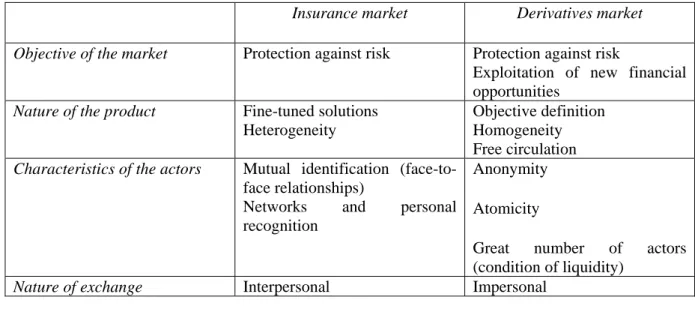
Overall, it can be said that the development of derivatives on all kind of assets or non assets observed over the last decades results from the happy encounter of a rise in liquidity seeking investment opportunities with two major productions of financial theory. One was the reframing of the investor’s figure into a risk buyer, the other the derivatives pricing techniques allowed by the Black and Scholes’ model. The crucial feature of this encounter however is largely ignored by most of the critical literature on derivatives (Arnoldi, 2004, Bryan and Rafferty, 2006; LiPuma and Lee, 2004, 2005, Maurer, 2002, Pryke and Allen, 2000, Pryke, 2007; Tickell, 1998). It is best understood by contrasting derivatives with insurance techniques. Factually, both techniques are supposed to organize the meeting of risk takers and risk protection seekers. The principles they rely on, however, are widely divergent. Insurance is based on a principle of mutual mitigation of risks in a “pool” that people would agree to pay into, for protection of the unlucky ones. The risk taker (insurance company) and the risk protection seeker (underwriter) have an interest in an interpersonal relationship where the risk- and moral hazard profile of the latter will play a role in the definition of the premium paid to the former. Derivatives, on the other hand, seek to “translate” risk hedging issues into investment opportunities. This requires that the goods to be exchanged between risk takers and risk sellers are objectively defined, so that the risk taker will be able to resell it on a secondary market when she wishes to. This possibility is essential to provide “liquidity”, a notion encompassing a mechanism where myriads of freely competing risk buyers are able to meet myriads of freely competing risk sellers, thus producing an accurate and transparent price for each product exchanged (Grossman, Luque and Muniesa, 2008). It is also essential to provide investors with a world resembling the one posited by Markowitz where financial investment opportunities should freely circulate in a space which has no limits. The following table synthetizes the main difference between an insurance and a derivatives market.
INSERT TABLE 1 ABOUT HERE
From what precedes, it appears that, for the encounter of amounts of liquid money and techniques provided by financial theory to result in the development of derivatives markets, the success of a specific process is required. New, exotic risks, hitherto never heard of in the financial sphere, must be drawn into it, under the guise of derivatives instruments. To enter into a world characterized by anonymity, liquidity and reciprocal independence of risk takers and risk hedgers, they have to become objectively defined financial products. This process is best designed as a process of risk “commodification” or “objectification” (DeGoede, 2004 ; LiPuma and Lee, 2005, Thrift, 2004). Following Callon (1998), we can expect it to involve “framing”, that is the production or co-production from buyers and sellers altogether of a definition of what a market transaction formally includes. It is likely that a large variety of
6
The speech envisioned the replacement of traditional finance by “particle” finance thanks to the derivatives technology. In dividing up classical financial assets into risk particles, this new finance would permit to “create order from apparent disorder” and “the amount of unwanted risk borne by individuals, institutions and the system as a whole” would be reduced in size
media will be required to succeed in performing this framing (Lepinay, 2007) and that a series of compromises will have to be reached for a new market to come to existence. We can further anticipate the risk commodification process to require “disentanglement” (Callon, 1998: p 253), by which agents and entities will have to extricate from their outside market networks of interactions to enter on an unmistakably demarcated “stage”7.
What we propose in this paper is to empirically study the difficulties of such a process. By focusing on the market for weather derivatives, we will ponder about what it is exactly that agents have to disentangle from. We will show that to draw such a thing as weather risk within the market sphere of derivatives requires the acknowledgment of the existence of other “spheres” interacting with one another around the very notion of weather risk. More precisely, we propose to characterize these interactions between “spheres” using the theoretical apparatus developed by Boltanski and Thevenot (1991/2006). Drawing on their definitions we will describe the “commodification of weather risk” process as a justification process, by which derivatives promoters try to drag risks into a world that Boltanski and Thevenot define as the Market World, while other agents refer to utterly different worlds. We will demonstrate that the market structure of the market under study is best described as the results of attempts to reach compromises between these worlds.
1.2 Constructing Derivatives Markets: A Justification Process
Boltanski and Thevenot (1991/2006) picture individuals who tend to live in different
worlds, defined as “a grammar of worth”, in other words, a specific justification regime or
form of evaluation (Lamont and Thevenot, 2000: 5). Against mainstream economic theory assumptions, and the idea that actors compete in a perfect and universal market on the basis of optimising rationality, this theoretical framework emphasizes complex operations of cultural adjustments and evaluation, to face economic uncertainty (Eulriet, 2008). It focuses upon the general question of agreement, by taking full account of the imperative to justify, a necessary condition to coordinate human behaviour. The justification regime is characterized by a “common superior principle” that may be referred to when involving justice in case of dispute or conflict. Boltanski and Thevenot identify six different worlds defined by six evaluation principles: 1/ The Market World which highest value is market performance. A person acting normally in this world has not only to rely on the objectivity of the good to reach agreement on a transaction, but also on its independence with respect to the various actors engaged in the transaction. “This distance has to produce indifference with regard to all the qualities that are foreign to those of buyer or seller in the persons with whom one is dealing” (2006: 202). Competition is the higher common principle and the circulation of goods and persons should have no limits. 2/ The Industrial World which puts forward industry efficiency. Here, the ideal situation is one where things function as was predicted and the solution to a problem is realistic. “Once the decision is made, the arrangement set up, the project launched, the mechanism started, its proper operation can be judged by an evaluation of its performance on the basis of the effects produced” (2006: 261). 3/ The Civic World which higher common principle is civic solidarity. In this world, beings have a taste for what is common, what unites them. Judgement is the expressions of the general will, which may be manifested through the achievement of awareness, or by a collective reflection, or in the form of mobilization around a cause (2006: 192). In this world, “whatever dilutes, splinters or restrains is unworthy” (2006: 193). 4/ The World of Fame which values renown. There, the worth of each being
7
depends on the opinion of others. The aim is to attract attention, to convince other people, to obtain respect from them, “to earn or win” their support. (2006 : 180) ; finally to capture the attention of the public. 5/ The World of Inspiration, which values creativity, spontaneity and originality 6/ The Domestic World which values trustworthiness expressed in tradition and hierarchy.
Our main argument is that the situation in which promoters of derivatives markets find themselves is one where the condition of success lies in overcoming potential conflicts between their world, which can be identified to the Market World of Boltanski and Thevenot and the other worlds to which potential market participants might be attached. To promoters, the ideal solution is to succeed in rallying all actors to their vision and make them adopt the principles of the Market World. Less ideal situations are described by Boltanski and Thevenot, who show that the reduction of tensions between worlds can also be realized by three alternative figures of agreement: compromising, arrangements and relativization. Compromising is an agreement where people agree to suspend a clash – a dispute involving more than one world, without settling it in just one of the worlds in presence (2006: 277). To work out a compromise consists in “finding a formulation acceptable to all”. Sometimes, when a compromise is unattainable, the solution has to be reduced to a private arrangement, which takes the form of a contingent and local agreement. Fragile, it is oriented toward private interests: “you do this which is good for me; I do that, which is good for you” (2006: 336)”. Finally, a last way of exiting from a dispute is relativization. To escape from a clash, people may agree that nothing really matters. In all cases, actors facing a conflict between worlds have to enter into processes of justification, by which they try to establish relations between worlds, produce agreements and coordinate their actions.
By analyzing the way promoters of weather derivatives attempt to drag weather risk into a world that used to be very alien to it, we seek to provide evidence that the market reality we observe is best understood as the result of such a process. Our use of Boltanski and Thevenot’s conceptualization allows us to provide a new characterization of the situations observed on the market, which opens the way for a renewed assessment of the power of derivatives to limitlessly enhance competition within capitalism.
2- Methods
Our research is based on an in-depth qualitative study of the development of the European market for weather risk from 1999 to 2008.
Our objective is to understand the intentions and beliefs of the actors, their representation of the market, the “worlds” in which they evolve, their arguments and their own interpretation. We focus on modes of justification, by which actors try to establish relations between worlds, produce agreements and coordinate their actions. Hence, we retain the methodological position consisting of studying justifications in disputes, without “assuming the privilege of a bird’s eye view” (Boltanski and Thevenot, 2006 : 349). Besides, inductive logic characterizes much of our approach (Lincoln and Guba, 1985).
Our approach focuses on how actors took part in the development of the European market for weather derivatives and on their perceptions of weather risk8. In a first stage, our objective was to offer a precise description of the emergence and development of the market, in order to improve our understanding of our object. In a second stage, we tried to put forward the views and types of arguments the agents used when debating.
To reach these objectives, the multiple sources of empirical evidence we used, can be divided into four main categories (Ravasi and Schultz, 2006: 438). Although it covers a 9-year period of development, our direct observation in the field lasted two 9-years from 2006 to 2008.
Semi-structured interviews. We conducted a total of 22 interviews. Our
sampling logic moved from purposeful to theoretical (Locke, 2001; Ravesi an Schultz, 2006 : 438). We initially interviewed people who could provide useful and general information on the market, its growth, its functioning, its main stakeholders and its operating routines. Our aim was also to identify key persons for subsequent interviews. Later, we theoretically selected our informants on the basis of our main research questions and interests. That is why we focused our attention not only on promoters of the market, but also on potential end-users, in order to deepen our understanding of tensions between different worlds, of disputes and agreements on this market. We selected interviewees so as to maximise the variety of profiles and heterogeneity of perspectives (Jacobides, 2005: 471). Respondents are traders and promoters in banks, re-assurance companies or index providing companies (Merill Lynch, Swiss Re, Paris Re, Scor, Metnext, Powernext), end-users in companies stemming from different industries (gardening, tourism, textile, energy), legal experts and economists in Paris and in London. More precisely, 9 interviews were conducted with promoters of the market, 2 with experts and 11 with end-users. Interviews were semi-structured and focused upon five main questions areas: 1/ The goal of the market for the interviewee, 2/ His/her representation of the market, of its different stakeholders, of cultures of risk ; 3/ His/her opinion as regard weather risk management ; 4/ The most important events s/he remembers as regard the development of the market ; 5/ The most significant or innovative products s/he used to manage weather risk ; 6/ The actions undertaken to deal with emerging problems and attempts to overcome conflicts.
Interviews lasted between one and two and half an hour, most of them were tape-recorded and transcribed. Whenever this was not possible, we took precise field notes. All the interviews involved the two researchers of the study, so as to minimize interviewer bias.
Archival materials. Many categories of archival information such as the studies of Deutsche Bank, the Société française de statistique, the Association française des
trésoriers d’entreprises (AFTE), the Weather Risk Management Association (WRMA)9, were consulted (see Appendix 2). These materials were used to confirm the main events on the market, to give details not available from interviews and also to provide textual accounts of debates and discussions. We also studied information, texts and discourses stemming from promoters’ websites such as WRMA and Metnext.
Press articles. To review press articles, we used the database Factiva, that provides business news collected from 14000 sources. In total, 250 articles were analyzed,
8
Although a market for weather derivatives exists in the United States, it mostly takes the form there of a standardized market within the Chicago Mercantile Exchange (CME). The focus on the European market in this paper is justified by the accessibility of main actors to the authors.
9
The goal of WRMA, or Weather Risk Management Association is to serve the weather risk industry by providing forums of discussion and information
beginning with research on the key-words : “weather risk” and “weather derivatives”. Besides, we also analyzed systematically the articles from the professional magazine
Environmental Finance. The database included issues of this magazine published from 1999
to 2008. 198 articles about “weather risk” were reviewed. Through these documents, we were not only able to reconstitute events, but also to focus on the representations and discourses of different actors as regards the market for weather risk.
Annual reports. We carefully analyzed annual reports of potential end-users from 2006 to 2007. Our aim was to assess how these actors take weather risk into account in their external communication, and to better understand their vision and their logics as regard weather risk management.
Finally, we also attended one professional seminar in March 2008, aiming at promoting the market. It was a very good opportunity to observe the arguments put forward by promoters and the way they justify the legitimacy of the market and their actions. This allowed also informal conversations with promoters (not counted as interviews).
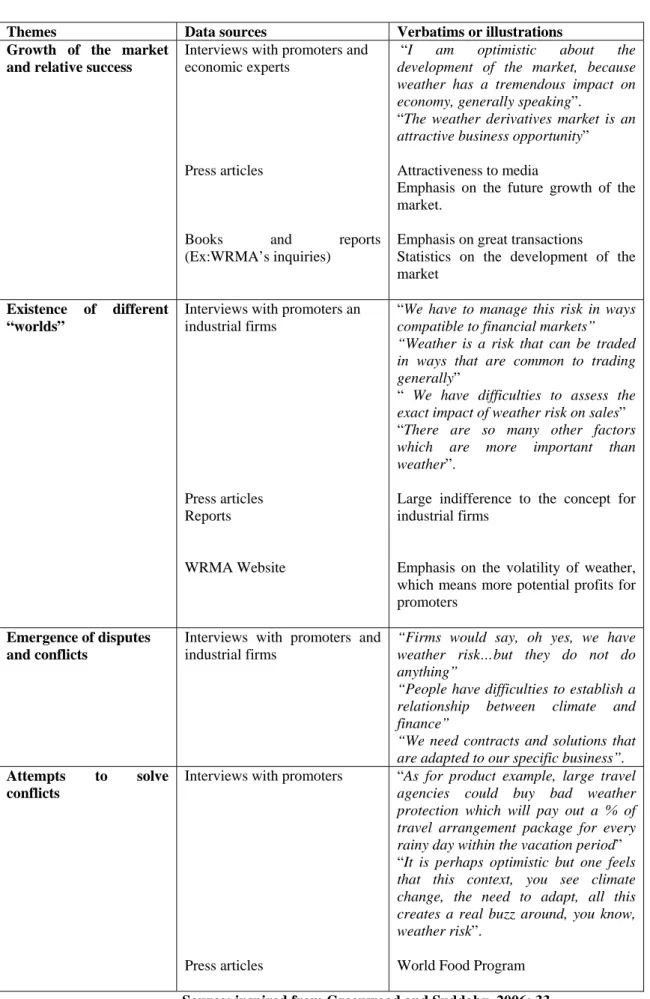
INSERT TABLE 2 ABOUT HERE
Data Analysis
Following Miles and Huberman (1994) and Yin (1989), we arranged the data into a chronological account in order to produce a "facts database" of the emergence and development of the market.Appendix 3 provides a chronology.
In a second stage, we tried to capture the “justificatory accounts” of the different actors (Greenwood and Suddaby, 2006: 32) and particularly of promoters trying to push the Market
World. We first conducted a primary analysis of these accounts, first identifying sentences
and words commonly used by actors to justify their activity. We identified an initial set of narratives, reviewed them carefully and interpreted the data using what we knew about the subject based on documents, press articles and systematic analysis of all interviews transcripts (Berg, 2004; Greenwood and Suddaby, 2006). We were then able to analyze diverse cultures of risk, different kinds of justification stemming from diverse actors, and different attempts to find an agreement on this particular market.
The third stage of data analysis was more directly linked to our research question. After identifying broad themes in the data, we reduced them to more precise categories (Miles and Huberman, 1994). We focused on four main categories: 1/ the absence of growth of the market 2/ the existence of different worlds, i.e. the different views and logics of actors as regard weather risk management, 3/ the emergence of disputes, i.e. of debates and discussions regarding the usefulness of weather derivatives 4/ the search for an agreement by promoters
i.e the different attempts to overcome conflicts between worlds.
As the research progressed, we sought to verify the emerging categories by using other data sources, in particular, professional press articles and annual reports. These data were collected after we had found the emerging themes from interviews and archival materials. It was then possible to verify the main actors of the market and their specific concerns.
INSERT TABLE 3 ABOUT HERE
3. Case study
The market for weather derivatives is usually considered to be born in 1997, with three noticeable transactions involving the firms Koch Industries, Enron and Willis10. At present, it involves as principle actors promoters (mainly re-insurance companies, large investment banks, hedge funds, weather index providers and energy companies) and end-users such as industrial firms in different sectors for example retail, leisure, textile or construction industries. Promoters are gathered in an association that aims at developing the market, the Weather Risk Management Association (WRMA), founded in 1999 by leading participants in the market.
The principle of weather derivatives is to use weather variables such as temperatures or precipitations, as a basis for risk indices, allowing for the transfer of weather risk from a risk seller to a risk taker. For example, in a typical temperature transaction, if weather is too warm – e.g., the average temperature over a defined period exceeds a pre- agreed threshold-, the buyer is entitled to receive a payment from the seller, on the extent to which the average temperature exceeds the threshold11
. Weather risk can be expressed in terms of temperatures, precipitation, snowfall, wind or any other measurable variable. The amount of payment received by the buyer is determined according to her sensitivity to adverse change in weather. It is important not to mistake weather derivatives with securities such as Cat (standing for catastrophe) Bonds. While the latter will trigger payment only if a major event such as a hurricane or an earthquake materializes, weather derivatives rely on the concept of dealing with normal weather conditions, or, to put it in the words of their promoters, with frequent events inducing small amounts of risks rather than rare events causing major risks of losses.
The concept of seeking insurance against bad weather in itself is not new. Well known in the realm of agriculture (e.g drought insurance) or in the management of public events (sporting events, concerts), insurance products are however not at the core of promoters of weather derivatives’ interest. The key issue for them is to develop a liquid market for derivatives comprising “a secondary” as well as “a primary market” for weather risk, a view repeatedly expressed by our interviewees, and reflected on the professional association in charge of the promotion of weather derivatives, the Weather Risk Management Association’s website12. Although promoters put forward the superior efficiency of a financial market over an insurance one in terms of risk mitigation, pricing and management, this tendency is best 10 WRMA Website 11 WRMA Website 12
On the page it devotes to the history of the market, the WRMA Website explicitly contrasts weather insurances and previous transactions of which “none developed into a market”, with the existing market of weather derivatives. In addition to more sophisticated ways to cover fine-tuned specifications of meteorological risk, this market has two specificities. It allows weather risk management “in ways compatible with both financial and insurance markets” (the former term here being the important one) and “comprises a primary and secondary market in weather risk”.
understood by recognizing it as an expression of the general shift in financial theories and practices we described in the first part. At the core of the idea of developing a market for weather derivatives is the wish to exploit potential investors’ interest in a new investment opportunity, whose attractiveness primarily lies in its lack of correlation with assets from the rest of the investment opportunity set13.
In what follows, we provide some information about the history and development of the market. In a further sub section, we contrast the most visible features of the market with the real issues promoters have to cope with, when trying to develop the demand on the part of weather risk protection seekers. Lastly, we propose an interpretation of the weather derivatives market, using the conceptual framework developed by Boltanski and Thevenot (1991/2006).
3.1 The market for weather derivatives: History and development
The market for weather derivatives began with a few private transactions taking place in the United States and involving a transfer of weather risk between private counterparties, in the autumn of 1997. This start was related to the El-Nino event of 1997-199814, which put to the fore the effect of climate change on business. As energy companies experienced massive reduced profit due to the warm winter, they thought of taking full advantage of the deregulation of the electricity markets which was taking place since 1996 and began to apply market techniques by resorting to weather derivatives. The market then developed along the two lines usually followed by financial innovations. First, a market for standardized contracts was created on the CME15 in 1999. Euronext attempted to launch a similar market on London’s LIFFE in 2001, meeting however no success: the weather contracts had to be withdrawn from the market in 2003, due to a lack in transactions. A timid attempt to give it a second chance is reflected in the creation in May 2007 of MetNext, a Euronext-Nyse and Meteo France joint venture, which aim is to provide weather indices that could be used in tailoring weather derivatives. The European market for weather derivatives then developed according to the second line often followed by financial innovations and today only involves customized contracts exchanged on an over-the-counter (OTC) basis.
Technically, weather derivatives are rather simple financial instruments and come into the guise or futures, swaps and options. Contracts over temperature dominate the market. The CME offers 42 such contracts in the form of futures and options on futures, based on temperature data measured in US, Canadian, Japanese and European cities. Being customized, contracts exchanged on the over-the-counter European market can take sophisticated forms. Paris Re for example describes a double trigger option to hedge French vineyard exposure to frost and excess rainfall. The option will trigger if one or both of the two weather indexes involved exceed a pre-agreed threshold, offering the wine producer a payout, computed as a linear function of both indices.16
13
It should also be noted that insurance products in all jurisdiction can only be sold by insurance companies. The development of a derivatives market can thus be understood as a way to extract business opportunities from insurance monopoly, and give alternative actors opportunities to take advantage of risk transfers by placing them on the financial markets.
14
Which among others climatic effects resulted in an exceptionally mild winter in the United States and in Japan 15
Chicago Mercantile Exchange 16
The evolution of the market has been measured by a yearly survey conducted by Price Waterhouse Coopers for the WRMA (Weather Risk Management Association), the industry association17, since 2001. For the 2001-2006 period, the available data are summarized in Chart 1.
---INSERT CHART 1 ABOUT HERE
The total value of trades reported in the 2005/6 survey is $45.2 billion, compared to $9.7 billion in the 2004/5 survey, with the CME experiencing significant increases in both the number of trades and the value of those trades. The survey also shows that High Degree Days18 remains the most common type of trade. The increase on the standardized market was somewhat offset by declines in the OTC market, which remains very thin. With slightly over $2.5 billion dollars, the OTC weather derivatives market represents almost nothing of the $ 414,290 billion of total notional amount of OTC derivatives exchanged worldwide in 200619. The number of OTC trades reported by survey participants was 2,180 in the 2005/2006s survey, as opposed to 4,057 the year before. We should also note that the WRMA website does not communicate as clearly on figures for years 2006/2008, a sign that could reasonably be interpreted as an attempt to understate the variability in the market. From a press release dated from June 2008, we learn that the total value of notional amount for the whole market went down $19 billion in 2006/2007 and rose up again to attain $32 billion in 2007-2008. No figures are provided as regards the proportion of OTC contracts within these figures.
Overall, although promoters keep on insisting on the significant growth of the weather derivatives market over the recent past years20, the market factually remains marginal when compared to other derivatives market worldwide. The European market in particular, appears noticeably thin and seems to meet difficulties in taking off.
3.2- Weather derivatives on stage and backstage
Despite the thinness of its actual size, the market for weather derivatives has a great capacity to attract the spotlight. The use of a rather crude measure of press coverage21 reveals that weather derivatives, which represented less than 0,005% of the total world derivatives markets 22, were mentioned in 34% of the articles devoted to financial derivatives over the period 1997-2007. Far from the spotlight however, the reality of market building involves private face-to-faces between markets promoters and industrial firms, who as potential risk protection seekers have to be convinced that weather derivatives constitute a sound solution to their problem. The contrast between these two facets of the market provides an interesting
17
Founded in 1999 by leading participants in the weather market, the WRMA is the “industry association for
the weather risk management business”
18
HDD (Heating Degree day) contracts are based on the number of temperature degrees within a given period below 18,33° C
19
Source BIS statistics 20
A recent illustration is given by the declarations of Martin Malinow, the newly elected president of WRMA commenting market data for year 2008:“The activity we’ve seen this year is indicative of a strongly growing market,” (…) “We have spent the last 10 years creating foundations for growth and we can now begin to reap the rewards”.
21
We simply counted the articles in Factiva for two requests: financial derivatives in the one hand and weather derivatives in the other hand.
22
perspective into the understanding of the social processes at stake in the construction of a new financial market.
In the spotlight: The market for weather derivatives success stories
The extensive press coverage received by weather derivatives certainly has to do, at least partly, to the facility with which they lend themselves to entertaining headlines. From “Cover against a rainy day”, to “Weatherproof Garment Co. is not leaving its fortunes up to
Mother Nature anymore”, weather derivatives have the great advantage to tie what is
probably the most universally common conversation topic to economic subjects, thus providing the good stories that media are known to be fond of. They are new, the principles they rely on are easy to explain and the risk they are tailored to hedge is largely familiar and of interest to readers of various types. In other words, weather derivatives provide far better light reading topics than any other financial derivatives ever. On top of that, the surge in debates around global climate change and potential higher frequencies of more extreme weather conditions provides them with a media wave on which they can fruitfully ride.
Besides their intrinsic qualities, another asset of weather derivatives in their relation to media is their ability to dramatize and give visibility to certain of the most striking transactions on the market. The WRMA’s website for example has a page devoted to “great
transactions” on which it describes two, which can not be seen as being picked up by chance.
The first one, also widely publicized in the press, is a transaction by which the World Food Program purchased a precipitation cover from Axa Re in order to prefund an emergency response in the event of a drought affecting Ethiopia in 2006. Presented by its promoters (and in the press) as a way to “manage human catastrophe risk”, this transaction was justified on the ground that it would insure “efficient use of donor funds”23 and “rapid response to drought emergency”, since the instruments pays immediately, “while normal donors response usually require months before funds are available”. The second transaction exemplifying the interest of weather derivatives on the WRMA website is a deal by which the Sacramento Municipal Utility District (SMUD), a customer owned generator and distributor of electricity, purchased a three year derivatives to protect it from the volatility in precipitation in California. According to this deal struck with two energy trading firms as risk takers, SMUD was to receive payment when precipitation is less than a given threshold and make payment when precipitation exceeds a second threshold. Promoters advocate the rationale of this deal as beneficial to the owner-customers of the mutual SMUD. The WRMA website insists that the “cost of power to SMUD customers remained among the lowest in the State despite turmoil in
California electricity market during this period”.
A third transaction, several times cited by our interviewees, was a five-year frostday protection contract sold in 2001 by the Dutch Bank ABN AMRO to the administrators of a ‘cold weather risk fund’ in the Netherlands. The derivative was meant to provide support to the government mandated fund which pays the wages of construction workers who are unable to work because of inclement weather. This contract, which was further extended in 2003, is said to be the largest ever weather derivatives transaction.
The attractiveness to media of weather derivatives and their capacity to structure transactions, involving as in the examples above, weather, human misery, efficient management of humanitarian assistance and public good echo to the description given in previously reviewed academic critical literature. As a matter of fact, weather derivatives of
23
purchased, according to the WRMA website “$7 million of financial resource for less than $1 million, to be available in the event of continued drought emergency”
the kind just depicted seem to typify the binding and blending capacity described by some authors as archetypal of financial derivatives. They seem to abolish the differences between financial securities and non traded asset forms and exemplify the expansion of the financial market sphere into yet non monetized domains of social life. However, looking only at the most glamorous side of weather derivatives, one runs the risk to miss the true picture. Exactly like one swallow does not a summer make, the above mentioned big deals do not make a financial derivatives market, which, to exist, should rally various type of actors around a unique view of what risk is and how it ought to be managed. This, in the case of weather derivatives, can not be taken for granted.
Behind the scenes: the face-to-face between market promoters and industrial firms
As many analysts of financial markets have already noted (Callon, 1998; Huault and Rainelli, forthcoming ; Lepinay, 2007; Mac Kenzie and Millo, 2003) the transformation of a given risk into a financial risk, that is a risk that can be taken in charge through derivatives instruments, do not go without framing efforts. One of the interests of the present case study is to show that the proposal to manage weather risk through financial markets impacts with pre existing representations of various market participants as regards weather risk and the way it can or must be managed.
What « the market » ought to be: the view of promoters
The WRMA website provides an accurate source of information to understand what it is exactly that promoters of a market for weather risk are fostering. In the chapter devoted to the history of the market, the WRMA website editor notes that the idea of transferring weather risk had been the subject of insurance considerations for some time. He, however, observes that prior to 1997, and contrary to the current situation, none of these early initiatives “developed into a market”. We hence learn that the whished-for market is one that presents three main specificities.
First, the weather derivatives market must provide investors with promising investment opportunities on which usual financial techniques could be exploited. It is defined as a market which manages risk “in ways compatible with financial markets”, or else “dynamically according to disciplines adapted from commodity and financial trading”. The website carefully mentions the weather derivatives market as “an attractive business
opportunity because weather essentially is uncorrelated with secular or systemic risk in general financial markets and provides an opportunity for diversification for traders”. This
argument is typically targeted for investors who, since Markowitz proposed his famous portfolio theory, have diversification as their first commandment. Weather is presented as a risk that “can be traded in ways that are common to trading generally”: “weather has
volatility24, the tails of weather risk may move differently from at-the-money positions, correlations between weather in different areas converge and diverge, etc” (…) portfolios of weather risk can be managed by most of the approaches used in managing portfolios of security and commodity risk: including ratio tests, Greek parameters and Value at Risk measures”.
24
The emphasis on the volatility of weather is one of the prime arguments of promoters, as can be seen for example, in the presentation made by Didier Marteau for AON, in Paris in March 2008, in the book from the same author (Marteau et al., 2004) or on the WRMA and MetNext Websites. More volatility means for investors in option-like instruments more potential profits.
Second, the market should rally participants with different risk profiles to ensure sufficient incentives for transactions:
“We need more financial players to speculate. We have to create some kind of free-money. People work hard to do this. So I am optimistic about liquidity” (Utility company).
“I think the big theme still for the market place is extension. The market is just not big enough to be fully sustainable in the long term (…) I think the extension of the market needs to happen in three different dimensions at the same time. We need to have expansion of the number of /clearers/ in any individual sector,(…) you need to see a sectoral expansion for instance: more and more end-user sectors coming in to hedge their risk in the market place. The third area is geographical expansion of the market” (Utility company)
Particularly emphasized is the fact that the place of energy traders, which were at the core of the market at its beginning, has “now be taken by insurers, banks and hedge funds and
by trading on exchanges, pre-eminently on the Chicago Mercantile Exchange”, and that “its numbers include several of the strongest financial institutions on the globe”25. Insisting further the WRMA website indicates that, “emerging from a period in which the market was
dominated by energy business, the market is (now) spreading to encompass a variety of sectors, including agriculture, construction, transportation and entertainment. In the last three years the exchange trading of weather risk, often in conjunction with commodity and energy risk, has mushroomed and has attained a level of critical mass on the CME”. In June
2008, a press release celebrating the 10th anniversary of the WRMA mentions among the conclusions of the Price Waterhouse Coppers annual quantitative study on market development, the fact that “ The industry also is seeing more diversity of participants with
insurance companies, banks, hedge funds and end-users active in the market. As evidence of a healthy increase in the volume of end-user transactions, the survey shows that the proportion of trades reported between WRMA members and non-members rose to 90 percent for 2007-2008”.
Third, the ideal market comprises “a primary and secondary market in weather risk”, a condition necessary to provide liquidity on the market and hence reliable prices for weather risk. There is a “constellation of market makers and market participants” which “offers the
weather market greater depth, breadth and financial security than ever”.
“I think the ideal market is one which is sort of active and liquid with a lot of activity going on
because I think that is the best for pricing efficiency. I think it should be a market were the corporations use weather derivatives as a risk management tool routine, in the same way as the routine hedge their foreign exchange exposure or their interest rate risk, that it would be a market developed to the point were it will be unusual for a company not to use weather derivatives” (Promoter)
The general vision of markets promoters is finally summarized by one of our interviewees:
“If in the end the only solution we come up with are major insurance companies writing risk
insurance which happens to help people against some of these things, that would be e very expensive way of dealing with that risk, which needs to be socialized and managed in a way that allow people to trade it and package it because it will be much more efficient” (Utility
Company)
25
Firms and weather risk
Although according to promoters, weather derivatives offer features of interest for various industries seeking protection again adverse climate, the view of industrial firms in Europe reveals, by and large, indifference to the concept.
“Essentially it is not a market driven by the end-user, the consumer, it’s a market driven by the people who sell the protection, whether that is marketers or structures, they are the ones pushing the products to the market” (Promoter)
A study conducted in France, Belgium and Luxembourg in 2006 on 53 companies chosen for the intensity of their risk management activities (Bertrand, 2007) shows that 47% of the enterprises from the sample considered weather risk to have a negligible impact on their economic performances. Only 21% of the firms studied have attempted to assess precisely this impact. One and only one out of the 53 had put in place a weather risk management strategy involving however no financial instruments, while two others said they might consider doing so. Outside this sample, Electrabel, a Belgian provider of electricity provides a further illustration of the lack of interest of most firms for weather derivatives. It has no activity on the market which it deems not important for its activities at present. One of our interviewee from a re-insurance company regrets the situation:
“Weather risk comes 27th in the ranking of the risks usually covered by end-users. This raises questions about the priorities given to the hedging needs for different risks.”
The difficulty of appreciating the exact impact of weather risk on sales is one of the primary reasons mentioned by companies for not developing any interest in weather derivatives. Vivarte, a textile group, reckons having been contacted by its reinsurance company regarding the possibility of using weather derivatives. They declined, on the basis of rather ambivalent considerations on their exposure to weather risk. Although weather conditions are at the top of the day-to-day consideration of the local shops, the precise risk seems too difficult to measure:
“They are so many other factors, such as the economic conditions, which are more important than weather. OK, weather is important on a day to day basis, but, in and all, bad weather does not last the whole season, and we catch up a bad week through a better one”. (General
Manager)
Beyond limited impact on results, other reasons often offered by companies to explain why they do not hedge against weather risk using derivatives are the price of hedging which they generally consider to be too expensive. For example, in 2003, the ski manufacturer Rossignol said the company was unable to find any “economically sound solution to
externalize weather risk” on the market. Compagnie des Alpes, a French ski lift operator,
terminated its weather derivatives contract two years in advance, on the ground that the premium was too expensive for the protection it offered.
By this, we see that the virtuous circle by which efficient management of weather risk by numerous participants respond to and entails an efficient and competitive market for weather derivatives remains a remote goal. The reason why in 10 years of development and despite the potential advantages offered by weather derivatives to financial investors, the competition between the latter does not succeed in decreasing weather products prices significantly is of crucial interest to our research questions. It can be traced back to the peculiarity of weather
risk exposure, which greatly differs from one end-user to another and remains heavily tied to operational specificities. While energy providers are largely and plainly exposed to a simple set of meteorological conditions, most industrial or service firms present highly specific risk profiles. To them, weather risk can be associated with all possible combinations of weather event involving temperature, rainfall, snow, wind, sunlight or storms. These weather events can be extremely localized, both in space and time. The impact of a risk of lack of snow for a given ski-lift operator will vary greatly from one spot to another, one week to another depending on which are holydays weeks, and might also combine with additional weather variables such as wind or sun.
Overall, the peculiarities of weather risk exposure in terms of localisation and meteorological conditions induce weather derivatives providers to design sophisticated contracts which require extensive preparation work and competences in fine-tuned meteorological aspects as well as a good understanding of the end-user’s business. The structuring of such tailor made contracts hampers competition between derivatives sellers to naturally arise, hence the price of hedging, and the view of potential risk protection seekers that the proposed products are generally too expensive. Consequently, instead of resorting to weather derivatives, many of the firms that are the most conscious of their exposure to weather risk tend to turn to operational management of weather risk and activity diversification. By so doing, they stay closer to the core competencies of the firm and design strategies that they consider far less expensive. “We will come to weather derivatives if the
market develops” says Philippe Huet from EDF, a company which weather exposure is
particularly obvious (….) “We look at the available physical resources before considering to
resort to some insurance contract (…) We rather use the agreements we have with some of our customers, be they industrial or individuals, which allows us to momentarily stop providing energy if we need to”. The Compagnie des Alpes, which early reckoned its
exposure to high temperature during winter, has adapted its ski resorts. Eric Guilpart, its spokesman says:
“Thanks to the work we do on the trails in winter but also in summer, skiers can enjoy their
favourite sport on snow layers no thicker as 10 cm, where 70 cm were necessary a few years ago. We have reoriented some trails, so that the sun will not melt the snow too rapidly (…) Our shareholders use to ask us questions about the way we managed weather risks: our geographical as well as activity diversification has reassured them”.
A similar view is expressed at Jardiland :
“We try to de-seasonalize our activity as much as we can. This explains why we diversify our activities by developing pet sales and Christmas decoration. ”.
Were climate to change drastically, for example as experts of global warming forecast, the people in Vivarte think they will adapt by managing their textile collections differently.
To summarize, the market for weather derivatives is characterized simultaneously by its thinness and its capacity to attract media attention. Extensive press coverage, focusing in particular on highly publicized transactions, contrast with the difficulties of the daily face to face between weather derivatives promoters and industrial firms seeking protection for weather risk. How are these difficulties taken into account by the actors? To what extent do they account for the actual structure of the market and the type of products that are produced on it? We propose in what follows to analyze these questions using the concepts of the Economy of Worth proposed by Boltanski and Thevenot (1991/2006).
3.3 Analysis of market promotion in terms of justification
In their theoretical framework, Boltanski and Thevenot (1991/2006) picture individuals living in different worlds characterized by a specific form of evaluation (“a grammar of worth”). Coordination of many activities, including economic ones, requires overcoming potential conflicts between worlds which can be achieved through a justification
process involving several alternative strategies. This theoretical apparatus can be used to
interpret three facets of the market for weather derivatives. First, the face-to face between market promoters and potential end-users can be described as a situation where the Market
World characterized by Boltanski and Thevenot enters in conflict with the Industrial World in
which end-users frame weather risk and weather risk management. Second, the weather derivatives promotion process can be analyzed as an attempt to overcome this conflict, and the strategies put forward by promoters can be characterized as the research of an agreement in Boltanski and Thevenot’s sense. Finally, some of the most visible products developed on the market can be reassessed in new ways.
Weather derivatives: the encounter of conflicting worlds
The reluctance of industrial firms to the efforts of weather derivatives promoters is largely perceived by the latter as a cultural issue. Many of our interviewees complain about industrial companies lacking of the appropriate risk culture or, more crudely, evidencing culture backwardation.
« Firms are used to hedge against interest risk or foreign exchange risk. They use
sophisticated instruments to do so, and in the same time, they do nothing against weather risk, which is of foremost importance. This difference in approaches is truly surprising. (…) How long will it take before firms realize that weather risk exists, and that it must be assessed and hedged ? (Re-insurer)
“It is like asking people who have their habits…you know an old couple, 50 years of marriage,
to change their habits of Sunday morning. Not to go to mass, or not to go shopping”
(Metnext)
“One learns at school, one is used to manage risk…interest rate risk for example. You learn at
school and you know how to do it. You have models that are operational, you are used to it…and suddenly, there is a new risk, weather risk. And it bothers everybody. Except that weather risk can sink a firm. Except that weather risk, is often more important than …many other risks. (Metnext)
Lamenting about firms’ cultural backwardation however does not seem to provide market promoters with an exact view of where the necessity of cultural adjustment in reality lies. It largely overlooks the existence of conflicting interests between a Market World and an
Industrial World view of weather risk. The problem of promoters on the one hand can indeed
be described as one of succeeding in drawing weather risk into what Boltanski and Thevenot characterize as the Market World. This requires weather derivatives to be objectively defined and as independent as possible of the characteristic of the buyer and seller. Admittedly, the clever design of tailor made instruments meant to fit the business peculiarities of protection seekers can lead to temporary high margins. But the lack of standardization that results hampers the expansion of the market in the long run, by hindering the development of liquidity and preventing the development of a secondary market, without which no financial market can properly function. Success in the commodification of weather risk would instead require the dragging of it in a world where ‘people are detached from one another, liberated, ready to willingly enter into any possible transaction’ (Boltanski and Thevenot, 1991/2006).
Industrial firms’ vision of weather risk management on the other hand, can be coined in what Boltanski and Thevenot define as the Industrial World, where action is mostly seen as a task of production, and the higher common principle refers to efficiency, performance and productivity. In line with this “grammar of worth”, companies tend to frame weather risk in close relation with their specific business and define its relevance to them in terms of operational considerations. When they do it at all, they are inclined to manage weather risk resorting to tools closely linked to their “savoir faire” and view proposals from the financial companies as too expensive, or “not sound”:
Overall, more than cultural differences in the mastering of weather risk, what we observe is a gap between the specific responses demanded by the Industrial World and the minimum standardization required to develop a financial market. The conflict between the
Market and Industrial world seems thus to account for most of the difficulties of the market in
taking off.
Although promoters largely overlook the above mentioned issue, expressing regrets about culture backwardation of industrial firms is however not the only solution left to them. In what follows, we examine how they attempt to provide solutions adapted to the demand stemming from the Industrial World framing of their counterparts and how they seek to involve other worlds than the Market and Industrial Worlds into the debate.
The promotion process as an attempt to overcome the conflict between worlds
As their view about the lack or ‘relevant risk culture’ within industrial firms shows, the ideal situation for promoters would be to have end users rally around their vision of how weather risk ought to be managed. In the terms of Boltanski and Thevenot, this would characterize a ‘situation that holds together” (2006:41), where beings and objects all belong to the same world, foreign pieces being “naturally” rejected. Such an ideal situation however, when confronted to the Industrial World perspective on weather risk, appears a remote goal.
Although not explicitly acknowledging the existence of a dispute, promoters pragmatically enter into various attempts to reach what Boltanski and Thevenot define as
agreements, or in other words, reduction of the tensions between worlds. Theoretically, two
alternative figures are offered to them: compromise or arrangement. Compromising would allow them to suspend the disagreement, without settling it in just one of the worlds in presence (2006: 277) and build with industrial firms relationships around weather risk management that would be deemed “acceptable to all”. Private arrangement in the form of contingent and local agreement would be more fragile and implicitly oriented toward private interests: “you do this which is good for me; I do that, which is good for you” (2006: 336)”.
The first path adopted by market promoters to overcome firms’ reluctance falls in the second of these alternatives. Somewhat paradoxically, it was revealed in our study by the answers provided by our interviewees to our question about the transactions they remembered as particularly striking. Following Boltanski and Thevenot, particular transactions are the kind of tests the Market World will resort to, to remedy ‘disputes’ within the world about state of
worth, or, in other words, contestations about the place different actors occupy in a given
situation. We used questions about striking transactions as a way to better understand the
world in which promoters framed weather risk. With remarkable regularity they provided us
with the description of transactions which main characteristic is to be finely adjusted to specific demand arising from risk protection seekers.
The documentation provided by a re insurer for example states:
“As for product example, large travel agencies could buy bad weather protection which will pay
out a % of travel arrangement package for every rainy day within the vacation period. A rainy day will be defined as 4 or more of consecutive rainy hours between 10:00 and 18:00 hour, a rainy hour implying 2 or more millimetres of rainfall during the 1 hour. This could allow the travel agency to sell