HAL Id: hal-01413575
https://hal.archives-ouvertes.fr/hal-01413575
Submitted on 9 Dec 2016
HAL is a multi-disciplinary open access
archive for the deposit and dissemination of
sci-entific research documents, whether they are
pub-lished or not. The documents may come from
teaching and research institutions in France or
L’archive ouverte pluridisciplinaire HAL, est
destinée au dépôt et à la diffusion de documents
scientifiques de niveau recherche, publiés ou non,
émanant des établissements d’enseignement et de
recherche français ou étrangers, des laboratoires
olfactory compound processing in honeybees
Nina Deisig, Harald Lachnit, Jean-Christophe Sandoz, K Lober, Martin Giurfa
To cite this version:
Nina Deisig, Harald Lachnit, Jean-Christophe Sandoz, K Lober, Martin Giurfa. A modified version
of the unique cue theory accounts for olfactory compound processing in honeybees. Learning and
Memory, Cold Spring Harbor Laboratory Press, 2003, 10 (3), pp.199-208. �10.1101/lm.55803�.
�hal-01413575�
Research
A Modified Version of the Unique Cue Theory
Accounts for Olfactory Compound Processing
in Honeybees
Nina Deisig,
1Harald Lachnit,
2,4Jean-Christophe Sandoz,
3Klaus Lober,
2and
Martin Giurfa
31
Neurobiology, Institute of Biology, Free University of Berlin, D-14195 Berlin, Germany;2Fachbereich Psychologie, Philipps-Universita¨t Marburg, D-35032 Marburg, Germany;3Centre de Recherches sur la Cognition Animale, CNRS–Universite´ Paul-Sabatier, 31062 Toulouse cedex 04,
France
We investigated the capability of honeybees to discriminate between single odorants, binary olfactory mixtures, and ternary olfactory mixtures in olfactory conditioning of the proboscis extension reflex. In Experiment 1, three single odorants (A+, B+, and C+) and three binary mixtures of these odors (AB+, AC+, and BC+) were reinforced while the ternary compound, consisting of all three odors (ABC−), was nonreinforced. In Experiment 2, only one single odorant (A+) and one binary olfactory compound (BC+) were reinforced while the ternary compound (ABC−) consisting of the single odor and the binary compound was nonreinforced. We studied whether bees can solve these problems and whether the course of differentiation can be predicted by the unique cue theory, a modified unique cue theory, or Pearce’s configural theory. Honeybees were not able to differentiate reinforced from nonreinforced stimuli in Experiment 1. However, summation to ABC observed at the beginning of training contradicts the predictions of Pearce’s configural theory. In Experiment 2, differentiation between the single odorant A and the ternary compound developed more easily than between the binary compound BC and ABC. This pattern of differentiation is in line with a modified unique cue theory and Pearce’s configural theory. Summation to ABC at the beginning of training, however, again was at odds with Pearce’s configural theory. Thus, olfactory compound processing in honeybees can best be explained by a modified unique cue theory.
The processing of stimuli composed of more than one single element (compounds) is of major interest but has not been clearly elucidated up to now (e.g., Rowe 1999; Pearce and Bouton 2001). Two main approaches, an “elemental” and a “configural” one, have been proposed to explain com-pound processing. The former assumes that animals are able to extract the elemental composition of the com-pound, whereas the latter postulates that animals process a compound as a new configuration, independently of its single stimuli. Among elemental theories, the pure elemen-tal theory is the most simple and supposes that the toelemen-tal associative strength (V) of a compound AB results from the mere summation of the associative strengths of its elements A and B (i.e., VAB= VA+ VB). For each stimulus, the change
in associative strength,⌬V, results from the model of Res-corla and Wagner (1972):
⌬V = ␣ *  * ( − VT) (1)
where⌬V is the change in associative strength V, ␣ is the learning rate associated with the stimulus under consider-ation (A, B, or AB), is the learning rate associated with the reinforcement, is the asymptotic level of associative strength that can be supported by the reinforcement, and
VTis the combined associative strengths of all stimuli
pre-sent on a learning trial. An extension of the elemental theory is the unique cue theory, which assumes that a compound AB is processed as the sum of the single elements A and B, plus a stimulus U, which is unique to the compound and results from the conjunction of A and B (i.e.,
VAB= VA+ VB+ VU; Rescorla 1972, 1973; Whitlow and
Wagner 1972).
Among configural theories, on the other hand, Pearce’s configural theory assumes that the elements of a compound collectively enter into a single association (e.g., Pearce 1987, 1994). Thus, no summation of the single associative strengths occurs. However, if stimuli share common ele-ments, generalization will occur between them. The degree of generalization will depend on the number of common elements (e.g., there will be generalization between AB and A or B, but not between A and B). Finally, an “extreme” configural theory was also proposed, which retains the as-sumption of Pearce’s configural theory but pushes its
phi-4Corresponding author.
E-MAIL [email protected]; FAX 49 6421 2826621.
Article and publication are at http://www.learnmem.org/cgi/doi/ 10.1101/lm.55803.
losophy to the extreme by postulating that a compound is coded as a new stimulus (“Gestalt”) that is totally unrelated to its elements. As a consequence, no generalization should occur between a compound and its elements (for a com-parison between configural and extreme configural points of views, see Williams and Braker 1999).
Negative patterning is a discrimination problem that is particularly interesting for comparing elemental and config-ural theories. In this task, animals have to learn to respond to two single reinforced stimuli (A+, B+) but not to their compound, which is nonreinforced (AB−). Negative pat-terning cannot be solved through pure elemental process-ing, as summation of the elemental excitatory strengths on compound presentation would always result in stronger re-sponding to the compound than to the elements. As solving a negative patterning discrimination is incompatible with the pure elemental theory, the unique cue theory has been invoked to explain such discrimination. It assumes that the unique cue (U) becomes sufficiently inhibitory to block re-sponding to the elements on compound presentation. Con-figural theories, on the other hand, can account for negative patterning discrimination. If animals perceive a compound as a new configuration that is distinct from its elements, then differentiation between elements and the compound is straightforward (Pearce 1987, 1994).
Recently, we have shown that honeybees, Apis
melli-fera L., are able to solve negative patterning both in the
olfactory and in the visual domain (Deisig et al. 2001, 2002; Schubert et al. 2002). In the olfactory domain, experiments were performed using classical conditioning of the probos-cis extension reflex (PER; Takeda 1961; Bitterman et al. 1983). In such a paradigm, bees learn to associate an odor presented to the antennae (conditioned stimulus or CS) with a reinforcement of sucrose solution (unconditioned stimulus or US) delivered to the proboscis. They thus learn to extend their proboscis to the mere presentation of the odor. Using this paradigm, we showed that bees solved negative patterning, a fact that allowed dismissing the pure elemental theory as an explanation for compound process-ing (Deisig et al. 2001). Furthermore, a certain amount of generalization between elements and compounds was found, a fact that allowed discarding the extreme configural theory, according to which generalization should never oc-cur. We also showed that a reduction of similarity between a compound and the elements enhances the degree to which animals discriminate between both kinds of CSs (Deisig et al. 2002). Thus, discrimination was better in an CD− versus A+, B+ task than in an AB− versus A+, B+ task. Discrimination in an AC− versus A+, B+ task was interme-diate. Both the unique cue theory and Pearce’s configural theory could account for the acquisition of the three tasks (Deisig et al. 2002). However, bees trained with the A+, B+ versus AB− discrimination, and then tested with a novel compound BC after training, showed stronger responding
to BC than to B+. This finding was not predicted by Pearce’s configural theory (Deisig et al. 2002).
Although our results indicate that olfactory compound processing in bees relies on the use of unique cues, two lines of evidence make it worth reconsidering this possibil-ity. Firstly, results from studies in other species (e.g., pi-geons, rabbits) contradict it because they support the idea that stimuli of the same modality (intramodal) favor the emergence of configural rather than elemental associations (e.g., Pearce and Redhead 1993; Redhead and Pearce 1995; Rescorla and Coldwell 1995; Pearce et al. 1997), whereas stimuli of different modalities (intermodal) favor the emer-gence of elemental associations (e.g., Bahc¸ekapili 1997; My-ers et al. 2001). Our experiments on negative patterning in bees used intramodal stimuli (odors) but nevertheless were in support of the elemental unique cue theory. The present experiments were thus conceived to provide further em-pirical assessment of these alternative accounts. Secondly, in our previous studies we neglected the problem that in olfactory PER conditioning of honeybees the conditionabil-ity of odorants may be reduced in mixtures. The experi-ments on overshadowing by Smith (1996) may be inter-preted as reflecting interferences between the components of an odor mixture.
As such interference is not taken into account neither by the unique cue theory nor by Pearce’s configural theory, we additionally have now considered the so-called modified unique cue theory (Redhead and Pearce 1995). This theory predicts that conditioning of a single reinforced element progresses in the manner predicted by the Rescorla and Wagner equation (see equation 1; Rescorla and Wagner 1972) but states that in the case of compound conditioning, the presence of one element restricts learning about the other, thus yielding a slower rate of learning for the com-pound. In this case, the change (⌬VA) in associative
strength of an element A belonging to an AB compound results from:
⌬VA=␣A* ␣A/␣T*  * ( − VT) (2)
where ␣T is determined by the combined salience of all
stimuli present (␣T=␣A+␣B). Interestingly, our previous
findings (Deisig et al. 2001; 2002) are consistent with the modified unique cue theory.
To further decide between the modified unique cue theory, the unique cue theory, and Pearce’s configural theory, we performed two experiments involving single odorants and binary and ternary odor mixtures, based on a study by Redhead and Pearce (1995) on visual conditioning of pigeons. In a first experiment, bees had to learn to re-spond to the single odorants (A+, B+, C+) and the binary mixtures (AB+, AC+, BC+) but not to the ternary mixture (ABC−). In a second experiment, they had to learn to re-spond to a single odorant A+ and the binary mixture BC+ but not to the ternary mixture ABC−.
In the first experiment, Pearce’s configural theory pre-dicts a better differentiation between A+/B+/C+ and ABC− than between AB+/AC+/BC+ and ABC−. This is because of the idea that binary compounds support more generaliza-tion to ABC− (and vice versa) than single elements, as the former have more elements in common with the ternary compound. Contrarily, the unique cue theory predicts bet-ter differentiation between AB+/AC+/BC+ and ABC− than between A+/B+/C+ and ABC−, as the single associative strengths sum up upon compound presentation. Because of such a summation, responses should be stronger for the binary compounds than for the single elements. The modi-fied unique cue theory also predicts stronger responding to binary compounds than to single elements (for a more de-tailed discussion, see Redhead and Pearce 1995). In the second experiment, according to the unique cue theory, one expects a better differentiation between BC+ and ABC− than between A+ and ABC− because of summation of the associative strengths of B and C upon binary compound presentation. Conversely, Pearce’s configural theory and the modified unique cue theory predict that differentiation between A+ and ABC− should be better than that between BC+ and ABC−. For Pearce’s configural theory this is caused by the higher degree of generalization between the AB+ and the ABC− compounds (more elements in common), which renders this discrimination difficult. For the modified unique cue theory, the presence of one stimulus restricts learning about the other on reinforced compound trials (BC+), and this results in a slower rate of conditioning for this compound. However, the two theories differ in their prediction of summation at the beginning of training. For Pearce’s configural theory, no summation should occur upon compound presentation. For the modified unique cue theory, summation is possible. Thus, the two experimental designs used in this work allow us to decide among the unique cue, the modified unique cue, and Pearce’s config-ural theories.
RESULTS
Experiment 1: A+/B+/C+ and AB+/AC+/BC+ Versus ABCⴑ
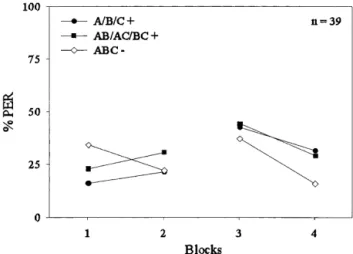
Figure 1 shows the responses (% PER) of the bees to the stimuli A+/B+/C+, AB+/AC+/BC+, and ABC− grouped in blocks. For the reinforced single stimuli (A+/B+/C+), each block consisted of one presentation of each stimulus (i.e., each block contains three trials); for the binary compounds (AB+/AC+/BC+), each block also consisted of one presen-tation of each mixture (i.e., each block has also three trials); for the ternary mixture (ABC−), each block consisted of six presentations of the nonreinforced compound. Blocks 1 and 2 show responding during the first day of conditioning, whereas blocks 3 and 4 show responding during the second day.
A 3 × 4 ANOVA for the complete training (both days) including the factors trial type and block revealed no sig-nificant effect of trial type (F < 1). However, the trial type × block interaction was significant (F6,342= 3.48,
p < 0.01), indicating that the amount of responding to
rein-forced and nonreinrein-forced trial types changed across blocks of trials. Furthermore, the main effect of block as well was significant (F3,342= 12.47, p < 0.01), indicating that
re-sponses on average changed across blocks of trials. On block 1, trials differed significantly (F2,114= 3.63, p < 0.05).
A Newman-Keuls post hoc comparison revealed that re-sponses to the ternary compound ABC− were significantly stronger than responses to the single elements A+/B+/C+. Responses to the binary compounds AB+/AC+/BC+ did not differ significantly from those to the ternary compound ABC−.
A separate analysis of the two training days revealed that responding to reinforced versus nonreinforced trials differed neither on day 1 nor on day 2 (3 × 2 ANOVA, day 1: F2,114= 1.33, p > 0.05; day 2: F2,114= 1.45, p > 0.05).
However, the trial type × block interaction was significant on the first day of training (F2,114= 4.99, p < 0.01), but the
main effect of block was not (F1,114= 0.01, p > 0.05),
indi-cating that overall responses did not change over blocks. On the second day of training, only the main effect of block was significant (F1,114= 43.4, p < 0.05), indicating that
re-sponses decreased over blocks, whereas the trial type × block interaction was not significant (F2,114= 1.51,
p > 0.05). An analysis of the last block of training revealed
that bees did not learn to differentiate between the
rein-Figure 1 Conditioned proboscis extension response (% PER)
alongtrials in an A+/B+/C+ and AB+/AC+/BC+ versus ABC− dis-crimination. The curve depicts the course of % PER to the rein-forced single elements A+, B+, and C+ (䊉); the reinforced binary compounds AB+, AC+, and BC+ (䊏); and the nonreinforced ter-nary compound ABC− (〫) duringacquisition alongfour blocks of training. For the single elements and the binary compounds, each block consists of the averaged response to all three elements or binary compounds on the given trial. For the ternary compound, each block consists of six sequential trials.
forced A+/B+/C+ or AB+/AC+/BC+ and the nonreinforced ABC− trials (F2,114= 2.88, p > 0.05). This means that on the
basis of these results, it was impossible to decide between the competing theories of compound processing, which make different predictions about the differentiation be-tween elements and mixtures.
Nevertheless, focusing on summation at the beginning of conditioning, it was possible to evaluate the theories. We therefore performed an analysis of the anticipatory re-sponses to the second presentation of each kind of trial. For the single elements and binary compounds, this measured responding after one reinforced trial, whereas for the ter-nary compound, it measured responding after one nonrein-forced trial. A one-way ANOVA revealed a significant effect of trial type (F2,114= 3.89, p < 0.05). A Newman-Keuls post
hoc comparison revealed that responding to the ternary compound ABC− was significantly stronger than respond-ing to the srespond-ingle stimuli A+/B+/C+. Respondrespond-ing to the bi-nary compounds AB+/AC+/BC+ was not significantly lower than responding to the ternary compound ABC−. Thus, summation during ABC− presentation occurred at the be-ginning of conditioning.
The pattern of results at the end of training does not allow a general conclusion with regard to the different theo-ries of compound processing. Responding to the single stimuli did not differ from responding to the binary com-pounds. However, summation in block 1 was unexpected from the point of view of Pearce’s configural theory but was in line with both the unique cue theory and the modified unique cue theory. As this experiment did not allow decid-ing in favor of a particular theory, we performed a second experiment in which a single element and a binary com-pound were reinforced (A+, BC+) while their ternary mix-ture was not (ABC−).
Experiment 2: A+ and BC+ Versus ABCⴑ
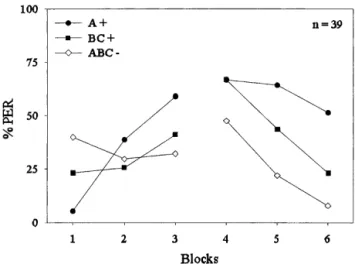
Figure 2 shows the responses (% PER) of the bees to the stimuli A+, BC+, and ABC− grouped into blocks. For the reinforced single stimulus A+, each block consisted of one presentation; for the binary compound BC+, each block consisted of one presentation; and for the ternary mixture (ABC−), each block consisted of two presentations.
For both days of training, response differentiation be-tween A+ and ABC− was stronger than that bebe-tween BC+ and ABC−. A 3 × 6 ANOVA for the complete training (both days) including the factors trial type and block revealed a significant effect of trial type (F2,114= 4.86, p < 0.01). The
difference between reinforced and nonreinforced trial types increased across blocks of training. This was con-firmed by the significant trial type × block interaction (F10,570= 6.06, p < 0.01). Furthermore, the main effect of
block was significant as well (F5,570= 15.55, p < 0.01),
in-dicating that on average, response proportions increased across blocks of trials. During the first block of training,
the response to the three stimuli differed significantly (F2,114= 9.58, p < 0.01). A Newman-Keuls test revealed that
in the first block, responding to the ternary compound ABC− was significantly stronger than responding to the bi-nary compound BC+ or to the single element A+. In block 2, responses did not differ significantly. In block 3, re-sponses to A+ were significantly stronger than rere-sponses to BC+ and ABC− (F2,114= 3.39, p < 0.04). During the first
block of training on day 2 (block 4), responding did not differ between any trial type (F < 1). In block 5, responses were again significantly different (F2,114= 8.86, p < 0.01).
Responding to A+ was strongest and differed significant-ly from responding to ABC−, as well as from responding to BC+. Responding to BC+ was also significantly strong-er than to ABC−. During the last block of training, respond-ing to the different stimuli also varied significantly (F2,114= 12.11, p < 0.01). Responding to A+ was
signifi-cantly stronger than responding to BC+ and ABC−, whereas responding to BC+ and ABC− did not differ significantly.
Considering the two training days separately, no over-all difference between reinforced and nonreinforced trial types could be found on day 1 (3 × 3 ANOVA of day 1:
F2,114< 1). However, the main effect of block (F2,228= 10.53,
p < 0.01) and the trial type × block interaction (F4,228= 7.8,
p < 0.01) were significant. For the second day of training,
there was a significant main effect of trial type (3 × 3 ANOVA of day 2: F2,114= 11.62, p < 0.01) as well as a
significant main effect of block (F2,228= 24.97, p < 0.01).
The trial type × block interaction was not significant (F4,228= 2.2, p > 0.05).
A Newman-Keuls test revealed that responses to A+
Figure 2 Conditioned proboscis extension response (% PER)
alongtrials in an A+ and BC+ versus ABC− discrimination. The curve depicts the course of % PER to the reinforced single element A+ (䊉), the reinforced binary compound BC+ (䊏), and the nonre-inforced ternary compound ABC− (〫) duringacquisition alongsix blocks of training. For the single element and the binary com-pound, each block consists of one trial each, whereas for the ter-nary compound, each block consist of two sequential trials.
and BC+ differed significantly in the first and last block of training. Responding to A+ was significantly weaker than to BC+ in the first block, whereas this situation was reversed in the last block of training. Therefore, the results of this experiment clearly show that bees learned to differentiate between reinforced and nonreinforced stimuli. At the end of training, response differentiation between A+ and ABC− was stronger than that between BC+ and ABC−. This finding is in contradiction to the unique cue theory. It is, however, in accordance with the predictions made by the modified unique cue theory and by Pearce’s configural theory. Fo-cusing on summation at the outset of training helps to de-cide between the remaining two theories. Responses to ABC− were significantly stronger than to A+ and BC+ in the first block of training. Summation on ABC− trials is only predicted by the modified unique cue theory but not by Pearce’s configural theory.
DISCUSSION
Our experiments show that a modified version of the unique cue theory can account for compound processing in olfactory patterning conditioning in honeybees. Although the final outcome of a complex A+/B+/C+, AB+/AC+/BC+, ABC− discrimination task (Experiment 1) did not allow us to distinguish empirically between the unique cue and modified unique cue theories, on the one hand, and Pearce’s configural theory, on the other hand, summation during ABC− presentation at the beginning of training con-tradicted Pearce’s configural theory. The outcome of an A+, BC+, ABC− discrimination task (Experiment 2), which was designed to differentiate between the unique cue and the modified unique cue theories, allowed us to discard the unique cue theory. Additionally, summation was also ob-served during ABC− presentation at the beginning of train-ing, contradicting again Pearce’s configural theory. The modified unique cue theory is thus the only theory that fully accounts for all our past and present results on olfactory compound processing in honeybees.
Experiment 1: A+/B+/C+ and AB+/AC+/BC+ Versus ABCⴑ
According to the unique cue theory and the modified unique cue theory, differentiation between the binary com-pounds AB+/AC+/BC+ and the ternary compound ABC− should develop faster than that between the single odors A+/B+/C+ and the ternary compound ABC−. Owing to sum-mation of the single associative strengths of the elements
VA, VB, and VC in the binary compounds, responding to
them should be stronger than to the single elements. Ac-cording to Pearce’s configural theory, however, differentia-tion between the binary compounds and the ternary com-pound should develop more slowly than between the single elements and the ternary compound because of higher
gen-eralization between binary and ternary mixtures, which share more common elements.
Bees in our experiment tended to respond more to the reinforced single odors and to the binary mixtures than to the nonreinforced ternary compound. However, at the end of training there was no differentiation between single odors and mixtures. Because of this result, it was impossible to decide between the unique cue and the modified unique cue theories, on the one hand, and Pearce’s configural theory, on the other hand. The lack of clear differentiation in this experiment could be explained by the high complex-ity of the task, because bees had to attend to seven different stimuli (A+, B+, C+, AB+, AC+, BC+, and ABC−) at the same time. Pigeons trained in autoshaping (Redhead and Pearce 1995) and humans conditioned with an eyelid conditioning procedure (Kinder and Lachnit 2003) had no difficulties in solving this task and showed clear response differentiation between reinforced and nonreinforced trial types. How-ever, pigeons and humans received far more conditioning trials (pigeons, 216 trials; humans, 144 trials), whereas bees in the present experiment received only 48 conditioning trials with a total of 24 rewarded presentations (four re-warded presentations for each of the six reinforced stimuli) and 24 nonrewarded presentations of ABC. In case of our Experiment 1, however, conditioning could not be ex-tended to more trials for two main reasons. Firstly, increas-ing the number of trials may severely affect motivational levels in the appetitive paradigm of olfactory conditioning of the proboscis extension reflex. A higher number of re-inforced trials may result in bees becoming satiated, as they usually got∼1 µL per reinforced trial, and the full capacity of their crop is∼60 µL (Nu´n˜ez 1966). Under satiation con-ditions, bees do not respond in such an appetitive-condi-tioning paradigm. Secondly, reducing the intertrial interval in order to increase the number of trials without reaching satiation is also problematic, as we found that bees cannot solve negative patterning (A+, B+, AB−) with intertrial in-tervals shorter than 8 min (N. Deisig, J.-C. Sandoz, H. Lach-nit, and M. Giurfa, unpubl.). This fact restricts the number of conditioning trials that could be applied in bees on a single experimental day. In an attempt to extend overall train-ing time, we performed conditiontrain-ing over two experimental days. However, the results showed that the overall respon-siveness of bees already decreased during the first experi-mental day, and deteriorated during the second day. Thus, we think that methodological problems make such a long and complex discrimination task difficult to solve for bees. Although the final outcome of differentiation in Experi-ment 1 did not allow distinguishing between the theories, we observed a summation effect at the outset of training. Summation occurs when responding to a compound (e.g., AB) is stronger than responding to the elements that form the compound (e.g., A and B). Summation is explained by addition of the elemental associative strengths (e.g.,
VA+ VB) on compound trials. In the A+/B+/C+, AB+/AC+/
BC+, ABC− discrimination, we observed at the beginning of training that responding to the ternary compound ABC− was considerably stronger than to the stimuli A+/B+/C+ or AB+/AC+/BC+. This finding indicates summation on ABC− presentation. This phenomenon was already observed in a wide range of conditioning preparations (see, e.g., Pavlov 1927; Reberg 1972; Kehoe 1986) and can easily be ex-plained by the unique cue and the modified unique cue theories. However, Pearce’s configural theory runs into dif-ficulties with this observation (see below). Therefore, the results of Experiment 1 supported the unique cue and the modified unique cue theories but not Pearce’s configural theory.
Experiment 2: A+ and BC+ Versus ABCⴑ
Experiment 2 was conceived to allow further assessment of the different theories of compound processing. We used an A+, BC+, ABC− discrimination task that requires learning of only three different stimuli. Predictions of the unique cue theory and the modified unique cue theory differ for the course of differentiation between stimuli. According to the unique cue theory, response differentiation between the binary compound BC+ and the ternary compound ABC− should develop faster than that between the single element A+ and the ternary compound ABC−, as summation of the single associative strengths of B and C (VB+ VC) in the
bi-nary compound BC+ should induce stronger responding to BC+. In contrast, according to the modified unique cue theory, response differentiation between the single element A+ and the ternary compound ABC− should develop faster than that between the binary compound BC+ and the ter-nary compound ABC−, as simultaneous occurrence of the two single stimuli B and C should distract their learning and should thus result in lower responding. Empirically, bees differentiated faster between the reinforced single odor A+ and the nonreinforced ternary compound ABC− than be-tween the reinforced binary compound BC+ and the non-reinforced ternary compound ABC−. Thus, the outcome of the second experiment clearly rejected the predictions of the unique cue theory, but was consistent with the predic-tions of the modified unique cue theory. Interestingly, Pearce’s configural theory makes the same predictions as the modified unique cue theory for this case. It predicts that response differentiation between the single odor A+ and the ternary compound ABC− should develop faster than between the binary compound BC+ and the ternary com-pound ABC− because of stronger generalization between the two latter stimuli. However, in this experiment, there was a clear summation effect during presentation of ABC− at the beginning of training. This finding replicates the sum-mation found at the beginning of training in Experiment 1 and is again at odds with Pearce’s configural theory (see also Rescorla 1997).
Summation
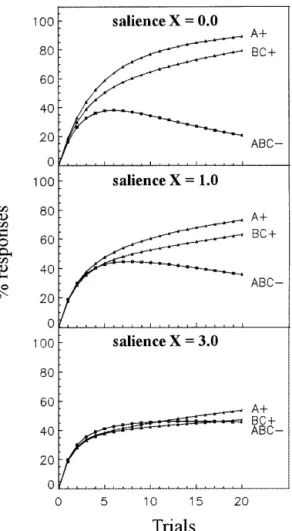
In the A+, BC+, ABC− task, Pearce’s configural theory can-not explain summation because responding to the ABC− compound should be based on generalization of associative strength of the element A+ and the binary compound BC+. According to Pearce’s view, generalization is based on the number of elements that ABC shares with A (1/3) and BC (2/3). Responding to ABC− should therefore not exceed the level of responding to A+ or BC+. To predict summation, the configural theory has to appeal to the fact that condi-tioning always takes place in an experimental context (Pearce 1994; Aydin and Pearce 1997; Pearce et al. 1997), which can be associated with the US like any other stimu-lus. Assuming that the context (X) is present throughout the experiment, the A+, BC+, ABC− training becomes an AX+, BCX+, ABCX− training, interspersed with X−, as the con-text is present but not reinforced between trials. Pearce’s model would then predict summation for ABCX− in a rather complex way (Rescorla 1997). Shortly, during training, the configural stimuli AX+ and BCX+ develop excitatory asso-ciative strength, while X− and ABCX− develop inhibitory associative strength. At any given time, responding to ABCX− reflects its own acquired associative strength, but also excitation generalized from AX+ and BCX+ as well as inhibition generalized from X−. In comparison to Pearce’s model without context influence, more excitation will be gained from AX+ and BCX+, than will be gained from A+ and BC+, because in the former case the stimuli have more elements in common. Most importantly, the inhibitory in-fluence of the context X, which also depends on the num-ber of common elements, will be lower for ABCX− than for BCX+ and for AX+. Therefore, at one point during training, responses to ABCX− will be higher than responses to either AX+ or BCX+. Eventually, however, differentiation will lead to enough inhibitory associative strength for ABCX− so that responding to it will decrease and will be below responding to AX+ and BCX+. To visualize this fact, we carried out computer simulations of the A+, BC+, ABC− task, including a context X with different saliencies (see Fig. 3). We found that in order to reproduce the pattern of results observed in our experiment, the context X has to be more salient than the other stimuli (see Rescorla 1997 for a similar report). Varying the value of, the learning rate associated with the US (see Materials and Methods), did not qualitatively change this result.
The crucial problem with the results of this simulation is that in general the context is viewed as less salient than the conditioned stimuli (e.g., Rescorla and Wagner 1972; Rescorla 1997). In line with this statement, the contextual surrounding of a harnessed bee trained in the paradigm of olfactory conditioning of the PER has limited influence on learning of the CS. It has been shown that when context exposure outlasts reward application as in our case, it can-not lead to excitatory memories for the context (Gerber and
Menzel 2000). Furthermore, if the context would be a very salient stimulus present during CS–US pairings, then it should acquire associative strength, and thus responding to this salient context should be observable between condi-tioning trials at least at the beginning of training. This was never observed during our experiments. Therefore, in our experiments, the context can be ruled out as salient stimu-lus and can be considered as being much less salient than the olfactory stimuli. Thus, the only explanation that Pearce’s configural theory can provide to explain summa-tion has to be rejected in our case, which discards this
theory in the case of olfactory compound processing in bees.
The Modified Unique Cue Theory
Our results strongly indicate that compound processing in bees occurs according to a modified unique cue theory. Such a theory not only explains the present experiments but can also account for all our previous results on learning of olfactory compounds by honeybees (Deisig et al. 2001, 2002). It assumes that compound processing relies on the use of a unique cue like that postulated by the unique cue theory (Rescorla 1972, 1973; Whitlow and Wagner 1972), but incorporates a correction for the reduced salience of components in a mixture due to interference between them (Mackintosh 1971; James and Wagner 1980). Such interfer-ence could be related to the fact that the associative strength that a US can convey in a given conditioning trial is limited, such that all CSs have to compete for it (Revusky 1971). Interference could also be related to an attentional process. Attentional theories assume that animals have only limited attentional capacity, so that attending to one CS will decrease the attention to, and learning about, another stimulus (e.g., Sutherland and Mackintosh 1971). Finally, it could be caused by a storage problem: Stimuli could com-pete for the maintenance of information in short-term memory even if they are independently well perceived (e.g., Atkinson and Shiffrin 1968; Norman 1968; Wagner 1976).
For the honeybee, interferences between olfactory stimuli were shown at the behavioral level with the over-shadowing paradigm (Smith 1996; see above). These inter-ferences can be retraced to different levels of processing (from peripheral to central). Elemental odors might already compete at the peripheral level for receptor sites or second messenger pathways. For instance, extracellular recordings from honeybees’ placode sensillae revealed only equal or even less responding to binary compounds than to single odorants (Getz and Akers 1994). The peripheral olfactory system represents thus a nonlinear filter. At the central level, olfactory information is first processed at the level of the two antennal lobes, the primary olfactory neuropil of the bee brain. Each antennal lobe receives the information from∼60,000 olfactory receptors on each antenna via the antennal nerve. Each antennal lobe consists of 160 glo-meruli, which are the functional processing units in which synaptic interaction takes place between incoming receptor neurons, local interneurons (∼4000), and projection neu-rons (∼800), conveying information to the higher-order pro-cessing centers, the mushroom bodies. Optical imaging studies revealed that binary mixtures sometimes evoke pat-terns of glomerular activation that correspond to simple combinations of the constituent odorants (Joerges et al. 1997; Sachse and Galizia 2002). However, response inten-sities of the most responsive glomeruli showed inhibitory
Figure 3 Computer simulation of an A+ and BC+ versus ABC−
discrimination includinga contextual stimulus X of three different saliencies along20 trials. The learningrate associated with the US () was 0.2 for reinforced trials and 0.1 for nonreinforced trials. The asymptotic level of associative strength () was 100 for reinforced trials and 0 for nonreinforced trials. Each cycle contained one trial with A+, one trial with BC+, and two trials with ABC−. The sa-lience of the context stimulus was varied from 0 to 3. The upper panel shows the discrimination task in which the context had a salience of 0 (as if no context was present at all). The middle panel shows the same discrimination task includinga context with a salience of 1 (salience equal to that of the other CSs). The lower panel shows the discrimination task includinga context with a salience three times higher than that of the other CSs. Initial sum-mation to ABC− can be observed only under this condition.
mixture interactions, which are probably caused by an in-hibitory histaminergic network of local interneurons con-necting glomeruli. Although such an effect has been dem-onstrated for odorants that are very similar (hexanol, octa-nol, nonanol; see Sachse and Galizia 2002), ternary mixtures involving similar and different odorants show such inhibi-tory interactions in a more accentuated way (Joerges et al. 1997). In that sense, the interactions between stimuli as-sumed by the modified unique cue theory could be simply a consequence of the intrinsic organization of the olfactory processing network with its inhibitory components (local interneurons) at the level of the antennal lobe. In any case, both peripheral and/or central interactions between odor-ants in a mixture could provide a relevant physiological basis for the assumptions of the modified unique cue theory.
Compound Processing Theories and Animal Models
This work provides strong evidence for a modified unique cue theory in the case of olfactory conditioning of the pro-boscis extension reflex in honeybees, that is, in a training procedure that uses stimuli of the same modality (olfac-tory). To our knowledge, the present work is the first report in which intramodal stimuli were used for modified pattern-ing tasks and in which evidence is at odds with Pearce’s configural theory. Further research seems necessary to in-vestigate the reasons for the diverging results. Previous find-ings from experiments with human participants may pro-vide some valuable hints for this search. Epro-vidence from skin conductance conditioning experiments, for example, has shown that even intramodal stimuli might be processed very differently depending on their psychophysical proper-ties (Lachnit 1988). Furthermore, prior experience may also influence whether a discrimination problem is solved el-ementally or configurally (e.g., Williams and Braker 1999; K. Lober, H. Lachnit, and D.R. Shanks, in prep.; K. Lober, H. Lachnit, M. U¨ ngo¨r, and D.R. Shanks, in prep.; M. Giurfa, M. Schubert, C. Reisenman, B. Gerber, and H. Lachnit, in prep.). The degree to which these factors may influence how stimuli are processed in honeybees and in other spe-cies deserves attention in future research. Free-flying bees could be a useful model for such research. Using bees that are not restrained in their behavior allows overcoming the limitation of PER conditioning in the sense that no manifes-tation of a conditioned response is visible in the case of harnessed bees whose PER is conditioned using visual stimuli. Furthermore, because free-flying honeybees can also be trained in patterning experiments with visual com-pounds (Schubert et al. 2002) and solve such patterning problems using nonelemental strategies, a next step should be to determine which nonelemental strategy (unique cue, modified unique cue, configural) is used by bees to solve these kind of problems. Additionally, to tackle the issue of intermodal versus intramodal in the case of stimuli used for
conditioning (see above), experiments with free-flying bees using bimodal compounds (visual and olfactory) would also be possible.
MATERIALS AND METHODS Behavioral Experiments
Honeybees (Apis mellifera L.) were caught at the entrance of out-door hives at the beginning of each first experimental day. Each bee was immobilized by cooling in a freezer and then mounted into restraining harnesses such that it could only move the antennae and mouthparts, including the proboscis (Takeda 1961; Bitterman et al. 1983). Animals were then kept undisturbed in the experimental room in front of a constant airflow comparable to that of the odor-supplying device for ∼2 h. Thus, familiarization with an airflow similar to that used in training was obtained such that mechanical airflow stimulation could not act as a predictor for the US.
Then, 10 min before the training on the first experimental day, each subject was checked for intact proboscis extension reflex by touching one antenna with a toothpick imbibed with sucrose solution without subsequent feeding. Extension of the proboscis beyond a virtual line between the open mandibles was counted as PER (unconditioned response). Animals that did not show the re-flex (<5%) were discarded before the experiments. Because experi-ments were performed over two experimental days, animals were fed to satiation∼1 h after the training on experimental day 1. This prevented them from starving until the next day. Overnight, they were kept in a covered plastic box with an imbibed tissue of water (to provide a certain humidity). On the second experimental day, bees that died during the night were removed (<15%), and the remaining bees were again placed in front of the constant airflow besides the experimental device without subsequent feeding for 2 h. The handling procedure on that day was similar to that on the first day.
The unconditioned stimulus (US) was always 1.25 Msucrose solution, and the conditioned stimuli (CSs) were the three odorants limonene, 2-octanol, and methylsalicylate (Sigma). On each experi-mental day, 4 µL of pure odorant was applied onto a fresh strip of filter paper. The paper strips were placed into a 1-mL plastic sy-ringe and mounted in an odor-supplying device (Pelz et al. 1997). When the bee was placed in front of the device, it received a gentle, constant flow of clean air provided by a standard aquarium pump. Computer-driven solenoid valves (Lee Company) controlled airflow delivery. During periods of odorant delivery, the airflow was shunted through a syringe containing the odorant. In that way, a single odorant or a compound of two or three odorants was delivered to the bee. In the latter case, the valves corresponding to two or three different syringes were opened simultaneously such that the airflow arriving at the antennae of the bee contained two or three odors as a compound. An exhaust system behind the bees removed odor-loaded air. Between conditioning trials, bees were replaced in front of the small fan besides the odor-delivering de-vice.
At the beginning of each trial the subject was placed in front of the odor-supplying device for 15 sec to allow familiarization with the training situation. Thereafter, the CS was presented for 6 sec. In reinforced trials, the US onset occurred 3 sec after CS onset. Both antennae were lightly touched with a toothpick imbibed with the sucrose solution, and after proboscis extension the bee was al-lowed to feed for 3 sec. Therefore, the interstimulus interval was 3 sec, and the overlap between CS and US was also 3 sec.
Nonrein-forced trials consisted of 6 sec of CS presentation without reward. The intertrial interval was 8 min for all discrimination tasks.
During acquisition, we recorded whether a bee extended its proboscis in the 3 sec after onset of the odor (CS) and, in the case of reinforced trials, before presentation of the sucrose solution (US). Thus, in such trials the PER recorded could not have been evoked directly by the US. The criterion for the occurrence of a conditioned response was the same as for the unconditioned one (extension of the proboscis beyond a virtual line between the open mandibles) except that it should occur in response to the olfactory stimulation. Multiple responses during a CS were counted as a single PER. Animals that never or always responded during condi-tioning were discarded for the analyses of data.
Experimental Design
Experiment 1: A+/B+/C+, AB+/AC+/BC+, ABCⳮ
The design of the first experiment was adopted from Redhead and Pearce (1995). A group of 39 bees was trained in a PER condition-ing paradigm with an A+/B+/C+, AB+/AC+/BC+, ABC− discrimina-tion task. Bees received a total of 48 training trials, with 4 presen-tations of each of the single elements A+, B+, and C+; 4 presenta-tions of each of the binary compounds AB+, AC+, and BC+; and 24 presentations of the ternary compound ABC−. Thus, each element was presented twice as often without reinforcement than with reinforcement. The number of training trials for the different types of stimuli was chosen to obtain the same number (24) of reinforced and nonreinforced trials. Training was performed over 2 d. Accord-ingly, on each experimental day, single elements and binary com-pounds were presented only twice, whereas the ternary compound was presented 12 times. The sequence of CS+ and CS− trials was randomized and changed on each experimental day. The three odorants limonene, 2-octanol, and methylsalicylate were random-ized as stimuli A, B, and C. The data are presented in 4 blocks of 6 trials for the ternary compound and in 4 blocks of 3 trials for single elements and binary compounds, respectively.
Experiment 2: A+, BC+, ABCⳮ
The design of the second experiment was also adapted from Red-head and Pearce (1995). For this experiment, a group of 39 bees was trained in a PER conditioning paradigm with an A+, BC+, ABC− discrimination task. Bees received a total of 24 training trials with 6 presentations of the single element A+, 6 presentations of the binary compound BC+, and 12 presentations of the ternary com-pound ABC−. The number of training trials for the different types of stimuli was chosen to obtain the same number (12) of reinforced and nonreinforced stimulus presentations. To match the experi-mental circumstances of Experiment 1, training was performed over 2 d with an intertrial interval of 8 min. Accordingly, on each experimental day, the single element and the binary compound were each presented 3 times, whereas the ternary compound was presented 6 times. The sequence of CS+ and CS− trials was ran-domized and changed on each experimental day. The three odor-ants limonene, 2-octanol, and methylsalicylate were randomized as stimuli A, B, and C. The data are presented in 6 blocks of 2 trials for the ternary compound and in 6 one-trial blocks for the single ele-ment and the binary compound.
In both experiments, 16 bees were trained at the same time. After discarding bees that died overnight and bees that responded always or never during the whole training, an average of 11 bees were trained per day. Accordingly, 4 × 2 d (= 8 d) were necessary to train the bees in each experiment.
Simulations
Simulations including a context stimulus (X) were performed for the second discrimination task (A+, BC+, ABC−). As the influence of the experimental context may qualitatively change the predic-tions of Pearce’s configural theory, we performed simulapredic-tions in-cluding a context stimulus X to which we assigned different salien-cies. All simulations were performed with the interactive data lan-guage (IDL, Research Systems) using the following equation:
⌬V =  * [ − (V + v)]
where⌬V is the change in associative strength of a stimulus,  is the learning rate associated with the US, V is the associative strength of a stimulus (E in Pearce’s formulations), and v is the associative strength that generalizes to a pattern as a consequence of conditioning with other patterns. For all simulations, was 0.2 on reinforced trials and 0.1 for nonreinforced trials, and was 100 for reinforced trials and 0 for nonreinforced trials. To match the experimental design, each cycle for the simulation contained one trial with A+, one trial with BC+, and two trials with ABC−. Ac-cording to Pearce, saliencies of stimuli are determined by generali-zation; thus, similarity factors (e) were assigned accordingly.
Data Transformation and Statistical Analyses We measured the percentage of conditioned responses (% PER) separately in successive CS+ trials (omitting the randomly inter-spersed CS− trials) and in successive CS− trials (omitting the ran-domly interspersed CS+ trials). For all groups, repeated-measure analyses of variance (ANOVAs) were used to analyze the data. Al-though ANOVA is usually not allowed in case of dichotomous data such as those of the PER, Monte Carlo studies have shown that it is permissible to use it under certain conditions (Lunney 1970), which were met by the two experiments reported here. Where necessary, Newman-Keuls tests were used to perform post hoc comparisons. The␣ level was set to 0.05 for all analyses.
ACKNOWLEDGMENTS
We thank Randolf Menzel for encouragement and valuable support. This work was supported by grants of the National German Science Foundation (DFG) to H.L. (DFG La 564/10-1, DFG La 564/10-3, DFG La 564/12-1, and DFG La 564/12-3) and Randolf Menzel (DFG Me 365/23-1) and by grants of the Programme Action Cognitique of the French Research Agency, the Fondation pour la Recherche Me ´di-cale (France), and the Human Frontier Science Program to Martin Giurfa.
The publication costs of this article were defrayed in part by payment of page charges. This article must therefore be hereby marked “advertisement” in accordance with 18 USC section 1734 solely to indicate this fact.
REFERENCES
Atkinson, R. and Shiffrin, R. 1968. Human memory: A proposed system and its control processes. In The psychology of learning and motivation: Advances in research and theory (ed. K. Spence ), Vol. 2, pp. 89–195. Academic Press, New York, NY.
Aydin, A. and Pearce, J.M. 1997. Some determinants of response summation. Anim. Learn. Behav. 25: 108–121.
Bahc¸ekapili, H.G. 1997. “An evaluation of Rescorla and Wagner’s elemenistic model versus Pearce’s configural model in discrimination learning.” Ph.D thesis. Yale University, New Haven, CT.
Bitterman, M.E., Menzel, R., Fietz, A., and Scha¨fer, S. 1983. Classical
conditioning of proboscis extension in honeybees (Apis mellifera). J. Comp. Psychol. 97: 107–119.
Deisig, N., Lachnit, H., Giurfa, M., and Hellstern, F. 2001. Configural olfactory learning in honeybees: Negative and positive patterning discrimination. Learn. Mem. 8: 70–78.
Deisig, N., Lachnit, H., and Giurfa, M. 2002. The effect of similarity between elemental stimuli and compounds in olfactory patterning discriminations. Learn. Mem. 9: 112–121.
Gerber, B. and Menzel, R. 2000. Contextual modulation of memory consolidation. Learn. Mem. 7: 151–158.
Getz, W.M. and Akers, R.P. 1994. Honeybee olfactory sensilla behave as integrated processing units. Behav. Neural Biol. 61: 191–195. James, J.H. and Wagner, A.R. 1980. One-trial overshadowing: Evidence of
distributive processing. J. Exp. Psychol. Anim. Behav. Proc.
6: 188–205.
Joerges, J., Küttner, A., Galizia, C.G., and Menzel, R. 1997. Representations of odors and odor mixtures visualized in the honeybee brain. Nature
387: 285–288.
Kehoe, E.J. 1986. Summation and configuration in conditioning of the rabbit’s nictitating membrane response. J. Exp. Psychol. Anim. Behav. Proc. 12: 186–195.
Kinder, A. and Lachnit, H. 2003. Similarity and discrimination in human Pavlovian conditioning. Psychophysiology 40: 226–234.
Lachnit, H. 1988. Convergent validation of information processing constructs with Pavlovian methodology. J. Exp. Psychol. Hum. Percept. Perform. 14: 143–152.
Lunney, G.H. 1970. Using analysis of variance with a dichotomous dependent variable: An empirical study. J. Educat. Meas. 7: 263–269. Mackintosh, N.J. 1971. An analysis of overshadowing and blocking. Quart.
J. Exp. Psychol. 23: 118–125.
Myers, K.M., Vogel, E.H., Shin, J., and Wagner, A.R. 2001. A comparison of the Rescorla-Wagner and Pearce models in a negative patterning and a summation problem. Anim. Learn. Behav. 29: 36–45.
Norman, D.A. 1968. Toward a theory of memory and attention. Psychol. Rev. 75: 522–536.
Nu´n˜ez, J.A. 1966. Qualitative Beziehungen zwischen den Eigenschaften von Futterquellen und dem Verhalten von Sammelbienen. Z. vergl. Physiol. 53: 142–164.
Pavlov, I. 1927. Conditioned reflexes. Oxford University Press, Oxford, UK.
Pearce, J.M. 1987. A model for stimulus generalization in Pavlovian conditioning. Psychol. Rev. 94: 61–73.
. 1994. Similarity and discrimination: A selective review and a connectionist model. Psychol. Rev. 101: 587–607.
Pearce, J.M. and Bouton, M.E. 2001. Theories of associative learning in animals. Ann. Rev. Psychol. 52: 111–139.
Pearce, J.M. and Redhead, E.S. 1993. The influence of an irrelevant stimulus on two discriminations. J. Exp. Psychol. Anim. Learn. Proc.
19: 180–190.
Pearce, J.M., Aydin, A., and Redhead, E.S. 1997. Configural analysis of summation in autoshaping. J. Exp. Psychol. Anim. Behav. Proc.
23: 84–94.
Pelz, C., Gerber, B., and Menzel, R. 1997. Odorant intensity as a determinant for olfactory conditioning in honeybees: Roles in discrimination, overshadowing and memory consolidation. J. Exp. Biol.
200: 837–847.
Reberg, D. 1972. Compound tests for excitation in early acquisition and after prolonged extinction of conditioned suppression. Learn. Mot.
3: 246–258.
Redhead, E.S. and Pearce, J.M. 1995. Stimulus salience and negative patterning. Q. J. Exp. Psychol. 48B: 67–83.
Rescorla, R.A. 1972. “Configural” conditioning in discrete-trial bar pressing. J. Comp. Physiol. Psychol. 79: 307–317.
. 1973. Evidence for unique stimulus account of configural conditioning. J. Comp. Physiol. Psychol. 85: 331–338.
. 1997. Summation: Assessment of a configural theory. Anim. Learn. Behav. 25: 200–209.
Rescorla, R.A. and Coldwell, S.E. 1995. Summation in autoshaping. Anim. Learn. Behav. 23: 314–326.
Rescorla, R.A. and Wagner, A.R. 1972. A theory of Pavlovian conditioning: Variations in the effectiveness of reinforcement and
non-reinforcement. In Classical conditioning. II. Current research and theory (eds. A.H. Black and W.F. Prokasy), pp. 64–99. Appleton-Century-Crofts, New York, NY.
Revusky, S. 1971. The role of interference in association over delay. In Animal memory (eds. W.K. Honig and P.H.R. James), pp. 155–213. Academic Press, New York.
Rowe, C. 1999. Receiver psychology and the evolution of multicomponent signals. Anim. Behav. 58: 921–931.
Sachse, S. and Galizia, C.G. 2002. Role of inhibition for temporal and spatial odor representation in olfactory output neurons: A calcium imaging study. J. Neurophysiol. 87: 1106–1117.
Schubert, M, Lachnit, H., Francucci, S., and Giurfa, M. 2002. Nonelemental visual learning in honeybees. Anim. Behav. 64: 175–184.
Smith, B.H. 1996. The role of attention in learning about odorants. Biol. Bull. MBL 191: 76–83.
Sutherland, N.S. and Mackintosh, N.J. 1971. Mechanisms of animal discrimination learning. Academic Press, New York, NY. Takeda, K. 1961. Classical conditioned response in the honey bee. J.
Insect Physiol. 6: 168–179.
Wagner A.R. 1976. Priming in STM: An information-processing mechanism for self-generated or retrieval-generated depression in performance. In Habituation: Perspectives from child development, animal behavior, and neurophysiology (eds. T.J. Tighe and R.N. Leaton), pp. 95–128. Erlbaum, Hillsdale, NJ.
Whitlow, J.W. and Wagner, A.R. 1972. Negative patterning in classical conditioning: Summation of response tendencies to isolable and configural components. Psychon. Sci. 27: 299–301.
Williams, D.A. and Braker, D.S. 1999. Influence of past experience on the coding of compound stimuli. J. Exp. Psychol. Anim. Behav. Proc.
25: 461–474.