UNIVERSITÉ DE MONTRÉAL
TARGET ALLOCATION UNDER UNCERTAINTY DURING THE VEHICLE
DEVELOPMENT PROCESS
ABDERRAHIM CHOKRI
DÉPARTEMENT DE GÉNIE MÉCANIQUE ÉCOLE POLYTECHNIQUE DE MONTRÉAL
THÈSE PRÉSENTÉE EN VUE DE L’OBTENTION DU DIPLÔME DE PHILOSOPHIAE DOCTOR
(GÉNIE MÉCANIQUE) AOÛT 2011
UNIVERSITÉ DE MONTRÉAL
ÉCOLE POLYTECHNIQUE DE MONTRÉAL
Cette thèse intitulée:
TARGET ALLOCATION UNDER UNCERTAINTY DURING THE VEHICLE DEVELOPMENT PROCESS
Présentée par : CHOKRI Abderrahim
en vue de l’obtention du diplôme de : Philosophiae Doctor a été dûment accepté par le jury d’examen constitué de :
M.FORTIN Clément, Ph.D., président
M.TRÉPANIER Jean-Yves, Ph.D., membre et directeur de recherche M.TRIBES Christophe, Ph.D., membre et codirecteur de recherche M.AGARD Bruno, Doct., membre
Dedication
To the memory of my beloved father Chokri Jilali To my mother Lannani Salha
To my wife Ilham and my son Jalal Abderrahmane To my brothers and sisters
Acknowledgements
Many people have contributed to the achievement of this thesis. They gave me help, guidance, support and encouragement during the whole course of this project.
I would to express my sincere gratitude to my advisor and tutor Pr. Dr. Jean-Yves Trépanier who gave me the chance to study with him in École Polytechnique, guide me through my research and my dissertation. His continuous guidance has helped me to grow intellectually and personally since I came to his laboratory.
I give my special thanks to my co-advisor, Dr. Christophe Tribes, who give help and support during the entire project. His expertise and his friendly coaching were a major asset in this research. His enthusiasm was a great encouragement in my work.
I owe my thanks to Dr. Peter Fenyes and Dr Stacey Gu. This achievement would not be possible without their precious support, help, guidance and contribution.
I thank Dr. John Cafeo, Dr. Artemis Kloess, Dr. Jean Ruth, Dr. Joe Donndelinger (GM R&D Center, Vehicle Development Research Lab, Michigan, USA) and Professor J. B. Yang (Manchester School of Management) for their constructive comments and suggestions.
I also tank my colleagues in the laboratory for their kindness, help, support and encouragement. The last but not the least, I would like to thank my lovely wife for her devotion, support, endurance and all her love during the whole course of my PhD.
I greatly acknowledge the financial support provided by General Motors of Canada and the Natural Sciences and Engineering Research Council of Canada for this work.
Résumé
L’industrie automobile est l’une des plus concurrentielles où les besoins des consommateurs et la technologie sont en changement perpétuel. Pour être compétitif dans ce marché, les constructeurs automobiles ont adopté une stratégie orientée clients où ils enquêtent en permanence sur les besoins des consommateurs pour déceler le plus tôt possible les performances désirées des futurs véhicules, concevoir et commercialiser des voitures innovatrices qui permettent de combler les attentes des consommateurs.
Le développement d’un nouveau véhicule suppose la traduction des performances utopiques, qui peuvent être définies par le département de marketing, dans des cibles pour les caractéristiques ingénieurs de ses composantes. Cette approche nécessite lors de la conception du véhicule de prendre des décisions critiques qui peuvent influencer considérablement la compétitivité et la profitabilité de la compagnie.
Pendant les premières étapes du processus de développement des véhicules (PDV), les ingénieurs manquent souvent d’informations précises et complètes qui peuvent leurs permettre de prédire les possibilités de rencontrer les performances utopiques du véhicule en question, et ce, à cause de plusieurs facteurs (technologiques, régulation et règlementation, ressources, etc.). Pour cette raison, l’identification, la quantification et la gestion des incertitudes inhérentes aux différentes phases du PDV sont devenues un problème majeur dont dépend l’efficacité du PDV.
La présente étude propose une méthodologie pour l’allocation des cibles et pour la prise de décision sous incertitudes durant le processus de développement des véhicules. La méthode commence par la décomposition du nouveau véhicule en une structure hiérarchique à multi-niveaux. Cette structure représente l’élément de base pour la définition du modèle de véhicule à multi-niveaux (MVM). Nous avons considéré qu’une ou plusieurs caractéristiques ainsi que leurs cibles peuvent être associées à chaque composante du MVM, et ce, en concordance avec les performances utopiques du véhicule. Les opinions des experts sont exprimées avec des incertitudes inhérentes à la faisabilité de chaque cible. Les opinions des experts sont données sous forme de distributions de probabilité ou d’ensembles d’intervalles associés à des crédibilités subjectives pour les valeurs possibles des caractéristiques. Ces opinions sont ensuite agrégées et propagées depuis les feuilles vers le sommet du modèle. La théorie des Évidences a été utilisée pour exprimer les incertitudes sous forme de deux mesures: la crédibilité et la plausibilité. En
utilisant ces informations, deux mesures concernant la désirabilité et la réalisabilité des caractéristiques ont été définies. Une approche pour l’allocation des cibles sous incertitudes dans le modèle du véhicule à multi-niveaux basée sur la maximisation des mesures de réalisabilité et désirabilité des caractéristiques est proposée.
Une méthode pour traiter les systèmes grands et complexes a été développée. Cette méthode consiste à réduire le nombre d’intervalles traités par leur fusion en contrôlant la granularité d’information, et ce, sans altérer les courbes de crédibilité et de plausibilité sur un ensemble discret de points. Cette méthode permet d’alléger la quantité des calculs et ainsi diminuer le temps nécessaire.
Un système de prise de décision basé sur l’intégration des techniques proposées pour la caractérisation des incertitudes et l’allocation des cibles dans le MVM est proposé. Ce système consiste à modéliser le processus de conception sous la forme d'une série de processus (étape et porte) parallèles qui alternent la génération des connaissances et la prise de décision. Itérativement, les valeurs des caractéristiques sont raffinées de manière à orienter le processus de conception vers un produit final désirable et réalisable.
Le fait d'inclure les incertitudes lors des processus d'allocation des cibles et de prise de décision durant le PDV présente des avantages potentiels pour les constructeurs automobiles. En fait, dans le cas de la conception de véhicule sous certitude, les caractéristiques du véhicule et de ses composantes sont supposées être connues à l'avance. Dans ce cas, le processus de conception se limite au choix d'une solution parmi un certain nombre de solutions déjà connues. Un tel processus peut donner naissance à des conceptions peu fiables qui ont été poussées à leurs limites en matière de fabrication, modélisation et conception. Conséquemment, l'équipe de conception peut manquer l'opportunité d’améliorer le produit au niveau désiré suite à la non-exploration de toutes les possibilités offertes, de satisfaire les attentes des clients et de rencontrer les objectifs de la compagnie. En contrepartie, inclure les incertitudes dans les processus d'allocation des cibles et de prise de décision implique l'exploration de nouvelles possibilités, la collecte de plus d'information et le développement de nouvelles connaissances. Cela mènera à de nouveaux concepts, de nouvelles conceptions et de nouvelles technologies qui permettront de combler les attentes des clients et en même temps l'atteinte des objectifs de la compagnie.
En conclusion, le présent travail représente un pas vers la formulation d'une méthodologie intégrée qui tient compte des incertitudes durant le PDV. Les méthodologies pour la caractérisation des incertitudes, l'allocation des cibles et la prise de décision sous incertitudes ont été développées pour la conception des systèmes complexes. Puisque le PDV est seulement une application spécifique du système préposé, ce denier peut être directement appliqué à n'importe quel secteur d'ingénierie concerné par le développement des systèmes complexes comme les industries aéronautique, aérospatiale et navale.
Abstract
Under the increasing pressure of the evolving customers’ expectations, the speed and competitiveness of the competitors, automakers have become customer-oriented. They continuously survey the customers’ needs in order to early identify the desired or utopian vehicle performances and strive to fulfill these expectations by designing and marketing quickly new innovative products. The development of a new vehicle supposes the translation of the vehicle performances into its components’ characteristics. Such approach requires making critical design decisions that can impact noticeably the competitiveness and profitability of the company.
In the early stages of the vehicle development process, the engineers lack precise and complete information about the possibility to meet the initial utopian vehicle performances due to many factors (technological, regulation, resources, etc.). For that reason, identifying, quantifying and handling the inherent uncertainty throughout the vehicle development process (VDP) became a serious issue, which affects the effectiveness of the design process.
This study proposes a methodology for target allocation and decision-making under uncertainty during the VDP. The method starts by the decomposition of the vehicle in hierarchical multilevel structure, which represents the basic framework required for the definition of the vehicle multilevel model (VMM). We have considered that each component in the VMM may have several characteristics, and that a target is defined for every component and characteristic in accordance with the utopian vehicle performances. Experts’ opinions are expressed with uncertainty regarding the feasibility of achieving each target. Experts’ opinions are given in the form of probability distributions or intervals associated with their subjective beliefs for the possible values of the characteristics and then are aggregated and propagated from the leaf nodes of the multilevel model up to the vehicle level. Evidence theory has been used to express uncertainty in the form of belief and plausibility measures. Using this information, two measures regarding the desirability and the achievability of the characteristics are defined. An approach for targets allocation under uncertainty based on the maximization of achievability and desirability measures of the characteristics is proposed and discussed.
A methodology to handle large-scale problem based on the merging of intervals by the control of the information granularity without affecting the precision of the belief and plausibility measures is presented.
A decision-making framework based on the integration of both exposed techniques for uncertainty characterization and target allocation under uncertainty in the vehicle multilevel model is proposed. This framework consists in modeling the design process in the form of a series of parallel stage-gate processes that alternate knowledge generation and decision-making. Iteratively the characteristics are set and refined in such a way to orient the design process towards an achievable and desirable final design.
In brief, including uncertainty in target allocation and decision-making processes presents many potential benefits to the automakers. In fact, in the case of vehicle design under certainty, the characteristics of the vehicle and its components are supposed to be known with certainty and the design process is restricted to only a choice among few existing alternatives. Such approach may yield unreliable designs that are pushed to the limits of design constraints boundaries. Consequently the design team may miss the opportunity: to improve the design to a desired level because of lack of exploration of all offered possibilities, to satisfy the customers' expectations and to meet the company's goals. In return considering uncertainty in targets allocation and decision-making processes implies exploring new possibilities, collecting more information and developing new knowledge that leads to new concepts, new designs and technologies allowing at best the fulfilment of the customers' needs and the attainment of the company's objectives.
In conclusion, the present work represents a step in the formulation of an integrated methodology to take into account uncertainty during the early stages of the vehicle development process. The proposed methodologies and the approaches for uncertainty management, target allocation under uncertainty and decision-making under uncertainty were developed for the design of complexes systems. Since, the VDP is only a specific application of the proposed systems. This later can be directly applied to any engineering field concerned by the development of complex system such as aeronautical, aerospace and naval industries.
Condensé en français
Introduction
Dans le monde de l’industrie automobile, le développement d’un nouveau véhicule qui satisfait les besoins des consommateurs passe par un processus itératif et complexe dit processus de développement des véhicules (PDV) visant à combler les attentes des clients. Ce processus alterne deux activités principales: la génération des connaissances et la prise de décision.
Au début du PDV, le nouveau véhicule est modélisé sous forme d’un modèle de véhicule à multi-niveaux (MVM) où il est décomposé en systèmes, sous-systèmes et pièces. La décomposition du véhicule peut être étendue à plusieurs niveaux dépendamment des besoins des concepteurs. Un ensemble de caractéristiques du véhicule désirées et leurs estimations définissent les objectifs utopiques du processus de conception. Ces caractéristiques sont passées à l’équipe de conception qui a pour première tâche de les traduire sous forme de cibles pour les caractéristiques ingénieurs aux niveaux des systèmes, sous-systèmes et pièces du véhicule. Les cibles des caractéristiques servent à guider l’équipe de conception et à orienter le processus de conception vers les niveaux les plus désirables qui peuvent être réalisés. L’allocation des cibles des caractéristiques de chaque composante du véhicule doit être consistante avec les caractéristiques du véhicule et doit respecter les couplages et les contraintes entre les systèmes, sous-systèmes et pièces.
À chaque itération du PDV, pour prendre des décisions cruciales qui influencent la valeur du nouveau véhicule, il est nécessaire de collecter des informations pertinentes au niveau des feuilles du MVM sous forme des opinions des experts. En fait, les experts ont le contrôle seulement sur les caractéristiques ingénieurs qui représentent les spécifications techniques des composantes du véhicule. Les caractéristiques véhicules sont obtenues par la combinaison des caractéristiques ingénieurs à travers des fonctionnelles.
Les opinions des experts sont générées en fonction des cibles, du niveau de progrès réalisé pendant les itérations précédentes du PDV et l'ensemble des connaissances disponibles. En fait, les experts basent leurs opinions sur une grande variété de sources d’information (analyse des résultats numériques de modèles mathématiques avec différents niveaux de fidélité, données historiques des véhicules actuels ou passés, étude comparative des véhicules des concurrents, objectifs d’amélioration des performances du véhicule).
Les opinions des experts sont aussi caractérisées par des incertitudes provenant de plusieurs sources à savoir: les variables aléatoires de conception, le manque d’information concernant l’évolution technologique et les processus de fabrication, les spécifications incomplètes des composantes et les interactions entre elles.
Les opinions des experts sont générées de façon relativement indépendante en considérant les cibles fournies à tous. Les cibles sont raffinées et les couplages entre les caractéristiques des composantes sont résolus itérativement en favorisant les compromis pour des conceptions désirables et réalisables.
Comme mentionné précédemment, l’incertitude est inévitable tout au long du PDV et affecte grandement la réalisabilité des projets de conception. De ce fait, l’efficacité du PDV dépend du niveau de son contrôle. Puisque les compagnies sont en recherche continuelle de nouvelles méthodes de développement pour faire face à la concurrence, l’incertitude est devenue un problème majeur durant le processus de conception. Tenir compte des incertitudes présente une opportunité de gérer les risques associés à la réalisabilité et la considération ou le rejet des solutions possibles en se basant sur cette mesure et la valeur ajoutée du produit.
Dans le présent projet, nous allons étudier les sujets suivants : les méthodologies de caractérisation des incertitudes, l’allocation des cibles et la prise de décision sous incertitudes durant le PDV. Nous allons développer une méthodologie pour l’allocation des cibles des spécifications du niveau de véhicule vers les niveaux les plus bas du MVM (systèmes, sous-systèmes et pièces) et nous allons développer une stratégie pour la prise de décision. Ceux-ci vont inclure une méthodologie spécifique pour la prise en compte des incertitudes inhérentes à l’avancement du processus de développement.
Axe de recherche
Cette recherche vise le développement d'une approche capable d'inclure les incertitudes durant le processus de conception des systèmes complexes. Cela est dans le but d'investiguer l’intérêt et l'impact de l'inclusion des incertitudes dans le processus de conception. L'évaluation des bienfaits et de l'impact de l'inclusion des incertitudes nécessite l'application de l'approche proposée à un produit réel et puisque seulement de simples exemples ont été utilisés, cette évaluation est
considérée hors étendue du projet. Cependant, des observations préliminaires sur l’intérêt et l’impact de l’inclusion des incertitudes sur le processus de conception vont être présentés.
Objectifs
L'objectif principal de ce projet est le développement d'une méthodologie pour l'allocation des cibles sous incertitudes comme composante d'un processus de prise de décision. Pour cela, trois objectifs spécifiques ont été identifiés :
1. Définition, implémentation et validation d’une approche pour caractériser les incertitudes. 2. Définition, implémentation et validation d'une méthodologie pour l'allocation des cibles
sous incertitudes.
3. Proposition d'une stratégie de prise de décision pour l'allocation des cibles durant les itérations du processus de conception.
Dans le contexte de ce projet, l'approche proposée sera supportée par le processus de développement des véhicules. Conséquemment une terminologie spécifique reliée au processus de développement des vehicules sera utilisée.
Méthodologie
Cette thèse comporte six chapitres et quatre annexes qui traitent des objectifs susmentionnés. Deux de ces chapitres sont des articles de journal soumis avec leur propre résumé, introduction, recherche de littérature, méthodologie, résultats, discussion et liste de références. Suite à ces chapitres, une discussion et une conclusion générale concernant la réussite des objectifs ainsi qu'un certain nombre de recommandations pour des études futures sont présentés.
La liste des articles soumis au cours de ce doctorat considéré pour la publication sont:
A. Chokri, J-Y. Trépanier, C. Tribes, P. Fenyes, and S. Gu, “Managing uncertainty in a multi-characteristic vehicle multilevel model," Journal of Computing and Information Science in Engineering, (Soumis le 10 Décembre 2010).
A. Chokri, J-Y. Trépanier, C. Tribes, P. Fenyes, and S. Gu, " Target allocation under uncertainty in a multi-characteristic vehicle multilevel model," Journal of Computing and Information Science in Engineering, (Soumis le 20 Décembre 2010).
Un autre article de conférence élaboré en collaboraiom avec Dr. Christophe Tribes est présenté sous forme d’annexe D.
C. Tribes, A. Chokri, J-Y. Trépanier, P. Fenyes, and S. Gu, " Propagation and Merging of Uncertain Expert Opinions in a Hierarchical Multilevel System,"AIAA MDO Conference 2010, FortWork, Texas, USA.
Contributions et discussion
Comme il a été mentionné auparavant, l'objectif principal du projet est le développement d'une méthodologie pour l’allocation des cibles et pour la prise de décision sous incertitudes, et ce, dans le but de supporter le processus de développement des nouveaux véhicules. Nous présumons que la réalisation de ces objectifs va permettre d’améliorer l’efficacité du processus de conception. En fait, la méthodologie proposée va orienter le processus de conception en identifiant tôt les meilleurs compromis réalisables. De cette manière, les erreurs vont être évitées et le retravail épargné. De plus, la méthodologie est supposée aider à distinguer entre les composantes les plus difficiles à réaliser de celles qui ne le sont pas. Sous réserve d’ajouter une composante pour l’allocation des ressources à la méthodologie proposée, cette méthode pourrait aider à mieux allouer les ressources de manière équilibrée pour maximiser les possibilités de réalisation de toutes les composantes.
Pour répondre aux objectifs susmentionnés, nous avons été amenés à examiner les sujets suivants: la caractérisation des incertitudes durant le processus de conception, l'allocation des cibles sous incertitude, la prise de décision sous incertitude.
Caractérisation des incertitudes durant le processus de conception
La méthode proposée pour la caractérisation des incertitudes est basée sur le principe de décomposition du véhicule en une structure hiérarchique qui constitue le squelette du modèle de véhicule à multi-nivaux (MVM). Au niveau supérieur du modèle, les performances utopiques du véhicule sont définies puis cascadées sous la forme de caractéristiques ingénieurs vers les niveaux inférieurs des systèmes, sous-systèmes et pièces. Au niveau des feuilles du modèle, les experts expriment leurs opinions sous la forme de groupes d’intervalles et des crédibilités associées. Cette manière d’expression est une représentation naturelle de l’expérience et des prévisions des experts leur permettant d’inclure différents types d’incertitude sans aucun besoin
de les distinguer. La théorie des Évidences a été choisie et utilisée pour l’agrégation et la propagation des incertitudes dans le MVM. En fait, cette théorie permet de gérer des données sous forme d’intervalles ou de distributions de probabilités. De plus, elle permet aussi de tenir comptes des conflits entre les opinions des experts.
Allocation des cibles sous incertitudes
Le processus d’allocation des cibles sert à propager des spécifications désirables au niveau du véhicule à tous les niveaux du MVM. Notre approche pour l’allocation des cibles consiste à représenter le véhicule sous forme d’un système de prise de décision qui sera dirigé par des objectifs mesurables et des contraintes vis-à-vis aux spécifications du véhicule.
La méthodologie proposée d’allocation des cibles consiste à maximiser la désirabilité et la réalisabilité des caractéristiques. La réalisabilité des caractéristiques est basée sur les mesures de plausibilité et de crédibilité qui sont déterminées à partir des opinions des experts propagés dans le MVM.
Plusieurs approches pour l’allocation des cibles basées sur la désirabilité et la réalisabilité des caractéristiques ont été présentées dans la référence (Chokri, A. et coauteurs, 2009). Cependant, seulement la formulation utilisant un objectif unique (Global Utility of Design) a été appliquée dans ce projet. Les autres approches peuvent présenter des opportunités pour supporter les processus de développement des nouveaux produits pour un éventail de compagnies qui ont des cultures d’entreprise très distinctes. Par conséquent, l’exploration des autres approches présente une bonne avenue pour des recherches futures.
Prise de décision sous incertitude durant le processus de conception
La stratégie de prise de décision sous incertitude consiste à modéliser le processus de développement du véhicule sous la forme d’une série de processus (étape/porte), un processus pour chaque composante du produit. Ces processus alternent la génération de la connaissance et la prise de décision. Le système proposé pour la prise de décision intègre les méthodologies de caractérisation des incertitudes et d’allocation des cibles sous incertitude. D’une manière itérative, les cibles des caractéristiques sont raffinées de manière à orienter le processus de développement vers un produit final désirable et réalisable.
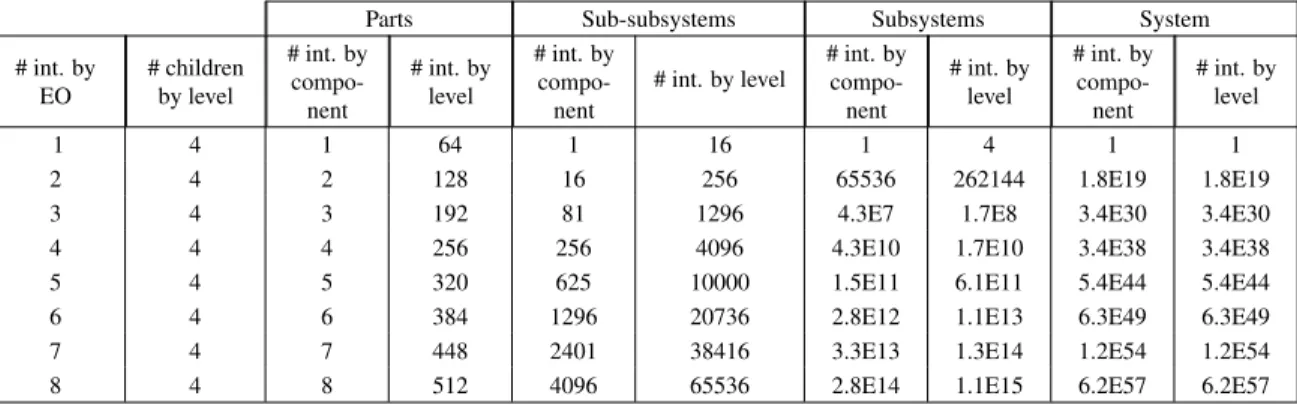
Lors de la conception des systèmes grands et complexes (taille de véhicule réel), la quantité d'information fournie par les experts et propagée dans le modèle à multi-niveaux peut devenir rapidement énorme au point qu’il serait difficile voir impossible de la traiter avec les moyens disponible. Par exemple dans un modèle à multi-niveaux constitué de 7 systèmes, 42 sous-systèmes et 252 pièces; le nombre d'intervalles propagés au niveau du véhicule est de 2.89e76 si seulement 2 intervalles sont collectés par pièce. Ce nombre passera à 1.71e120 si 3 intervalles sont collectés par pièce.
Dans ce cas, la stratégie proposée pour traiter de tel problème consiste dans la réduction du nombre des intervalles propagés en les fusionnant tout en contrôlant la granularité de l’information, et ce, sans altérer les mesures de plausibilités et de crédibilités sur un certain nombre de points.
Conclusion et recommandations
Cette étude a permis d’adresser le problème d’inclusion des incertitudes dans le processus de développement des nouveaux véhicules. Elle couvre le management des incertitudes, l’allocation des cibles sous incertitude, la prise de décision sous incertitude et l’intégration de l’ensemble de ces concepts dans un seul système qui va supporter le processus de développement des véhicules chez GM.
Le présent travail constitue un pas vers la formulation d’une méthodologie intégrée qui tient compte des incertitudes dans les premières étapes du processus de développement des véhicules. Il est constitué de trois contributions principales.
La première contribution concerne le développement d’une méthodologie pour caractériser les incertitudes. La méthode consiste à représenter le véhicule sous la forme d’un modèle à multi-niveaux ou les cibles des caractéristiques sont cascadées dans le modèle. Des experts aux multi-niveaux des feuilles du modèle fournissent leurs opinions en fonction de la faisabilité des cibles sous forme d’intervalles associés à leur crédibilité subjective. Ces opinions sont agrégées et propagées du bas vers le haut du modèle. La théorie des Évidences a été utilisée pour propager les mesures de plausibilité et de crédibilité.
La deuxième contribution se rapporte au développement d’une méthodologie pour l’allocation des cibles sous incertitudes. Cette méthodologie utilise les mesures de plausibilité et crédibilité.
Deux nouvelles mesures de désirabilité et réalisabilité des caractéristiques sont introduites. La réalisabilité est définie à partir des mesures de plausibilité et crédibilité. L’approche pour l’allocation des cibles sous incertitudes « GUD » est basée sur la maximisation de la désirabilité et la réalisabilité du produit final. Elle consiste à cascader des problèmes d’optimisation du haut vers le bas permettant ainsi de définir les cibles des caractéristiques.
La troisième contribution concerne le développement d’un système de prise de décision qui intègre les méthodologies de management d’incertitude et d’allocation des cibles. Le processus de prise de décision a été modelé sous forme d’une série de processus parallèles (étape-porte) qui alterne itérativement la génération de connaissance et la prise de décision.
Une contribution additionnelle a été élaborée en collaboration avec Dr. Christophe Tribes visant le développement d’une méthodologie permettant de traiter les systèmes grands et complexes. La méthode consiste à la réduction du nombre des intervalles propagés en les fusionnant tout en contrôlant la granularité de l’information, et ce, sans altérer les mesures de plausibilités et de crédibilités sur un certain nombre de points.
Les méthodologies proposées pour le management des incertitudes, l’allocation des cibles sous incertitudes et de prise de décision sous incertitude ont été développées sous un angle général que l’on peut appliquer à la conception de toute sorte de système complexe provenant d’autres domaines d’ingénierie tel que l’aéronautique, l’aérospatiale et le naval, etc.
Notre méthodologie peut être étendue pour contenir d’autres concepts dont nous n’avons pas traité dans cette thèse. Dans le cadre des travaux futurs, nous recommandons d'adresser les sujets suivants:
• Exploration d'autres moyens pour orienter le processus de conception basé sur l'approche proposée via d'autres paramètres tel que le facteur de prise de décision qui représente la tolérance au risque lors des décision d'allocation des cibles.
• Les opinions des experts sous la forme d'intervalles et des crédibilités associés est une manière simplifiée pour représenter les connaissances des experts. Cette représentation est purement quantitative supposant que les experts sont capable de quantifier n'importe qu'elle information même leurs visions ou sentiments. La quantification de ce type d'information implique sa distorsion et la perte de sa qualité
ce qui pourra mener à des conceptions non satisfaisantes. De ce fait, l'investigation de nouvelles manières de représentation des opinions des experts pourrait mener à de meilleures conceptions.
• L'allocation des ressources sous incertitude doit être investiguée dans le but de développer une méthodologie basée sur un modèle mathématique qui supporte la méthodologie de prise de décision proposée et remplace les méthodes d'allocation des ressources qui sont basées sur les estimations et l'expérience.
• Explorer la possibilité de supporter des opinions d'experts qui sont fournis par des modèles d'analyses ou l'incertitude est complètement probabiliste. Cela va permettre l'intégration de la méthodologie proposée et les outils d'analyse existants et de la comparer avec les méthodes existantes.
Table of contents
Dedication ... iii Acknowledgements ... iv Résumé ... v Abstract ... viii Condensé en français ... xTable of contents ... xviii
List of tables ... xxiii
List of figures ... xxiv
List of abbreviations ... xxvi
List of symbols ... xxviii
List of appendices ... xxx
Introduction ... 1
Chapter 1 Literature review ... 8
1.1 Vehicle development process ... 8
1.2 Uncertainty management... 9
1.2.1 Sources of uncertainty ... 9
1.2.2 Uncertainty definitions, classifications and representations ... 11
1.2.2.1 Ambiguity uncertainty... 12
1.2.2.2 Epistemic uncertainty ... 12
1.2.2.3 Aleatory uncertainty ... 12
1.2.3 Interaction uncertainty ... 13
1.2.4 Theories to represent and propagate uncertainty ... 13
1.2.4.2 Evidence theory ... 15
1.2.4.3 Possibility theory ... 16
1.2.4.4 Fuzzy set theory ... 17
1.2.4.5 Conclusion ... 19
1.3 Target allocation under uncertainty... 19
1.4 Decision-making strategy in the vehicle development process ... 22
1.4.1 Multi-objective optimization ... 23
1.4.2 Monitoring strategy of decision-making process ... 24
1.5 Synthesis... 24
References ... 26
Chapter 2 Research methodology ... 34
2.1 Introduction ... 34
2.2 Research Methodology ... 35
2.2.1 GM support and participation ... 44
References ... 45
Chapter 3 Managing Uncertainty in a Multi-Characteristic Vehicle Multilevel Model ... 47
3.1 Introduction ... 47
3.2 Vehicle multilevel model concepts and definitions ... 50
3.2.1 Vehicle multilevel model ... 50
3.2.2 Functional relations among characteristics ... 51
3.2.3 Targets and experts’ opinions ... 52
3.3 Uncertainty management... 53
3.3.1 Uncertainty definition and classification ... 53
3.3.3 Evidence theory ... 55
3.3.3.1 Frame of discernment ... 55
3.3.3.2 Basic belief assignment ... 55
3.3.3.3 Belief and plausibility functions ... 56
3.3.4 Aggregation of experts’ opinions ... 58
3.3.5 Incomplete or conflicting experts’ opinions ... 58
3.3.6 Uncertainty propagation ... 59
3.3.7 Managing interaction uncertainty ... 61
3.3.7.1 Effect of shared design variables ... 62
3.3.7.2 Effect of coupled characteristics ... 62
3.3.8 Application example ... 65
3.3.8.1 Propagation of a mass characteristic ... 66
3.3.8.2 Propagation of characteristics with functional relations ... 67
3.4 Conclusion ... 68
Acknowledgements ... 69
References ... 69
Chapter 4 Target Allocation under Uncertainty in a Multi-Characteristic Vehicle Multilevel Model... ... 73
4.1 Introduction ... 73
4.2 Uncertainty management in a vehicle multilevel model ... 75
4.2.1 Vehicle multilevel model (VMM) ... 75
4.2.2 Uncertain experts’ opinions ... 77
4.2.3 Uncertainty representation ... 77
4.3 Target allocation under uncertainty... 80
4.3.1 Desirability measure ... 82
4.3.2 Achievability measure ... 83
4.3.3 Global utility of design (GUD) ... 84
4.3.4 Multi-characteristic achievability (MCA) ... 85
4.3.5 Target allocation by cascading optimization ... 86
4.3.6 Independence of the characteristics ... 88
4.4 Application ... 89
4.4.1 Target allocation of the mass characteristic ... 89
4.4.2 Target allocation for multiple vehicle characteristics ... 91
4.5 Conclusion ... 93
Acknowledgements ... 94
References ... 94
Chapter 5 Validation and application ... 98
5.1 Introduction ... 98
5.2 Validation of the methodology for uncertainty management... 98
5.2.1 Problem from Sandia laboratory... 99
5.2.1.1 Evidence theory approach ... 99
5.2.1.2 Probability approach ... 102
5.2.1.3 Comparison and interpretation ... 102
5.2.2 Simple Multilevel problem ... 103
5.3 Verification of the target allocation under uncertainty methodology ... 106
5.3.1 Probabilistic formulation of target allocation ... 107
5.3.2.1 Target allocation using probability theory ... 108 5.3.2.2 Target allocation using Evidence theory ... 110 5.3.2.3 Comparison between the two methods for target allocation under uncertainty 112 5.4 Decision-making under uncertainty during the design process ... 113 5.4.1 Simulation of decision-making in the VDP ... 114 5.4.1.1 Multilevel model with a single characteristic (Mass) ... 117 5.4.1.2 Effect of the decision-making factor ... 119 5.4.1.3 Handling large-scale problem ... 120 5.4.2 Application of decision-making process under uncertainty to a multi-characteristics multilevel model ... 120 5.5 Conclusion ... 122 References ... 123 Chapter 6 General Discussion ... 124 Conclusion and recommendations ... 131 References ... 133 Appendices ... 142
List of tables
Table 3-1: Example of experts’ opinions aggregation ... 58 Table 3-2: Propagation through summation of intervals and multiplication of subjective beliefs 60 Table 4-1: Allocated mass targets for the VMM nodes ... 91 Table 4-2: Allocated targets for multiple characteristics ... 93 Table 5-1: Allocated targets by both methodologies using evidence and probability theories .. 112
List of figures
Figure 1-1: Uncertainty classification by Thunnissen [15]... 11 Figure 1-2: Hierarchical relationship among theories of uncertainty [21] ... 13 Figure 2-1: Research methodology organization chart ... 36 Figure 3-1: Example of a simplified vehicle hierarchical structure ... 49 Figure 3-2: Example of a multi-characteristic vehicle multilevel model ... 52 Figure 3-3: Belief and plausibility curves for the characteristic >x ... 57 Figure 3-4: Simple VMM to illustrate uncertainty propagation ... 59 Figure 3-5: Belief, plausibility and probability curves for without interaction... 61 Figure 3-6: Belief and plausibility curves for System 1 with and without evaluation of interaction uncertainty... 65 Figure 3-7: Simplified vehicle with functional characteristic and interaction among elements ... 66 Figure 3-8: Belief and plausibility curves for the vehicle mass... 67 Figure 3-9: Belief and plausibility curves for the vehicle acceleration characteristic ... 67 Figure 4-1: Example of vehicle multilevel model ... 76 Figure 4-2: Belief and plausibility for the mass characteristic (experts' opinions in the form of single intervals (a), sets of intervals (b) and discrete values (c)). ... 79 Figure 4-3: Stage/gate development process ... 81 Figure 4-4: Lower is better desirability function for time for acceleration characteristic ... 82 Figure 4-5: Higher is better desirability function for fuel economy characteristic... 82 Figure 4-6:Achievability/desirability compromise for “higher is better” characteristic ... 85 Figure 4-7: Achievability/desirability compromise for “lower is better” characteristic... 85 Figure 4-8: Desirability and achievability ( and ) curves for the vehicle mass characteristic ... 91 Figure 4-9: GUD ( and ) curves for the vehicle mass characteristic ... 91
Figure 4-10: GUD measure of fuel economy and time for acceleration ... 93 Figure 5-1: Sandia challenge problem ... 99 Figure 5-2: Belief, plausibility and probability representations for Sandia challenge problem . 103 Figure 5-3: Belief, plausibility and representations for Sandia challenge problem form Ref. [4]. ... 103 Figure 5-4: Simple VMM to illustrate uncertainty propagation ... 104 Figure 5-5: Coarse granularity ... 106 Figure 5-6: Medium granularity (Ndiscr=20) ... 106 Figure 5-7: fine granularity (Ndiscr =100) ... 106 Figure 5-8: Simple multilevel model with experts 'opinions in the form of set of intervals ... 108 Figure 5-9: Probability density function ... 109 Figure 5-10: Cumulative probability function of ... 109 Figure 5-11:MCPP for and ... 109 Figure 5-12: Belief, plausibility and desirability curves ... 111 Figure 5-13: GUD ( and ) curves for the vehicle mass characteristic ... 111 Figure 5-14: MCA for subsystems 1& 2 mass characteristics and ... 111 Figure 5-15: MCA for subsystems 1& 2 mass characteristics and ... 111 Figure 5-16: Stage-gate development process ... 114 Figure 5-17: Example of vehicle multilevel model ... 115 Figure 5-18: Experts' opinions for seven iterations of the VDP ... 116 Figure 5-19: Results of the VDP with a single characteristic vehicle multilevel model ... 118 Figure 5-20: Evolution of the vehicle mass target for =0 and =1 ... 119 Figure 5-21: Results of the VDP of multi-characteristics vehicle multilevel model ... 121
List of abbreviations
ATC: Analytical Target Cascading BBA: Basic Belief Assignment Bel: Belief
BPA: Basic Probability Assignment CO: Collaborative Optimization CPT: Characteristic Propagation Tree DBD: Decision-Based Design
DOM: Document Object Model EO: Expert's Opinion
GA: Genetic Algorithm GM: General Motors
GUD: Global Utility of Design HP: Horse Power
Kg: Kilogram
MAUT: Multi-Attribute Utility Theory
and : The bounds of desirability interval
MCA: Multi-Characteristic Achievability MCDA : the Multi-Criteria Decision Analysis MCS: Monte Carlo simulation
MCPP: Multi-characteristic Probability Product MDO: Multidisciplinary Design Optimization MPP: Most Probable Point
MVM: Modèle de véhicule à multi-niveaux NPD: New Product Development
NPDP: New Product Development Process PDF: Probability Density Function
PDV: Processus de Développement des Véhicules PEO: Propagated Expert's Opinion
Pl: Plausibility
QFD: Quality Function Deployment TAU: Target Allocation under Uncertainty VC: Vehicle Characteristic
VDP: Vehicle Development Process VMM: Vehicle Multilevel Model XML: Extensible Markup Language
List of symbols
: Focal element given by the experts
, , , : Achievability measures : An event
: Characteristic 'i' of the component
: Characteristic 'i' of the system 'j'
: Characteristic 'i' of the subsystem 'j' : Power characteristic of the engine
: Selected point of reference for the power characteristic of the engine : Desirability measure
: Expert Opinion of the characteristic 'i' : A functional
: Global length of the initial interval at the beginning of the VDP
: Global length of the expert opinion interval at the iteration “i” : Interval 'i'
: Lower and upper bounds of intervals
: Initial value of the kurtosis excess factor
: Kurtosis excess factor value at the iteration "it"
: Basic Belief Assignment for the focal element
: Initial maximum number of intervals that can constitute the expert's opinion.
: Propagated Expert's opinion of the engineering characteristic 'i' : Propagated Expert's opinion of the vehicle characteristic 'i'
: Shared parameter
: Subjective belief 'i'
: Target of the characteristic 'i'
: Target of the vehicle characteristic 'i' : Utility function
: Vehicle speed in (km/h)
: Fuel economy characteristic of the vehicle
: Mass characteristic of the vehicle
: Selected point of reference for the vehicle mass
Time needed to accelerate from rest to km/h
: Scaled weight assigned according to the reliability of the sources : Frame of Discernment
: Design parameter of the component
Set of the various propositions that the experts can express
: Weighting factors for the effect of variation of the engine power and the vehicle mass on the fuel economy
: Parameter equal to 1 or 0
List of appendices
Appendix A MATLAB and XML implementation ... 142 Appendix B Fundamentals of the Evidence theory ... 144 Appendix C Probability representation of uncertainty and Monte Carlo simulation ... 153 Appendix D Propagation and Merging of Uncertain Experts' opinions in Hierarchical Multilevel System... ... 163
Introduction
Context
Developing a new vehicle that satisfies consumer's needs is accomplished through a complex iterative vehicle development process (VDP) aiming the allocation of the characteristics targets and the needed resources. This process alternates knowledge generation and decision-making leading to a satisfying and feasible design.
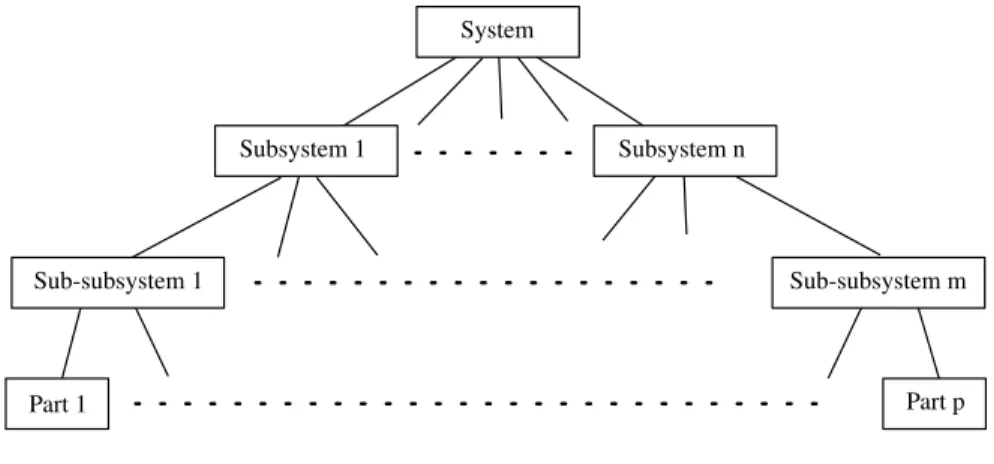
At the beginning of the VDP, the overall vehicle is modeled as a vehicle multilevel model (VMM) where it is decomposed into a number of systems. The systems are further decomposed into subsystems, which in turn are decomposed into parts and so on. Hence, the VMM can be viewed as a hierarchical tree of vehicle components. A set of desirable vehicle characteristics and their estimated values, which may be identified by the marketing department, defines the utopian goals of the design process. These characteristics values/targets are passed on to the design team, whose first task is to translate them into engineering characteristics targets for the systems, subsystems and parts. The targets serve to guide the design teams and to orient the process towards the highest desirable design that can be achieved. The target allocation for each component of the vehicle must be consistent with the vehicle characteristics and must respect the couplings and constraints among systems, subsystems and parts.
At any iteration, to make crucial decisions impacting the value of the new vehicle, the VDP requires collecting relevant information at the leaf nodes of the VMM in the form of experts’ opinions because the engineers have control only over the engineering characteristics. The latter represent the technical specifications of the vehicle components. The vehicle characteristics result from the combination of the engineering characteristics through functional relationships.
The experts’ opinions are generated depending on the targets, the progress performed in the previous iteration of the VDP and the available knowledge. In fact, the experts base their opinions on a wide variety of sources (analysis results from computer models of various levels of fidelity, historical data for current and past vehicles, benchmark of competitive vehicles and selected goals for the performance improvements). However, the experts’ opinions are tainted by uncertainty because several aspects are inherently uncertain during the design of complex systems owing to many factors such as aleatory design variables, lack of information about
evolving technologies and manufacturing processes, incomplete specification of components and interactions amongst vehicle components.
The experts’ opinions are generated independently, in the sense that each expert aims his/her own targets with limited interactions during the design progress of the other experts. Iteratively, the targets are refined and couplings between components’ characteristics are resolved. Indeed, the iterativity of the VDP fosters communication and discussion among engineers at specific stages of the process leading to implicit consensus in the form of desirable and feasible trade-off expressed in target selection.
As mentioned previously, uncertainty is inevitable throughout the VDP. It greatly affects the realizability of a design and may conduct to unforeseen rework. Thus, the effectiveness of the VDP depends on the level of its control. Until recently, only aleatory uncertainty was explicitly considered whereas other forms of uncertainty were included implicitly without using a rigorous mathematical formalism. Since companies are continuously in search of better design methods to face the competition and the market pressure, the uncertainty became a major concern during the design process. Taking into account the uncertainty presents an opportunity to better manage risks associated to realizability and to consider/reject possible candidates’ solutions based on this measure and the value of the product.
Research focus
Many commonalities can be discerned between the VDP and other engineering design processes. One of the key aspects is the inevitable presence of uncertainties. Hence, the present research focuses on the management of uncertainties and its impact on the design process of complexes engineering systems. In this case, managing uncertainty first implies a formal mathematical formalism characterization and then to control its reduction by selecting proper targets. A realistic evaluation of the impact and benefit of inclusion of uncertainties requires the application to a complex product. Since, for practical reasons only simplified examples are available, this evaluation is out of the scope of this project. However, preliminary observations can be provided.
Presuppositions
The context of this study being the vehicle development process, a terminology stemming from the automotive is used throughout of this document for the sake of practicality. Nevertheless, this
research project can be generalized to other complex design processes verifying a series of not restrictive presuppositions. These presuppositions have been identified during consultation with our industrial partner and constitute the starting point for the project. Some of the reasons explaining the following presuppositions are briefly discussed. Please note that detailed discussions about some specific aspects are provided along this document.
Presupposition 1:
Complex system such as a vehicle can be modeled in the form of hieratical tree structure.
A common way to decompose a complex product in engineering design is in the form of hierarchical tree structure where the nodes of the structure represent the systems, subsystem and parts of the product. Each node of the structure is characterized by a set of characteristics.
Presupposition 2:
The experts are responsible of component design and are the only source of information available for target allocation.
Design variable for all components are under experts' responsibility. At any stage of the design process, the experts can select their own source of information to conduct component design. Also, it is considered as part of the experts work to design components with an acceptable probability of failure.
Presupposition 3:
The experts’ opinions are in the form of set of intervals and their associated subjective beliefs (confidence measure).
Intervals and subjective beliefs are a common and natural way to express uncertain information. Presupposition 4:
All types of uncertainty are included in the experts’ opinions.
The experts’ opinions are the result of a process of synthesis of the available information. Depending on the level of experts’ knowledge and the sources of information used, the nature of uncertainty varies (epistemic, aleatory or interaction). We consider that all types of uncertainty are combined and no decomposition is available.
The development process is iterative and oriented by the characteristics targets.
Characteristics targets are defined at the beginning of the development process. These targets are provided to the experts who iteratively make progress, evaluate the feasibility of each characteristic and make adjustments until the obtainment of the desired product.
Presupposition 6:
The development process starts with high level of uncertainty that decreases as the process progresses.
At the beginning of the development process, due to the lack of sufficient and precise information on the specifications of the vehicle, the material and manufacturing processes, the uncertainty is naturally high. As the development progresses, new knowledge is generated and experts' opinions are refined and consequently reducible uncertainty is diminished.
Research questions
The dissertation is organized in a manner to answer comprehensively the following questions considering the presuppositions presented in the previous section:
Question 1:
How to characterize explicitly uncertainties throughout a hierarchical tree of components? Question 2:
How to allocate the product performance characteristics targets at top level and how to cascade them into the form of engineering characteristics targets in lowest levels of the multilevel model during the development process?
Question 3:
How to orient the development process in order to maximize the value of the product?
Objectives of the research
The main objective of this project is to develop a methodology for target allocation under uncertainty as part of a decision-making process. For that, three specific objectives have been identified:
1. Define, implement and validate approaches for the characterization of uncertainties. 2. Define and implement a methodology for target allocation under uncertainty.
3. Propose a decision-making strategy for target allocation during iterations of the design process.
Research contributions
The scientific contribution of this thesis is three fold where all the contributions relate to the management of uncertainty and its impact on the targets allocation and decision-making during the vehicle development process. Each contribution represents the achievement of one of the three aforementioned specific objective and the three together participate to achievement of the global objective of the project. These contributions are presented as follow:
The first contribution consists in the development of a methodology for the characterization of uncertainty in design process. This methodology consists in modeling the vehicle in the form of a multi-characteristics multilevel model and applying the principles of Evidence theory for the aggregation and the propagation of uncertain information provided by the experts at the leaf nodes of the model. The uncertainty is synthesized at each node of the model by two measures, the belief and the plausibility. Chapter 3 provides a comprehensive presentation of this methodology.
The second contribution consists in the development of a methodology for targets allocation under uncertainty in the multi-characteristics multilevel model. The method demonstrates how to rigorously allocate system, subsystem and parts targets while actively managing the uncertainties associated with a vehicle program. The targets allocation is performed by taking into account two conflicting dimensions: the customers’ expectations and the engineers concerns about achievement of the product. This methodology is presented in details in Chapter 4.
The third contribution consists in the proposition of a strategy for decision-making under uncertainty during the iterations of the design process. This strategy integrates both methodologies for uncertainty management and target allocation in the multi-characteristics multilevel model. It consists in an iterative process that alternates knowledge generation and decision-making. This strategy is presented in Section 5.4.
An additional contribution, developed in collaboration with Dr. Christophe Tribes, concerns the development of intervals merging technique that facilitates the handling of large amount of information in the case of large-scale system. It consists to reduce the number of intervals handled by controlling the information granularity while keeping the accuracy of the uncertainty measures on a given discrete set of characteristic values. This contribution is presented in Appendix D.
Dissertation overview
This dissertation is organized in six chapters and four appendices with an introduction and a conclusion. Chapters 3 and 4 are in the format of journal papers with their own introduction, literature review, methodology, results, discussion and list of references.
A. Chokri, J-Y. Trépanier, C. Tribes, P. Fenyes, and S. Gu, “Managing uncertainty in a multi-characteristic vehicle multilevel model," Journal of Computing and Information Science in Engineering, (Submitted on december 10th, 2010).
A. Chokri, J-Y. Trépanier, C. Tribes, P. Fenyes, and S. Gu, " Target allocation under uncertainty in a multi-characteristic vehicle multilevel model," Journal of Computing and Information Science in Engineering, (Submitted on december 20th, 2010).
Another conference paper elaborated in collaboration with Dr. Christophe Tribes is presented in Appendix D.
C. Tribes, A. Chokri, J-Y. Trépanier, P. Fenyes, and S. Gu, '' Propagation and Merging of Uncertain Expert Opinions in a Hierarchical Multilevel System," AIAA MDO Conference 2010, FortWork, Texas, USA.
In the Introduction, we present an overview of the problem, the research focus, the research questions and presuppositions, the objectives and the organization of the dissertation.
In Chapter 1, we provide a literature review on the vehicle development process, the foundational concepts for uncertainty management, the target allocation and the decision-making under uncertainty. We conclude the chapter by positioning our research project and scientific contributions compared to the state of the art.
In Chapter 2, we present the research methodology pursued in the project to achieve the different objectives.
In Chapter 3, we propose a methodology to decompose a vehicle in a multi-characteristics multilevel model and to manage uncertainty using the Evidence theory (Evidence theory itself is presented in Appendix B). In Section 5.2, we validate the proposed methodology for uncertainty management by the mean of a Monte Carlo simulation proposed in Appendix C.
In Chapter 4, we present a methodology for targets allocation in the multi-characteristics vehicle multilevel model. In Section 5.3, we verify the proposed methodology for targets allocation by comparison of its results to those of a methodology with a probabilistic approach and using the Monte Carlo simulation presented in Appendix C.
In Chapter 5, we present the validation and verification aspects of the proposed methodologies for uncertainty management and target allocation. We propose also a strategy for decision-making under uncertainty in Section 5.4. This strategy consists in the integration of the methodologies of uncertainty management and target allocation under uncertainty presented consecutively in Chapters 3 and 4. In this chapter, we point out also the problem of large-scale system and we propose a methodology that can handle such problem (see Appendix D).
In Chapter 6, we present a general discussion on different aspects of the project.
The dissertation is concluded with a summary of the research contributions and the recommendations for future works.
Chapter 1 Literature review
In this chapter a comprehensive literature review is presented on the vehicle development process (Section 1.1), the uncertainty management (Section 1.2), the target allocation and the decision-making under uncertainty in (Sections 1.3 and 1.4) respectively.
1.1
Vehicle development process
The VDP is a specific case of new product development process applied to the automotive industry [1, 2]. The VDP means different things to different people even to the persons responsible of the vehicle development and can be viewed from different perspectives because of the diversity of activities that it requires [3]. The VDP can be considered as a complex multi-phases process that consists in a set of activities (research, design, choices, decisions, etc.) that must be steered and coordinated in order to translate the customer requirements in a final product [4, 5]. The VDP starts with the identification of the customers' expectations which are then translated into the form of vehicle performances targets and cascaded down in the form of engineering characteristics to the systems, subsystems, components and parts of the vehicle. Like any product development process, the VDP has evolved under the imperative and pressures of the automotive market, which is more and more competitive.
In the early decades of the automotive industry history, the phases of the VDP were sequential. This implies frequent reworks were required, low quality and high costs of development were occasioned. As a result, long time to market and less commercial advantage were guaranteed to the automakers [6, 7]. To overcome the drawbacks of the sequential VDP, the phases became concurrent. This helps the automakers to shorten the development cycle, minimize the reworks, improve the quality, reduce the development cost and consequently answer more effectively to the customers' expectations [6-8]. However, this new approach of conducting the VDP raised new technical and managerial problems and challenges that cannot be handled by a human without specialized methods and tools. Recently, with the apparition of the information technology, many software applications were developed and deployed through the automakers organizations. These new tools support all activities of the VDP and have proved their effectiveness in improving all its aspects. The VDP aims the following two objectives:
The determination of targets for the vehicle performances specifications and the corresponding engineering characteristics of its components that will meet the customers’ requirements.
The determination and allocation of the needed resources to maximize the likelihood of fulfillmentofthecustomers’expectations.
In practice, qualified experts participate in achieving these two objectives. They provide their opinions based on their previous experiences with similar situations and considering the customers’ expectations.
Since only partial or imprecise information about the material, manufacturing process and candidate technologies for the new vehicle is available, the experts have incomplete knowledge of the possible technical specifications of the final product and consequently their opinions are tainted with different types of uncertainty. In a recent paper, Cafeo and coauthors [9] discussed the importance of taking into account uncertainty in the VDP. Their paper proposes to use the Decision Analysis Cycle together with uncertainty information managed using the probabilistic framework. They point out the need to later extend this process to include other theories for uncertainty management, such as Evidence theory or Possibility theory, to better account for all kinds of uncertainties. The Decision Analysis Cycle concept includes an informational phase where managers decide to reduce uncertainties in specific aspects of the design based on the value of information - an estimate of the value of eliminating uncertainty versus the cost of its elimination. However, the paper is not clear on how to estimate the value of eliminating uncertainties.
1.2
Uncertainty management
1.2.1 Sources of uncertainty
As mentioned previously, the VDP begins with the strategic vehicle performances that may be suggested by the marketing service. Then, the experts seek the specific systems, subsystems and parts characteristics that will satisfy these strategic requirements.
At the early stage of the VDP (conceptual phase), the vehicle is only an abstraction and the characteristics are approximated because of the uncertain design environment of innovative
vehicle, which often requires new technologies, new materials, new manufacturing processes and even new design techniques. For that reason, the engineers face various uncertainties and are constrained to develop new knowledge in order to deal with this uncertain environment. Their greater challenge comes from specifications and attributes uncertainties inherent to the product and process. The sources of these uncertainties are related to the sources of information used by the engineers. Many authors [10-13] agree that there are mainly two sources of information that could potentially be accounted for during the design process: (1) engineering analysis, modeling and simulations and (2) “archived” experiences. The first source of information enables simulation-based (model-based) design optimization and is now routinely used due to the availability of numerical simulation analysis tools. The second source of information comes in many forms including empirical data, knowledge databases, interpolation or extrapolation, rules-of-thumb, design handbooks and guidelines. Furthermore, many decisions made in the process are based upon individual or corporate experience knowledge that is not formally archived in a database. This type of information can be approximated by experts in the form of set of intervals, which constitute a natural way for them to express their opinions when they lack precise or complete knowledge about a situation. In addition, these sources of information are potentially tainted with imprecision or uncertainty. As mentioned in Ref. [14], the benefit of distinguishing the nature of uncertainty includes an improved interpretation of the consequences of uncertainty onthesystem’spossiblebehaviorsandanimprovedabilitytoallocateresourcestodecrease,if necessary, the system uncertainty (or risk). Consequently, taking into account the uncertainty during the VDP may represent an opportunity for engineers to improve the vehicle design through the exploration of more candidates solutions which were not considered before [11, 15, 16].
The identification of the sources of uncertainty is the key to develop a general methodology to quantify epistemic uncertainty, variability, interaction and ambiguity. Any proposed tool for target allocation under uncertainty must be able to incorporate these sources of information and the inherent uncertainties.
1.2.2 Uncertainty definitions, classifications and representations
For a long time, the uncertainty was used to encompass a multiplicity of concepts such as error, ambiguity, imprecision, etc. It is only during the last decades that a particular attention was given to this concept when specific problems were manifested to engineers such as: the need of optimization of consumed resources, the needs of control of the industrial processes and prediction of the systems’ behaviors. Many research works have been driven to provide deep understanding of the subject. A comprehensive description and classification of uncertainty is presented in Refs. [10, 14, 17].
Several authors such as Der Kiureghian [18], Isukapalli and co-authors [19], Haukaas [16], Oberkampf and co-authors [20], Thunnissen [15], Agarwal and al. [21] and Nikolaidis [22] have offered many comprehensive taxonomies of uncertainty. These authors recognize many distinct kinds of uncertainty with considerable subtlety. Each one of them brings a classification that meets the specific needs of his activity field.
In this document we present only the classification proposed by Thunnissen [15]. We consider that this classification responds to our requirements for the VDP. Moreover, it was especially elaborated for the development of complex and multidisciplinary systems.