IMPORTANCE OF FALLEN COARSE WOODY DEBRIS TO THE DIVERSITY OF SAPROXYLIC DIPTERA IN THE BOREAL MIXEDWOOD FORESTS OF EASTERN
NORTH AMERICA
THESIS PRESENTED
AS A PARTIAL REQUIREMENT FOR THE MASTERS IN BIOLOGY
BY
ANNIE HIBBERT
Service des bibliothèques
Avertissement
La diffusion de ce mémoire se fait dans le respect des droits de son auteur, qui a signé le formulaire Autorisation de reproduire et de diffuser un travail de recherche de cycles
supérieurs (SDU-522 - Rév.01-2006). Cette autorisation stipule que «conformément
à
l'article 11 du Règlement no 8 des études de cycles supérieurs, [l'auteur] concèdeà
l'Université du Québecà
Montréal une licence non exclusive d'utilisation et de publication oe la totalité ou d'une partie importante de [son] travail de recherche pour des fins pédagogiques et non commerciales. Plus précisément, [l'auteur] autorise l'Université du Québecà
Montréalà
reproduire, diffuser, prêter, distribuer ou vendre des copies de [son] travail de rechercheà
des fins non commerciales sur quelque support que ce soit, y compris l'Internet. Cette licence et cette autorisation n'entraînent pas une renonciation de [la] part [de l'auteur]à
[ses] droits moraux nià
[ses] droits de propriété intellectuelle. Sauf entente contraire, [l'auteur] conserve la liberté de diffuser et de commercialiser ou non ce travail dont [il] possède un exemplaire.»L'J]v1PORTANCE DU DÉBRIS LIGNEUX GROSSIERS AU SOL POUR LA DIVERSITÉ
DES DIPTÈRES SAPROXYLIQUES DANS LA FORÊT BORÉALE MIXTE DE L'EST DE
L'AMÉRIQUE DU NORD
MÉMOIRE
PRÉSENTÉ
COMME EXIGENCE PARTIELLE
DE LA MAÎTRISE EN BIOLOGIE
PAR
ANNIE HIBBERT
L'information de base concernant la réponse des espèces saproxyliques aux propriétés des débris ligneux grossiers est nécessaire au raffinement des stratégies de conservation et d'aménagement basées sur l'approche du filtre brut en forêt boréale. Afin de vérifier si les besoins des insectes saproxyliques réflètent également ceux d'un plus large spectre d'espèces, nous avons mesuré l'utilisation des débris ligneux grossiers par les diptères saproxyliques, un groupe abondant mais peu étudié. Pour décrire les assemblages de diptères saproxyliques en forêt boréale mixte de l'est de l'Amérique du nord, des pièges d'émergence ont été installés sur des bûches de peuplier faux-tremble (Populus lremuloides Michaux; N=46) et d'épinettes noires (Picea mariana (Miller); N=47). La campagne d'échantillonnage s'est échelonnée sur deux étés de terrain (2006-2007) de mai à août. Nous avons mesuré les effets du diamètre, du stade de décomposition (densité) et de l'espèce de J'arbre hôte sur la composition et la structure des assemblages de diptères saproxyliques. Un total de 6753 individus ont été capturés pour un total de 227 taxa. Un peu plus de la majorité des taxa capturés se sont avérés relativement rares puisque 121 de ceux-ci (53%) n'ont été représentés que par un seul individu. De plus, 2119 individus (51 taxa) était présents dans au moins 5% des bûches échantillonnées. Les cinq familles les plus abondantes furent les suivantes: Sciaridae (1850 individus), Cecidomyidae (1539 individus), Ceratopogonidae (816 individus), Phoridae (801 individus) et Mycetophilidae (749 individus). Les Mycetophilidae constituèrent la plupart de la richesse avec un total de 178 taxa. La richesse spécifique et l'occurrence des espèces de diptères étaient négativement liées à la densité du bois chez l'épinette noire, indiquant que l'importance du bois mort s'accroît au cours du processus de décomposition pour la plupart des espèces. Les mycétophages et saprophages étaient les guildes les plus communes et leurs abondances étaient positivement associées au diamètre des bûches ainsi qu'à leur stade de décomposition, bien que la proportion de la variance expliquée par ces facteurs étaient modeste. De plus, la densité du bois influençait les assemblages d'espèces en général, mais seulement pour l'épinette noire. Lorsqu'ils sont analysés séparément des autres guildes, les assemblages de mycétophages répondaient aussi à la densité du bois de l'épinette noire, tandis que les saprophages répondaient à la densité du bois des deux espèces-hôtes. La prépondérance des espèces rares et agrégées suggère que les diptères saproxyliques qui émergent du bois mort sont fortement liés à certains microhabitats. MOTS-CLÉS: Biodiversité, débris ligneux grossiers, bois mort, diptères, saproxylique
Baseline data regarding the associations of saproxylic species with coarse woody debris (CWD) properties are needed to refine coarse-filter conservation efforts and management in the boreal forest. In order to veritY whether our current understanding of saproxylic insect requirements ref1ect the needs of a wide spectrum of species, we measured the use of coarse woody debris by Diptera an abundant but less studied group. More specifically, we measured the effect of log diameter, wood decay (wood density g/cm3) and tree host species on the abundance, species richness and community structure of saproxylic Diptera. We used emergence tents in situ to collect adult Diptera from 70 cm length portions of aspen (Populus tremuloides Michaux., N=46) and black spruce (Picea mariana (Miller.), N=47) logs of different diameters and stages of decay (wood density glcm3) in boreal mixedwood forests in eastern North America. Collection from late May to August in 2006 and early May to August in 2007 yielded a total of 6753 individuals and a total of 227 taxa. Most taxa were rarely collected as 121 taxa or 53% were represented by one individual over two years of collection. A total of 2119 individuals (51 taxa) were present in 5% or more of sampled logs. The five most abundant families collected were Sciaridae (1850 individuals), Cecidomyiidae (I539 individuals), Ceratopogonidae, (816 individuals), Phoridae (801 individuals) and Mycetophylidae (749 individuals). The Mycetophilidae was the most species rich family with a total of 178 taxa. Overall dipteran abundance and species richness was negatively related to wood density in spruce indicating that coarse woody debris (CWD) becomes increasingly valuable as decay progresses for most saproxylic Diptera. Mycetophages and saprophages were the most dominant guilds and we revealed that although the amount of variation explained by our variables was small, increasing diameter and increasing decay has a positive affect on their abundance in spruce. Overall, assemblages changed along with changes in wood density in spruce. The same pattern was revealed when the mycetophagous guild was analyzed separately. Saprophagous guild assemblages changed along with changes in wood density in both tree host species. The preponderance of rare and aggregated taxa and the high assemblage dissimilarity between individual logs in our study suggests' saproxylic Diptera emerging from fallen CWD may be highly microhabitat specifie.
Historically, the presence of coarse woody debris (CWD) in a managed forest was regarded as a waste of resources attributed to wasteful management practices. In addition, CWD was often considered a potential source of pest populations affecting healthy trees (Martikainen et al., 1999; Schiegg, 2001). However, CWD is now regarded as a key component of boreal forest ecosystems, providing energy, nutrients and habitat to a number of organisms (Schiegg, 200 1; Grove, 2002; Hovemeyer and Schauermann, 2003; Hammond, Langor and Spence, 2001).
Widespread interest in the role of CWD in forest ecosystems stems from concerns over species richness and abundance loss resulting from reductions of dead wood and habitat fragmentation in Europe and Fennoscandia (Berg et al., 1994; Siitonen and Martikainen 1994; Edman et al., 2004). It has been estimated by IUCN (International Union for the Conservation of Nature and Natural Resources) that 50% of red listed species in Fennoscandia are threatened by forestry practices (Berg et al., 1994). In Sweden, species dependent on dead wood dominate threatened species lists (Jonsell, Weslien and Ehnstrom, 1998). In response to concerns over biodiversity loss, changes in forest management practices have occurred such as dead wood retention in the form of high-stumps in Fennoscandia
(Jonsell, Nittérus and Stighall, 2004) and protection of forested land in many parts of Europe (Shiegg, 2001).
In Quebec, mechanized forestry has a much shorter history than Europe and Fennoscandia, therefore questions regarding CWD ecology and management have only recently begun to emerge (Drapeau, et al., 2002; Nappi, Drapeau and Savard, 2004; Saint Germain, Drapeau and Buddle, 2007; Angers, 2009; Drapeau et al., 2009) and some objectives regarding its conservation have been outlined by decision makers (Ministère des ressources naturelles et de la faune (Ministère des ressources naturelles et de la faune et des parcs (MRNFP), 2005). For instance, moribund trees of no economic value should be left standing, 20% of the area within riparian boarders is to be subtracted from exploitation in perpetuity and tree patches of a few 100 m2 on a minimum of 5% of harvested area should be left intact (MRNFP, 2005). There is no direct objective addressing fallen CWD and there is little addressing the quality or quantity of dead wood to be left in place.
Harvesting in Quebec is a major disturbance factor and has driven the boreal forest outside of its natural range of variability (Bergeron et al., 2002; Cyr et al., 2009). ln sorne cases harvesting in Quebec has affected the proportion of old growth forests down to levels that were never reached during the entire post-glacial history of the boreal forest (Cyr et al., 2009). ûlder forests provide relatively constant inputs of coarse woody debris and a diversity of decay stages, tree species and size classes of standing and fallen wood (Martikainen et al., 1999; Hély, Bergeron and Flannigan, 2000) therefore changes in the proportion of old growth forests in Quebec have the potential to affect the natural continuity of dead wood over time and space.
In Quebec, the major harvesting technique used is CPRS (cutting with protection of regeneration and soils) (MRNF, 2009). This type of harvesting, like clear cutting disrupts the continuity ofCWD input over time by removing live trees from the landscape (Siitonen, 2001; Grove, 2002; Jonsson, Kruys, and Ranius, 2005). In addition, a landscape harvested using CPRS is dominated by small classes of dead wood in the early stages of decomposition (Brais, Harvey and Bergeron, 2004) that are susceptible to rapid decomposition adding to the continuity gap (Grove, 2002). Large diameter dead wood in later stages of decay is presumably lost during harvesting through the crushing action of working machinery. Finally, harvesting is generally conducted before forests reach maturity limiting the size of tree growth and therefore the potential size of dead wood available (Angers, 2009).
Most recently, there have been concerns that increasing demands for fiber including use for biofuels will reduce long-term stocks of CWD (Jonsell, Hansson and Wedmo, 2007). ln Quebec, the use of tree fiber for biofuel remains in the early developmental and experimental stages. This practice may be applied in the future through increased harvest intensities, such as whole-tree harvesting, or through operations that recover residual wood that remains after regular harvesting or after forest fire salvage logging operations.
Importance ofcoarse woody debris
Coarse wood debris (CWD) is involved in a number of biogeochemical process. Notably, it can serve as a temporary sink for carbon after large disturbances (Goodale et aL, 2002) and serves as a source of nutrients, providing N and P to soil (Brais, Paré, Lierman, 2006). In addition, it likely regulates soil erasion and downward movement of water (Harmon and Hua, 1991; Hammond, Langor and Spence, 2001) Further, buried wood has been shown to indirectly affect site productivity by increasing cation exchange in the soil (Brais et al., 2005). A variety of animais are dependent on CWD for habitat (e.g.. , as nesting sites for birds (Bunnell et aL, 2002), denning sites for mammals (Moses and Boutin, 2001), and shelter for amphibians (Dupuis, Smith and Bunnell, 1995). Further benefits for birds are derived from CWD as it is used for perching, as a look out (Bunnell et al., 2002) and for drumming and foraging sites (Imbeau and Desrochers, 2002). Heteratraphs such as fungi and arthrapods use CWD as a source of energy, nutrients and structure (Hammond, Langor and Spence, 2001).
Saproxylic insects
Saproxylic is the name given to the suite of organisms requiring dead or dying wood for a portion of their lifecycle (Speight, 1989). This functional group includes xylophagous wood and bark feeders, predators, parasites, parasitoids, detritivores and fungivores (Grave, 2002). Saproxylic insects are a popular topic of study as they account for a large proportion of diversity in forests and perform important functional raies in these ecosystems (Grave, 2002). For instance, they contribute to the dispersal of wood decomposing fungi (Beaver, 1989) and further pramote decomposition through mechanical break up of woody tissues and the introduction of moisture (Speight, 1989). Decomposition of CWD is thought to be initiated and facilitated primarily by xylophagous beetles sllch as scolytid, buprestid and cerambycid beetles (Hammond, Langor and Spence, 2001). Invertebrates such as wood wasps and wood boring beetles help fungus establish often via introduction of fungus by specialized organs called mycangia (French and Roeper, 1972). After fungi have established, groups such as Collembola, Acari and Diptera appear, likely due to their saprophagous and fungivorous habits (Hammond, Langor and Spence, 2001). In Quebec, beetle activity (Cerambycidae activity) has been shown to be an important factor in snag mineralization for trembling aspen,
jack pine and balsam fir (Angers, personal communication) and the amount of decay ln
branch-wood in Europe has been linked to the activity of arthropods (Swift, Boddy and Healey, 1984).
ln addition to their role as decomposers, saproxylic insects are an important food source for woodpeckers in standing CWO (Murphy and Lenhaussen, 1998; Nappi et al., 2003; Drapeau et al., 2009) and potentially important for birds in fallen wood (Swift, Boddy and Healey, 1984; Bunnell et al., 2002). lt has also been suggested that in old-growth forests where volumes of deadwood are relatively constant compared to managed forests saproxylic insects have the potential to control pest populations through predation, parasitism and competition (Martikainen et al., 1999).
Saproxylic insects and CWD properties
Dead wood properties affecting saproxylic insect species include: tree host, decay stage, diameter, sun exposure, type of wood-rotting basidiomycetes, and wood moisture content (Grove, 2002).
Tree host species is an important factor for xylophagous (wood feeding) insect species colonizing fresh dead wood (Grove, 2002). Different tree species become more similar with decomposition and saproxylic tree host specificity drops off (Grove, 2002). However, for reasons which remain unclear, the differences between dead conifer and deciduous wood appear to remain irrespective of the stage of decomposition as insect faunas differ between them (Grove, 2002). Special adaptations are required by insects inhabiting living wood to deal with different chemical components such as tannins and resins present in the bark, cambium and phloem (Haack and Slansky, 1987). It is not clear how long these characteristics play a role in specialization after decomposition. Fungi, an important food source for many saproxylic insects shows tree host preference (Lumley, Gignac and Currah, 2001; Heilmann-Clausen and Christensen, 2003; Heilmann-Clausen and Christensen, 2005) and many insects are host specific on large, long lasting polypores and mycelium (Kaila et aL,
Saproxylic beetles respond to CWD diameter with larger diameter debris having higher beetle richness and abundance than smaller pieces (Jonsell, Weslien and Ehnstrom, 1998). This is not surprising, as we would expect the probability of capturing more species and more individuals to increase as the volume of sampled area increases until the rarefaction asymptote is reached (Gotelli and Colwell, 2001). However, larger logs may have more microhabitats than smaller logs thus increasing the number of species beyond simple species volume relationships and making them potentially more valuable as habitat (Jonsson, Kruys, and Ranius, 2005). Other qualities of larger diameters may indirectly affect saproxylic insect preference. For instance, xylophagous species present in burned snags have been found to prefer larger diameters (Saint-Germain, Drapeau and Hébert, 2004). This was attributed to the thicker bark which provides protection during tire of the subcorticle layers on which beetle larvae feed (Saint-Germain, Drapeau and Hébert, 2004). Fallen logs of large diameter also provide greater water content and a more stable environment with less fluctuation in temperatures (Harmon et aL, 1986).
Wood eating insects, particularly xylophagous Coleoptera, tend to specialize on particular tissues of a tree (phloem and cambium, xylem, including sapwood and heartwood, or bark) as evidenced by the differing types of digestive organs, development times and morphological characters among different species (Haack and Slansky, J989). For example, Coleoptera larva in the family Cerambycidae often specialize on nutritionally poor xylem and have large bodies allowing for a long and complex digestive system which acquires nutrients more effectively than a shorter digestive system would allow (Haack and SJansky, 1989). When a tree dies changes in the availability of woody tissues are apparent as a succession of wood feeding Coleoptera can be found exploiting the wood throughout different stages of decomposition (Saint-Germain, Drapeau and Buddle, 2007). Early in the decay process phloem and cambium feeders are the first to exploit dead or dying wood. As this resource diminishes, other xylem (sapwood and heartwood) feeders emerge (Saint-Germain, Drapeau and Buddle, 2007). The bioavailability of proteins and minerais such as Ca, Zn, Fe and Pare Iimited in wood with higher fiber and tannin content (Haack and Slansky, 1987) and are found in higher concentrations in later decay stages (Lai ho and Prescou, 2004; Brais, Paré and Lierman, 2006) which may suggest that insects with greater nutritional needs or requiring rapid development may prefer wood in later stages of decomposition. Other factors important
for insect growth and survival such as water content and N (Haak and Slansky, 1987) increase with decay and may play a role in the decay stage in which particular species are found (Hovemeyer and Schauermann, 2003; Laiho and PrescoU, 2004; Brais, Paré, Lierman, 2006; Saint-Germain, 2006). Further contributions to saproxylic assemblage changes are likely driven by changes in fungal communities during decomposition (Allen et al., 2000; Lumley et al., 2001).
Diptera and coarse woody de bris
In order to create sound guidelines regarding CWD conservation, information is required on the diversity it supports, notably saproxylic taxa. Although our knowledge of saproxylic Coleoptera ecology has expanded, more knowledge is required on the use of CWD by less studied taxa (Rotheray et al., 2001). Diptera, is one such group that is poorly known (Tesky, 1976; Schiegg, 2000; Schiegg, 2001) and may consequently be under-represented on threatened species lists in Europe and Fennoscandia (Jonsell, Weslien and Ehnstrom, 1998).Basic morphological and behavioral characteristics of saproxylic Diptera make them good candidates for comparison with Coleoptera and would help increase our knowledge on the functional role of CWD.
This thesis is comprised of one English chapter in the form of a scientific article. The article presents the results of a field study conducted on the importance of fallen CWD to the diversity of saproxylic Diptera in the boreal mixedwood forest of eastern North America. We captured emerging adult Diptera in situ from fallen aspen (Populus tremuloides Michaux.) and spruce (Picea mariana (Miller.)) logs of varying diameter and states of decay using emergence tents. We then measured the abundance, species richness and community structure of saproxylic Diptera and their associations with these wood properties. The article begins with an introduction which presents background information and current knowledge of saproxylic insects with particular attention paid to our current knowledge of saproxylic Diptera. We finish this section by presenting our hypothesis regarding Diptera response to the CWD properties: tree host species, decay stage and diameter. We follow by presenting our methods, statistical analyses, results and finish with a discussion on our findings.
Following the article a general conclusion provides a synthesis of the work and general discussion of the results. One reference section for the thesis is provided and combines references from the general introduction and chapter 1. Finally, four appendices are provided. Appendix A is a list of taxa collected during the study and includes information regarding abundance, year of capture, trophic guild designation and the frequency for each taxon. Logs from 2006 were re-sampled in 2007 however they were not included as part of the analysis or discussion of the thesis. A list of the species captured in these re-sampled logs is provided in Appendix B. Appendix C presents competing multiple linear regression models used in dipteran emergence analyses. Appendix 0 lists taxonomic literature that was used for species identification. Appendix E presents drawing from the authors personal notes which were used to c1assify Diptera in to morpho species. The drawings are not to scale and the author plans on having them re-drawn or photographed for a future work.
IMPORTANCE OF FALLEN COARSE WOODY DEBRIS TO THE DIVERSITY OF SAPROXYLIC DIPTERA IN THE BOREAL MIXEDWOOD FORESTS OF EASTERN
NORTH AMERICA
Annie Hibbert, Timothy T. Work and Pierre Drapeau
Annie Hibbert was responsible for the planning, field work, identification of specimens, compiling of data and analysis. Timothy T. Work and Pien"e Drapeau contributed as co directors throughout ail stages and are co-authors of the article. Funding was provided in part by a CRSNG grant awarded to Suzanne Brais (Université du Québec à Abitibi Témiscamingue). The final version of this thesis incorporates the comments and in some cases includes direct contributions by the co-authors.
1.1 Introduction
Throughout Northern and Western Europe long-term habitat fragmentation and a decrease in CWD due to tree harvesting have resulted in a decrease in saproxylic diversity (Siitonen and Martikainen, 1994; Siitonen, 2001; Grove, 2002). Recently, there have been concems that increasing demands for fiber including use for biofuels will reduce long-term stocks of CWD (Jonsell, Hansson and Wedmo, 2007). Species in managed forests would benefit from a coarse-filter conservation approach which would take into account the amount of CWD on the ground (Work et al., 2004). However, an approach based solely on the quantity of CWD rather than its quality may overlook key habitat elements necessary for saproxylic conservation. For example, CWD in unmanaged landscapes can be found in a variety of sizes, decay stages and tree species which cou Id represent varying wood qualities for saproxylic species. Baseline data regarding the associations of saproxylic species with dead wood properties in unmanaged stands are needed in order to refine conservation efforts in managed forests (Jonsell, Hansson and Wedmo, 2007).
Common ecological associations of saproxylic insects have been reviewed by Grove (2002). The Coleoptera which are by far the best studied saproxylic insect group have strong associations with the following dead wood properties: decay stage, tree host, diameter, sun exposure, type of wood-rotting basidiomycetes, and wood moisture content (Grove, 2002). Although our knowledge of saproxylic Coleoptera ecology has expanded, more knowledge is required on the use of CWD by less studied taxa to ensure that our current understanding of saproxylic requirements reflect the needs of a wider spectrum of species (Rotheray et al., 2001). Diptera are good candidates for comparison, as they may be more sensitive to desiccation and may have poorer dispersal capabilities than beetles (Okland, et aL1996; Jonsell, Nordlander and Jonsson, 1999). ln addition, saproxylic Diptera have man y other characteristics that make them good study subjects. They are very abundant (Swift, Boddy, and Healey, 1984; Irmler, Helier and Warning, 1996; Schiegg, 2000; Schiegg, 2001; Hovemeyer and Schauermann, 2003), diverse (Hovemeyer and Schauermann, 2003; Rotheray et al., 2001), and sensitive to changes in habitat such as clear-cutting and canopy opening (Okland, 1994; Deans et aL, 2007; Okland, Gotmark and Norden, 2008). In addition, they occupy a wide variety of microhabitats in dead wood (Rotheray et aL, 2001) and can be
grouped into trophic guilds (Hovemeyer, 1999) which can be used to analyze specialization or changes in community structure along wood property gradients.
Abundance and species richness of saproxylic Diptera in Europe have been found to increase with decomposition in fallen logs of aider, spruce and beech (Irmler, Helier and Waming, 1996; Shiegg, 2001) and in fallen branch wood of beech (Hovemeyer and Schauermann, 2003). Altematively, abundance and richness were negatively correlated with bark coyer, C:N ratio, and relative wood density in fallen beech branches (Hovemeyer and SchaUermaIU1, 2003). Saproxylic Diptera in Europe also show positive responses to water content and moss coyer within fallen beech branches (Shiegg 2001; Hoveymeyer and Schauermann, 2003). Studies on saproxylic Diptera and their associations with wood properties in fallen CWD at the species level in North America have yet to be published.
As sampled volume increases we would expect the probability of capturing more species and more individuals to increase until the rarefaction asymptote is reached (Gotelli and Colwell, 2001). It has also been argued that larger logs have more microhabitats than smaller logs thus increasing the number of species beyond simple species volume relationships and making them potentially more valuable as habitat (Jonsson, Kruys, and Ranius, 2005). In addition, fallen logs of large diameter also provide greater water content and a more stable environment with less fluctuation in temperatures (Harmon et al., 1986).
Structural and chemical characteristics of fallen wood, including wood density, minerais and water content change as decomposition proceeds (Hovemeyer and Schauermann, 2003; Laiho and Prescott 2004; Brais, Paré and Lierman, 2006). These factors may affect the nutritional quality of the substrate for saproxylic Diptera. For example, fungi, an important resource for mycetophagous Diptera" will change in community structure a10ng with decreasing wood density (Allen et al., 2000; Lumley, Gignac and Currah, 2001). Potential food sources for Dipterasuch as phloem-feeding beetle larvae, including Ips species (McAlpine et al., 1981), will decrease along with the degradation of phloem. The value of logs as an oviposition site should increase with decay as decreases in wood density could affect the ease with which saproxylic females oviposit and improve larval movement in the substrate. Further, increasing water content with decay (Haack and Slansky, 1987) could affect female choice of logs for oviposition as many species are thought to be drought
sensitive (Okland, Gotmark and Norden, 2008) and water content has been found to affect the survival and growth ofinsects in wood (Haack and Slasky, 1987). Finally, decaying organic matter such as leaf litter cover, insect feces and bacteria of particular interest to the saprophagous Diptera may increase with decay.
Diptera may have less affinity for tree host species as compared to other groups like Coleoptera (Saint-Germain, Drapeau and Buddle, 2007) and fungi (Heilmann-Clausen and Chritensen, 2005). Unlike Coleoptera, few saproxylic Diptera species feed directly on wood (Teskey, 1976) and many rely on other food sources whose availability is not necessarily affected by tree host species. However, many factors which could vary among tree species, particularly between deciduous and coniferous hosts such as the rate of decay, colonization patterns of fungi, secondary chemical compounds or even saproxylic Coleoptera species (dipteran prey or food resources i.e., feces) could potentially drive an indirect tree host preference for Diptera (Saint-Germain, 2006; Saint-Germain, Drapeau and Buddle, 2007). For example, we would expect Diptera that specialize on particular species of fungi to have and indirect relationship to tree species as most fungi prefer particular species of tree (Lumley, Gignac and Currah, 2001 Heilmann-Clausen and Christensen, 2005).
In this study, we measure the abundance, species richness and community composition of saproxylic Diptera assemblages with regards to varying diameters and wood decay stages of two important host species in the eastern boreal forest of North America, aspen (Popufus tremufoides Michaux.) and black spruce (Picea mariana (Miller.)). We ask how Diptera assemblages will change with diameter, decay stage and tree species. We predict: (1) overall saproxylic Diptera abundance and species richness will increase with log diameter and (2) overall saproxylic Diptera abundance and species richness will increase along with increasing wood decay.
1.2 Methods /.2./ Sampling sites
Our study sites were located in the Lake Duparquet Research and Teaching Forest (LDRTF) (48°86'N-48°32'N, 79° 19'W-79°30'W) in the Abitibi region of northem Quebec, Canada. These sites are permanent unmanaged stands which are studied as part of the SAPE
experiment (Sylviculture et Aménagement Forestier Écosystémique) (Brais, Harvey and Bergeron, 2004) (Figure 1.1). They are characterized as borea I-mixedwood forests on clay soils. Climate is cool with an average annual temperature of 2.5°C and has a relatively short growing season of 160 days (Robitai11e and Saucier, 1998). Annual precipitation is 800mm to 900mm (Robitai11e and Saucier, 1998).
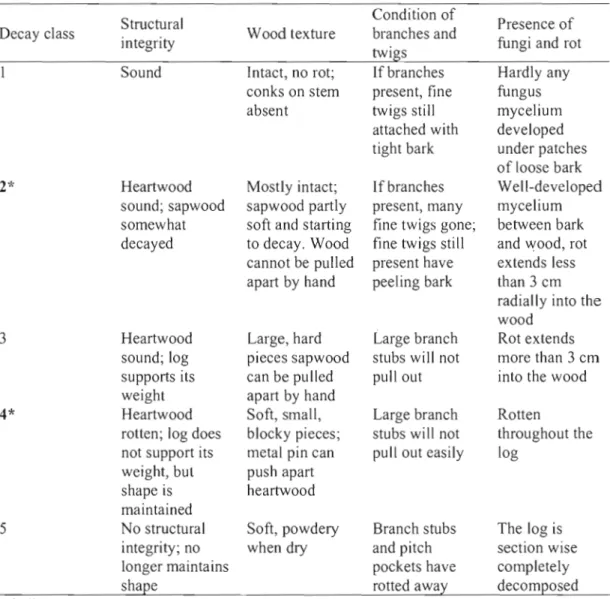
We classified fa11en aspen and spruce logs within six forest stands into 1 of 5 visual decay classes, 1 being the least decayed and 5 being the most decayed (modified from Wadde11 (2002) and Stokland and Kauserud, (2004)) (Table 1.1). Logs in decay class 2 and 4 were used for the study as they could be found in sufficient quantities for analysis. A total of
12 logs for eachtree species / decay combination were randomly selected for sampling in the spring of 2006 for a total of 48 logs (Table 1.2). In the field, we used emergence tents similar to Shiegg (2001), made from quick drying, light weight nylon mesh that encircled 70 cm length sections of each log. We used urine cups filled with 30ml of 50%/50% water and propylene glycol to trap and preserve ail emerging insects. Two young aspen and one young spruce were disturbed by animais throughout the summer of 2007 and had to be removed from the study leaving ci total of93 10gs sampled (Table 1.2).
Forest stands differed in stand composition and time since fire and insect outbreak. Three of the six stands defined by Brais, Harvey and Bergeron (2004) as mixed forest, were dominated by trembling aspen (Populus lremuloides Michaux), black spruce (Picea mariana (Miller)) B.S.P.), and white spruce (Picea glauca [Moench] Voss). Aspen represented 70% of the basal area, and spruce represented 13-23% basal area (Brais, Harvey and Bergeron, 2004). The average fa lien spruce deadwood volume was 2m3/hectare and 6m3/hectare for aspen. The last fire event in these stands occurred in 1919 (Brais, Harvey and Bergeron, 2004; Dansereau and Bergeron, 1993). Young aspen (decay 2), advanced aspen (decay 4) and young spruce (decay 2) logs were sampled in these stands (Table 1.2). Advanced decay classes of spruce were limited and therefore not sampled in these stands as much of this component was either Iikely consumed by the 1919 fire or long-since decayed.
The other three forest stands defined by Brais, Harvey and Bergeron (2004) as balsam fir birch forest were dominated by white birch (Belula papyrifera Marsh.), (43-66% basal area), white spruce (Picea glauca [Moench] Voss), (13-43% basal area), balsam fir (Abies
balsamea (L.) (Miller)), (13% basal area), and had an average fallen spruce deadwood volume of 8m3/hectare (Brais, Harvey and Bergeron, 2004). This area was affected by a spruce budwonn outbreak that occurred between the years 1970 and 1987 (Brais, Harvey and Bergeron, 2004) and the last fire event was 1720 (Dansereau and Bergeron, 1993). Only old spruce logs (decay 4) were sampled in these stands (Table 1.2).
We measured the diameter and wood density of each log. To measure wood density we cut a 10cm length wedge in 2007 from the sampled area of each log and split it in to two sections. The first section was weighed (fresh) and coated in paraffm before measuring volume by water displacement. The second section was weighed (fresh) and dried at 60°C to constant mass (after 4 days). The difference between fresh mass and dried constant mass was taken and the percentage humidity calculated. The first wood section was then corrected for moisture content giving the final mass used for wood density estimation: d=m/v. Four wood density measures (3 old aspen logs and 1 old spruce log) were not included in analyses due to erroneous measures.
1.2.2 Diptera sampling
We sampled insects once a month (4 collections) for a total of 88 days of continuous trapping. Tents were first erected over three days (May 28- 31, 2Q06}. Collection dates were as follows: June 19-20, July 11-12, July 31-August 1 and August 24-25. ln 2007, Diptera were again sampled once a month (4 collections). Trapping began earlier than the previous year giving a total of 104 sampling days. Tents were erected over three days (May 5-7, 2007) and collections dates were as follows: May 27-28, June 29-30, July 28-29 and the la st collection was completed on August. 18. The last collection of one aspen-spruce forest block in 2007 took place two weeks later (September 4) due to site inaccessibility.
Ail Diptera families were identified to species or morpho species except for the Cecidomyiidae, Ceratopogonidae, Chironomidae and Psychodidae which were left at the family level. Identifications were determined to the genus level using McAlpine and others (1981) and McAlpine and others (1987) and the most recent taxonomie literature available for species identification (see Appendix C for full list of literature used). Identifications of Chloropidae and Mycetophilidae were verified by I.A. Wheeler and Chris Borkent, McGill
University. Species that could not be named were sorted into morpho species which were determined by detailed examination of genitalia (see Appendix E). We placed individuals into one of 5 trophic gui Ids based on information of known laJ-val feeding habits at the species level when possible. When species level data were unavailable feeding habits were defined at the genus level and on occasion at the family level using McAlpine and others (1981) and McAlpine and others (1987) and Hovemeyer and Schauermann (2003). We defined the trophic gui Ids as (1) mycetophagous (MYT); species feeding on fungi, (2) saprophagous (SAP); species feeding on detritus including decaying plant material and insect waste, (3) parasitic (PAR); species that parasitize other insects, (4) xylophagous (XYL); wood-feeding, and (5) zoophagous (ZOO); feeding on insects and other animais. Very few xylophagous species were captured therefore they could not be used in analyses. Voucher specimens were deposited at McGill University's Lyman Entomological Museum and Université du Québec à Montréal.
1.3 Statistical analysis
A preliminary analysis of frequency distribution of wood density measures across our visual decay classes showed that wood density overlapped considerably among early and advanced decay stages (Figure 1.2). Thus, throughout ail analyses we used wood density (g/cm3) as a more direct measure of the decay gradient instead of the visual decay classes that were used for log selection.
Although efforts were made to sample logs that were within the commercial timber size classes of lOto 20 cm, a range of diameters was sampled. The range of diameters we sampled differed between tree hosts with spruce logs having the widest range. Most spruce logs were in the lower range between 10 and 15 cm while most aspen were between 15 and 20 cm (Figure 1.3). We statistically controlled for differences in Diptera abundance related to differences in log volume by including diameter as a factor in generallinear models.
1.3.1Dipteran emergence
In order to assess whether wood density, wood diameter and tree species were useful predictors of Diptera abundance at the order, guild and species level, we used the following procedure:
Abundance data was standardized to an emergence rate of flies per day to account for uneven sampling effort as a result of periodic disturbance of sorne traps. This was done for a data set including ail Diptera (6753 indv.) and for 2 guilds (saprophagous (3663 indv.) and mycetophagous (2288 indv.). Emergence patterns were modeled with negative bionomial regression. The list of regression models are presented in Appendix D. The dispersion was corrected when necessary. For ail data sets the sample size (89logs after removal oflogs with erroneous density) was small relative to the number of parameters, therefore the second-order Akaike's information criterion (AICc) was used to select the best model, which is expressed by:
AICc = -2(log-likelihood) + 2K + 2K (K+I) / (n-K-l)
where K is the number of parameters ln the model (including intercept and variance),
(Burnham and Anderson, 2002).
Multimodel inference was used when several models competed for top rank (fl AICc< 2), (Burnham and Anderson, 2002). This was done by computing a weighted average of the regression coefficients of a given variable for all models including that variable. Then, a model-averaged estimate and unconditional standard error were generated and used to build a 95% confidence interval, enabling us to assess the magnitude of the effect of the specifie variable (Bumham and Anderson, 2002).
The abundance of individual species was converted to incidence (presence/absence) data. Multiple regression for species that were present in less than 15% of logs suffered from under dispersion and could not be corrected, therefore we assessed whether the probability of occurrence was related to variables using binomial regression for species that were present in
15% or more of the sampled logs which inc1uded the following 7 taxa: Corynoptera sp.3 (257 indv.), Corynoptera sp.5 (78 indv.), Scatopsciara hastata (378 indv.), Neophylomyza
quadripunctata (271 indv.), VIa sp. (42 indv.), Tachypeza sp.l (72indv), Bradysia jucunda (110 indv.). The zoophagous (305 indv) and parasitic (72 indv) gui Ids were treated in the same manner. The list of regression models are presented in Appendix D. Tree host was not included in a model alone when species occurrence was fairly equa1 between tree hosts. In such cases, it was placed in models as a potential factor interacting with diameter and density.
1.3.2 Dipteran species richness
Species richness analyses used a sm aller data set which included taxa with positive species or morpho species identification (227 taxa, 2579 individuals). See Appendix A for species included in the data set. Since many of the Diptera species can only be distinguished on the basis of male genitalic characters these analyses were dominated by males. The following families proved difficult to resolve to morpho species because of a lack of good identification tools and were therefore not represented in this data set: Cecidomyi idae (n= 1539), Ceratopogonidae (n=816) and Psychodidae (n=78). The genus Megaselia (family: Phoridae; n=72I) was excluded because it proved too difficult for the authors to resolve into morpho species. Other authors have referred to Megaselia as "the Diptera enfant terrible" due to the difficulties in determining species even when male genitalia are compared (Disney, 1999).
Species richness between tree hosts (aspen and spruce) and estimates of richness were obtained from raw abundance data and used the rarefaction function by Jacobs (2009). Individual-based rarefaction was used to correct for uneven catches. Rarefaction provides unbiased estimates of species richness for samples with different numbers of individuals and therefore allows accurate comparisons among a number of treatments (Gotelli and Colwell, 2001).
Spearman 's rank correlation (r5) was used to evaluate the relationship between species richness and wood propeliies: log diameter and wood density for each tree species.
1.3.3 Community composition
Dipteran assemblage similarity was analyzed using a smaller data set that excluded taxa that were not present in 5% or more of sampled logs (51 taxa, 2119 individuals). This reduced the sample size from n=93 to n=88 because sorne logs did not produce any frequently occurring species. See Appendix A for species included ln the data set. Compositional similarity was analyzed between logs using Bray-Curtis distance with nonmetric multidimensional scaling (NMS) ordination procedures. Multiresponse permutation procedure (MRPP) was used to measure the within and between group differences of the community for the categorical variable tree species (aspen and spruce).
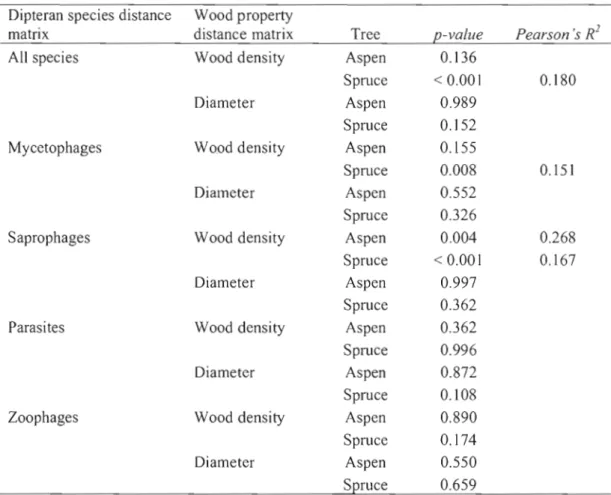
Mantel's test (Mantel, 1967) was used to evaluate the correlation of the communi ty matrix with CWD decay gradient (wood density g/cm\ (n=84 logs) and diameter (n=88 logs). Wood density data were missing for 4 logs as they cou Id not be accessed in the field when this measure was conducted. The correlation of the community matrix was tested against the Euclidean distance of each variable (wood density glcm3, diameter cm) independently. Significance was evaluated against a Monte-Carlo test with 1000 permutations. Mantel's test was also used to evaluate the correlation of trophic guild separately with wood density g/cm3,and diameter.
1.4 Results
1.4.1 General trends in emergence
Overall, we collected 6753 adult Diptera, representing 227 taxa from 34 families (Appendix A). Most taxa were rarely collected as 121 taxa or 53% were represented by one individual over two years of collection. A total of 2119 individuals (51 taxa) were present in
5% or more of sampled logs. The most abundant families (100 or more individuals) were: Sciaridae (1850), Cecidomyidae (1539), Ceratopogonidae (816), Phoridae (801), Mycetophylidae (749), Milichiidae (271), Tipulidae (107), Dolichopodidae (110) (see Appendix A for details). The most species rich family was the Mycetophilidae with 179 species.
/.4.2 Factors associated with Dipteran emergence
Model selection with AICc approach is presented In Appendix D. Overall Diptera emergence increased with decomposition (decreasing wood density) in spruce logs (p=O.O 1,
R2 = 0.45, Table 1.3) and emergence was greater in 2006 compared to 2007 (p=<O.O l ,R2 = 0.45, Table 1.3 ).
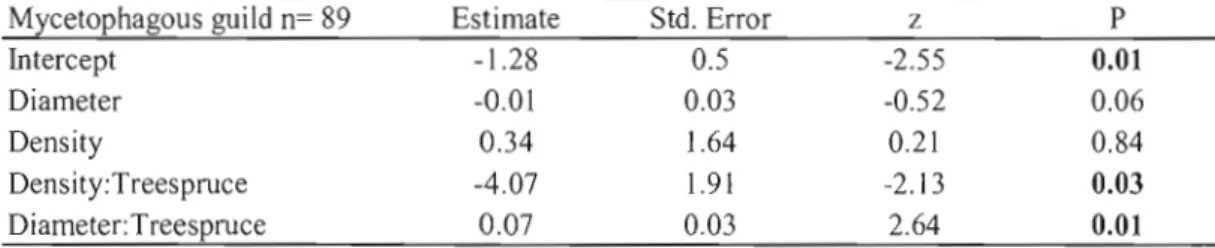
Mycetophagous and saprophagous guild emergence increased with decomposition (decreasing wood density) in spruce (p=0.03 R2
=
0.11, Tablel.4; p=<O.OI, R2=
0.23, Table 1.5) and positively affected by log diameter in spruce (p= 0.01, R2 = 0.11, Table 1.4; p=<O.O 1, R2 = 0.23, Table 1.5). For zoophagous and parasitic guild occurrences ArCc scores suggested that many models shared high strength of evidence (L". ArCc< 2) therefore the multi-model inference approach (model-averaging) was used in order to select the most important variables. For an explanation of model-averaging please see the analysis section (1.3.1 Dipteran emergence) on page 15. After multi-model inference, no variables were found to affect emergence as 95% confidence intervals did not exclude zero (Burnham and Anderson, 2002)./.4.3 Species richness
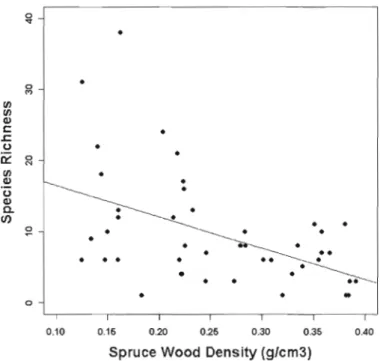
A negative relationship between species richness and wood density (decreasing wood decay) was observed for spruce logs (p<O.OO l, r5= -0.48) (Figure 1.4). No relationship between species richness and wood density was found for aspen logs (p= 0.49, r5=0.11). We did not detect any significant relationship between Diptera species richness and log diameter for either tree species (spruce: p=0.62, r5=0.08; aspen: p= 0.96, r5=-0.0 1).
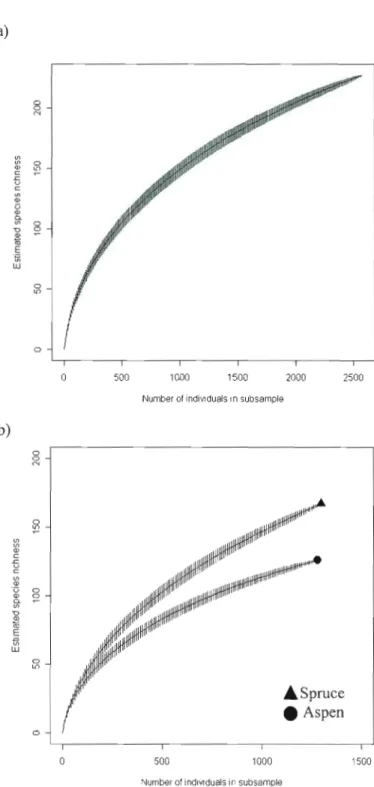
Estimated species richness was higher in spruce logs than aspen logs. We were unable to observe an asymptote in either rarefaction curve (Figure 1.5 (b)). Estimated species richness for the entire data set is presented in Figure I.S (a).
1.4.4 Community composition
High assemblage dissimilarity between sampled logs was observed USIng nonmetric multidimensional scaling (NMS). The final solution consisted of 3 dimensions with a stress of 20 (Figure 1.6). This stress value is relatively high (McCune and Grace, 1999).
Differences between aspen and spruce groups evaJuated with MRPP were statistically different however, the chance-corrected within group agreement (measure of homogeneity within groups) was low (A= 0.0044, p=0.02) indicating large variation in species assemblages within a given tree species. Although the homogeneity within groups was about equivalent to group membership by chance, a total of 8 taxa present in 5% or more of sampled logs emerged exclusively from one tree species. Those collected exclusively from aspen were: Medetera crassivenis (n=6, frequency (freq.) 4), Acadia polypori, (n= 16, freg. 10), Limonia sp.2 (n=36, freg. 6), Mycetophila procera (n=4, freq. 4), and Stilpon sp.1 (n=8, freq. 5). Those collected exclusively from spruce were: Eremomyioides sp. (n=IO, freq. 8), Leptomorphus sp. 4 (n=4, freq. 4), and Trichonta pulchra (n=7, freg. 5).
There was a significant correlation between variations in the overall saproxylic dipteran assemblages and wood density in spruce logs (R2 = 0.18 p=< 0.001) (Table 1.6). Wood density was also significantly correlated with variations in the composition of mycetophage assemblages (R2= 0.15 p= 0.008) in spruce and for saprophage assemblage composition and wood density in both tree species (R2= 0.27, p= 0.004; R2=0.16, p=O.OOI) (Table 1.6).
1.4.5 Responses ofindividual taxa
AICc scores for species specific observations suggested that many models shared high strength of evidence (Li AICc< 2) therefore we used the multi-model inference approach (model-averaging). For an explanation of model-averaging please see the analysis section (1.3.1 Dipteran emergence) on page 15. Occurrenèes for the species Scatopsciara hastata increased with decomposition (decreasing wood density) (model-averaged estimate= -10.96, SE= 3.56). The occurrences however for other species could not be associated with any factors with confidence (95% confidence intervals did not exclude zero).
1.5 Discussion
Our results suggest sorne saproxylic Diptera use CWD based on tree specles, log diameter and wood density. Results followed our predictions that overall saproxylic Diptera abundance and richness would increase along with increasing wood decay (decreasing wood density) however, this pattern was significant only in spruce logs. When measured separately,
the two most dominant guilds (mycetophagous and saprophagous) had the same response. The lack of patterns associated with decay in aspen may be due to the difficulties in obtaining representative wood density measures across a given volume for this tree species. Work by Saint-Germain, Buddle and Drapeau (2010), has demonstrated significant within-snag variation in wood density for aspen. When Scm disks were taken along I-m sections of snags, measurements within disks often revealed densities that ranged from 0.08-0.38 g/cm3 within the same \-m section (Saint-Germain, Buddle and Drapeau, 2010). Our wood samples therefore may not have been large enough to account for wood density variability within our aspen logs. It has been demonstrated that decay selection by beetle larvae can occur at a small scale within variable aspen hosts (Saint-Germain, Buddle and Drapeau, 2010) therefore we cannot conclude that a lack of patterns in our study confirms a lack of selection for decay by Diptera in aspen. Snag dissections of spruce revealed less variation in wood density (Saint Germain, personal communication) and could explain our ability to observe stronger relationships with Diptera and wood decay in spruce logs. The bioavailability of proteins and minerais such as Ca, Zn, Fe and Pare limited in wood with higher fiber and tannin content (Haack and Slansky, 1987) and most of these minerais have been found in higher concentrations in later stages of decomposition (Laiho and Prescott, 2004; Brais, Paré and Lierman, 2006). Diptera, especially the Sciaridae, develop rapidly (Nielson and Nielson, 2004) and may not find the adequate nutrients in earlier stages of decay in the time frame they require. Other factors important for insect growth and survival such as water content and N (Haak and Slansky, 1987) increase with decay and may further contribute to Diptera preference for weil decomposed wood (Hovemeyer and Schauermann, 2003; Laiho and Prescott, 2004; Brais, Paré, Lierman, 2006).
We expected overall saproxylic dipteran abundance and richness to increase with diameter not only because increased volume should translate to a larger sample but also because we presumed that bigger logs have more microhabitats and contain a more stable microclimate (Grove, 2002). When analyzed by guild, the overall emergence of mycetophages and saprophages increased with increasing wood decay in spruce logs however little of the variation for either guild was explained by our models. It was surprising in this study that diameter was not more strongly associated with the emergence or species richness of Diptera at the order level, for other gui Ids or individual taxa. Most studies indicate a
positive relationship between dead wood diameter and abundance and richness of beetles (Grove, 2002; Saint-Germain, Drapeau and Hébert, 2004).
Estimated richness in spruce logs was higher compared to aspen logs. Clear differences exist in the degradation pathways between spruce and aspen (Angers, Drapeau and Bergeron, 2010). Spruce decomposes more slowly than aspen (Brais, Paré and Lierman, 2006) and therefore persists in the environment longer (Angers, Drapeau and Bergeron, 2010). [t is possible that the longer degradation pathway of spruce provides greater time for more chance co!onization events of species to be successful. [n addition, the longer persistence in the environment of spruce logs may provide greater connectivity on the forest floor between insect populations that disperse poorly.
We observed a difference in dipteran species composition between aspen and spruce however there was extremely high assemblage dissimilarity within each tree host which may be due to differences in microhabitat characteristics of each log. Dipteran assemblages at the order and guild level changed along with changes in wood density (mycetophages in spruce and saprophages in both host species) however little of the variation could be explained by this factor alone.
Studies by [rmler, Helier and Warning (1996), and Rotheray and others (2001), have observed !ittle tree host specificity for saproxylic Diptera species therefore it was not surprising most species collected in our study emerged from both tree hosts. Scatopsciara hastata, family: Sciaridae, was the only species in this study in which density was observed to predict occurrence. We do not have any specific !ife history information available ônthis species however we do know that larva in the family Sciaridae develop rapidly (Nielson and Nielson, 2004) and may benefit from higher water content and greater concentrations of mineraIs in weil decomposed wood compared to early stages.
Overall, it proved very difficult to identify relationships between occurrence of dipteran species and wood characteristics in this study. We attribute the difficulties in part, to the distributional inconsistencies of the species. The emerging Diptera were highly aggregated and rare. For example, of the l79species of Mycetophilidae we captured, 139 were represented by only one individual and only 14 of these species were present in 5% or more of sampled logs. Hovemeyer and Schauermann (2003) also observed highly aggregated and
rare species during their 10 year long study of beech branches. They controlled for many possible sources of variation by using branches cut from only two trees. Rarity and aggregated populations in their study was attributed to the high variability of decomposition between branches (Hovemeyer and Schauermann, 2003).
Diptera may be highly microhabitat specific and therefore may be responding to finer level characteristics of individual logs not measured in this study. The genus Phronia spp. (Mycetophilidae) collected in our study (8 morpho species, and 68 individuals) provides one of many possible examples of habitat specialization that are likely contributing to the rare and patchy nature of our dataset. Most of the known larvae of Phronia spp. are free living and graze on slime moulds (Myxomycetes) and other fungi growing on the surface of sodden, barkless logs (Gagné, 1975). The presence of Phronia spp. may be determined indirectly by the presence of their hosts. Feeding specialization within beetles that feed on slime-mould can be extreme, as they have been known to specialize even on particular stages of development within particular species (Laaksonen et al., 2010). For instance, sorne Agathidium species specialize on the plasmodial phase only and still others only on their fmiting bodies (Laaksonen et al., 2010). The plasmodial phase of slime mould feeds on bacteria and other micro-organisms on dead wood and the formation of fmiting bodies by slime mould is dependent on microclimatic conditions, especially moisture (Laaksonen, et al., 2010).
In the context of saproxylic insect conservation studies, CWD is considered an important microhabitat for species at the scale of a stand (Work et al. 2004). However, important microhabitats also occur at the scale of a single log. Barbour, Storer and Potts (2009), found that the fllngal community stmcture, species richness and individual species of fungi, colonizing fa lien Eucalyptus logs are affected by microhabitats such as the presence of bark, newly exposed wood and north and south facing surfaces. In that particular study, high fungal richness in bark compared with exposed areas of wood was believed to be related to the greater surface area of bark. Higher richness of fungi on south facing surfaces was attributed to higher moisture and shade compared to north surfaces (Barbour, Storer and Potts, 2009). Fine scale characteristics of logs such as those mentioned above and additional physical and biological aspects of thelogs (ie. number of cracks and crevices, thickness of bark, water
fluctuation, ground evenness, aspect of logs, and presence of particular fungi or bacteria) may be important factors directly or indirectly affecting Diptera.
Many Diptera like the Sciaridae are opportunists, exploiting small food sources that occur by chance and are short lived (Papp, 2002). They are able to do this because of their rapid larval development and adult flight which allows them to disperse to new sources of food (Papp, 2002). For example, many species of forest dwelling Diptera specialize on animal feces, dead snails or sap ho les (Pa pp, 2002). Saproxylic Diptera, like other forest Diptera, may be responding to unpredictable food sources which could make predicting species occurrence difficult.
1.6 Conclusion
This study provides the first replicated study on CWD use by saproxyJic Diptera in aspen and spruce logs in eastern North America. This study has highlighted the importance of studying a wide variety of saproxylic taxa, as Diptera were found to respond differently to CWD properties than other better studied groups such as the saproxylic Coleoptera. For instance, beetle communities and individual species are tree host specific in early stages of decay (Grove, 2002). In later stages, tree specificity may decrease but differences between coniferous and deciduous hosts remain (Grove, 2002). ln this study, few individual Diptera species were specific to tree host.
Our observations of low dipteran assemblage similarity between logs, high species rarity and patchiness are consistent with other studies conducted on saproxylic Diptera. These findings indicate that Diptera may be highly microhabitat specific. In order to have a more complete picture of the factors affecting CWD use by saproxylic Diptera, more study is required on fine scale characteristics of logs that may play a larger l'ole. Particularly useful avenues of research would include associations between Diptera and saproxyJic fungi (ie. Basidiomycetes and Myxomycetes).We were able to reach a rather fine scale of saproxylic Diptera identification using a morpho species approach, however, in order to fully understand observed patterns, more tools for the identification of saproxylic Diptera and knowledge on their associated life history is required.
Ol/TARIO Lake Duparquet Research and Teaching Forest (LDRTF) I---~--..;.
*
L:f1·~IJr"\~Q..:d SI,t'rd) - - = , I < m ..j
"'rol~h:f f{ar)19U)!'. 1"0 "lr.~':.. Ç-fR. Z:;I:r;, ,';"/t\'\Figure 1.1 Map depicting general location of study in eastern North America and general location of unmanaged stands where logs were sampled for saproxylic Diptera using emergence tents within two forest types (balsam fir-birch and aspen spruce forest).
a) Young aspen b) Old aspen -1 1 0.0 0.1 0.2 0.3 0.4 0.5 0.0 0.1 0.2 0.3 0.4 0.5 Density (g/cm3) Density (g/cm3)
c) Young spruce d) Old spruce
~ >. >. 0 0 "' , c C QI QI :;, :;, , l:T l:T ~ ~ .., u. u. , ,...- 1--- r--- ,...- 1-- 0.0 0.1 0.2 0.3 0.4 0.5 0.0 0.1 0.2 0.3 0.4 0.5 Density (g/cm3) Density (g/cm3)
Figure 1.2 Frequency ofwood densities for young aspen (a), old aspen (b), young spruce (c), and old spruce logs (d).
•
•
•
• •• • •
•
•
•
•
•
•
•
••a) Spruce logs b) Aspen logs
0 0 M M on on N N 0 0 N N >. 0 >. 0 <: <: Cl> Cl> ~ ~ ~ ~ C" Cl> C" Cl> al: al: :'! :'! 10 15 20 25 30 35 40 la 15 20 25 30 35 40 Diameter (cm) Diameter (cm)
Figure 1.3 Frequency of log diameters for spruce (a) and frequency of log diameters for aspen (b). 0 '<1
•
•
0'"
fi) fi) CI> l:•
..r:: u•
•
0 ii: N fi)•
CI>•
•
U CI> a.•
•
li)•
•
~•
•
•
•
•
0 ••
•
0,10 0,16 0,20 0,25 0,30 0,35 0,40Spruce Wood Density (g/cm3)
Figure 1.4 Scatter plot of species richness and spruce wood density (g/cm3). Spearman's coefficient of rani< correlation (rs ): -0.48, p<O.OO 1.
a) 0 0 N ID '" 0 '" C ~ .c u c ID '" U ID 5} 0 U (» ~ tU .~ Lü 0
'"
Figure 1.5 Rarefied species richness curves with posItIve species identification or morphospecies designation including 227 taxa from a pool of 2579 individuals sampled in one season. Measures of variance (±I SD), a) ail species, ail log types and b) species accumulation for aspen (1281 individuals) and spruce (1298 individuals).
• Spruce Aspen LD 0 LD 0
t
0 0 C0 10 + - - - I - - - + - 05 LD 9 00 0 -0.5 ~ LD ~ -1.0 -0.5 0.0 05 10 1.5 2Figure 1.6 Three-dimensional NMS ordination illustrating saproxylie dipteran assemblage similarity between 88 logs and 51 taxa (speeies present in 5% or more of sampled logs) from l-year emergenee data. Different eolours represent different tree speeies (aspen and spmee).
Table 1.1 Classification that was used for determination of decay stage for logs (modified from Wadde1l2002 and Stokland and Kauserud 2004).
Decay class Structural
integrity Wood texture
Condition of branches and twigs
Presence of fungi and rot Sound Intact, no rot; If branches Hardlyany
conks on stem present, fine fungus absent twigs still mycelium
attached with developed tight bark under patches
of loose bark 2* Heartwood Mostly intact; If branches Well-developed
sound; sapwood sapwood partly present, many mycelium somewhat soft and starting fine twigs gone; between bark decayed to decay. Wood fine twigs still and wood, rot
cannot be pulled present have extends less apart by hand peeling bark than 3 cm
radially into the wood
3 Heartwood Large, hard Large branch Rot ex tends sound; log pieces sapwood stubs will not more than 3 cm supports its can be pu lled pull out into the wood weight apart by hand
4* Heartwood Soft, small, Large branch Rotten
rotten; log does blocky pieces; stubs will not throughout the not support its metal pin can pull out easily log
weight, but push apart shape is heartwood maintained
5 No structural Soft, powdery Branch stubs The log is integrity; no when dry and pitch section wise longer maintains pockets have completely
shape rotted away decomposed
Table 1.2 Sampling design illustrating the number offallen logs (n=93) of each tree species and decay stage used to measure emergence, species richness and community composition of saproxylic Diptera.
2006 2007
Log type rep. 2 3 subtotal 2 3 subtotal
Aspen class 2 4 4 4 12 2 4 4 10
Aspen class 4 4 4 4 12 4 4 4 12
Spruce class 2 4 4 4 12 3 4 4 II
Spruce class 4* 4 4 4 12 4 4 4 12
Totallogs 48 45
*Logs sampled in balsam fir-birch forest blocks. The other logs were sampled in aspen spruce forest blocks.
Table 1.3 Multiple linear regression results predicting overall dipteran emergence*. Overall Dipteran Emergence
Estimate Std.Error z p n=89 Intercept 1288.56 386.82 3.33 <0.01 Year -0.64 0.19 -3.33 <0.01 Diameter -0.03 0.03 -0.85 0.39 Density -1.29 1.64 -0.79 0.43 Treespruce 0.59 0.93 0.64 0.52 Density:Treespruce -5.68 2.26 -2.51 0.01 Diameter:Treespruce 0.05 0.04 1.37 0.17
*Best model according to /':, AICc (Appendix D): Year + Diameter + Density + Tree + Density:Tree + Diameter:Tree. AIC: 109.61. Residual deviance: 59.27 on 82 degrees of freedom. Null deviance: 86.289 on 88 degrees of freedom. Dispersion parameter for gamma distribution was taken to be: 0.79
Table 1.4 Multiple linear regression results predicting Mycetophagous emergence*.
Mycetophagous guild n= 89 Estimate Std. Error z P
Intercept -1.28 0.5 -2.55 0.01
Diameter -0.01 0.03 -0.52 0.06
Density 0.34 1.64 0.21 0.84
Density:Treespruce -4.07 1.91 -2.13 0.03
Diameter:Treespruce 0.07 0.03 2.64 0.01
*From best mode1 according to 6. ArCe (Appendix D):Diameter + Density + Density:Tree + Diameter:Tree. R2=0.11. AIC: 728.77. Null deviance: 116.48 on 88 degrees of freedom. Residual deviance: 97.94 on 84 degrees of freedom. The dispersion parameter for negative binomial taken to be 1.27.
Table 1.5 Multiple linear regression results predicting Saprophagous emergence*.
Saprophagous guild n= 89 Estimate Std.Error z P
rntercept -0.01 0.42 -0.01 0.99
Diameter -0.03 0.02 -1.36 0.17
Density -1.47 1.36 -1.08 0.28
Density:Treespruce -5.40 1.60 -3.37 <0.01
Diameter:Treespruce 0.08 0.02 3.50 <0.01
*From best model according to 6. ArCe (Appendix D): Diameter + Density + Density:Tree + Diameter:Tree. R2=0.23. ArC: 828.6. Null deviance: 131.30 on 88 degrees of freedom. Residual deviance: 97.48 on 84 degrees of freedom. The dispersion parameter for negative binomial taken to be 1.51.
Table 1.6 Results of mantel tests revealing correlations between variations in dipteran species assemblages and variations in wood properties.
Dipteran species distance Wood property
matrix distance matrix Tree p-value Pearson 's R2
Ali species Wood density Aspen 0.136
Spruce < 0.001 0.180
Diameter Aspen 0.989
Spruce 0.152
Mycetophages Wood density Aspen 0.155
Spruce 0.008 0.151
Diameter Aspen 0.552
Spruce 0.326
Saprophages Wood density Aspen 0.004 0.268
Spruce < 0.001 0.167
Diameter Aspen 0.997
Spruce 0.362
Parasites Wood density Aspen 0.362
Spruce 0.996
Diameter Aspen 0.872
Spruce 0.108
Zoophages Wood density Aspen 0.890
Spruce 0.174
Diameter Aspen 0.550