For Peer Review Only
Going beyond the identification of change facilitators to effectively implement a new model of services: Lessons learned from a case example in pediatric rehabilitation
Journal: Developmental Neurorehabilitation Manuscript ID: Draft
Manuscript Type: Original Paper
Keywords: Rehabilitation, children, disability, service delivery model, socio constructivist, change management
For Peer Review Only
Title
Going beyond the identification of change facilitators to effectively implement a new model
of services: Lessons learned from a case example in pediatric rehabilitation
3 4 5 6 7 8 9 10 11 12 13 14 15 16 17 18 19 20 21 22 23 24 25 26 27 28 29 30 31 32 33 34 35 36 37 38 39 40 41 42 43 44 45 46 47 48 49 50 51 52 53 54 55 56
For Peer Review Only
Abstract
Purpose
Identify facilitators and barriers to service reorganization, how they evolved and interacted to influence change during the implementation of a new service delivery model of pediatric rehabilitation.
Methods
Over three years, different stakeholders responded to SWOT questionnaires (n=139), participated in focus groups (n=19) and telephone interviews (n=13). A framework based on socio constructivist theories made sense of the data.
Results
Facilitators related to the programme’s structure (e.g. funding), the actors (e.g. willingness to test the new service model) and the change management process (e.g. participative approach). Some initial facilitators became barriers (e.g. leadership lacked at the end), while other barriers emerged (e.g. lack of tools). Understanding factor interactions requires examining the multiple actors' intentions, actions and consequences, and their relations with structural elements.
Conclusions
Analysing facilitators and barriers helped better understand the change processes, but this must be followed by concrete actions to successfully implement new pediatric rehabilitation models.
Key words
Rehabilitation; children; disability; service delivery model; socio constructivist; change management. 3 4 5 6 7 8 9 10 11 12 13 14 15 16 17 18 19 20 21 22 23 24 25 26 27 28 29 30 31 32 33 34 35 36 37 38 39 40 41 42 43 44 45 46 47 48 49 50 51 52 53 54 55 56 57
For Peer Review Only
Background
Changes in pediatric rehabilitation services are needed to diminish the gap between actual and best services, to integrate research knowledge, to adopt new approaches such as family-centred care and to develop new forms of expertise [1-6]. Budget restrictions are also putting extra pressure on rehabilitation centres forcing stakeholders to find creative solutions to respond to all children's needs. Burning issues such as long waiting times and reduced access to pediatric rehabilitation services call for service reorganization. Indeed, children with physical disabilities can wait from several months up to more than a year before receiving rehabilitation services [7-9]. Waiting times can have negative consequences for the well being of the children and their families [10]. Although some authors advocate reorganizing services to increase accessibility [8,11], few models of service delivery are available to guide such efforts. Moreover, reorganizing services can be disruptive involving many changes in practises and numerous other challenges for which pediatric rehabilitation settings must be prepared.
In the change management literature, the identification of barriers and facilitators to the implementation of new health interventions modifying clinical practises has received increasing attention in the last decade. The implicit reason behind this growing interest lies in the belief that creating optimal conditions before implementing a new intervention increases the probability of success in changing practises. Moreover, the literature stresses the importance of creating an appropriate organizational culture, involving top management and distributing the leadership to ensure the concretization of the vision into new processes to effectively implement the changes [12-15]. Decision makers are thus expected to use tools to identify potential barriers and facilitators in their organizational context, work to develop organizational readiness for change and then successfully implement a new intervention and change practises [16,17]. However, in
3 4 5 6 7 8 9 10 11 12 13 14 15 16 17 18 19 20 21 22 23 24 25 26 27 28 29 30 31 32 33 34 35 36 37 38 39 40 41 42 43 44 45 46 47 48 49 50 51 52 53 54 55 56
For Peer Review Only
reality, readiness for change is sometimes only weakly associated with the success of the implementation of change [18,19].
To increase the success rate of change efforts, estimated to be no higher than 50% [20], it is important to better capture the notion of readiness for change and identify how concretely strategies for creating strong implementation procedures can be developed [15]. This could be accomplished by combining an examination of the various contextual and human facilitators and barriers in a given organizational context [21] with better descriptions of the strategies used to implement a change. Moreover, it is important to know how the initial facilitators and barriers evolve over time during an implementation process, and how the different factors interact and influence the process. In-depth studies are necessary to better understand the intricacies of change management efforts.
To date, some qualitative studies have examined how different facilitators and barriers can concretely influence the implementation of specific interventions in a particular context. For instance, Goderis and al. [22] documented the barriers and facilitators encountered during a 18-month quality improvement programme aimed at providing evidence-based care for patients with type 2 diabetes. Their reported barriers and facilitators are similar to the ones generally documented in the literature (e.g. practitioner and organizational-related facilitators, such as the inner motivation and the communication among staff). Their study was informative with respect to how general factors concretely influenced the implementation of new standards of diabetes care. Indeed, broad categories of barriers and facilitators are useful, but differences across contexts call for specific studies in distinct contexts to produce empirically based data and knowledge. 3 4 5 6 7 8 9 10 11 12 13 14 15 16 17 18 19 20 21 22 23 24 25 26 27 28 29 30 31 32 33 34 35 36 37 38 39 40 41 42 43 44 45 46 47 48 49 50 51 52 53 54 55 56 57
For Peer Review Only
In rehabilitation for children with disabilities, few have documented the factors influencing service reorganization. One group discussed some general facilitators (e.g. the adoption of the model by clinical leaders) and barriers (e.g. the difficulties in obtaining funds for new activities) following the implementation of a new model of service delivery [23]. However, their paper did not present a systematic analysis of the factors having influenced the service reorganization in the pediatric rehabilitation centre. Knowledge about these factors could facilitate implementation of service delivery models in pediatric rehabilitation and thus ultimately help improve service accessibility and quality.
Study objectives
Over a three-year process beginning in 2006, our pediatric rehabilitation programme developed and implemented a new service delivery model and the principal outcomes of the reorganization process have been reported [24,25]. This article reports specifically on the change process and some of the challenges and the lessons learned encountered during the implementation process. Although the new service delivery model aimed at increasing service accessibility and quality, we believe that sharing our experiences with others can provide important information for all stakeholders wishing to change any type of existing clinical practises. Specifically, this paper reports on 1) facilitators and barriers identified during the reorganization process and how these factors evolved during the 3-year project, and 2) our examination about how the different factors interacted to influence the reorganization of services.
Methods
Context
The pediatric rehabilitation programme is one of the six programmes of the rehabilitation centre
3 4 5 6 7 8 9 10 11 12 13 14 15 16 17 18 19 20 21 22 23 24 25 26 27 28 29 30 31 32 33 34 35 36 37 38 39 40 41 42 43 44 45 46 47 48 49 50 51 52 53 54 55 56
For Peer Review Only
five sub programmes: developmental delay (e.g. various syndromes), dyspraxia (e.g. developmental coordination disorders), motor (e.g. cerebral palsy), speech and language (e.g. language disorders) and teenagers (e.g. children with mixed diagnoses attending high school). Each year, the programme provides outpatient services to 1000 families of children aged 0– 18 years. Before 2006, more than 400 children were waiting for services for several weeks, or for some, as long as 3 years, depending on their diagnosis, age and place of residence. The service reorganization project was launched in the Spring of 2006 and was called Apollo, making reference to the movie Apollo 13 where space shuttle crew had to figure out a way to use what was onboard to create a new C02 filter to enable a return to earth. In our case, the pediatric rehabilitation programme was faced with the challenge of reducing waiting times while using existing resources and ensuring quality services.
In the Spring of 2006, the strengths, weaknesses, opportunities and threats (SWOT) of the programme were documented with a SWOT analysis involving the programme’s service providers [24]. A planning committee responsible for overseeing the reorganization process used the SWOT results to develop the best service model possible based on the rehabilitation literature and the service providers’ perceptions. This committee was composed of a representative from each of the programme’s disciplines, the clinical coordinators, the programme head, a research coordinator and an organizational development counsellor. In 2006-2007, the committee met weekly to further develop the service delivery model and to describe how each activity component would work within the model (e.g. to define the goals of group activities and to create procedures of referral). Other activities in 2006-2007 included a pilot project experimenting with the new admission procedures and many change management activities to ensure that everyone had a clear vision of the new model. The symbol of Apollo was frequently used during these
3 4 5 6 7 8 9 10 11 12 13 14 15 16 17 18 19 20 21 22 23 24 25 26 27 28 29 30 31 32 33 34 35 36 37 38 39 40 41 42 43 44 45 46 47 48 49 50 51 52 53 54 55 56 57
For Peer Review Only
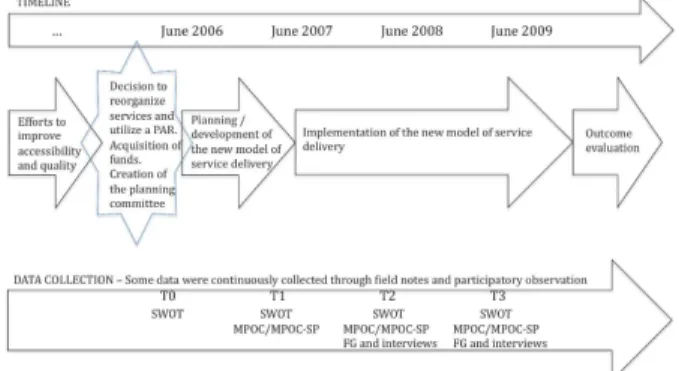
change management activities. In the Spring of 2007, the newly developed model, illustrated as a special shuttle, was presented to all programme staff during a monthly programme meeting. Its implementation began in the following weeks. Despite our plans to complete the implementation in one year, the process took twice as long as planned… Figure 1 illustrates the implementation and the data collection timeframe.
[Insert figure 1 about here]
Study design
This study was part of a larger participatory action research using mixed methods to document the process and outcomes related to service reorganization. The ethics board of the Centre of Interdisciplinary Rehabilitation Research of Montreal (CRIR-286-04-07) approved this larger research. Grounded in participatory action research principles [26], the research team worked closely with the clinical team and used participatory observation throughout the study to support the service reorganization process and collect additional information on the context. Specifically, a qualitative research design was chosen to better understand the change process.
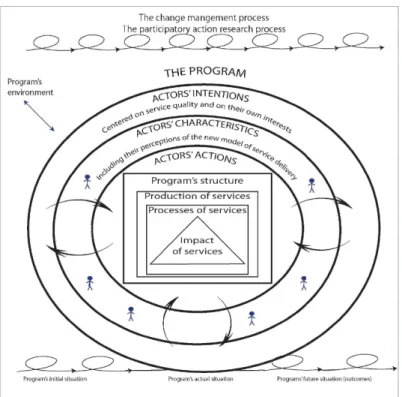
Organized action system theories [27] and Carrière’s work focusing on the socio constructivist approach of change management [28] served as the basis for the framework used to analyse data from the different sources (figure 2). Organized action systems theories state that different actors interplay together, within structures and environmental contexts, to produce services and achieve goals [27]. Socio constructivist theories foster the co-construction of knowledge and competencies among the stakeholders involved in a change situation [29] and aim to better understand the reciprocal influence of the actors’ intentions on actions and their dialectic relationships with the structural elements (i.e. how actions influence structures, and vice versa) [30,31]. Organized action systems and socio constructivist theories are complementary, as they
3 4 5 6 7 8 9 10 11 12 13 14 15 16 17 18 19 20 21 22 23 24 25 26 27 28 29 30 31 32 33 34 35 36 37 38 39 40 41 42 43 44 45 46 47 48 49 50 51 52 53 54 55 56
For Peer Review Only
can be used to detail the different components of a particular programme, while allowing a better understanding of their interactions, especially in regards to actors’ actions and intentions.
[Insert figure 2 about here]
In figure 2, the square in the centre of the figure represents a programme at any given point in time. The two arrows, spirally above and below the square, represent the programme’s evolution over time. The change management and participatory action research activities influence a programme’s evolution, modifying its initial conditions to create new ones. Changes will modify the different components of a programme, which are all interrelated. Actors’ actions are one of the most important components. Actors’ intentions are often multiple and can be centred on the programme’s components and on one’s own interests. The characteristics of the actors, as well as their perceptions of the change, influence their intentions and actions. Actors’ actions can influence the structure, and vice versa. Bidirectional arrows in the figure illustrate the interrelations between all of the programme components, and the dialectic relation between actions and structure. Indeed, the structure of a programme can be modified by the implementation of new practises. The processes (e.g. the type of services) and how services are produced might need to be modified to achieve the desired impacts of the services, according to the service reorganization’s goals. Finally, all of the programme’s components are grounded in a political, societal and economic context influencing the programme and the service reorganization process – just as the project itself can influence its environment.
Data sources, data collection and procedures
Four data sources were used to document the barriers and facilitators to the service reorganization process: 1) SWOT questionnaires, 2) telephone interviews, 3) focus groups, and 4) field notes and participatory observation.
3 4 5 6 7 8 9 10 11 12 13 14 15 16 17 18 19 20 21 22 23 24 25 26 27 28 29 30 31 32 33 34 35 36 37 38 39 40 41 42 43 44 45 46 47 48 49 50 51 52 53 54 55 56 57
For Peer Review Only
A SWOT analysis was conducted once a year over the 3-year reorganization process. SWOT analysis has been shown to be useful for situational analysis, programme evaluation, quality improvements and for guiding service reorganization and implementing new models of care [32-35]. Moreover, the SWOT questionnaire used by our programme in 2006 [24] was seen as helpful in creating readiness for change. Almost all of programme’s employees attended the one-day annual meetings in June in 2007, 2008 and 2009, and agreed to respond to open-ended questions about the current programme’s strengths, weaknesses, opportunities and threats. Over the three years, the heads of the programme provided responses to three SWOT questionnaires, the clinical coordinators completed nine SWOT questionnaires and the service providers completed 127.
Telephone interviews lasting 30 minutes to three hours were conducted with the four directors of the centre, the heads of the programme, the research coordinator and the organizational development counsellor (n=13). In 2008, interview guides included questions on the perceived barriers and facilitators to the service reorganization, and explored topics such as the perceptions related to the different actors’ roles and the activities conducted to facilitate the implementation of the new model. The 2009 interview guide was developed to explore in more depth actors’ perceptions of issues raised in 2008 (e.g. the programme’s climate and the participatory approach as facilitators, actor’s role(s) and the complexity of the model as a barrier), as well as their evolution over time. A research agent with extensive knowledge of organizational change conducted the interviews.
Focus groups lasting about two hours were conducted in 2008 and 2009 with 19 therapists. The third author, who has extensive experience in qualitative research, led the focus groups and used interview guides similar to those used for the telephone interviews.
3 4 5 6 7 8 9 10 11 12 13 14 15 16 17 18 19 20 21 22 23 24 25 26 27 28 29 30 31 32 33 34 35 36 37 38 39 40 41 42 43 44 45 46 47 48 49 50 51 52 53 54 55 56
For Peer Review Only
Finally, participatory observation and field notes collected data throughout the service reorganization project. The first author was part of the planning committee and attended the majority of its meetings and met formally or informally on several occasions with the different stakeholders (e.g. programme heads, the organizational development counsellor and the centre’s directors). She participated in the development of various information materials (e.g. report) and activities (e.g. oral presentations) and reviewed various documents. Using a journal, she also kept records of the different conversations and meetings over the 3 years.
Analysis
All data were transcribed verbatim into Nvivo. Quotes cited below were translated from French. Two researchers first coded the verbatim using an emerging coding grid inspired by the framework presented in figure 2 to identify facilitators and barriers, as well as how they evolved. They validated their coding by reviewing each other’s codes; disagreements were discussed until a consensus about the most appropriate code(s) was reached. We created a matrix to identify, for each theme (i.e. coding categories inspired from the main components of the framework), the facilitators and the obstacles to the service reorganization, and their evolution over the three years (as indicated by the years in parenthesis in table 1). Facilitators included the SWOT responses with regard to the programme’s strengths and opportunities, and comments related to factors positively influencing the service reorganization process gleaned from the interviews and focus groups. Barriers regrouped the programme’s weaknesses, threats and other concerns, as well as comments about the factors negatively influencing the service reorganization process.
Secondly, the concepts of the framework were used to analyse how the different factors interacted to concretely influence the change process. Here, the focus was then on better understanding the interactions of all the influencing factors (i.e. the bidirectional arrows in figure
3 4 5 6 7 8 9 10 11 12 13 14 15 16 17 18 19 20 21 22 23 24 25 26 27 28 29 30 31 32 33 34 35 36 37 38 39 40 41 42 43 44 45 46 47 48 49 50 51 52 53 54 55 56 57
For Peer Review Only
2) by examining the actors’ intentions and actions, as well as the duality of each factor. Specifically, as suggested by socio constructivist theories, the analysis looked at actors’ actions guided, influenced and constrained by their own intentions or by other actors’ actions or by structural factors [30,31]. In other words, actors’ actions influence the evolving process of implementing a new model of service delivery. Actors can also mobilize the resources they perceive useful and in concordance with those to which they have access, according to their position and the rules within the structure of the organization and the broader context. Resources can be material, human, or related to authority. For instance, a specific position in an organization can give power and control over other actors. Rules refer to procedures, codes and the power structure [31]. Resources and rules within the organizational structure and the environment can also be modified by actors’ actions, highlighting that actors’ actions are closely related to all of the programme’s components. Analysing actors’ actions thus helped understand how the factors interacted to concretely influence the service reorganization.
Results and discussion
Facilitators and barriers to the implementation of the new model of pediatric rehabilitation
The major facilitators and barriers that emerged from the SWOT, interviews and focus groups are summarized in table 1. In general, the facilitators related to funding and the ability of the first head of the programme and the service delivery model to mobilize service providers. Globally, the obstacles concerned the lack of concrete details to guide the implementation of the service delivery model and leadership issues. Some facilitators and barriers were generally similar to those found in any change management project, while others were more specific to pediatric rehabilitation. In some cases, the same factor was perceived as a facilitator and as a barrier, either
3 4 5 6 7 8 9 10 11 12 13 14 15 16 17 18 19 20 21 22 23 24 25 26 27 28 29 30 31 32 33 34 35 36 37 38 39 40 41 42 43 44 45 46 47 48 49 50 51 52 53 54 55 56
For Peer Review Only
by the different stakeholders or at different times. The years in parenthesis indicate when respondents discussed the factor.
[Insert table 1 about here]
At the structure level (theme 1), almost twice as many barriers were noted compared to facilitators. The lack of time and heavy caseloads reported by our participants are identified as barriers in the literature [9,21]. Other barriers concerned the coordination of services and the organization of the programme in sub programmes and regional locations. With regards to facilitators, stakeholders perceived that special funds for the project, and increased annual funding for the programme by the provincial Health Ministry during the course of the service reorganization, were important facilitators. Indeed, having sufficient resources is documented as being important to ease the change process [13,36-38].
At the actors’ level (theme 2), many perceived facilitators (e.g. need for leadership) are also well documented [12,13,15,36,39,40]. Service providers generally perceived the new model positively. The acceptance of a new model has been described as an important facilitator [21,38]. However, the lack of concrete details about distinct aspects of the model was a barrier to its implementation. Other perceived facilitators and barriers under the Actors heading highlight some specific issues in pediatric rehabilitation (e.g. the leadership roles for clinical coordinators). Perceptions related to the Environment, Processes, Production of services and Impact of services (themes 3 to 6) also highlight facilitators and barriers specific to pediatric rehabilitation and not generally found in the literature. Under the heading of Change management process (theme 7), a lack of tools and guidance were identified as barriers by participants, especially during the two last years of the project. In 2009, a lack of information was also reported despite that the participatory and information sharing approach was a reported facilitator at the beginning of the
3 4 5 6 7 8 9 10 11 12 13 14 15 16 17 18 19 20 21 22 23 24 25 26 27 28 29 30 31 32 33 34 35 36 37 38 39 40 41 42 43 44 45 46 47 48 49 50 51 52 53 54 55 56 57
For Peer Review Only
project. Indeed, the use of a participative approach is a well-known facilitator of change [13,41-43], and as such, in our work, the research process itself was also generally perceived as a facilitator (theme 8).
Evolution of facilitators and barriers over time
Table 1 also highlights that facilitators and barriers are not static but rather evolve during a process of reorganization of services in a health care facility. Some facilitator-related perceptions remained quite stable over the years, such as the positive perception of the process involving a first contact with health professionals. Others changed over time. For instance, leadership, initially perceived as a facilitator, was later seen as a barrier following a period of intense staff turnover in positions of authority (i.e. head of the programme and clinical coordinators).
It is maybe not because the [new heads of the programme] lack leadership qualities (…) but it slows down the process. It takes time to understand the model of service delivery, to get to know the centre (…). And if a lack of leadership was raised [as a barrier], it is because the two previous heads of the programme were in position only for a year (…) but maybe they lacked experience and it was difficult for them to assume a leadership role (Adminstrator2, 2009)
Indeed, others have reported that a high turnover rate among leaders who initiate a project can be a barrier if they leave during the implementation [44]. Castle and Lin [12] refer to a ‘learning period’ when new leaders devote most of their attention to learning about the people, equipment, and routines within a new programme, and have less energy for quality improvement initiatives. Although Weiner, Shortell and Alexander suggest that different processes, structures and actors can be mobilized to diminish the negative impacts of staff turnover [40], few concrete examples
3 4 5 6 7 8 9 10 11 12 13 14 15 16 17 18 19 20 21 22 23 24 25 26 27 28 29 30 31 32 33 34 35 36 37 38 39 40 41 42 43 44 45 46 47 48 49 50 51 52 53 54 55 56
For Peer Review Only
management structures and processes to support a change is essential [15]. Distributing leadership can be an interesting way of fostering changes [13]. In fact, adequate planning of all the required actions and defining each actor’s responsibilities, may foster the implementation of a new service delivery model and help minimize the negative impacts associated with high turnover rates. Such detailed planning appears to be difficult to do when a programme embarks upon a reorganization process.
The first head of the programme had such great credibility within the programme, it helped sharing the vision [embedded within the new model], people trusted her. […] However, initially, we were not conscious of all the changes the new model would impose on clinical practise. [The first head of the programme] had not planned it either. During the [implementation of the model], we realized that some additional changes were needed, and this destabilized everyone [involved in the project] (Coordinator1, 2008)
Indeed, everyone’s role needs to be reviewed during the course of project, especially in-between the planning and implementing phases [13]. To successfully implement a change, actions must improve processes and remove barriers. In our case, table 1 illustrates that some barriers remained stable over the years. For example, under the heading Environment, different obstacles to collaboration with community partners were continuously identified. The persistence of these barriers was perceived by respondents to be associated with leadership issues during the last year of the project.
Without leadership, we do not go anywhere (…). Someone needs to decide and say ‘ok, let’s do it’, and support service providers. It is a need; it would reassure everyone that we know where we are going (Provider2-Committee, 2009)
3 4 5 6 7 8 9 10 11 12 13 14 15 16 17 18 19 20 21 22 23 24 25 26 27 28 29 30 31 32 33 34 35 36 37 38 39 40 41 42 43 44 45 46 47 48 49 50 51 52 53 54 55 56 57
For Peer Review Only
It is easy to say that people in positions of authority should assume a leadership role, set priorities, and act upon identified barriers. However, for one to lead, one must consider and use the programme’s rules and resources. In our study, it appears the new programme heads might have had difficulties using these rules and resources. For example, they held positions of authority, but had inadequate access to information and guidelines about the service delivery model. The charismatic trait of the original head of the programme might have caused some dependency for decision-making in the programme, and overshadowed the fact some rules and resources were lacking. For example, formal roles and responsibilities related to the coordination of services were not available. Upon the departure of the original programme head, these structural issues became clear barriers difficult to overcome for the new programme heads who had yet to acquire experience in the programme. This example highlights that leadership, as with other factors influencing implementation of change, can be an enabling or a constraining factor.
Factor interactions
To understand the interactions between the factors discussed above, we first considered their duality (i.e. their enabling and constraining influence) to better understand the concrete impact of each factor on the whole action system (i.e. the programme). Second, we looked at actors’ actions because they create a cascade of changes that can be coherent or incoherent with their original intentions.
Regarding duality, it was easier to recognize the enabling effect of some factors rather than their constraining influence. For instance, funding was identified as a facilitator, helping to free up time for service providers to devote to tool development. However, funding also caused some dependency upon these extra resources to run the programme effectively and efficiently.
3 4 5 6 7 8 9 10 11 12 13 14 15 16 17 18 19 20 21 22 23 24 25 26 27 28 29 30 31 32 33 34 35 36 37 38 39 40 41 42 43 44 45 46 47 48 49 50 51 52 53 54 55 56
For Peer Review Only
mainly used to create new clinical positions for disciplines showing the longest waiting times (e.g. hired speech and language therapists). Perhaps such decisions should not have been taken without reflecting upon other new positions that might have been created within the new model to provide services more effectively and support community participation (e.g. community workers). We thus learned that resources do not necessarily have the potential to facilitate the implementation of a new service delivery model. Similar results were reported by Hagedorn and Haiderman [18]. Rather, it is the actions taken with additional funding that are important factors to consider. Intentions regarding how to use funds can be good (e.g. to decrease waiting times), but actions can lead to unexpected consequences (e.g. reinforcing the traditional model by using funds to provide more hours of direct services).
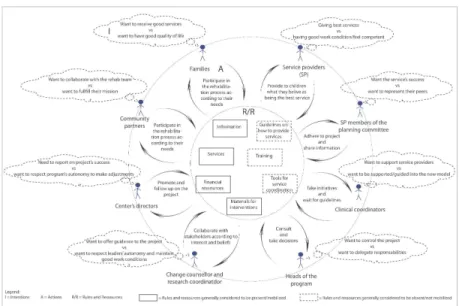
Figure 3 illustrates how actors’ actions can impact the service reorganization process. The dotted clouds represent the multiple intentions of the different stakeholders involved in this process. The short texts between the bidirectional arrows represent examples of actors’ actions, based on their intentions and the rules and resources of the programme (indicated by the rectangular text boxes).
[Insert figure about 3 here]
Different examples can illustrate the interactions between the concepts presented in figure 3. For instance, one of the new programme heads really wanted to understand the project and the programme to be able to make the most appropriate decisions (intentions). She thus frequently consulted with the members of the planning committee, read numerous documents related to the project and took time to reflect on the best decisions to make (actions). Meanwhile, the implementation of some parts of the model, such as the community interventions, was almost stopped because everyone else was waiting for someone to make the decisions and set up guidelines regarding how to provide these services (consequences). In this example, there does
3 4 5 6 7 8 9 10 11 12 13 14 15 16 17 18 19 20 21 22 23 24 25 26 27 28 29 30 31 32 33 34 35 36 37 38 39 40 41 42 43 44 45 46 47 48 49 50 51 52 53 54 55 56 57
For Peer Review Only
not seem to be a direct link between the initial intentions (fostering the implementation of the model) and the consequences (slowing the implementation process), but when the influence of multiple factors and actors’ actions are considered, the change process can be better understood. Actors are always considered to be acting in a context, with their own intentions and logic behind their actions [30]. Understanding the rational behind actors’ actions can help design more effective strategies for change management.
For example, in the context of our research, each group of actors had very good intentions and wanted the project to succeed. However, each group also had other interests. Service providers wanted the best for the children, but their idea of what constituted the best was influenced by how they were trained to provide services, and by the rules and resources in the programme they perceived to be available. Service providers struggled to redefine their practises, the quality of the services and their work conditions. Changes in their practises, combined with the perceived lack of support, made them doubtful about the service quality they could provide with the new service delivery model. They started feeling uncomfortable and incompetent, diminishing their initial enthusiasm to adhere to the new model. As they did not know what to do, or how to do it, it was easier to maintain the status quo than to feel insecure within the new model. The organizational climate was thus affected and many service providers felt they did not have the power to facilitate change. These two factors are known to negatively affecting perceptions of service quality and the change management process [14,45]. In our case, service providers did not actively oppose the service reorganization project: they felt constrained to act and needed more concrete guidelines. Indeed, perceived resistance to change is often caused by a lack of concrete resources to implement a change, and not by active opposition [46]. In our programme, it was not sufficient
3 4 5 6 7 8 9 10 11 12 13 14 15 16 17 18 19 20 21 22 23 24 25 26 27 28 29 30 31 32 33 34 35 36 37 38 39 40 41 42 43 44 45 46 47 48 49 50 51 52 53 54 55 56
For Peer Review Only
to convince service providers that the new model was better than the old one rather service providers needed more guidance to redefine their practises.
Clinical and administrative implications
We believe useful knowledge for future actions within our pediatric programme was generated through the identification of facilitators and barriers and their evolution, as well as the utilization of socio constructivist theories to better understand the interactions of all factors influencing the service reorganization. The lessons learned presented here could also help other healthcare settings interested in service delivery reorganization. Based on our experience, we propose five general recommendations:
1. Explore and act upon the potential duality of every factor that could influence the project: Act to build upon facilitators and to remove barriers. Insist upon diminishing negative consequences related to the constraining aspects of facilitators, and explore the enabling possibilities of barriers.
2. Go beyond reviewing processes of a given programme and do not forget that all programme components can be modified by the implementation of new interventions: Change is not only about implementing a new service; it involves creating optimal conditions in which a new programme can be effective and sustainable. Do not take anything for granted: Review all programme components such as service organization, service providers’ skills, the availability of tools and procedures.
3. Share the leadership role: Leadership should not only be theoretical or structural (e.g. giving official support or creating committees); rather it has to be functional and involve clear actions to successfully lead a project. Every actor needs to understand his or her role and responsibilities.
3 4 5 6 7 8 9 10 11 12 13 14 15 16 17 18 19 20 21 22 23 24 25 26 27 28 29 30 31 32 33 34 35 36 37 38 39 40 41 42 43 44 45 46 47 48 49 50 51 52 53 54 55 56 57
For Peer Review Only
4. Distinguish between intentions, actions and consequences: Good intentions must be translated into appropriate actions leading to desired outcomes. Explore actors’ interests and constraints to determine how to effectively support appropriate actions.
5. Be aware of interactions between all programme components: Anticipate the cascade of changes relating to every action, or the absence of action.
Limits and futures directions
Our study involved one specific implementation project within a pediatric rehabilitation setting. The context specific results may thus have limited generalizabilty to other settings. There is also a risk of social desirability bias in participants’ responses. Moreover, participant observation is subject to researchers’ subjectivity, but triangulation with different data sources and discussions and reflexion with peers fostered greater objectivity in our work.
More longitudinal research is needed, in a variety of contexts, to document the evolution and interactions of all factors coming into play while implementing change. Moreover, qualitative studies, specifically using socio constructivist approaches and participatory action research, may provide useful methods taking into account the complexity embedded within the process of change management. Identifying all of the general factors influencing any kind of service reorganization is a good first step. Providing more information regarding the enabling and constraining possibilities of each factor, and offering tools to clinical settings to act upon these factors, are additional necessary steps to concretely support stakeholders in their efforts to improve service quality.
Conclusions
Despite a growing body of literature on factors influencing uptake of new interventions and how
3 4 5 6 7 8 9 10 11 12 13 14 15 16 17 18 19 20 21 22 23 24 25 26 27 28 29 30 31 32 33 34 35 36 37 38 39 40 41 42 43 44 45 46 47 48 49 50 51 52 53 54 55 56
For Peer Review Only
reorganizing their services to improve the quality of care. Prior to the implementation of any new intervention, identification of barriers and facilitators, and fostering readiness for change is essential. We agree with Weiner that organizational readiness should lead to better success in regard to the implementation of new interventions [19]. However, we argue that conditions for organizational readiness are not something that only has to be created before initiating a change, but also needs to be maintained throughout the duration of an implementation project. Organizational readiness is necessary, but not sufficient. To link readiness with the probability of implementation success, we need to better understand what happens during implementation processes. The case presented here provided examples of what happens in real life. The identification of the facilitators and the barriers to the implementation of a new model of pediatric rehabilitation services, as well as the documentation of their evolution and interactions over time, provides insight into the change management process of a given programme.
Acknowledgements
We wish to thank all who were involved in this project, especially the service providers and administrators. The first author is funded by scholarships from the Canadian Institutes of Health Research, the Analyse et Évaluation des Interventions en Santé programme of Université de Montréal and the Eleanor Côté Foundation. The research project was funded by a grant from the Office des Personnes Handicapées du Québec.
Declaration of Interest statement
The authors declare that they have no competing interests. The ethics board of the Centre of Interdisciplinary Rehabilitation Research of Montreal (CRIR-286-04-07) approved this research.
3 4 5 6 7 8 9 10 11 12 13 14 15 16 17 18 19 20 21 22 23 24 25 26 27 28 29 30 31 32 33 34 35 36 37 38 39 40 41 42 43 44 45 46 47 48 49 50 51 52 53 54 55 56 57
For Peer Review Only
References
1. Braga LW. Should we empower the family? Developmental neurorehabilitation 2009;12(4):179.
2. Gibson BE, Darrah J, Cameron D, Hashemi G, Kingsnorth S, Lepage C, Martini R, Mandich A, Menna-Dack D. Revisiting therapy assumptions in children's rehabilitation: clinical and research implications. Disability & Rehabilitation 2009;31(17):1446-53. 3. Helders PJM, Engelbert RHH, Custers JWH, Gorter JW, Takken T, Van Der Net J.
Creating and being created: The changing panorama of paediatric rehabilitation. Developmental Neurorehabilitation 2003;6(1):5-12.
4. Johnson DA. Research and practice - Are we giving children the best treatment? Pediatric Rehabilitation 2003;6(2):65-66.
5. King G, Currie M, Bartlett DJ, Gilpin M, Willoughby C, Tucker MA, Strachan D, Baxter D. The development of expertise in pediatric rehabilitation therapists: Changes in approach, self-knowledge, and use of enabling and customizing strategies. Developmental Neurorehabilitation 2007;10(3):223-40.
6. Saleh MN, Korner-Bitensky N, Snider L, Malouin F, Mazer B, Kennedy E, Roy M-A. Actual vs. best practices for young children with cerebral palsy: A survey of paediatric occupational therapists and physical therapists in Quebec, Canada. Developmental Neurorehabilitation 2008;11(1):60-80.
7. Ehrmann Feldman D, Couture M, Grilli L, Simard MN, Azoulay L, Gosselin J. When and by whom is concern first expressed for children with neuromotor problems? Archives of Pediatrics & Adolescent Medicine 2005;159(9):882-6.
3 4 5 6 7 8 9 10 11 12 13 14 15 16 17 18 19 20 21 22 23 24 25 26 27 28 29 30 31 32 33 34 35 36 37 38 39 40 41 42 43 44 45 46 47 48 49 50 51 52 53 54 55 56
For Peer Review Only
8. Grilli L, Feldman DE, Swaine B, Gosselin J, Champagne F, Pineault R. Wait times for paediatric rehabilitation. Healthcare Policy 2007;2(3):e171-87.
9. Mazer B, Feldman D, Majnemer A, Gosselin J, Kehayia E. Rehabilitation services for children: therapists' perceptions. Pediatric Rehabilitation 2006;9(4):340-50.
10. Feldman DE, Swaine B, Gosselin J, Meshefedjian G, Grilli L. Is waiting for rehabilitation services associated with changes in function and quality of life in children with physical disabilities? Physical & Occupational Therapy in Pediatrics 2008;28(4):291-304.
11. Miller AR, Armstrong RW, Mâsse LC, Klassen AF, Shen J, O’Donnell ME. Waiting for child developmental and rehabilitation services: an overview of issues and needs. Developmental Medicine & Child Neurology 2008;50(11):815-21.
12. Castle NG, Lin M. Top management turnover and quality in nursing homes. Health Care Management Review 2010;35(2):161-74.
13. Chreim S, Williams BE, Janz L, Dastmalchian A. Change agency in a primary health care context: The case of distributed leadership. Health Care Management Review 2010;35(2):187-99.
14. Gregory DM, Way CY, Barrett BJ, Parfrey PS. Predictors of perceived health care quality for registered nurses during and after health care reform. Health Care Management Review 2010;35(4):301-11.
15. VanDeusen Lukas C, Engle RL, Holmes SK, Parker VA, Petzel RA, Nealon Seibert M, Shwartz M, Sullivan JL. Strengthening organizations to implement evidence-based clinical practices. Health Care Management Review 2010;35(3):235-45.
16. Helfrich C, Li Y-F, Sharp N, Sales A. Organizational readiness to change assessment (ORCA): Development of an instrument based on the Promoting Action on Research in
3 4 5 6 7 8 9 10 11 12 13 14 15 16 17 18 19 20 21 22 23 24 25 26 27 28 29 30 31 32 33 34 35 36 37 38 39 40 41 42 43 44 45 46 47 48 49 50 51 52 53 54 55 56 57
For Peer Review Only
17. Damschroder L, Aron D, Keith R, Kirsh S, Alexander J, Lowery J. Fostering implementation of health services research findings into practice: A consolidated framework for advancing implementation science. Implementation Science 2009;4(1):50. 18. Hagedorn H, Heideman P. The relationship between baseline Organizational Readiness to
Change Assessment subscale scores and implementation of hepatitis prevention services in substance use disorders treatment clinics: A case study. Implementation Science 2010;5(1):46.
19. Weiner B. A theory of organizational readiness for change. Implementation Science 2009;4(1):67.
20. Champagne F. The ability to manage change in health care organizations. Montréal, Québec: University of Montréal; 2002. 46 p.
21. Kajermo K, Bostrôm A, Thompson D, Hutchinson A, Estabrooks C, Wallin L. The BARRIERS scale - The barriers to research utilization scale. Implementation Science 2010;5(1), 32.
22. Goderis G, Borgermans L, Mathieu C, Van Den Broeke C, Hannes K, Heyrman J, Grol R. Barriers and facilitators to evidence based care of type 2 diabetes patients: Experiences of general practitioners participating to a quality improvement program. Implementation Science 2009;4(1):41.
23. King GA, Tucker MA, Baldwin P, LaPorta J. Bringing the Life Needs Model to Life: Implementing a Service Delivery Model for Pediatric Rehabilitation. Physical & Occupationnal Therapy in Pediatrics 2006;26(1):41-68.
24. Camden C, Swaine B, Tétreault S, Bergeron S. SWOT analysis on a pediatric rehabilitation programme: A participatory evaluation fostering quality improvement.
3 4 5 6 7 8 9 10 11 12 13 14 15 16 17 18 19 20 21 22 23 24 25 26 27 28 29 30 31 32 33 34 35 36 37 38 39 40 41 42 43 44 45 46 47 48 49 50 51 52 53 54 55 56
For Peer Review Only
25. Camden C, Swaine B, Tétreault S, Brodeur M-M. Reorganizing pediatric rehabilitation services to improve accessibility: Do we sacrifice quality? BMC Health Services Research 2010;10:227.
26. Tandon R. Participatory research: Revisiting the roots. New Delhi: Mosaic books; 2002. 27. Contandriopoulos A-P, Champagne F, Denis J-L, Avargues M-C. L'évaluation dans le
domaine de la santé : concepts et méthodes. Revue d'Epidémiologie et de Santé Publique 2000;48:517-39.
28. Carrière M, Clément M, Tétreault S, Pépin G, Fortier M, Paquet S. Réflexion québécoise sur l'approche familiale: Quand la mère a un trouble de santé mentale. Congress of the Association latine d'analyse des systèmes de santé (ALASS); 2007; Marseille.
29. Lafortune L, Lepage C, Persechino F, Bélanger K. Un modèle d'accompagnement professionnel d'un changement pour un leadership novateur. Québec: Presses de l'Université du Québec; 2009. 240 p.
30. Amblard H, Bernoux P, Herreros G, Livian Y-F. Les nouvelles approches sociologiques des organisations. Paris: Seuil, editor; 2005. 300 p.
31. Giddens A. La constitution de la société. Éléments de la théorie de la structuration. Paris: Presses universitaires de France; 1987. 474 p.
32. Kuipers P, Kendall E, Hancock T. Evaluation of a rural community-based disability service in Queensland, Australia. Rural & Remote Health 2003;3(1):186.
33. Lanzotti LM. Staff participation in a strength, weakness, opportunity, and threats analysis. Journal of Nursing Administration 1991;21(10):67-9.
34. Pollack CD. Planning for success: The first steps in new program development. Journal of School Nursing 1994;10(3):11-5. 3 4 5 6 7 8 9 10 11 12 13 14 15 16 17 18 19 20 21 22 23 24 25 26 27 28 29 30 31 32 33 34 35 36 37 38 39 40 41 42 43 44 45 46 47 48 49 50 51 52 53 54 55 56 57
For Peer Review Only
35. Tomasovi N. Geriatric-palliative care units model for improvement of elderly care. Collegium Antropologicum 2005;29(1):277-82.
36. Kotter J. Leading change. Boston: Harvard; 2006. 169 p.
37. Wallace LM, Freeman T, Latham L, Walshe K, Spurgeon P. Organizational strategies for changing clinical practice : How trusts are meeting the challenges of clinical governance. Quality in Health Care 2001;10:76-82.
38. Landry R, Becheikh N, Amara N, Jbilou J, Halilem N, Mosconi E, Hammami H. Innovation dans les services publics et parapublics à vocation sociale. Tableau de bord de suivi de l'innovation et de ses déterminants. Sainte-Foy: Département de management, Université Laval; 2007. 39 p.
39. Weiner BJ. Leadership for quality improvement in health care : Empirical evidence on hospital boards, managers, physicians. Medical Care Research and Review 1996;53:397-416.
40. Weiner BJ, Shortell SM, Alexander J. Promoting clinical involvement in hospital quality improvement efforts: The effects of top management, board, and physician leadership. Health Services Research 1997;32(4):491-510.
41. Chenoweth L, Luck K. Quality Improvement in Discharge Planning Through Action Research. Outcomes Management 2003;7(2):68-73.
42. Glasson JB, Chang EM, Bidewell JW. The value of participatory action research in clinical nursing practice. International Journal of Nursing Practice 2008;14(1):34-39. 43. Parker VA, Wubbenhorst WH, Young GJ, Desai KR, Charns MP. Implementing quality
improvement in hospitals: The role of leadership and culture. American Journal of Medical Quality 1999;14(1):64-9. 3 4 5 6 7 8 9 10 11 12 13 14 15 16 17 18 19 20 21 22 23 24 25 26 27 28 29 30 31 32 33 34 35 36 37 38 39 40 41 42 43 44 45 46 47 48 49 50 51 52 53 54 55 56
For Peer Review Only
44. Young GJ, Charns MP, Shortell SM. Top management and network effect on the adoption of innovative management practices : A study of TQM in public hospital system. Strategic management journal 2001;22:935-51.
45. Leggat SG, Bartram T, Casimir G, Stanton P. Nurse perceptions of the quality of patient care: Confirming the importance of empowerment and job satisfaction. Health Care Management Review 2010;35(4):355-64.
46. Kathri N, Baveja A, Boren S, Mammo A. Medical Errors and Quality of Care: From Control to Commitment. California management review 2006;48(3).
Tables
Table 1 - Major themes (i.e. facilitators and barriers) that emerged from the SWOT, the
interviews and the focus groups presented according to different components related to the
study framework (figure 2)
Figures
Figure 1 - Timeline for the implementation process of a new service delivery model for
pediatric rehabilitation
Figure 2 - A framework based on organized action systems and socio constructivist theories
to illustrate the evolution and the interactions between various factors during a service
reorganization process
Figure 3 - Actors’ actions interacting with the programme’s rules and resources to impact
on the service reorganization process
3 4 5 6 7 8 9 10 11 12 13 14 15 16 17 18 19 20 21 22 23 24 25 26 27 28 29 30 31 32 33 34 35 36 37 38 39 40 41 42 43 44 45 46 47 48 49 50 51 52 53 54 55 56 57
For Peer Review Only
Figure 1 - Timeline for the implementation process of a new service delivery model for pediatric rehabilitation 215x279mm (496 x 502 DPI) 3 4 5 6 7 8 9 10 11 12 13 14 15 16 17 18 19 20 21 22 23 24 25 26 27 28 29 30 31 32 33 34 35 36 37 38 39 40 41 42 43 44 45 46 47 48 49 50 51 52 53 54 55 56
For Peer Review Only
Figure 2 - A framework based on organized action systems and socio constructivist theories to illustrate the evolution and the interactions between various factors during a service reorganization
process 215x279mm (242 x 242 DPI) 3 4 5 6 7 8 9 10 11 12 13 14 15 16 17 18 19 20 21 22 23 24 25 26 27 28 29 30 31 32 33 34 35 36 37 38 39 40 41 42 43 44 45 46 47 48 49 50 51 52 53 54 55 56 57
For Peer Review Only
Figure 3 - Actors’ actions interacting with the programme’s rules and resources to impact on the service reorganization process
279x215mm (414 x 414 DPI) 3 4 5 6 7 8 9 10 11 12 13 14 15 16 17 18 19 20 21 22 23 24 25 26 27 28 29 30 31 32 33 34 35 36 37 38 39 40 41 42 43 44 45 46 47 48 49 50 51 52 53 54 55 56
For Peer Review Only
Themes and sub themes Facilitators Barriers 1. Programme’s structure Organization of serviceso Service planning was perceived to be increased within the new service organization (e.g. increase continuity of services across children’s lifespan) (2007-2008)
o Concerns regarding the
o Increase need for service coordination within this new model of service delivery (2007)
o Decreasing possibilities to customize services according to needs (2007-2008-2009)
o Applicability of the new service delivery model in rural locations (2007-2008-2009)
o Difficulty integrating the different services for the children into a coherent model of care (2008-2009)
o Service variability provided across providers (2008) Work
organization
o Time was granted to service providers to develop the model and discuss among peers (2007-2008)
o Professional autonomy was perceived to foster service quality (2007)
o Heavy caseloads and lack of time (2007-2008-2009) o Administrative rules were threats for the implementation
of the new model (2007-2008)
o Groups led to increased numbers of children served but took time to prepare (2008-2009)
o Service providers were not prepared by academia to work within a service model like the one implemented, and although planned, no formal training was offered during the project (2008)
o Fears that standardization of services within the new model would diminish professional autonomy (2007-2008-2009)
Resources o Lack of human resources facilitated the adherence to
group interventions (2008)
o Special funds for the project allowed time for the development of the model and of the resources needed (2008)
o Recurrent funds from the health Ministry increased the yearly programme budget (2009)
o Lack of financial and human resources, penury of rehabilitation service providers (2008-2009)
o Concerns about the
o Availability of physical equipment, especially for group interventions (2007 and 2008)
o Team’s stability (vs staff turnover) (2009)
o Funding period ending for the service reorganization (2009)
o Lack of information tool to help clinical coordinators to coordinate services (2008-2009)
Symbolic structure (values of the programme)
o The centre’s humanistic approach (2007-2008-2009)
2. Actors (intentions, characteristics and actions) Service
providers and programme’s team
o Service providers’ vision and creativity, as well as the good working climate (2007-2008-2009)
o Service providers were initially mobilized toward the project (2007-2008)
o Planning committee members were perceived to ease the communication between the project leaders and
o Concerns about
o Program’s atmosphere (2008-2009)
o Adaptation to change and professional fatigue (2007-2008-2009)
o Some service providers felt discouraged and expected more important changes within the service reorganization.
3 4 5 6 7 8 9 10 11 12 13 14 15 16 17 18 19 20 21 22 23 24 25 26 27 28 29 30 31 32 33 34 35 36 37 38 39 40 41 42 43 44 45 46 47 48 49 50 51 52 53 54 55 56 57
For Peer Review Only
the rest of the programme (2008) o Positive perceptions of the new model
o Good aims (2007-2008-2009)
o Allowed to respond to the ever increasing needs of children (2007-2008)
Some also reported feeling incompetent (2009)
o Planning committee members felt a lack of clear directives to make things work and play their roles (2009)
o Concerns in regards to some aspects of the new model o Lack of concrete details (2007)
o Lack of common understanding and vision regarding the new model (2008-2009)
o Complex model that involves many changes (2008) Head of the
programme and clinical coordinators
o Leadership of the first head of the programme (2007-2008)
o General support of the head of the programme and clinical coordinators (2007)
o Subsequent heads of the programme lacked knowledge about the project (2008-2009)
o Concerns were expressed regarding the high rate of turn over and the lack of continuity in the support provided to service providers (2008-2009)
o The lack of support and guidelines provided by the head of the programme and the clinical coordinators during the implementation (2008-2009)
o Clinical coordinators felt unsupported to assume new coordination roles (2009)
Centre’s directors
o Directors were generally perceived to be supportive of the project (2007)
Families o New service delivery model was perceived to better
respond to families’ needs (2007-2008)
o Participation of families within the rehabilitation process (2007-2008)
o Difficult to know each child’s needs without being able to respond to all of them (2008-2009)
o Participation of families within the rehabilitation process (2007-2008)
o Lack of families’ involvement into the project of service reorganization (2008-2009)
3. Programme’s environment
Partners o Possibility of increasing collaboration with
community partners (2007-2008)
o Health ministry’s announcement of the access plan to increase service accessibility for children with disabilities (2009)
o Different obstacles to collaboration with community partners were identified (e.g. different visions) (2007-2008-2009)
o Professional orders’ rules (i.e. lack of coherence of the new service delivery model with the regulations of different professional associations) (2008-2009)
4. Processes of services First contact and follow-up
o First contact was perceived as a strength as it facilitates responding to families’ concerns and decreases their stress (2007-2008-2009)
o Compared with what was planned, changes were made in the way of making the first contact, potentially resulting in a lack of information for subsequent planning of services (2009)
o Some concerns were expressed regarding the follow-up process and the continuity of services, and some elements were lacking in comparison to what was originally planned (e.g. the key contact service provider) (2008-2009) Community
interventions
o Some community interventions already existed before beginning the service reorganization.
o Perceived as strengths and opportunities as they
o Concerns regarding the lack of time to develop these interventions, resulting in fewer than expected new community interventions (2008-2009) 3 4 5 6 7 8 9 10 11 12 13 14 15 16 17 18 19 20 21 22 23 24 25 26 27 28 29 30 31 32 33 34 35 36 37 38 39 40 41 42 43 44 45 46 47 48 49 50 51 52 53 54 55 56
For Peer Review Only
waiting for someone’s authorization, either in the centre or in the community partner’s organization) (2008-2009) Group
interventions
o Some group interventions already existed before the beginning of the service reorganization (2007-2008) o Groups permitted more children to be seen. Groups
also foster motivation and generalization of learning (2008-2009)
o Concerns about o Lack of procedures
o Groups do not always respond to specific needs o Time required to develop the groups (2008-2009)
5. Impact of services
o New model was perceived to foster children’s social participation and well being (2008-2009)
o Impact on social participation was questioned by some, as time was sometimes lacking for the follow up into the community (2009)
o Difficulties faced in regards to measuring social participation (2008-2009)
6. Production of services
o Increase in service accessibility, in terms of reduction of waiting times and increased number of children seen (2007-2008-2009)
o Lack of service accessibility after the first contact, and some children’s needs might remained unaddressed (2008) o Concerns emerged regarding the small number of hours of
services given to each child and the quality of the services (2008-2009)
7. Change management process Implementation
process of the new model
o Different change activities were conducted to foster the implementation of the new model (2008)
o Worries regarding how the model would concretely be implemented, especially in regional locations (2007-2008) o Fears that some colleagues could loose motivation or felt
insecure (2007-2008)
o The rhythm of the implementation was a concern (too fast in 2007-2008, too slow in 2009)
o Need for a leader to take decisions (2009)
Project guidance o Lack of guidance, which created insecurity among service
providers (2008-2009)
o Lack of support and tools (2009) Participative
approach
o The model was developed through consultation; adjustments were possible and information was shared (2007-2008)
o Some perceived that service providers needed more information on the project, and that decisions needed to be taken based on the information provided to project leaders (2009)
8. Participatory action research process
o Some service providers believed research could help develop better services and integrate evidence-base data into the new model of service delivery (2008-2009)
o Research takes time (e.g. for service providers to respond to surveys) (2009) 3 4 5 6 7 8 9 10 11 12 13 14 15 16 17 18 19 20 21 22 23 24 25 26 27 28 29 30 31 32 33 34 35 36 37 38 39 40 41 42 43 44 45 46 47 48 49 50 51 52 53 54 55 56 57