Titre:
Title:
Development and modelling of a steel slag filter effluent
neutralization process with CO₂-enriched air from an upstream
bioprocess
Auteurs:
Authors:
Patricia Bove, Dominique Claveau-Mallet, Étienne Boutet, Félix Lida
et Yves Comeau
Date: 2018
Type:
Article de revue / Journal articleRéférence:
Citation
:
Bove, P., Claveau-Mallet, D., Boutet, É., Lida, F. & Comeau, Y. (2018).
Development and modelling of a steel slag filter effluent neutralization process with CO₂-enriched air from an upstream bioprocess. Water Research, 129, p. 11-19. doi:10.1016/j.watres.2017.11.005
Document en libre accès dans PolyPublie
Open Access document in PolyPublieURL de PolyPublie:
PolyPublie URL: https://publications.polymtl.ca/5292/
Version: Version finale avant publication / Accepted version Révisé par les pairs / Refereed Conditions d’utilisation:
Terms of Use: CC BY-NC-ND
Document publié chez l’éditeur officiel Document issued by the official publisher
Titre de la revue:
Journal Title: Water Research (vol. 129)
Maison d’édition:
Publisher: Elsevier
URL officiel:
Official URL: https://doi.org/10.1016/j.watres.2017.11.005
Mention légale:
Legal notice:
Ce fichier a été téléchargé à partir de PolyPublie, le dépôt institutionnel de Polytechnique Montréal
This file has been downloaded from PolyPublie, the institutional repository of Polytechnique Montréal
1
Development and modelling of a steel slag filter effluent neutralization process with CO2-enriched air from an upstream bioprocess
Patricia Bove1, Dominique Claveau-Mallet1*, Étienne Boutet2, Félix Lida2 and Yves Comeau1 1Department of Civil, Geological and Mining Engineering, Polytechnique Montreal, Montreal,
Quebec, Canada, H3C 3A7
2Bionest, 55, 12e Rue, C.P. 10070, Shawinigan, Quebec, Canada, G9T 5K7
* corresponding author: [email protected] Abstract
The main objective of this project was to develop a steel slag filter effluent neutralization process by acidification with CO2-enriched air coming from a bioprocess. Sub-objectives were to evaluate
the neutralization capacity of different configurations of neutralization units in lab-scale conditions and to propose a design model of steel slag effluent neutralization. Two lab-scale column neutralization units fed with two different types of influent were operated at hydraulic retention time of 10 hours. Tested variables were mode of flow (saturated or percolating), type of media (none, gravel, Bionest and AnoxKaldnes K3), type of air (ambient or CO2-enriched) and
airflow rate. One neutralization field test (saturated and no media, 2000 to 5000 ppm CO2,
sequential feeding, hydraulic retention time of 7.8 hours) was conducted for 7 days. Lab-scale and field-scale tests resulted in effluent pH of 7.5 to 9.5 when the aeration rate was sufficiently high. A model was implemented in the PHREEQC software and was based on the carbonate system, CO2 transfer and calcite precipitation; and was calibrated on ambient air lab tests. The model was
validated with CO2-enriched air lab and field tests, providing satisfactory validation results over a
2 hydraulic efficiency, while the type of media had little influence. The flow mode also had a major impact on the calcite surface concentration in the reactor: it was constant in saturated mode and was increasing in percolating mode. Predictions could be made for different steel slag effluent pH and different operation conditions (hydraulic retention time, CO2 concentration, media and mode
of flow). The pH of the steel slag filter effluent and the CO2 concentration of the enriched air were
factors that influenced most the effluent pH of the neutralization process. An increased concentration in CO2 in the enriched air reduced calcite precipitation and clogging risks.
Stoichiometric calculations showed that a typical domestic septic tank effluent with 300 mg/L of biodegradable COD provides enough biological CO2 for neutralization of a steel slag effluent with
pH of 10.5 to 11.5. A saturated neutralization reactor with no media operated at hydraulic retention time of 10 h and a concentration of 2000 ppm in CO2 enriched air is recommended for
full-scale applications.
Keywords: Steel slag filter; Neutralization; Gas transfer; Wastewater; CO2; Modelling 1 Introduction
Phosphorus removal is required for wastewater effluents discharged into sensitive environments such as lakes or upstream of a lake in the province of Quebec, Canada. For residential systems with a point discharge, a tertiary treatment criteria for total phosphorus (TP) is set at 1 mg TP/L (MDDELCC, 2017). Slag filters are efficient and economical for phosphorus removal and they could be used in isolated dwellings tertiary treatment. However, effluent pH of 11 makes its application difficult (Barca et al., 2012). These values exceed the pH discharge criteria between 6.0 and 9.5 applied for water resource recovery facilities (LégisQuébec, 2017).
This project is carried out as part of a larger project to develop a slag filter phosphorus treatment system for onsite and decentralized treatment of domestic wastewater. The main objective of this
3 project was to develop a steel slag filter effluent neutralization process by using passive CO2
acidification. Secondary objectives of this project were to evaluate the neutralization capacity of different configurations of neutralization units in laboratory conditions and to propose a design model of steel slag effluent neutralization. The variables tested were the aeration rate, the media used (none, Bionest, AnoxKaldnes K3 and gravel), the type of flow (saturated or percolating) and the CO2 air concentration. A model for CO2 transfer and calcite precipitation was developed,
calibrated and validated with lab and field tests.
Two approaches were previously used for phosphorus removal from wastewater using reactive alkaline filters: treatment of a primary or of a secondary effluent. Nilsson et al. (2013a) used reactive filters with a high recirculation rate for the treatment of a primary effluent for 90 days, resulting in 40-80% phosphate removal. Claveau-Mallet et al. (2015) used a slag filter in a recirculation line within a septic tank, which increased the phosphorus removal of the septic tank. Karabelnik et al. (2012) fed primary effluent to a percolating filter followed by a horizontal saturated filter both filled by oil shale fly ash. They achieved combined removal of organic matter, nitrogen and phosphorus. It was shown that a high organic matter concentration reduced the phosphorus removal efficiency of a slag filter (Nilsson et al. 2013b), enlightening the need for a secondary treatment prior to the reactive filter for increased longevity.
Reactive alkaline filters as tertiary treatment (fed with secondary effluent) has been tested by several research teams. Slag filters have been tested as tertiary units following an aerated bed (Kõiv et al., 2016) or constructed wetlands (Barca et al., 2013). While past studies on phosphorus removal are focused on phosphorus removal efficiency and filter longevity, little attention has been given to process design of the high-pH effluent neutralization.
4 The originality of this project resides in the evaluation of the neutralization capacity of different configurations of neutralization units in laboratory conditions and the proposal of a mechanistic model of steel slag effluent neutralisation. The original neutralization strategy is to use CO2
enriched air coming from a biological wastewater treatment process (Boutet et al., 2017), which is more passive and economical than using CO2 from gas cylinders. Confined secondary treatment
processes typically used in decentralized applications are expected to provide CO2 enriched air
with a concentration between 1000 and 5000 ppm.
The pH of alkaline reactive filters effluents for P removal using steel slag (Claveau-Mallet et al., 2013; Penn et al., 2016) or hydrated oil shale ash (Kõiv et al., 2010) is typically between pH 11 and 12 at the beginning of operation, and it drops progressively to 9 or less. Calcite precipitation in alkaline reactive filter neutralization is expected because of typical high calcium concentration in such effluents (Vohla et al., 2011).
1.1 Use of CO2 for alkaline wastewater neutralization
CO2 acidification has already been used to neutralize various wastewater streams such as
ash-pond effluents, cooling water or others (Wine & Morrison, 1986). For example, a pilot-scale basic oxygen furnace slag filter effluent with pH between 11.5 and 12.0 was successfully neutralized using pure CO2 during 2 years (Hussain et al., 2014). This filter treated lake water with phosphate
concentrations between 0.25 and 0.49 mg/L. In their study, 0.01 moles of CO2/L liquid effluent
were used to reduce effluent pH between 6.5 and 8.5. The need of CO2 was higher in the first days
of operation, when the slag filter effluent pH was higher. In another study (Mayes et al., 2006), a 1500 m2 pond of alkaline (pH>10) leachate from a steel slag storage pile was documented. Natural
attenuation by ambient air CO2 and biological activity from the wetland was observed in this pond.
5 was a dominant constituent of alkalinity (at pH > 9.5). Estimates of calcite precipitation was made using the limestone tablet method (Mayes et al., 2006), which consists in monitoring calcite precipitation on a limestone tablet with weight measurements of the tablet at the beginning and end of the experiment. CO2 neutralization was also reported as part of intensive industrial synergy
processes. A landfill gas was purified from its CO2 while being used for neutralization of an alkaline
wastewater (Gaur et al., 2009). Also, neutralization of alkaline metalworking wastewater and carbonation of slag, in a steel making plant, was performed using CO2, which insured efficient
wastewater neutralization, CO2 capture and improvement of slag stability (Pan et al., 2013).
2 Material and Methods
The project included three parts, first, neutralization column tests in which the effect of media and mode of flow were tested, then a neutralization field test and finally, modelling of experimental results to propose design criteria.
2.1 Column Tests
Two parallel streams of an upflow steel slag filters followed by a clear polyvinyl chloride (PVC) neutralization columns were installed. Electric arc furnace (EAF) slag from Arcelor Mittal (Contrecoeur, QC) was used. Its particle size was 5-10 mm and its grain density was 3.6 g/cm3. The
chemical composition of the slag was 33% Fe2O3, 30% CaO, 16% SiO2 and 12% MgO
(Claveau-Mallet et al., 2014). Each steel slag column had a diameter of 10 cm and a length of 159 cm and was run at a hydraulic retention time of voids (HRTV) of 13.9 h for column 1 and 13.7 h for column
2. EAF slag from steel slag filter 2 was changed for new media after a year of use. A different synthetic influent solution was used for each stream and it was continuously pumped through the steel slag filter then to the neutralization column (Table 1). Solution 1 contained analytical grade KH2PO4, K2HPO4, NaHCO3 and CaCl2 in tap water. Solution 2 contained analytical grade CH3COOH
6 and CH3COONa in tap water. The solution composition was fixed in a previous project in which
the slag filter behavior was studied (Claveau-Mallet et al., 2017 for column 1 and results not yet published for column 2).
Table 1 : Mean chemical composition of synthetic solutions and steel slag effluents
Synthetic solutions Steel slag effluent Solution 1 Solution 2 Column 1 Column 2
Parameter Units Concentration
COD mg/L 0 320 0 310 TOC mg C/L 0 121 0 121 pH - 7.8 7.3 11.0 11.2 TP mg P/L 11.5 0 0.15 0 o-PO4 mg P/L 8.9 0 0.020 0 Ca mg/L 61.6 37.1 45.7 65.3 Na mg/L 28.3 114 NA NA DIC mg C/L 21.9 21.9 3.4 3.6 Alkalinity mg CaCO3/L 102 215 85 269
The neutralization columns were run with an empty bed HRT of about 10 h. Each neutralization column had a diameter of 63 mm by 1520 mm in length with 1300 mm of water level. Percolating tests were fed downflow and saturated tests were fed upflow. Ambient air or CO2 enriched air
was injected at the bottom of the neutralization columns through a fine-bubble air stone. Air was enriched by combining it with CO2 from a gas cylinder in a sealed container in which there was a
7 container. The variables tested in the neutralization units (see Table 2) were air flow rate, type of air and CO2 concentration (ambient or enriched), type of media (none, Bionest, AnoxKaldnes K3,
gravel) and flow mode (saturated or percolating). The Bionest media is composed of an unattached elongated thin plastic film with a nest-like configuration and is normally used as support in fixed film biological processes (Bionest, 2011). The AnoxKaldnes K3 carriers are composed of polyethylene of high density, several cavities of alveolar shape are present in the carrier that is generally used as suspended biofilm growing support (Brosseau, 2015). For example, an experiment identified as SEN would have had operating conditions of Saturated flow, CO2 Enriched air and No media (Table 2). The neutralization columns were packed with media up
to their water level. The effluent from each neutralization column was sampled three times a week for dissolved inorganic carbon (DIC) and for pH, and once a week for alkalinity and calcium concentration. The flow was measured before sampling three times a week.
8 Table 2 : Column test operating conditions (listed in chronological order of testing)
Code Col No Flow mode Air type Media
Media concentration in reactor Duration pH of the steel slag filter effluent
Air flow rate range* CO2 conc. range
(S/P) (A/E) (N/G/B/K) m2/m3 kg/m3 d - mL/min ppm
SAN 1 Saturated Ambient None - - 44 11.27±0.15 700-3000 400
SEN 1 Saturated Enriched None - - 51 11.08±0.16 65-1800 400-22500
PAG 1 Percolating Ambient Gravel 229 1440 12 10.97±0.04 0-1200 400
PEG 1 Percolating Enriched Gravel 229 1440 21 10.99±0.05 150-2400 460-7700
SAG 1 Saturated Ambient Gravel 229 1440 19 10.96±0.06 250-2000 400
SEG 1 Saturated Enriched Gravel 229 1440 42 10.79±0.09 90-2100 2000-9200
SAB 2 Saturated Ambient Bionest 162 16 35 11.28±0.16 480-1400 400
SEB 2 Saturated Enriched Bionest 162 16 38 11.26±0.15 80-1000 400-24000
PAB 2 Percolating Ambient Bionest 805 80 12 10.90±0.06 0-2300 400
PEB 2 Percolating Enriched Bionest 805 80 21 10.84±0.10 190-3000 500-7700
SAK 2 Saturated Ambient K3 500 80 17 11.03±0.16 100-2200 400
Change slag media for fresh slag in column 2
SEK 2 Saturated Enriched K3 500 80 14 11.47±0.10 200-200 2000-9200
PEK 2 Percolating Enriched K3 500 80 19 11.32±0.05 160-2400 2000-8700
PAK 2 Percolating Ambient K3 500 80 13 11.40±0.05 0-3500 400
9 2.1.1 Description of tracer test method
Tracer experiments were carried out for each neutralization condition. An amount of 0.1 mg of fluorescein was injected to the column in one pulse. Equal volumes of effluent were collected periodically from each column and were tested for absorbance using a spectrofluorophotometer (model RF-1501 from Shimadzu).
2.2 Field Test
The field test was composed of a typical onsite domestic wastewater treatment system including a septic tank followed by a Bionest secondary treatment unit (MDDELCC, 2017). The Bionest unit effluent was sent to a steel slag filter, and the steel slag filter effluent was sent to a neutralization unit. Wastewater from the Grandes-Piles village (Quebec, Canada) was used as the influent to the system. The wastewater flowrate was 1350 L/d in a sequential feeding mode (feeding during 3 hours in the morning, 3 hours at noon and 3 hours in the evening). The composition of the Bionest effluent was pH = 7.2, alkalinity = 20-50 mg CaCO3/L, TP = 3.1 mg P/L, o-PO4 = 3.0 mg P/L, COD = 43 mg/L, TSS = 6 mg/L and NH4 = 10 mg N/L, while
that of the slag filter effluent was pH = 10.5, TP = 0.7 mg P/L and o-PO4 = 0.6 mg P/L.
The slag filter and neutralization unit were combined in a modified septic tank reactor. The first compartment was filled with slag and was operated in an upflow mode using a low-pressure distribution system typically used for infiltration beds. The slag filter effluent was overflowing through sealed pipes going to the bottom of the second compartment in which neutralization occurred. The slag filter HRTV was
15.4 h and the neutralization unit HRT was 7.8 h. In the neutralization compartment, air was injected at the bottom of the reactor using a fine bubble diffuser at 64 L/min. Neutralization air was pumped from the Bionest biological reactor, resulting in CO2 enriched air at 3500 to 5500 ppm CO2 concentration. The
CO2 concentration was 5000-5500 in feeding sequences and it decreased slowly to 3500 ppm at the end
10 manholes. pH in the neutralization unit water and CO2 concentration in the gas headspace of the
neutralization unit were continuously monitored with probes for 7 days. 2.3 Analytical Determinations
The pH determinations were carried out using a pH-meter XL15 from Fisher Scientific and a VWR 89231-596 refillable 3M KCl electrode according to Standard Method 4500-H+ (APHA et al., 2012). The electrode was 3-point calibrated using pH 7, 10 and 12 standards. DIC and TOC were measured using a Dohrman Rosemount DC-190 instrument according to Standard Method 5310-B High temperature Combustion method, on 0.45 µm filtered samples for DIC (APHA et al., 2012). Water samples were filtered at 0.45 µm and acidified with H2SO4 5N or HNO3 6N prior to sodium and calcium analyses. Analyse of calcium and
sodium were conducted with an AAnalyst 200 flame atomic absorption apparatus, using a standard mass spectrometry method (MDDEP, 2006). Alkalinity was determined using a Mettler Toledo DL28 Titrator according to Standard Methods 2320B (APHA et al., 2012). Samples were capped with parafilm just after sampling and were analyzed within 1 hour following sampling, to limit contact with ambient air CO2. CO2
concentrations were measured using Scion 456-GC apparatus with TCD (Thermal Conductivity Detector) and gas vector hydrogen-argon for configurations SEN and SEB and with the probe Wöhler CDL 210 in the headspace of the container. Samples for GC were taken from the air inlet pipe with a three-way valve into a gas vial.
2.4 Model Description and Numerical Simulations
The model included CO2 transfer (Lizarralde et al., 2015) and the PWP model for calcite precipitation
(Plummer et al., 1978), as seen in Table 3. In the model equations, KH_CO2 is the Henry’s law constant for
CO2 (M/atm), KspCAL is the calcite solubility product (M2), kCO2 is the CO2 transfer coefficient (s-1), aCAL is the
concentration of calcite surface on which precipitation occurs (cm2/L), T is temperature (K) and {𝐶𝑂 2},
{𝐶𝑎2+} and {𝐶𝑂
11 Table 3: Model equations for CO2 transfer and calcite precipitation
Process Formula Rate Solubility
constant CO2 transfer CO2 𝑟𝐶𝑂2= −𝑘𝐶𝑂2×(𝐾𝐻_𝐶𝑂2 𝑝𝐶𝑂2−{𝐶𝑂2}) 𝐾𝐻_𝐶𝑂2 =10−1.468𝑀⁄𝑎𝑡𝑚 Calcite precipitation CaCO3 𝑟𝐶𝐴𝐿= 0.001𝑟 (1 − ( {𝐶𝑎2+}{𝐶𝑂 32−} 𝐾𝑠𝑝𝐶𝐴𝐿 ) 2 3 ⁄ ) 𝑟 = 𝑎𝐶𝐴𝐿(𝑘1{𝐻+} + 𝑘2{𝐶𝑂2(𝑎𝑞)} + 𝑘3{𝐻2𝑂}) 𝑘1= 10(0.198− 444 𝑇 ) 𝑘2 = 10(2.84− 2177 𝑇 ) 𝑘3 = 10(−5.86− 317 𝑇 ) 𝐾𝑠𝑝𝐶𝐴𝐿 = 10−8.48𝑀2
The model was implemented in the PHREEQC software using a MATLAB interface via IPHREEQC modules (Charlton & Parkhurst, 2011). Model equations were written in the RATES and KINETICS datablock; while reactor hydraulic was written in MIX or TRANSPORT datablocks (Table 4). For hybrid reactors, the effective volume fraction ne, immobile volume fraction nim, dispersivity D* and diffusion coefficient Dn needed for
the dual porosity feature (Parkhurst & Appelo, 1999) were calibrated with experimental tracer tests. All column test conditions were considered hybrid following calibration with tracer tests. Field test data was divided into individual segments; completely mixed (feeding phase); batch (feeding just stopped); and equilibrium (no feeding and equilibrium reached). The feeding phase was assumed to be completely mixed without having conducted tracer tests.
12 Table 4: Modeling methodology for hydraulic
Type of reactor PHREEQC datablock
Batch (no inflow) KINETICS only, no datablock for flow
Completely mixed succession of MIX; 1% influent with 99% from reactor Hybrid (between CM and plug flow) TRANSPORT with first order dual porosity
For column tests, the influent was simulated using the REACTION datablock in which CaCl2 and NaHCO3
(col 1) or CH3COOH, CH3COONa and NaHCO3 (col 2) were added to pure water to reproduce experimental
concentrations. NaOH was added to reproduce the exact pH of the experimental slag filter effluent, using the Newton method. The influent calibration was refined by changing added NaHCO3 until the slag filter
alkalinity was accurately reproduced. The influent was calibrated at each neutralization configuration. For field test, the influent was simulated using the same methodology with salts KH2PO4, K2HPO4, NaHCO3,
CaCl2, NH4Cl, NaNO2, NaNO3 and NaOH. The influent calibration was refined at each completely mixed test
by changing NaHCO3 concentration until pH at the end of the preceding rest period was properly
reproduced (equilibrium was assumed to be reached).
The model constants kCO2 and aCAL were determined by calibration of column tests with ambient air. pH
and DIC grab sample data were accurately reproduced while calcium was used as validation. The model was validated by reproducing both column tests with CO2 enriched air and field test using calibrated kCO2
and aCAL.
3 Results and discussion
Calibration of the model with ambient air column tests results are presented in a first section that is followed by model validation with CO2 enriched air column tests and a full scale field test. Simulations for
13 3.1 Model calibration
Ambient air neutralization resulted in effluent pH values shown in Figure 1. In saturation mode (black symbols), pH was above 8.3 for all media and QG/QW generally influenced pH decrease until QG/QW reached
100-150. Saturated conditions with media provided only a slight decrease of pH compared to conditions without media. Under saturated conditions, the Bionest media showed the best result (lowest effluent pH) at QG/QW under 170. Percolating conditions were not as efficient as saturated conditions for the Bionest
and Kaldnes K3 media but were more efficient for gravel, attaining an effluent pH value of 8.3 or less at QG/QW of higher than 100. PAB pH decreased until QG/QW >200 at pH around 9.2 but PAK pH was not stable
following QG/QW. The poor performance of PAK can be explained by high influent pH as slag was renewed
prior to this test (Table 2), leading to random pH at the neutralization process effluent.
The decrease in Ca concentration in the effluent was observed in all ambient air tests and indicated the precipitation of calcite. A white precipitate assumed to be calcite was observed on the porous diffuser and reactor sides upon dismantling.
Figure 1 : Effect of Qgas/Qwater ratio on the effluent pH using ambient air in columns (standard conditions of 20˚C and 1 atm for
Qgas).
Tracer test results are presented in Figure 2 and % tracer recovery and displacement efficiency ED are
14 curve). The % tracer recovery obtained was between 82 and 107%, indicating valid tracer results. All saturated configurations resulted in satisfactory ED (0.75 and over), indicating that the whole reactor
volume was used for the process. The gravel percolating configuration also showed an efficient hydraulic behavior (ED = 1.33). The hydraulic behavior of other percolating configurations, however, was poorer,
with ED of 0.21 and 0.40 for Bionest and K3 media, respectively. The Bionest media was the media that
showed the poorest hydraulic behavior in percolating mode.
Figure 2 : Tracer test results for each operating condition tested. F: normalized concentration C / total mass (L-1)
Table 5 : Column tracer test results
Code Column No Recovery (%) ED SAN 1 102 0.90 PEG 1 94 1.33 SAG 1 102 1.32 SAB 2 89 0.93 PEB 2 82 0.21 SEK 2 97 0.75
15
PAK 2 107 0.40
Results of gas transfer coefficient kCO2 calibration are shown in Figure 3A. The gas transfer constant
kCO2 was higher for percolating conditions (mean 0.014 s-1 [1210 d-1]) than for saturated conditions (mean
0.00285 s-1 [250 d-1]), indicating that the mass transfer was better under percolating conditions. In
saturated mode, kCO2 was slightly higher for SAN and SAB than for SAG and SAK (according to t-tests with
p ≤ 0.05). kCO2 for percolating conditions was significantly higher for PAB and PAK (reaching 0.018 s-1) than
for PAG (reaching 0.010 s-1), meaning that the high specific surface of the Bionest and K3 media were
useful to reduce water drop size and improve gas transfer. Percolating conditions required a high ventilation rate (QG/Qw) near 200 before reaching the maximum kCO2 compared to saturated conditions
16 Figure 3 : Effect of media and feeding mode on ambient air calibration (standard conditions of 20˚C and 1 atm for Qgas) of CO2
transfer coefficient (A) and calcite surface concentration calibration (B). Each data point was collected after reaching steady state in the reactor at fixed QG/Qw.
Even though media type had a minor influence on kCO2, the feeding mode (saturated or percolating) was
the factor that had the greatest influence on the kCO2 transfer constant. It was initially thought that adding
a media to a saturated reactor would increase gas transfer but this expected improvement was not observed. This result is not consistent with previous studies in which media improved oxygen transfer by fractionation of coarse bubbles (Dias et al., 2017). In the present study, the media may have been inefficient for bubble fractionation because a fine diffuser was used. In saturated mode, the observed minor effect of media on kCO2 may not be relevant because the aeration rate was not the same for different
tests. The minor effect of media may also be attributed to the slowly and gradually decreasing pH of the steel slag filter effluent resulting in media not being tested under identical steel slag effluent pH, and pH uncertainty is greater with higher pH.
17 Results of calcite surface concentration (aCAL) calibration are shown in Figure 3B. In saturated mode,
aCAL was not affected by the media and had a mean value of 68 cm2/L. aCAL slightly increased over time,
meaning that newly formed crystal precipitates were mostly evacuated from the reactor under steady state conditions. In percolating mode, aCAL increased markedly over time, meaning that precipitates were
accumulating on the media surface and progressively increasing the precipitation rate. In percolating mode, media with high specific surface (Bionest and K3) resulted in higher aCAL increase rate (up to 1000
cm2/L) while gravel only resulted in a
CAL increasing up to 200 cm2/L. These findings have important
consequence on maintenance aspects. While calcite precipitation takes place under both saturated and percolating mode (Table 6), saturated mode may be less affected by clogging as calcite is constantly evacuated from the reactor. In percolating mode, calcite is expected to accumulate and result in gradual media clogging.
18 Table 6 : Calcium concentration in influent and effluent of neutralization units
Code Column Mean Ca inf (mg/L) Mean Ca eff (mg/L) % Ca in effluent SAN 1 62.6 30.0 48% SEN 1 47.2 49.9 106% PAG 1 42.5 23.7 56% PEG 1 42.9 37.0 86% SAG 1 41.0 27.0 66% SEG 1 38.7 46.1 119% SAB 2 66.7 31.4 47% SEB 2 59.3 62.9 106% PAB 2 39.1 20.1 51% PEB 2 39.9 29.6 74% SAK 2 48.1 33.9 71%
Change slag media for fresh slag in steel slag column 2
SEK 2 89.9 62.1 69%
PEK 2 99.2 68.2 69%
PAK 2 80.4 37.1 46%
The effect of feeding mode on evolution of aCAL also influences current practice in wastewater treatment
modelling. Recent modelling approaches consider a calcite precipitation rate increase as a result of surface increase following accumulation of calcite (Lizarralde et al., 2015; Mbamba, Batstone, et al., 2015; Mbamba, Tait, et al., 2015). In particular conditions, the calcite precipitation rate is constant and does not increase following calcite accumulation possibly due to aeration inducing enough turbulence for the steady state evacuation of calcite seeds, as indicated by results from this study. Conducting more research related to calcite precipitation mechanisms (occurrence of homogeneous precipitation with constant precipitation rate or heterogeneous precipitation with precipitation rate related to surface increase) could improve modelling tools. Factors that may influence precipitation behavior are aeration and mixing (Jung et al., 2010), seeding surfaces and presence/absence of catalyzers or inhibitors (Feng et al., 2007).
19 3.2 Model Validation
The calibrated model was used to reproduce data from CO2 enriched air column tests and from a field test
as validation step. For the column tests, mean values of kCO2 and aCAL were used for each condition (mode
of flow and type of media). Mean values of kCO2 = 0.00285 s-1 and aCAL = 68 cm2/L from saturated conditions
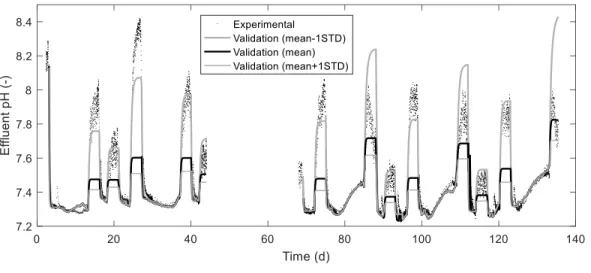
were used for the field test. For the field test, two additional simulations with kCO2 = 0.0015 s-1 (mean value
minus standard deviation) and kCO2 = 0.0042 s-1 (mean value plus standard deviation) from calibration of
saturated conditions were realized. Simulated and experimental data are compared in Figures 4 and 5.
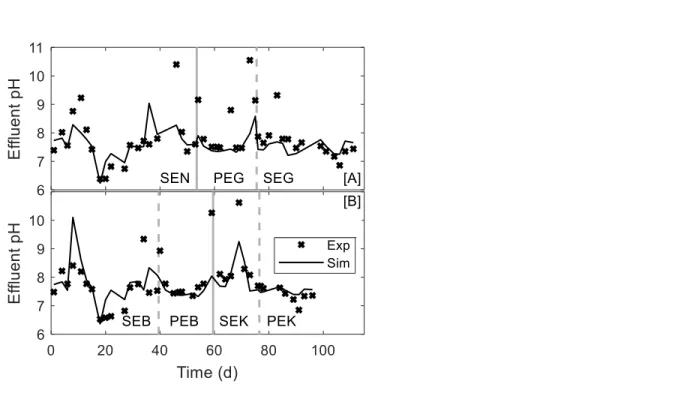
Figure 4 : Lab-scale model validation for the effluent pH from the neutralization reactor effluent of columns 1 (A) and 2 (B). Changes in type of flow mode (dashed lines) or media (full lines) are indicated by vertical gray lines.
In the validation step using CO2 enriched air conditions lab data (Figure 4), good prediction was obtained
for pH values between 6.5 and 8.5 for all medias used in both columns, under a wide range of CO2 enriched
air concentration (400 to 24 000 ppm). Predictions were less accurate at higher pH values: this reduced accuracy can be explained by the high pH sensitivity to any CO2 input if pH is greater than 8.5, and higher
20 explained by the CO2 concentration measurement method that was not optimized for the first CO2
enriched air tests (SEN & SEB).
Figure 5: Field-scale model validation for the neutralization reactor effluent pH (STD = standard deviation)
Validation using field test data lead to good prediction with pH being slightly underestimated (Figure 5, mean validation). The simulation with kCO2 of 0.0015 s-1 (mean minus 1 standard deviation) improved the
validation quality. This smaller kCO2 may be attributed to the reduced transfer efficiency in real wastewater
compared to synthetic wastewater, or to incertitude considering the high result variability of the kCO2
calibration.
3.3 Using simulations for process design
The treatment system considered for simulations consists of a septic tank, a biological treatment process, a slag filter and a neutralization unit. The model was used to simulate different operating conditions of a saturated neutralization unit without media using CO2 enriched air with QG/Qw = 100 (SEN; Figure 6). In
this figure, the neutralization capacity of the SEN configuration is shown for different steel slag effluent pH, secondary effluent (slag filter influent) alkalinity and CO2 enriched air concentration. Simulations were
divided in two operation scenarios which are neutralization at the beginning of the slag filter operation (critical conditions with high pH at the slag filter effluent, Figure 6A) and neutralization once the pH of the
21 slag filter has slightly decreased (pH of 11.0, Figure 6B). The initial operation of the neutralization unit represents critical conditions because CO2 needs are much higher with fresh slag and may require a longer
HRT or a higher addition of CO2. At high slag filter effluent pH, small changes in pH represent large
variations in CO2 needs. For example, increasing the slag effluent pH from 11.4 to only 11.5 represents a
15-20% increase in CO2 needs. A pH of 11.5 was chosen as representative of initial operation of slag based
on this study’s results and also from previous works using the same type of slag (Claveau-Mallet et al., 2017; Claveau-Mallet et al., 2015; Kõiv et al., 2016). The alkalinity range was chosen following possible alkalinity met in onsite domestic cases for which groundwater is often the source of drinking water. Low alkalinity and filter slag effluent pH requires a shorter reactor HRT to provide sufficient neutralization. The CO2 enriched air concentration had a major effect on neutralization result. While ambient air
conditions (400 ppm) resulted in sufficient neutralization at HRT of at least 16 h, complete neutralization was properly achieved at HRT of only 6 h with the use of 2000 ppm CO2 enriched air. A higher concentration
of CO2 would also reduce clogging risks by reducing calcite precipitation. Simulations results indicated an
increase in the effluent calcium concentration following an increase in CO2 concentration. Simulation
results corresponded well with experimental observations: more clogging occurred (accumulation of calcite suspension on the diffuser and lower calcium concentration at effluent, Table 6) under ambient air conditions than under CO2 enriched air conditions.
22 Figure 6: Simulated effluent pH of SEN neutralization unit under different CO2 concentration and HRT at the beginning of slag
operation (pH slag effluent = 11.5, panel A) and after the initial period of slag operation (pH slag effluent = 11.0, panel B). Alkalinity of slag filter influent is indicated in the legend (units mg CaCO3/L)
Simulations for all configurations tested at the lab are shown in Figure 7 (set conditions for influent alkalinity, slag filter pH and CO2 enriched air concentration). All modes of flow and types of media resulted
in similar decreasing curves, with minimum operation HRT being between 6 and 10 h. For percolating conditions, the combination of higher kCO2 but poorer hydraulic efficiency resulted in neutralization
efficiency similar to saturated conditions. The performance of the percolating conditions could be improved by optimising flow distribution and media packing to improve hydraulic efficiency. Considering uncertainties on the model calibration and experimental measurement (discussed in previous sections), Figure 7 was not used for comparison of media but was only used for evaluating effluent pH ranges from model predictions. Using this conservatory approach, an HRT of 10 h was selected for design of saturated conditions.
23 Figure 7: Simulated effluent pH of various neutralization units under fixed conditions (Influent alkalinity = 63 mg CaCO3/L; pH
at slag filter effluent = 11.5; enriched air concentration = 2000 ppm CO2)
3.4 Recommendations and full-scale considerations
Based on experimental and simulations conducted in this study, it is recommended to use a saturated reactor without media operated at an HRT of 10 h and using CO2 enriched air at concentration of 2000
ppm. The saturated mode was chosen for simplicity and robustness for onsite applications (essentially no head loss and lower risks of poor hydraulics and clogging) while the absence of media was chosen considering the minimal performance improvement resulting from adding media. The HRT of 10 h was chosen to provide a sufficiently long HRT under critical conditions (initial period of slag filter operation, Figure 7). As the critical period is expected to be at the beginning of the slag filter operation, design of the neutralization unit should be done according to this period and not to the expected mean pH value which will be lower. A minimum of 2000 ppm was recommended to ensure fast neutralization and reduced calcite precipitation.
Following the recommended HRT of 10 h, a neutralization column providing 130 cm of water level and 66 cm of diameter (volume 450 L) with an aeration air flow of 32 L/min (1.14 SCFM) are required for a two-bedroom home onsite treatment system (design influent flowrate of 1080 L/d). Aeration needs were determined according to the minimum aeration rate observed in this study to reach the maximum CO2
24 It is recommended to run additional field tests with the PEK condition to validate the good neutralization potential observed in this study. It is also recommended to assess the effect of mixing on kCO2 for all the
configurations.
Neutralization predictions presented in this section assume that CO2 concentration is controlled and fixed
(infinite source of CO2) which is not the case in practice as CO2 concentration in the CO2 enriched-air is the
result of a finite input from the biological reactor. Consequently, applicability of this design approach must be validated by stoichiometric calculations of CO2 needs and CO2 availability from influent COD. Assuming
that all influent biodegradable COD is oxidized with an observed yield of 0.24 g VSS/g bCOD (low value because of high sludge retention time in the Bionest reactor), it is possible to calculate COD needs for providing sufficient CO2 for neutralization (Table 7). In this table, CO2 needs were determined using
PHREEQC under batch conditions as described previously. Assuming a typical biodegradable COD of 300 mg/L for domestic wastewater septic tank effluents (Bernier, 2001; Metcalf & Eddy et al., 2014), Table 7 indicates that the available influent CO2 from such a wastewater is sufficient to provide CO2 enrichment
by the secondary treatment process for an efficient neutralization. CO2 in ambient air would also
contribute to pH neutralization, thus reducing CO2 needs from biological sources.
Table 7 : CO2 and corresponding influent biodegradable COD needs for neutralization of slag filter effluent with various pH
(slag filter influent alkalinity = 156 mg CaCO3/L)
Slag filter effluent pH
CO2 needs
for pH 8.0 neutralization (mmol/L)
Biodegradable COD needed to provide the required CO2
(mg/L)
11.5 4.85 235
11.0 2.72 132
25 The main limitation of the proposed neutralization process is the need of a confined biological process. As shown in Figure 6, neutralization using ambient air does not result in a sufficiently low pH in the effluent, which highlights the need for a CO2 enriched-air source. The neutralization process could fail if wastewater
were diluted, thus limiting CO2 input for neutralization. Large-scale biological processes as activated sludge
could not be used as enriched-air source as there is typically no air confinement. The application potential in decentralized treatment remains interesting because secondary treatment units are generally confined underground.
4 Conclusions
The main objective of this project was to develop a steel slag filter effluent neutralization process by acidifying with CO2 enriched air produced by a confined biological process. Different configurations of steel
slag effluent neutralization units in laboratory and field conditions were tested and provided satisfactory neutralization performance. Best results were obtained with CO2 enriched air containing at least 2000 ppm
in CO2. A model of slag filter effluent neutralization based on the carbonate system, CO2 transfer and
calcite precipitation was developed, calibrated and validated with lab and field tests over a wide range of CO2 concentration. The model calibrated in lab-scale conditions provided satisfactory validation at lab
scale and field scale conditions.
The mode of flow had an important impact on CO2 transfer (kCO2) and hydraulic efficiency. A percolating
mode had a high kCO2 (mean 0.014 s-1) and a poor hydraulic efficiency, while a saturated mode had a low
kCO2 (mean 0.0029 s-1) and an efficient hydraulic flow. The type of media (none, gravel, Bionest or
AnoxKaldnes K3) had little influence on kCO2. In saturated mode, hydraulics was more related to aeration
than media, while in percolating mode, media affected the hydraulic flow efficiency.
The mode of flow had an important effect on calcite surface concentration (aCAL) in the reactor. In
26 calcite surface concentration. In percolating mode, calcite aCAL progressively increased following
precipitation. The type of media influenced the increase rate of aCAL with media having a higher specific
surface (Bionest and K3) resulted in higher increase compared to gravel.
Predictions could be made for different steel slag effluent pH (11.5 and 11.0) and influent alkalinity (50 to 250 mg CaCO3/L) and different operation conditions for the neutralization process (HRT of 4 to 18 h, CO2
concentration of 400 to 2000 ppm and mode of flow). pH of the steel slag filter effluent and CO2
concentration of the enriched air were factors that influenced most the effluent pH of the neutralization process, while influent alkalinity and mode of flow had a lower influence. An increased concentration of CO2 in the enriched air reduced calcite precipitation and clogging risks. Stochiometric calculations showed
that a typical domestic septic tank effluent containing 300 mg/L of biodegradable COD provided enough biological CO2 for neutralization of a steel slag effluent with pH of 10.5 to 11.5. A saturated neutralization
reactor with no media operated at HRT of 10 h and a concentration of 2000 ppm in CO2 enriched air was
recommended for full-scale onsite applications. 5 Acknowledgements
This work was funded by the Natural Sciences and Engineering Research Council of Canada, Bionest, Arcelor Mittal and Harsco Minerals. The authors thank Denis Bouchard, Jérôme Leroy and Manon Leduc from Polytechnique Montréal for analytical determinations, and Simon Allaire, undergraduate researcher, for technical assistance. The authors thank Marc Boissonnault from Bionest for the field test construction and Philie Dallaire from Bionest for the field test monitoring.
6 References
APHA, AWWA, & WEF. (2012). Standard methods for the examination of water and wastewater (22nd
ed.). American Public Health Association, American Water Works Association & Water Environment Federation, Washington, D. C.
27 Barca, C., Gérente, C., Meyer, D., Chazarenc, F., & Andrès, Y. (2012). Phosphate removal from synthetic
and real wastewater using steel slags produced in Europe. Water Research, 46(7), 2376-2384. Barca, C., Troesch, S., Meyer, D., Drissen, P., Andrès, Y., & Chazarenc, F. (2013). Steel slag filters to
upgrade phosphorus removal in constructed wetlands: two years of field experiments.
Environmental Science & Technology, 47(1), 549-556.
Bernier, B. (2001). Guide of conventional technologies for domestic wastewater treatment (In French). Direction des politiques du secteur municipal – Service de l’expertise technique en eau, Québec: Ministère du développement durable, de l’environnement et des parcs.
Bionest Wastewater Treatment Solutions. (2011). Bionest system - a technology of choice. Retrieved from http://www.bionest-tech.com/QC-en/product/21-22/bionest-system.html, Accessed on June 21st 2017.
Boutet, E., Baillargeon, S., Allaire, F., Lida, F., Claveau-Mallet, D. & Comeau, Y. (2017). Apparatus and method for wastewater treatment, US Provisional Patent Application No. 62/450,210, filed January 25, 2017.
Brosseau, C. (2015). Recovery of biodegradable organic matter in the effluent of a high rate MBBR (In French). M.A.Sc. thesis, Polytechnique Montreal, Canada.
Charlton, S. R., & Parkhurst, D. L. (2011). Modules based on the geochemical model PHREEQC for use in scripting and programming languages. Computers & Geosciences, 37(10), 1653-1663.
Claveau-Mallet, D., Courcelles, B., & Comeau, Y. (2014). Phosphorus removal by steel slag filters: Modeling dissolution and precipitation kinetics to predict longevity. Environmental Science and
Technology, 48(13), 7486-7493.
Claveau-Mallet, D., Courcelles, B., Pasquier, P., & Comeau, Y. (2017). Numerical Simulations with the P-Hydroslag Model for Prediction of Phosphorus Removal by Steel Slag Filters. Water Research,
28 Claveau-Mallet, D., Lida, F., & Comeau, Y. (2015). Improving phosphorus removal of conventional septic
tanks by a recirculating steel slag filter. Water Quality Research Journal of Canada, 50(3), 211-218.
Claveau-Mallet, D., Wallace, S., & Comeau, Y. (2013). Removal of phosphorus, fluoride and metals from a gypsum mining leachate using steel slag filters. Water Research, 47(4), 1512-1520.
Dias, J., Bellingham, M., Hassan, J., Barrett, M., Stephenson, T., & Soares, A. (2017). Carrier media in
moving bed biofilm processes: does size matter? Paper presented at the 10th International
Conference on Biofilm Reactors, Dublin, Ireland, 9-12 May 2017.
Feng, B., Yong, A. K., & An, H. (2007). Effect of various factors on the particle size of calcium carbonate formed in a precipitation process. Materials Science and Engineering, 445, 170-179.
Gaur, A., Park, J.-W., Jang, J.-H., Maken, S., Lee, J., & Song, H.-J. (2009). Characteristics of Alkaline Wastewater Neutralization for CO2 Capture from Landfill Gas (LFG). Energy & Fuels, 23, 5467-5473.
Hussain, S. I., Blowes, D. W., Ptacek, C. J., & Olding, D. (2014). Phosphorus removal from lake water using basic oxygen furnace slag: system performance and characterization of reaction products.
Environmental Engineering Science, 31(11), 631-642.
Jung, W.-M., Kang, S. H., Kim, K.-S., Kim, W.-S., & Choi, C. K. (2010). Precipitation of calcium carbonate particles by gas-liquid reaction: morphology and size distribution of particles in Couette-Taylor and stirred tank reactors. Journal of Crystal Growth, 312, 3331-3339.
Karabelnik, K., Kõiv, M., Kasak, K., D. Jenssen, P. & Mander Ü. (2012). High-strength greywater treatment in compact hybrid filter systems with alternative substrates. Ecological Engineering, 49, 84-92. Kõiv, M., Liira, M., Mander, Ü., Mõtlep, R., Vohla, C., & Kirsimäe, K. (2010). Phosphorus removal using
Ca-rich hydrated oil shale ash as filter material - The effect of different phosphorus loadings and wastewater compositions. Water Research, 44(18), 5232- 5239.
29 Kõiv, M., Mahadeo, K., Brient, S., Claveau-Mallet, D., & Comeau, Y. (2016). Treatment of fish farm sludge
supernatant by aerated filter beds and steel slag filters - effect of organic loading rate. Ecological
Engineering, 94, 190-199.
LégisQuébec. (2017). Regulation on wastewater treatment municipal plants, chapter Q-2, r. 34-1 C.F.R, Publications Québec, Government of Quebec.
Lizarralde, I., Fernández-Arévalo, T., Brouckaert, C., Vanrolleghem, P., Ikumi, D. S., Ekama, G. A., Ayesa, E., Grau, P. (2015). A new general methodology for incorporating physico-chemical
transformations into multi-phase wastewater treatment process models. Water Research, 74, 239-256.
Mayes, W. M., Younger, P. L., & Aumônier, J. (2006). Buffering of Alkaline Steel Slag Leachate across a Natural Weland. Environmental Science and Technology, 40, 1237-1243.
Mbamba, C. K., Batstone, D. J., Flores-Alsina, X., & Tait, S. (2015). A generalised chemical precipitation modelling approach in wastewater treatment applied to calcite. Water Research, 68, 342-353. Mbamba, C. K., Tait, S., Flores-Alsina, X., & Batstone, D. J. (2015). A systematic study of multiple minerals
precipitation modelling in wastewater treatment. Water Research, 85, 359-370.
MDDEP. (2006). Metals determination: method by mass spectrometry with argon plasma ionizing source (in French) (3rd ed.): Centre d’expertise en analyse environnementale, Ministère du
développement durable, de l'environnement et des parcs, Government of Quebec. MA. 200 – Mét 1.1.
MDDELCC. (2017). Technical guide – wastewater treatment of remote dwellings (In French). Ministère du Développement durable, de l'Environnement et de la Lutte contre les changements climatiques, Goverment of Quebec. Retrieved from
30 Metcalf & Eddy-AECOM (2014). Wastewater Engineering: Treatment and Resource Recovery (5th ed.).
New York: McGraw-Hill.
Nilsson, C., Lakshmanan, R., Renman, G., & Rajarao, G. K. (2013a). Efficacy of reactive mineral-based sorbents for phosphate, bacteria, nitrogen and TOC removal – Column experiment in recirculation batch mode. Water Research, 47, 5165-5175.
Nilsson, C., Renman, G., Westholm, L. J., Renman, A., & Drizo, A. (2013b). Effect of organic load on phosphorus and bacteria removal from wastewater using alkaline filter materials. Water
Research, 47, 6289-6297.
Pan, S.-Y., Chiang, P.-C., Chen, Y.-H., Tan, C.-S., & Chang, E.-E. (2013). Ex Situ CO2 Capture by Carbonation of Steelmaking Slag Coupled with Metalworking Wastewater in a Rotating Packed Bed.
Environmental Science and Technology, 47, 3308-3315.
Parkhurst, D. L., & Appelo, C. A. J. (1999). User's guide to PHREEQC (Version 2) - A computer program for
speciation, batch-reaction, one-dimensional transport, and inverse geochemical calculations.
(Water-Resources Investigations Report 99-4259). Denver: United States Geological Survey. Penn, C., Bowen, J., McGrath, J., Nairn, R., Fox, G., Brown, G., Wilson, S., Gill, C. (2016). Evaluation of a
universal flow-through model for predicting and designing phosphorus removal structures.
Chemosphere, 151, 345-355.
Plummer, L. N., Wigley, T. M. L., & Parkhurst, D. (1978). The kinetics of Calcite Dissolution in CO2-Water Systems at 5 to 60°C and 0.0 to 1.0 atm CO2. American Journal of Science, 278, 179-216.
Vohla, C., Kõiv, M., Bavor, H. J., Chazarenc, F., & Mander, Ü. (2011). Filter materials for phosphorus removal from wastewater in treatment wetlands-A review. Ecological Engineering, 37(1), 70-89. Wine, R. D., & Morrison, R. D. (1986). Effective use of carbon dioxide for pH control in utility service and
waste waters. In Proceedings of the American Power Conference (Vol. 48, pp. 1041-1045). Illinois