HAL Id: hal-01316509
https://hal.archives-ouvertes.fr/hal-01316509
Submitted on 17 May 2016
HAL is a multi-disciplinary open access
archive for the deposit and dissemination of
sci-entific research documents, whether they are
pub-lished or not. The documents may come from
teaching and research institutions in France or
abroad, or from public or private research centers.
L’archive ouverte pluridisciplinaire HAL, est
destinée au dépôt et à la diffusion de documents
scientifiques de niveau recherche, publiés ou non,
émanant des établissements d’enseignement et de
recherche français ou étrangers, des laboratoires
publics ou privés.
BBOBB: A total order broadcast algorithm achieving
low latency and high throughput
Michel Simatic, Benoit Tellier
To cite this version:
Michel Simatic, Benoit Tellier. BBOBB: A total order broadcast algorithm achieving low latency
and high throughput. 46th Annual IEEE/IFIP International Conference on Dependable Systems and
Networks (DSN 2016), Jun 2016, Toulouse, France. �hal-01316509�
BBOBB: A total order broadcast algorithm
achieving low latency and high throughput
Michel Simatic and Benoit Tellier
T´el´ecom SudParis, Universit´e Paris-Saclay, 9 rue Charles Fourier - 91011 ´Evry Cedex Email: [First name].[Last name]@telecom-sudparis.eu
Abstract—Within data centers, many applications rely on
a total order broadcast algorithm to achieve fault-tolerance. In this context, reducing latency and improving throughput are important issues. Current algorithms fail to optimize both latency and throughput at the same time. This paper presents BBOBB, a new total order broadcast algorithm. BBOBB offers simultaneously a low latency and a high throughput, especially for small application messages.
I. INTRODUCTION
Total order broadcast is a fundamental group communica-tion abstraccommunica-tion that lies at the core of different approaches to replication, such as state-machine replication [1], [2]. Total order broadcast guarantees that 1) every non-faulty replica receive all requests and 2) no two replicas disagree on the order in which requests are received. From a performance perspective, since 1984 when Chang and Maxemchuk pub-lished the historical first algorithm [3], reducing latency and improving throughput have been the two main driving forces for new algorithms. Reducing latency contributes to reducing application’s response time. Improving throughput contributes to optimizing data center resources usage and reducing its energy consumption. Current algorithms fail to optimize both latency and throughput at the same time [4]. For instance, LCR [5] and TRAINS [6] are algorithms which optimize throughput to the detriment of latency. FastCast [7] is an attempt to combine low latency and high throughput, but its throughput is lower than the throughput of LCR and TRAINS. This paper presents BBOBB (Broadcast Based On a Bi-nary Behavior), a new total order broadcast algorithm inspired by the binary round-robin protocol [8] and the use of a broad-cast tree in GentleRain [9]. BBOBB offers simultaneously a low latency and a high throughput, especially for small application messages: In this case, the average latency is
3n
2 log2(n) instead of
3(n−1)
2 .
II. MODEL
Concerning the system model, we assume a small cluster of homogeneous machines interconnected by a local area network. Each machine hosts a process participating in the algorithm. BBOBB relies on a membership service. This service implements the abstraction of a perfect failure detec-tor (P ) [10] to which each process has access. In addition, it provides each process with the same ordered view of the processes participating in the algorithm.
Concerning the performance model, we assume that our LAN is based on a switch. Thus, we use the round-based model proposed in [5]. In one round: 1) a network card can send a
message and simultaneously receive one; 2) a process can send a message to all or a subset of processes; 3) the network is able to carry several messages simultaneously.
III. ALGORITHM
When a process pi wants to broadcast an application message m with total order guarantees, pi stores m into lbi, a local batch of application messages.
BBOBB is a distributed wave algorithm. During a step, each process sends its own batch and the batches received until now to a process chosen according to a binary scheme. Let us detail the algorithm. We assume there are n participating processes. When a new wave starts, its first step consists in each process pi copying lbi into a batch bi and
fsending1 a set of batches containing onlyb
i to its successor
p(i+1) mod n. Step two of the wave consists in each process
pi fsending a set of batches containing the batchb(i−1) mod n
received from pi’s predecessor and bi to p(i+2) mod n. More generally, stepj (j ≥ 2) consists in each process pi fsending
a set of batches containing bu,u∈[(i+1−2j−1) modn,i] to
p(i+2j−1) modn. Whenpireceives messages of stepk with 2k greater or equal to the numbern of participating processes, pi has received all of the batches of this wave. We demonstrate this by proving by induction that: ∀i ∈ [0, n), ∀j ∈ [1, k],
pi has received batches bu,u∈[(i+1−2j) modn,i] at the end of step j. By definition, at the end of step 1, any pi has received b(i−1) mod n and bi: The property holds for
j = 1. Let us assume it is true for step j ∈ [1, k).
Then, ∀i ∈ [0, n), pi has received bu,u∈[(i+1−2j) modn,i] at the end of step j. In particular, p(i−2j) modn has received bu,u∈[(i−2j+1−2j) modn,(i−2j) modn]. During step j + 1, p(i−2j) modn fsends a set containing
bu,u∈[(i+1−2j+1) modn,(i−2j) modn] topi. Thus, at the end of step j + 1, pi has received batches bu,u∈[(i+1−2j+1) modn,i]: The property holds for j + 1. We conclude that, at step k, everypi has received all of the batches. Moreover, thanks to the membership service, any pi has the same ordered view of the processes participating in BBOBB: each pi delivers application messages contained in batch b0, then application
messages inb1, etc. The wave is finished.
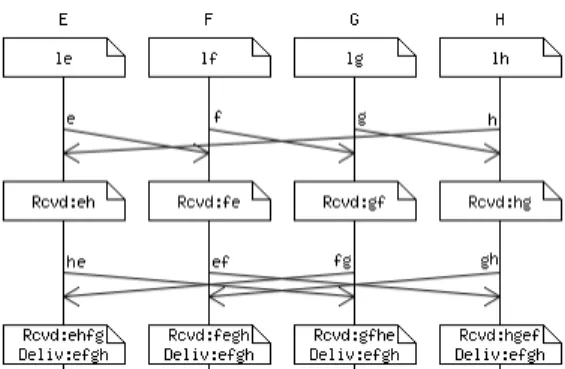
Figure 1 presents an example: Participating processesE, F ,
G and H have built local batches le, lf, lg and lh containing
application messages to be TO-broadcast. At the end of the wave, each process has received all of the batchese, f, g and
h: It delivers application messages contained in batch e, then
application messages inf, etc.
1fsend() is a primitive for sending messages reliably and in FIFO order.
Fig. 1. Message sequence chart of a wave executed by participating processes
E, F , G and H
Group membership changes: When a new process arrives
or a participating process leaves (intentionaly or not), the membership service generates a view_change event on all processes. Upon receiving this event, each process pi executes a view change procedure similar to the one of LCR protocol [5]. Once this procedure is done,pistarts a new wave.
IV. PERFORMANCE EVALUATION
The latency of broadcasting a message is the number of rounds that are necessary from the initial broadcast of message m until the last process delivers m [5]. In BBOBB, unlike other total order broadcast algorithms, it is not sufficient to count the number of network messages to determine the number of rounds. This is because the network messages sent during the different steps of a wave do not have the same size. There are 2 cases. First case: The size of the header of network messages (e.g. 40 bytes for TCP and IPv4, 60 bytes for TCP and IPv6) is negligible against the average size of batches. Then, sending a network message containing a set of batches takes as long as sending one network message per batch. In this case, a wave lasts n − 1 rounds (where n is the number of participating processes). The average latency is 3(n−1)2 . Second case: The size of the header of network messages is not negligible against the average size of batches. Then, sending a network message containing a set of batches is less sensitive to the number of batches inside the set. In this case, a wave lasts logn
2(n) rounds.
The average latency is 2 log3n
2(n), which is remarkably lower
than 3(n−1)2 as soon as n ≥ 4.
Concerning BBOBB throughput, Guerraoui et al. prove that, given n computers involved in a total order broadcast algorithm, wired on a switch providing a throughput Dlink on each link, the maximum throughput is Dlink× n−1n [5]. However, their demonstration of this upper bound is based on the number of messages. Using the same demonstra-tion with BBOBB leads to the non pertinent upper bound
Dlink × logn2(n). To prove that Dlink × n
n−1 is indeed the
upper bound, we notice that, during a wave, any process pi delivers n × Sbatch bytes (where Sbatch is the average total size of all application messages in a batch). But, pi receives only (n − 1) × Sbatch bytes from the network (the bytes of all batches except the batch of pi). We conclude that the maximum throughput isDlink×(n−1)·Sn·Sbatchbatch. In addition, the maximum throughput is reduced by the prediction-oriented
throughput efficiency (P OT E), i.e. the theoretical ratio be-tween the number of bytes delivered per network message and the number of bytes of the network message [6]. When batches of messages are small, P OT EBBOBB is better than
P OT ETRAINS, TRAINScurrently having the bestP OT E [6]:
BBOBB is closer to maximum theoretical throughput than TRAINS.
V. RELATED WORK
TRAINS[6] has better throughput than LCR [5]. BBOBB has a better throughput than TRAINS, and a lower latency. FastCast [7] has been designed to provide a low latency and a high throughput. For small messages, as soon as there are at least 4 processes, BBOBB has a lower latency than FastCast [7], with a better throughput.
Cason et al. present the importance of latency variability in nowadays applications [11]. We need a full implementation of BBOBB to measure this variability.
VI. CONCLUSION AND PERSPECTIVES
This paper presents BBOBB, a new total order broadcast algorithm. BBOBB offers simultaneously a low latency and a high throughput, especially for small application messages. We are currently implementing BBOBB to study experimentally its performance and in particular its latency variability.
REFERENCES
[1] L. Lamport, “The implementation of reliable distributed multiprocess systems,” Computer Networks, vol. 2, no. 2, pp. 95–114, May 1978. [2] F. B. Schneider, “Implementing fault-tolerant services using the state
machine approach: a tutorial,” ACM Comput. Surv., vol. 22, pp. 299– 319, December 1990.
[3] J.-M. Chang and N. F. Maxemchuk, “Reliable broadcast protocols,”
ACM Trans. on Comput. Syst., vol. 2, no. 3, pp. 251–273, 1984.
[4] P. Urb´an, X. D´efago, and A. Schiper, “Contention-aware metrics for distributed algorithms: Comparison of atomic broadcast algorithms,” in Proceedings of the Nineth International Conference on Computer
Communications and Networks, October 2000, pp. 582–589.
[5] R. Guerraoui, R. R. Levy, B. Pochon, and V. Qu´ema, “Throughput optimal total order broadcast for cluster environments,” ACM Trans. on
Comput. Syst., vol. 28, pp. 5:1–5:32, July 2010.
[6] M. Simatic, A. Foltz, D. Graux, N. Hasco¨et, S. Ouillon, N. Reboud, and T. Wang, “TRAINS: A Throughput-Efficient Uniform Total Order Broadcast Algorithm,” in Proceedings of the International Conference
on New Technologies of Distributed Systems (NTDS), Paris, France, Jul.
2015, pp. 1–8.
[7] G. Berthou and V. Qu´ema, “FastCast: a Throughput- and Latency-efficient Total Order Broadcast Protocol,” in Proceedings of the
In-ternational Middleware Conference, 2013, pp. 1–20.
[8] S. Ranganathan, A. George, R. Todd, and M. Chidester, “Gossip-style failure detection and distributed consensus for scalable heterogeneous clusters,” Cluster Computing, vol. 4, no. 3, pp. 197–209, 2001. [9] J. Du, C. Iorgulescu, A. Roy, and W. Zwaenepoel, “Gentlerain: Cheap
and scalable causal consistency with physical clocks,” in Proceedings
of the ACM Symposium on Cloud Computing, 2014, pp. 4:1–4:13.
[10] T. D. Chandra and S. Toueg, “Unreliable failure detectors for reliable distributed systems,” Journal of ACM, vol. 43, pp. 225–267, March 1996. [Online]. Available: http://doi.acm.org/10.1145/226643.226647 [11] D. Cason, P. J. Marandi, L. E. Buzato, and F. Pedone, “Chasing the tail
of atomic broadcast protocols,” in Proceedings of the 34th Symposium