HAL Id: pastel-00598156
https://pastel.archives-ouvertes.fr/pastel-00598156
Submitted on 4 Jun 2011
HAL is a multi-disciplinary open access
archive for the deposit and dissemination of
sci-entific research documents, whether they are
pub-lished or not. The documents may come from
teaching and research institutions in France or
abroad, or from public or private research centers.
L’archive ouverte pluridisciplinaire HAL, est
destinée au dépôt et à la diffusion de documents
scientifiques de niveau recherche, publiés ou non,
émanant des établissements d’enseignement et de
recherche français ou étrangers, des laboratoires
publics ou privés.
Performance, Scalability, Automatic Management and
Internet Integration of Ad Hoc Networks
Ulrich Herberg
To cite this version:
Ulrich Herberg. Performance, Scalability, Automatic Management and Internet Integration of Ad
Hoc Networks. Networking and Internet Architecture [cs.NI]. Ecole Polytechnique X, 2011. English.
�pastel-00598156�
Th`
ese pr´
esent´
ee pour obtenir le grade de
DOCTEUR DE L’ECOLE POLYTECHNIQUE
en Math´
ematiques et Informatique
par
Ulrich HERBERG
R´
eseaux Ad Hoc :
Performance, Dimensionnement,
Gestion Automatis´
ee et Int´
egration
dans l’Internet
Soutenue le 20 mai 2011 devant le jury compos´
e de:
Michel Diaz
LAAS-CNRS
Rapporteur
Joseph Macker
Naval Research Laboratory
Rapporteur
Kenichi Mase
Universit´
e de Niigata
Rapporteur
Robert G. Cole
US Army
Examinateur
Walid Dabbous
INRIA
Examinateur
Christopher Dearlove
BAE Systems
Examinateur
Philippe Jacquet
INRIA
Directeur de Th`
ese
Thesis for the degree of
DOCTEUR DE L’ECOLE POLYTECHNIQUE
in Mathematics and Computer Science
handed in by
Ulrich Herberg
Performance, Scalability, Automatic
Management and Internet Integration
of Ad Hoc Networks
Defended on May 20, 2011
Jury members:
Michel Diaz
LAAS-CNRS
Rapporteur
Joseph Macker
Naval Research Laboratory
Rapporteur
Kenichi Mase
Niigata University
Rapporteur
Robert G. Cole
US Army
Examiner
Walid Dabbous
INRIA
Examiner
Christopher Dearlove
BAE Systems
Examiner
Philippe Jacquet
INRIA
Ph.D adviser
Abstract
This manuscript provides several ad hoc routing protocol extensions and evaluations thereof, that allow increasing performance, scaling the network size, and integrating ad hoc networks into the Internet:
First, this manuscript presents software tools, which allow to study unmodified routing pro-tocols, implemented in Java, in the network simulator NS2.
Second, the manuscript provides an architectural discussion of ad hoc networks, which ex-plains the problems of automatic configuration of IP addresses (called “autoconfiguration”) on ad hoc routers, and presents an architectural model for ad hoc networks, compatible with the Internet. An autoconfiguration protocol, based on the proposed architectural model, is specified, and its properties are formally verified by means of model checking.
Third, several extensions to the Optimized Link State Routing Protocol version 2 (OLSRv2) are presented: The in-router performance of the protocol is largely increased when using a dynamic shortest path algorithm for calculating routes.
Another proposed optimization is an SNMP-based framework to manage and control perfor-mance related objects on routers running OLSRv2.
An extension of OLSRv2 is presented, where packets are retransmitted later for temporarily unavailable destinations, instead of dropping them, leading to delivery ratios significantly higher than standard OLSRv2 in certain scenarios.
This manuscript presents an analysis of security threats to OLSRv2, followed by a specifica-tion of a router and link admittance control mechanism for OLSRv2, alleviating many of these attacks.
Fourth, this manuscript investigates scalability of wireless sensor networks (WSNs), and evaluates a routing protocol for such WSNs being specified by the IETF as of 2011, denoted RPL. Moreover, as RPL does not contain any mechanism for efficient broadcasts, several optimized broadcasting mechanisms in RPL are presented and compared.
R´
esum´
e
Le pr´esent rapport fournit plusieurs extensions des protocoles de r´eseau ad hoc et leurs ´evaluations, qui permettent d’augmenter la performance, de dimensionner la taille des r´eseaux et d’int´egrer les r´eseaux ad hoc dans l’Internet :
Premi`erement, ce rapport pr´esente plusieurs outils de logiciel qui permettent d’´etudier des protocoles de routage sans modifications, impl´ement´es en Java, dans le simulator de r´eseaux NS2. Deuxi`emement, ce rapport fournit une discussion architecturale des r´eseaux ad hoc, qui ex-plique les probl`emes de la configuration automatique des adresses IP (nomm´e
autoconfigu-ration ) des routeurs ad hoc. Ensuite, le rapport pr´esente un mod`ele architectural pour des
r´eseaux ad hoc qui est compatible avec l’Internet. Un protocole d’autoconfiguration, bas´e sur le mod`ele architectural propos´e, est sp´ecifi´e, et ses propri´et´es sont formellement v´erifi´ees au moyen de Model Checking .
Troisi`emement, plusieurs extensions du protocole de routage des r´eseaux ad hoc OLSRv2 ( Optimized Link State Routing Protocol version 2 ) sont pr´esent´ees : La performance du
protocole est augment´ee d’ordre de grandeur en utilisant un algorithme dynamique pour calculer les plus courts chemins.
Une autre optimisation propos´ee est un framework bas´e sur SNMP pour g´erer et contrˆoler des objets li´es `a la performance sur des routeurs tournant OLSRv2.
Une extension d’OLSRv2 est pr´esent´ee dans laquelle des paquets sont retransmis ult´erieurement lorsque les destinations sont indisponibles temporairement, au lieu de les rejeter. Cette exten-sion m`ene `a un taux de remis consid´erablement plus ´elev´e que OLSRv2 par d´efaut dans certains scenarios.
Ce rapport pr´esente alors une analyse des menaces de s´ecurit´e pour OLSRv2, suivie par la sp´ecification d’un m´ecanisme de contrˆole d’acc`es pour OLSRv2, qui empˆeche nombre de ces attaques.
Quatri`emement, ce rapport explore le dimensionnement des r´eseaux de capteurs sans fil, et ´
evalue un protocole de routage des r´eseaux de capteurs, nomm´e RPL, sp´ecifi´e par l’IETF en 2011. En outre, ´etant donn´e que RPL ne contient pas de m´ecanisme de broadcast efficace,
plusieurs m´ecanismes de broadcast optimis´es dans RPL sont pr´esent´es et compar´es.
Acknowledgments
First and foremost, I would like to thank Thomas Clausen, who guided me during my time at LIX, Ecole Polytechnique. I really appreciated his dedication, his vast experience, his teaching approach, his inspiration and his immense pool of stories about air line companies. I greatly enjoyed working in the Hipercom team, in particular with Emmanuel Baccelli and Philippe Jacquet, who were both very helpful in research and administrative matters. My thanks also go to all other (current and former) members of the team: Veronika Maria Bauer, Alberto Camacho Mart´ınez, Ming-Chih Chien, Songyean Cho, Axel Colin de Verdi`ere, Juan Antonio Cordero Fuertes, Marienestor Mariyasagayam, Matthias Philipp, Georgios Rodolakis, Georg Wittenburg, and Jiazi Yi. They made my stay at LIX a great time. Without our charming and hardworking assistants, Lydie Fontaine, Marie-Jeanne Gaffard, Val´erie Lecomte, and Cindy Vingadassamy, I would not have survived the administrative part during my time in France.
I greatly enjoyed my teaching experience at Ecole Polytechnique, and would like to thank Julien Cervelle, Christophe Jacquet, Sylvie Putot, Dominique Rossin, Olivier Serre, and Vincent Siles. A special thanks to my friends and colleagues Vivek Nigam, Carlos Olarte, Balaji Raman, and Florian Richoux. I appreciated working together with colleagues from our cryptography team: Andreas Enge, J´erˆome Milan, and Fran¸cois Morain.
Aaron Kaplan and Henning Rogge gave me a deep insight in their deployment experience, and I had many intense technical discussions with them, which I enjoyed very much.
I would like to express my gratitude to Ian Taylor, for his kindness, his great programming skills and his collaboration on AgentJ.
A special thanks to all my friends and colleagues that I met at IETF meetings, in particular Brian Adamson, Justin Dean, Yuichi Igarashi, Yannick Lacharit´e, Charles E. Perkins, Hiroki Satoh, Mark Townsley, Ronald in ’t Velt, and Ryuji Wakikawa.
I really appreciate the work of the reviewers of the thesis, Michel Diaz, Joseph Macker, and Kenichi Mase, as well as the examiners of the thesis, Robert G. Cole, Walid Dabbous and Christopher Dearlove.
Lastly, I profoundly thank my parents and my wife, for all their support during the thesis. My wife should be awarded with a Master of Science in Ad Hoc Networking, since she had to listen to all my chitchat about OLSRv2 and ad hoc networking.
Contents
I
Introductory Part
1
1 Introduction 3
1.1 Classic Networks . . . 4
1.2 Highly Dynamic Core . . . 6
1.2.1 Properties of Ad Hoc Networks . . . 7
1.3 Use Cases . . . 8
1.3.1 FunkFeuer Community Ad Hoc Network . . . 8
1.3.2 Ad Hoc Networks in Emergency Situations . . . 9
1.3.3 Wireless Sensor Networks . . . 11
1.4 Challenges of Ad Hoc Networks . . . 12
1.5 Standardization in the Internet Engineering Taskforce . . . 14
1.5.1 MANET Working Group . . . 16
1.5.2 AUTOCONF Working Group . . . 16
1.5.3 ROLL Working Group . . . 17
1.6 Contributions and Structure of the Manuscript . . . 17
2 Simulation Toolchain 21 2.1 Chapter Outline . . . 22
2.2 The NS2 Simulator . . . 22
2.3 Scenario Generation Tools . . . 22
2.3.1 Wsg – The Scenario Generator . . . 22
2.3.2 create-multiple-runs.sh . . . 25
2.4 NS2 Tools . . . 25
2.5 Evaluation Tools . . . 26
2.5.1 NS2stats.awk . . . 26
2.5.2 plot.rb and result.rb . . . 27
2.5.3 stats.plot . . . 27
2.6 Typical Workflow of a Simulation and Evaluation . . . 28
2.6.1 Generating the Scenario Files . . . 28
2.6.2 Running the Simulation . . . 28
2.6.3 Performing Statistics . . . 28 vii
viii CONTENTS
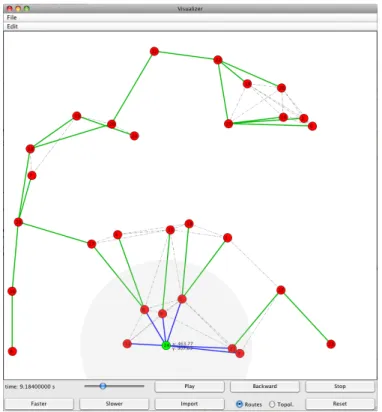
2.6.4 NS2 Trace File Visualizer . . . 28
2.7 Conclusion . . . 29
3 Framework for Supporting Java NS2 Routing Protocols (AgentJ) 33 3.1 Chapter Outline . . . 33
3.2 Related Work . . . 34
3.3 AgentJ Overview without Routing Functionalities . . . 35
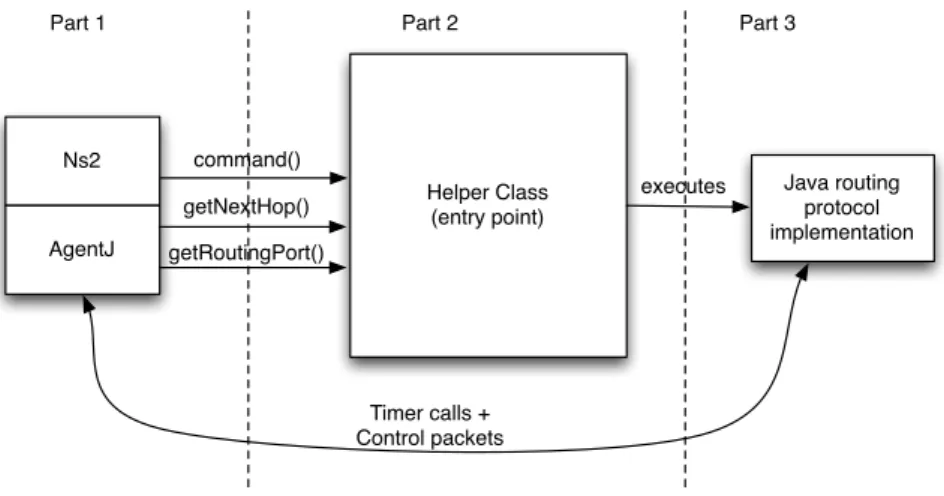
3.4 Architectural Modifications of AgentJ for Support of Routing Protocols . . . 36
3.4.1 Overview . . . 36
3.4.2 Detailed Description . . . 37
3.5 Performance Comparison . . . 38
3.6 Advantages of AgentJ Routing Framework . . . 40
3.7 Conclusion . . . 41
II
General Architectural Considerations of Ad Hoc Networks
43
4 Architectural Considerations of Ad Hoc Networks 45 4.1 Chapter Outline . . . 454.2 What is an IP Address? . . . 46
4.2.1 The Basics . . . 46
4.2.2 Networks . . . 46
4.2.3 Prefixes – the Internet Term for Intervals . . . 48
4.2.4 Delegation and Assignment . . . 49
4.3 The MANET Architecture . . . 49
4.3.1 The Classic IP Link Model . . . 49
4.3.2 The Missing Link . . . 51
4.3.3 /32 and /128 Prefix Lengths . . . 52
4.3.4 Definition of a MANET Router . . . 53
4.3.5 ‘M’ for Mobility – ‘A’ for Ad hoc . . . 54
4.4 Connected vs. Disconnected MANETs . . . 55
4.4.1 On why these Terms are Misleading . . . 55
4.4.2 On why these Terms are Unfortunate . . . 58
4.4.3 A Better Taxonomy . . . 58
4.5 AUTOCONF – The Goals . . . 60
4.5.1 Architectural Considerations . . . 60
4.5.2 Acquiring a Prefix in an Autonomous MANET . . . 61
4.5.3 Acquiring a Prefix in a Subordinate MANET . . . 61
4.5.4 Consequences . . . 62
4.6 Automatic Configuration in the Internet . . . 62
4.6.1 Dynamic Host Configuration Protocol (DHCP) . . . 62
CONTENTS ix
4.6.3 IP Architecture Assumptions . . . 63
4.7 Internet vs MANETs . . . 64
4.7.1 Different Link-Model of MANETs . . . 64
4.7.2 Routers vs. Hosts . . . 64
4.7.3 Mobility in MANETs . . . 64
4.7.4 Relationship between MANET Routers . . . 65
4.8 Conclusion . . . 65
5 Yet Another Autoconf Proposal (YAAP) for MANETs 67 5.1 Chapter Outline . . . 67
5.2 Related Work . . . 68
5.3 MANET Autoconfiguration Mechanism . . . 68
5.3.1 Algorithmic Overview . . . 69
5.3.2 Formal Protocol Specification . . . 70
5.3.3 Autoconfiguration Example . . . 72
5.4 Extensions and Optimizations . . . 72
5.4.1 Proxying . . . 72
5.4.2 Unicast RAs . . . 72
5.4.3 Optimized Broadcasting . . . 74
5.4.4 Periodical Prefix Propagation . . . 74
5.4.5 IPv4 vs. IPv6 . . . 74 5.4.6 Initiator Selection . . . 74 5.5 Additional Considerations . . . 74 5.5.1 Duplicate UUIDs . . . 74 5.5.2 No Initiator Router . . . 77 5.5.3 Initiator Proxying . . . 77
5.6 Formal Validation using a Model Checker . . . 78
5.6.1 Assumptions and Simplifications of the Model . . . 78
5.6.2 Results of Verification of Properties in UPPAAL . . . 80
5.7 Simulation . . . 81
5.7.1 Simulation Results . . . 81
5.8 Conclusion . . . 84
III
OLSRv2 Performance and Scalability
85
6 OLSRv2 Overview 87 6.1 Chapter Outline . . . 876.2 Classic Link State Protocol . . . 88
6.2.1 Neighborhood Discovery . . . 88
6.2.2 Link State Advertisements . . . 88
x CONTENTS
6.2.4 Shortest Path Calculation . . . 90
6.3 OLSRv2 . . . 93
6.3.1 Neighborhood Discovery (NHDP) . . . 93
6.3.2 MPR Flooding (MPRF) . . . 94
6.3.3 Link State Advertisement . . . 95
6.3.4 Flexible Message Format . . . 96
6.3.5 Inherent Protocol Extensibility . . . 96
6.4 Conclusion . . . 96
7 Java OLSRv2 Implementation 97 7.1 Chapter Outline . . . 97
7.2 Architecture Overview . . . 97
7.2.1 Packetbb . . . 98
7.2.2 NHDP . . . 99
7.2.3 OLSRv2 . . . 99
7.3 RMI GUI Client . . . 101
7.4 Logging API . . . 101
7.5 Routing API for other Operating Systems . . . 102
7.6 Writing Extensions . . . 103
7.7 Interoperability Tests . . . 104
7.7.1 Packetbb Tests . . . 104
7.7.2 Packetbb Applets . . . 105
7.7.3 Emulator for large Topologies . . . 105
7.7.4 NHDP Tests . . . 108
7.7.5 OLSRv2 Tests . . . 109
7.7.6 Packetbb Interoperability Test Results . . . 109
7.7.7 Network Emulation using CORE . . . 111
7.7.8 Remote Tests . . . 111
7.8 Conclusion . . . 112
8 Dynamic Shortest Path Algorithm in OLSRv2 113 8.1 Chapter Outline . . . 113
8.2 Related Work . . . 114
8.3 Routing Set Updates in OLSRv2 . . . 114
8.4 Test Methodology . . . 115
8.4.1 Topology Emulator . . . 115
8.4.2 OLSRv2 Implementation . . . 115
8.4.3 Time Measurement . . . 115
8.5 Evaluation . . . 116
8.6 Incremental Route Updates . . . 117
8.6.1 Evaluation Settings . . . 117
CONTENTS xi
8.7 Conclusion . . . 119
9 OLSRv2 Network Management and Performance Monitoring 123 9.1 Chapter Outline . . . 123
9.2 OLSRv2 Router Configuration . . . 124
9.3 A Brief SNMP Primer . . . 124
9.4 Related Work . . . 125
9.5 Problem Statement: Managing OLSRv2 Networks . . . 126
9.6 OLSRv2 Management Architecture . . . 127
9.7 NHDP and OLSRv2 MIBs . . . 128
9.8 Performance Management . . . 129
9.8.1 Object Types . . . 129
9.8.2 Derived Objects in NHDP and OLSRv2 . . . 131
9.9 Performance Study of SNMP in OLSRv2 MANETs . . . 133
9.9.1 Simulation Settings . . . 133
9.9.2 Simulation Results . . . 135
9.10 Conclusion . . . 141
10 Delay Tolerant Routing with OLSRv2 143 10.1 Chapter Outline . . . 143
10.2 Link Buffer Mechanism . . . 144
10.2.1 IP Buffering . . . 144
10.2.2 L2 Buffering . . . 144
10.2.3 Flow Chart . . . 145
10.2.4 Buffering at Intermediate Hops . . . 145
10.3 Model Description . . . 146
10.4 Performance Evaluation . . . 147
10.4.1 God Routing Protocol . . . 147
10.4.2 Graceful Shutdown . . . 148
10.4.3 Simulation Settings . . . 149
10.4.4 Simulation Results . . . 149
10.5 Conclusion . . . 154
11 Vulnerability Analysis of OLSRv2 155 11.1 Chapter Outline . . . 155
11.2 Related Work . . . 155
11.3 Overview . . . 156
11.3.1 Link State Vulnerability Taxonomy . . . 156
11.3.2 OLSRv2 Attack Vectors . . . 156
11.4 Topology Map Acquisition . . . 156
11.4.1 Flooding Disruption . . . 157
xii CONTENTS
11.4.3 Attack on Jittering . . . 160
11.4.4 Hop Count and Hop Limit Attacks . . . 160
11.5 Effective Topology . . . 162
11.5.1 Incorrect Forwarding . . . 162
11.5.2 Wormholes . . . 162
11.5.3 Sequence Number Attacks . . . 163
11.5.4 Message Timing Attacks . . . 164
11.5.5 Indirect Jamming . . . 164 11.6 Inconsistent Topology . . . 167 11.6.1 Identity Spoofing . . . 168 11.6.2 Link Spoofing . . . 171 11.6.3 Creating Loops . . . 174 11.7 Replay Attacks . . . 175
11.8 Inherent OLSRv2 Resilience . . . 176
11.9 Conclusion . . . 177
12 Router and Link Admittance Control in OLSRv2 179 12.1 Chapter Outline . . . 179
12.2 Problem Statement . . . 180
12.3 Router Admittance Control . . . 181
12.3.1 Resilience Evaluation . . . 182
12.4 Link Admittance Control . . . 182
12.5 Protocol Extension Specification: Router and Link Admittance Control . . . 184
12.5.1 TLV Specification . . . 184
12.5.2 OLSRv2 Interaction . . . 185
12.6 Cryptographic Keys . . . 185
12.7 Timestamps . . . 186
12.8 Performance Study . . . 186
12.8.1 Overhead of Router and Link Admittance Control . . . 187
12.8.2 In-Router Resource Requirements . . . 189
12.9 Conclusion . . . 189
IV
Wireless Sensor Networks
191
13 RPL Protocol Overview 193 13.1 Chapter Outline . . . 19313.2 DODAG Routing Structure . . . 193
13.3 RPL Data Traffic Flows . . . 194
13.3.1 Upward Routes . . . 194
13.3.2 Downward Routes . . . 194
CONTENTS xiii 13.4 Rank Changes in RPL . . . 196 13.5 RPL Operational Requirements . . . 197 13.6 Trickle Timer . . . 197 13.7 RPL Discussion . . . 198 13.8 Conclusion . . . 199 14 Java RPL Implementation 201 14.1 Chapter Outline . . . 201 14.2 Architecture Overview . . . 201 14.3 Objective Function . . . 202 14.4 Upward Flow . . . 202 14.4.1 DIO . . . 202
14.4.2 Upward Unicast Traffic . . . 204
14.5 Downward Flow . . . 204
14.5.1 DAO . . . 204
14.5.2 DAOACK . . . 205
14.5.3 Downward Unicast Traffic . . . 206
14.6 Local Repair . . . 207 14.7 Loop Detection . . . 208 14.8 Conclusion . . . 209 15 Multipoint-to-Point in RPL 211 15.1 Chapter Outline . . . 211 15.2 Simulation Settings . . . 211 15.2.1 DIO settings . . . 211 15.3 Simulation Results . . . 212 15.3.1 RPL Control Traffic . . . 212
15.3.2 Unicast Data Traffic . . . 215
15.4 Conclusion . . . 218
16 Broadcast in RPL 219 16.1 Chapter Outline . . . 219
16.2 Data Broadcasting in RPL . . . 219
16.2.1 Classic Flooding (CF) . . . 220
16.2.2 MultiPoint Relay Flooding (MPRF) . . . 220
16.2.3 Parent Flooding (PF) . . . 220
16.2.4 Preferred Parent Flooding (PPF) . . . 221
16.2.5 Preferred Parent MPR Flooding (PPMPRF) . . . 221
16.2.6 Optimized Preferred Parent MPR Flooding (PPMPRF-opt) . . . 222
16.3 RPL Performance Study . . . 223
16.3.1 Simulation Settings . . . 223
xiv CONTENTS
16.4 Conclusion . . . 230
V
Conclusion
231
VI
Appendices
239
A List of Publications 241 A.1 Journal Publications . . . 241A.2 Conference and Workshop Publications . . . 241
A.3 Research Reports . . . 242
A.4 Internet Drafts . . . 243
A.4.1 Working Group Internet Drafts . . . 243
A.4.2 Individual Internet Drafts . . . 245
B Usage Instructions of AgentJ 247 B.1 Basic Integration . . . 247
B.1.1 Addition of a Helper Class as Single Point of Entry for NS2 . . . 247
B.1.2 Installation of the Java Classes . . . 249
B.1.3 Scenario Tcl Script . . . 249
B.1.4 Change Addressing Scheme . . . 250
B.1.5 Running the NS2 Simulation . . . 251
B.2 Advanced Features . . . 251
B.2.1 Tracing of Routing Control Packets . . . 251
B.2.2 Changing the Behavior of the Router when Data Packets arrive . . . 253
B.2.3 Limitations of AgentJ with Routing Functionalities . . . 254
C Usage Instructions of JOLSRv2 257 C.1 Installation Instructions . . . 257
C.2 Options in the Configuration File . . . 258
C.3 Running JOLSRv2 in NS2 . . . 260
C.3.1 JOLSRv2 Helper Class . . . 260
C.3.2 Custom JOLSRv2 Trace File Logging . . . 260
C.3.3 JOLSRv2 Router Agent . . . 261
D Usage Instructions of JRPL 263 D.1 Installation Instructions . . . 263
D.2 Options in the Configuration File . . . 263
D.3 Running JRPL in NS2 . . . 264
D.3.1 JRPL Helper Class . . . 264
D.3.2 Custom JRPL Trace File Logging . . . 264
Part I
Introductory Part
Chapter 1
Introduction
The Internet has grown in size by orders of magnitude since its inception in the late 1970s. According to [1], the number of hosts in the Internet has increased from about 200 hosts in 1981 to more than 700 million hosts in 2010, as depicted in figure 1.1. A similar indication of the scaling of the Internet is illustrated in figure 1.2, showing the development over time of the number of active BGP forwarding entries, as observed by [2].
0 1e+08 2e+08 3e+08 4e+08 5e+08 6e+08 7e+08 8e+08 1990 1992 1994 1996 1998 2000 2002 2004 2006 2008 2010 number of hosts year
Figure 1.1: Hosts in the Internet (data source: [1]) 0 50000 100000 150000 200000 250000 300000 350000 1990 1992 1994 1996 1998 2000 2002 2004 2006 2008 2010
active BPG entries (FIB)
year
Figure 1.2: Active entries in the BGP For-warding Table (FIB) (data source: [2]) Despite the growth of the Internet, it has remained roughly unchanged in structure: hosts can communicate with other hosts anywhere in the world, enabled by an intricate system of wires and network infrastructure, called “routers”. The structure of the Internet can schematically be divided into two parts: the “core” and the “edge”. The core – typically under administration of Internet Service Providers (ISPs) – contains the required network infrastructure that allows an end-to-end connection of hosts in the “edge” (e.g. home PCs and laptops). The reason for separating the network into core and edge is, in part, that hosts on the edge of the Internet need very little knowledge about how to find paths to other hosts, allowing smaller and cheaper devices for the end customers, whereas the more expensive network equipment is hosted by ISPs. [3, 4] show that the topology of the core is relatively stable, with network components mostly
4 Chapter 1. Introduction connected by cables, and the network topology planned by ISPs. With the advent of wireless interfaces in the 1990s, and the resulting mobility of devices, hosts on the edge were enabled to change the “point of attachment” to the core of the Internet. For example, a user with a laptop equipped with a wireless interface, can access the Internet through both the wireless access point at home, and through the employer’s wireless network. Due to the separation of the Internet into core and edge, the mobility of hosts did not require a significant change to the classic model of the Internet, since a mobile host can disconnect from the core, move and reconnect elsewhere without any required change within the topology of the core.
As demonstrated in [5, 6], the Internet core does not handle well high topology dynamism and instability, such as faced with router mobility or unstable connectivity between routers due to wireless radio characteristics. As Internet protocols were originally not specifically designed for a dynamic core, new protocols need to be specified which cope with this new kind of network [7]. In the following, the classic network model with a stable core and the new mobile model, in which the core is much more dynamic, are presented.
1.1
Classic Networks
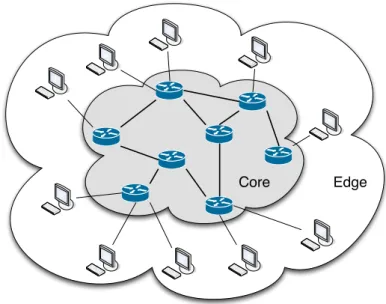
The (simplified) classic model of the Internet is depicted in figure 1.3. The inner gray cloud rep-resents the core of the Internet, whereas the outer white cloud reprep-resents the edge of the Internet. The edge is comprised of hosts, running applications such as web browsers, text processors or games. Through a network connection via the core, these hosts can run distributed applications, i.e. applications that are shared among several hosts. An example distributed application is a web browser, requesting the content of a web site from another host, the web server hosting the requested web site. For both hosts (web browser and web server), the internal structure of the network core is invisible (a “black box”), so they only need to send the data to their “point of attachment” to the core, and are unaware of the path the data takes towards the destination.
The core of the Internet contains routers that provide the end-to-end connection for the hosts on the edge of the Internet. A router is, basically, a device with one or several network interfaces, which receives incoming data in form of packets, not destined to the router itself, from one of these interfaces and then selects one of its outgoing interfaces to forward the data. To be able to make the decision to which “next hop” along the path the packet should be sent, the router needs information about the path through the core towards the destination of the data. This information is usually gathered by running a “routing protocol” on the router which, by means of message exchange with other routers, “learns” the topology of the network.
A condition for routers to be able to forward data correctly from the source to the destination is that the routing protocol can cope with changes to the network topology, in which it finds itself, quickly enough to provide an accurate path when the router is supposed to forward data. In the classic network model, the topology of the routers on the core typically changes infrequently [3, 4]: the topology is planned and administrated by system operators of ISPs. Moreover, as routers are mostly connected via cables, their relative topological “position” to other routers rarely changes, and the links between routers are stable.
1.1. Classic Networks 5
Core Edge
Figure 1.3: Classic Internet model: routers on the core of the network connect hosts on the edge of the network.
A precondition for successful routing is that all entities in the network (hosts and routers) have acquired unique identifiers. These identifiers (IP addresses) are used by hosts to address the destination of the transmitted data, and by routers to calculate paths to the destination and to correctly forward the data throughout the network. In the Internet, a pool of addresses is assigned to each ISP from a global registry of IP addresses, as depicted in figure 1.41. Each ISP
assigns IP addresses from its pool to its routers. Customers then get a pool of addresses for their hosts. The hosts can be automatically configured with addresses from the pool. The ISP must have a precise plan of the network topology and the allocated IP addresses of its routers, before it can apply for addresses from the registry [9]. Due to this planned configuration of routers, address conflicts (i.e. duplicate addresses of two routers) are rare and can be fixed manually.
Another consideration is that hosts on the edge rely on the correct behavior of routers on the core; if a router does not behave according to the specification (either because it is misconfigured, damaged or compromised), the stability of the network may be reduced and data sent through the network may not reach the correct destination. In the Internet, the risk of such instability due to a misbehaving router is contained by the physical access using a wire to routers on the core; an attacker needs to connect to the core by plugging a wire into a router, which is usually secured in protected server rooms with restricted access.
In the classic model of the Internet, routers on the core are devices, especially designed for their specific tasks: (1) to route large amounts of data per second through the network, to (2) efficiently calculate paths to destinations and (3) to store possibly huge tables of destination IP addresses in memory. Commercial routers are therefore equipped with large storage capacity as
1To be accurate, each ISP acquires the pool from a regional address registry (RIR), which in turn acquires its
6 Chapter 1. Introduction
Global address pool
unassigned addresses
Address pools of regional address registries
Africa
Europe ... ... ...
Address pools of ISPs Orange SFR Bouygues
Address pools of customers
Customer 1 Customer 2
Figure 1.4: Address pools: end customers acquire an address or a pool of addresses from a global registry (through their ISP and a regional registry per continent).
well as powerful processors, contrary to hosts on the edge, which may include hardware with only little CPU power and memory (such as mobile phones or PDAs).
1.2
Highly Dynamic Core
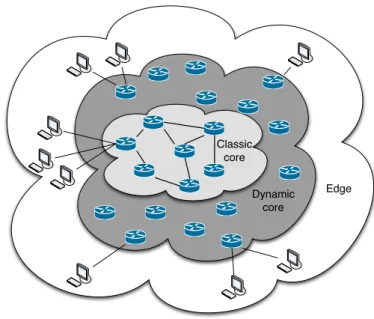
A new class of networks has emerged since the late 1990s [10], which add an additional layer to the static core of the Internet as summarized in section 1.1. The enabling technology for this kind of networks is wireless interfaces, which allow routers in the core of the network to be mobile, creating dynamic topologies, as depicted in figure 1.5 (in the cloud denoted “Dynamic core”).
Routers with wireless interfaces form a new kind of network, communicating among them-selves over wireless links and thereby forming a dynamic, arbitrary and often multi-hop graph. The core properties of these networks are their autonomy, i.e. that they can be deployed with no a priori configuration, and their ability to cope with a high degree of network topology dynamism. Contrary to the classic network model as presented in section 1.1, routers are not necessarily managed and administered by ISPs, but become a commodity, available on every computer or PDA equipped with a wireless interface. In the following, the properties of this new kind of network are presented in more detail. As these new networks form in a spontaneous, ad-hoc fashion, without any preplanning and a dynamic topology, they are denoted “ad hoc networks” for the remainder of this manuscript.
Ad hoc networks are often also called “Mesh networks” or “Mobile Ad Hoc Networks (MANETs)”, with the connotation that, contrary to a MANET, routers in a Mesh network are not mobile. But since a dynamic topology can be caused by mobility as well as by unstable links due to
1.2. Highly Dynamic Core 7 Classic core Edge Dynamic core
Figure 1.5: New Internet model: mobile routers form a spontaneous, unplanned network with a dynamic topology
wireless radio characteristics, both MANETs and Mesh networks have the same properties, only influenced by the degree of the topology dynamism.
1.2.1
Properties of Ad Hoc Networks
Ad hoc networks have the following main attributes:
• Dynamic topology: A particularity of ad hoc networks is the dynamic topology of the network. Links between routers may change dynamically – due to router mobility, or other factors influencing link stability such as environmental changes, obstacles, etc. – and with a higher frequency than in classic, wired networks. At a given point in time, depending on the mobile routers’ positions and stability of the wireless link between two adjacent routers, a wireless connectivity in the form of a random, multi-hop graph or “ad hoc” network exists between the routers [10].
• Wireless radio characteristics: In addition to the dynamism of the topology, the following properties of the wireless radio medium affect the topology of the network: asymmetry and non-transitivity of links. Asymmetry means that, unlike on a wired link (i.e. a cable), the fact that a router A “hears” a router B does not necessarily imply the inverse, as depicted in figure 1.6(a).
Furthermore, transitivity is not guaranteed in ad hoc networks. In figure 1.6(b), three routers A, B and C are depicted, each of them equipped with a wireless interface. Non-transitivity means that router A cannot “hear” C, even though A can hear B, and B can hear C.
8 Chapter 1. Introduction A B (a) Asymmetry B C A (b) Non-transitivity
Figure 1.6: Wireless radio link properties (A, B, C are routers with a wireless interface each, and the circles around the routers represent the radio range)
• Infrastructureless: Typically, no centralized infrastructure exists in ad hoc networks, such as access points in classic networks. Even if a “central” router exists in an ad hoc network, communication between that central router and each other router in the network cannot be guaranteed due to the dynamic topology.
• Autonomy: Ad hoc networks are “autonomous”, i.e. routers do not need any a priori configuration. All parameters required for establishing communication, such as for the routing protocol, are negotiated between the routers by a message exchange [10].
1.3
Use Cases
In this section, some example use cases of ad hoc networks are presented, that demonstrate the interest and the advantages of ad hoc networks over classic, wired networks in these deployments.
1.3.1
FunkFeuer Community Ad Hoc Network
One example of operational ad hoc networks are community networks in Europe, such as the FunkFeuer [11] network in Vienna, Austria. FunkFeuer is a public, non-regulated, community network allowing inhabitants of Vienna to connect to each other and – through an uplink to an ISP – to the Internet for no fee, other than the initial purchase of a wireless router. Funk-Feuer comprises several hundred routers [11], many of which have several radio interfaces (with omnidirectional and some directed antennas)2.
The routers of the network are small-sized wireless routers, such as the Linksys WRT54GL, available in 2011 for less than 50 Euros. These routers, with 16 MB of RAM and 264 MHz of CPU power, are mounted on the rooftops of Vienna, as depicted in figure 1.7.
When new users want to connect to the network, they have to acquire a wireless router, install the appropriate firmware and routing protocol, and mount the router on the rooftop. IP address(es) for the router are assigned manually from a list of addresses.
2As of August 2010, 749 routers were registered, but only 222 of them were active. The topology contained
1.3. Use Cases 9
(a) Initially, simple Tupperware has been used to protect the routers
(b) Recently, better protection boxes have been used
Figure 1.7: FunkFeuer routers (source: [11])
This network is not intended for testing purposes, and there is no “operator” or “maintainer” having remote access to the routers once installed, which requires the routers to be completely autonomous. Figure 1.8 depicts the network topology of the FunkFeuer network as of July 23, 2010. The network covers a large area of central Vienna, and via some directed links, also some suburbs further away from the city center. While the routers are non-mobile, fluctuations in link quality require an ad hoc routing protocol that allows for quick convergence to reflect the effective topology of the network.
Similar community network deployments are situated, e.g., in Berlin [12], Athens [13] and Seattle [14].
As of 2011, the routing protocol that operates on FunkFeuer routers is unsecured. Therefore, the users of the network have to trust that nobody harms the network integrity (intentionally or otherwise).
1.3.2
Ad Hoc Networks in Emergency Situations
Establishing basic communication after an emergency such as a flood, earthquake or nuclear accident, is difficult when the communication infrastructure is damaged. Mobile phones require nearby infrastructure that provide connectivity, which may not work any more. Even if the infrastructure is still available, the increased use of mobile phones after an emergency can saturate the network. The cable telephone network may be malfunctioning when cables are broken, satellite phones are rarely available and expensive.
In addition to voice communication, data collection on the emergency site is desirable. In-formation, such as temperature, humidity or radioactivity of the disaster area, can help under-standing the degree of the disaster, and to coordinate help accordingly. [15, 16, 17, 18] describe different such deployments, establishing communication in emergency situations. To pick one example, the SKYMESH project of Niigata University [15], is aimed at establishing communi-cation between several unmanned balloons (as depicted in figure 1.9) in order to rapidly create communication networks for rescuers. A small computer, together with a GPS device and a
10 Chapter 1. Introduction
Figure 1.8: FunkFeuer topology (as of July 23, 2010)
(a) Balloons used for establishing an ad hoc network in emergency situations
(b) GPS, camera and computer are attached to the balloon
1.3. Use Cases 11 camera, is attached to the balloon, which floats in a height of 50 to 100m over ground, allowing remote wide area monitoring of the disaster area, as well as establishing communication (voice or data) using the ad hoc network.
Another deployment in emergency situations is to drop large numbers of sensors from an airplane. The sensors can then establish an ad hoc network, once they are on the ground, without the necessity for humans to enter the disaster site and to deploy the sensors manually.
1.3.3
Wireless Sensor Networks
The general context for Wireless Sensor Networks (WSNs) is small, cheap devices whose primary function is data acquisition, with communications capabilities enabling them to send data to a controller, using a wireless multi-hop topology. As an example, a WSN deployed for environmen-tal monitoring might contain a set of temperature sensors, sending “notifications” to a central controller when the temperature exceeds certain thresholds. Compared to a network of wired sensors, WSNs offer the advantage of enabling mobility to sensors, as well as reducing cost and space requirements for the installation of cables. The properties of WSNs are similar to the ad hoc network presented in section 1.3.1, with the following differences: (1) hardware resources (in terms of CPU and memory) of sensor routers are even more constrained than ad hoc routers in the FunkFeuer network, (2) unlike the routers in the FunkFeuer network, sensor routers may be battery driven, and (3) sensor network topologies are often optimized for particular traffic patterns.
Figure 1.10: Sensor router MSB430 with 55 KByte of flash and 5KByte of RAM (source: [19]) As for (1), figure 1.10 depicts a typical sensor router, which is equipped with only 55 KByte of flash, 5 KByte of RAM, and a few Megahertz of CPU speed [19]. Compared to the routers in the FunkFeuer network, these sensor routers have much more constrained resources [20], and thus require special care when designing protocols for these sensor routers, minimizing required memory space and CPU power. As for (2), sensor nodes, such as [19], are battery-driven, constraining their life-time compared to routers with a permanent energy supply. This implies that protocols for such sensors should have the objective to maximize resource savings (e.g. by reducing the frequency of message transmissions). As for (3), a major use case for sensors is measuring a set of environmental data and sending it through the network to a central
12 Chapter 1. Introduction controller [20]. This traffic flow assumption allows to construct specific, optimized network topologies which focus on connections from a sensor to the controller (versus sensor-to-sensor or controller-to-sensor), such as the topology depicted in figure 1.11.
S S S C S S S
Figure 1.11: Sample wireless multi-hop topology of a Wireless Sensor Network with sensors (S) sending traffic to a controller (C)
1.4
Challenges of Ad Hoc Networks
Section 1.3 has shown use cases of ad hoc networks that demonstrate advantages of this new kind of networks. Before ad hoc networks can be commercially deployed, however, several technical challenges have to be solved, which are summarized in this section (without claiming complete-ness):
1. As ad hoc networks are designed to be autonomous, and to have an un-planned, possibly dynamic network topology, manual allocation of IP addresses on routers may not be feasible. 2. Routing protocols have to cope with the high dynamism of the topology as well as properties
of the wireless radio channel.
3. Router parameters should be remotely manageable in order to change settings on the router and to tweak the network performance.
4. Due to the wireless radio interfaces, physical access to routers in an ad hoc networks is easier than in wired networks, and therefore attacks on the network integrity are facilitated. 5. Ad hoc networks should be integrated in the wider Internet.
6. Due to constrained hardware and bandwidth, ad hoc networks are more difficult to scale. Autoconfiguration: As described in section 1.2.1, ad hoc networks are (1) autonomous, (2) in-frastructureless, and (3) have no preplanned topology with a possibly dynamic network topology. Due to their autonomy, no “a priori” network configuration is required for network deployments, and routers therefore should provide means to configure addresses automatically (called “auto-configuration”). As for (2), no centralized infrastructure, such as an address registry, is available
1.4. Challenges of Ad Hoc Networks 13 from which unique addresses can be allocated. As the network topology is not planned, guaran-teeing unique and topologically correct addresses at all times is difficult; parts of the network can split and merge at a later point of time, and the relative position between routers may change due to the dynamic topology. Protocols for autoconfiguration in the Internet ([21, 22, 23]) exist, but are not applicable for ad hoc networks, as they have not been designed to cope with the above-mentioned properties of ad hoc networks [24]. Moreover, the autoconfiguration protocols in the Internet are specified for hosts, not routers, i.e. existing protocols have to be extended or new protocols have to be specified for ad hoc routers.
Routing Protocol Challenges: Due to the dynamic and spontaneously forming topology of ad hoc networks, routing protocols have to react to the changing topology of the network and find paths through the network. Current routing protocols in the Internet, such as OSPF [25] and BGP [26], were not designed to handle such dynamic topologies [5, 6] and produce a high message overhead in ad hoc networks, prohibiting their use in these networks [27, 28]. In OSPF, routers synchronize their databases that reflect the topology of the network, which creates a considerable overhead in ad hoc networks, if links between adjacent routers are interrupted due to the dynamic topology [28]. OSPF also specifies to use reliable dissemination of routing protocol messages throughout the network, i.e. the protocol verifies that messages are received by other routers using an acknowledgment mechanism; in a wireless medium, this may lead to loss of the acknowledgment messages if they are transmitted at the same time on the channel.
Router Management: Management of router parameters (e.g. parameters of the routing protocol, such as message transmission intervals), similarly to address configuration, is more difficult than in classic networks: there may not be any network operators for the network, and even if there are, they might not have access to the router to be managed (either because it is not “owned” by the network operator and protected against external access, or because it is currently in another, separated, part of the network and thus not reachable from the operator’s computer).
Security: Security is another major concern for ad hoc networks. While the threats to the operating system, routing protocols and other applications are the same for ad hoc networks as for their counterparts in wired networks, the physical access to the routers is easier in ad hoc networks. It suffices for an attacker to use a computer with a wireless interface in radio range of any router in the ad hoc network in order to attack the integrity of the network, e.g. by transmitting control messages reflecting a “wrong” network topology. In wired networks, physical access to the routers is more difficult, since they are typically protected in secured server rooms, and since a connection via cable is required in order to attack the router or the network integrity3
Integration in the Internet: It is desirable to integrate ad hoc networks into the larger Internet, in order to allow communication between hosts in the ad hoc network and other hosts in
3However, attacks on the BGP protocol – which relies on trust between routers – indicate that even wired
14 Chapter 1. Introduction the Internet. This requires care when designing protocols that should interoperate with current protocols and architectural assumptions in the Internet. The different properties of ad hoc networks, summarized in section 1.2.1, should be transparent (i.e. indifferent) to all hosts on the edge and all classic routers (not running an ad hoc routing protocol) on the core, in order to avoid rewriting software for millions of devices already deployed.
Scalability: Increasing the size of ad hoc networks, e.g. in order to allow city-wide or even larger ad hoc networks, is challenging because, unlike typical classic routers, ad hoc routers may have constrained hardware power, running on laptops, PDAs or even more constrained devices. Moreover, the bandwidth of the wireless radio medium may be more limited than in wired networks. Routing protocols demand both in-router resources (CPU, memory) and bandwidth for message exchange between routers which, depending on the traffic patterns, may scale with the number of routers in the network.
Finding solutions to these challenges is important, as ad hoc networks are not only part of academic research, but are operated in real life deployments, as presented in section 1.3. This manuscript aims at analyzing the problem space in more detail and at proposing solutions, that help to deploy such networks in industry and academia, and to integrate this new kind of network into the classic Internet.
1.5
Standardization in the Internet Engineering Taskforce
The fact that ad hoc networks are not just deployed in academic lab test beds, but in operational industrial and community networks, shows that there is an interest of industry to market these networks. If companies develop proprietary protocols for ad hoc networks, there is a risk of market fragmentation and non-interoperable protocols [29]. In order to standardize protocols and to avoid such a market fragmentation, the Internet Engineering Taskforce (IETF) [30] publishes specifications of protocols for the Internet. In particular, the IETF has formed several Working Groups (WG) and assigned them with the task of standardizing protocols for ad hoc networks. This section briefly overviews the organization and the standardization process of the IETF. For a complete, detailed description of the structure and processes of the IETF, refer to [31].
According to [32], “the mission of the IETF is to produce high quality, relevant technical and engineering documents that influence the way people design, use, and manage the Internet in such a way as to make the Internet work better”. Contrary to other standardization bodies, the IETF is loosely organized: there is no membership, no membership fees, no board of directors, and the IETF is no corporation. Three times a year, interested people from industry and academia meet face-to-face in order to make progress on standardizing protocols. In between these meetings, communication is mainly performed via mailing lists. The opinion of everyone interested in the topic and producing constructive comments is welcome, independent of his or her affiliation with a company or the hierarchy within the company. One unofficial motto of the IETF, expressed
1.5. Standardization in the Internet Engineering Taskforce 15 by David Clark, is: “We reject kings, presidents and voting. We believe in rough consensus and running code” [31]. That means that (1) decisions on controversial questions are not made by hierarchical decisions or votes, but by rough consensus on the mailing list (i.e. not necessarily unanimous, but no major technical objection) and (2) that protocols must also be implemented and tested before they can be standardized.
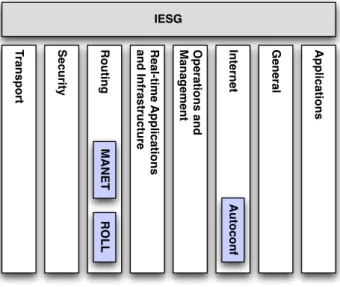
The Working Groups in the IETF are organized in different areas, as depicted in figure 1.12 (with only Working Groups listed that work on ad hoc network protocols which are considered in this manuscript, notably MANET, Autoconf and ROLL). Each area is guided by two area
A p p lic a ti o n s General In te rn e t O p e ra ti o n s a n d Ma n a g e m e n t R e a l-ti m e A p p lic a ti o n s a n d In fr a s tr u c tu re R o u ti n g MA N ET ROLL Se c u rity T ransport A u to c o n f IESG
Figure 1.12: Organization of Working Groups in the IETF: Working Groups (here: MANET, ROLL, Autoconf) are organized in different areas
directors, which are part of the Internet Engineering Steering Group (IESG). Nominated for a duration of two years, the ADs administer the publication process according to a set of rules and procedures [31]. The IESG ratifies or corrects the output from the IETF’s Working Groups [31]. Before a document is published as “Request for Comment (RFC)”4, it has to run through a standardization process, typically starting as individual draft, which can be submitted by every-one without peer review. As such, it is available for discussion by other interested participants on the mailing list, but simply expresses an individual proposal of a person. If a Working Group is interested in the work, it can agree (by rough consensus) that this draft becomes a Working Group draft. Once the Working Group agrees that after a certain number of revisions of the draft, it is mature for publication, it will issue a Working Group last call. During this limited time period, substantial issues and comments should be expressed by members of the Working Group. The draft will then be sent to the IESG, which determines whether the draft is ready to be published, and in particular does not conflict with other, already published RFCs.
4Contrary to what the name “Request for Comment” implies, RFCs are the standards specified by the IETF
16 Chapter 1. Introduction Several of the Working Groups of the IETF focus on protocols that apply to ad hoc networks. For this manuscript, in particular the work of the MANET, AUTOCONF and ROLL Working Group is considered.
1.5.1
MANET Working Group
Created in 1997, the MANET Working Group aims at developing routing solutions in the field of mobile ad-hoc networks [7]. The purpose of the MANET Working Group is
“(...) to standardize IP routing protocol functionality suitable for wireless routing application within both static and dynamic topologies with increased dynamics due to node motion or other factors.” [33]
The Working Group has published the following modular documents that may serve as build-ing blocks for other ad hoc (routbuild-ing) protocols:
• “Jitter Considerations in Mobile Ad Hoc Networks (MANETs)” [34]
• “Generalized Mobile Ad Hoc Network (MANET) Packet/Message Format ” [35] • “Representing Multi-Value Time in Mobile Ad Hoc Networks (MANETs)” [36] • “Mobile Ad Hoc Network (MANET) Neighborhood Discovery Protocol (NHDP)” [37] DYMO [38], OLSRv2 [39] and SMF [40] are protocols which use the above-mentioned modular components, and which are in the process of standardization by the MANET Working Group as of 2011.
1.5.2
AUTOCONF Working Group
The AUTOCONF Working Group charter [41] from 2009/2010 states5:
“In order to communicate among themselves, ad hoc nodes [...] need to configure their network interface(s) with local addresses that are valid within an ad hoc network. Ad hoc nodes may also need to configure globally routable addresses, in order to communicate with devices on the Internet. From the IP layer perspective, an ad hoc network presents itself as a L3 multi-hop network formed over a collection of links.” [41], as of 2009/2010, furthermore states the objective: to “describe the addressing model for ad hoc networks and how nodes in these networks configure their addresses”. This manuscript discusses the issues that the AUTOCONF Working Group faces in chapter 4, and proposes an architectural model that adheres to the architecture of the Internet. Core assumption of the proposed model have been documented in [42].
1.6. Contributions and Structure of the Manuscript 17
1.5.3
ROLL Working Group
ROLL is an abbreviation of an IETF Working Group named “Routing Over Low power and Lossy networks”. This Working Group has as objective to develop a routing protocol for WSNs, based on IPv6.
The unofficial goal, which this Working Group tries to attain, is to prevent fragmentation in the WSN market by providing an IP-based routing standard and solicit broad industrial support behind that standard. As of 2011, the ROLL Working Group is mainly working on the “Routing Protocol for Low Power and Lossy Networks” (RPL)” [43], which is described and further evaluated and extended in this manuscript.
1.6
Contributions and Structure of the Manuscript
This manuscript is structured into four main parts (plus a conclusive part and appendices), each focusing on solutions to a different problem area, as described in section 1.4.
Part I contains, in addition to this introduction chapter, two chapters describing developed software tools which are applied throughout this manuscript:
Chapter 2 first presents a preexisting software tool, called NS2, which is used for protocol evaluations using network simulations throughout this manuscript. Using a simulator allows to understand and evaluate high-level properties of routing protocols and extensions. Simulations are often easier to perform than building a large testbed network of routers, simulating mobility, and guaranteeing the reproducibility of predefined scenarios. Then, the chapter details several tools that have been developed, which allow to automate the process of defining scenarios for the simulator, creating the scenario files required for NS2, running the simulator using these files, evaluating the output of the simulator and plotting figures, all in a single step.
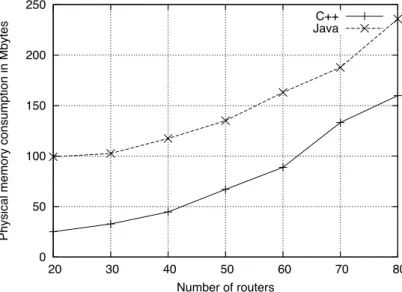
Chapter 3 details how to run unmodified Java applications in the C++ based NS2 network simulator, i.e. using the very same Java code that runs on a real network, using a tool called AgentJ. In the remainder of the manuscript, several protocols have been implemented in Java, due to the platform independence, ease of prototyping and extensibility. An extension to AgentJ is proposed which allows for also testing routing protocols in NS2. The necessary architectural changes to AgentJ are described in the chapter. When using a routing protocol in NS2 with AgentJ, only a single extra Java class has to be added to the routing protocol, and NS2 does not have to be recompiled for new routing protocols, once AgentJ is installed. The simulation of a basic Java routing protocol is compared with a similar routing protocol implemented in C++, showing that the memory and CPU requirements for the simulation with AgentJ compared to the C++ protocol are only moderately higher. These contributions have been published in [44]. Part II proposes an architectural model that allows to integrate ad hoc networks into the wider Internet. Moreover, this model facilitates scalability of ad hoc networks by enabling automatic configuration of IP addresses on network interfaces and delegating prefixes to ad hoc routers, which is advantageous over manual configuration in large networks:
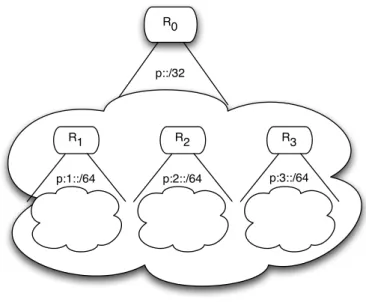
18 Chapter 1. Introduction Chapter 4 contains an architectural model for allowing ad hoc networks to be integrated seamlessly into the Internet. The model compares the current architecture of the Internet with a commonly assumed model of ad hoc networks, and shows that this ad hoc model is not compliant with the Internet. The chapter proposes an alternative model, which avoids these problems and sets the stage for new autoconfiguration algorithms adhering to that model. These contributions have been published in [45, 24] and as contribution to RFC5889 [42].
Chapter 5 specifies an autoconfiguration algorithm, and extensions thereof, adhering to the model presented in chapter 4. The proposed protocol is formally verified using a model checker, which proves correctness of the algorithm. The performance of the algorithm is tested using network simulations in scenarios with increasing number of routers, showing that with some optimizations, the algorithm is performant. These contributions have been published in [24].
Part III explores performance improvements, scalability, management and security exten-sions of the Optimized Link State Routing Protocol version 2 (OLSRv2) [39], an ad hoc routing protocol which is being standardized by the MANET Working Group in the IETF as of 2011.
Chapter 6 provides an overview of the specification of OLSRv2.
Chapter 7 describes a Java implementation of OLSRv2 (called “JOLSRv2”), which is used for performance analysis and evaluation of extensions in the following chapters. The implemen-tation contains all specified features of the routing protocol, has been shown to be interoperable with other implementations, and can be easily used for prototyping of extensions. These contri-butions have been published in [46].
Chapter 8 proposes an optimization of OLSRv2 for more efficiently calculating shortest paths from a router to all other destinations in the network. Typically, OLSRv2 runs a variation of the well-known Dijkstra algorithm for path calculation. This implies that for each incoming control message with new topology information, the previously calculated paths are deleted and a new graph is calculated on the router. This chapter proposes the use of a dynamic (i.e. in-cremental) shortest path calculation algorithm (DSP) in OLSRv2, and presents a performance evaluation of OLSRv2 with such a DSP, showing that the performance of OLSRv2 can be in-creased by orders of magnitude without changing compatibility with the OLSRv2 specification. Using the proposed extensions, topologies of tens of thousands of routers can be handled by standard hardware components, as available in 2011. These contributions have been published in [47].
Chapter 9 presents means for externally managing and monitoring OLSRv2 with the Sim-ple Network Management Protocol (SNMP), a prevalent network management protocol in the Internet, in order to optimize parameters of the routing protocol. Such an optimization may lead to a more stable perceived topology and to a lower control traffic overhead, and therefore to a higher delivery success ratio of data packets, a lower end-to-end delay, and less unneces-sary bandwidth and energy usage. The chapter proposes a management framework for OLSRv2, including management objects for controlling OLSRv2 and gathering performance related statis-tics of the protocol. Moreover, the performance of SNMP in OLSRv2-routed MANETs is tested in network simulations. These contributions have been published in [48] and in IETF working
1.6. Contributions and Structure of the Manuscript 19 group drafts [49, 50], which are on track to become RFCs in 2011.
Chapter 10 proposes a “delay-tolerance” mechanism to be used in OLSRv2-routed MANETs. Typically, successful packet forwarding on a router depends on whether the routing table of the operating system contains a “valid route” towards the destination of the packet. If such a valid route exists, the packet is retransmitted, otherwise, it is dropped. In ad hoc networks, that behavior may lead to low delivery ratio of packets if the network topology is “unstable”. In some deployments, it may be preferable to accept a higher delay of packet delivery by retransmitting the data later when a valid route exists again to the destination, instead of dropping it. This chapter proposes such a delay tolerant mechanism for OLSRv2-routed MANETs, and evaluates the performance by means of network simulations in increasingly large MANET deployments, showing a large increase in delivery ratio at expense of higher end-to-end delays. In order to test the effect of delay tolerant routing in “extreme” cases, a special network model for simulations is proposed, and the mechanism tested in such scenarios.
Chapter 11 sets the stage for a security extension of OLSRv2 by analyzing security vul-nerabilities and inherent resilience of OLSRv2. Attacks are classified in three types: (i) attacks that affect the ability for any given router in the network to acquire a representation of the network connectivity, (ii) attacks that have impact on the ability of a router to acquire an ac-curate topology map which reflects the effective topology map, and (iii) attacks that lead to an inconsistent topology among several routers in the network. For each of the three classes, several attacks are exemplarily demonstrated, and finally, inherent resilience of OLSRv2 (without secu-rity extension) to some of these attacks is described. These contributions have been published in [51, 52].
Chapter 12 proposes a security extension to OLSRv2 and evaluates the scalability of that extension. Many of the attacks presented in chapter 11 are only possible because OLSRv2 routers per default “trust” each other. This chapter specifies a security extension to OLSRv2 allowing to control access of routers to the network, and to verify “links” that each such admitted router advertises in its control messages. A simulation evaluation compares the CPU time for processing and generating control traffic signatures, as well as the message overhead, for both the “link-admittance” and the “router-“link-admittance” mechanism. These contributions have been published in [53, 54] and in a IETF Working Group draft [55], which is on track to become RFC in 2011.
Part IV explores routing performance and scalability issues in Wireless Sensor Networks (WSNs):
Chapter 13 provides an overview of the specification of the IPv6 Routing Protocol for Low Power and Lossy Links (RPL), a routing protocol specially targeted for large networks of constrained sensors.
Chapter 14 presents a Java implementation of the RPL protocol (called “JRPL”), which is used for performance analysis and evaluation of extensions in the following chapters.
Chapter 15 evaluates the performance and scalability of RPL in network simulations up to thousand routers, and tests the impact of the protocol on unicast data performance, showing that RPL has a very low overhead on the network and facilitates successful unicast data traffic
20 Chapter 1. Introduction communication for large sensor networks. These contributions have been published in [56].
Chapter 16: As RPL does not contain any mechanism for flooding information throughout an RPL-routed WSN, several such flooding mechanisms are proposed and compared in their performance with increasing number of routers, showing that optimized flooding mechanisms can largely increase the efficiency in terms of reduced message overhead and number of packet collisions. These contributions have been published in [57, 58].
Part V summarizes and concludes this manuscript, and outlines some possible future work. Part VI contains a list of publications, as well as more detailed usage and installation instructions for AgentJ, JOLSRv2, and JRPL.
Chapter 2
Simulation Toolchain
An important step when designing and developing a new protocol is often to verify its behavior in a network simulator, such as NS2 [59]. While network simulators have their limits, especially in terms of the fidelity of the lower layers and, for wireless network interfaces, the fidelity of the propagation model used for representing the behavior of radio waves, their use facilitates the understanding of high-level and algorithmic properties of a given routing protocol. In particular, in the area of ad hoc networks, simulations are often easier to perform than building a large testbed network of routers, simulating mobility, and guaranteeing the reproducibility of prede-fined scenarios. Using NS2, scenarios can be deprede-fined to simulate not only the network traffic but also the underlying mobility patterns that affect signal strengths between routers as the scenario progresses.
This chapter briefly overviews the functionality of the NS2 simulator and then describes several tools that have been developed for the purpose of running unsupervised simulations of protocol implementations and extensions in NS2. Automating the process of network simulations is useful for simulating protocols and extensions with a large parameter space and many different scenarios. The tools allow for running many simulations without (much) human interaction. They also facilitate to perform statistics over all scenarios and create plots as images. In the following sections, the different tools are presented, and then a typical workflow of how to run a simulation and perform an evaluation of parameters is described.
It should be noted that there exist network simulators other than NS2, such as QualNet [60], OMNeT++ [61], and NS3 [62]. The reason for using NS2 throughout the evaluations in this manuscript is threefold: (i) NS2 is open-source, which allows to modify the code base, if required, and to save licensing fees, (ii) NS2 contains a variety of standard Internet protocols and link layer types, which allows to consider all aspects a protocol in a simulation, and (iii) NS2 is widely used in research, which allows to compare results and which may increase confidence in the correctness of results (as described in section 3.2). NS3, the successor of NS2, was not used for the evaluations presented in this manuscript because it was still under development, and the code base has largely changed in the last few years (more than 2 million lines of source code have changed from 2007 to 2011 [62]).
22 Chapter 2. Simulation Toolchain Since in this manuscript only NS2 has been used, a description of other network simula-tors is out of scope. [63] presents different network simulasimula-tors and compares them in terms of performance requirements and scalability.
2.1
Chapter Outline
Section 2.2 overviews the functionality of the NS2 simulator. Section 2.3 describes tools that are used to automatically generate many scenarios from a given set of configuration files. Section 2.4 provides an overview of tools which allow for running NS2 simulations automatically without human interaction. Section 2.5 presents tools that can be used to perform statistics over the simulation results and to create images that can be included in, e.g., scientific papers. Section 2.6 describes the typical workflow of preparing, running and evaluating simulations using all the presented tools. Section 2.7 concludes the chapter.
2.2
The NS2 Simulator
NS2 [59] is a discrete event network simulator, written in C++, intended for simulations of network protocols between several nodes with predefined mobility and traffic patterns. NS2 is single threaded, and events are scheduled to be executed at a certain simulation time using callbacks. NS2 contains implementations of all major protocols for each layer on the IP stack, such as different physical media, MAC layers, routing protocols and implementations of TCP and UDP. Additional protocol implementations for each layer can, if desired, be added to NS2.
The simulation scenarios are defined in OTcl [64], an object oriented scripting language. The scripts define (1) basic scenarios settings (number of nodes, physical channel, MAC type, routing protocol, etc.), (2) mobility settings of nodes, and (3) data traffic patterns.
A complete description of NS2 can be found at [59].
2.3
Scenario Generation Tools
This section presents tools for automatically generating scenario files to be used by network simu-lators such as NS2. These scenarios files all correspond to the same abstract scenario description (specified by a configuration file).
2.3.1
Wsg – The Scenario Generator
The purpose of the Wsg scenario generator is to create different scenario files that represent complete scenario files, i.e. not only router movement patters, but a standalone scenario file including router initialization, data traffic patterns and movements. This eases the distribution of the scenario files on several machines that run network simulations in parallel. It is written in Ruby and is generic for different simulators, i.e. it has its own intermediate representation of
2.3. Scenario Generation Tools 23 the scenario and eventually prints out a file that is particular to one network simulator or the other. So far, only an NS2 output generator is implemented.
The wsg directory has the following contents: |-- conf | ‘-- JOLSRv2-20-waypoint.conf |-- create-multiple-runs.sh |-- generic | |-- BulkTransfer.rb | |-- Generators.rb | |-- Globalparameters.rb | |-- LineSegment.rb | |-- LinearMovement.rb | |-- Movements.rb | |-- Node.rb | |-- NodeGroup.rb | |-- Popup.rb | |-- Random_walk.rb | |-- Random_waypoint.rb | |-- Scenario.rb | |-- Singlelane.rb | |-- Stream.rb | ‘-- Vector.rb |-- scenarios |-- simulators | |-- Human.rb | |-- Ns2_full.rb | |-- Simulators.rb | ‘-- ns2.rb |-- wsg.conf ‘-- wsg.rb 2.3.1.1 Config Files
The conf directory contains all config files that are used to create the scenario files. Every config file represents a single abstract scenario description. However, several “runs” of every scenario can be created using the same settings but different random initialized router positions and movements. An example of such a configuration file is listed in the following:
GLOBAL.chan Channel/WirelessChannel # channel
GLOBAL.prop Propagation/TwoRayGround # radio propagation GLOBAL.netif Phy/WirelessPhy # physical medium GLOBAL.mac Mac/802_11 # MAC layer