HAL Id: tel-01962784
https://hal.archives-ouvertes.fr/tel-01962784
Submitted on 20 Dec 2018HAL is a multi-disciplinary open access
archive for the deposit and dissemination of sci-entific research documents, whether they are pub-lished or not. The documents may come from teaching and research institutions in France or abroad, or from public or private research centers.
L’archive ouverte pluridisciplinaire HAL, est destinée au dépôt et à la diffusion de documents scientifiques de niveau recherche, publiés ou non, émanant des établissements d’enseignement et de recherche français ou étrangers, des laboratoires publics ou privés.
error-sensitivity, uniformity, redundancy, and
interactivity
Laurent Feuilloley
To cite this version:
Laurent Feuilloley. Local certification in distributed computing: error-sensitivity, uniformity, re-dundancy, and interactivity. Computer Science [cs]. Université paris diderot, 2018. English. �tel-01962784�
de l’Université Sorbonne Paris Cité
Préparée à l’Université Paris Diderot
Ecole doctorale Sciences Mathématiques de Paris Centre (ED 386) Institut de Recherche en Informatique Fondamentale (IRIF)
Spécialité : Informatique
Local certification in distributed computing:
error-sensitivity, uniformity, redundancy, and interactivity
Par :
Laurent Feuilloley
Dirigé par Pierre Fraigniaud
Soutenue publiquement le 19 septembre 2018 devant le jury constitué de :
Jérémie Chalopin, CR Université d’Aix-Marseille Examinateur Bernadette Charron-Bost, DR École polytechnique Examinatrice Carole Delporte, PU Université Paris Diderot Présidente du jury Pierre Fraigniaud, DR Université Paris Diderot Directeur de thèse
Nicolas Hanusse, DR Université de Bordeaux Examinateur
Sophie Laplante, PU Université Paris Diderot Examinatrice
Boaz Patt-Shamir, PU Tel Aviv University Rapporteur
Abstract.
This dissertation is about local certification, a central topic in distributed decision, a subfield of distributed computing. The distributed decision mechanism consists, for the nodes of a network, in deciding in a distributed manner whether the network is in a proper configuration or not, with respect to some fixed predicate. This decision is said to be local because the nodes of the network can communicate only with their neighbours. After communication, every node outputs a decision, stating whether the network is locally correct, that is, correct given the partial information gathered so far by this node. The network is declared to be globally correct, if and only if, it is declared to be locally correct by every node.
Most predicates cannot be verified by this type of computation, due to the loc-ality constraint. Local certification is a mechanism that enables to circumvent this difficulty, and to check any property. It consists in providing the nodes of the network with labels, called certificates, that can be verified locally by a distributed algorithm. A local certification scheme is correct if only the networks that satisfy the predicate can be certified. In addition to its theoretical appeal, as a form of distributed non-determinism, the concept of local certification is especially relevant in the study of fault-tolerant distributed algorithms, where a key step consists in checking the status of the network, based on information stored at the nodes.
This dissertation deals with four aspects of local certification: error-sensitivity, uniformity, redundancy, and interactivity. The study of these four topics is motivated by the same essential question: How to reduce the resources needed for certification, and/or ensure a better fault-tolerance? In order to tackle this question we have to understand fundamental properties of certification. In particular, in this dissertation we answer questions such as: How redundant the certificates need to be for a proper certification? Are the classic certification protocols robust to a strengthening of the acceptance condition? and, How does introducing interactivity in the process changes the complexity of certification?
Keywords: Distributed network computing, distributed decision, local certification, proof-labelling scheme, fault-tolerance.
Résumé.
Cette thèse porte sur la notion de certification locale, un sujet central en décision distribuée, un domaine du calcul distribué. Le mécanisme de la décision distribuée consiste, pour les nœuds d’un réseau, à décider de manière distribuée si le réseau est dans une configuration correcte ou non, selon un certain prédicat. Cette décision est dite locale, car les nœuds du réseau ne peuvent communiquer qu’avec leurs voisins. Après avoir communiqué, chaque nœud prend une décision, exprimant si le réseau est correct ou non localement, c’est-à-dire correct étant donné l’information partielle récoltée jusque-là. Le réseau est déclaré correct globalement s’il est déclaré correct localement par tous les nœuds.
Du fait de la contrainte de localité, peu de prédicats peuvent être vérifiés de cette manière. La certification locale est un moyen de contourner cette difficulté, et permet de décider tous les prédicats. C’est un mécanisme qui consiste à étiqueter les nœuds du réseau avec ce que l’on appelle des certificats, qui peuvent être vérifiés localement par un algorithme distribué. Un schéma de certification locale est correct si seuls les réseaux dans une configuration correcte peuvent être certifiés. L’idée de la certification locale est non seulement séduisante d’un point de vue théorique, comme une forme de non-déterminisme distribué, mais c’est surtout un concept très utile pour l’étude des algorithmes tolérants aux pannes, où une étape-clé consiste à vérifier l’état du réseau en se basant sur des informations stockées par les nœuds.
Cette thèse porte sur quatre aspects de la certification locale : la sensibilité aux erreurs, l’uniformité, la redondance et l’interactivité. L’étude de ces quatre sujets est motivée par une question essentielle : comment réduire les ressources nécessaires à la certification et/ou permettre une meilleure tolérance aux pannes? Pour aborder cette question, il est nécessaire de comprendre le mécanisme de certification en profondeur. Dans cette optique, dans cette thèse, nous apportons des réponses aux questions suivantes. À quel point les certificats doivent-ils être redondants, pour assurer une certification correcte? Les schémas de certification classiques sont-ils robustes à un changement de la condition de correction? Le fait d’introduire de l’interactivité dans le processus change-t-il la complexité de la certification?
Mots-clefs: Calcul distribué sur réseau, décision distribuée, certification locale, schéma d’étiquetage de preuve, tolérance aux pannes.
Aknowledgments.
This thesis has only one author, but many people participated in this project, and it is time to thank them. I would first like thank my advisor, Pierre Fraigniaud, for his wise and cheerful guidance, and for giving me both the freedom and the support that I needed. Also I would like to thank Pierre for constantly reminding me that clarity is the key in scientific writing. I hope this thesis shows that I am trying to follow this mantra!
I am grateful to Boaz Patt-Shamir and Franck Petit for reviewing this document and giving a nice feedback. Their reviews made me improve the manuscript in various ways. My sincere thanks to Jérémie Chalopin, Bernadette Charron-Bost, Carole Delporte, Nicolas Hanusse and Sophie Laplante, for accepting to participate in my thesis committee.
I would like to thank the researchers (and friends) who co-authored the papers on which this thesis is built, and who shared my office for some time: Juho Hirvonen (we have already four papers together, I hope others will follow!), Ami Paz and Mor Perry (one paper is the first step, let’s continue!).
My life in research is certainly not restricted to the content this manuscript. First, my PhD would not have been the same without its prelude: various internships with nice and talented people. I would like to warmly thank Marie-France Sagot, José Correa, Jukka Suomela, and Ola Svensson, for giving me the opportunity to work with them (and their colleagues and students), and for making me discover the world of research. Also I express my gratitude for the teachers I had along the years that lead to this thesis. Then I thank my colleagues who did not participate directly to the works presented in this dissertation, but were very important anyway, through numerous discussions. I also learned a lot from the teaching, and I thank the students, the professors, and the Ufr staff for this. Special greetings to my fellow PhD seminar organizers, Clément and Théo (I think we did a good job!), and to my successor Baptiste. Thanks to the speakers of the seminar, especially the ones who participated in the semidoc blog! And thanks to Victor for accepting to take care of the blog. On a more general perspective, the research and teaching community, and the staff around, are essential to any scientific work, including this one.
During my three years at Irif, an indispensable breath of fresh air came from the Crous lunches and endless pause-cafés, with wonderful friends from the fourth and (more recently) the third floors. I do not want to list them, they know who they are! I am also grateful to the great people outside the lab who made my life better.
Enfin, un merci immense et ému à mes parents, Georges et Bénédicte, à mon frère Éric, et à Julie. Merci d’être là, tout simplement.
Structure.
This document begins with a fairly long introduction that surveys the results and techniques of both the previous work and the thesis. A more complete review of the previous work can be found at the end of this document, in Chapter 7, which is a sur-vey of the literature. After a chapter about the model and the definitions (Chapter 2), the main technical contributions of the thesis are developed in Chapters 3, 4, 5 and 6. These core chapters correspond to four papers that are either published or accepted for publication. They are structurally quite close to the original versions, but the in-troductions have been changed and some proof sketches and figures have been added. Chapter 8 is the conclusion, with open problems and perspectives.
1 Introduction 13
1.1 Introduction to distributed decision . . . 13
1.2 Proof-labelling schemes toolbox . . . 29
1.3 Overview of the thesis . . . 35
1.4 Annotated list of publications . . . 48
2 Model and definitions 51 3 Error-sensitivity 55 3.1 Introduction . . . 55
3.2 Basic properties . . . 57
3.3 Characterization . . . 63
3.4 Compact error-sensitive proof-labelling schemes . . . 73
4 Uniformity 85 4.1 Introduction . . . 85
4.2 The price of locality . . . 86
4.3 Locality for free and reversing decision . . . 89
4.4 Beyond free locality . . . 93
5 Redundancy 97 5.1 Introduction . . . 97
5.2 All proof-labelling schemes scale linearly in trees . . . 99
5.3 Universal scaling of uniform schemes . . . 106
5.4 Certifying distance-related predicates . . . 108
5.5 Distributed proofs for spanning trees . . . 114
6 Impact of interactivity 117 6.1 Introduction . . . 117
6.2 Structural results . . . 119
6.3 Positive results . . . 123
6.4 Separation results . . . 129
6.5 Link with the communication complexity hierarchy . . . 132 11
7 Survey of distributed decision 137
7.1 Introduction . . . 137
7.2 Model and definitions . . . 139
7.3 Distributed decision in networks . . . 144
7.4 Distributed verification in networks . . . 149
7.5 Local hierarchies in networks . . . 153
7.6 Other computational models . . . 155
8 Conclusion and perspectives 157 8.1 Open problems chapter by chapter . . . 157
8.2 Cross-cutting view and new questions . . . 160
Introduction
This introduction has four parts. The first part is an introduction to distributed decision, the subfield of distributed computing this thesis is concerned with. The second part is an overview of the results and techniques from the literature that are essential for what follows. The third part reviews the contributions of the thesis. The fourth part is an annotated list of my works in (or related with) distributed computing.
1.1
Introduction to distributed decision
This thesis is about distributed decision, a subfield of network distributed computing. This section is an introduction to this domain. We present informally the essential concepts in a narrative style, keeping just the key elements, and avoiding citations in purpose. Discussions of the original papers and of some technical points can be found in the last two subsections, Historical notes and Complements. A broader, more systematic and exhaustive review of the domain can be found towards the end of this document, in the form of a survey of the literature (Chapter 7).
1.1.1
Distributed computing and local algorithms
A domain of distributed computing. Distributed computing is the field of com-puter science that studies the systems in which several entities communicate in order to complete a task, without central control. These entities can be agents in a net-works, animals, robots etc., but we will simply consider machines. There are plenty of models to study such setting, but one can distinguish two main challenges: asyn-chrony, and locality. Asynchrony is a problem of time. Entities may not have the same notion of time, may compute at different speed, and may crash. Locality is a problem of space. The machines may be far apart, and it may take a long time to communicate. Thus in general, a machine would not get any information from a far-away machine, and still it has to compute something meaningful globally. These two challenges are usually decoupled, and this thesis is focused on the second one, that is, locality.
Modelling networks as graphs. We consider networks of computing machines, modelled as graphs. The vertices of the graph represent the machines of the network, and the edges represent communication links. This (connected) graph is the commu-nication graph. A concrete example would be to model a set of sensors with radio communication, by assigning a node for each sensor, and adding an edge between two sensors that are close enough to communicate by radio one with other.
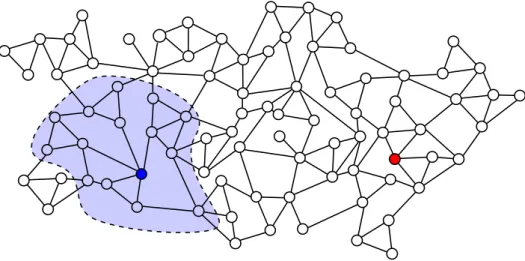
Locality. The natural model of distributed algorithms on graphs uses messages, that the nodes can send and receive in rounds. We use a more abstract model with the nodes having a partial view of the graph. These are equivalent, as we show in the later Subsection 1.1.6. We consider that every node can see the subgraph induced by the nodes at some distance t from itself, and has to output a relevant value, only based on this knowledge. That is, every node has a partial view of the graph, and its output is independent of the parts of graph that are outside this view. See Figure 1.1. An algorithm in this model may be called a local algorithm. The smaller the radius of the view, the more local the algorithm. The constraint of not being able to communicate with nodes that are far away can be called the locality constraint, and the theory that focus on this constraint is usually refered to as the study of locality.
Figure 1.1: In a local algorithm, every node has a local view. For example the dark blue node can see only the node in the light blue area. In particular it has no knowledge about the red node: the output of the blue node on this graph, or on the graph where we have changed the red node in some way, should be the same.
A typical question about locality is: can every node output a colour such that the colouring has some global property, if we impose that every node can only see at a bounded distance? Typical research in the field consists in designing local algorithms for computing such a colouring with the smallest possible views. Remark that the graph is both the input (it is this one graph that we want to colour) and the structure that defines the neighbourhoods of the nodes. The approach we take here is a bit different from this colouring question, in the sense that we do not seek to construct
a solution to a problem. Instead we want to check whether the current solution is correct. That is, we consider decision problems and not construction problems.
From construction to decision. In centralized computing, decision problems are the foundation of the theory of complexity. The current decade has seen efforts to define a theory of complexity for distributed computing, based on a distributed version of decision problems. In a problem of distributed decision, the input is the communication graph, with some additional labels on the nodes and edges, and the machines have to collaborate for deciding whether this input corresponds to a proper configuration with respect to a fixed predicate. For example, in a setting where every node is given a colour, we want to check that no edge has the same colour on both endpoints. The way the nodes take a global decision will be specified later, but it is based on a local process: every node will just have access to a small view of the graph.
Motivations for a new field. Motivations for the study of distributed decision range from practical to theoretical. On the practical side, deciding whether a config-uration of the network is in a proper state is a natural primitive when the network is subject to faults. Focusing on this kind of problems is useful as a building block for more complex systems (concrete examples will come later in this section). On a more theoretical point of view, distributed decision gives insights about distributed construction (we will see an example in the paragraph about probabilistic decision). Nonetheless the links between construction and decision are not as tight as in cent-ralized computing, which is why distributed decision is a field in itself. Another motivation comes from the division we have mentioned earlier, between asynchrony and locality in distributed computing. It is unfortunate that the two aspects are so rarely tackled together. A concrete reason why this happens is that the algorithmic problems studied in these two subfields are of very different nature. For example, locality-oriented research would typically focus on combinatorial optimization prob-lems, while the asynchrony-oriented research will typically focus on reaching some form of consensus between the processes. An expectation of distributed decision is that checking whether some configuration satisfies some predicate is general enough to fit in both frameworks. This thesis will only deal with the locality perspective, but we give in Subsection 1.1.6 a few pointers to papers aiming at bridging the gap.
How to decide when there are several machines. Decision in centralized com-puting is easy to define: there is one input to consider, and one decision to make, accept or reject. In distributed computing, there are several machines, thus different partial views of the input, and different outputs. Every node will output a local de-cision and those local dede-cisions will be aggregated to define a global dede-cision. For the aggregation of the decisions, a natural choice is to accept a configuration if, and only if, all the nodes locally accept, and this is the choice for this thesis. Other aggregation mechanisms have been studied, but the literature mostly focuses on this one, because of its simplicity and its practical relevance. Indeed, in a practical scenario, every node
is checking regularly its neighbourhood, and that if something looks wrong, then it raises an alarm or launch a recovery procedure that resets the whole network.
Languages and examples. So far, we have informally described decision as the task of determining whether the graph is in a correct state with respect to some predicate. Usually, in distributed decision, one considers languages, just like in cent-ralized computing. A language is a set of configurations, that is a set of graphs whose nodes (and more rarely edges) can be labelled. The labels can be called inputs. The instances in the language may be called yes-instances and the others no-instances. Examples of languages are: the graphs that can be properly coloured with some given number of colours (this language has empty input labels), graphs that are properly coloured (the inputs are colours), graphs that are trees, etc.
Identifiers. We will always assume that the nodes have distinct identifiers (or ID for short), that is, every node is given a number, and these numbers are different. This will be detailed and justified later. An important point is that a language should not refer to the identifiers, for example a set of graphs where the node with identifier 1 has some special property, is not a language.
1.1.2
Basic decision and its limits
Basic decision mechanism. The basic decision mechanism for a given language is deterministic. Every node gathers its neighbourhood at some distance, and then decides to accept or reject based on this view. More precisely, for a given language, a basic scheme consists in a local algorithm, that first gathers the neighbourhood at some fixed constant distance t (that is, it gets a snapshot containing the structure of the graph, the identifiers, and the inputs of the nodes within this radius t), and then decides to output accept or reject. This algorithm is the same at every node. See Figure 1.2 for a concrete example.
Limits: acyclicity. Now one can try to define a local algorithm for checking that the communication graph is a tree, that is, checking the acyclicity of the underlying graph. This is actually impossible, that is, there is no such algorithm. The high-level reason for this is that, locally, one cannot distinguish between a cycle and a path. See Figure 1.3 for an illustrated proof of this result. The type of reasoning used in the proof is common in distributed computing, and is called the indistinguishability technique.
The main way to cope with this limitation of the basic schemes is to consider non-determinism, which we will describe soon. But let us do a small detour to take a look at the probabilistic side.
1.1.3
Probabilistic decision
Allowing some randomness. In the light of the great power of randomness for distributed graph algorithms, one is tempted to ask whether we can decide more
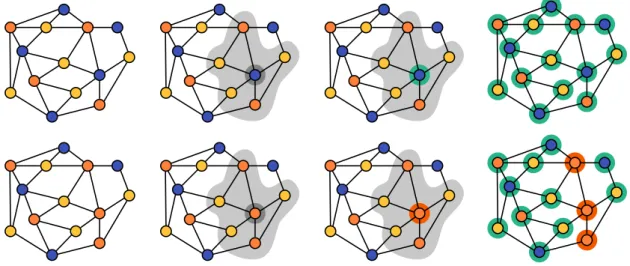
Figure 1.2: The figure illustrates the basic decision scheme for this language of properly coloured graphs (Subsection 1.1.2). The local algorithm of this scheme is simple: every node gets a view at distance 1, and rejects if and only if one of its neighbours has the same colour as its own. The first raw describes the behaviour of the algorithm on a yes-instance (that is on a graph that is properly coloured). For this instance, the node that is highlighted is blue, and its neighbours are either yellow or orange, thus it accepts. Actually no node has a neighbour with the same colour, thus every node accepts, and the instance is (globally) accepted. The second raw illustrates the behaviour of the local algorithm on a no-instance. Here the highlighted node has colour orange and has two orange neighbours, thus it reject. This automatically lead to the (global) rejection of the configuration.
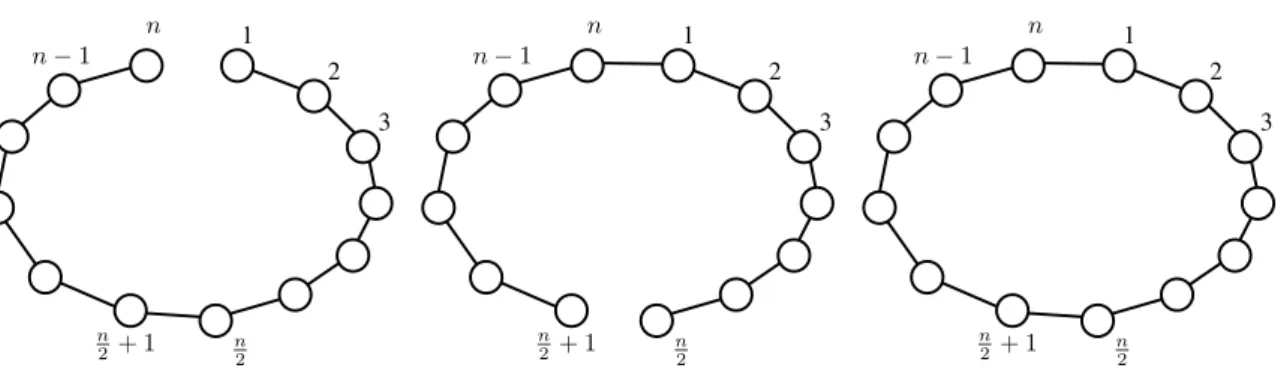
1 2 3 n 2 n 2+ 1 n− 1 n 1 2 3 n 2 n 2+ 1 n− 1 n 1 2 3 n 2 n 2+ 1 n− 1 n
Figure 1.3: This figure illustrates the fact that some languages cannot be decided by a basic decision scheme (Subsection 1.1.2). The language studied is the set of trees. Consider the two paths on n vertices of the two first pictures. They only differ by their identifier assignments. The first path has identifiers from 1 to n in increasing order. The second one has identifiers from n/2 + 1 (suppose n is even) up to n, and then from 1 to n/2. Both are yes-instances (because paths are trees). Thus if there exists a correct local algorithm to decide the language, then it should accept on all nodes, in both instances. Now consider a cycle where the identifiers go from 1 to n and then loop, as in the third picture. This is a no-instance, thus the local algorithm should reject on at least one node. Consider some node where it rejects, and the view of this node. By construction this view also appears in one of the two paths we mentioned before. This means that with exactly the same view, the local algorithm is accepting in the path and rejecting in the cycle. This is impossible because the algorithm is deterministic and cannot distinguish between the two instances. Thus a basic decision is not enough for this language.
languages if we allow the local algorithm to use random bits. In a similar way as in centralized computing (or, more precisely, as in the complexity class BPP), a scheme will be considered correct if, on yes-instances, there is a good probability of acceptance, and on no-instances, there is a good probability of rejection. By good probability, we mean larger than some fixed constant. With this definition, randomness does help. In particular, it provides the ability to basically count up to a constant, as the following example shows.
At most one node selected. In the language we consider, every node has an input bit stating whether it is selected or not. The labelled graphs in the language are the ones that have at most one selected node. The language is called At most one selected, or Amos for short. Having at most one selected node is a global property, in the sense that two far away nodes cannot detect that they are both selected, thus no basic decision scheme can decide this language. Nevertheless, with randomness, it is decidable, and it does not even require the nodes to have any knowledge of the graph, except their own input. The trick is the following. The algorithm consists simply in stating that every unselected node accepts, and every selected node accepts with some probability p. If there are no selected node then the probability that every node accepts is 1. If there is just one selected node, then it is p. If two or more nodes are selected, the probability that all nodes accept is at most p2. This scheme is correct if we consider the following decision thresholds. If an instance is in the language, we require that the nodes accept with probability at least p. If an instance is not in the language, we require that the nodes reject with probability at least 1− p2. (Note that this makes sense only for p inside some interval.)
Impact on construction tasks. The study of probabilistic decision has led to an improvement in the understanding of construction algorithms that is worth stressing here, as such new light is also a motivation for the field. It has long been known that randomness does not help for construction tasks if: (1) the solutions form a language that can been checked locally (that is, checked with a basic decision mechanism) (2) we consider only constant-time construction. This result has been extended to more problems, by proving that the first condition can be lifted from languages decided with basic decision, to languages decided with probabilistic decision.
1.1.4
Non-determinism
The core topic of this thesis is non-determinism in distributed decision. Let us first recall the form of non-determinism in centralized computing.
Non-determinism in centralized computing. We will do an analogy between our model and the well-known complexity class NP. The class NP was originally defined with non-deterministic Turing machines, but the modern definition is often more handy. A decision scheme for NP is based on two entities: the machine, called the verifier, and an external oracle, called the prover. It follows the following sequence of steps. First, given the instance, the prover provides a certificate of polynomial size
to the verifier. Second, the verifier runs a polynomial-time algorithm that takes as input both the instance and the certificate. Third, the verifier outputs a decision, accept or reject. Such a scheme is correct if the following condition holds for every instance: the instance is in the language, if and only if, there exists a certificate such that the verifier accepts. This can be pictured in a less formal way as: an omniscient prover trying to make the limited verifier accept, regardless of whether or not the instance belongs to the language. The verifier has to distinguish between the cases in which the prover is honest, and the cases where it is dishonest.
Proof-labelling schemes. The classic form of non-determinism in distributed de-cision is called a proof-labelling scheme.1 In such a scheme, there is a prover and every node acts as a verifier. The prover provides a local certificate, also called proof, to each vertex. In general, these certificates are all different. In this new framework, the view that a node gathers, includes the certificates of the nodes within the view; in addition to the structure of the graph, the identifiers and inputs, as in a basic scheme. The local decisions are aggregated as before. The acceptance rule is similar to the one of NP, that is, for every instance: the configuration is in the language if and only if there exists an assignment of certificates that makes every node accept. The usual way to describe a scheme is to describe the way the prover crafts certificates on yes-instances, and then to explain how the nodes can distinguish between certificates of good instances, and certificates designed to mimic those on bad instances.
A concrete example: acyclicity. Let us go back to the example we used to highlight the limitations of basic deterministic decision in Figure 1.3, the set of trees. We describe a proof-labelling scheme for this language. The strategy for the prover on a yes-instance (that is on a tree) is to pick an arbitrary node, the leader, and to give to every node, as a certificate, its distance to the leader. The local verifier algorithm used by the nodes is the following. The node considers the distance d written on its certificate, and accepts if and only if, either (1) d = 0 and all the neighbours have distance 1, or (2) it has exactly one neighbour with distance d− 1 and the other neighbours have distance d + 1. It is easy to be convinced that on yes-instances, the verifier algorithm outputs accept on every node. It then requires a proof to be convinced that, if there exists a cycle in the graph, then there is always one node to catch an inconsistency, regardless of the certificate assignment the prover has designed. A sketchy proof of this fact is the following. Consider a cycle in the graph, and consider the certificates assigned by the prover for the nodes of this cycle. The verifier understand these certificates as numbers. Consider the node that is assigned the largest number in the cycle. This node has two neighbours with equal or smaller numbers. This matches none of two cases we have described above. Thus this node rejects, and the configuration is globally rejected. See Figure 1.4, for a similar scheme designed for a different, but similar, language: acyclicity of a selected subgraph.
1In this paragraph, we give a general definition of proof-labelling schemes, see the Historical notes
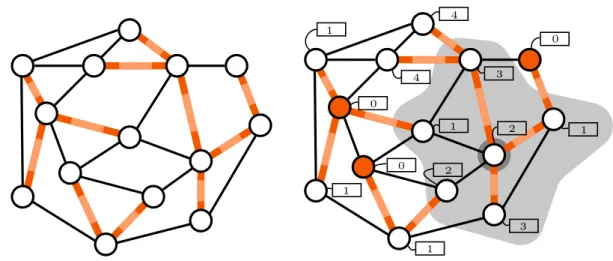
4 1 0 4 3 1 0 1 2 0 1 2 1 3
Figure 1.4: In the text, we have used the set of trees to illustrate the notion of proof-labelling scheme. It is more common to consider properties of a proof-labelling of the graph, instead of properties of the graph itself. Here, this translates into having an edge labelling describing a set of selected edges, and deciding whether the subgraph defined by these edges is acyclic. The picture on the left, where the selected edges are coloured in orange, is an example of yes-instance for this language. The picture on the right illustrates the certificate assignment given by the prover, and the view of a particular node. The strategy for the prover on yes-instances consists in first choosing a leader in each tree. This choice is represented by the orange nodes in the picture on the right. Then the prover provides every node with its distance to the leader of its tree. The verifier simply checks that the distances are consistent along the selected edges, just as in the scheme for trees. For example, here, the highlighted node has label 2, which is consistent with the numbers given to its neighbours in the subgraph: one of them has distance 1, and the others have distance 3.
Link with self-stabilizing algorithms. Proof-labelling schemes can be described as local non-determinism inside distributed decision, but this notion was introduced before the field of distributed decision was formally created. They were considered first as a way to study some specific parts of so-called self-stabilizing algorithms. Basically, a (construction) algorithm is self-stabilizing if, starting from an arbitrary state of the network, it can reach a proper configuration (with respect to a given language). At any time, such an algorithm has to check that the configuration is correct, and if it is not the case, then it has to fix it. For example, consider an algorithm whose role is to select an acyclic subset of edges (as in Figure 1.4). Suppose it has done so, but then some register is corrupted, a new edge is selected, and the addition of this edge creates a cycle. The algorithm has to detect that the configuration has changed, and that it is not correct any more, and has to reach a new acyclic configuration quickly. An essential step in this scenario is to detect that something is wrong, and this is of course where decision appears. For acyclic subgraph, for example, we know from Figure 1.3 that we cannot decide the correctness locally. A strategy to cope with this is to write some information at the nodes during the computation. That is, not only does the algorithm build an acyclic labelling, but it also mark the distances at the nodes. This way, if the graph is modified in a way that does not match the information available at the nodes, then the nodes can detect it, and launch a recovery procedure.
Considering proof-labelling schemes is a way to focus on the fault detection phase. In this framework, the additional information left at the nodes is abstracted as an external prover.
Proof sizes and measure of the locality. An essential aspect of a proof-labelling scheme is the size of the certificates used, that we call the proof size. The first reason for this importance is practical: small certificates are better, because in applications they use less resources. The second reason is more theoretical. If we consider only the (deterministic) basic decision mechanisms, then we can easily define a dichotomy between local and global languages. A local language would be a language for which there exists such a mechanism (as the language of properly coloured graphs in Fig. 1.2) and a global language would be a language such that no such mechanism exists (such as the set of trees in Fig. 1.3). The study of proof sizes allows a more fine-grain analysis. Remember that the certificates are assigned by an oracle that has full knowledge of the graph, thus they are, in some sense, pieces of global information given to the nodes. From this perspective, the larger the certificates need to be, the more global information we have to give to the nodes to decide, and thus the more global the language. The optimal size of the proofs for a language is then a measure (or, more rigorously, an inverse measure) of its locality. Note that this definition extends the first rough definition of local/global we had: languages that can be decided with a basic decision mechanism have in some sense proof size zero, and languages that cannot be decided this way, need non-zero proof size.
1.1.5
Historical notes
This subsection is a personal and partial historical view of the field. Reader not interested in history or citations may skip this part. This text is not meant to be exhaustive, see the survey for the citations of all the works of the domain.
Study of locality and locally checkable labellings. The model of network distributed computing dates back to the 1990s with the papers of Linial [87], and Naor and Stockmeyer [89]. A fundamental book on the topic, by Peleg, appeared in 2000 [95]. In their paper, Naor and Stockmeyer define a class of (construction) problems called locally checkable labelling, LCL for short. For these problems, the nodes may have inputs, and they have to compute outputs. A problem is in LCL if there exists an algorithm that, given a view at some constant distance, with the in-puts and outin-puts, can decide whether the solution computed is correct. Also for LCL problems, inputs, outputs and the degrees of the graphs are assumed to be constant. This class includes many classic problems such as computing colourings, independent sets, matchings etc. Note that the definition of LCL implies that the correctly labelled instances form a language that can be decided via a basic decision mechanism.
Proof-labelling schemes. Proof-labelling schemes were introduced by Korman, Kutten and Peleg, in 2005 (see [81] for the conference version, and [82] for the 2010 journal version). The definition of a proof-labelling scheme in this original paper is a bit different from the one we gave in Subsection 1.1.4. The authors of [81, 82] consider that the nodes are exchanging messages instead of having a view, but more importantly, that the only communication a node can perform is to send its certificates to its neighbours.
Locally checkable proofs. To sum up, in the original definition of proof-labelling schemes, a node only knows the following: its degree, input, and identifier, and its certificate and the ones of all its neighbours (meaning the nodes it is adjacent to). In [66, 67], Göös and Suomela, used the terms Locally checkable proofs, to describe proof-labelling schemes, in the general form we have described before. This implies allowing arbitrary constant radius for the view, and accessing all the inputs, IDs and certificates within this view. In later works, the term “proof-labelling schemes” refers to the original model, or to locally checkable proofs. The two cases are pretty different when it comes to lower bounds, as in the second definition (that is the one used in this thesis) the nodes have more information about the graph, which implies that it is harder for the prover to fool them.
Distributed decision as a subfield of distributed computing. In 2012-2013, Fraigniaud, Korman and Peleg argue in favour of a complexity theory for distributed decision [54]. This was followed by a handful of papers studying randomization in this context, or on the impact of the model of identifiers. Lately several groups have studied various aspects of proof-labelling schemes. Let us cite some relevant recent works, excluding the ones directly related to this thesis, that will be mentioned
later. In [24], Censor-Hillel, Paz and Perry study the interplay between approximation and non-determinism. In [14] and [94], Fraigniaud, Perry and Patt-Shamir focus on message communication during the verification (with the original definition of proof-labelling scheme). The first paper deals with randomization, while the second deals with the type of communication at hand (broadcast versus unicast). Finally, proof-labelling schemes can be seen as certification mechanism, and Fraigniaud and Balliu [9] use them to certify routing tables.
1.1.6
Complements
In this subsection we answer (or give pointers that answer) some natural questions, that the previous sections may have raised. In particular this subsection provides some indications about topics that are at the boundary of the current work. These complements are not essential for the rest of the text, therefore they may also be skipped.
On representing networks by graphs. We have modelled networks as graphs, and this will be the setting for the whole thesis. Readers may consider that this mod-elling is too rough. A more realistic model for wireless communication, for example, is the SINR model, that takes into account interference. Even such models are reas-onably well approximated by simple graphs [71], thus it is reasonable to begin with graphs. Nevertheless distributed decision in more realistic models is an interesting avenue of research.
From messages to views. In the Locality paragraph of Subsection 1.1.1, we have mentioned the fact that our quite high-level model with views (let us call it the view model ) is equivalent to the more realistic message-passing model. Let us first specify which message-passing model we consider, and then sketch the equivalence. In the message-passing model, computation proceeds in rounds. In the context of distributed decision, the number of rounds is usually constant. At each round every node can receive messages from its neighbours in the graph, compute new messages, and send them to its neighbours. The size of the messages is not bounded. We now sketch the proof of the equivalence between the two models, without mentioning the possible inputs, for simplicity. Let us first show that the message-passing model is at least as strong as the view model. At each round, every node can send, to all its neighbours, all the information about the graph it has. At the very beginning of the process, a node knows only its degree and its ID. It can send them to its neighbours. Then it receives the analogue messages from its neighbours, and is able to reconstruct the view at distance 1. The next step is to send this view at distance 1 to all its neighbours, and to receive their views at distance 1. 2 By merging these views, every node can reconstruct its own view at distance 2, etc. Thus, with basically t rounds every node can reconstruct its view at distance t. Now in the other direction, suppose a node has
2Note that at this step, if there is no bound on the degree, the messages used can be polynomially
large in n. Thus this transformation does not work in the so-called congest model, where the messages must have logarithmic size.
a view at some distance t. It can compute the first messages sent by the nodes in its (t− 1)-neighbourhood, because it knows their IDs and degrees. Then, the node can compute which messages are received by the nodes in its (t− 2)-neighbourhood. And so on and so forth, until it simulates (only) its own behaviour for the t-th round.
Relation between decision and construction. We have evoked the fact that decision and construction are not as closely related in distributed computing as in centralized computing. Let us consider colouring to exemplify this claim. In cent-ralized computing, if one has access to an oracle deciding if some partial 3-colouring can be completed to a correct 3-colouring, then it is easy to build a construction algorithm of similar complexity. Indeed one can follow the following trial-and-error strategy. First ask whether the graph can be 3-coloured, if not, stop. Otherwise, select a node arbitrarily, give it an arbitrary colour, and ask whether this colouring can be completed. If the answer is positive, one can continue with a second vertex, otherwise one can try another colour, and ask again for approval etc. If it does not stop after the first step, this procedure produces a proper 3-colouring, and the running time is only multiplied by a linear factor. In distributed computing, it is not that simple. The main reason is that the process described above is inherently sequential, and does not correspond to the distributed setting. For example, for colouring, all the nodes have to choose their colours at the same time. Thus the fact that verifying a colouring is easy in distributed manner, does not give much information on the difficulty of computing a colouring.
Dealing with asynchrony. As said, distributed decision was partly justified as a path to gather together asynchrony and locality in distributed computing. We refer to results in that direction, or more precisely results about wait-free distributed decision, in Subsection 7.6.1 in the survey.
Other decision mechanisms. The decision mechanism studied in this thesis (ac-cept globally, if and only if, every node ac(ac-cepts locally), is justified by practical scen-arios, but from a theoretical perspective it relevant to investigate other mechanisms. For example, one can allow more bits of output, or different ways to gather the out-puts into one decision. This has been investigated in [4] and [5]. See Subsection 7.3.3 in the survey.
Alarm scenarios. A practical motivation for our decision mechanism is the scenario where the nodes can raise an alarm. A reference about such decentralized monitoring is [16].
Indistinguishability technique. A proof technique that is essential in distributed computing, and in particular in this thesis, is the indistinguishability technique. In a distributed environment, the machines often have a partial knowledge of the current state of the system. Thus there may be several global configurations that, from the point of view of a specific machine, are exactly the same; then the behaviour of
this machine must be the same in all these configurations. The indistinguishability technique consists in using this simple fact to show lower bounds. A usual reasoning is: if some quantity is not large enough, then there exists two instances that cannot be distinguished, although the task to solve requires the algorithm to have two different output, thus this quantity must be large. A reference on this technique (among others) is [43].
Randomness and difficulty of boosting. We have described probabilistic de-cision in Subsection 1.1.3. The paper that introduced the concept is [54]. In this paper, the schemes require some precise threshold for the decision, which is intriguing because in centralized computing these numbers are usually unimportant, as they can be boosted to obtain any (meaningful) number. The question of whether boosting is possible in the distributed setting was answered negatively in [56].
The result about derandomization mentioned in Subsection 1.1.3 is the main the-orem of [35], and is an improvement over a result of [89].
Not only can randomness enable to decide more languages, but also it helps to decrease the message size, when considering the message-passing model. In [14] the authors show that one can gain an exponential factor in the size of the messages, by using some hashing techniques.
Role of the identifiers. So far, we have not used the identifiers a lot, but those are important. In the first place, identifiers are essential for the transformation from the message-passing model to the view model. Indeed without identifiers, it is impossible to reconstruct the view of a node, as we do not know if two nodes that appear in two different messages are different or not. Later in the text, identifiers will also be very useful to design schemes for some languages. For example, the prover may give the ID of a leader to all the nodes. Actually, there exists a parallel line of research that considers proofs that do not use IDs, that is, proofs that are correct whatever the ID-assignment is. In both our framework and this other framework, the languages studied do not depend on the identifiers.
The polynomial bound on the identifiers is a classic assumption in network dis-tributed computing. On the one hand, it is small enough to allow to encode the identifiers on a logarithmic number of bits. On the other hand it is large enough to ensure that the numbers are distinct, and having identities between 1 and n would be too strong in some applications, and would allow the algorithm to abuse the power these identifiers.
The impact of the precise model of identifiers on decision can be a pretty subtle issue, as shown for example in [59]. See Subsection 7.4.1 in the survey.
Message size. In the papers that consider the message-passing models, the size of the messages is a key parameter. One can for example study the interplay between message and proof sizes. See Subsection 7.3.2 in the survey, for the basic and probabil-istic decision in presence of congestion, and Subsection 7.4.2 for the non-determinprobabil-istic analogue.
Weaker computational power. We have not mentioned any restriction on the computational power of the nodes of the network, and we actually do not bound it in general. This is because our focus is on the proof sizes, and on the locality of the verification. One result of the thesis needs the assumption that the language is com-putable (in a centralized manner), but in general we do not even need this assumption. Much more restricted models have been studied, where the nodes basically compute with finite automata. In this framework, a fruitful approach to use modal logic to characterize the languages that can be recognized. See for example the thesis [98], and the references therein.
Advice versus certificate. A concept close to local certificates is the notion of advice. An advice also comes as an assignment of labels to the nodes, given by an oracle, but this oracle can be trusted. That is, the information just helps for the computation, and does not need to be verified. This concept has been introduced to measure how much global information is needed to complete some task. See for example [50].
Differences with the self-stabilizing approach We have mentioned that proof-labelling schemes have been defined in the first place to study the fault detection phase of self-stabilizing algorithms, and that these two concepts share the same flavour. Yet, there are some aspects on which these models differ. On the one hand, in a self-stabilizing algorithm, the additional information required to check the correctness must be efficiently computable. This is not the case in proof-labelling schemes where the certificates are given by an external prover. On the other hand, a proof-labelling scheme is required to work for every configuration of the language, which may not be necessary for self-stabilizing algorithms. Let us illustrate this statement on the language of acyclic subgraphs. In a proof-labelling scheme, any acyclic subgraph must be properly decided. Whereas a self-stabilizing algorithm may always choose to output some constrained form of acyclic subgraph. This may make the certification easier for the algorithms, as it does not have to detect errors in arbitrary configurations.
Use in (centralized) parameterized complexity. The concept of local proofs is natural enough to ask whether it can be of any use in a centralized setting. It is actually useful in parameterized complexity. More precisely, a simple argument allows to transform automatically the existence of local proofs (of some type) into algorithms that are polynomial in the size of the graph, and single exponential in the treewidth. This mechanism works for example in the case of maximum independent set and vertex cover. The lower bounds established on local proofs can rule out the possibility of using this tool, which can in turn justify the use of other techniques [19].
Complexity theory for construction tasks. One of the original motivations for distributed decision was to have a complexity theory similar to the one of centralized computing. Indeed until 2010, network distributed computing was mainly about pushing further and further the bounds on particular problems (maximal matching,
colouring, spanning tree constructions etc.), and not on putting these problems into neat classes. While distributed decision was growing, research has also been done to classify the problems of constructing LCL languages (as described in Subsection 1.1.5). For example, it has long been known that a whole body of problems (such as (∆ + 1)-colouring and maximal independent set), can be solved in time O(log∗n), whereas for some other problems the best known algorithms had complexities in Ω(log n). It was unknown whether there exist problems in between. In [25], it is proved that there is a gap between the two types of problems, thus defining classes of complexity for LCL. See [11] for a recent paper on this line of research.
1.2
Proof-labelling schemes toolbox
This section is a toolbox of techniques and results used in the investigation of proof-labelling schemes. It takes the form of questions and answers, with proof sketches. These techniques will be used in the thesis, either as building blocks for new proofs, or as benchmarks, to which we can compare our techniques.
What are the languages that admit a proof-labelling scheme? All distrib-uted languages do. The technique to prove this statement is now classic, and was first evoked in [81]. Basically, there exists a universal scheme that works for every lan-guage. On yes-instances the prover provides the whole adjacency matrix of the graph, with the correspondence between the raws and the identifiers of the nodes, and also the input assignment. The nodes first check that they are given the same certificate. Then they check that this description of the graph is consistent with their local views. It is easy to show that if this step succeeds, then the configuration described in the certificates is indeed the actual configuration. Finally all the nodes check in parallel and without communication, that the configuration is in the language. This scheme uses certificates of size θ(n2) (plus a possible term for the inputs).
Can we do better? Yes, for many languages we can have smaller proofs. For example the scheme for acyclicity sketched in Subsection 1.1.4 uses certificates of size O(log n). One of challenges of distributed decision is to show upper and lower bounds on the proof sizes for diverse languages.
What about spanning trees? The language of trees, we have studied first is not very common in distributed computing, as it deals with the communication graph itself, and not with a labelling. We have then used the example of acyclic subgraphs, like in Figure 1.4. An even more important language is the language of spanning trees. We want to decide whether a subset of selected edges form a spanning tree of the communication graph. The classic scheme for this language tackles acyclicity with distances, as in the scheme of Figure 1.4, but, to ensure the connectivity, every node is also given the ID of the root, called root-ID. In addition to the verification of the distances, the verifier checks that it is given the same root-ID as its neighbours. Also if a node has distances zero, then it checks that its ID is equal the root-ID. To prove the correctness of this scheme, we just have to prove the connectivity of the subgraph of selected edges, as the acyclicity is guaranteed by the distances. Consider an instance with several trees. Then, in case the prover does not give the same root-ID to every nodes, two adjacent nodes are given different root-ID, and reject. Otherwise, every node is given the same root-ID, but then, there is one node that is given distance 0, but whose ID is not the root-ID, and this node rejects. Thus the scheme is correct. Note that as the identifiers are supposed to be bounded by a polynomial in n, the size of the certificate is in O(log n)), like for acyclic subgraphs.
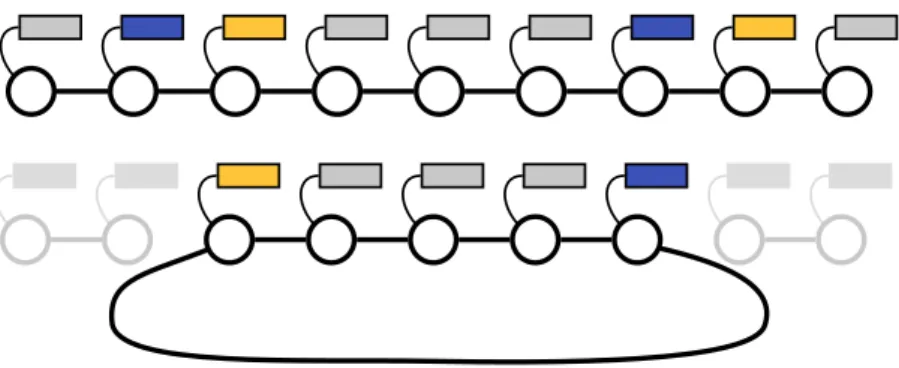
Is Θ(log n) optimal for spanning trees? Yes it is. This has first been proved for the original definition of proof-labelling scheme in [81], with a technique called
Figure 1.5: This figure illustrates the crossing technique, for the language of trees. It extends to spanning trees. The main point is that if o(log n) bits certificates are used, then there exist two edges, (a, b) and (c, d), such that a and c (respectively b and d) are assigned the same certificate (by the pigeon-hole principle). On the top picture, we illustrate this with blue and yellow certificates (the other certificates are all in grey, but they are not equal in general, they are arbitrary). Then we cross the edges: we remove, (a, b) and (c, d), add (b, c). We get a cycle, and some disconnected parts that can be discarded. The point is, if the prover provides the same certificates as in the first instance, the nodes receive exactly the same messages (remember that we consider the original definition of proof-labelling scheme). Then the nodes cannot distinguish the top and the bottom picture, although one is a yes-instance and the other is a no-instance.
edge-crossing. Then it has been proved for the more general definition in [67], with a technique called gluing. The crossing technique basically consists in proving that it is possible to take two edges and cross them without the nodes noticing. We give more details in Figure 1.5. This technique does not apply to our framework, but it is an opportunity to provide a simple application of the indistinguishability technique, in a non-deterministic setting.
The reason why this technique does not work for the general definition of proof-labelling schemes used in this thesis, is that if the nodes do have the knowledge of the IDs of their neighbours, then any change in the topology, such as crossing some edges, is detected. To deal with the more general framework, a more involved technique based on gluing different instances has been developed. We describe it now. For simplicity, we consider languages that are dealing with inputs, and not with the communication graph itself. We sketch the proof without any specific problem in mind, but one can think about spanning trees for example.
The high-level idea is to consider a large family of yes-instances, and their ac-cepting certificates, and to show that if the certificates are not large enough, there exists a no-instance for which we can craft an accepting certificate assignment. More precisely, each yes-instance we consider is formed of two long paths, linked together by the endpoints to create a cycle. As this is a yes-instance, there exists a certificate assignment that makes the nodes of the cycle accept. Now consider a new instance formed by taking two paths from two different yes-instances and connecting them into a cycle. This may be no-instance. If the prover provides to the nodes of each path, the same certificates as in the original yes-instance it comes from, then only the nodes
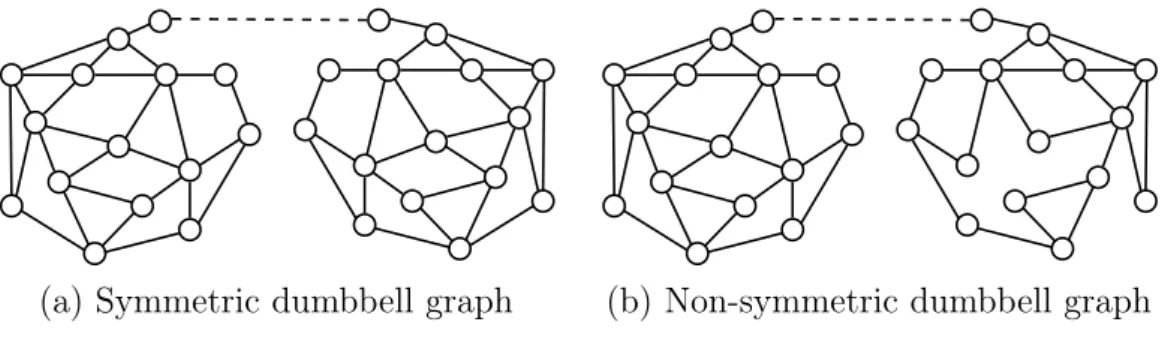
(a) Symmetric dumbbell graph (b) Non-symmetric dumbbell graph
Figure 1.6: Consider a special class of graphs that we call dumbbell graphs. These are graphs formed by (1) taking two graphs, that we call primary graphs, that have the same number of nodes, and that are both are non-symmetric, and (2) linking them by a path that is at least twice as large as the verification radius. Basically, in such graphs, if a non-trivial automorphism exists, then it must exchange the two primary graphs (that is the permutation must map one to the other). This can happen only if the two primary graphs are isomorphic. On the picture above, the graph on the left has a non-trivial automorphism, whereas the graph on the right does not have one. Now the high-level idea, is that, in order to check if the two graphs are isomorphic, one needs to gather all the information about both primary graphs at one node. But there is no node that can see both primary graphs, because the path is too long. Thus the information has to be conveyed by the certificates. As the primary graphs have roughly n/2 nodes, describing one of them takes Ω(n2) bits. This implies a
lower bound on the size of the certificates. This intuitive reasoning about communicating information is made rigorous via a counting argument. See [67] for the details.
at the border (that is the nodes close to the endpoints of the paths) can detect the difference. Then in such instances, the main challenge for the prover is to convince the border nodes that the connection is legal. One can prove that if the certificate size is not at least Ω(log n), then paths from several yes-instances, equipped with the certificates inherited from these yes-instances, can be connected such that: (1) the resulting graph is a no-instance; (2) every connection is accepted by the nodes. This results in a no-instance being accepted by all nodes. This is a contradiction, and the lower bound follows. See [67] for the details and illustrations.
Are there languages that require the quadratic proof size? Yes, there are. The classic examples are the ones based on isomorphism-flavoured questions. The language of symmetric graphs consists in the set of graphs that have a non-trivial automorphism. That is, a graph is in the language if there exists a permutation of the identifiers, different from the identity permutation, that preserves the adjacency relation. For this language, we are basically required to describe the whole graph in the certificates of all nodes. The proof of this statement is in [67]. We sketch it in Figure 1.6.
Another example of language that requires (almost) quadratic certificates is the set of graphs that cannot be properly coloured with three colours. The proof is more involved, and explicitly uses communication complexity and intricate colouring gadgets (see [67]).
Any language with Θ(1) proofs? Yes, the main examples are colourings. After quadratic size, we look at the other end of the spectrum of proof sizes. There are languages with empty proofs: the ones that are decidable with the basic decision mechanism. Just above basic decision, there are problems that have optimal proofs of size Θ(1). An example is the set of bipartite graphs: the prover just has to provide a 2-colouring, and the nodes can check that their neighbours have a colour that is different from their own. More generally deciding if a graph can be coloured with some number k of colours falls into this category.
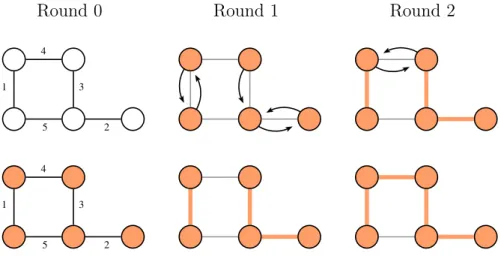
What about minimum spanning trees? Minimum spanning trees are funda-mental objects in networks and in distributed computing. We consider the minimum spanning tree language, that is the set of graphs whose edges are weighted, and some of them selected, such that the selected edges form a minimum spanning tree of the communication graph, with respect to the input weights. The optimal proof size for this language Θ(log2n). This result, especially the lower bound, requires advanced proof techniques [79]. We sketch the upper bound. For simplicity, we assume that all the weights are distinct, which implies that there is a unique minimum spanning tree. The scheme for this language is based on the GHS algorithm [63], which is itself based on Borůvka algorithm. Let us recall the principles of Borůvka algorithm, and see Figure 1.7 for the run of this algorithm on a small instance. It proceeds in rounds, adding edges to a set of selected edges, until this set is a minimum spanning tree. At the beginning no edge is selected. Then, in parallel, every node chooses the lightest edge it is adjacent to, and all the chosen edges are added to the set. These form a subgraph of the network, and the connected components of this subgraph are called fragments. At the next round, every fragment chooses an outgoing edge (that is an edge with exactly one endpoint in the fragment) of minimum weight. These newly chosen edges are added to the set, and consequently some fragments are merged. New rounds are played until there is only one fragment. This fragment is the minimum spanning tree. There are at most O(log n) rounds.
We now sketch the scheme based on this algorithm. The certificates describe locally the run of the algorithm. There is a field of O(log n) bits for each of the O(log n) rounds. Each field, basically contains (1) the identifier of a so-called leader of the fragment (to identify the fragment), (2) a tree of selected edges pointing to this leader (to ensure its connectivity, and the existence of the leader) (3) the weight of the lightest outgoing edge chosen for the next round, with the identifiers of its endpoints (to allow the verification of the minimality), along with (4) a spanning tree pointing to the edge (to ensure its existence). These four elements can be encoded with O(log n) bits locally. This is because by assumption the identifiers are on O(log n) bits, and the trees, as said above can be verified with O(log n) bits too. As there are O(log n) rounds, these local proofs have size O(log2n).
Is there any natural problem with proof size between Θ(polylogn) and Θ(n2)? Until recently, only artificial languages were known with proof size within this range. In particular, the known techniques were not able to prove such intermediate lower bounds. This is not the case any more, with the introduction in distributed decision
Round 0 Round 1 Round 2 1 2 3 4 5 1 2 3 4 5
Figure 1.7: Illustration of Borůvka algorithm. In the first column, the top picture is the original instance with the weights, and the bottom picture illustrates the original fragments, that is, the nodes. In the second column, we depicted the outgoing edges chosen by the nodes, and the fragments at the end of Round 1. In the third column, we drew the edges chosen by the two fragments, and the final output. This output is the minimum spanning tree.
of tools from communication complexity, with gadgets developed for lower bounds for construction tasks. Specifically, verifying that the diameter of the communication graph is bounded by some integer k is proved to be in Ω(n/k) and O(n log n) in [24].
Do a language and its complement have the same proof size? As a language is a set (of labelled graphs), one can ask whether deciding the complement of this set is as hard as deciding the original language. In terms of proof-labelling scheme, this means establishing whether they have the same optimal proof size. In the centralized setting, for deterministic computation, complement languages have the same com-plexity. However for non-deterministic (centralized) computation it is (a priori) not the same.3 In distributed decision, the deterministic setting is already non trivial. For example, consider the language where the nodes of the graph are given colours, and we want to decide whether this colouring is a proper colouring. This can be done with a basic decision scheme. But what about accepting only bad colourings? We cannot just make every node flip its decision. Indeed, consider a colouring with a single monochromatic edge. In the scheme for proper colourings, every node accepts, except the ones close to the monochromatic edge. After flipping, every node rejects except the two endpoints of the monochromatic edge, which means rejecting the in-stance. The question is then: how to reverse decision? In general, this comes at a cost, for example for bad colourings, one can reverse decision with O(log n) proofs (by pointing to the monochromatic edge with a spanning tree).
This difference between a language and its complement also appears when none of them is locally decidable. For example, the language of the graphs that can be
coloured has constant size proofs, but that its complement requires almost quadratic proofs.
1.3
Overview of the thesis
The thesis can be summarized as a study of different alternative definitions of proof-labelling schemes. The goal of this approach is twofold. First, these new models are justified by diverse practical scenarios, that are better captured by a different form of non-determinism. Second, these models enable us to study diverse aspects of dis-tributed non-determinism: error-sensitivity, uniformity, redundancy and the impact of interactivity. The core of the thesis consists in four chapters one for each of these concepts. These are adaptations of four papers, either published or accepted for pub-lication. The only significant change in the structure is Section 6.5, that originally appeared along with the content of Chapter 4. For each of these four chapters, we now give a high-level description of the model, along with sketches of the main results and techniques. Formulas and technicalities are avoided to keep a narrative style ; readers more comfortable with more formal statements can jump right to the technical content.
1.3.1
Error-sensitivity via a stronger rejection (Chapter 3)
Two questions. This work originates from two seemingly unrelated questions. The first one is related to property testing. Property testing (of graphs) is a field of centralized computing that, very roughly speaking, studies whether one can test if a graph has a property or not, by just querying the adjacency of a few nodes. That is, in this scenario, the (centralized) algorithm does not have access to the whole graph, but is probing a database to get enough information about it. A task can be solved in such a restricted model only if we relax the usual algorithmic problems. The definition of graph property testing allows to make a mistake in the decision if the graph is close to have the property (for some notion of close). We note that property testing has a flavour of both locality and decision, thus it is natural to see if we can relate it with distributed decision.4 The second seminal question of this chapter is: can we make more than one node reject a bad instance? Indeed, the definition of proof-labelling scheme only requires that for every certificate assignment at least one node rejects, but in practice, the more nodes rejecting, the faster we can fix the situation. In a nutshell we ask what happens to the results on proof-labelling schemes if we require a stronger rejection?
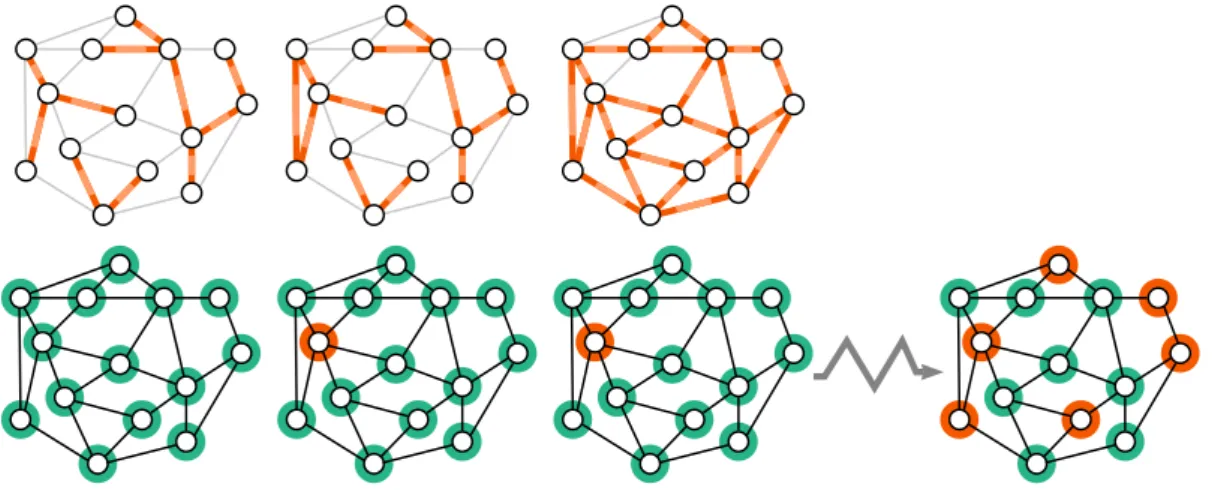
Error-sensitivity. We define a notion of error-sensitivity for proof-labelling schemes. Basically, a scheme is error-sensitive, if the number of rejecting nodes is at least linear in the distance from the instance to the language. We will precise this definition soon, but let us give a motivating example first. We use our running example of verifying acyclicity. Every node is given as input an adjacency list, and we want to check whether these lists define a proper acyclic subgraph or not. Consider three instances
4Relating property testing to distributed graph algorithm has led us to define the model of
Chapter 3, but it has also motivated another field of research, somehow closer to the original property testing, that focuses on congestion and uses randomization. See the seminal papers [21, 23], the papers citing them, and the paragraph on the topic in the survey chapter in Subsection 7.3.2.
(see Figure 1.8): in the first one the subgraph is a proper forest, in the second it has only one cycle, and in the third it is a very dense subgraph.
Figure 1.8: The three instances of the paragraph Error-sensitivity, along with the decisions of the nodes. First column: the top picture represents a yes-instance, thus all the nodes have to accept if given the right certificates (bottom picture). Second column, a no-instance, close to the language, and the nodes decisions on the bottom: at least one node must reject, whatever the certificate assignment is. The third instance is similar to the second, but it is far from the language, thus we can hope to have more than one node rejecting, as pictured on the graph on the far right.
In a proof-labelling scheme, the verifier is required to accept the first instance if provided the right certificates, and to reject on at least one node, for every certificate assignment on the two other instances. In the second instance, a very large portion of the subgraph is acyclic, that is by changing just a little bit the inputs we can get a yes-instance. Then we cannot hope that there exists a scheme where many nodes are rejecting, because of the following prover strategy. The prover first decides which is the accepting certificate assignment of the close yes-instance, and then uses the same assignment on the current instance. Because few nodes can detect the change in the input (because we took a close yes-instance), then few nodes can reject. However, in the third instance there is no very large part that could appear in a proper instance, thus we can hope that with any certificate assignment many node will catch inconsistencies.
A distance on instances. To be more precise we need to define what it means for an instance to be far or close to a language. Let us first precise the type of languages we consider. In this chapter, we only consider languages that deal with node inputs. That is we will not consider properties of the communication graphs, nor properties of edge labellings. This is actually the type of language that makes more sense in practice. Indeed it corresponds to the scenario where a construction algorithm builds some solution to a problem (with every node holding its part of the output), and where we want to check that this solution is correct. Also in this context every graph