HAL Id: hal-01308694
https://hal.archives-ouvertes.fr/hal-01308694
Submitted on 28 Apr 2016
HAL is a multi-disciplinary open access
archive for the deposit and dissemination of
sci-entific research documents, whether they are
pub-lished or not. The documents may come from
teaching and research institutions in France or
abroad, or from public or private research centers.
L’archive ouverte pluridisciplinaire HAL, est
destinée au dépôt et à la diffusion de documents
scientifiques de niveau recherche, publiés ou non,
émanant des établissements d’enseignement et de
recherche français ou étrangers, des laboratoires
publics ou privés.
Shaping future service environments with the cloud and
internet of things : networking challenges and service
evolution
Gyu Myoung Lee, Noel Crespi
To cite this version:
Gyu Myoung Lee, Noel Crespi. Shaping future service environments with the cloud and internet of
things : networking challenges and service evolution. 4th International Symposium On Leveraging
Applications of Formal Methods, Verification and Validation (ISoLA 2010), Oct 2010, Heraclion,
Greece. pp.399-410, �10.1007/978-3-642-16558-0_34�. �hal-01308694�
Shaping Future Service Environments with the Cloud
and Internet of Things: Networking Challenges and
Service Evolution
Gyu Myoung Lee1, and Noel Crespi1
1 Institut Telecom, Telecom SudParis
9 rue Charles Fourier, 91011, Evry Cedex, France {gm.lee, noel.crespi}@it-sudparis.eu
Abstract. To address the new paradigm of future services, cloud computing will be essential for integrating storage and computing functions with the network. As many new types of devices will be connected to networks in the future, it is very important to provide ubiquitous networking capabilities for “connecting to anything” between humans and objects for realize the Internet of Things (IoT). This paper introduces several challenges for the cloud computing in telecom perspectives and ubiquitous networking capabilities to support the IoT. For this, we present the basic concepts and present our vision related to this topic. In addition, we clearly identify characteristics and additional capabilities to support key technologies to be used for the IoT. For various services using ubiquitous networking of IoT, we propose the cloud-based IoT which aims to efficiently support varies services using cloud technology from different kinds of objects (e.g., devices, machines, etc). We also emphasize the necessity of virtualization for service evolution using smart environment of the cloud and the IoT.
Keywords: Cloud computing, Internet of things, ubiquitous networking, future Internet.
1 Introduction
New paradigms for future mobile and ubiquitous environments imply decisions regarding the direction for the evolution of networks as well as investigating technologies that will allow an efficient support of new services by the future Internet. Most of network providers already support basic offers such as simple access to services (e.g., Internet access) based on user devices such as personal computer (PC). Users also expect to access future Internet value-added services, which enhance quality of life and of work. Ubiquitous service capabilities as well as network-based utility monitoring and billing are examples of such value added services. Accordingly, simple and basic broadband “access” oriented business will shift to future Internet-based business opportunities.
The following represents key features of evolving future Internet business-driven services:
- Ubiquity: for providing anywhere/anytime service with “connecting to anything” feature, e.g., seamless mobility between heterogeneous networks using convergence devices;
- Personalization: for personalizing features of application and services;
- Handy access: for easing access to services through various terminals using easy, simple, intuitive and consistent user interface(s);
- Intelligence: for providing convenient services with automatic recognition and recommending of user’s interests and preferences;
- Broadband: for delivering multimedia information including data with large traffic volume due to increase of connected devices and increase of bandwidth required by services and applications;
- Convergence: for offering services in an integrated way that include fixed, mobile;
- Quality: for providing customizable quality of services (QoS)/ quality of experience (QoE) from end-to-end across different provider networks.
Based on network evolutions, future Internet needs to support the architectural principles of both vertical (from transport to services/applications) and horizontal (one end-user to other end-user through user to network and network to network interfaces) perspectives [1]. To cope with new paradigms future services, integrating the network with the storage and computing functions is most critical to the cloud. The telecom providers can leverage their natural advantages more by integrating the network with storage and computing [2].
Looking at the vertical perspective, studies are required in the area of networking capabilities for the control and operation of various multimedia services over complex stacks involving different layer technologies. From a horizontal perspective, further enhancements in the area of user-centric communication capabilities should take into account complex user situations including various devices connected to home networks and various access technologies which support convergence [3]. For so-called the Internet of Things (IoT) [4], these capabilities are necessary to support ubiquitous networking and to provide interconnection between humans and objects, i.e., providing for Any Time, Any Where, Any Service, Any Network and Any Object.
In this paper, we introduce several issues for the cloud computing in telecom perspectives and ubiquitous networking capabilities to support the IoT. For this, we present the basic concepts and expose our vision related to this topic. In addition, we clearly identify characteristics and additional capabilities to support key technologies to be used for the IoT. For various services using ubiquitous networking of IoT, we propose the cloud-based IoT which aims to efficiently support varies services using cloud technology from different kinds of objects (e.g., devices, machines). We also emphasize the necessity of virtualization for service evolution using smart environment of the cloud and the IoT.
The remainder of the paper is organized as follows. In Section 2, we explain characteristics of cloud computing in telecom perspectives. The Section 3 explains the concept and visions of ubiquitous networking for IoT. Then, in Section 4, we propose the cloud-based IoT service environment. In Section 5, we discuss key characteristics, enhanced capabilities for ubiquitous networking as future networking challenges and we present service evolution using smart environment of the cloud and the IoT. Finally in Section 6, we summarize and discuss future work.
2 Cloud Computing in the Telecom Perspectives
In this section, we introduce the concept and characteristics and deployment models of cloud computing. In addition, we investigate several benefits of offering cloud computing services from the telecom perspectives.
The term “cloud” is used as a metaphor for the Internet, based on the cloud drawing used in the past to represent the telephone network, and later to depict the Internet in computer network diagram as an abstraction of the underlying infrastructure it represents. The term “cloud computing” is a used to describe a new class of network based computing that takes place over the Internet, basically a step on from utility computing [5].
From national institute of standards and technology (NIST) [6], cloud computing is a model for enabling convenient, on-demand network access to a shared pool of configurable computing resources (e.g., networks, servers, storage, applications, and services) that can be rapidly provisioned and released with minimal management effort or service provider interaction. This cloud model promotes availability and is composed of five essential characteristics, three service models, and four deployment models as shown in Figure 1.
Fig. 1. The service model, deployment models and essential characteristics of cloud computing (illustration from [7])
Virtualization, grid computing, web 2.0, service oriented architecture (SOA), web oriented architecture (WOA), etc., are the technology trends that will, for now, fuel the cloud computing initiative, but these are ephemerons, and the same concept remains regardless of technology changes.
Telecom service providers consider alternative delivery models to acquire and deliver information technology (IT) services demanded by their customers. Service providers regard their networks as a strategic asset capable of driving incremental
revenue and increased profitability in replacement of existing revenue schemes. With a cloud computing services model, service providers can insert themselves into the value chain by redefining their roles to expand beyond connectivity and provide Web-based application delivery services.
There are several reasons why service providers should capitalize on cloud computing for their business and for their customers [8]:
- Reduced cost
Cloud technology has the potential impact to minimize operational costs by reducing the hardware and software requirements as well as management costs compared to current networks and platforms.
- Web-based applications
Web-based services and applications are suitable for the rapidly changing enterprise workplace. Service providers can increase their revenue and market share and capitalize on Web-based application services by communicating and promoting the tangible business perspectives to their customers.
- Cloud-based managed services
Cloud technology offers service providers an ideal model for developing managed services because they already have the scalable engine to build mass services. By assuming an end-to-end position (i.e., application to end user) in the cloud computing value chain, the service provider can improve and add significant quality of service to user-to-application experiences.
- Carriers’ data center efficiency and operations
A cloud computing data center model enables rapid innovation, scalability and support of core enterprise functions, resulting in significant economies of scale. A cloud computing data center reduces the need for additional hardware, software and facilities, as well as automation of server, network, storage, operating systems and middleware provisioning, and security issues, all of which are costly and time-consuming functions.
- Differentiating service providers from the pack
The current economic climate has forced service providers to take a hard look at their business models and how they differentiate themselves from their competitors. Delivering cloud-based consumer and business-critical applications with solid service-level agreements (SLAs) will not only allow service providers to differentiate themselves but will maximize the value of the network while promoting a new business model.
3 Ubiquitous Networking and Vision for the Internet of Things
For IoT, it is critical to extend current networking capabilities to devices/machines for ubiquitous access to the network. For this, we explain the concept and features of ubiquitous networking and also provide vision of the IoT for interdisciplinary fusion revolution crosses over industries.
3.1 Ubiquitous Networking for the Internet of Things
In this paper, we focus on “ubiquitous” perspective from the point of view of networking aspects of the IoT. In this context, the term “ubiquitous networking” is used for naming the networking capabilities which are needed to provide various classes of applications/services which require “Any Services, Any Time, Any Where and Any Objects” type of operation [9].
Figure 2 makes a distinction between the following users of ubiquitous networking: humans (using attached devices such as PC, mobile phones) and objects (such as remote monitoring and information devices, contents).
As shown in Figure 2, ubiquitous networking supports three types of communications:
- Human-to-Human Communication: humans communicate with each other using attached devices;
- Human-to-Object Communication: humans communicate with a device in order to get specific information (e.g., IPTV content, file transfer);
- Object-to-Object Communication: an object delivers information (e.g., sensor related information) to another object with or without involvement of humans.
PC Human-to-Human Communication Internet of Things: Human-to-Object Communication Object-to-Object Communication PDA Wearable PC Mobile Phone Home Electronics Vehicle RFID tag Sensors TV Smart Card Telematics, Navigation Device Ubiquitous Networking Data, Resource, Web/Application Server, Content Medical Device Camera Humans with Attached Devices Objects(Remote Monitoring and Information Devices, Contents) Home server, gateway Internet 1 2 3 3 1 2
Fig. 2. Ubiquitous networking for IoT – three types of communications
Ubiquitous networking for IoT aims to provide seamless communications between humans, between objects as well as between humans and objects while they move from one location to another.
The capabilities required for the support of ubiquitous networking for IoT are built upon capabilities of current Internet with necessary extensions and/or modifications
of capabilities required for the support of ubiquitous networking services and communications.
Ubiquitous networking in future Internet will support many types of devices connected to the networks. Smart objects such as radio frequency identifier (RFID) tag, sensors, smart cards, medical devices, navigation devices, vehicles as well as the existing personal devices such as PC and smartphones are examples of these [5]. We consider that the end points that are not always humans but may be objects such as devices/machines, and then expanding to small objects and parts of objects. The ubiquitous networking aims to provide “seamless connection between humans, objects and both” while they move from one location to another in pervasive computing environments. Figure 1 shows the extension of the networking domain to support new ubiquitous devices and databases, Web, application servers.
3.2 Interdisciplinary fusion revolution crosses over industries
This section provides further information regarding the potential directions for network evolution and a vision of ubiquitous networking services, applications and capabilities.
One of the ultimate objectives of ubiquitous networking is to meet the challenge of seamless communications of “anything” (e.g., humans and objects). Ubiquitous networking will have to encompass the following:
- Ubiquitous connectivity allowing for whenever, whoever, wherever, whatever types of communications;
- Pervasive reality for effective interface to provide connectable real world environments;
- Ambient intelligence allowing for innovative communications and providing increased value creation.
As a result, ubiquitous networking will also enable innovative services involving the use of technologies such as bio-technologies (BT), nano-technologies (NT) and content technologies (CT), thus allowing the provision of services that go beyond traditional telecommunication and IT services. These innovative services will require extensions in terms of networking capabilities as well as the access of any type of object.
New businesses using ubiquitous networking require multiple technologies to operate together such as RFID/sensors, protocols, security, and data processing. In order to communicate with related technical parties accommodated in new business relationships, one of the most urgent needs consists in the integration and combination of technologies such as BT, NT or CT. In particular attention needs to be paid to “interdisciplinary fusion” technologies which combine BT, NT, CT as well as IT using ubiquitous networking capabilities. Thus, integrated engineering for new “Interdisciplinary Fusion Revolution” will emerge allowing for extension of services to other industries beyond the IT industry and constituting the vision of ubiquitous networking.
Communication networks have been mainly supporting the evolution of information processing and service capabilities within IT industries. However, the capabilities of networks benefiting from ubiquitous networking should impact other industries such as medical industry, education industry, finance industry or transportation/distribution industry resulting in new requirements for medical or education networks and services taking into consideration of IT technologies. There are several examples of interdisciplinary fusion services using ubiquitous networking: remote medical services, Intelligent Transport Systems, Supply Chain Management, U-Building or U-City. Providing “fusion services” in future Internet will require that the following capabilities be supported: location tracking, sensing, surveillance and management capabilities.
Businesses using ubiquitous networking will impact on many other industries. Thus, technologies related to architectural functions and enhanced capabilities for the support interdisciplinary fusion services using ubiquitous networking capabilities need to be developed once the basic concept and principles will be ready. Case studies for each service area are also required for helping future developments of emerging Internet technologies.
4 The Cloud-based Internet of Things
In this section, we introduce evolutional steps of Internet services considering the cloud computing and the IoT. In addition, we propose a new service environment which combines both the cloud computing and the IoT.
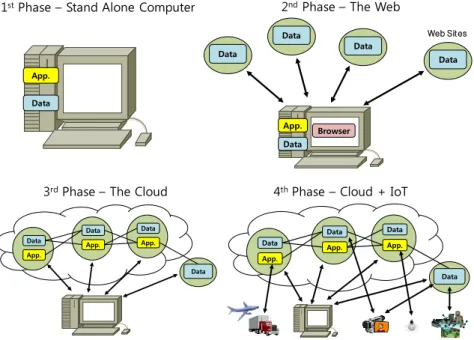
Long time ago, we had used stand alone computers (i.e., 1st phase in Figure 3)
which contain applications and data. At this time, we didn’t need any communication
network. With the help of networks, we started to share data from web sites (i.e., 2nd
phase in Figure 3). However, the emergence of new computing technologies such as cloud computing is changing the current service paradigms. In case of the cloud (i.e., 3rd phase in Figure 3), hosts such as computers can use resources in cloud which
contains data and applications. In the next phase (i.e., 4th phase in Figure 3), cloud
computing and IoT will be combined in order to support so many heterogamous objects. These objects are directly attached to the cloud for storing and retrieving of data.
In this paper, we propose a new service provisioning environment – the
cloud-based IoT which combines the cloud and the IoT as shown in the 4th phase of Figure 3.
The proposed service environment aims to efficiently support various services using cloud technology from different kinds of objects.
There are many advantages for the proposed the cloud-based IoT. These advantages might come from characteristics of cloud computing depending on specific use cases of the IoT. For the cloud-based IoT, we can consider the following points: flexibility of resource allocation, more intelligent applications, energy saving, heterogeneity of smart environment, scalability/agility, virtualization, security, etc.
App. Data Data Data App. Data App. Data App. Data Data App. Data App. Data App. Data Data Data Data Web Sites App. Data Browser
1stPhase – Stand Alone Computer 2ndPhase – The Web
3rdPhase – The Cloud 4thPhase – Cloud + IoT
Fig. 3. From stand alone computer to cloud-based IoT
5 Future Networking Challenges and Service Evolution to
Support the Internet of Things
In this section, we provide key characteristics for ubiquitous networking to support the IoT and enhanced capabilities for ubiquitous networking in the IoT environment.
5.1. Characteristics of ubiquitous networking for IoT
Fundamental characteristics of ubiquitous networking for IoT are as follows: - IP connectivity:
IP connectivity will allow objects involved in ubiquitous networking to communicate with each other within a network and/or when objects have to be reachable from outside their network. Particularly, as many new types of objects will be connected to networks, IPv6 will play a key role in object-to-object communications using auto-configuration and also mitigate the foreseeable IPv4 address exhaustion.
- Personalization:
Personalization will allow to meet the user’s needs and to improve the user’s service experience since delivering appropriate contents and services to the user. User satisfaction is motivated by the recognition that a user has needs, and meeting them
successfully is likely to lead to a satisfying client-customer relationship and re-use of the services offered.
- Intelligence:
Numerous network requirements in terms of data handing and processing capabilities will emerge from various industries involved in the field of ubiquitous networking (e.g., the car industry, semi-conductor industry or medical industry). Making these capabilities available for use by business and assisting this business in terms of efficient and timing decision making is very important. Intelligence which enables network capabilities to provide user-centric and context-aware service is therefore essential. Introduction of artificial intelligence techniques in networks will help to accelerate the synergies and ultimately the “fusion” between the involved industries.
- Tagging objects:
RFID is one of tag-based solutions for enabling real-time identification and tracking of objects. Tag-based solutions on ubiquitous environment will allow to get and retrieve information of objects from anywhere through the network. As active tags have networking capabilities, a large number of tags will need network addresses for communications. As IP technology will be used for ubiquitous networking, it is essential to develop mapping solutions between tag-based objects (e.g., RFIDs) and IP addresses.
- Smart devices:
Smart devices attached to networks can support multiple functions including camera, video recorder, phone, TV, music player. Sensor devices which enable detection of environmental status and sensory information can utilize networking functionalities to enable interconnection between very small devices, so-called ‘smart dusts’. Specific environments such as homes, vehicles, buildings will also require adaptive smart devices.
5.2. Enhanced capabilities for ubiquitous networking in the Internet of things smart environment
To establish a set of common principles and architectures for the convergence and ubiquitous environment, enhanced architectural frameworks for IoT are required to facilitate innovation in the use and application of industry capabilities. To cope with changes of future Internet environment, we should take appropriate measures to accommodate the increase in the number of devices.
The high-level capabilities for the support of ubiquitous networking in the IoT smart environment are listed as follows:
- “Connecting to anything” capabilities
The capabilities of “connecting to anything” refer to the support of the different ubiquitous networking communication types as described in Section 3.1 and include the support of tag-based devices and sensor devices. Identification, naming, and addressing capabilities are essential for supporting “connecting to anything” [10]. - Open web-based service environment capabilities
Emerging ubiquitous services/applications will be provided based upon an open web-based service environment as well as legacy telecommunication and broadcasting services based. In particular, application programming interface (API) and web with dynamics and interactivities that do not exist today should be supported. Such a web-based service environment will allow not only creation of retail community-type services but also building of an open service platform environment which third-party application developers can access and launch their own applications. Using interactive, collaborative and customizable features, the web can provide rich user experiences and new business opportunities for the provision of ubiquitous networking services and applications.
- Context-awareness and seamlessness capabilities
Context-awareness implies the ability to detect changes in the status of objects. Intelligence system associated with this capability can help to provide the best service which meets the situation using user and environmental status recognition. Seamlessness is a capability that can be supported in many different ways: at the network level using handover and roaming in heterogeneous networks, at the device level with no service interruption during device changing and recognition, and at the content level for providing personalized content delivery services, e.g. based on user’s situation, user’s device, and network conditions.
- Multi-networking capabilities
Transport stratum needs multi-networking capabilities in order to simultaneously support unicast/multicast, multi-homing, and multi-path, etc. Because of high traffic volume and number of receivers, ubiquitous networking requires multicast transport capability for resource efficiency. Multi-homing enables the device to be always best connected using multiple network interfaces including different fixed/mobile access technologies. These capabilities can improve network reliability and guarantee continuous connectivity with desirable QoS through redundancy and fault tolerance. - End-to-end connectivity over interconnected networks
For ubiquitous networking, it is critical to develop the solution to provide end-to-end connectivity to all of objects over interconnected heterogeneous networks such as fixed networks, broadcasting networks, mobile/wireless networks, etc. IPv6 with large address space can be considered as a good candidate for providing globally unique addresses to objects. IPv6 offers the advantages of localizing traffic with unique local addresses, while making some devices globally reachable by also assigning them globally scoped addresses.
5.3 Service evolution using smart environment of the cloud and the IoT
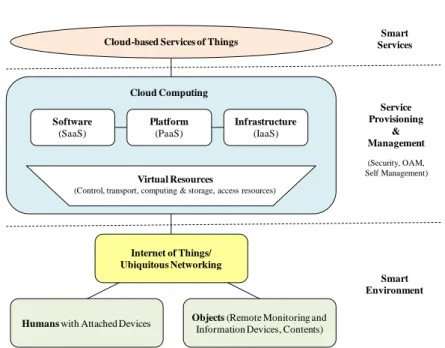
Using smart environments of the cloud and the IoT, various services can be supported as shown in Figure 4. On top of our proposed cloud-based IoT, several kinds of smart services should be supported with the help of key functionalities such as service provisioning and management. We can represent it the cloud-based service of things which uses the cloud and the IoT.
Humans with Attached Devices Objects (Remote Monitoring and
Information Devices, Contents)
Internet of Things/ Ubiquitous Networking Cloud-based Services of Things
Software
(SaaS)
Virtual Resources
(Control, transport, computing & storage, access resources)
Platform (PaaS) Infrastructure (IaaS) Smart Environment Smart Services Service Provisioning & Management (Security, OAM, Self Management) Cloud Computing
Fig. 4. A conceptual diagram for the cloud-based Internet of Things
There are two solutions for virtual resources of service provisioning and management in a cloud: horizontally with network virtualization and vertically with resource virtualization. For network virtualization [11], it is essential to develop the technology that enables the creation of logically isolated network partitions over shared physical network infrastructures so that multiple heterogeneous virtual networks can simultaneously coexist over the shared infrastructures. In addition, for resource virtualization, we also need to consider the virtualization of resources which include software, equipment, platform, computing, storage, memory, etc.
In conclusion, a novel resource management for service provisioning and management in a cloud will be a key enabler for realizing smart services of the IoT.
6 Conclusion
This paper has presented characteristics of cloud computing in telecom perspectives and the issues to support ubiquitous networking for IoT. We have provided the basic concept and visions of ubiquitous networking and clearly identified key technologies essential to the ubiquitous networking in the IoT environment. For developing the relevant technical solutions, we have proposed the cloud-based IoT service environment which combines both the cloud computing and the IoT. We hope that our proposals will provide some key inputs for realization of IoT.
As future work, we plan to focus on objects-to-objects communications for various use cases using cloud computing in the IoT environment and business aspects. For this, it would be helpful if the relevant research efforts for realization of the cloud-based IoT are accelerated with special consideration of their commercial viability.
References
1. Chae Sub Lee, Ryu Won, “Future vision on “Beyond NGN” and next study period of SG13,” ITU-T COM 13 – C 191 – E, April 2007.
2. Gubbins, “How telcos could conquer the cloud,” April 2009, available at http://connectedplanetonline.com.
3. Keith Knightson, “Question NEW-Q-ARCH – Principles and functional architecture for NGNs including ubiquitous networking,” ITU-T TD 423 Rev1 (WP2/13), January 2008. 4. ITU-T Internet Reports, “Internet of Things,” November 2005.
5. Cloud computing - wikipedia, available at http://en.wikipedia.org/wiki/Cloud_computing. 6. Peter Mell, Tim Grance, “The NIST definition of cloud computing,” version 15, October
2009, available at http://csrc.nist.gov.
7. Definition of Cloud Computing, incorporating NIST and G-Cloud views, available at http://www.katescomment.com/feed/
8. Ray Mota, “Five telecom provider benefits of offering cloud computing services,” available at http://searchtelecom.techtarget.com.
9. Gyu Myoung Lee, Jun Kyun Choi, Taesoo Chung, Doug Montgomery, “Standardization for ubiquitous networking in IPv6-based NGN,” ITU-T Kaleidoscope Event - Innovations in NGN, pp.351-357, May 2008.
10. Gyu Myoung Lee, Jun Kyun Choi, Seng Kyoun Jo, Jeong Yun Kim, Noel Crespi “Naming Architecture for Object to Object Communications,” IETF internet-draft <draft-lee-object-naming-02.txt>, work in progress, March 2010.
11. Network virtualization – wikipeida, available at http://en.wikipedia.org/wiki/Network_virtualization
![Fig. 1. The service model, deployment models and essential characteristics of cloud computing (illustration from [7])](https://thumb-eu.123doks.com/thumbv2/123doknet/11662629.310013/4.892.239.660.569.855/service-model-deployment-models-essential-characteristics-computing-illustration.webp)