HAL Id: hal-01785229
https://hal.archives-ouvertes.fr/hal-01785229
Submitted on 4 May 2018
HAL is a multi-disciplinary open access
archive for the deposit and dissemination of
sci-entific research documents, whether they are
pub-lished or not. The documents may come from
teaching and research institutions in France or
abroad, or from public or private research centers.
L’archive ouverte pluridisciplinaire HAL, est
destinée au dépôt et à la diffusion de documents
scientifiques de niveau recherche, publiés ou non,
émanant des établissements d’enseignement et de
recherche français ou étrangers, des laboratoires
publics ou privés.
Modeling and performance evaluation of the eICIC/ABS
in H-CRAN
Hadjer Touati, H Castel-Taleb, B Jouaber, Sara Akbarzadeh, Ahlem Khlass
To cite this version:
Hadjer Touati, H Castel-Taleb, B Jouaber, Sara Akbarzadeh, Ahlem Khlass. Modeling and
perfor-mance evaluation of the eICIC/ABS in H-CRAN. Rencontres Francophones sur la Conception de
Protocoles, l’Evaluation de Performance et l’Expérimentation des Réseaux de Communication, May
2018, Roscoff, France. �hal-01785229�
eICIC/ABS in H-CRAN
H.Touati,
1
H.Castel-Taleb,
1
B.Jouaber,
1
S.Akbarzadeh
2
and A. Khlass
2
1SAMOVAR, Télécom SudParis, CNRS, 9 rue Charles Fourier-91011 Evry Cedex, France 2DAVIDSON CONSULTING, 37 Rue Marcel Dassault, 92100 Boulogne-Billancourt, France
In this paper, we propose mathematical models to evaluate the performance of the interference remediation technique eICIC/ABS (enhanced Inter-Cell Interference Coordination / Almost Blank Sub-frame) in the context of Heterogeneous Cloud based Radio Access Networks (H-CRAN) architecture and 5G networks. The objective is to propose a dynamic resource management tool to ease decisions on the activation/deactivation of micro-cells as well as on the distributions of subframes among macro and micro cells. First, we propose a Markov chain based model that fits the behavior of the considered scheme and allows the analysis of the cell throughput according to traffic load, radio conditions and the distribution of available resources among macro and micro cells. Then, we propose an approximation model with a closed form formula. The two models are validated and evaluated in terms of accuracy and computation time. Numerical results are compared to matlab simulations that reproduce realistic radio conditions. Results show that both models are accurate. However, the closed form approximation is less complex and provides faster results.
Introduction
The H-CRAN architecture proposed for 5G cellular networks combines the Heterogeneous Networks con-cept (HetNets) with the Cloud Radio Access Network (C-RAN) architecture. The HetNet concon-cept allows the use of small cells within macro cells in order to enhance edge user’s radio conditions. In return, the small cells use the same radio resources and may increase interference levels. For network operators, deciding on the planning, activation and tuning of small cells is not an easy task. Many dynamic parameters should be considered including user’s radio conditions, QoS and spectrum and power usage. The C-RAN architecture is also referring to Centralized RAN. It can help in achieving HetNet objectives since decisions can be cen-tralized and based on global knowledge. In order to reduce and/or control the interferences among macro and micro Cells, eICIC and CoMP (Coordinated Multi-Point) mechanisms have been proposed by 3GPP for LTE-Advanced. In the eICIC/ABS (eICIC/Almost Blank Sub-frame), part of the radio resources (sub-frames) are delegated to the micro cells. During its allocated subframes, the macro cell keeps silent and the micro cell can transmit at reduced interference. With this approach, one of the most important challenges is how to determine the amount of sub-frames to delegate to micro cells. In this paper, we are interested in proposing a dimensioning tool for the eICIC/ABS mechanism. Our objective is to provide an easy to use mathematical model that can help, in real time, network managers for their decision making regarding dynamic activation and dimensioning of the small cells.
H.Touati, H.Castel-Taleb, B.Jouaber, S.Akbarzadeh and A. Khlass
System model and assumptions
In this paper, we consider a H-CRAN cluster composed of a central cell and its 6 first tier neighboring cells, numbered from 2 to 7. All these cells are macro cells. The cluster also includes a micro cell deployed within the central macro cell. In the following, we will focus our analysis on users within the central region, covered by both the central macro and the micro cell. We focus our studies on downlink. Users are randomly distributed over the central region. Their serving cells are determined based on the higher received power. The amount of radio resources allocated to each user is determined based on (i) the data size the user is willing to receive, (ii) traffic load within the cell and (iii) the optimal MCS (Modeling and Coding Scheme). This latter is determined according to user’s radio conditions subject to interference, attenuation and noise. In practice, the optimal MCS is selected based on the SINR (Signal to Interference and Noise Ratio). The SINR of user u is obtained through the following equation:
SINR(u)[db] = 10log10(
PRx(u)[W ] ∑7i=2PRxi(u)[W ] + No[W ]
) (1)
where PRx(u)[W] (resp. PRxi(u)[W ], for i = 2, . . . , 7) are the received power (in watt) from the serving
cell (resp. the interfering cell i ), and No[W ] is the thermal noise power expressed in watt over the entire considered bandwidth. According to [Neta], the thermal noise per Hz is equal to −174. Note that the received power given in equation (1) depends on the pathloss PL(u)[db] between the user u and the BS (Base Station) in db. For the macro cell, the pathloss PL(u)[db] is given by:PL(u)[db] = 128.1 + 37.6 × log10(R[km]) and for the micro cell: PL(u)[db] = 38 + 30 × log10(R[m]) where R[km] (resp. R[m]) is the
distance between the user and the BS in kilometers (resp. meters) [Neta]. Once the SINR of each user is determined, the optimal MCS is selected according to the 3GPP correspondence tables [Netb].
In LTE, radio resources are assigned to users at a frame basis. Each frame is composed of 10 sub-frames. The BS allocates to each UE a set of GRBs (Group of Resource Blocks). The number of RBs (Resource Blocks) within a GRB depends on the considered bandwidth [Netb]. In the following, we denote by S the total number of available GRBs in a frame and by NbRBthe number of RBs within a GRB. For each user
u, with a size (size(u)), and a MCS (MCS(u)), the number of required GRBs/frame is obtained as follows: NbGRBs(u) =NbNbSubch(u)
RB where NbSymb(u) =
size(u)
MCS(u) determine the number of required OFDM symbols and
NbSubch(u) =
NbSymb(u)
7×12 determine the number of corresponding sub-channels (i.e. RBs).
Markov chain
We suppose that in the macro-cell (resp. micro-cell), clients arrive according to a Poisson process of rate λM,
(resp. λm). We suppose that arrivals are divided into classes corresponding to the batch size (to simplify, we
consider that clients of class i have a bach size of i). The batch size of a client corresponds to the number of GRBs required to its transmission within a frame. Let λM,iand JM(resp. λm,i, and Jm) arrival rates of class i
and the number of classes in the macro cell (resp. micro cell). We have ∑JM
i=1λM,i= λM(resp. ∑Ji=1m λi= λm)
the total arrival rate in the macro cell and the micro cell respectively.
In order to remedy the interference, S servers (which refers to S GRBs/frame) are shared between the macro-cell and the micro-macro-cell according to the number of ABS allocated to the micro-macro-cell. During the frame duration, we consider the arrivals of the macro and the micro, and the services of at most SM= S − S ×
(nbABS/10) where nbABSrepresents the number of ABS assigned to the micro-cell, and Sm= S × (nbABS/10)
GRBs. We represent the behavior of eICIC technique as two discrete-time Markov chains one for the macro and the other for the micro cell. We denote by YM(n) (resp. Ym(n)) the number of GRBs occupying the macro (resp. the micro) at frame n. At each end of the frame time (n), we consider service of clients arrived
at the precedent frame time n − 1, and we add clients arrived in the present frame time n. Let AM,i(n) (resp.
Am,i(n)) the number of arrivals at frame n in the macro cell (resp. micro cell). Then ∑Ji=1M i× AM,i(n) (resp.
∑Ji=1m i× Am,i(n) represents the total GRBs necessary to arrivals in the macro cell (resp micro cell). So YM(n)
and Ym(n) for n ≥ 0 represent discrete-time Markov chains, and the evolution equations are given as follows:
YM(n) = min(SM, [YM(n − 1) − SM]++ JM
∑
i=1 i× AM,i(n)) (2) Ym(n) = min(Sm, [Ym(n − 1) − Sm]++ Jm∑
i=1 i× Am,i(n)) (3)where YM(0) = min(SM, ∑Ji=1M i× AM,i(0)), and Ym(0) = min(Sm, ∑Ji=1m i× Am,i(0)). The proposed Markov
chain is so slow for a real-time dimensioning tool, due to the fact that we consider batch arrivals that generate very large number of transitions, multiserver (500 for 20MHz, 1000 for 40 Mhz, ...), and it takes 2 hours to simulate a point of the curve (when we consider 20 MHz) to ensure a 95% confidence interval. That’s why we had to look for an approximation using a queueing model with a closed form.
Closed form equations
We propose to model the system with a multi-server loss queueing system. As the arrivals are supposed Poisson with different batch sizes (a client has a batch size of j GRBs), then we consider the loss discrete-time M/G/S/S queue [D.82] with batch arrivals and grouped departures to represent the behavior of the macro-cell. In this queueing model, each arrival corresponds to a batch of size j, which occupies simultaneously j servers if there is enough place [D.82], otherwise it is lost. Since in our model, the admission is made by element of the batch (or GRB) , and not by considering the whole batch (or the client batches), then the queueing model will increase the blocking probability. We propose to consider the M/G/S/S queueing model with Poisson simple arrivals, and deterministic service times. Each client occupy one server, but the service time is approximated by the mean service time of all batches sizes of the serving cell (macro or micro). So in this model, clients are not differentied by classes (or different service time) they have the same service time equal to the mean batch size of the clients. So in the exact model, if a client occupy j resources (or GRBs) in a frame time, then in the queueing system the client occupy one resource for j frame times. From M/G/S/S queue, we can use the Erlang loss formula [D.82] in order to derive the blocking probability of clients in the serving cell. From the blocking probabilities we can derive the throughput for each cell, and also the total throughput. Let PM (resp. Pm) the blocking probability of the macro cell (resp. the micro cell). They are computed
as follows from Erlang loss formula [D.82]: PM =
ρSMM SM !
∑SMn=0ρM
n n!
where ρM= λµMM, and µ1M = ∑Ji=1M i× λi,M λM and Pm= ρSmm Sm! ∑Smn=0ρm n n! , where ρm=λµmm,µ1m = ∑Ji=1m i× λi,m
λm . So we can derive the throughput XMfor the macro-cell as
XM= λM× (1 − PM), the throughput Xm= λm× (1 − Pm) for the micro cell, and the total overall throughput
is X = XM+ Xm.
Numerical results
We consider the following parameters: f=2 Ghz, BP = 20 Mhz which corresponds to 500 GRBs/frame and 1GRB= 4 subchannels [Netb], for the macro cell (resp. micro cell) the radius is Rmacro=3500m (resp.
H.Touati, H.Castel-Taleb, B.Jouaber, S.Akbarzadeh and A. Khlass
and client size= 1024 bits. Using Matlab simulator, we generate uniformly in the macro cell the clients whose number follows Poisson distribution. First, the simulator associate each user to his serving cell based on the highest power reception. Then, it calculates for each client the number of GRBs required as explained in the previous section. So clients with the same number of GRBs are regrouped into classes, the corresponding arrival rates and service times will be injected into the proposed Markov chain simulator and into the M/G/S/S formulas so that these two models are based on real scenarios.
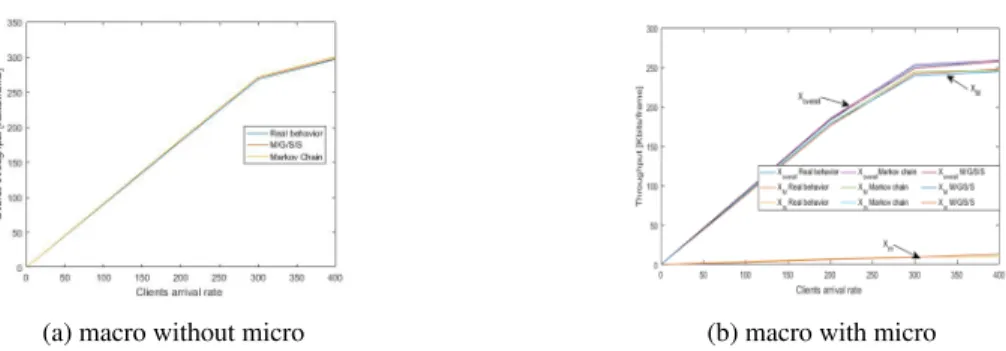
The figure below compares the performance results (the macro throughput, the micro throughput and the overall throughput) obtained by the simulator of real behavior, the proposed Markov chain and the M/G/S/S. As shown in these figures, in the considered scenarios (macro without/with micro) the throughputs obtained
(a) macro without micro (b) macro with micro
Fig. 1: Validation of the Markov chain and the M/G/S/S approximation
with the Markov chain and the M/G/S/S formulas match perfectly with the simulation results of the real behavior. Thus, we can validate the proposed Markov chain and the simple M/G/S/S.
Conclusion
In this paper, two models are proposed and validated through simulations for the eICIC/ABS mechanisms in the context of H-CRAN. The first is a Markov chain based model. It reflects the behavior of the system with batch arrivals corresponding to users with variable radio conditions and requiring more or less resources to transmit their data. The second model is an approximation using the M/G/S/S queue that provides a closed form result. Both models provide similar results in terms of throughput and system capacity for both the micro and the macro cells. Furthermore, both models results are evaluated by comparing with simulations that reproduce a real behavior of radio conditions. The proposed models can then be used as a dimensioning tool for the considered mechanism. The M/G/S/S approximation can in addition be used in real time to adapt in real time the eICIC/ABS mechanism according to user distribution, to load and to radio conditions.
References
[D.82] Fakinos D. The m/g/k group-arrival group-departure loss system. Journal of Applied Probability, 19(4):826–834, 1982.
[Neta] Technical Specification Group Radio Access Network. 3gpp tr 36.931 evolved universal terrestrial radio access (e-utra); radio frequency (rf) requirements for lte pico node b (release 10). 3rd Genera-tion Partnership Project.
[Netb] Technical Specification Group Radio Access Network. 3gpp ts 36.213 evolved universal terrestrial radio access (e-utra); physical layer procedures (release 9). 3rd Generation Partnership Project.