HAL Id: hal-00762515
https://hal.archives-ouvertes.fr/hal-00762515
Submitted on 14 Nov 2013
HAL is a multi-disciplinary open access
archive for the deposit and dissemination of
sci-entific research documents, whether they are
pub-lished or not. The documents may come from
teaching and research institutions in France or
abroad, or from public or private research centers.
L’archive ouverte pluridisciplinaire HAL, est
destinée au dépôt et à la diffusion de documents
scientifiques de niveau recherche, publiés ou non,
émanant des établissements d’enseignement et de
recherche français ou étrangers, des laboratoires
publics ou privés.
Demo: Experimentation with a DoDWAN-based
Application Suite for Opportunistic Computing
Frédéric Guidec, Pascale Launay, Nicolas Le Sommer, Yves Mahéo
To cite this version:
Frédéric Guidec, Pascale Launay, Nicolas Le Sommer, Yves Mahéo. Demo: Experimentation with a
DoDWAN-based Application Suite for Opportunistic Computing. 4th Extreme Conference on
Com-munication (ExtremeCom’12), Mar 2012, Zurich, Switzerland. pp.1-4. �hal-00762515�
Demo: Experimentation with a DoDWAN-based
Application Suite for Opportunistic Computing
F. Guidec
Irisa Université de Bretagne-Sud Vannes, FranceP. Launay
Irisa Université de Bretagne-Sud Vannes, FranceN. Le Sommer
Irisa Université de Bretagne-Sud Vannes, FranceY. Mahéo
Irisa Université de Bretagne-Sud Vannes, FranceABSTRACT
DoDWAN is a middleware system that supports content-based in-formation dissemination in partially or intermittently connected mo-bile ad hoc networks. It can be used to allow communication be-tween people in challenged environments, such as in rural, remote, or disaster-struck areas. An application suite has been implemented on top of DoDWAN. This suite includes services such as email, text and voice messaging, filesharing, etc. A preliminary experimental trial conducted on a university campus with volunteer students has confirmed that DoDWAN and its applications are robust and reli-able. We would now like to deploy a flotilla of DoDWAN-enabled netbooks and smartphones during the ExtremeCom’12 conference, using this event as an opportunity to test our system in challenged conditions while collecting inputs from the users.
1.
OVERVIEW OF DODWAN
Building an application suite for disconnected mobile ad hoc net-works (or D-MANETs) requires some communication middleware system with which mobile hosts can collaborate in a peer-to-peer manner to ensure message transportation. DoDWAN (Document Dissemination in mobile Wireless Ad hoc Networks)is a commu-nication middleware system we designed along that line [2]. It is written in Java, and it is distributed under the terms of the GNU General Public License1.
DoDWAN supports content-based information dissemination in D-MANETs. This is a characteristic it shares with the Haggle sys-tem, while the DTN2 system is rather meant to support destination-driven message forwarding. In content-based networking, infor-mation flows towards receivers rather than towards specifically set destinations. This approach notably fits the needs of applications and services dedicated to information sharing or event distribu-tion. It can also be used for destination-driven message forwarding, though, considering that destination-driven forwarding is simply a
1http://www-irisa.univ-ubs.fr/CASA/DoDWAN
Permission to make digital or hard copies of all or part of this work for personal or classroom use is granted without fee provided that copies are not made or distributed for profit or commercial advantage and that copies bear this notice and the full citation on the first page. To copy otherwise, to republish, to post on servers or to redistribute to lists, requires prior specific permission and/or a fee.
ExtremeCom2012,March 10-14, 2012, Zürich, Switzerland. Copyright 2012 ACM 978-1-4503-1264-6/12/03 ...$10.00.
particular case of content-driven forwarding where the only signif-icant parameter is the identifier of the destination host (or user).
DoDWAN uses the store, carry and forward principle to ensure the dissemination of documents over the network. Each DoDWAN node maintains a local cache and an “interest profile” that deter-mines the kind of information it is interested in, and thus implicitly the kinds of documents for which it is willing to serve as a mobile carrier. A gossip-like communication protocol orchestrates interac-tions between neighboring nodes, allowing them to exchange doc-uments according to their respective interest profiles. Interaction between mobile nodes relies on a simple scheme, whereby each node informs it neighbors of its own interest profile and of the cat-alogue of the document headers that are currently available in its local cache. When a node discovers that one of its neighbors can provide a document it is interested in (that is, a document header that matches its own interest profile and that is not already available in its own cache), it can request a copy of this document from this neighbor.
Mobile hosts running DoDWAN only interact by exchanging control and data messages encapsulated in UDP datagrams, which can themselves be transported either in IPv4 or IPv6 packets. DoD-WAN has originally been implemented so as to rely on Wi-Fi in-terfaces running in ad hoc mode, and this is the way it is usually used in most situations. Yet it has also been experimented in a mil-itary tactical network, using VHF battlefield radios with low-bitrate built-in modems instead of Wi-Fi interfaces, and proved robust and reliable in such harsh conditions [1].
2.
OPPORTUNISTIC COMPUTING WITH
DODWAN
A number of applications have been designed and implemented based on the DoDWAN middleware. These applications allow users to rely on legacy services such as email and newsgroups, although no server is required to use these services: messages are transported by DoDWAN from mobile host to mobile host opportunistically in a peer-to-peer fashion, rather than using the traditional client-server model. Short-text messaging (similar to the SMS service), voice messaging, filesharing, and plateau games are also available.
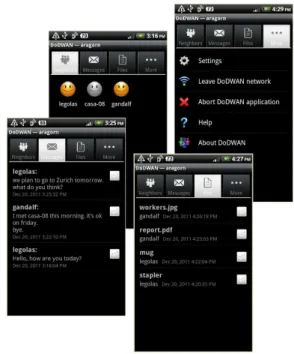
This application suite has originally been implemented so as to run on laptops and netbooks, and an experimental trial conducted with volunteer students has confirmed that it performs satisfacto-rily[3]. A version of the suite adapted to smartphones has also been developed for the Android platform.
Figure 1: DoDWAN applications deployed on netbooks and smartphones
3.
EXPERIMENTATION DURING
EXTREMECOM’12
The goal of the experiment is to promote opportunistic comput-ing as a means to support communication and coordination be-tween people in an environment devoid of networking infrastruc-ture. We plan to provide a number of DoDWAN-enabled netbooks and smartphones, which will be available for ExtremeCom’12 at-tendees during the whole duration of the conference. Participants will also be encouraged to install our software kit on their own lap-top or smartphone, provided these devices meet the requirements specified in Section 4.
With our or their own devices, volunteer users will be able to ex-change text and voice messages, and to share documents (such as pictures taken with the smartphones’ builtin cameras, conference papers, presentation slides...) with all or part of the other users. Some messages may be published for anybody to receive, while in some occasions some users may wish to create a restricted commu-nity and exchange messages only within this commucommu-nity. In any case message dissemination will be ensured in the background by DoDWAN, in an opportunistic manner, as radio contacts between devices occur over time.
Conference attendees participating in the outdoor activities (such as igloo building or snowshoe hikes) will be encouraged to bring smartphones and keep using DoDWAN’s applications on these oc-casions. Thus, a picture taken and published with his smartphones by an igloo builder should disseminate opportunistically from host to host, and reach eventually –possibly hours later– the devices of users who were hiking with snowshoes at the same moment. A file containing the presentation slides of a keynote speaker may simi-larly be published for all to receive, even though all mobile devices do not have to be close to the publisher and running when the file is published.
4.
REQUIREMENTS
We assume that the batteries of netbooks and smartphones can be charged at the conference venue, although snowshoe hikers may have to rely on solar panels (we’ll provide a couple of these) or backup batteries. Our software kit can be installed on the partici-pants’ own devices, provided these devices include JRE 1.6 and a Wi-Fi interface. This kit is currently available for standard laptops (running Linux preferably) and Android 2.2 and 2.3 smartphones. Users that are not familiar with software installation and Wi-Fi ad hoc configuration on their device may require our assistance.
More-over a short introduction to the possibilities offered by the software kit would certainly be helpful for volunteer users. For this reason it is desirable that a time slot be assigned for this activity at the beginning of the conference.
Figure 2: Screenshots of the DoDWAN Android application running on a smartphone
5.
EXPECTED RESULTS
We expect to gather interesting inputs from volunteer users dur-ing the conference. Moreover, trace files generated by DoDWAN on each mobile device will be collected at the end of the trial. The confidentiality of user to user communication is here guaranteed: the trace files contain low-level details about the wireless gossiping between mobile hosts (such as radio contact occurrences and du-rations), but no information is recorded about the actual content of the messages exchanged between these hosts. By analyzing these trace files after the conference, we expect to better understand how opportunistic networking and computing tools such as those we de-signed can help people communicate in challenged environments.
6.
REFERENCES
[1] Julien Haillot, Frederic Guidec, Serge Corlay, and Jacques Turbert. Disruption-Tolerant Content-Driven Information Dissemination in Partially Connected Military Tactical Radio Networks. In 28th IEEE Military Communication Conference, October 2009.
[2] Julien Haillot and Frédéric Guidec. A Protocol for
Content-Based Communication in Disconnected Mobile Ad Hoc Networks. Journal of Mobile Information Systems, 6(2):123–154, 2010.
[3] Yves Mahéo, Nicolas Le Sommer, Pascale Launay, Frédéric Guidec, and Mario Dragone. Beyond Opportunistic Networking Protocols: a Disruption-Tolerant Application Suite for Disconnected MANETs. In Proceedings of the 4th International Conference on Communication - The Alpine Expedition (ExtremeCom’12), Zürich, Switzerland, March 2012. ACM Press.