To cite this document:
Ming, Yue and Houe, Raymond and Grabot, Bernard Models for supply chain
negotiation in collaborative relationships. (2012) In: 9th International Conference on
Modeling, Optimization & SIMulation, 6-8 Juin, 2012, Bordeaux, France.
O
pen
A
rchive
T
oulouse
A
rchive
O
uverte (
OATAO
)
OATAO is an open access repository that collects the work of Toulouse researchers and
makes it freely available over the web where possible.
This is an author-deposited version published in:
http://oatao.univ-toulouse.fr/
Eprints ID: 8573
Any correspondence concerning this service should be sent to the repository
administrator:
[email protected]
9th International Conference of Modeling, Optimization and Simulation - MOSIM’12 June 06-08, 2012 – Bordeaux - France
“Performance, interoperability and safety for sustainable development”
MODELS FOR SUPPLY CHAIN NEGOTIATION
IN COLLABORATIVE RELATIONSHIPS
Y. MING, R. HOUE NGOUNA, B. GRABOT University of Toulouse, INPT-ENIT
47, Avenue d’Azereix, BP1629 F-65016 Tarbes Cedex – France {yue.ming, rhoue, bernard.grabot}@enit.fr
ABSTRACT: Nowadays, firms are increasingly building collaborative relationships with their partners in order to
improve the global performance of the supply chain in which they are involved. Such collaborative relationships require information exchange or share and negotiation. In this paper, we first formalize some practices of collaboration from case studies of the aeronautical area then suggest some models for negotiation, allowing a supply chain member to publish hidden constraints and share risks/costs in order to achieve a win-win situation.
KEYWORDS: supply chain, collaboration, negotiation, risks.
1. INTRODUCTION
In collaborative supply chain, the conflicts between au-tonomy and collaboration in one hand, local interest and global objectives in the other hand, are important prob-lems the supply chain members are currently facing, especially when involved in multiple networks. Further-more, the growing uncertainty on the customers' demand makes the supply chain harder to manage. In this con-text, it is usually considered that an increased collabora-tion is a good way to minimize the risks linked to this uncertainty (Hallikas et al., 2005). Firms are so building collaborative relationships with their supply chain part-ners in order to achieve efficiency, flexibility, and com-petitive advantages (Nyaga et al., 2010).
We suggest in this communication a series of models of negotiation between customer and supplier, which helps to publish hidden constraints, synchronize internal and external interests and share risks with supply chain member in a context of collaborative relationships. 2. COLLABORATIVE RELATIONSHIP IN A
SUPPLY CHAIN
Many studies suggest that collaborative relationships are associated with the improvement of the supply chain performance. Kalwani and Narayandas (1995) noted that manufacturers seek for long-term relationships with few-er supplifew-ers in ordfew-er to secure valued resources and tech-nologies, master supplier skills and strengths, and gain from quality and process improvements. Holland (1995) has shown that companies are moving towards collabo-rative relationships in an effort to make the supply chain as a whole more competitive. Maloni and Benton (1997) suggest that it is essential for a firm’s survival to have collaborative relationships with its suppliers.
Chung et al. (2005) express the idea that an interesting way to build an efficient supply chain is to integrate the supply chain activities by developing collaborative rela-tionships between firms. Daugherty et al. (2006) found that firms engaged in collaborative relationships achieved improved visibility, higher service levels, in-creased flexibility, greater end-customer satisfaction, and reduced cycle times.
However, the real collaboration practices seem to be more complex to implement than considered in the lit-erature. Considering practical cases, we have analyzed the behaviors resulting from collaborative relationships in the aeronautical industry. This study, along with asso-ciated results, is described in the following.
3. EXAMPLE OF PROBLEMS IN
COLLABORATIVE RELATIONSHIPS: FROM THEORY TO REAL SITUATIONS
The case studies considered here are based on projects launched within the federative structure IODE1, aiming at analyzing collaboration in supply chains, among which one performed with funding from an association of companies of the aeronautic sector and from a public body interested in SMEs development. The objective of the project was to analyze the problems linked to the collaboration between partners of aeronautical supply chains, especially when SMEs are involved. The people in charge of the relationship with customers and suppli-ers of twenty companies have been interviewed in that purpose, the panel being composed of 7 large companies and 13 of middle (around 200 employees) or low (less than 100 employees) size.
1
IODE is a group of researchers in Industrial Engineering in the South West of France (http://idce.enit.fr/iode/)
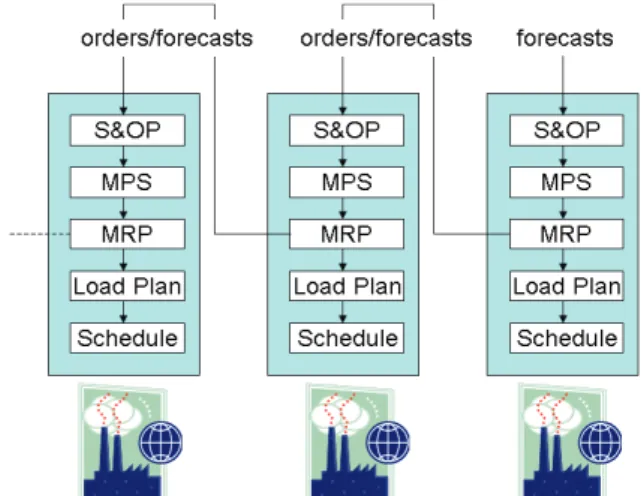
In a decentralized supply chain (e.g. when no central planning is performed), a cascade of ERP systems is usually considered as a mean to coordinate partners. MRPII (Manufacturing Resource Planning), the core production model of an ERP system, is usually used to perform and organize planning during supply and de-mand processes, including sharing information at differ-ent levels of operation plans and purchase orders. As seen in Figure 1, forecasts based on the expected cus-tomer’s demand are built by the focal company of the chain (usually the final assembler in the aeronautical sector) then processed using the MRPII principles. After the MRP (Material Requirement Planning) step, planned orders/forecasts are grouped in a supply plan, sent to the tier (n+1) partners (see the left and middle side of the figure).
Figure 1. Supply chain planning using a cascade of MRP processes
When analyzing the implementation of these processes through interviews, some problems were identified, es-pecially related with SMEs (see (Ming, 2011) and (Af-fonso, 2008) for more details). In this paper, we will focus on some specific problems showing that real situa-tions are more complex than the basic framework of Figure 1. The gaps, which are usually hidden, might lead to poor performance in the collaboration within the sup-ply chain.
• Problems linked to the firm period of the forecasts The first issue identified during the interviews is that the size of the firm period of the forecasts may be incon-sistent with the supply lead times. As an example, a rela-tive scarcity of some aeronautical alloys together with a lack of capacity of companies providing casting parts made that the supply time of raw materials increased up to 12 months in some cases. In spite of this, the firm period of the forecasts sent by the customer to their sup-pliers remained constant, around 3 months, compelling the suppliers to take the risk to order materials on the base of flexible forecasts, or to be late if they were wait-ing for confirmation of the correspondwait-ing orders.
• Protection/pressure using the periods of the forecasts Some (rare) companies use the difference between the firm period received from their customers and the one they send to their suppliers as a way to protect their smallest partners, who may hardly deal with large varia-tion of the demand.
• Load smoothing at supplier's
Load smoothing may be an important issue for SMEs, which have a limited capacity. During the periods of high load, some orders are often delayed while when the load is lower, SMEs are looking for work in order to get minimum incomes.
• Protection against variations of load
As seen in previous point, load smoothing can be per-formed on the supplier's side but also by the customer: in some cases, this problem was formally taken into ac-count by the customers willing to protect their smallest suppliers.
• Link between price and cycle time
Satisfying urgent orders is part of the daily work in aero-nautical supply chains; it usually means spending extra money (due to extra hours, etc.) or postponing other or-ders considered as less urgent, with the result of pertur-bations in the planning. In some very specific cases, we have seen that the principle of a priority negotiation of the price and cycle time could be considered in order to address the problem of these urgencies.
• Information sharing
As already stated, many SMEs are facing a variable de-mand that they can hardly satisfy at low cost. Even if some orders are not as urgent as others, this information is not often shared by the customer. As a consequence, the SMEs have to make their decisions (on the priority of orders, grouping of similar orders, adjustment of lot siz-es, etc.) on the sole base of internal considerations. Some cases of customers sharing such type of information with their suppliers have nevertheless been noticed.
• Lot sizes
Lot size is an important item, negotiated in the contracts. Nevertheless, SMEs have to decrease their costs through time, and have so to find solutions for constantly increas-ing the efficiency of their production system. In order to do this, most of them may need to provisionally increase their lot sizes. Therefore, many suppliers try to group various orders from their customers in order to decrease their set-ups.
Looking back at the studies, important problems have been described in purchasing of raw material/component and on the delivery of the requirements. Therefore, we have especially focused on the aspects of the supply and demand process, such as period of forecasts, load varia-tions, order priorities, lot sizes, or purchasing cycle
times, which were the objects of many hidden practices, especially from the suppliers.
Usually, “supplier development” is considered as a long-term approach to deal with these problems, many cus-tomers considering that they are the proof of a lack of maturity of their suppliers. In that purpose, many pro-jects have been launched during the last five years aim-ing for instance at disseminataim-ing the principles of MRP and lean management in the SMEs of the aeronautic sec-tor.
For us, practices are linked to actual needs, closely at-tached to a type of relationship between supplier and customer, even if their result can be considered as nega-tive. Therefore, we suggest to have a different attitude, and to consider that the practices of the suppliers, even if they may be unacceptable by their customers, are the symptoms of real problems. Therefore, we propose to turn these “hidden” practices into public ones, subject to negotiation with the partner. In order to illustrate this, we have focused on four points, detailed in next section. 4. CONTEXT AND MODELS FOR SUPPLY
CHAIN NEGOTIATION
Our goal here is not to suggest a so-called “optimal” negotiation process, but to take some real empirical situ-ations from case studies as examples, and try to include them into a consistent formal negotiation process, using Business Process Diagram (BPMN, 2011), in order to check their real potential. Therefore, the cases mentioned are not for us a closed list, but an illustration of what can be brought by extending the objects of the negotiation process, which may concern quite different aspects. In the proposed negotiation processes, we shall first consid-er four items based on the case studies: pconsid-eriods of fore-casts, load variation, price and cycle time, then order priority and lot sizes.
4.1. Period of forecast
In the aeronautical industry, the forecast usually consists of firm, flexible and free periods. As seen from the case studies, the problems are basically due to possible inconsistencies between the firm period and the cycle time of the orders, or the link between the lengths of the periods received by the customer and those he sends to his supplier.
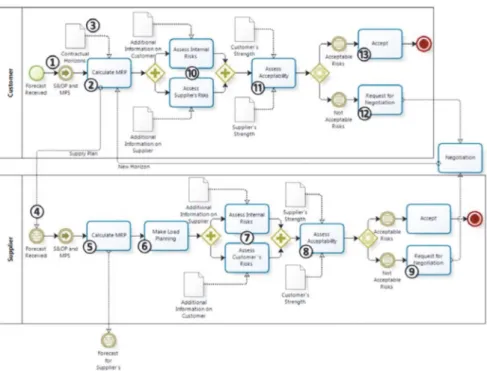
Normally, after building a S&OP (Sales and Operations Plan) and a MPS (Master Production Schedule) (points ! and "), the supply plan, one of the outputs of MRP, is generated according to the contractual lengths of firm, flexible and free periods (point #).
The supply plan is considered as forecasts by the supplier (point $). The supplier makes then his own MRP calculation (point %), allowing him to build his own supply plan (not mentioned in Fig. 2) and his load plan (point &). Having taken into account his cycle time and the one of his suppliers, the supplier is able to
check whether this load plan is consistent or not, or in other terms whether he takes too much risks (for instance by ordering parts on the base of the flexible period of forecasts, point '). Depending on additional information on his customers and suppliers (such as “can they be urged or not? Do they have financial stability or not?”), he decides whether these risks are acceptable or not (point (). If he considers that he takes more risks than his partners (customers and suppliers), he may ask for negotiation (point )). Of course, the notion of "acceptable risk", should be defined with better accuracy, which has not been done here since it is hard to formalize whereas decision maker have usually a clear view on what is "acceptable" or not.
The customer performs the same evaluation: he makes his assessment of both internal risks and risks he assumes to be on supplier’s side (point *). This assessment of course considers the received horizon of the firm period from his own customer, the horizon of the firm period he sends to his supplier, his internal cycle time and his supplier’s cycle time. It should also include his opinion on the cycle time from supplier’s suppliers, the real costs of his suppliers, etc. This information is usually only assessed, since it is seldom provided by the supplier. The risk taken by the customer somehow proportional to the difference between the horizon he receives and the horizon he sends. It can be different for each of his suppliers, since two different suppliers do not need the same protection, or in other terms do not deserve that the customer takes the same risk (it is for instance acceptable to take risks for protecting a critical supplier, but not a “common” one). Such assessment will provide a customer’s vision on the allocation of risks between him and his suppliers.
The next step is to balance the customer’s own strength and its supplier’s strength and weakness, aiming at assessing the acceptability of the risks he takes (point +). For instance, the customer may consider that he should take lower risks if his supplier has more “strength” than him. Of course, this assessment is very subjective, but is indeed done daily in real situations, within less formalized processes. If, from customer’s vision, risks are not acceptable, he will request a negotiation process (point ,). Otherwise, the customer will accept the current plans (point -).
Therefore, three triggers may launch negotiation: request from customer, request from supplier, and request from both customer and supplier. Surely, the visions of risks allocation and acceptability may be opposed at the customer and supplier side, mainly because a company knows his own problems much better than his partners’ and may so overestimate them. In any case, sharing real information instead of trying to assess the situation of one's partner could facilitate to reach a consensus, but would certainly lead to other problems linked for instance to confidentiality.
After the negotiation process, a new agreed horizon will be integrated into the customer’s MRP plan.
Figure 2. Business Process Diagram of period of forecast negotiation 4.2. Load Variation
In case of load variation, instead of considering that the supplier has to, or cannot answer to an overload if it is consistent with the contract, overloads (or lacks of loads) could also be negotiated.
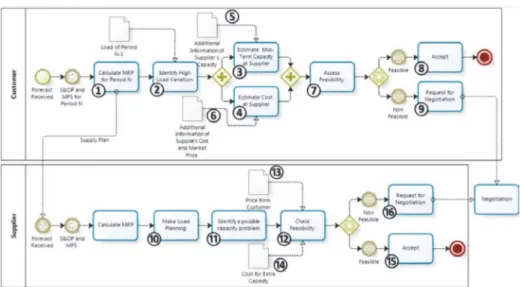
On the customer’s side, the negotiation on load variation is proposed after the MRP step has been performed (see the top part of Figure 3). After S&OP and MPS design, the customer begins the MRP calculation (point !). The customer may then consider the supply plan for each of his suppliers in order to identify high load variations (by comparing the load for current and previous periods) (point "). For dealing with high load variation, the flexibility of the mid-term capacity of the supplier is essential. Therefore, the customer has to estimate the mid-term capacity on the supplier’s side (point #), as well as the costs to manage such capacity (point $). As a consequence, additional information on the supplier’s capacity, including internal regular and overtime capacity, external accessible capacity (subcontracting capacity) (point %), and additional information of related costs (point &) are important inputs for this estimation. Depending on the closeness of the relationship, this information can be known or estimated. Based on the results, the customer needs to assess the feasibility of the load variation expected in the current period (point '). From the customer’s vision, if the supplier is capable to manage this load variation, the current plan is considered as feasible and the MRP result is accepted (point (). Otherwise, the customer requests a negotiation process, considering as doubtful the
supplier’s capability to perform satisfied delivery when facing the considered load variation (point )).
On the supplier’s side, the detection of the problem of capacity is not based on estimation, but on the actual capacity/load situation. According to the result of the load planning (point *), the supplier identifies a possible capacity problem (point +) and checks the feasibility (point ,) to address this problem (for instance, by extra hours or subcontracting in case of increase, by other solutions aiming at decreasing his capacity in case of decrease). Therefore, two important factors have to be taken into account: i) price paid by customer (point -) and ii) cost for extra capacity or decrease of capacity (point .).
From the supplier’s vision, if the capacity change is considered as feasible, the current plans are accepted (point /). Otherwise, the supplier will request a negotiation process and communicate his capacity problems to the customer (point 0).
Again, the negotiation process will be triggered either by a customer request, a supplier request or a double request (not considered here). Of course, if the problem is detected by one of the partners, the other has to agree on the fact that there is an actual problem. For instance, a customer may detect a high overload, which may have no consequence for a supplier, if other customers of this supplier have decreased their own orders during the same period.
Figure 3. Business Process Diagram for load variation negotiation 4.3. Price and Cycle Time
Urgencies are detected at the customer’s side but they also have consequences for the supplier, challenged through his flexibility and adjustment of capacity. Therefore, we suggest to negotiate price and cycle time of urgent orders as the third item of our model.
The negotiation on price and cycle time is considered here for a small number of urgent orders, see Figure 4. At the customer’s side, MRP calculation is based on S&OP and MPS, also taking into account the urgent orders sent by customer’s customer (point ! of Figure 4), at a level consistent with their degree of anticipation. The results of the MRP step will provide a clear view on the material requirements induced by these urgent orders to the supplier (point "): they may have no effects on the current supply plan, or urgent material orders may be necessary. After load planning, the required due dates of the materials are confirmed (point #), then the customer needs to estimate the feasibility of urgent orders on supplier’s side (point $), as well as the possible extra cost for the supplier (point %). According to customer’s vision, if the urgent orders are considered
as feasible, meaning that the supplier is supposed to be capable to deal with such urgency, the current plan is accepted (point &) and the urgent orders are sent to the supplier (point '). Otherwise, if the customer thinks that his supplier is not able to deal with these urgent orders (based on customer’s estimation), negotiation is requested (point ().
At the supplier’s side, the urgent orders usually arrive at the load planning or detailed scheduling levels (point )). Based on the allocation of capacity/load towards each customer, the supplier needs to check whether it is feasible to deliver the urgent order(s) (point *) in the conditions required by the customer (including price) (point +). If the actual situation allows the supplier to adjust his capacity/load for fulfilling the urgent orders, the current plan is acceptable and the production process is launched (point ,). Otherwise, the supplier sends a request for negotiation (point -), and notifies his customer that delivery as requested is questionable in the present situation.
Therefore, three possible triggers launch the negotiation on price and cycle time of urgent orders: customer request, supplier request and double request from both customer and supplier. After negotiation on the urgent orders, the new agreed due date will be integrated in both customer and supplier’s plans (point ., /).
4.4. Order priority and lot size
The final item we suggest to put into the negotiation process is the orders priority and lot sizes. From the interviews, we have seen real cases where SMEs are trying to regroup orders having common features, usually in order to decrease the set-up times. On the other hand, if they do not have additional information to the due dates, it is common that the suppliers use an internal priority for scheduling the orders at the operational level if all the orders cannot be fulfilled in time, as well as when urgent orders are required. As a consequence, tardy orders towards one or several customers may occur. Temporal margins or safety stocks may allow the customer to face delayed delivery on some of the orders, but this information is not always shared with the suppliers.
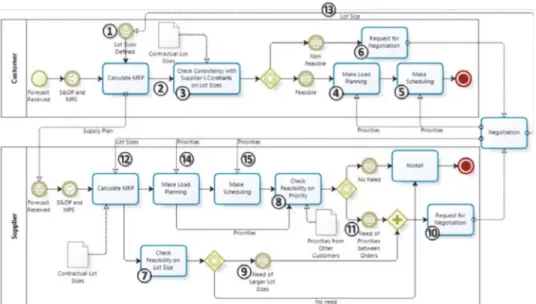
The negotiation on orders priority and lot sizes occurs at the operational levels is mainly related to constraints on capacity or cost (see Figure 5). At the customer’s side, depending on the lot sizing policy, the lot size is either an input (for instance, if an economical lot size has been defined) (point !) or a result (if a lot-for-lot policy is used) (point "). The customer may in the last case need to check whether the supplier’s constraints on lot sizes are consistent with his actual requirements (point #). If, from the customer’s point of view, no problem is expected, the current MRP calculation is acceptable and a load plan and detailed schedule can be performed (points $, %). If the customer considers that the
current lot size is not feasible, due to the constraints of the supplier, a request for negotiation on lot size will be sent (point &).
At the supplier’s side, there are two major tasks: one is to check the feasibility on lot sizes based on the results of the MRP calculation (point '); the other is to check the respect of the due dates based on the load planning and detailed scheduling (point ().
In order to reduce the frequency of the set-ups, the suppliers usually regroup orders of similar parts coming from a single, or eventually from several, customers. As a consequence, the real production lot size may be larger than the contractual one with one customer, which may be necessary to meet acceptable prices. As seen during the interviews, these internal adjustments might occasionally result in early or delayed deliveries. Therefore, if the supplier considers that increasing the current contractual lot size could possibly lead to some benefits (point )), a request for negotiation on lot sizes can be sent to the customer (point *).
Similarly, if it is not possible to meet all the due dates of the orders in process, instead of defining internal priorities linked to the importance of each customer (point +), the supplier can ask for a negotiation on the real priorities of the orders (point *), which would allow him to define a schedule possibly acceptable by all the customers.
The negotiation process on lot sizes is launched by the customer’s request, supplier’s request or both, while problems on orders priorities are detected by the supplier. The corresponding negotiation process may so only be launched upon supplier’s request.
After the negotiation process, the new agreed lot sizes will be integrated into the MRP calculation of both cus-tomer and supplier (points ,, -), and the order priori-ties an input for the load planning and scheduling (points ., /). It can be noticed that these two negotiations are quite different from the previous ones, since they may involve several customers at the same time, and would so be certainly more difficult to handle in practice. So far, we have introduced the suggested context of ne-gotiation, which results are obviously linked to extra costs related with inventory, purchasing, capacity, etc. and the ways to compensate them. Back to the case stud-ies, some practices provide us the primary idea of com-pensable extra payment. In that purpose, it is necessary to define a cost model which bases are summarized in next section.
5. ASSESSMENT OF THE MODELS FOR NEGOTIATION
5.1. Extra cost assessment
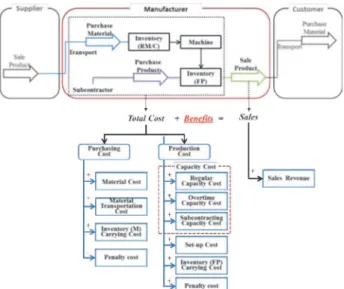
We have summarized the different costs present in the supply and demand process in Figure 5. We consider without loss of generalization that the buyer (customer) pays for the transportation of the goods (considering other solutions do not set into question the consistence of the framework). So, a supply chain member buys com-ponents/materials from his suppliers, pays the material cost and transportation cost and stores the components into material (components) inventories before releasing production orders. As a consequence, purchasing costs include here the costs of the materials, of the transporta-tion and of the inventories of raw materials/components (see Figure 5). If the supplier’s delivery is delayed, a penalty cost may be charged on this supplier, which de-creases the purchasing cost of the customer.
Considering the items that have to be negotiated (see section 4), it is important to include issues related to lot sizes and resource capacity in the cost model. Therefore, we have decided to describe the internal production costs then include the cost linked to the capacity of the used work center (using regular or extra-hours) or linked to sub-contracting, as well as set-up costs and finished product inventory carrying costs (see Figure 5). Penalty costs for delayed delivery (shortage) towards the cus-tomer may also be included, due by the manufacturer. Each supply chain member, either supplier or customer, has the same total cost structure: purchasing costs and production costs, plus benefit, is equal to the sales reve-nue.
Figure 5. Suggested structure of total cost Using this structure of total cost, we can identify for each negotiable item the related elemental costs, which define the conditions of negotiation.
A negotiation on the period of forecast on customer’s side is usually triggered by a request for an increased firm period sent by his supplier. In that case, the customer takes the risk to store parts delivered by the supplier, being unsure to really need them. As a consequence, there is a corresponding extra carrying cost, depending on the confirmation of his own customer’s demand. On supplier’s side, a request from the customer asking to decrease the firm period is usually received, with as a possible result, the necessity to order raw materials on the base of the flexible period of the forecasts, resulting in increased carrying costs if the expected demand is not confirmed. The related elementary costs are listed in Table 1.
Extra Cost Related elementary costs Inventory cost Inventory carrying cost
Penalty cost Purchasing cost
Table 1. Elements for cost calculation in period of forecast negotiation
During the negotiation of the load variation, the variables taken into account for extra cost assessment are different for the customer and the supplier, since load variation leads to problems of capacity at supplier’s side whereas they are linked with inventory levels at customer’s side. We have summarized the related costs in Table 2, distinguishing the customer side from supplier side.
Customer Side Supplier Side
Extra Cost Extra Cost
Cost of Inventory Variation Cost for Capacity Variation Related Variable Related Variable
Inventory carrying cost Penalty cost
Purchasing price
Regular capacity cost Overtime capacity cost Subcontracting capacity cost Sales price
Table 2. Elements for cost calculation in load variation negotiation Customer Side Supplier Side
Extra Cost Extra Cost
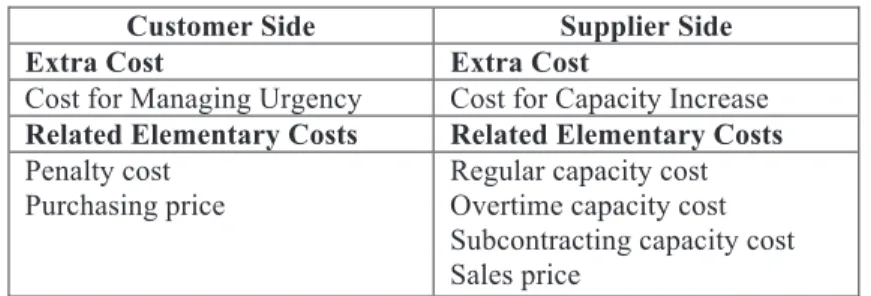
Cost for Managing Urgency Cost for Capacity Increase Related Elementary Costs Related Elementary Costs Penalty cost
Purchasing price
Regular capacity cost Overtime capacity cost Subcontracting capacity cost Sales price
Table 3. Elements for cost calculation in price and cycle time negotiation Customer Side Supplier Side
Extra Cost Extra Cost
Cost for Increased Lot sizes Cost for Decreased lot sizes Related Elementary Costs Related Elementary Costs Inventory carrying cost
Penalty cost Material cost
Material transportation cost Purchasing cost
Inventory carrying cost Set-up cost
Material transportation cost Penalty cost
Sales Price
Table 4. Elements for cost calculation in order priorities and lot sizes negotiation Concerning urgent orders negotiation, at the supplier’s
side, the extra costs are mainly concerning the possible increase of capacity required by the processing of the urgent orders, and eventually a cost for re-planning. At the customer’s side, the changes on the required delivery time depend on the slack time kept by the customer. There are two possibilities for assessing extra costs: i) the due date is mandatory, and an agreement has to be found on the price, ii) the due date can be negotiated, resulting in a lower increase of the price. Detailed costs are listed in Table 3.
In the negotiation of order priority and lot size, at the supplier’s side, a so-called “optimal” manufacturing lot size is still often defined, depending on the set-up costs and inventory carrying cost (see for instance Wilson’s formula (Camisullis and Giard, 2008)). At the customer’s side, the purchasing lot size of the components depends on the delivery cost and inventory carrying cost. Indeed, deliveries in large quantities may be less expensive, but this is seldom the case in the aeronautic industry, quantities being relatively low and unitary prices, and consequently carrying costs, high. The elements allowing to calculate extra costs are listed in Table 4, showing considerations in lot sizes extra cost assessment, transport cost, back order cost and purchasing/sale price.
The listed costs allow us to have a global view of the extra costs due to the suggested negotiation items. It is obvious that if customer and supplier reach a mutual agreement on the balance of these extra costs and the extra payment of compensation, the suggested negotiation processes become realistic. Therefore, the assessment of the extra costs, allowing cost/benefit and risk sharing between partners, is also considered as one of the main requirements for making this negotiation possible.
Another constraint of our proposals is that such negotiations directly require the emphasis of collaborative relationships, mainly related with trust, maturity, power, dependency and goodwill, which are important factors for negotiation (Ming et al., 2012). We will focus on these in the next section.
5.2. Collaborative relationship assessment
The suggested negotiation processes aim at helping to increase the performance of relationship by turning hid-den problems into negotiation items, which may lead to a better supply chain collaboration. Nevertheless, it is clear that making these processes realistic requires an inten-sive exchange of information, including data usually considered as confidential, like internal lead time, capac-ity or costs. Opportunistic behaviors, exaggerated
con-straints publishing, false information sharing, etc. are inevitably barriers towards our proposal. We try in next section to go give some basic ideas on the collaborative relationships that are in our opinion consistent with the negotiation framework we have suggested.
5.2.1. Customer’s side
In the customer’s point of view, if the customer distrusts or feels indifference towards his supplier, a strict execu-tion of the contract is certainly the common way to per-form cooperation in the supply chain. In our proposals, except for price, cycle time and lot sizes, the other sug-gested items are usually fixed in contract. However, ne-gotiation on these items needs a high level of trust. Even for urgent orders management, a complex issue which is often outside the terms of the contract, good perfor-mance of negotiation on price and cycle time requires a long-term and better managed relationship, in which trust is a prerequisite. Thereby, we think that these nego-tiations all require a trustful collaborative relationship. As mentioned, the four suggested negotiation items are based on hidden constraints seen in real practices. How-ever, it is clear that dominated members have insufficient power to publish their constraints towards their custom-er. Thereby, when the customers have a high power over the suppliers, the customer should be ready to launch the negotiation process as soon as he expects problems at his supplier's, in order to avoid hidden problems.
5.2.2. Supplier’s side
If the supplier distrusts or feels indifference towards his customer, the contract will be the base of the coopera-tion, whereas a strict execution of the contract is in our opinion a barrier against a better collaboration and nego-tiation on the occurring problems. Therefore, we also limit our suggested negotiation processes to the collabo-rative relationships with high level of trust.
Negotiation launched by the supplier is always aiming at publishing operational problems. As a consequence, when the changes/conflicts on the supplier’s side have critical impacts on the customer, in another term when the customer is dependent towards the supplier, we also suggest that the supplier should launch the negotiation process aiming at publishing real problems and then minimizing the following impacts through sharing risks/costs.
As a brief synthesis, trustful collaborative relationships are the primary conditions for our suggested negotiation process. Depending on the allocation of power and de-pendency, customers are suggested to launch the nego-tiations in order to avoid potential problems, while sup-pliers are encouraged to publish their real constraints.
6. CONCLUSION
The basic ideas contained in our proposal come from cases studies in the aeronautic industry. On the base of a comparison between expected behaviors and real ones in real supply chains, we have suggested to include unexpected practices, expressing in our opinion real problems, in negotiation processes. The context of these negotiation processes has been defined in details on four subjects: periods of forecast, load variation, price and cycle time, and order priority and lot sizes. These items are not a closed list of what can be negotiable but aim at providing examples of the fact that, paradoxically, taking into account the partner’s constraints may in some cases finally lead to a win-win situation.
We have briefly presented the basic guidelines of a cost structure, which would be the basis of the negotiations. This cost structure is developed in (Ming, 2011) and examples of negotiation based on it are provided. The conclusions of the first tests are that, as expected, a win-win situation may be the result of negotiation in some cases, under conditions which analysis is in progress. In order to automate the negotiation process in a realistic way, our perspectives are now to model the negotiation itself by game theory, more and more often considered for modeling customer/supplier relations in Supply Chains.
REFERENCES
Affonso, R.S., 2008. Proposition d’un cadre de
modélisation pour la coordination d’entreprise dans la chaîne logistique. Doctoral dissertation. Institut
National Polytechnique de Toulouse, France. BPMN, 2011. Documents Associated with Business
Process Model and Notation (BPMN) Version 2.0, http://www.bpmn.org.
Camisullis, C. and V. Giard, 2008. A new need for safety stocks in a supply chain dedicated to customized mass production. Supply Chain Forum:
an international journal, 9, p. 88-96.
Chung, Y.-K., S.-H Cho and S.-C. Kim, 2005. Building co-operative supply chain in auto parts manufacturing industry. Proceedings of the Fifth
International Conference on Electronic Business,
Hong Kong, p. 921-924.
Daugherty, P. J., R. G. Richey, A. S. Roath, S. Min, H. Chen, A. D. Arndt and S. E. Genchev, 2006. Is collaboration paying off for firms? Business
Horizons, 49, p. 61-70.
Hallikas, J., K. Puumalainen, T. Vesterinen and V.-M. Virolainen, 2005. Risk-based classification of
supplier relationship. Journal of Purchasing and
Management, 11, p. 72-82.
Holland, C. P., 1995. Cooperative supply chain management: the impact of interorganisational information systems. Journal of Strategic Information Systems, 4 (2), pp. 117-133.
Kalwani, M. U. and N. Narayandas, 1995. Long-term manufacturer-supplier relationships: do they pay off for supplier firms? Journal of Marketing, 59 (1), p. 1-16.
Maloni, M. J. and W. C. Benton, 1997. Supply chain partnerships: opportunities for operations research.
European Journal of Operational Research, 101 (3),
p. 419-429.
Ming, Y., 2011. Models for customer-supplier
negotiation in a collaborative supply chain. Doctoral
dissertation. Institut National Polytechnique de Toulouse, France.
Ming, Y., B. Grabot and R. Houé, 2012. A taxonomy of the situations of cooperation in supply chains,
Com-puter and Industrial Engineering, submitted.
Nyaga, G.N., J. M. Whipple and D. F. Lynch, 2010. Examining supply chain relationship: Do buyer and supplier perspectives on collaborative relationship differ? Journal of Operations Management, 28, p. 101-114.