PERCEPTIONS LOCALES DE L'AMÉNAGEMENT fORESTIER DURABLE DANS TROIS RÉGIONS DE LA fORÊT BORÉALE
THÈSE PRÉSENTÉE
COMME EXIGENCE PARTIELLE
DU DOCTORAT EN SCIENCES DE L'ENVIRONNEMENT
PAR
KATI BERNINGER
LOCAL PERCEPTIONS ON SUSTAINABLE FOREST MANAGEMENT IN THREE BOREAL REGIONS
THESIS PRESENTED
IN PARTIAL FULFILLMENT OF THE REQUlREMENT FOR
THE DOCTORAL DEGREE IN ENVIRONMENTAL SCIENCES
BY
KATI BERNINGER
Service des bibliothèques
Avertissement
La diffusion de cette thèse se fait dans le respect des droits dé son auteur, qui a signé le formulaire Autorisation de reproduire et de diffuser un travail de recherche de cycles
supérieurs (SDU-522 - Rév.ü1-2üü6). Cette autorisation stipule que «conformément à
l'article 11 du Règlement no 8 des études de cycles supérieurs, [l'auteur] concède à l'Université du Québec à Montréal une licence non exclusive d'utilisation et de publication de la totalité ou d'une partie importante de [son] travail de recherche pour des fins pédagogiques et non commerciales. Plus précisément, [l'auteur] autorise l'Université du Québec à Montréal à reproduire, diffuser, prêter, distribuer ou vendre des copies de [son] travail de recherche à des fins non commerciales sur quelque support que ce soit, y compris l'Internet. Cette licence et cette autorisation n'entraînent pas une renonciation de [la] part [de l'auteur] à [ses] droits moraux ni à [ses] droits de propriété intellectuelle. Sauf entente contraire, [l'auteur] conserve la liberté de diffuser et de commercialiser ou non ce travail dont [il] possède un exemplaire.»
1 most warmly thank my supervisor Daniel Kneeshaw for his continuous support in all phases of my work. He read and commented numerous versions of the text and although my topic was not within his main discipline, he al ways suggested good revisions and by asking questions made me better explain things. 1 thank my co supervisor Christian Messier for his ideas in setting up my work in the context of two of his Sustainable Forest Management Network projects, the TRIAD project and the Labrador model intégration project as well as for comments that improved the different parts of this work. The members of my Ph.D. committee Peter Duinker and Vic Adamowicz provided valuable comments. 1 especially wish to thank Vic Adamowicz for his invaluable help in setting up, analyzing and understanding the choice experiment for my research project. Without his support 1 would not have been able to carry out this part of the research.
1 owe a 10'1 to the over two hundred participants in my three research areas, who sacrificed their time to make this research project happen. Some of them came ta two meetings and helped me to set-up the meetings. Special thanks to the key resource persons in the three areas without whom 1 couldn't have collected my data: Timo Weckroth from the Regional Forestry Centre of Southeastem Finland; Caroline Lacasse and Nadyre Beaulieu from AbitibiBowater in Shawinigan Quebec; Neal Simon and Frank Phillips from the NL Department of Natural Resources; Valerie Courtois from the Innu Nation and Bryn Wood from the Labrador Metis Nation.
l thank the various persans who helped me in various ways to set up and finish this work: Andrew Fall for his help in scenario building and simulations with the SELES modeling tool, Leanne Elson for inviting me to stay at her house and for her continuous help in Labrador, Yves Claveau and Myriam Jourdain for translating the questionnaires into French, Julie Poulin for revision of French and other technical
support, Darren Jennings for his help with GIS data in Labrador, Mélanie Desrochers for her help with maps and Lana Ruddick for English proofing. l thank the students in the Laboratory of Dan Kneeshaw for commenting on my work and testing the presentation of simulation results before my field work, as weil as the more social aspect of working together: Marie-Christine Adam, Iulian Dragotescu, Carolina Aguilar, Annick St-Denis, Mario Larouche, Udayalaksmi Vepakoma, Marie St Arnaud, Louis-EtieIU1e Robert, Gerardo Reyes, Benoît G.-Berthiaume and Francis Manka.
l want to thank ail colleagues who reviewed and commented on my work in its different phases for their valuable comments: Rebecca Ford, Paula Horne, Richard Howarth, Bonita McFarlane, Anja Nygren, Risto Willamo and Kathryn Williams. Special thanks belong to Kaisa Raitio and Mikko Jokinen for providing support in developing the theoretical base for my thesis. The International Symposium of Society and Natural Resources (ISSRM), where l presented parts of my work in three consecutive years, provided an important forum for testing my ideas and getting to know research related to mine.
1 thank the Sustainable Forest Management Network as weil as the Finnish Helsingin Sanomat Fund and the FiIU1ish Cultural Foundation for funding this research.
l thank the Finnish community ln Montreal, especially the people at the FiIU1ish School and the Finnish Church for making me feel at home.
Finally, 1 want to thank my family and friends both in Finland and in Montreal for encouragement and for taking me out to do other things. Especially my husband Frank and my children Jonas and Saara who have been more than patient during this work.
LIST OF FIGURES xi xiii xv LIST OF TABLES RÉSUMÉ ABSTRACT xviii GENERAL INTRODUCTION 1
0.1 Study of local perceptions on forests and forestry 1
0.2 Sustainabte forest management and its acceptability 3
0.3 Hurnan-forest interactions 5
0.4 Held and assigned values 7
0.5 The concept "importance of commercial forestry" 7
0.6 Objectives, main research questions and organization of the thesis 8
0.7 Notes on the methods used 10
CHAPTERI
THE ROLE OF CULTURAL MODELS IN LOCAL PERCEPTIONS OF SFM - DIFFERENCES AND SIMILARITIES OF INTEREST GROUPS
FROM THREE BOREAL REGIONS 13
1.1 Résumé 14
1.2 Abstract 15
1.3 Introduction 16
1.4 Conceptual framework and predictions 18
1.5.1 Interest groups 21
1.5.2 The meetings and the participants 22
1.5.3 Ana1ysis 24
1.6 Results 26
1.6.1 Comparison between regions 26
1.6.2 Interest groups within and across regions 28
1.7 Discussion 30
1.8 Conclusions 33
CHAPTER II
FOREST VALUE ORIENTATIONS AND ATTITUDES TOWARDS FORESTRY OF INTEREST GROUPS IN THREE REGIONS
VARYING IN IMPORTANCE OF FORESTRy .42
2.1 Résumé 43
2.2 Abstract 44
2.3 Introduction 45
2.4 Methods 48
2.4.1 Study areas and interest groups .48
2.4.2 Meetings and participants .49
2.4.3 Data ana1ysis 52
2.5 Resu1ts 53
2.6 Discussion 54
CHAPTER
III
SFM PREFERENCES OF INTEREST GROUPS IN THREE REGIONS VARYING IN IMPORTANCE OF INDUSTRIAL FORESTRY:
AN ATTRIBUTE-BASED CHOICE EXPERlMENT. 67
3.1 Résumé 68
3.2 Abstract 69
3.3 Introduction 70
3.4 Methods 72
3.4.1 The choice experiment method 72
3.4.2 The survey instrument 73
3.4.3 The study areas and interest groups 74
3.4.4 The recruit.ment of participants and meetings 76
3.4.5 The participants 78
3.4.6 Data analysis 78
3.5 Results 79
3.5.1 Differences within regions 79
3.5.2 Comparison of groups across regions 80
3.5.3 Is the difference between groups greater than the difference across
regions? 82
3.6 Discussion 83
3.6.1 Preference differences within and across regions 83
3.6.2 Preferences possib1y reflecting indigenous and multiple use values ... 84 3.6.3 Tendencies to select or to avoid the status quo alternative 85
3.7 Conclusions 86
CHAPTERIV
EFFECTS OF PRESENTING FOREST SIMULATION RESULTS ON THE FOREST VALUES AND ATTITUDES OF FORESTR
y
PROFESSIONALS AND OTHER FOREST USERS IN CENTRAL
LABRADOR 97
4.1 Résumé 98
4.2 Abstract 99
4.3 Introduction 100
4.4 Theoretical framework and hypotheses 101
4.5 Methods 103
4.5.1 Study area, modelling and simulations 103
4.5.2 Recruitment, meetings and participants 105
4.5.3 Data analysis 107
4.6 Results 108
4.7 Discussion 109
4.7.1 Presentation of long-term effects 109
4.7.2 Quality and direction ofchange 110
4.7.3 Differences between groups 112
4.8 Conclusions , 113
CHAPTER V
EFFECTS OF SHOWING FOREST SIMULATION RESULTS ON
SFM PREFERENCES OF FOREST USERS IN CENTRAL LABRADOR ... 127
5.2 Abstract 129
5.3 Introduction 130
5.4 Methods : 132
5.4.1 Multiattribute approach for preference construction 132
5.4.2 Study area, modeling and simulations 133
5.4.3 Choice experiments and the survey instrument 134
5.4.4 Recruitment of participants and meetings 137
5.4.5 Description ofparticipants 138
5.5 Results 138
5.6 Discussion : 140
GENERAL CONCLUSIONS 149
6.1 The raie of cultural models in shaping perceptions 149
6.2 Regional differences 150
6.3 Effect of additional information 152
6.4 Groups 154
6.5 Management implications 156
APPENDIX A
DECISION OF THE ETHICAL COMMITTEE 158
A.1 Letter of approva1 of the ethical committee of the Faculty of
Sciences, UQAM 158
APPENDIX B
QUESTIONNAIRES USED IN THE STUDY 159
B.1 Questionnaire for Central Labrador before showing simulation results,
B.2 Questionnaire for Central Labrador after showing simulation results,
version 2 of the choice experiment, modified for the Innu 167 B.3 Choice set instructions for Central Labrador 179 BA Questionnaire for the Mauricie, version 1 of the choice experiment.. 183 B.5 The Mauricie, version 2 of the choice experiment 196 B.6 Questionnaire for Southeastern Finland, version 1 of the choice
ex periment 200
B.7 Southeastern Finland, version 2 of the choice experiment 208 B.8 Choice set instructions for Southeastern Finland 212 APPENDIX C
SIMULATION RESULTS THAT WERE PRESENTED TO THE
PARTICIPANTS IN CENTRAL LABRADOR )16
C.1 Copy of the PowerPoint presentation 216
Figure 0.1 The relationship between held and assigned values 12
Figure 0.2 The thesis is organized along two axes: measuring change in one
region vs. comparing several regions at a certain point of time and
measuring held values and attitudes vs. measuring preferences. The theory on cul tural models about forests links al! chapters together. 12
Figure 1.1 A conceptual model il!ustrating the cycle of interaction between
the forest, cultural models on forests and forest management.. 38
Figure 1.2 The study locations: The Mauricie region in Quebec, Central
Labrador and Southeastern Finland 39
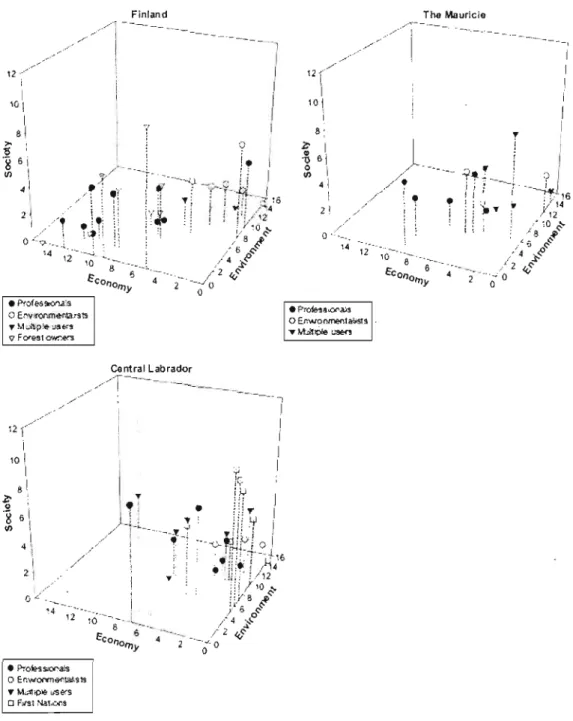
Figure 1.3 Individual answers from the three study areas placed in
three-dimensional space, where the dimensions represent the environmental,
economic and social components of sustainability 40
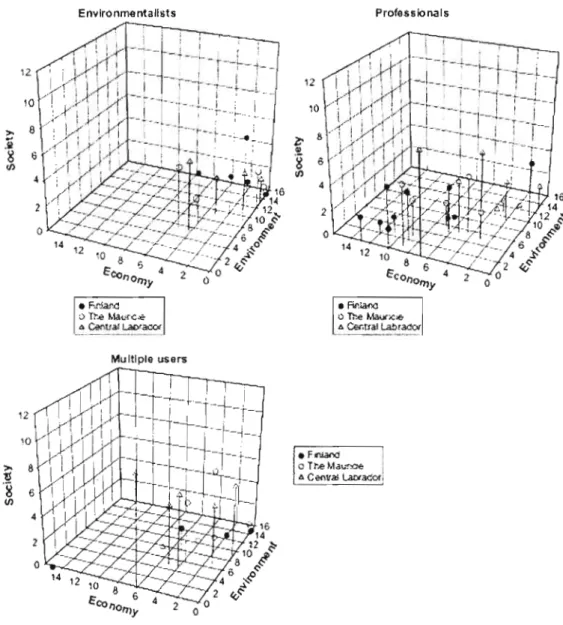
Figure 1.4 Individual answers of different interest groups placed in
three-dimensional space, where the dimensions represent the environmental,
economic and social components of sustainability .41
Figure 2.1 The study locations: The Mauricie region in Quebec, Central
Labrador and Southeastern Finland 62
Figure 2.2 Biocentric and anthropocentric forest value scores for each
cluster , 63
Figure 2.3 Percentage of participants belonging to an interest group
that were associated with biocentric, intermediate, and anthropocentric
clusters in the three regions 64
Figure 2.4 Biocentric and anthropocentric value scores for
environmentalists, multiple users and forestry professionals in the three
regions 65
Figure 2.5 Differences in biocentric and anthropocentric value scores
between extreme groups 66
Figure 3.1 The study locations: The Mauricie region in Quebec, Central
Figure 3.2 The marginal values (in CAD 100) of attribute change for
conservation, cut block size, wildlife and jobs by region and by group 95
Figure 3.3 Differences between extreme groups in altemative-specific
constant (ASC) parameter estimates across regions 96
Figure 4.1 The study area constitutes the forest management District 19A
in Central Labrador, Canada 121
Figure 4.2 Example of simulation results presented in the meetings:
Development of the area of a rare forest type over 100 years and over 120
years in the three main scenarios 122
Figure 4.3 An example of simulation results shown to the participants:
development of stand age under the no conservation and the 20 year
plan scenarios from year 20 to year 200 123
Figure 4.4 Self evaluation by forestry professionals and other forest users on
learning and opinion change following discussion of simulation results of
alternative management scenarios for district 19A 124
Figure 4.5 Mean value (a and b) and attitude scores (c and d) for four
statements measured before and after presenting forest simulation
results by anthropocentric value orientation 125
Figure 4.6 Mean change in answers to questions measuring forest
values and attitudes towards forest management for forestry
professionals and for other forest users 126
Figure 5.1 Description of the multiattribute process applied in this work. ... 147
Figure 5.2 An example of simulation results shown to the participants:
area logged under the no conservation and the 20 year plan scenarios from
Table 1.1 Basic information characterizing the three areas 34
Table 1.2 Number of participants and their age group distribution for each
interest group and region 35
Table 1.3 The main themes and sub-themes identified and examples of
indicators belonging to each theme
36
Table 1.4 Group opinions on the most important issues in sustainable
forestry in each interest group in Southeastern Finland , the Mauricie and
Central Labrador 37
Table 2.1 The number of participants, percentage of women and mean age
in each region and each group 59
Table 2.2 The varimax -rotated principal comp6nent loadings of the
questions used to measure biocentric and anthropocentric value orientations ....
60
Table 2.3 Spearman's nonparametric correlations are shown between the
biocentric and anthropocentric value scores and responses to questions on the effects of forestry and satisfaction with forest management
61
Table 3.1 Components of sustainable forest management (SFM), related
attributes and their levels in the three study regions 88
Table 3.2 An example of a choice set from the Central Labrador study area ... 89
Table 3.3 The number of participants, percentage of women and mean age
in each region and each group 90
Table 3.4 Parameter estimates (and standard errors) for models estimated
for each group and joint models estimated for ail participants in each region .... 91
Table 3.5 Results ofthe pairwise likelihood ratio test between groups in
each region 92
Table 3.6 Results of the pairwise likeIihood ratio test between the same
groups across regions 93
Table 4.1 An example of simulation results shown to the participants: the
built in each of the three main scenarios 115
Table 4.2 Questions used in the study and the ones included in the
anthropocentrie value score 116
Table 4.3 The number of participants, the number of men and women, mean
age and median income by group 118
Table 4.4 Classification of the answers of forestry professionals and other
Table 4.5 Classification of the answers of forestry professionals and other
Table 5.1 Sustainable forest management themes, related attributes and their
Table 5.4 Parameter estimates (and standard errors) for linear models
forest users to the question "What did you leam?" 119
forest users to the question "How did your opinions change?" 120
levels 143
Table 5.2 An example of a choice task 144
Table 5.3 Demographie characteristics of the participants 145
,Depuis les années 1990, l'étude de la perception du public sur les forêts et i'aménagement forestier fait l'objet d'un intérêt croissant qui se reflète par une attention accrue sur l'aménagement durable des forêts (ADF). Puisque que l'ADF vise à intégrer les diverses valeurs écologiques, économiques et sociales, l'acceptabilité sociale devient un préalable essentiel à sa réalisation. Afin d'évaluer l'acceptabilité sociale, il est important d'avoir des informations sur les perceptions locales et leur distribution entre les groupes.
Jusqu'à présent, il n'existe pas de théorie ou de modèle conceptuel qui explique les interactions entre la forêt, l'individu, incluant son milieu social et culturel, ainsi que la politique et l'aménagement forestier. Pour illustrer ces interactions, le concept de modèle culturel est introduit et utilisé pour créer un modèle conceptuel fournissant un cadre théorique permettant les comparaisons entre les régions. Ce modèle conceptuel facilite aussi le lien entre l'utilisation actuelle et historique des forêts et les perceptions. Le cadre théorique explique aussi la qualité non-statique des modèles culturels sur les forêts et décrit la façon dont ils sont changés ou renforcés par de nouvelles expériences forestières ou par le discours public. L'introduction d'informations additionnelles sur les forêts et leur aménagement devrait ainsi influencer les modèles culturels des gens et leurs perceptions des forêts.
Basée sur le cadre théorique décrit au-dessus, cette dissertation a conune but de mieux comprendre l'effet des conditions locales et de l'introduction de nouvelles informations sur les perceptions reliées à l' ADF. La question des conditions locales est approchée en étudiant les valeurs forestières, les attitudes par rapport à l'aménagement forestier et les préférences des groupes d'intérêt provenant de trois régions boréales concernant l'ADF. Les régions étudiées diffèrent dans leur utilisation actuelle et historique des forêts. L'effet de l'introduction de nouvelles informations est étudié en mesurant les valeurs forestières, les attitudes face à l'aménagement forestier et les préférences touchant l' ADF avant et après la présentation des résultats de simulations illustrant les effets probables des scénarios alternatifs à long terme et à grande échelle.
Les régions étudiées, le sud-est de la Finlande, le centre du Québec et le centre du Labrador, accordent, respectivement, une grande, moyenne et basse importance à la foresterie industrielle. L'importance de la foresterie industrielle est utilisée conune indice permettant de décrire le gradient de J'utilisation actuelle et historique dans les trois régions. Les participants à cette étude, 252 personnes au total, représentent des groupes environnementaux, des utilisateurs des produits forestiers non ligneux, des groupes autochtones, des propriétaires de forêts privées et des professionnels forestiers des trois régions étudiées.
Les résultats démontrent des variations dans la priorité accordée aux composantes environnementales et économiques menant à la durabilité ainsi qu'à quelques attributs de l'ADF en fonction de l'importance de la foresterie industrielle. Le résultat 'le plus intéressant montre que les différences entre les groupes s'accentuent pour plusieurs aspects lorsque l'importance de la foresterie industrielle augmente. Les tendances observées reflètent, entre autres, l'influence de l'utilisation actuelle et historique des forêts sur les perceptions face à l'aménagement durable des forêts. Des différences ainsi que des similarités ont été détectées entre les groupes d'intérêt entre les régions et au sein même des régions. Les différences les plus grandes entre les régions se trouveraient dans les perceptions des professionnels forestiers. Par contre, les environnementalistes ont des perceptions relativement similaires dans les trois régions. Les perceptions des groupes d'intérêt devraient être influencées par les conditions locales, incluant l'utilisation caractéristique de la forêt, ainsi que par des questions partagées par les groupes similaires des différentes régions, comme l'agenda global des environnementalistes, l'éducation technique des professionnels forestiers ou l'expérience des chasseurs dans la forêt.
Après avoir montré aux participants les résultats des simulations forestières
à
long telme et à grande échelle, nous observons aussi quelques changements significatifs au niveau des valeurs et des attitudes, mais aucun changement des préférences. Le changement le plus commun est la formation des opinions. Les participants ont aussi signalé qu'ils ont appris durant la présentation. Autant les professionnels forestiers que les autres utilisateurs des forêts ont fait des apprentissages, mais à des niveaux différents. Cette observation reflète des différences qualitatives entre les connaissances techniques et les connaissances locales. Le fait qu'il n'y a pas de changements significatifs des préférences peut être expliqué par le contexte de balancement des divers attributs sous-jacent aux expériences de choix. Il est aussi possible que les préférences soient plus stables que les valeurs et les attitudes.Quelques groupes d'intérêt étudiés ont signalé qu'ils préfèrent le changement de régime forestier. Des perceptions conflictuelles entre groupes ont aussi été détectées spécialement dans la région de grande importance de la foresterie industrielle, le sud est de la Finlande. Des opinions conflictuelles peuvent possiblement être réconciliées par l'utilisation d'approches innovatrices comme le commerce des valeurs de conservation ou l'approche de zonage TRiADE.
La présentation des résultats de simulations illustrant les effets des scénarios alternatifs à long terme et
à
grande échelle est une manière efficace pom améliorer la compréhension entre les professionnels forestiers et les autres utilisateurs des forêts. La communication répétée des résultats de simulations et l'opportunité de les commenter et de discuter durant le processus de modélisation améliore la qualité des modèles développés ainsi que la profondeur de la compréhension des participants.Mots-clés: Aménagement forestier durable, aspects sociaux de la foresterie,
interactions nature - honune, modèles culturels, attitude, valeur, préférence, comparaison régional, mesure de changement, changement de préférence, simulations forestiers
Public perceptions on forests and forestry form the subject of an increasing amount of research since the 1990's due to the emerging focus on Sustainable Forest Management (SFM). SFM ai ms at integrating various ecological, economic and social values and thus its essential prerequisite is social acceptability. In order to evaluate social acceptability, information on local perceptions and their distribution across groups is needed.
So far, there has not been a theory or conceptual model that would explain the relationship between the forest, the individual with hislher social and cultural setting, and forest policy and management. In order to describe this relationship, the concept of cultural models is introduced and used to create a conceptual model that provides a theoretical framework for regional comparisons and connects the CUITent and historical forest use with perceptions. This theoretical framework also explains how cultural models about forests are not static, but are either changed or reinforced by new forest experiences or public discourse. Thus the provision of new information on forests or their management is expected to affect people's cultural models and their perceptions about forests.
Based on this theoretical framework, this dissertation aims at better understanding the effect of local conditions and additional information on perceptions related to SFM. The question of local conditions is approached by studying forest values, attitudes towards forest management and sustainable forest management preferences of interest groups in three boreal regions varying in their CUITent and historical forest use. The effect of additional information is studied by measuring forest values, attitudes towards forest management and SFM preferences before and after showing forest simulation results that demonstrate long-term effects of various forest management alternatives in a large area.
The study areas are Southeastern Finland, Central Quebec and Central Labrador which are used as examples of high, intermediate and low importance of commercial forestry in the region. The importance of commercial forestry is used as an index to describethe gradient in the historical and CUITent forest use in the three study areas. The participants in this study, ail together 252 persons, were local and regional forest users representing environmental groups, multiple users of the forest, indigenous groups, forest owners and forestry professionals from the three regions.
The results show sorne gradients in weighting of environmental and economic components of sustainability and sorne attributes of SFM along a gradient of importance of commercial forestry. The clearest result was found in relation to inter group differences which grew in many aspects with increasing importance of commercial forestry. These detected trends are interpreted to ref1ect, among other
factors, the influence of CUITent and historical forest use ln shaping perceptions
related to sustainable forest management.
Both differences and similarities among interest groups across and within regions were detected. Biggest differences across regions were detected in the perceptions of fOl"estry professionals while the environmentalists were rather similar in their perceptions in ail three regions. It is interpreted that the perceptions of interest groups are influenced by both the local setting with its forest conditions and characteristic forest use and issues shared by similar groups across regions like the global agenda of environmental groups, similar technical education of forestry professionals or partially similar forest experience of hunters.
The results also show sorne statistically significant change in held values and attitudes, but not in preferences, upon showing long-term forest simulation results on a large area. Opinion forming was the most common change and participants themselves also reported having leamed from the presentation. Both forestry professionals and other forest users learned, but their learning was at different levels. While forest users gained more confidence in the CUITent forest management plan and were 1110tivated to further p31ticipate, professionals leamed more specific things. This reflects qualitative differences between technical knowledge and local ·knowledge. The lack of detected preference change may be explained by the trade-off setting inherent in choice experiments or greater stability of preferences in comparison to values and attitudes.
Sorne of the interest groups studied showed their preference for change over the current management regime. Conflicting views were also detected within regions especially in the region that was used as an example of high importance of commercial forestry, Southeastem Finland. Conflicting views could probably bc accommodated by introducing new innovative solutions like trading in natural values or the TRIAD zoning approach. Trading in natural values has been piloted in Finland. It means that private forest owners offer to maintain certain qualities of a forest area important for conservation for lOto 20 years and receive compensation for it.
Showing simulation results that demonstrate the long-term effects of various forest management alternatives in a large area was proven an effective way to enhance understanding both among forestry professionals and other forest users. Repeated communication of simulation results and an opportunity to discuss and comment on them during the modeling process would improve both the quality of models developed and the depth of understanding of participants during public participation processes.
Key words: Sustainable forest management, social aspects of forestry, human-nature interaction, cultural models, attitude, value, preference, regional comparison,
0.1 STUDY OF LOCAL PERCEPTIONS ON FORESTS AND FORESTRY
Perceptions 1 of the general public on forests and forestry have been studied in various nation-wide or provincial surveys both in North America and Northern Europe (Kangas and Niemelainen 1995; Hanninen and Karppinen, 1996; Robinson and Hawley 1997; Nadeau et al. 2007). While these studies provide valuable information for the development of general forest policies, many issues related to forests and forestry are tied to a certain fore st area and are dealt with at a more local level. As stated by Côté and Bouthillier (1999), regional, national or even international actors may become involved in these issues, but those with the strongest ties to the forest are local forest users. As l am interested in the dynamic relationships between the forest, the people and their forest use, l focus on local or regional actors that are using the forests or actively working for their protection.Local perceptions have been broadly studied in case studies revealing critical issues for improving local forest management or improving understanding of the mechanisms related to forest related values, attitudes or preferences (Pykalainen and Rantala, 1997; Mantymaa, 1998; BOIll1ell, 2000; Brown and Reed, 2000; Nadeau, 2002; Watson and McFarlane, 2004). For examp1e, the general public both in Western Newfoundland and the Haut-St.-Mauricie region in Quebec has been very critical towards CUITent forest management and whether it is sustainable (Bonneil, 2000; Nadeau, 2002). There is a great gap in knowledge since most previous work on perceptions of forests and forestry, like those cited above, concentrated on studying one region or country and did not study regional differences. In addition, differences in theoretical background and methodology do not facilitate comparison across
regions. An exception is a set of European studies that use spatial variations in forest cover across Europe or across regions in one country to explain differences in local forest atti tudes (Elands et aL, 2004; Selby et aL, 2007).
In addition to studies on the perceptions of the general public, information is needed on the distribution of perceptions across different interest groups or forest user groups (Home, 2008). Private forest owners, forestry professionals and forestry sector employees tend to have greater support for economic values in forestry than the general public (Tindal1, 2003; Home et al., 2004b; Kant and Lee, 2004). In contrast, users of non-timber forest products, like hunters and campers, have been found to support protection-oriented management strategies (McFarlane and Boxall, 2000a). As expected, members of environmental organizations have been shown to be more environmentally oriented and biocentric than the general public or other stakeholder groups (McFarlane and Boxall, 2000b; Leskinen et aL, 2004). Aboriginal groups represent an indigenous view that clearly differs from the Euro-American view (Pobihuschchy, 1986; Adamowicz et aL, 1998b; Adam and Kneeshaw, 2008). Comparison of aboriginal groups with others is difficult, since in general distinct methods and research approaches are used for studying these groups. In their study in Ontario, Kumar and Kant (2007), however, found that the aboriginal group had a .greater preference for spiritual and environmental values of the forest than most other groups. These are al1 case studies, however, and no research has so far been conducted on the differences and similarities of interest groups across regions.
0.2 SUSTAINABLE FOREST MANAGEMENT AND ITS ACCEPTABILITY
The notion of Sustainable Forest Management (SFM) has evolved historically from sustainable timber production to managing the forests for various ecological, economic and social values (Messier and Kneeshaw, 1999; McDonald and Lane, 2002; Wang, 2004). There is no single broadly accepted definition of SFM (Klenk et al. 2008), rather the concept and its application in forest management is continuously being debated. One way of conceptualizing SFM is to divide it into ecological, social and economic components; the three pillars of sustainability (Goodland, 1995; Adamowicz and Burton, 2003; Robinson, 2004). 1 use this conceptualization to elicit local perceptions of SFM.
While the economic component of sustainability has been strong in the tradition of managing the forest for maximum sustainable timber production, forest management has been criticized for not being based on sufficient ecological information. It has been suggested that especially information on ecological processes that occur at large spatial scales (over 100 000 ha) should be better understood and integrated into planning systems (Hunter, 1990; Levin, 2000; Turner et al., 2001). Having this in mind, forest managers and scientists are searching for new, sustainable management strategies that would simultaneously use ecological information on forest dynamics and be economically feasible (Messier et al., 20OJa; Groot et al., 2004).
In order to be successful, forest management strategies should also be socially acceptable (Clawson, 1975). Social acceptability is based on an individual's judgement process where they "(1) compare perceived reality with its known alternatives; and (2) decide whether the "real" condition is superior, or sufficiently similar, to the most favorable alternative condition ... " (Brunson, 1996, p.9). In this context the concept perception means a subjective judgement of something that is
more abstract rather than referring to the physical environment and recognlZlng objects, space and landscape like in environmental psychology (Kaplan and Kaplan 1982; Purcell 1987). We can refer to social acceptability as a perception that is shared by a politically relevant2 group of people (Shindler et al., 2002, pA). Social acceptability of forest management is thus based on shared perceptions related to forests and their management. In order to evaluate social acceptability, information on these perceptions and their distribution across groups is needed (Horne 2008).
As described above, different groups may have differing perceptions on SFM and the values for which forests should be managed. SFM planning therefore needs to consider the long-terrn effects of different scenarios on multiple attributes in a large area and at time-scales up to or exceeding several human generations. Modeling tools can be used to demonstrate these effects that exceed our first-hand perceptions (Daniels and Walker, 1996; Messier and Kneeshaw, 1999; Messier et al., 2003a; Sturtevant et al., 2007). The use of modeling tools helps forest managers to make better informed decisions and simulation results may also be used to facilitate discussion with local forest users (FaU et al., 2001; Sheppard and Meitner, 2005).
In
this work 1 test whether the local forest users' SFM perceptions change following demonstration of the effect of different management options on 10ng-term processes at a landscape scale.0.3 HUMAN-FOREST INTERACTIONS
People's perceptions on forests and their management are influenced by their interaction with both the socio-cultural and natural environments (Adamowicz et al. 1998b). Tuan (1974) explains how human beings perceive the physical world, structure it and create symbolic meanings. In studying the perceptions of a given group of people, it is essential to know their cultural history and experiences in the context of their physical setting (Tuan, 1974, p.59). Thus a place and its physical qualities, which may be shaped by human activities and interwoven with given meanings, become important. Recently, much work has been done on the sense of place and attachment to a particular place (for example Stedman, 2003a, b; Brown and Raymond, 2007).
People's relationships with the forest in a broader context of the forest in general, without making reference to particular places, have been studied in relation to forest and wilderness experience and forest landscape (Hallikainen, 1998; O'Brien 2005). Also the impact of social networks on people's relationship with the forest has been examined (Harshaw and Tindall, 2005). There is no theory or conceptual model, however, that would explain the relationship between the forest, the individual with
his/her
social and cultural setting, and forest policy and management. l introduce the concept of cultural models derived from psychological anthropology (Shore, 1996; Strauss and Quinn, 1997) in order to describe this relationship. The conceptual model presented in Chapter 1 provides a theoretical framework for regional comparisons and connecting current and historical forest use with perceptions.The conceptual model described in Chapter 1 is based on the idea of the interrelatedness between physical and social or cultural worlds: people's perceptions on the physical :world are shaped by social construction processes, whereas the physical qualities of the environment influence social phenomena (Freudenburg et al.
1995). The concept of culture has been defined in vanous, distinct ways and especial1y in anthropology its definition is subject to continuous debate. Milton (1996) describes how culture may be redefined in order to describe human interactions with the environment. According to Milton (1996, p.66) culture includes three dimensions: "First, culture exists in people's minds and is expressed through what they say and do. Second, culture consists of perceptions and interpretations ... through which people make sense of their experience. Third, culture is the mechanism through which human beings interact with their environments."
The theoretical framework based on cultural models also explains how cultural mode1s about forests are not static, but are either changed or reinforced by new fore st experiences or public discourse. This means that the provision of new information on forests or their management should have an effect on people's cultural models and their perceptions about forests. The effect of providing new or additional information has been studied by two clearly distinguishable research traditions. One is studying cognitive learning and the effects of persuasive messages (Petty and Cacioppo, 1986; Eagly and Chaiken, 1993), while the other concentrates on de1iberation and learning by hearing other peop1es' opinions (Arvai et al., 2001). The latter approach has its origin in political science (for example Fishkin, 1991; 1995) and has been recently applied by economists searching for methods to elicit more informed opinions in economic valuation (for example Howarth and Wilson, 2006; Shapansky et al., 2008). In relation to forest management, there are a few studies fol1owing each tradition (Bright and Manfredo, 1997; Tyrvainen et al., 2003; Seekamp, 2006), but none of them tests changes in perceptions fol1owing demonstration of the effect of different management options on long-term processes at a landscape scale.
0.4 HELD AND ASSIGNED VALUES
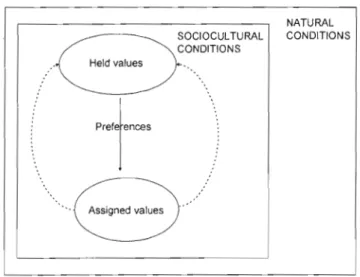
Perceptions are often described using the concepts of held values and attitudes or the concept of preferences. These concepts are based on distinct disciplines and theories. The cognitive hierarchy model from social psychology describes the concepts of held values, value orientations and attitudes (Rokeach, 1973, 1979; Fulton et al. 1996; Vaske and Donnel1y 1999) while the concept of preferences is related to assigned values and based on economic theory (Brown and Manfredo, 1987; Grafton et aL, 2004). Adamowicz et al. (l998b) theoretical1y describe the hypothesized relationship between held and assigned values in a resource use setting. Held values are described as influencing assigned values through preferences, which are defined as favoured options of forest management, for example (Figure 0.1). Assigned values related to forests describe the relative value of ecosystem services or different uses of the forest (Adamowicz et aL, 1998b). Socially shared assigned values may also influence held values which is demonstrated by the dashed arrows in Figure 1. Further work has empirical1y found a moderate connection between held forest values and attitudes and preferences for forest use or management alternatives (Brown and Reed, 2000; Horne et al., 2004a,b). In spite ofthese few exceptions, most researchers have studied either held values or assigned values and very little has been do ne to link these concepts.
0.5 THE CONCEPT "IMPORTANCE OF COMMERCIAL FORESTRY"
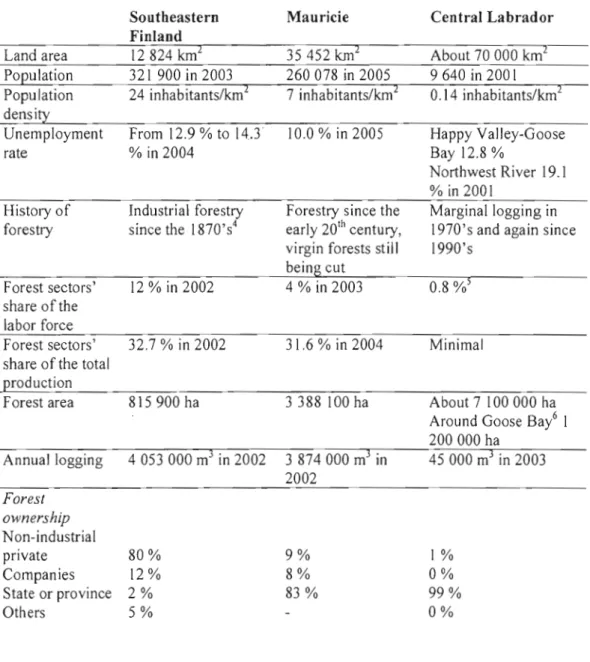
This work focuses on local perceptions in three boreal regions - Southeastem Finland, the Mauricie region in Quebec and Central Labrador, the latter two both in Canada. In the comparison of the three study regions, 1 use a new concept - the importance of commercial forestry - as an index to describe the gradient in historical and current forest use in the three study areas. One of the aspects involved is the intensity of forest management which can be defined as the extent of silvicultural
interventions to increase wood production. Park and Wilson (2007) classify forest management into four categories according to intensity: 1) Extensive management with minimal silvicultural intervention and long rotation times, 2) Basic management with sorne silvicutural intervention, rotation times may be reduced by planting or juvenile spacing, 3) Intensive management with silvicultural treatments that shorten the rotation time and increase wood volume and quality, and 4) Super-intensive management with plantations of fast growing trees like hybrid varieties. Of the three study areas one fa Ils clearly into the category of basic management (the Mauricie) and one into the category of intensive management (Southeastem Finland). In Central Labrador logging has been marginal (for example in 1997-2002 less than 0.1 % of the land area of District 19A was harvested), but where it's done it can be categorised as extensive or basic management. Other attributes used to describe the importance of commercial forestry as an index are the length of time that commercial forestry has been employed, the importance of the forest sector to local and regional employment and the economy as weil as the forest ownership structure (see Table 1.1 in Chapter 1).
0.6 OBJECTIVES, MAIN RESEARCH QUESTIONS AND ORGANIZATION OF THE THESIS
The long-term objective of the CUITent research is to better understand the effect of local conditions and additional information on perceptions related to Sustainable Forest Management (SFM). The short-term objectives are:
1) to compare forest related values, attitudes and preferences of different interest groups in three regions,
2) to study how different historical and CUITent forest use affects the forest related values, attitudes and preferences, and whether the importance of commercial forestry plays a role in regional differences in perceptions,
3) to study if people's forest related values, attitudes and preferences change when they are given information that illustrates long-time and large-scale processes
The main research questions are the following:
1) Is there a gradient in forest values, attitudes related to forest management and/or SFM preferences along a gradient of importance of commercial forestry?
2) Will values, attitudes and preferences change when long-term forest simulation results are shown for a large area?
The thesis is organized around two axis (Figure 0.2): the first axis proceeds from a comparison of regions at a fixed point in time to measuring change in one region, while the other axis moves from measuring held values and attitudes based on social psychological theory to measuring preferences which refiect assigned values based on economic theory (see introduction above). Chapter 1 develops theory on the connection of the historical and CUITent forest use and forest conditions and held forest values. The theory is based on cultural models on forests that are shared by groups of people with similar forest experiences. This theory is used as a basis for comparing value orientations and attitudes (Chapter 2) and preferences (Chapter 3) in the three research areas measured at one point in time. It also explains how cultural models change over time which links it to Chapters 4 and 5 measuring value and attitude change (Chapter 4) and preference change (Chapter 5) in one region, Central Labrador.
0.7 NOTES ON THE METHODS USED
This the sis is written in the form of a collection of articles published or submitted to scientific joumals. The methods used and the research setting are described separately in each chapter. Thus there is sorne repetition in the description of the methods, participants and research areas. The participants in Chapters 1-3 come from ail three research areas, while Chapters 4 and 5 focus on participants from Central Labrador only. There is also variation in the number of participants included in each Chapter. The data in Chapter 1 is based on a preliminary study and thus the sample was smaller (n=72) than in other Chapters studying regional differences (n=252). In Chapter 4 the sample was smaller than that of Central Labrador in Chapters 2 and 3 since not ail the participants filled in the second questionnaire. In Chapter 5 the Innu group was not included in the analysis since the initial choice experiment showed a strong preferenc,e for one attribute only (wildlife), while the parameter estimates for other attributes were not significant (Chapter 3). It was thus not feasible to measure change.
ln this work, 1 use a mixed methods approach. The mam methods used are quantitative and they are complemented with qualitative data on SFM indicators and self-evaluation about things learned as weil as the quality of opinion change (Creswell, 2005, pp.208-2IO). The qualitative data was used to develop attributes for the choice experiment, and provide a deeper understanding of the issues that were important for the participants as weil as their views of the presentation of modeling results. Part of the information gathered after presentation of modeling results was used in further refining the model (Sturtevant et al. 2007).
The participants were invited to take part in seminars. This was essential in order to complete the group work in the preliminary study reported in Chapter 1 and to present the simulation results in Central Labrador (Chapters 4 and 5). In order to
ensure comparability of results across regions, this approach was used in ail three reglOns.
An alternative approach could have been the use of semi-structured or deep interviews which would have allowed deeper qualitative understanding on the issue, describing why people perceive the forests and forestry the way they do (Creswell, 2005). This would have, however, required a long time per participant which would have affected the breath of the study. Conducting interviews in three (or four if innu aimun is included) languages would also have required interpretation during interviews and/or translation of transcribed interviews.
NATURAl SOCIOCUlTURAl CONDITIONS CONDITIONS Held values Prete ences Assigned values
Figure 0.1 The relationship between held and assigned values, modified from
Adamowicz et al. (l998b)
Values and attitudes
Chapter 2 Chapter 4
Values and Value and
attitudes altitude
across regions change
Across region S. Chapter 1 Chapter 1 One region.
at a certain Weightingof Theory on ch ange in time
point in time SFM cultural
components mode/s about
across regions forests
Chapter 3 Chapter 5
Preferences Preference
across regions change
Preferences
Figure 0.2 The thesis is organized along two axes: measuring change in one region
vs. comparing severa1 regions at a certain point of time and measuring he1d values and attitudes vs. measuring preferences. The theory on cultural models about forests links al1 chapters together.
THE ROLE OF CULTURAL MODELS IN LOCAL PERCEPTIONS OF SFM - DIFFERENCES AND SIMILARITIES OF INTEREST GROUPS
FROM THREE BOREAL REGIONS
Kati Beminger, Daniel Kneeshaw and Christian Messier
Article published in 2009 in
1.1 RÉSUMÉ
I"es différences de perception des groupes d'intérêt locaux et reglOnaux face à l'aménagement durable des forêts sont étudiées en fonction de régions présentant un gradient de l'historique de l'utilisation de la forêt. Le sud-est de la Finlande, le centre du Québec et le centre du Labrador accordent respectivement une grande, moyenne et faible importance à la foresterie industrielle. Nous présentons ici un modèle conceptuel qui illustre l'interaction cyclique entre la forêt, les modèles culturels sur les forêts et l'aménagement forestier. Notre hypothèse suppose que les perceptions des gens seraient influencées par leur modèle culturel et varieraient donc entre les régions ayant différentes histoires d'utilisation de la forêt ainsi qu'entre différents groupes d'intérêt. Des données sur l'ordre d'importance des composantes environnementales, sociales et économiques menant à la durabilité ainsi que des données sur les thèmes importants pour chaque groupe d'intérêt ont été collectées en demandant à chaque individu de créer une liste des indicateurs d'aménagement durable des forêts. Par la suite, un travail d'équipe a été réalisé pour obtenir un consensus sur une liste commune des indicateurs. Dans le sud-est de la Finlande, les opinions des différents groupes sont polarisées sur les axes environnement économie alors que dans le centre du Labrador, les opinions de tous les groupes accordent une plus grande importance à l'environnement. La dimension sociale (peu représentée) est faible pour tous les groupes sauf pour les Metis et les Innus du Labrador. Seuil' ordre d'importance accordé par les groupes environnementaux est similaire pour les trois régions étudiées. Les plus grandes différences se retrouvent parmi les professionnels forestiers au niveau du poids qu'ils accordent à l'importance des facteurs économiques et envirormementaux. Lorsque l'importance de la foresterie industrielle augmente, une plus grande importance des aspects économiques est exprimée, alors qu'une tendance contraire est observée pour les aspects environnementaux. De plus, les différences entre les groupes augmentent lorsque l'importance de la foresterie industrielle augmente. Nous considérons que l'aménagement forestier et l'utilisation des forêts sont des facteurs influençant fortement les modèles culturels sur les forêts.
Mots-clés: Approche de trois piliers, valeur forestier, modèle culturel, histoire d'utilisation de la forêt
1.2 ABSTRACT
Differences in the way local and regional interest groups perceive Sustainable Forest Management in regions with different forest use histories were studied using Southeastem Finland, the Mauricie in Quebec and Central Labrador in Canada as examples of regions with high, medium and low importance of commercial forestry. We present a conceptual model illustrating the cyclic interaction between the forest, cultural models about forests and forest management. We hypothesized that peoples' perceptions would be influenced by their cultural models about forests and would thus vary amongst regions with different forest use histories and among different interest groups. The weightings of the environmental, economic and social components of sustainability as weil as themes important for each of the interest groups were elicited using individuallisting of SFM indicators and group work aimed at developing a consensus opinion on a common indicator list. In Southeastern Finland the views of the different groups were polarized along the environment economy axis, whereas in Central Labrador ail groups were environmentally oriented. The social dimension was low overall except among the Metis and the lnnu in Labrador. Only environmental groups were similar in ail tlu'ee research regions, the largest differences between regions were found among the forestry professionals in their weightings conceming economy and nature. As the importance of commercial forestry increased, a greater importance of economic issues was expressed whereas the opposite trend was observed for issues regarding nature, Aiso inter-group differences grew as the importance of cornn1ercial fOl'estry increased in the region. Forest management and forest use can be seen as factors strongly influencing peoples' cultural modeIs on forests.
1.3 INTRODUCTION
The concept of Sustainable Forest Management (SFM) has been debated by scientists and forestry professionals during the last two decades (Messier and Kneeshaw, 1999; McDonald and Lane, 2002; Wang, 2004). Determining public and stakeholder forest values is considered an integral part of SFM and this knowledge is increasingly being used to guide forest management planning especially in publicly owned forests (Xu and Bengston, 1997; McFarlane and Boxall, 2000a,b;Watson and McFarlane, 2004). Local people have also been involved in the definition of Sustainable Forest Management criteria and indicators of SFM (CMFP, 2000). Despite this earlier work, the local definition of SFM is just begirming to take form and there is a need for innovative approaches to study how local people in different regions perceive SFM. Our study contributes to this end.
We use the three-pillar approach to sustainability (Goodland, 1995; Adamowicz and Burton, 2003; Robinson, 2004), where the concept of sustainable development is divided into ecological, social and economic components. In natural resource management, earlier studies related to the three-pillar approach used weightings by different stakeholder groups of the three components of sustainability in coastal
,.
management (Brown et al., 2001) and criteria for sustainable forestry (Sheppard and Meitner, 2005). These are ail case studies focused on one region. In contrast, we compare three geographical regions with great differences in the importance of commercial forestry. In Section 2 we present a conceptual model that describes the dynami.cs by which local natural and socio-cultural conditions together with forest use history influence peoples' perceptions on forests and forestry.
Specifie and contrasting perceptions about the forest and forestry have been associated with various interest groups (McFarlane and Boxall, 2000a,b; Tindall, 2003; Horne et al., 2004b; Kant and Lee, 2004). Forest owners and forestry sector
employees tend to have greater support for economic values in forestry than the general public (Tindall, 2003; Horne et al., 2004b; Kant and Lee, 2004).
In
contrast, users of non-timber forest products, like hunters and campers, have been shown to support protection-oriented management strategies (McFarlane and Boxall, 2000a). Members of environmental organizations have, logically, been found to be more environrnentally oriented and biocentric than the general public or other stakeholder groups (McFarlane and Boxall, 2000b; Leskinen et al., 2004). Although differences between interest groups have been consistently identified in local studies, it is unclear whether such trends exist across regions. We predict that forest subcultures of interest groups are partially shared across regions so that in spite of regional differences the same interest groups, such as forestry professionals or environmentalists, should have similar views in ail regions.Our study will provide additional insights into the ways local communities define sustainability and weighs the three components of sustainability in forest use and management in three regions. We used a combination of different methods including individual listing of SFM indicators and group work aimed at developing a consensus opinion on a common indicator list to elicit themes and weightings of the three components of sustainability. The comparisons in this paper are structured on the differences between the three regions, each having a different history of forest management and use. Within each region we also studied the differences between the perceptions of interest groups. Thus this is a stratified study with the main focus on regional comparison.
1.4 CONCEPTUAL FRAMEWORK AND PREDICTIONS
Many previous studies state that forest management and other forest uses reflect peoples' values (Xu and Bengston, 1997; McFarlane and Boxall, 2000a,b). We believe that this re1ationship between values and forest use functions in two ways. Forest use history affects our forest values through the experiences we have in the forest and the cultural models that reflect life experiences shared by a group of people.
Human perception of the environment 1S influenced by how the expenence 1S
modeled by a particular socio-cu1tura1 environment (Shore, 1996, p. 4). The theory of cultural models describes the existence of prepackaged forms of knowledge that coordinate groups of people (Shore, 1996, p. 10). Culture is here understood as not on1y a private or a public property, but as a combination of the two (Shore, 1996, p. 36). The theory of cultural models is related to the psychologists' theory of schemas which can be described as mental structures by which we interpret the world or organize information (Strauss and Quinn, 1997, p. 16, 49). Cultural models are schemas that are socially shared and learned through explicit teaching or observation (Strauss and Quinn, 1997, p. 7, 16). Cultural models are not uniform, but may vary between indi viduals and groups (Shore, 1996, p. 312). Sorne persistent cultural models are transmitted from one generation to the next either unintentionally or deliberately (Strauss and Quinn, 1997, pp.111-112). This creates the historical durability of cultural models. Different sub-cultural groups may have different typical experiences, their cognitive networks may develop in a different way and thus their interpretation of a certain object or event may differ (Strauss and Quinn, 1997, p. 89).
Using the theoretical basis on the creation and transmission of cultural models explained above, we created a conceptual model to illustrate the cycle of interaction between the forest, cultural models about forests and forest management (Figure 1.1).
A certain group of people has a shared understanding (cultural models) about how forests can and should be managed or used. The models are based on both local natural and sociocultural conditions as weil as the relationship each individual has with the forest, and thus they are a result of an interaction of public and individual factors. For example, public attitudes toward forest management are related to both the individuals' economic dependence on forestry and the local socio-cultural conditions (Brunson et al., 1997). These cultural models modify and are modified by forest values and public discourse. The cultural models about forests together with other cultural models have an effect on fore st poliçy. The extent ofthis.effect depends on how widely shared the particular cultural models are in the society. Forest policy determines how forests are managed whereas cultural modelshave a direct effect on forest use in guiding the activities we do in the forest. Forest policy has an indirect effect on cultural models by modifying the forest itself and by influencing the public discourse on forests. The forest, modified by historieal and CUITent use, has an effect on our understanding of what the forest should be like. The forest that we have become accustomed to see and the activities we normally do in the fore st become familiar and natural. These perceptions of what is familiar and natural are then transmitted from one generation to another (Strauss and Quinn, 1997, p. 112). Certain attributes of the forest are associated with characteristic forest experiences (Stedman, 2003). New forest experiences or public discourse will either change or reinforce existing models (Strauss and Quinn, 1997, p. 89, 115). Cultural models about forests are thus created by an interaction between forest experiences, forest values and social interaction.
Based on this conceptual model, we formulated three research hypotheses:
1. Based on different social environments and forest experiences, cultural models about forests in our three study regions will be different. This will lead to differences between weightings of sustainability components and topics included in SFM across reglOns.
2. The same interest groups in different regions will have partially shared cultural models about forests in spite of regional differences in forest culture. This will lead to similarities in weightings of sustainability components and topics incIuded in SFM by the same interest groups across regions.
3. Different interest groups in the same region will have partially contrasting cultural models about forests as a result of subcultures created by partially different forest experiences, forest values and forest discourse. Thus the weightings of sustainability components and topics included in SFM will differ between groups in the same region. Even if the regions are different, the environrnental groups are predicted to be more environmentally oriented and forestry professionals more economically oriented than other groups in each region.
1.5 METHünS
We used a combination of quantitative and qualitative methods to cOllect data from the same individuals. Individuals' listings and rankings were collected using fonns before participants discussed the given task. After the individual work, a consensus opinion was developed during group discussions. Work done in groups incIude inter group interaction which makes it possible to gather information that would be difficult to reach in individual situations (Morgan, 1997, p.2). Groups have previously been used to study environrnental values and attitudes (Myers and McNaghten, 1998; Linnros and HaIlin, 2001), public participation in forestry (Smith and McDonough, 2001; Schusler et al., 2003) and weighting of criteria of sustainable forestry (Sheppard and Meitner, 2005).
1.5.1 Interest groups
The target public included those residents of the study areas that belonged to the selected interest groups. The purpose of this study was thus not to reach the silent majority, but rather to contact individuals actively involved in the use or protection of forests. Interest groups included those who have direct links to the management or the use of forests in each study area: (1) local or regional environmental groups; (2) multiple users of the fore st including local hunting, berry and mushroom picking or recreation groups; and (3) forestry professionals in each of the three study locations. The forestry professionals group included representatives of both govemment forest resource management and the forest industry. They were grouped together because earlier studies have shown that their views on forestry are similar (Leskinen et al., 2004).
We also inc1uded area-specific interest groups to reflect important stakeholders. In Finland, a non-industrial private forest owners group (later called only forest owners) was added because they are a key group in Finnish forestry (see Table 1.1 about the forest ownership structure). In the Labrador study area, the Innu Nation (about 13% of the population in Central Labrador) and the Labrador Metis Nation were included in the study because they strongly influence forestry decisions. In contrast with sorne earlier studies and other regions, these groups have been empowered and are equal partners in the decision making process regarding the development of forest management in the region. Although their views differ somewhat, they represent an indigenous view that c1ear1y differs from the Euro-American view (Pobihuschchy, 1986; Adamowicz et al., 1998). In the quantitative results the Innu and the Metis are together called First Nations, whereas in the qualitative results their views are presented separately.